Cambridge IGCSE English - Literature (BES) 0427 — 2024 May/June Paper 1 · Variant 0
0427/10/M/J/24 · 50 marks · ≈56 min
The question paper and its mark scheme, free to read here and free to download. This is Cambridge’s own paper, exactly as it was sat.
Question paper16 pages





Mark scheme
No mark scheme is in the library for this paper.
Paper as text
Question paper, page 1
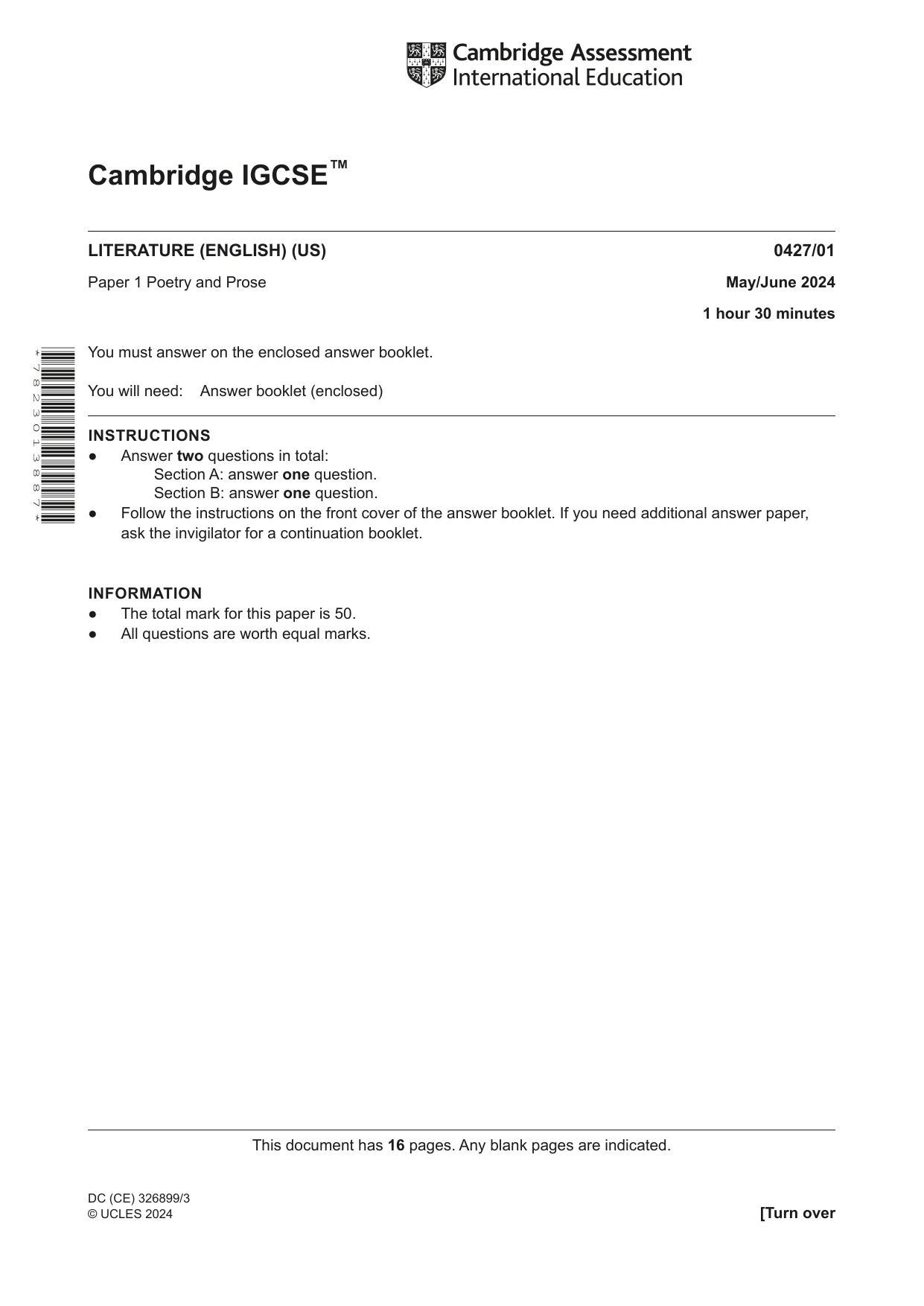
This document has 16 pages. Any blank pages are indicated. [Turn over Cambridge IGCSE™ DC (CE) 326899/3 © UCLES 2024 LITERATURE (ENGLISH) (US) 0427/01 Paper 1 Poetry and Prose May/June 2024 1 hour 30 minutes You must answer on the enclosed answer booklet. You will need: Answer booklet (enclosed) INSTRUCTIONS ● Answer two questions in total: Section A: answer one question. Section B: answer one question. ● Follow the instructions on the front cover of the answer booklet. If you need additional answer paper, ask the invigilator for a continuation booklet. INFORMATION ● The total mark for this paper is 50. ● All questions are worth equal marks. * 7 8 2 3 0 1 3 8 8 7 *
Question paper, page 2
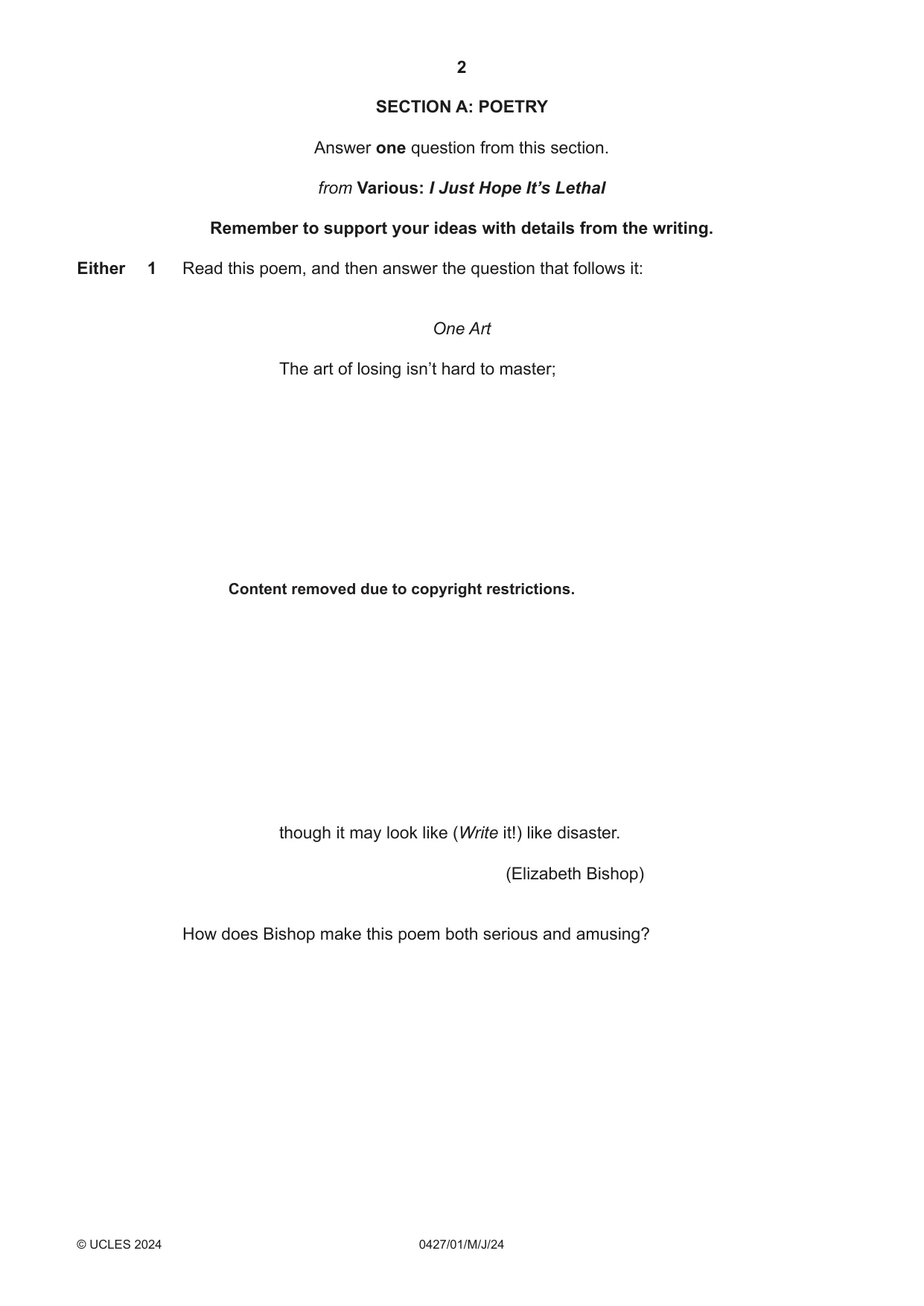
2 0427/01/M/J/24 © UCLES 2024 SECTION A: POETRY Answer one question from this section. from Various: I Just Hope It’s Lethal Remember to support your ideas with details from the writing. Either 1 Read this poem, and then answer the question that follows it: One Art The art of losing isn’t hard to master; though it may look like (Write it!) like disaster. (Elizabeth Bishop) How does Bishop make this poem both serious and amusing? Content removed due to copyright restrictions.
Question paper, page 3
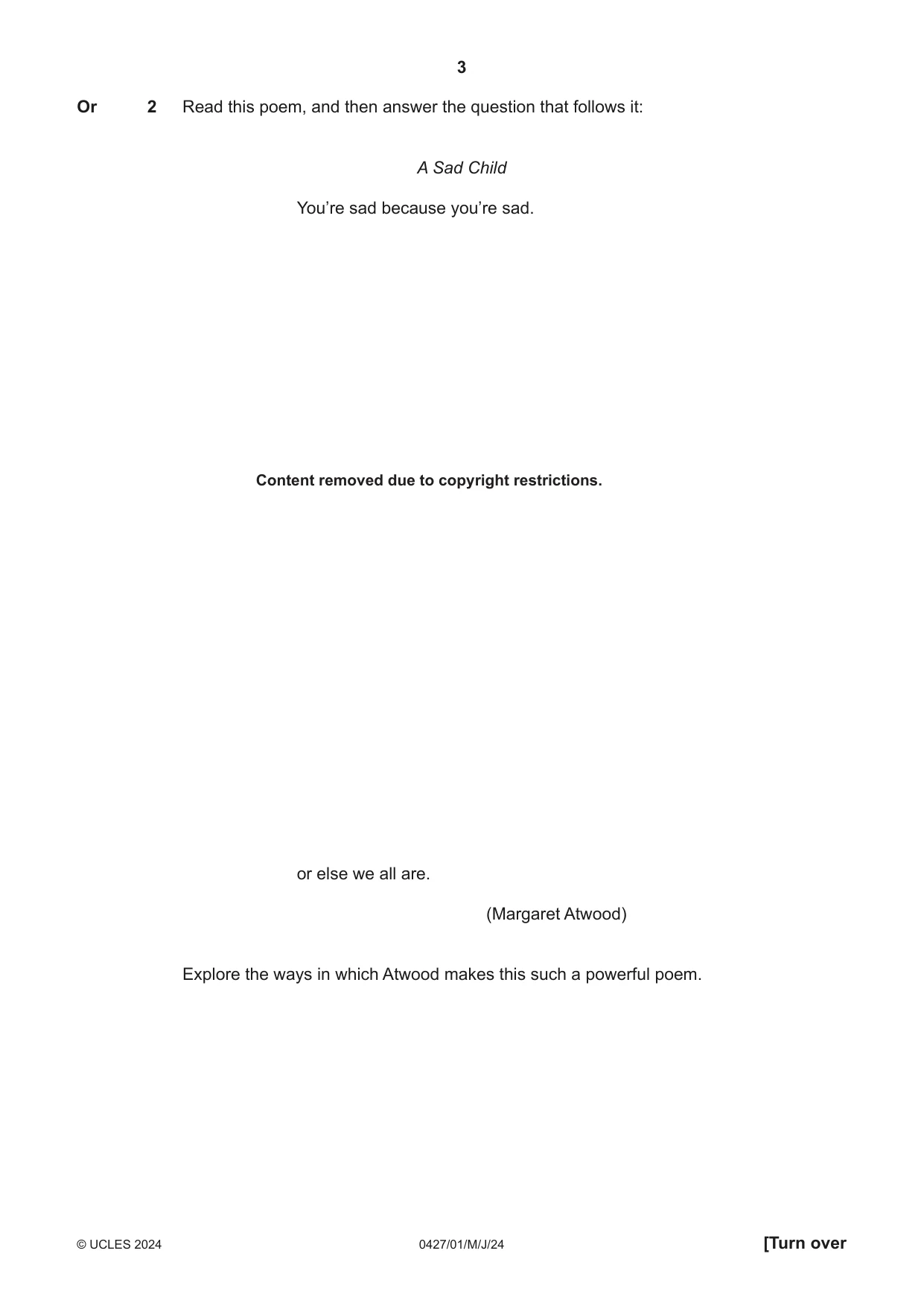
3 0427/01/M/J/24 © UCLES 2024 [Turn over Or 2 Read this poem, and then answer the question that follows it: A Sad Child You’re sad because you’re sad. or else we all are. (Margaret Atwood) Explore the ways in which Atwood makes this such a powerful poem. Content removed due to copyright restrictions.
Question paper, page 4
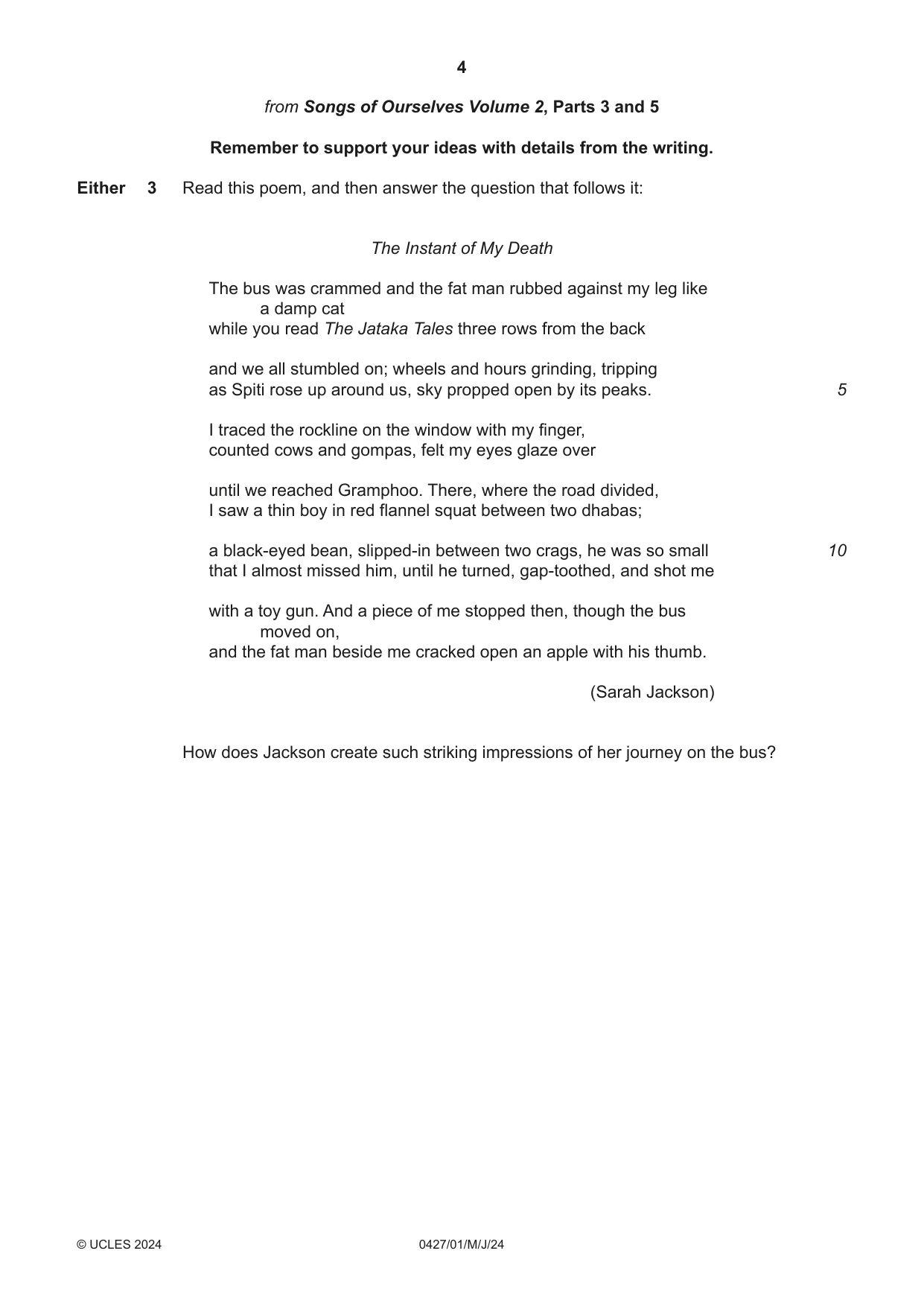
4 0427/01/M/J/24 © UCLES 2024 from Songs of Ourselves Volume 2, Parts 3 and 5 Remember to support your ideas with details from the writing. Either 3 Read this poem, and then answer the question that follows it: The Instant of My Death The bus was crammed and the fat man rubbed against my leg like a damp cat while you read The Jataka Tales three rows from the back and we all stumbled on; wheels and hours grinding, tripping as Spiti rose up around us, sky propped open by its peaks. 5 I traced the rockline on the window with my finger, counted cows and gompas, felt my eyes glaze over until we reached Gramphoo. There, where the road divided, I saw a thin boy in red flannel squat between two dhabas; a black-eyed bean, slipped-in between two crags, he was so small 10 that I almost missed him, until he turned, gap-toothed, and shot me with a toy gun. And a piece of me stopped then, though the bus moved on, and the fat man beside me cracked open an apple with his thumb. (Sarah Jackson) How does Jackson create such striking impressions of her journey on the bus?
Question paper, page 5
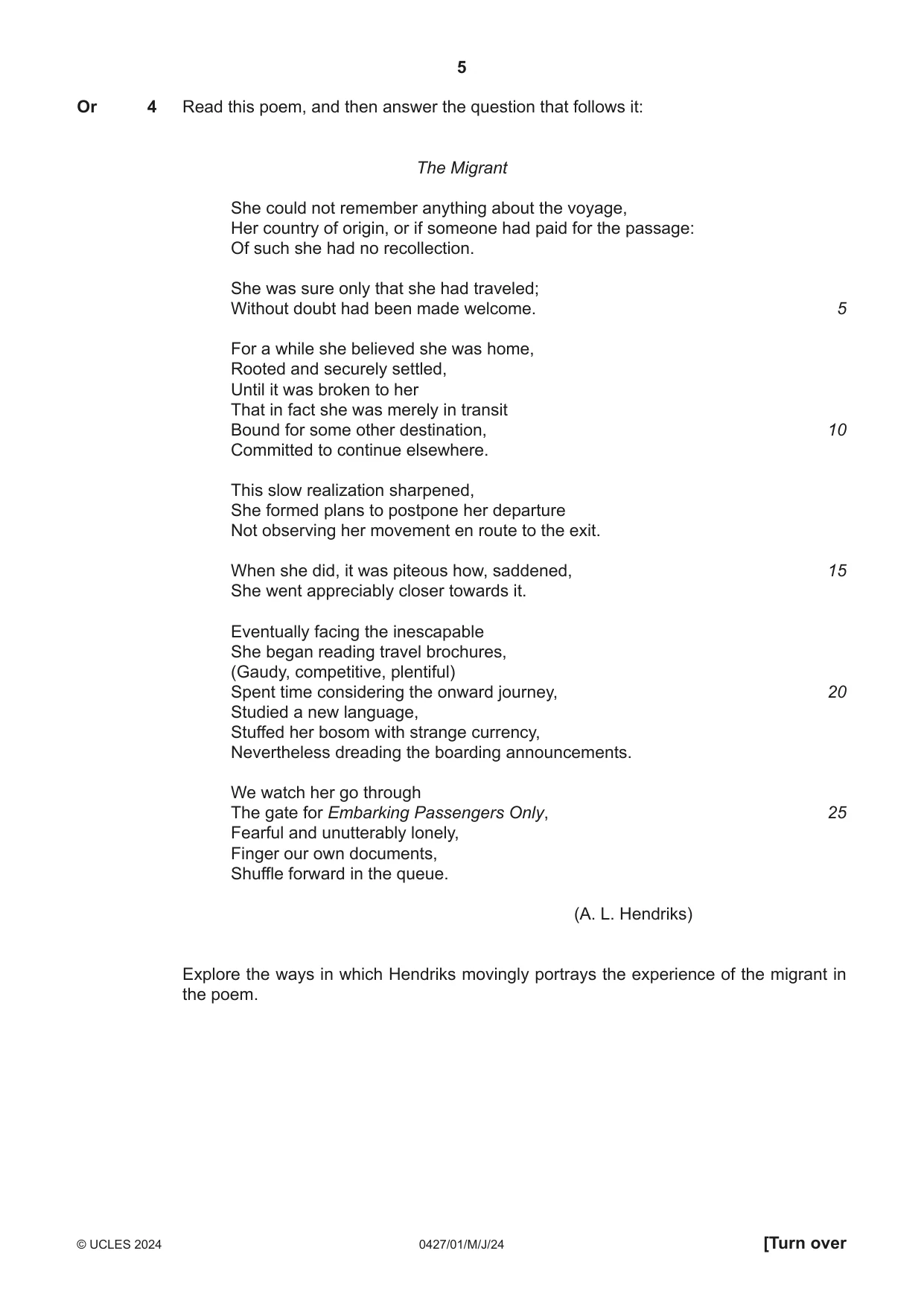
5 0427/01/M/J/24 © UCLES 2024 [Turn over Or 4 Read this poem, and then answer the question that follows it: The Migrant She could not remember anything about the voyage, Her country of origin, or if someone had paid for the passage: Of such she had no recollection. She was sure only that she had traveled; Without doubt had been made welcome. 5 For a while she believed she was home, Rooted and securely settled, Until it was broken to her That in fact she was merely in transit Bound for some other destination, 10 Committed to continue elsewhere. This slow realization sharpened, She formed plans to postpone her departure Not observing her movement en route to the exit. When she did, it was piteous how, saddened, 15 She went appreciably closer towards it. Eventually facing the inescapable She began reading travel brochures, (Gaudy, competitive, plentiful) Spent time considering the onward journey, 20 Studied a new language, Stuffed her bosom with strange currency, Nevertheless dreading the boarding announcements. We watch her go through The gate for Embarking Passengers Only, 25 Fearful and unutterably lonely, Finger our own documents, Shuffle forward in the queue. (A. L. Hendriks) Explore the ways in which Hendriks movingly portrays the experience of the migrant in the poem.
Question paper, page 6
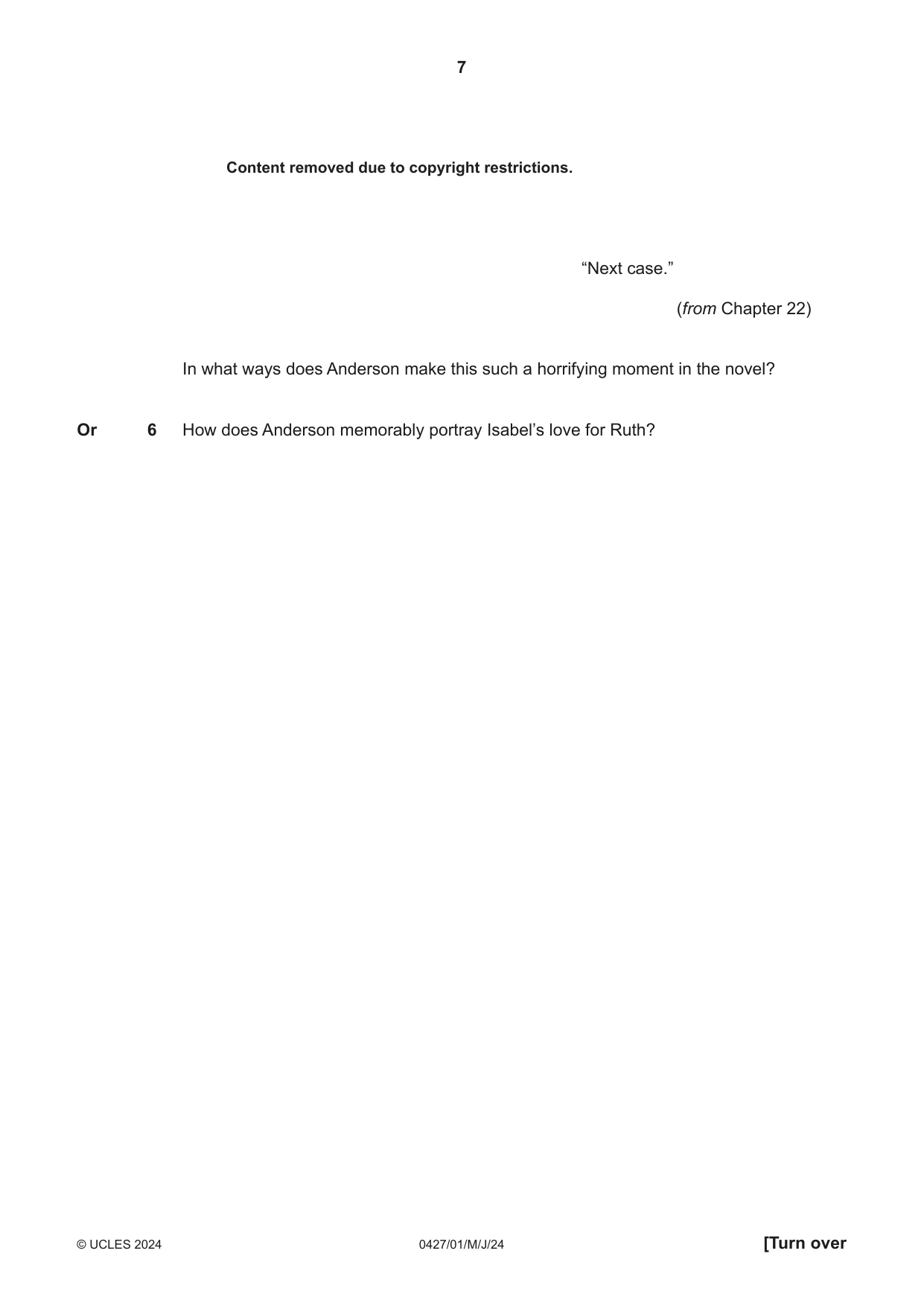
6 0427/01/M/J/24 © UCLES 2024 SECTION B: PROSE Answer one question from this section. LAURIE HALSE ANDERSON: Chains Remember to support your ideas with details from the writing. Either 5 Read this passage, and then answer the question that follows it: A tall man wearing black robes and a long wig sat at a table that was raised on a platform. Content removed due to copyright restrictions.
Question paper, page 7
7 0427/01/M/J/24 © UCLES 2024 [Turn over “Next case.” (from Chapter 22) In what ways does Anderson make this such a horrifying moment in the novel? Or 6 How does Anderson memorably portray Isabel’s love for Ruth? Content removed due to copyright restrictions.
Question paper, page 8
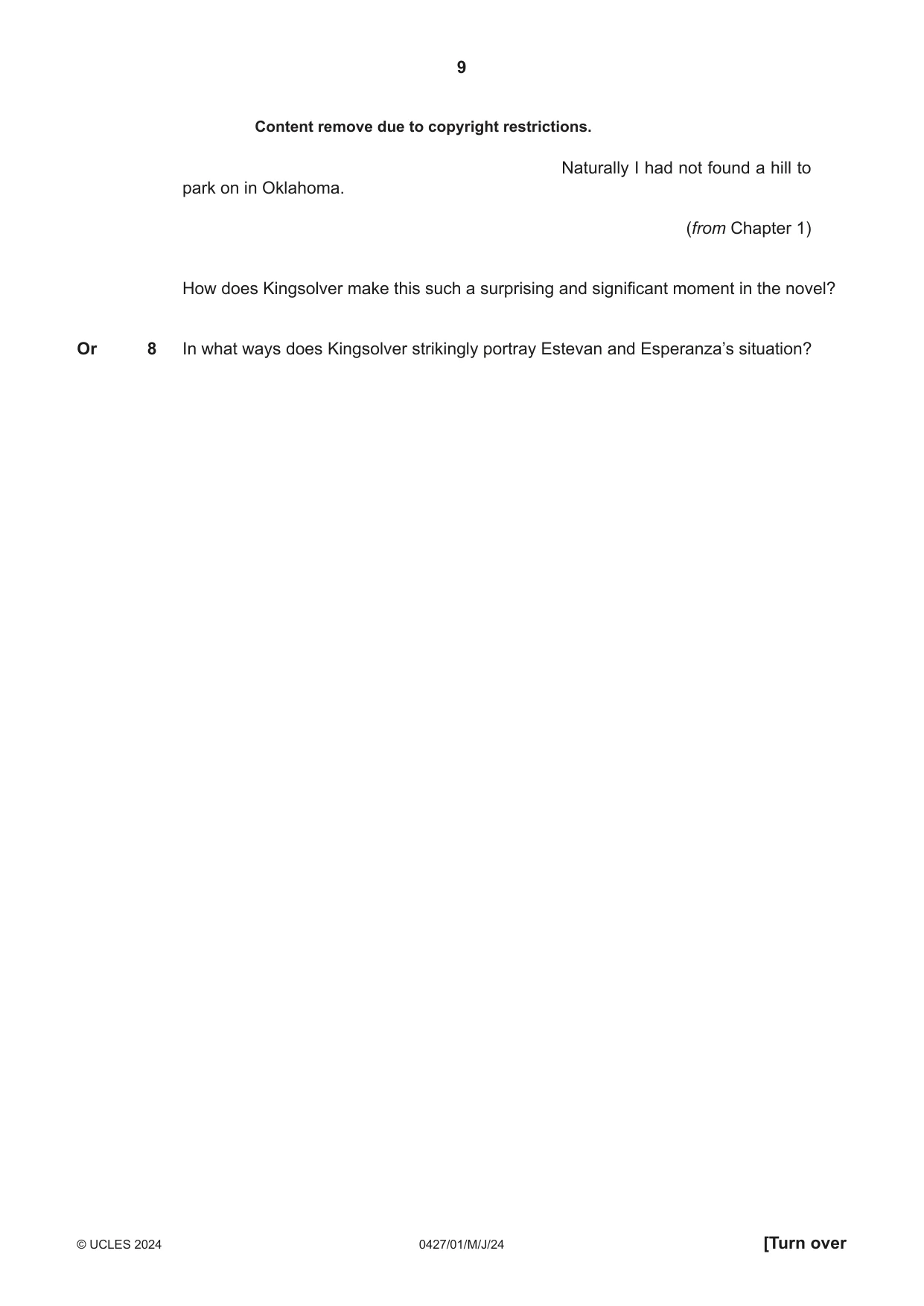
8 0427/01/M/J/24 © UCLES 2024 BARBARA KINGSOLVER: The Bean Trees Remember to support your ideas with details from the writing. Either 7 Read this passage, and then answer the question that follows it: Her body, her face, and her eyes were all round. Content removed due to copyright restrictions.
Question paper, page 9
9 0427/01/M/J/24 © UCLES 2024 [Turn over Naturally I had not found a hill to park on in Oklahoma. (from Chapter 1) How does Kingsolver make this such a surprising and significant moment in the novel? Or 8 In what ways does Kingsolver strikingly portray Estevan and Esperanza’s situation? Content remove due to copyright restrictions.
Question paper, page 10
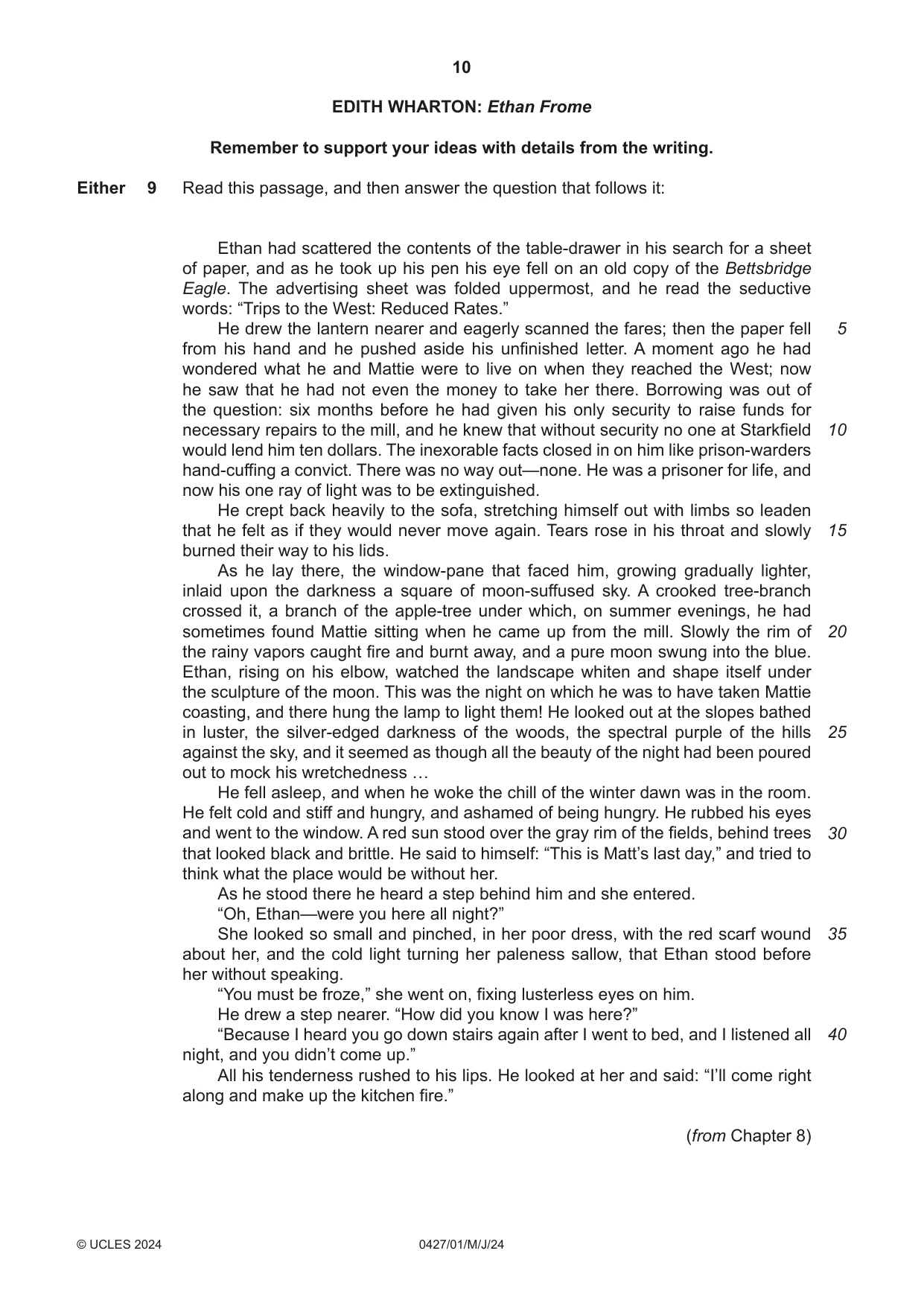
10 0427/01/M/J/24 © UCLES 2024 EDITH WHARTON: Ethan Frome Remember to support your ideas with details from the writing. Either 9 Read this passage, and then answer the question that follows it: Ethan had scattered the contents of the table-drawer in his search for a sheet of paper, and as he took up his pen his eye fell on an old copy of the Bettsbridge Eagle. The advertising sheet was folded uppermost, and he read the seductive words: “Trips to the West: Reduced Rates.” He drew the lantern nearer and eagerly scanned the fares; then the paper fell from his hand and he pushed aside his unfinished letter. A moment ago he had wondered what he and Mattie were to live on when they reached the West; now he saw that he had not even the money to take her there. Borrowing was out of the question: six months before he had given his only security to raise funds for necessary repairs to the mill, and he knew that without security no one at Starkfield would lend him ten dollars. The inexorable facts closed in on him like prison-warders hand-cuffing a convict. There was no way out—none. He was a prisoner for life, and now his one ray of light was to be extinguished. He crept back heavily to the sofa, stretching himself out with limbs so leaden that he felt as if they would never move again. Tears rose in his throat and slowly burned their way to his lids. As he lay there, the window-pane that faced him, growing gradually lighter, inlaid upon the darkness a square of moon-suffused sky. A crooked tree-branch crossed it, a branch of the apple-tree under which, on summer evenings, he had sometimes found Mattie sitting when he came up from the mill. Slowly the rim of the rainy vapors caught fire and burnt away, and a pure moon swung into the blue. Ethan, rising on his elbow, watched the landscape whiten and shape itself under the sculpture of the moon. This was the night on which he was to have taken Mattie coasting, and there hung the lamp to light them! He looked out at the slopes bathed in luster, the silver-edged darkness of the woods, the spectral purple of the hills against the sky, and it seemed as though all the beauty of the night had been poured out to mock his wretchedness … He fell asleep, and when he woke the chill of the winter dawn was in the room. He felt cold and stiff and hungry, and ashamed of being hungry. He rubbed his eyes and went to the window. A red sun stood over the gray rim of the fields, behind trees that looked black and brittle. He said to himself: “This is Matt’s last day,” and tried to think what the place would be without her. As he stood there he heard a step behind him and she entered. “Oh, Ethan—were you here all night?” She looked so small and pinched, in her poor dress, with the red scarf wound about her, and the cold light turning her paleness sallow, that Ethan stood before her without speaking. “You must be froze,” she went on, fixing lusterless eyes on him. He drew a step nearer. “How did you know I was here?” “Because I heard you go down stairs again after I went to bed, and I listened all night, and you didn’t come up.” All his tenderness rushed to his lips. He looked at her and said: “I’ll come right along and make up the kitchen fire.” (from Chapter 8) 5 10 15 20 25 30 35 40
Question paper, page 11
11 0427/01/M/J/24 © UCLES 2024 [Turn over How does Wharton make this such a sad moment in the novel? Or 10 Explore how Wharton creates such striking impressions of Zeena.
Question paper, page 12
12 0427/01/M/J/24 © UCLES 2024 COLM TÓIBÍN: Brooklyn Remember to support your ideas with details from the writing. Either 11 Read this passage, and then answer the question that follows it: Her mother was in the kitchen, washing up. Content removed due to copyright restrictions.
Question paper, page 13
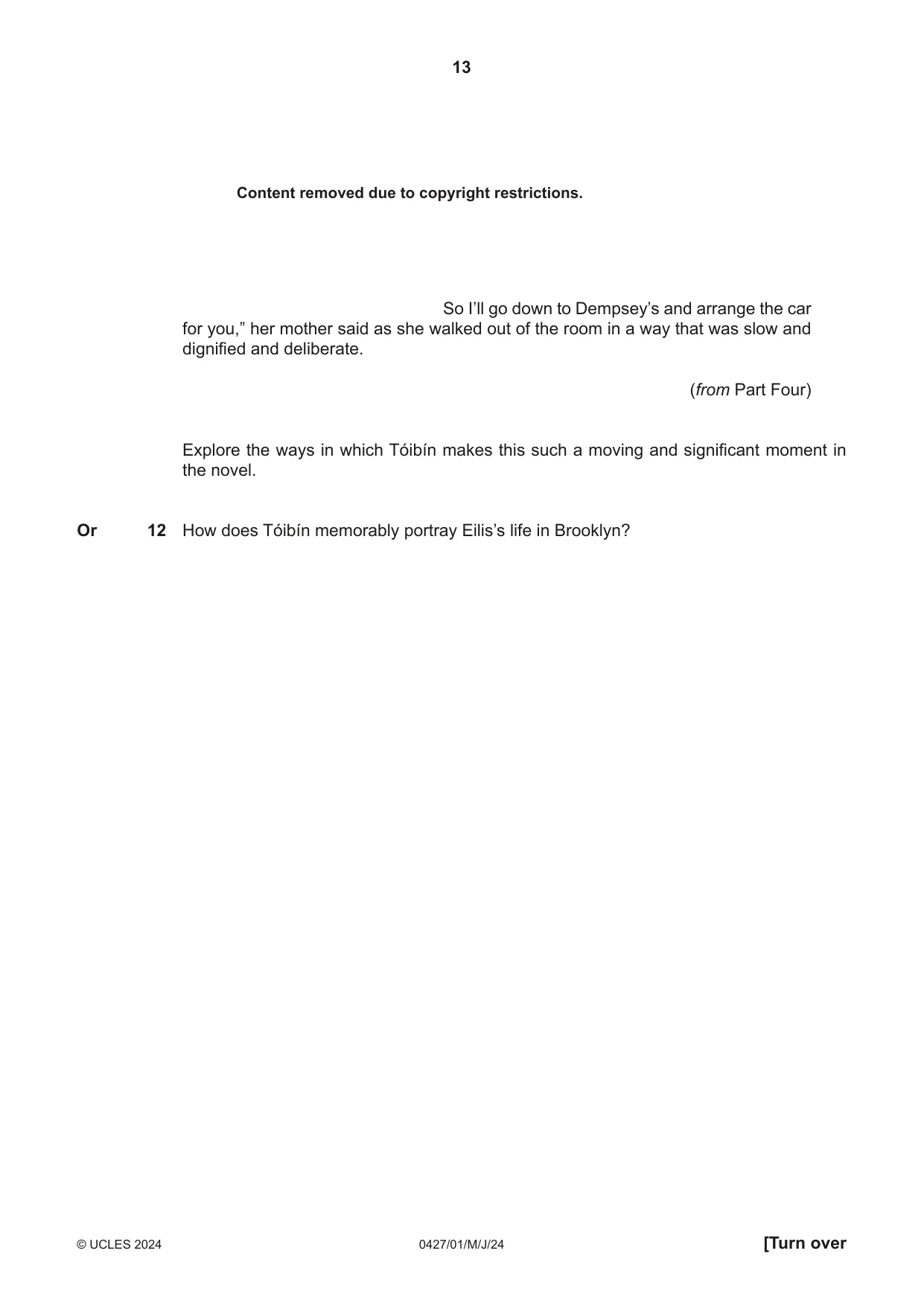
13 0427/01/M/J/24 © UCLES 2024 [Turn over So I’ll go down to Dempsey’s and arrange the car for you,” her mother said as she walked out of the room in a way that was slow and dignified and deliberate. (from Part Four) Explore the ways in which Tóibín makes this such a moving and significant moment in the novel. Or 12 How does Tóibín memorably portray Eilis’s life in Brooklyn? Content removed due to copyright restrictions.
Question paper, page 14
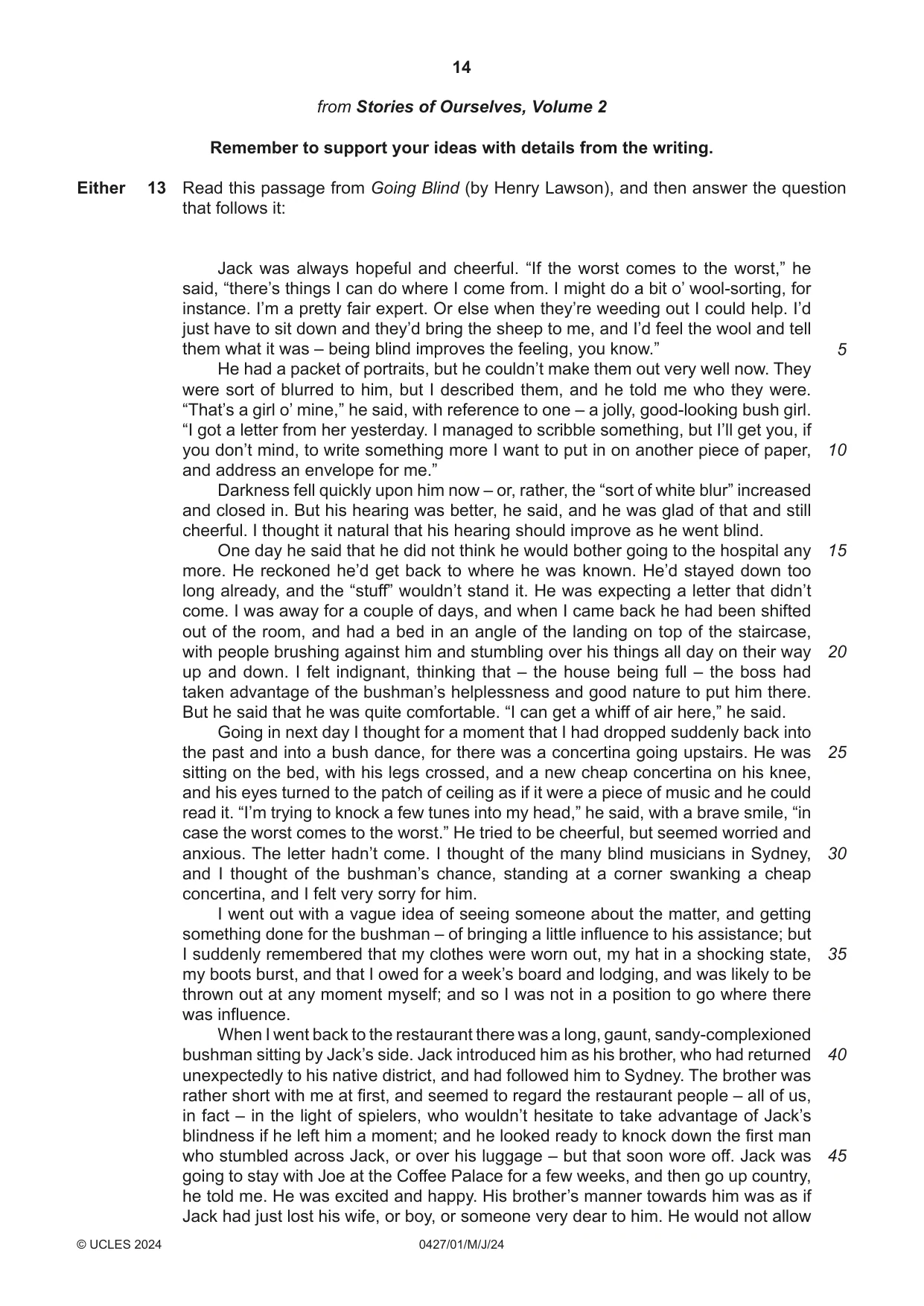
14 0427/01/M/J/24 © UCLES 2024 from Stories of Ourselves, Volume 2 Remember to support your ideas with details from the writing. Either 13 Read this passage from Going Blind (by Henry Lawson), and then answer the question that follows it: Jack was always hopeful and cheerful. “If the worst comes to the worst,” he said, “there’s things I can do where I come from. I might do a bit o’ wool-sorting, for instance. I’m a pretty fair expert. Or else when they’re weeding out I could help. I’d just have to sit down and they’d bring the sheep to me, and I’d feel the wool and tell them what it was – being blind improves the feeling, you know.” He had a packet of portraits, but he couldn’t make them out very well now. They were sort of blurred to him, but I described them, and he told me who they were. “That’s a girl o’ mine,” he said, with reference to one – a jolly, good-looking bush girl. “I got a letter from her yesterday. I managed to scribble something, but I’ll get you, if you don’t mind, to write something more I want to put in on another piece of paper, and address an envelope for me.” Darkness fell quickly upon him now – or, rather, the “sort of white blur” increased and closed in. But his hearing was better, he said, and he was glad of that and still cheerful. I thought it natural that his hearing should improve as he went blind. One day he said that he did not think he would bother going to the hospital any more. He reckoned he’d get back to where he was known. He’d stayed down too long already, and the “stuff” wouldn’t stand it. He was expecting a letter that didn’t come. I was away for a couple of days, and when I came back he had been shifted out of the room, and had a bed in an angle of the landing on top of the staircase, with people brushing against him and stumbling over his things all day on their way up and down. I felt indignant, thinking that – the house being full – the boss had taken advantage of the bushman’s helplessness and good nature to put him there. But he said that he was quite comfortable. “I can get a whiff of air here,” he said. Going in next day I thought for a moment that I had dropped suddenly back into the past and into a bush dance, for there was a concertina going upstairs. He was sitting on the bed, with his legs crossed, and a new cheap concertina on his knee, and his eyes turned to the patch of ceiling as if it were a piece of music and he could read it. “I’m trying to knock a few tunes into my head,” he said, with a brave smile, “in case the worst comes to the worst.” He tried to be cheerful, but seemed worried and anxious. The letter hadn’t come. I thought of the many blind musicians in Sydney, and I thought of the bushman’s chance, standing at a corner swanking a cheap concertina, and I felt very sorry for him. I went out with a vague idea of seeing someone about the matter, and getting something done for the bushman – of bringing a little influence to his assistance; but I suddenly remembered that my clothes were worn out, my hat in a shocking state, my boots burst, and that I owed for a week’s board and lodging, and was likely to be thrown out at any moment myself; and so I was not in a position to go where there was influence. When I went back to the restaurant there was a long, gaunt, sandy-complexioned bushman sitting by Jack’s side. Jack introduced him as his brother, who had returned unexpectedly to his native district, and had followed him to Sydney. The brother was rather short with me at first, and seemed to regard the restaurant people – all of us, in fact – in the light of spielers, who wouldn’t hesitate to take advantage of Jack’s blindness if he left him a moment; and he looked ready to knock down the first man who stumbled across Jack, or over his luggage – but that soon wore off. Jack was going to stay with Joe at the Coffee Palace for a few weeks, and then go up country, he told me. He was excited and happy. His brother’s manner towards him was as if Jack had just lost his wife, or boy, or someone very dear to him. He would not allow 5 10 15 20 25 30 35 40 45
Question paper, page 15
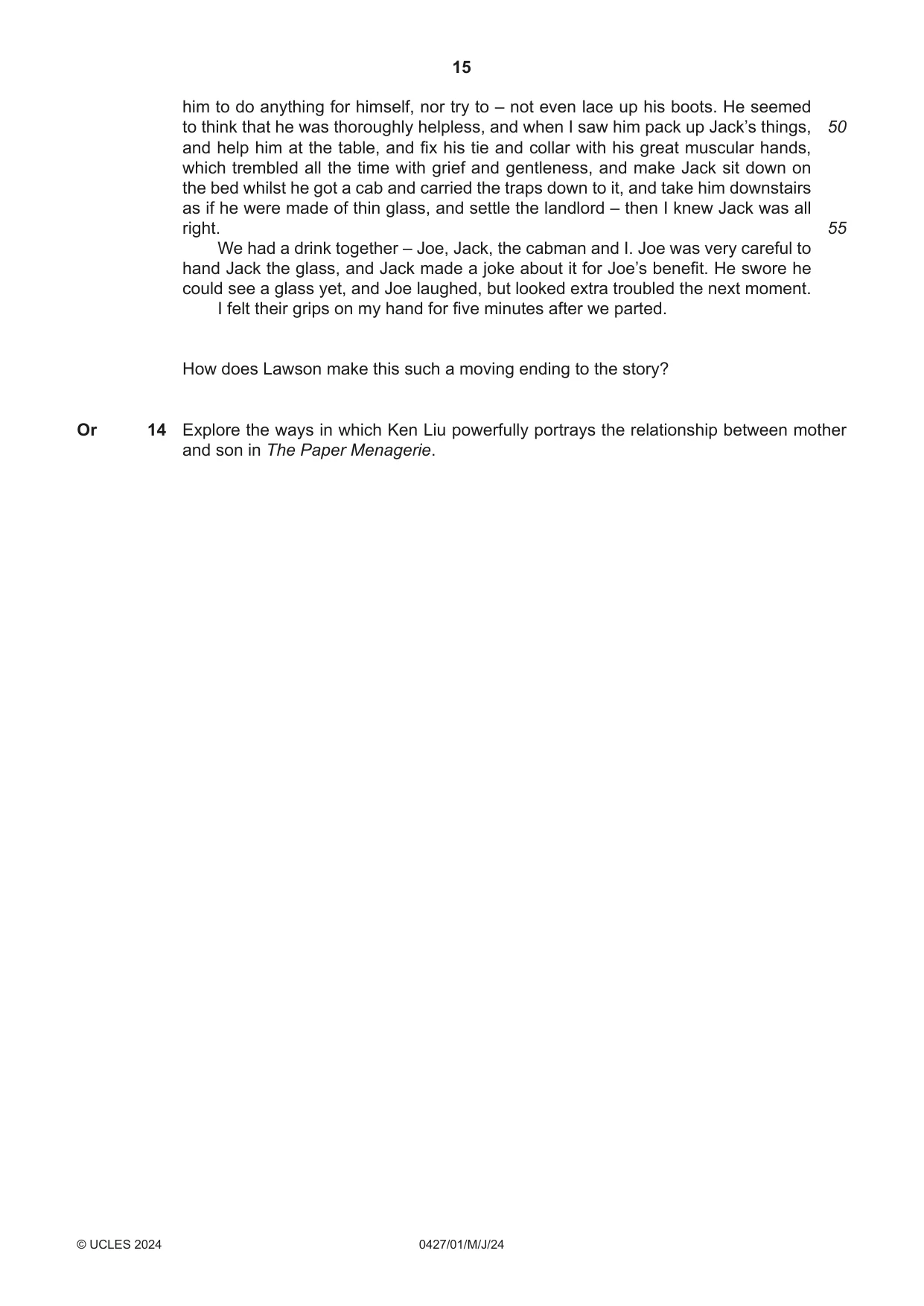
15 0427/01/M/J/24 © UCLES 2024 him to do anything for himself, nor try to – not even lace up his boots. He seemed to think that he was thoroughly helpless, and when I saw him pack up Jack’s things, and help him at the table, and fix his tie and collar with his great muscular hands, which trembled all the time with grief and gentleness, and make Jack sit down on the bed whilst he got a cab and carried the traps down to it, and take him downstairs as if he were made of thin glass, and settle the landlord – then I knew Jack was all right. We had a drink together – Joe, Jack, the cabman and I. Joe was very careful to hand Jack the glass, and Jack made a joke about it for Joe’s benefit. He swore he could see a glass yet, and Joe laughed, but looked extra troubled the next moment. I felt their grips on my hand for five minutes after we parted. How does Lawson make this such a moving ending to the story? Or 14 Explore the ways in which Ken Liu powerfully portrays the relationship between mother and son in The Paper Menagerie. 50 55
Question paper, page 16
16 0427/01/M/J/24 © UCLES 2024 Permission to reproduce items where third-party owned material protected by copyright is included has been sought and cleared where possible. Every reasonable effort has been made by the publisher (UCLES) to trace copyright holders, but if any items requiring clearance have unwittingly been included, the publisher will be pleased to make amends at the earliest possible opportunity. To avoid the issue of disclosure of answer-related information to candidates, all copyright acknowledgements are reproduced online in the Cambridge Assessment International Education Copyright Acknowledgements Booklet. This is produced for each series of examinations and is freely available to download at www.cambridgeinternational.org after the live examination series. Cambridge Assessment International Education is part of Cambridge Assessment. Cambridge Assessment is the brand name of the University of Cambridge Local Examinations Syndicate (UCLES), which is a department of the University of Cambridge. BLANK PAGE
What you needed in this session
Cambridge’s own grade thresholds for 2024 May/June, Paper 1 · Variant 0. A higher threshold means an easier paper — the bar moves with how the cohort did.