Cambridge IGCSE English - Literature (BES) 0427 — 2023 May/June Paper 1 · Variant 0
0427/10/M/J/23 · 50 marks · ≈56 min
The question paper and its mark scheme, free to read here and free to download. This is Cambridge’s own paper, exactly as it was sat.
Question paper16 pages






Mark scheme
No mark scheme is in the library for this paper.
Paper as text
Question paper, page 1
This document has 16 pages. Any blank pages are indicated. [Turn over Cambridge IGCSE™ * 8 2 7 3 8 7 0 0 3 7 * DC (RCL (DF)) 313297/3 © UCLES 2023 LITERATURE (ENGLISH) (US) 0427/01 Paper 1 Poetry and Prose May/June 2023 1 hour 30 minutes You must answer on the enclosed answer booklet. You will need: Answer booklet (enclosed) INSTRUCTIONS ● Answer two questions in total: Section A: answer one question. Section B: answer one question. ● Follow the instructions on the front cover of the answer booklet. If you need additional answer paper, ask the invigilator for a continuation booklet. INFORMATION ● The total mark for this paper is 50. ● All questions are worth equal marks.
Question paper, page 2
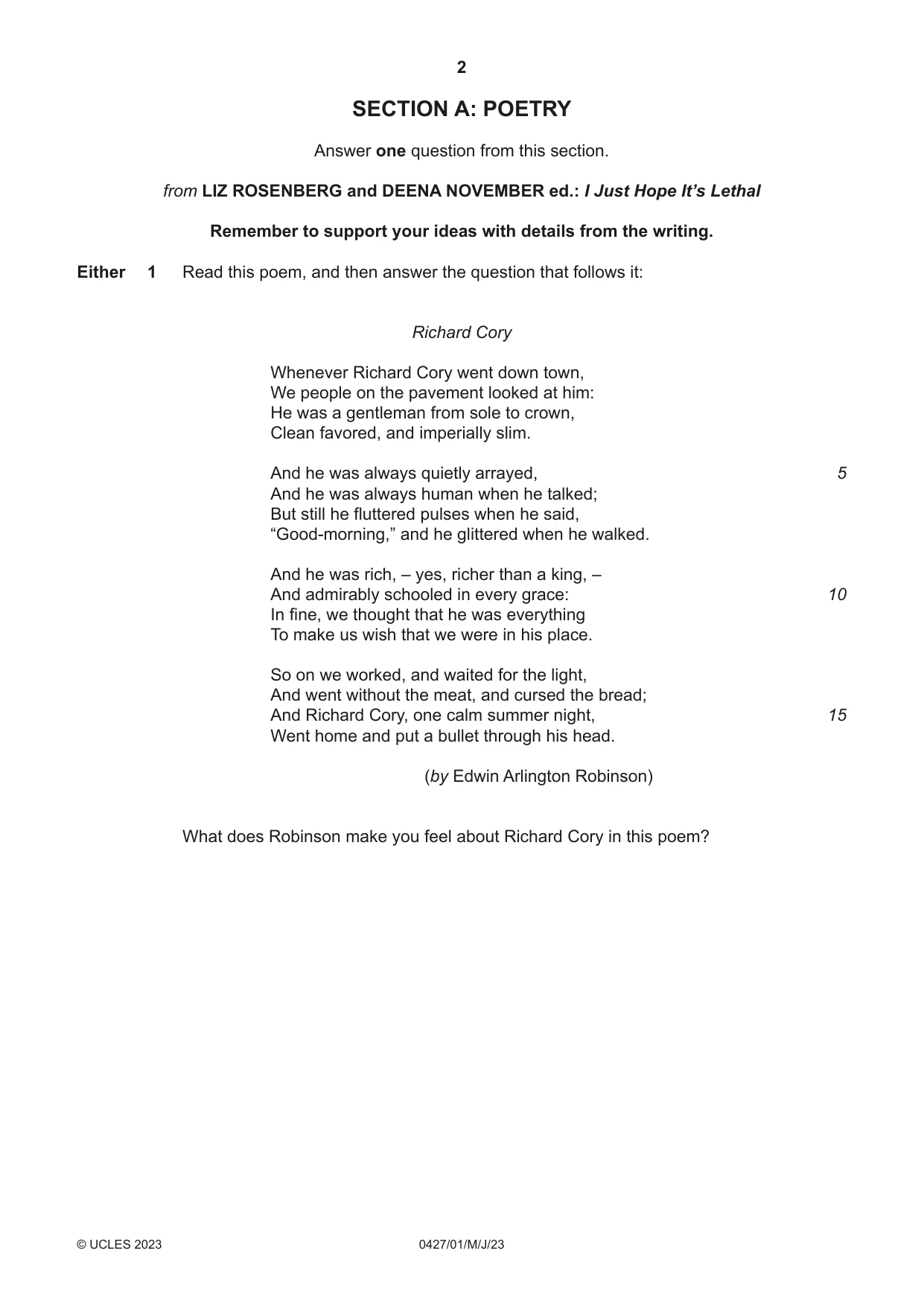
2 0427/01/M/J/23 © UCLES 2023 SECTION A: POETRY Answer one question from this section. from LIZ ROSENBERG and DEENA NOVEMBER ed.: I Just Hope It’s Lethal Remember to support your ideas with details from the writing. Either 1 Read this poem, and then answer the question that follows it: Richard Cory Whenever Richard Cory went down town, We people on the pavement looked at him: He was a gentleman from sole to crown, Clean favored, and imperially slim. And he was always quietly arrayed, And he was always human when he talked; But still he fluttered pulses when he said, “Good-morning,” and he glittered when he walked. And he was rich, – yes, richer than a king, – And admirably schooled in every grace: In fine, we thought that he was everything To make us wish that we were in his place. So on we worked, and waited for the light, And went without the meat, and cursed the bread; And Richard Cory, one calm summer night, Went home and put a bullet through his head. (by Edwin Arlington Robinson) What does Robinson make you feel about Richard Cory in this poem? 5 10 15
Question paper, page 3
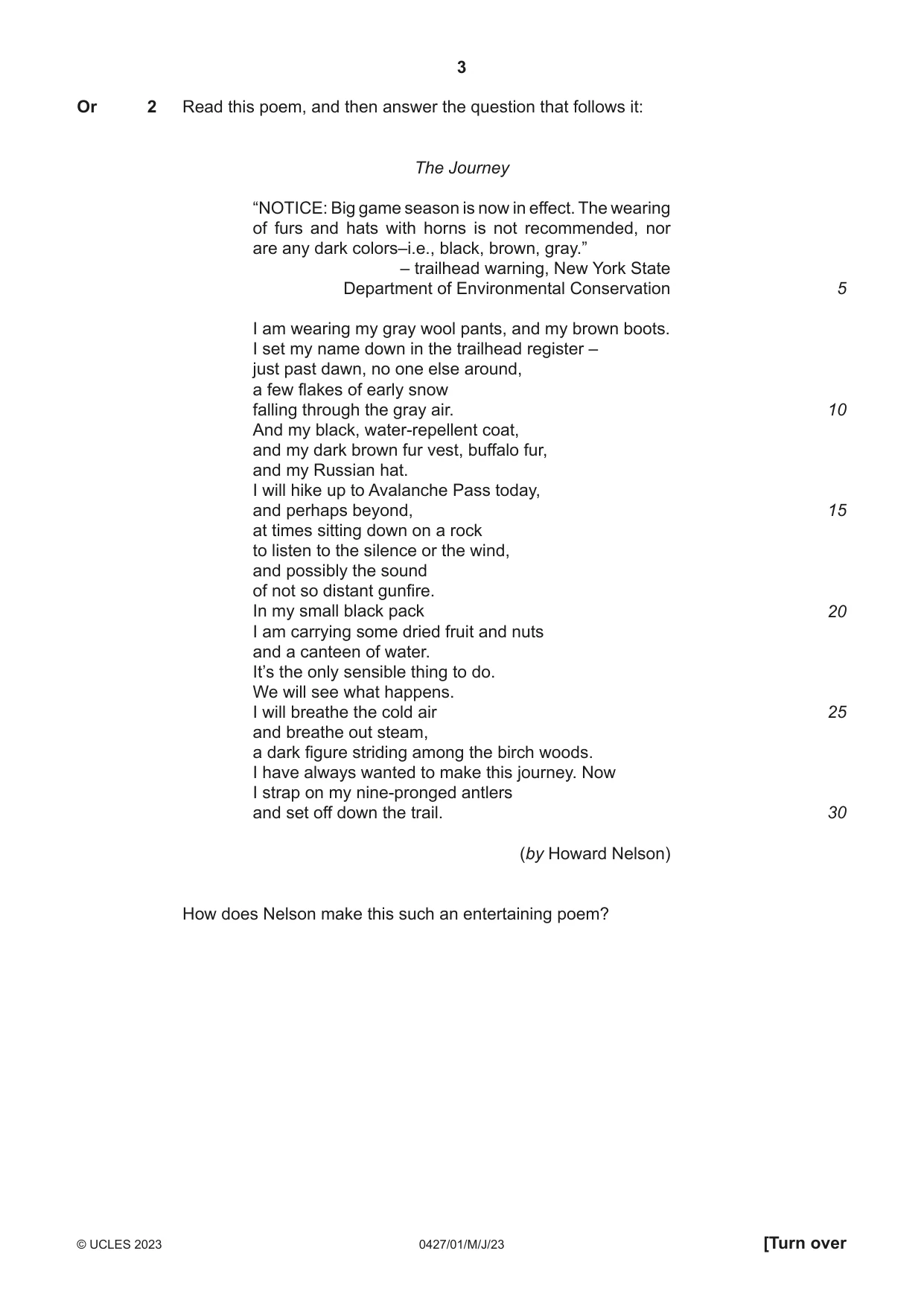
3 0427/01/M/J/23 © UCLES 2023 [Turn over Or 2 Read this poem, and then answer the question that follows it: The Journey “NOTICE: Big game season is now in effect. The wearing of furs and hats with horns is not recommended, nor are any dark colors–i.e., black, brown, gray.” – trailhead warning, New York State Department of Environmental Conservation I am wearing my gray wool pants, and my brown boots. I set my name down in the trailhead register – just past dawn, no one else around, a few flakes of early snow falling through the gray air. And my black, water-repellent coat, and my dark brown fur vest, buffalo fur, and my Russian hat. I will hike up to Avalanche Pass today, and perhaps beyond, at times sitting down on a rock to listen to the silence or the wind, and possibly the sound of not so distant gunfire. In my small black pack I am carrying some dried fruit and nuts and a canteen of water. It’s the only sensible thing to do. We will see what happens. I will breathe the cold air and breathe out steam, a dark figure striding among the birch woods. I have always wanted to make this journey. Now I strap on my nine-pronged antlers and set off down the trail. (by Howard Nelson) How does Nelson make this such an entertaining poem? 5 10 15 20 25 30
Question paper, page 4
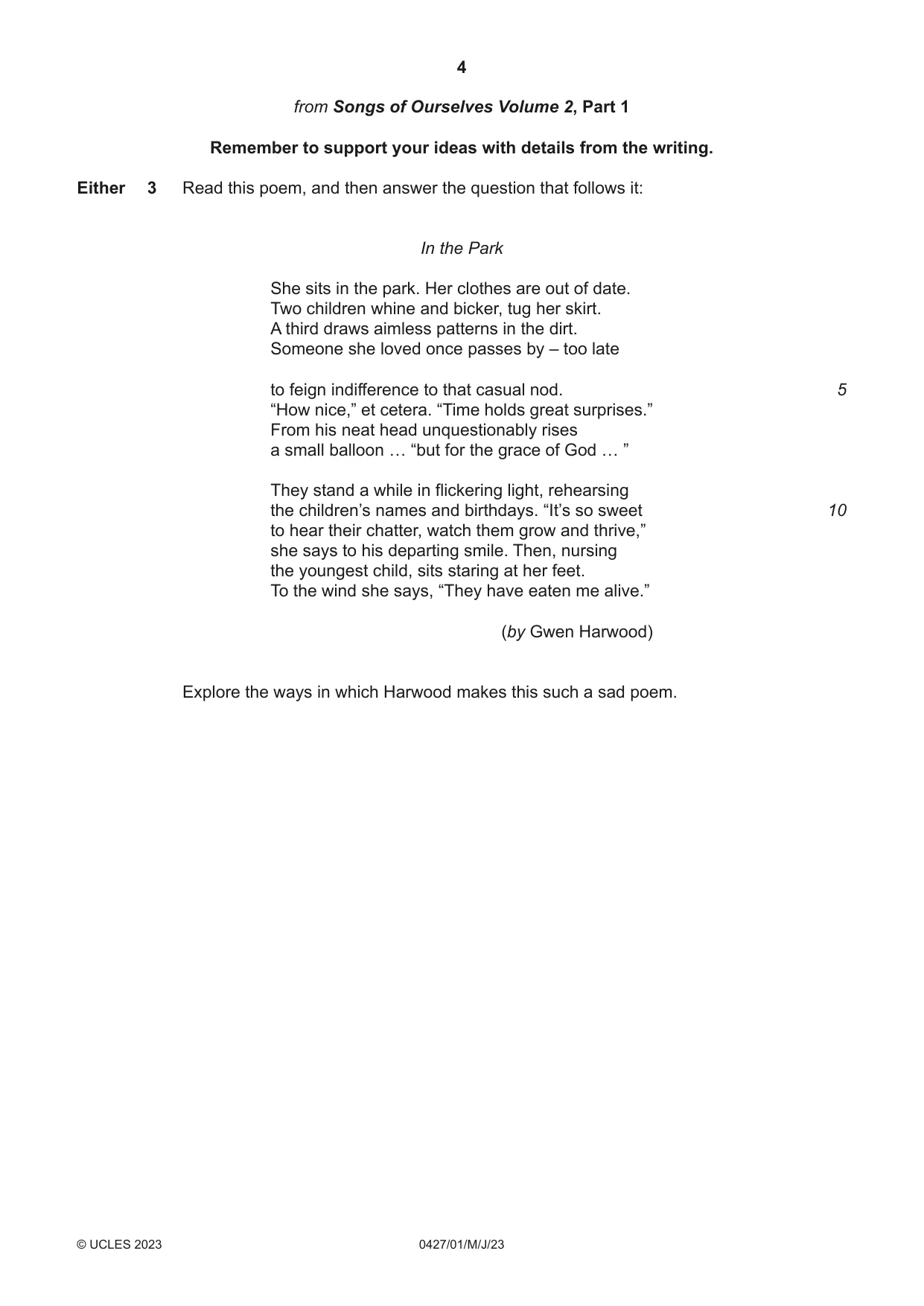
4 0427/01/M/J/23 © UCLES 2023 from Songs of Ourselves Volume 2, Part 1 Remember to support your ideas with details from the writing. Either 3 Read this poem, and then answer the question that follows it: In the Park She sits in the park. Her clothes are out of date. Two children whine and bicker, tug her skirt. A third draws aimless patterns in the dirt. Someone she loved once passes by – too late to feign indifference to that casual nod. “How nice,” et cetera. “Time holds great surprises.” From his neat head unquestionably rises a small balloon … “but for the grace of God … ” They stand a while in flickering light, rehearsing the children’s names and birthdays. “It’s so sweet to hear their chatter, watch them grow and thrive,” she says to his departing smile. Then, nursing the youngest child, sits staring at her feet. To the wind she says, “They have eaten me alive.” (by Gwen Harwood) Explore the ways in which Harwood makes this such a sad poem. 5 10
Question paper, page 5
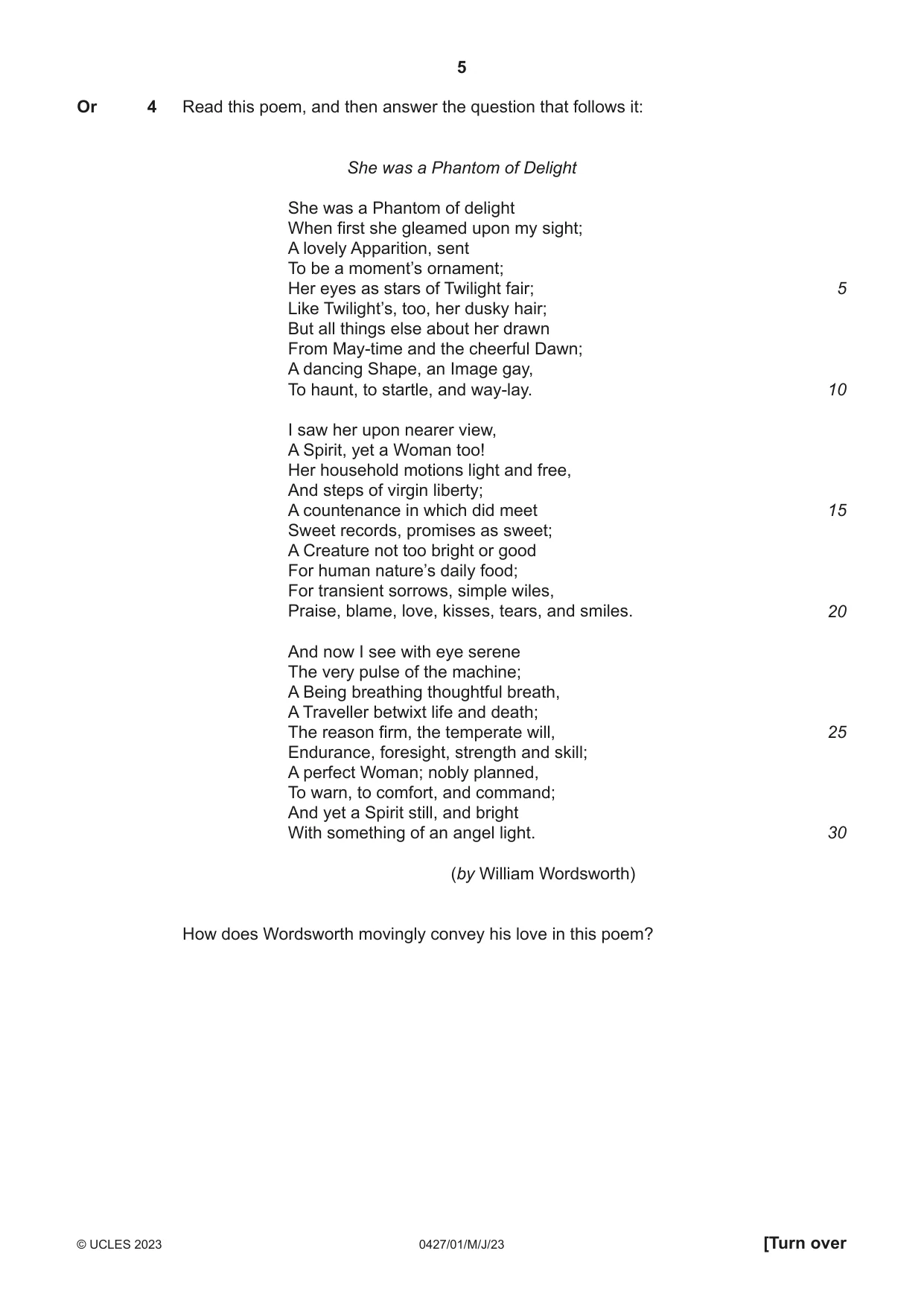
5 0427/01/M/J/23 © UCLES 2023 [Turn over Or 4 Read this poem, and then answer the question that follows it: She was a Phantom of Delight She was a Phantom of delight When first she gleamed upon my sight; A lovely Apparition, sent To be a moment’s ornament; Her eyes as stars of Twilight fair; Like Twilight’s, too, her dusky hair; But all things else about her drawn From May-time and the cheerful Dawn; A dancing Shape, an Image gay, To haunt, to startle, and way-lay. I saw her upon nearer view, A Spirit, yet a Woman too! Her household motions light and free, And steps of virgin liberty; A countenance in which did meet Sweet records, promises as sweet; A Creature not too bright or good For human nature’s daily food; For transient sorrows, simple wiles, Praise, blame, love, kisses, tears, and smiles. And now I see with eye serene The very pulse of the machine; A Being breathing thoughtful breath, A Traveller betwixt life and death; The reason firm, the temperate will, Endurance, foresight, strength and skill; A perfect Woman; nobly planned, To warn, to comfort, and command; And yet a Spirit still, and bright With something of an angel light. (by William Wordsworth) How does Wordsworth movingly convey his love in this poem? 5 10 15 20 25 30
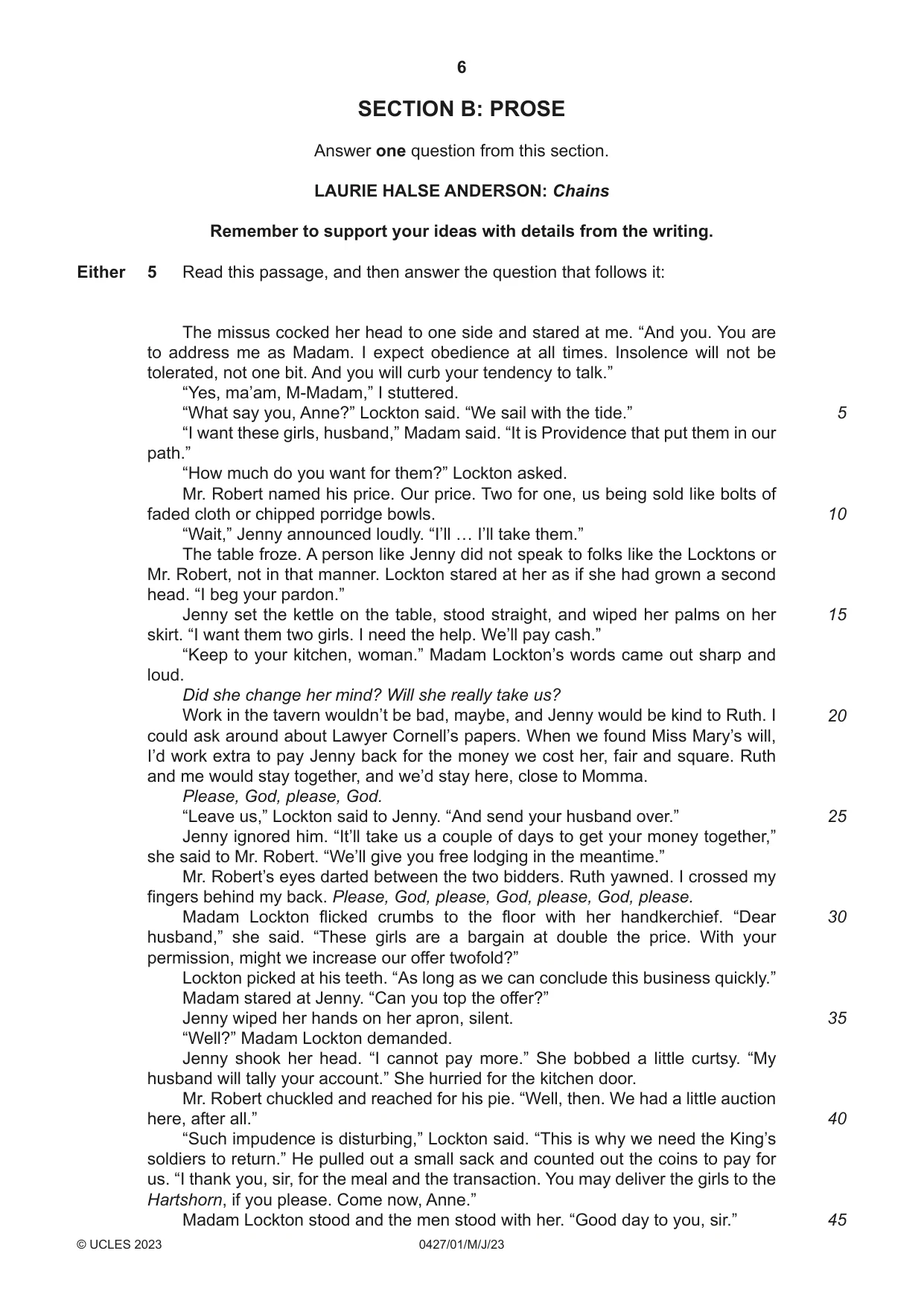
Question paper, page 6
6 0427/01/M/J/23 © UCLES 2023 SECTION B: PROSE Answer one question from this section. LAURIE HALSE ANDERSON: Chains Remember to support your ideas with details from the writing. Either 5 Read this passage, and then answer the question that follows it: The missus cocked her head to one side and stared at me. “And you. You are to address me as Madam. I expect obedience at all times. Insolence will not be tolerated, not one bit. And you will curb your tendency to talk.” “Yes, ma’am, M-Madam,” I stuttered. “What say you, Anne?” Lockton said. “We sail with the tide.” “I want these girls, husband,” Madam said. “It is Providence that put them in our path.” “How much do you want for them?” Lockton asked. Mr. Robert named his price. Our price. Two for one, us being sold like bolts of faded cloth or chipped porridge bowls. “Wait,” Jenny announced loudly. “I’ll … I’ll take them.” The table froze. A person like Jenny did not speak to folks like the Locktons or Mr. Robert, not in that manner. Lockton stared at her as if she had grown a second head. “I beg your pardon.” Jenny set the kettle on the table, stood straight, and wiped her palms on her skirt. “I want them two girls. I need the help. We’ll pay cash.” “Keep to your kitchen, woman.” Madam Lockton’s words came out sharp and loud. Did she change her mind? Will she really take us? Work in the tavern wouldn’t be bad, maybe, and Jenny would be kind to Ruth. I could ask around about Lawyer Cornell’s papers. When we found Miss Mary’s will, I’d work extra to pay Jenny back for the money we cost her, fair and square. Ruth and me would stay together, and we’d stay here, close to Momma. Please, God, please, God. “Leave us,” Lockton said to Jenny. “And send your husband over.” Jenny ignored him. “It’ll take us a couple of days to get your money together,” she said to Mr. Robert. “We’ll give you free lodging in the meantime.” Mr. Robert’s eyes darted between the two bidders. Ruth yawned. I crossed my fingers behind my back. Please, God, please, God, please, God, please. Madam Lockton flicked crumbs to the floor with her handkerchief. “Dear husband,” she said. “These girls are a bargain at double the price. With your permission, might we increase our offer twofold?” Lockton picked at his teeth. “As long as we can conclude this business quickly.” Madam stared at Jenny. “Can you top the offer?” Jenny wiped her hands on her apron, silent. “Well?” Madam Lockton demanded. Jenny shook her head. “I cannot pay more.” She bobbed a little curtsy. “My husband will tally your account.” She hurried for the kitchen door. Mr. Robert chuckled and reached for his pie. “Well, then. We had a little auction here, after all.” “Such impudence is disturbing,” Lockton said. “This is why we need the King’s soldiers to return.” He pulled out a small sack and counted out the coins to pay for us. “I thank you, sir, for the meal and the transaction. You may deliver the girls to the Hartshorn, if you please. Come now, Anne.” Madam Lockton stood and the men stood with her. “Good day to you, sir.” 5 10 15 20 25 30 35 40 45
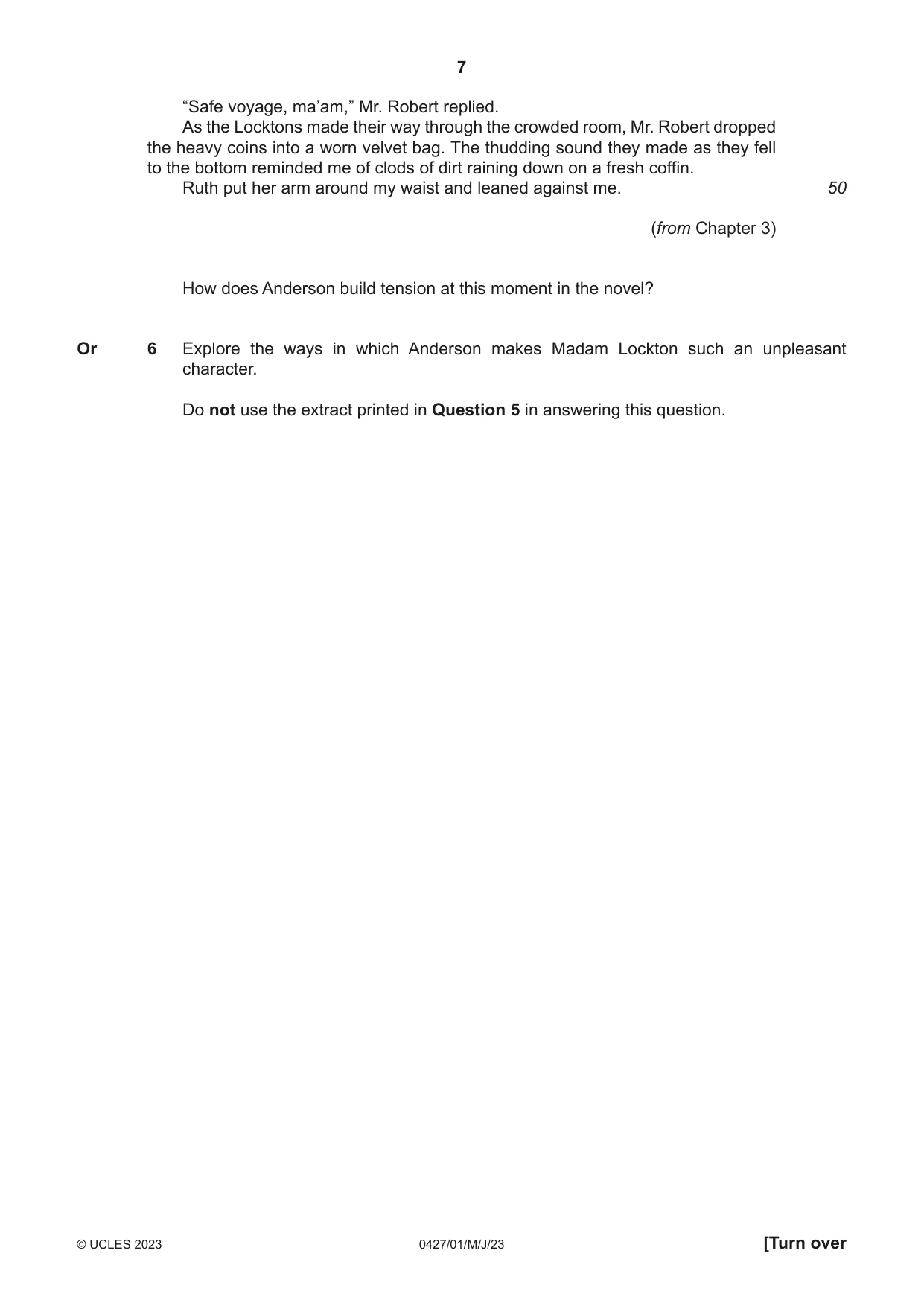
Question paper, page 7
7 0427/01/M/J/23 © UCLES 2023 [Turn over “Safe voyage, ma’am,” Mr. Robert replied. As the Locktons made their way through the crowded room, Mr. Robert dropped the heavy coins into a worn velvet bag. The thudding sound they made as they fell to the bottom reminded me of clods of dirt raining down on a fresh coffin. Ruth put her arm around my waist and leaned against me. (from Chapter 3) How does Anderson build tension at this moment in the novel? Or 6 Explore the ways in which Anderson makes Madam Lockton such an unpleasant character. Do not use the extract printed in Question 5 in answering this question. 50
Question paper, page 8
8 0427/01/M/J/23 © UCLES 2023 BARBARA KINGSOLVER: The Bean Trees Remember to support your ideas with details from the writing. Either 7 Read this passage, and then answer the question that follows it: I think we all felt the same exhaustion. Content removed due to copyright restrictions.
Question paper, page 9
9 0427/01/M/J/23 © UCLES 2023 [Turn over All four of us had buried someone we loved in Oklahoma. (from Chapter 17) In what ways does Kingsolver make this such a powerful moment in the novel? Or 8 How does Kingsolver vividly convey Taylor’s love for Turtle? Content removed due to copyright restrictions.
Question paper, page 10
10 0427/01/M/J/23 © UCLES 2023 JOHN STEINBECK: The Wayward Bus Remember to support your ideas with details from the writing. Either 9 Read this passage, and then answer the question that follows it: Mrs. Pritchard had been wanting to explain to the other passengers how people of the obvious position of the Pritchards should come to find themselves on a bus – should put themselves in the way of this kind of thing. Content removed due to copyright restrictions.
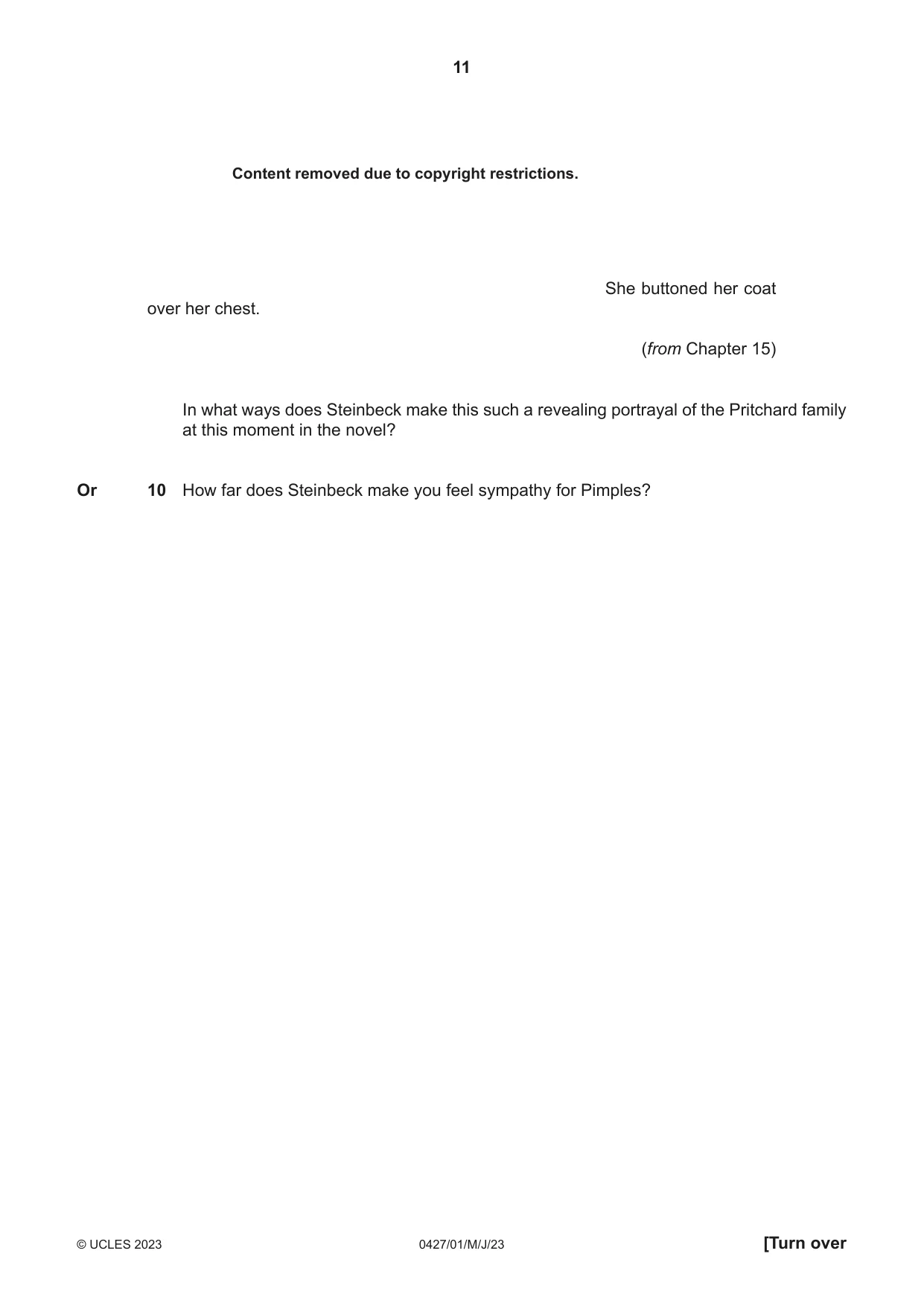
Question paper, page 11
11 0427/01/M/J/23 © UCLES 2023 [Turn over She buttoned her coat over her chest. (from Chapter 15) In what ways does Steinbeck make this such a revealing portrayal of the Pritchard family at this moment in the novel? Or 10 How far does Steinbeck make you feel sympathy for Pimples? Content removed due to copyright restrictions.
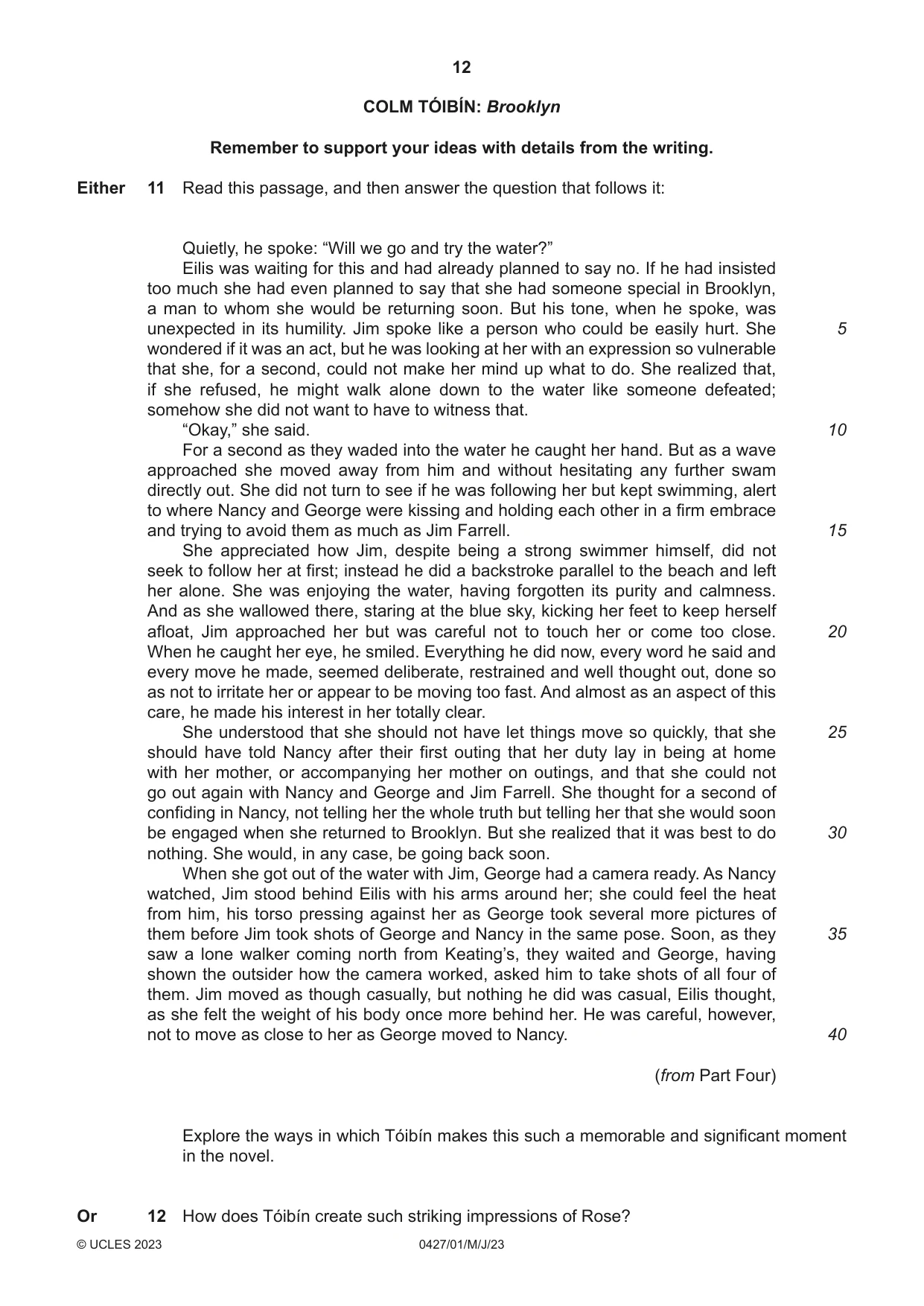
Question paper, page 12
12 0427/01/M/J/23 © UCLES 2023 COLM TÓIBÍN: Brooklyn Remember to support your ideas with details from the writing. Either 11 Read this passage, and then answer the question that follows it: Quietly, he spoke: “Will we go and try the water?” Eilis was waiting for this and had already planned to say no. If he had insisted too much she had even planned to say that she had someone special in Brooklyn, a man to whom she would be returning soon. But his tone, when he spoke, was unexpected in its humility. Jim spoke like a person who could be easily hurt. She wondered if it was an act, but he was looking at her with an expression so vulnerable that she, for a second, could not make her mind up what to do. She realized that, if she refused, he might walk alone down to the water like someone defeated; somehow she did not want to have to witness that. “Okay,” she said. For a second as they waded into the water he caught her hand. But as a wave approached she moved away from him and without hesitating any further swam directly out. She did not turn to see if he was following her but kept swimming, alert to where Nancy and George were kissing and holding each other in a firm embrace and trying to avoid them as much as Jim Farrell. She appreciated how Jim, despite being a strong swimmer himself, did not seek to follow her at first; instead he did a backstroke parallel to the beach and left her alone. She was enjoying the water, having forgotten its purity and calmness. And as she wallowed there, staring at the blue sky, kicking her feet to keep herself afloat, Jim approached her but was careful not to touch her or come too close. When he caught her eye, he smiled. Everything he did now, every word he said and every move he made, seemed deliberate, restrained and well thought out, done so as not to irritate her or appear to be moving too fast. And almost as an aspect of this care, he made his interest in her totally clear. She understood that she should not have let things move so quickly, that she should have told Nancy after their first outing that her duty lay in being at home with her mother, or accompanying her mother on outings, and that she could not go out again with Nancy and George and Jim Farrell. She thought for a second of confiding in Nancy, not telling her the whole truth but telling her that she would soon be engaged when she returned to Brooklyn. But she realized that it was best to do nothing. She would, in any case, be going back soon. When she got out of the water with Jim, George had a camera ready. As Nancy watched, Jim stood behind Eilis with his arms around her; she could feel the heat from him, his torso pressing against her as George took several more pictures of them before Jim took shots of George and Nancy in the same pose. Soon, as they saw a lone walker coming north from Keating’s, they waited and George, having shown the outsider how the camera worked, asked him to take shots of all four of them. Jim moved as though casually, but nothing he did was casual, Eilis thought, as she felt the weight of his body once more behind her. He was careful, however, not to move as close to her as George moved to Nancy. (from Part Four) Explore the ways in which Tóibín makes this such a memorable and significant moment in the novel. Or 12 How does Tóibín create such striking impressions of Rose? 5 10 15 20 25 30 35 40
Question paper, page 13
13 0427/01/M/J/23 © UCLES 2023 [Turn over TURN OVER FOR QUESTION 13.
Question paper, page 14
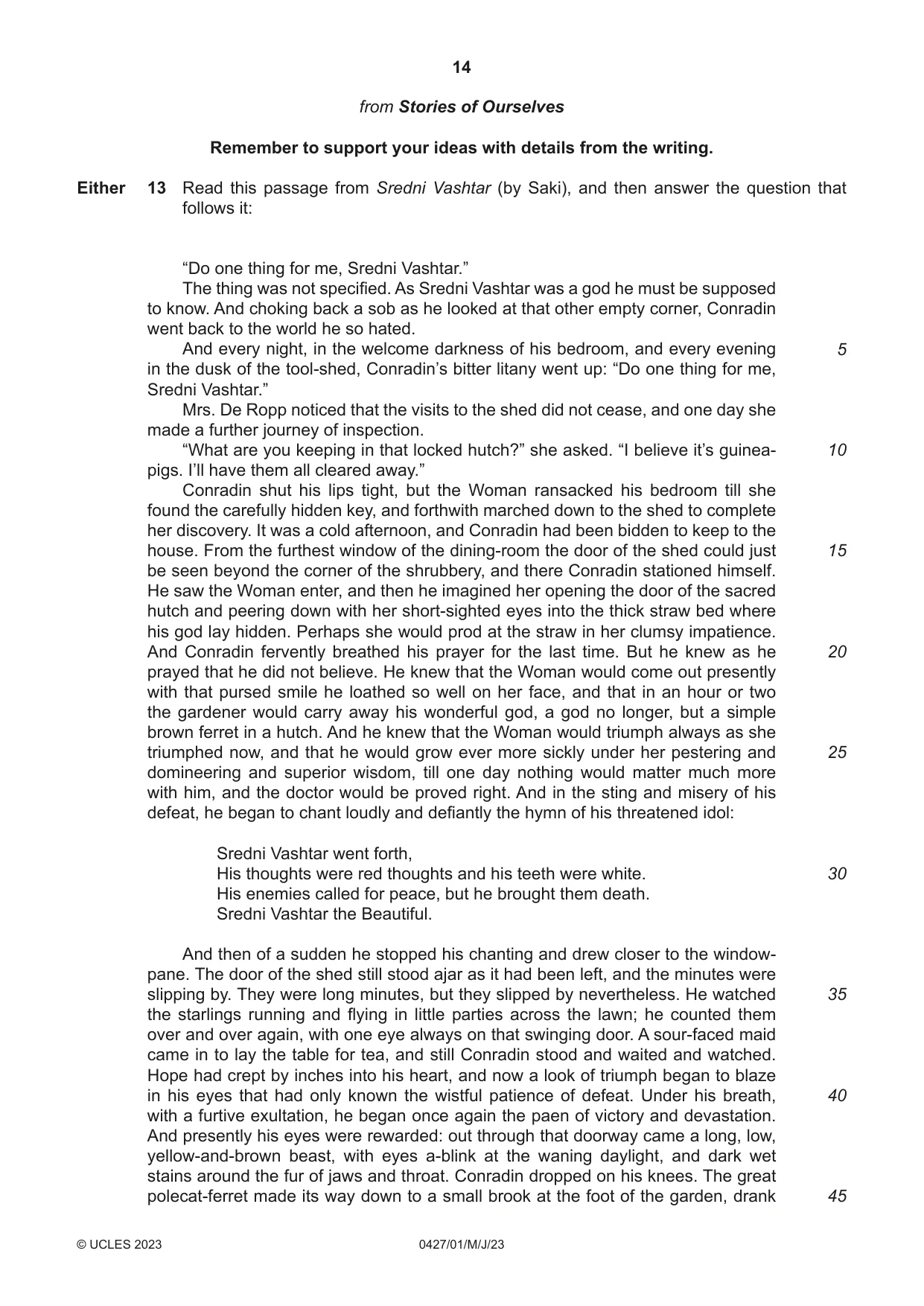
14 0427/01/M/J/23 © UCLES 2023 from Stories of Ourselves Remember to support your ideas with details from the writing. Either 13 Read this passage from Sredni Vashtar (by Saki), and then answer the question that follows it: “Do one thing for me, Sredni Vashtar.” The thing was not specified. As Sredni Vashtar was a god he must be supposed to know. And choking back a sob as he looked at that other empty corner, Conradin went back to the world he so hated. And every night, in the welcome darkness of his bedroom, and every evening in the dusk of the tool-shed, Conradin’s bitter litany went up: “Do one thing for me, Sredni Vashtar.” Mrs. De Ropp noticed that the visits to the shed did not cease, and one day she made a further journey of inspection. “What are you keeping in that locked hutch?” she asked. “I believe it’s guinea- pigs. I’ll have them all cleared away.” Conradin shut his lips tight, but the Woman ransacked his bedroom till she found the carefully hidden key, and forthwith marched down to the shed to complete her discovery. It was a cold afternoon, and Conradin had been bidden to keep to the house. From the furthest window of the dining-room the door of the shed could just be seen beyond the corner of the shrubbery, and there Conradin stationed himself. He saw the Woman enter, and then he imagined her opening the door of the sacred hutch and peering down with her short-sighted eyes into the thick straw bed where his god lay hidden. Perhaps she would prod at the straw in her clumsy impatience. And Conradin fervently breathed his prayer for the last time. But he knew as he prayed that he did not believe. He knew that the Woman would come out presently with that pursed smile he loathed so well on her face, and that in an hour or two the gardener would carry away his wonderful god, a god no longer, but a simple brown ferret in a hutch. And he knew that the Woman would triumph always as she triumphed now, and that he would grow ever more sickly under her pestering and domineering and superior wisdom, till one day nothing would matter much more with him, and the doctor would be proved right. And in the sting and misery of his defeat, he began to chant loudly and defiantly the hymn of his threatened idol: Sredni Vashtar went forth, His thoughts were red thoughts and his teeth were white. His enemies called for peace, but he brought them death. Sredni Vashtar the Beautiful. And then of a sudden he stopped his chanting and drew closer to the window- pane. The door of the shed still stood ajar as it had been left, and the minutes were slipping by. They were long minutes, but they slipped by nevertheless. He watched the starlings running and flying in little parties across the lawn; he counted them over and over again, with one eye always on that swinging door. A sour-faced maid came in to lay the table for tea, and still Conradin stood and waited and watched. Hope had crept by inches into his heart, and now a look of triumph began to blaze in his eyes that had only known the wistful patience of defeat. Under his breath, with a furtive exultation, he began once again the paen of victory and devastation. And presently his eyes were rewarded: out through that doorway came a long, low, yellow-and-brown beast, with eyes a-blink at the waning daylight, and dark wet stains around the fur of jaws and throat. Conradin dropped on his knees. The great polecat-ferret made its way down to a small brook at the foot of the garden, drank 5 10 15 20 25 30 35 40 45
Question paper, page 15
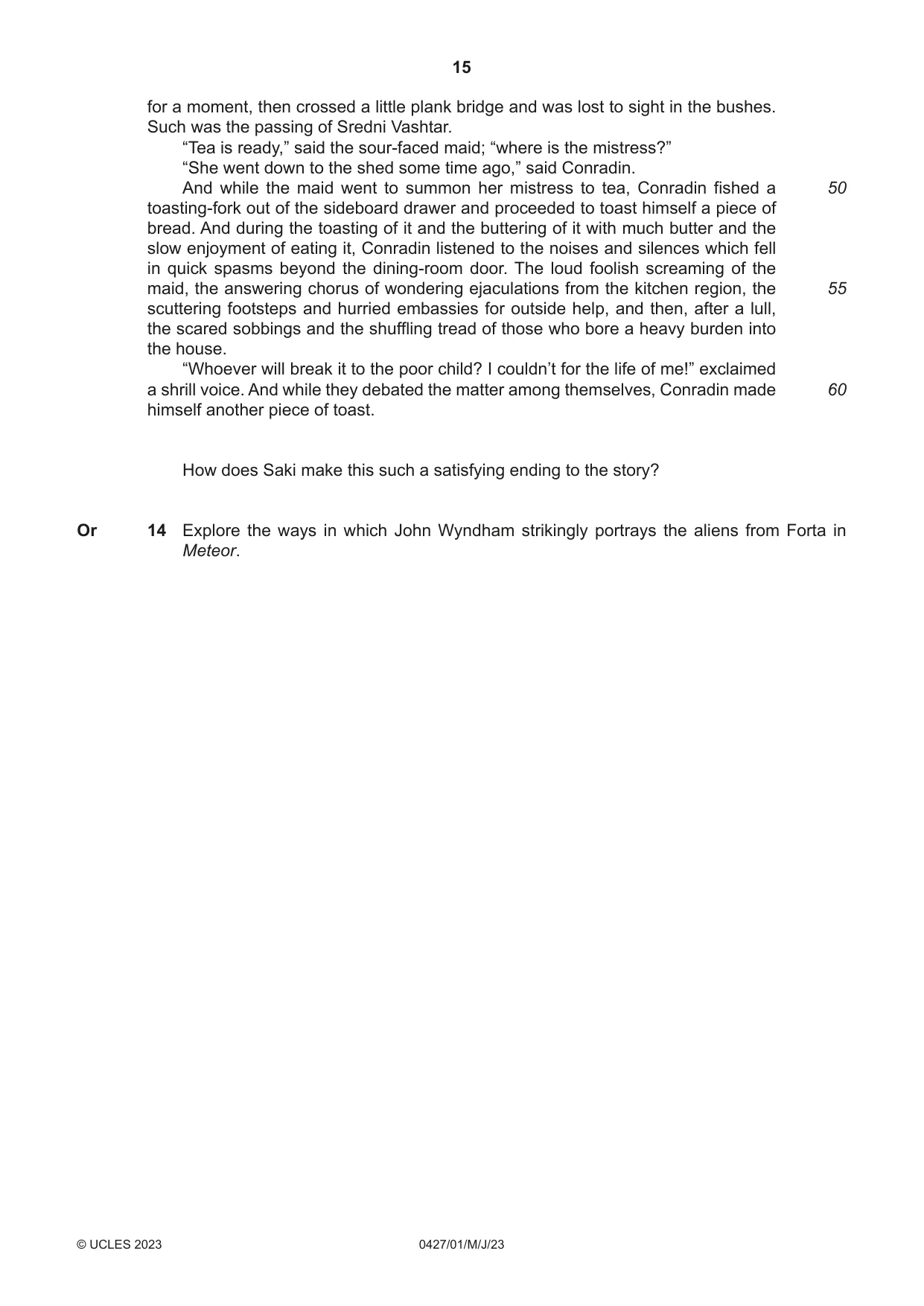
15 0427/01/M/J/23 © UCLES 2023 for a moment, then crossed a little plank bridge and was lost to sight in the bushes. Such was the passing of Sredni Vashtar. “Tea is ready,” said the sour-faced maid; “where is the mistress?” “She went down to the shed some time ago,” said Conradin. And while the maid went to summon her mistress to tea, Conradin fished a toasting-fork out of the sideboard drawer and proceeded to toast himself a piece of bread. And during the toasting of it and the buttering of it with much butter and the slow enjoyment of eating it, Conradin listened to the noises and silences which fell in quick spasms beyond the dining-room door. The loud foolish screaming of the maid, the answering chorus of wondering ejaculations from the kitchen region, the scuttering footsteps and hurried embassies for outside help, and then, after a lull, the scared sobbings and the shuffling tread of those who bore a heavy burden into the house. “Whoever will break it to the poor child? I couldn’t for the life of me!” exclaimed a shrill voice. And while they debated the matter among themselves, Conradin made himself another piece of toast. How does Saki make this such a satisfying ending to the story? Or 14 Explore the ways in which John Wyndham strikingly portrays the aliens from Forta in Meteor. 50 55 60
Question paper, page 16
16 0427/01/M/J/23 © UCLES 2023 Permission to reproduce items where third-party owned material protected by copyright is included has been sought and cleared where possible. Every reasonable effort has been made by the publisher (UCLES) to trace copyright holders, but if any items requiring clearance have unwittingly been included, the publisher will be pleased to make amends at the earliest possible opportunity. To avoid the issue of disclosure of answer-related information to candidates, all copyright acknowledgements are reproduced online in the Cambridge Assessment International Education Copyright Acknowledgements Booklet. This is produced for each series of examinations and is freely available to download at www.cambridgeinternational.org after the live examination series. Cambridge Assessment International Education is part of Cambridge Assessment. Cambridge Assessment is the brand name of the University of Cambridge Local Examinations Syndicate (UCLES), which is a department of the University of Cambridge. BLANK PAGE
What you needed in this session
Cambridge’s own grade thresholds for 2023 May/June, Paper 1 · Variant 0. A higher threshold means an easier paper — the bar moves with how the cohort did.