Cambridge IGCSE English - Literature (BES) 0427 — 2021 May/June Paper 1 · Variant 0
0427/10/M/J/21
The question paper and its mark scheme, free to read here and free to download. This is Cambridge’s own paper, exactly as it was sat.
Question paper16 pages

Mark scheme
No mark scheme is in the library for this paper.
Paper as text
Question paper, page 1
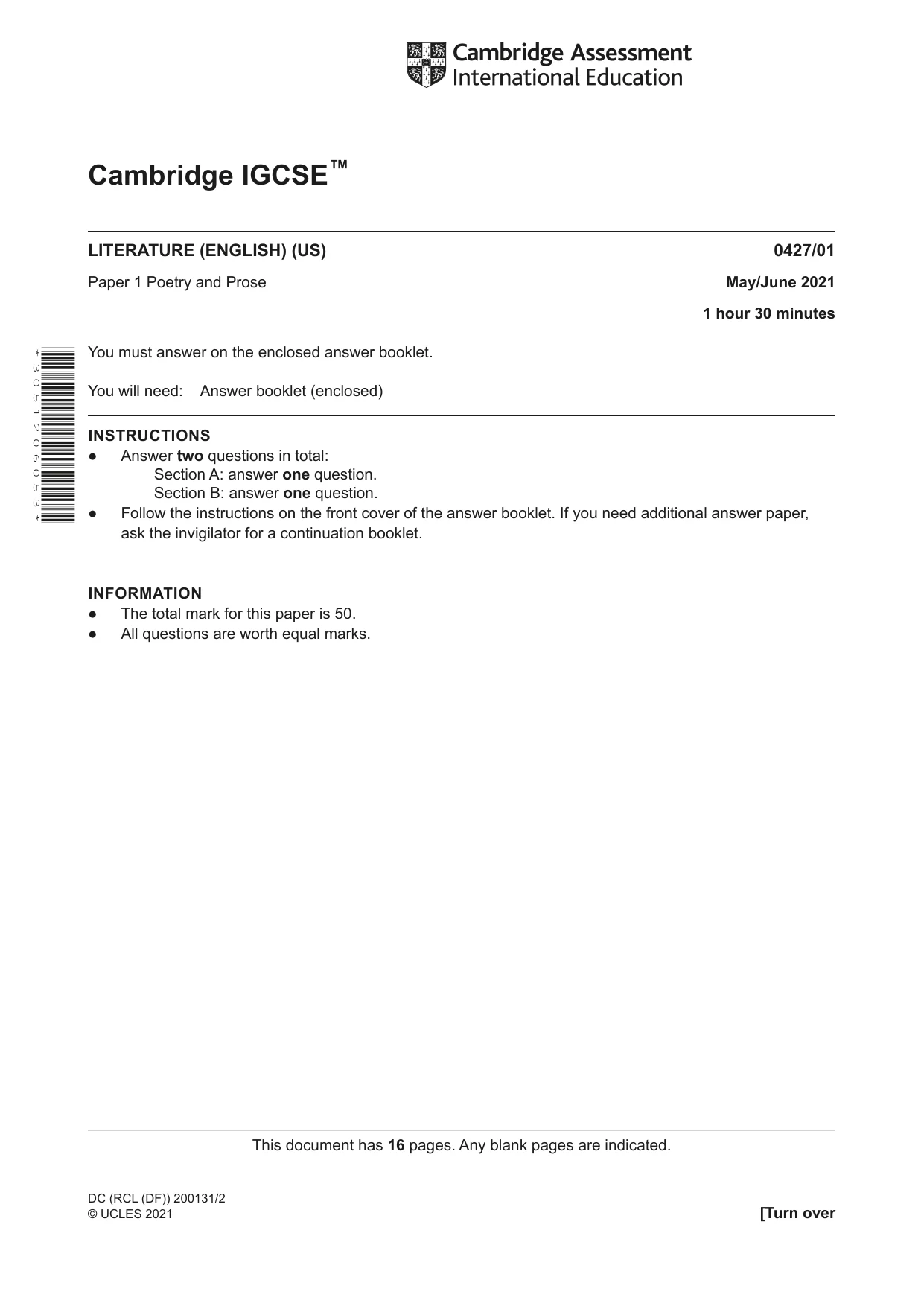
This document has 16 pages. Any blank pages are indicated. * 3 0 5 1 2 0 6 0 5 3 * Cambridge IGCSE™ DC (RCL (DF)) 200131/2 © UCLES 2021 [Turn over LITERATURE (ENGLISH) (US) 0427/01 Paper 1 Poetry and Prose May/June 2021 1 hour 30 minutes You must answer on the enclosed answer booklet. You will need: Answer booklet (enclosed) INSTRUCTIONS ● Answer two questions in total: Section A: answer one question. Section B: answer one question. ● Follow the instructions on the front cover of the answer booklet. If you need additional answer paper, ask the invigilator for a continuation booklet. INFORMATION ● The total mark for this paper is 50. ● All questions are worth equal marks.
Question paper, page 2
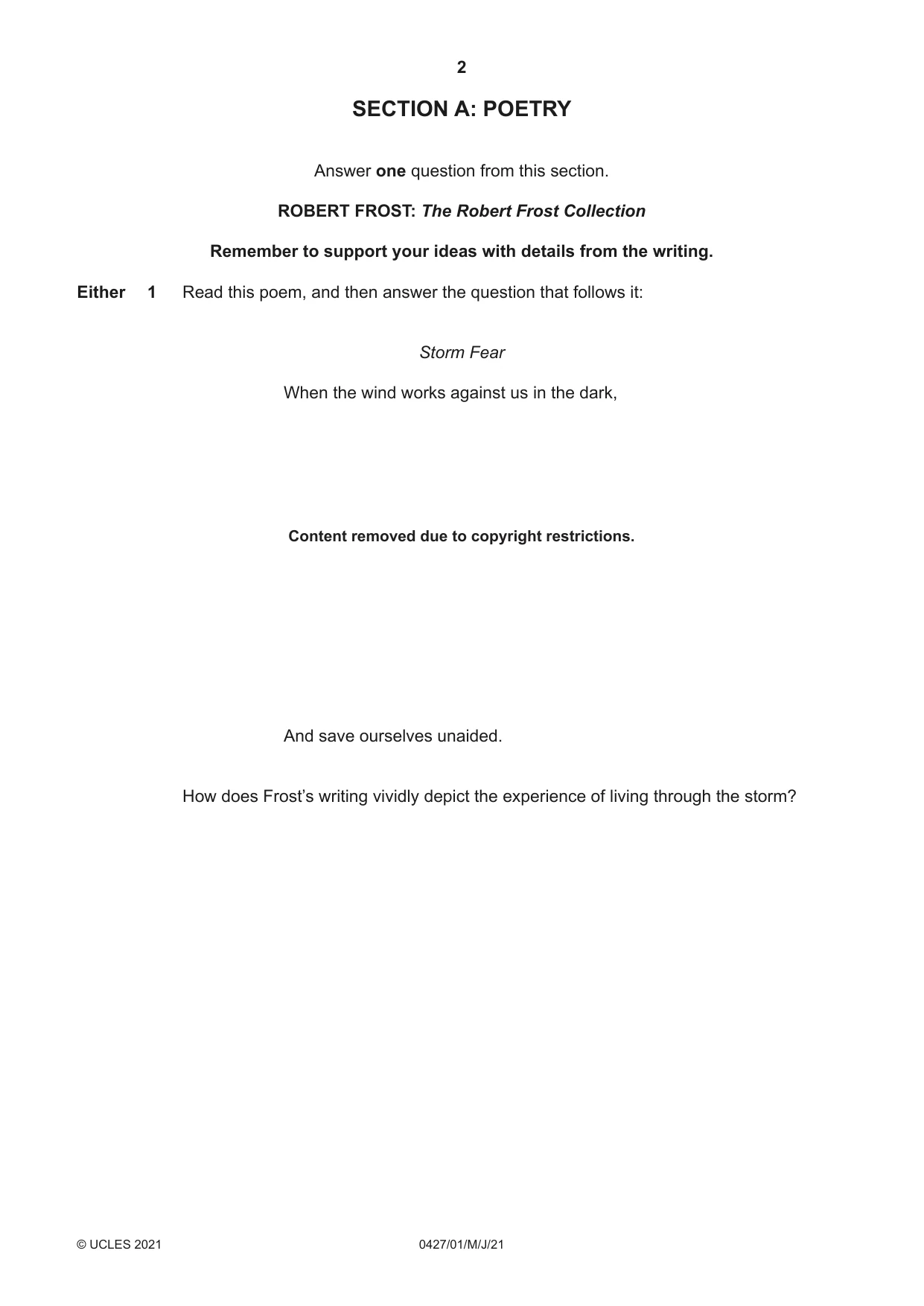
2 0427/01/M/J/21 © UCLES 2021 SECTION A: POETRY Answer one question from this section. ROBERT FROST: The Robert Frost Collection Remember to support your ideas with details from the writing. Either 1 Read this poem, and then answer the question that follows it: Storm Fear When the wind works against us in the dark, And save ourselves unaided. How does Frost’s writing vividly depict the experience of living through the storm? Content removed due to copyright restrictions.
Question paper, page 3
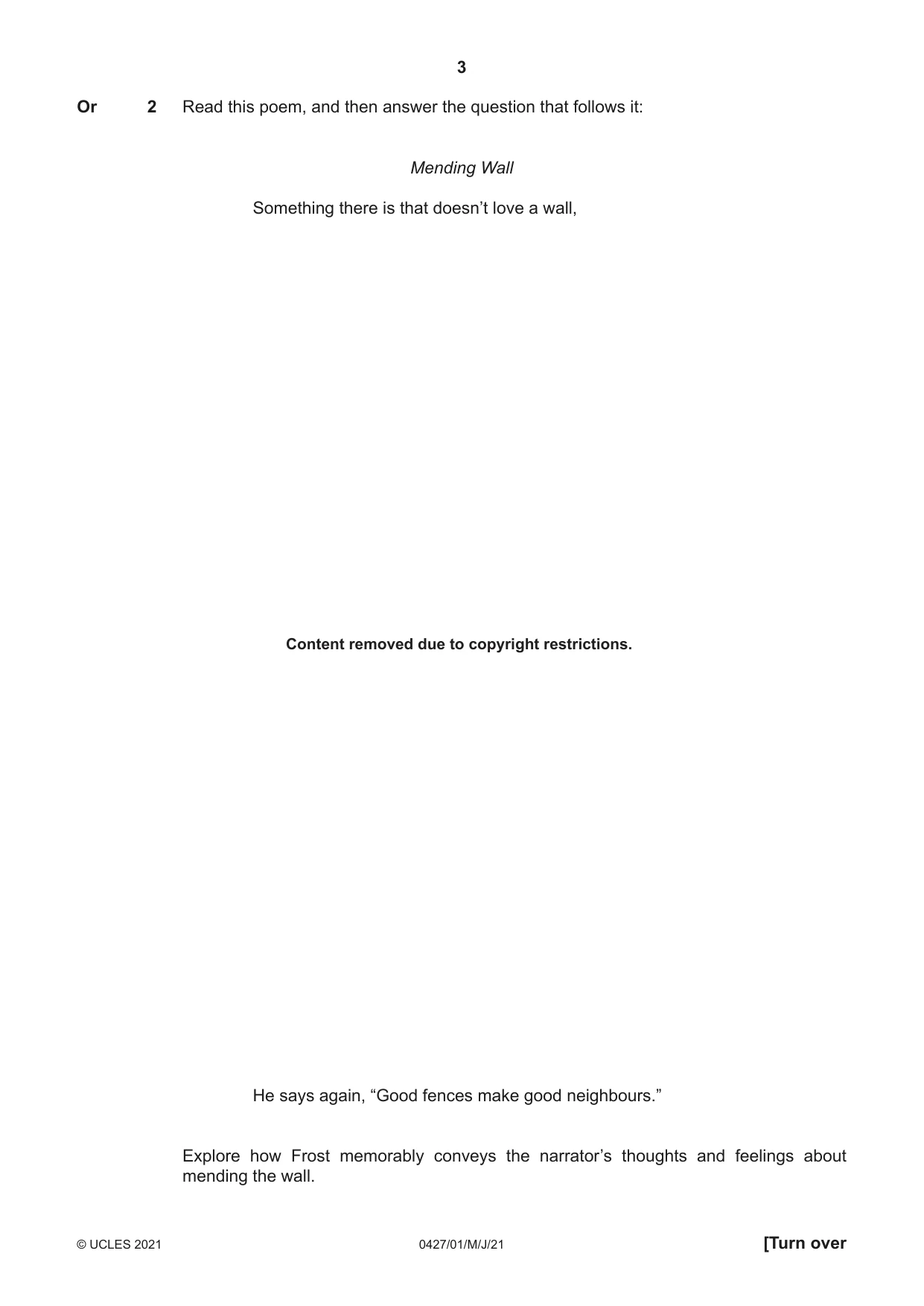
3 0427/01/M/J/21 © UCLES 2021 [Turn over Or 2 Read this poem, and then answer the question that follows it: Mending Wall Something there is that doesn’t love a wall, He says again, “Good fences make good neighbours.” Explore how Frost memorably conveys the narrator’s thoughts and feelings about mending the wall. Content removed due to copyright restrictions.
Question paper, page 4
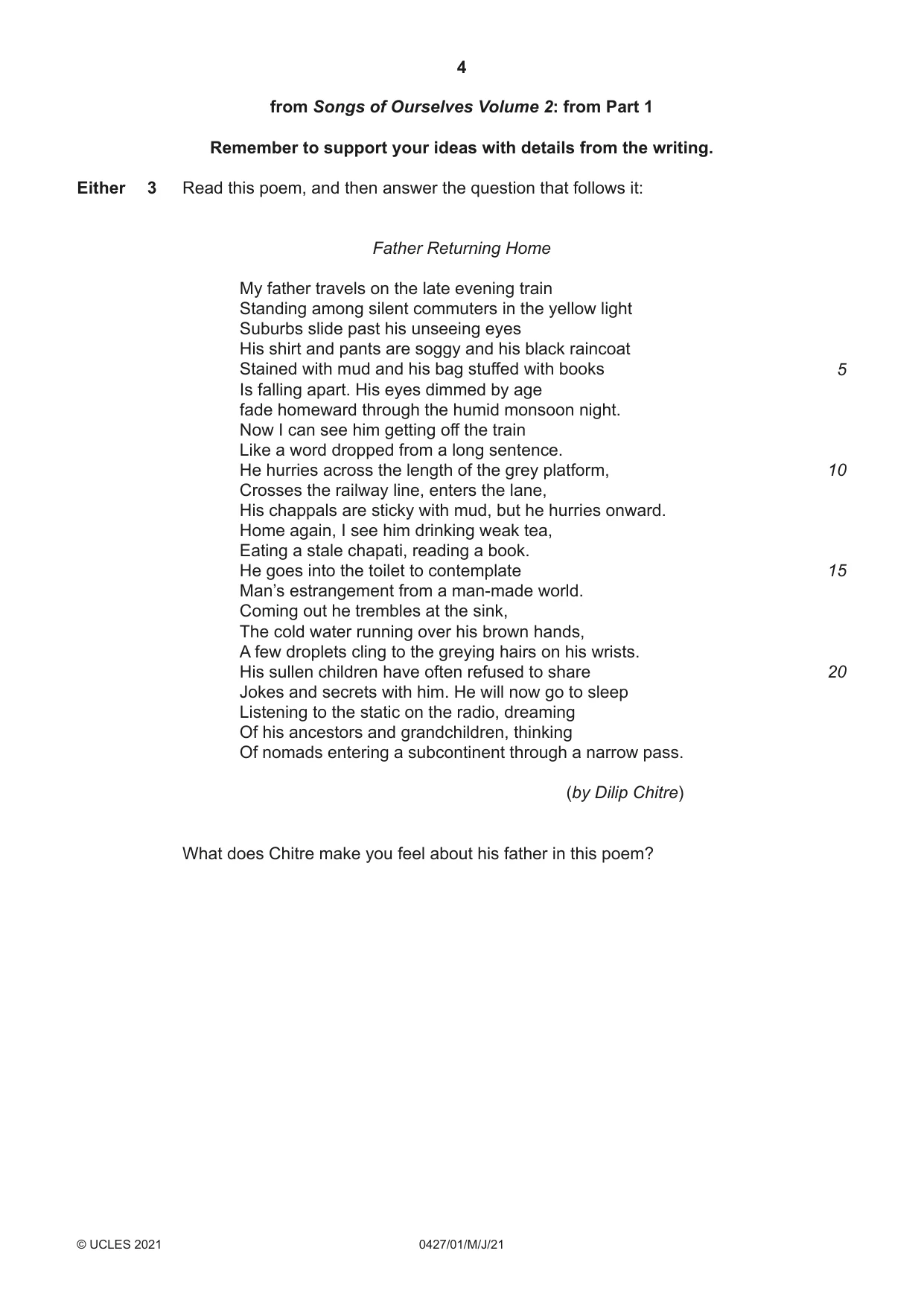
4 0427/01/M/J/21 © UCLES 2021 from Songs of Ourselves Volume 2: from Part 1 Remember to support your ideas with details from the writing. Either 3 Read this poem, and then answer the question that follows it: Father Returning Home My father travels on the late evening train Standing among silent commuters in the yellow light Suburbs slide past his unseeing eyes His shirt and pants are soggy and his black raincoat Stained with mud and his bag stuffed with books Is falling apart. His eyes dimmed by age fade homeward through the humid monsoon night. Now I can see him getting off the train Like a word dropped from a long sentence. He hurries across the length of the grey platform, Crosses the railway line, enters the lane, His chappals are sticky with mud, but he hurries onward. Home again, I see him drinking weak tea, Eating a stale chapati, reading a book. He goes into the toilet to contemplate Man’s estrangement from a man-made world. Coming out he trembles at the sink, The cold water running over his brown hands, A few droplets cling to the greying hairs on his wrists. His sullen children have often refused to share Jokes and secrets with him. He will now go to sleep Listening to the static on the radio, dreaming Of his ancestors and grandchildren, thinking Of nomads entering a subcontinent through a narrow pass. (by Dilip Chitre) What does Chitre make you feel about his father in this poem? 5 10 15 20
Question paper, page 5
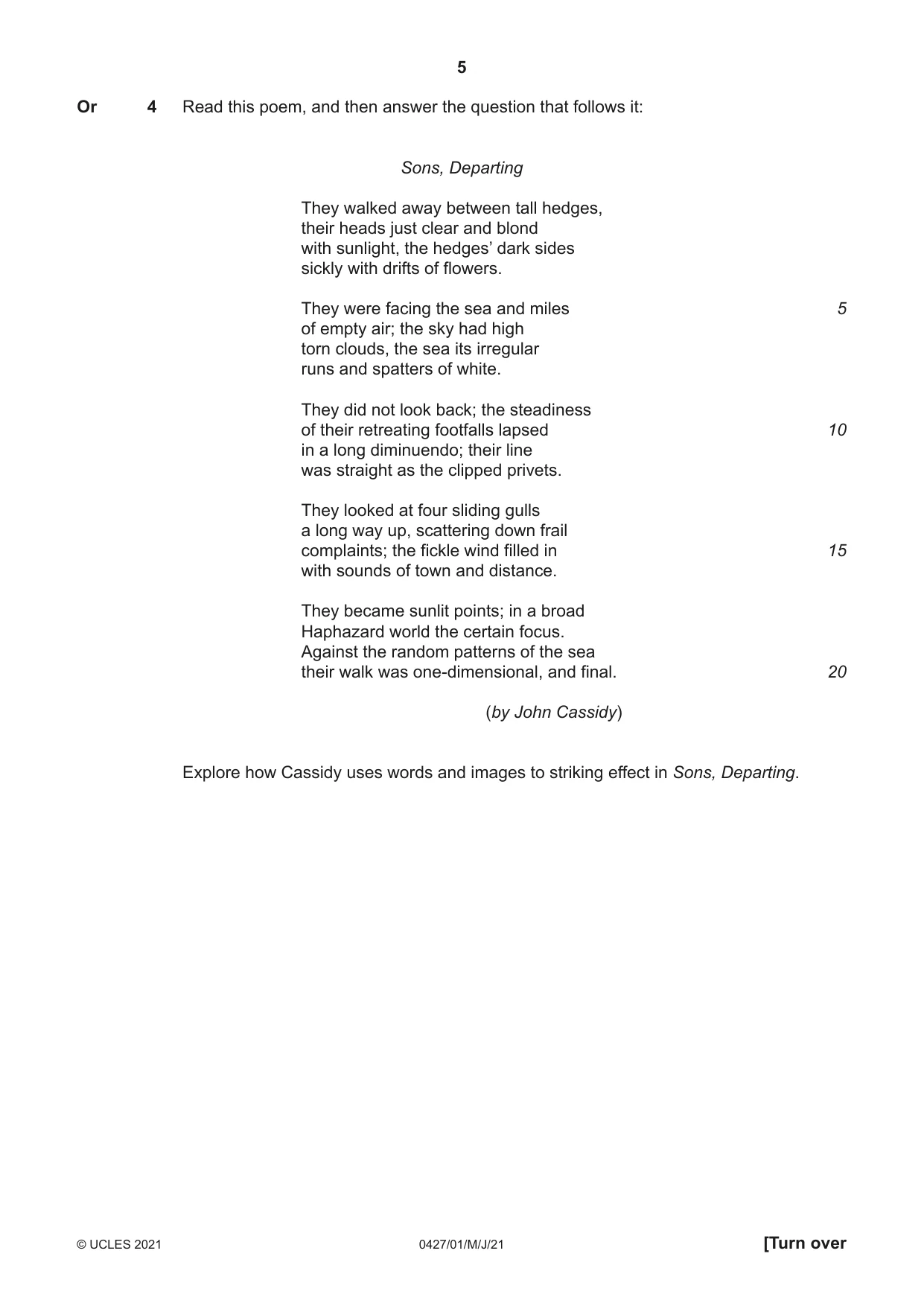
5 0427/01/M/J/21 © UCLES 2021 [Turn over Or 4 Read this poem, and then answer the question that follows it: Sons, Departing They walked away between tall hedges, their heads just clear and blond with sunlight, the hedges’ dark sides sickly with drifts of flowers. They were facing the sea and miles of empty air; the sky had high torn clouds, the sea its irregular runs and spatters of white. They did not look back; the steadiness of their retreating footfalls lapsed in a long diminuendo; their line was straight as the clipped privets. They looked at four sliding gulls a long way up, scattering down frail complaints; the fickle wind filled in with sounds of town and distance. They became sunlit points; in a broad Haphazard world the certain focus. Against the random patterns of the sea their walk was one-dimensional, and final. (by John Cassidy) Explore how Cassidy uses words and images to striking effect in Sons, Departing. 5 10 15 20
Question paper, page 6
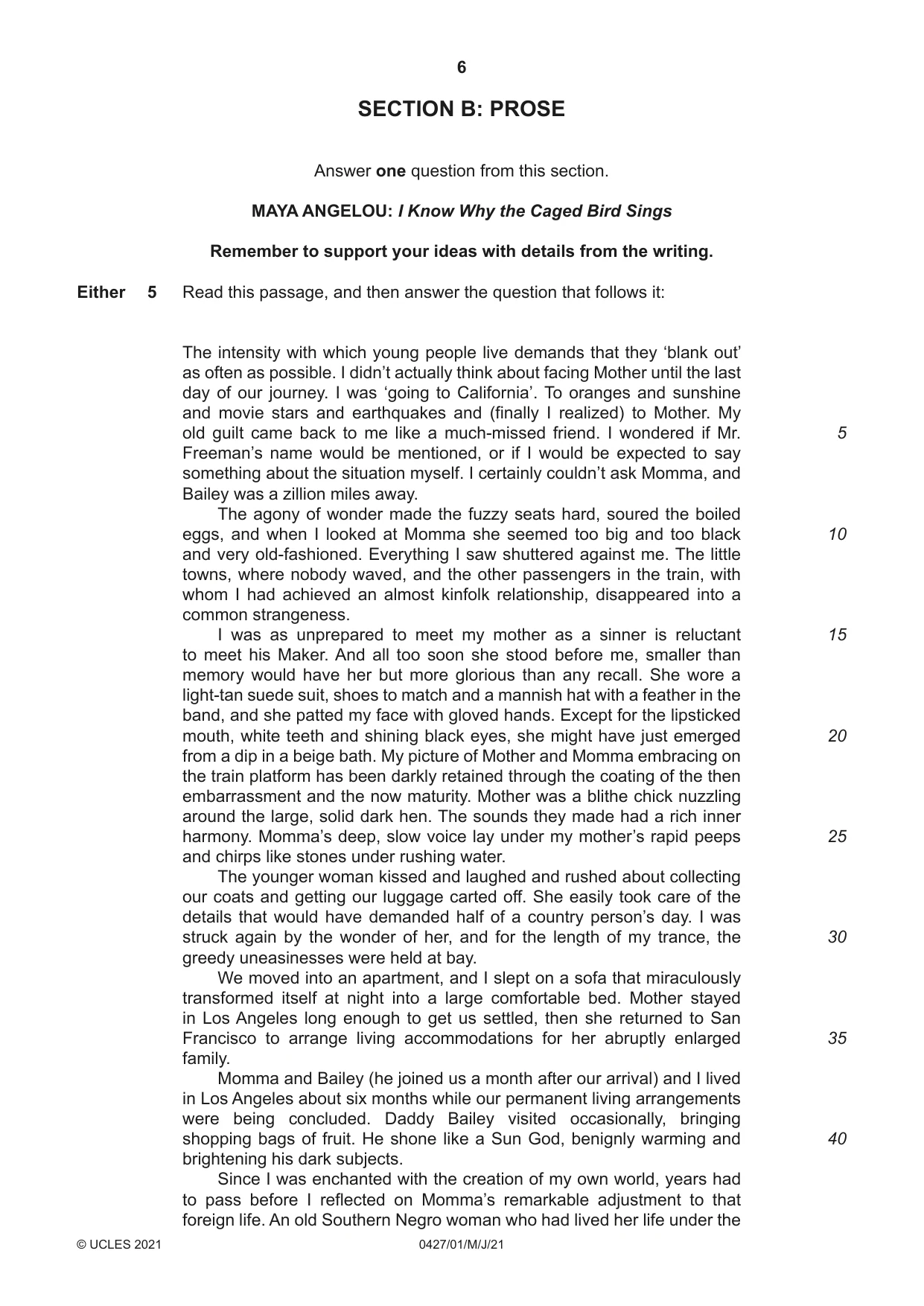
6 0427/01/M/J/21 © UCLES 2021 SECTION B: PROSE Answer one question from this section. MAYA ANGELOU: I Know Why the Caged Bird Sings Remember to support your ideas with details from the writing. Either 5 Read this passage, and then answer the question that follows it: The intensity with which young people live demands that they ‘blank out’ as often as possible. I didn’t actually think about facing Mother until the last day of our journey. I was ‘going to California’. To oranges and sunshine and movie stars and earthquakes and (finally I realized) to Mother. My old guilt came back to me like a much-missed friend. I wondered if Mr. Freeman’s name would be mentioned, or if I would be expected to say something about the situation myself. I certainly couldn’t ask Momma, and Bailey was a zillion miles away. The agony of wonder made the fuzzy seats hard, soured the boiled eggs, and when I looked at Momma she seemed too big and too black and very old-fashioned. Everything I saw shuttered against me. The little towns, where nobody waved, and the other passengers in the train, with whom I had achieved an almost kinfolk relationship, disappeared into a common strangeness. I was as unprepared to meet my mother as a sinner is reluctant to meet his Maker. And all too soon she stood before me, smaller than memory would have her but more glorious than any recall. She wore a light-tan suede suit, shoes to match and a mannish hat with a feather in the band, and she patted my face with gloved hands. Except for the lipsticked mouth, white teeth and shining black eyes, she might have just emerged from a dip in a beige bath. My picture of Mother and Momma embracing on the train platform has been darkly retained through the coating of the then embarrassment and the now maturity. Mother was a blithe chick nuzzling around the large, solid dark hen. The sounds they made had a rich inner harmony. Momma’s deep, slow voice lay under my mother’s rapid peeps and chirps like stones under rushing water. The younger woman kissed and laughed and rushed about collecting our coats and getting our luggage carted off. She easily took care of the details that would have demanded half of a country person’s day. I was struck again by the wonder of her, and for the length of my trance, the greedy uneasinesses were held at bay. We moved into an apartment, and I slept on a sofa that miraculously transformed itself at night into a large comfortable bed. Mother stayed in Los Angeles long enough to get us settled, then she returned to San Francisco to arrange living accommodations for her abruptly enlarged family. Momma and Bailey (he joined us a month after our arrival) and I lived in Los Angeles about six months while our permanent living arrangements were being concluded. Daddy Bailey visited occasionally, bringing shopping bags of fruit. He shone like a Sun God, benignly warming and brightening his dark subjects. Since I was enchanted with the creation of my own world, years had to pass before I reflected on Momma’s remarkable adjustment to that foreign life. An old Southern Negro woman who had lived her life under the 5 10 15 20 25 30 35 40
Question paper, page 7
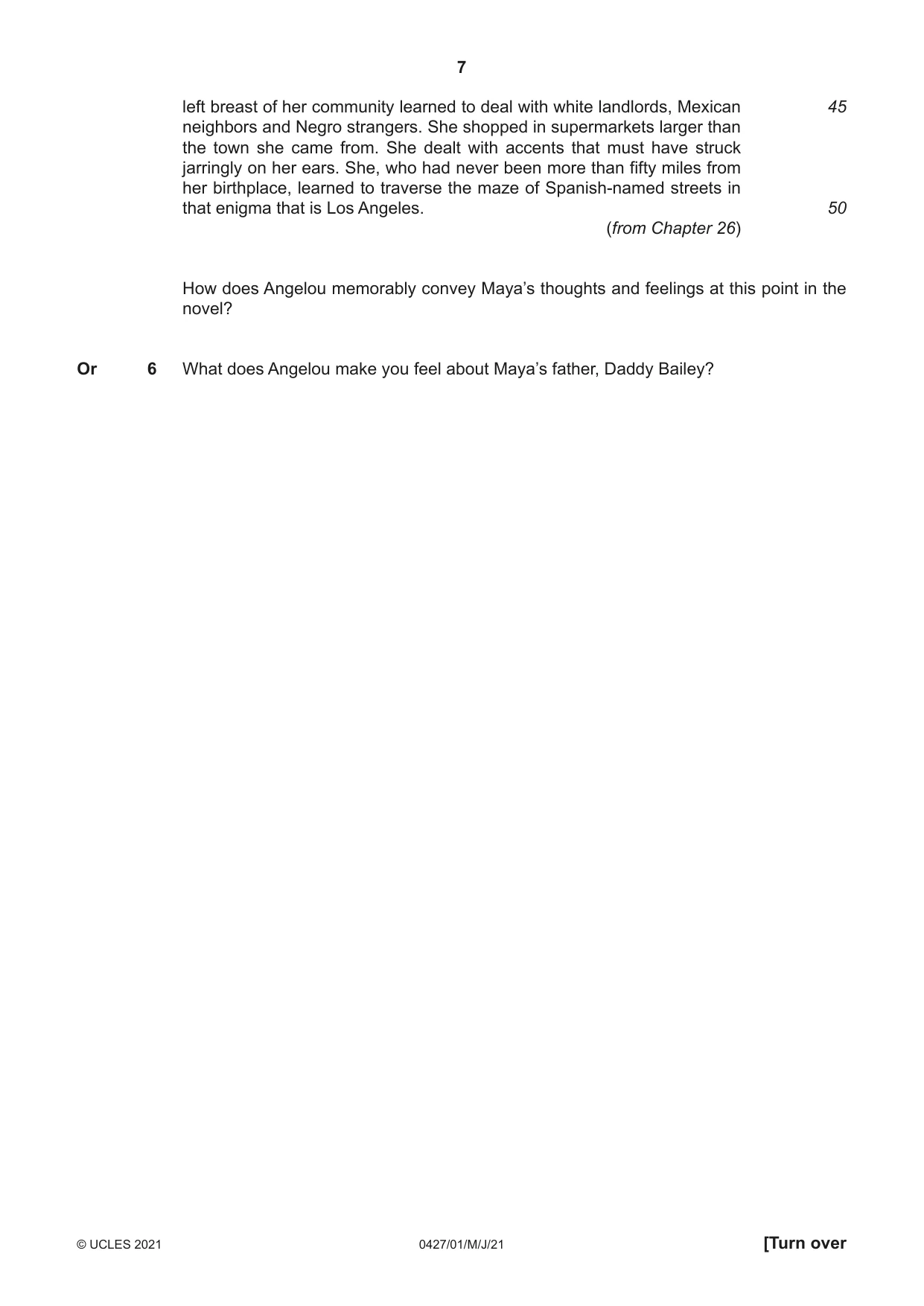
7 0427/01/M/J/21 © UCLES 2021 [Turn over left breast of her community learned to deal with white landlords, Mexican neighbors and Negro strangers. She shopped in supermarkets larger than the town she came from. She dealt with accents that must have struck jarringly on her ears. She, who had never been more than fifty miles from her birthplace, learned to traverse the maze of Spanish-named streets in that enigma that is Los Angeles. (from Chapter 26) How does Angelou memorably convey Maya’s thoughts and feelings at this point in the novel? Or 6 What does Angelou make you feel about Maya’s father, Daddy Bailey? 45 50
Question paper, page 8
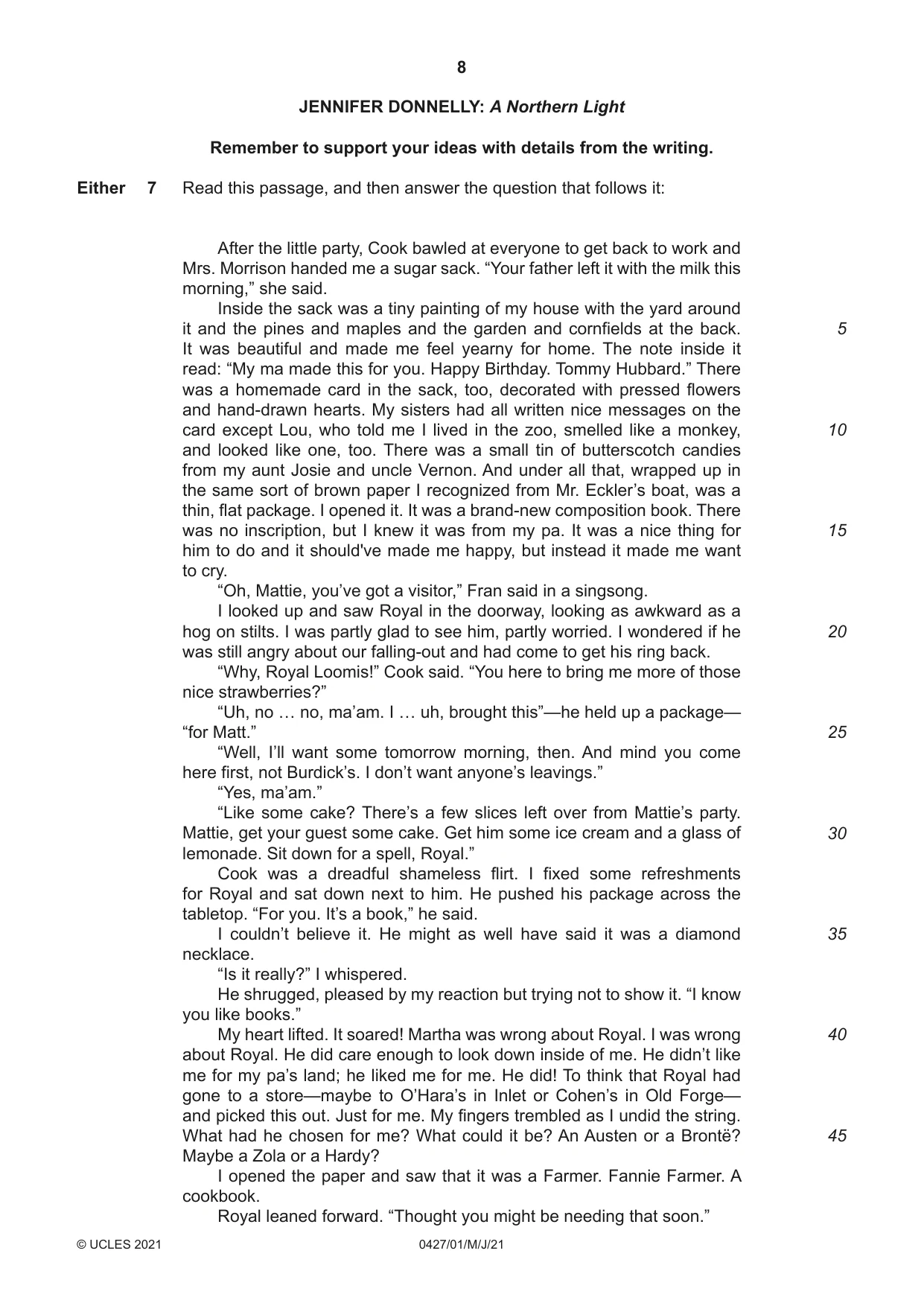
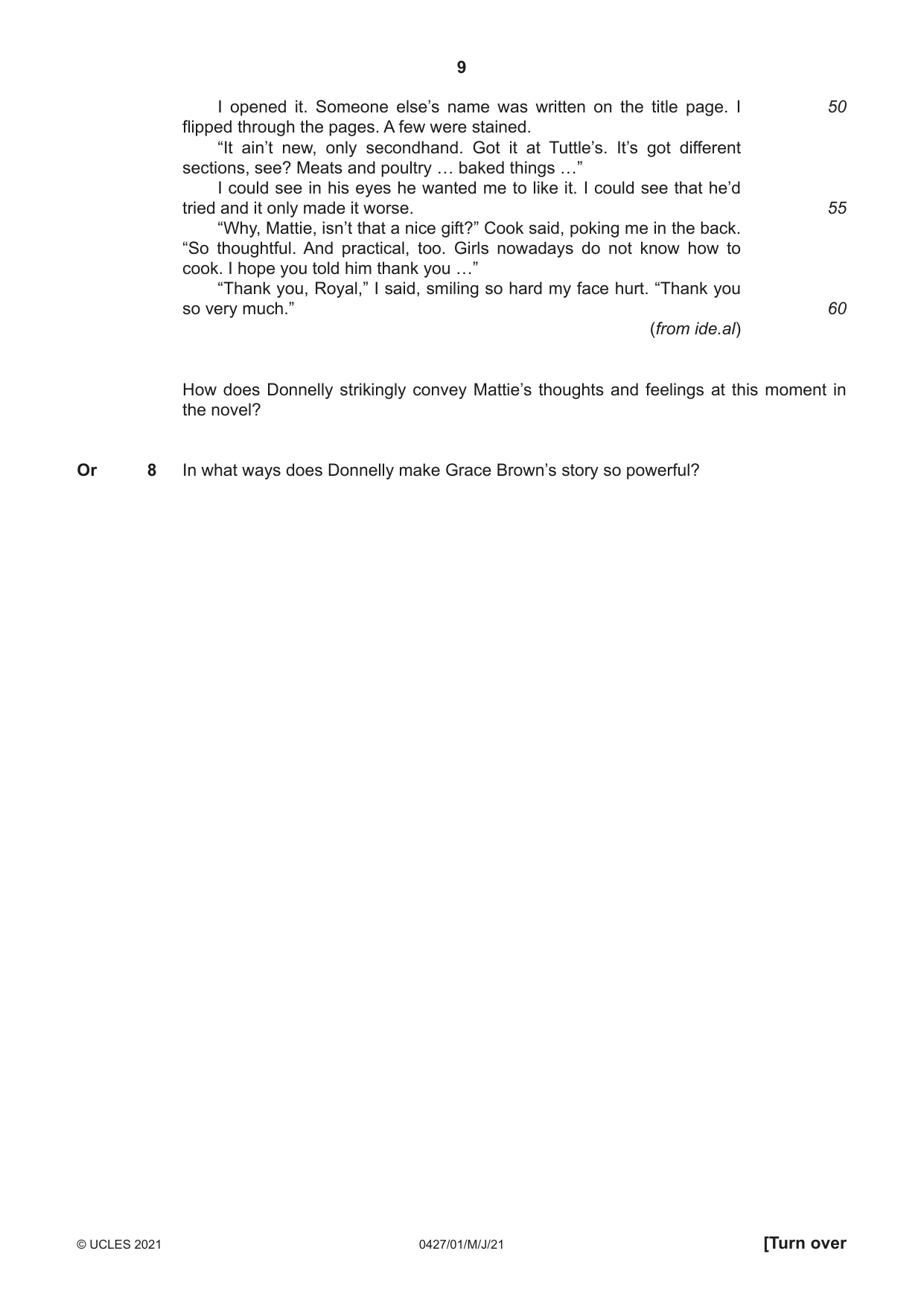
8 0427/01/M/J/21 © UCLES 2021 JENNIFER DONNELLY: A Northern Light Remember to support your ideas with details from the writing. Either 7 Read this passage, and then answer the question that follows it: After the little party, Cook bawled at everyone to get back to work and Mrs. Morrison handed me a sugar sack. “Your father left it with the milk this morning,” she said. Inside the sack was a tiny painting of my house with the yard around it and the pines and maples and the garden and cornfields at the back. It was beautiful and made me feel yearny for home. The note inside it read: “My ma made this for you. Happy Birthday. Tommy Hubbard.” There was a homemade card in the sack, too, decorated with pressed flowers and hand-drawn hearts. My sisters had all written nice messages on the card except Lou, who told me I lived in the zoo, smelled like a monkey, and looked like one, too. There was a small tin of butterscotch candies from my aunt Josie and uncle Vernon. And under all that, wrapped up in the same sort of brown paper I recognized from Mr. Eckler’s boat, was a thin, flat package. I opened it. It was a brand-new composition book. There was no inscription, but I knew it was from my pa. It was a nice thing for him to do and it should've made me happy, but instead it made me want to cry. “Oh, Mattie, you’ve got a visitor,” Fran said in a singsong. I looked up and saw Royal in the doorway, looking as awkward as a hog on stilts. I was partly glad to see him, partly worried. I wondered if he was still angry about our falling-out and had come to get his ring back. “Why, Royal Loomis!” Cook said. “You here to bring me more of those nice strawberries?” “Uh, no … no, ma’am. I … uh, brought this”—he held up a package— “for Matt.” “Well, I’ll want some tomorrow morning, then. And mind you come here first, not Burdick’s. I don’t want anyone’s leavings.” “Yes, ma’am.” “Like some cake? There’s a few slices left over from Mattie’s party. Mattie, get your guest some cake. Get him some ice cream and a glass of lemonade. Sit down for a spell, Royal.” Cook was a dreadful shameless flirt. I fixed some refreshments for Royal and sat down next to him. He pushed his package across the tabletop. “For you. It’s a book,” he said. I couldn’t believe it. He might as well have said it was a diamond necklace. “Is it really?” I whispered. He shrugged, pleased by my reaction but trying not to show it. “I know you like books.” My heart lifted. It soared! Martha was wrong about Royal. I was wrong about Royal. He did care enough to look down inside of me. He didn’t like me for my pa’s land; he liked me for me. He did! To think that Royal had gone to a store—maybe to O’Hara’s in Inlet or Cohen’s in Old Forge— and picked this out. Just for me. My fingers trembled as I undid the string. What had he chosen for me? What could it be? An Austen or a Brontë? Maybe a Zola or a Hardy? I opened the paper and saw that it was a Farmer. Fannie Farmer. A cookbook. Royal leaned forward. “Thought you might be needing that soon.” 5 10 15 20 25 30 35 40 45
Question paper, page 9
9 0427/01/M/J/21 © UCLES 2021 [Turn over I opened it. Someone else’s name was written on the title page. I flipped through the pages. A few were stained. “It ain’t new, only secondhand. Got it at Tuttle’s. It’s got different sections, see? Meats and poultry … baked things …” I could see in his eyes he wanted me to like it. I could see that he’d tried and it only made it worse. “Why, Mattie, isn’t that a nice gift?” Cook said, poking me in the back. “So thoughtful. And practical, too. Girls nowadays do not know how to cook. I hope you told him thank you …” “Thank you, Royal,” I said, smiling so hard my face hurt. “Thank you so very much.” (from ide.al) How does Donnelly strikingly convey Mattie’s thoughts and feelings at this moment in the novel? Or 8 In what ways does Donnelly make Grace Brown’s story so powerful? 50 55 60
Question paper, page 10
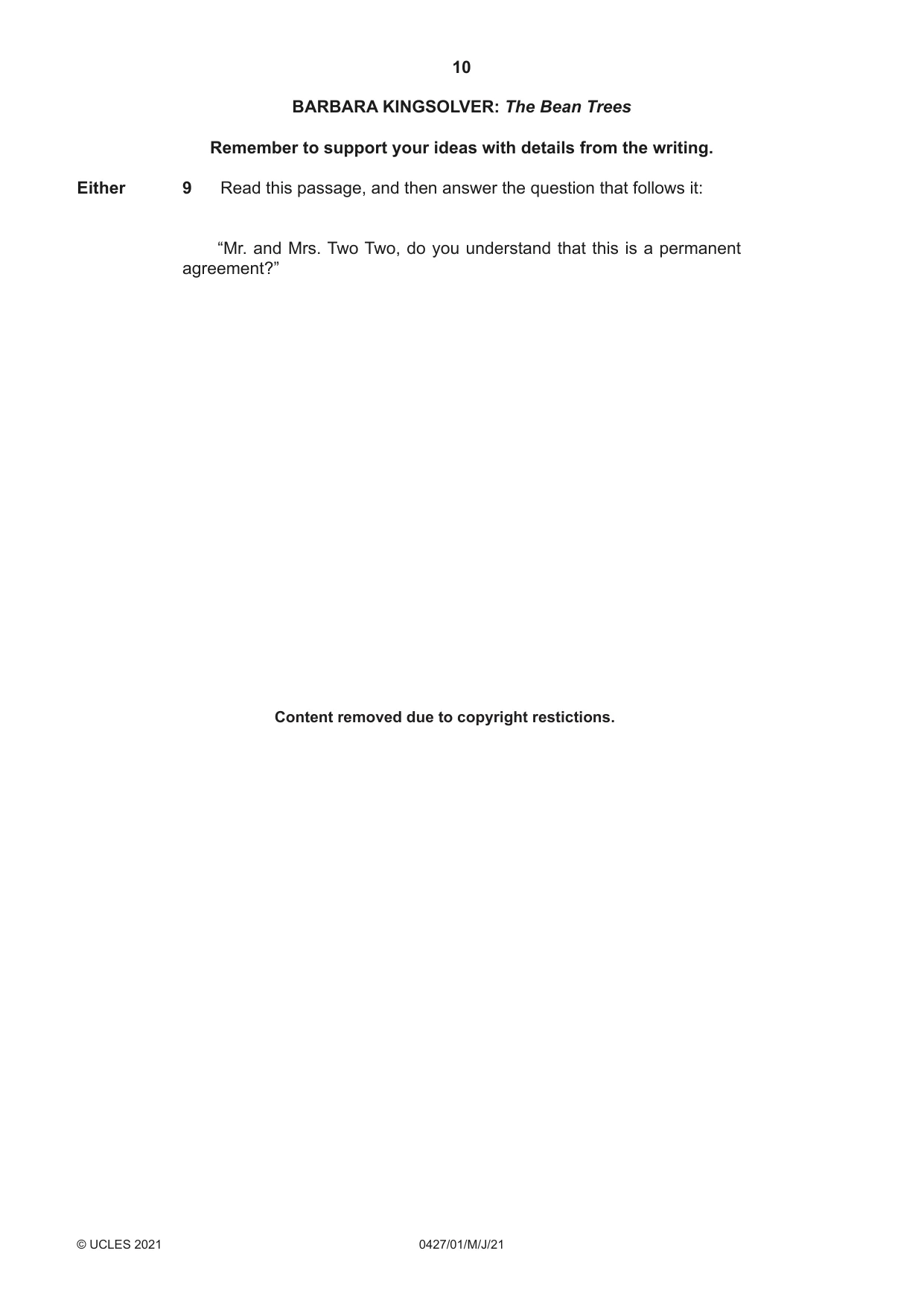
10 0427/01/M/J/21 © UCLES 2021 BARBARA KINGSOLVER: The Bean Trees Remember to support your ideas with details from the writing. Either 9 Read this passage, and then answer the question that follows it: “Mr. and Mrs. Two Two, do you understand that this is a permanent agreement?” Content removed due to copyright restictions.
Question paper, page 11
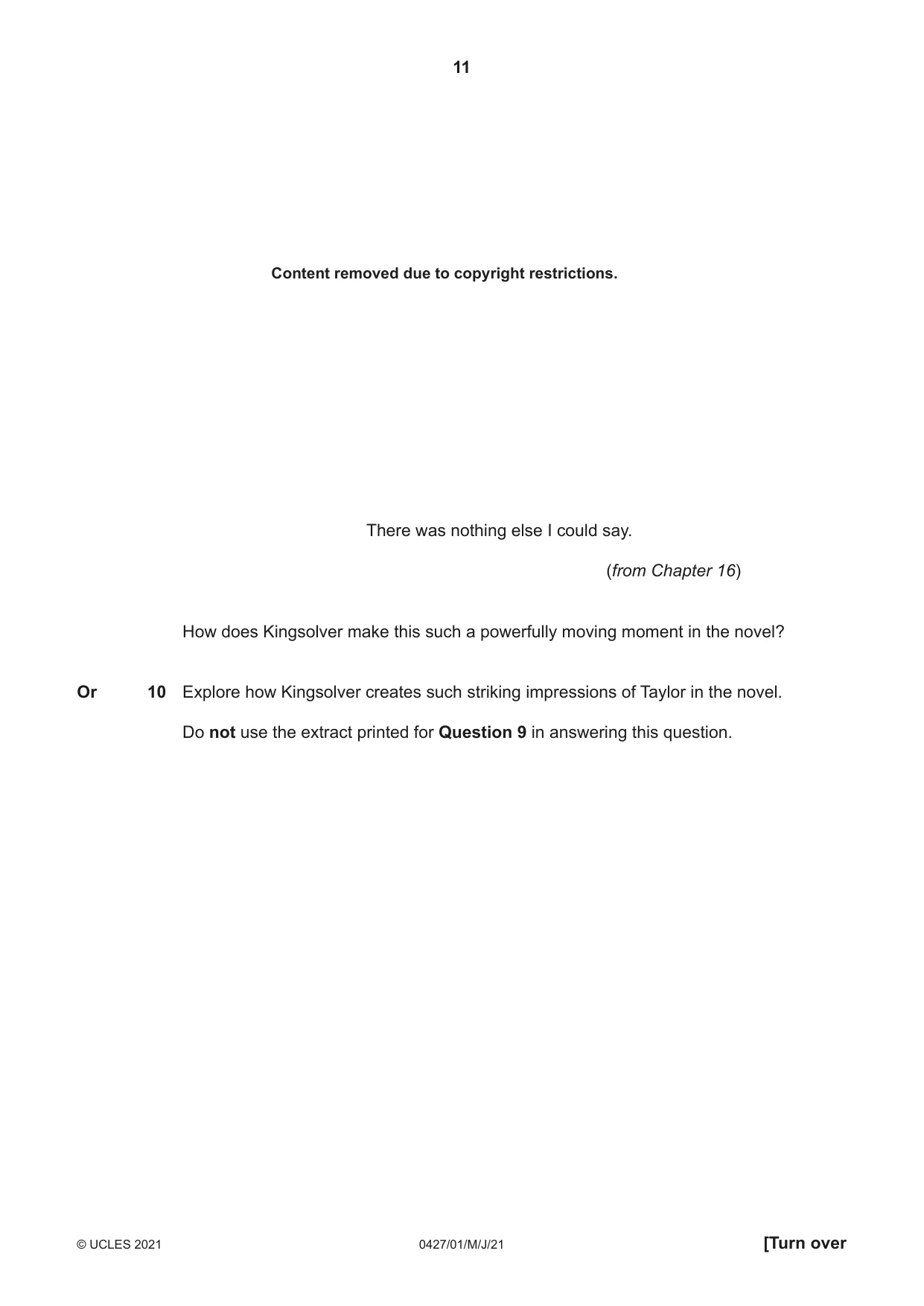
11 0427/01/M/J/21 © UCLES 2021 [Turn over There was nothing else I could say. (from Chapter 16) How does Kingsolver make this such a powerfully moving moment in the novel? Or 10 Explore how Kingsolver creates such striking impressions of Taylor in the novel. Do not use the extract printed for Question 9 in answering this question. Content removed due to copyright restrictions.
Question paper, page 12
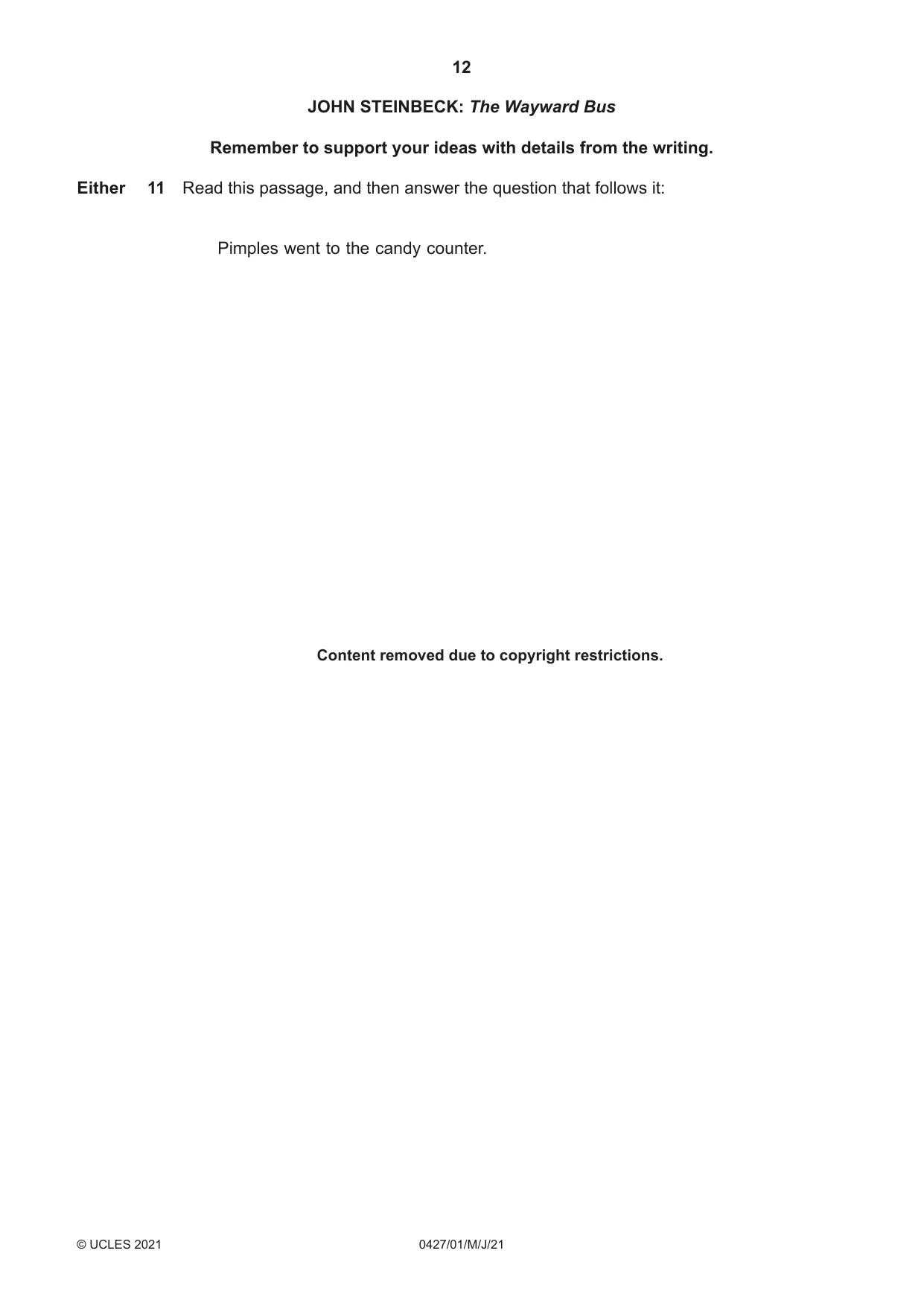
12 0427/01/M/J/21 © UCLES 2021 JOHN STEINBECK: The Wayward Bus Remember to support your ideas with details from the writing. Either 11 Read this passage, and then answer the question that follows it: Pimples went to the candy counter. Content removed due to copyright restrictions.
Question paper, page 13
13 0427/01/M/J/21 © UCLES 2021 [Turn over “And you would too,” he said. (from Chapter 13) What does Steinbeck’s writing make you feel at this moment in the novel? Or 12 Explore how Steinbeck memorably portrays hopes and dreams of a better life in The Wayward Bus. Do not use the extract printed for Question 11 in answering this question. Content removed due to copyright restrictions.
Question paper, page 14
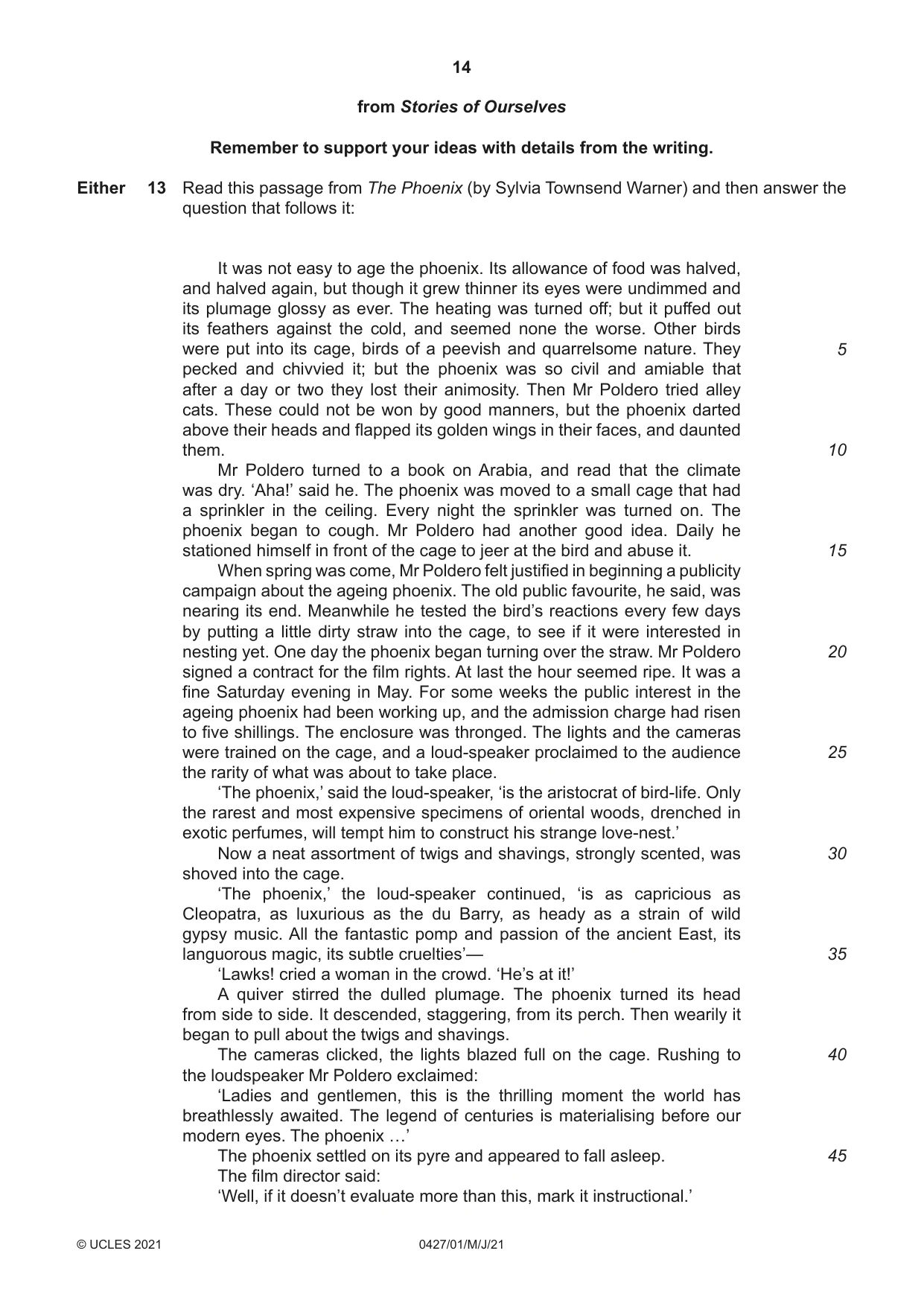
14 0427/01/M/J/21 © UCLES 2021 from Stories of Ourselves Remember to support your ideas with details from the writing. Either 13 Read this passage from The Phoenix (by Sylvia Townsend Warner) and then answer the question that follows it: It was not easy to age the phoenix. Its allowance of food was halved, and halved again, but though it grew thinner its eyes were undimmed and its plumage glossy as ever. The heating was turned off; but it puffed out its feathers against the cold, and seemed none the worse. Other birds were put into its cage, birds of a peevish and quarrelsome nature. They pecked and chivvied it; but the phoenix was so civil and amiable that after a day or two they lost their animosity. Then Mr Poldero tried alley cats. These could not be won by good manners, but the phoenix darted above their heads and flapped its golden wings in their faces, and daunted them. Mr Poldero turned to a book on Arabia, and read that the climate was dry. ‘Aha!’ said he. The phoenix was moved to a small cage that had a sprinkler in the ceiling. Every night the sprinkler was turned on. The phoenix began to cough. Mr Poldero had another good idea. Daily he stationed himself in front of the cage to jeer at the bird and abuse it. When spring was come, Mr Poldero felt justified in beginning a publicity campaign about the ageing phoenix. The old public favourite, he said, was nearing its end. Meanwhile he tested the bird’s reactions every few days by putting a little dirty straw into the cage, to see if it were interested in nesting yet. One day the phoenix began turning over the straw. Mr Poldero signed a contract for the film rights. At last the hour seemed ripe. It was a fine Saturday evening in May. For some weeks the public interest in the ageing phoenix had been working up, and the admission charge had risen to five shillings. The enclosure was thronged. The lights and the cameras were trained on the cage, and a loud-speaker proclaimed to the audience the rarity of what was about to take place. ‘The phoenix,’ said the loud-speaker, ‘is the aristocrat of bird-life. Only the rarest and most expensive specimens of oriental woods, drenched in exotic perfumes, will tempt him to construct his strange love-nest.’ Now a neat assortment of twigs and shavings, strongly scented, was shoved into the cage. ‘The phoenix,’ the loud-speaker continued, ‘is as capricious as Cleopatra, as luxurious as the du Barry, as heady as a strain of wild gypsy music. All the fantastic pomp and passion of the ancient East, its languorous magic, its subtle cruelties’— ‘Lawks! cried a woman in the crowd. ‘He’s at it!’ A quiver stirred the dulled plumage. The phoenix turned its head from side to side. It descended, staggering, from its perch. Then wearily it began to pull about the twigs and shavings. The cameras clicked, the lights blazed full on the cage. Rushing to the loudspeaker Mr Poldero exclaimed: ‘Ladies and gentlemen, this is the thrilling moment the world has breathlessly awaited. The legend of centuries is materialising before our modern eyes. The phoenix …’ The phoenix settled on its pyre and appeared to fall asleep. The film director said: ‘Well, if it doesn’t evaluate more than this, mark it instructional.’ 5 10 15 20 25 30 35 40 45
Question paper, page 15
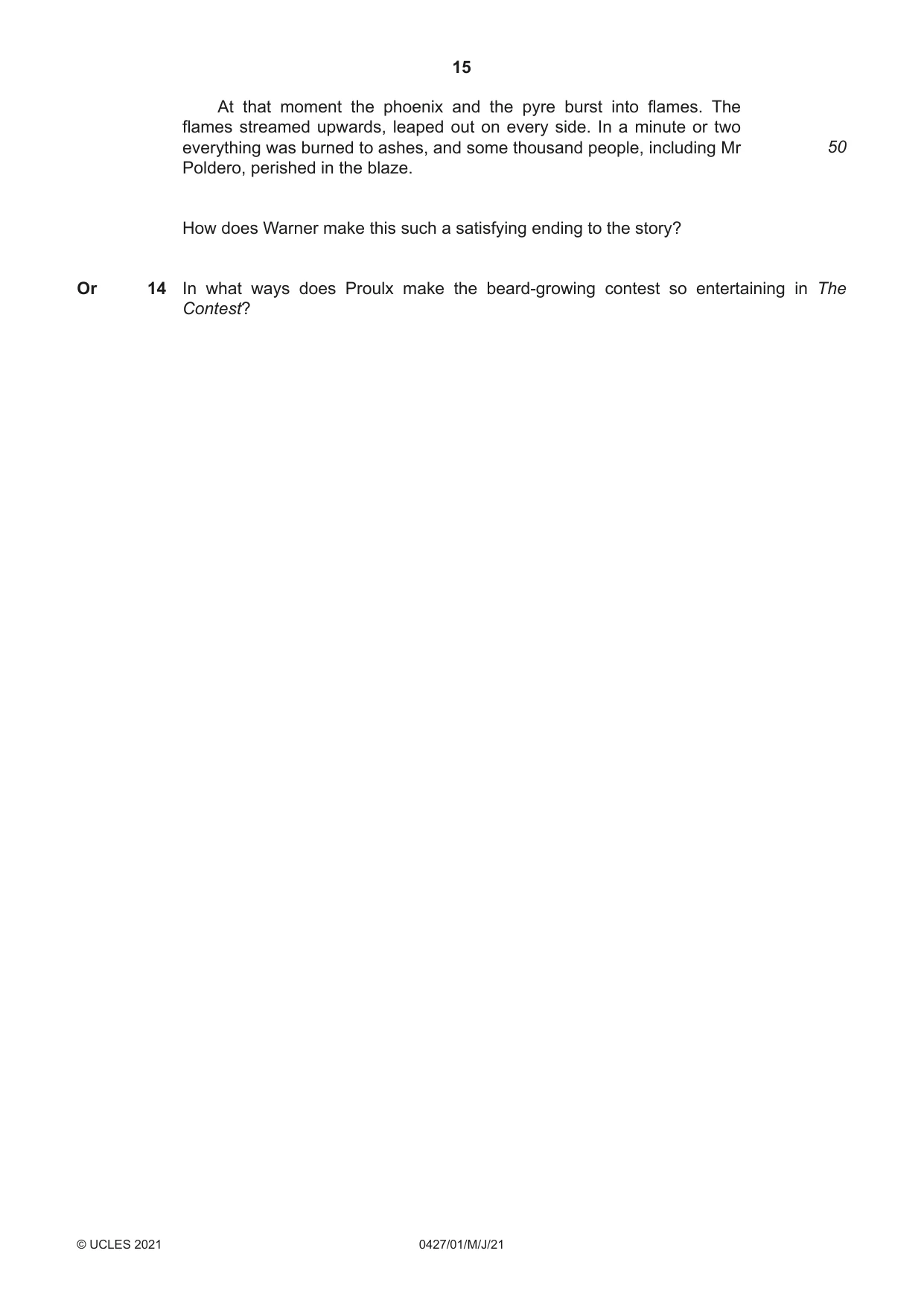
15 0427/01/M/J/21 © UCLES 2021 At that moment the phoenix and the pyre burst into flames. The flames streamed upwards, leaped out on every side. In a minute or two everything was burned to ashes, and some thousand people, including Mr Poldero, perished in the blaze. How does Warner make this such a satisfying ending to the story? Or 14 In what ways does Proulx make the beard-growing contest so entertaining in The Contest? 50
Question paper, page 16
16 0427/01/M/J/21 © UCLES 2021 Permission to reproduce items where third-party owned material protected by copyright is included has been sought and cleared where possible. Every reasonable effort has been made by the publisher (UCLES) to trace copyright holders, but if any items requiring clearance have unwittingly been included, the publisher will be pleased to make amends at the earliest possible opportunity. To avoid the issue of disclosure of answer-related information to candidates, all copyright acknowledgements are reproduced online in the Cambridge Assessment International Education Copyright Acknowledgements Booklet. This is produced for each series of examinations and is freely available to download at www.cambridgeinternational.org after the live examination series. Cambridge Assessment International Education is part of the Cambridge Assessment Group. Cambridge Assessment is the brand name of the University of Cambridge Local Examinations Syndicate (UCLES), which itself is a department of the University of Cambridge. BLANK PAGE