Cambridge IGCSE English - Literature (BES) 0427 — 2021 Oct/Nov Paper 1 · Variant 0
0427/10/O/N/21 · 50 marks · ≈56 min
The question paper and its mark scheme, free to read here and free to download. This is Cambridge’s own paper, exactly as it was sat.
Question paper16 pages




Mark scheme
No mark scheme is in the library for this paper.
Paper as text
Question paper, page 1
This document has 16 pages. Any blank pages are indicated. Cambridge IGCSE™ * 2 1 5 0 4 2 5 1 9 3 * DC (RCL (DF)) 200129/1 © UCLES 2021 [Turn over LITERATURE (ENGLISH) (US) 0427/01 Paper 1 Poetry and Prose October/November 2021 1 hour 30 minutes You must answer on the enclosed answer booklet. You will need: Answer booklet (enclosed) INSTRUCTIONS ● Answer two questions in total: Section A: answer one question. Section B: answer one question. ● Follow the instructions on the front cover of the answer booklet. If you need additional answer paper, ask the invigilator for a continuation booklet. INFORMATION ● The total mark for this paper is 50. ● All questions are worth equal marks.
Question paper, page 2
2 0427/01/O/N/21 © UCLES 2021 SECTION A: POETRY Answer one question from this section. ROBERT FROST: The Robert Frost Collection Remember to support your ideas with details from the writing. Either 1 Read this poem, and then answer the question that follows it: The Sound of the Trees I wonder about the trees. But I shall be gone. How does Frost use striking words and images in this poem? Content removed due to copyright restrictions.
Question paper, page 3
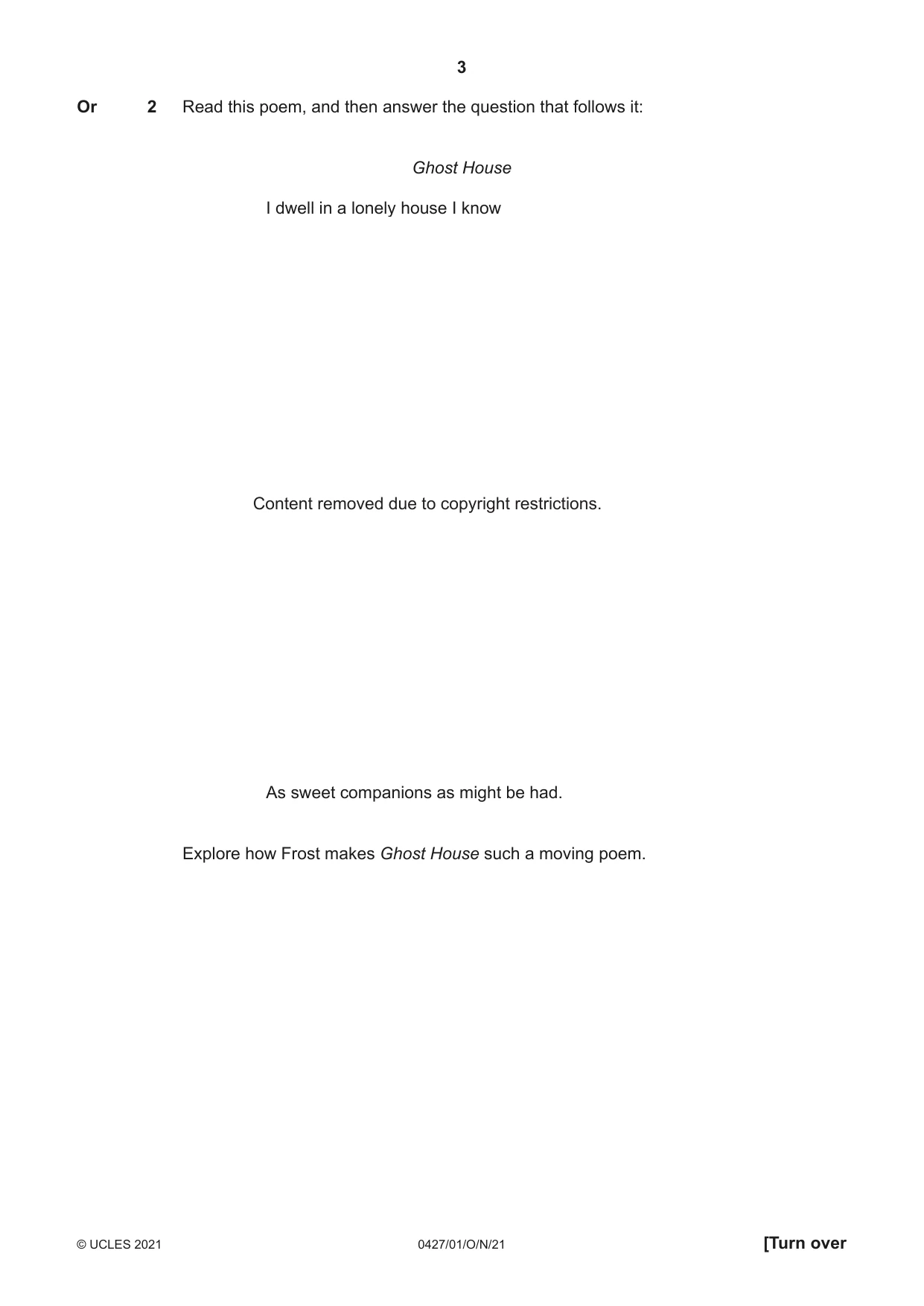
3 0427/01/O/N/21 © UCLES 2021 [Turn over Or 2 Read this poem, and then answer the question that follows it: Ghost House I dwell in a lonely house I know As sweet companions as might be had. Explore how Frost makes Ghost House such a moving poem. Content removed due to copyright restrictions.
Question paper, page 4
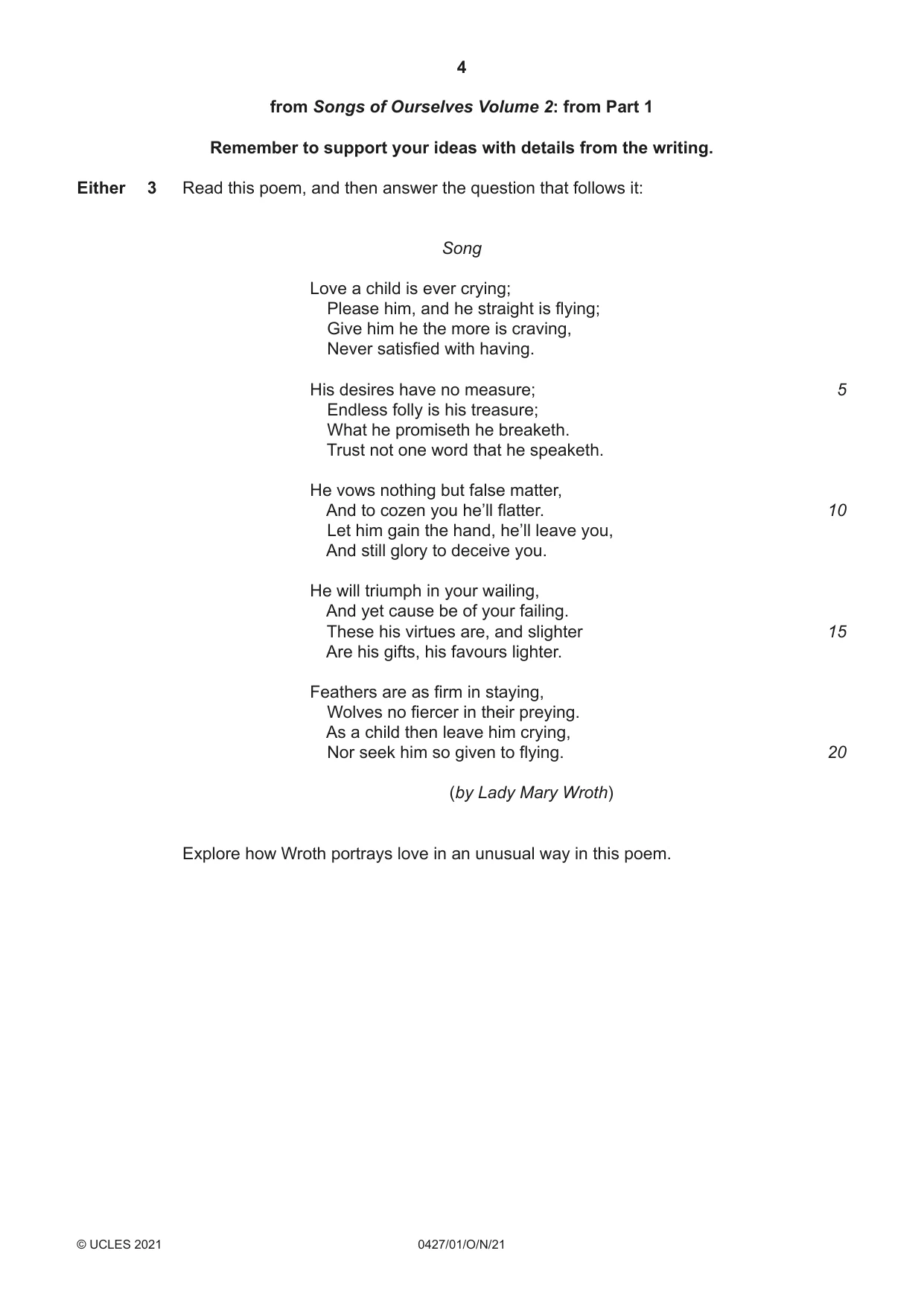
4 0427/01/O/N/21 © UCLES 2021 from Songs of Ourselves Volume 2: from Part 1 Remember to support your ideas with details from the writing. Either 3 Read this poem, and then answer the question that follows it: Song Love a child is ever crying; Please him, and he straight is flying; Give him he the more is craving, Never satisfied with having. His desires have no measure; Endless folly is his treasure; What he promiseth he breaketh. Trust not one word that he speaketh. He vows nothing but false matter, And to cozen you he’ll flatter. Let him gain the hand, he’ll leave you, And still glory to deceive you. He will triumph in your wailing, And yet cause be of your failing. These his virtues are, and slighter Are his gifts, his favours lighter. Feathers are as firm in staying, Wolves no fiercer in their preying. As a child then leave him crying, Nor seek him so given to flying. (by Lady Mary Wroth) Explore how Wroth portrays love in an unusual way in this poem. 5 10 15 20
Question paper, page 5
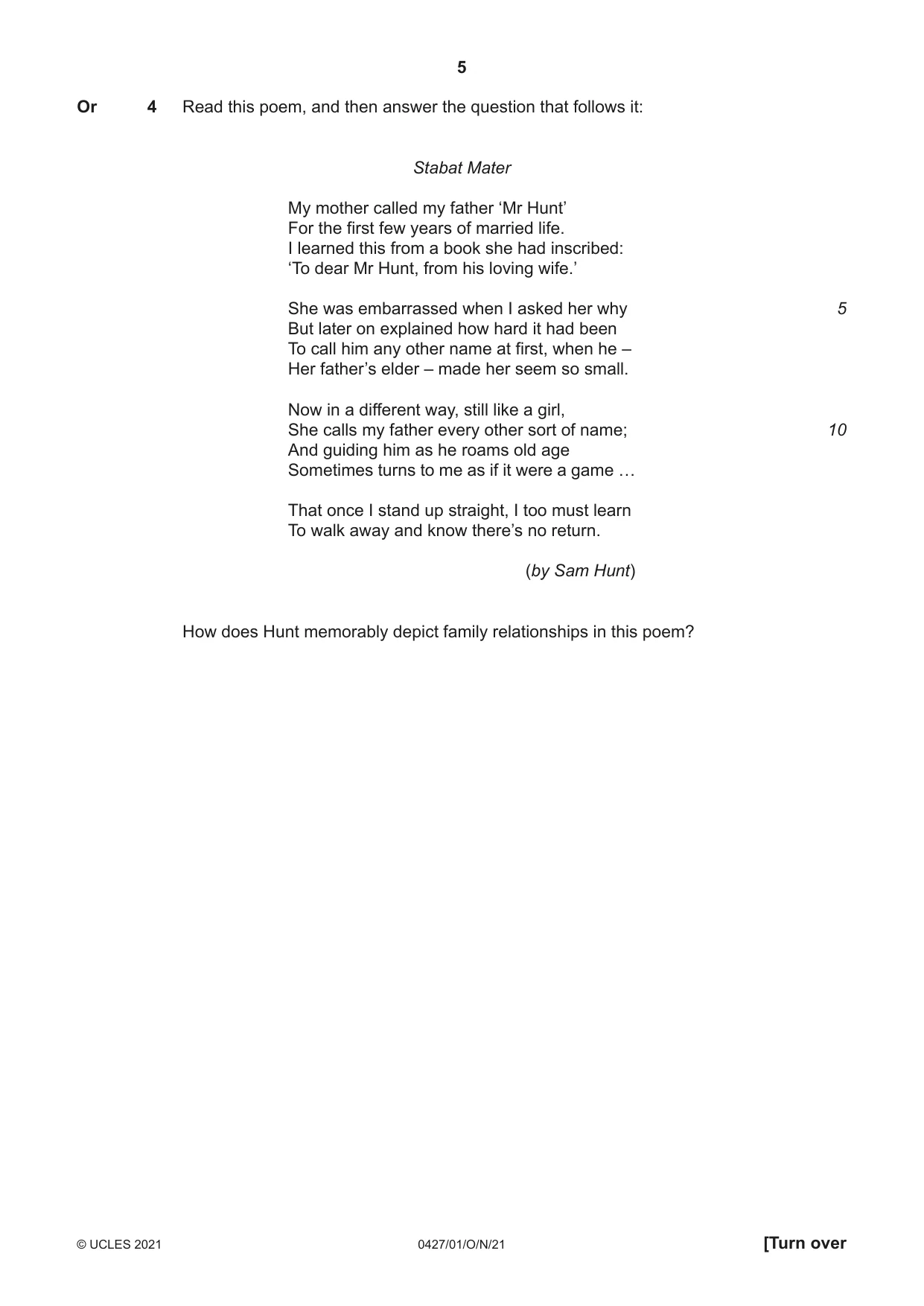
5 0427/01/O/N/21 © UCLES 2021 [Turn over Or 4 Read this poem, and then answer the question that follows it: Stabat Mater My mother called my father ‘Mr Hunt’ For the first few years of married life. I learned this from a book she had inscribed: ‘To dear Mr Hunt, from his loving wife.’ She was embarrassed when I asked her why But later on explained how hard it had been To call him any other name at first, when he – Her father’s elder – made her seem so small. Now in a different way, still like a girl, She calls my father every other sort of name; And guiding him as he roams old age Sometimes turns to me as if it were a game … That once I stand up straight, I too must learn To walk away and know there’s no return. (by Sam Hunt) How does Hunt memorably depict family relationships in this poem? 5 10
Question paper, page 6
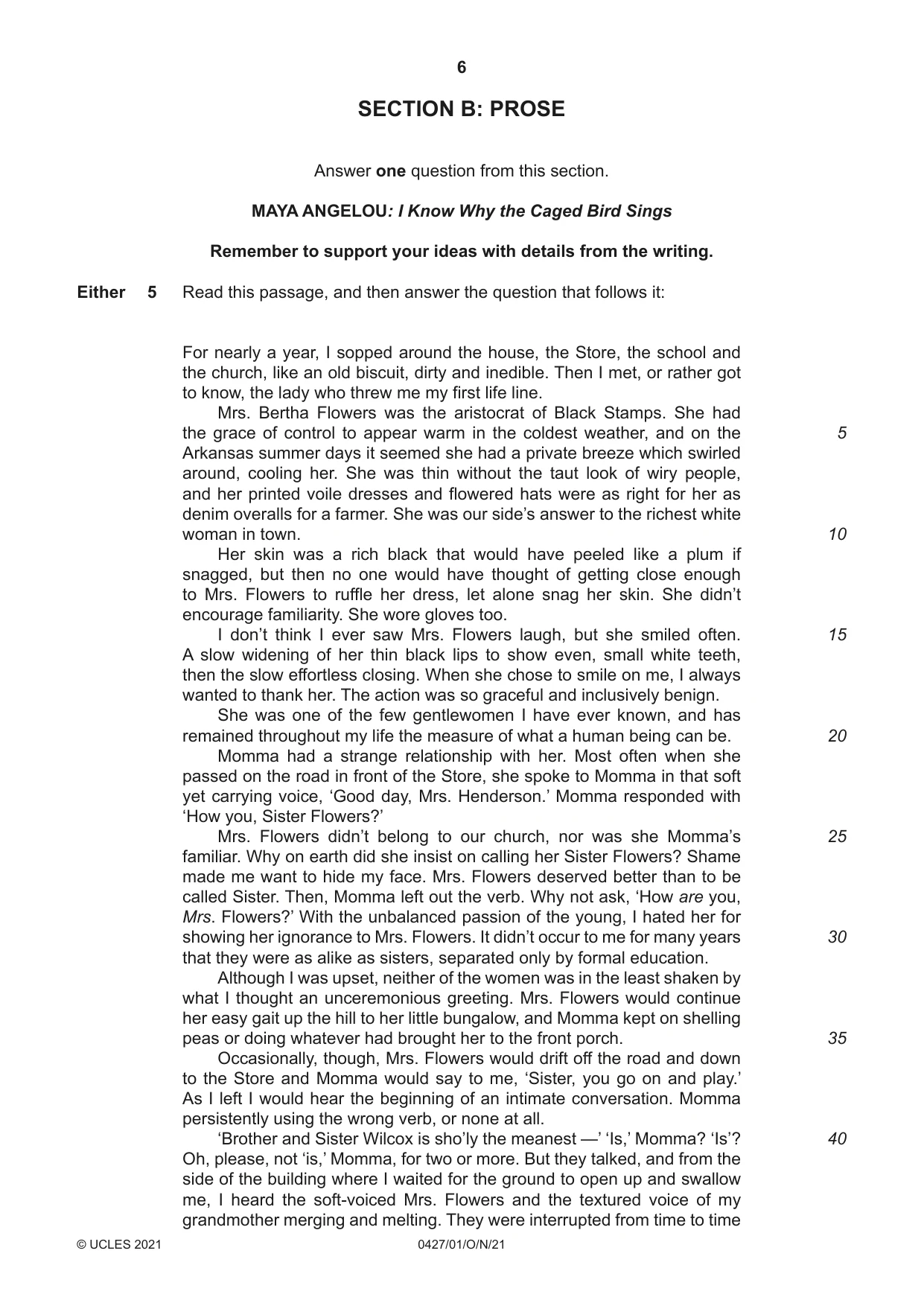
6 0427/01/O/N/21 © UCLES 2021 SECTION B: PROSE Answer one question from this section. MAYA ANGELOU: I Know Why the Caged Bird Sings Remember to support your ideas with details from the writing. Either 5 Read this passage, and then answer the question that follows it: For nearly a year, I sopped around the house, the Store, the school and the church, like an old biscuit, dirty and inedible. Then I met, or rather got to know, the lady who threw me my first life line. Mrs. Bertha Flowers was the aristocrat of Black Stamps. She had the grace of control to appear warm in the coldest weather, and on the Arkansas summer days it seemed she had a private breeze which swirled around, cooling her. She was thin without the taut look of wiry people, and her printed voile dresses and flowered hats were as right for her as denim overalls for a farmer. She was our side’s answer to the richest white woman in town. Her skin was a rich black that would have peeled like a plum if snagged, but then no one would have thought of getting close enough to Mrs. Flowers to ruffle her dress, let alone snag her skin. She didn’t encourage familiarity. She wore gloves too. I don’t think I ever saw Mrs. Flowers laugh, but she smiled often. A slow widening of her thin black lips to show even, small white teeth, then the slow effortless closing. When she chose to smile on me, I always wanted to thank her. The action was so graceful and inclusively benign. She was one of the few gentlewomen I have ever known, and has remained throughout my life the measure of what a human being can be. Momma had a strange relationship with her. Most often when she passed on the road in front of the Store, she spoke to Momma in that soft yet carrying voice, ‘Good day, Mrs. Henderson.’ Momma responded with ‘How you, Sister Flowers?’ Mrs. Flowers didn’t belong to our church, nor was she Momma’s familiar. Why on earth did she insist on calling her Sister Flowers? Shame made me want to hide my face. Mrs. Flowers deserved better than to be called Sister. Then, Momma left out the verb. Why not ask, ‘How are you, Mrs. Flowers?’ With the unbalanced passion of the young, I hated her for showing her ignorance to Mrs. Flowers. It didn’t occur to me for many years that they were as alike as sisters, separated only by formal education. Although I was upset, neither of the women was in the least shaken by what I thought an unceremonious greeting. Mrs. Flowers would continue her easy gait up the hill to her little bungalow, and Momma kept on shelling peas or doing whatever had brought her to the front porch. Occasionally, though, Mrs. Flowers would drift off the road and down to the Store and Momma would say to me, ‘Sister, you go on and play.’ As I left I would hear the beginning of an intimate conversation. Momma persistently using the wrong verb, or none at all. ‘Brother and Sister Wilcox is sho’ly the meanest —’ ‘Is,’ Momma? ‘Is’? Oh, please, not ‘is,’ Momma, for two or more. But they talked, and from the side of the building where I waited for the ground to open up and swallow me, I heard the soft-voiced Mrs. Flowers and the textured voice of my grandmother merging and melting. They were interrupted from time to time 5 10 15 20 25 30 35 40
Question paper, page 7
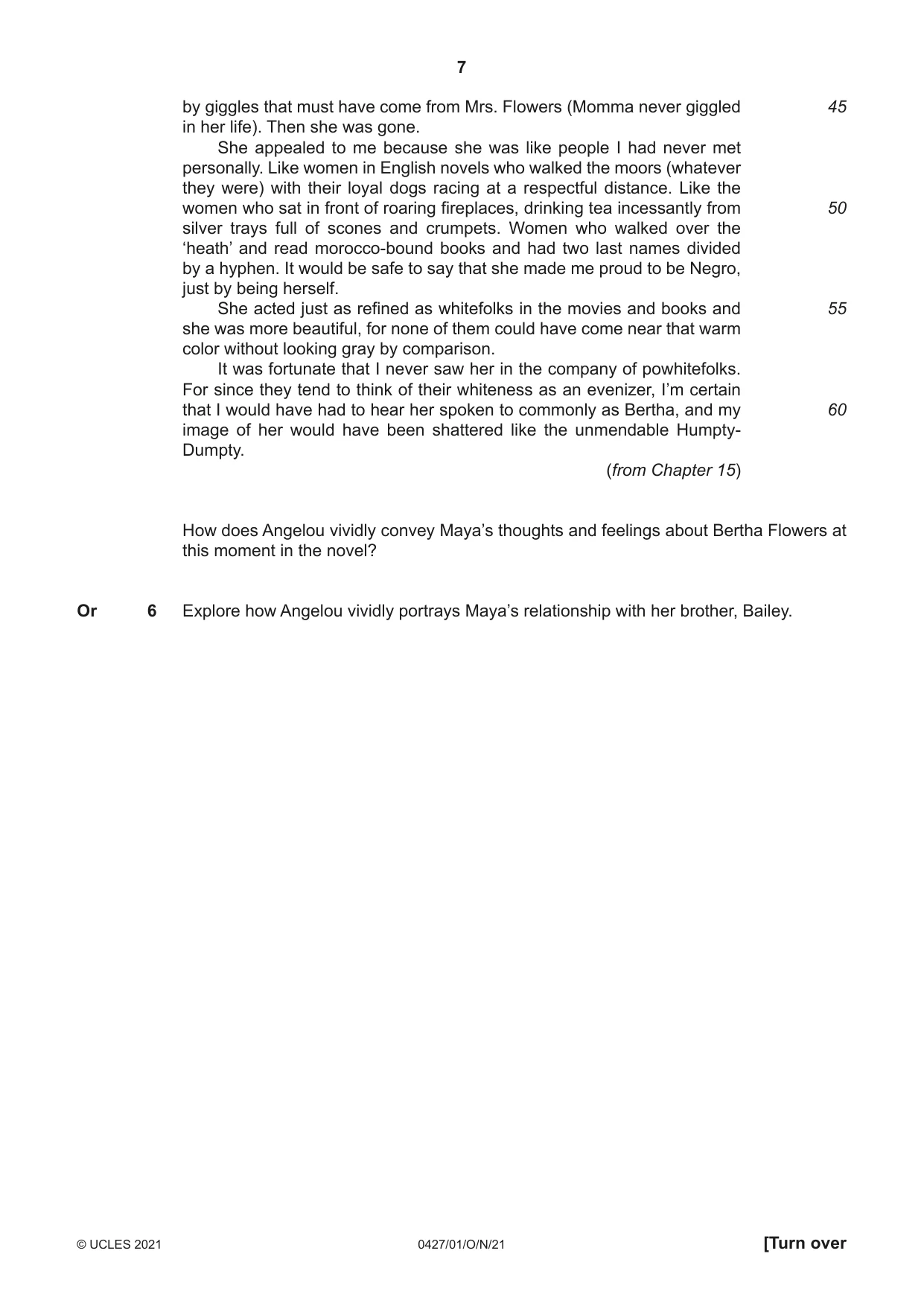
7 0427/01/O/N/21 © UCLES 2021 [Turn over by giggles that must have come from Mrs. Flowers (Momma never giggled in her life). Then she was gone. She appealed to me because she was like people I had never met personally. Like women in English novels who walked the moors (whatever they were) with their loyal dogs racing at a respectful distance. Like the women who sat in front of roaring fireplaces, drinking tea incessantly from silver trays full of scones and crumpets. Women who walked over the ‘heath’ and read morocco-bound books and had two last names divided by a hyphen. It would be safe to say that she made me proud to be Negro, just by being herself. She acted just as refined as whitefolks in the movies and books and she was more beautiful, for none of them could have come near that warm color without looking gray by comparison. It was fortunate that I never saw her in the company of powhitefolks. For since they tend to think of their whiteness as an evenizer, I’m certain that I would have had to hear her spoken to commonly as Bertha, and my image of her would have been shattered like the unmendable Humpty- Dumpty. (from Chapter 15) How does Angelou vividly convey Maya’s thoughts and feelings about Bertha Flowers at this moment in the novel? Or 6 Explore how Angelou vividly portrays Maya’s relationship with her brother, Bailey. 45 50 55 60
Question paper, page 8
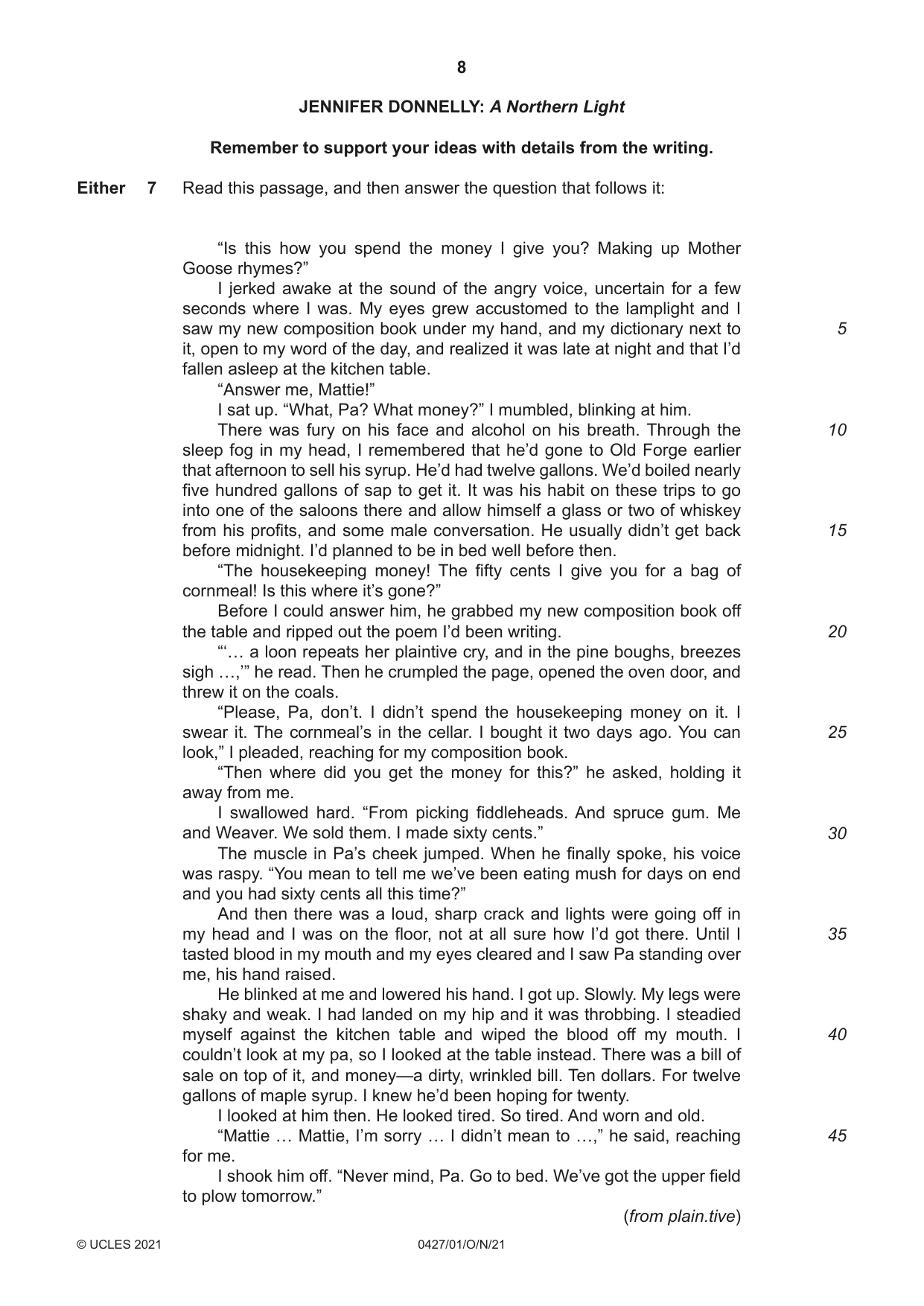
8 0427/01/O/N/21 © UCLES 2021 JENNIFER DONNELLY: A Northern Light Remember to support your ideas with details from the writing. Either 7 Read this passage, and then answer the question that follows it: “Is this how you spend the money I give you? Making up Mother Goose rhymes?” I jerked awake at the sound of the angry voice, uncertain for a few seconds where I was. My eyes grew accustomed to the lamplight and I saw my new composition book under my hand, and my dictionary next to it, open to my word of the day, and realized it was late at night and that I’d fallen asleep at the kitchen table. “Answer me, Mattie!” I sat up. “What, Pa? What money?” I mumbled, blinking at him. There was fury on his face and alcohol on his breath. Through the sleep fog in my head, I remembered that he’d gone to Old Forge earlier that afternoon to sell his syrup. He’d had twelve gallons. We’d boiled nearly five hundred gallons of sap to get it. It was his habit on these trips to go into one of the saloons there and allow himself a glass or two of whiskey from his profits, and some male conversation. He usually didn’t get back before midnight. I’d planned to be in bed well before then. “The housekeeping money! The fifty cents I give you for a bag of cornmeal! Is this where it’s gone?” Before I could answer him, he grabbed my new composition book off the table and ripped out the poem I’d been writing. “‘… a loon repeats her plaintive cry, and in the pine boughs, breezes sigh …,’” he read. Then he crumpled the page, opened the oven door, and threw it on the coals. “Please, Pa, don’t. I didn’t spend the housekeeping money on it. I swear it. The cornmeal’s in the cellar. I bought it two days ago. You can look,” I pleaded, reaching for my composition book. “Then where did you get the money for this?” he asked, holding it away from me. I swallowed hard. “From picking fiddleheads. And spruce gum. Me and Weaver. We sold them. I made sixty cents.” The muscle in Pa’s cheek jumped. When he finally spoke, his voice was raspy. “You mean to tell me we’ve been eating mush for days on end and you had sixty cents all this time?” And then there was a loud, sharp crack and lights were going off in my head and I was on the floor, not at all sure how I’d got there. Until I tasted blood in my mouth and my eyes cleared and I saw Pa standing over me, his hand raised. He blinked at me and lowered his hand. I got up. Slowly. My legs were shaky and weak. I had landed on my hip and it was throbbing. I steadied myself against the kitchen table and wiped the blood off my mouth. I couldn’t look at my pa, so I looked at the table instead. There was a bill of sale on top of it, and money—a dirty, wrinkled bill. Ten dollars. For twelve gallons of maple syrup. I knew he’d been hoping for twenty. I looked at him then. He looked tired. So tired. And worn and old. “Mattie … Mattie, I’m sorry … I didn’t mean to …,” he said, reaching for me. I shook him off. “Never mind, Pa. Go to bed. We’ve got the upper field to plow tomorrow.” (from plain.tive) 5 10 15 20 25 30 35 40 45
Question paper, page 9
9 0427/01/O/N/21 © UCLES 2021 [Turn over How does Donnelly make this such a shocking moment in the novel? Or 8 Explore how Donnelly strikingly portrays the need for freedom in A Northern Light.
Question paper, page 10
10 0427/01/O/N/21 © UCLES 2021 BARBARA KINGSOLVER: The Bean Trees Remember to support your ideas with details from the writing. Either 9 Read this passage, and then answer the question that follows it: There had been something of a scene between Esperanza and Turtle earlier that day. Content removed due to copyright restrictions.
Question paper, page 11
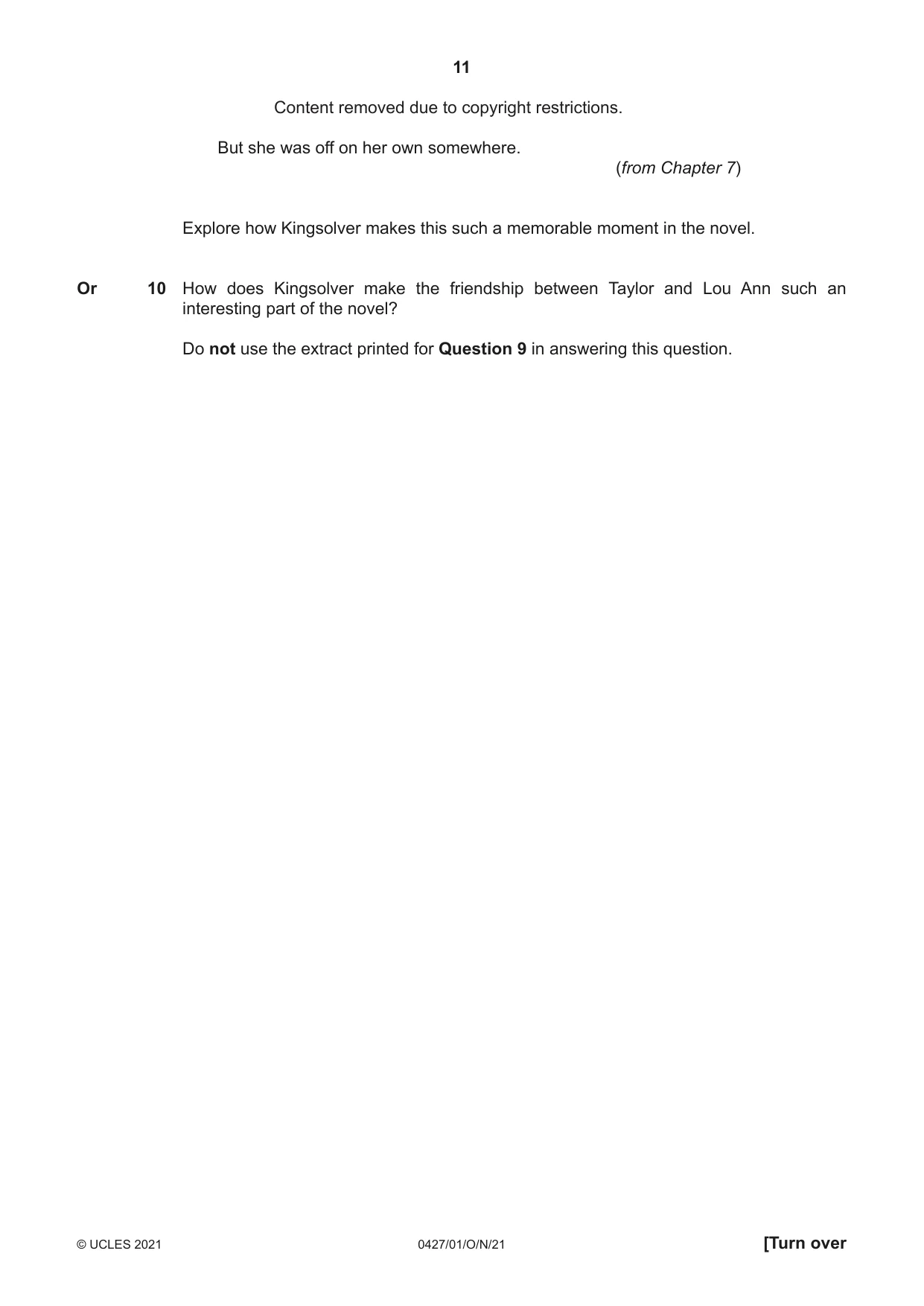
11 0427/01/O/N/21 © UCLES 2021 [Turn over But she was off on her own somewhere. (from Chapter 7) Explore how Kingsolver makes this such a memorable moment in the novel. Or 10 How does Kingsolver make the friendship between Taylor and Lou Ann such an interesting part of the novel? Do not use the extract printed for Question 9 in answering this question. Content removed due to copyright restrictions.
Question paper, page 12
12 0427/01/O/N/21 © UCLES 2021 JOHN STEINBECK: The Wayward Bus Remember to support your ideas with details from the writing. Either 11 Read this passage, and then answer the question that follows it: Alice Chicoy stood inside the screen door and watched the bus pull away. Content removed due to copyright restrictions.
Question paper, page 13
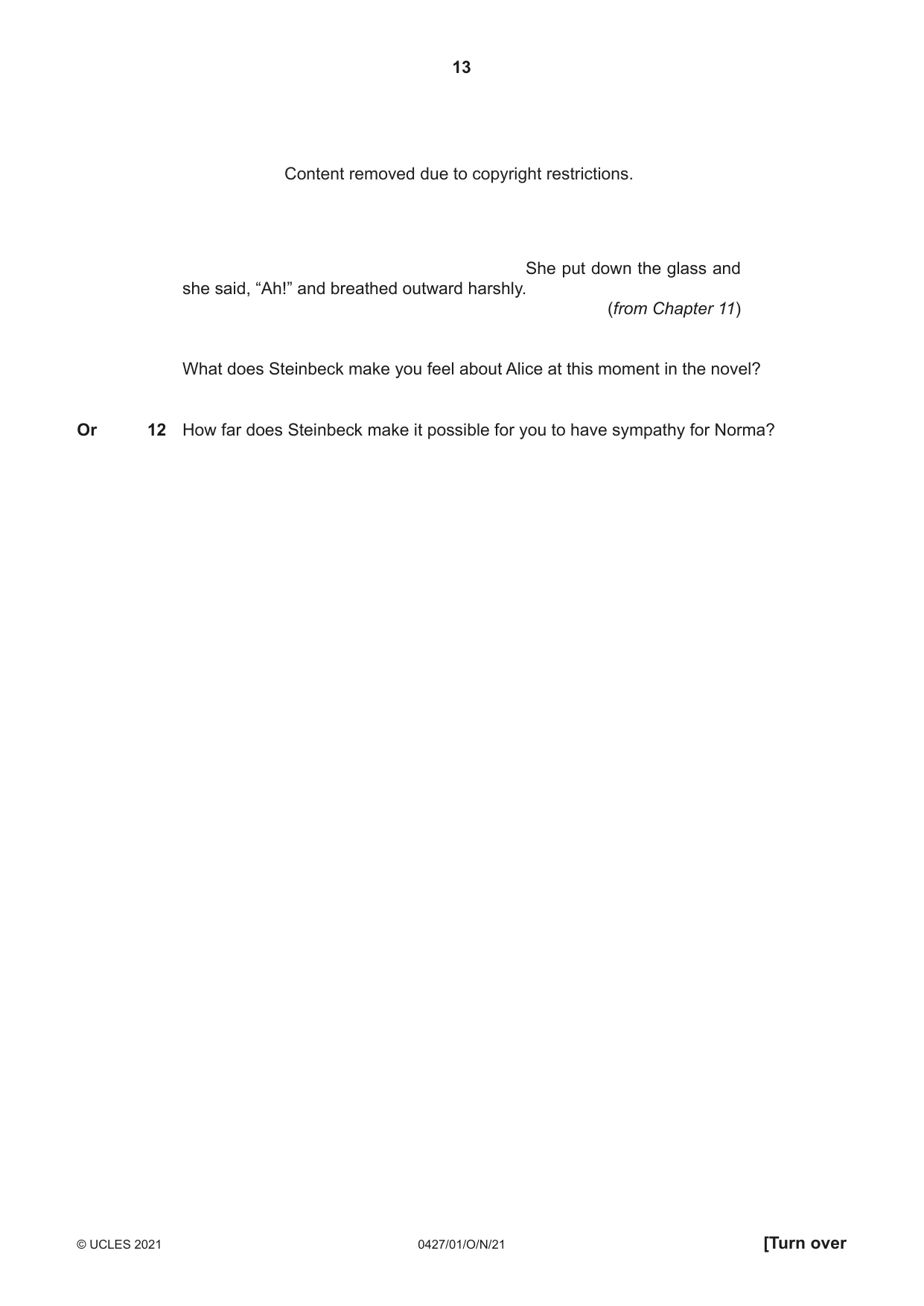
13 0427/01/O/N/21 © UCLES 2021 [Turn over She put down the glass and she said, “Ah!” and breathed outward harshly. (from Chapter 11) What does Steinbeck make you feel about Alice at this moment in the novel? Or 12 How far does Steinbeck make it possible for you to have sympathy for Norma? Content removed due to copyright restrictions.
Question paper, page 14
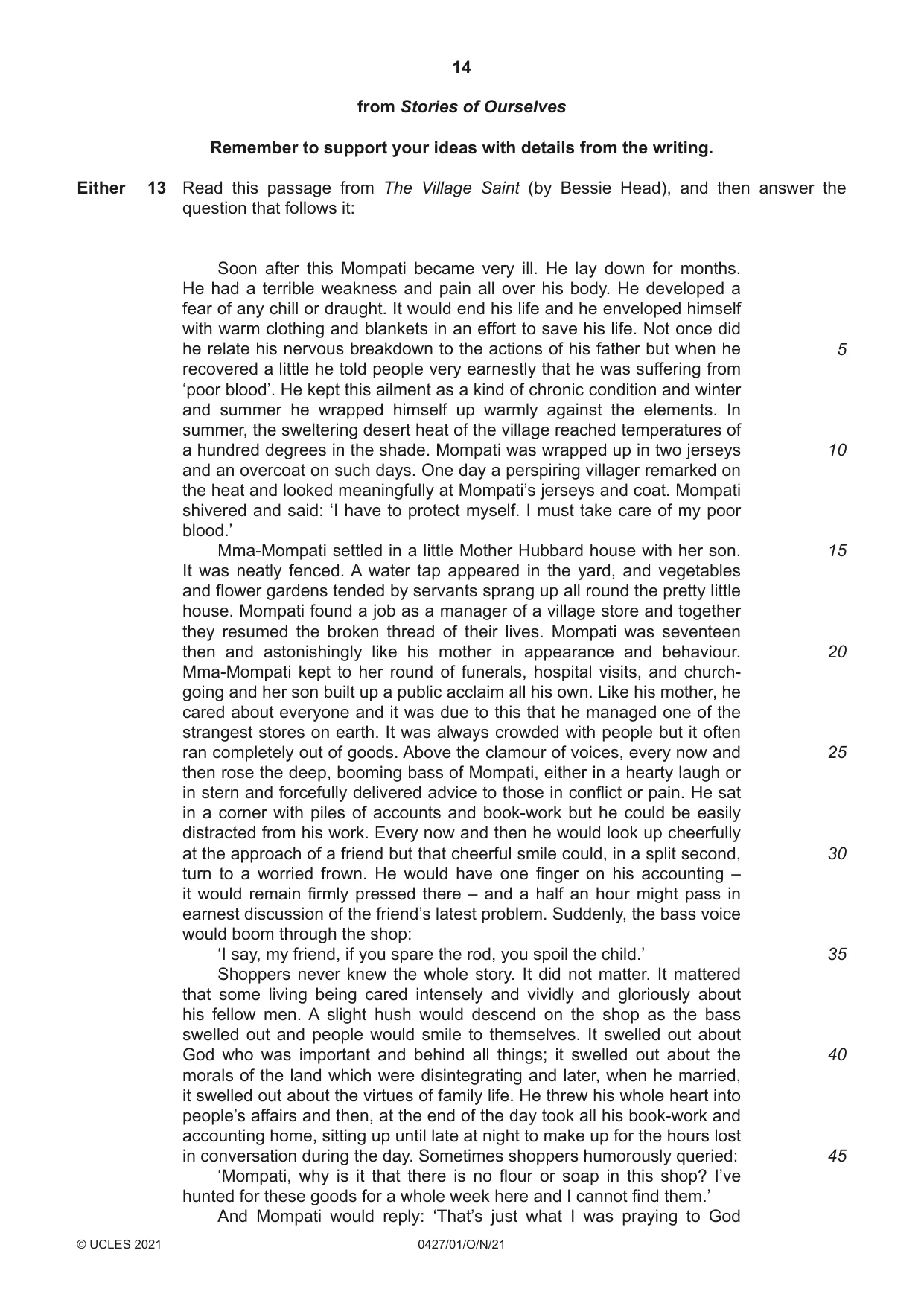
14 0427/01/O/N/21 © UCLES 2021 from Stories of Ourselves Remember to support your ideas with details from the writing. Either 13 Read this passage from The Village Saint (by Bessie Head), and then answer the question that follows it: Soon after this Mompati became very ill. He lay down for months. He had a terrible weakness and pain all over his body. He developed a fear of any chill or draught. It would end his life and he enveloped himself with warm clothing and blankets in an effort to save his life. Not once did he relate his nervous breakdown to the actions of his father but when he recovered a little he told people very earnestly that he was suffering from ‘poor blood’. He kept this ailment as a kind of chronic condition and winter and summer he wrapped himself up warmly against the elements. In summer, the sweltering desert heat of the village reached temperatures of a hundred degrees in the shade. Mompati was wrapped up in two jerseys and an overcoat on such days. One day a perspiring villager remarked on the heat and looked meaningfully at Mompati’s jerseys and coat. Mompati shivered and said: ‘I have to protect myself. I must take care of my poor blood.’ Mma-Mompati settled in a little Mother Hubbard house with her son. It was neatly fenced. A water tap appeared in the yard, and vegetables and flower gardens tended by servants sprang up all round the pretty little house. Mompati found a job as a manager of a village store and together they resumed the broken thread of their lives. Mompati was seventeen then and astonishingly like his mother in appearance and behaviour. Mma-Mompati kept to her round of funerals, hospital visits, and church- going and her son built up a public acclaim all his own. Like his mother, he cared about everyone and it was due to this that he managed one of the strangest stores on earth. It was always crowded with people but it often ran completely out of goods. Above the clamour of voices, every now and then rose the deep, booming bass of Mompati, either in a hearty laugh or in stern and forcefully delivered advice to those in conflict or pain. He sat in a corner with piles of accounts and book-work but he could be easily distracted from his work. Every now and then he would look up cheerfully at the approach of a friend but that cheerful smile could, in a split second, turn to a worried frown. He would have one finger on his accounting – it would remain firmly pressed there – and a half an hour might pass in earnest discussion of the friend’s latest problem. Suddenly, the bass voice would boom through the shop: ‘I say, my friend, if you spare the rod, you spoil the child.’ Shoppers never knew the whole story. It did not matter. It mattered that some living being cared intensely and vividly and gloriously about his fellow men. A slight hush would descend on the shop as the bass swelled out and people would smile to themselves. It swelled out about God who was important and behind all things; it swelled out about the morals of the land which were disintegrating and later, when he married, it swelled out about the virtues of family life. He threw his whole heart into people’s affairs and then, at the end of the day took all his book-work and accounting home, sitting up until late at night to make up for the hours lost in conversation during the day. Sometimes shoppers humorously queried: ‘Mompati, why is it that there is no flour or soap in this shop? I’ve hunted for these goods for a whole week here and I cannot find them.’ And Mompati would reply: ‘That’s just what I was praying to God 5 10 15 20 25 30 35 40 45
Question paper, page 15
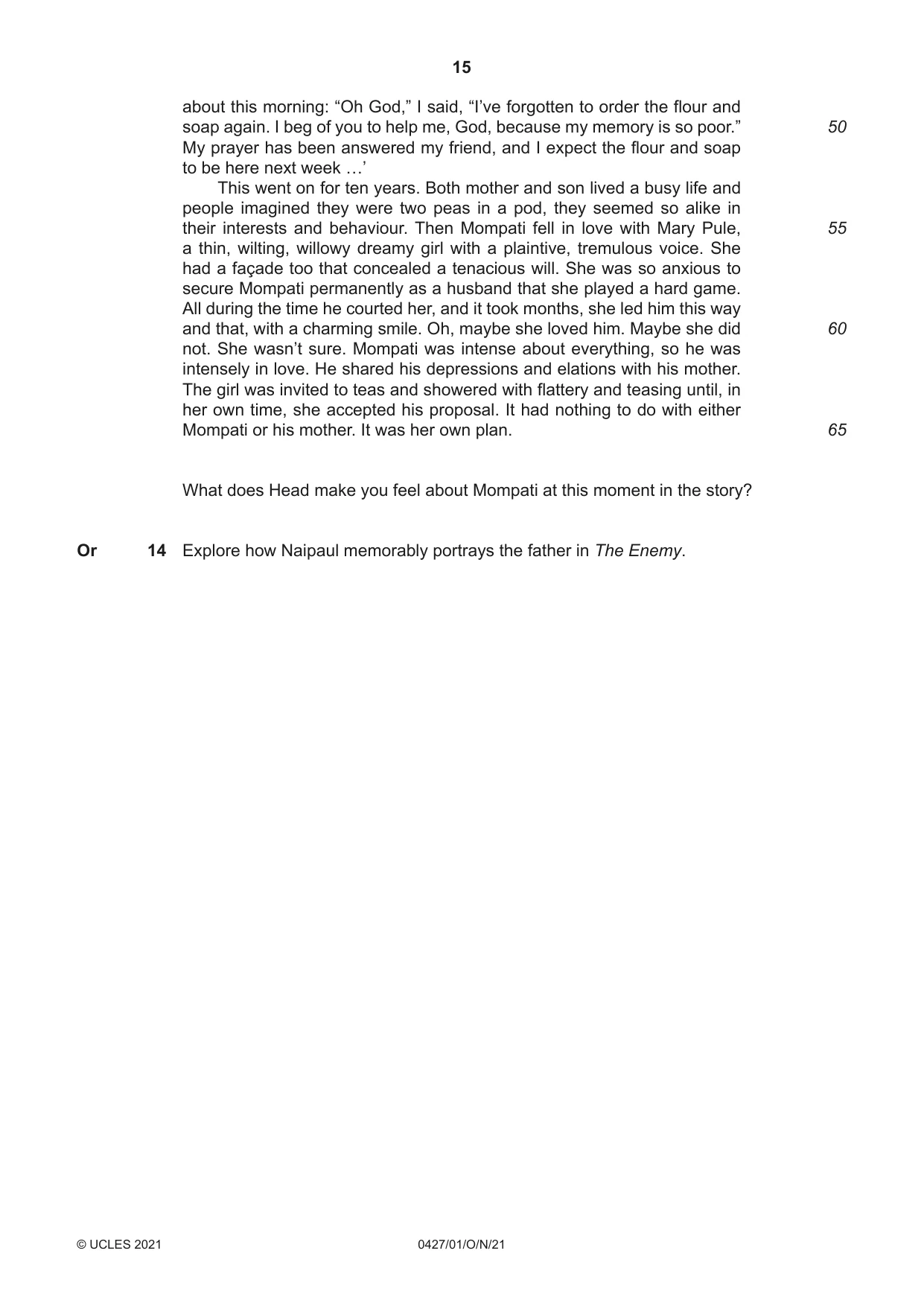
15 0427/01/O/N/21 © UCLES 2021 about this morning: “Oh God,” I said, “I’ve forgotten to order the flour and soap again. I beg of you to help me, God, because my memory is so poor.” My prayer has been answered my friend, and I expect the flour and soap to be here next week …’ This went on for ten years. Both mother and son lived a busy life and people imagined they were two peas in a pod, they seemed so alike in their interests and behaviour. Then Mompati fell in love with Mary Pule, a thin, wilting, willowy dreamy girl with a plaintive, tremulous voice. She had a façade too that concealed a tenacious will. She was so anxious to secure Mompati permanently as a husband that she played a hard game. All during the time he courted her, and it took months, she led him this way and that, with a charming smile. Oh, maybe she loved him. Maybe she did not. She wasn’t sure. Mompati was intense about everything, so he was intensely in love. He shared his depressions and elations with his mother. The girl was invited to teas and showered with flattery and teasing until, in her own time, she accepted his proposal. It had nothing to do with either Mompati or his mother. It was her own plan. What does Head make you feel about Mompati at this moment in the story? Or 14 Explore how Naipaul memorably portrays the father in The Enemy. 50 55 60 65
Question paper, page 16
16 0427/01/O/N/21 © UCLES 2021 Permission to reproduce items where third-party owned material protected by copyright is included has been sought and cleared where possible. Every reasonable effort has been made by the publisher (UCLES) to trace copyright holders, but if any items requiring clearance have unwittingly been included, the publisher will be pleased to make amends at the earliest possible opportunity. To avoid the issue of disclosure of answer-related information to candidates, all copyright acknowledgements are reproduced online in the Cambridge Assessment International Education Copyright Acknowledgements Booklet. This is produced for each series of examinations and is freely available to download at www.cambridgeinternational.org after the live examination series. Cambridge Assessment International Education is part of the Cambridge Assessment Group. Cambridge Assessment is the brand name of the University of Cambridge Local Examinations Syndicate (UCLES), which itself is a department of the University of Cambridge. BLANK PAGE
What you needed in this session
Cambridge’s own grade thresholds for 2021 Oct/Nov, Paper 1 · Variant 0. A higher threshold means an easier paper — the bar moves with how the cohort did.