Cambridge IGCSE English - Literature (BES) 0427 — 2022 Oct/Nov Paper 1 · Variant 0
0427/10/O/N/22 · 50 marks · ≈56 min
The question paper and its mark scheme, free to read here and free to download. This is Cambridge’s own paper, exactly as it was sat.
Question paper16 pages
Mark scheme
No mark scheme is in the library for this paper.
Paper as text
Question paper, page 1
This document has 16 pages. Any blank pages are indicated. * 1 7 6 1 1 0 5 4 1 3 * Cambridge IGCSE™ LITERATURE (ENGLISH) (US) 0427/01 Paper 1 Poetry and Prose October/November 2022 1 hour 30 minutes You must answer on the enclosed answer booklet. You will need: Answer booklet (enclosed) INSTRUCTIONS ● Answer two questions in total: Section A: answer one question. Section B: answer one question. ● Follow the instructions on the front cover of the answer booklet. If you need additional answer paper, ask the invigilator for a continuation booklet. INFORMATION ● The total mark for this paper is 50. ● All questions are worth equal marks. DC (RCL (DF)) 302876/1 © UCLES 2022 [Turn over
Question paper, page 2
2 0427/01/O/N/22 © UCLES 2022 SECTION A: POETRY Answer one question from this section. ROBERT FROST: The Robert Frost Collection Remember to support your ideas with details from the writing. Either 1 Read this poem, and then answer the question that follows it: “Out, Out—” The buzz-saw snarled and rattled in the yard Were not the one dead, turned to their affairs. Explore the ways in which Frost makes this such a moving poem. Content removed due to copyright restrictions.
Question paper, page 3
3 0427/01/O/N/22 © UCLES 2022 [Turn over Or 2 Read this poem, and then answer the question that follows it: After Apple-Picking My long two-pointed ladder’s sticking through a tree Or just some human sleep. How does Frost use words and images to striking effect in this poem? Content removed due to copyright restrictions.
Question paper, page 4
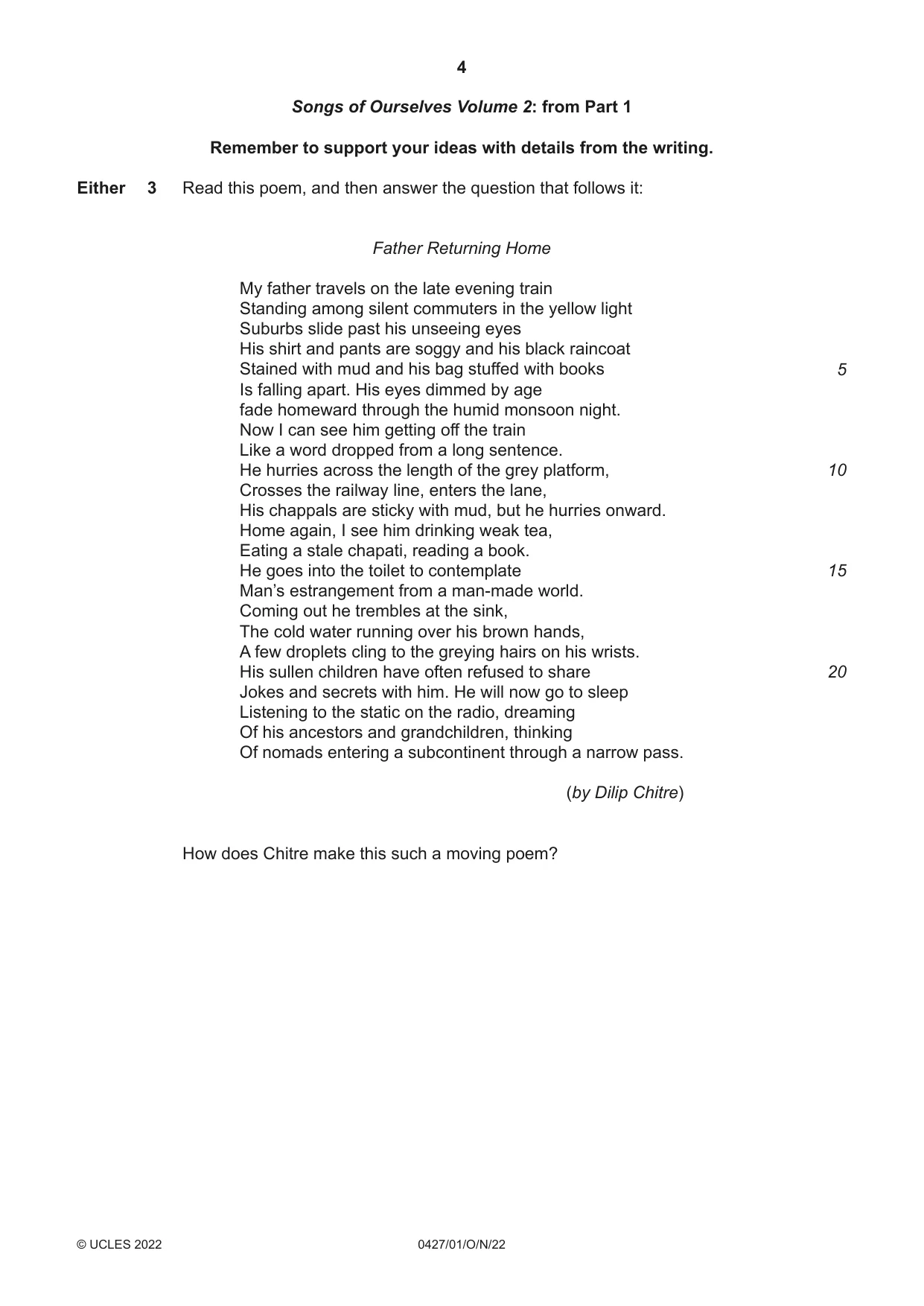
4 0427/01/O/N/22 © UCLES 2022 Songs of Ourselves Volume 2: from Part 1 Remember to support your ideas with details from the writing. Either 3 Read this poem, and then answer the question that follows it: Father Returning Home My father travels on the late evening train Standing among silent commuters in the yellow light Suburbs slide past his unseeing eyes His shirt and pants are soggy and his black raincoat Stained with mud and his bag stuffed with books Is falling apart. His eyes dimmed by age fade homeward through the humid monsoon night. Now I can see him getting off the train Like a word dropped from a long sentence. He hurries across the length of the grey platform, Crosses the railway line, enters the lane, His chappals are sticky with mud, but he hurries onward. Home again, I see him drinking weak tea, Eating a stale chapati, reading a book. He goes into the toilet to contemplate Man’s estrangement from a man-made world. Coming out he trembles at the sink, The cold water running over his brown hands, A few droplets cling to the greying hairs on his wrists. His sullen children have often refused to share Jokes and secrets with him. He will now go to sleep Listening to the static on the radio, dreaming Of his ancestors and grandchildren, thinking Of nomads entering a subcontinent through a narrow pass. (by Dilip Chitre) How does Chitre make this such a moving poem? 5 10 15 20
Question paper, page 5
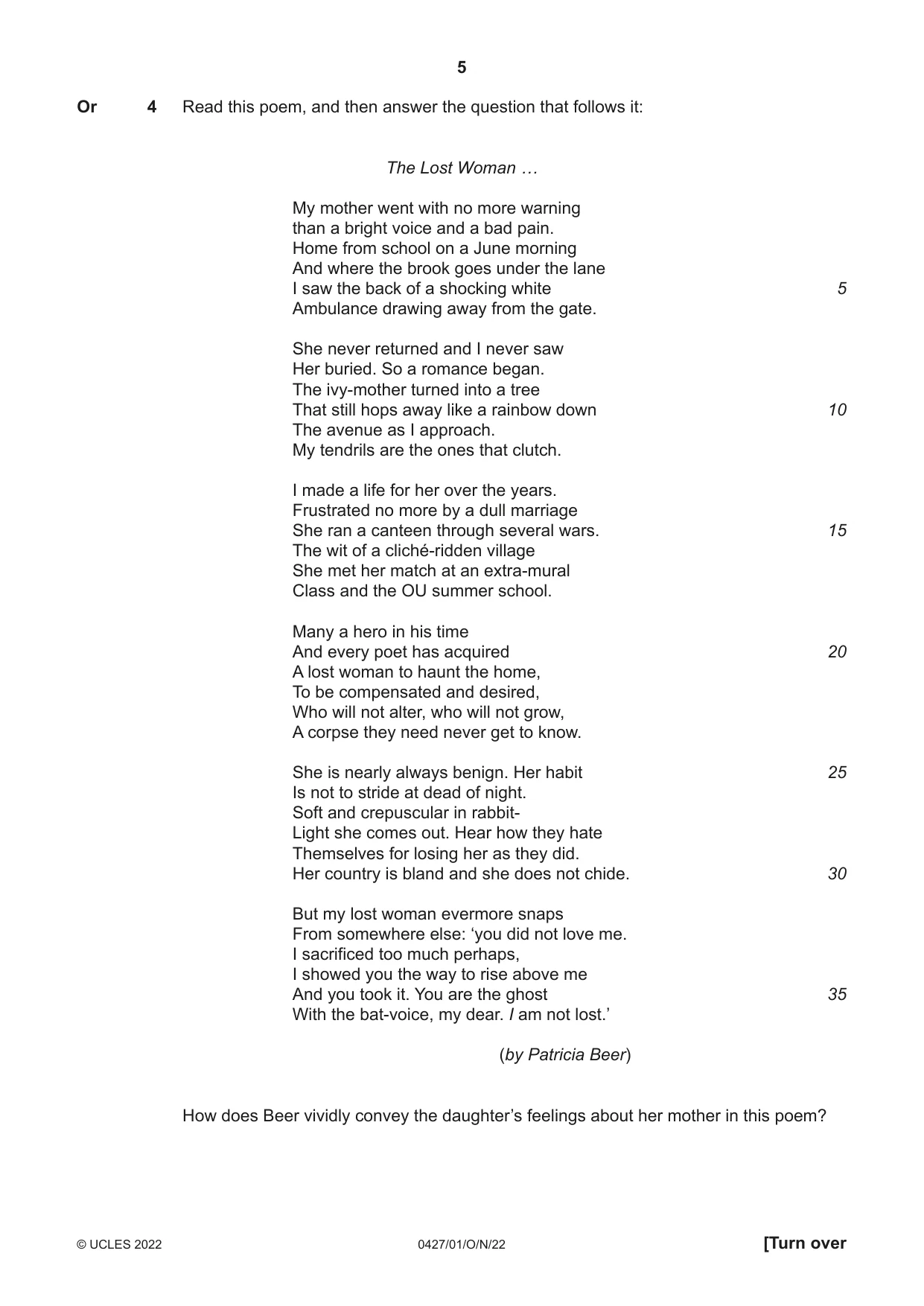
5 0427/01/O/N/22 © UCLES 2022 [Turn over Or 4 Read this poem, and then answer the question that follows it: The Lost Woman … My mother went with no more warning than a bright voice and a bad pain. Home from school on a June morning And where the brook goes under the lane I saw the back of a shocking white Ambulance drawing away from the gate. She never returned and I never saw Her buried. So a romance began. The ivy-mother turned into a tree That still hops away like a rainbow down The avenue as I approach. My tendrils are the ones that clutch. I made a life for her over the years. Frustrated no more by a dull marriage She ran a canteen through several wars. The wit of a cliché-ridden village She met her match at an extra-mural Class and the OU summer school. Many a hero in his time And every poet has acquired A lost woman to haunt the home, To be compensated and desired, Who will not alter, who will not grow, A corpse they need never get to know. She is nearly always benign. Her habit Is not to stride at dead of night. Soft and crepuscular in rabbit- Light she comes out. Hear how they hate Themselves for losing her as they did. Her country is bland and she does not chide. But my lost woman evermore snaps From somewhere else: ‘you did not love me. I sacrificed too much perhaps, I showed you the way to rise above me And you took it. You are the ghost With the bat-voice, my dear. I am not lost.’ (by Patricia Beer) How does Beer vividly convey the daughter’s feelings about her mother in this poem? 5 10 15 20 25 30 35
Question paper, page 6
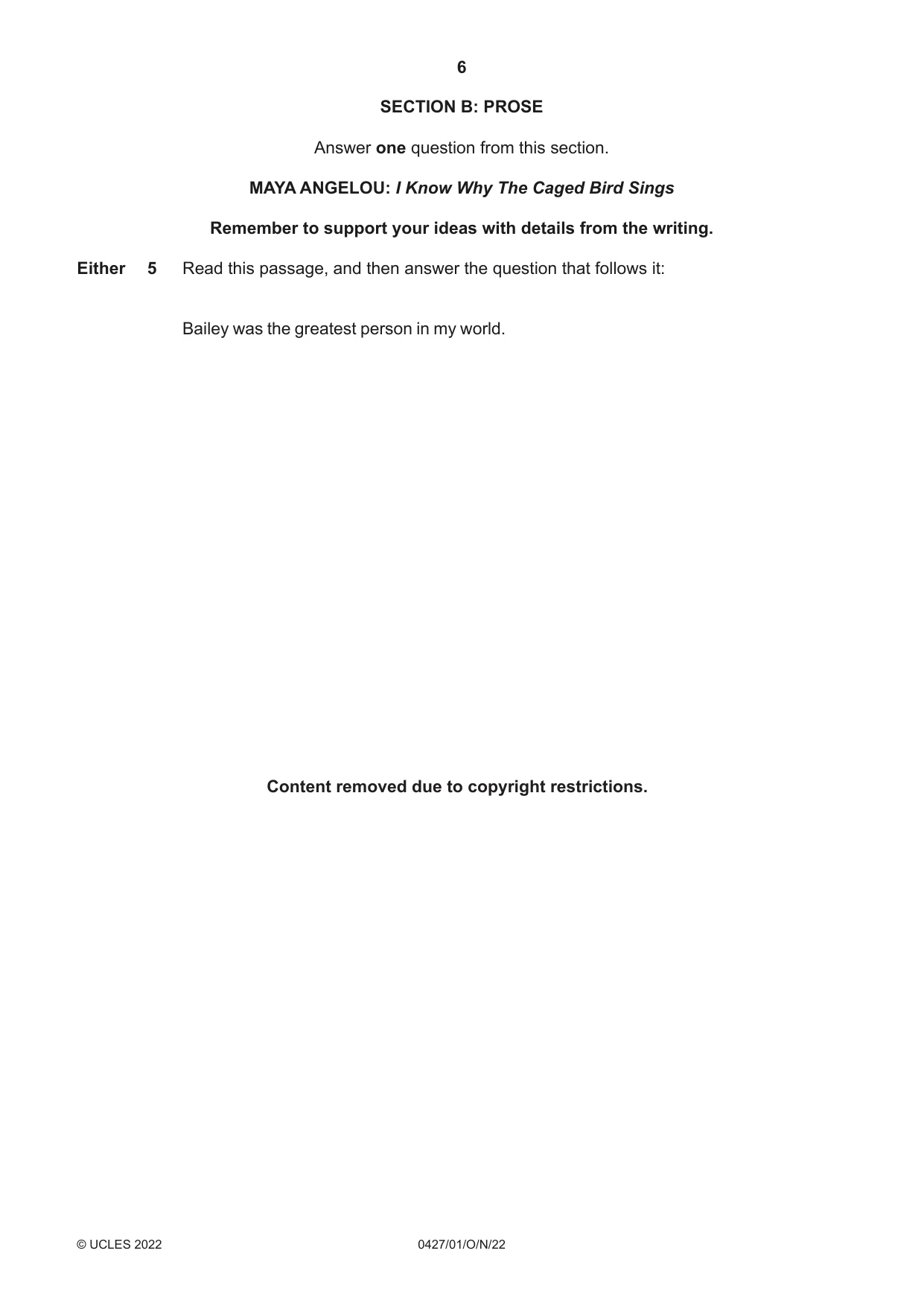
6 0427/01/O/N/22 © UCLES 2022 SECTION B: PROSE Answer one question from this section. MAYA ANGELOU: I Know Why The Caged Bird Sings Remember to support your ideas with details from the writing. Either 5 Read this passage, and then answer the question that follows it: Bailey was the greatest person in my world. Content removed due to copyright restrictions.
Question paper, page 7
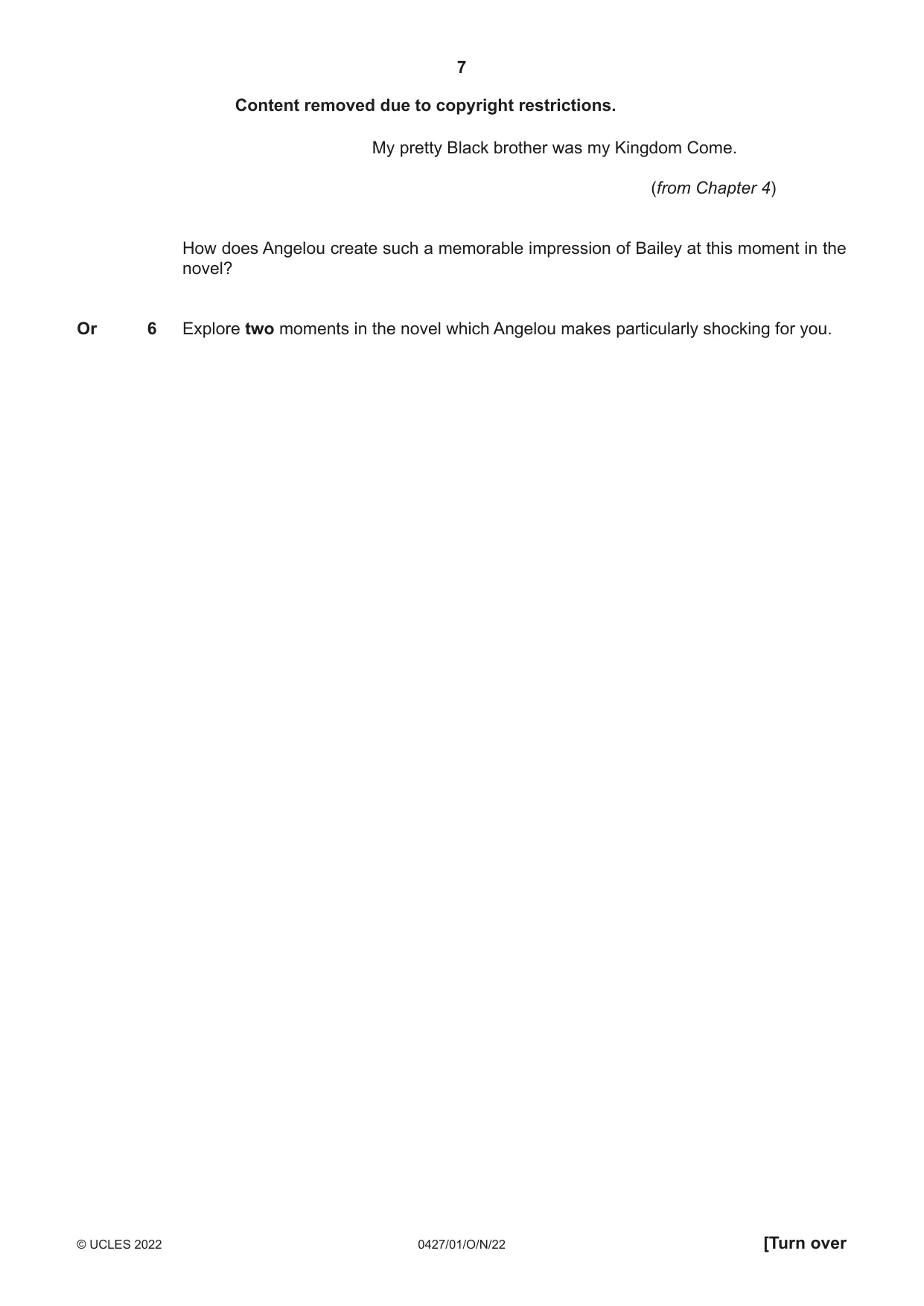
7 0427/01/O/N/22 © UCLES 2022 [Turn over My pretty Black brother was my Kingdom Come. (from Chapter 4) How does Angelou create such a memorable impression of Bailey at this moment in the novel? Or 6 Explore two moments in the novel which Angelou makes particularly shocking for you. Content removed due to copyright restrictions.
Question paper, page 8
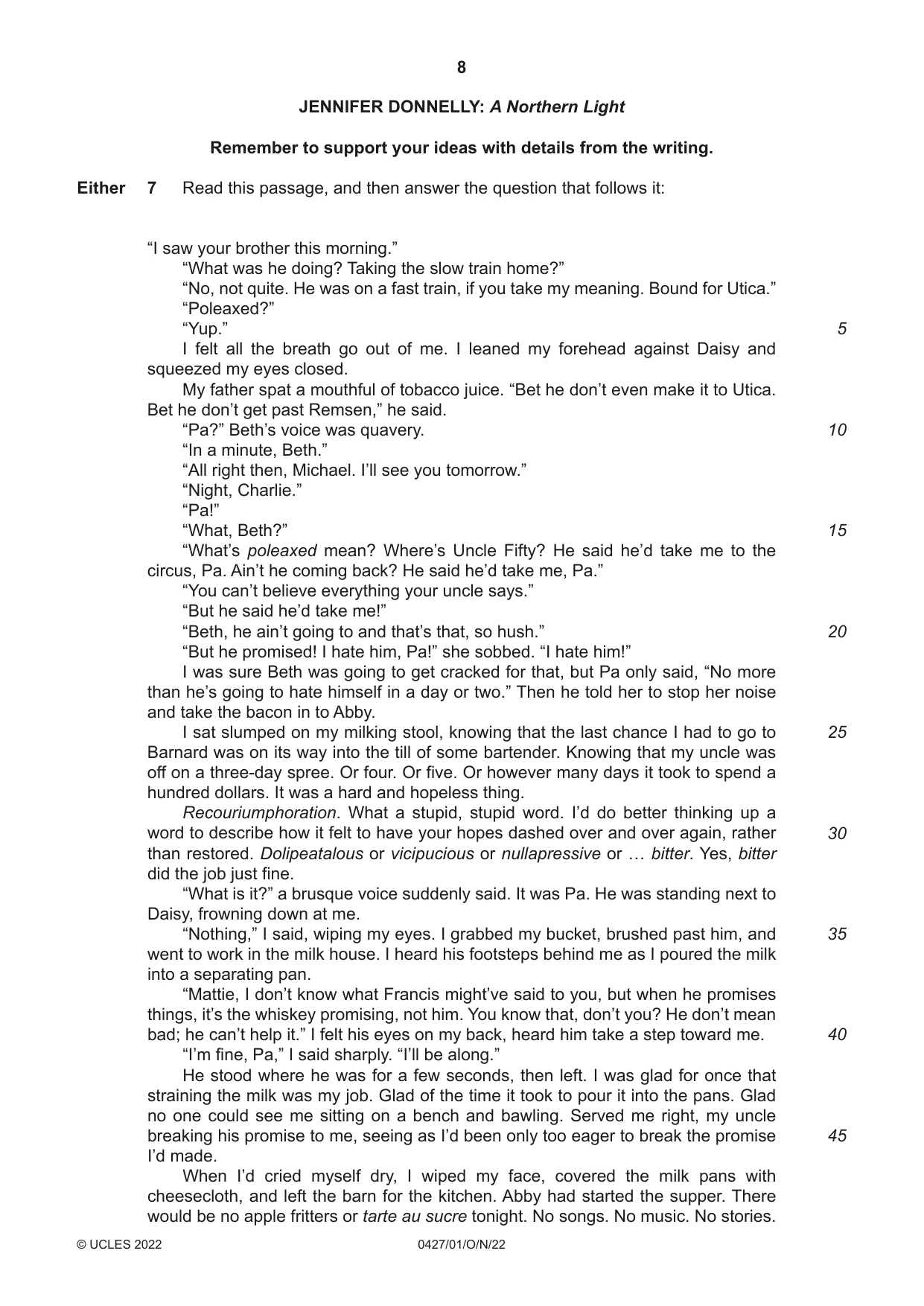
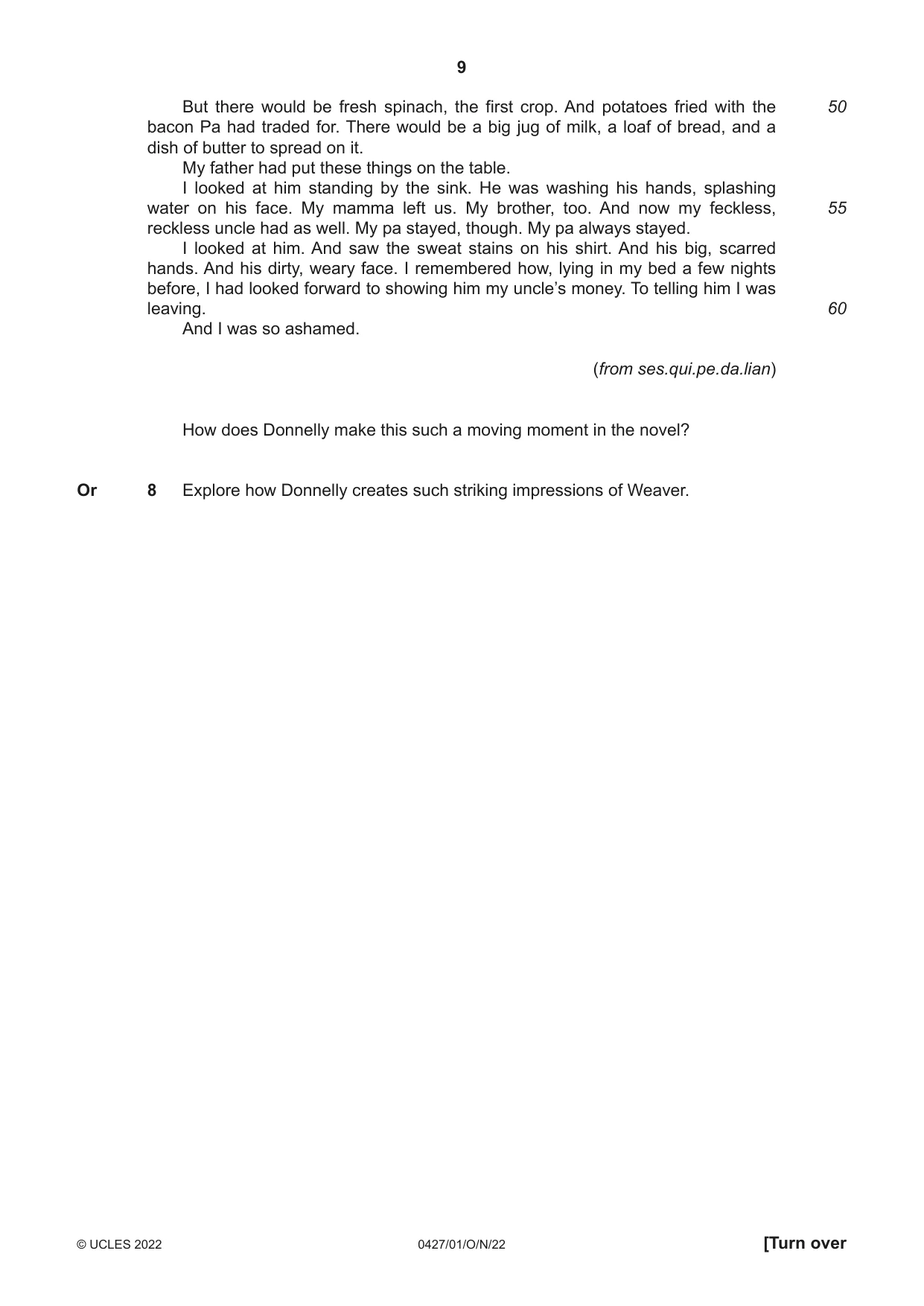
8 0427/01/O/N/22 © UCLES 2022 JENNIFER DONNELLY: A Northern Light Remember to support your ideas with details from the writing. Either 7 Read this passage, and then answer the question that follows it: “I saw your brother this morning.” “What was he doing? Taking the slow train home?” “No, not quite. He was on a fast train, if you take my meaning. Bound for Utica.” “Poleaxed?” “Yup.” I felt all the breath go out of me. I leaned my forehead against Daisy and squeezed my eyes closed. My father spat a mouthful of tobacco juice. “Bet he don’t even make it to Utica. Bet he don’t get past Remsen,” he said. “Pa?” Beth’s voice was quavery. “In a minute, Beth.” “All right then, Michael. I’ll see you tomorrow.” “Night, Charlie.” “Pa!” “What, Beth?” “What’s poleaxed mean? Where’s Uncle Fifty? He said he’d take me to the circus, Pa. Ain’t he coming back? He said he’d take me, Pa.” “You can’t believe everything your uncle says.” “But he said he’d take me!” “Beth, he ain’t going to and that’s that, so hush.” “But he promised! I hate him, Pa!” she sobbed. “I hate him!” I was sure Beth was going to get cracked for that, but Pa only said, “No more than he’s going to hate himself in a day or two.” Then he told her to stop her noise and take the bacon in to Abby. I sat slumped on my milking stool, knowing that the last chance I had to go to Barnard was on its way into the till of some bartender. Knowing that my uncle was off on a three-day spree. Or four. Or five. Or however many days it took to spend a hundred dollars. It was a hard and hopeless thing. Recouriumphoration. What a stupid, stupid word. I’d do better thinking up a word to describe how it felt to have your hopes dashed over and over again, rather than restored. Dolipeatalous or vicipucious or nullapressive or … bitter. Yes, bitter did the job just fine. “What is it?” a brusque voice suddenly said. It was Pa. He was standing next to Daisy, frowning down at me. “Nothing,” I said, wiping my eyes. I grabbed my bucket, brushed past him, and went to work in the milk house. I heard his footsteps behind me as I poured the milk into a separating pan. “Mattie, I don’t know what Francis might’ve said to you, but when he promises things, it’s the whiskey promising, not him. You know that, don’t you? He don’t mean bad; he can’t help it.” I felt his eyes on my back, heard him take a step toward me. “I’m fine, Pa,” I said sharply. “I’ll be along.” He stood where he was for a few seconds, then left. I was glad for once that straining the milk was my job. Glad of the time it took to pour it into the pans. Glad no one could see me sitting on a bench and bawling. Served me right, my uncle breaking his promise to me, seeing as I’d been only too eager to break the promise I’d made. When I’d cried myself dry, I wiped my face, covered the milk pans with cheesecloth, and left the barn for the kitchen. Abby had started the supper. There would be no apple fritters or tarte au sucre tonight. No songs. No music. No stories. 5 10 15 20 25 30 35 40 45
Question paper, page 9
9 0427/01/O/N/22 © UCLES 2022 [Turn over But there would be fresh spinach, the first crop. And potatoes fried with the bacon Pa had traded for. There would be a big jug of milk, a loaf of bread, and a dish of butter to spread on it. My father had put these things on the table. I looked at him standing by the sink. He was washing his hands, splashing water on his face. My mamma left us. My brother, too. And now my feckless, reckless uncle had as well. My pa stayed, though. My pa always stayed. I looked at him. And saw the sweat stains on his shirt. And his big, scarred hands. And his dirty, weary face. I remembered how, lying in my bed a few nights before, I had looked forward to showing him my uncle’s money. To telling him I was leaving. And I was so ashamed. (from ses.qui.pe.da.lian) How does Donnelly make this such a moving moment in the novel? Or 8 Explore how Donnelly creates such striking impressions of Weaver. 50 55 60
Question paper, page 10
10 0427/01/O/N/22 © UCLES 2022 BARBARA KINGSOLVER: The Bean Trees Remember to support your ideas with details from the writing. Either 9 Read this passage, and then answer the question that follows it: The second house on my agenda turned out to be right across the park from Jesus Is Lord’s. Content removed due to copyright restrictions.
Question paper, page 11
11 0427/01/O/N/22 © UCLES 2022 [Turn over It took some effort here to keep straight who was cats and who was husbands. (from Chapter 5) How does Kingsolver make this first meeting between Taylor and Lou Ann so memorable? Or 10 Explore the ways in which Kingsolver strikingly portrays how Taylor changes after she leaves home. Content removed due to copyright restrictions.
Question paper, page 12
12 0427/01/O/N/22 © UCLES 2022 JOHN STEINBECK: The Wayward Bus Remember to support your ideas with details from the writing. Either 11 Read this passage, and then answer the question that follows it: Mildred forced herself to turn around and go back to her mother. But it was a dream she often had. (from Chapter 13) Content removed due to copyright restrictions.
Question paper, page 13
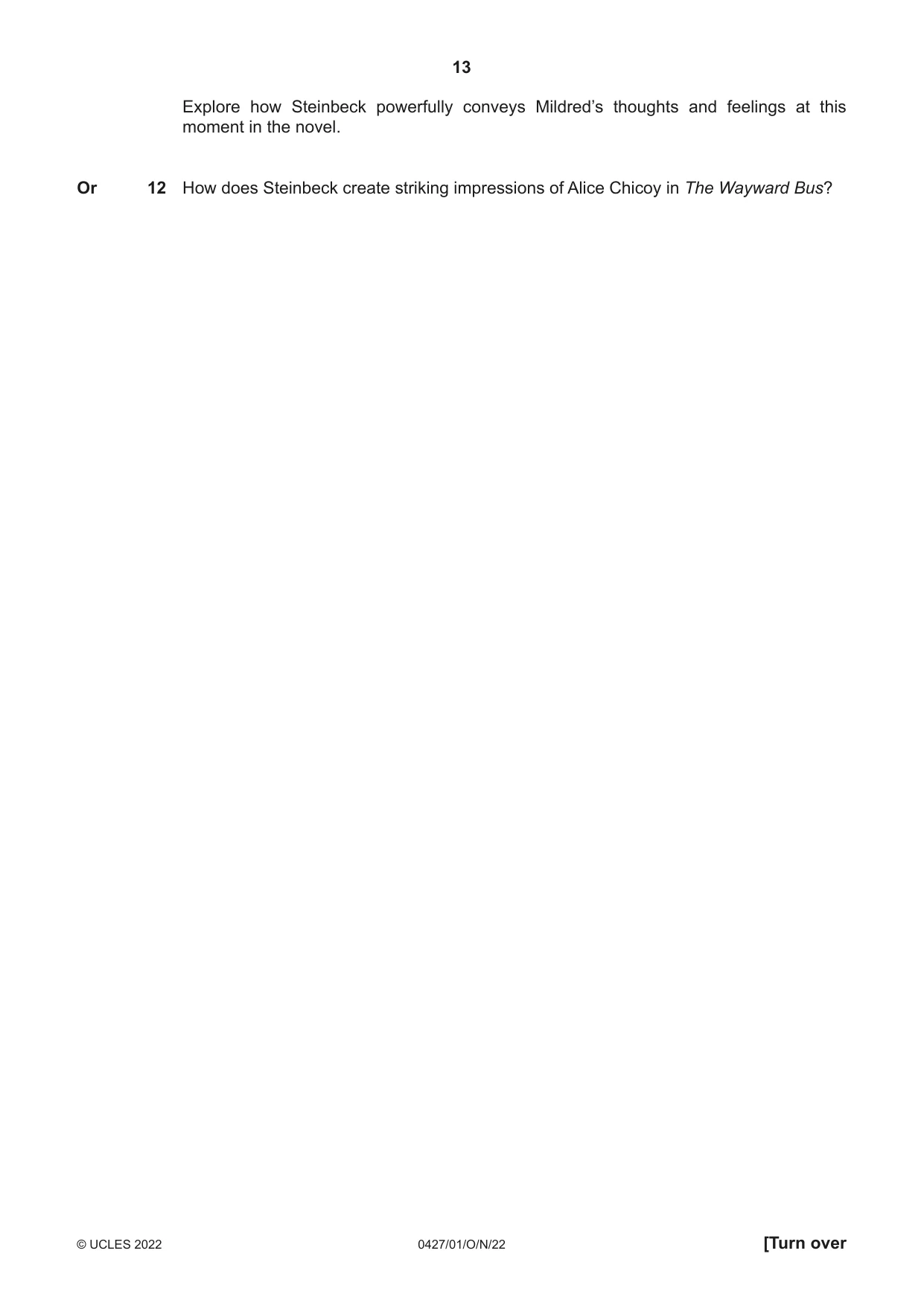
13 0427/01/O/N/22 © UCLES 2022 [Turn over Explore how Steinbeck powerfully conveys Mildred’s thoughts and feelings at this moment in the novel. Or 12 How does Steinbeck create striking impressions of Alice Chicoy in The Wayward Bus?
Question paper, page 14
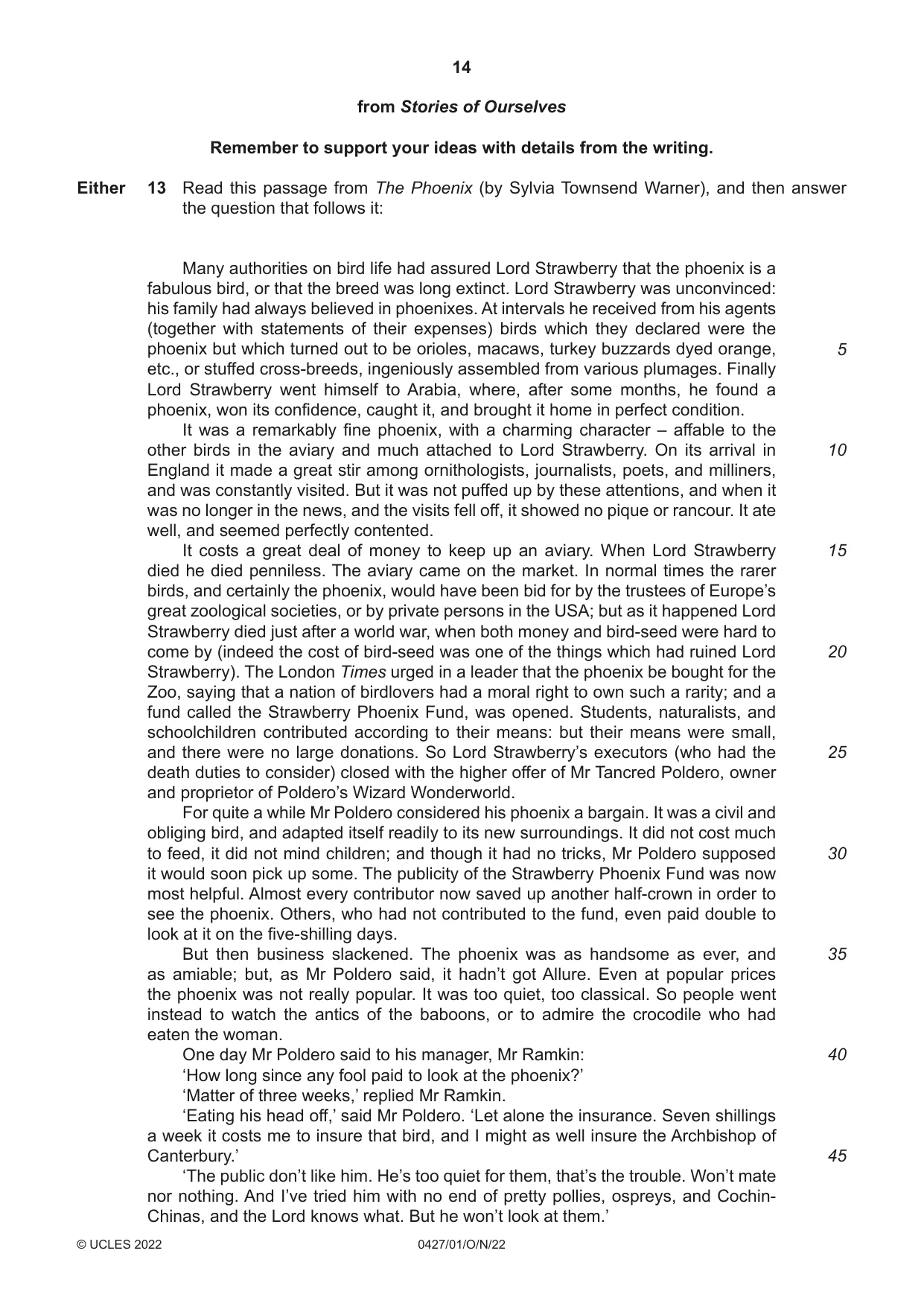
14 0427/01/O/N/22 © UCLES 2022 from Stories of Ourselves Remember to support your ideas with details from the writing. Either 13 Read this passage from The Phoenix (by Sylvia Townsend Warner), and then answer the question that follows it: Many authorities on bird life had assured Lord Strawberry that the phoenix is a fabulous bird, or that the breed was long extinct. Lord Strawberry was unconvinced: his family had always believed in phoenixes. At intervals he received from his agents (together with statements of their expenses) birds which they declared were the phoenix but which turned out to be orioles, macaws, turkey buzzards dyed orange, etc., or stuffed cross-breeds, ingeniously assembled from various plumages. Finally Lord Strawberry went himself to Arabia, where, after some months, he found a phoenix, won its confidence, caught it, and brought it home in perfect condition. It was a remarkably fine phoenix, with a charming character – affable to the other birds in the aviary and much attached to Lord Strawberry. On its arrival in England it made a great stir among ornithologists, journalists, poets, and milliners, and was constantly visited. But it was not puffed up by these attentions, and when it was no longer in the news, and the visits fell off, it showed no pique or rancour. It ate well, and seemed perfectly contented. It costs a great deal of money to keep up an aviary. When Lord Strawberry died he died penniless. The aviary came on the market. In normal times the rarer birds, and certainly the phoenix, would have been bid for by the trustees of Europe’s great zoological societies, or by private persons in the USA; but as it happened Lord Strawberry died just after a world war, when both money and bird-seed were hard to come by (indeed the cost of bird-seed was one of the things which had ruined Lord Strawberry). The London Times urged in a leader that the phoenix be bought for the Zoo, saying that a nation of birdlovers had a moral right to own such a rarity; and a fund called the Strawberry Phoenix Fund, was opened. Students, naturalists, and schoolchildren contributed according to their means: but their means were small, and there were no large donations. So Lord Strawberry’s executors (who had the death duties to consider) closed with the higher offer of Mr Tancred Poldero, owner and proprietor of Poldero’s Wizard Wonderworld. For quite a while Mr Poldero considered his phoenix a bargain. It was a civil and obliging bird, and adapted itself readily to its new surroundings. It did not cost much to feed, it did not mind children; and though it had no tricks, Mr Poldero supposed it would soon pick up some. The publicity of the Strawberry Phoenix Fund was now most helpful. Almost every contributor now saved up another half-crown in order to see the phoenix. Others, who had not contributed to the fund, even paid double to look at it on the five-shilling days. But then business slackened. The phoenix was as handsome as ever, and as amiable; but, as Mr Poldero said, it hadn’t got Allure. Even at popular prices the phoenix was not really popular. It was too quiet, too classical. So people went instead to watch the antics of the baboons, or to admire the crocodile who had eaten the woman. One day Mr Poldero said to his manager, Mr Ramkin: ‘How long since any fool paid to look at the phoenix?’ ‘Matter of three weeks,’ replied Mr Ramkin. ‘Eating his head off,’ said Mr Poldero. ‘Let alone the insurance. Seven shillings a week it costs me to insure that bird, and I might as well insure the Archbishop of Canterbury.’ ‘The public don’t like him. He’s too quiet for them, that’s the trouble. Won’t mate nor nothing. And I’ve tried him with no end of pretty pollies, ospreys, and Cochin- Chinas, and the Lord knows what. But he won’t look at them.’ 5 10 15 20 25 30 35 40 45
Question paper, page 15
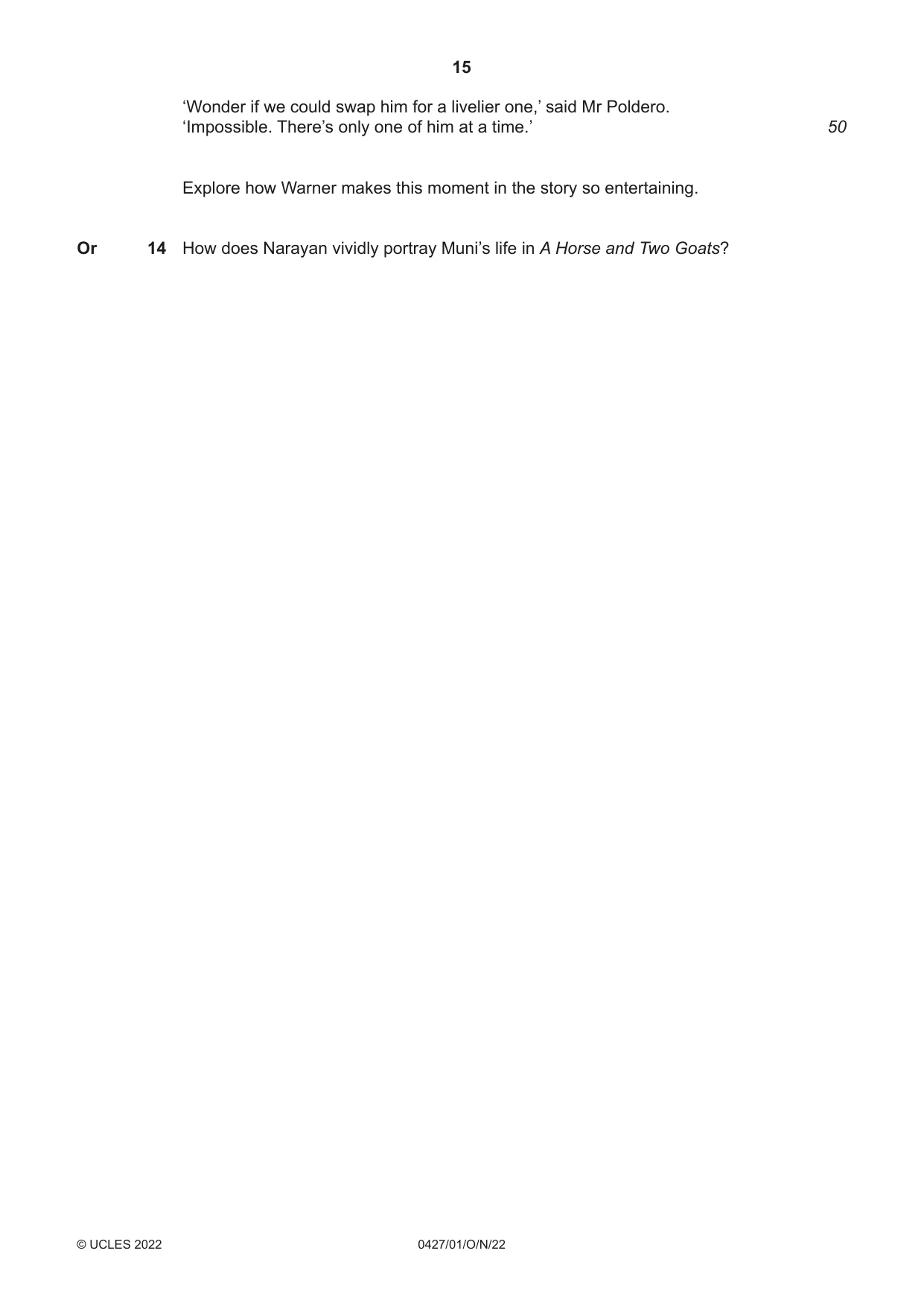
15 0427/01/O/N/22 © UCLES 2022 ‘Wonder if we could swap him for a livelier one,’ said Mr Poldero. ‘Impossible. There’s only one of him at a time.’ Explore how Warner makes this moment in the story so entertaining. Or 14 How does Narayan vividly portray Muni’s life in A Horse and Two Goats? 50
Question paper, page 16
16 0427/01/O/N/22 © UCLES 2022 Permission to reproduce items where third-party owned material protected by copyright is included has been sought and cleared where possible. Every reasonable effort has been made by the publisher (UCLES) to trace copyright holders, but if any items requiring clearance have unwittingly been included, the publisher will be pleased to make amends at the earliest possible opportunity. To avoid the issue of disclosure of answer-related information to candidates, all copyright acknowledgements are reproduced online in the Cambridge Assessment International Education Copyright Acknowledgements Booklet. This is produced for each series of examinations and is freely available to download at www.cambridgeinternational.org after the live examination series. Cambridge Assessment International Education is part of Cambridge Assessment. Cambridge Assessment is the brand name of the University of Cambridge Local Examinations Syndicate (UCLES), which is a department of the University of Cambridge. BLANK PAGE
What you needed in this session
Cambridge’s own grade thresholds for 2022 Oct/Nov, Paper 1 · Variant 0. A higher threshold means an easier paper — the bar moves with how the cohort did.