Cambridge IGCSE English - Literature (BES) 0427 — 2018 Oct/Nov Paper 1 · Variant 0
0427/10/O/N/18
The question paper and its mark scheme, free to read here and free to download. This is Cambridge’s own paper, exactly as it was sat.
Question paper16 pages

Mark scheme
No mark scheme is in the library for this paper.
Paper as text
Question paper, page 1
This document consists of 15 printed pages, 1 blank page and 1 Insert. DC (RCL (GO)) 151710/3 © UCLES 2018 [Turn over Cambridge International Examinations Cambridge International General Certificate of Secondary Education * 8 1 9 6 0 4 2 9 3 0 * LITERATURE (ENGLISH) (US) 0427/01 Paper 1 Poetry and Prose October/November 2018 1 hour 30 minutes No Additional Materials are required. READ THESE INSTRUCTIONS FIRST An answer booklet is provided inside this question paper. You should follow the instructions on the front cover of the answer booklet. If you need additional answer paper ask the invigilator for a continuation booklet. Answer two questions: one question for Section A and one question for Section B. All questions in this paper carry equal marks.
Question paper, page 2
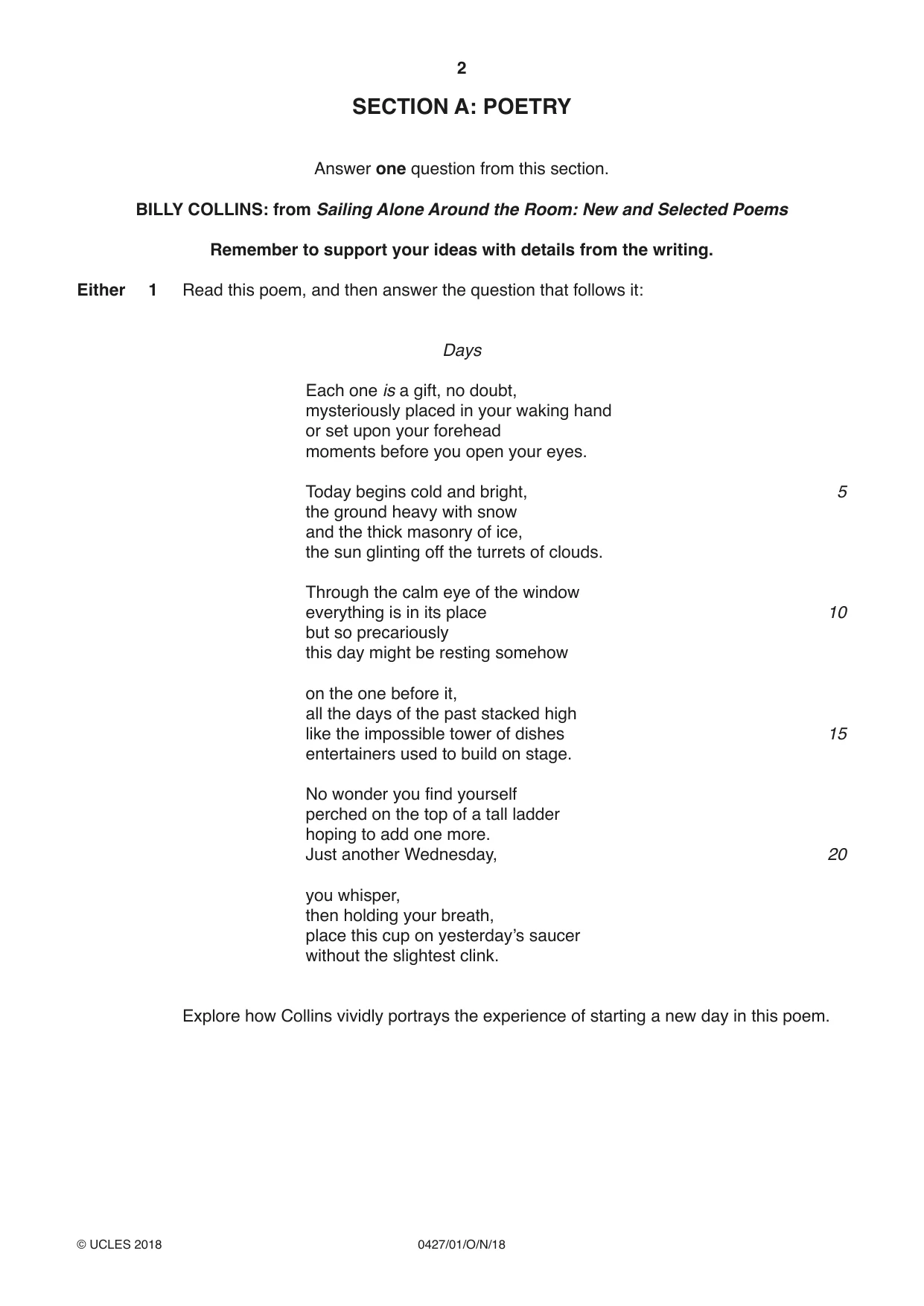
2 0427/01/O/N/18 © UCLES 2018 SECTION A: POETRY Answer one question from this section. BILLY COLLINS: from Sailing Alone Around the Room: New and Selected Poems Remember to support your ideas with details from the writing. Either 1 Read this poem, and then answer the question that follows it: Days Each one is a gift, no doubt, mysteriously placed in your waking hand or set upon your forehead moments before you open your eyes. Today begins cold and bright, the ground heavy with snow and the thick masonry of ice, the sun glinting off the turrets of clouds. Through the calm eye of the window everything is in its place but so precariously this day might be resting somehow on the one before it, all the days of the past stacked high like the impossible tower of dishes entertainers used to build on stage. No wonder you find yourself perched on the top of a tall ladder hoping to add one more. Just another Wednesday, you whisper, then holding your breath, place this cup on yesterday’s saucer without the slightest clink. Explore how Collins vividly portrays the experience of starting a new day in this poem. 5 10 15 20
Question paper, page 3
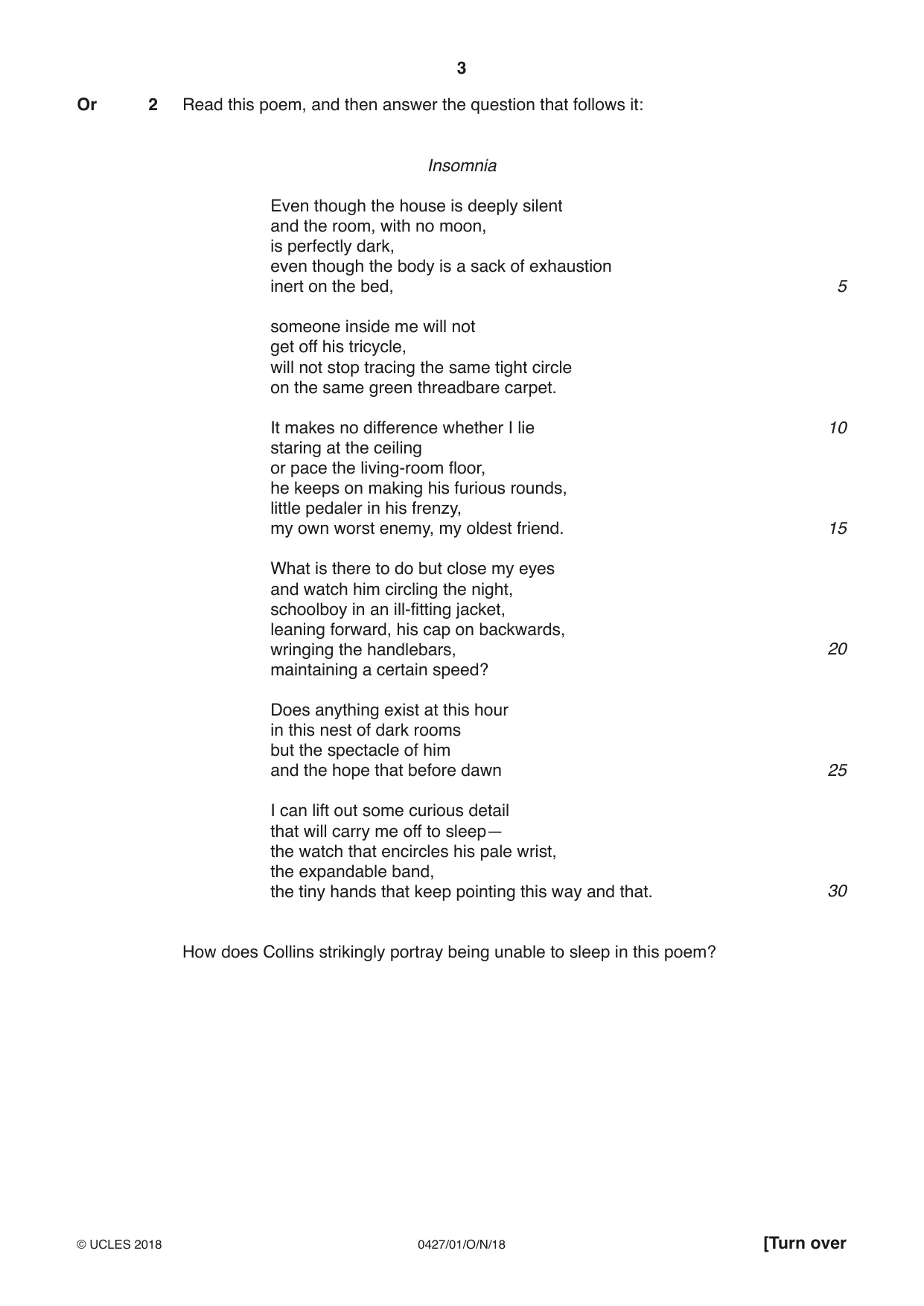
3 0427/01/O/N/18 © UCLES 2018 [Turn over Or 2 Read this poem, and then answer the question that follows it: Insomnia Even though the house is deeply silent and the room, with no moon, is perfectly dark, even though the body is a sack of exhaustion inert on the bed, someone inside me will not get off his tricycle, will not stop tracing the same tight circle on the same green threadbare carpet. It makes no difference whether I lie staring at the ceiling or pace the living-room floor, he keeps on making his furious rounds, little pedaler in his frenzy, my own worst enemy, my oldest friend. What is there to do but close my eyes and watch him circling the night, schoolboy in an ill-fitting jacket, leaning forward, his cap on backwards, wringing the handlebars, maintaining a certain speed? Does anything exist at this hour in this nest of dark rooms but the spectacle of him and the hope that before dawn I can lift out some curious detail that will carry me off to sleep— the watch that encircles his pale wrist, the expandable band, the tiny hands that keep pointing this way and that. How does Collins strikingly portray being unable to sleep in this poem? 5 10 15 20 25 30
Question paper, page 4
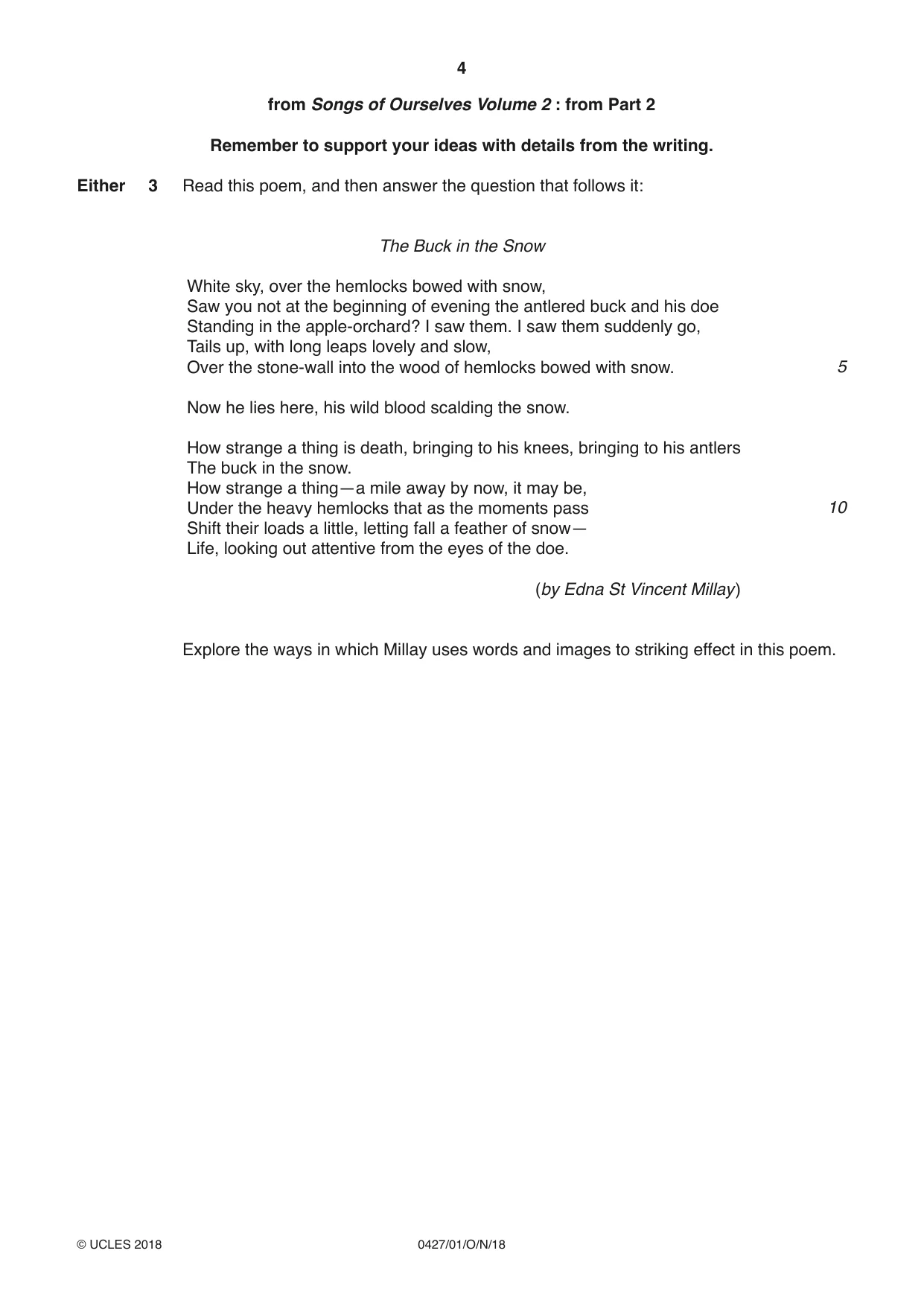
4 0427/01/O/N/18 © UCLES 2018 from Songs of Ourselves Volume 2 : from Part 2 Remember to support your ideas with details from the writing. Either 3 Read this poem, and then answer the question that follows it: The Buck in the Snow White sky, over the hemlocks bowed with snow, Saw you not at the beginning of evening the antlered buck and his doe Standing in the apple-orchard? I saw them. I saw them suddenly go, Tails up, with long leaps lovely and slow, Over the stone-wall into the wood of hemlocks bowed with snow. Now he lies here, his wild blood scalding the snow. How strange a thing is death, bringing to his knees, bringing to his antlers The buck in the snow. How strange a thing—a mile away by now, it may be, Under the heavy hemlocks that as the moments pass Shift their loads a little, letting fall a feather of snow— Life, looking out attentive from the eyes of the doe. (by Edna St Vincent Millay) Explore the ways in which Millay uses words and images to striking effect in this poem. 5 10
Question paper, page 5
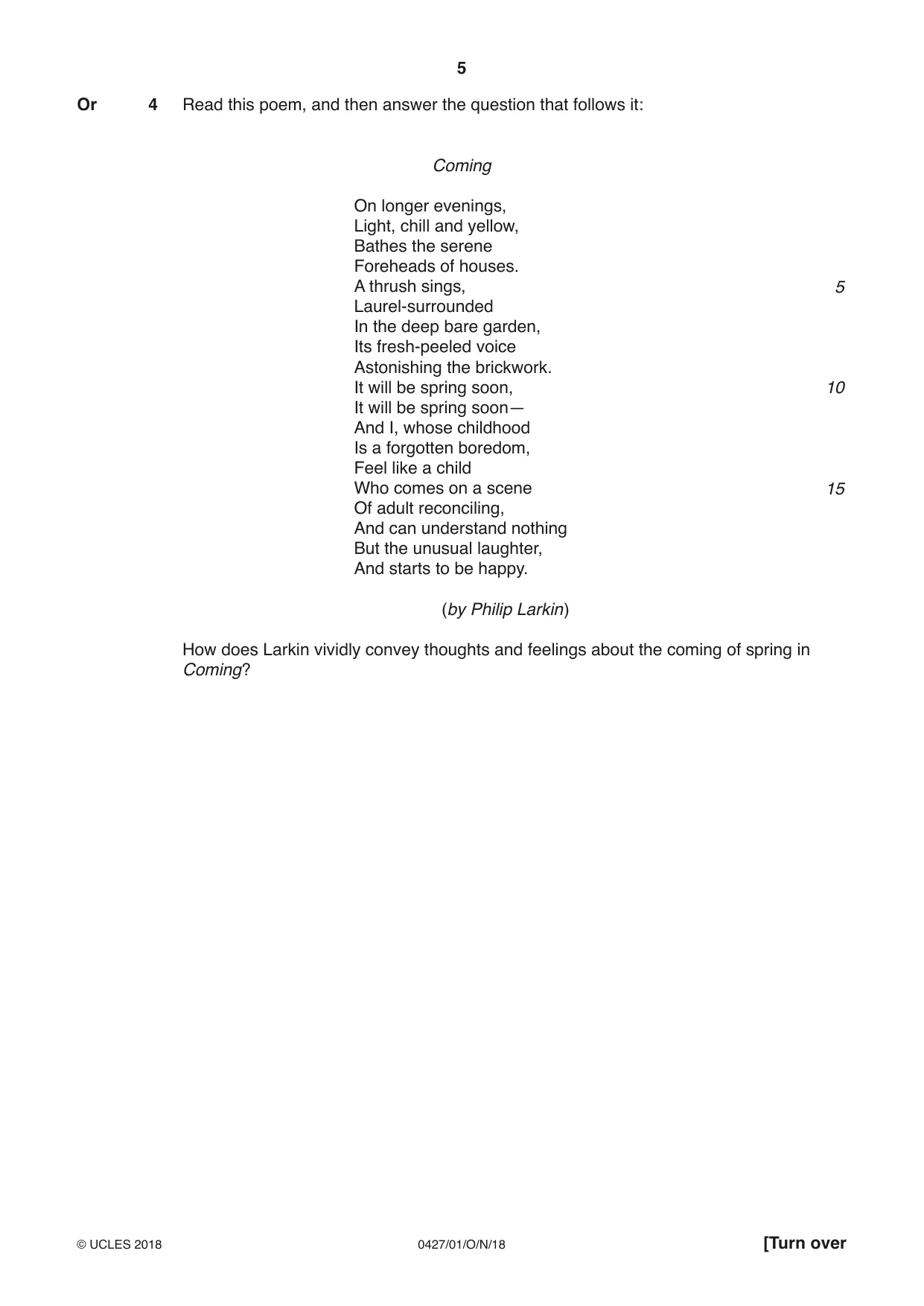
5 0427/01/O/N/18 © UCLES 2018 [Turn over Or 4 Read this poem, and then answer the question that follows it: Coming On longer evenings, Light, chill and yellow, Bathes the serene Foreheads of houses. A thrush sings, Laurel-surrounded In the deep bare garden, Its fresh-peeled voice Astonishing the brickwork. It will be spring soon, It will be spring soon— And I, whose childhood Is a forgotten boredom, Feel like a child Who comes on a scene Of adult reconciling, And can understand nothing But the unusual laughter, And starts to be happy. (by Philip Larkin) How does Larkin vividly convey thoughts and feelings about the coming of spring in Coming? 5 10 15
Question paper, page 6
6 0427/01/O/N/18 © UCLES 2018 SECTION B: PROSE Answer one question from this section. RAY BRADBURY: Fahrenheit 451 Remember to support your ideas with details from the writing. Either 5 Read this passage, and then answer the question that follows it: Half an hour later, cold, and moving carefully on the tracks, ‘It’s all right,’ the voice said. ‘You’re welcome here.’ [from ‘Burning Bright’ ] Content removed due to copyright restrictions
Question paper, page 7
7 0427/01/O/N/18 © UCLES 2018 [Turn over How does Bradbury movingly convey the significance of this moment for Montag? Or 6 Explore two moments in the novel which Bradbury’s writing makes particularly shocking for you. Do not use the extract in Question 5 in answering this question.
Question paper, page 8
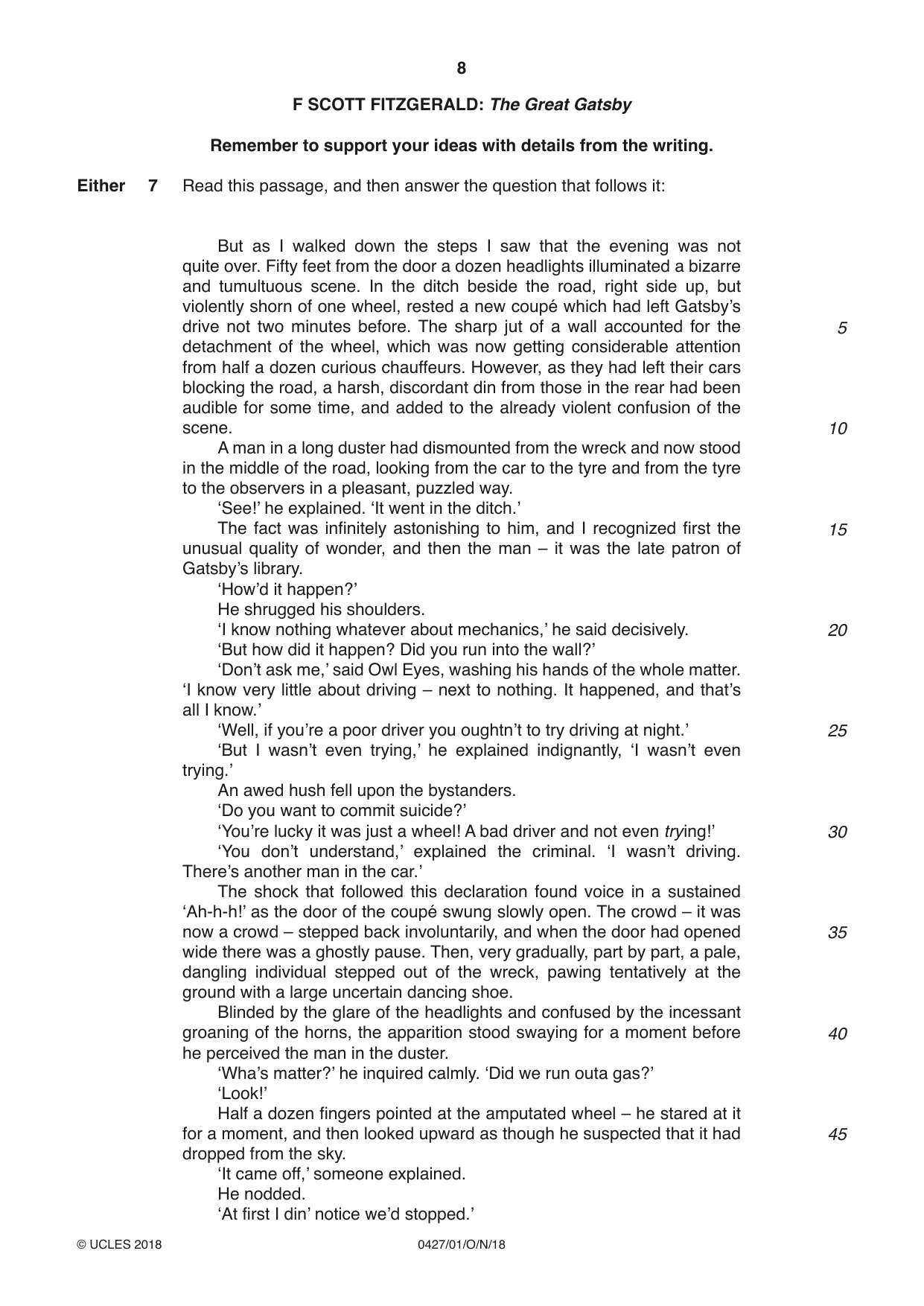
8 0427/01/O/N/18 © UCLES 2018 F SCOTT FITZGERALD: The Great Gatsby Remember to support your ideas with details from the writing. Either 7 Read this passage, and then answer the question that follows it: But as I walked down the steps I saw that the evening was not quite over. Fifty feet from the door a dozen headlights illuminated a bizarre and tumultuous scene. In the ditch beside the road, right side up, but violently shorn of one wheel, rested a new coupé which had left Gatsby’s drive not two minutes before. The sharp jut of a wall accounted for the detachment of the wheel, which was now getting considerable attention from half a dozen curious chauffeurs. However, as they had left their cars blocking the road, a harsh, discordant din from those in the rear had been audible for some time, and added to the already violent confusion of the scene. A man in a long duster had dismounted from the wreck and now stood in the middle of the road, looking from the car to the tyre and from the tyre to the observers in a pleasant, puzzled way. ‘See!’ he explained. ‘It went in the ditch.’ The fact was infinitely astonishing to him, and I recognized first the unusual quality of wonder, and then the man – it was the late patron of Gatsby’s library. ‘How’d it happen?’ He shrugged his shoulders. ‘I know nothing whatever about mechanics,’ he said decisively. ‘But how did it happen? Did you run into the wall?’ ‘Don’t ask me,’ said Owl Eyes, washing his hands of the whole matter. ‘I know very little about driving – next to nothing. It happened, and that’s all I know.’ ‘Well, if you’re a poor driver you oughtn’t to try driving at night.’ ‘But I wasn’t even trying,’ he explained indignantly, ‘I wasn’t even trying.’ An awed hush fell upon the bystanders. ‘Do you want to commit suicide?’ ‘You’re lucky it was just a wheel! A bad driver and not even trying!’ ‘You don’t understand,’ explained the criminal. ‘I wasn’t driving. There’s another man in the car.’ The shock that followed this declaration found voice in a sustained ‘Ah-h-h!’ as the door of the coupé swung slowly open. The crowd – it was now a crowd – stepped back involuntarily, and when the door had opened wide there was a ghostly pause. Then, very gradually, part by part, a pale, dangling individual stepped out of the wreck, pawing tentatively at the ground with a large uncertain dancing shoe. Blinded by the glare of the headlights and confused by the incessant groaning of the horns, the apparition stood swaying for a moment before he perceived the man in the duster. ‘Wha’s matter?’ he inquired calmly. ‘Did we run outa gas?’ ‘Look!’ Half a dozen fingers pointed at the amputated wheel – he stared at it for a moment, and then looked upward as though he suspected that it had dropped from the sky. ‘It came off,’ someone explained. He nodded. ‘At first I din’ notice we’d stopped.’ 5 10 15 20 25 30 35 40 45
Question paper, page 9
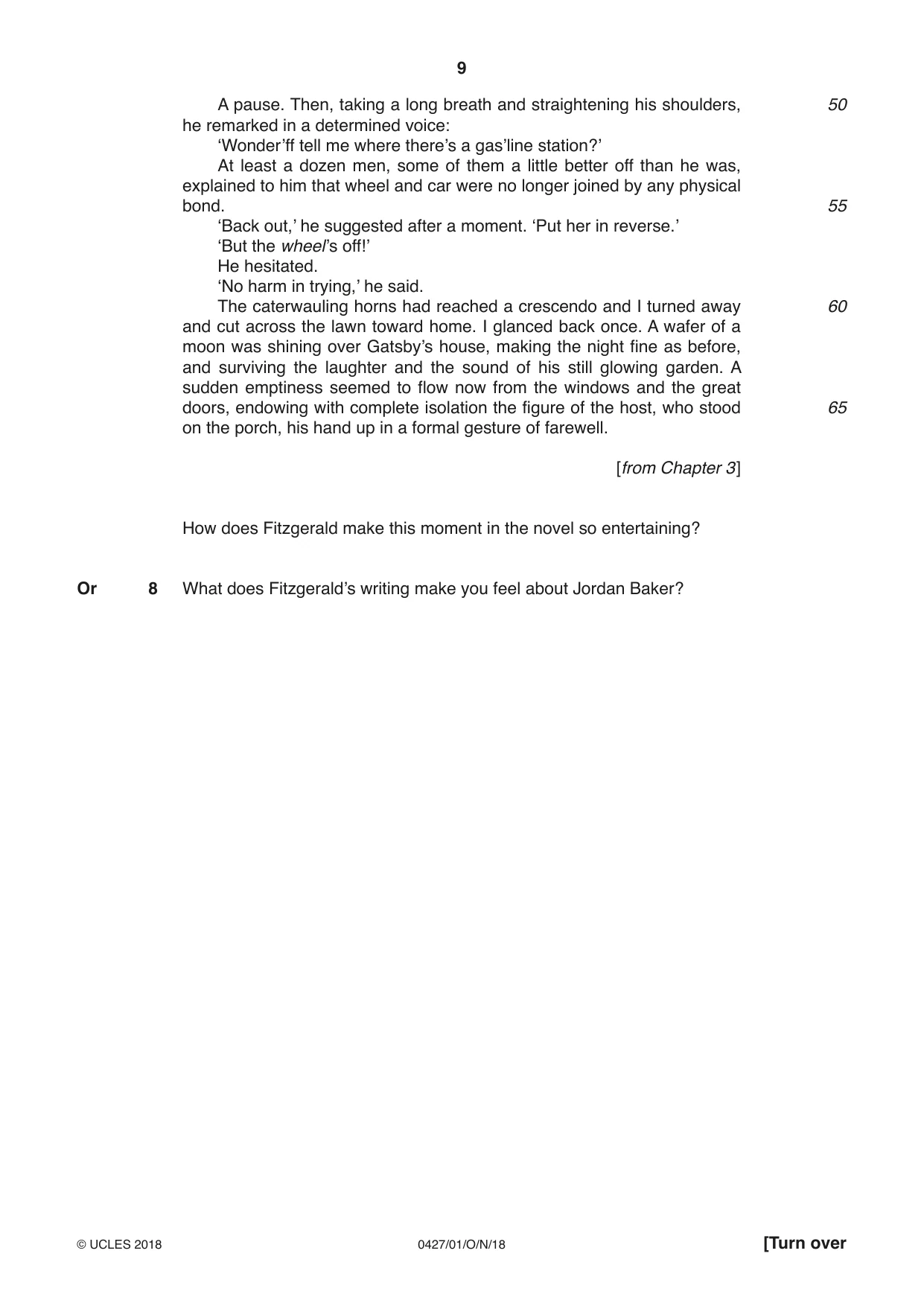
9 0427/01/O/N/18 © UCLES 2018 [Turn over A pause. Then, taking a long breath and straightening his shoulders, he remarked in a determined voice: ‘Wonder’ff tell me where there’s a gas’line station?’ At least a dozen men, some of them a little better off than he was, explained to him that wheel and car were no longer joined by any physical bond. ‘Back out,’ he suggested after a moment. ‘Put her in reverse.’ ‘But the wheel’s off!’ He hesitated. ‘No harm in trying,’ he said. The caterwauling horns had reached a crescendo and I turned away and cut across the lawn toward home. I glanced back once. A wafer of a moon was shining over Gatsby’s house, making the night fine as before, and surviving the laughter and the sound of his still glowing garden. A sudden emptiness seemed to flow now from the windows and the great doors, endowing with complete isolation the figure of the host, who stood on the porch, his hand up in a formal gesture of farewell. [from Chapter 3] How does Fitzgerald make this moment in the novel so entertaining? Or 8 What does Fitzgerald’s writing make you feel about Jordan Baker? 50 55 60 65
Question paper, page 10
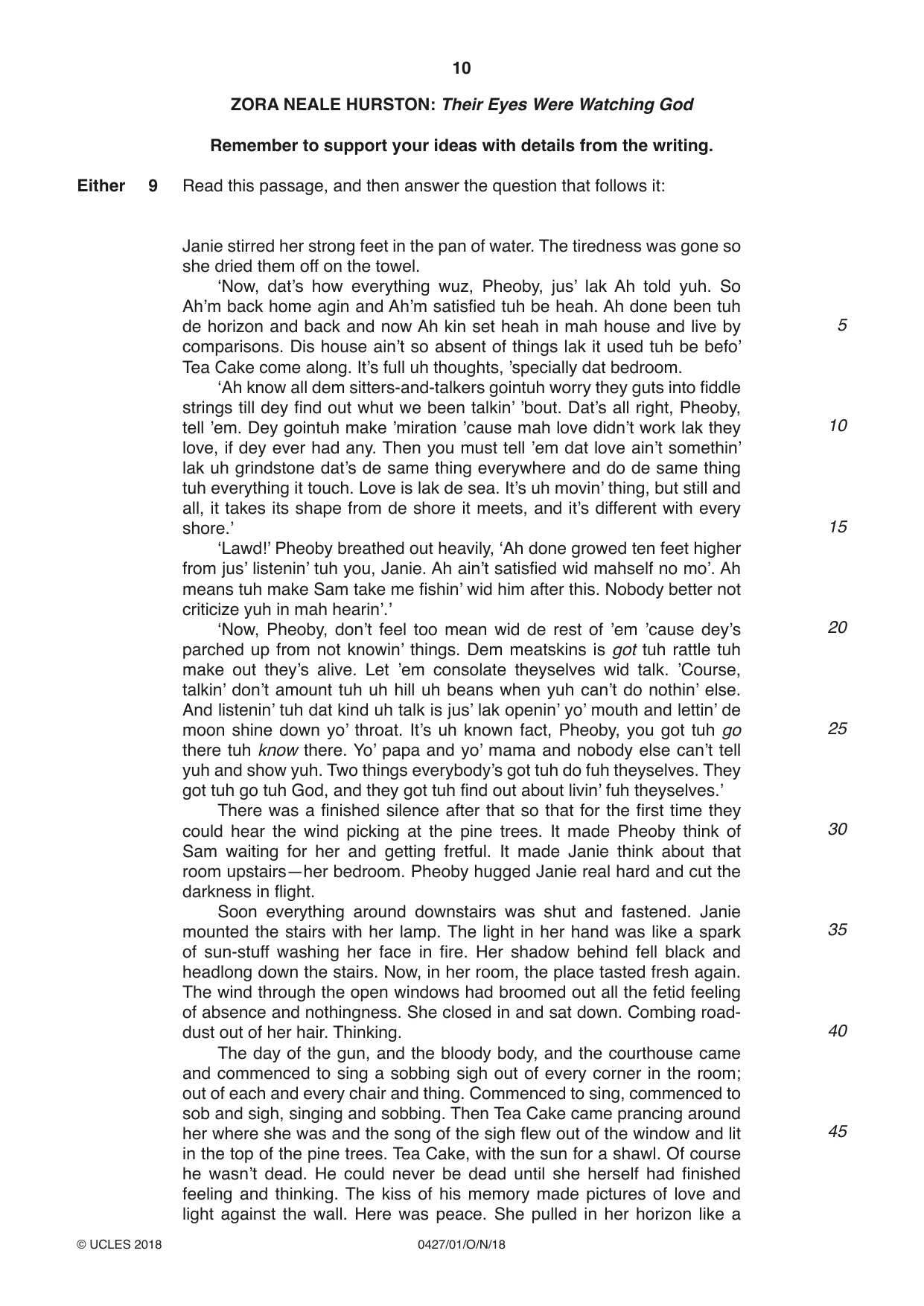
10 0427/01/O/N/18 © UCLES 2018 ZORA NEALE HURSTON: Their Eyes Were Watching God Remember to support your ideas with details from the writing. Either 9 Read this passage, and then answer the question that follows it: Janie stirred her strong feet in the pan of water. The tiredness was gone so she dried them off on the towel. ‘Now, dat’s how everything wuz, Pheoby, jus’ lak Ah told yuh. So Ah’m back home agin and Ah’m satisfied tuh be heah. Ah done been tuh de horizon and back and now Ah kin set heah in mah house and live by comparisons. Dis house ain’t so absent of things lak it used tuh be befo’ Tea Cake come along. It’s full uh thoughts, ’specially dat bedroom. ‘Ah know all dem sitters-and-talkers gointuh worry they guts into fiddle strings till dey find out whut we been talkin’ ’bout. Dat’s all right, Pheoby, tell ’em. Dey gointuh make ’miration ’cause mah love didn’t work lak they love, if dey ever had any. Then you must tell ’em dat love ain’t somethin’ lak uh grindstone dat’s de same thing everywhere and do de same thing tuh everything it touch. Love is lak de sea. It’s uh movin’ thing, but still and all, it takes its shape from de shore it meets, and it’s different with every shore.’ ‘Lawd!’ Pheoby breathed out heavily, ‘Ah done growed ten feet higher from jus’ listenin’ tuh you, Janie. Ah ain’t satisfied wid mahself no mo’. Ah means tuh make Sam take me fishin’ wid him after this. Nobody better not criticize yuh in mah hearin’.’ ‘Now, Pheoby, don’t feel too mean wid de rest of ’em ’cause dey’s parched up from not knowin’ things. Dem meatskins is got tuh rattle tuh make out they’s alive. Let ’em consolate theyselves wid talk. ’Course, talkin’ don’t amount tuh uh hill uh beans when yuh can’t do nothin’ else. And listenin’ tuh dat kind uh talk is jus’ lak openin’ yo’ mouth and lettin’ de moon shine down yo’ throat. It’s uh known fact, Pheoby, you got tuh go there tuh know there. Yo’ papa and yo’ mama and nobody else can’t tell yuh and show yuh. Two things everybody’s got tuh do fuh theyselves. They got tuh go tuh God, and they got tuh find out about livin’ fuh theyselves.’ There was a finished silence after that so that for the first time they could hear the wind picking at the pine trees. It made Pheoby think of Sam waiting for her and getting fretful. It made Janie think about that room upstairs—her bedroom. Pheoby hugged Janie real hard and cut the darkness in flight. Soon everything around downstairs was shut and fastened. Janie mounted the stairs with her lamp. The light in her hand was like a spark of sun-stuff washing her face in fire. Her shadow behind fell black and headlong down the stairs. Now, in her room, the place tasted fresh again. The wind through the open windows had broomed out all the fetid feeling of absence and nothingness. She closed in and sat down. Combing road- dust out of her hair. Thinking. The day of the gun, and the bloody body, and the courthouse came and commenced to sing a sobbing sigh out of every corner in the room; out of each and every chair and thing. Commenced to sing, commenced to sob and sigh, singing and sobbing. Then Tea Cake came prancing around her where she was and the song of the sigh flew out of the window and lit in the top of the pine trees. Tea Cake, with the sun for a shawl. Of course he wasn’t dead. He could never be dead until she herself had finished feeling and thinking. The kiss of his memory made pictures of love and light against the wall. Here was peace. She pulled in her horizon like a 5 10 15 20 25 30 35 40 45
Question paper, page 11
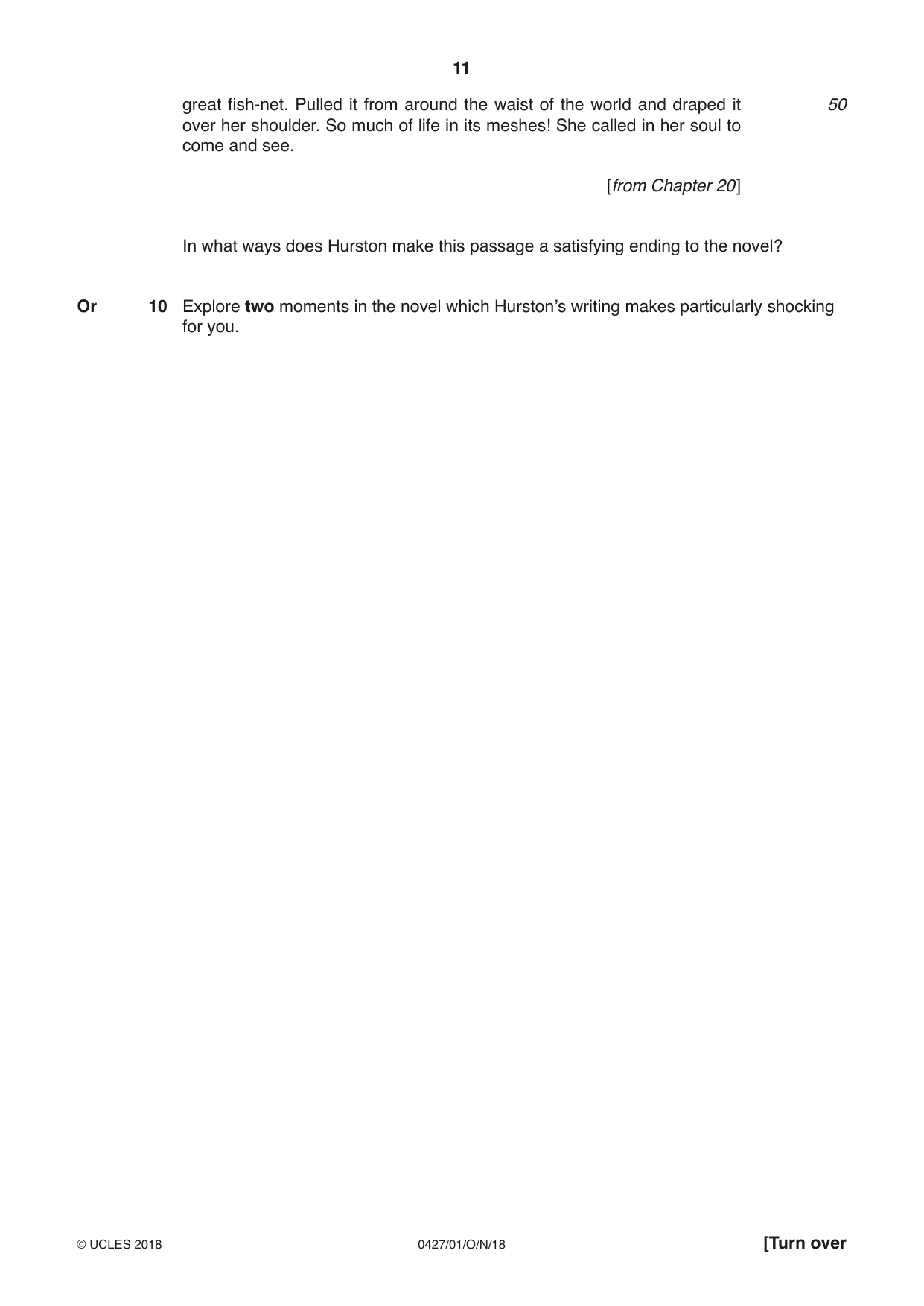
11 0427/01/O/N/18 © UCLES 2018 [Turn over great fish-net. Pulled it from around the waist of the world and draped it over her shoulder. So much of life in its meshes! She called in her soul to come and see. [from Chapter 20] In what ways does Hurston make this passage a satisfying ending to the novel? Or 10 Explore two moments in the novel which Hurston’s writing makes particularly shocking for you. 50
Question paper, page 12
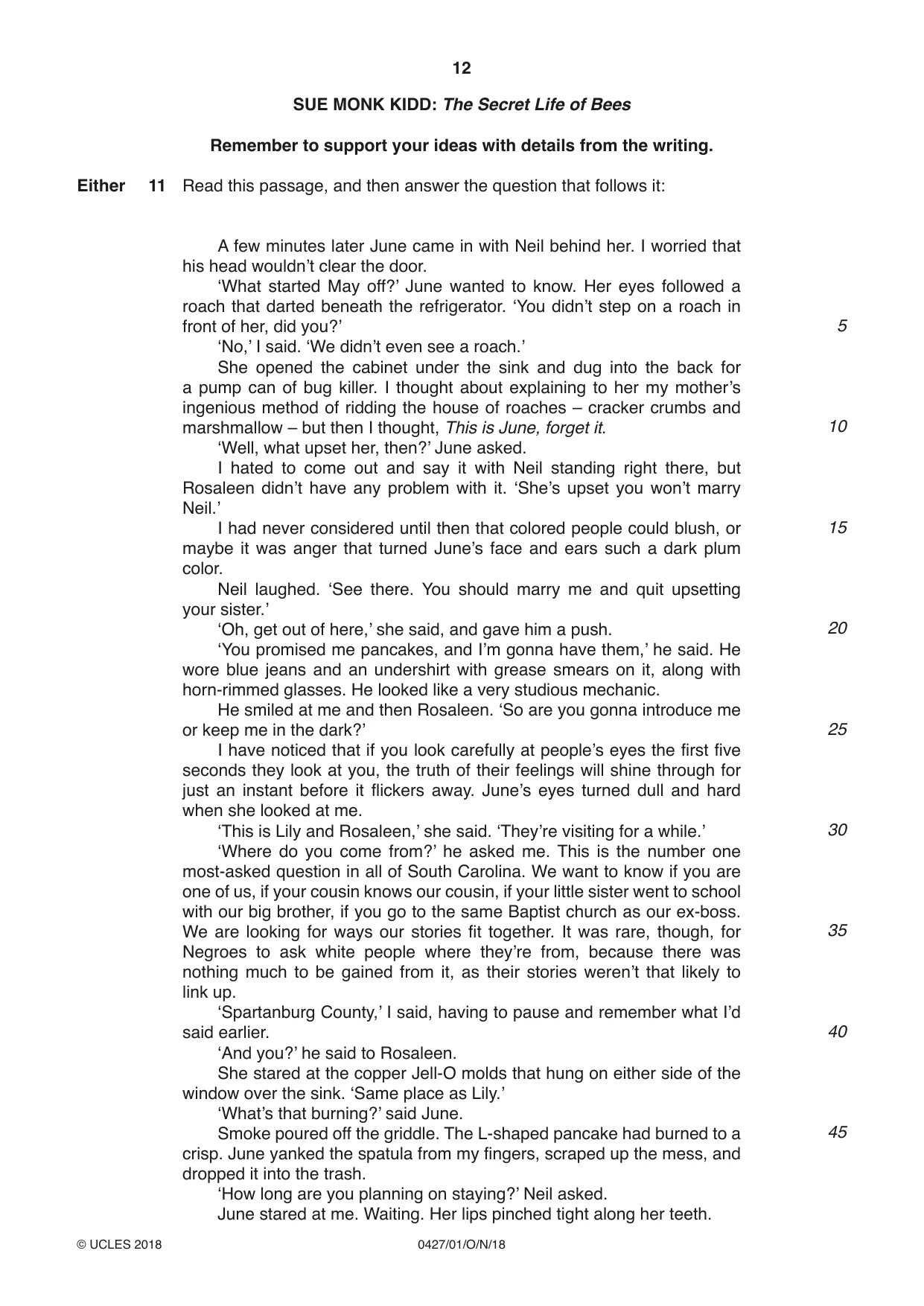
12 0427/01/O/N/18 © UCLES 2018 SUE MONK KIDD: The Secret Life of Bees Remember to support your ideas with details from the writing. Either 11 Read this passage, and then answer the question that follows it: A few minutes later June came in with Neil behind her. I worried that his head wouldn’t clear the door. ‘What started May off?’ June wanted to know. Her eyes followed a roach that darted beneath the refrigerator. ‘You didn’t step on a roach in front of her, did you?’ ‘No,’ I said. ‘We didn’t even see a roach.’ She opened the cabinet under the sink and dug into the back for a pump can of bug killer. I thought about explaining to her my mother’s ingenious method of ridding the house of roaches – cracker crumbs and marshmallow – but then I thought, This is June, forget it. ‘Well, what upset her, then?’ June asked. I hated to come out and say it with Neil standing right there, but Rosaleen didn’t have any problem with it. ‘She’s upset you won’t marry Neil.’ I had never considered until then that colored people could blush, or maybe it was anger that turned June’s face and ears such a dark plum color. Neil laughed. ‘See there. You should marry me and quit upsetting your sister.’ ‘Oh, get out of here,’ she said, and gave him a push. ‘You promised me pancakes, and I’m gonna have them,’ he said. He wore blue jeans and an undershirt with grease smears on it, along with horn-rimmed glasses. He looked like a very studious mechanic. He smiled at me and then Rosaleen. ‘So are you gonna introduce me or keep me in the dark?’ I have noticed that if you look carefully at people’s eyes the first five seconds they look at you, the truth of their feelings will shine through for just an instant before it flickers away. June’s eyes turned dull and hard when she looked at me. ‘This is Lily and Rosaleen,’ she said. ‘They’re visiting for a while.’ ‘Where do you come from?’ he asked me. This is the number one most-asked question in all of South Carolina. We want to know if you are one of us, if your cousin knows our cousin, if your little sister went to school with our big brother, if you go to the same Baptist church as our ex-boss. We are looking for ways our stories fit together. It was rare, though, for Negroes to ask white people where they’re from, because there was nothing much to be gained from it, as their stories weren’t that likely to link up. ‘Spartanburg County,’ I said, having to pause and remember what I’d said earlier. ‘And you?’ he said to Rosaleen. She stared at the copper Jell-O molds that hung on either side of the window over the sink. ‘Same place as Lily.’ ‘What’s that burning?’ said June. Smoke poured off the griddle. The L-shaped pancake had burned to a crisp. June yanked the spatula from my fingers, scraped up the mess, and dropped it into the trash. ‘How long are you planning on staying?’ Neil asked. June stared at me. Waiting. Her lips pinched tight along her teeth. 5 10 15 20 25 30 35 40 45
Question paper, page 13
13 0427/01/O/N/18 © UCLES 2018 [Turn over ‘A while longer,’ I answered, looking over into the garbage can. L for Lily. I could feel the questions gathering in him, knew I could not face them. ‘I’m not hungry,’ I said, and walked out the back door. Crossing the back porch, I heard Rosaleen say to him, ‘Have you registered yourself to vote?’ [from Chapter 6] How does Kidd vividly convey tension at this moment in the novel? Or 12 Explore how Kidd makes the relationship between Lily and Rosaleen so memorable. Do not use the extract in Question 11 in answering this question. 50 55
Question paper, page 14
14 0427/01/O/N/18 © UCLES 2018 from Stories of Ourselves Remember to support your ideas with details from the writing. Either 13 Read this passage from My Greatest Ambition (by Morris Lurie), and then answer the question that follows it: My greatest ambition was to be a comic-strip artist, but I grew out of it. People were always patting me on the head and saying, ‘He’ll grow out of it.’ They didn’t know what they were talking about. Had any of them ever read a comic? Studied one? Drawn one? ‘Australia is no place for comics,’ they said, and I had to lock myself up in the dining room to get some peace. My mother thought I was studying in there. I was the only person in my class – probably in the whole school – who wanted to be a comic-strip artist. They were all dreamers. There they sat, the astronomer, the nuclear physicist, the business tycoon (on the Stock Exchange), two mathematicians, three farmers, countless chemists, a handful of doctors, all aged thirteen and all with their heads in the clouds. Dreamers! Idle speculators! A generation of hopeless romantics! It was a Friday night, I recall, when I put the finishing touches to my first full length, inked-in, original, six-page comic-strip. I didn’t have the faintest idea what to do with it. Actually, doing anything with it hadn’t ever entered my mind. Doing it was enough. Over the weekend I read it through sixty or seventy times, analysed it, studied it, stared at it, finally pronounced it ‘Not too bad,’ and then put it up on the top of my wardrobe where my father kept his hats. And that would have been the end of it, only the next day I happened to mention to Michael Lazarus, who sat next to me at school, that I had drawn a comic-strip, and he happened to mention to me that there was a magazine in Melbourne I could send it to. We were both thrown out of that class for doing too much mentioning out loud, and kept in after school, to write fifty eight-letter words and their meanings in sentences – a common disciplinary action at that time. I remember writing ‘ambulate’ and saying it was a special way of walking. Do I digress? Then let me say that the first thing I did when I got home was roll my comic up in brown paper, address it, and put it in my schoolbag where I wouldn’t forget it in the morning. Some chance of that. Lazarus had introduced an entirely new idea into my head. Publication. I hardly slept all night. One of the things that kept me tossing and turning was the magazine I was sending my comic to. Boy Magazine. I had never bought one in my life, because it had the sneaky policy of printing stories, with only one illustration at the top of the page to get you interested. Stories? The school library was full of them, and what a bore they were. Did I want my comic to appear in a magazine which printed stories, where it would be read by the sort of people who were always taking books out of the library and sitting under trees and wearing glasses and squinting and turning pages with licked fingers? An awful prospect! At two o’clock in the morning I decided no, I didn’t, and at three I did, and at four it was no again, but the last thing I saw before I finally fell asleep was Lazarus’s face and he was saying, ‘Publication!’ and that decided it. Away it went. Now let me properly introduce my father, a great scoffer. In those pre- television days, he had absolutely nothing to do in the evening but to walk past my room and look in and say, ‘Nu? They sent you the money yet?’ Fifty times a night, at least. And when the letter came from Boy Magazine, did he change his tune? Not one bit. 5 10 15 20 25 30 35 40 45
Question paper, page 15
15 0427/01/O/N/18 © UCLES 2018 ‘I don’t see a cheque,’ he said. ‘Of course there’s no cheque,’ I said. ‘How can there be? We haven’t even discussed it yet. Maybe I’ll decide not to sell it to them. Which I will, if their price isn’t right.’ ‘Show me again the letter,’ my father said, ‘Ha, listen, listen. “We are very interested in your comic and would like you to phone Miss Gordon to make an appointment to see the editor.” An appointment? That means they don’t want it. If they wanted it, believe me, there’d be a cheque.’ It serves no purpose to put down the rest of this pointless conversation, which included such lines as ‘How many comics have you sold in your life?’ and, ‘Who paid for the paper? The ink?’ other than to say that I made the phone call to Miss Gordon from a public phone and not from home. I wasn’t going to have my father listening to every word. My voice, when I was thirteen, and standing on tiptoe and talking into a public phone, was, I must admit, unnecessarily loud, but Miss Gordon didn’t say anything about it. ‘And what day will be most convenient for you, Mr Lurie?’ she asked. ‘Oh, any day at all!’ I shouted. ‘Any day will suit me fine!’ ‘A week from Thursday then?’ she asked. ‘Perfect!’ I yelled, trying to get a piece of paper and a pencil out of my trouser pocket to write it down, and at the same time listening like mad in case Miss Gordon said something else. And she did. ‘Ten o’clock?’ ‘I’ll be there!’ I shouted, and hung up with a crash. It hadn’t occurred to me to mention to Miss Gordon that I was thirteen and at school and would have to take a day off to come and see the editor. I didn’t think these things were relevant to our business. In what ways does Lurie make this opening to My Greatest Ambition so entertaining? Or 14 What striking impressions of Mr Wills does Deal’s writing create for you in The Taste of Watermelon? 50 55 60 65 70
Question paper, page 16
16 0427/01/O/N/18 © UCLES 2018 BLANK PAGE Permission to reproduce items where third-party owned material protected by copyright is included has been sought and cleared where possible. Every reasonable effort has been made by the publisher (UCLES) to trace copyright holders, but if any items requiring clearance have unwittingly been included, the publisher will be pleased to make amends at the earliest possible opportunity. To avoid the issue of disclosure of answer-related information to candidates, all copyright acknowledgements are reproduced online in the Cambridge International Examinations Copyright Acknowledgements Booklet. This is produced for each series of examinations and is freely available to download at www.cie.org.uk after the live examination series. Cambridge International Examinations is part of the Cambridge Assessment Group. Cambridge Assessment is the brand name of University of Cambridge Local Examinations Syndicate (UCLES), which is itself a department of the University of Cambridge.