Cambridge IGCSE English - Literature (BES) 0427 — 2017 Oct/Nov Paper 1 · Variant 0
0427/10/O/N/17
The question paper and its mark scheme, free to read here and free to download. This is Cambridge’s own paper, exactly as it was sat.
Question paper20 pages




Mark scheme
No mark scheme is in the library for this paper.
Paper as text
Question paper, page 1
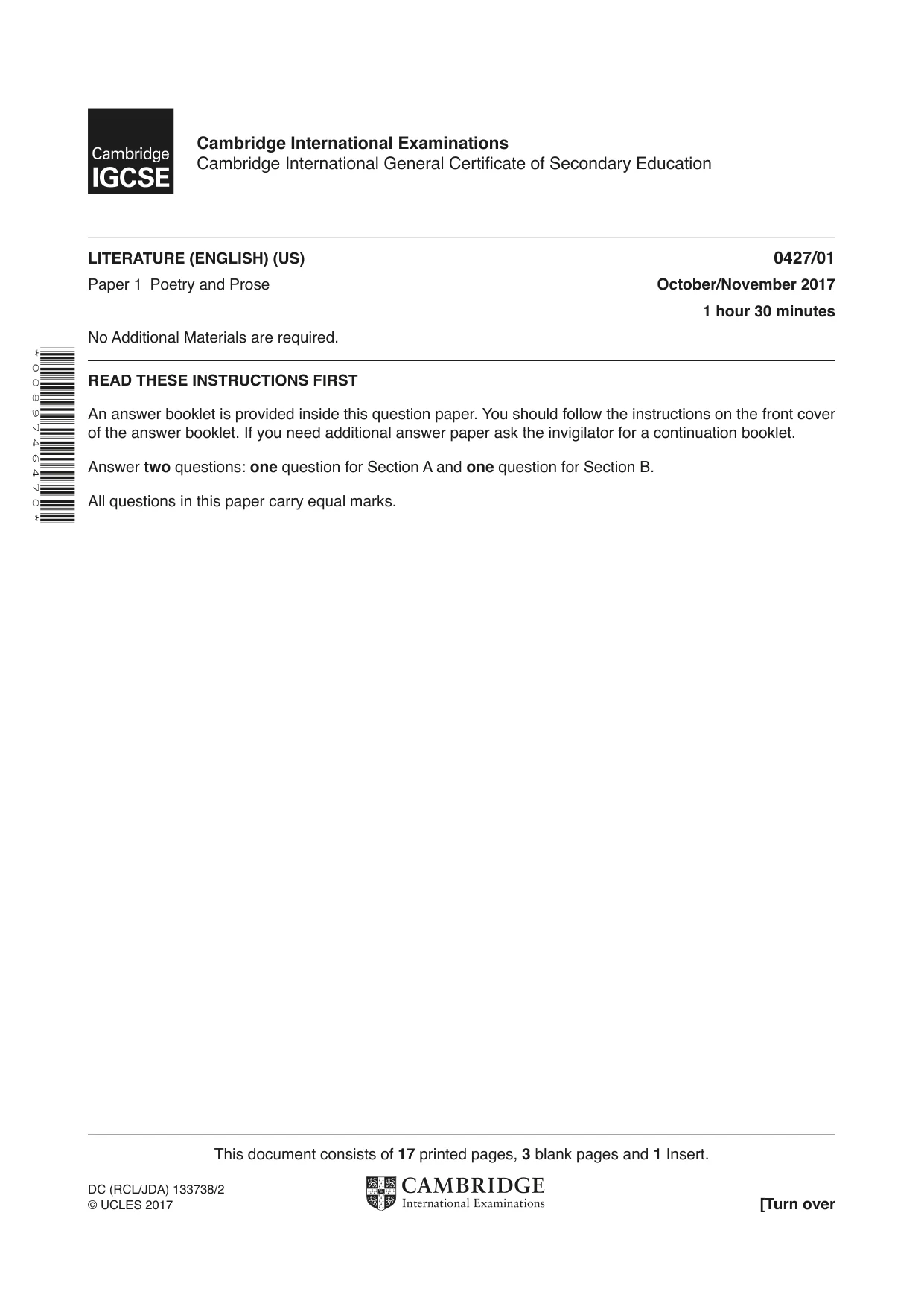
This document consists of 17 printed pages, 3 blank pages and 1 Insert. DC (RCL/JDA) 133738/2 © UCLES 2017 [Turn over Cambridge International Examinations Cambridge International General Certificate of Secondary Education * 0 0 8 9 7 4 6 4 7 0 * LITERATURE (ENGLISH) (US) 0427/01 Paper 1 Poetry and Prose October/November 2017 1 hour 30 minutes No Additional Materials are required. READ THESE INSTRUCTIONS FIRST An answer booklet is provided inside this question paper. You should follow the instructions on the front cover of the answer booklet. If you need additional answer paper ask the invigilator for a continuation booklet. Answer two questions: one question for Section A and one question for Section B. All questions in this paper carry equal marks.
Question paper, page 2
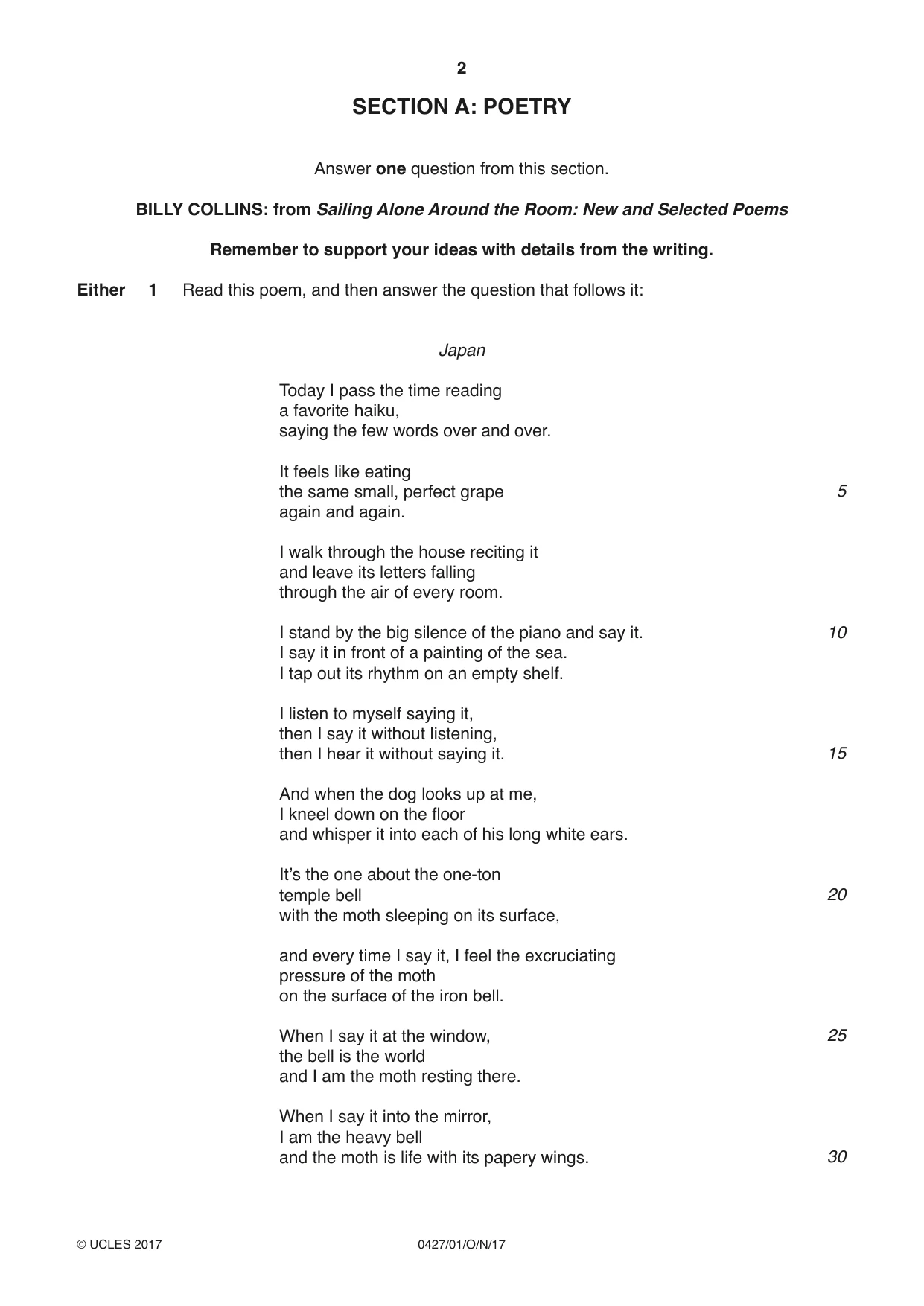
2 0427/01/O/N/17 © UCLES 2017 SECTION A: POETRY Answer one question from this section. BILLY COLLINS: from Sailing Alone Around the Room: New and Selected Poems Remember to support your ideas with details from the writing. Either 1 Read this poem, and then answer the question that follows it: Japan Today I pass the time reading a favorite haiku, saying the few words over and over. It feels like eating the same small, perfect grape again and again. I walk through the house reciting it and leave its letters falling through the air of every room. I stand by the big silence of the piano and say it. I say it in front of a painting of the sea. I tap out its rhythm on an empty shelf. I listen to myself saying it, then I say it without listening, then I hear it without saying it. And when the dog looks up at me, I kneel down on the floor and whisper it into each of his long white ears. It’s the one about the one-ton temple bell with the moth sleeping on its surface, and every time I say it, I feel the excruciating pressure of the moth on the surface of the iron bell. When I say it at the window, the bell is the world and I am the moth resting there. When I say it into the mirror, I am the heavy bell and the moth is life with its papery wings. 5 10 15 20 25 30
Question paper, page 3
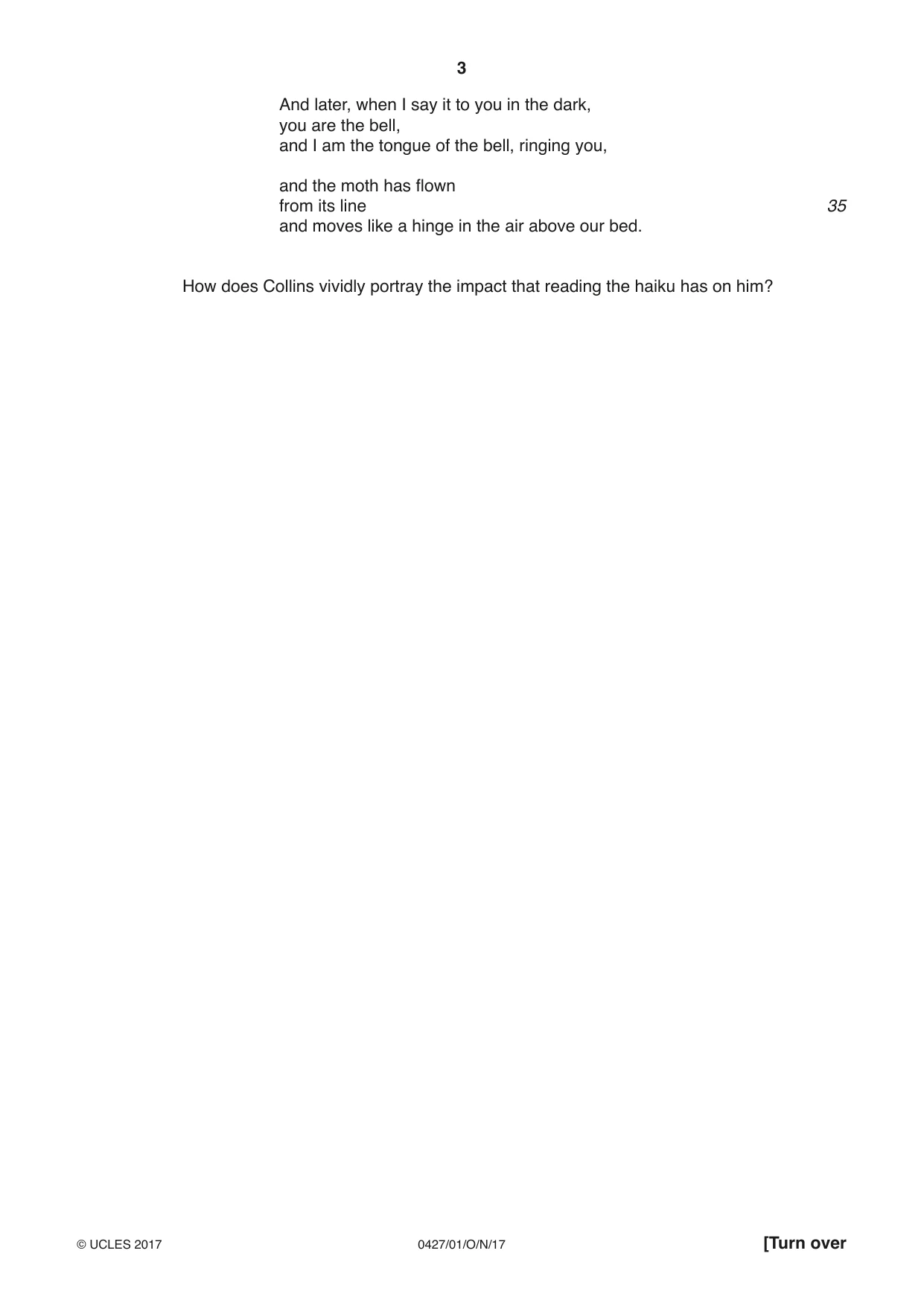
3 0427/01/O/N/17 © UCLES 2017 [Turn over And later, when I say it to you in the dark, you are the bell, and I am the tongue of the bell, ringing you, and the moth has flown from its line and moves like a hinge in the air above our bed. How does Collins vividly portray the impact that reading the haiku has on him? 35
Question paper, page 4
4 0427/01/O/N/17 © UCLES 2017 Or 2 Read this poem, and then answer the question that follows it: The Movies I would like to watch a movie tonight Content removed due to copyright restrictions
Question paper, page 5
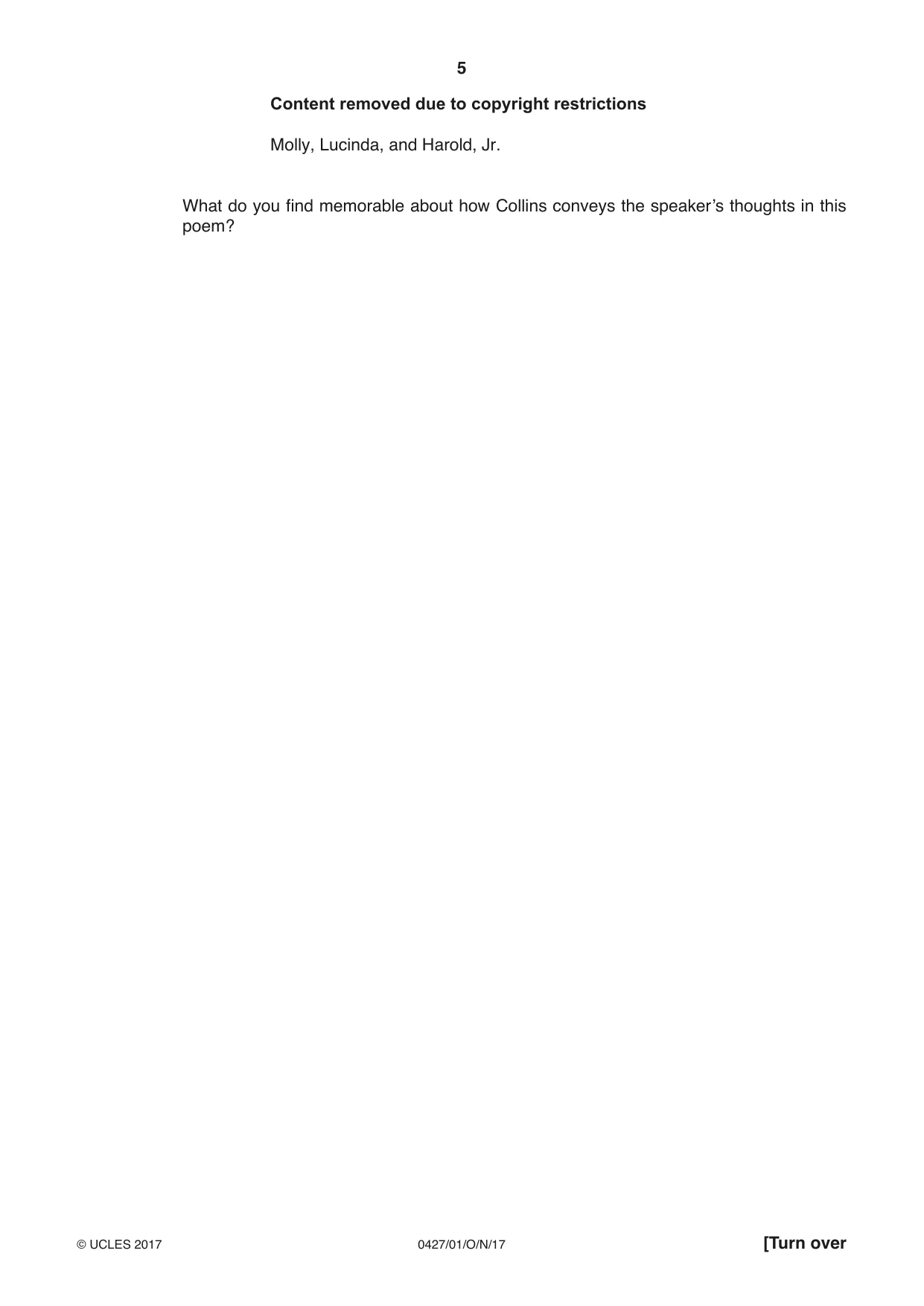
5 0427/01/O/N/17 © UCLES 2017 [Turn over Content removed due to copyright restrictions Molly, Lucinda, and Harold, Jr. What do you find memorable about how Collins conveys the speaker’s thoughts in this poem?
Question paper, page 6
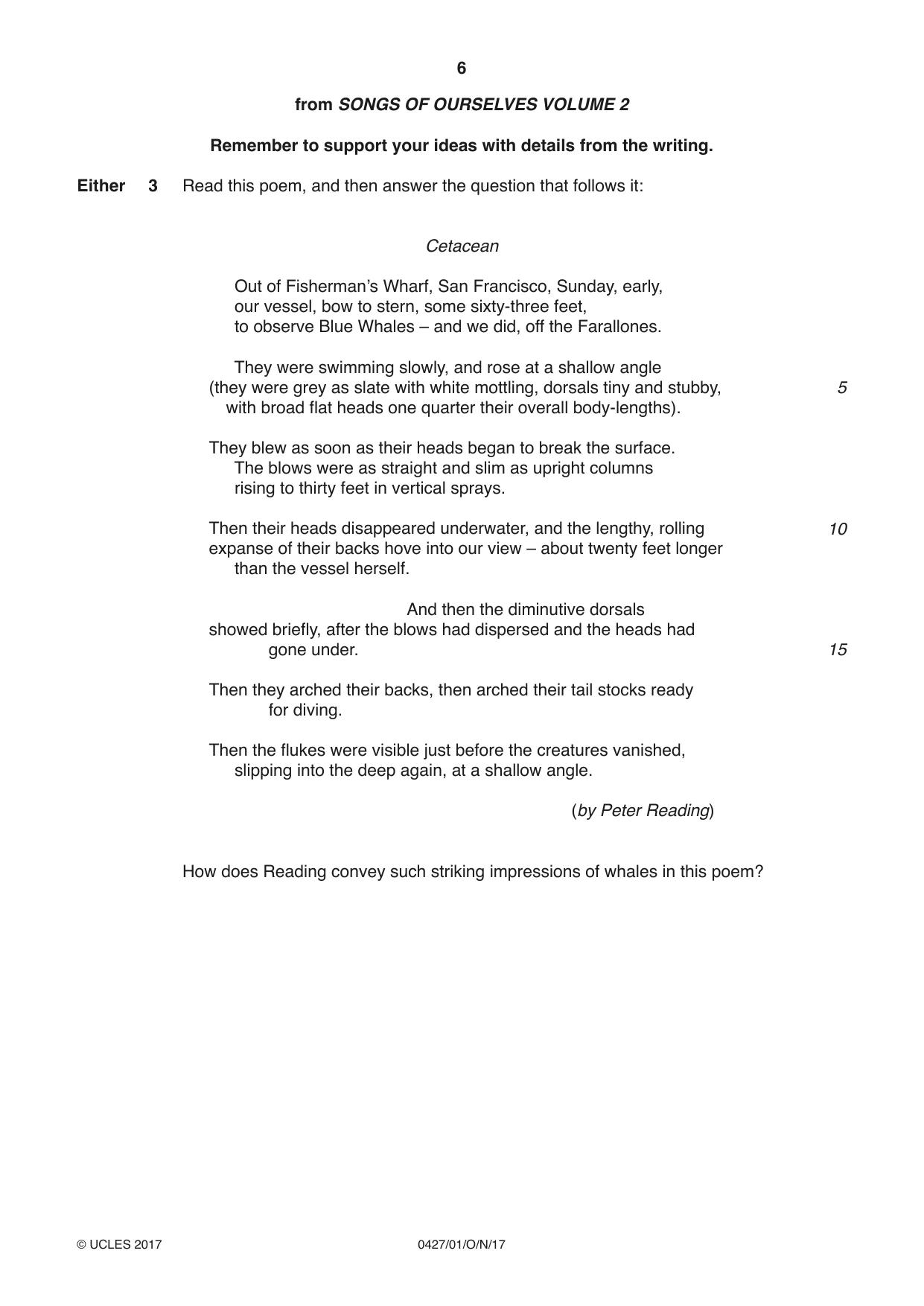
6 0427/01/O/N/17 © UCLES 2017 from SONGS OF OURSELVES VOLUME 2 Remember to support your ideas with details from the writing. Either 3 Read this poem, and then answer the question that follows it: Cetacean Out of Fisherman’s Wharf, San Francisco, Sunday, early, our vessel, bow to stern, some sixty-three feet, to observe Blue Whales – and we did, off the Farallones. They were swimming slowly, and rose at a shallow angle (they were grey as slate with white mottling, dorsals tiny and stubby, with broad flat heads one quarter their overall body-lengths). They blew as soon as their heads began to break the surface. The blows were as straight and slim as upright columns rising to thirty feet in vertical sprays. Then their heads disappeared underwater, and the lengthy, rolling expanse of their backs hove into our view – about twenty feet longer than the vessel herself. And then the diminutive dorsals showed briefly, after the blows had dispersed and the heads had gone under. Then they arched their backs, then arched their tail stocks ready for diving. Then the flukes were visible just before the creatures vanished, slipping into the deep again, at a shallow angle. (by Peter Reading) How does Reading convey such striking impressions of whales in this poem? 5 10 15
Question paper, page 7
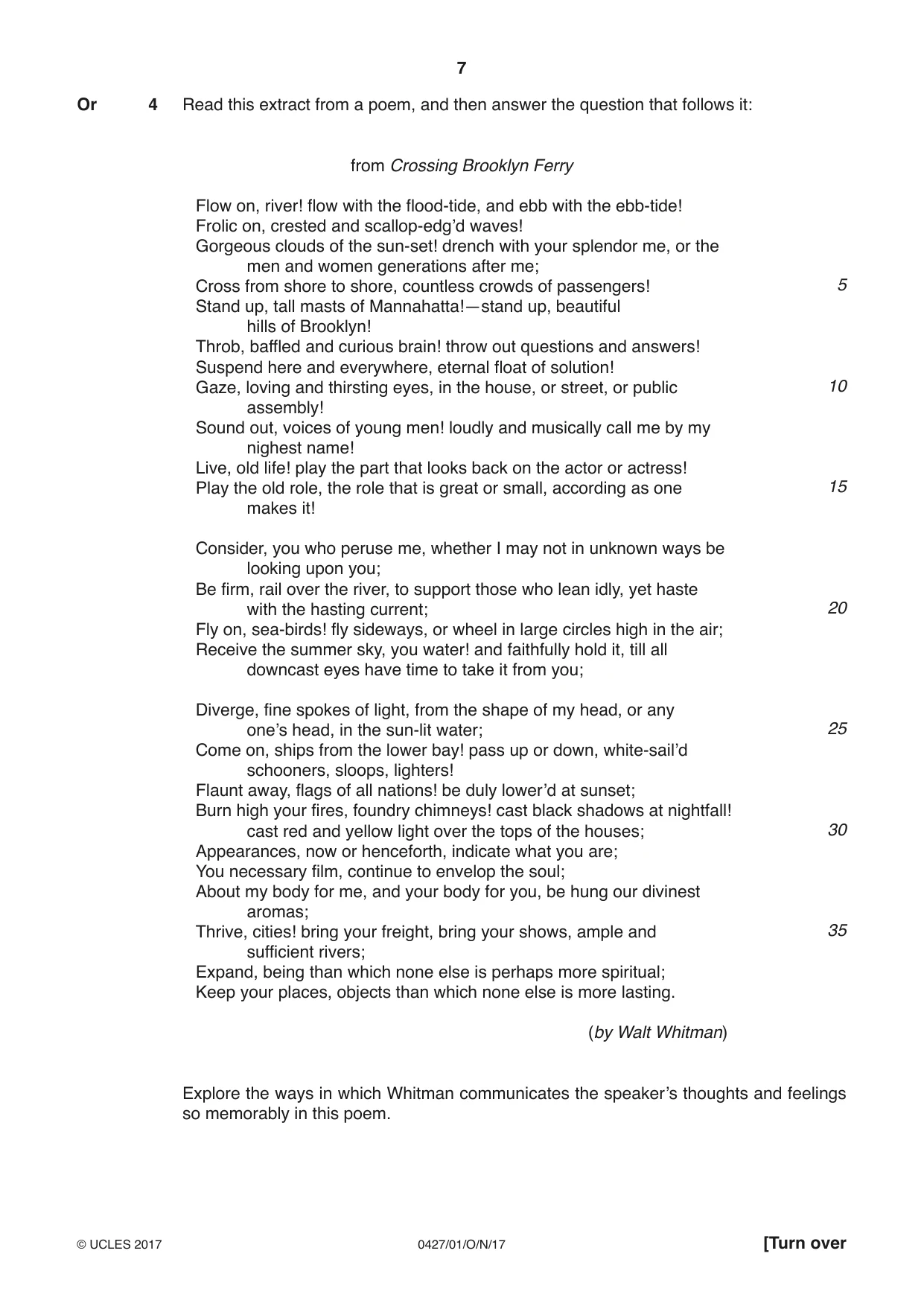
7 0427/01/O/N/17 © UCLES 2017 [Turn over Or 4 Read this extract from a poem, and then answer the question that follows it: from Crossing Brooklyn Ferry Flow on, river! flow with the flood-tide, and ebb with the ebb-tide! Frolic on, crested and scallop-edg’d waves! Gorgeous clouds of the sun-set! drench with your splendor me, or the men and women generations after me; Cross from shore to shore, countless crowds of passengers! Stand up, tall masts of Mannahatta!—stand up, beautiful hills of Brooklyn! Throb, baffled and curious brain! throw out questions and answers! Suspend here and everywhere, eternal float of solution! Gaze, loving and thirsting eyes, in the house, or street, or public assembly! Sound out, voices of young men! loudly and musically call me by my nighest name! Live, old life! play the part that looks back on the actor or actress! Play the old role, the role that is great or small, according as one makes it! Consider, you who peruse me, whether I may not in unknown ways be looking upon you; Be firm, rail over the river, to support those who lean idly, yet haste with the hasting current; Fly on, sea-birds! fly sideways, or wheel in large circles high in the air; Receive the summer sky, you water! and faithfully hold it, till all downcast eyes have time to take it from you; Diverge, fine spokes of light, from the shape of my head, or any one’s head, in the sun-lit water; Come on, ships from the lower bay! pass up or down, white-sail’d schooners, sloops, lighters! Flaunt away, flags of all nations! be duly lower’d at sunset; Burn high your fires, foundry chimneys! cast black shadows at nightfall! cast red and yellow light over the tops of the houses; Appearances, now or henceforth, indicate what you are; You necessary film, continue to envelop the soul; About my body for me, and your body for you, be hung our divinest aromas; Thrive, cities! bring your freight, bring your shows, ample and sufficient rivers; Expand, being than which none else is perhaps more spiritual; Keep your places, objects than which none else is more lasting. (by Walt Whitman) Explore the ways in which Whitman communicates the speaker’s thoughts and feelings so memorably in this poem. 5 10 15 20 25 30 35
Question paper, page 8
8 0427/01/O/N/17 © UCLES 2017 SECTION B: PROSE Answer one question from this section. RAY BRADBURY: Fahrenheit 451 Remember to support your ideas with details from the writing. Either 5 Read this passage, and then answer the question that follows it: They read the long afternoon through, while the cold November rain fell from the sky upon the quiet house. Content removed due to copyright restrictions
Question paper, page 9
9 0427/01/O/N/17 © UCLES 2017 [Turn over Content removed due to copyright restrictions Why should I read? What for?’ [from “The Sieve and The Sand” ] Explore how Bradbury makes this such a significant moment in the novel. Or 6 How does Bradbury vividly portray Montag’s changing feelings about being a “fireman”?
Question paper, page 10
10 0427/01/O/N/17 © UCLES 2017 F SCOTT FITZGERALD: The Great Gatsby Remember to support your ideas with details from the writing. Either 7 Read this passage, and then answer the question that follows it: For a while I lost sight of Jordan Baker, and then in midsummer I found her again. At first I was flattered to go places with her, because she was a golf champion, and everyone knew her name. Then it was something more. I wasn’t actually in love, but I felt a sort of tender curiosity. The bored haughty face that she turned to the world concealed something – most affectations conceal something eventually, even though they don’t in the beginning – and one day I found what it was. When we were on a house- party together up in Warwick, she left a borrowed car out in the rain with the top down, and then lied about it – and suddenly I remembered the story about her that had eluded me that night at Daisy’s. At her first big golf tournament there was a row that nearly reached the newspapers – a suggestion that she had moved her ball from a bad lie in the semi-final round. The thing approached the proportions of a scandal – then died away. A caddy retracted his statement, and the only other witness admitted that he might have been mistaken. The incident and the name had remained together in my mind. Jordan Baker instinctively avoided clever, shrewd men, and now I saw that this was because she felt safer on a plane where any divergence from a code would be thought impossible. She was incurably dishonest. She wasn’t able to endure being at a disadvantage and, given this unwillingness, I suppose she had begun dealing in subterfuges when she was very young in order to keep that cool, insolent smile turned to the world and yet satisfy the demands of her hard, jaunty body. It made no difference to me. Dishonesty in a woman is a thing you never blame deeply – I was casually sorry, and then I forgot. It was on that same house-party that we had a curious conversation about driving a car. It started because she passed so close to some workmen that our fender flicked a button on one man’s coat. ‘You’re a rotten driver,’ I protested. ‘Either you ought to be more careful, or you oughtn’t to drive at all.’ ‘I am careful.’ ‘No, you’re not.’ ‘Well, other people are,’ she said lightly. ‘What’s that got to do with it?’ ‘They’ll keep out of my way,’ she insisted. ‘It takes two to make an accident.’ ‘Suppose you met somebody just as careless as yourself.’ ‘I hope I never will,’ she answered. ‘I hate careless people. That’s why I like you.’ Her grey, sun-strained eyes stared straight ahead, but she had deliberately shifted our relations, and for a moment I thought I loved her. But I am slow-thinking and full of interior rules that act as brakes on my desires, and I knew that first I had to get myself definitely out of that tangle back home. I’d been writing letters once a week and signing them: ‘Love, Nick,’ and all I could think of was how, when that certain girl played tennis, a faint moustache of perspiration appeared on her upper lip. Nevertheless there was a vague understanding that had to be tactfully broken off before I was free. 5 10 15 20 25 30 35 40 45
Question paper, page 11
11 0427/01/O/N/17 © UCLES 2017 [Turn over Every one suspects himself of at least one of the cardinal virtues, and this is mine: I am one of the few honest people that I have ever known. [from Chapter 3 ] Explore the ways in which Fitzgerald strikingly portrays Jordan Baker and Nick (the narrator) at this moment in the novel. Or 8 How does Fitzgerald’s writing make the parties at Gatsby’s house on West Egg memorable for you? 50
Question paper, page 12
12 0427/01/O/N/17 © UCLES 2017 ZORA NEALE HURSTON: Their Eyes Were Watching God Remember to support your ideas with details from the writing. Either 9 Read this passage, and then answer the question that follows it: It was the meanest moment of eternity. Content removed due to copyright restrictions
Question paper, page 13
0427/01/O/N/17 © UCLES 2017 [Turn over 13 [from Chapter 19 ] In what ways does Hurston make this moment in the novel so powerful? Or 10 Explore the ways in which Hurston vividly depicts the unhappy marriage between Janie and Logan Killicks. Hanging was too good.
Question paper, page 14
14 0427/01/O/N/17 © UCLES 2017 SUE MONK KIDD: The Secret Life of Bees Remember to support your ideas with details from the writing. Either 11 Read this passage, and then answer the question that follows it: The next morning I woke early and walked outside. The rain had stopped and the sun glowed behind a bank of clouds. Pinewoods stretched beyond the honey house in every direction. I could make out about fourteen beehives tucked under the trees in the distance, the tops of them postage stamps of white shine. The night before, during dinner, August had said she owned twenty- eight acres left to her by her granddaddy. A girl could get lost on twenty-eight acres in a little town like this. She could open a trapdoor and disappear. Light spilled through a crack in a red-rimmed cloud, and I walked toward it along a path that led from the honey house into the woods. I passed a child’s wagon loaded with garden tools. It rested beside a plot growing tomatoes tied to wooden stakes with pieces of nylon hose. Mixed in with them were orange zinnias and lavender gladiolus that dipped toward the ground. The sisters loved birds, I could see. There was a concrete bird-bath and tons of feeders – hollowed-out gourds and rows of big pinecones sitting everywhere, each one smeared with peanut butter. Where the grass gave way to the woods, I found a stone wall crudely cemented together, not even knee high but nearly fifty yards long. It curved on around the property and abruptly stopped. It didn’t seem to have any purpose to it. Then I noticed tiny pieces of folded-up paper stuck in the crevices around the stones. I walked the length of the fence, and it was the same all the way, hundreds of these bits of paper. I pulled one out and opened it, but the writing was too blurred from rain to make out. I dug out another one. Birmingham, Sept 15, four little angels dead. I folded it and put it back, feeling like I’d done something wrong. Stepping over the wall, I moved into the trees, picking my way through little ferns with their blue-green feathers, careful not to tear the designs the spiders had worked so hard on all morning. It was like me and Rosaleen really had discovered the Lost Diamond City. As I walked, I began to hear the sound of running water. It’s impossible to hear that sound and not go searching for the source. I pushed deeper into the woods. The growth turned thick, and sticker bushes snagged my legs, but I found it – a little river, not much bigger than the creek where Rosaleen and I had bathed. I watched the currents meander, the lazy ripples that once in a while broke along the surface. Taking off my shoes, I waded in. The bottom turned mushy, squishing up through my toes. A turtle plopped off a rock into the water right in front of me, nearly scaring the Lord Jesus out of me. There was no telling what other invisible creatures I was out here socializing with – snakes, frogs, fish, a whole river world of biting bugs, and I could have cared less. When I put on my shoes and headed back, the light poured down in shafts, and I wanted it to always be like this – no T. Ray, no Mr Gaston, nobody wanting to beat Rosaleen senseless. Just the rain-cleaned woods and the rising light. [from Chapter 4 ] 5 10 15 20 25 30 35 40 45
Question paper, page 15
15 0427/01/O/N/17 © UCLES 2017 [Turn over How does Kidd memorably convey Lily’s feelings on her first morning at the pink house? Or 12 How does Kidd make Zach such a memorable and significant character in the novel?
Question paper, page 16
16 0427/01/O/N/17 © UCLES 2017 from STORIES OF OURSELVES Remember to support your ideas with details from the writing. Either 13 Read this passage from The Taste of Watermelon (by Borden Deal), and then answer the question that follows it: I looked towards Mr Wills’s barn. The moon was still high and bright, but I could not see him. My breath caught in my throat when I saw him in the field, walking towards the middle. I stood stiffly, watching him. He reached the place where the melon should have been, I saw him hesitate, looking around, then he bent, and I knew he was looking at the depression in the earth where the melon had lain. He straightened, a great strangled cry tearing out of his throat. It chilled me deep down and all the way through, like the cry of a wild animal. My father jerked himself out of the chair, startled by the sound. He turned in time to see Mr Wills lift the shotgun over his head and hurl it from him, his voice crying out again in a terrible, surging yell of pain and anger. ‘Lord, what’s the matter?’ my father said. Mr Wills was tearing up and down the melon patch, and I was puzzled by his actions. Then I saw; he was destroying every melon in the patch. He was breaking them open with his feet, silent now, concentrating on his frantic destruction. I was horrified by the awful sight, and my stomach moved sickly. My father stood for a moment, watching him, then he jumped off the porch and ran toward Mr Wills. I followed him. I saw Mrs Wills and Willadean huddled together in the kitchen doorway. My father ran into the melon patch and caught Mr Wills by the arm. ‘What’s come over you?’ he said. ‘What’s the matter, man?’ Mr Wills struck his grip away. ‘They’ve stolen my seed melon,’ he yelled. ‘They took it right out from under me.’ My father grabbed him with both arms. He was a brave man, for he was smaller than Mr Wills, and Mr Wills looked insane with anger, his teeth gripped over his lower lip, his eyes gleaming furiously. Mr Wills shoved my father away, striking at him with his fist. My father went down into the dirt. Mr Wills didn’t seem to notice. He went back to his task of destruction, raging up and down the field, stamping melons large and small. My father got up and began to chase him. But he didn’t have a chance. Every time he got close, Mr Wills would sweep his great arm and knock him away again. At last Mr Wills stopped of his own accord. He was standing on the place where the great melon had grown. His chest was heaving with great sobs of breath. He gazed about him at the destruction he had wrought, but I don’t think he saw it. ‘They stole my seed melon,’ he said. His voice was quieter now than I had ever heard it. I had not believed such quietness was in him. ‘They got it away, and now it’s gone.’ I saw that tears stood on his cheeks, and I couldn’t look at him any more. I’d never seen a grown man cry, crying in such strength. ‘I had two plans for that melon,’ he told my father. ‘Mrs Wills has been poorly all the spring, and she dearly loves the taste of melon. It was her melon for eating, and my melon for planting. She would eat the meat, and next spring I would plant the seeds for the greatest melon crop in the world. Every day she would ask me if the great seed melon was ready yet.’ 5 10 15 20 25 30 35 40 45
Question paper, page 17
17 0427/01/O/N/17 © UCLES 2017 I looked toward the house. I saw the two women, the mother and the daughter, standing there. I couldn’t bear any more. I fled out of the field towards the sanctuary of my house. I ran past my mother, standing on the porch, and went into my room. Explore the ways in which Deal makes this such a powerful moment in the story. Or 14 In what ways does La Guma make The Lemon Orchard such a disturbing portrayal of cruelty? 50
Question paper, page 18
18 0427/01/O/N/17 © UCLES 2017 BLANK PAGE
Question paper, page 19
19 0427/01/O/N/17 © UCLES 2017 BLANK PAGE
Question paper, page 20
20 0427/01/O/N/17 © UCLES 2017 Permission to reproduce items where third-party owned material protected by copyright is included has been sought and cleared where possible. Every reasonable effort has been made by the publisher (UCLES) to trace copyright holders, but if any items requiring clearance have unwittingly been included, the publisher will be pleased to make amends at the earliest possible opportunity. To avoid the issue of disclosure of answer-related information to candidates, all copyright acknowledgements are reproduced online in the Cambridge International Examinations Copyright Acknowledgements Booklet. This is produced for each series of examinations and is freely available to download at www.cie.org.uk after the live examination series. Cambridge International Examinations is part of the Cambridge Assessment Group. Cambridge Assessment is the brand name of University of Cambridge Local Examinations Syndicate (UCLES), which is itself a department of the University of Cambridge. BLANK PAGE