Cambridge IGCSE English - Literature 0486 — 2018 May/June Paper 1 · Variant 2
0486/12/M/J/18 · 50 marks · ≈56 min
The question paper and its mark scheme, free to read here and free to download. This is Cambridge’s own paper, exactly as it was sat.
Question paper28 pages







Mark scheme4 pages
Answers below. Sit the paper first if you are practising.
Paper as text
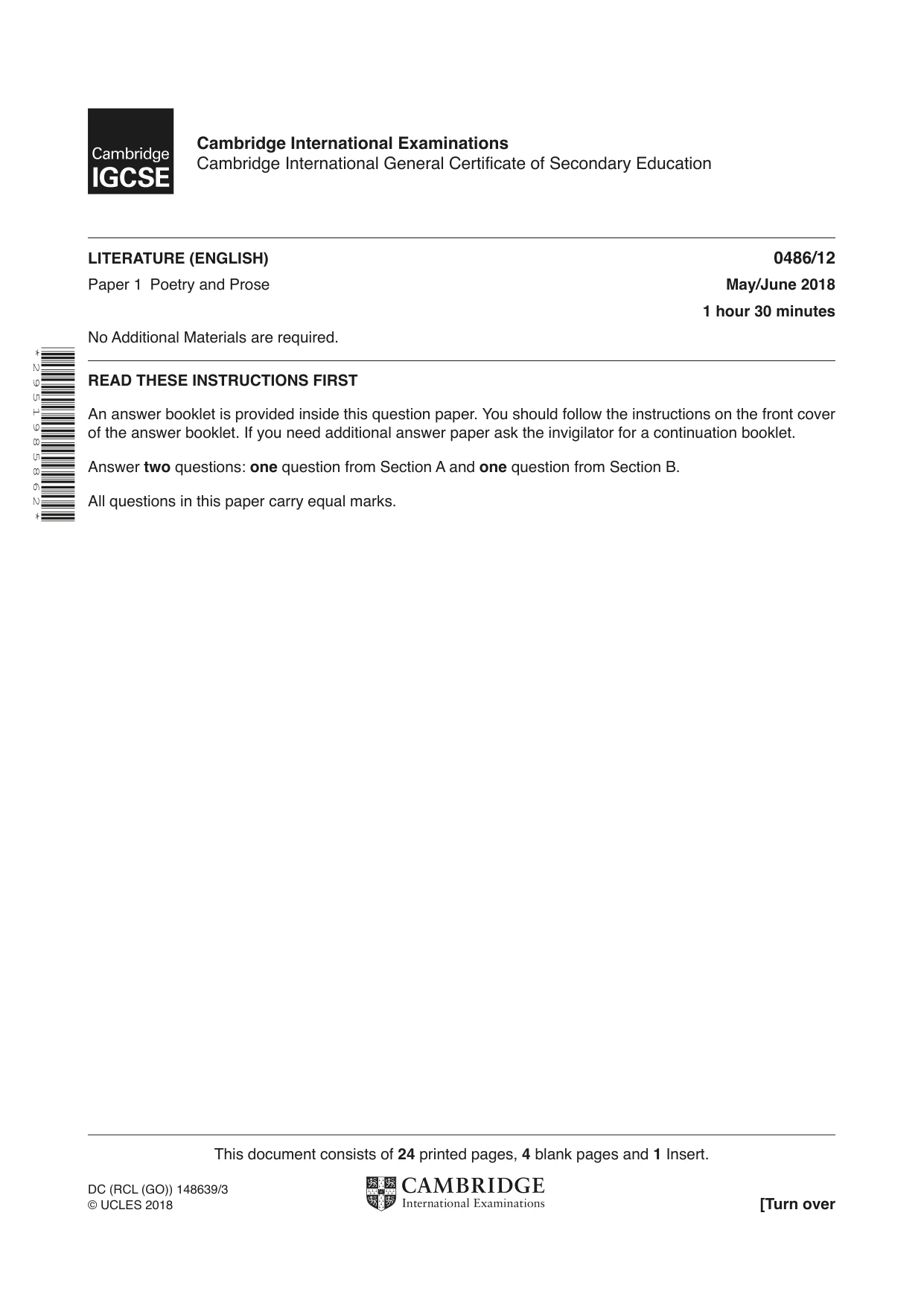
Question paper, page 1
This document consists of 24 printed pages, 4 blank pages and 1 Insert. DC (RCL (GO)) 148639/3 © UCLES 2018 [Turn over Cambridge International Examinations Cambridge International General Certificate of Secondary Education * 2 9 5 1 9 8 5 8 6 2 * LITERATURE (ENGLISH) 0486/12 Paper 1 Poetry and Prose May/June 2018 1 hour 30 minutes No Additional Materials are required. READ THESE INSTRUCTIONS FIRST An answer booklet is provided inside this question paper. You should follow the instructions on the front cover of the answer booklet. If you need additional answer paper ask the invigilator for a continuation booklet. Answer two questions: one question from Section A and one question from Section B. All questions in this paper carry equal marks.
Question paper, page 2
2 0486/12/M/J/18 © UCLES 2018 BLANK PAGE
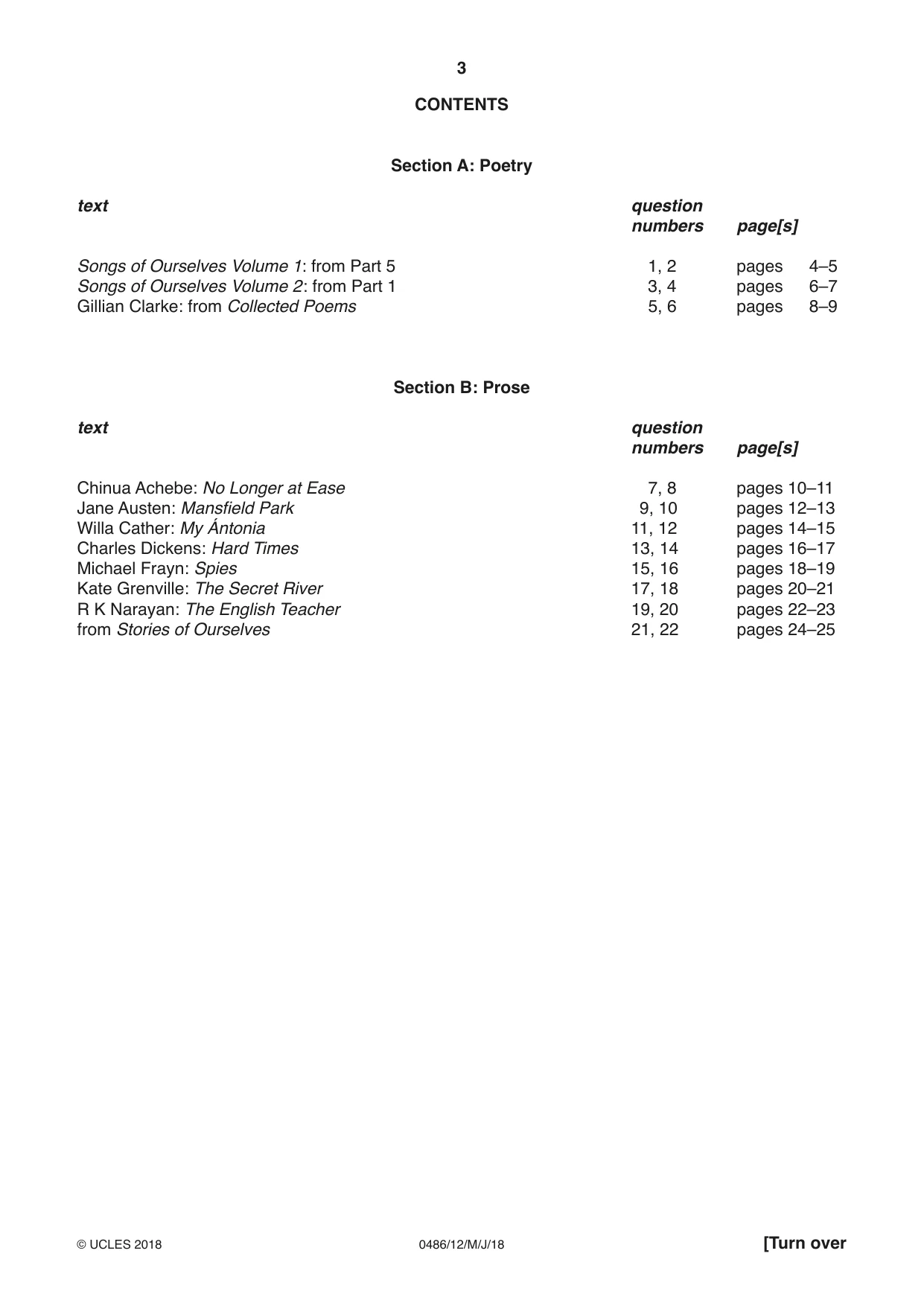
Question paper, page 3
3 0486/12/M/J/18 © UCLES 2018 [Turn over CONTENTS Section A: Poetry text question numbers page[s] Songs of Ourselves Volume 1: from Part 5 1, 2 pages 4–5 Songs of Ourselves Volume 2 : from Part 1 3, 4 pages 6–7 Gillian Clarke: from Collected Poems 5, 6 pages 8–9 Section B: Prose text question numbers page[s] Chinua Achebe: No Longer at Ease 7, 8 pages 10–11 Jane Austen: Mansfield Park 9, 10 pages 12–13 Willa Cather: My Ántonia 11, 12 pages 14–15 Charles Dickens: Hard Times 13, 14 pages 16–17 Michael Frayn: Spies 15, 16 pages 18–19 Kate Grenville: The Secret River 17, 18 pages 20–21 R K Narayan: The English Teacher 19, 20 pages 22–23 from Stories of Ourselves 21, 22 pages 24–25
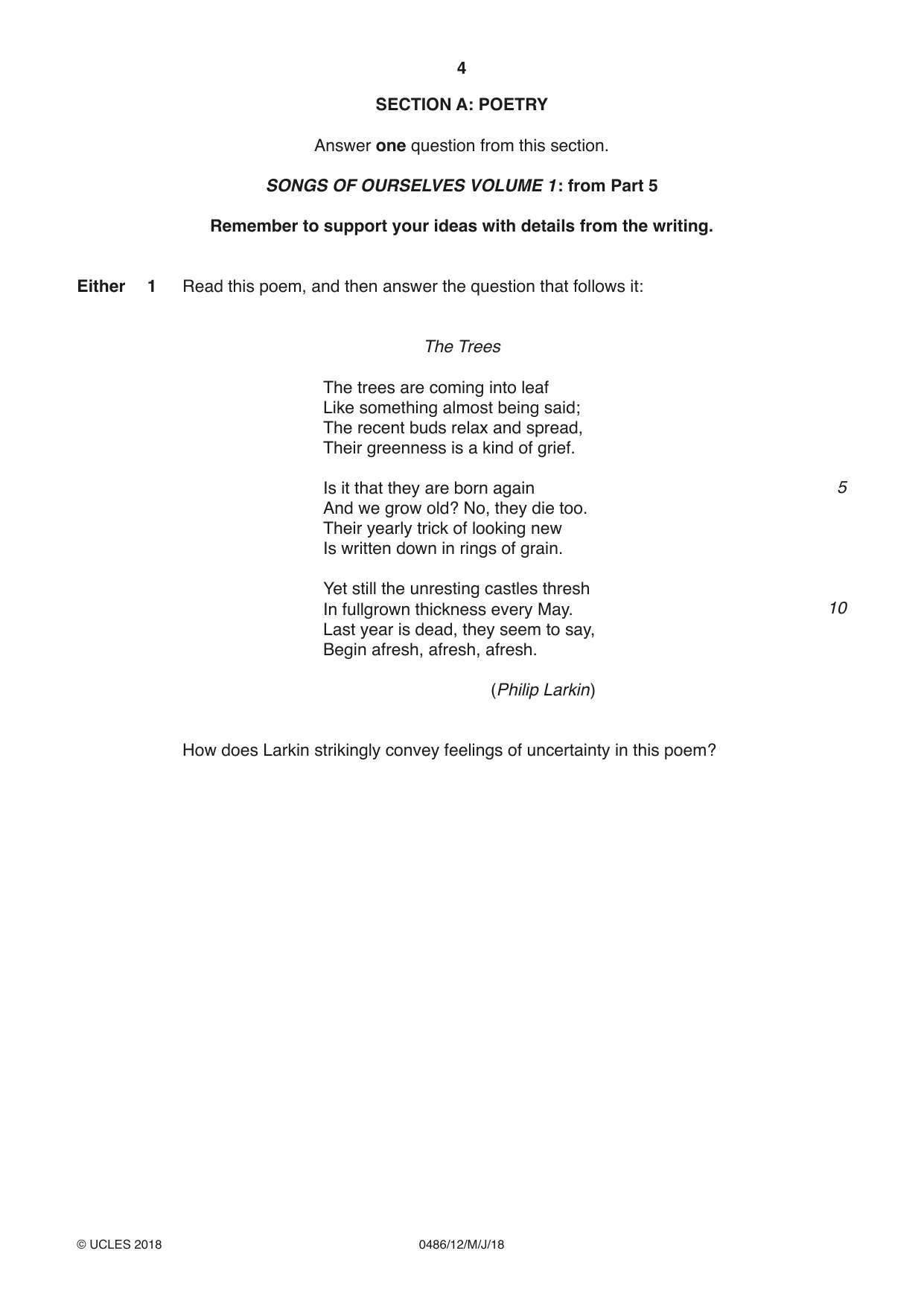
Question paper, page 4
4 0486/12/M/J/18 © UCLES 2018 SECTION A: POETRY Answer one question from this section. SONGS OF OURSELVES VOLUME 1: from Part 5 Remember to support your ideas with details from the writing. Either 1 Read this poem, and then answer the question that follows it: The Trees The trees are coming into leaf Like something almost being said; The recent buds relax and spread, Their greenness is a kind of grief. Is it that they are born again And we grow old? No, they die too. Their yearly trick of looking new Is written down in rings of grain. Yet still the unresting castles thresh In fullgrown thickness every May. Last year is dead, they seem to say, Begin afresh, afresh, afresh. (Philip Larkin) How does Larkin strikingly convey feelings of uncertainty in this poem? 5 10
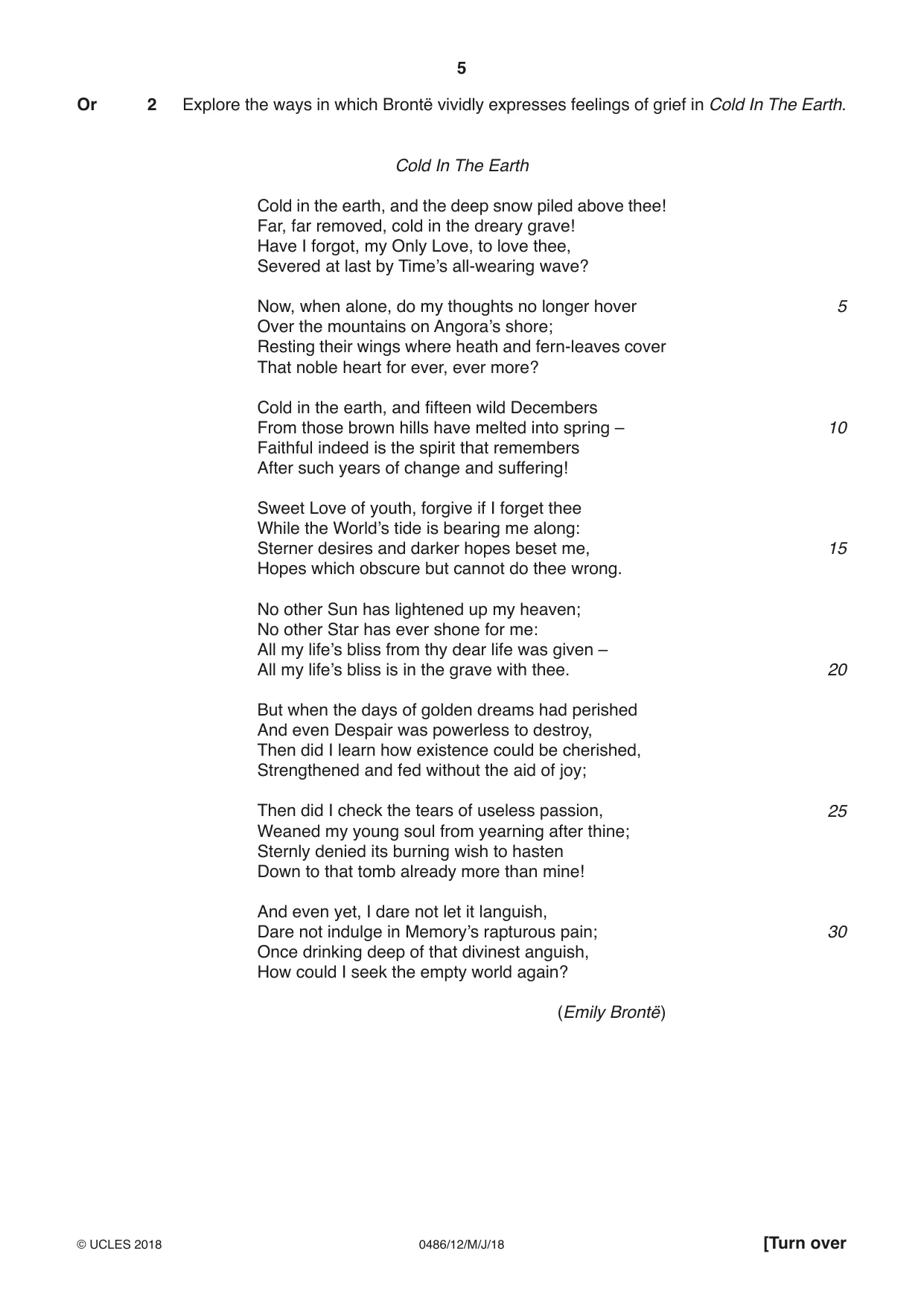
Question paper, page 5
5 0486/12/M/J/18 © UCLES 2018 [Turn over Or 2 Explore the ways in which Brontë vividly expresses feelings of grief in Cold In The Earth. Cold In The Earth Cold in the earth, and the deep snow piled above thee! Far, far removed, cold in the dreary grave! Have I forgot, my Only Love, to love thee, Severed at last by Time’s all-wearing wave? Now, when alone, do my thoughts no longer hover Over the mountains on Angora’s shore; Resting their wings where heath and fern-leaves cover That noble heart for ever, ever more? Cold in the earth, and fifteen wild Decembers From those brown hills have melted into spring – Faithful indeed is the spirit that remembers After such years of change and suffering! Sweet Love of youth, forgive if I forget thee While the World’s tide is bearing me along: Sterner desires and darker hopes beset me, Hopes which obscure but cannot do thee wrong. No other Sun has lightened up my heaven; No other Star has ever shone for me: All my life’s bliss from thy dear life was given – All my life’s bliss is in the grave with thee. But when the days of golden dreams had perished And even Despair was powerless to destroy, Then did I learn how existence could be cherished, Strengthened and fed without the aid of joy; Then did I check the tears of useless passion, Weaned my young soul from yearning after thine; Sternly denied its burning wish to hasten Down to that tomb already more than mine! And even yet, I dare not let it languish, Dare not indulge in Memory’s rapturous pain; Once drinking deep of that divinest anguish, How could I seek the empty world again? (Emily Brontë) 5 10 15 20 25 30
Question paper, page 6
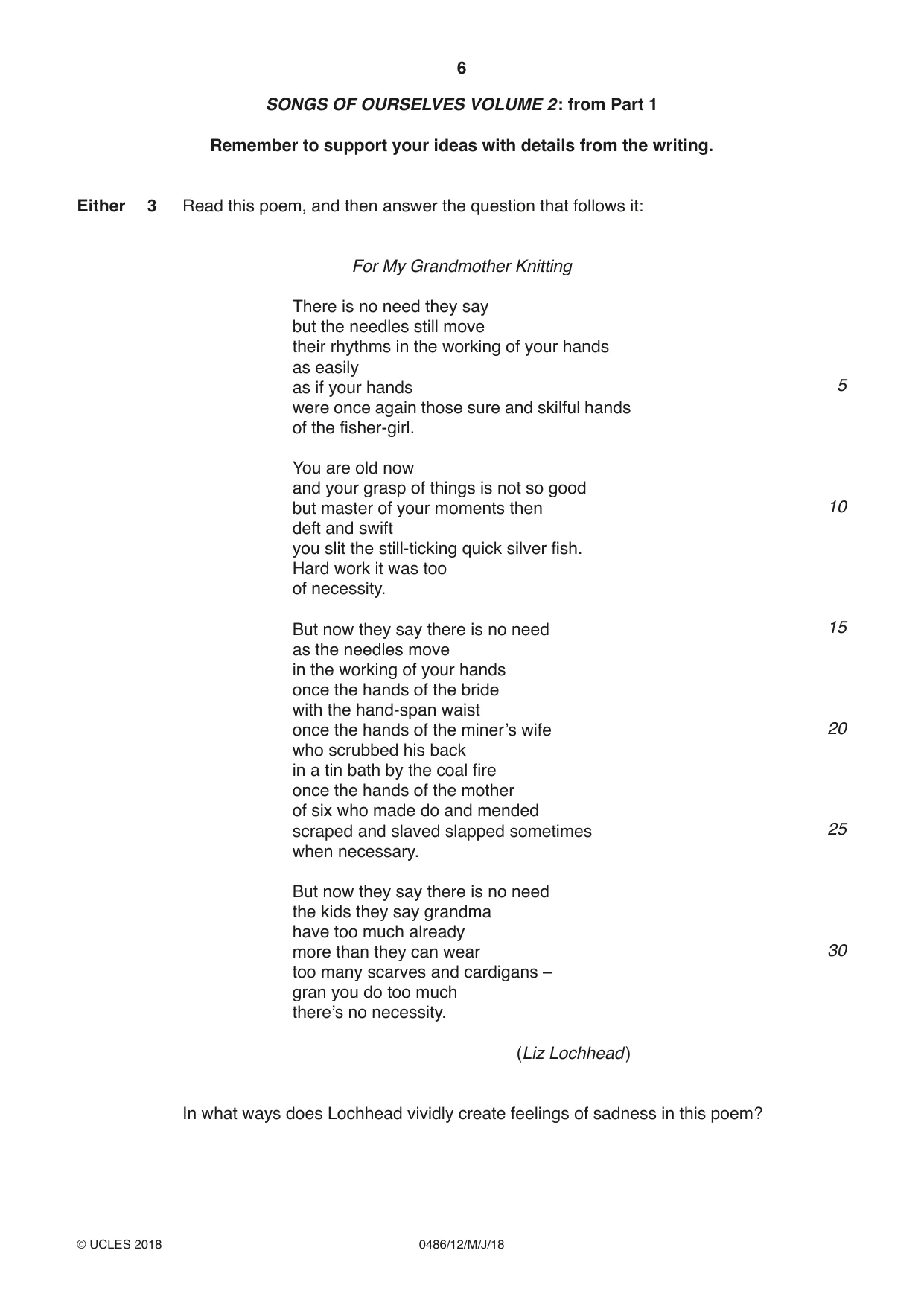
6 0486/12/M/J/18 © UCLES 2018 SONGS OF OURSELVES VOLUME 2: from Part 1 Remember to support your ideas with details from the writing. Either 3 Read this poem, and then answer the question that follows it: For My Grandmother Knitting There is no need they say but the needles still move their rhythms in the working of your hands as easily as if your hands were once again those sure and skilful hands of the fisher-girl. You are old now and your grasp of things is not so good but master of your moments then deft and swift you slit the still-ticking quick silver fish. Hard work it was too of necessity. But now they say there is no need as the needles move in the working of your hands once the hands of the bride with the hand-span waist once the hands of the miner’s wife who scrubbed his back in a tin bath by the coal fire once the hands of the mother of six who made do and mended scraped and slaved slapped sometimes when necessary. But now they say there is no need the kids they say grandma have too much already more than they can wear too many scarves and cardigans – gran you do too much there’s no necessity. (Liz Lochhead) In what ways does Lochhead vividly create feelings of sadness in this poem? 5 10 15 20 25 30
Question paper, page 7
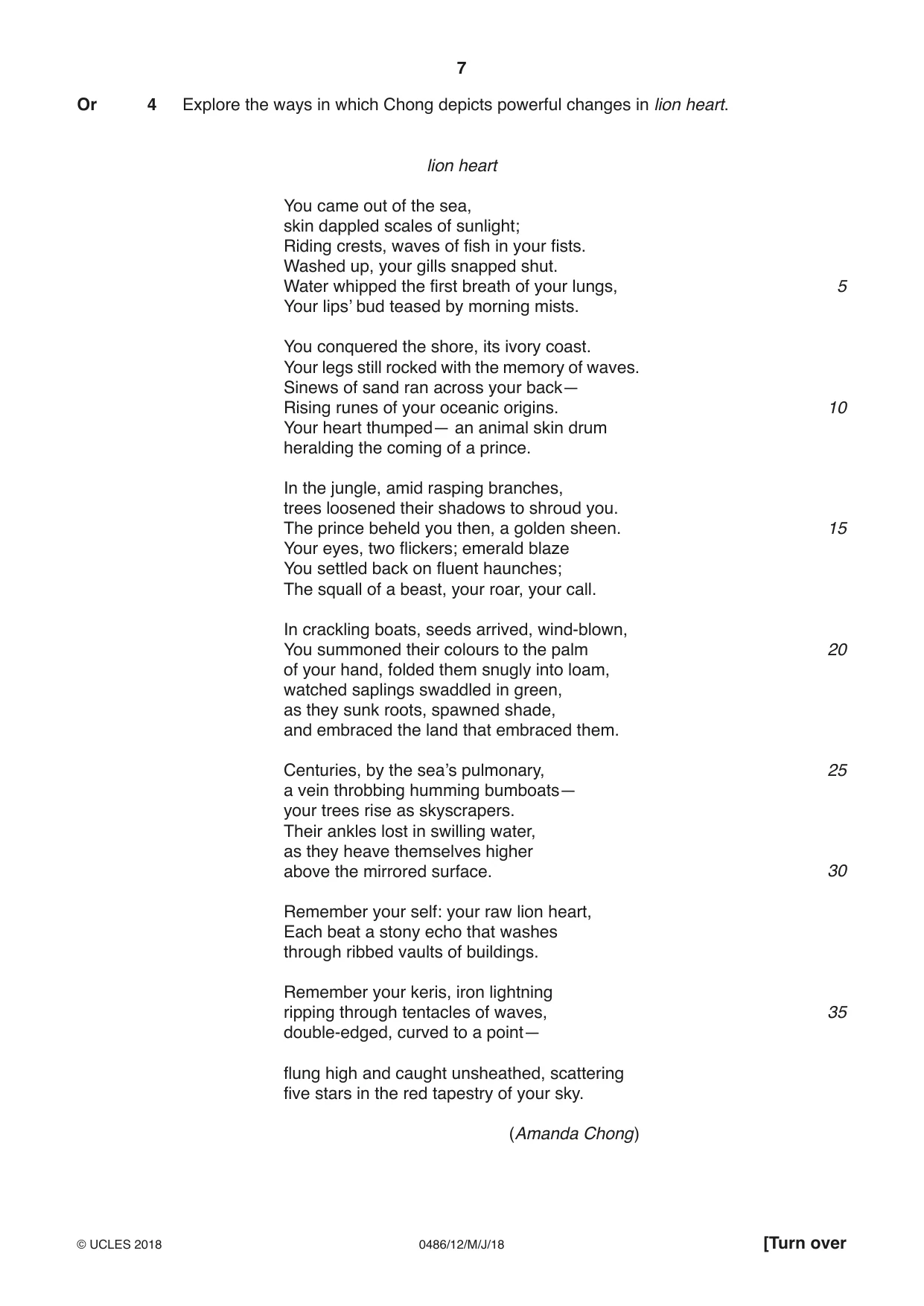
7 0486/12/M/J/18 © UCLES 2018 [Turn over Or 4 Explore the ways in which Chong depicts powerful changes in lion heart. lion heart You came out of the sea, skin dappled scales of sunlight; Riding crests, waves of fish in your fists. Washed up, your gills snapped shut. Water whipped the first breath of your lungs, Your lips’ bud teased by morning mists. You conquered the shore, its ivory coast. Your legs still rocked with the memory of waves. Sinews of sand ran across your back— Rising runes of your oceanic origins. Your heart thumped— an animal skin drum heralding the coming of a prince. In the jungle, amid rasping branches, trees loosened their shadows to shroud you. The prince beheld you then, a golden sheen. Your eyes, two flickers; emerald blaze You settled back on fluent haunches; The squall of a beast, your roar, your call. In crackling boats, seeds arrived, wind-blown, You summoned their colours to the palm of your hand, folded them snugly into loam, watched saplings swaddled in green, as they sunk roots, spawned shade, and embraced the land that embraced them. Centuries, by the sea’s pulmonary, a vein throbbing humming bumboats— your trees rise as skyscrapers. Their ankles lost in swilling water, as they heave themselves higher above the mirrored surface. Remember your self: your raw lion heart, Each beat a stony echo that washes through ribbed vaults of buildings. Remember your keris, iron lightning ripping through tentacles of waves, double-edged, curved to a point— flung high and caught unsheathed, scattering five stars in the red tapestry of your sky. (Amanda Chong) 5 10 15 20 25 30 35
Question paper, page 8
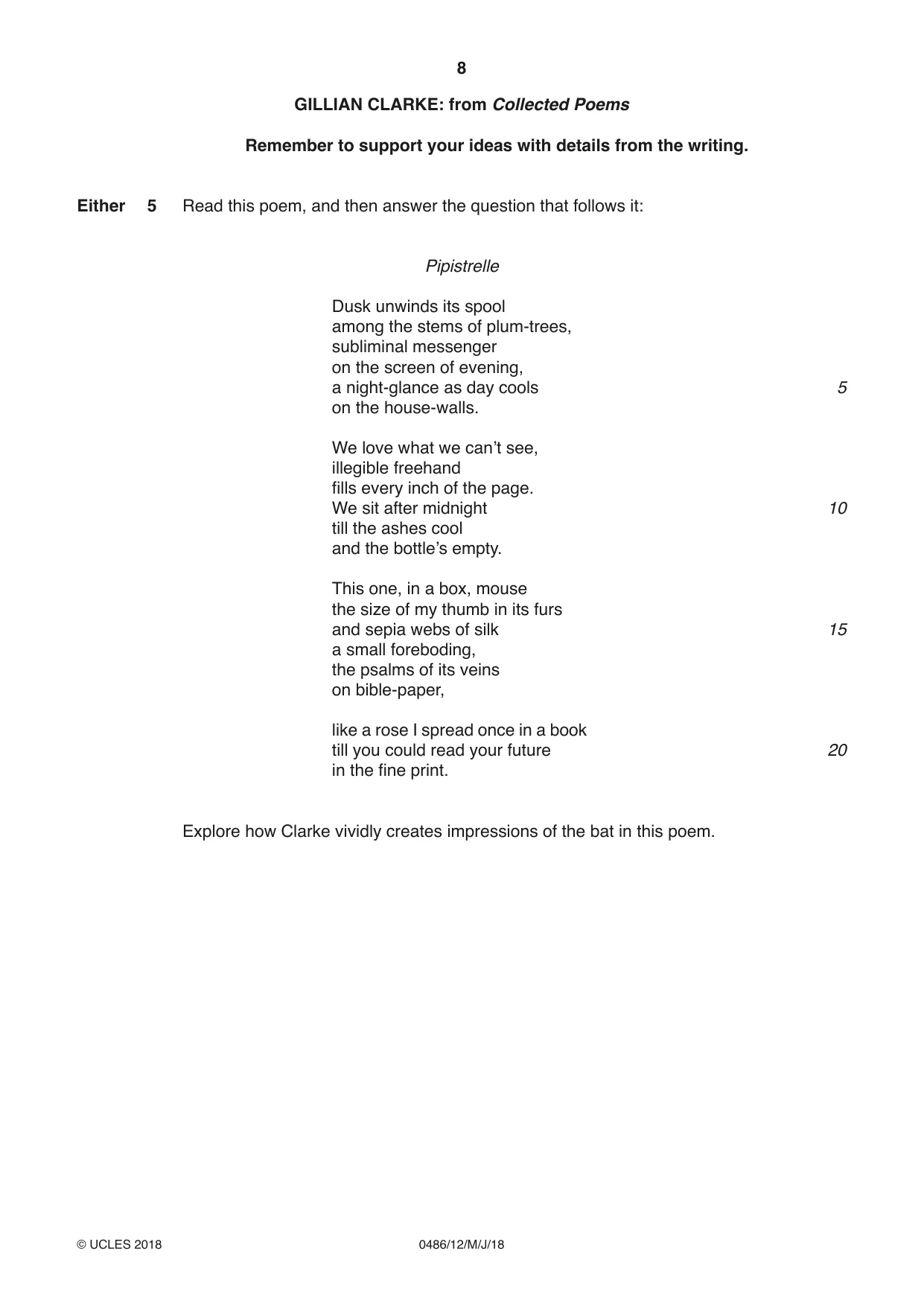
8 0486/12/M/J/18 © UCLES 2018 GILLIAN CLARKE: from Collected Poems Remember to support your ideas with details from the writing. Either 5 Read this poem, and then answer the question that follows it: Pipistrelle Dusk unwinds its spool among the stems of plum-trees, subliminal messenger on the screen of evening, a night-glance as day cools on the house-walls. We love what we can’t see, illegible freehand fills every inch of the page. We sit after midnight till the ashes cool and the bottle’s empty. This one, in a box, mouse the size of my thumb in its furs and sepia webs of silk a small foreboding, the psalms of its veins on bible-paper, like a rose I spread once in a book till you could read your future in the fine print. Explore how Clarke vividly creates impressions of the bat in this poem. 5 10 15 20
Question paper, page 9
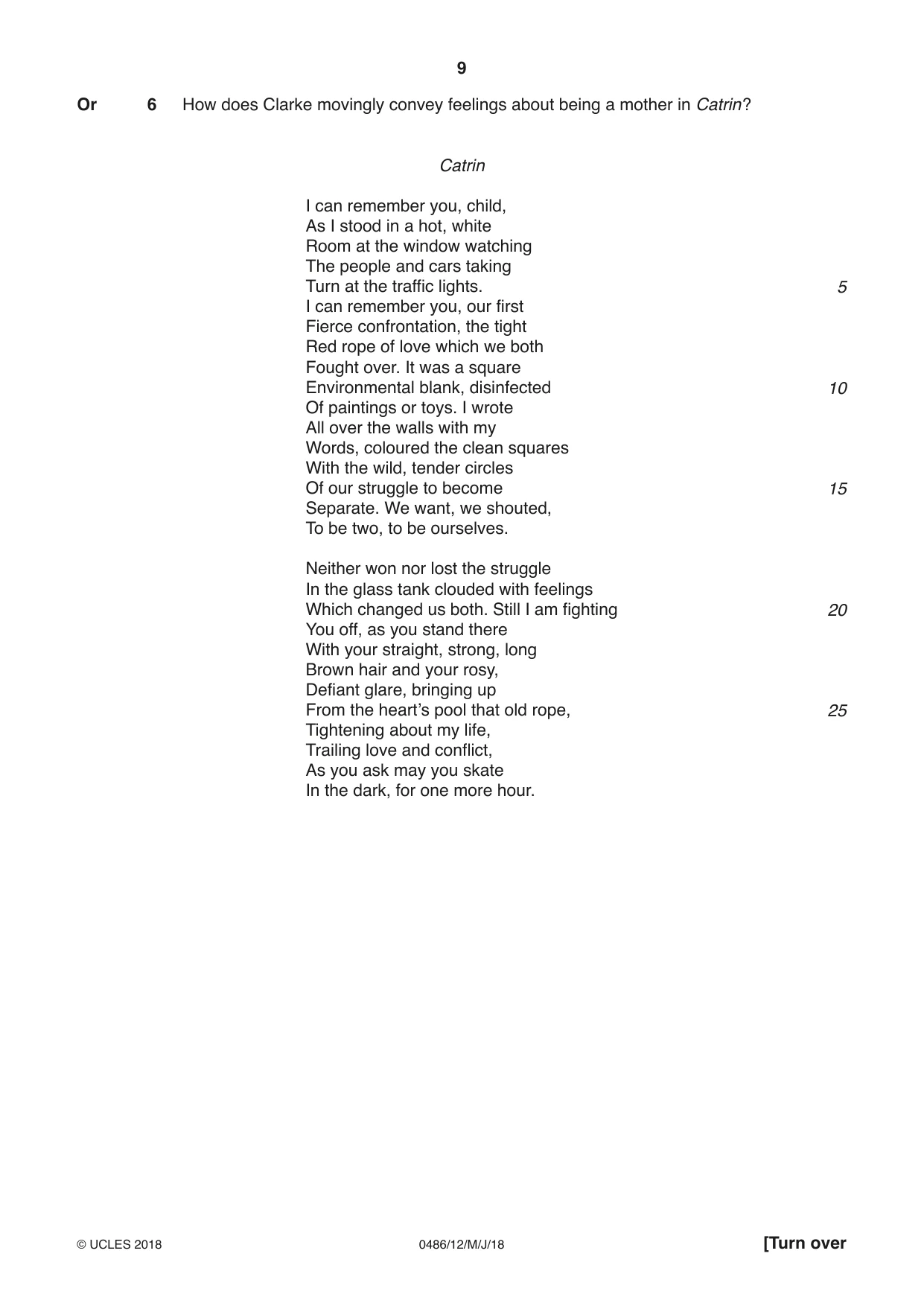
9 0486/12/M/J/18 © UCLES 2018 [Turn over Or 6 How does Clarke movingly convey feelings about being a mother in Catrin? Catrin I can remember you, child, As I stood in a hot, white Room at the window watching The people and cars taking Turn at the traffic lights. I can remember you, our first Fierce confrontation, the tight Red rope of love which we both Fought over. It was a square Environmental blank, disinfected Of paintings or toys. I wrote All over the walls with my Words, coloured the clean squares With the wild, tender circles Of our struggle to become Separate. We want, we shouted, To be two, to be ourselves. Neither won nor lost the struggle In the glass tank clouded with feelings Which changed us both. Still I am fighting You off, as you stand there With your straight, strong, long Brown hair and your rosy, Defiant glare, bringing up From the heart’s pool that old rope, Tightening about my life, Trailing love and conflict, As you ask may you skate In the dark, for one more hour. 5 10 15 20 25
Question paper, page 10
10 0486/12/M/J/18 © UCLES 2018 SECTION B: PROSE Answer one question from this section. CHINUA ACHEBE: No Longer at Ease Remember to support your ideas with details from the writing. Either 7 Read this extract, and then answer the question that follows it: They had mixed grill, which Obi admitted wasn’t too bad. Content removed due to copyright restrictions
Question paper, page 11
0486/12/M/J/18 © UCLES 2018 [Turn over Content removed due to copyright restrictions [from Chapter 4] How does Achebe make this such a revealing moment in the novel? Or 8 Explore the ways in which Achebe makes Obi’s relationship with his father so powerful in the novel. ‘Good old Sam! He doesn’t spare them.’ 11
Question paper, page 12
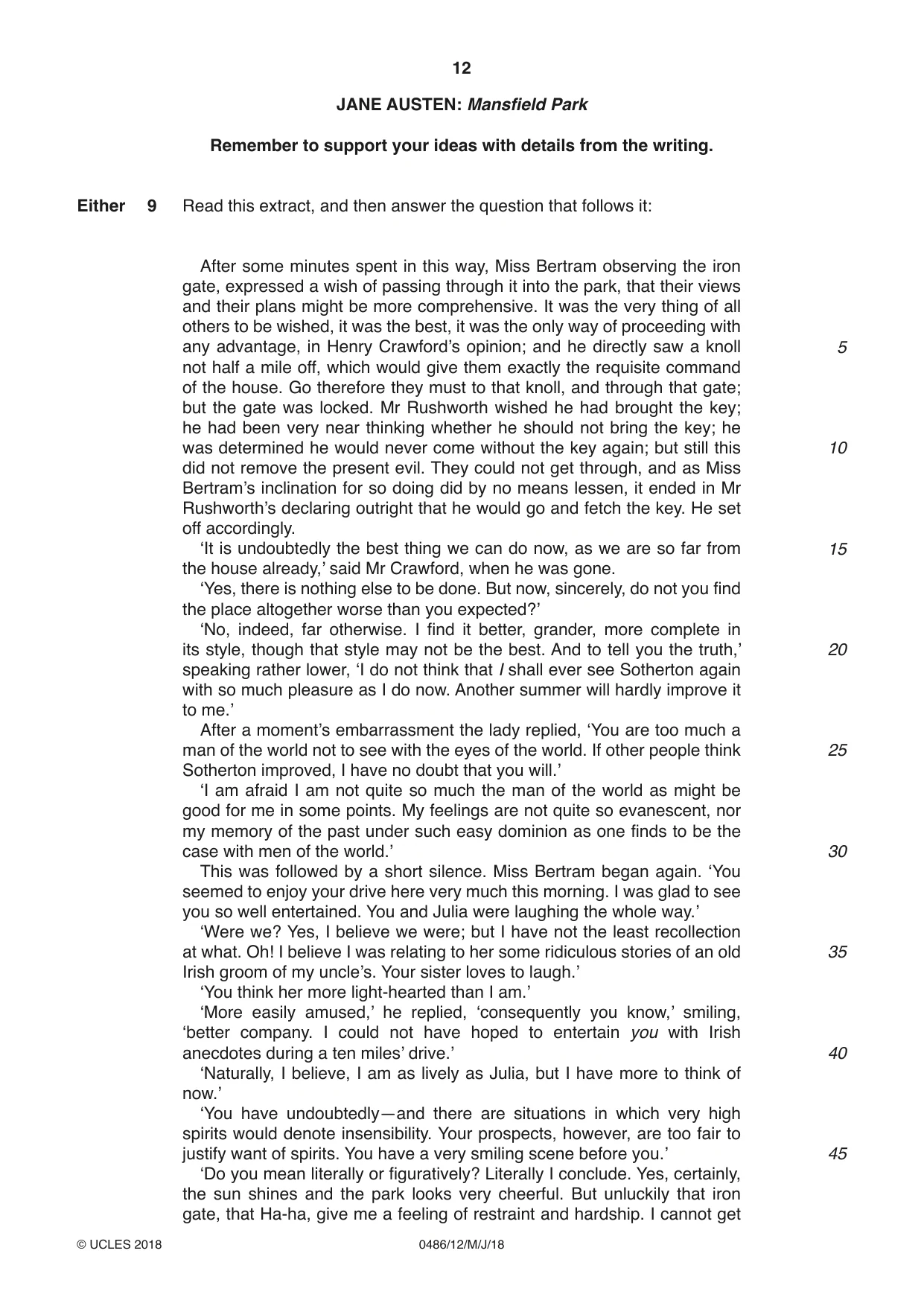
12 0486/12/M/J/18 © UCLES 2018 JANE AUSTEN: Mansfield Park Remember to support your ideas with details from the writing. Either 9 Read this extract, and then answer the question that follows it: After some minutes spent in this way, Miss Bertram observing the iron gate, expressed a wish of passing through it into the park, that their views and their plans might be more comprehensive. It was the very thing of all others to be wished, it was the best, it was the only way of proceeding with any advantage, in Henry Crawford’s opinion; and he directly saw a knoll not half a mile off, which would give them exactly the requisite command of the house. Go therefore they must to that knoll, and through that gate; but the gate was locked. Mr Rushworth wished he had brought the key; he had been very near thinking whether he should not bring the key; he was determined he would never come without the key again; but still this did not remove the present evil. They could not get through, and as Miss Bertram’s inclination for so doing did by no means lessen, it ended in Mr Rushworth’s declaring outright that he would go and fetch the key. He set off accordingly. ‘It is undoubtedly the best thing we can do now, as we are so far from the house already,’ said Mr Crawford, when he was gone. ‘Yes, there is nothing else to be done. But now, sincerely, do not you find the place altogether worse than you expected?’ ‘No, indeed, far otherwise. I find it better, grander, more complete in its style, though that style may not be the best. And to tell you the truth,’ speaking rather lower, ‘I do not think that I shall ever see Sotherton again with so much pleasure as I do now. Another summer will hardly improve it to me.’ After a moment’s embarrassment the lady replied, ‘You are too much a man of the world not to see with the eyes of the world. If other people think Sotherton improved, I have no doubt that you will.’ ‘I am afraid I am not quite so much the man of the world as might be good for me in some points. My feelings are not quite so evanescent, nor my memory of the past under such easy dominion as one finds to be the case with men of the world.’ This was followed by a short silence. Miss Bertram began again. ‘You seemed to enjoy your drive here very much this morning. I was glad to see you so well entertained. You and Julia were laughing the whole way.’ ‘Were we? Yes, I believe we were; but I have not the least recollection at what. Oh! I believe I was relating to her some ridiculous stories of an old Irish groom of my uncle’s. Your sister loves to laugh.’ ‘You think her more light-hearted than I am.’ ‘More easily amused,’ he replied, ‘consequently you know,’ smiling, ‘better company. I could not have hoped to entertain you with Irish anecdotes during a ten miles’ drive.’ ‘Naturally, I believe, I am as lively as Julia, but I have more to think of now.’ ‘You have undoubtedly—and there are situations in which very high spirits would denote insensibility. Your prospects, however, are too fair to justify want of spirits. You have a very smiling scene before you.’ ‘Do you mean literally or figuratively? Literally I conclude. Yes, certainly, the sun shines and the park looks very cheerful. But unluckily that iron gate, that Ha-ha, give me a feeling of restraint and hardship. I cannot get 5 10 15 20 25 30 35 40 45
Question paper, page 13
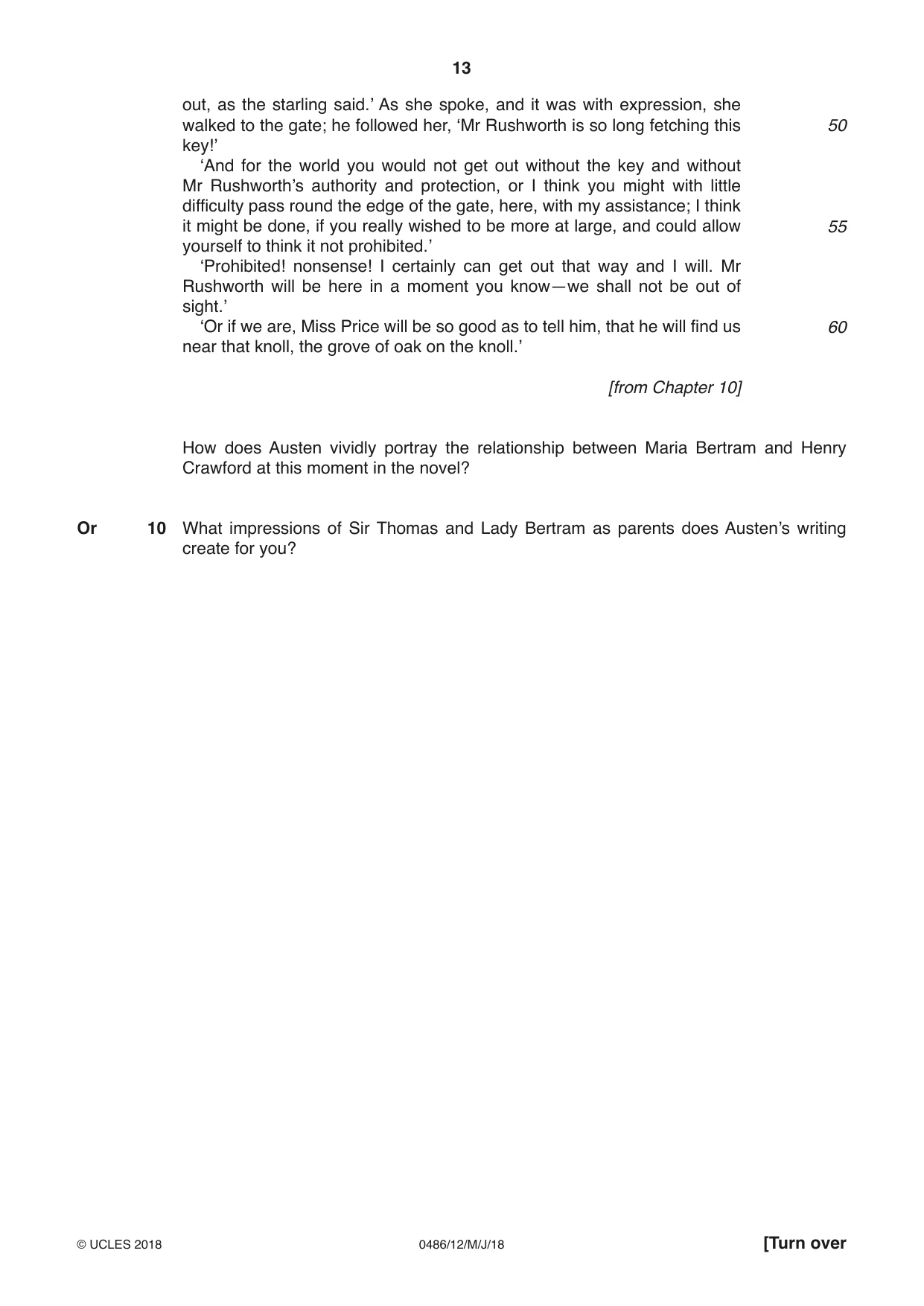
13 0486/12/M/J/18 © UCLES 2018 [Turn over out, as the starling said.’ As she spoke, and it was with expression, she walked to the gate; he followed her, ‘Mr Rushworth is so long fetching this key!’ ‘And for the world you would not get out without the key and without Mr Rushworth’s authority and protection, or I think you might with little difficulty pass round the edge of the gate, here, with my assistance; I think it might be done, if you really wished to be more at large, and could allow yourself to think it not prohibited.’ ‘Prohibited! nonsense! I certainly can get out that way and I will. Mr Rushworth will be here in a moment you know—we shall not be out of sight.’ ‘Or if we are, Miss Price will be so good as to tell him, that he will find us near that knoll, the grove of oak on the knoll.’ [from Chapter 10] How does Austen vividly portray the relationship between Maria Bertram and Henry Crawford at this moment in the novel? Or 10 What impressions of Sir Thomas and Lady Bertram as parents does Austen’s writing create for you? 50 55 60
Question paper, page 14
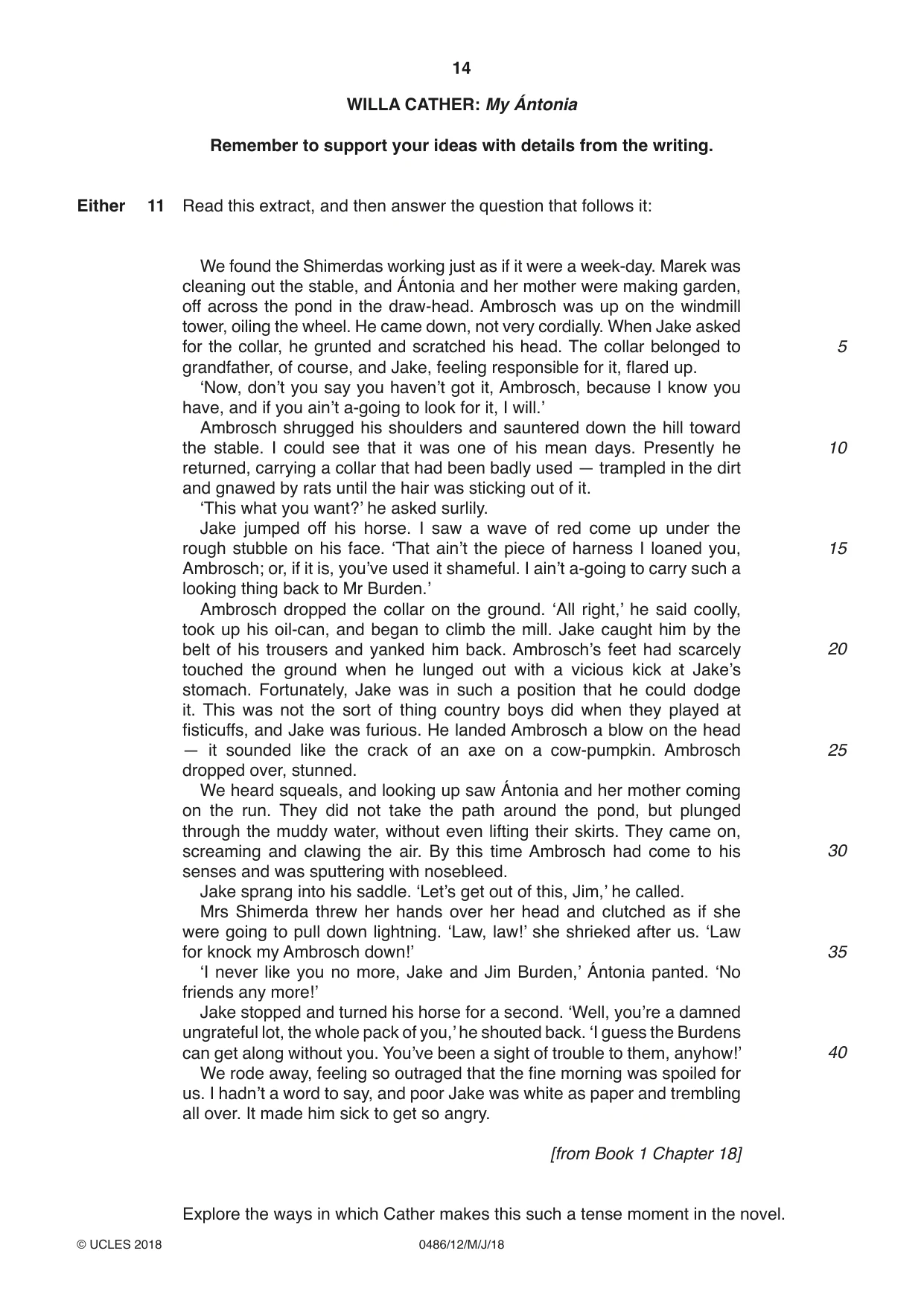
14 0486/12/M/J/18 © UCLES 2018 WILLA CATHER: My Ántonia Remember to support your ideas with details from the writing. Either 11 Read this extract, and then answer the question that follows it: We found the Shimerdas working just as if it were a week-day. Marek was cleaning out the stable, and Ántonia and her mother were making garden, off across the pond in the draw-head. Ambrosch was up on the windmill tower, oiling the wheel. He came down, not very cordially. When Jake asked for the collar, he grunted and scratched his head. The collar belonged to grandfather, of course, and Jake, feeling responsible for it, flared up. ‘Now, don’t you say you haven’t got it, Ambrosch, because I know you have, and if you ain’t a-going to look for it, I will.’ Ambrosch shrugged his shoulders and sauntered down the hill toward the stable. I could see that it was one of his mean days. Presently he returned, carrying a collar that had been badly used — trampled in the dirt and gnawed by rats until the hair was sticking out of it. ‘This what you want?’ he asked surlily. Jake jumped off his horse. I saw a wave of red come up under the rough stubble on his face. ‘That ain’t the piece of harness I loaned you, Ambrosch; or, if it is, you’ve used it shameful. I ain’t a-going to carry such a looking thing back to Mr Burden.’ Ambrosch dropped the collar on the ground. ‘All right,’ he said coolly, took up his oil-can, and began to climb the mill. Jake caught him by the belt of his trousers and yanked him back. Ambrosch’s feet had scarcely touched the ground when he lunged out with a vicious kick at Jake’s stomach. Fortunately, Jake was in such a position that he could dodge it. This was not the sort of thing country boys did when they played at fisticuffs, and Jake was furious. He landed Ambrosch a blow on the head — it sounded like the crack of an axe on a cow-pumpkin. Ambrosch dropped over, stunned. We heard squeals, and looking up saw Ántonia and her mother coming on the run. They did not take the path around the pond, but plunged through the muddy water, without even lifting their skirts. They came on, screaming and clawing the air. By this time Ambrosch had come to his senses and was sputtering with nosebleed. Jake sprang into his saddle. ‘Let’s get out of this, Jim,’ he called. Mrs Shimerda threw her hands over her head and clutched as if she were going to pull down lightning. ‘Law, law!’ she shrieked after us. ‘Law for knock my Ambrosch down!’ ‘I never like you no more, Jake and Jim Burden,’ Ántonia panted. ‘No friends any more!’ Jake stopped and turned his horse for a second. ‘Well, you’re a damned ungrateful lot, the whole pack of you,’ he shouted back. ‘I guess the Burdens can get along without you. You’ve been a sight of trouble to them, anyhow!’ We rode away, feeling so outraged that the fine morning was spoiled for us. I hadn’t a word to say, and poor Jake was white as paper and trembling all over. It made him sick to get so angry. [from Book 1 Chapter 18] Explore the ways in which Cather makes this such a tense moment in the novel. 5 10 15 20 25 30 35 40
Question paper, page 15
15 0486/12/M/J/18 © UCLES 2018 [Turn over Or 12 When he meets her again after a long time, Jim says to Ántonia: ‘You really are a part of me.’ How does Cather vividly convey the truth of this statement?
Question paper, page 16
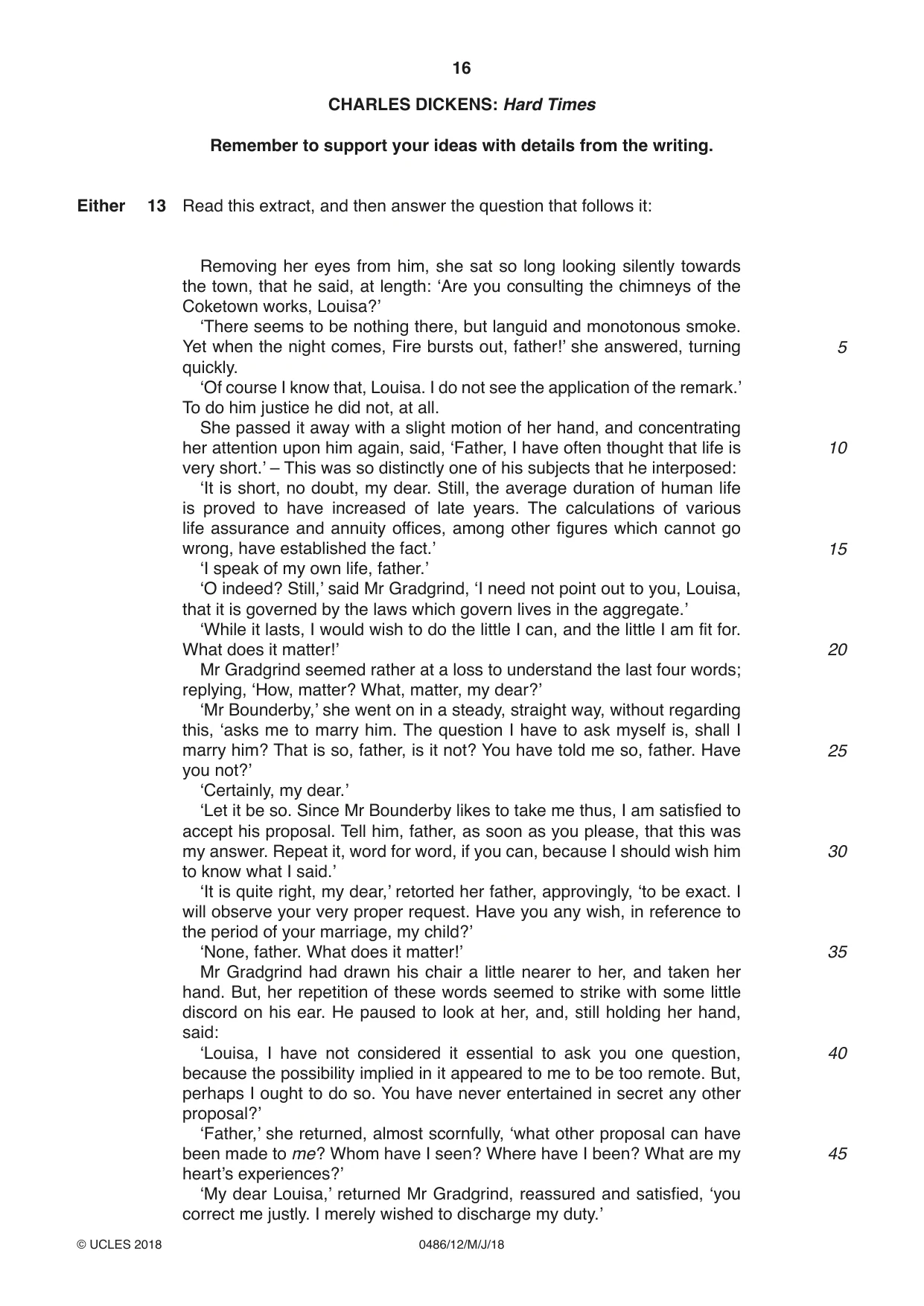
16 0486/12/M/J/18 © UCLES 2018 CHARLES DICKENS: Hard Times Remember to support your ideas with details from the writing. Either 13 Read this extract, and then answer the question that follows it: Removing her eyes from him, she sat so long looking silently towards the town, that he said, at length: ‘Are you consulting the chimneys of the Coketown works, Louisa?’ ‘There seems to be nothing there, but languid and monotonous smoke. Yet when the night comes, Fire bursts out, father!’ she answered, turning quickly. ‘Of course I know that, Louisa. I do not see the application of the remark.’ To do him justice he did not, at all. She passed it away with a slight motion of her hand, and concentrating her attention upon him again, said, ‘Father, I have often thought that life is very short.’ – This was so distinctly one of his subjects that he interposed: ‘It is short, no doubt, my dear. Still, the average duration of human life is proved to have increased of late years. The calculations of various life assurance and annuity offices, among other figures which cannot go wrong, have established the fact.’ ‘I speak of my own life, father.’ ‘O indeed? Still,’ said Mr Gradgrind, ‘I need not point out to you, Louisa, that it is governed by the laws which govern lives in the aggregate.’ ‘While it lasts, I would wish to do the little I can, and the little I am fit for. What does it matter!’ Mr Gradgrind seemed rather at a loss to understand the last four words; replying, ‘How, matter? What, matter, my dear?’ ‘Mr Bounderby,’ she went on in a steady, straight way, without regarding this, ‘asks me to marry him. The question I have to ask myself is, shall I marry him? That is so, father, is it not? You have told me so, father. Have you not?’ ‘Certainly, my dear.’ ‘Let it be so. Since Mr Bounderby likes to take me thus, I am satisfied to accept his proposal. Tell him, father, as soon as you please, that this was my answer. Repeat it, word for word, if you can, because I should wish him to know what I said.’ ‘It is quite right, my dear,’ retorted her father, approvingly, ‘to be exact. I will observe your very proper request. Have you any wish, in reference to the period of your marriage, my child?’ ‘None, father. What does it matter!’ Mr Gradgrind had drawn his chair a little nearer to her, and taken her hand. But, her repetition of these words seemed to strike with some little discord on his ear. He paused to look at her, and, still holding her hand, said: ‘Louisa, I have not considered it essential to ask you one question, because the possibility implied in it appeared to me to be too remote. But, perhaps I ought to do so. You have never entertained in secret any other proposal?’ ‘Father,’ she returned, almost scornfully, ‘what other proposal can have been made to me? Whom have I seen? Where have I been? What are my heart’s experiences?’ ‘My dear Louisa,’ returned Mr Gradgrind, reassured and satisfied, ‘you correct me justly. I merely wished to discharge my duty.’ 5 10 15 20 25 30 35 40 45
Question paper, page 17
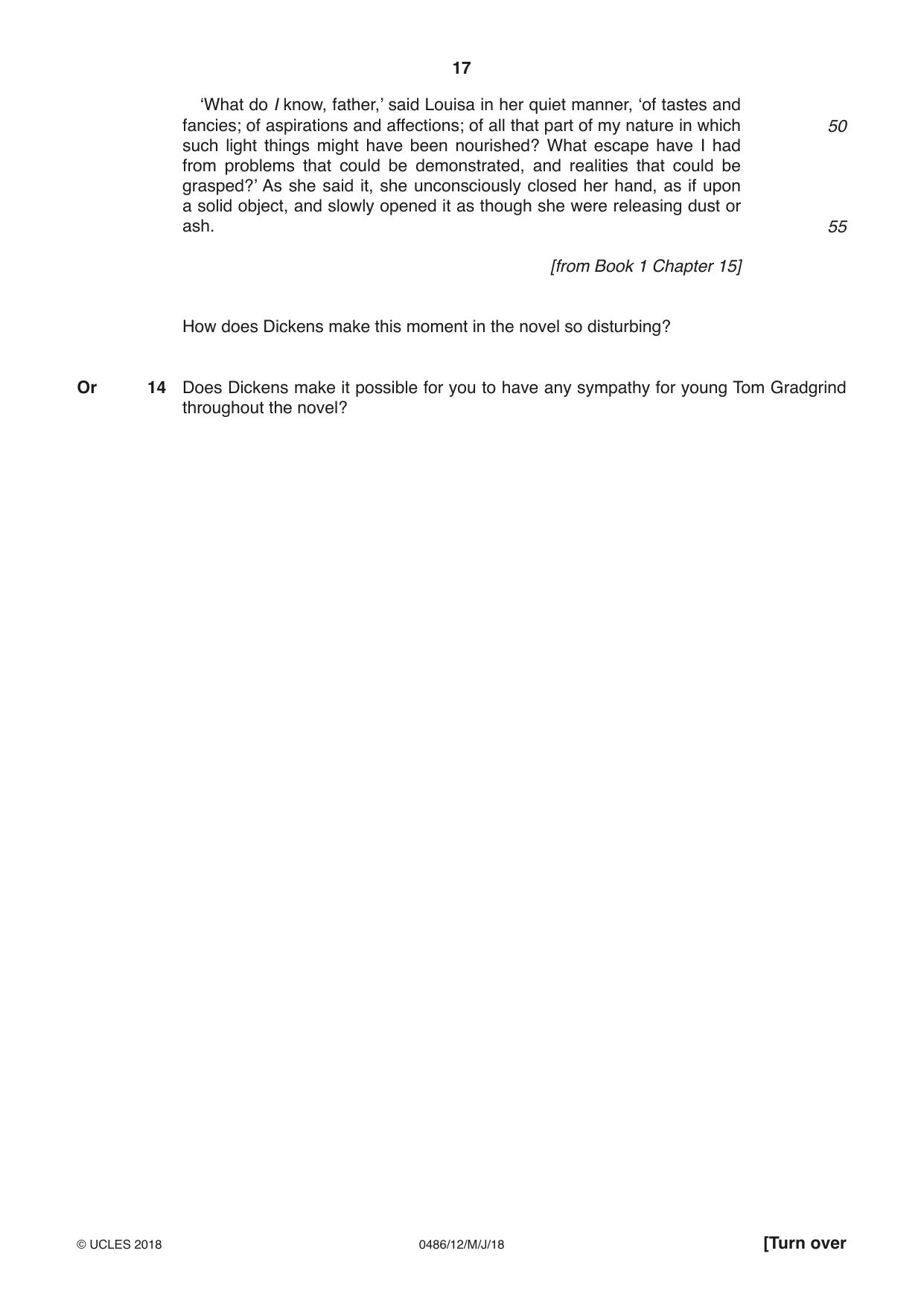
17 0486/12/M/J/18 © UCLES 2018 [Turn over ‘What do I know, father,’ said Louisa in her quiet manner, ‘of tastes and fancies; of aspirations and affections; of all that part of my nature in which such light things might have been nourished? What escape have I had from problems that could be demonstrated, and realities that could be grasped?’ As she said it, she unconsciously closed her hand, as if upon a solid object, and slowly opened it as though she were releasing dust or ash. [from Book 1 Chapter 15] How does Dickens make this moment in the novel so disturbing? Or 14 Does Dickens make it possible for you to have any sympathy for young Tom Gradgrind throughout the novel? 50 55
Question paper, page 18
18 0486/12/M/J/18 © UCLES 2018 MICHAEL FRAYN: Spies Remember to support your ideas with details from the writing. Either 15 Read this extract, and then answer the question that follows it: Did Stephen understand at last who it was down there in the darkness, when he heard his own name spoken? Content removed due to copyright restrictions
Question paper, page 19
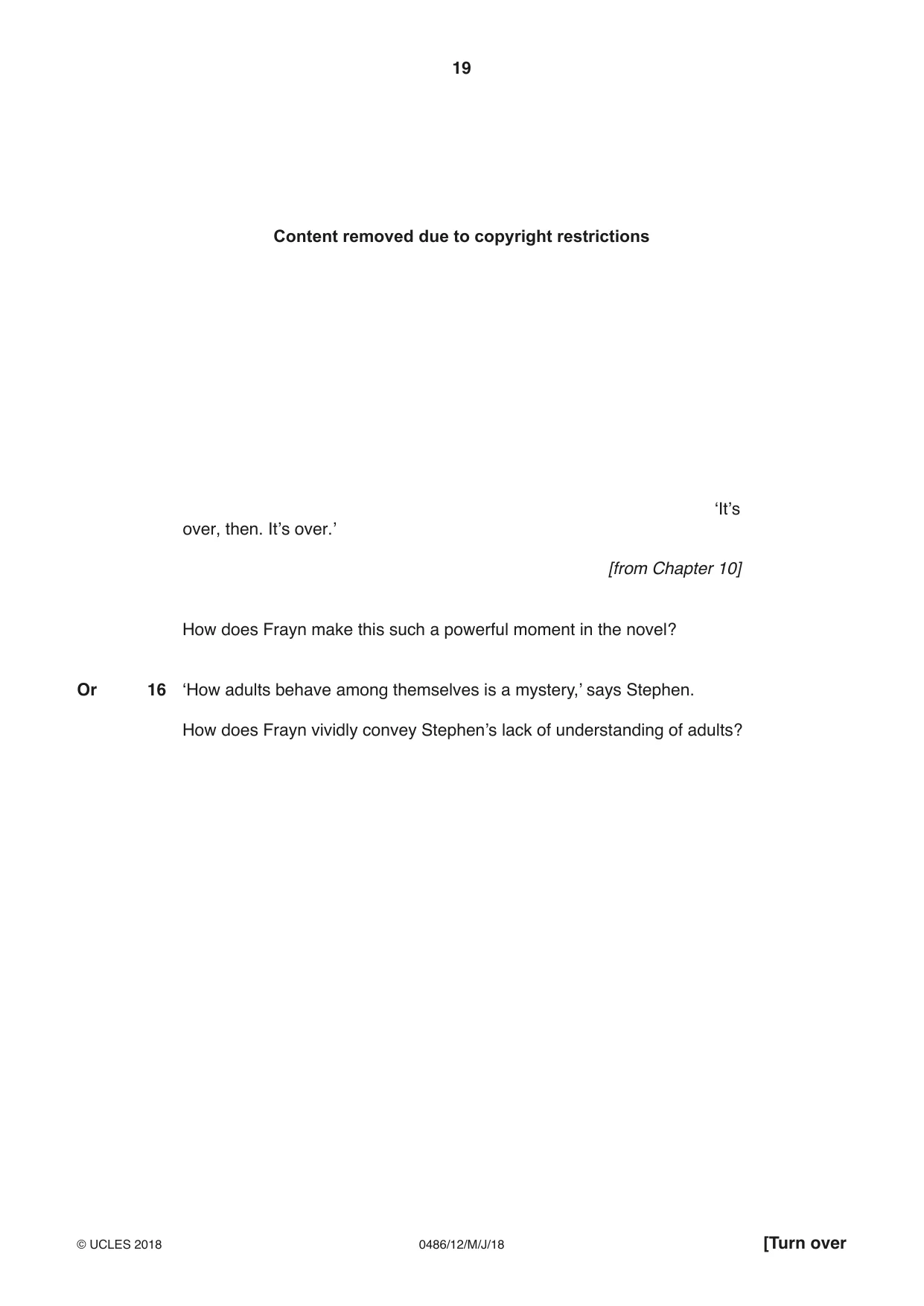
19 0486/12/M/J/18 © UCLES 2018 [Turn over Content removed due to copyright restrictions [from Chapter 10] How does Frayn make this such a powerful moment in the novel? Or 16 ‘How adults behave among themselves is a mystery,’ says Stephen. How does Frayn vividly convey Stephen’s lack of understanding of adults? ‘It’s over, then. It’s over.’
Question paper, page 20
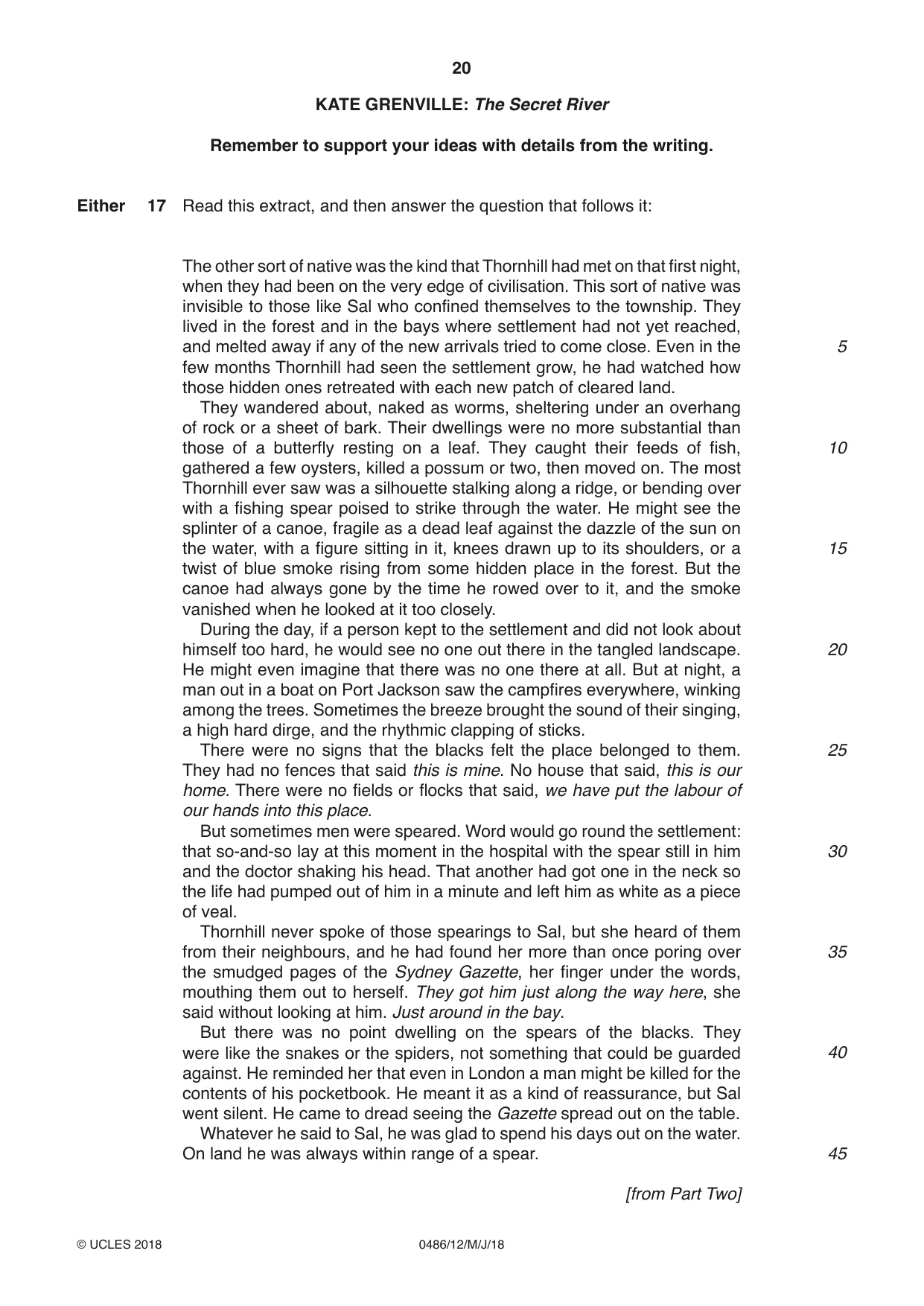
20 0486/12/M/J/18 © UCLES 2018 KATE GRENVILLE: The Secret River Remember to support your ideas with details from the writing. Either 17 Read this extract, and then answer the question that follows it: The other sort of native was the kind that Thornhill had met on that first night, when they had been on the very edge of civilisation. This sort of native was invisible to those like Sal who confined themselves to the township. They lived in the forest and in the bays where settlement had not yet reached, and melted away if any of the new arrivals tried to come close. Even in the few months Thornhill had seen the settlement grow, he had watched how those hidden ones retreated with each new patch of cleared land. They wandered about, naked as worms, sheltering under an overhang of rock or a sheet of bark. Their dwellings were no more substantial than those of a butterfly resting on a leaf. They caught their feeds of fish, gathered a few oysters, killed a possum or two, then moved on. The most Thornhill ever saw was a silhouette stalking along a ridge, or bending over with a fishing spear poised to strike through the water. He might see the splinter of a canoe, fragile as a dead leaf against the dazzle of the sun on the water, with a figure sitting in it, knees drawn up to its shoulders, or a twist of blue smoke rising from some hidden place in the forest. But the canoe had always gone by the time he rowed over to it, and the smoke vanished when he looked at it too closely. During the day, if a person kept to the settlement and did not look about himself too hard, he would see no one out there in the tangled landscape. He might even imagine that there was no one there at all. But at night, a man out in a boat on Port Jackson saw the campfires everywhere, winking among the trees. Sometimes the breeze brought the sound of their singing, a high hard dirge, and the rhythmic clapping of sticks. There were no signs that the blacks felt the place belonged to them. They had no fences that said this is mine. No house that said, this is our home. There were no fields or flocks that said, we have put the labour of our hands into this place. But sometimes men were speared. Word would go round the settlement: that so-and-so lay at this moment in the hospital with the spear still in him and the doctor shaking his head. That another had got one in the neck so the life had pumped out of him in a minute and left him as white as a piece of veal. Thornhill never spoke of those spearings to Sal, but she heard of them from their neighbours, and he had found her more than once poring over the smudged pages of the Sydney Gazette, her finger under the words, mouthing them out to herself. They got him just along the way here, she said without looking at him. Just around in the bay. But there was no point dwelling on the spears of the blacks. They were like the snakes or the spiders, not something that could be guarded against. He reminded her that even in London a man might be killed for the contents of his pocketbook. He meant it as a kind of reassurance, but Sal went silent. He came to dread seeing the Gazette spread out on the table. Whatever he said to Sal, he was glad to spend his days out on the water. On land he was always within range of a spear. [from Part Two] 5 10 15 20 25 30 35 40 45
Question paper, page 21
21 0486/12/M/J/18 © UCLES 2018 [Turn over How does Grenville vividly convey the mysteriousness of the ‘native’ people to Thornhill at this moment in the novel? Or 18 In what ways does Grenville portray Sal as heroic?
Question paper, page 22
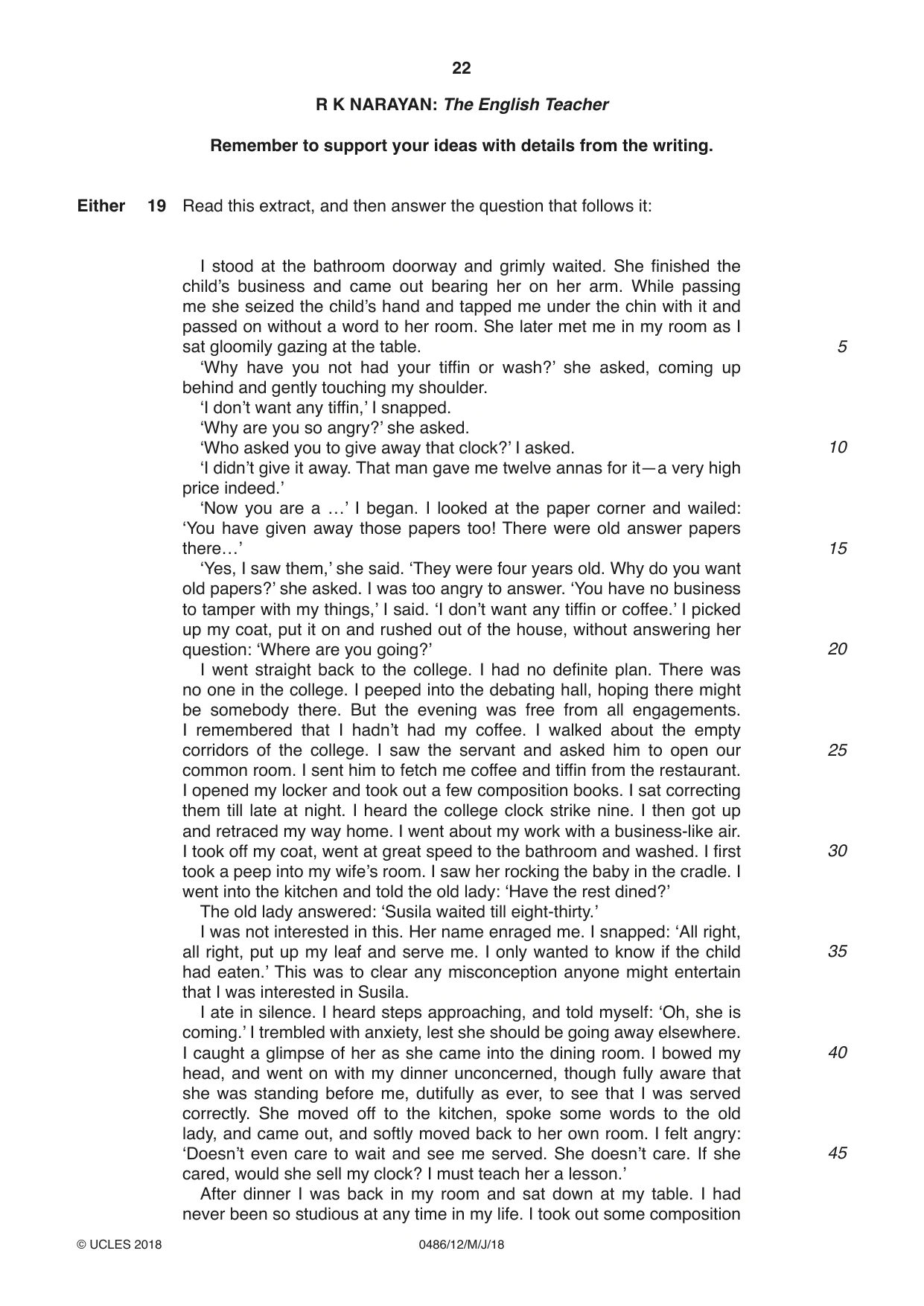
22 0486/12/M/J/18 © UCLES 2018 R K NARAYAN: The English Teacher Remember to support your ideas with details from the writing. Either 19 Read this extract, and then answer the question that follows it: I stood at the bathroom doorway and grimly waited. She finished the child’s business and came out bearing her on her arm. While passing me she seized the child’s hand and tapped me under the chin with it and passed on without a word to her room. She later met me in my room as I sat gloomily gazing at the table. ‘Why have you not had your tiffin or wash?’ she asked, coming up behind and gently touching my shoulder. ‘I don’t want any tiffin,’ I snapped. ‘Why are you so angry?’ she asked. ‘Who asked you to give away that clock?’ I asked. ‘I didn’t give it away. That man gave me twelve annas for it—a very high price indeed.’ ‘Now you are a …’ I began. I looked at the paper corner and wailed: ‘You have given away those papers too! There were old answer papers there…’ ‘Yes, I saw them,’ she said. ‘They were four years old. Why do you want old papers?’ she asked. I was too angry to answer. ‘You have no business to tamper with my things,’ I said. ‘I don’t want any tiffin or coffee.’ I picked up my coat, put it on and rushed out of the house, without answering her question: ‘Where are you going?’ I went straight back to the college. I had no definite plan. There was no one in the college. I peeped into the debating hall, hoping there might be somebody there. But the evening was free from all engagements. I remembered that I hadn’t had my coffee. I walked about the empty corridors of the college. I saw the servant and asked him to open our common room. I sent him to fetch me coffee and tiffin from the restaurant. I opened my locker and took out a few composition books. I sat correcting them till late at night. I heard the college clock strike nine. I then got up and retraced my way home. I went about my work with a business-like air. I took off my coat, went at great speed to the bathroom and washed. I first took a peep into my wife’s room. I saw her rocking the baby in the cradle. I went into the kitchen and told the old lady: ‘Have the rest dined?’ The old lady answered: ‘Susila waited till eight-thirty.’ I was not interested in this. Her name enraged me. I snapped: ‘All right, all right, put up my leaf and serve me. I only wanted to know if the child had eaten.’ This was to clear any misconception anyone might entertain that I was interested in Susila. I ate in silence. I heard steps approaching, and told myself: ‘Oh, she is coming.’ I trembled with anxiety, lest she should be going away elsewhere. I caught a glimpse of her as she came into the dining room. I bowed my head, and went on with my dinner unconcerned, though fully aware that she was standing before me, dutifully as ever, to see that I was served correctly. She moved off to the kitchen, spoke some words to the old lady, and came out, and softly moved back to her own room. I felt angry: ‘Doesn’t even care to wait and see me served. She doesn’t care. If she cared, would she sell my clock? I must teach her a lesson.’ After dinner I was back in my room and sat down at my table. I had never been so studious at any time in my life. I took out some composition 5 10 15 20 25 30 35 40 45
Question paper, page 23
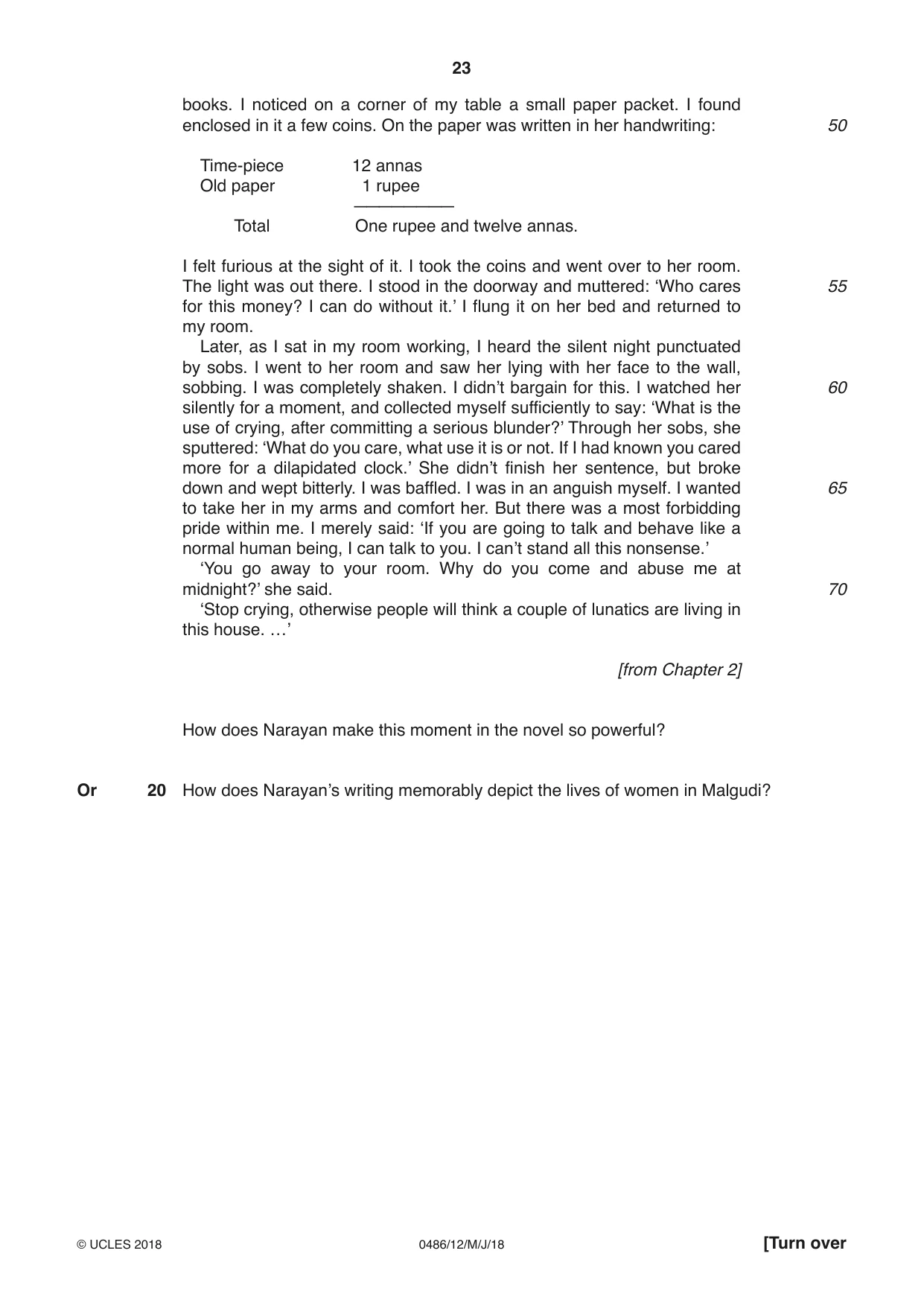
23 0486/12/M/J/18 © UCLES 2018 [Turn over books. I noticed on a corner of my table a small paper packet. I found enclosed in it a few coins. On the paper was written in her handwriting: Time-piece 12 annas Old paper 1 rupee ———————— Total One rupee and twelve annas. I felt furious at the sight of it. I took the coins and went over to her room. The light was out there. I stood in the doorway and muttered: ‘Who cares for this money? I can do without it.’ I flung it on her bed and returned to my room. Later, as I sat in my room working, I heard the silent night punctuated by sobs. I went to her room and saw her lying with her face to the wall, sobbing. I was completely shaken. I didn’t bargain for this. I watched her silently for a moment, and collected myself sufficiently to say: ‘What is the use of crying, after committing a serious blunder?’ Through her sobs, she sputtered: ‘What do you care, what use it is or not. If I had known you cared more for a dilapidated clock.’ She didn’t finish her sentence, but broke down and wept bitterly. I was baffled. I was in an anguish myself. I wanted to take her in my arms and comfort her. But there was a most forbidding pride within me. I merely said: ‘If you are going to talk and behave like a normal human being, I can talk to you. I can’t stand all this nonsense.’ ‘You go away to your room. Why do you come and abuse me at midnight?’ she said. ‘Stop crying, otherwise people will think a couple of lunatics are living in this house. …’ [from Chapter 2] How does Narayan make this moment in the novel so powerful? Or 20 How does Narayan’s writing memorably depict the lives of women in Malgudi? 50 55 60 65 70
Question paper, page 24
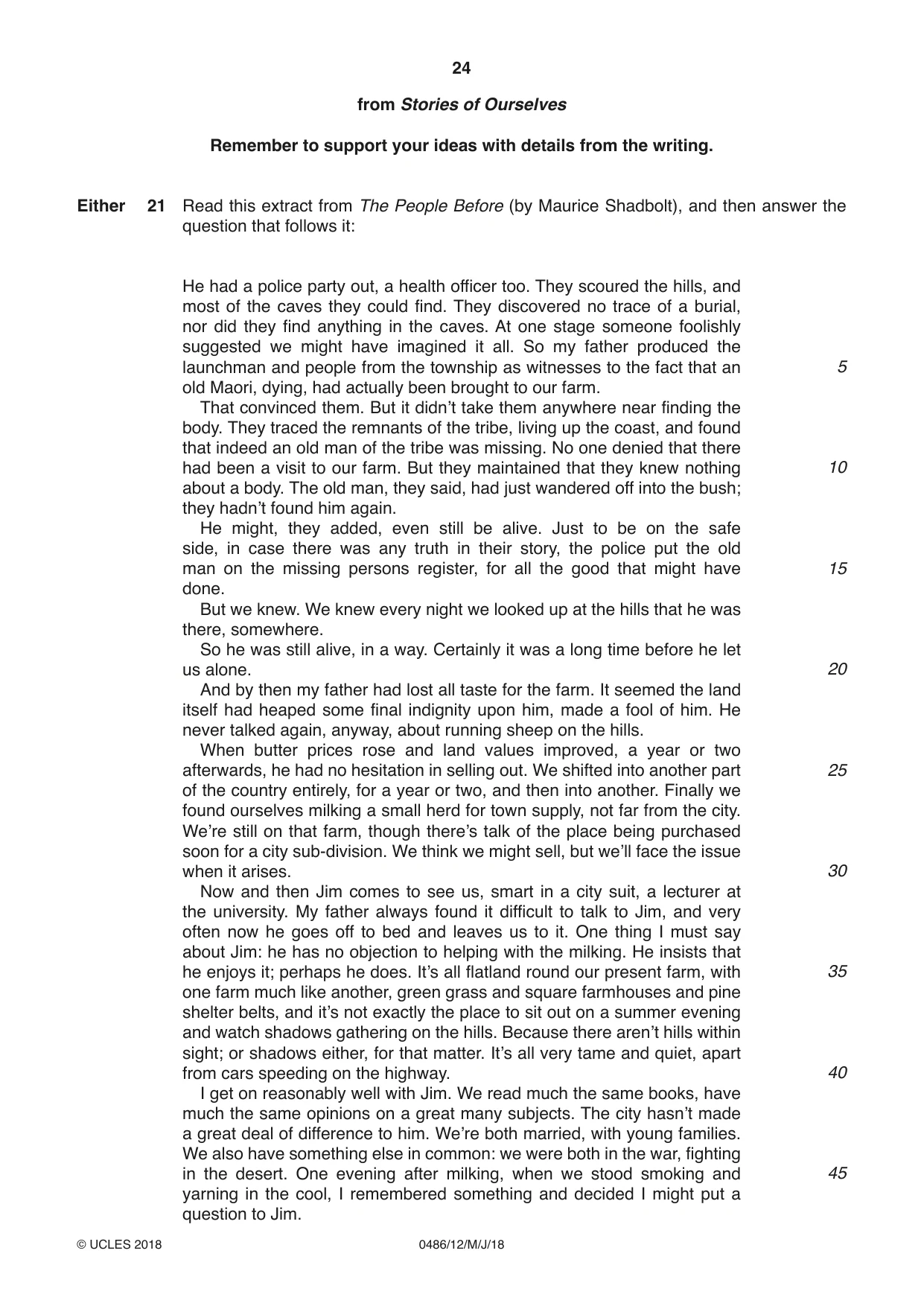
24 0486/12/M/J/18 © UCLES 2018 from Stories of Ourselves Remember to support your ideas with details from the writing. Either 21 Read this extract from The People Before (by Maurice Shadbolt), and then answer the question that follows it: He had a police party out, a health officer too. They scoured the hills, and most of the caves they could find. They discovered no trace of a burial, nor did they find anything in the caves. At one stage someone foolishly suggested we might have imagined it all. So my father produced the launchman and people from the township as witnesses to the fact that an old Maori, dying, had actually been brought to our farm. That convinced them. But it didn’t take them anywhere near finding the body. They traced the remnants of the tribe, living up the coast, and found that indeed an old man of the tribe was missing. No one denied that there had been a visit to our farm. But they maintained that they knew nothing about a body. The old man, they said, had just wandered off into the bush; they hadn’t found him again. He might, they added, even still be alive. Just to be on the safe side, in case there was any truth in their story, the police put the old man on the missing persons register, for all the good that might have done. But we knew. We knew every night we looked up at the hills that he was there, somewhere. So he was still alive, in a way. Certainly it was a long time before he let us alone. And by then my father had lost all taste for the farm. It seemed the land itself had heaped some final indignity upon him, made a fool of him. He never talked again, anyway, about running sheep on the hills. When butter prices rose and land values improved, a year or two afterwards, he had no hesitation in selling out. We shifted into another part of the country entirely, for a year or two, and then into another. Finally we found ourselves milking a small herd for town supply, not far from the city. We’re still on that farm, though there’s talk of the place being purchased soon for a city sub-division. We think we might sell, but we’ll face the issue when it arises. Now and then Jim comes to see us, smart in a city suit, a lecturer at the university. My father always found it difficult to talk to Jim, and very often now he goes off to bed and leaves us to it. One thing I must say about Jim: he has no objection to helping with the milking. He insists that he enjoys it; perhaps he does. It’s all flatland round our present farm, with one farm much like another, green grass and square farmhouses and pine shelter belts, and it’s not exactly the place to sit out on a summer evening and watch shadows gathering on the hills. Because there aren’t hills within sight; or shadows either, for that matter. It’s all very tame and quiet, apart from cars speeding on the highway. I get on reasonably well with Jim. We read much the same books, have much the same opinions on a great many subjects. The city hasn’t made a great deal of difference to him. We’re both married, with young families. We also have something else in common: we were both in the war, fighting in the desert. One evening after milking, when we stood smoking and yarning in the cool, I remembered something and decided I might put a question to Jim. 5 10 15 20 25 30 35 40 45
Question paper, page 25
25 0486/12/M/J/18 © UCLES 2018 ‘You know,’ I began, ‘they say it’s best, when you’re under fire in the war, to fix your mind on something remote. So you won’t be afraid. I remember Dad telling me that. I used to try. But it never seemed any good. I couldn’t think of anything. I was still as scared as hell.’ ‘I was too. Who wasn’t?’ ‘But, I mean, did you ever think of anything?’ ‘Funny thing,’ he said. ‘Now I come to think of it, I did. I thought of the old place – you know, the old place by the river. Where,’ he added, and his face puckered into a grin, ‘where they buried that old Maori. And where I found those greenstones. I’ve still got it at home, you know, up on the mantelpiece. I seem to remember trying to give it away once, to those Maoris. Now I’m glad I didn’t. It’s my only souvenir from there, the only thing that makes that place still live for me.’ He paused. ‘Well, anyway, that’s what I thought about. That old place of ours.’ I had a sharp pain. I felt the dismay of a long-distance runner who, coasting confidently to victory, imagining himself well ahead of the field, finds himself overtaken and the tape snapped at the very moment he leans forward to breast it. For one black moment it seemed I had been robbed of something which was rightfully mine. I don’t think I’ll ever forgive him. Explore the ways in which Shadbolt makes this such a satisfying ending to the story. Or 22 Explore the ways in which the writer creates a strong sense of place in either To Da-duh, in Memoriam (by Paule Marshall) or Billennium (by J G Ballard). 50 55 60 65
Question paper, page 26
26 0486/12/M/J/18 © UCLES 2018 BLANK PAGE
Question paper, page 27
27 0486/12/M/J/18 © UCLES 2018 BLANK PAGE
Question paper, page 28
28 0486/12/M/J/18 © UCLES 2018 BLANK PAGE Permission to reproduce items where third-party owned material protected by copyright is included has been sought and cleared where possible. Every reasonable effort has been made by the publisher (UCLES) to trace copyright holders, but if any items requiring clearance have unwittingly been included, the publisher will be pleased to make amends at the earliest possible opportunity. To avoid the issue of disclosure of answer-related information to candidates, all copyright acknowledgements are reproduced online in the Cambridge International Examinations Copyright Acknowledgements Booklet. This is produced for each series of examinations and is freely available to download at www.cie.org.uk after the live examination series. Cambridge International Examinations is part of the Cambridge Assessment Group. Cambridge Assessment is the brand name of University of Cambridge Local Examinations Syndicate (UCLES), which is itself a department of the University of Cambridge.
Mark scheme, page 1
IGCSE™ is a registered trademark. This document consists of 4 printed pages. © UCLES 2018 [Turn over Cambridge Assessment International Education Cambridge International General Certificate of Secondary Education LITERATURE (ENGLISH) 0486/12 Paper 12 Poetry and Prose May/June 2018 MARK SCHEME Maximum Mark: 50 Published This mark scheme is published as an aid to teachers and candidates, to indicate the requirements of the examination. It shows the basis on which Examiners were instructed to award marks. It does not indicate the details of the discussions that took place at an Examiners’ meeting before marking began, which would have considered the acceptability of alternative answers. Mark schemes should be read in conjunction with the question paper and the Principal Examiner Report for Teachers. Cambridge International will not enter into discussions about these mark schemes. Cambridge International is publishing the mark schemes for the May/June 2018 series for most Cambridge IGCSE™, Cambridge International A and AS Level and Cambridge Pre-U components, and some Cambridge O Level components.
Mark scheme, page 2
0486/12 Cambridge IGCSE – Mark Scheme PUBLISHED May/June 2018 © UCLES 2018 Page 2 of 4 Generic Marking Principles These general marking principles must be applied by all examiners when marking candidate answers. They should be applied alongside the specific content of the mark scheme or generic level descriptors for a question. Each question paper and mark scheme will also comply with these marking principles. GENERIC MARKING PRINCIPLE 1: Marks must be awarded in line with: • the specific content of the mark scheme or the generic level descriptors for the question • the specific skills defined in the mark scheme or in the generic level descriptors for the question • the standard of response required by a candidate as exemplified by the standardisation scripts. GENERIC MARKING PRINCIPLE 2: Marks awarded are always whole marks (not half marks, or other fractions). GENERIC MARKING PRINCIPLE 3: Marks must be awarded positively: • marks are awarded for correct/valid answers, as defined in the mark scheme. However, credit is given for valid answers which go beyond the scope of the syllabus and mark scheme, referring to your Team Leader as appropriate • marks are awarded when candidates clearly demonstrate what they know and can do • marks are not deducted for errors • marks are not deducted for omissions • answers should only be judged on the quality of spelling, punctuation and grammar when these features are specifically assessed by the question as indicated by the mark scheme. The meaning, however, should be unambiguous. GENERIC MARKING PRINCIPLE 4: Rules must be applied consistently e.g. in situations where candidates have not followed instructions or in the application of generic level descriptors. GENERIC MARKING PRINCIPLE 5: Marks should be awarded using the full range of marks defined in the mark scheme for the question (however; the use of the full mark range may be limited according to the quality of the candidate responses seen). GENERIC MARKING PRINCIPLE 6: Marks awarded are based solely on the requirements as defined in the mark scheme. Marks should not be awarded with grade thresholds or grade descriptors in mind.
Mark scheme, page 3
0486/12 Cambridge IGCSE – Mark Scheme PUBLISHED May/June 2018 © UCLES 2018 Page 3 of 4 All questions are marked out of 25. Assessment Objectives The Assessment Objectives are evenly weighted across each question. The assessment objectives for the paper are: AO1 show detailed knowledge of the content of literary texts, supported by reference to the text AO2 understand the meanings of literary texts and their context, and explore texts beyond surface meaning to show deeper awareness of ideas and attitudes AO3 recognise and appreciate ways in which writers use language, structure, and form to create and shape meanings and effects AO4 communicate a sensitive and informed personal response to literary texts. The Band Descriptors cover marks from 0 to 25, and apply to the marking of each question. They guide examiners to an understanding of the qualities normally expected of, or typical of, work in a band. They are a means of general guidance.
Mark scheme, page 4
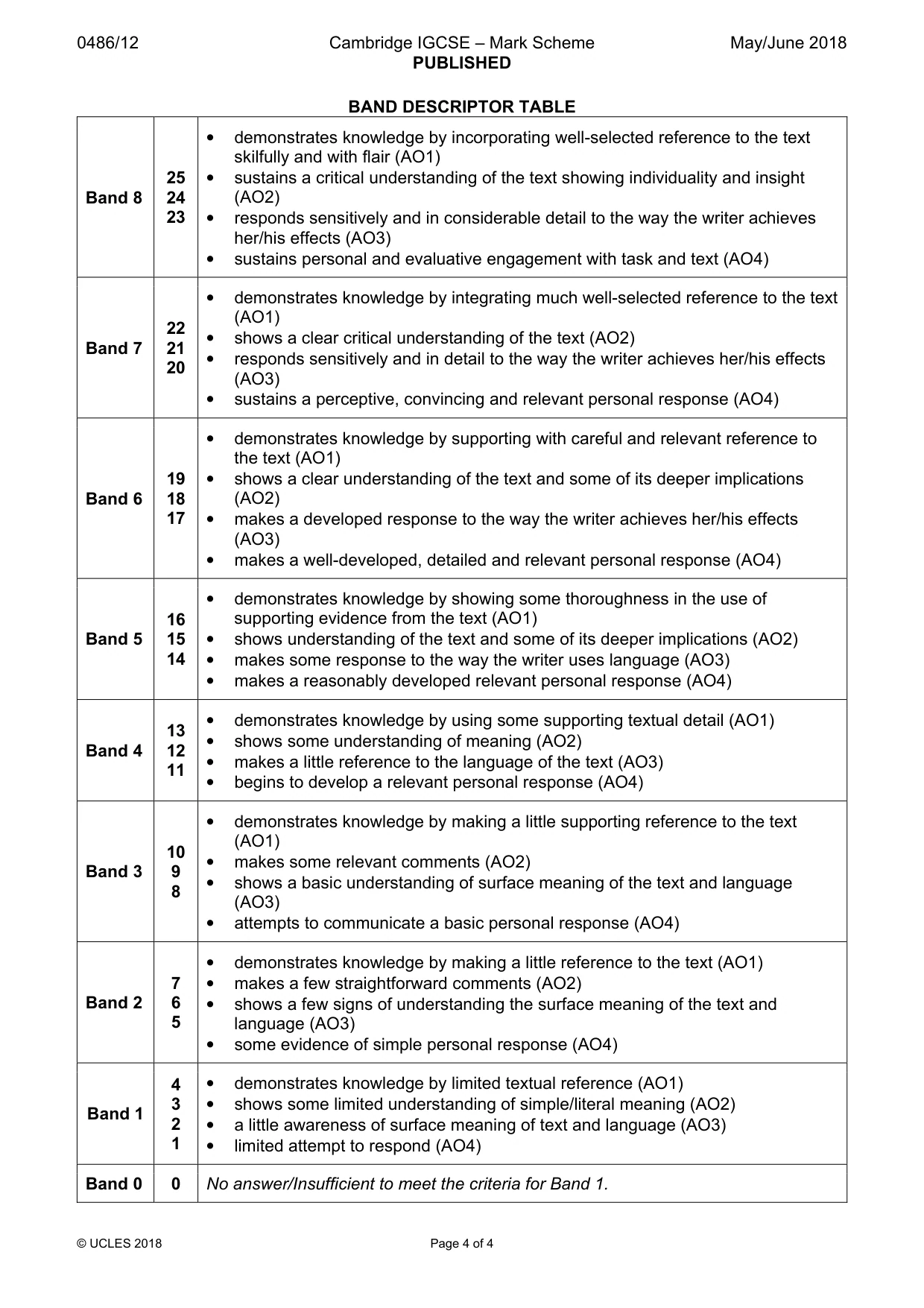
0486/12 Cambridge IGCSE – Mark Scheme PUBLISHED May/June 2018 © UCLES 2018 Page 4 of 4 BAND DESCRIPTOR TABLE Band 8 25 24 23 • demonstrates knowledge by incorporating well-selected reference to the text skilfully and with flair (AO1) • sustains a critical understanding of the text showing individuality and insight (AO2) • responds sensitively and in considerable detail to the way the writer achieves her/his effects (AO3) • sustains personal and evaluative engagement with task and text (AO4) Band 7 22 21 20 • demonstrates knowledge by integrating much well-selected reference to the text (AO1) • shows a clear critical understanding of the text (AO2) • responds sensitively and in detail to the way the writer achieves her/his effects (AO3) • sustains a perceptive, convincing and relevant personal response (AO4) Band 6 19 18 17 • demonstrates knowledge by supporting with careful and relevant reference to the text (AO1) • shows a clear understanding of the text and some of its deeper implications (AO2) • makes a developed response to the way the writer achieves her/his effects (AO3) • makes a well-developed, detailed and relevant personal response (AO4) Band 5 16 15 14 • demonstrates knowledge by showing some thoroughness in the use of supporting evidence from the text (AO1) • shows understanding of the text and some of its deeper implications (AO2) • makes some response to the way the writer uses language (AO3) • makes a reasonably developed relevant personal response (AO4) Band 4 13 12 11 • demonstrates knowledge by using some supporting textual detail (AO1) • shows some understanding of meaning (AO2) • makes a little reference to the language of the text (AO3) • begins to develop a relevant personal response (AO4) Band 3 10 9 8 • demonstrates knowledge by making a little supporting reference to the text (AO1) • makes some relevant comments (AO2) • shows a basic understanding of surface meaning of the text and language (AO3) • attempts to communicate a basic personal response (AO4) Band 2 7 6 5 • demonstrates knowledge by making a little reference to the text (AO1) • makes a few straightforward comments (AO2) • shows a few signs of understanding the surface meaning of the text and language (AO3) • some evidence of simple personal response (AO4) Band 1 4 3 2 1 • demonstrates knowledge by limited textual reference (AO1) • shows some limited understanding of simple/literal meaning (AO2) • a little awareness of surface meaning of text and language (AO3) • limited attempt to respond (AO4) Band 0 0 No answer/Insufficient to meet the criteria for Band 1.
What you needed in this session
Cambridge’s own grade thresholds for 2018 May/June, Paper 1 · Variant 2. A higher threshold means an easier paper — the bar moves with how the cohort did.