Cambridge IGCSE English - Literature 0486 — 2016 Oct/Nov Paper 3 · Variant 3
0486/33/O/N/16 · 25 marks · ≈28 min
The question paper and its mark scheme, free to read here and free to download. This is Cambridge’s own paper, exactly as it was sat.
Question paper12 pages
Mark scheme3 pages
Answers below. Sit the paper first if you are practising.
Paper as text
Question paper, page 1
This document consists of 11 printed pages, 1 blank page and 1 insert. DC (AL) 133089 © UCLES 2016 [Turn over Cambridge International Examinations Cambridge International General Certificate of Secondary Education * 5 6 7 3 8 1 1 8 4 8 * LITERATURE (ENGLISH) 0486/33 Paper 3 Drama (Open Text) October/November 2016 45 minutes Texts studied should be taken into the examination. READ THESE INSTRUCTIONS FIRST An answer booklet is provided inside the question paper. You should follow the instructions on the front cover of the answer booklet. If you need additional answer paper ask the invigilator for a continuation booklet. Answer one question. All questions in this paper carry equal marks. The syllabus is approved for use in England, Wales and Northern Ireland as a Cambridge International Level 1/Level 2 Certificate.
Question paper, page 2
2 0486/33/O/N/16 © UCLES 2016 ARTHUR MILLER: All My Sons Remember to support your ideas with details from the writing. Either 1 Read this passage carefully, and then answer the question that follows it: Keller: I ignore what I gotta ignore. Content removed due to copyright restrictions.
Question paper, page 3
3 0486/33/O/N/16 © UCLES 2016 [Turn over Chris: I am thinking that way. [from Act 1] In what ways does Miller make this such an intense moment in the play? Or 2 How does Miller make two moments in the play particularly disturbing for you? Content removed due to copyright restrictions.
Question paper, page 4
4 0486/33/O/N/16 © UCLES 2016 J. B. PRIESTLEY : An Inspector Calls Remember to support your ideas with details from the writing. Either 3 Read this passage carefully, and then answer the question that follows it: Birling [triumphantly ]: There you are! Content removed due to copyright restrictions.
Question paper, page 5
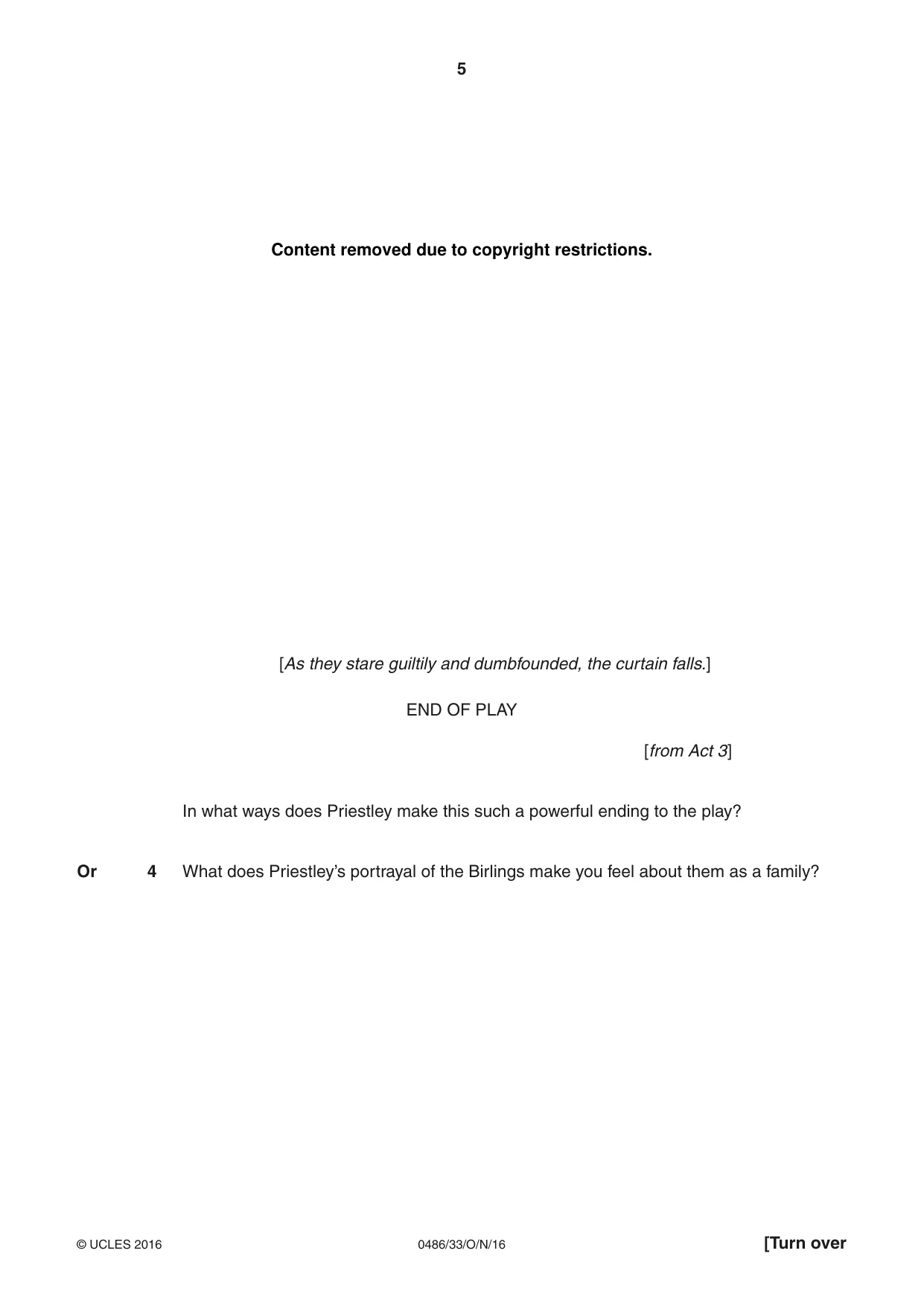
5 0486/33/O/N/16 © UCLES 2016 [Turn over [As they stare guiltily and dumbfounded, the curtain falls.] END OF PLAY [from Act 3 ] In what ways does Priestley make this such a powerful ending to the play? Or 4 What does Priestley’s portrayal of the Birlings make you feel about them as a family? Content removed due to copyright restrictions.
Question paper, page 6
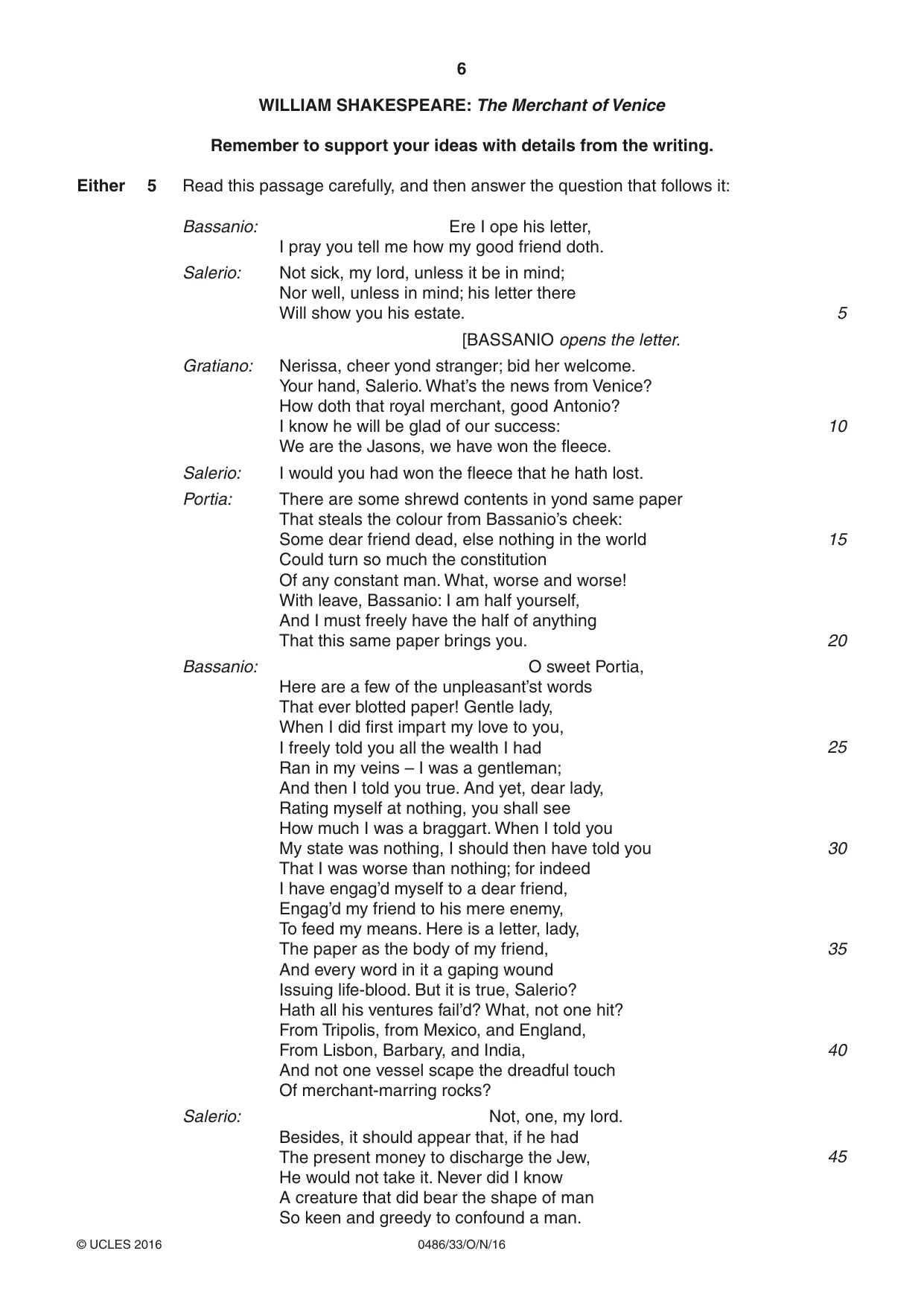
6 0486/33/O/N/16 © UCLES 2016 WILLIAM SHAKESPEARE: The Merchant of Venice Remember to support your ideas with details from the writing. Either 5 Read this passage carefully, and then answer the question that follows it: Bassanio: Ere I ope his letter, I pray you tell me how my good friend doth. Salerio: Not sick, my lord, unless it be in mind; Nor well, unless in mind; his letter there Will show you his estate. [BASSANIO opens the letter. Gratiano: Nerissa, cheer yond stranger; bid her welcome. Your hand, Salerio. What’s the news from Venice? How doth that royal merchant, good Antonio? I know he will be glad of our success: We are the Jasons, we have won the fleece. Salerio: I would you had won the fleece that he hath lost. Portia: There are some shrewd contents in yond same paper That steals the colour from Bassanio’s cheek: Some dear friend dead, else nothing in the world Could turn so much the constitution Of any constant man. What, worse and worse! With leave, Bassanio: I am half yourself, And I must freely have the half of anything That this same paper brings you. Bassanio: O sweet Portia, Here are a few of the unpleasant’st words That ever blotted paper! Gentle lady, When I did first impart my love to you, I freely told you all the wealth I had Ran in my veins – I was a gentleman; And then I told you true. And yet, dear lady, Rating myself at nothing, you shall see How much I was a braggart. When I told you My state was nothing, I should then have told you That I was worse than nothing; for indeed I have engag’d myself to a dear friend, Engag’d my friend to his mere enemy, To feed my means. Here is a letter, lady, The paper as the body of my friend, And every word in it a gaping wound Issuing life-blood. But it is true, Salerio? Hath all his ventures fail’d? What, not one hit? From Tripolis, from Mexico, and England, From Lisbon, Barbary, and India, And not one vessel scape the dreadful touch Of merchant-marring rocks? Salerio: Not, one, my lord. Besides, it should appear that, if he had The present money to discharge the Jew, He would not take it. Never did I know A creature that did bear the shape of man So keen and greedy to confound a man. 5 10 15 20 25 30 35 40 45
Question paper, page 7
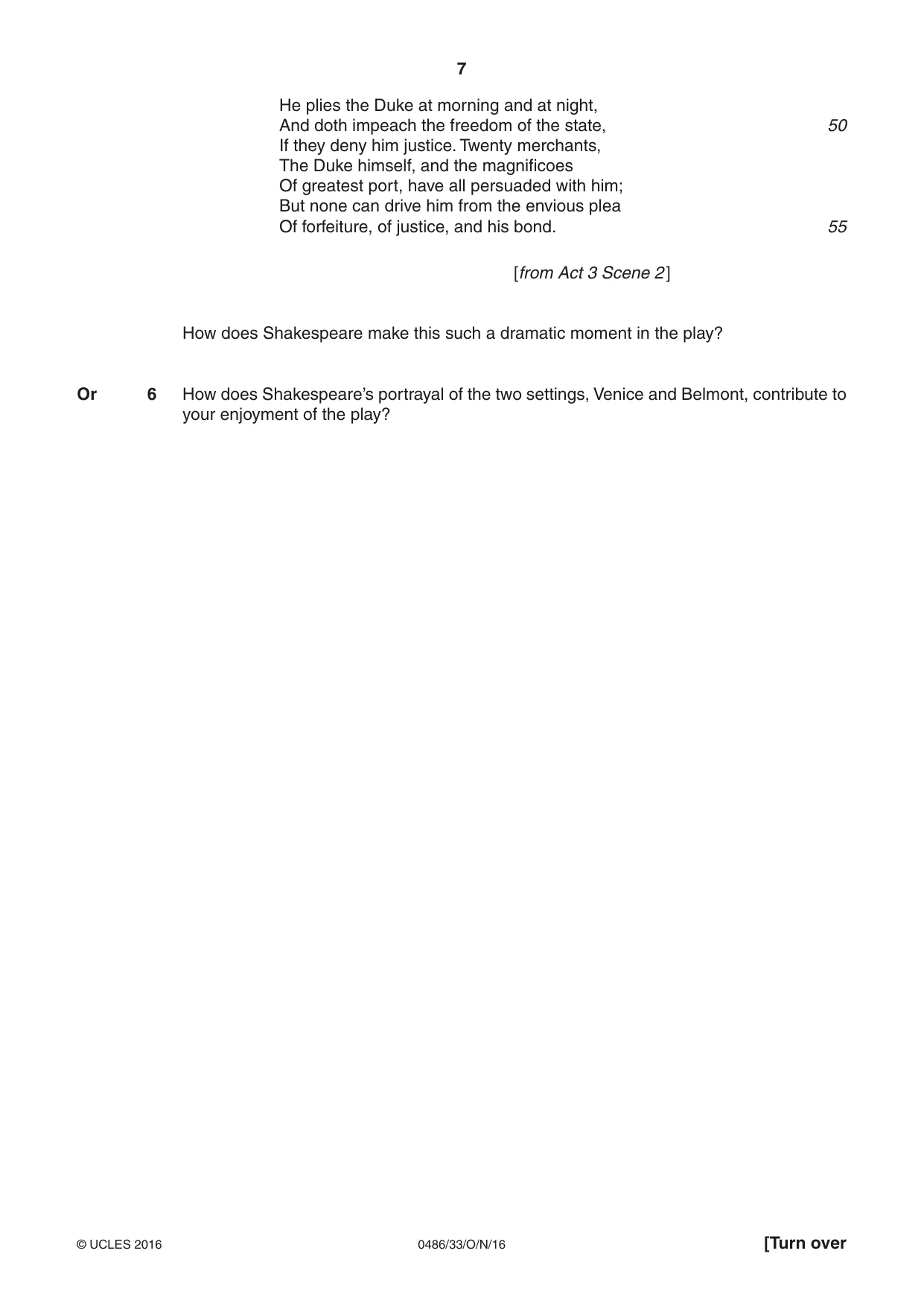
7 0486/33/O/N/16 © UCLES 2016 [Turn over He plies the Duke at morning and at night, And doth impeach the freedom of the state, If they deny him justice. Twenty merchants, The Duke himself, and the magnificoes Of greatest port, have all persuaded with him; But none can drive him from the envious plea Of forfeiture, of justice, and his bond. [from Act 3 Scene 2 ] How does Shakespeare make this such a dramatic moment in the play? Or 6 How does Shakespeare’s portrayal of the two settings, Venice and Belmont, contribute to your enjoyment of the play? 50 55
Question paper, page 8
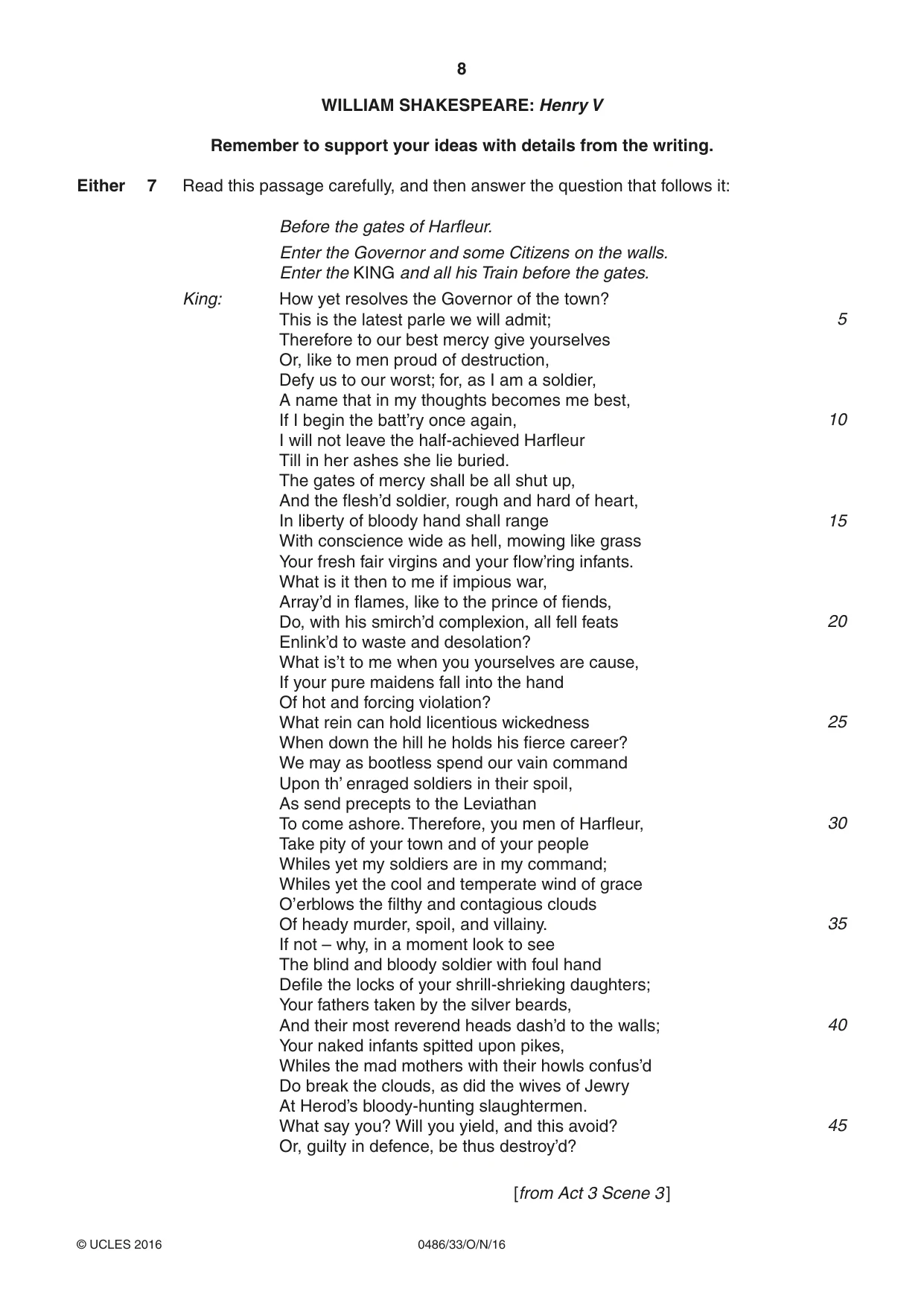
8 0486/33/O/N/16 © UCLES 2016 WILLIAM SHAKESPEARE: Henry V Remember to support your ideas with details from the writing. Either 7 Read this passage carefully, and then answer the question that follows it: Before the gates of Harfleur. Enter the Governor and some Citizens on the walls. Enter the KING and all his Train before the gates. King: How yet resolves the Governor of the town? This is the latest parle we will admit; Therefore to our best mercy give yourselves Or, like to men proud of destruction, Defy us to our worst; for, as I am a soldier, A name that in my thoughts becomes me best, If I begin the batt’ry once again, I will not leave the half-achieved Harfleur Till in her ashes she lie buried. The gates of mercy shall be all shut up, And the flesh’d soldier, rough and hard of heart, In liberty of bloody hand shall range With conscience wide as hell, mowing like grass Your fresh fair virgins and your flow’ring infants. What is it then to me if impious war, Array’d in flames, like to the prince of fiends, Do, with his smirch’d complexion, all fell feats Enlink’d to waste and desolation? What is’t to me when you yourselves are cause, If your pure maidens fall into the hand Of hot and forcing violation? What rein can hold licentious wickedness When down the hill he holds his fierce career? We may as bootless spend our vain command Upon th’ enraged soldiers in their spoil, As send precepts to the Leviathan To come ashore. Therefore, you men of Harfleur, Take pity of your town and of your people Whiles yet my soldiers are in my command; Whiles yet the cool and temperate wind of grace O’erblows the filthy and contagious clouds Of heady murder, spoil, and villainy. If not – why, in a moment look to see The blind and bloody soldier with foul hand Defile the locks of your shrill-shrieking daughters; Your fathers taken by the silver beards, And their most reverend heads dash’d to the walls; Your naked infants spitted upon pikes, Whiles the mad mothers with their howls confus’d Do break the clouds, as did the wives of Jewry At Herod’s bloody-hunting slaughtermen. What say you? Will you yield, and this avoid? Or, guilty in defence, be thus destroy’d? [from Act 3 Scene 3 ] 5 10 15 20 25 30 35 40 45
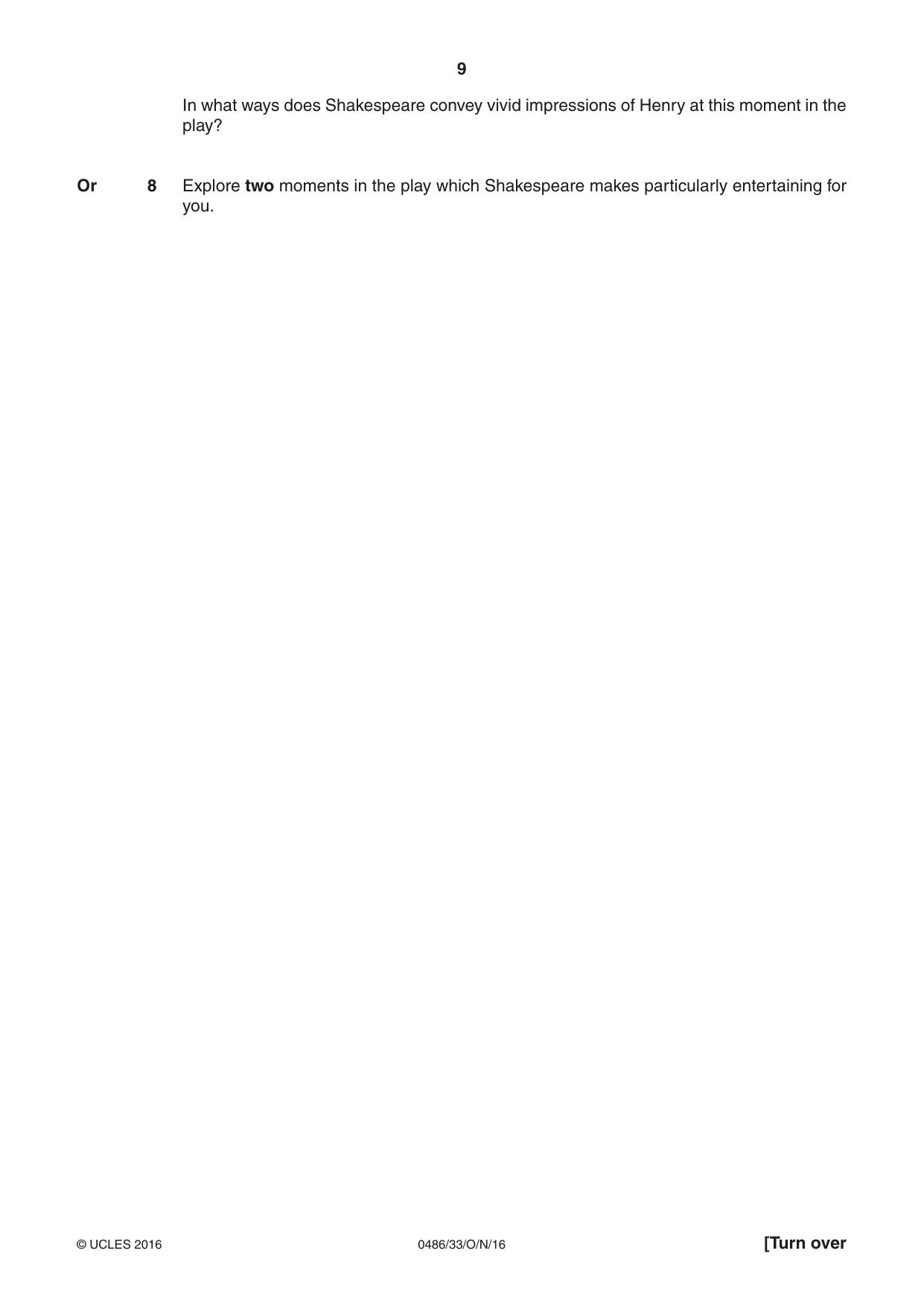
Question paper, page 9
9 0486/33/O/N/16 © UCLES 2016 [Turn over In what ways does Shakespeare convey vivid impressions of Henry at this moment in the play? Or 8 Explore two moments in the play which Shakespeare makes particularly entertaining for you.
Question paper, page 10
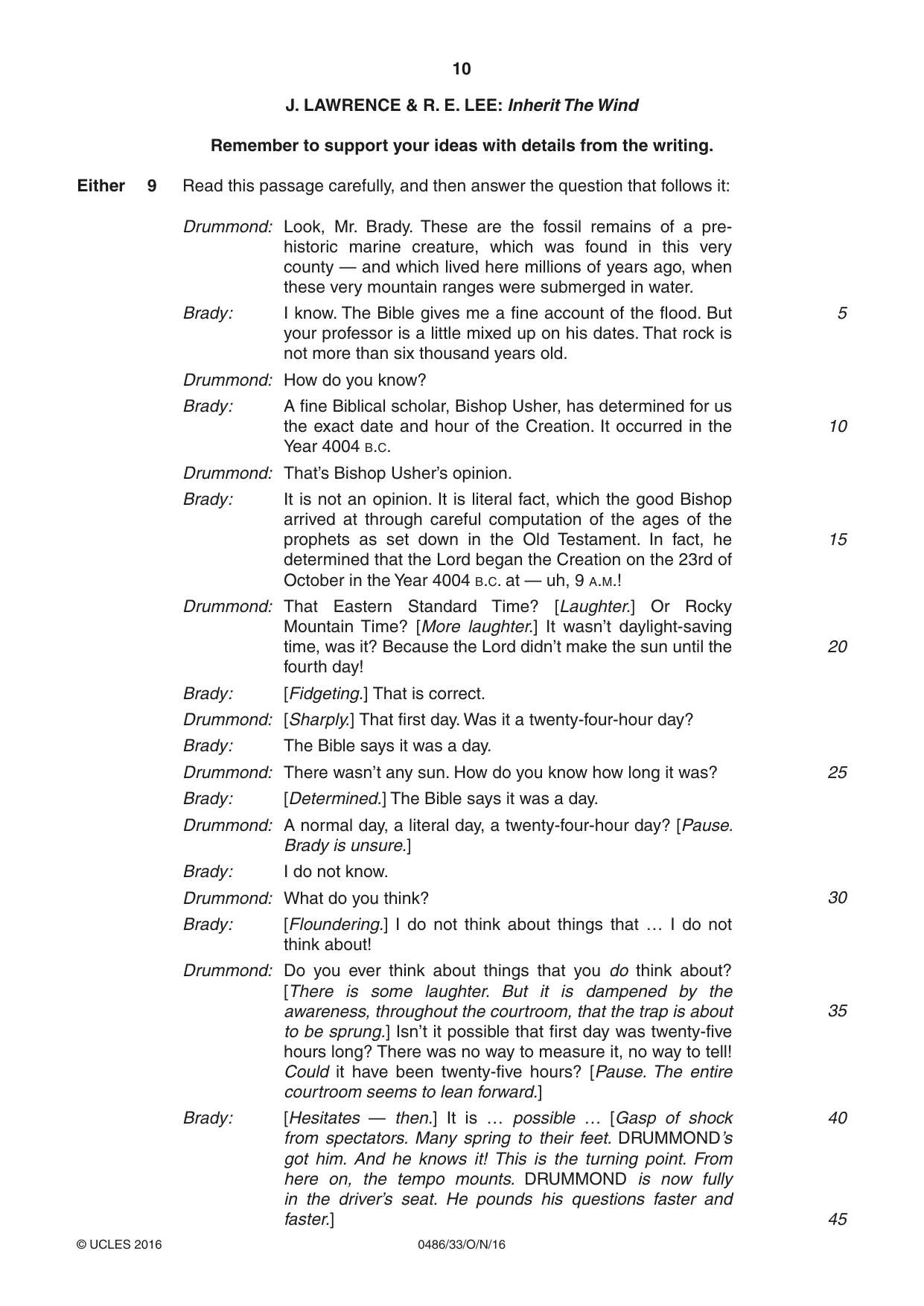
10 0486/33/O/N/16 © UCLES 2016 J. LAWRENCE & R. E. LEE: Inherit The Wind Remember to support your ideas with details from the writing. Either 9 Read this passage carefully, and then answer the question that follows it: Drummond: Look, Mr. Brady. These are the fossil remains of a pre- historic marine creature, which was found in this very county — and which lived here millions of years ago, when these very mountain ranges were submerged in water. Brady : I know. The Bible gives me a fine account of the flood. But your professor is a little mixed up on his dates. That rock is not more than six thousand years old. Drummond: How do you know? Brady : A fine Biblical scholar, Bishop Usher, has determined for us the exact date and hour of the Creation. It occurred in the Year 4004 B.C. Drummond: That’s Bishop Usher’s opinion. Brady : It is not an opinion. It is literal fact, which the good Bishop arrived at through careful computation of the ages of the prophets as set down in the Old Testament. In fact, he determined that the Lord began the Creation on the 23rd of October in the Year 4004 B.C. at — uh, 9 A.M.! Drummond: That Eastern Standard Time? [Laughter.] Or Rocky Mountain Time? [More laughter.] It wasn’t daylight-saving time, was it? Because the Lord didn’t make the sun until the fourth day! Brady : [Fidgeting.] That is correct. Drummond: [Sharply.] That first day. Was it a twenty-four-hour day? Brady : The Bible says it was a day. Drummond: There wasn’t any sun. How do you know how long it was? Brady : [Determined.] The Bible says it was a day. Drummond: A normal day, a literal day, a twenty-four-hour day? [Pause. Brady is unsure.] Brady : I do not know. Drummond: What do you think? Brady : [Floundering.] I do not think about things that … I do not think about! Drummond: Do you ever think about things that you do think about? [There is some laughter. But it is dampened by the awareness, throughout the courtroom, that the trap is about to be sprung.] Isn’t it possible that first day was twenty-five hours long? There was no way to measure it, no way to tell! Could it have been twenty-five hours? [Pause. The entire courtroom seems to lean forward.] Brady : [Hesitates — then.] It is … possible … [Gasp of shock from spectators. Many spring to their feet. DRUMMOND’s got him. And he knows it! This is the turning point. From here on, the tempo mounts. DRUMMOND is now fully in the driver’s seat. He pounds his questions faster and faster.] 5 10 15 20 25 30 35 40 45
Question paper, page 11
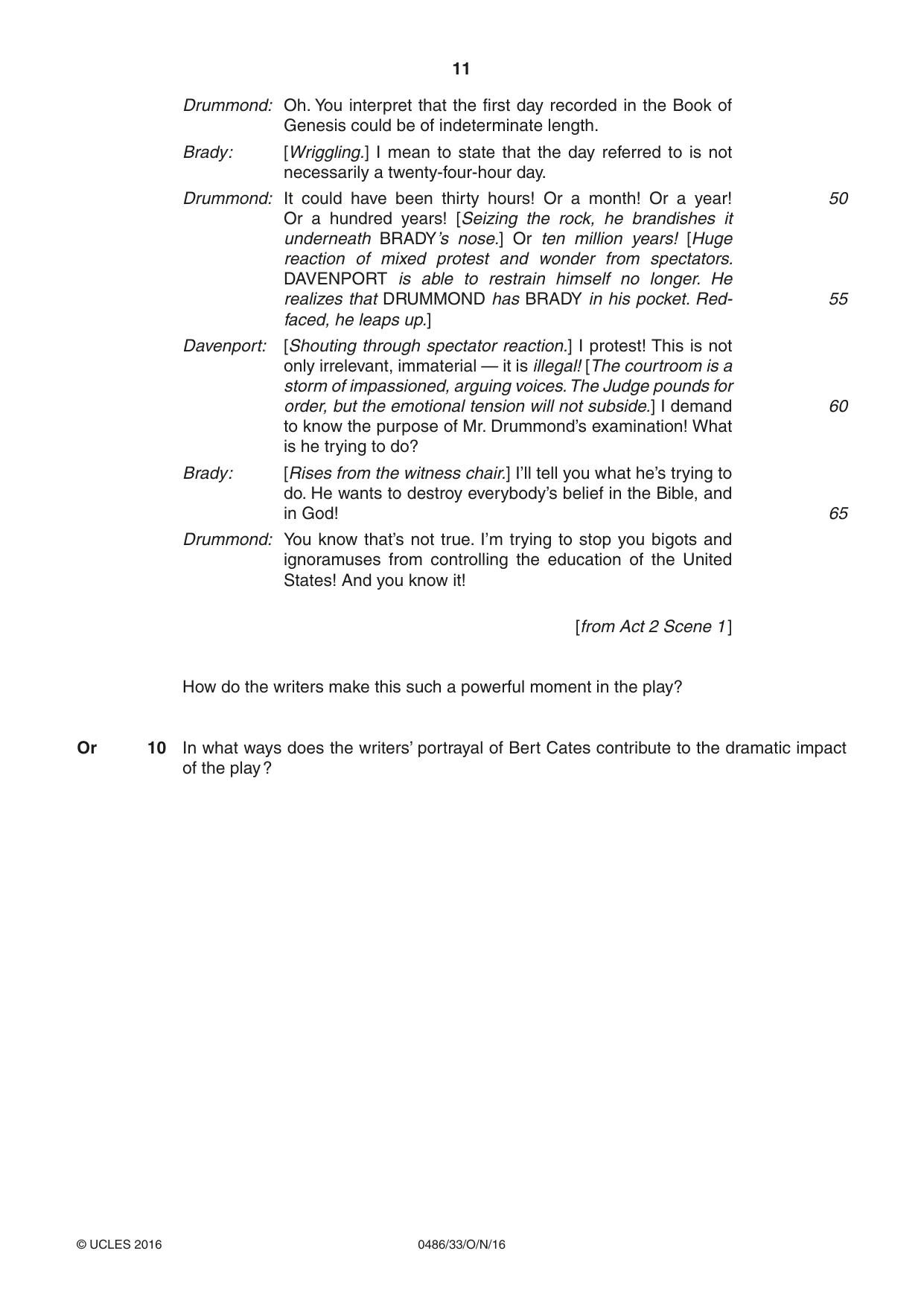
11 0486/33/O/N/16 © UCLES 2016 Drummond: Oh. You interpret that the first day recorded in the Book of Genesis could be of indeterminate length. Brady : [Wriggling.] I mean to state that the day referred to is not necessarily a twenty-four-hour day. Drummond: It could have been thirty hours! Or a month! Or a year! Or a hundred years! [Seizing the rock, he brandishes it underneath BRADY’s nose.] Or ten million years! [Huge reaction of mixed protest and wonder from spectators. DAVENPORT is able to restrain himself no longer. He realizes that DRUMMOND has BRADY in his pocket. Red- faced, he leaps up.] Davenport: [Shouting through spectator reaction.] I protest! This is not only irrelevant, immaterial — it is illegal! [The courtroom is a storm of impassioned, arguing voices. The Judge pounds for order, but the emotional tension will not subside.] I demand to know the purpose of Mr. Drummond’s examination! What is he trying to do? Brady : [Rises from the witness chair.] I’ll tell you what he’s trying to do. He wants to destroy everybody’s belief in the Bible, and in God! Drummond: You know that’s not true. I’m trying to stop you bigots and ignoramuses from controlling the education of the United States! And you know it! [from Act 2 Scene 1 ] How do the writers make this such a powerful moment in the play? Or 10 In what ways does the writers’ portrayal of Bert Cates contribute to the dramatic impact of the play ? 50 55 60 65
Question paper, page 12
12 0486/33/O/N/16 © UCLES 2016 BLANK PAGE Permission to reproduce items where third-party owned material protected by copyright is included has been sought and cleared where possible. Every reasonable effort has been made by the publisher (UCLES) to trace copyright holders, but if any items requiring clearance have unwittingly been included, the publisher will be pleased to make amends at the earliest possible opportunity. To avoid the issue of disclosure of answer-related information to candidates, all copyright acknowledgements are reproduced online in the Cambridge International Examinations Copyright Acknowledgements Booklet. This is produced for each series of examinations and is freely available to download at www.cie.org.uk after the live examination series. Cambridge International Examinations is part of the Cambridge Assessment Group. Cambridge Assessment is the brand name of University of Cambridge Local Examinations Syndicate (UCLES), which is itself a department of the University of Cambridge.
Mark scheme, page 1
® IGCSE is the registered trademark of Cambridge International Examinations. This syllabus is approved for use in England, Wales and Northern Ireland as a Cambridge International Level 1/Level 2 Certificate. This document consists of 3 printed pages. © UCLES 2016 [Turn over Cambridge International Examinations Cambridge International General Certificate of Secondary Education LITERATURE (ENGLISH) 0486/33 Paper 3 Drama (Open Text) October/November 2016 MARK SCHEME Maximum Mark: 25 Published This mark scheme is published as an aid to teachers and candidates, to indicate the requirements of the examination. It shows the basis on which Examiners were instructed to award marks. It does not indicate the details of the discussions that took place at an Examiners’ meeting before marking began, which would have considered the acceptability of alternative answers. Mark schemes should be read in conjunction with the question paper and the Principal Examiner Report for Teachers. Cambridge will not enter into discussions about these mark schemes. Cambridge is publishing the mark schemes for the October/November 2016 series for most Cambridge IGCSE®, Cambridge International A and AS Level components and some Cambridge O Level components.
Mark scheme, page 2
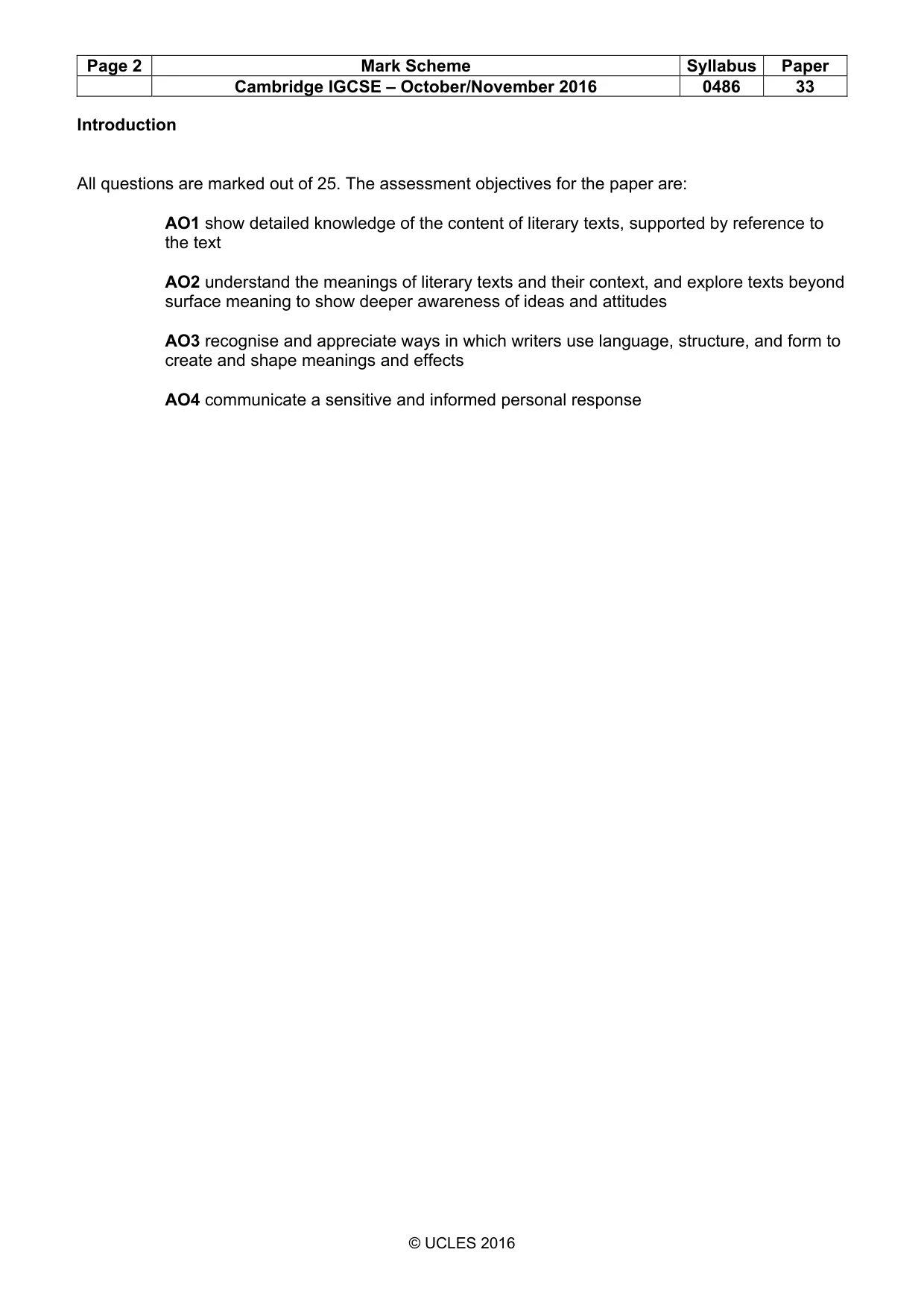
Page 2 Mark Scheme Syllabus Paper Cambridge IGCSE – October/November 2016 0486 33 © UCLES 2016 Introduction All questions are marked out of 25. The assessment objectives for the paper are: AO1 show detailed knowledge of the content of literary texts, supported by reference to the text AO2 understand the meanings of literary texts and their context, and explore texts beyond surface meaning to show deeper awareness of ideas and attitudes AO3 recognise and appreciate ways in which writers use language, structure, and form to create and shape meanings and effects AO4 communicate a sensitive and informed personal response
Mark scheme, page 3
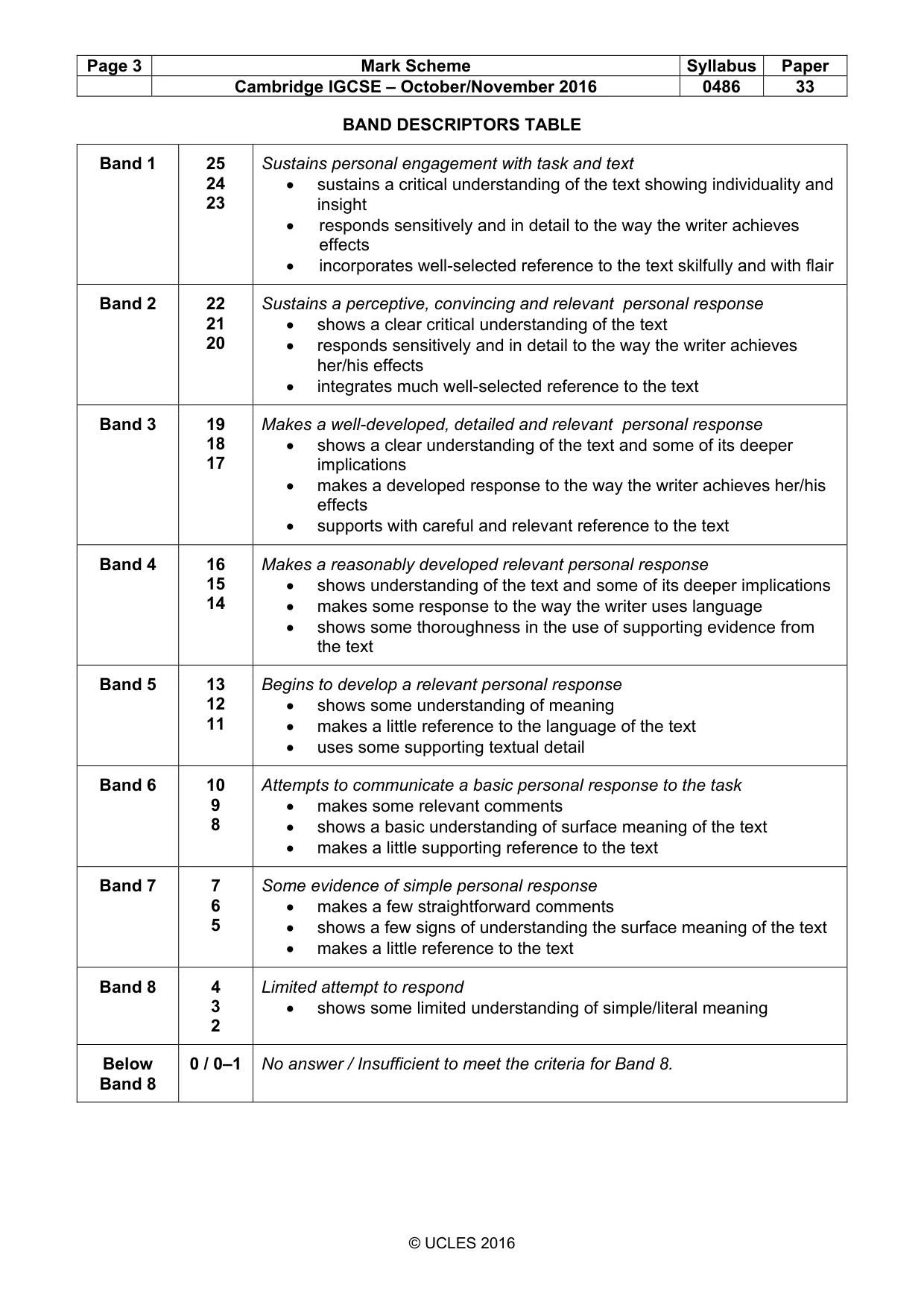
Page 3 Mark Scheme Syllabus Paper Cambridge IGCSE – October/November 2016 0486 33 © UCLES 2016 BAND DESCRIPTORS TABLE Band 1 25 24 23 Sustains personal engagement with task and text • sustains a critical understanding of the text showing individuality and insight • responds sensitively and in detail to the way the writer achieves effects • incorporates well-selected reference to the text skilfully and with flair Band 2 22 21 20 Sustains a perceptive, convincing and relevant personal response • shows a clear critical understanding of the text • responds sensitively and in detail to the way the writer achieves her/his effects • integrates much well-selected reference to the text Band 3 19 18 17 Makes a well-developed, detailed and relevant personal response • shows a clear understanding of the text and some of its deeper implications • makes a developed response to the way the writer achieves her/his effects • supports with careful and relevant reference to the text Band 4 16 15 14 Makes a reasonably developed relevant personal response • shows understanding of the text and some of its deeper implications • makes some response to the way the writer uses language • shows some thoroughness in the use of supporting evidence from the text Band 5 13 12 11 Begins to develop a relevant personal response • shows some understanding of meaning • makes a little reference to the language of the text • uses some supporting textual detail Band 6 10 9 8 Attempts to communicate a basic personal response to the task • makes some relevant comments • shows a basic understanding of surface meaning of the text • makes a little supporting reference to the text Band 7 7 6 5 Some evidence of simple personal response • makes a few straightforward comments • shows a few signs of understanding the surface meaning of the text • makes a little reference to the text Band 8 4 3 2 Limited attempt to respond • shows some limited understanding of simple/literal meaning Below Band 8 0 / 0–1 No answer / Insufficient to meet the criteria for Band 8.
What you needed in this session
Cambridge’s own grade thresholds for 2016 Oct/Nov, Paper 3 · Variant 3. A higher threshold means an easier paper — the bar moves with how the cohort did.