Cambridge IGCSE English - Literature 0486 — 2016 Feb/March Paper 4 · Variant 2
0486/42/F/M/16 · 25 marks · ≈28 min
The question paper and its mark scheme, free to read here and free to download. This is Cambridge’s own paper, exactly as it was sat.
Question paper8 pages
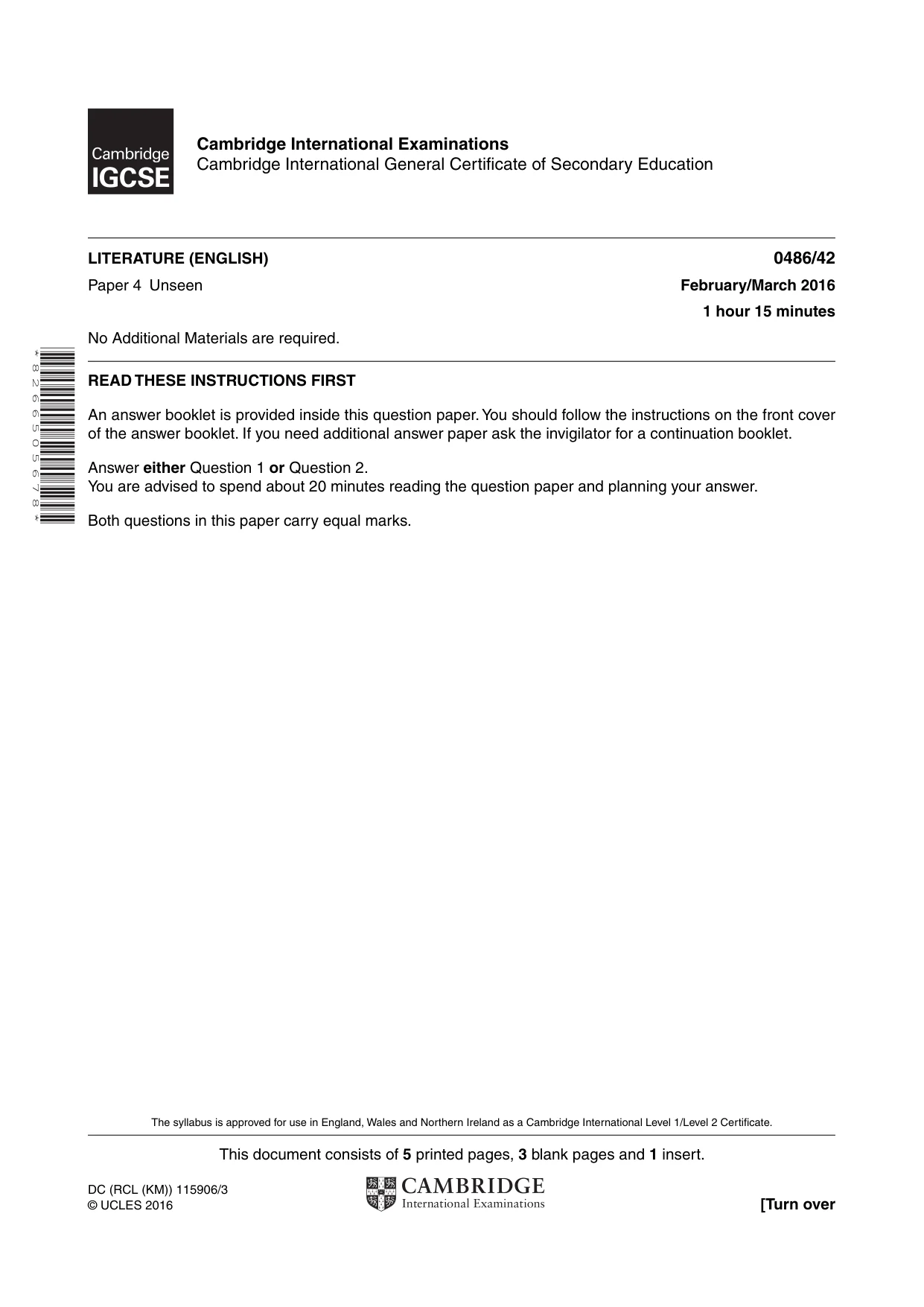
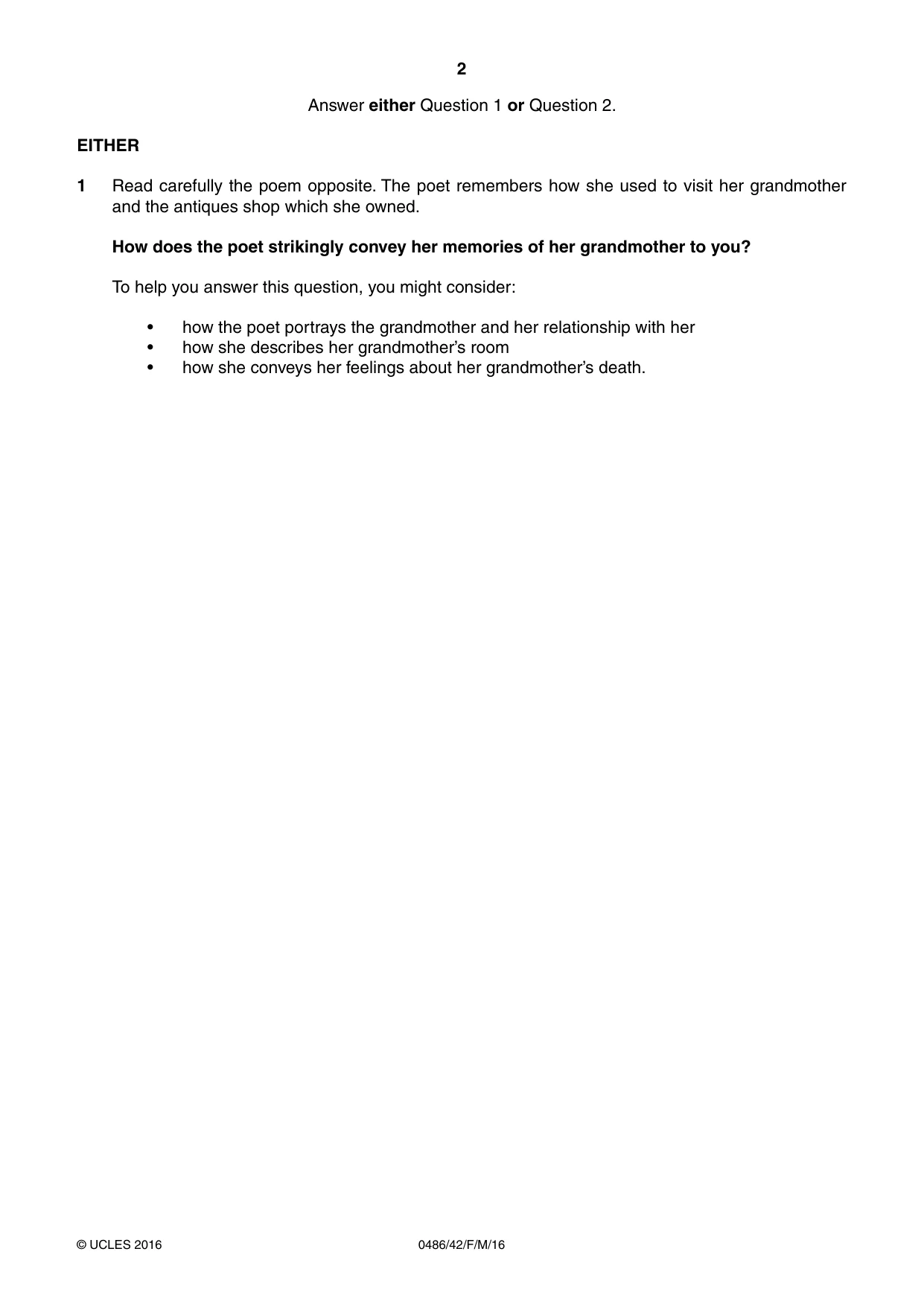
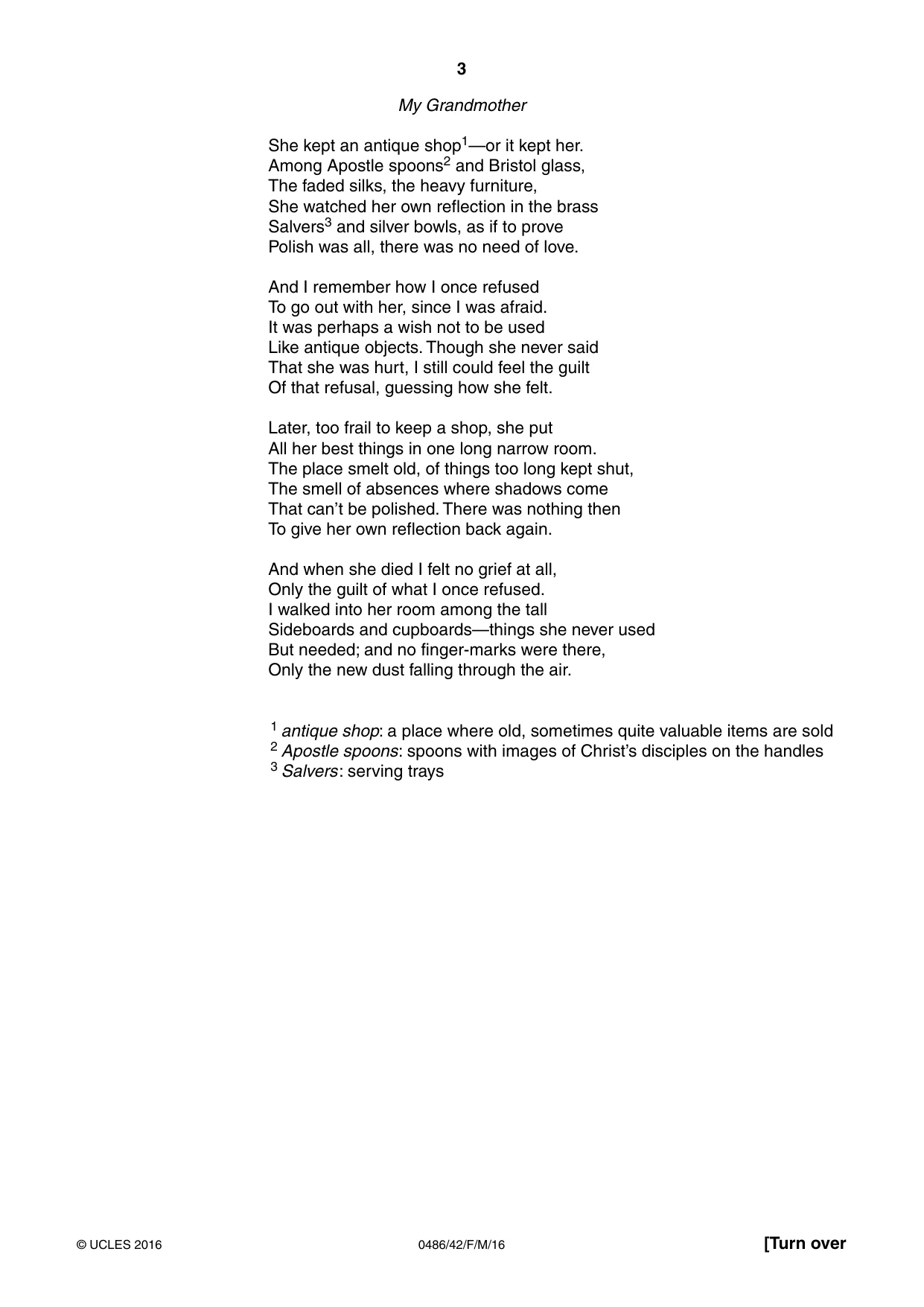
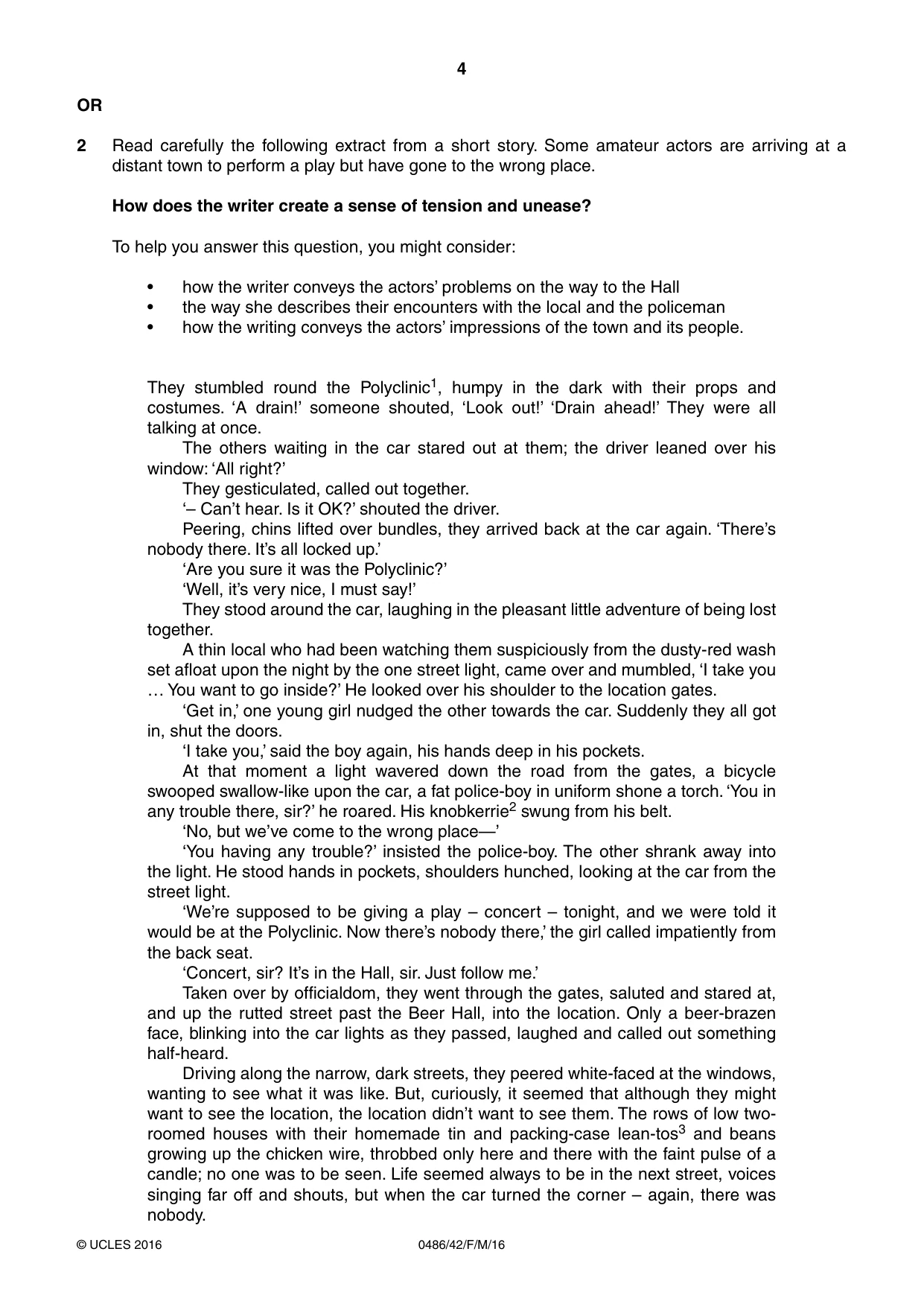


Mark scheme3 pages
Answers below. Sit the paper first if you are practising.
Paper as text
Question paper, page 1
This document consists of 5 printed pages, 3 blank pages and 1 insert. DC (RCL (KM)) 115906/3 © UCLES 2016 [Turn over Cambridge International Examinations Cambridge International General Certificate of Secondary Education * 8 2 6 6 5 0 5 6 7 8 * LITERATURE (ENGLISH) 0486/42 Paper 4 Unseen February/March 2016 1 hour 15 minutes No Additional Materials are required. READ THESE INSTRUCTIONS FIRST An answer booklet is provided inside this question paper. You should follow the instructions on the front cover of the answer booklet. If you need additional answer paper ask the invigilator for a continuation booklet. Answer either Question 1 or Question 2. You are advised to spend about 20 minutes reading the question paper and planning your answer. Both questions in this paper carry equal marks. The syllabus is approved for use in England, Wales and Northern Ireland as a Cambridge International Level 1/Level 2 Certificate.
Question paper, page 2
2 0486/42/F/M/16 © UCLES 2016 Answer either Question 1 or Question 2. EITHER 1 Read carefully the poem opposite. The poet remembers how she used to visit her grandmother and the antiques shop which she owned. How does the poet strikingly convey her memories of her grandmother to you? To help you answer this question, you might consider: • how the poet portrays the grandmother and her relationship with her • how she describes her grandmother’s room • how she conveys her feelings about her grandmother’s death.
Question paper, page 3
3 0486/42/F/M/16 © UCLES 2016 [Turn over My Grandmother She kept an antique shop1—or it kept her. Among Apostle spoons2 and Bristol glass, The faded silks, the heavy furniture, She watched her own reflection in the brass Salvers3 and silver bowls, as if to prove Polish was all, there was no need of love. And I remember how I once refused To go out with her, since I was afraid. It was perhaps a wish not to be used Like antique objects. Though she never said That she was hurt, I still could feel the guilt Of that refusal, guessing how she felt. Later, too frail to keep a shop, she put All her best things in one long narrow room. The place smelt old, of things too long kept shut, The smell of absences where shadows come That can’t be polished. There was nothing then To give her own reflection back again. And when she died I felt no grief at all, Only the guilt of what I once refused. I walked into her room among the tall Sideboards and cupboards—things she never used But needed; and no finger-marks were there, Only the new dust falling through the air. 1 antique shop: a place where old, sometimes quite valuable items are sold 2 Apostle spoons : spoons with images of Christ’s disciples on the handles 3 Salvers : serving trays
Question paper, page 4
4 0486/42/F/M/16 © UCLES 2016 OR 2 Read carefully the following extract from a short story. Some amateur actors are arriving at a distant town to perform a play but have gone to the wrong place. How does the writer create a sense of tension and unease? To help you answer this question, you might consider: • how the writer conveys the actors’ problems on the way to the Hall • the way she describes their encounters with the local and the policeman • how the writing conveys the actors’ impressions of the town and its people. They stumbled round the Polyclinic1, humpy in the dark with their props and costumes. ‘A drain!’ someone shouted, ‘Look out!’ ‘Drain ahead!’ They were all talking at once. The others waiting in the car stared out at them; the driver leaned over his window: ‘All right?’ They gesticulated, called out together. ‘– Can’t hear. Is it OK?’ shouted the driver. Peering, chins lifted over bundles, they arrived back at the car again. ‘There’s nobody there. It’s all locked up.’ ‘Are you sure it was the Polyclinic?’ ‘Well, it’s very nice, I must say!’ They stood around the car, laughing in the pleasant little adventure of being lost together. A thin local who had been watching them suspiciously from the dusty-red wash set afloat upon the night by the one street light, came over and mumbled, ‘I take you … You want to go inside?’ He looked over his shoulder to the location gates. ‘Get in,’ one young girl nudged the other towards the car. Suddenly they all got in, shut the doors. ‘I take you,’ said the boy again, his hands deep in his pockets. At that moment a light wavered down the road from the gates, a bicycle swooped swallow-like upon the car, a fat police-boy in uniform shone a torch. ‘You in any trouble there, sir?’ he roared. His knobkerrie2 swung from his belt. ‘No, but we’ve come to the wrong place—’ ‘You having any trouble?’ insisted the police-boy. The other shrank away into the light. He stood hands in pockets, shoulders hunched, looking at the car from the street light. ‘We’re supposed to be giving a play – concert – tonight, and we were told it would be at the Polyclinic. Now there’s nobody there,’ the girl called impatiently from the back seat. ‘Concert, sir? It’s in the Hall, sir. Just follow me.’ Taken over by officialdom, they went through the gates, saluted and stared at, and up the rutted street past the Beer Hall, into the location. Only a beer-brazen face, blinking into the car lights as they passed, laughed and called out something half-heard. Driving along the narrow, dark streets, they peered white-faced at the windows, wanting to see what it was like. But, curiously, it seemed that although they might want to see the location, the location didn’t want to see them. The rows of low two- roomed houses with their homemade tin and packing-case lean-tos3 and beans growing up the chicken wire, throbbed only here and there with the faint pulse of a candle; no one was to be seen. Life seemed always to be in the next street, voices singing far off and shouts, but when the car turned the corner – again, there was nobody.
Question paper, page 5
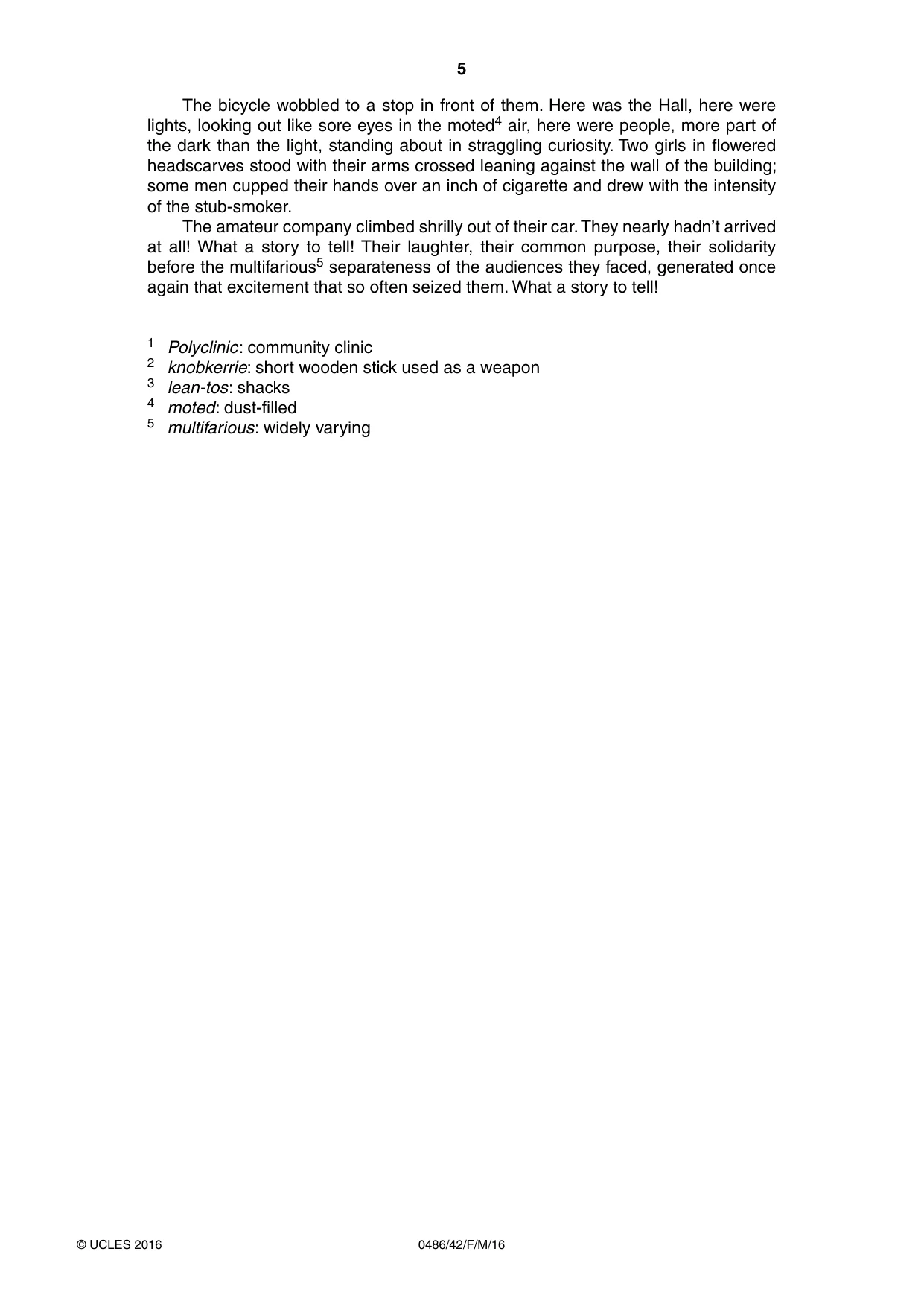
5 0486/42/F/M/16 © UCLES 2016 The bicycle wobbled to a stop in front of them. Here was the Hall, here were lights, looking out like sore eyes in the moted4 air, here were people, more part of the dark than the light, standing about in straggling curiosity. Two girls in flowered headscarves stood with their arms crossed leaning against the wall of the building; some men cupped their hands over an inch of cigarette and drew with the intensity of the stub-smoker. The amateur company climbed shrilly out of their car. They nearly hadn’t arrived at all! What a story to tell! Their laughter, their common purpose, their solidarity before the multifarious5 separateness of the audiences they faced, generated once again that excitement that so often seized them. What a story to tell! 1 Polyclinic : community clinic 2 knobkerrie: short wooden stick used as a weapon 3 lean-tos : shacks 4 moted : dust-filled 5 multifarious : widely varying
Question paper, page 6
6 0486/42/F/M/16 © UCLES 2016 BLANK PAGE
Question paper, page 7
7 0486/42/F/M/16 © UCLES 2016 BLANK PAGE
Question paper, page 8
8 0486/42/F/M/16 © UCLES 2016 BLANK PAGE Permission to reproduce items where third-party owned material protected by copyright is included has been sought and cleared where possible. Every reasonable effort has been made by the publisher (UCLES) to trace copyright holders, but if any items requiring clearance have unwittingly been included, the publisher will be pleased to make amends at the earliest possible opportunity. To avoid the issue of disclosure of answer-related information to candidates, all copyright acknowledgements are reproduced online in the Cambridge International Examinations Copyright Acknowledgements Booklet. This is produced for each series of examinations and is freely available to download at www.cie.org.uk after the live examination series. Cambridge International Examinations is part of the Cambridge Assessment Group. Cambridge Assessment is the brand name of University of Cambridge Local Examinations Syndicate (UCLES), which is itself a department of the University of Cambridge.
Mark scheme, page 1
® IGCSE is the registered trademark of Cambridge International Examinations. CAMBRIDGE INTERNATIONAL EXAMINATIONS Cambridge International General Certificate of Secondary Education MARK SCHEME for the March 2016 series 0486 LITERATURE (ENGLISH) 0486/42 Paper 4 (Unseen), maximum raw mark 25 This mark scheme is published as an aid to teachers and candidates, to indicate the requirements of the examination. It shows the basis on which Examiners were instructed to award marks. It does not indicate the details of the discussions that took place at an Examiners’ meeting before marking began, which would have considered the acceptability of alternative answers. Mark schemes should be read in conjunction with the question paper and the Principal Examiner Report for Teachers. Cambridge will not enter into discussions about these mark schemes. Cambridge is publishing the mark schemes for the March 2016 series for most Cambridge IGCSE® and Cambridge International A and AS Level components.
Mark scheme, page 2
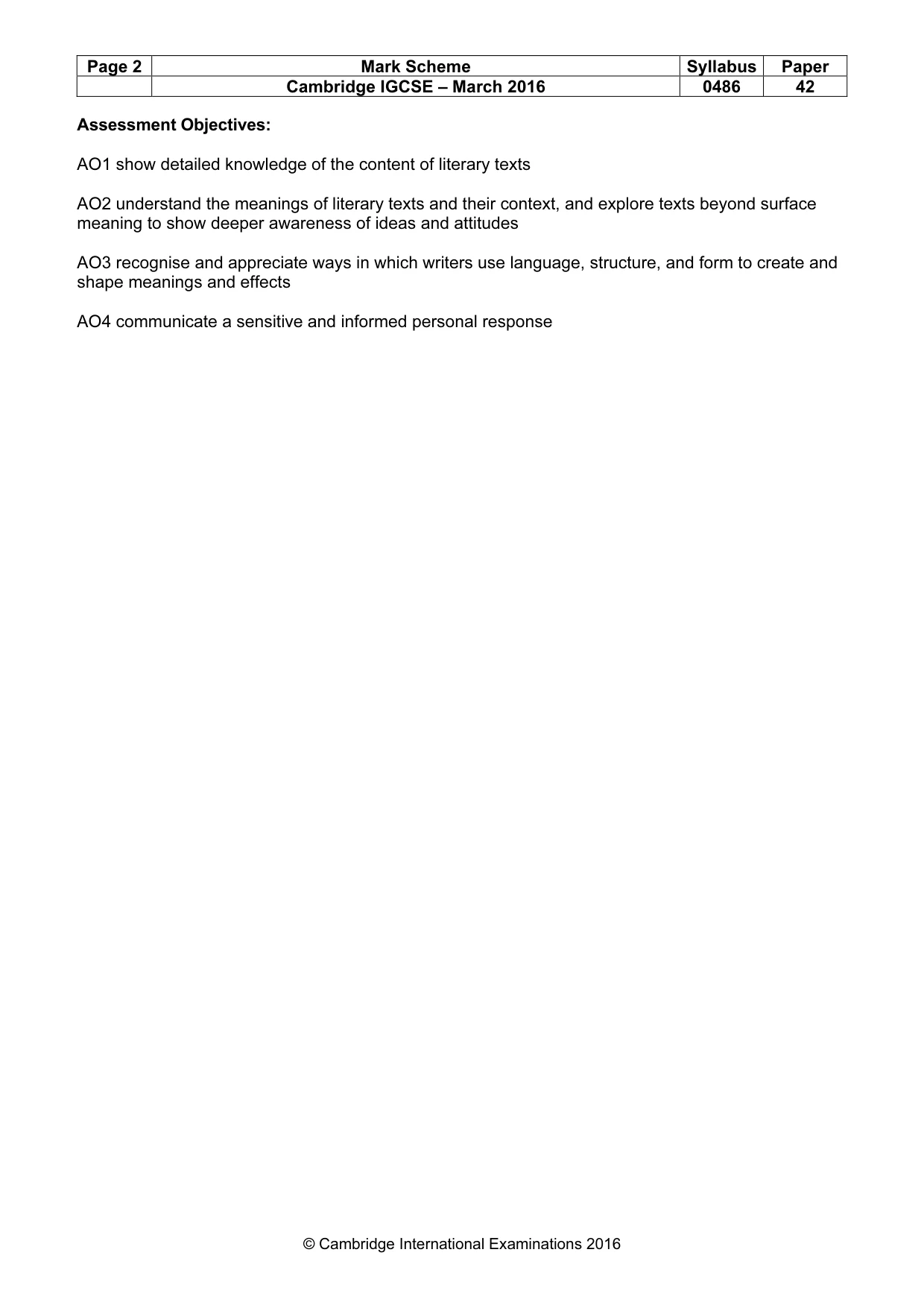
Page 2 Mark Scheme Syllabus Paper Cambridge IGCSE – March 2016 0486 42 © Cambridge International Examinations 2016 Assessment Objectives: AO1 show detailed knowledge of the content of literary texts AO2 understand the meanings of literary texts and their context, and explore texts beyond surface meaning to show deeper awareness of ideas and attitudes AO3 recognise and appreciate ways in which writers use language, structure, and form to create and shape meanings and effects AO4 communicate a sensitive and informed personal response
Mark scheme, page 3
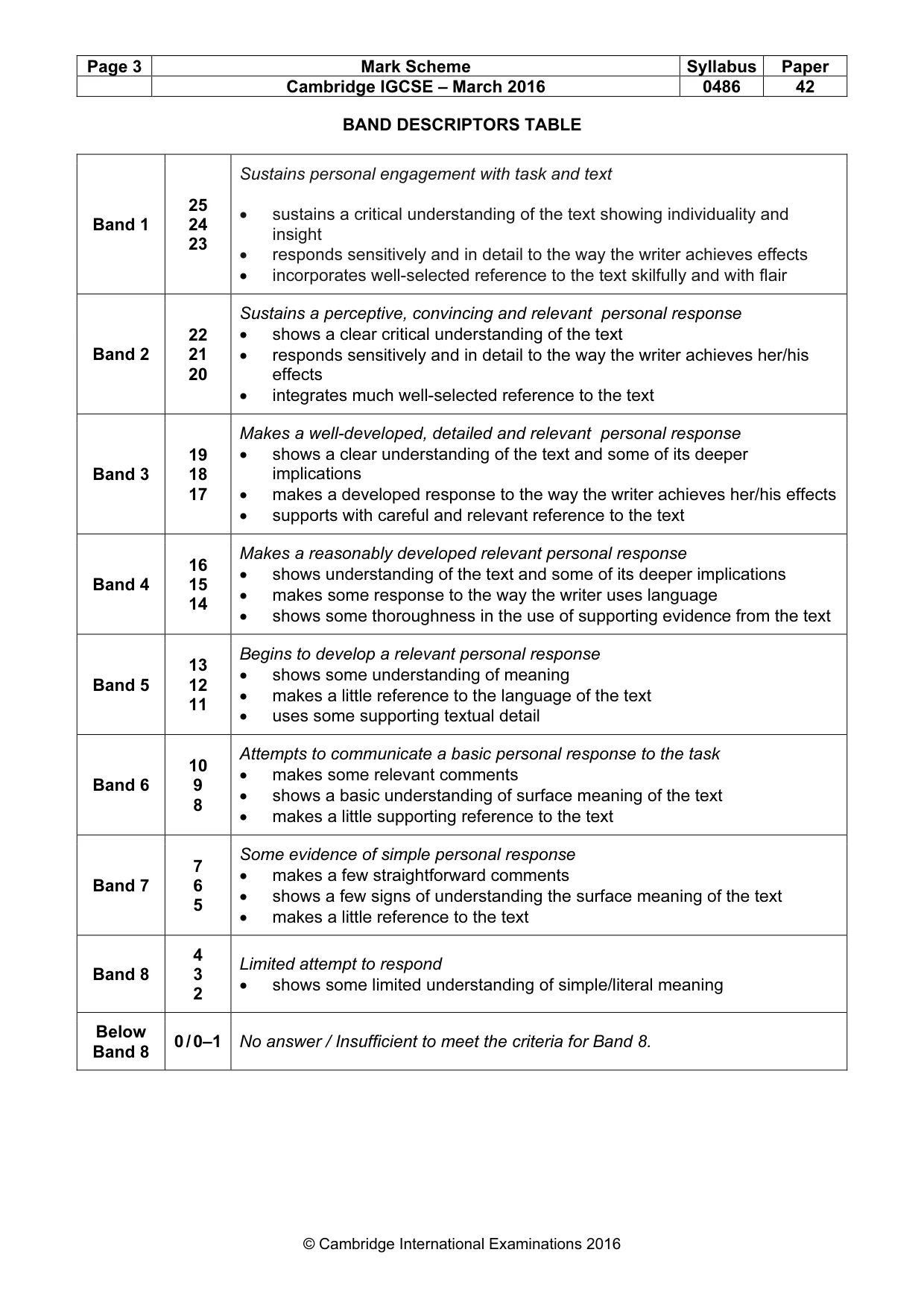
Page 3 Mark Scheme Syllabus Paper Cambridge IGCSE – March 2016 0486 42 © Cambridge International Examinations 2016 BAND DESCRIPTORS TABLE Band 1 25 24 23 Sustains personal engagement with task and text • sustains a critical understanding of the text showing individuality and insight • responds sensitively and in detail to the way the writer achieves effects • incorporates well-selected reference to the text skilfully and with flair Band 2 22 21 20 Sustains a perceptive, convincing and relevant personal response • shows a clear critical understanding of the text • responds sensitively and in detail to the way the writer achieves her/his effects • integrates much well-selected reference to the text Band 3 19 18 17 Makes a well-developed, detailed and relevant personal response • shows a clear understanding of the text and some of its deeper implications • makes a developed response to the way the writer achieves her/his effects • supports with careful and relevant reference to the text Band 4 16 15 14 Makes a reasonably developed relevant personal response • shows understanding of the text and some of its deeper implications • makes some response to the way the writer uses language • shows some thoroughness in the use of supporting evidence from the text Band 5 13 12 11 Begins to develop a relevant personal response • shows some understanding of meaning • makes a little reference to the language of the text • uses some supporting textual detail Band 6 10 9 8 Attempts to communicate a basic personal response to the task • makes some relevant comments • shows a basic understanding of surface meaning of the text • makes a little supporting reference to the text Band 7 7 6 5 Some evidence of simple personal response • makes a few straightforward comments • shows a few signs of understanding the surface meaning of the text • makes a little reference to the text Band 8 4 3 2 Limited attempt to respond • shows some limited understanding of simple/literal meaning Below Band 8 0 / 0–1 No answer / Insufficient to meet the criteria for Band 8.
What you needed in this session
Cambridge’s own grade thresholds for 2016 Feb/March, Paper 4 · Variant 2. A higher threshold means an easier paper — the bar moves with how the cohort did.