Cambridge IGCSE English - Literature 0486 — 2016 Feb/March Paper 3 · Variant 2
0486/32/F/M/16 · 25 marks · ≈28 min
The question paper and its mark scheme, free to read here and free to download. This is Cambridge’s own paper, exactly as it was sat.
Question paper12 pages

Mark scheme3 pages
Answers below. Sit the paper first if you are practising.
Paper as text
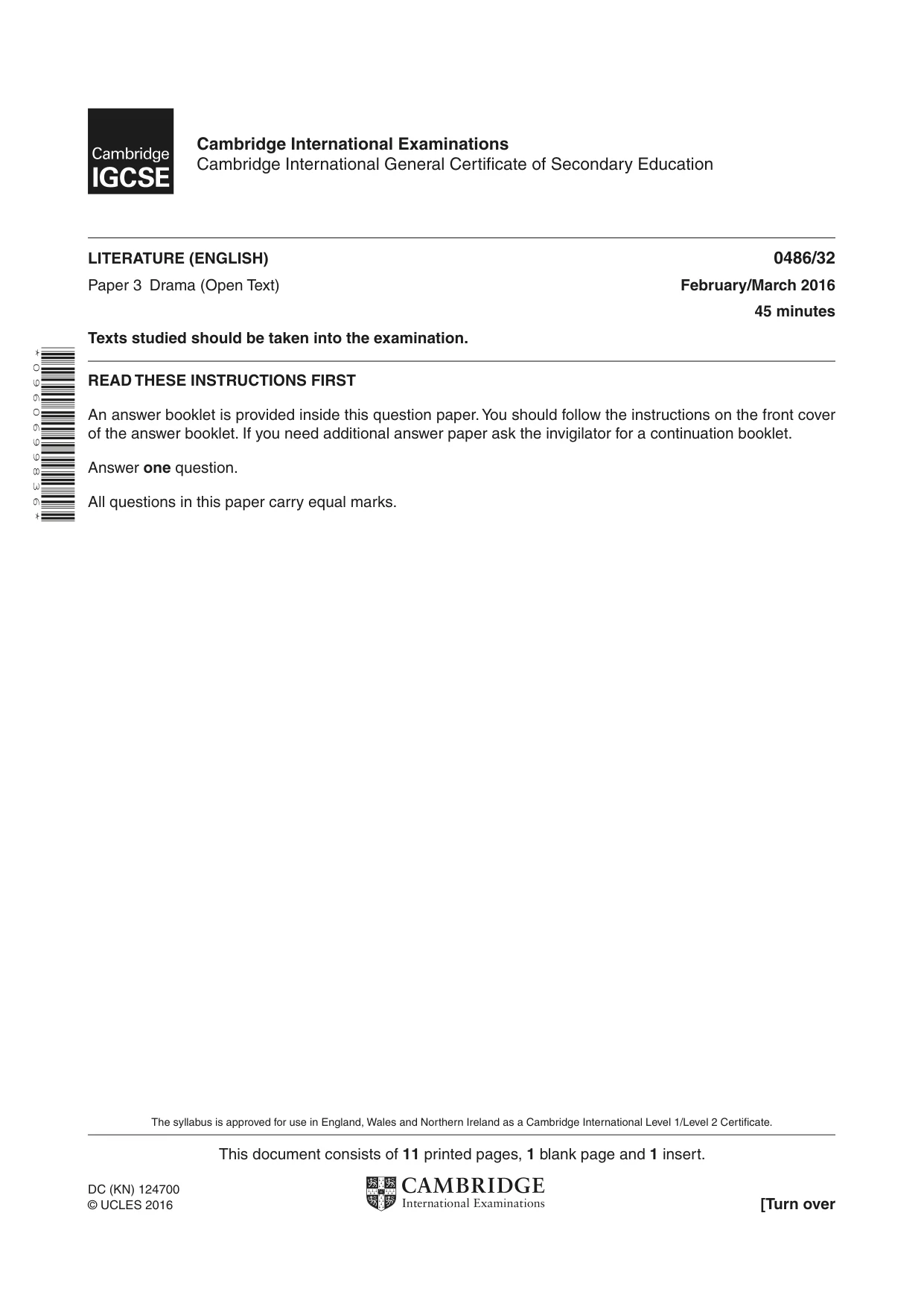
Question paper, page 1
This document consists of 11 printed pages, 1 blank page and 1 insert. DC (KN) 124700 © UCLES 2016 [Turn over Cambridge International Examinations Cambridge International General Certificate of Secondary Education * 0 9 6 0 6 9 9 8 3 6 * LITERATURE (ENGLISH) 0486/32 Paper 3 Drama (Open Text) February/March 2016 45 minutes Texts studied should be taken into the examination. READ THESE INSTRUCTIONS FIRST An answer booklet is provided inside this question paper. You should follow the instructions on the front cover of the answer booklet. If you need additional answer paper ask the invigilator for a continuation booklet. Answer one question. All questions in this paper carry equal marks. The syllabus is approved for use in England, Wales and Northern Ireland as a Cambridge International Level 1/Level 2 Certificate.
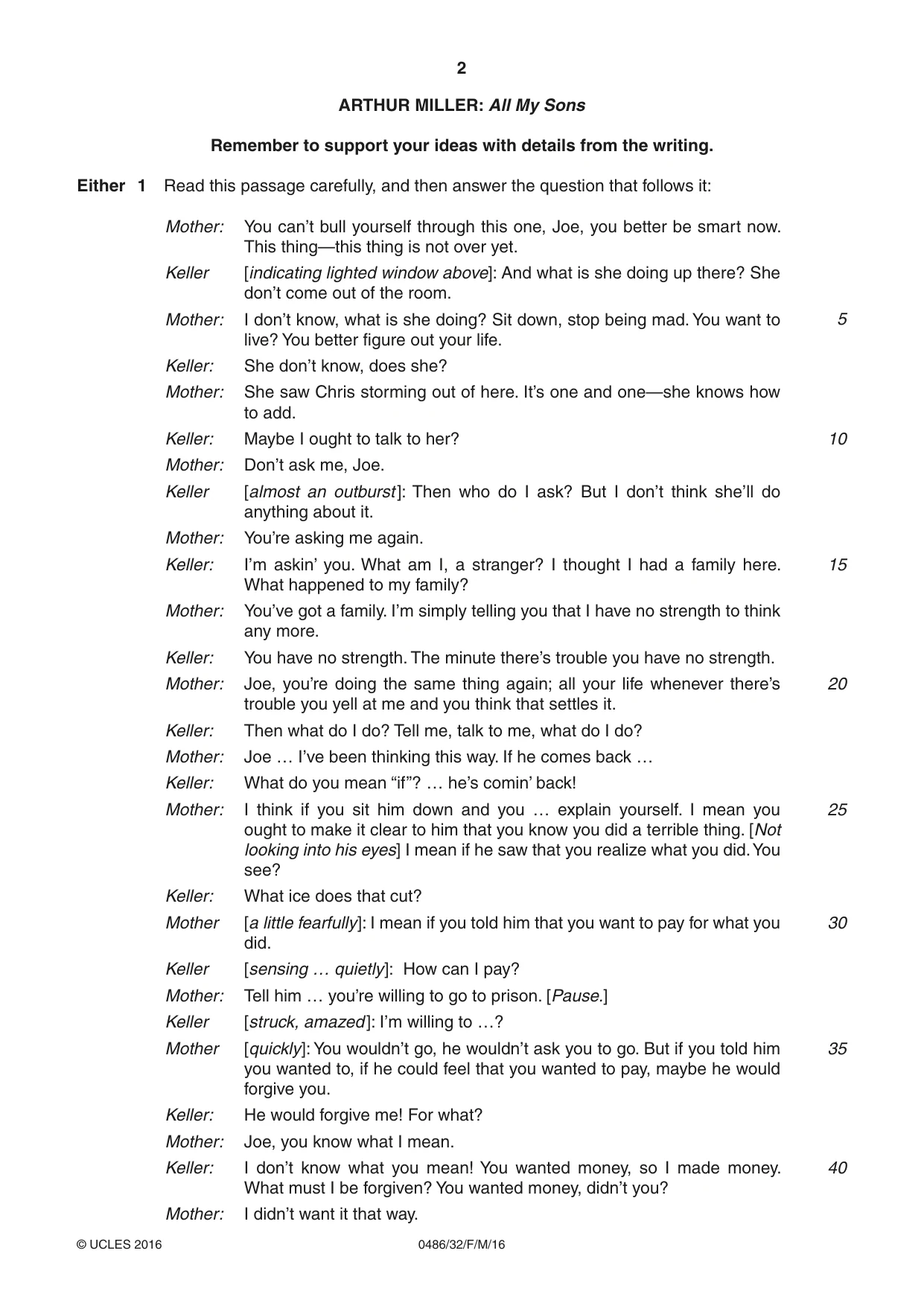
Question paper, page 2
2 0486/32/F/M/16 © UCLES 2016 ARTHUR MILLER: All My Sons Remember to support your ideas with details from the writing. Either 1 Read this passage carefully, and then answer the question that follows it: Mother: You can’t bull yourself through this one, Joe, you better be smart now. This thing—this thing is not over yet. Keller [indicating lighted window above]: And what is she doing up there? She don’t come out of the room. Mother: I don’t know, what is she doing? Sit down, stop being mad. You want to live? You better figure out your life. Keller: She don’t know, does she? Mother: She saw Chris storming out of here. It’s one and one—she knows how to add. Keller: Maybe I ought to talk to her? Mother: Don’t ask me, Joe. Keller [almost an outburst ]: Then who do I ask? But I don’t think she’ll do anything about it. Mother: You’re asking me again. Keller: I’m askin’ you. What am I, a stranger? I thought I had a family here. What happened to my family? Mother: You’ve got a family. I’m simply telling you that I have no strength to think any more. Keller: You have no strength. The minute there’s trouble you have no strength. Mother: Joe, you’re doing the same thing again; all your life whenever there’s trouble you yell at me and you think that settles it. Keller: Then what do I do? Tell me, talk to me, what do I do? Mother: Joe … I’ve been thinking this way. If he comes back … Keller: What do you mean “if”? … he’s comin’ back! Mother: I think if you sit him down and you … explain yourself. I mean you ought to make it clear to him that you know you did a terrible thing. [Not looking into his eyes] I mean if he saw that you realize what you did. You see? Keller: What ice does that cut? Mother [a little fearfully ]: I mean if you told him that you want to pay for what you did. Keller [sensing … quietly ]: How can I pay? Mother: Tell him … you’re willing to go to prison. [Pause.] Keller [struck, amazed ]: I’m willing to …? Mother [quickly ]: You wouldn’t go, he wouldn’t ask you to go. But if you told him you wanted to, if he could feel that you wanted to pay, maybe he would forgive you. Keller: He would forgive me! For what? Mother: Joe, you know what I mean. Keller: I don’t know what you mean! You wanted money, so I made money. What must I be forgiven? You wanted money, didn’t you? Mother: I didn’t want it that way. 5 10 15 20 25 30 35 40
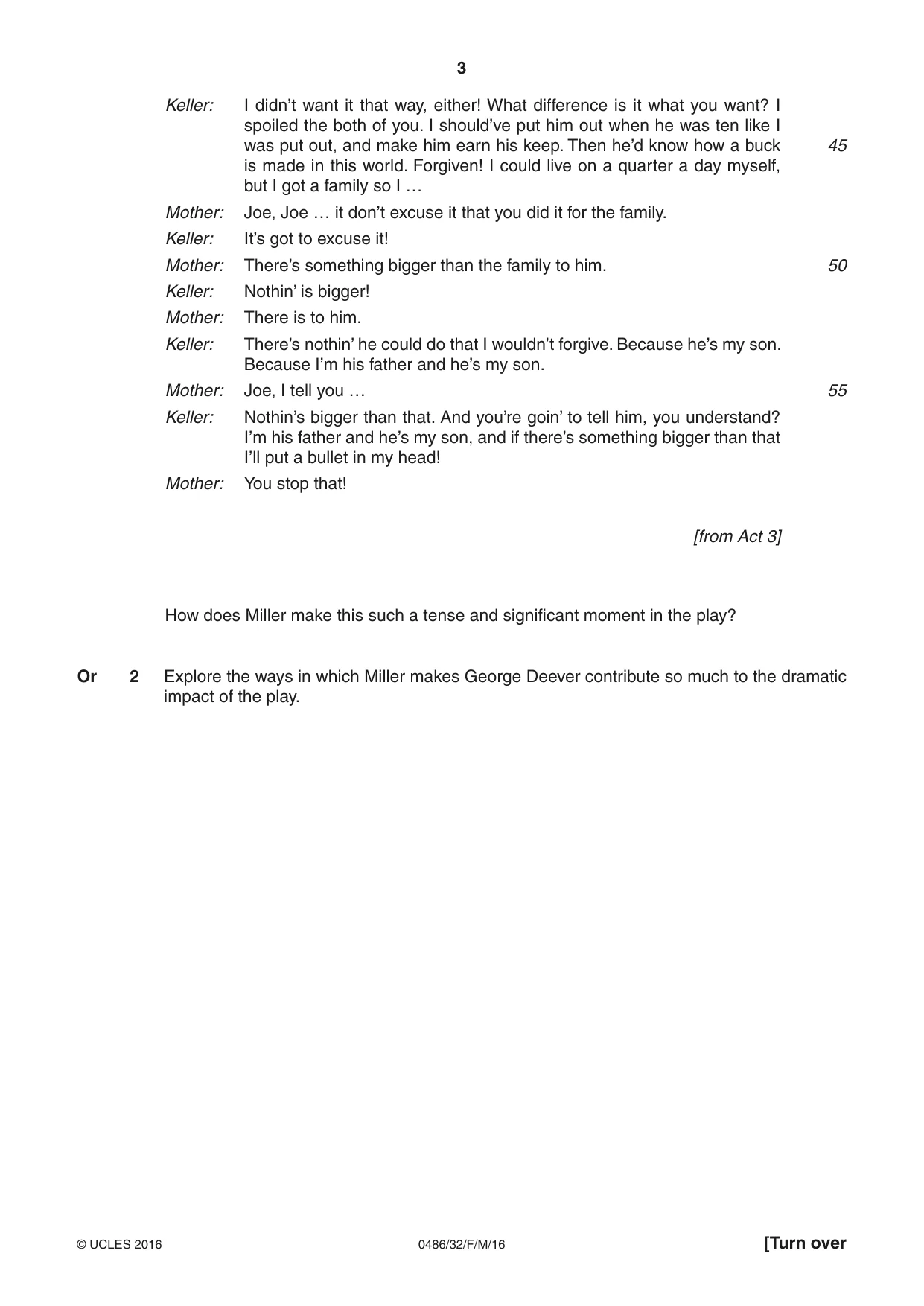
Question paper, page 3
3 0486/32/F/M/16 © UCLES 2016 [Turn over Keller: I didn’t want it that way, either! What difference is it what you want? I spoiled the both of you. I should’ve put him out when he was ten like I was put out, and make him earn his keep. Then he’d know how a buck is made in this world. Forgiven! I could live on a quarter a day myself, but I got a family so I … Mother: Joe, Joe … it don’t excuse it that you did it for the family. Keller: It’s got to excuse it! Mother: There’s something bigger than the family to him. Keller: Nothin’ is bigger! Mother: There is to him. Keller: There’s nothin’ he could do that I wouldn’t forgive. Because he’s my son. Because I’m his father and he’s my son. Mother: Joe, I tell you … Keller: Nothin’s bigger than that. And you’re goin’ to tell him, you understand? I’m his father and he’s my son, and if there’s something bigger than that I’ll put a bullet in my head! Mother: You stop that! [from Act 3] How does Miller make this such a tense and significant moment in the play? Or 2 Explore the ways in which Miller makes George Deever contribute so much to the dramatic impact of the play. 45 50 55
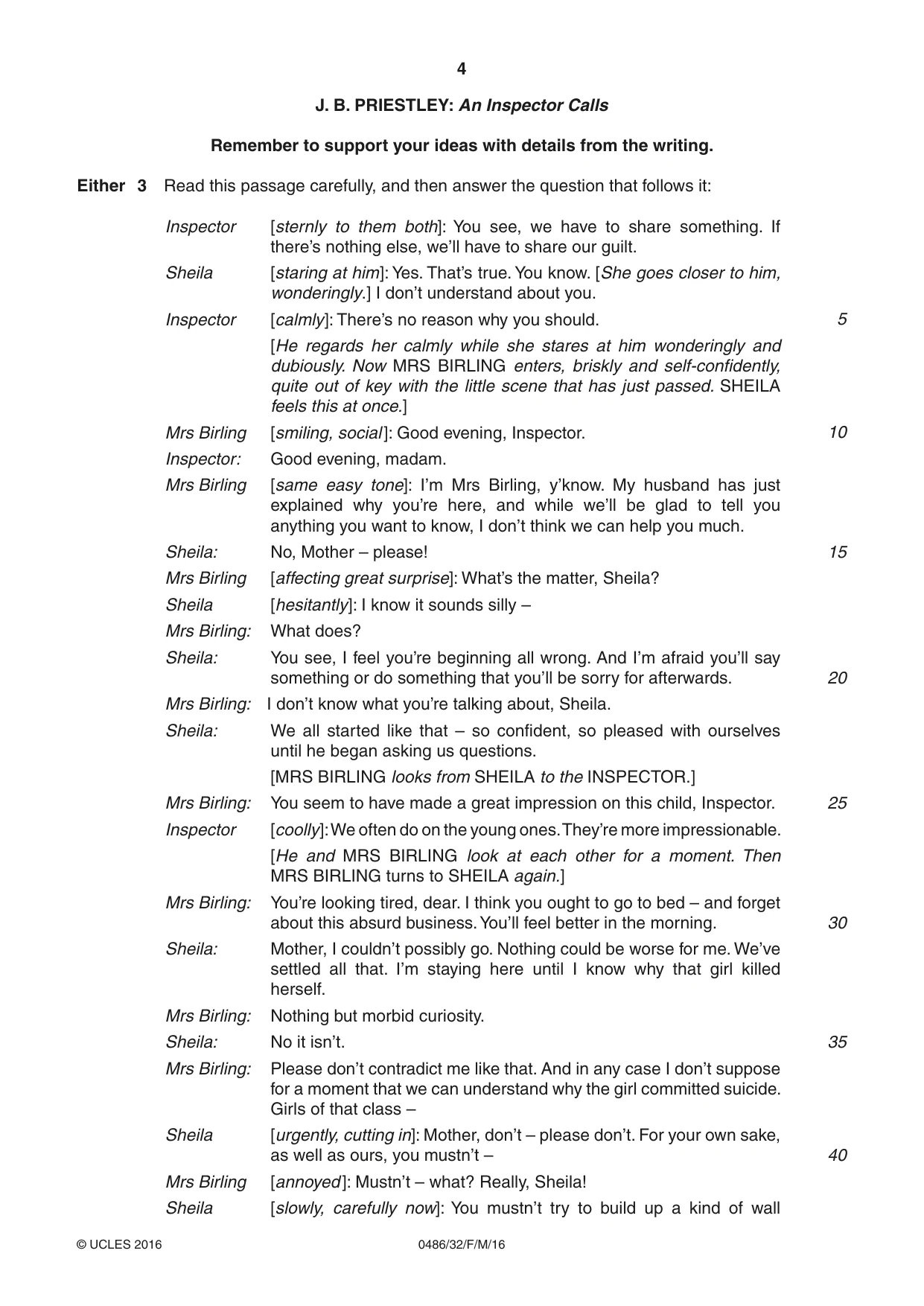
Question paper, page 4
4 0486/32/F/M/16 © UCLES 2016 J. B. PRIESTLEY: An Inspector Calls Remember to support your ideas with details from the writing. Either 3 Read this passage carefully, and then answer the question that follows it: Inspector [sternly to them both]: You see, we have to share something. If there’s nothing else, we’ll have to share our guilt. Sheila [staring at him ]: Yes. That’s true. You know. [She goes closer to him, wonderingly.] I don’t understand about you. Inspector [calmly ]: There’s no reason why you should. [He regards her calmly while she stares at him wonderingly and dubiously. Now MRS BIRLING enters, briskly and self-confidently, quite out of key with the little scene that has just passed. SHEILA feels this at once.] Mrs Birling [smiling, social ]: Good evening, Inspector. Inspector: Good evening, madam. Mrs Birling [same easy tone]: I’m Mrs Birling, y’know. My husband has just explained why you’re here, and while we’ll be glad to tell you anything you want to know, I don’t think we can help you much. Sheila: No, Mother – please! Mrs Birling [affecting great surprise]: What’s the matter, Sheila? Sheila [hesitantly ]: I know it sounds silly – Mrs Birling: What does? Sheila: You see, I feel you’re beginning all wrong. And I’m afraid you’ll say something or do something that you’ll be sorry for afterwards. Mrs Birling: I don’t know what you’re talking about, Sheila. Sheila: We all started like that – so confident, so pleased with ourselves until he began asking us questions. [MRS BIRLING looks from SHEILA to the INSPECTOR.] Mrs Birling: You seem to have made a great impression on this child, Inspector. Inspector [coolly ]: We often do on the young ones. They’re more impressionable. [He and MRS BIRLING look at each other for a moment. Then MRS BIRLING turns to SHEILA again.] Mrs Birling: You’re looking tired, dear. I think you ought to go to bed – and forget about this absurd business. You’ll feel better in the morning. Sheila: Mother, I couldn’t possibly go. Nothing could be worse for me. We’ve settled all that. I’m staying here until I know why that girl killed herself. Mrs Birling: Nothing but morbid curiosity. Sheila: No it isn’t. Mrs Birling: Please don’t contradict me like that. And in any case I don’t suppose for a moment that we can understand why the girl committed suicide. Girls of that class – Sheila [urgently, cutting in]: Mother, don’t – please don’t. For your own sake, as well as ours, you mustn’t – Mrs Birling [annoyed ]: Mustn’t – what? Really, Sheila! Sheila [slowly, carefully now]: You mustn’t try to build up a kind of wall 5 10 15 20 25 30 35 40
Question paper, page 5
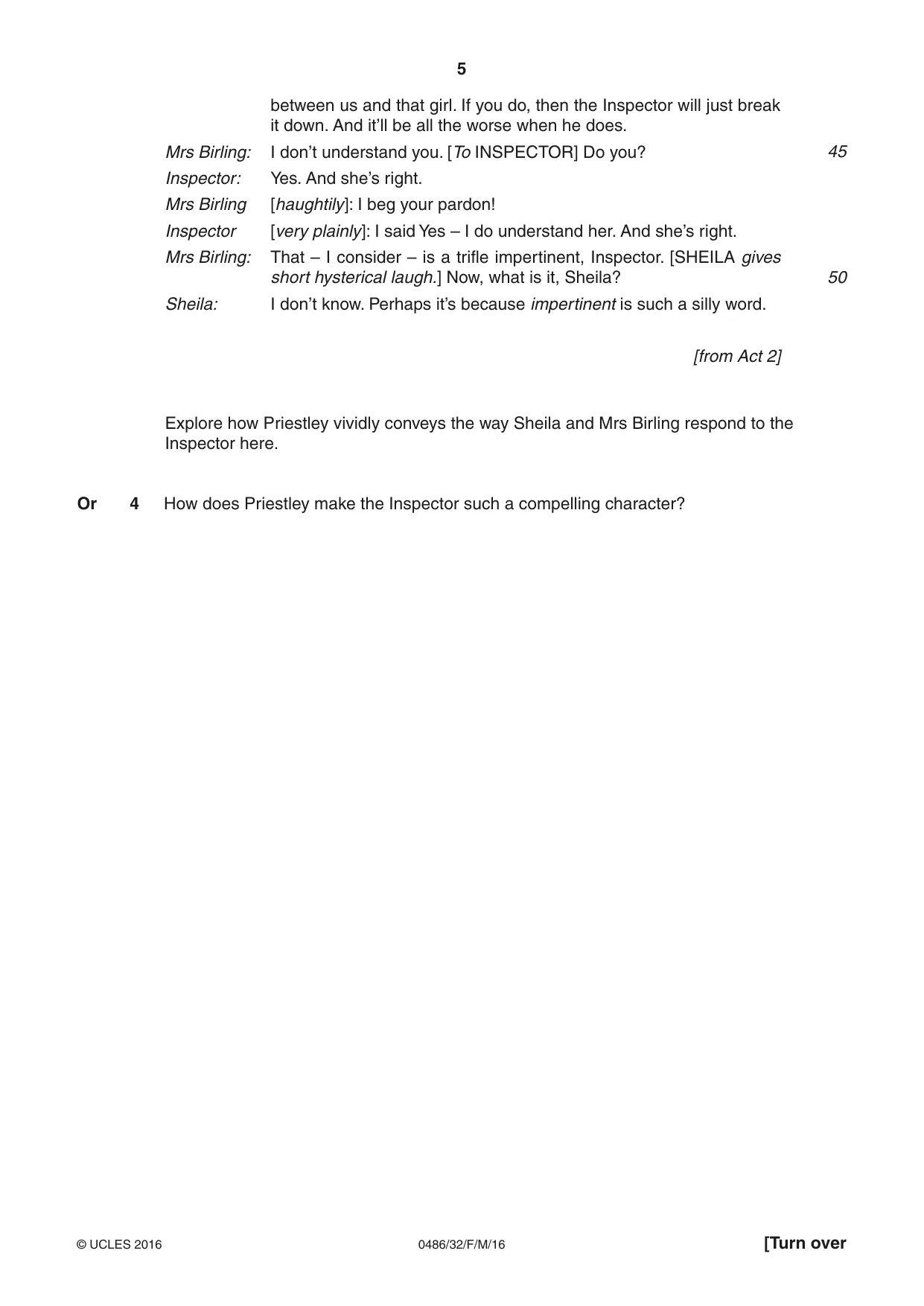
5 0486/32/F/M/16 © UCLES 2016 [Turn over between us and that girl. If you do, then the Inspector will just break it down. And it’ll be all the worse when he does. Mrs Birling: I don’t understand you. [To INSPECTOR] Do you? Inspector: Yes. And she’s right. Mrs Birling [haughtily ]: I beg your pardon! Inspector [very plainly ]: I said Yes – I do understand her. And she’s right. Mrs Birling: That – I consider – is a trifle impertinent, Inspector. [SHEILA gives short hysterical laugh.] Now, what is it, Sheila? Sheila: I don’t know. Perhaps it’s because impertinent is such a silly word. [from Act 2] Explore how Priestley vividly conveys the way Sheila and Mrs Birling respond to the Inspector here. Or 4 How does Priestley make the Inspector such a compelling character? 45 50
Question paper, page 6
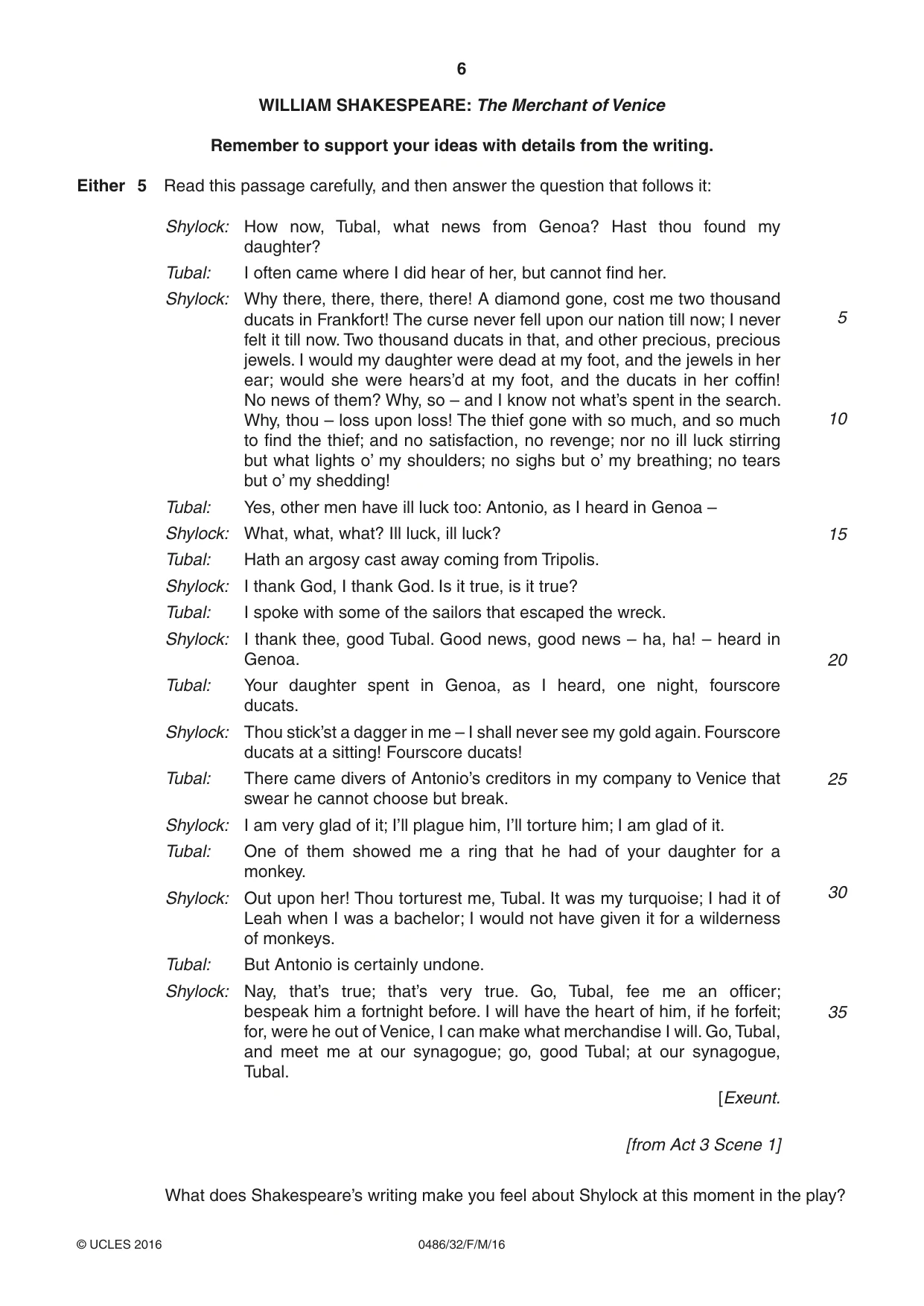
6 0486/32/F/M/16 © UCLES 2016 WILLIAM SHAKESPEARE: The Merchant of Venice Remember to support your ideas with details from the writing. Either 5 Read this passage carefully, and then answer the question that follows it: Shylock: How now, Tubal, what news from Genoa? Hast thou found my daughter? Tubal: I often came where I did hear of her, but cannot find her. Shylock: Why there, there, there, there! A diamond gone, cost me two thousand ducats in Frankfort! The curse never fell upon our nation till now; I never felt it till now. Two thousand ducats in that, and other precious, precious jewels. I would my daughter were dead at my foot, and the jewels in her ear; would she were hears’d at my foot, and the ducats in her coffin! No news of them? Why, so – and I know not what’s spent in the search. Why, thou – loss upon loss! The thief gone with so much, and so much to find the thief; and no satisfaction, no revenge; nor no ill luck stirring but what lights o’ my shoulders; no sighs but o’ my breathing; no tears but o’ my shedding! Tubal: Yes, other men have ill luck too: Antonio, as I heard in Genoa – Shylock: What, what, what? Ill luck, ill luck? Tubal: Hath an argosy cast away coming from Tripolis. Shylock: I thank God, I thank God. Is it true, is it true? Tubal: I spoke with some of the sailors that escaped the wreck. Shylock: I thank thee, good Tubal. Good news, good news – ha, ha! – heard in Genoa. Tubal: Your daughter spent in Genoa, as I heard, one night, fourscore ducats. Shylock: Thou stick’st a dagger in me – I shall never see my gold again. Fourscore ducats at a sitting! Fourscore ducats! Tubal: There came divers of Antonio’s creditors in my company to Venice that swear he cannot choose but break. Shylock: I am very glad of it; I’ll plague him, I’ll torture him; I am glad of it. Tubal: One of them showed me a ring that he had of your daughter for a monkey. Shylock: Out upon her! Thou torturest me, Tubal. It was my turquoise; I had it of Leah when I was a bachelor; I would not have given it for a wilderness of monkeys. Tubal: But Antonio is certainly undone. Shylock: Nay, that’s true; that’s very true. Go, Tubal, fee me an officer; bespeak him a fortnight before. I will have the heart of him, if he forfeit; for, were he out of Venice, I can make what merchandise I will. Go, Tubal, and meet me at our synagogue; go, good Tubal; at our synagogue, Tubal. [Exeunt. [from Act 3 Scene 1] What does Shakespeare’s writing make you feel about Shylock at this moment in the play? 5 10 15 20 25 30 35
Question paper, page 7
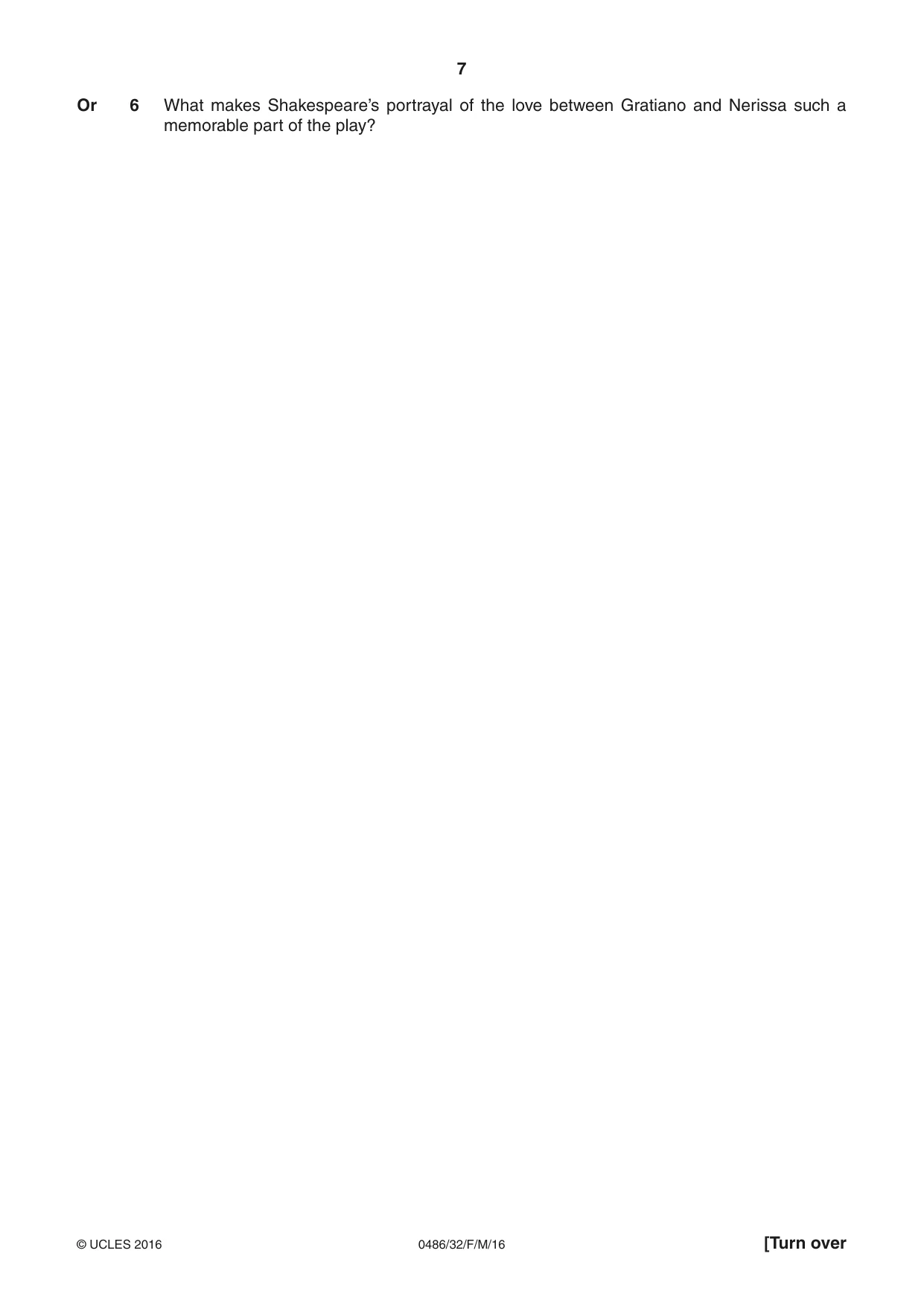
7 0486/32/F/M/16 © UCLES 2016 [Turn over Or 6 What makes Shakespeare’s portrayal of the love between Gratiano and Nerissa such a memorable part of the play?
Question paper, page 8
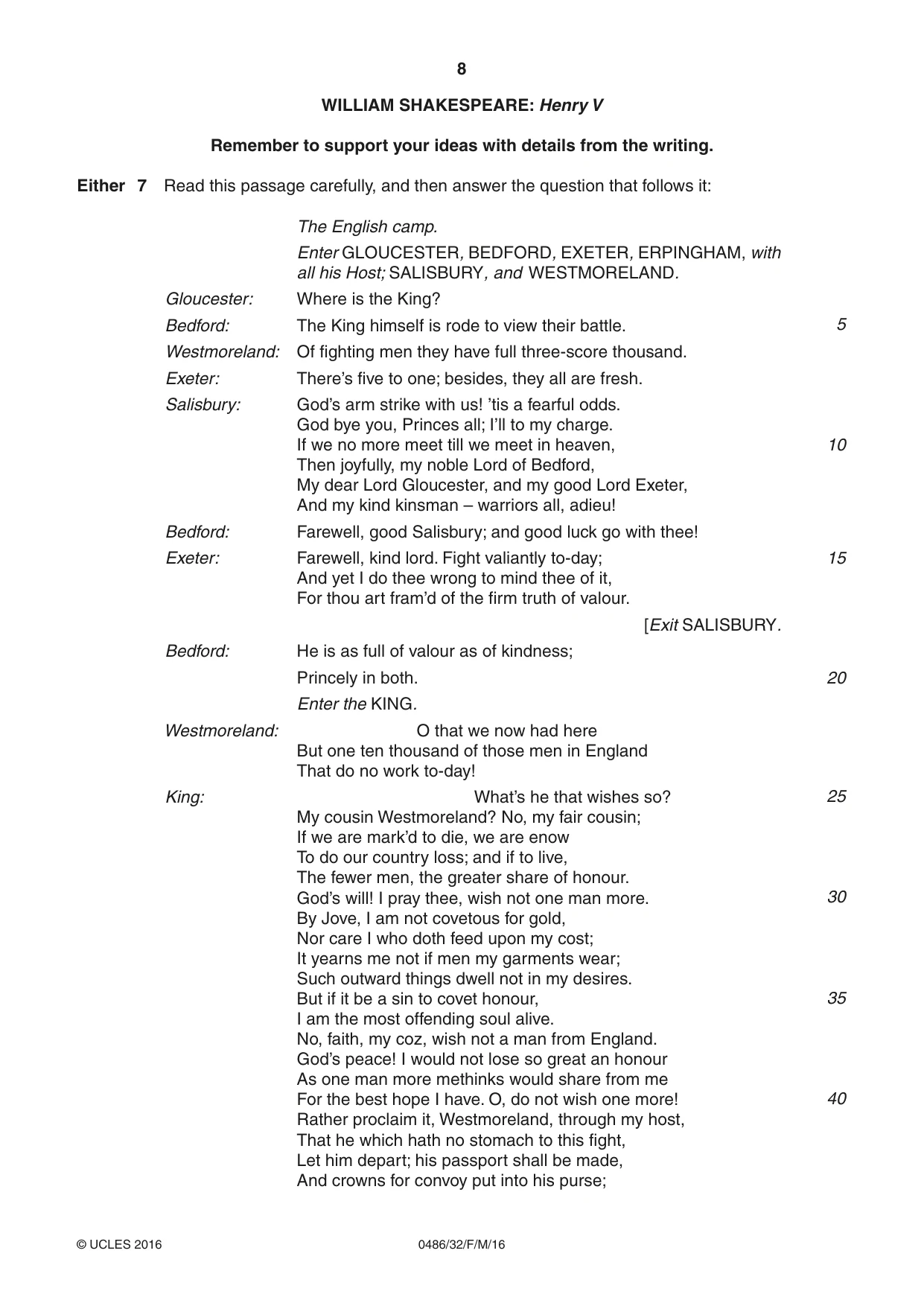
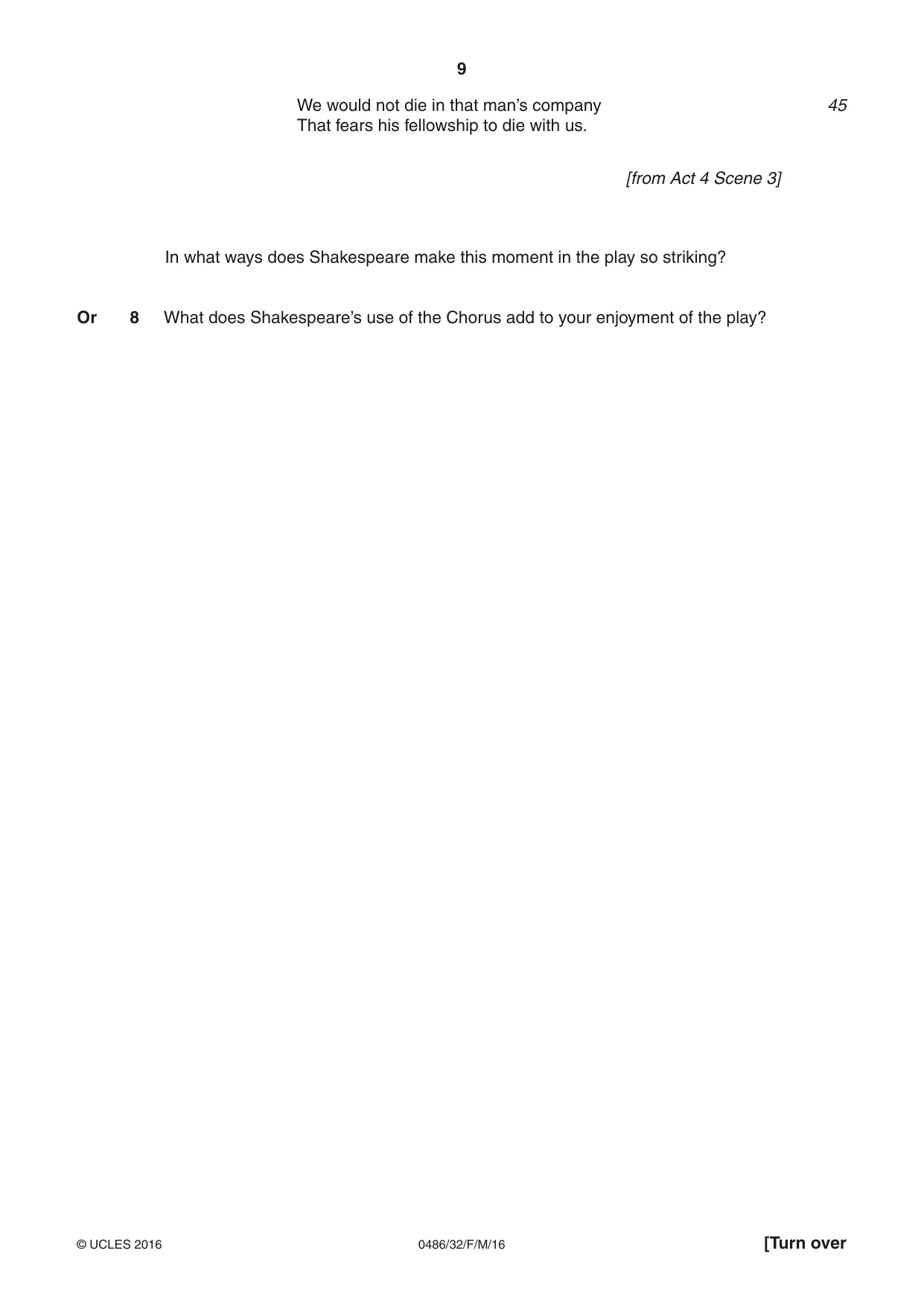
8 0486/32/F/M/16 © UCLES 2016 WILLIAM SHAKESPEARE: Henry V Remember to support your ideas with details from the writing. Either 7 Read this passage carefully, and then answer the question that follows it: The English camp. Enter GLOUCESTER, BEDFORD, EXETER, ERPINGHAM, with all his Host; SALISBURY, and WESTMORELAND. Gloucester: Where is the King? Bedford: The King himself is rode to view their battle. Westmoreland: Of fighting men they have full three-score thousand. Exeter: There’s five to one; besides, they all are fresh. Salisbury: God’s arm strike with us! ’tis a fearful odds. God bye you, Princes all; I’ll to my charge. If we no more meet till we meet in heaven, Then joyfully, my noble Lord of Bedford, My dear Lord Gloucester, and my good Lord Exeter, And my kind kinsman – warriors all, adieu! Bedford: Farewell, good Salisbury; and good luck go with thee! Exeter: Farewell, kind lord. Fight valiantly to-day; And yet I do thee wrong to mind thee of it, For thou art fram’d of the firm truth of valour. [Exit SALISBURY. Bedford: He is as full of valour as of kindness; Princely in both. Enter the KING. Westmoreland: O that we now had here But one ten thousand of those men in England That do no work to-day! King: What’s he that wishes so? My cousin Westmoreland? No, my fair cousin; If we are mark’d to die, we are enow To do our country loss; and if to live, The fewer men, the greater share of honour. God’s will! I pray thee, wish not one man more. By Jove, I am not covetous for gold, Nor care I who doth feed upon my cost; It yearns me not if men my garments wear; Such outward things dwell not in my desires. But if it be a sin to covet honour, I am the most offending soul alive. No, faith, my coz, wish not a man from England. God’s peace! I would not lose so great an honour As one man more methinks would share from me For the best hope I have. O, do not wish one more! Rather proclaim it, Westmoreland, through my host, That he which hath no stomach to this fight, Let him depart; his passport shall be made, And crowns for convoy put into his purse; 5 10 15 20 25 30 35 40
Question paper, page 9
9 0486/32/F/M/16 © UCLES 2016 [Turn over We would not die in that man’s company That fears his fellowship to die with us. [from Act 4 Scene 3] In what ways does Shakespeare make this moment in the play so striking? Or 8 What does Shakespeare’s use of the Chorus add to your enjoyment of the play? 45
Question paper, page 10
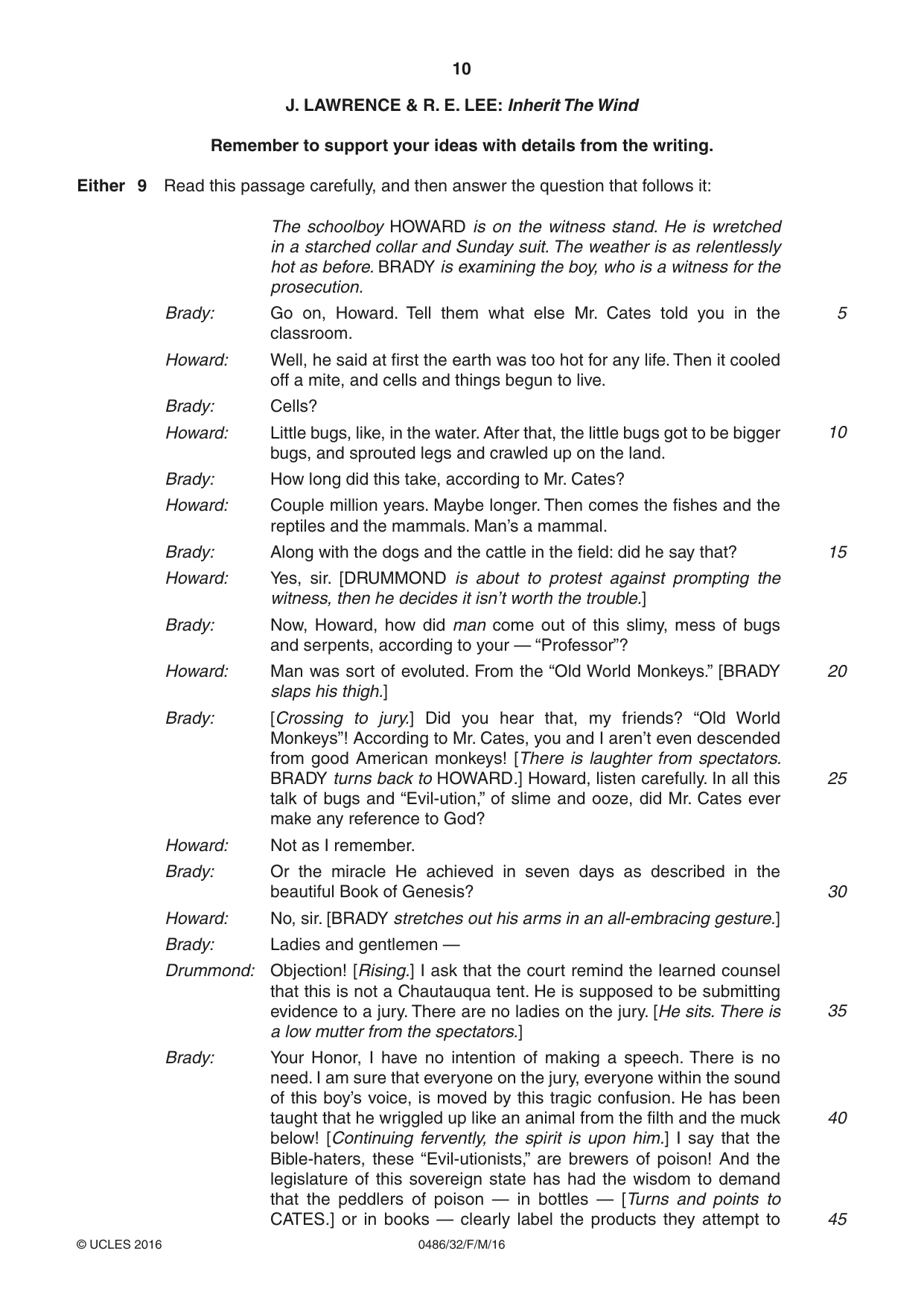
10 0486/32/F/M/16 © UCLES 2016 J. LAWRENCE & R. E. LEE: Inherit The Wind Remember to support your ideas with details from the writing. Either 9 Read this passage carefully, and then answer the question that follows it: The schoolboy HOWARD is on the witness stand. He is wretched in a starched collar and Sunday suit. The weather is as relentlessly hot as before. BRADY is examining the boy, who is a witness for the prosecution. Brady: Go on, Howard. Tell them what else Mr. Cates told you in the classroom. Howard: Well, he said at first the earth was too hot for any life. Then it cooled off a mite, and cells and things begun to live. Brady: Cells? Howard: Little bugs, like, in the water. After that, the little bugs got to be bigger bugs, and sprouted legs and crawled up on the land. Brady: How long did this take, according to Mr. Cates? Howard: Couple million years. Maybe longer. Then comes the fishes and the reptiles and the mammals. Man’s a mammal. Brady: Along with the dogs and the cattle in the field: did he say that? Howard: Yes, sir. [DRUMMOND is about to protest against prompting the witness, then he decides it isn’t worth the trouble.] Brady: Now, Howard, how did man come out of this slimy, mess of bugs and serpents, according to your — “Professor”? Howard: Man was sort of evoluted. From the “Old World Monkeys.” [BRADY slaps his thigh.] Brady: [Crossing to jury.] Did you hear that, my friends? “Old World Monkeys”! According to Mr. Cates, you and I aren’t even descended from good American monkeys! [There is laughter from spectators. BRADY turns back to HOWARD.] Howard, listen carefully. In all this talk of bugs and “Evil-ution,” of slime and ooze, did Mr. Cates ever make any reference to God? Howard: Not as I remember. Brady: Or the miracle He achieved in seven days as described in the beautiful Book of Genesis? Howard: No, sir. [BRADY stretches out his arms in an all-embracing gesture.] Brady: Ladies and gentlemen — Drummond: Objection! [Rising.] I ask that the court remind the learned counsel that this is not a Chautauqua tent. He is supposed to be submitting evidence to a jury. There are no ladies on the jury. [He sits. There is a low mutter from the spectators.] Brady: Your Honor, I have no intention of making a speech. There is no need. I am sure that everyone on the jury, everyone within the sound of this boy’s voice, is moved by this tragic confusion. He has been taught that he wriggled up like an animal from the filth and the muck below! [Continuing fervently, the spirit is upon him.] I say that the Bible-haters, these “Evil-utionists,” are brewers of poison! And the legislature of this sovereign state has had the wisdom to demand that the peddlers of poison — in bottles — [Turns and points to CATES.] or in books — clearly label the products they attempt to 5 10 15 20 25 30 35 40 45
Question paper, page 11
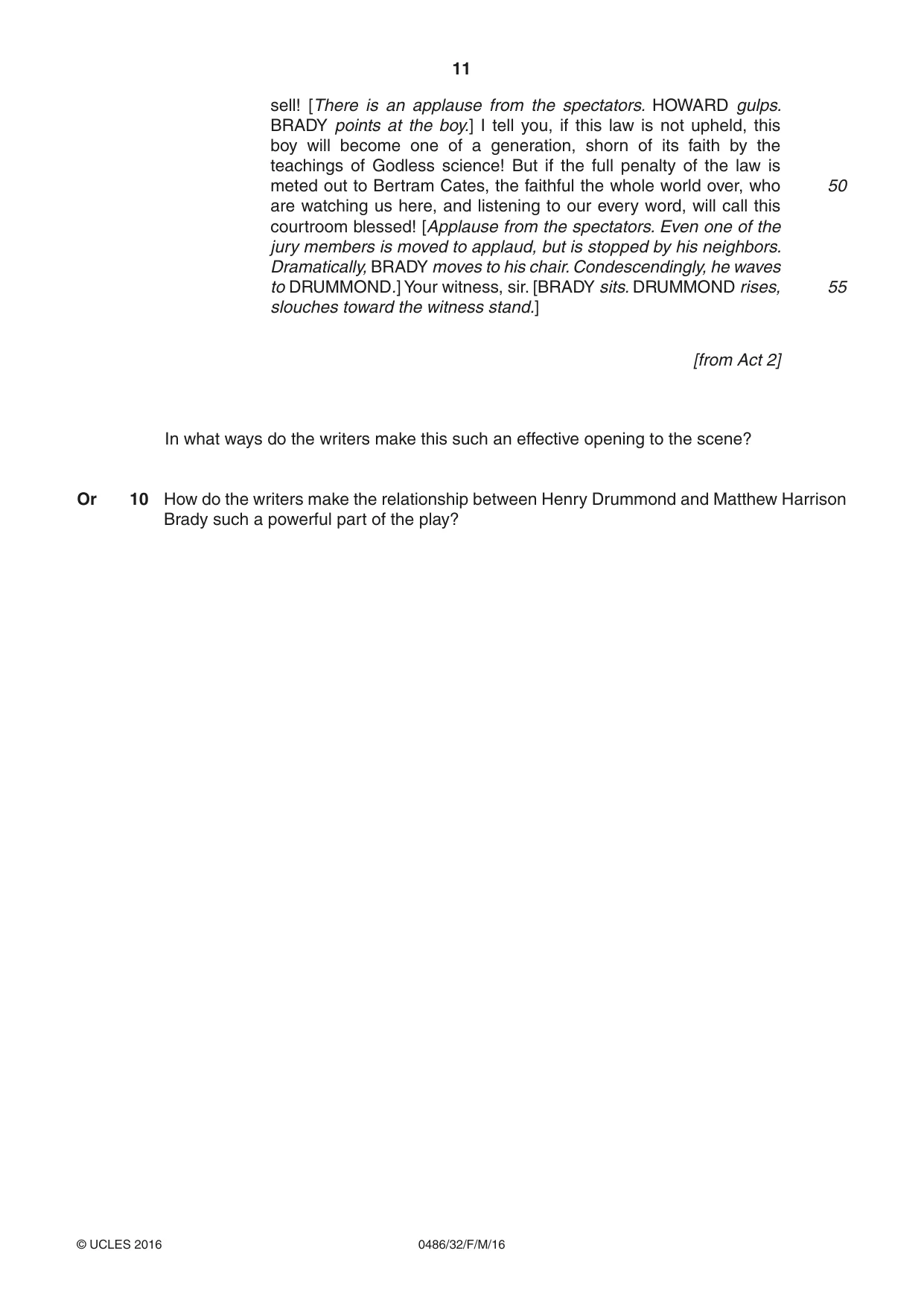
11 0486/32/F/M/16 © UCLES 2016 sell! [There is an applause from the spectators. HOWARD gulps. BRADY points at the boy.] I tell you, if this law is not upheld, this boy will become one of a generation, shorn of its faith by the teachings of Godless science! But if the full penalty of the law is meted out to Bertram Cates, the faithful the whole world over, who are watching us here, and listening to our every word, will call this courtroom blessed! [Applause from the spectators. Even one of the jury members is moved to applaud, but is stopped by his neighbors. Dramatically, BRADY moves to his chair. Condescendingly, he waves to DRUMMOND.] Your witness, sir. [BRADY sits. DRUMMOND rises, slouches toward the witness stand.] [from Act 2] In what ways do the writers make this such an effective opening to the scene? Or 10 How do the writers make the relationship between Henry Drummond and Matthew Harrison Brady such a powerful part of the play? 50 55
Question paper, page 12
12 0486/32/F/M/16 © UCLES 2016 BLANK PAGE Permission to reproduce items where third-party owned material protected by copyright is included has been sought and cleared where possible. Every reasonable effort has been made by the publisher (UCLES) to trace copyright holders, but if any items requiring clearance have unwittingly been included, the publisher will be pleased to make amends at the earliest possible opportunity. To avoid the issue of disclosure of answer-related information to candidates, all copyright acknowledgements are reproduced online in the Cambridge International Examinations Copyright Acknowledgements Booklet. This is produced for each series of examinations and is freely available to download at www.cie.org.uk after the live examination series. Cambridge International Examinations is part of the Cambridge Assessment Group. Cambridge Assessment is the brand name of University of Cambridge Local Examinations Syndicate (UCLES), which is itself a department of the University of Cambridge.
Mark scheme, page 1
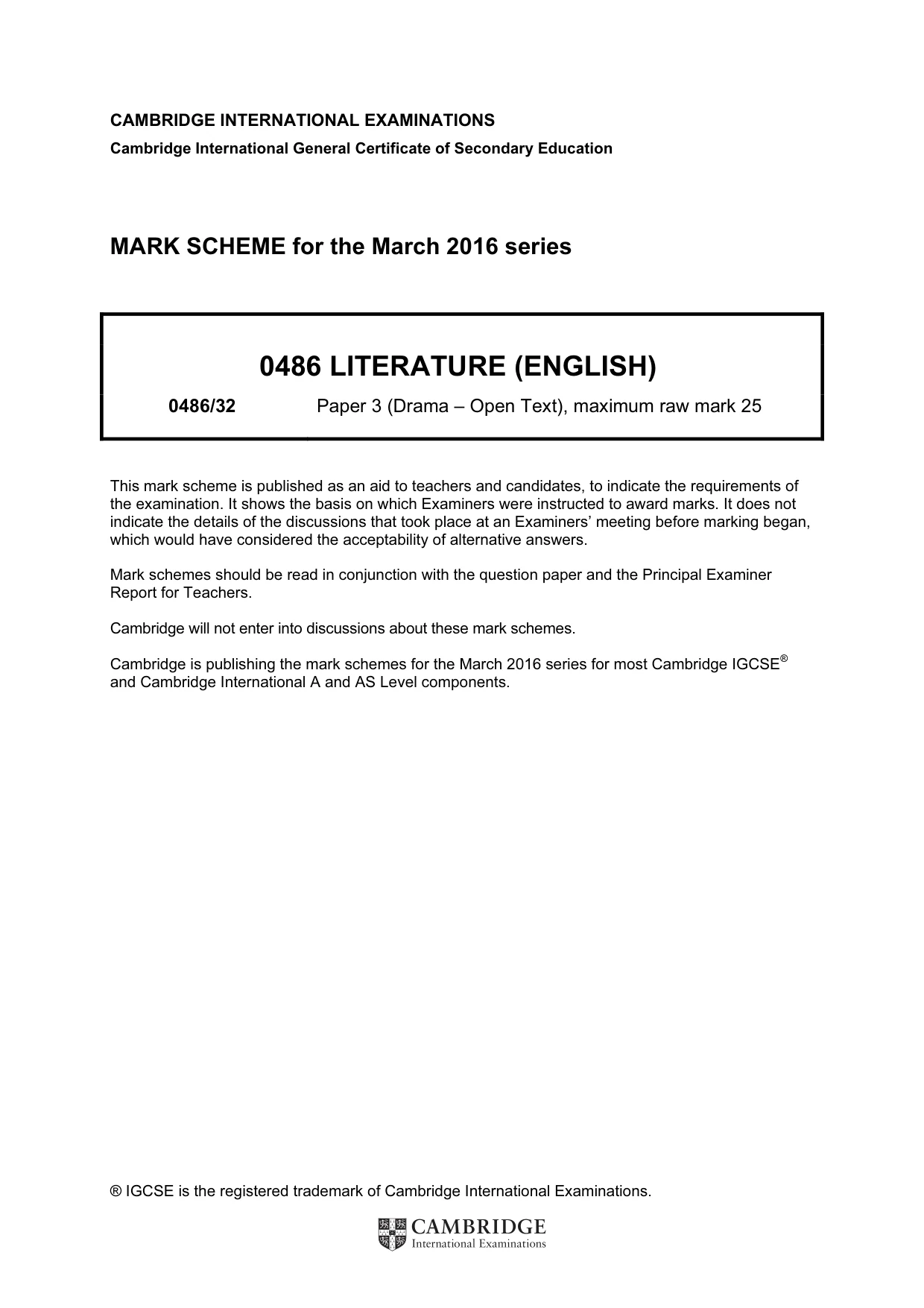
® IGCSE is the registered trademark of Cambridge International Examinations. CAMBRIDGE INTERNATIONAL EXAMINATIONS Cambridge International General Certificate of Secondary Education MARK SCHEME for the March 2016 series 0486 LITERATURE (ENGLISH) 0486/32 Paper 3 (Drama – Open Text), maximum raw mark 25 This mark scheme is published as an aid to teachers and candidates, to indicate the requirements of the examination. It shows the basis on which Examiners were instructed to award marks. It does not indicate the details of the discussions that took place at an Examiners’ meeting before marking began, which would have considered the acceptability of alternative answers. Mark schemes should be read in conjunction with the question paper and the Principal Examiner Report for Teachers. Cambridge will not enter into discussions about these mark schemes. Cambridge is publishing the mark schemes for the March 2016 series for most Cambridge IGCSE® and Cambridge International A and AS Level components.
Mark scheme, page 2
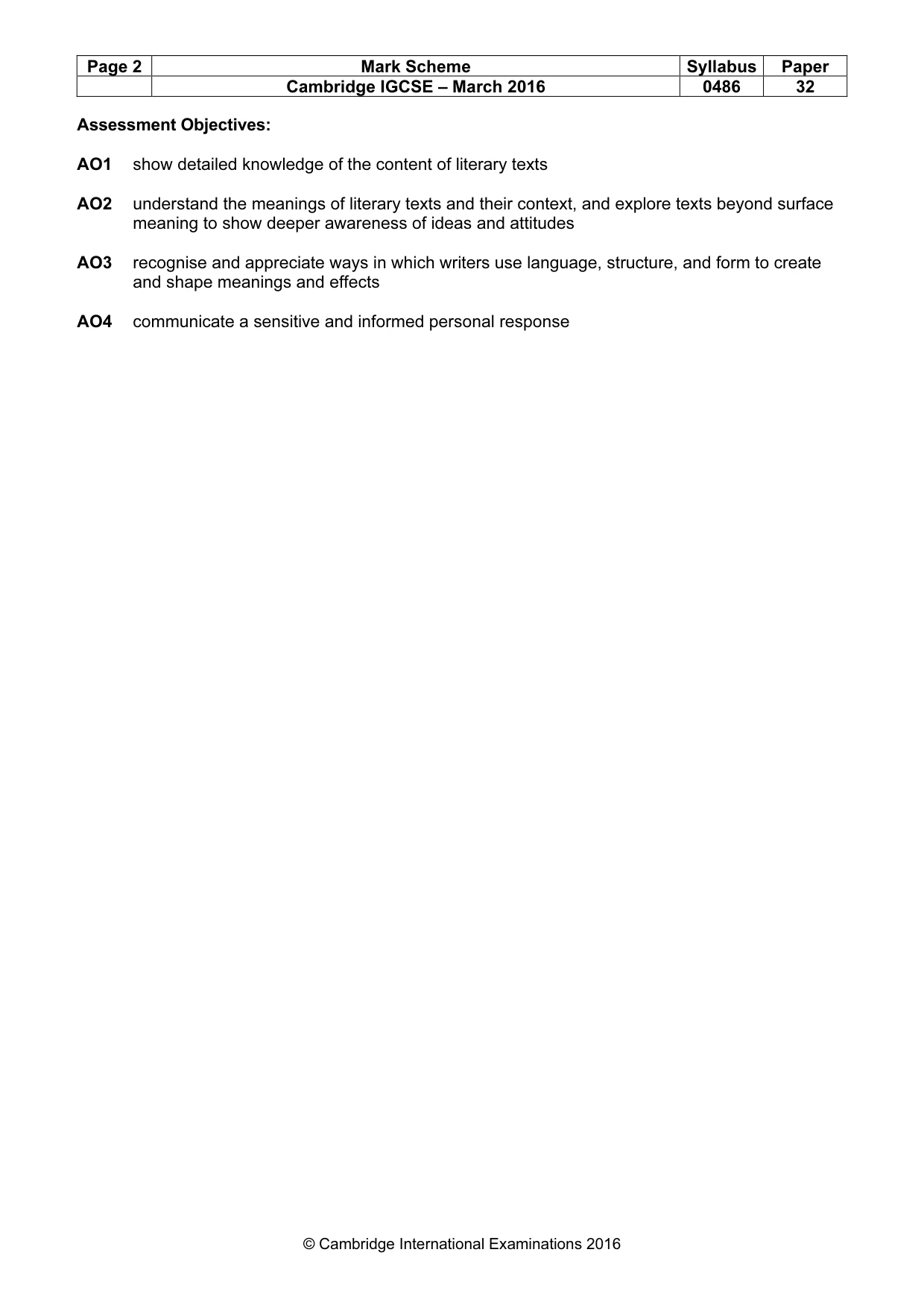
Page 2 Mark Scheme Syllabus Paper Cambridge IGCSE – March 2016 0486 32 © Cambridge International Examinations 2016 Assessment Objectives: AO1 show detailed knowledge of the content of literary texts AO2 understand the meanings of literary texts and their context, and explore texts beyond surface meaning to show deeper awareness of ideas and attitudes AO3 recognise and appreciate ways in which writers use language, structure, and form to create and shape meanings and effects AO4 communicate a sensitive and informed personal response
Mark scheme, page 3
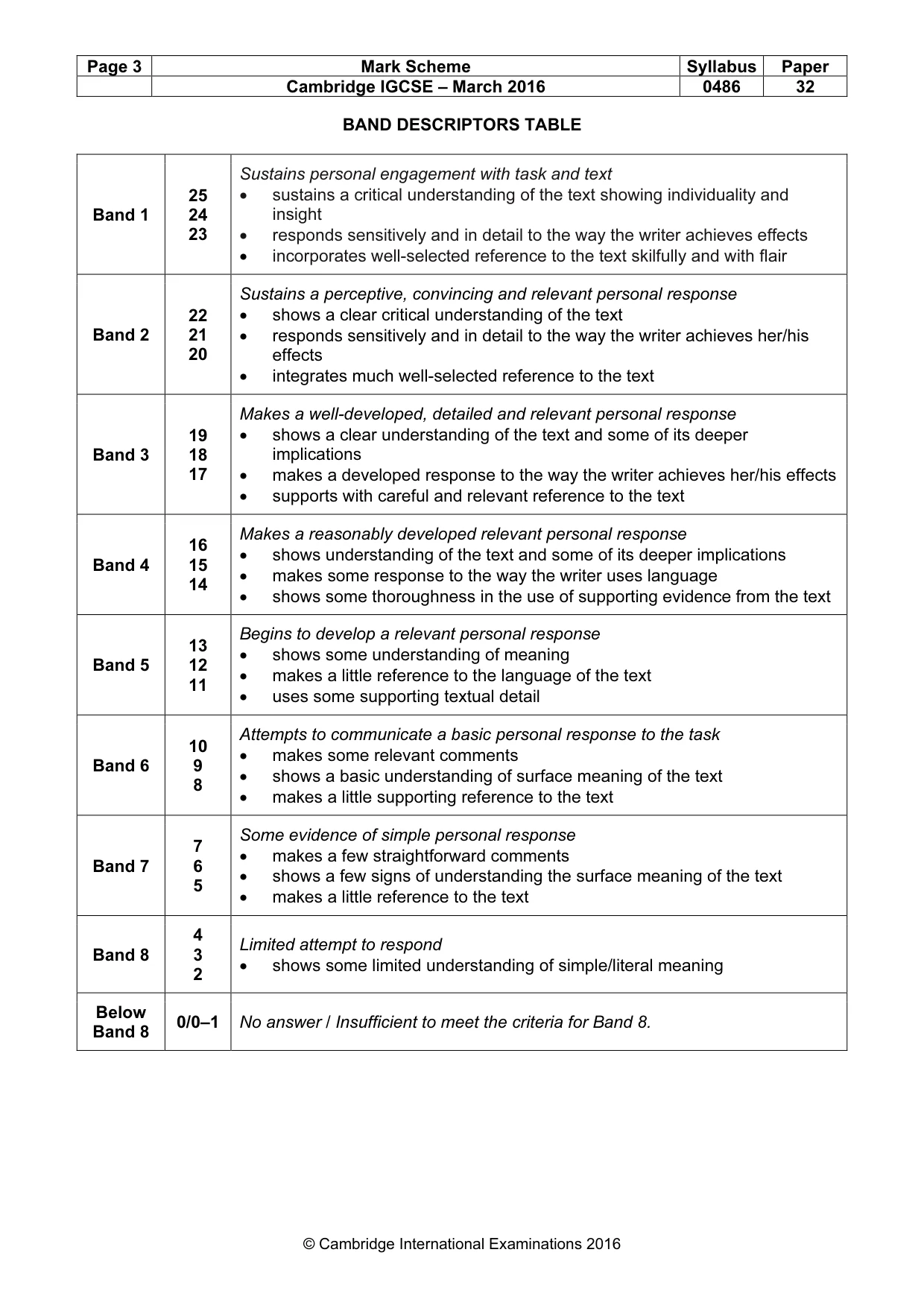
Page 3 Mark Scheme Syllabus Paper Cambridge IGCSE – March 2016 0486 32 © Cambridge International Examinations 2016 BAND DESCRIPTORS TABLE Band 1 25 24 23 Sustains personal engagement with task and text • sustains a critical understanding of the text showing individuality and insight • responds sensitively and in detail to the way the writer achieves effects • incorporates well-selected reference to the text skilfully and with flair Band 2 22 21 20 Sustains a perceptive, convincing and relevant personal response • shows a clear critical understanding of the text • responds sensitively and in detail to the way the writer achieves her/his effects • integrates much well-selected reference to the text Band 3 19 18 17 Makes a well-developed, detailed and relevant personal response • shows a clear understanding of the text and some of its deeper implications • makes a developed response to the way the writer achieves her/his effects • supports with careful and relevant reference to the text Band 4 16 15 14 Makes a reasonably developed relevant personal response • shows understanding of the text and some of its deeper implications • makes some response to the way the writer uses language • shows some thoroughness in the use of supporting evidence from the text Band 5 13 12 11 Begins to develop a relevant personal response • shows some understanding of meaning • makes a little reference to the language of the text • uses some supporting textual detail Band 6 10 9 8 Attempts to communicate a basic personal response to the task • makes some relevant comments • shows a basic understanding of surface meaning of the text • makes a little supporting reference to the text Band 7 7 6 5 Some evidence of simple personal response • makes a few straightforward comments • shows a few signs of understanding the surface meaning of the text • makes a little reference to the text Band 8 4 3 2 Limited attempt to respond • shows some limited understanding of simple/literal meaning Below Band 8 0/0–1 No answer / Insufficient to meet the criteria for Band 8.
What you needed in this session
Cambridge’s own grade thresholds for 2016 Feb/March, Paper 3 · Variant 2. A higher threshold means an easier paper — the bar moves with how the cohort did.