Cambridge IGCSE English - Literature 0486 — 2015 Oct/Nov Paper 3 · Variant 2
0486/32/O/N/15 · 25 marks · ≈28 min
The question paper and its mark scheme, free to read here and free to download. This is Cambridge’s own paper, exactly as it was sat.
Question paper16 pages



Mark scheme3 pages
Answers below. Sit the paper first if you are practising.
Paper as text
Question paper, page 1
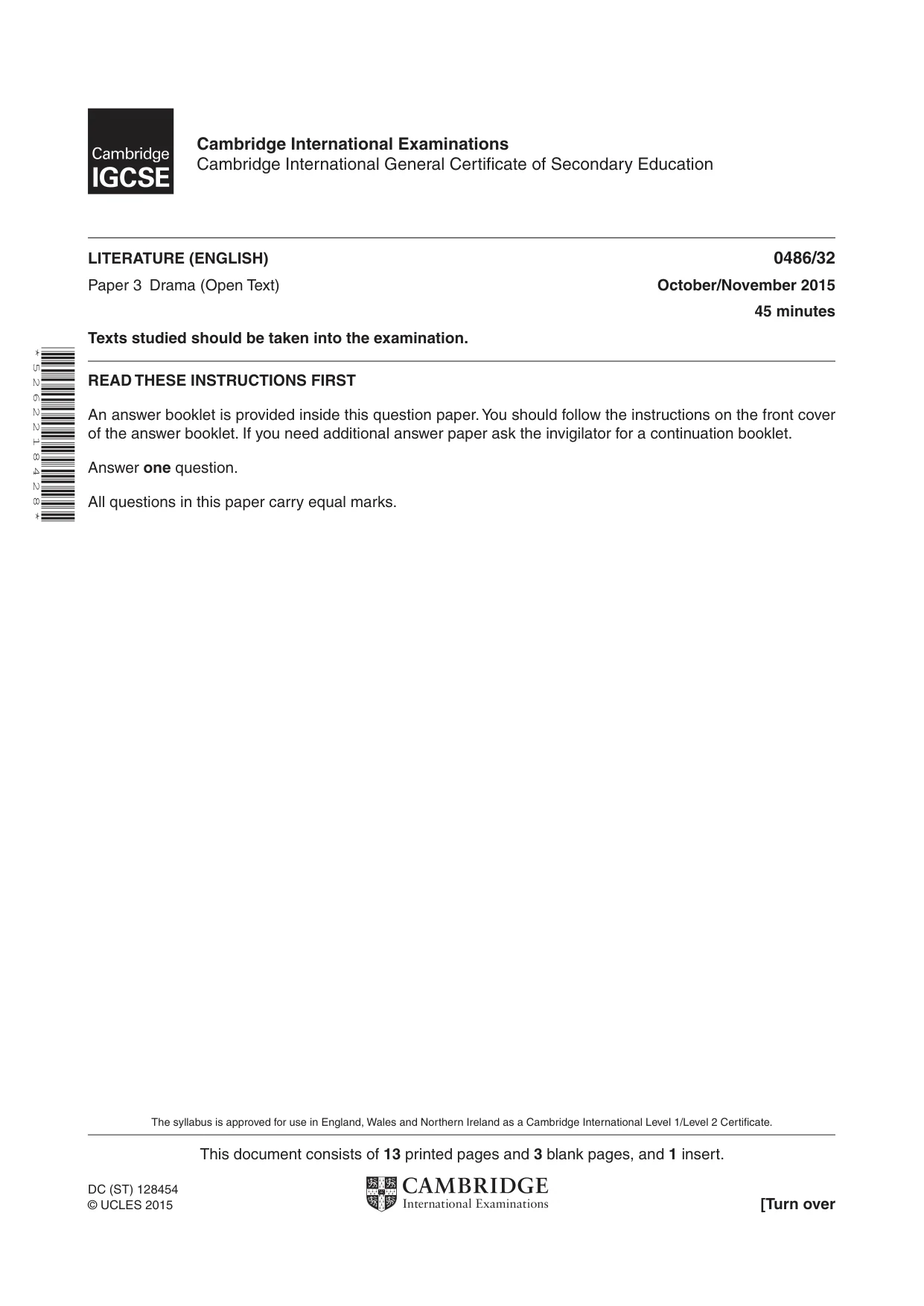
This document consists of 13 printed pages and 3 blank pages, and 1 insert. DC (ST) 128454 © UCLES 2015 [Turn over Cambridge International Examinations Cambridge International General Certificate of Secondary Education * 5 2 6 2 2 1 8 4 2 8 * LITERATURE (ENGLISH) 0486/32 Paper 3 Drama (Open Text) October/November 2015 45 minutes Texts studied should be taken into the examination. READ THESE INSTRUCTIONS FIRST An answer booklet is provided inside this question paper. You should follow the instructions on the front cover of the answer booklet. If you need additional answer paper ask the invigilator for a continuation booklet. Answer one question. All questions in this paper carry equal marks. The syllabus is approved for use in England, Wales and Northern Ireland as a Cambridge International Level 1/Level 2 Certificate.
Question paper, page 2
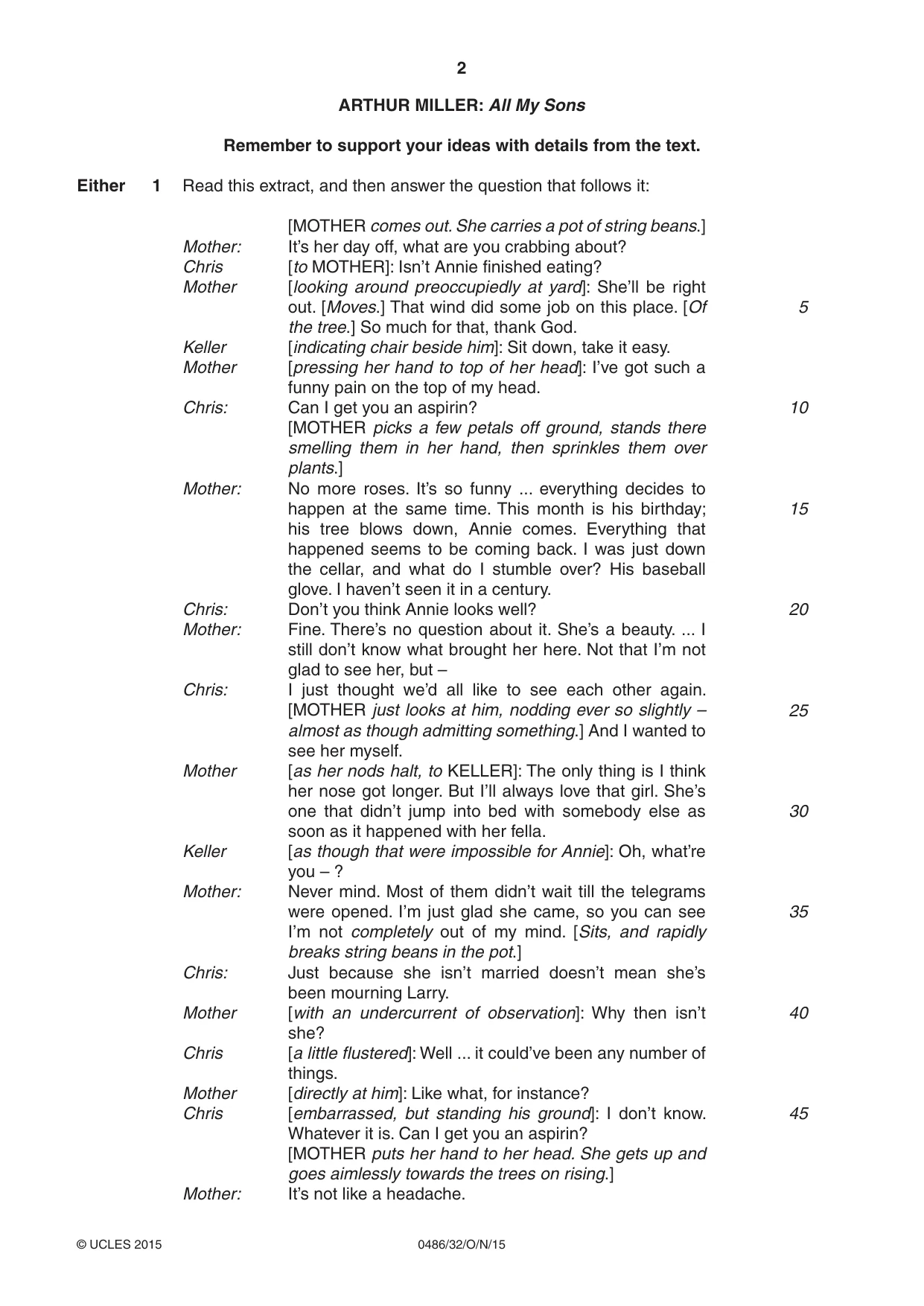
2 0486/32/O/N/15 © UCLES 2015 ARTHUR MILLER: All My Sons Remember to support your ideas with details from the text. Either 1 Read this extract, and then answer the question that follows it: [MOTHER comes out. She carries a pot of string beans.] Mother: It’s her day off, what are you crabbing about? Chris [to MOTHER]: Isn’t Annie finished eating? Mother [looking around preoccupiedly at yard]: She’ll be right out. [Moves.] That wind did some job on this place. [Of the tree.] So much for that, thank God. Keller [indicating chair beside him]: Sit down, take it easy. Mother [pressing her hand to top of her head]: I’ve got such a funny pain on the top of my head. Chris: Can I get you an aspirin? [MOTHER picks a few petals off ground, stands there smelling them in her hand, then sprinkles them over plants.] Mother: No more roses. It’s so funny ... everything decides to happen at the same time. This month is his birthday; his tree blows down, Annie comes. Everything that happened seems to be coming back. I was just down the cellar, and what do I stumble over? His baseball glove. I haven’t seen it in a century. Chris: Don’t you think Annie looks well? Mother: Fine. There’s no question about it. She’s a beauty. ... I still don’t know what brought her here. Not that I’m not glad to see her, but – Chris: I just thought we’d all like to see each other again. [MOTHER just looks at him, nodding ever so slightly – almost as though admitting something.] And I wanted to see her myself. Mother [as her nods halt, to KELLER]: The only thing is I think her nose got longer. But I’ll always love that girl. She’s one that didn’t jump into bed with somebody else as soon as it happened with her fella. Keller [as though that were impossible for Annie]: Oh, what’re you – ? Mother: Never mind. Most of them didn’t wait till the telegrams were opened. I’m just glad she came, so you can see I’m not completely out of my mind. [Sits, and rapidly breaks string beans in the pot.] Chris: Just because she isn’t married doesn’t mean she’s been mourning Larry. Mother [with an undercurrent of observation]: Why then isn’t she? Chris [a little flustered]: Well ... it could’ve been any number of things. Mother [directly at him]: Like what, for instance? Chris [embarrassed, but standing his ground]: I don’t know. Whatever it is. Can I get you an aspirin? [MOTHER puts her hand to her head. She gets up and goes aimlessly towards the trees on rising.] Mother: It’s not like a headache. 5 10 15 20 25 30 35 40 45
Question paper, page 3
3 0486/32/O/N/15 © UCLES 2015 [Turn over Keller: You don’t sleep, that’s why. She’s wearing out more bedroom slippers than shoes. Mother: I had a terrible night. [She stops moving.] I never had a night like that. Chris [looking at KELLER]: What was it, Mom? Did you dream? Mother: More, more than a dream. Chris [hesitantly]: About Larry? Mother: I was fast asleep, and – [Raising her arm over the audience.] Remember the way he used to fly low past the house when he was in training? When we used to see his face in the cockpit going by? That’s the way I saw him. Only high up. Way, way up, where the clouds are. He was so real I could reach out and touch him. And suddenly he started to fall. And crying, crying to me ... Mom, Mom! I could hear him like he was in the room. Mom! ... it was his voice! If I could touch him I knew I could stop him, if I could only – [Breaks off, allowing her outstretched hand to fall.] I woke up and it was so funny – The wind ... it was like the roaring of his engine. I came out here ... I must’ve still been half asleep. I could hear that roaring like he was going by. The tree snapped right in front of me – and I like – came awake. [She is looking at tree. She suddenly realizes something, turns with a reprimanding finger shaking slightly at KELLER.] See? We should never have planted that tree. I said so in the first place; it was too soon to plant a tree for him. [from Act 1] How does Miller make this such a striking introduction to Kate? Or 2 What makes Miller’s portrayal of the relationship between Steve and George Deever such a powerful part of the play? 50 55 60 65 70 75
Question paper, page 4
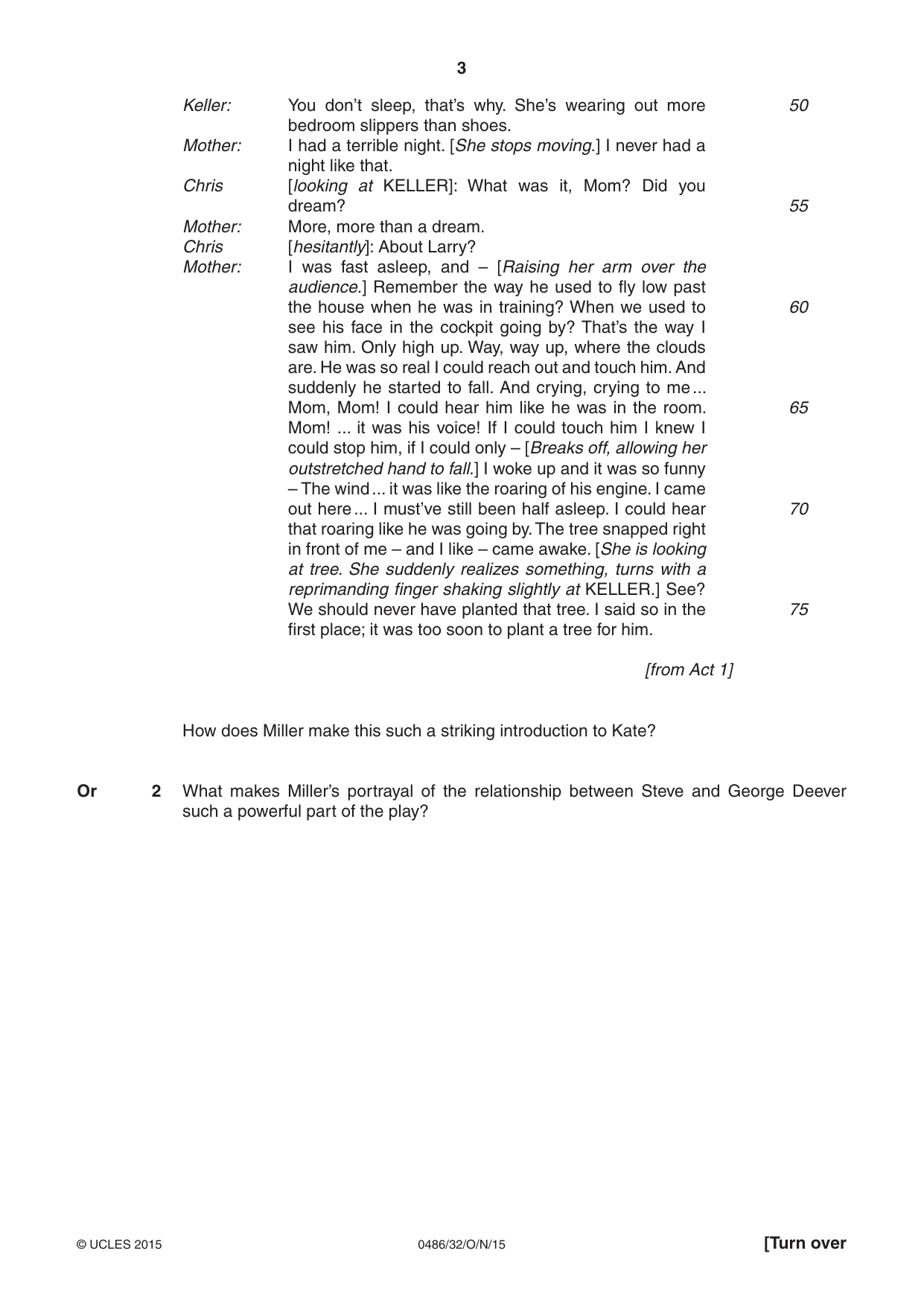
4 0486/32/O/N/15 © UCLES 2015 J.B. PRIESTLEY: An Inspector Calls Remember to support your ideas with details from the text. Either 3 Read this extract, and then answer the question that follows it: Inspector [taking charge, masterfully]: Stop! Content removed due to copyright restrictions.
Question paper, page 5
5 0486/32/O/N/15 © UCLES 2015 [Turn over Sheila: But that’s not what I’m talking about. I don’t care about that. The point is, you don’t seem to have learnt anything. [from Act 3] In what ways does Priestley make this such a powerfully dramatic moment in the play? Or 4 Explore the ways in which Priestley creates such a memorable portrait of Eva Smith, despite the fact that she never appears in the play. Do not use the extract printed in Question 3 in your answer. Content removed due to copyright restrictions.
Question paper, page 6
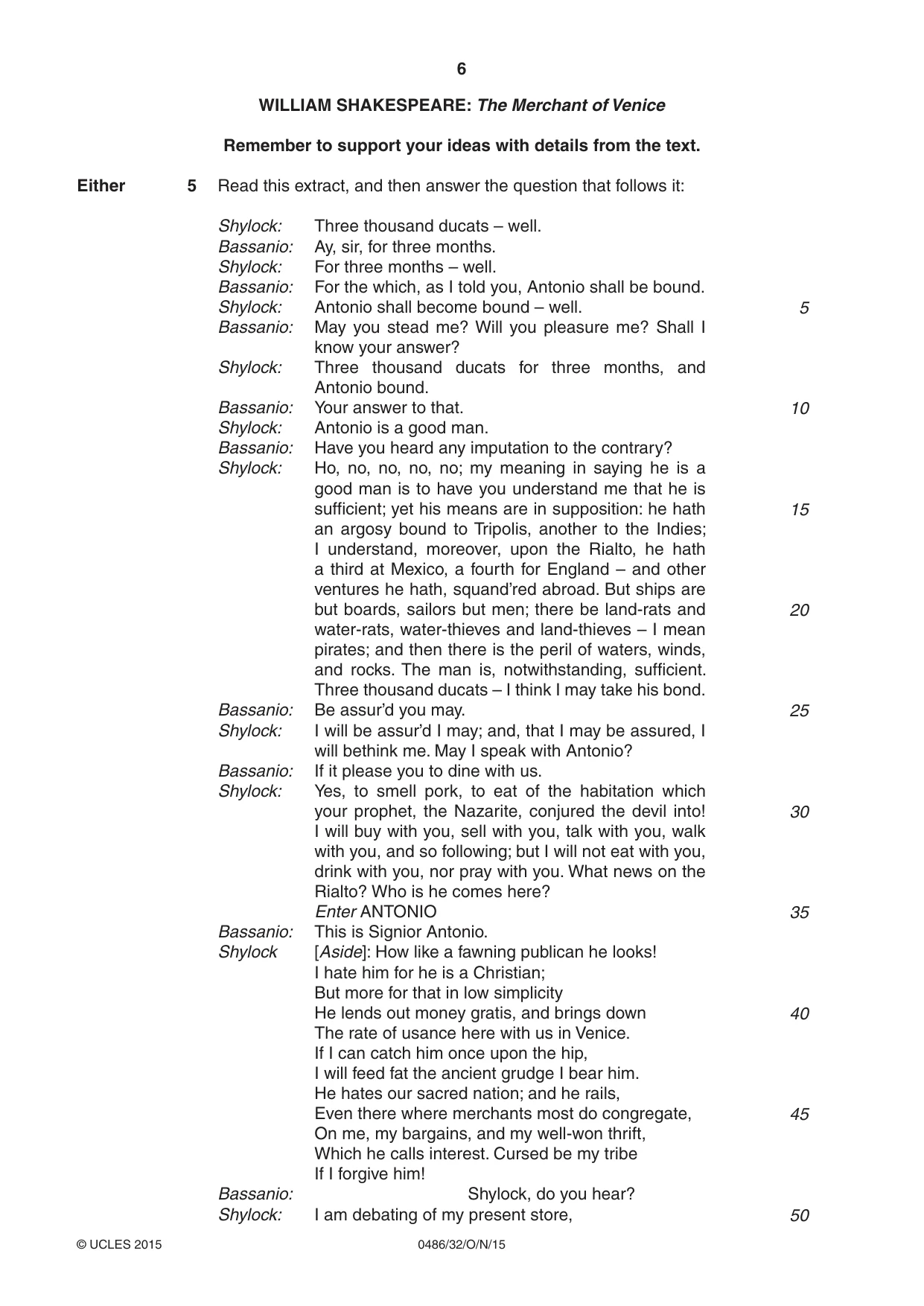
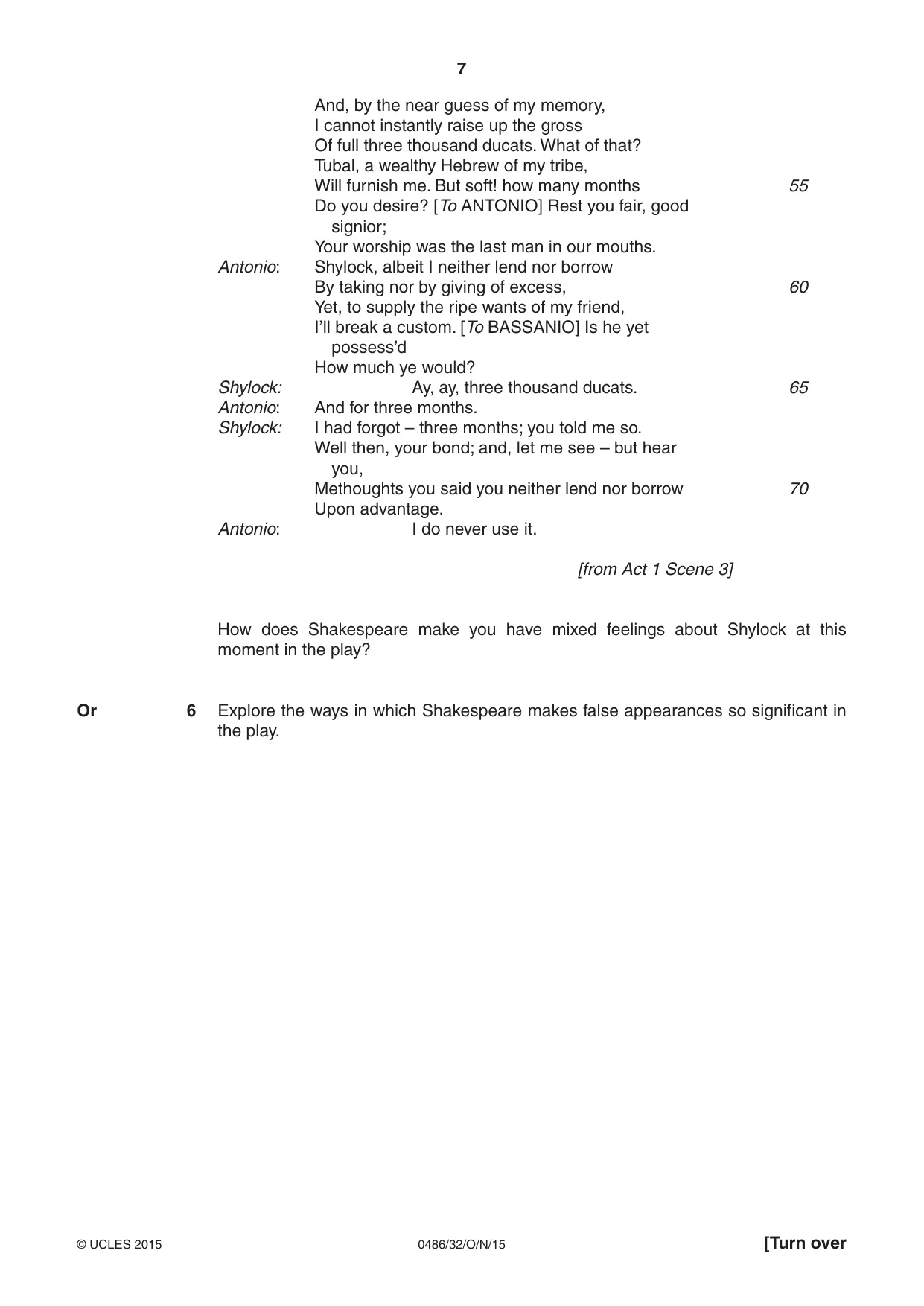
6 0486/32/O/N/15 © UCLES 2015 WILLIAM SHAKESPEARE: The Merchant of Venice Remember to support your ideas with details from the text. Either 5 Read this extract, and then answer the question that follows it: Shylock: Three thousand ducats – well. Bassanio: Ay, sir, for three months. Shylock: For three months – well. Bassanio: For the which, as I told you, Antonio shall be bound. Shylock: Antonio shall become bound – well. Bassanio: May you stead me? Will you pleasure me? Shall I know your answer? Shylock: Three thousand ducats for three months, and Antonio bound. Bassanio: Your answer to that. Shylock: Antonio is a good man. Bassanio: Have you heard any imputation to the contrary? Shylock: Ho, no, no, no, no; my meaning in saying he is a good man is to have you understand me that he is sufficient; yet his means are in supposition: he hath an argosy bound to Tripolis, another to the Indies; I understand, moreover, upon the Rialto, he hath a third at Mexico, a fourth for England – and other ventures he hath, squand’red abroad. But ships are but boards, sailors but men; there be land-rats and water-rats, water-thieves and land-thieves – I mean pirates; and then there is the peril of waters, winds, and rocks. The man is, notwithstanding, sufficient. Three thousand ducats – I think I may take his bond. Bassanio: Be assur’d you may. Shylock: I will be assur’d I may; and, that I may be assured, I will bethink me. May I speak with Antonio? Bassanio: If it please you to dine with us. Shylock: Yes, to smell pork, to eat of the habitation which your prophet, the Nazarite, conjured the devil into! I will buy with you, sell with you, talk with you, walk with you, and so following; but I will not eat with you, drink with you, nor pray with you. What news on the Rialto? Who is he comes here? Enter ANTONIO Bassanio: This is Signior Antonio. Shylock [Aside]: How like a fawning publican he looks! I hate him for he is a Christian; But more for that in low simplicity He lends out money gratis, and brings down The rate of usance here with us in Venice. If I can catch him once upon the hip, I will feed fat the ancient grudge I bear him. He hates our sacred nation; and he rails, Even there where merchants most do congregate, On me, my bargains, and my well-won thrift, Which he calls interest. Cursed be my tribe If I forgive him! Bassanio: Shylock, do you hear? Shylock: I am debating of my present store, 5 10 15 20 25 30 35 40 45 50
Question paper, page 7
7 0486/32/O/N/15 © UCLES 2015 [Turn over And, by the near guess of my memory, I cannot instantly raise up the gross Of full three thousand ducats. What of that? Tubal, a wealthy Hebrew of my tribe, Will furnish me. But soft! how many months Do you desire? [To ANTONIO] Rest you fair, good signior; Your worship was the last man in our mouths. Antonio: Shylock, albeit I neither lend nor borrow By taking nor by giving of excess, Yet, to supply the ripe wants of my friend, I’ll break a custom. [To BASSANIO] Is he yet possess’d How much ye would? Shylock: Ay, ay, three thousand ducats. Antonio: And for three months. Shylock: I had forgot – three months; you told me so. Well then, your bond; and, let me see – but hear you, Methoughts you said you neither lend nor borrow Upon advantage. Antonio: I do never use it. [from Act 1 Scene 3] How does Shakespeare make you have mixed feelings about Shylock at this moment in the play? Or 6 Explore the ways in which Shakespeare makes false appearances so significant in the play. 55 60 65 70
Question paper, page 8
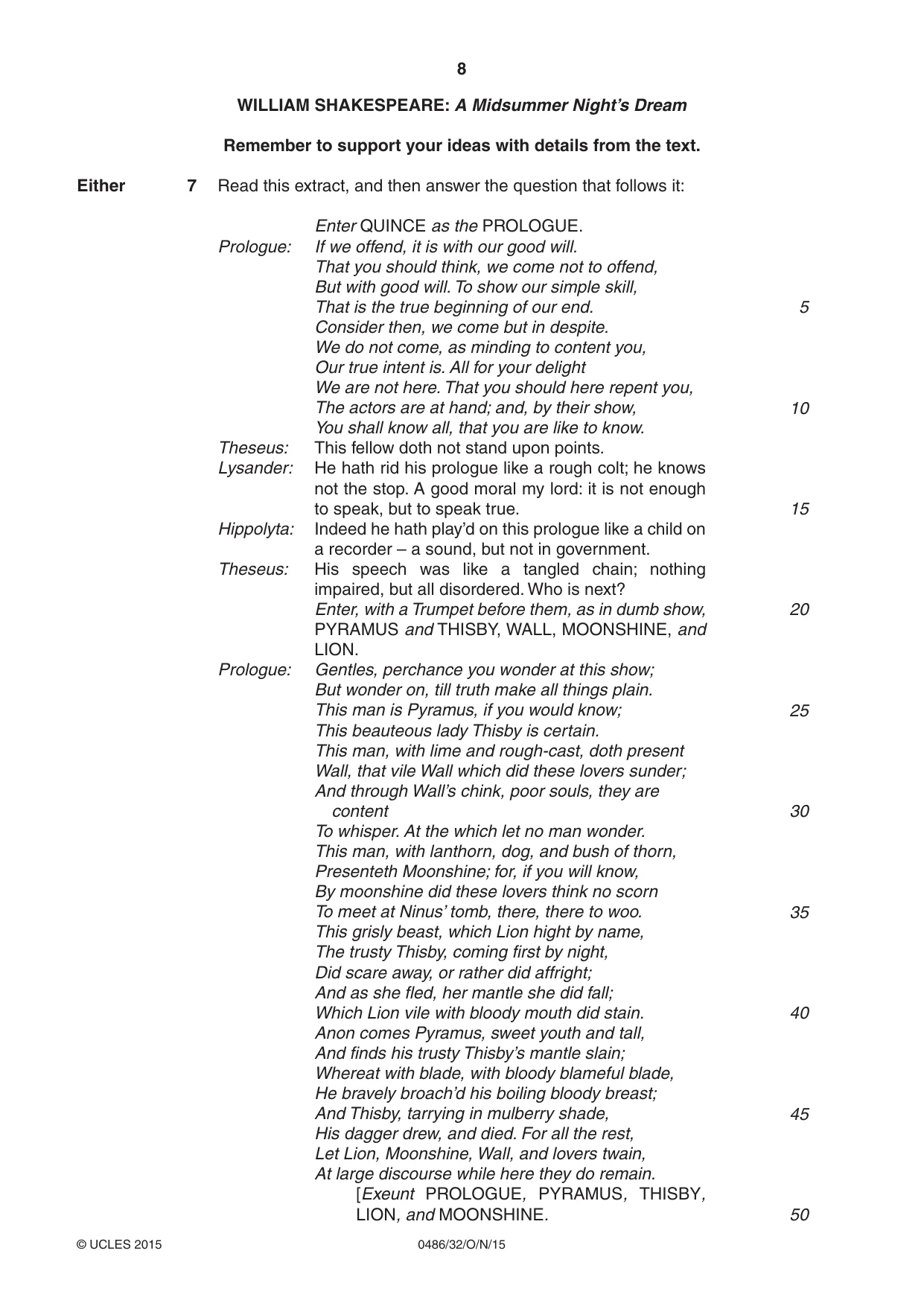
8 0486/32/O/N/15 © UCLES 2015 WILLIAM SHAKESPEARE: A Midsummer Night’s Dream Remember to support your ideas with details from the text. Either 7 Read this extract, and then answer the question that follows it: Enter QUINCE as the PROLOGUE. Prologue: If we offend, it is with our good will. That you should think, we come not to offend, But with good will. To show our simple skill, That is the true beginning of our end. Consider then, we come but in despite. We do not come, as minding to content you, Our true intent is. All for your delight We are not here. That you should here repent you, The actors are at hand; and, by their show, You shall know all, that you are like to know. Theseus: This fellow doth not stand upon points. Lysander: He hath rid his prologue like a rough colt; he knows not the stop. A good moral my lord: it is not enough to speak, but to speak true. Hippolyta: Indeed he hath play’d on this prologue like a child on a recorder – a sound, but not in government. Theseus: His speech was like a tangled chain; nothing impaired, but all disordered. Who is next? Enter, with a Trumpet before them, as in dumb show, PYRAMUS and THISBY, WALL, MOONSHINE, and LION. Prologue: Gentles, perchance you wonder at this show; But wonder on, till truth make all things plain. This man is Pyramus, if you would know; This beauteous lady Thisby is certain. This man, with lime and rough-cast, doth present Wall, that vile Wall which did these lovers sunder; And through Wall’s chink, poor souls, they are content To whisper. At the which let no man wonder. This man, with lanthorn, dog, and bush of thorn, Presenteth Moonshine; for, if you will know, By moonshine did these lovers think no scorn To meet at Ninus’ tomb, there, there to woo. This grisly beast, which Lion hight by name, The trusty Thisby, coming first by night, Did scare away, or rather did affright; And as she fled, her mantle she did fall; Which Lion vile with bloody mouth did stain. Anon comes Pyramus, sweet youth and tall, And finds his trusty Thisby’s mantle slain; Whereat with blade, with bloody blameful blade, He bravely broach’d his boiling bloody breast; And Thisby, tarrying in mulberry shade, His dagger drew, and died. For all the rest, Let Lion, Moonshine, Wall, and lovers twain, At large discourse while here they do remain. [Exeunt PROLOGUE, PYRAMUS, THISBY, LION, and MOONSHINE. 5 10 15 20 25 30 35 40 45 50
Question paper, page 9
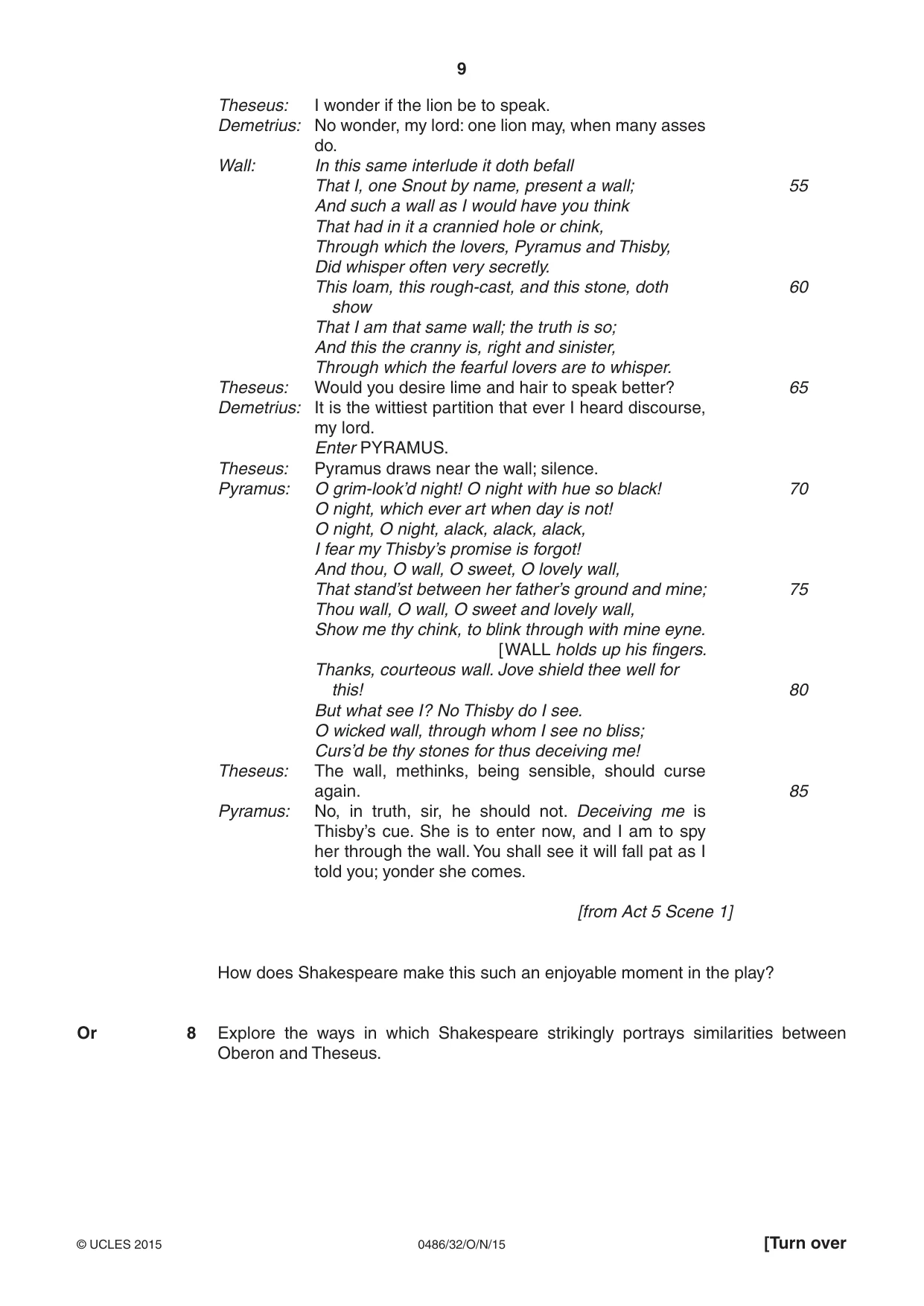
9 0486/32/O/N/15 © UCLES 2015 [Turn over Theseus: I wonder if the lion be to speak. Demetrius: No wonder, my lord: one lion may, when many asses do. Wall: In this same interlude it doth befall That I, one Snout by name, present a wall; And such a wall as I would have you think That had in it a crannied hole or chink, Through which the lovers, Pyramus and Thisby, Did whisper often very secretly. This loam, this rough-cast, and this stone, doth show That I am that same wall; the truth is so; And this the cranny is, right and sinister, Through which the fearful lovers are to whisper. Theseus: Would you desire lime and hair to speak better? Demetrius: It is the wittiest partition that ever I heard discourse, my lord. Enter PYRAMUS. Theseus: Pyramus draws near the wall; silence. Pyramus: O grim-look’d night! O night with hue so black! O night, which ever art when day is not! O night, O night, alack, alack, alack, I fear my Thisby’s promise is forgot! And thou, O wall, O sweet, O lovely wall, That stand’st between her father’s ground and mine; Thou wall, O wall, O sweet and lovely wall, Show me thy chink, to blink through with mine eyne. [ WALL holds up his fingers. Thanks, courteous wall. Jove shield thee well for this! But what see I? No Thisby do I see. O wicked wall, through whom I see no bliss; Curs’d be thy stones for thus deceiving me! Theseus: The wall, methinks, being sensible, should curse again. Pyramus: No, in truth, sir, he should not. Deceiving me is Thisby’s cue. She is to enter now, and I am to spy her through the wall. You shall see it will fall pat as I told you; yonder she comes. [from Act 5 Scene 1] How does Shakespeare make this such an enjoyable moment in the play? Or 8 Explore the ways in which Shakespeare strikingly portrays similarities between Oberon and Theseus. 55 60 65 70 75 80 85
Question paper, page 10
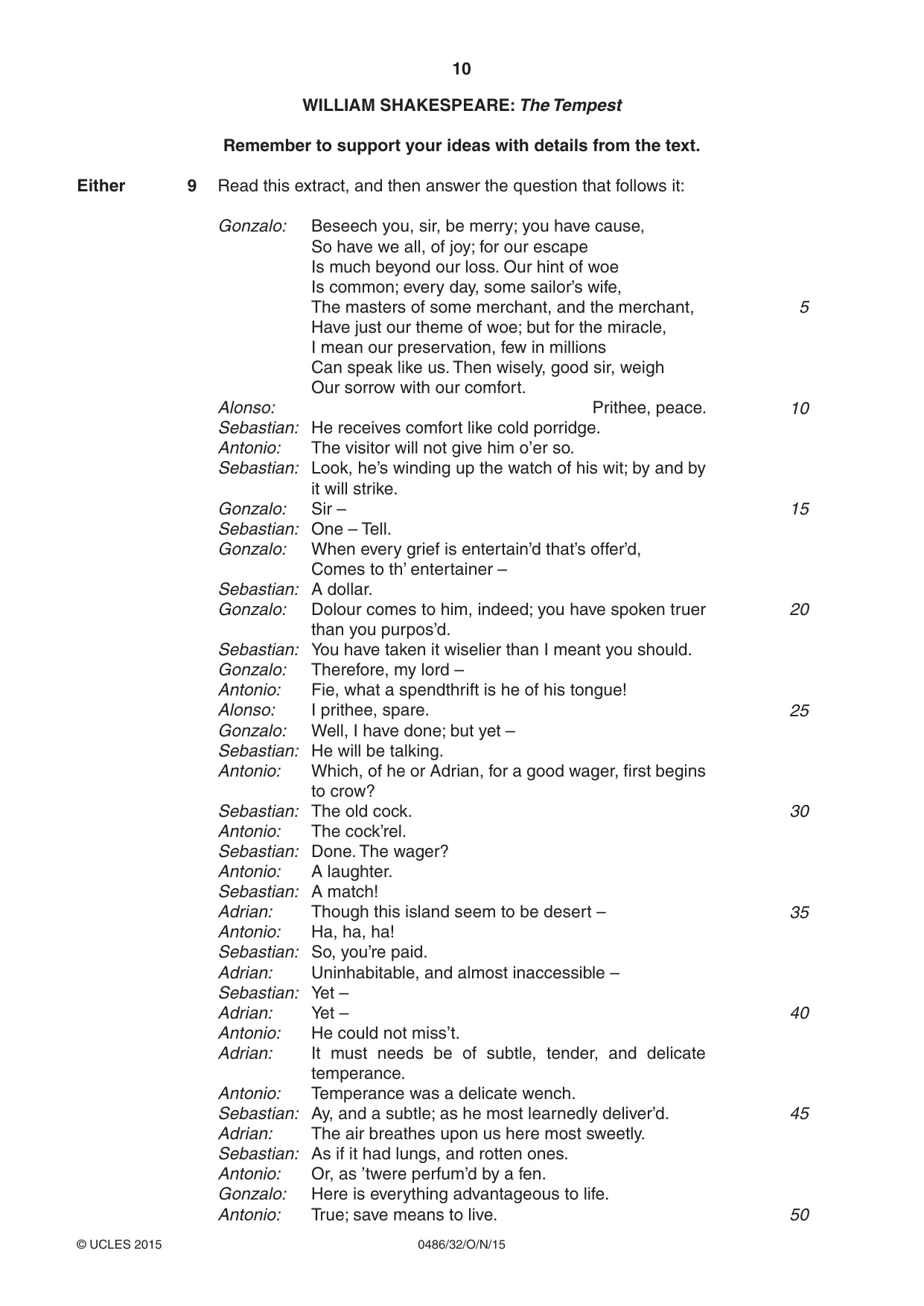
10 0486/32/O/N/15 © UCLES 2015 WILLIAM SHAKESPEARE: The Tempest Remember to support your ideas with details from the text. Either 9 Read this extract, and then answer the question that follows it: Gonzalo: Beseech you, sir, be merry; you have cause, So have we all, of joy; for our escape Is much beyond our loss. Our hint of woe Is common; every day, some sailor’s wife, The masters of some merchant, and the merchant, Have just our theme of woe; but for the miracle, I mean our preservation, few in millions Can speak like us. Then wisely, good sir, weigh Our sorrow with our comfort. Alonso: Prithee, peace. Sebastian: He receives comfort like cold porridge. Antonio: The visitor will not give him o’er so. Sebastian: Look, he’s winding up the watch of his wit; by and by it will strike. Gonzalo: Sir – Sebastian: One – Tell. Gonzalo: When every grief is entertain’d that’s offer’d, Comes to th’ entertainer – Sebastian: A dollar. Gonzalo: Dolour comes to him, indeed; you have spoken truer than you purpos’d. Sebastian: You have taken it wiselier than I meant you should. Gonzalo: Therefore, my lord – Antonio: Fie, what a spendthrift is he of his tongue! Alonso: I prithee, spare. Gonzalo: Well, I have done; but yet – Sebastian: He will be talking. Antonio: Which, of he or Adrian, for a good wager, first begins to crow? Sebastian: The old cock. Antonio: The cock’rel. Sebastian: Done. The wager? Antonio: A laughter. Sebastian: A match! Adrian: Though this island seem to be desert – Antonio: Ha, ha, ha! Sebastian: So, you’re paid. Adrian: Uninhabitable, and almost inaccessible – Sebastian: Yet – Adrian: Yet – Antonio: He could not miss’t. Adrian: It must needs be of subtle, tender, and delicate temperance. Antonio: Temperance was a delicate wench. Sebastian: Ay, and a subtle; as he most learnedly deliver’d. Adrian: The air breathes upon us here most sweetly. Sebastian: As if it had lungs, and rotten ones. Antonio: Or, as ’twere perfum’d by a fen. Gonzalo: Here is everything advantageous to life. Antonio: True; save means to live. 5 10 15 20 25 30 35 40 45 50
Question paper, page 11
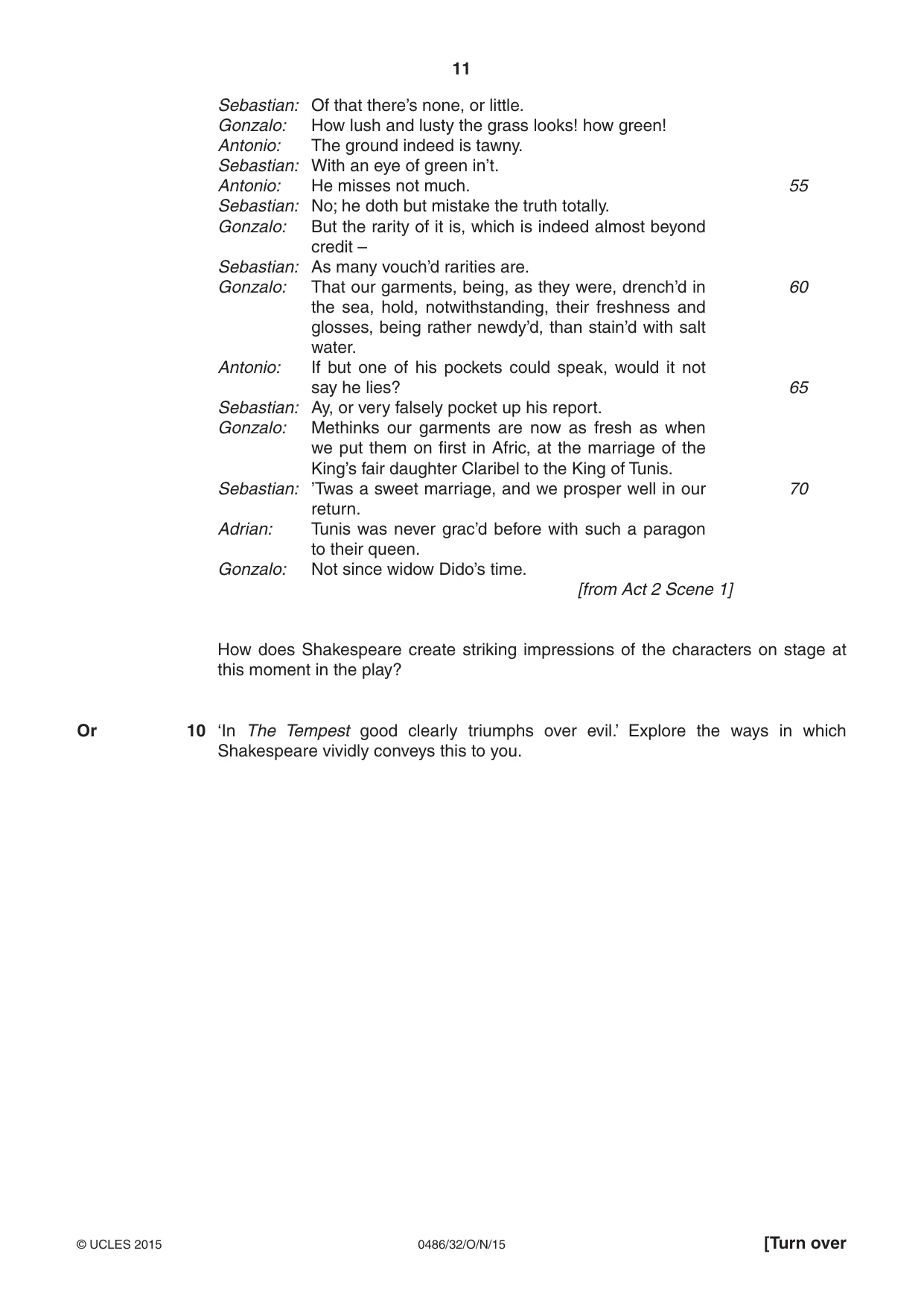
11 0486/32/O/N/15 © UCLES 2015 [Turn over Sebastian: Of that there’s none, or little. Gonzalo: How lush and lusty the grass looks! how green! Antonio: The ground indeed is tawny. Sebastian: With an eye of green in’t. Antonio: He misses not much. Sebastian: No; he doth but mistake the truth totally. Gonzalo: But the rarity of it is, which is indeed almost beyond credit – Sebastian: As many vouch’d rarities are. Gonzalo: That our garments, being, as they were, drench’d in the sea, hold, notwithstanding, their freshness and glosses, being rather newdy’d, than stain’d with salt water. Antonio: If but one of his pockets could speak, would it not say he lies? Sebastian: Ay, or very falsely pocket up his report. Gonzalo: Methinks our garments are now as fresh as when we put them on first in Afric, at the marriage of the King’s fair daughter Claribel to the King of Tunis. Sebastian: ’Twas a sweet marriage, and we prosper well in our return. Adrian: Tunis was never grac’d before with such a paragon to their queen. Gonzalo: Not since widow Dido’s time. [from Act 2 Scene 1] How does Shakespeare create striking impressions of the characters on stage at this moment in the play? Or 10 ‘In The Tempest good clearly triumphs over evil.’ Explore the ways in which Shakespeare vividly conveys this to you. 55 60 65 70
Question paper, page 12
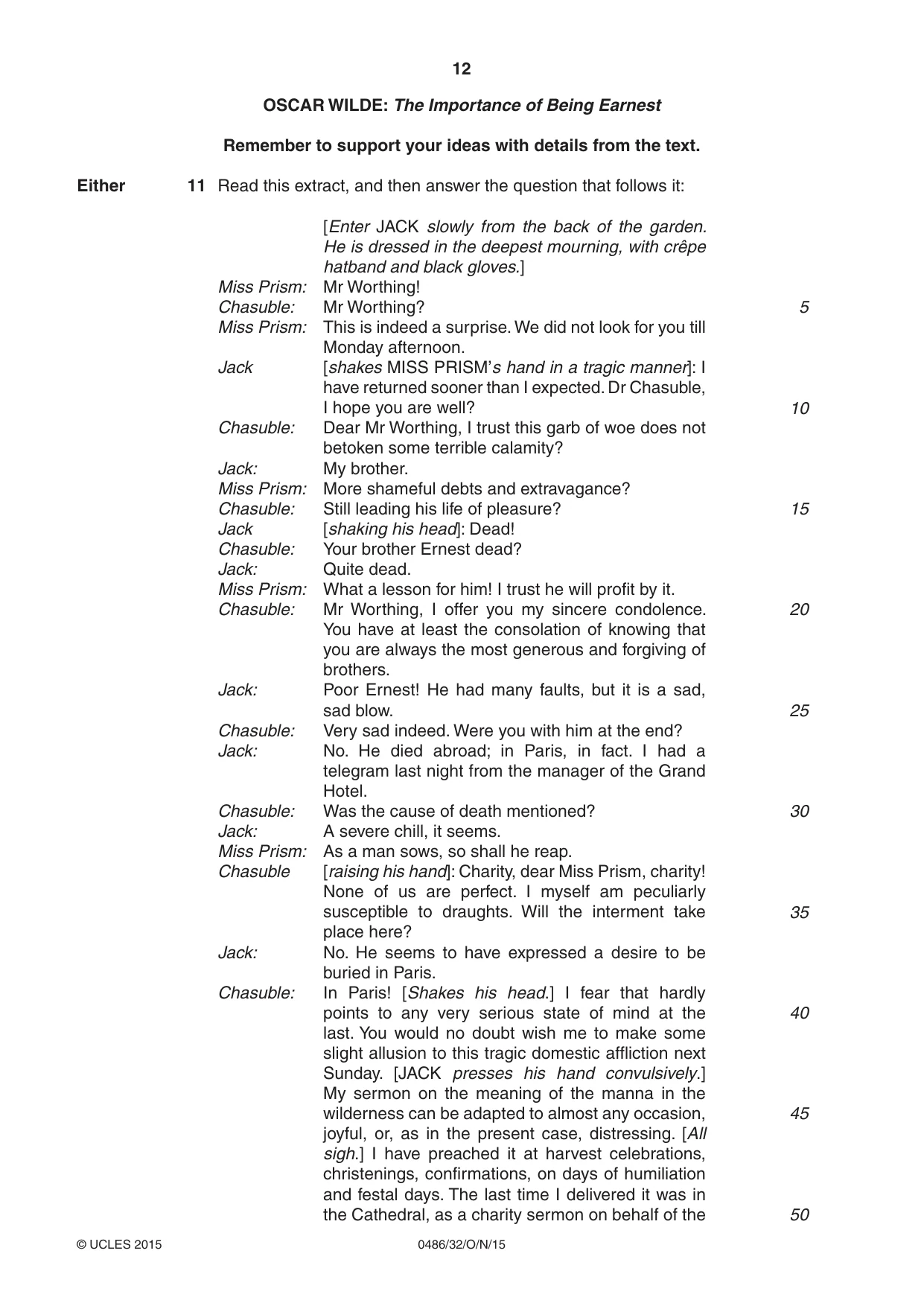
12 0486/32/O/N/15 © UCLES 2015 OSCAR WILDE: The Importance of Being Earnest Remember to support your ideas with details from the text. Either 11 Read this extract, and then answer the question that follows it: [Enter JACK slowly from the back of the garden. He is dressed in the deepest mourning, with crêpe hatband and black gloves.] Miss Prism: Mr Worthing! Chasuble: Mr Worthing? Miss Prism: This is indeed a surprise. We did not look for you till Monday afternoon. Jack [shakes MISS PRISM’s hand in a tragic manner]: I have returned sooner than I expected. Dr Chasuble, I hope you are well? Chasuble: Dear Mr Worthing, I trust this garb of woe does not betoken some terrible calamity? Jack: My brother. Miss Prism: More shameful debts and extravagance? Chasuble: Still leading his life of pleasure? Jack [shaking his head]: Dead! Chasuble: Your brother Ernest dead? Jack: Quite dead. Miss Prism: What a lesson for him! I trust he will profit by it. Chasuble: Mr Worthing, I offer you my sincere condolence. You have at least the consolation of knowing that you are always the most generous and forgiving of brothers. Jack: Poor Ernest! He had many faults, but it is a sad, sad blow. Chasuble: Very sad indeed. Were you with him at the end? Jack: No. He died abroad; in Paris, in fact. I had a telegram last night from the manager of the Grand Hotel. Chasuble: Was the cause of death mentioned? Jack: A severe chill, it seems. Miss Prism: As a man sows, so shall he reap. Chasuble [raising his hand]: Charity, dear Miss Prism, charity! None of us are perfect. I myself am peculiarly susceptible to draughts. Will the interment take place here? Jack: No. He seems to have expressed a desire to be buried in Paris. Chasuble: In Paris! [Shakes his head.] I fear that hardly points to any very serious state of mind at the last. You would no doubt wish me to make some slight allusion to this tragic domestic affliction next Sunday. [JACK presses his hand convulsively.] My sermon on the meaning of the manna in the wilderness can be adapted to almost any occasion, joyful, or, as in the present case, distressing. [All sigh.] I have preached it at harvest celebrations, christenings, confirmations, on days of humiliation and festal days. The last time I delivered it was in the Cathedral, as a charity sermon on behalf of the 5 10 15 20 25 30 35 40 45 50
Question paper, page 13
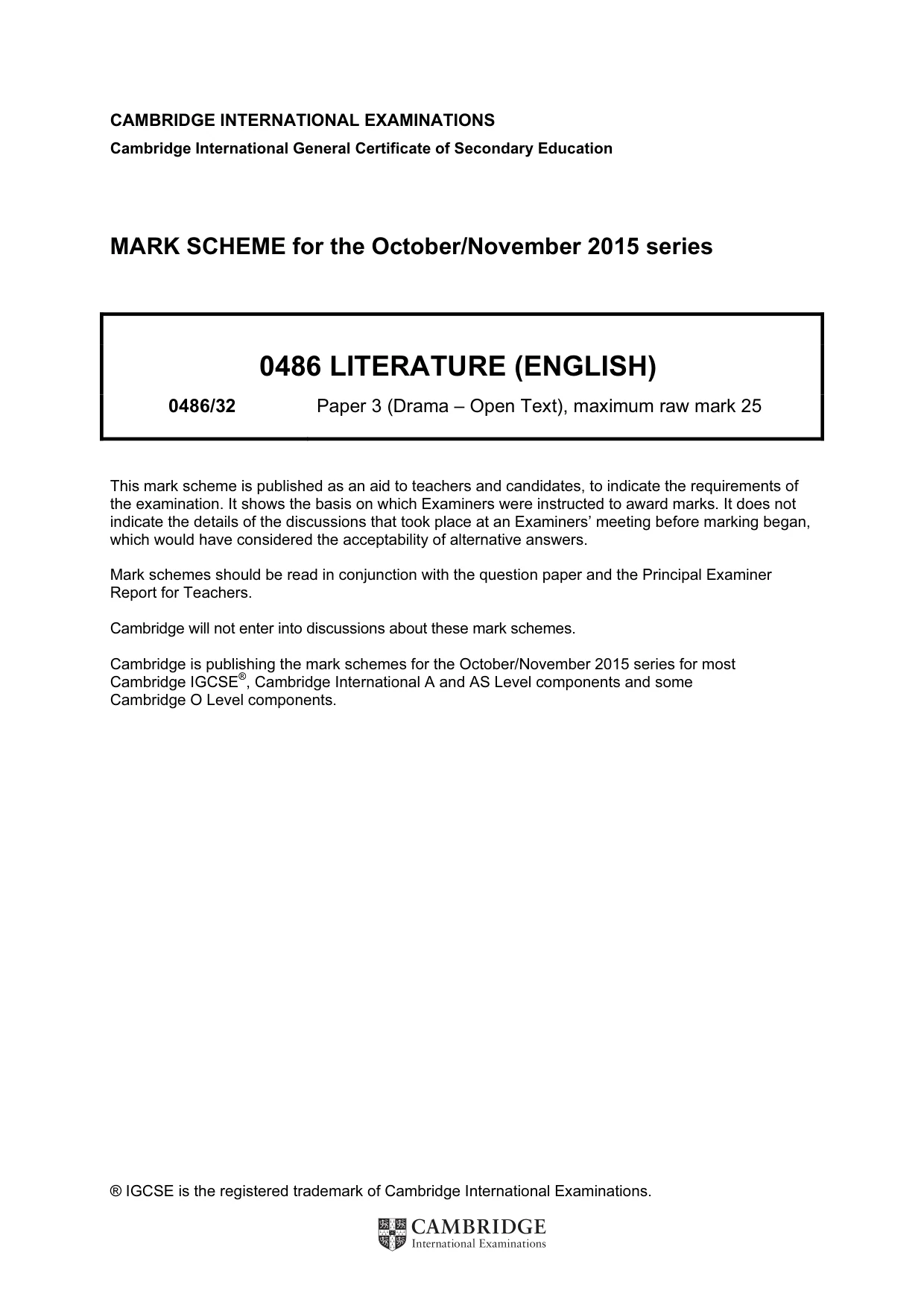
13 0486/32/O/N/15 © UCLES 2015 Society for the Prevention of Discontent among the Upper Orders. The Bishop, who was present, was much struck by some of the analogies I drew. Jack: Ah! that reminds me, you mentioned christenings I think, Dr Chasuble? I suppose you know how to christen all right? [DR CHASUBLE looks astounded.] I mean, of course, you are continually christening, aren’t you? Miss Prism: It is, I regret to say, one of the Rector’s most constant duties in this parish. I have often spoken to the poorer classes on the subject. But they don’t seem to know what thrift is. Chasuble: But is there any particular infant in whom you are interested, Mr Worthing? Your brother was, I believe, unmarried, was he not? Jack: Oh yes. Miss Prism [bitterly]: People who live entirely for pleasure usually are. Jack: But it is not for any child, dear Doctor. I am very fond of children. No! the fact is, I would like to be christened myself, this afternoon, if you have nothing better to do. Chasuble: But surely, Mr Worthing, you have been christened already? Jack: I don’t remember anything about it. Chasuble: But have you any grave doubts on the subject? Jack: I certainly intend to have. Of course I don’t know if the thing would bother you in any way, or if you think I am a little too old now. Chasuble: Not at all. The sprinkling, and, indeed, the immersion of adults is a perfectly canonical practice. Jack: Immersion! [from Act 2] How does Wilde make this such an entertaining moment in the play? Or 12 Cecily is described as ‘a sweet, simple, innocent girl’ by Jack. How far does Wilde make you agree with this description? 55 60 65 70 75 80
Question paper, page 14
14 0486/32/O/N/15 © UCLES 2015 BLANK PAGE
Question paper, page 15
15 0486/32/O/N/15 © UCLES 2015 BLANK PAGE
Question paper, page 16
16 0486/32/O/N/15 © UCLES 2015 BLANK PAGE Permission to reproduce items where third-party owned material protected by copyright is included has been sought and cleared where possible. Every reasonable effort has been made by the publisher (UCLES) to trace copyright holders, but if any items requiring clearance have unwittingly been included, the publisher will be pleased to make amends at the earliest possible opportunity. To avoid the issue of disclosure of answer-related information to candidates, all copyright acknowledgements are reproduced online in the Cambridge International Examinations Copyright Acknowledgements Booklet. This is produced for each series of examinations and is freely available to download at www.cie.org.uk after the live examination series. Cambridge International Examinations is part of the Cambridge Assessment Group. Cambridge Assessment is the brand name of University of Cambridge Local Examinations Syndicate (UCLES), which is itself a department of the University of Cambridge.
Mark scheme, page 1
® IGCSE is the registered trademark of Cambridge International Examinations. CAMBRIDGE INTERNATIONAL EXAMINATIONS Cambridge International General Certificate of Secondary Education MARK SCHEME for the October/November 2015 series 0486 LITERATURE (ENGLISH) 0486/32 Paper 3 (Drama – Open Text), maximum raw mark 25 This mark scheme is published as an aid to teachers and candidates, to indicate the requirements of the examination. It shows the basis on which Examiners were instructed to award marks. It does not indicate the details of the discussions that took place at an Examiners’ meeting before marking began, which would have considered the acceptability of alternative answers. Mark schemes should be read in conjunction with the question paper and the Principal Examiner Report for Teachers. Cambridge will not enter into discussions about these mark schemes. Cambridge is publishing the mark schemes for the October/November 2015 series for most Cambridge IGCSE®, Cambridge International A and AS Level components and some Cambridge O Level components.
Mark scheme, page 2
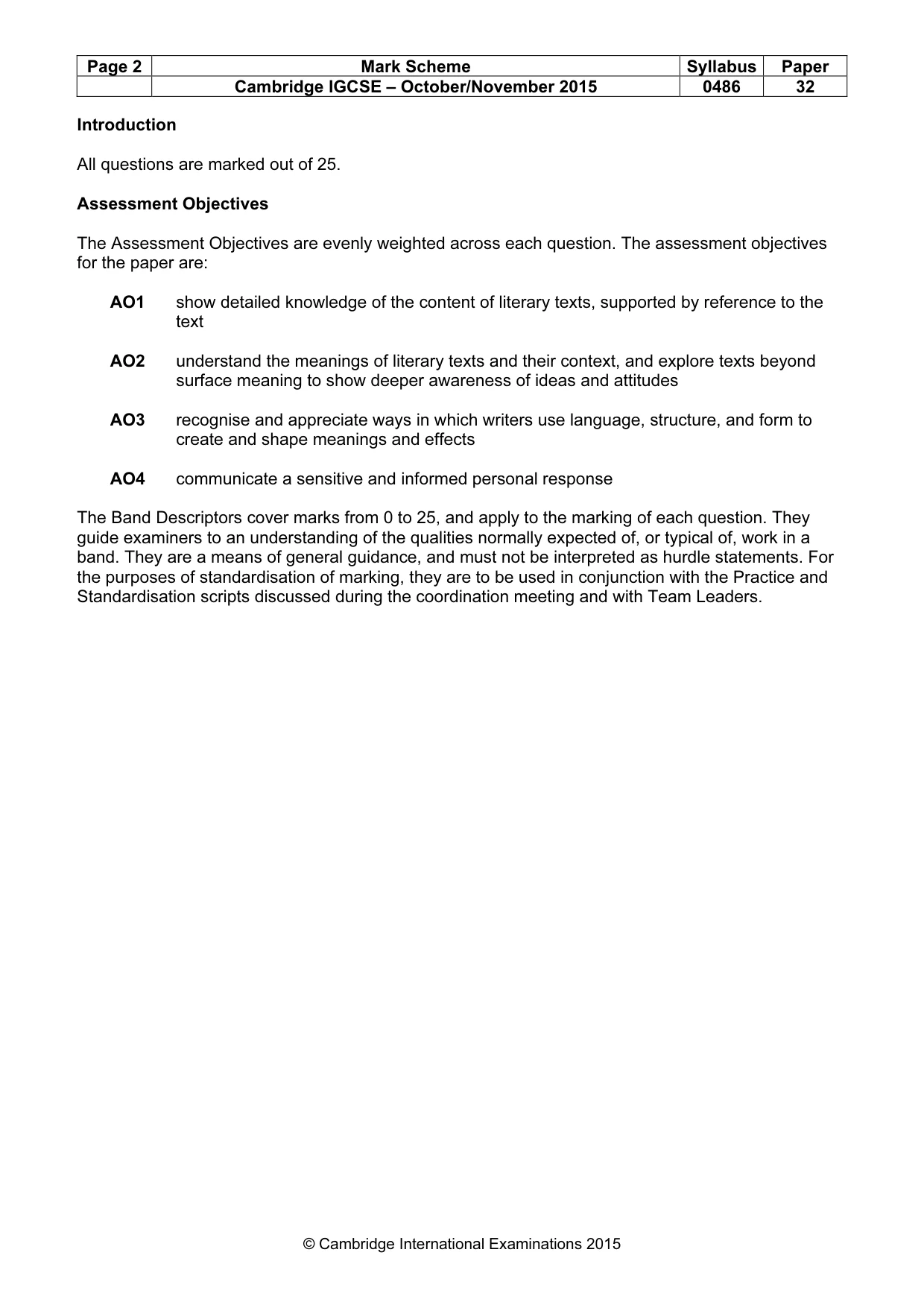
Page 2 Mark Scheme Syllabus Paper Cambridge IGCSE – October/November 2015 0486 32 © Cambridge International Examinations 2015 Introduction All questions are marked out of 25. Assessment Objectives The Assessment Objectives are evenly weighted across each question. The assessment objectives for the paper are: AO1 show detailed knowledge of the content of literary texts, supported by reference to the text AO2 understand the meanings of literary texts and their context, and explore texts beyond surface meaning to show deeper awareness of ideas and attitudes AO3 recognise and appreciate ways in which writers use language, structure, and form to create and shape meanings and effects AO4 communicate a sensitive and informed personal response The Band Descriptors cover marks from 0 to 25, and apply to the marking of each question. They guide examiners to an understanding of the qualities normally expected of, or typical of, work in a band. They are a means of general guidance, and must not be interpreted as hurdle statements. For the purposes of standardisation of marking, they are to be used in conjunction with the Practice and Standardisation scripts discussed during the coordination meeting and with Team Leaders.
Mark scheme, page 3
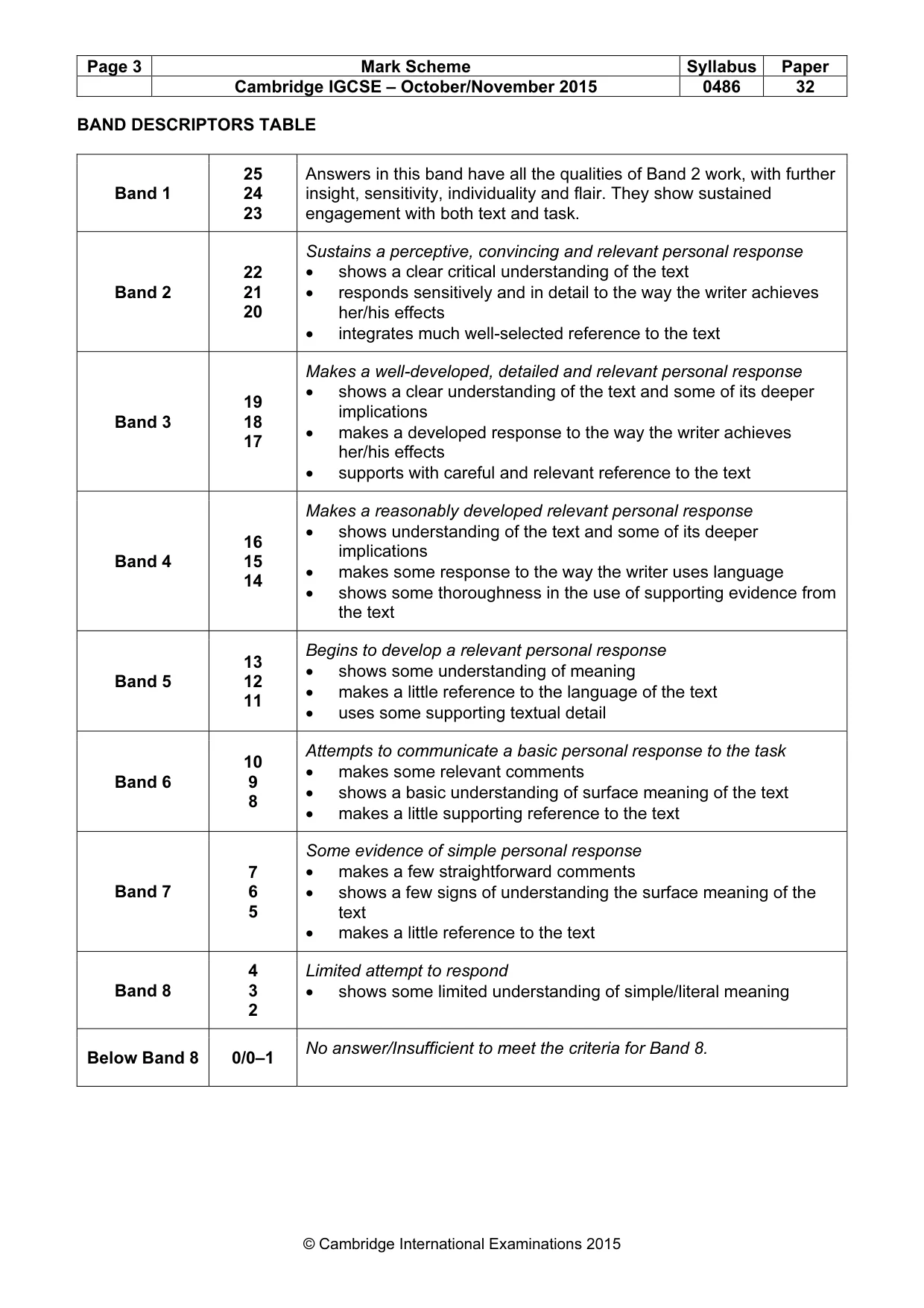
Page 3 Mark Scheme Syllabus Paper Cambridge IGCSE – October/November 2015 0486 32 © Cambridge International Examinations 2015 BAND DESCRIPTORS TABLE Band 1 25 24 23 Answers in this band have all the qualities of Band 2 work, with further insight, sensitivity, individuality and flair. They show sustained engagement with both text and task. Band 2 22 21 20 Sustains a perceptive, convincing and relevant personal response • shows a clear critical understanding of the text • responds sensitively and in detail to the way the writer achieves her/his effects • integrates much well-selected reference to the text Band 3 19 18 17 Makes a well-developed, detailed and relevant personal response • shows a clear understanding of the text and some of its deeper implications • makes a developed response to the way the writer achieves her/his effects • supports with careful and relevant reference to the text Band 4 16 15 14 Makes a reasonably developed relevant personal response • shows understanding of the text and some of its deeper implications • makes some response to the way the writer uses language • shows some thoroughness in the use of supporting evidence from the text Band 5 13 12 11 Begins to develop a relevant personal response • shows some understanding of meaning • makes a little reference to the language of the text • uses some supporting textual detail Band 6 10 9 8 Attempts to communicate a basic personal response to the task • makes some relevant comments • shows a basic understanding of surface meaning of the text • makes a little supporting reference to the text Band 7 7 6 5 Some evidence of simple personal response • makes a few straightforward comments • shows a few signs of understanding the surface meaning of the text • makes a little reference to the text Band 8 4 3 2 Limited attempt to respond • shows some limited understanding of simple/literal meaning Below Band 8 0/0–1 No answer/Insufficient to meet the criteria for Band 8.
What you needed in this session
Cambridge’s own grade thresholds for 2015 Oct/Nov, Paper 3 · Variant 2. A higher threshold means an easier paper — the bar moves with how the cohort did.