Cambridge IGCSE English - Literature 0486 — 2015 Feb/March Paper 4 · Variant 2
0486/42/F/M/15 · 25 marks · ≈28 min
The question paper and its mark scheme, free to read here and free to download. This is Cambridge’s own paper, exactly as it was sat.
Question paper8 pages


Mark scheme3 pages
Answers below. Sit the paper first if you are practising.
Paper as text
Question paper, page 1
This document consists of 5 printed pages, 3 blank pages and 1 insert. DC (NH) 95996/3 © UCLES 2015 [Turn over * 3 6 8 0 6 4 5 5 2 8 * LITERATURE (ENGLISH) 0486/42 Paper 4 Unseen February/March 2015 1 hour 15 minutes No Additional Materials are required. READ THESE INSTRUCTIONS FIRST An answer booklet is provided inside this question paper. You should follow the instructions on the front cover of the answer booklet. If you need additional answer paper ask the invigilator for a continuation booklet. Answer either Question 1 or Question 2. You are advised to spend about 20 minutes reading the question paper and planning your answer. Both questions in this paper carry equal marks. Cambridge International Examinations Cambridge International General Certificate of Secondary Education The syllabus is approved for use in England, Wales and Northern Ireland as a Cambridge International Level 1/Level 2 Certificate.
Question paper, page 2
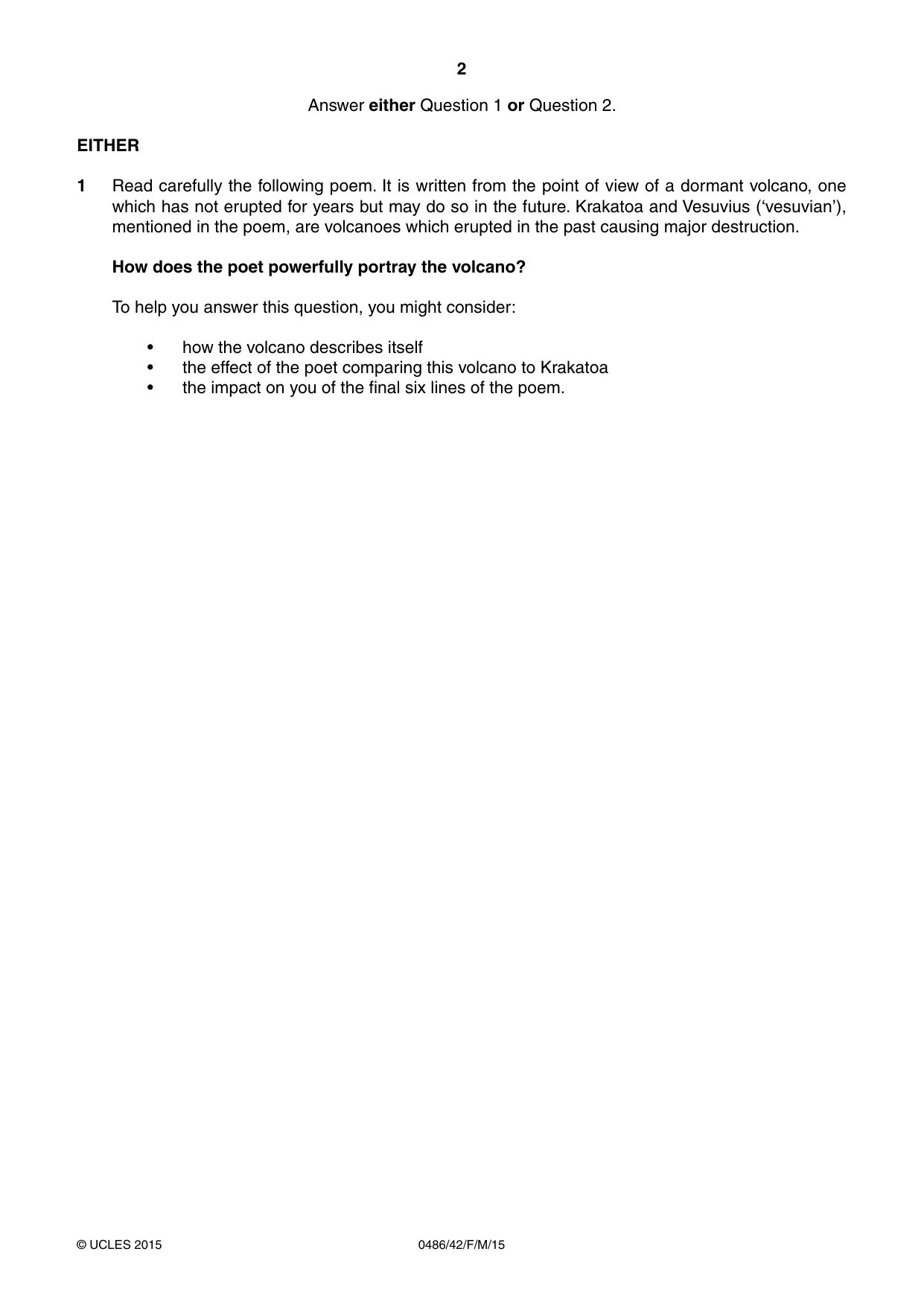
2 0486/42/F/M/15 © UCLES 2015 Answer either Question 1 or Question 2. EITHER 1 Read carefully the following poem. It is written from the point of view of a dormant volcano, one which has not erupted for years but may do so in the future. Krakatoa and Vesuvius (‘vesuvian’), mentioned in the poem, are volcanoes which erupted in the past causing major destruction. How does the poet powerfully portray the volcano? To help you answer this question, you might consider: • how the volcano describes itself • the effect of the poet comparing this volcano to Krakatoa • the impact on you of the final six lines of the poem.
Question paper, page 3
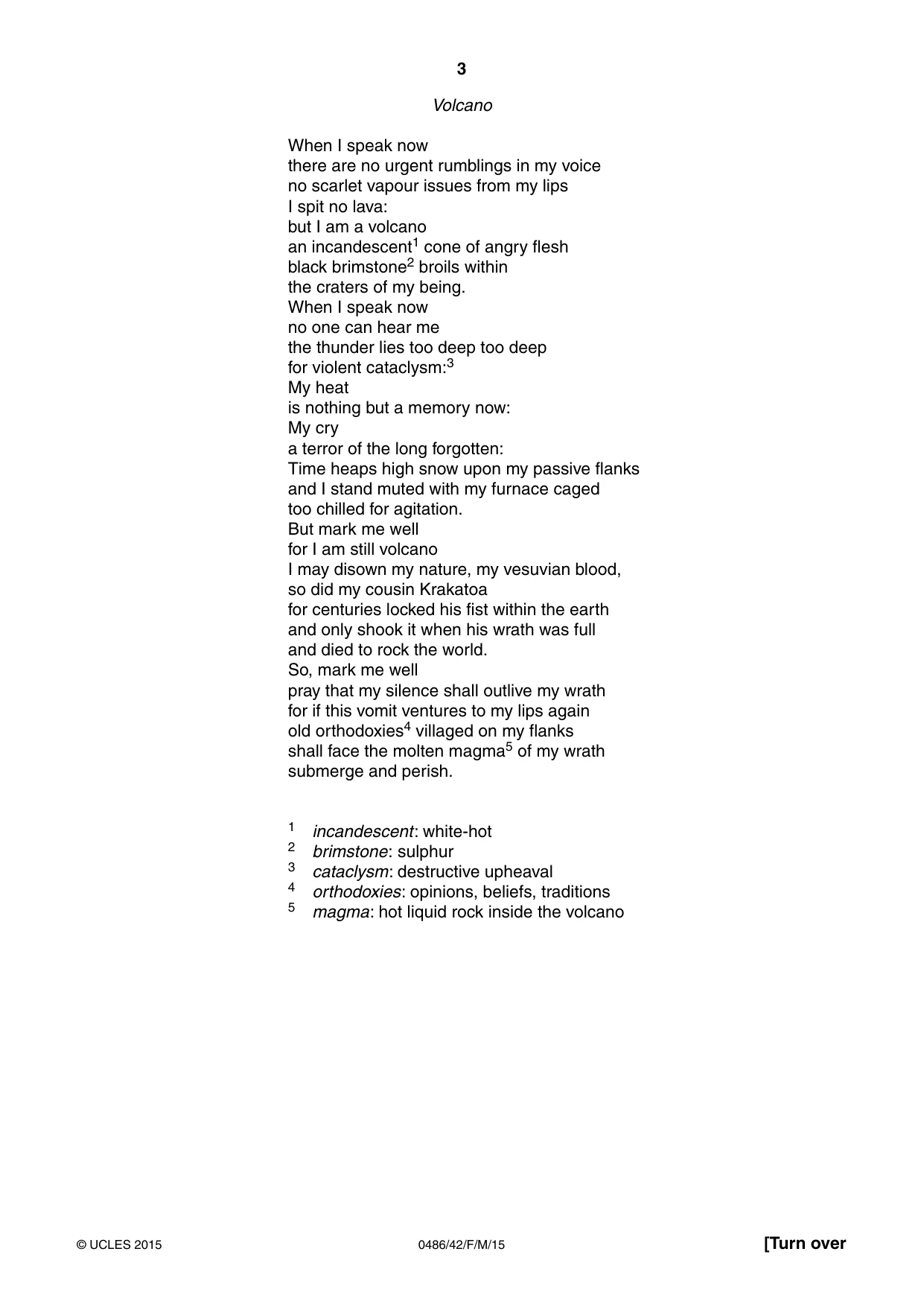
3 0486/42/F/M/15 © UCLES 2015 [Turn over Volcano When I speak now there are no urgent rumblings in my voice no scarlet vapour issues from my lips I spit no lava: but I am a volcano an incandescent1 cone of angry flesh black brimstone2 broils within the craters of my being. When I speak now no one can hear me the thunder lies too deep too deep for violent cataclysm:3 My heat is nothing but a memory now: My cry a terror of the long forgotten: Time heaps high snow upon my passive flanks and I stand muted with my furnace caged too chilled for agitation. But mark me well for I am still volcano I may disown my nature, my vesuvian blood, so did my cousin Krakatoa for centuries locked his fist within the earth and only shook it when his wrath was full and died to rock the world. So, mark me well pray that my silence shall outlive my wrath for if this vomit ventures to my lips again old orthodoxies4 villaged on my flanks shall face the molten magma5 of my wrath submerge and perish. 1 incandescent : white-hot 2 brimstone: sulphur 3 cataclysm: destructive upheaval 4 orthodoxies: opinions, beliefs, traditions 5 magma: hot liquid rock inside the volcano
Question paper, page 4
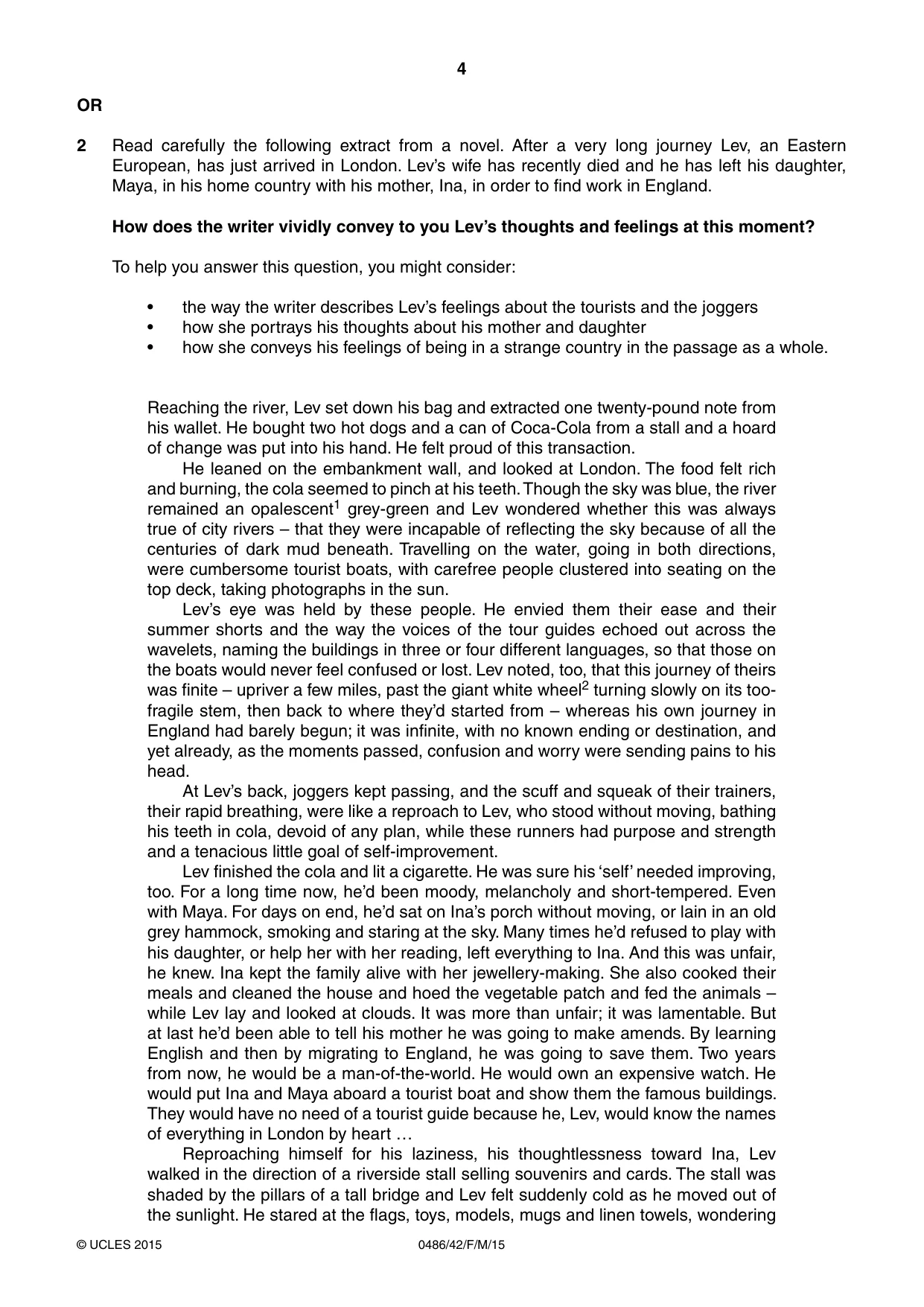
4 0486/42/F/M/15 © UCLES 2015 OR 2 Read carefully the following extract from a novel. After a very long journey Lev, an Eastern European, has just arrived in London. Lev’s wife has recently died and he has left his daughter, Maya, in his home country with his mother, Ina, in order to find work in England. How does the writer vividly convey to you Lev’s thoughts and feelings at this moment? To help you answer this question, you might consider: • the way the writer describes Lev’s feelings about the tourists and the joggers • how she portrays his thoughts about his mother and daughter • how she conveys his feelings of being in a strange country in the passage as a whole. Reaching the river, Lev set down his bag and extracted one twenty-pound note from his wallet. He bought two hot dogs and a can of Coca-Cola from a stall and a hoard of change was put into his hand. He felt proud of this transaction. He leaned on the embankment wall, and looked at London. The food felt rich and burning, the cola seemed to pinch at his teeth. Though the sky was blue, the river remained an opalescent1 grey-green and Lev wondered whether this was always true of city rivers – that they were incapable of reflecting the sky because of all the centuries of dark mud beneath. Travelling on the water, going in both directions, were cumbersome tourist boats, with carefree people clustered into seating on the top deck, taking photographs in the sun. Lev’s eye was held by these people. He envied them their ease and their summer shorts and the way the voices of the tour guides echoed out across the wavelets, naming the buildings in three or four different languages, so that those on the boats would never feel confused or lost. Lev noted, too, that this journey of theirs was finite – upriver a few miles, past the giant white wheel2 turning slowly on its too- fragile stem, then back to where they’d started from – whereas his own journey in England had barely begun; it was infinite, with no known ending or destination, and yet already, as the moments passed, confusion and worry were sending pains to his head. At Lev’s back, joggers kept passing, and the scuff and squeak of their trainers, their rapid breathing, were like a reproach to Lev, who stood without moving, bathing his teeth in cola, devoid of any plan, while these runners had purpose and strength and a tenacious little goal of self-improvement. Lev finished the cola and lit a cigarette. He was sure his ‘self’ needed improving, too. For a long time now, he’d been moody, melancholy and short-tempered. Even with Maya. For days on end, he’d sat on Ina’s porch without moving, or lain in an old grey hammock, smoking and staring at the sky. Many times he’d refused to play with his daughter, or help her with her reading, left everything to Ina. And this was unfair, he knew. Ina kept the family alive with her jewellery-making. She also cooked their meals and cleaned the house and hoed the vegetable patch and fed the animals – while Lev lay and looked at clouds. It was more than unfair; it was lamentable. But at last he’d been able to tell his mother he was going to make amends. By learning English and then by migrating to England, he was going to save them. Two years from now, he would be a man-of-the-world. He would own an expensive watch. He would put Ina and Maya aboard a tourist boat and show them the famous buildings. They would have no need of a tourist guide because he, Lev, would know the names of everything in London by heart … Reproaching himself for his laziness, his thoughtlessness toward Ina, Lev walked in the direction of a riverside stall selling souvenirs and cards. The stall was shaded by the pillars of a tall bridge and Lev felt suddenly cold as he moved out of the sunlight. He stared at the flags, toys, models, mugs and linen towels, wondering
Question paper, page 5
5 0486/42/F/M/15 © UCLES 2015 what to buy for his mother. The stall-holder watched him lazily from his corner in the shadows. Lev knew that Ina would like the towels – the linen felt thick and hard- wearing – but the price on them was £5.99, so he moved away. Slowly, he turned the rack of postcards, and scenes from life in London revolved obediently in front of him. Then he saw the thing he knew he would have to buy: it was a greetings card in the shape of Princess Diana’s3 head. On her face was her famous, heartbreaking smile and in her blonde hair nestled a diamond tiara and the blue of her eyes was startling and sad. Buying the Diana card exhausted Lev. As he slouched back into the sunshine, he felt spent, lame, at the end of what he could endure that day. He had to find a bed somewhere and lie down. 1 opalescent : changing colour 2 the giant white wheel : ‘The London Eye’, a famous Ferris wheel and tourist attraction 3 Princess Diana: a member of the British Royal Family
Question paper, page 6
6 0486/42/F/M/15 © UCLES 2015 BLANK PAGE
Question paper, page 7
7 0486/42/F/M/15 © UCLES 2015 BLANK PAGE
Question paper, page 8
8 0486/42/F/M/15 © UCLES 2015 BLANK PAGE Permission to reproduce items where third-party owned material protected by copyright is included has been sought and cleared where possible. Every reasonable effort has been made by the publisher (UCLES) to trace copyright holders, but if any items requiring clearance have unwittingly been included, the publisher will be pleased to make amends at the earliest possible opportunity. To avoid the issue of disclosure of answer-related information to candidates, all copyright acknowledgements are reproduced online in the Cambridge International Examinations Copyright Acknowledgements Booklet. This is produced for each series of examinations and is freely available to download at www.cie.org.uk after the live examination series. Cambridge International Examinations is part of the Cambridge Assessment Group. Cambridge Assessment is the brand name of University of Cambridge Local Examinations Syndicate (UCLES), which is itself a department of the University of Cambridge.
Mark scheme, page 1
® IGCSE is the registered trademark of Cambridge International Examinations. CAMBRIDGE INTERNATIONAL EXAMINATIONS Cambridge International General Certificate of Secondary Education MARK SCHEME for the March 2015 series 0486 LITERATURE (ENGLISH) 0486/42 Paper 4 (Unseen), maximum raw mark 25 This mark scheme is published as an aid to teachers and candidates, to indicate the requirements of the examination. It shows the basis on which Examiners were instructed to award marks. It does not indicate the details of the discussions that took place at an Examiners’ meeting before marking began, which would have considered the acceptability of alternative answers. Mark schemes should be read in conjunction with the question paper and the Principal Examiner Report for Teachers. Cambridge will not enter into discussions about these mark schemes. Cambridge is publishing the mark schemes for the March 2015 series for most Cambridge IGCSE® components.
Mark scheme, page 2
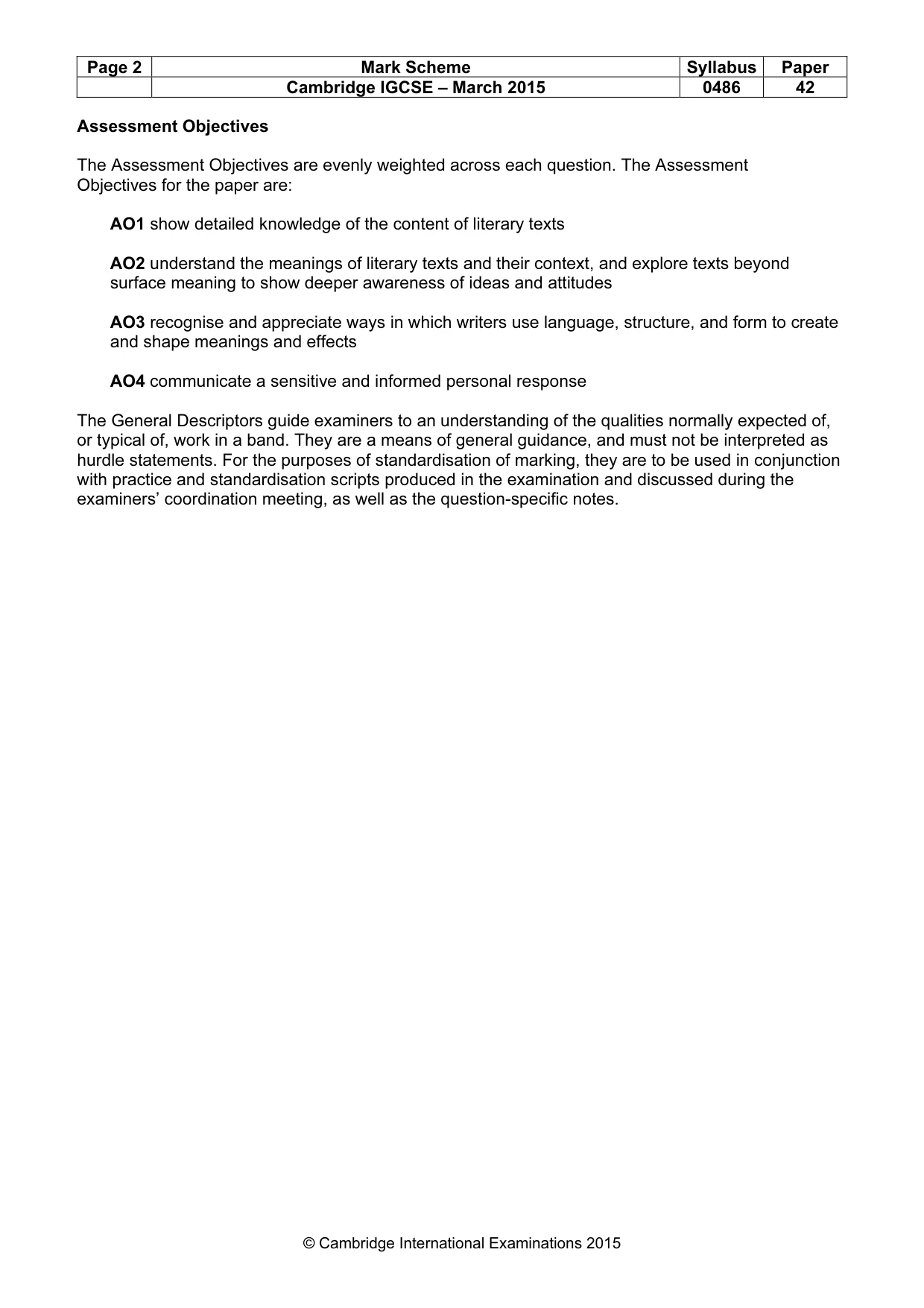
Page 2 Mark Scheme Syllabus Paper Cambridge IGCSE – March 2015 0486 42 © Cambridge International Examinations 2015 Assessment Objectives The Assessment Objectives are evenly weighted across each question. The Assessment Objectives for the paper are: AO1 show detailed knowledge of the content of literary texts AO2 understand the meanings of literary texts and their context, and explore texts beyond surface meaning to show deeper awareness of ideas and attitudes AO3 recognise and appreciate ways in which writers use language, structure, and form to create and shape meanings and effects AO4 communicate a sensitive and informed personal response The General Descriptors guide examiners to an understanding of the qualities normally expected of, or typical of, work in a band. They are a means of general guidance, and must not be interpreted as hurdle statements. For the purposes of standardisation of marking, they are to be used in conjunction with practice and standardisation scripts produced in the examination and discussed during the examiners’ coordination meeting, as well as the question-specific notes.
Mark scheme, page 3
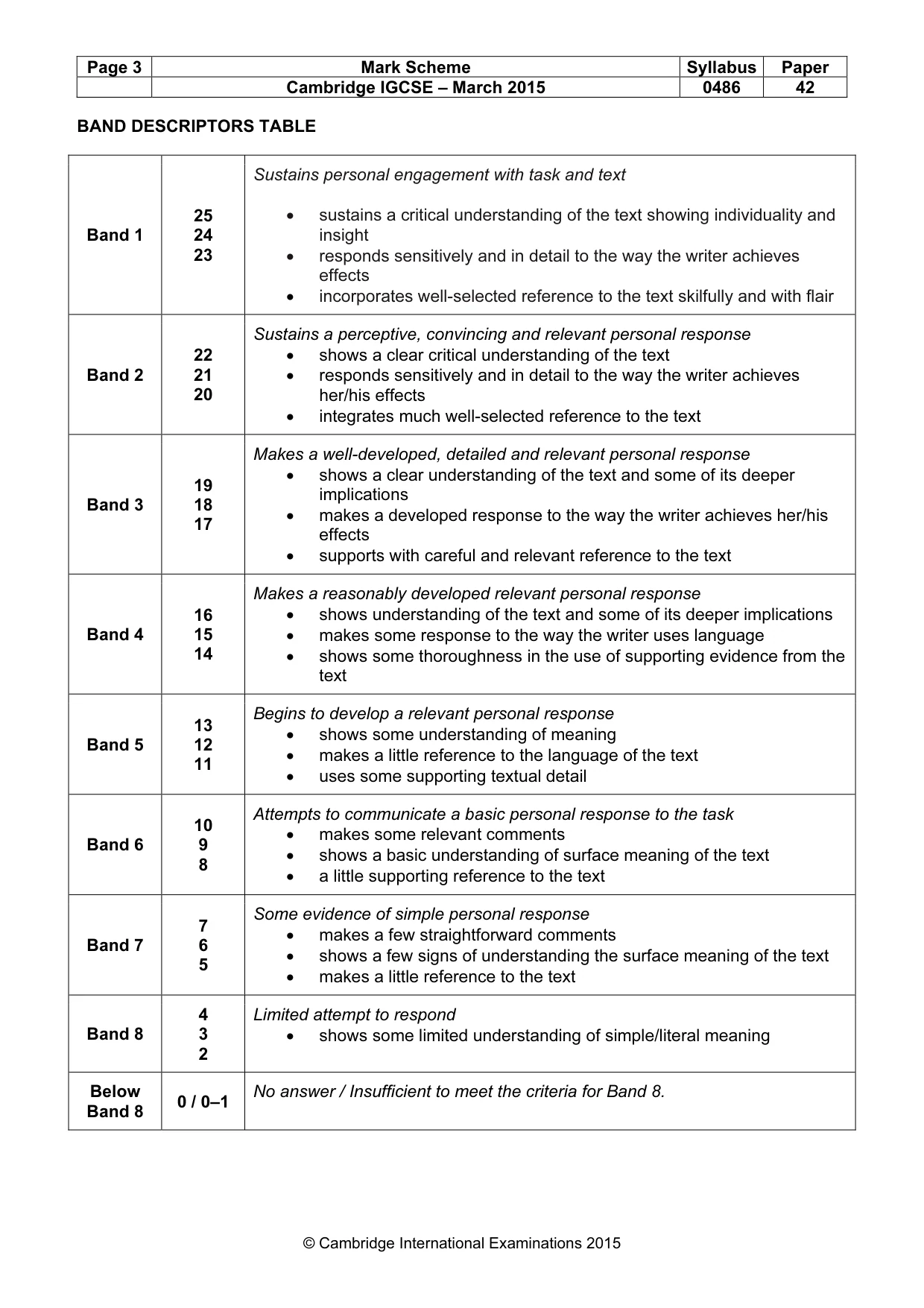
Page 3 Mark Scheme Syllabus Paper Cambridge IGCSE – March 2015 0486 42 © Cambridge International Examinations 2015 BAND DESCRIPTORS TABLE Band 1 25 24 23 Sustains personal engagement with task and text • sustains a critical understanding of the text showing individuality and insight • responds sensitively and in detail to the way the writer achieves effects • incorporates well-selected reference to the text skilfully and with flair Band 2 22 21 20 Sustains a perceptive, convincing and relevant personal response • shows a clear critical understanding of the text • responds sensitively and in detail to the way the writer achieves her/his effects • integrates much well-selected reference to the text Band 3 19 18 17 Makes a well-developed, detailed and relevant personal response • shows a clear understanding of the text and some of its deeper implications • makes a developed response to the way the writer achieves her/his effects • supports with careful and relevant reference to the text Band 4 16 15 14 Makes a reasonably developed relevant personal response • shows understanding of the text and some of its deeper implications • makes some response to the way the writer uses language • shows some thoroughness in the use of supporting evidence from the text Band 5 13 12 11 Begins to develop a relevant personal response • shows some understanding of meaning • makes a little reference to the language of the text • uses some supporting textual detail Band 6 10 9 8 Attempts to communicate a basic personal response to the task • makes some relevant comments • shows a basic understanding of surface meaning of the text • a little supporting reference to the text Band 7 7 6 5 Some evidence of simple personal response • makes a few straightforward comments • shows a few signs of understanding the surface meaning of the text • makes a little reference to the text Band 8 4 3 2 Limited attempt to respond • shows some limited understanding of simple/literal meaning Below Band 8 0 / 0–1 No answer / Insufficient to meet the criteria for Band 8.
What you needed in this session
Cambridge’s own grade thresholds for 2015 Feb/March, Paper 4 · Variant 2. A higher threshold means an easier paper — the bar moves with how the cohort did.