Cambridge IGCSE English - Literature 0486 — 2015 Feb/March Paper 3 · Variant 2
0486/32/F/M/15 · 25 marks · ≈28 min
The question paper and its mark scheme, free to read here and free to download. This is Cambridge’s own paper, exactly as it was sat.
Question paper16 pages



Mark scheme3 pages
Answers below. Sit the paper first if you are practising.
Paper as text
Question paper, page 1
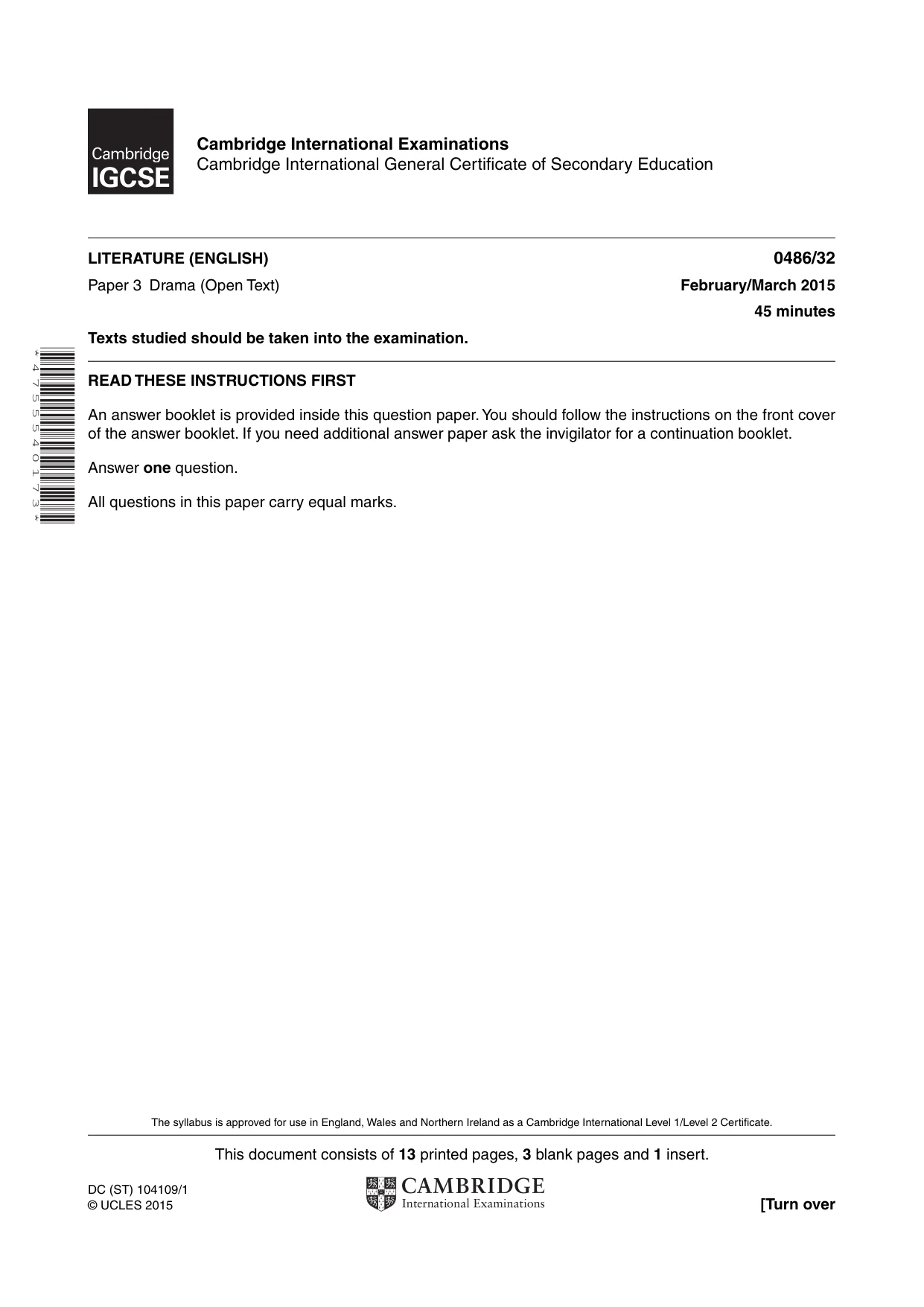
This document consists of 13 printed pages, 3 blank pages and 1 insert. DC (ST) 104109/1 © UCLES 2015 [Turn over Cambridge International Examinations Cambridge International General Certificate of Secondary Education * 4 7 5 5 5 4 0 1 7 3 * LITERATURE (ENGLISH) 0486/32 Paper 3 Drama (Open Text) February/March 2015 45 minutes Texts studied should be taken into the examination. READ THESE INSTRUCTIONS FIRST An answer booklet is provided inside this question paper. You should follow the instructions on the front cover of the answer booklet. If you need additional answer paper ask the invigilator for a continuation booklet. Answer one question. All questions in this paper carry equal marks. The syllabus is approved for use in England, Wales and Northern Ireland as a Cambridge International Level 1/Level 2 Certificate.
Question paper, page 2
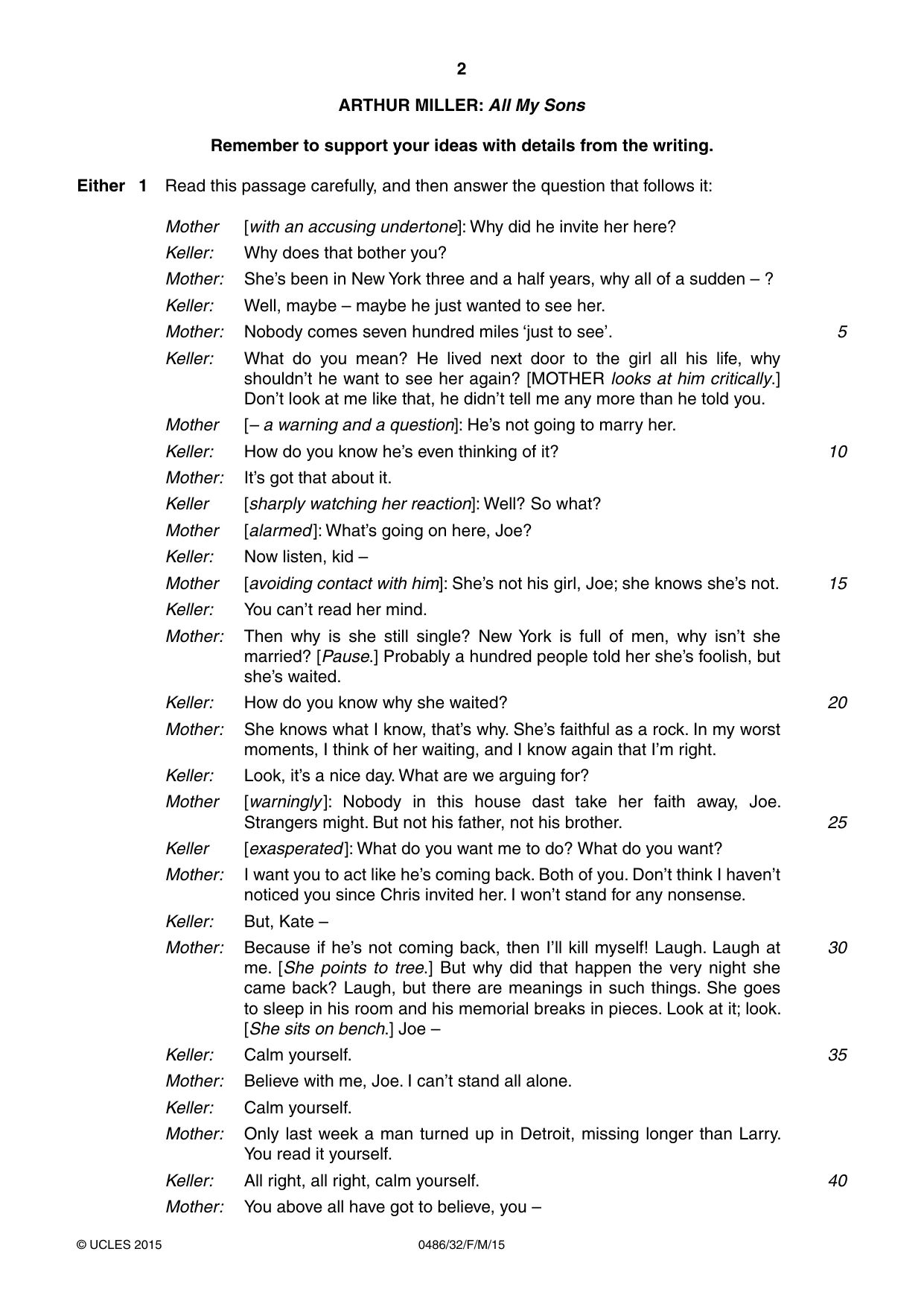
2 0486/32/F/M/15 © UCLES 2015 ARTHUR MILLER: All My Sons Remember to support your ideas with details from the writing. Either 1 Read this passage carefully, and then answer the question that follows it: Mother [with an accusing undertone]: Why did he invite her here? Keller: Why does that bother you? Mother: She’s been in New York three and a half years, why all of a sudden – ? Keller: Well, maybe – maybe he just wanted to see her. Mother: Nobody comes seven hundred miles ‘just to see’. Keller: What do you mean? He lived next door to the girl all his life, why shouldn’t he want to see her again? [MOTHER looks at him critically.] Don’t look at me like that, he didn’t tell me any more than he told you. Mother [– a warning and a question]: He’s not going to marry her. Keller: How do you know he’s even thinking of it? Mother: It’s got that about it. Keller [sharply watching her reaction]: Well? So what? Mother [alarmed ]: What’s going on here, Joe? Keller: Now listen, kid – Mother [avoiding contact with him]: She’s not his girl, Joe; she knows she’s not. Keller: You can’t read her mind. Mother: Then why is she still single? New York is full of men, why isn’t she married? [Pause.] Probably a hundred people told her she’s foolish, but she’s waited. Keller: How do you know why she waited? Mother: She knows what I know, that’s why. She’s faithful as a rock. In my worst moments, I think of her waiting, and I know again that I’m right. Keller: Look, it’s a nice day. What are we arguing for? Mother [warningly ]: Nobody in this house dast take her faith away, Joe. Strangers might. But not his father, not his brother. Keller [exasperated ]: What do you want me to do? What do you want? Mother: I want you to act like he’s coming back. Both of you. Don’t think I haven’t noticed you since Chris invited her. I won’t stand for any nonsense. Keller: But, Kate – Mother: Because if he’s not coming back, then I’ll kill myself! Laugh. Laugh at me. [She points to tree.] But why did that happen the very night she came back? Laugh, but there are meanings in such things. She goes to sleep in his room and his memorial breaks in pieces. Look at it; look. [She sits on bench.] Joe – Keller: Calm yourself. Mother: Believe with me, Joe. I can’t stand all alone. Keller: Calm yourself. Mother: Only last week a man turned up in Detroit, missing longer than Larry. You read it yourself. Keller: All right, all right, calm yourself. Mother: You above all have got to believe, you – 5 10 15 20 25 30 35 40
Question paper, page 3
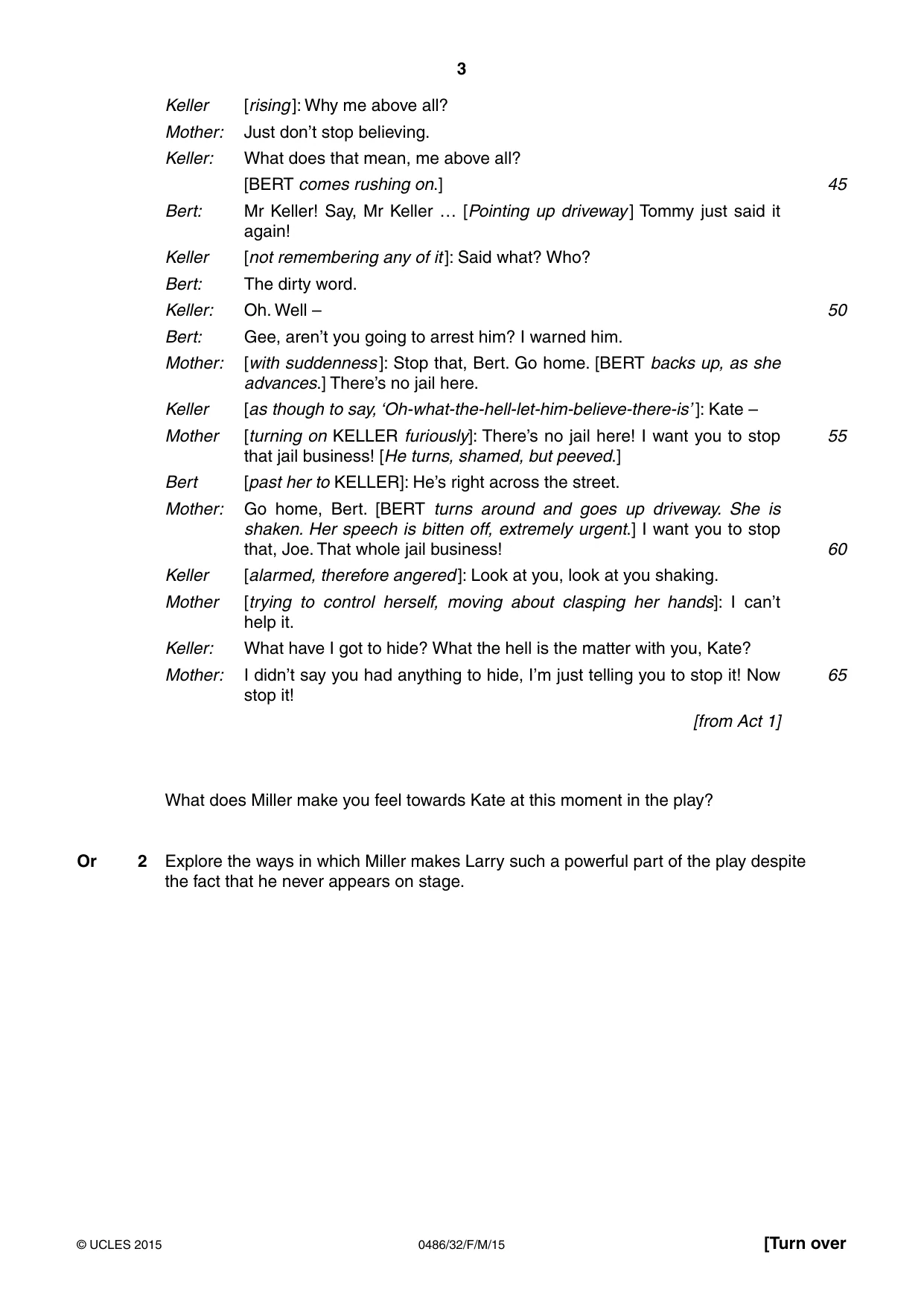
3 0486/32/F/M/15 © UCLES 2015 [Turn over Keller [rising ]: Why me above all? Mother: Just don’t stop believing. Keller: What does that mean, me above all? [BERT comes rushing on.] Bert: Mr Keller! Say, Mr Keller … [Pointing up driveway ] Tommy just said it again! Keller [not remembering any of it ]: Said what? Who? Bert: The dirty word. Keller: Oh. Well – Bert: Gee, aren’t you going to arrest him? I warned him. Mother: [with suddenness ]: Stop that, Bert. Go home. [BERT backs up, as she advances.] There’s no jail here. Keller [as though to say, ‘Oh-what-the-hell-let-him-believe-there-is’ ]: Kate – Mother [turning on KELLER furiously]: There’s no jail here! I want you to stop that jail business! [He turns, shamed, but peeved.] Bert [past her to KELLER]: He’s right across the street. Mother: Go home, Bert. [BERT turns around and goes up driveway. She is shaken. Her speech is bitten off, extremely urgent.] I want you to stop that, Joe. That whole jail business! Keller [alarmed, therefore angered ]: Look at you, look at you shaking. Mother [trying to control herself, moving about clasping her hands]: I can’t help it. Keller: What have I got to hide? What the hell is the matter with you, Kate? Mother: I didn’t say you had anything to hide, I’m just telling you to stop it! Now stop it! [from Act 1] What does Miller make you feel towards Kate at this moment in the play? Or 2 Explore the ways in which Miller makes Larry such a powerful part of the play despite the fact that he never appears on stage. 45 50 55 60 65
Question paper, page 4
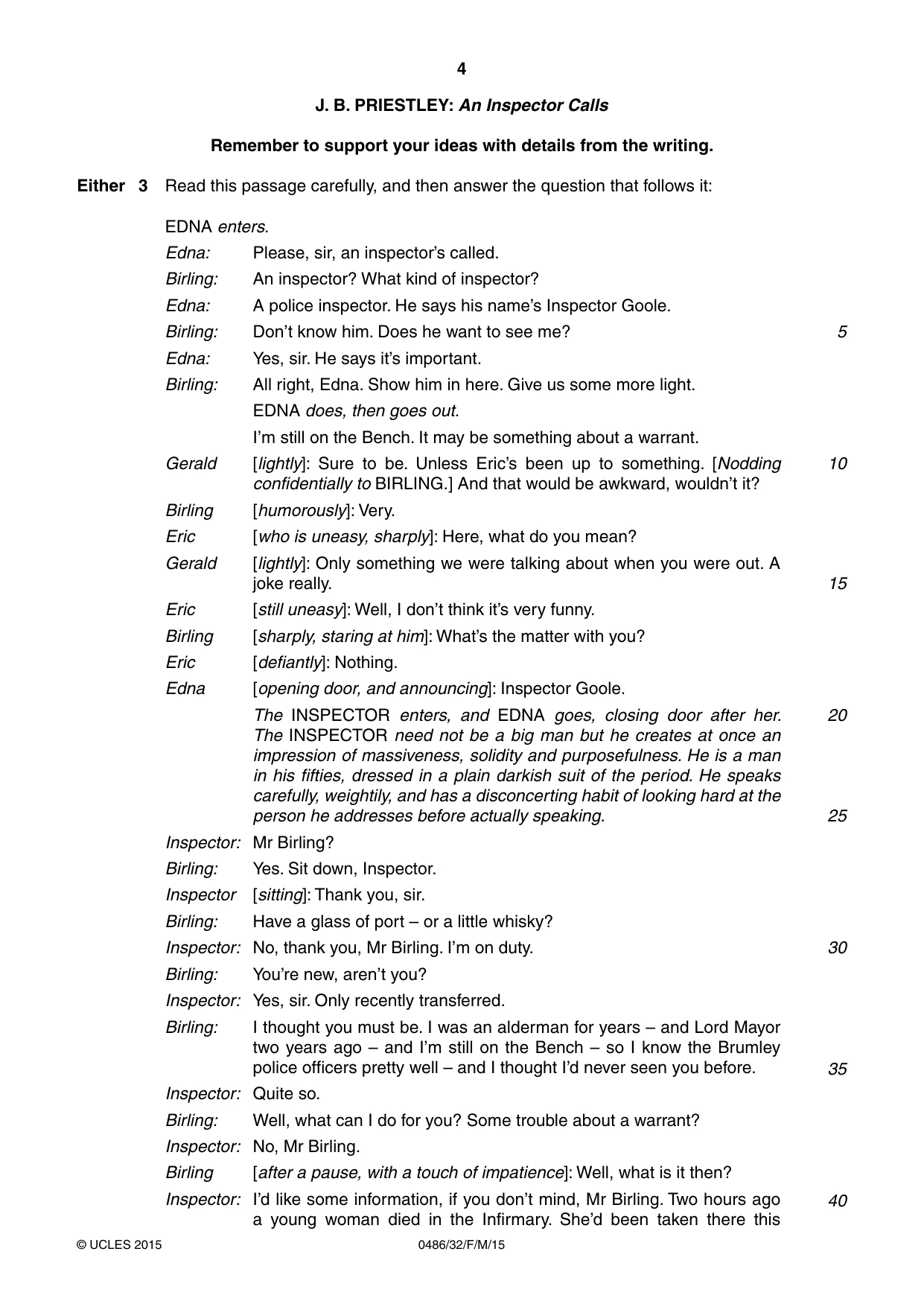
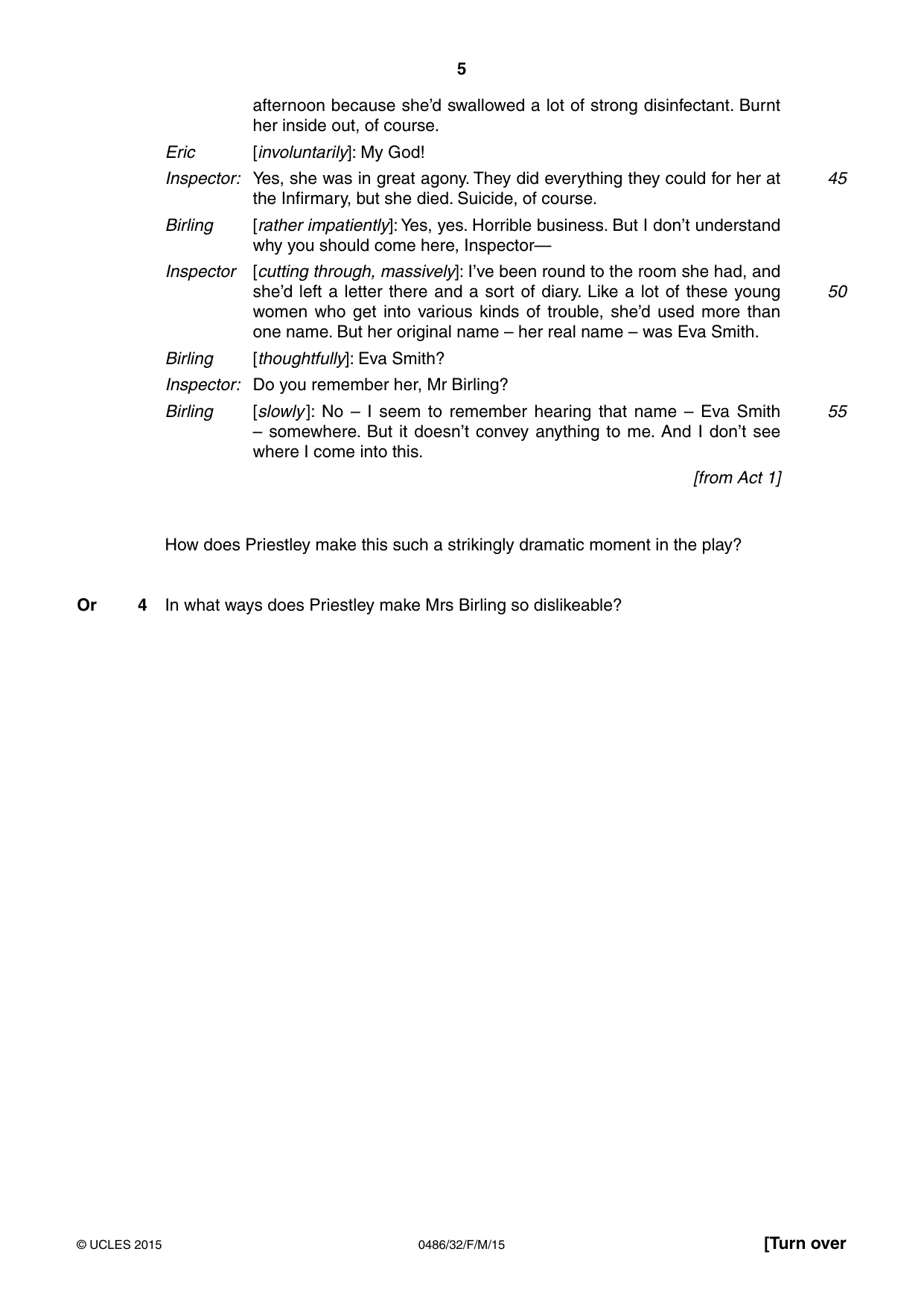
4 0486/32/F/M/15 © UCLES 2015 J. B. PRIESTLEY: An Inspector Calls Remember to support your ideas with details from the writing. Either 3 Read this passage carefully, and then answer the question that follows it: EDNA enters. Edna: Please, sir, an inspector’s called. Birling: An inspector? What kind of inspector? Edna: A police inspector. He says his name’s Inspector Goole. Birling: Don’t know him. Does he want to see me? Edna: Yes, sir. He says it’s important. Birling: All right, Edna. Show him in here. Give us some more light. EDNA does, then goes out. I’m still on the Bench. It may be something about a warrant. Gerald [lightly]: Sure to be. Unless Eric’s been up to something. [Nodding confidentially to BIRLING.] And that would be awkward, wouldn’t it? Birling [humorously]: Very. Eric [who is uneasy, sharply]: Here, what do you mean? Gerald [lightly]: Only something we were talking about when you were out. A joke really. Eric [still uneasy]: Well, I don’t think it’s very funny. Birling [sharply, staring at him]: What’s the matter with you? Eric [defiantly]: Nothing. Edna [opening door, and announcing]: Inspector Goole. The INSPECTOR enters, and EDNA goes, closing door after her. The INSPECTOR need not be a big man but he creates at once an impression of massiveness, solidity and purposefulness. He is a man in his fifties, dressed in a plain darkish suit of the period. He speaks carefully, weightily, and has a disconcerting habit of looking hard at the person he addresses before actually speaking. Inspector: Mr Birling? Birling: Yes. Sit down, Inspector. Inspector [sitting]: Thank you, sir. Birling: Have a glass of port – or a little whisky? Inspector: No, thank you, Mr Birling. I’m on duty. Birling: You’re new, aren’t you? Inspector: Yes, sir. Only recently transferred. Birling: I thought you must be. I was an alderman for years – and Lord Mayor two years ago – and I’m still on the Bench – so I know the Brumley police officers pretty well – and I thought I’d never seen you before. Inspector: Quite so. Birling: Well, what can I do for you? Some trouble about a warrant? Inspector: No, Mr Birling. Birling [after a pause, with a touch of impatience]: Well, what is it then? Inspector: I’d like some information, if you don’t mind, Mr Birling. Two hours ago a young woman died in the Infirmary. She’d been taken there this 5 10 15 20 25 30 35 40
Question paper, page 5
5 0486/32/F/M/15 © UCLES 2015 [Turn over afternoon because she’d swallowed a lot of strong disinfectant. Burnt her inside out, of course. Eric [involuntarily]: My God! Inspector: Yes, she was in great agony. They did everything they could for her at the Infirmary, but she died. Suicide, of course. Birling [rather impatiently]: Yes, yes. Horrible business. But I don’t understand why you should come here, Inspector— Inspector [cutting through, massively]: I’ve been round to the room she had, and she’d left a letter there and a sort of diary. Like a lot of these young women who get into various kinds of trouble, she’d used more than one name. But her original name – her real name – was Eva Smith. Birling [thoughtfully]: Eva Smith? Inspector: Do you remember her, Mr Birling? Birling [slowly ]: No – I seem to remember hearing that name – Eva Smith – somewhere. But it doesn’t convey anything to me. And I don’t see where I come into this. [from Act 1] How does Priestley make this such a strikingly dramatic moment in the play? Or 4 In what ways does Priestley make Mrs Birling so dislikeable? 45 50 55
Question paper, page 6
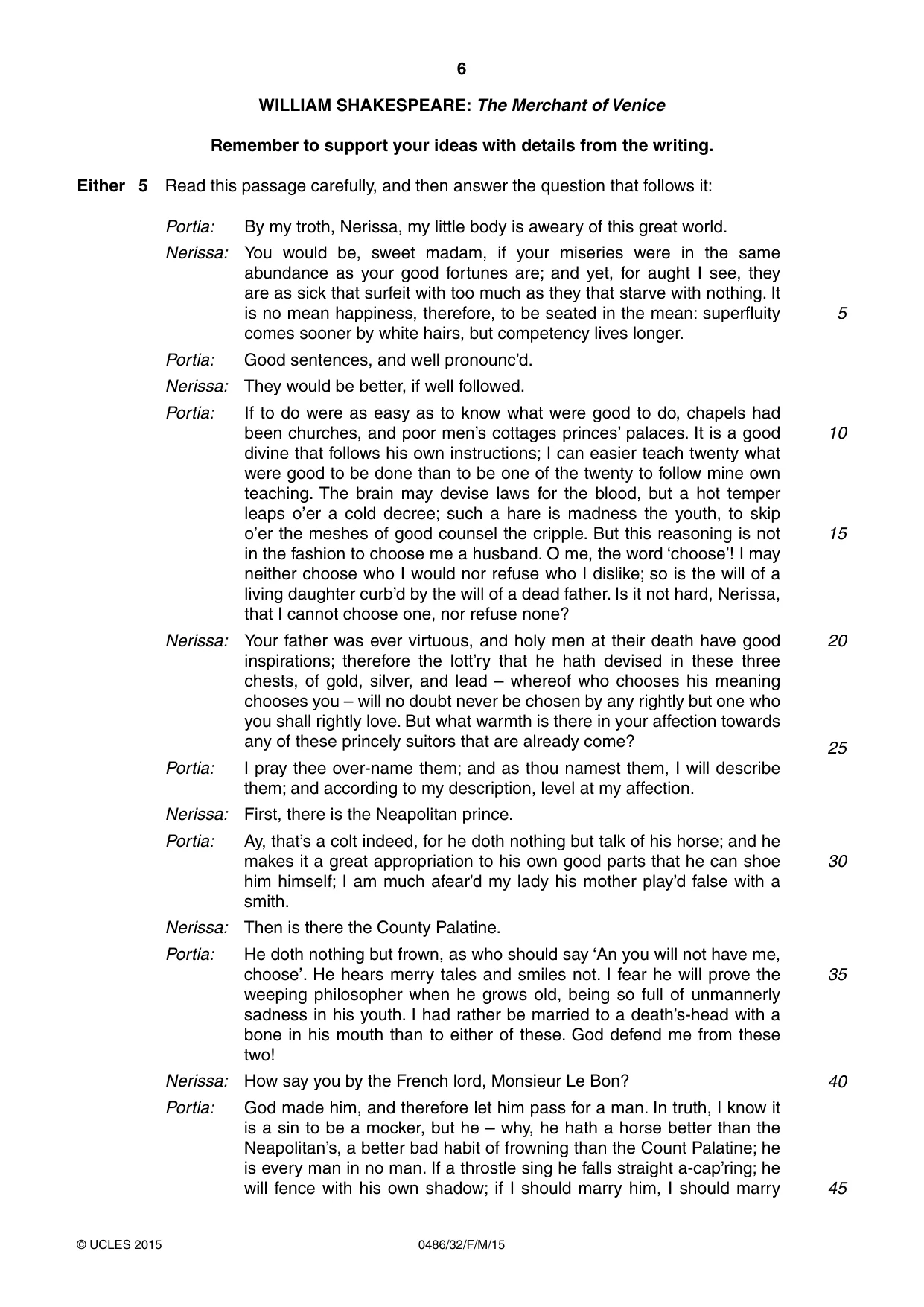
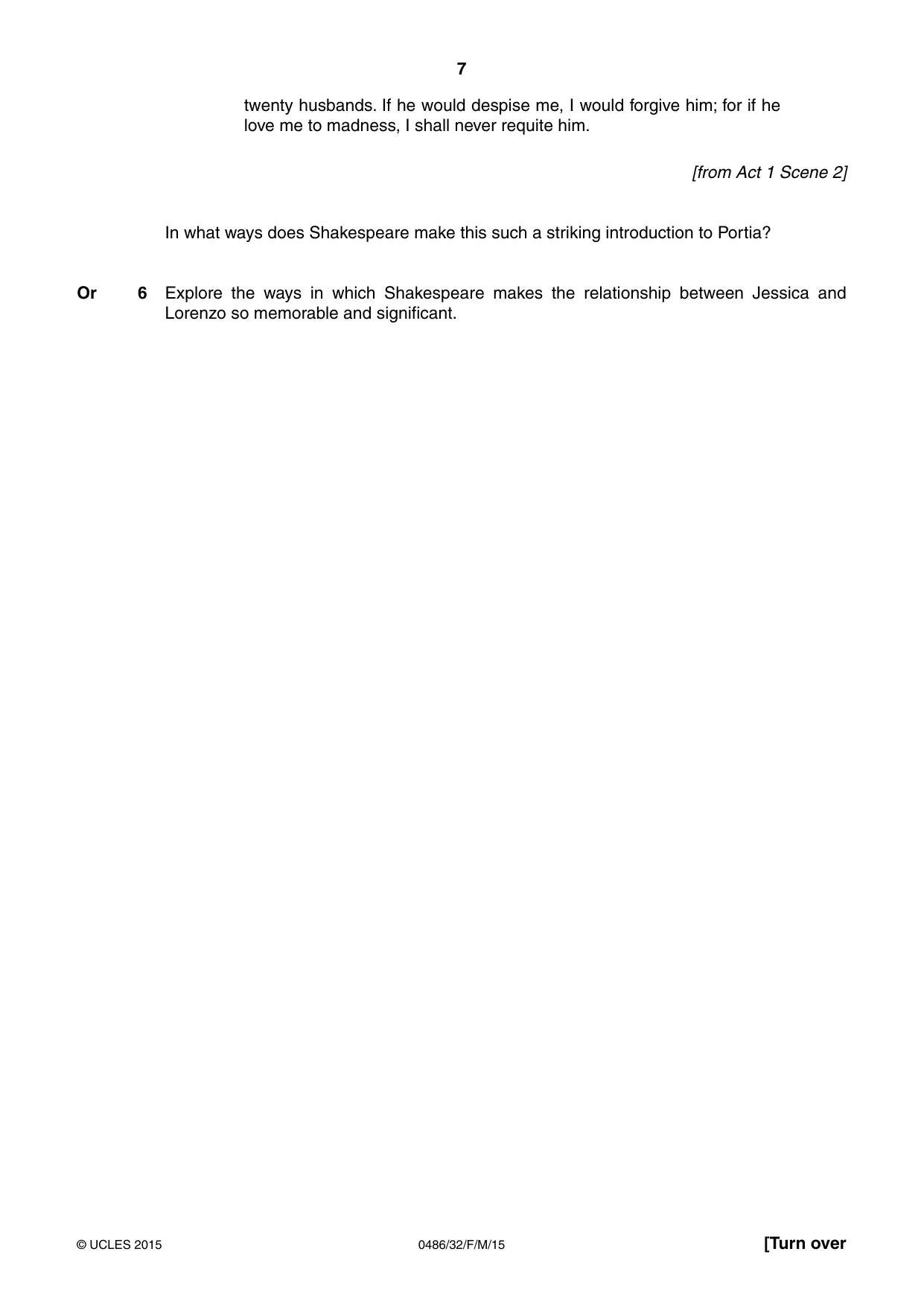
6 0486/32/F/M/15 © UCLES 2015 WILLIAM SHAKESPEARE: The Merchant of Venice Remember to support your ideas with details from the writing. Either 5 Read this passage carefully, and then answer the question that follows it: Portia: By my troth, Nerissa, my little body is aweary of this great world. Nerissa: You would be, sweet madam, if your miseries were in the same abundance as your good fortunes are; and yet, for aught I see, they are as sick that surfeit with too much as they that starve with nothing. It is no mean happiness, therefore, to be seated in the mean: superfluity comes sooner by white hairs, but competency lives longer. Portia: Good sentences, and well pronounc’d. Nerissa: They would be better, if well followed. Portia: If to do were as easy as to know what were good to do, chapels had been churches, and poor men’s cottages princes’ palaces. It is a good divine that follows his own instructions; I can easier teach twenty what were good to be done than to be one of the twenty to follow mine own teaching. The brain may devise laws for the blood, but a hot temper leaps o’er a cold decree; such a hare is madness the youth, to skip o’er the meshes of good counsel the cripple. But this reasoning is not in the fashion to choose me a husband. O me, the word ‘choose’! I may neither choose who I would nor refuse who I dislike; so is the will of a living daughter curb’d by the will of a dead father. Is it not hard, Nerissa, that I cannot choose one, nor refuse none? Nerissa: Your father was ever virtuous, and holy men at their death have good inspirations; therefore the lott’ry that he hath devised in these three chests, of gold, silver, and lead – whereof who chooses his meaning chooses you – will no doubt never be chosen by any rightly but one who you shall rightly love. But what warmth is there in your affection towards any of these princely suitors that are already come? Portia: I pray thee over-name them; and as thou namest them, I will describe them; and according to my description, level at my affection. Nerissa: First, there is the Neapolitan prince. Portia: Ay, that’s a colt indeed, for he doth nothing but talk of his horse; and he makes it a great appropriation to his own good parts that he can shoe him himself; I am much afear’d my lady his mother play’d false with a smith. Nerissa: Then is there the County Palatine. Portia: He doth nothing but frown, as who should say ‘An you will not have me, choose’. He hears merry tales and smiles not. I fear he will prove the weeping philosopher when he grows old, being so full of unmannerly sadness in his youth. I had rather be married to a death’s-head with a bone in his mouth than to either of these. God defend me from these two! Nerissa: How say you by the French lord, Monsieur Le Bon? Portia: God made him, and therefore let him pass for a man. In truth, I know it is a sin to be a mocker, but he – why, he hath a horse better than the Neapolitan’s, a better bad habit of frowning than the Count Palatine; he is every man in no man. If a throstle sing he falls straight a-cap’ring; he will fence with his own shadow; if I should marry him, I should marry 5 10 15 20 25 30 35 40 45
Question paper, page 7
7 0486/32/F/M/15 © UCLES 2015 [Turn over twenty husbands. If he would despise me, I would forgive him; for if he love me to madness, I shall never requite him. [from Act 1 Scene 2] In what ways does Shakespeare make this such a striking introduction to Portia? Or 6 Explore the ways in which Shakespeare makes the relationship between Jessica and Lorenzo so memorable and significant.
Question paper, page 8
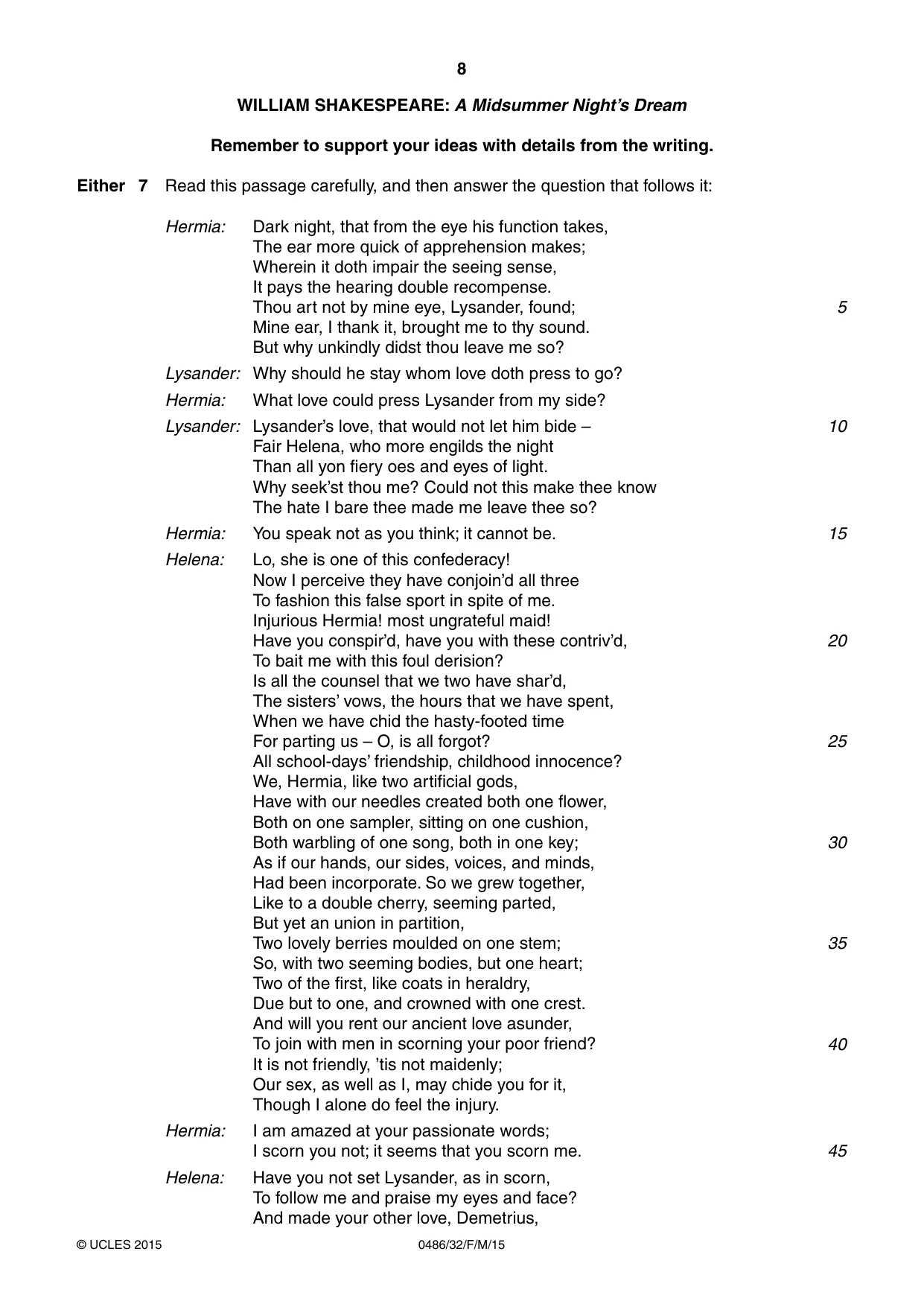
8 0486/32/F/M/15 © UCLES 2015 WILLIAM SHAKESPEARE: A Midsummer Night’s Dream Remember to support your ideas with details from the writing. Either 7 Read this passage carefully, and then answer the question that follows it: Hermia: Dark night, that from the eye his function takes, The ear more quick of apprehension makes; Wherein it doth impair the seeing sense, It pays the hearing double recompense. Thou art not by mine eye, Lysander, found; Mine ear, I thank it, brought me to thy sound. But why unkindly didst thou leave me so? Lysander: Why should he stay whom love doth press to go? Hermia: What love could press Lysander from my side? Lysander: Lysander’s love, that would not let him bide – Fair Helena, who more engilds the night Than all yon fiery oes and eyes of light. Why seek’st thou me? Could not this make thee know The hate I bare thee made me leave thee so? Hermia: You speak not as you think; it cannot be. Helena: Lo, she is one of this confederacy! Now I perceive they have conjoin’d all three To fashion this false sport in spite of me. Injurious Hermia! most ungrateful maid! Have you conspir’d, have you with these contriv’d, To bait me with this foul derision? Is all the counsel that we two have shar’d, The sisters’ vows, the hours that we have spent, When we have chid the hasty-footed time For parting us – O, is all forgot? All school-days’ friendship, childhood innocence? We, Hermia, like two artificial gods, Have with our needles created both one flower, Both on one sampler, sitting on one cushion, Both warbling of one song, both in one key; As if our hands, our sides, voices, and minds, Had been incorporate. So we grew together, Like to a double cherry, seeming parted, But yet an union in partition, Two lovely berries moulded on one stem; So, with two seeming bodies, but one heart; Two of the first, like coats in heraldry, Due but to one, and crowned with one crest. And will you rent our ancient love asunder, To join with men in scorning your poor friend? It is not friendly, ’tis not maidenly; Our sex, as well as I, may chide you for it, Though I alone do feel the injury. Hermia: I am amazed at your passionate words; I scorn you not; it seems that you scorn me. Helena: Have you not set Lysander, as in scorn, To follow me and praise my eyes and face? And made your other love, Demetrius, 5 10 15 20 25 30 35 40 45
Question paper, page 9
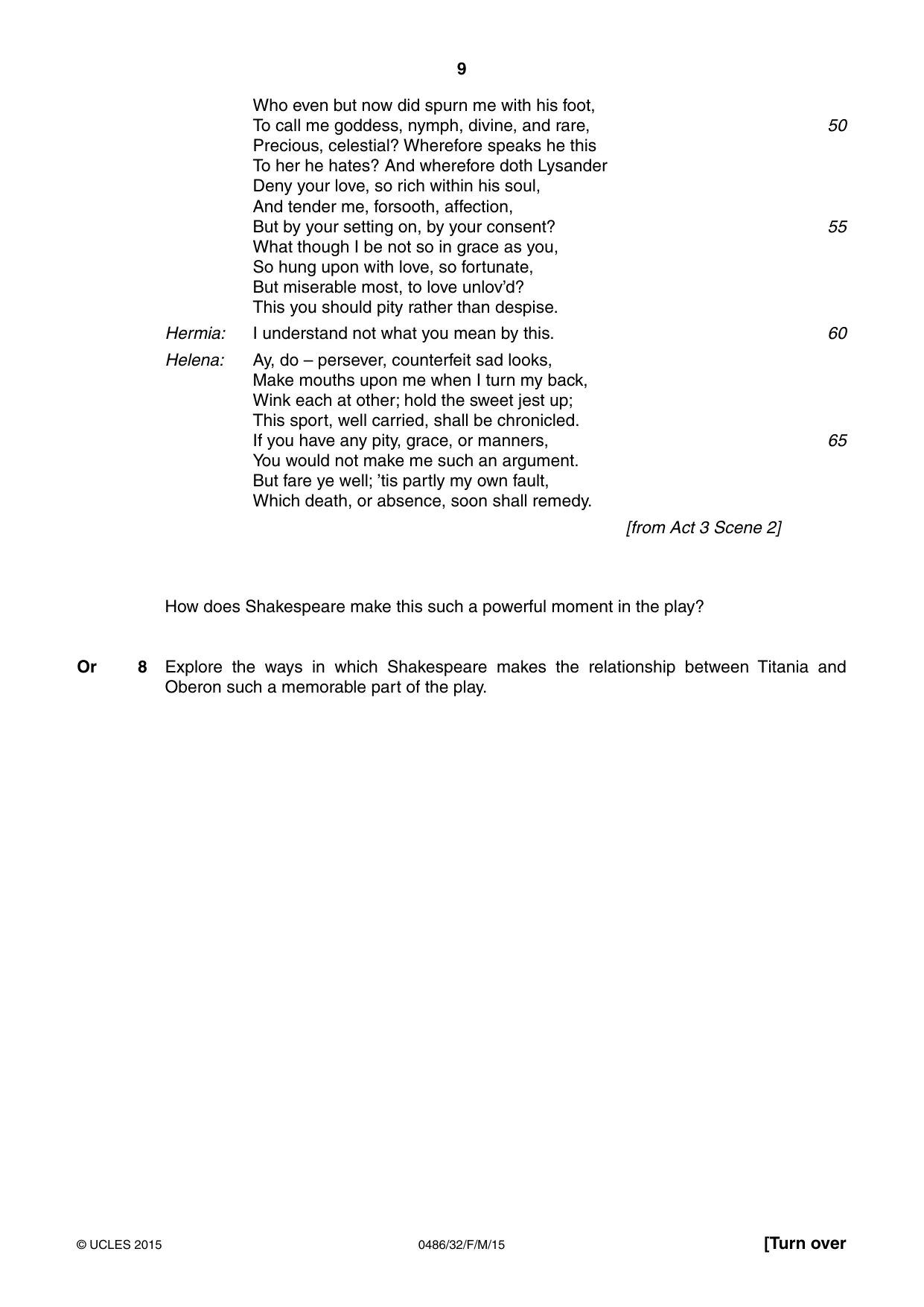
9 0486/32/F/M/15 © UCLES 2015 [Turn over Who even but now did spurn me with his foot, To call me goddess, nymph, divine, and rare, Precious, celestial? Wherefore speaks he this To her he hates? And wherefore doth Lysander Deny your love, so rich within his soul, And tender me, forsooth, affection, But by your setting on, by your consent? What though I be not so in grace as you, So hung upon with love, so fortunate, But miserable most, to love unlov’d? This you should pity rather than despise. Hermia: I understand not what you mean by this. Helena: Ay, do – persever, counterfeit sad looks, Make mouths upon me when I turn my back, Wink each at other; hold the sweet jest up; This sport, well carried, shall be chronicled. If you have any pity, grace, or manners, You would not make me such an argument. But fare ye well; ’tis partly my own fault, Which death, or absence, soon shall remedy. [from Act 3 Scene 2] How does Shakespeare make this such a powerful moment in the play? Or 8 Explore the ways in which Shakespeare makes the relationship between Titania and Oberon such a memorable part of the play. 50 55 60 65
Question paper, page 10
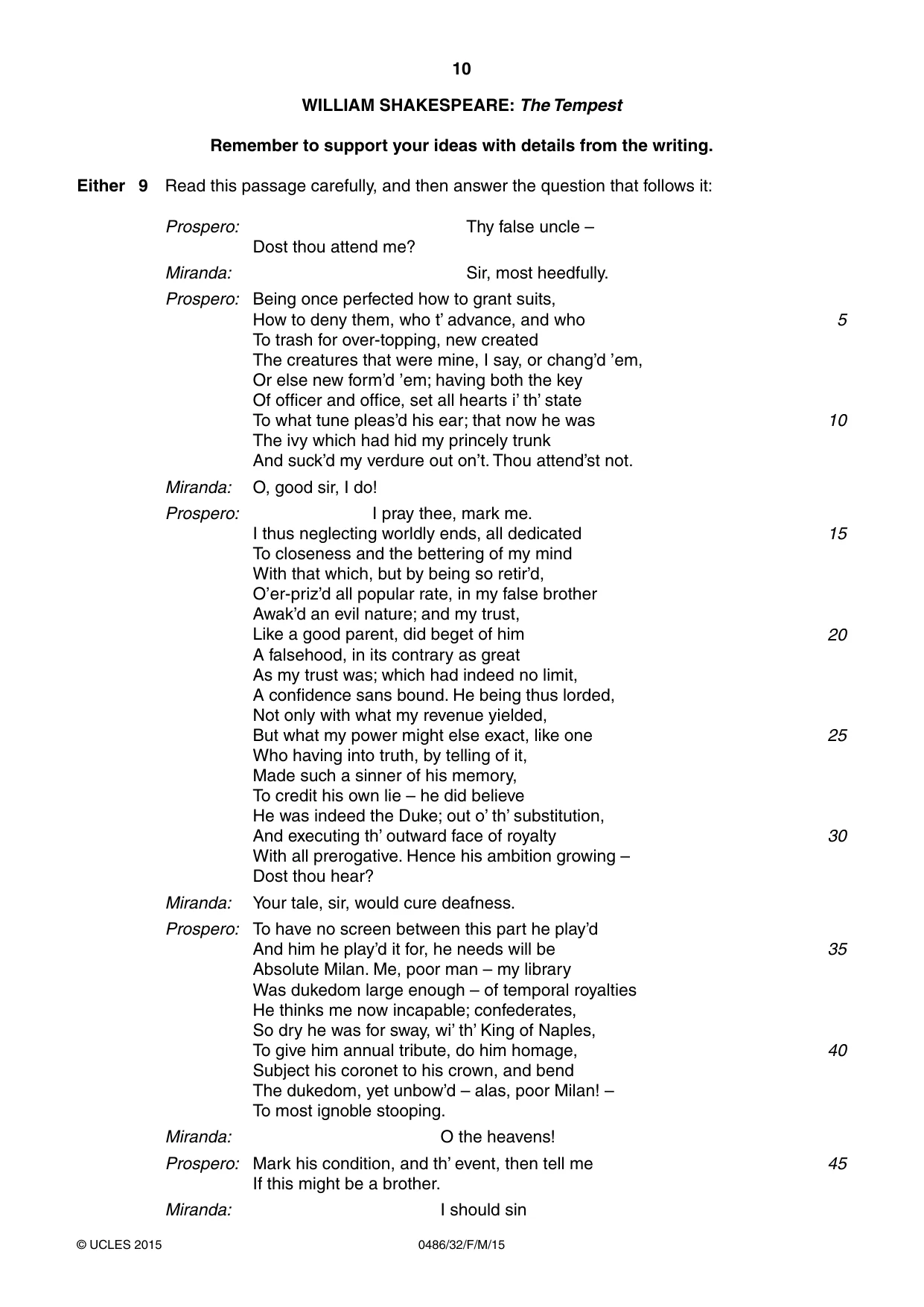
10 0486/32/F/M/15 © UCLES 2015 WILLIAM SHAKESPEARE: The Tempest Remember to support your ideas with details from the writing. Either 9 Read this passage carefully, and then answer the question that follows it: Prospero: Thy false uncle – Dost thou attend me? Miranda: Sir, most heedfully. Prospero: Being once perfected how to grant suits, How to deny them, who t’ advance, and who To trash for over-topping, new created The creatures that were mine, I say, or chang’d ’em, Or else new form’d ’em; having both the key Of officer and office, set all hearts i’ th’ state To what tune pleas’d his ear; that now he was The ivy which had hid my princely trunk And suck’d my verdure out on’t. Thou attend’st not. Miranda: O, good sir, I do! Prospero: I pray thee, mark me. I thus neglecting worldly ends, all dedicated To closeness and the bettering of my mind With that which, but by being so retir’d, O’er-priz’d all popular rate, in my false brother Awak’d an evil nature; and my trust, Like a good parent, did beget of him A falsehood, in its contrary as great As my trust was; which had indeed no limit, A confidence sans bound. He being thus lorded, Not only with what my revenue yielded, But what my power might else exact, like one Who having into truth, by telling of it, Made such a sinner of his memory, To credit his own lie – he did believe He was indeed the Duke; out o’ th’ substitution, And executing th’ outward face of royalty With all prerogative. Hence his ambition growing – Dost thou hear? Miranda: Your tale, sir, would cure deafness. Prospero: To have no screen between this part he play’d And him he play’d it for, he needs will be Absolute Milan. Me, poor man – my library Was dukedom large enough – of temporal royalties He thinks me now incapable; confederates, So dry he was for sway, wi’ th’ King of Naples, To give him annual tribute, do him homage, Subject his coronet to his crown, and bend The dukedom, yet unbow’d – alas, poor Milan! – To most ignoble stooping. Miranda: O the heavens! Prospero: Mark his condition, and th’ event, then tell me If this might be a brother. Miranda: I should sin 5 10 15 20 25 30 35 40 45
Question paper, page 11
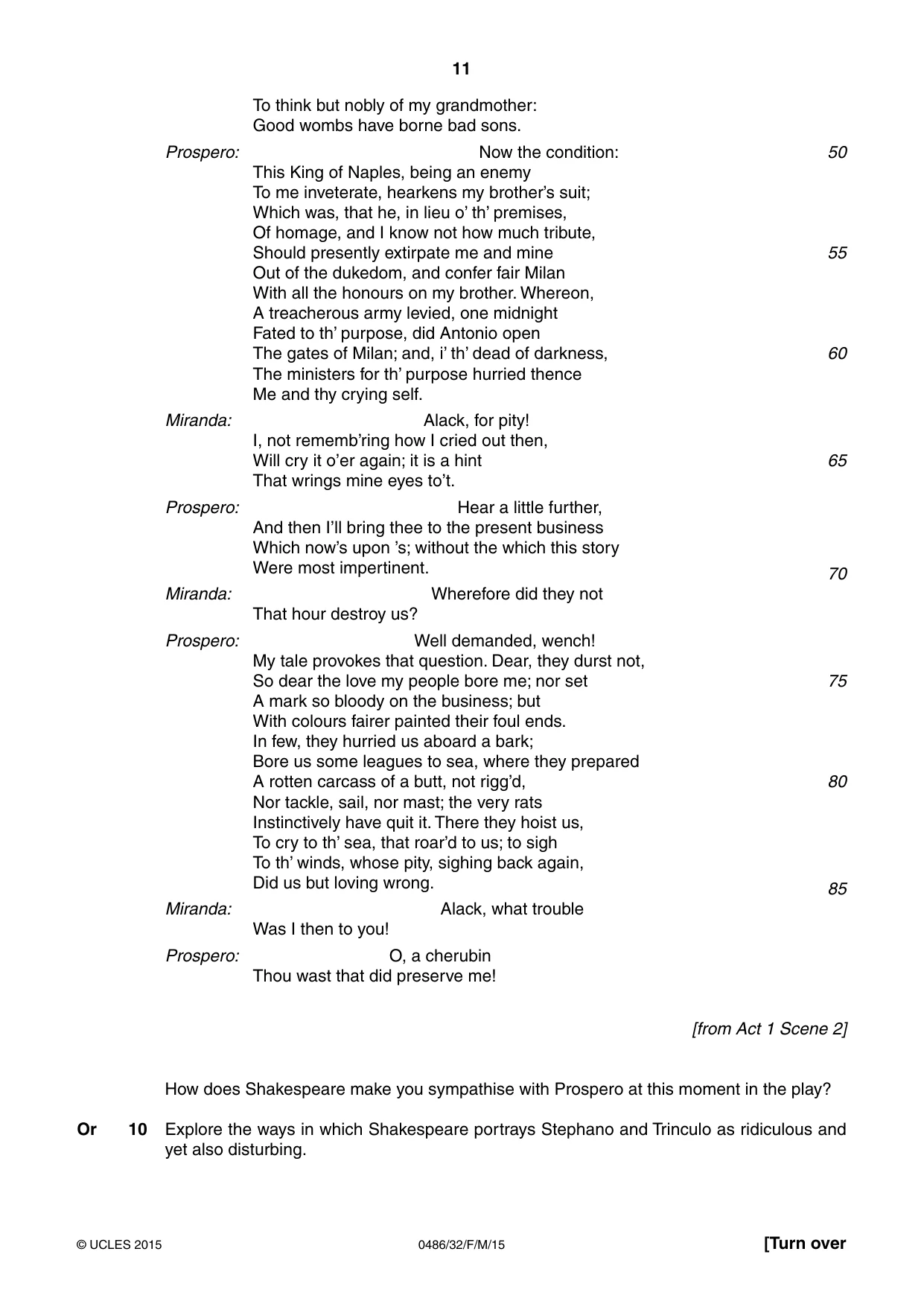
11 0486/32/F/M/15 © UCLES 2015 [Turn over To think but nobly of my grandmother: Good wombs have borne bad sons. Prospero: Now the condition: This King of Naples, being an enemy To me inveterate, hearkens my brother’s suit; Which was, that he, in lieu o’ th’ premises, Of homage, and I know not how much tribute, Should presently extirpate me and mine Out of the dukedom, and confer fair Milan With all the honours on my brother. Whereon, A treacherous army levied, one midnight Fated to th’ purpose, did Antonio open The gates of Milan; and, i’ th’ dead of darkness, The ministers for th’ purpose hurried thence Me and thy crying self. Miranda: Alack, for pity! I, not rememb’ring how I cried out then, Will cry it o’er again; it is a hint That wrings mine eyes to’t. Prospero: Hear a little further, And then I’ll bring thee to the present business Which now’s upon ’s; without the which this story Were most impertinent. Miranda: Wherefore did they not That hour destroy us? Prospero: Well demanded, wench! My tale provokes that question. Dear, they durst not, So dear the love my people bore me; nor set A mark so bloody on the business; but With colours fairer painted their foul ends. In few, they hurried us aboard a bark; Bore us some leagues to sea, where they prepared A rotten carcass of a butt, not rigg’d, Nor tackle, sail, nor mast; the very rats Instinctively have quit it. There they hoist us, To cry to th’ sea, that roar’d to us; to sigh To th’ winds, whose pity, sighing back again, Did us but loving wrong. Miranda: Alack, what trouble Was I then to you! Prospero: O, a cherubin Thou wast that did preserve me! [from Act 1 Scene 2] How does Shakespeare make you sympathise with Prospero at this moment in the play? Or 10 Explore the ways in which Shakespeare portrays Stephano and Trinculo as ridiculous and yet also disturbing. 50 55 60 65 70 75 80 85
Question paper, page 12
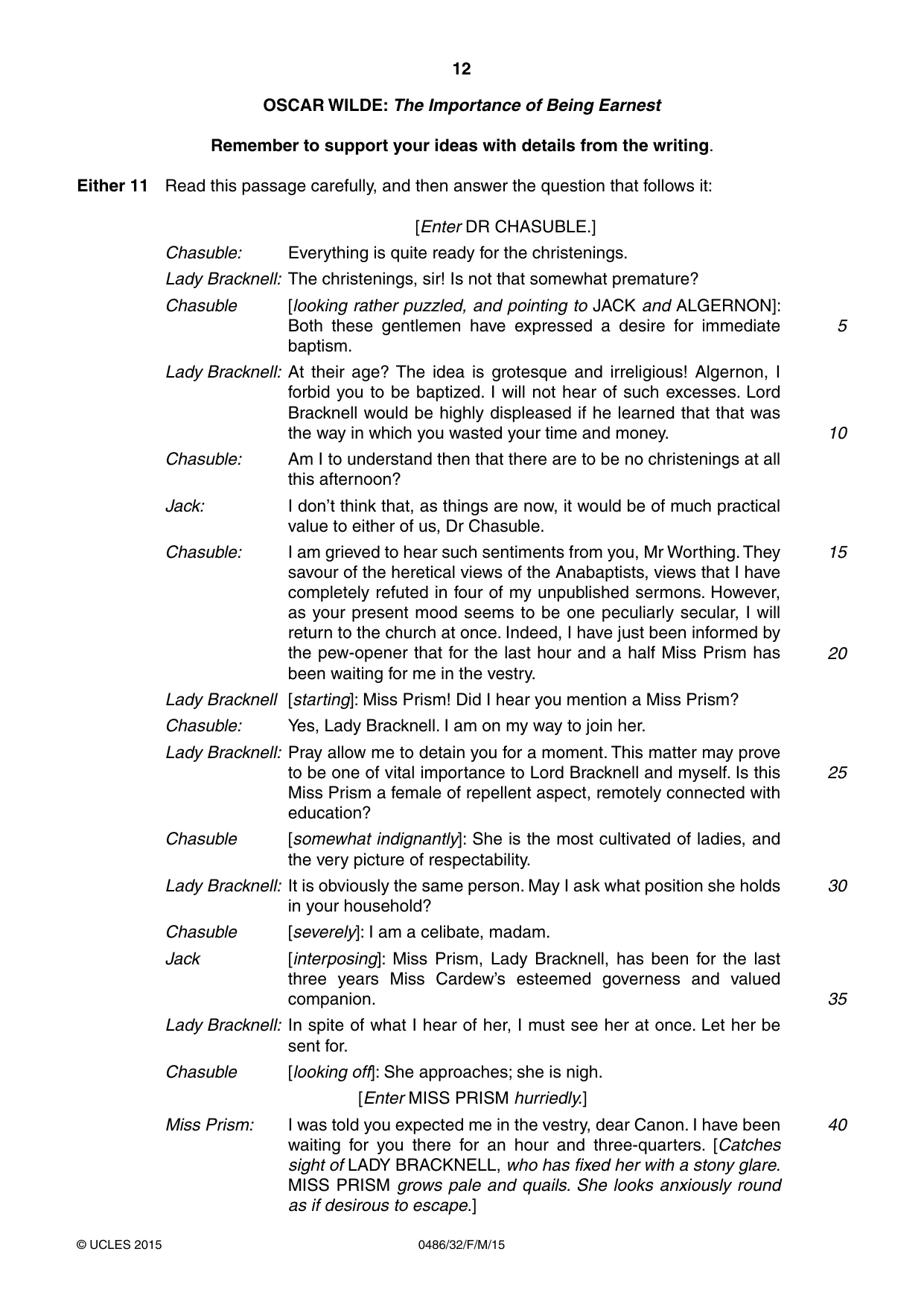
12 0486/32/F/M/15 © UCLES 2015 OSCAR WILDE: The Importance of Being Earnest Remember to support your ideas with details from the writing. Either 11 Read this passage carefully, and then answer the question that follows it: [Enter DR CHASUBLE.] Chasuble: Everything is quite ready for the christenings. Lady Bracknell: The christenings, sir! Is not that somewhat premature? Chasuble [looking rather puzzled, and pointing to JACK and ALGERNON]: Both these gentlemen have expressed a desire for immediate baptism. Lady Bracknell: At their age? The idea is grotesque and irreligious! Algernon, I forbid you to be baptized. I will not hear of such excesses. Lord Bracknell would be highly displeased if he learned that that was the way in which you wasted your time and money. Chasuble: Am I to understand then that there are to be no christenings at all this afternoon? Jack: I don’t think that, as things are now, it would be of much practical value to either of us, Dr Chasuble. Chasuble: I am grieved to hear such sentiments from you, Mr Worthing. They savour of the heretical views of the Anabaptists, views that I have completely refuted in four of my unpublished sermons. However, as your present mood seems to be one peculiarly secular, I will return to the church at once. Indeed, I have just been informed by the pew-opener that for the last hour and a half Miss Prism has been waiting for me in the vestry. Lady Bracknell [starting]: Miss Prism! Did I hear you mention a Miss Prism? Chasuble: Yes, Lady Bracknell. I am on my way to join her. Lady Bracknell: Pray allow me to detain you for a moment. This matter may prove to be one of vital importance to Lord Bracknell and myself. Is this Miss Prism a female of repellent aspect, remotely connected with education? Chasuble [somewhat indignantly]: She is the most cultivated of ladies, and the very picture of respectability. Lady Bracknell: It is obviously the same person. May I ask what position she holds in your household? Chasuble [severely]: I am a celibate, madam. Jack [interposing]: Miss Prism, Lady Bracknell, has been for the last three years Miss Cardew’s esteemed governess and valued companion. Lady Bracknell: In spite of what I hear of her, I must see her at once. Let her be sent for. Chasuble [looking off]: She approaches; she is nigh. [Enter MISS PRISM hurriedly.] Miss Prism: I was told you expected me in the vestry, dear Canon. I have been waiting for you there for an hour and three-quarters. [Catches sight of LADY BRACKNELL, who has fixed her with a stony glare. MISS PRISM grows pale and quails. She looks anxiously round as if desirous to escape.] 5 10 15 20 25 30 35 40
Question paper, page 13
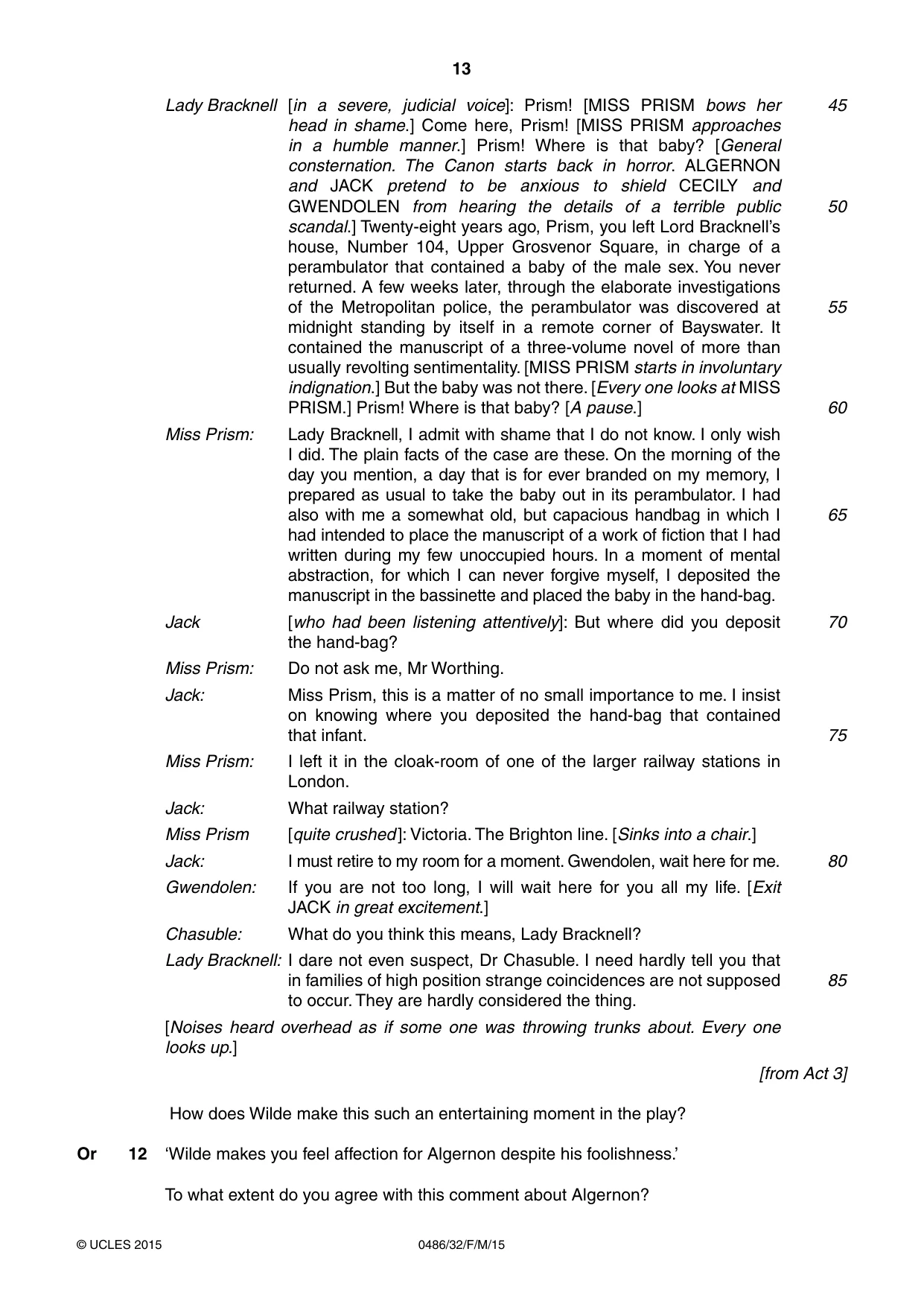
13 0486/32/F/M/15 © UCLES 2015 Lady Bracknell [in a severe, judicial voice]: Prism! [MISS PRISM bows her head in shame.] Come here, Prism! [MISS PRISM approaches in a humble manner.] Prism! Where is that baby? [General consternation. The Canon starts back in horror. ALGERNON and JACK pretend to be anxious to shield CECILY and GWENDOLEN from hearing the details of a terrible public scandal.] Twenty-eight years ago, Prism, you left Lord Bracknell’s house, Number 104, Upper Grosvenor Square, in charge of a perambulator that contained a baby of the male sex. You never returned. A few weeks later, through the elaborate investigations of the Metropolitan police, the perambulator was discovered at midnight standing by itself in a remote corner of Bayswater. It contained the manuscript of a three-volume novel of more than usually revolting sentimentality. [MISS PRISM starts in involuntary indignation.] But the baby was not there. [Every one looks at MISS PRISM.] Prism! Where is that baby? [A pause.] Miss Prism: Lady Bracknell, I admit with shame that I do not know. I only wish I did. The plain facts of the case are these. On the morning of the day you mention, a day that is for ever branded on my memory, I prepared as usual to take the baby out in its perambulator. I had also with me a somewhat old, but capacious handbag in which I had intended to place the manuscript of a work of fiction that I had written during my few unoccupied hours. In a moment of mental abstraction, for which I can never forgive myself, I deposited the manuscript in the bassinette and placed the baby in the hand-bag. Jack [who had been listening attentively]: But where did you deposit the hand-bag? Miss Prism: Do not ask me, Mr Worthing. Jack: Miss Prism, this is a matter of no small importance to me. I insist on knowing where you deposited the hand-bag that contained that infant. Miss Prism: I left it in the cloak-room of one of the larger railway stations in London. Jack: What railway station? Miss Prism [quite crushed ]: Victoria. The Brighton line. [Sinks into a chair.] Jack: I must retire to my room for a moment. Gwendolen, wait here for me. Gwendolen: If you are not too long, I will wait here for you all my life. [Exit JACK in great excitement.] Chasuble: What do you think this means, Lady Bracknell? Lady Bracknell: I dare not even suspect, Dr Chasuble. I need hardly tell you that in families of high position strange coincidences are not supposed to occur. They are hardly considered the thing. [Noises heard overhead as if some one was throwing trunks about. Every one looks up.] [from Act 3] How does Wilde make this such an entertaining moment in the play? Or 12 ‘Wilde makes you feel affection for Algernon despite his foolishness.’ To what extent do you agree with this comment about Algernon? 45 50 55 60 65 70 75 80 85
Question paper, page 14
14 0486/32/F/M/15 © UCLES 2015 BLANK PAGE
Question paper, page 15
15 0486/32/F/M/15 © UCLES 2015 BLANK PAGE
Question paper, page 16
16 0486/32/F/M/15 © UCLES 2015 BLANK PAGE Permission to reproduce items where third-party owned material protected by copyright is included has been sought and cleared where possible. Every reasonable effort has been made by the publisher (UCLES) to trace copyright holders, but if any items requiring clearance have unwittingly been included, the publisher will be pleased to make amends at the earliest possible opportunity. To avoid the issue of disclosure of answer-related information to candidates, all copyright acknowledgements are reproduced online in the Cambridge International Examinations Copyright Acknowledgements Booklet. This is produced for each series of examinations and is freely available to download at www.cie.org.uk after the live examination series. Cambridge International Examinations is part of the Cambridge Assessment Group. Cambridge Assessment is the brand name of University of Cambridge Local Examinations Syndicate (UCLES), which is itself a department of the University of Cambridge.
Mark scheme, page 1
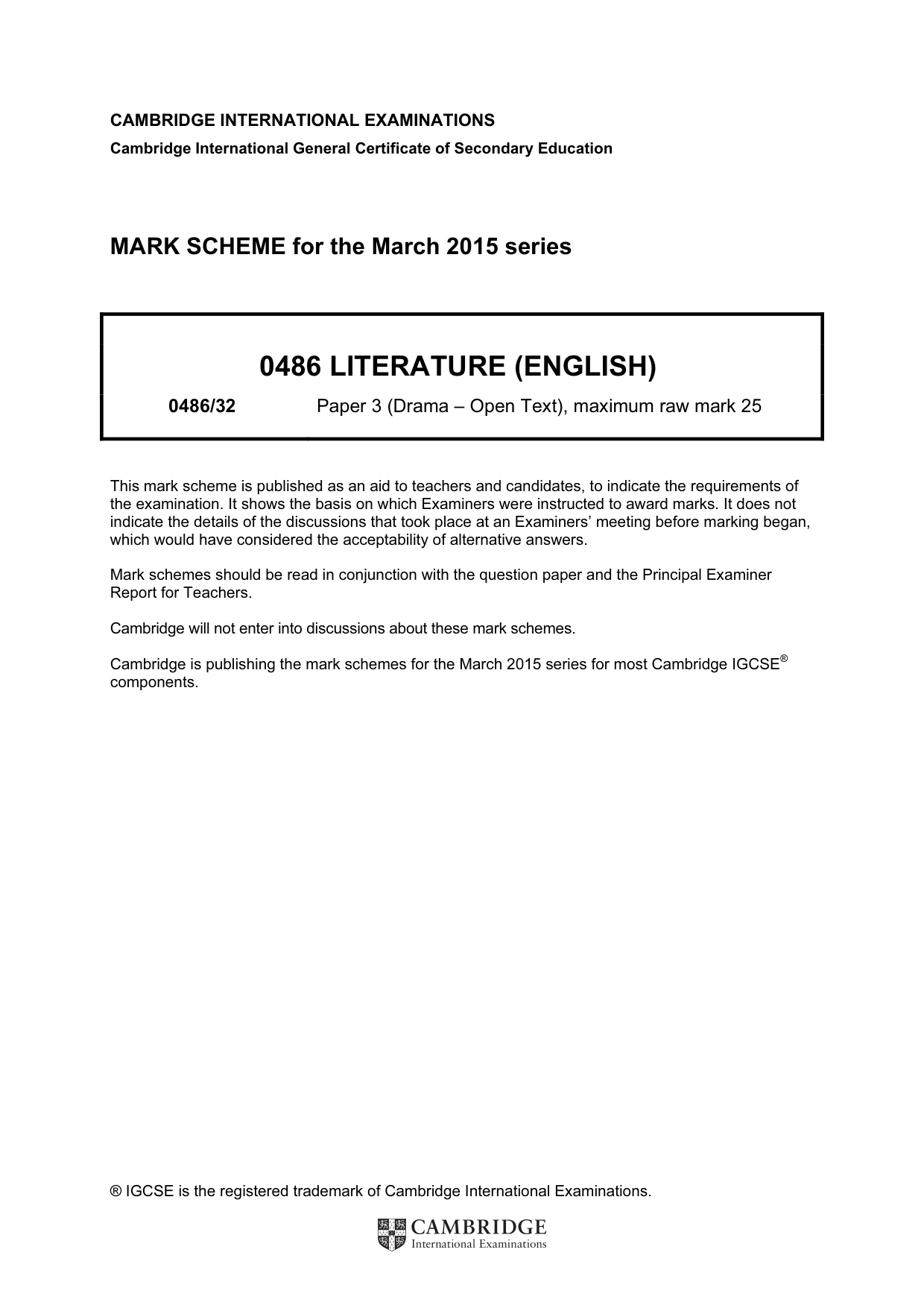
® IGCSE is the registered trademark of Cambridge International Examinations. CAMBRIDGE INTERNATIONAL EXAMINATIONS Cambridge International General Certificate of Secondary Education MARK SCHEME for the March 2015 series 0486 LITERATURE (ENGLISH) 0486/32 Paper 3 (Drama – Open Text), maximum raw mark 25 This mark scheme is published as an aid to teachers and candidates, to indicate the requirements of the examination. It shows the basis on which Examiners were instructed to award marks. It does not indicate the details of the discussions that took place at an Examiners’ meeting before marking began, which would have considered the acceptability of alternative answers. Mark schemes should be read in conjunction with the question paper and the Principal Examiner Report for Teachers. Cambridge will not enter into discussions about these mark schemes. Cambridge is publishing the mark schemes for the March 2015 series for most Cambridge IGCSE® components.
Mark scheme, page 2
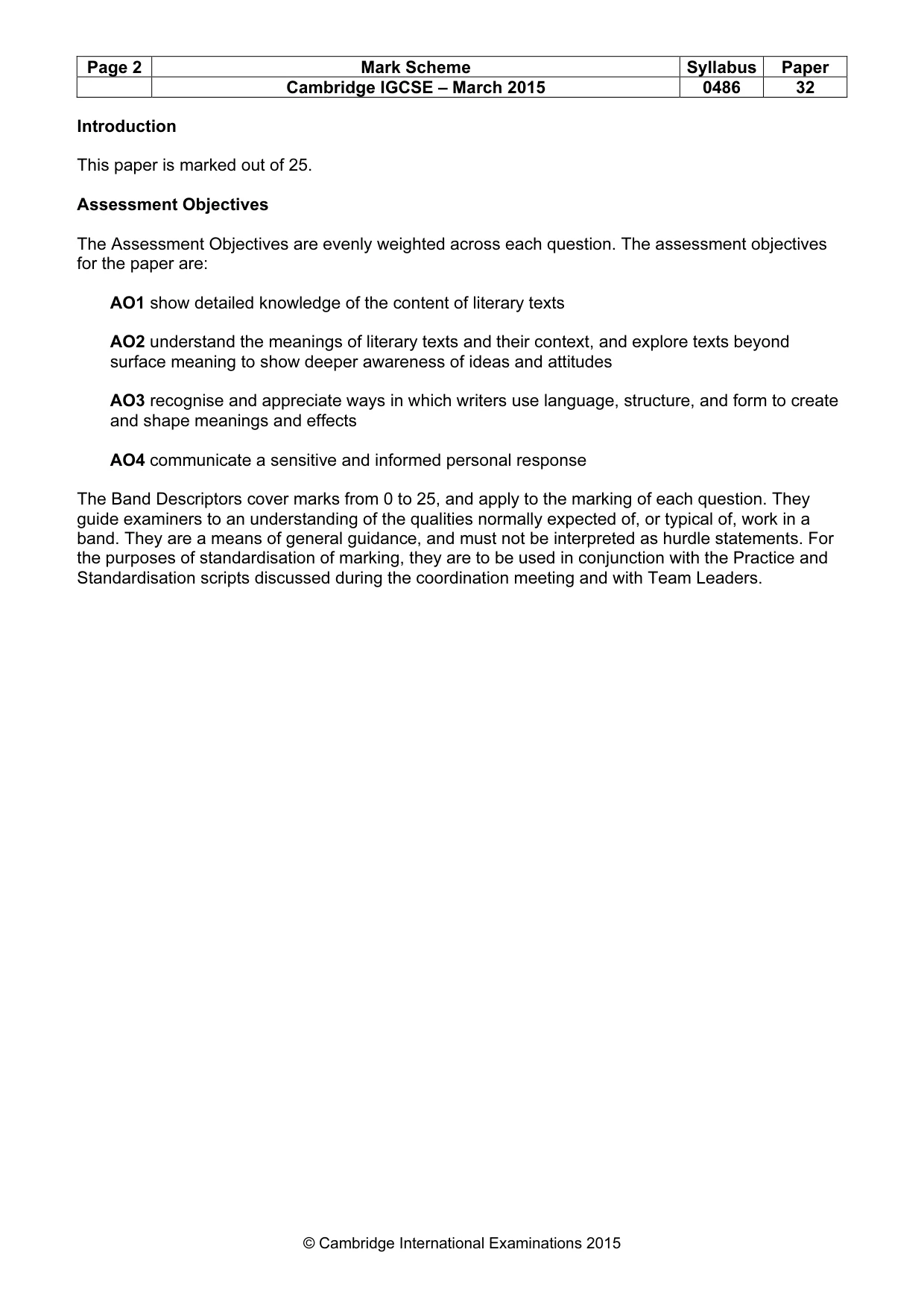
Page 2 Mark Scheme Syllabus Paper Cambridge IGCSE – March 2015 0486 32 © Cambridge International Examinations 2015 Introduction This paper is marked out of 25. Assessment Objectives The Assessment Objectives are evenly weighted across each question. The assessment objectives for the paper are: AO1 show detailed knowledge of the content of literary texts AO2 understand the meanings of literary texts and their context, and explore texts beyond surface meaning to show deeper awareness of ideas and attitudes AO3 recognise and appreciate ways in which writers use language, structure, and form to create and shape meanings and effects AO4 communicate a sensitive and informed personal response The Band Descriptors cover marks from 0 to 25, and apply to the marking of each question. They guide examiners to an understanding of the qualities normally expected of, or typical of, work in a band. They are a means of general guidance, and must not be interpreted as hurdle statements. For the purposes of standardisation of marking, they are to be used in conjunction with the Practice and Standardisation scripts discussed during the coordination meeting and with Team Leaders.
Mark scheme, page 3
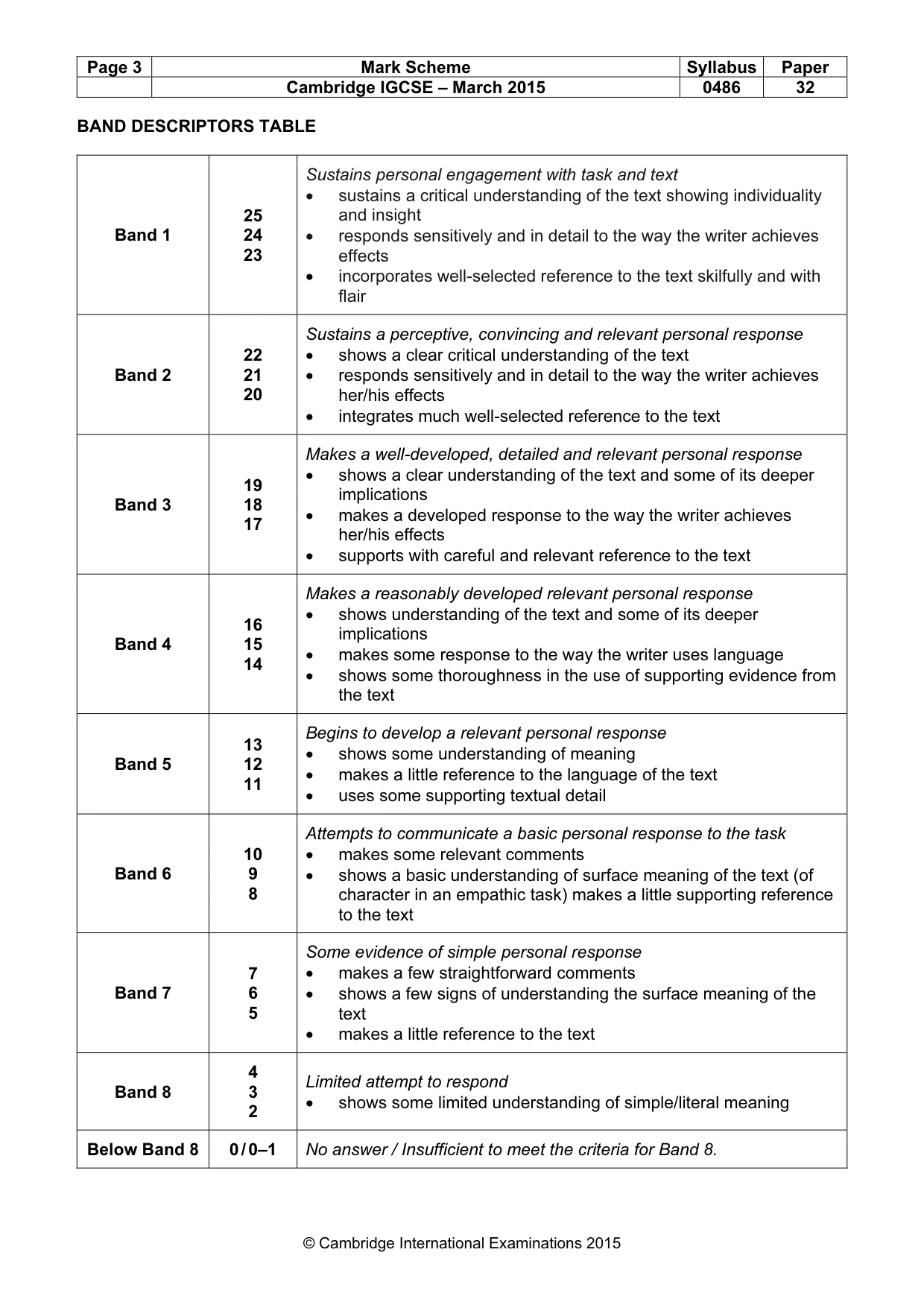
Page 3 Mark Scheme Syllabus Paper Cambridge IGCSE – March 2015 0486 32 © Cambridge International Examinations 2015 BAND DESCRIPTORS TABLE Band 1 25 24 23 Sustains personal engagement with task and text • sustains a critical understanding of the text showing individuality and insight • responds sensitively and in detail to the way the writer achieves effects • incorporates well-selected reference to the text skilfully and with flair Band 2 22 21 20 Sustains a perceptive, convincing and relevant personal response • shows a clear critical understanding of the text • responds sensitively and in detail to the way the writer achieves her/his effects • integrates much well-selected reference to the text Band 3 19 18 17 Makes a well-developed, detailed and relevant personal response • shows a clear understanding of the text and some of its deeper implications • makes a developed response to the way the writer achieves her/his effects • supports with careful and relevant reference to the text Band 4 16 15 14 Makes a reasonably developed relevant personal response • shows understanding of the text and some of its deeper implications • makes some response to the way the writer uses language • shows some thoroughness in the use of supporting evidence from the text Band 5 13 12 11 Begins to develop a relevant personal response • shows some understanding of meaning • makes a little reference to the language of the text • uses some supporting textual detail Band 6 10 9 8 Attempts to communicate a basic personal response to the task • makes some relevant comments • shows a basic understanding of surface meaning of the text (of character in an empathic task) makes a little supporting reference to the text Band 7 7 6 5 Some evidence of simple personal response • makes a few straightforward comments • shows a few signs of understanding the surface meaning of the text • makes a little reference to the text Band 8 4 3 2 Limited attempt to respond • shows some limited understanding of simple/literal meaning Below Band 8 0 / 0–1 No answer / Insufficient to meet the criteria for Band 8.
What you needed in this session
Cambridge’s own grade thresholds for 2015 Feb/March, Paper 3 · Variant 2. A higher threshold means an easier paper — the bar moves with how the cohort did.