Cambridge IGCSE English - Literature 0486 — 2013 Oct/Nov Paper 3 · Variant 3
0486/33/O/N/13 · 25 marks · ≈28 min
The question paper and its mark scheme, free to read here and free to download. This is Cambridge’s own paper, exactly as it was sat.
Question paper8 pages


Mark scheme3 pages
Answers below. Sit the paper first if you are practising.
Paper as text
Question paper, page 1
This document consists of 5 printed pages and 3 blank pages. DC (SJF) 91810 © UCLES 2013 [Turn over UNIVERSITY OF CAMBRIDGE INTERNATIONAL EXAMINATIONS International General Certificate of Secondary Education * 1 1 9 9 5 6 2 8 3 1 * LITERATURE (ENGLISH) 0486/33 Paper 3 Unseen October/November 2013 1 hour 15 minutes Additional Materials: Answer Booklet/Paper READ THESE INSTRUCTIONS FIRST If you have been given an Answer Booklet, follow the instructions on the front cover of the Booklet. Write your Centre number, candidate number and name on all the work you hand in. Write in dark blue or black pen. Do not use staples, paper clips, highlighters, glue or correction fluid. DO NOT WRITE IN ANY BARCODES. Answer either Question 1 or Question 2. You are advised to spend about 20 minutes reading the question paper and planning your answer. At the end of the examination, fasten all your work securely together. Both questions in this paper carry equal marks. www.XtremePapers.com
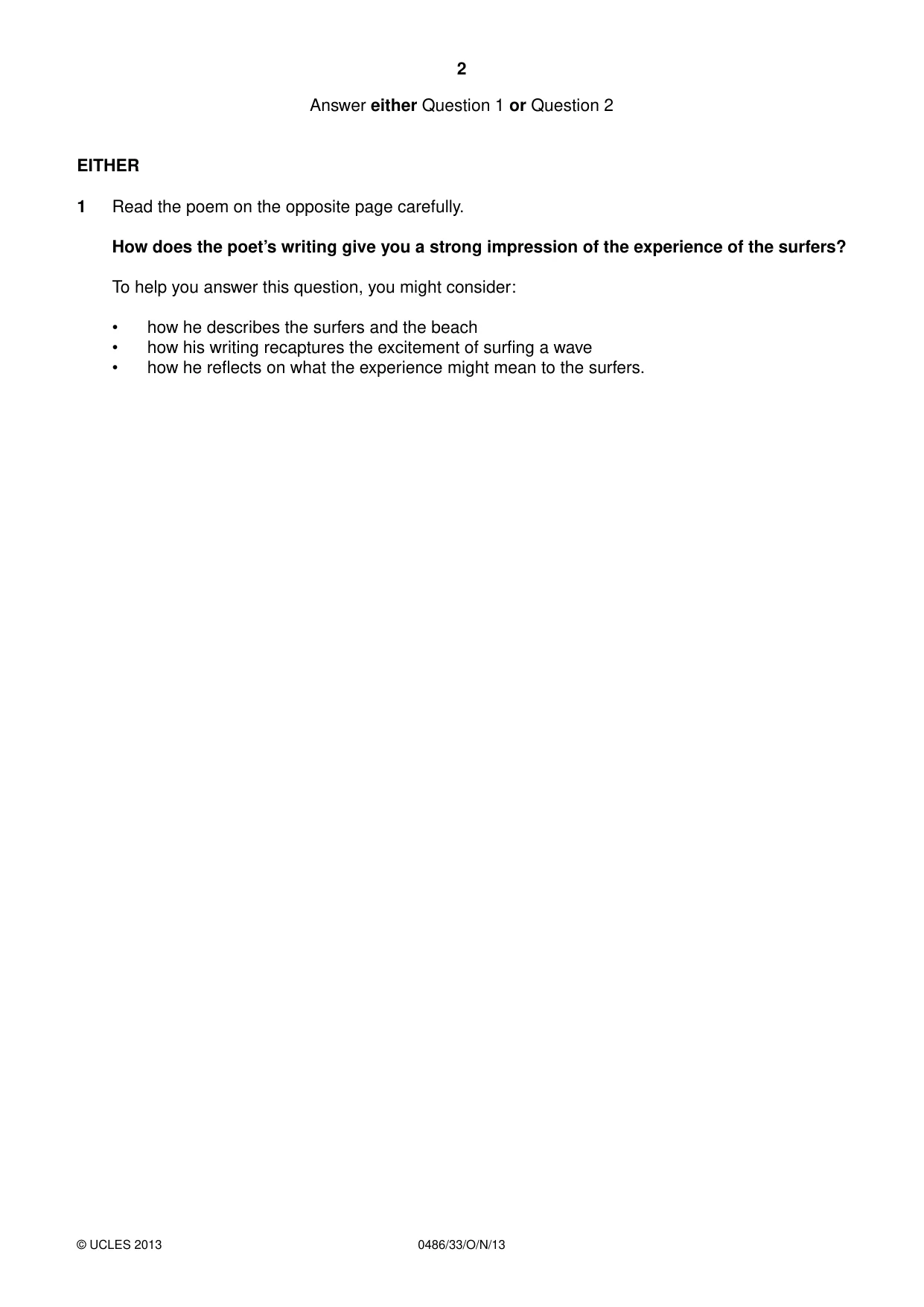
Question paper, page 2
2 0486/33/O/N/13 © UCLES 2013 Answer either Question 1 or Question 2 EITHER 1 Read the poem on the opposite page carefully. How does the poet’s writing give you a strong impression of the experience of the surfers? To help you answer this question, you might consider: • how he describes the surfers and the beach • how his writing recaptures the excitement of surfing a wave • how he reflects on what the experience might mean to the surfers.
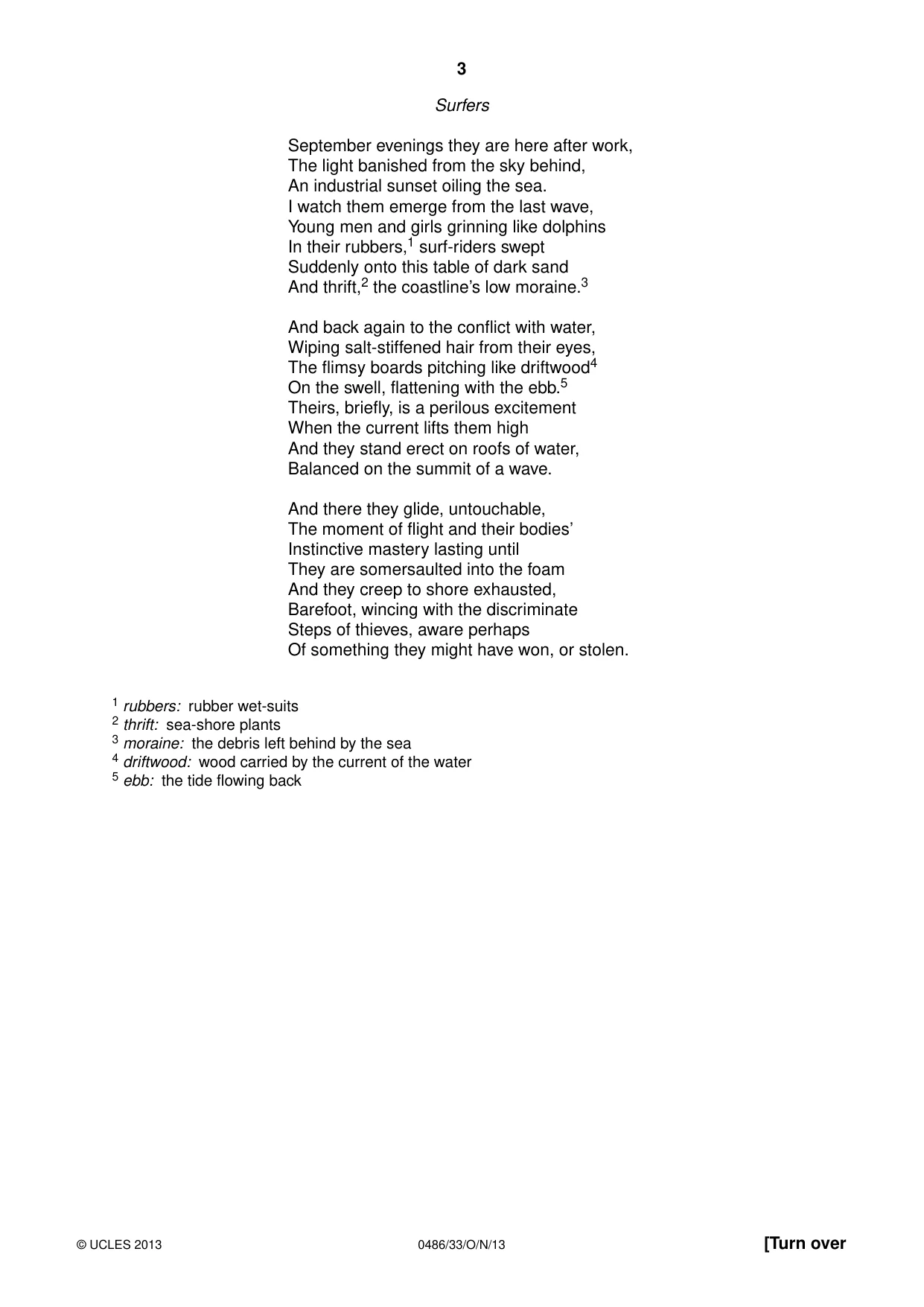
Question paper, page 3
3 0486/33/O/N/13 © UCLES 2013 [Turn over Surfers September evenings they are here after work, The light banished from the sky behind, An industrial sunset oiling the sea. I watch them emerge from the last wave, Young men and girls grinning like dolphins In their rubbers,1 surf-riders swept Suddenly onto this table of dark sand And thrift,2 the coastline’s low moraine.3 And back again to the conflict with water, Wiping salt-stiffened hair from their eyes, The flimsy boards pitching like driftwood4 On the swell, flattening with the ebb.5 Theirs, briefly, is a perilous excitement When the current lifts them high And they stand erect on roofs of water, Balanced on the summit of a wave. And there they glide, untouchable, The moment of flight and their bodies’ Instinctive mastery lasting until They are somersaulted into the foam And they creep to shore exhausted, Barefoot, wincing with the discriminate Steps of thieves, aware perhaps Of something they might have won, or stolen. 1 rubbers: rubber wet-suits 2 thrift: sea-shore plants 3 moraine: the debris left behind by the sea 4 driftwood: wood carried by the current of the water 5 ebb: the tide flowing back
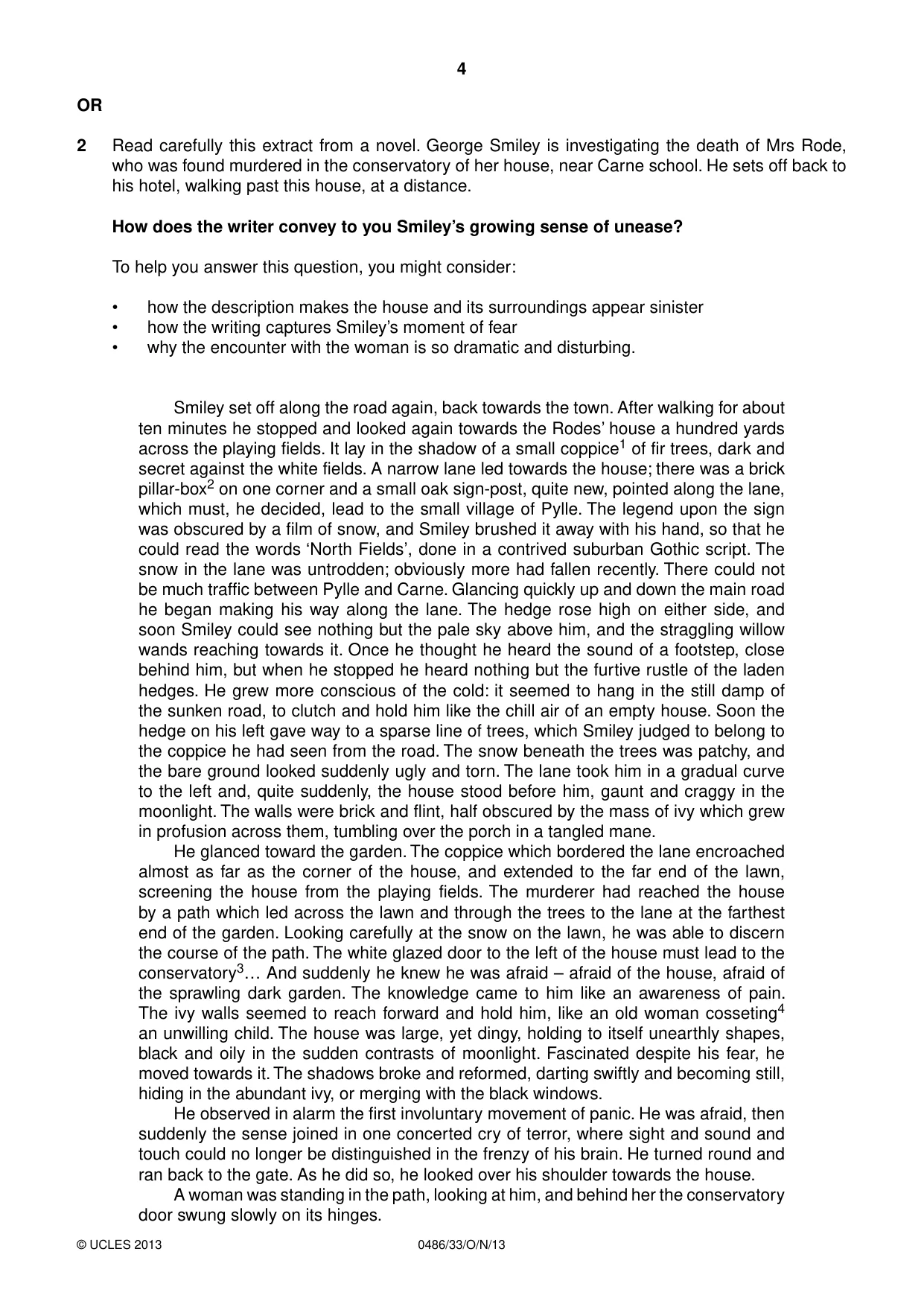
Question paper, page 4
4 0486/33/O/N/13 © UCLES 2013 OR 2 Read carefully this extract from a novel. George Smiley is investigating the death of Mrs Rode, who was found murdered in the conservatory of her house, near Carne school. He sets off back to his hotel, walking past this house, at a distance. How does the writer convey to you Smiley’s growing sense of unease? To help you answer this question, you might consider: • how the description makes the house and its surroundings appear sinister • how the writing captures Smiley’s moment of fear • why the encounter with the woman is so dramatic and disturbing. Smiley set off along the road again, back towards the town. After walking for about ten minutes he stopped and looked again towards the Rodes’ house a hundred yards across the playing fields. It lay in the shadow of a small coppice1 of fir trees, dark and secret against the white fields. A narrow lane led towards the house; there was a brick pillar-box2 on one corner and a small oak sign-post, quite new, pointed along the lane, which must, he decided, lead to the small village of Pylle. The legend upon the sign was obscured by a film of snow, and Smiley brushed it away with his hand, so that he could read the words ‘North Fields’, done in a contrived suburban Gothic script. The snow in the lane was untrodden; obviously more had fallen recently. There could not be much traffic between Pylle and Carne. Glancing quickly up and down the main road he began making his way along the lane. The hedge rose high on either side, and soon Smiley could see nothing but the pale sky above him, and the straggling willow wands reaching towards it. Once he thought he heard the sound of a footstep, close behind him, but when he stopped he heard nothing but the furtive rustle of the laden hedges. He grew more conscious of the cold: it seemed to hang in the still damp of the sunken road, to clutch and hold him like the chill air of an empty house. Soon the hedge on his left gave way to a sparse line of trees, which Smiley judged to belong to the coppice he had seen from the road. The snow beneath the trees was patchy, and the bare ground looked suddenly ugly and torn. The lane took him in a gradual curve to the left and, quite suddenly, the house stood before him, gaunt and craggy in the moonlight. The walls were brick and flint, half obscured by the mass of ivy which grew in profusion across them, tumbling over the porch in a tangled mane. He glanced toward the garden. The coppice which bordered the lane encroached almost as far as the corner of the house, and extended to the far end of the lawn, screening the house from the playing fields. The murderer had reached the house by a path which led across the lawn and through the trees to the lane at the farthest end of the garden. Looking carefully at the snow on the lawn, he was able to discern the course of the path. The white glazed door to the left of the house must lead to the conservatory3… And suddenly he knew he was afraid – afraid of the house, afraid of the sprawling dark garden. The knowledge came to him like an awareness of pain. The ivy walls seemed to reach forward and hold him, like an old woman cosseting4 an unwilling child. The house was large, yet dingy, holding to itself unearthly shapes, black and oily in the sudden contrasts of moonlight. Fascinated despite his fear, he moved towards it. The shadows broke and reformed, darting swiftly and becoming still, hiding in the abundant ivy, or merging with the black windows. He observed in alarm the first involuntary movement of panic. He was afraid, then suddenly the sense joined in one concerted cry of terror, where sight and sound and touch could no longer be distinguished in the frenzy of his brain. He turned round and ran back to the gate. As he did so, he looked over his shoulder towards the house. A woman was standing in the path, looking at him, and behind her the conservatory door swung slowly on its hinges.
Question paper, page 5
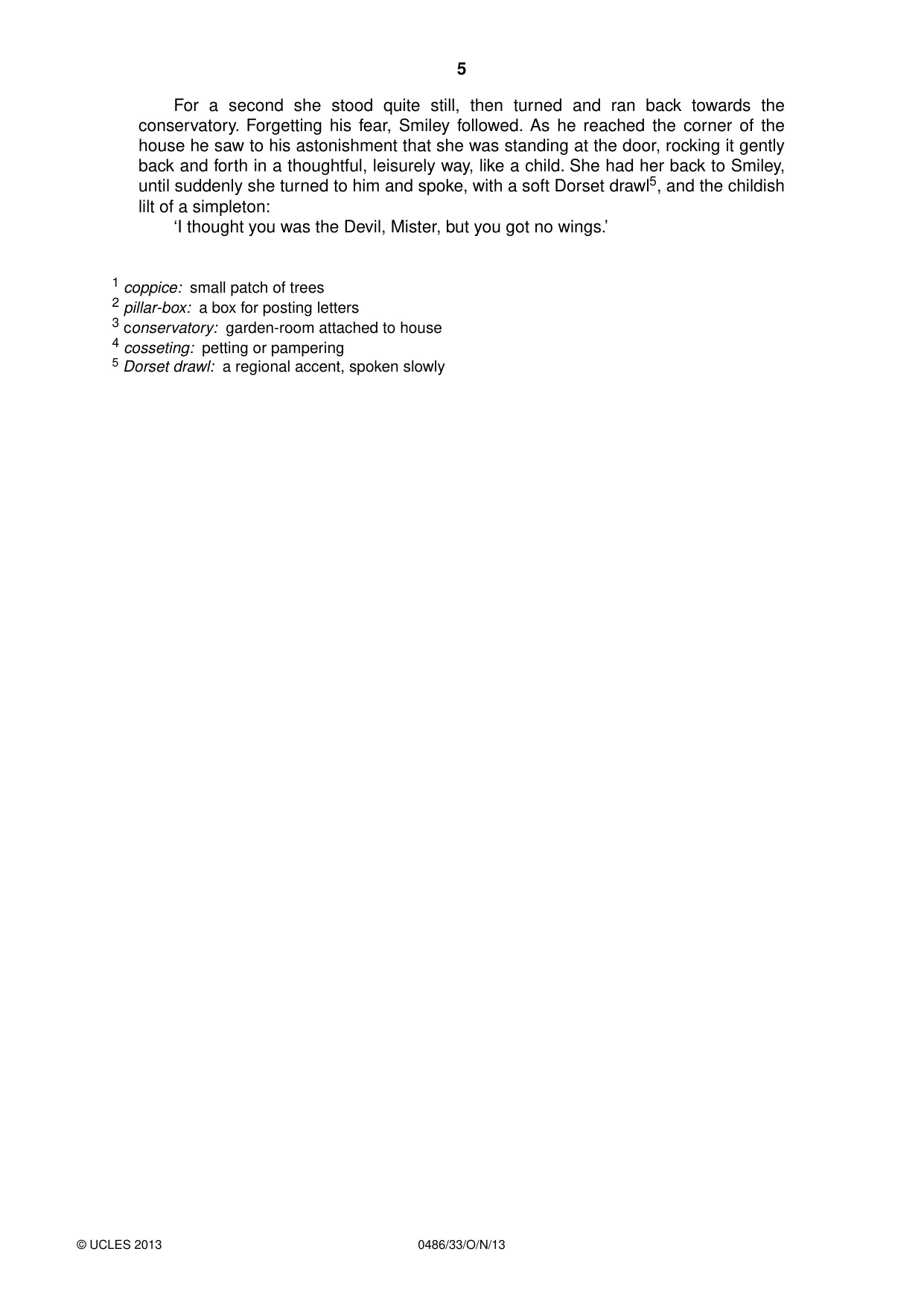
5 0486/33/O/N/13 © UCLES 2013 For a second she stood quite still, then turned and ran back towards the conservatory. Forgetting his fear, Smiley followed. As he reached the corner of the house he saw to his astonishment that she was standing at the door, rocking it gently back and forth in a thoughtful, leisurely way, like a child. She had her back to Smiley, until suddenly she turned to him and spoke, with a soft Dorset drawl5, and the childish lilt of a simpleton: ‘I thought you was the Devil, Mister, but you got no wings.’ 1 coppice: small patch of trees 2 pillar-box: a box for posting letters 3 conservatory: garden-room attached to house 4 cosseting: petting or pampering 5 Dorset drawl: a regional accent, spoken slowly
Question paper, page 6
6 0486/33/O/N/13 © UCLES 2013 BLANK PAGE
Question paper, page 7
7 0486/33/O/N/13 © UCLES 2013 BLANK PAGE
Question paper, page 8
8 0486/33/O/N/13 © UCLES 2013 BLANK PAGE Copyright Acknowledgements: Question 1 © Robert Minhinnick; Surfers, in Selected Poems; Carcanet Press Ltd; 1999. Question 2 © John le Carré; A Murder of Quality; Penguin Books Ltd; 1962; Reproduced with permission of Curtis Brown Group Ltd, London, on behalf of John le Carré. Copyright © le Carré Productions 1962. Permission to reproduce items where third-party owned material protected by copyright is included has been sought and cleared where possible. Every reasonable effort has been made by the publisher (UCLES) to trace copyright holders, but if any items requiring clearance have unwittingly been included, the publisher will be pleased to make amends at the earliest possible opportunity. University of Cambridge International Examinations is part of the Cambridge Assessment Group. Cambridge Assessment is the brand name of University of Cambridge Local Examinations Syndicate (UCLES), which is itself a department of the University of Cambridge.
Mark scheme, page 1
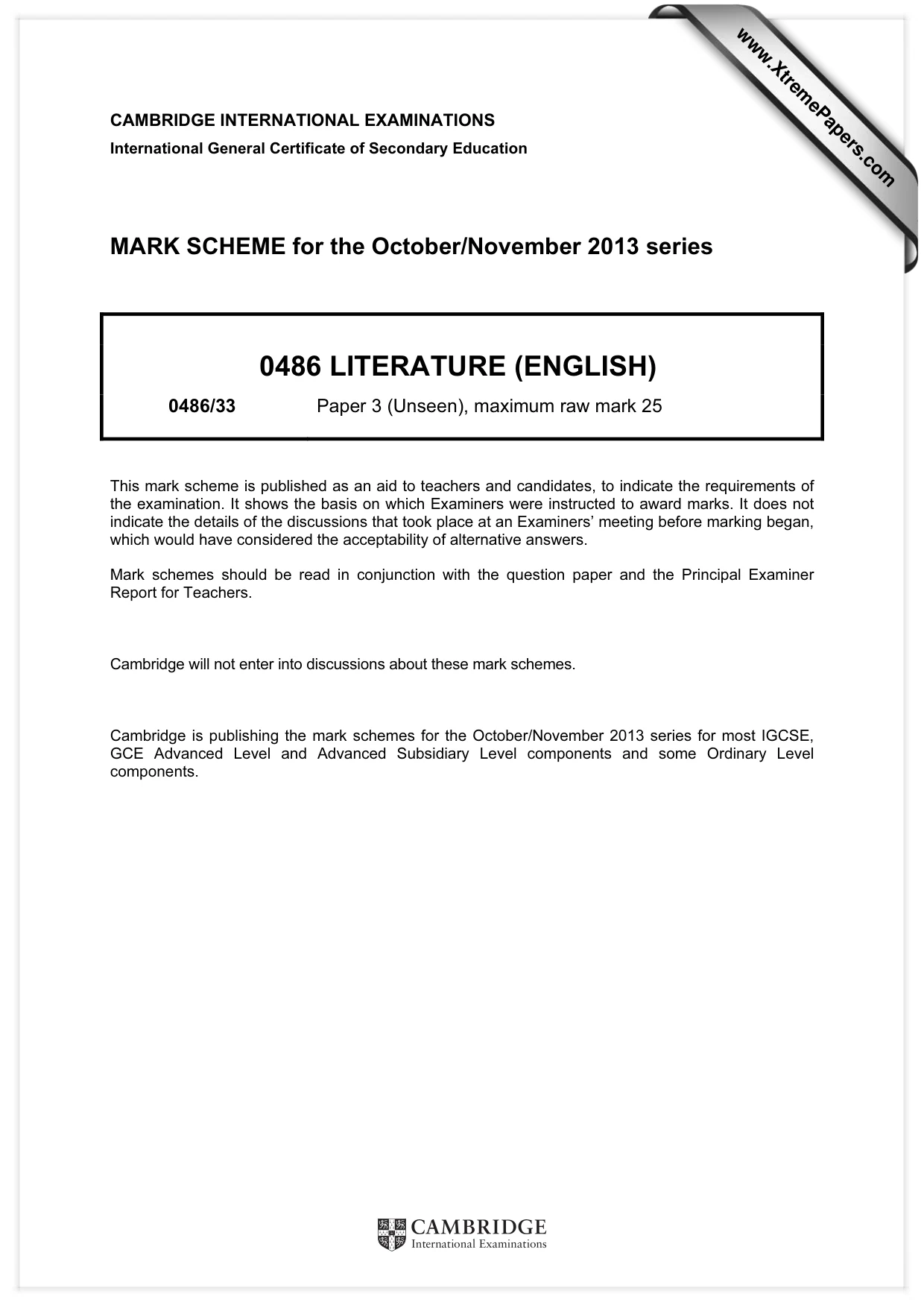
CAMBRIDGE INTERNATIONAL EXAMINATIONS International General Certificate of Secondary Education MARK SCHEME for the October/November 2013 series 0486 LITERATURE (ENGLISH) 0486/33 Paper 3 (Unseen), maximum raw mark 25 This mark scheme is published as an aid to teachers and candidates, to indicate the requirements of the examination. It shows the basis on which Examiners were instructed to award marks. It does not indicate the details of the discussions that took place at an Examiners’ meeting before marking began, which would have considered the acceptability of alternative answers. Mark schemes should be read in conjunction with the question paper and the Principal Examiner Report for Teachers. Cambridge will not enter into discussions about these mark schemes. Cambridge is publishing the mark schemes for the October/November 2013 series for most IGCSE, GCE Advanced Level and Advanced Subsidiary Level components and some Ordinary Level components. www.XtremePapers.com
Mark scheme, page 2
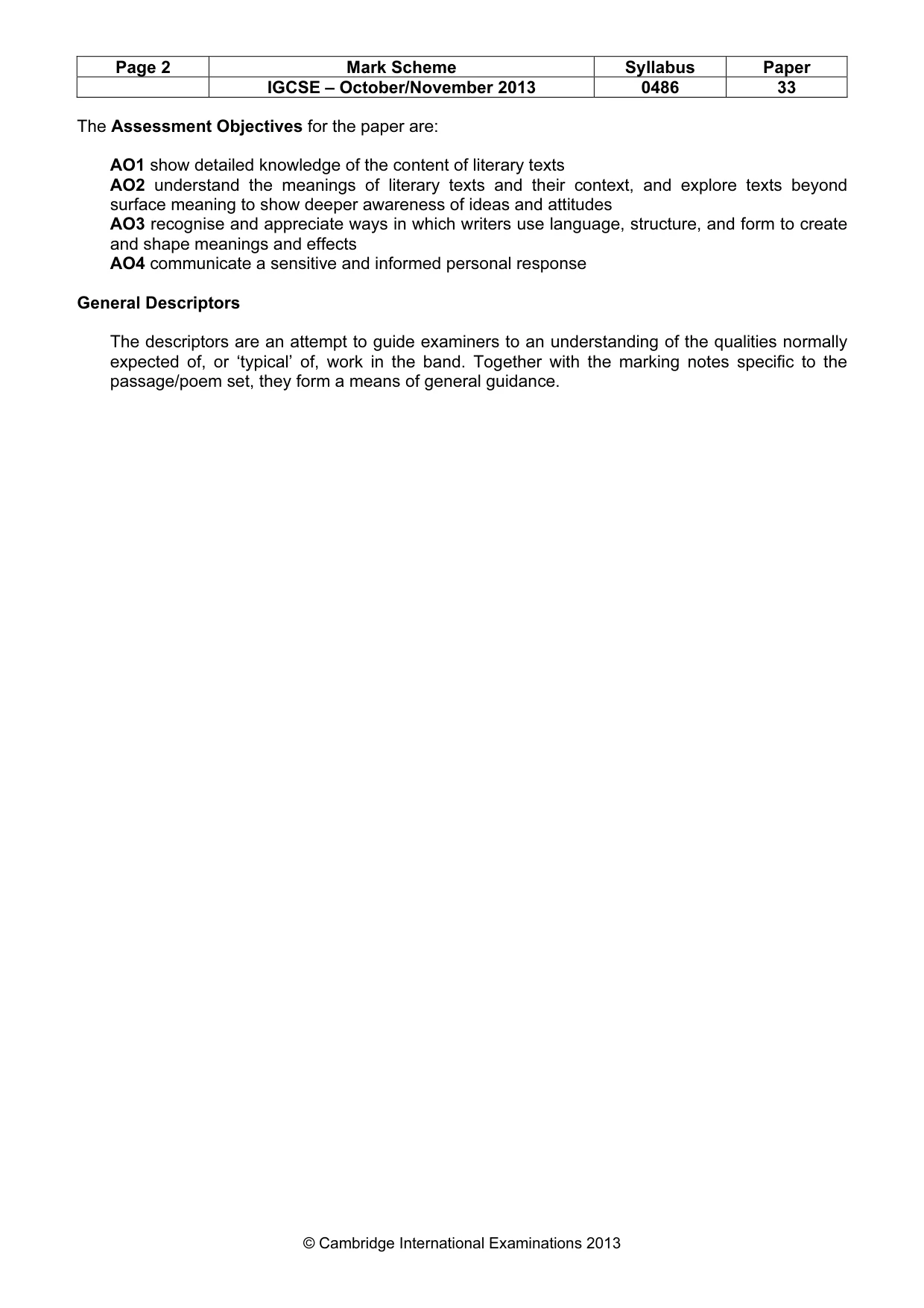
Page 2 Mark Scheme Syllabus Paper IGCSE – October/November 2013 0486 33 © Cambridge International Examinations 2013 The Assessment Objectives for the paper are: AO1 show detailed knowledge of the content of literary texts AO2 understand the meanings of literary texts and their context, and explore texts beyond surface meaning to show deeper awareness of ideas and attitudes AO3 recognise and appreciate ways in which writers use language, structure, and form to create and shape meanings and effects AO4 communicate a sensitive and informed personal response General Descriptors The descriptors are an attempt to guide examiners to an understanding of the qualities normally expected of, or ‘typical’ of, work in the band. Together with the marking notes specific to the passage/poem set, they form a means of general guidance.
Mark scheme, page 3
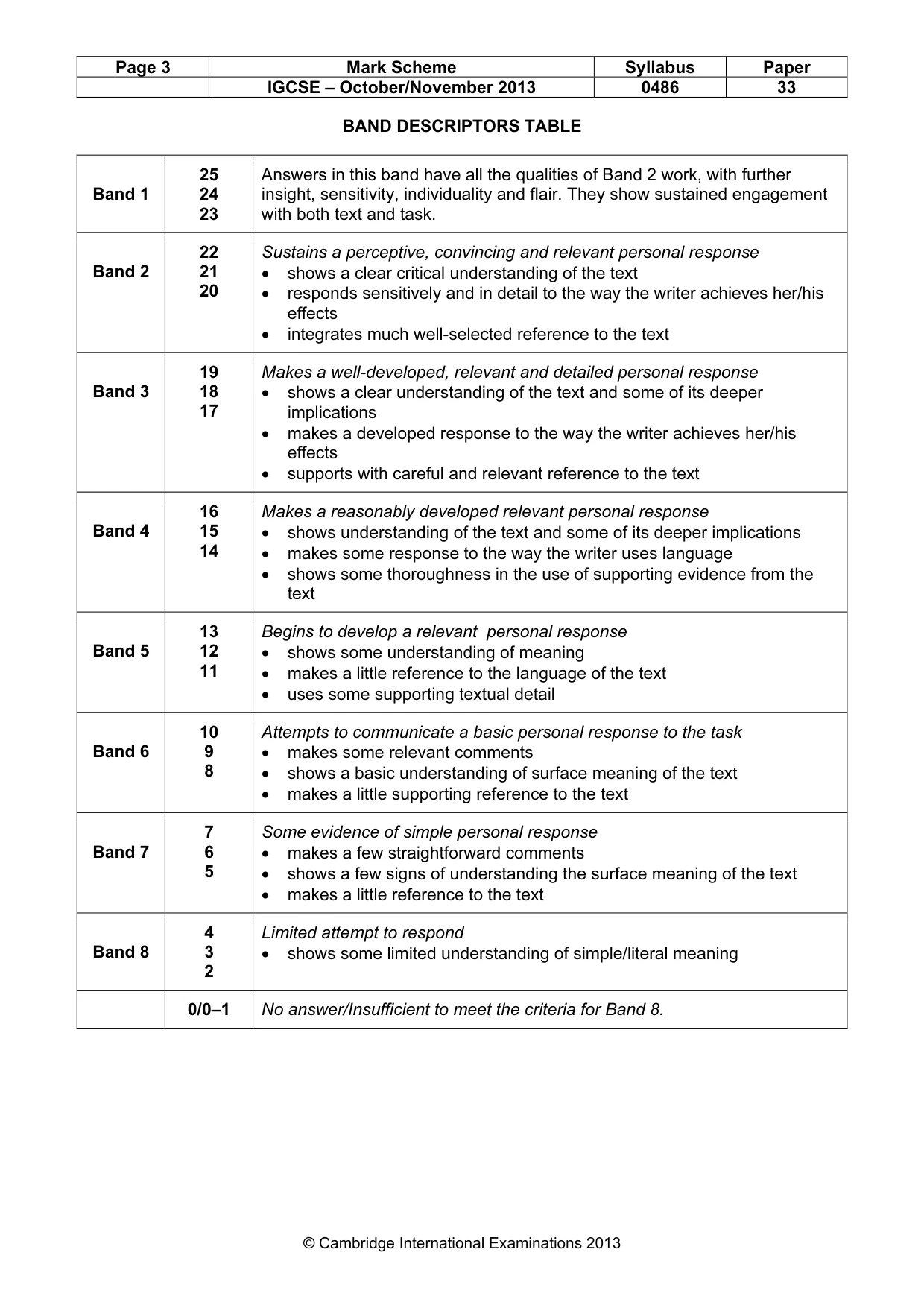
Page 3 Mark Scheme Syllabus Paper IGCSE – October/November 2013 0486 33 © Cambridge International Examinations 2013 BAND DESCRIPTORS TABLE Band 1 25 24 23 Answers in this band have all the qualities of Band 2 work, with further insight, sensitivity, individuality and flair. They show sustained engagement with both text and task. Band 2 22 21 20 Sustains a perceptive, convincing and relevant personal response • shows a clear critical understanding of the text • responds sensitively and in detail to the way the writer achieves her/his effects • integrates much well-selected reference to the text Band 3 19 18 17 Makes a well-developed, relevant and detailed personal response • shows a clear understanding of the text and some of its deeper implications • makes a developed response to the way the writer achieves her/his effects • supports with careful and relevant reference to the text Band 4 16 15 14 Makes a reasonably developed relevant personal response • shows understanding of the text and some of its deeper implications • makes some response to the way the writer uses language • shows some thoroughness in the use of supporting evidence from the text Band 5 13 12 11 Begins to develop a relevant personal response • shows some understanding of meaning • makes a little reference to the language of the text • uses some supporting textual detail Band 6 10 9 8 Attempts to communicate a basic personal response to the task • makes some relevant comments • shows a basic understanding of surface meaning of the text • makes a little supporting reference to the text Band 7 7 6 5 Some evidence of simple personal response • makes a few straightforward comments • shows a few signs of understanding the surface meaning of the text • makes a little reference to the text Band 8 4 3 2 Limited attempt to respond • shows some limited understanding of simple/literal meaning 0/0–1 No answer/Insufficient to meet the criteria for Band 8.
What you needed in this session
Cambridge’s own grade thresholds for 2013 Oct/Nov, Paper 3 · Variant 3. A higher threshold means an easier paper — the bar moves with how the cohort did.