Cambridge IGCSE English - Literature 0486 — 2012 May/June Paper 3 · Variant 2
0486/32/M/J/12 · 25 marks · ≈28 min
The question paper and its mark scheme, free to read here and free to download. This is Cambridge’s own paper, exactly as it was sat.
Question paper8 pages


Mark scheme3 pages
Answers below. Sit the paper first if you are practising.
Paper as text
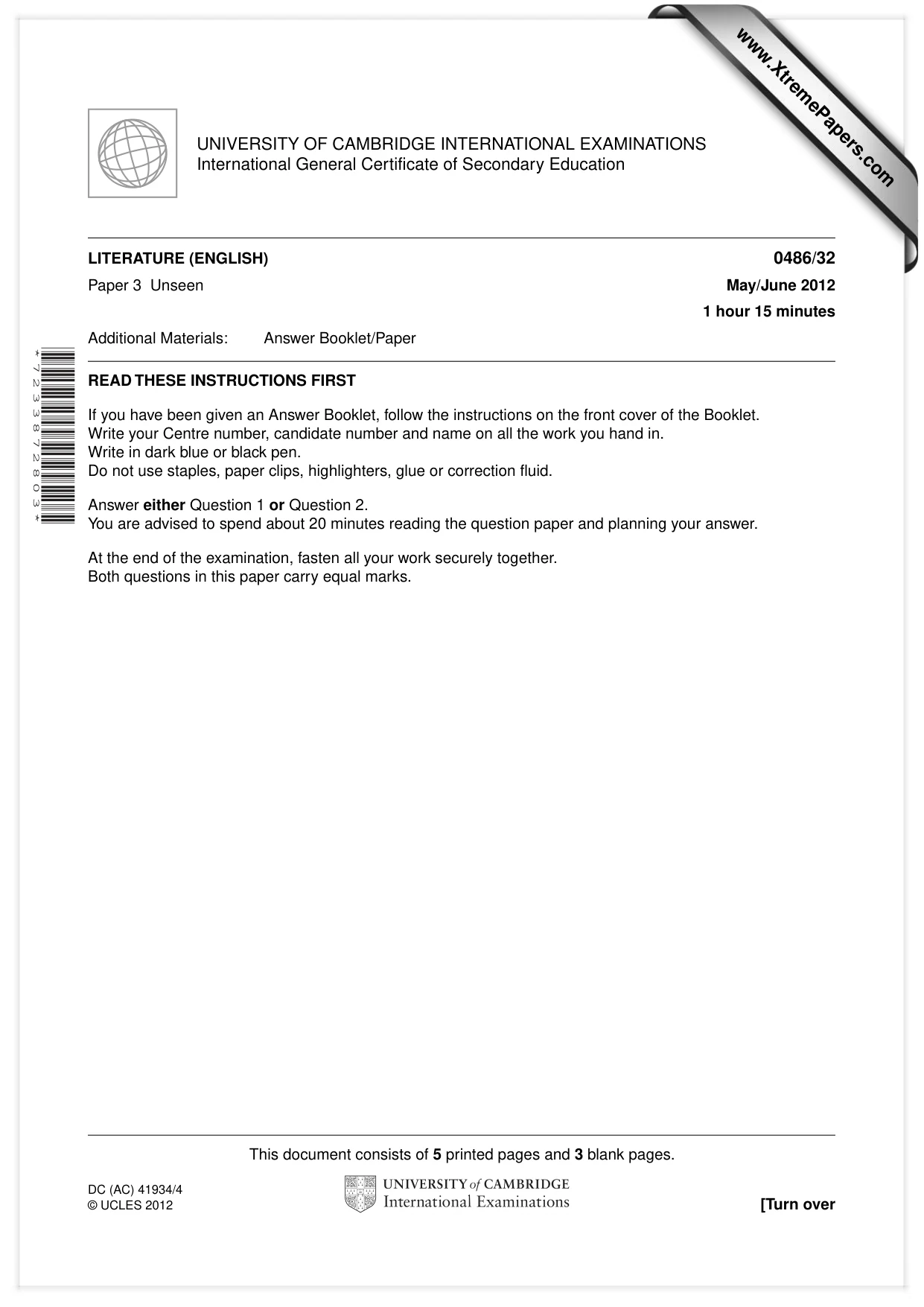
Question paper, page 1
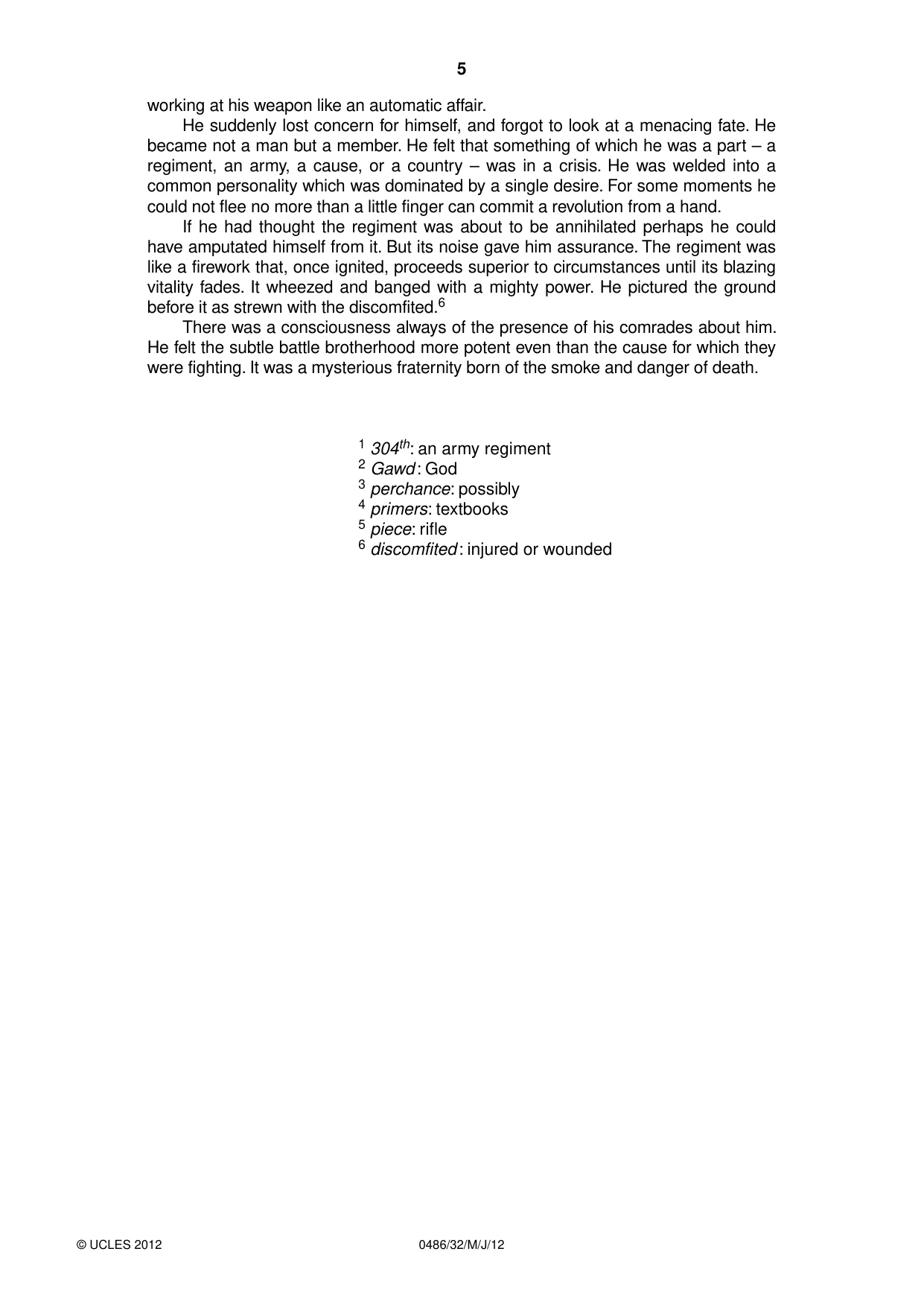
This document consists of 5 printed pages and 3 blank pages. DC (AC) 41934/4 © UCLES 2012 [Turn over UNIVERSITY OF CAMBRIDGE INTERNATIONAL EXAMINATIONS International General Certificate of Secondary Education * 7 2 3 3 8 7 2 8 0 3 * LITERATURE (ENGLISH) 0486/32 Paper 3 Unseen May/June 2012 1 hour 15 minutes Additional Materials: Answer Booklet/Paper READ THESE INSTRUCTIONS FIRST If you have been given an Answer Booklet, follow the instructions on the front cover of the Booklet. Write your Centre number, candidate number and name on all the work you hand in. Write in dark blue or black pen. Do not use staples, paper clips, highlighters, glue or correction fluid. Answer either Question 1 or Question 2. You are advised to spend about 20 minutes reading the question paper and planning your answer. At the end of the examination, fasten all your work securely together. Both questions in this paper carry equal marks. www.XtremePapers.com
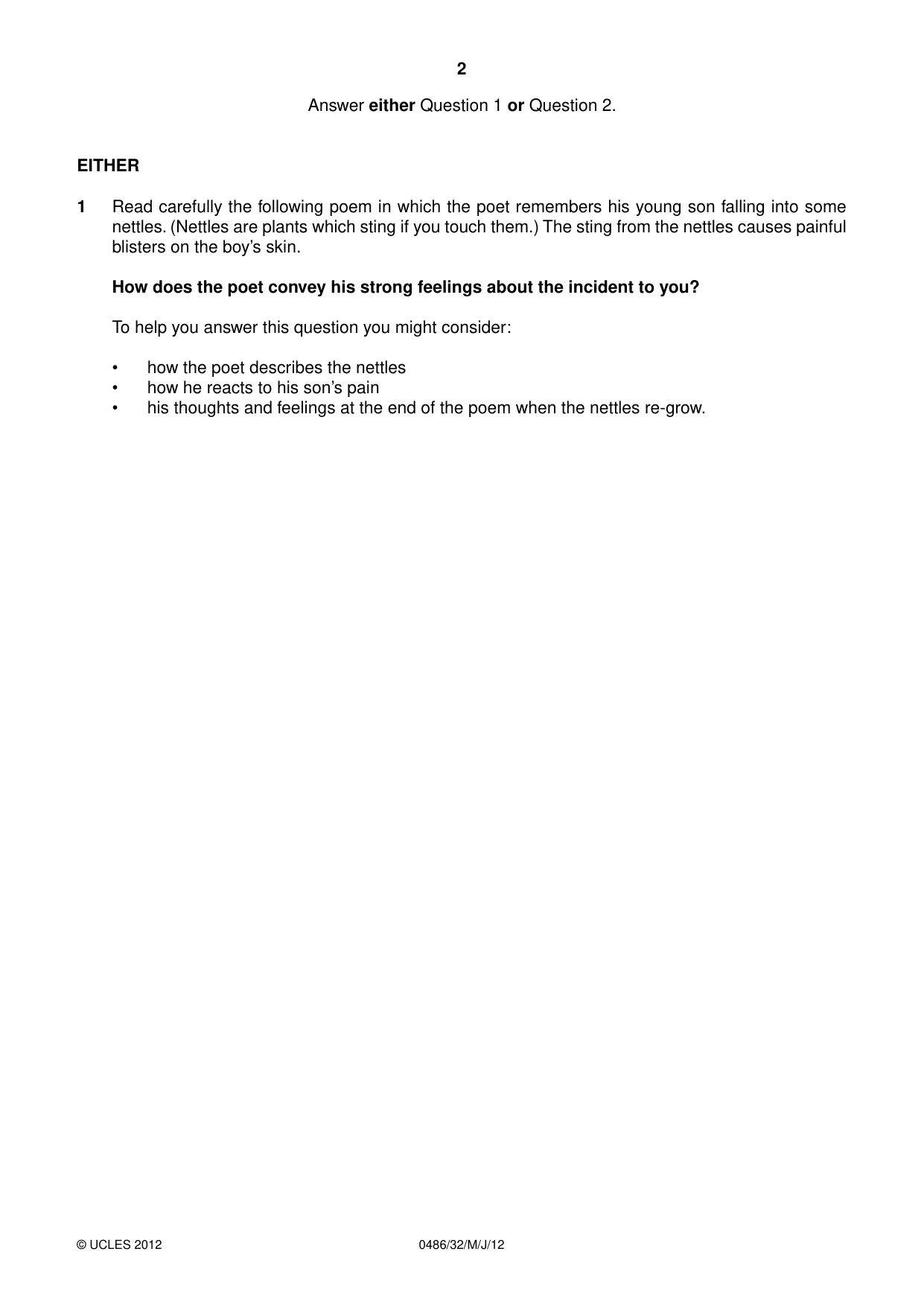
Question paper, page 2
2 0486/32/M/J/12 © UCLES 2012 Answer either Question 1 or Question 2. EITHER 1 Read carefully the following poem in which the poet remembers his young son falling into some nettles. (Nettles are plants which sting if you touch them.) The sting from the nettles causes painful blisters on the boy’s skin. How does the poet convey his strong feelings about the incident to you? To help you answer this question you might consider: • how the poet describes the nettles • how he reacts to his son’s pain • his thoughts and feelings at the end of the poem when the nettles re-grow.
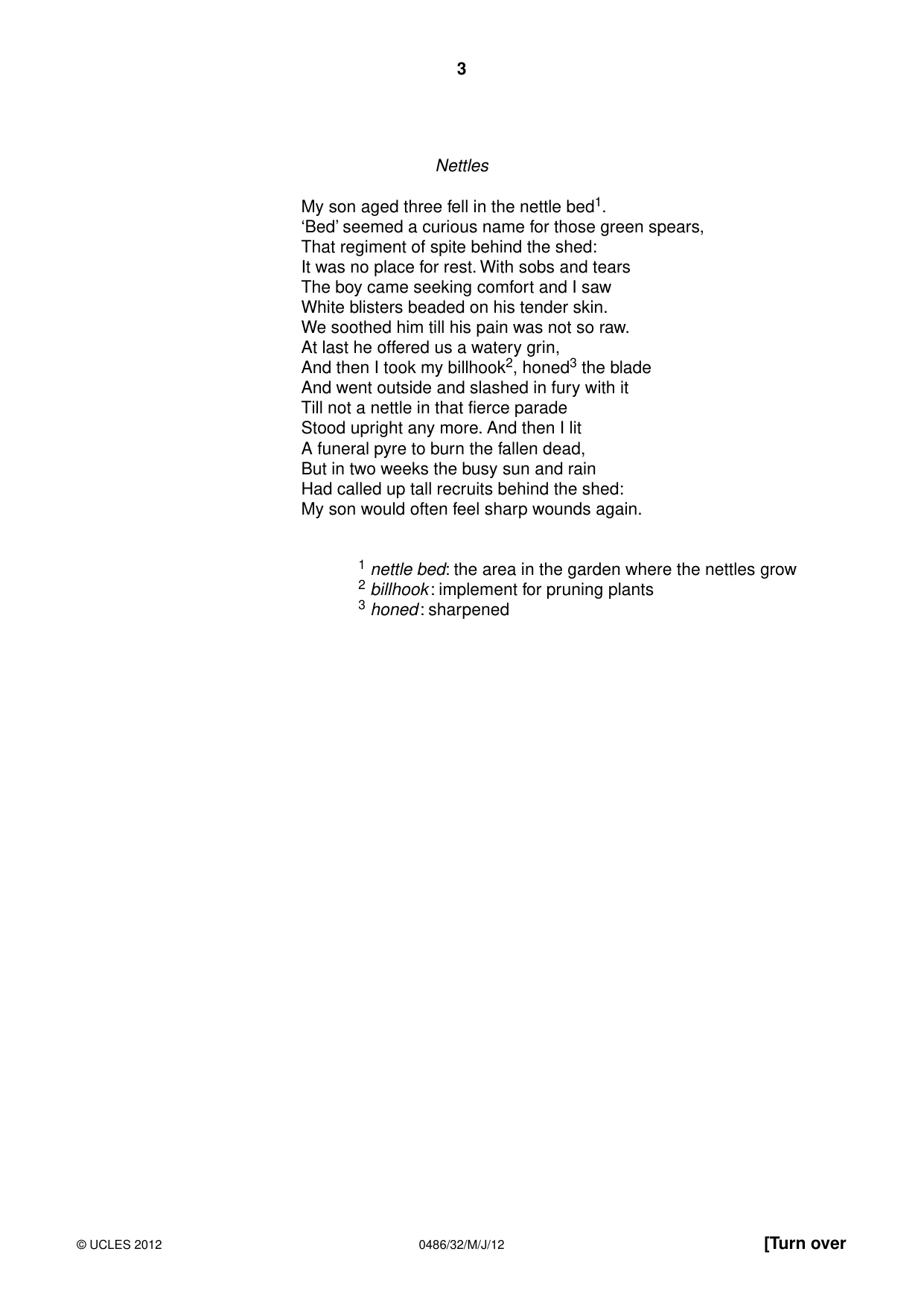
Question paper, page 3
3 0486/32/M/J/12 © UCLES 2012 [Turn over Nettles My son aged three fell in the nettle bed1. ‘Bed’ seemed a curious name for those green spears, That regiment of spite behind the shed: It was no place for rest. With sobs and tears The boy came seeking comfort and I saw White blisters beaded on his tender skin. We soothed him till his pain was not so raw. At last he offered us a watery grin, And then I took my billhook2, honed3 the blade And went outside and slashed in fury with it Till not a nettle in that fierce parade Stood upright any more. And then I lit A funeral pyre to burn the fallen dead, But in two weeks the busy sun and rain Had called up tall recruits behind the shed: My son would often feel sharp wounds again. 1 nettle bed: the area in the garden where the nettles grow 2 billhook : implement for pruning plants 3 honed : sharpened
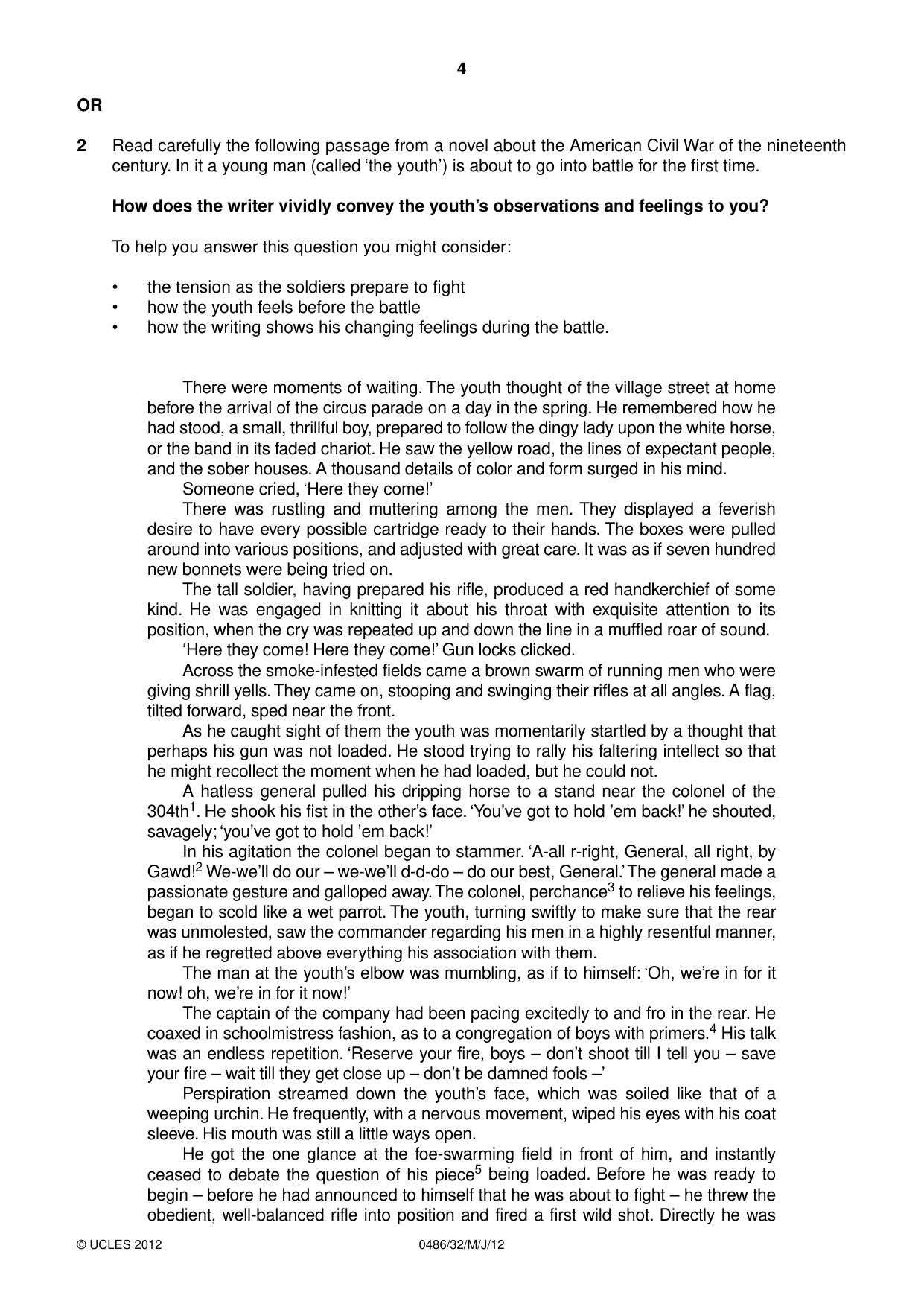
Question paper, page 4
4 0486/32/M/J/12 © UCLES 2012 OR 2 Read carefully the following passage from a novel about the American Civil War of the nineteenth century. In it a young man (called ‘the youth’) is about to go into battle for the first time. How does the writer vividly convey the youth’s observations and feelings to you? To help you answer this question you might consider: • the tension as the soldiers prepare to fight • how the youth feels before the battle • how the writing shows his changing feelings during the battle. There were moments of waiting. The youth thought of the village street at home before the arrival of the circus parade on a day in the spring. He remembered how he had stood, a small, thrillful boy, prepared to follow the dingy lady upon the white horse, or the band in its faded chariot. He saw the yellow road, the lines of expectant people, and the sober houses. A thousand details of color and form surged in his mind. Someone cried, ‘Here they come!’ There was rustling and muttering among the men. They displayed a feverish desire to have every possible cartridge ready to their hands. The boxes were pulled around into various positions, and adjusted with great care. It was as if seven hundred new bonnets were being tried on. The tall soldier, having prepared his rifle, produced a red handkerchief of some kind. He was engaged in knitting it about his throat with exquisite attention to its position, when the cry was repeated up and down the line in a muffled roar of sound. ‘Here they come! Here they come!’ Gun locks clicked. Across the smoke-infested fields came a brown swarm of running men who were giving shrill yells. They came on, stooping and swinging their rifles at all angles. A flag, tilted forward, sped near the front. As he caught sight of them the youth was momentarily startled by a thought that perhaps his gun was not loaded. He stood trying to rally his faltering intellect so that he might recollect the moment when he had loaded, but he could not. A hatless general pulled his dripping horse to a stand near the colonel of the 304th1. He shook his fist in the other’s face. ‘You’ve got to hold ’em back!’ he shouted, savagely; ‘you’ve got to hold ’em back!’ In his agitation the colonel began to stammer. ‘A-all r-right, General, all right, by Gawd!2 We-we’ll do our – we-we’ll d-d-do – do our best, General.’ The general made a passionate gesture and galloped away. The colonel, perchance3 to relieve his feelings, began to scold like a wet parrot. The youth, turning swiftly to make sure that the rear was unmolested, saw the commander regarding his men in a highly resentful manner, as if he regretted above everything his association with them. The man at the youth’s elbow was mumbling, as if to himself: ‘Oh, we’re in for it now! oh, we’re in for it now!’ The captain of the company had been pacing excitedly to and fro in the rear. He coaxed in schoolmistress fashion, as to a congregation of boys with primers.4 His talk was an endless repetition. ‘Reserve your fire, boys – don’t shoot till I tell you – save your fire – wait till they get close up – don’t be damned fools –’ Perspiration streamed down the youth’s face, which was soiled like that of a weeping urchin. He frequently, with a nervous movement, wiped his eyes with his coat sleeve. His mouth was still a little ways open. He got the one glance at the foe-swarming field in front of him, and instantly ceased to debate the question of his piece5 being loaded. Before he was ready to begin – before he had announced to himself that he was about to fight – he threw the obedient, well-balanced rifle into position and fired a first wild shot. Directly he was
Question paper, page 5
5 0486/32/M/J/12 © UCLES 2012 working at his weapon like an automatic affair. He suddenly lost concern for himself, and forgot to look at a menacing fate. He became not a man but a member. He felt that something of which he was a part – a regiment, an army, a cause, or a country – was in a crisis. He was welded into a common personality which was dominated by a single desire. For some moments he could not flee no more than a little finger can commit a revolution from a hand. If he had thought the regiment was about to be annihilated perhaps he could have amputated himself from it. But its noise gave him assurance. The regiment was like a firework that, once ignited, proceeds superior to circumstances until its blazing vitality fades. It wheezed and banged with a mighty power. He pictured the ground before it as strewn with the discomfited.6 There was a consciousness always of the presence of his comrades about him. He felt the subtle battle brotherhood more potent even than the cause for which they were fighting. It was a mysterious fraternity born of the smoke and danger of death. 1 304th: an army regiment 2 Gawd : God 3 perchance: possibly 4 primers: textbooks 5 piece: rifle 6 discomfited : injured or wounded
Question paper, page 6
6 0486/32/M/J/12 © UCLES 2012 BLANK PAGE
Question paper, page 7
7 0486/32/M/J/12 © UCLES 2012 BLANK PAGE
Question paper, page 8
8 0486/32/M/J/12 © UCLES 2012 BLANK PAGE Copyright Acknowledgements: Question 1 © Vernon Scannell; Nettles, from, Collected Poems 1950-93; Robson Books; 1998. Permission to reproduce items where third-party owned material protected by copyright is included has been sought and cleared where possible. Every reasonable effort has been made by the publisher (UCLES) to trace copyright holders, but if any items requiring clearance have unwittingly been included, the publisher will be pleased to make amends at the earliest possible opportunity. University of Cambridge International Examinations is part of the Cambridge Assessment Group. Cambridge Assessment is the brand name of University of Cambridge Local Examinations Syndicate (UCLES), which is itself a department of the University of Cambridge.
Mark scheme, page 1
UNIVERSITY OF CAMBRIDGE INTERNATIONAL EXAMINATIONS International General Certificate of Secondary Education MARK SCHEME for the May/June 2012 question paper for the guidance of teachers 0486 LITERATURE (ENGLISH) 0486/32 Paper 3 (Unseen), maximum raw mark 25 This mark scheme is published as an aid to teachers and candidates, to indicate the requirements of the examination. It shows the basis on which Examiners were instructed to award marks. It does not indicate the details of the discussions that took place at an Examiners’ meeting before marking began, which would have considered the acceptability of alternative answers. Mark schemes must be read in conjunction with the question papers and the report on the examination. • Cambridge will not enter into discussions or correspondence in connection with these mark schemes. Cambridge is publishing the mark schemes for the May/June 2012 question papers for most IGCSE, GCE Advanced Level and Advanced Subsidiary Level syllabuses and some Ordinary Level syllabuses. www.XtremePapers.com
Mark scheme, page 2
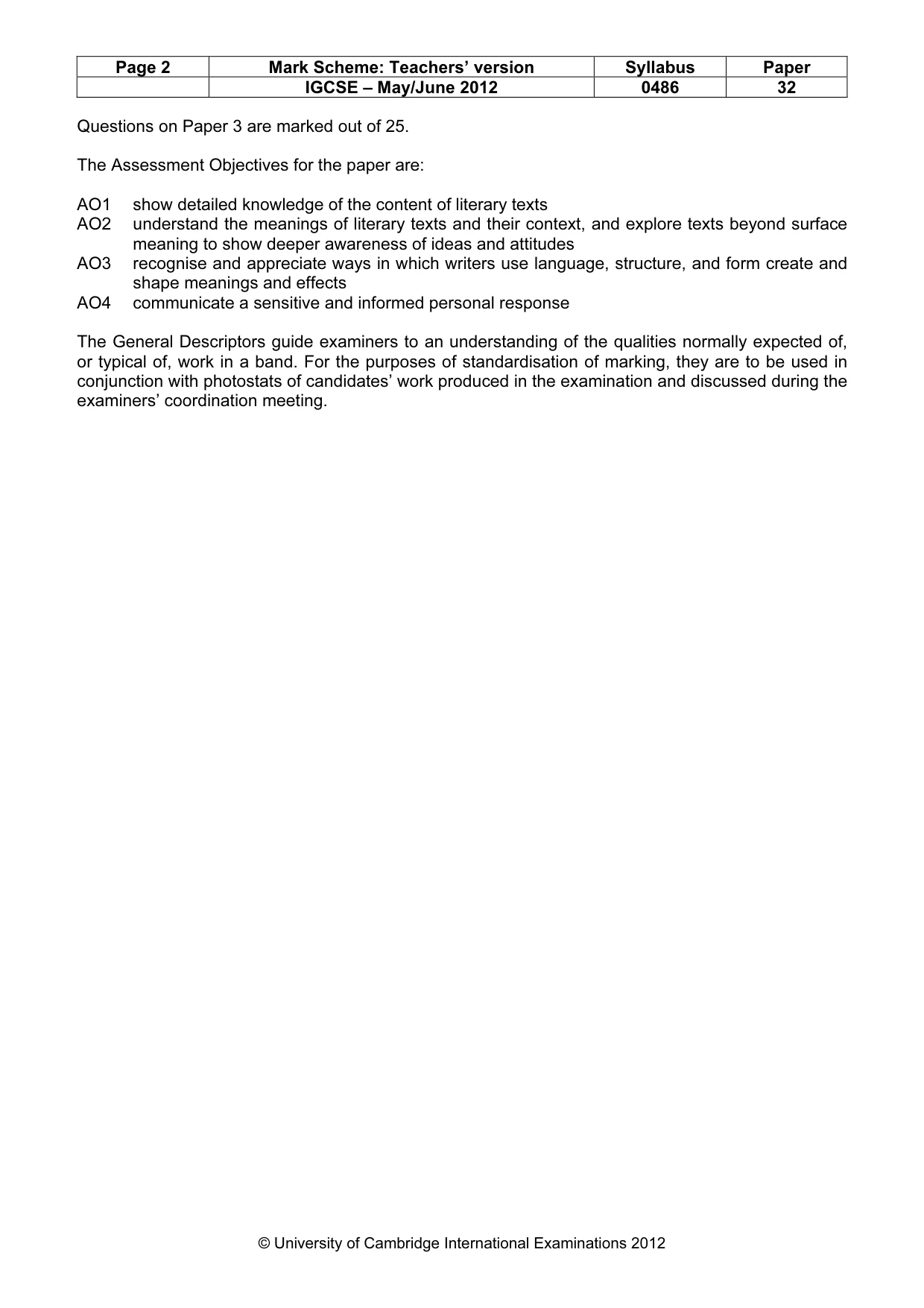
Page 2 Mark Scheme: Teachers’ version Syllabus Paper IGCSE – May/June 2012 0486 32 © University of Cambridge International Examinations 2012 Questions on Paper 3 are marked out of 25. The Assessment Objectives for the paper are: AO1 show detailed knowledge of the content of literary texts AO2 understand the meanings of literary texts and their context, and explore texts beyond surface meaning to show deeper awareness of ideas and attitudes AO3 recognise and appreciate ways in which writers use language, structure, and form create and shape meanings and effects AO4 communicate a sensitive and informed personal response The General Descriptors guide examiners to an understanding of the qualities normally expected of, or typical of, work in a band. For the purposes of standardisation of marking, they are to be used in conjunction with photostats of candidates’ work produced in the examination and discussed during the examiners’ coordination meeting.
Mark scheme, page 3
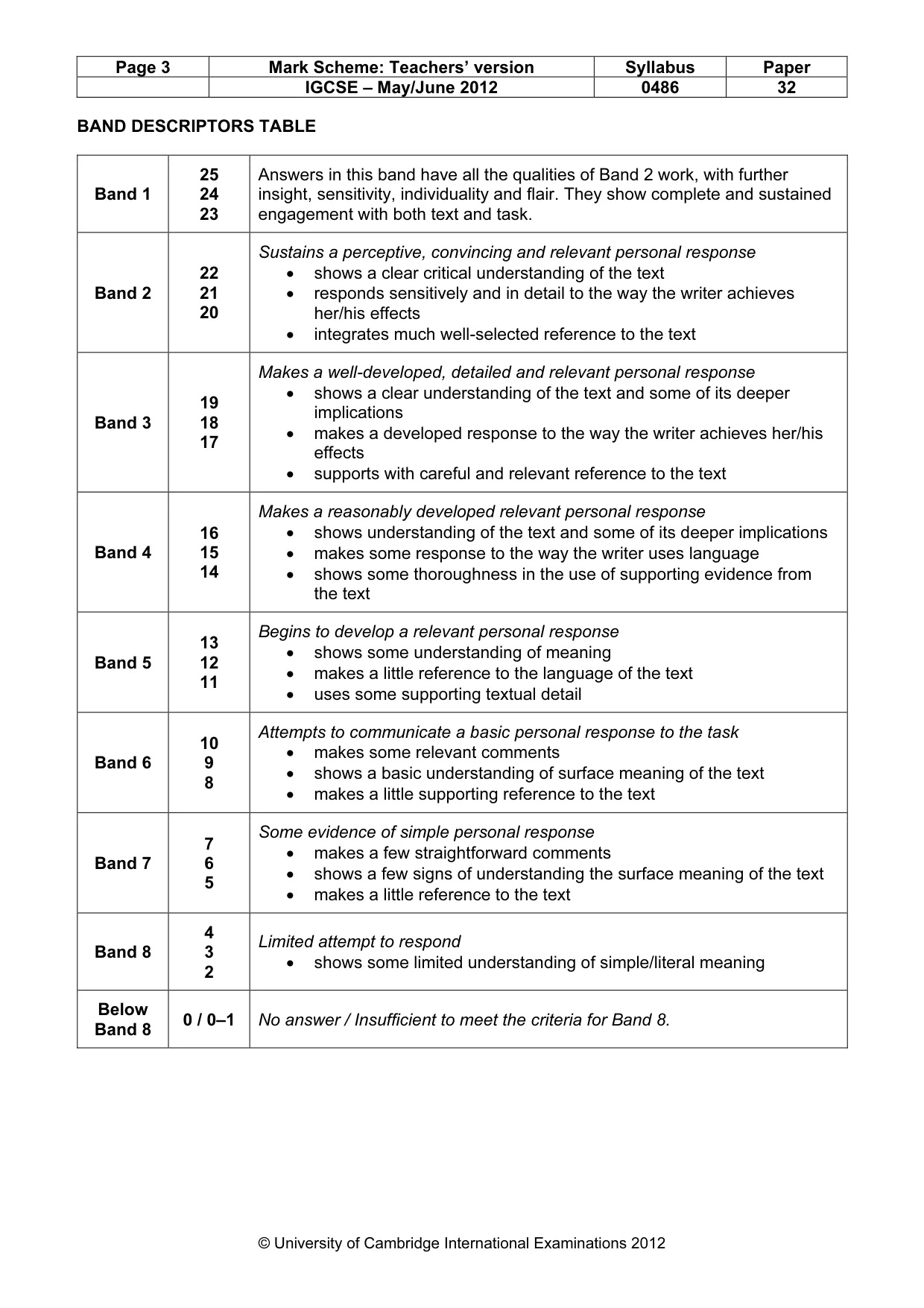
Page 3 Mark Scheme: Teachers’ version Syllabus Paper IGCSE – May/June 2012 0486 32 © University of Cambridge International Examinations 2012 BAND DESCRIPTORS TABLE Band 1 25 24 23 Answers in this band have all the qualities of Band 2 work, with further insight, sensitivity, individuality and flair. They show complete and sustained engagement with both text and task. Band 2 22 21 20 Sustains a perceptive, convincing and relevant personal response • shows a clear critical understanding of the text • responds sensitively and in detail to the way the writer achieves her/his effects • integrates much well-selected reference to the text Band 3 19 18 17 Makes a well-developed, detailed and relevant personal response • shows a clear understanding of the text and some of its deeper implications • makes a developed response to the way the writer achieves her/his effects • supports with careful and relevant reference to the text Band 4 16 15 14 Makes a reasonably developed relevant personal response • shows understanding of the text and some of its deeper implications • makes some response to the way the writer uses language • shows some thoroughness in the use of supporting evidence from the text Band 5 13 12 11 Begins to develop a relevant personal response • shows some understanding of meaning • makes a little reference to the language of the text • uses some supporting textual detail Band 6 10 9 8 Attempts to communicate a basic personal response to the task • makes some relevant comments • shows a basic understanding of surface meaning of the text • makes a little supporting reference to the text Band 7 7 6 5 Some evidence of simple personal response • makes a few straightforward comments • shows a few signs of understanding the surface meaning of the text • makes a little reference to the text Band 8 4 3 2 Limited attempt to respond • shows some limited understanding of simple/literal meaning Below Band 8 0 / 0–1 No answer / Insufficient to meet the criteria for Band 8.
What you needed in this session
Cambridge’s own grade thresholds for 2012 May/June, Paper 3 · Variant 2. A higher threshold means an easier paper — the bar moves with how the cohort did.