Cambridge IGCSE English - Literature 0486 — 2011 May/June Paper 3 · Variant 2
0486/32/M/J/11 · 25 marks · ≈28 min
The question paper and its mark scheme, free to read here and free to download. This is Cambridge’s own paper, exactly as it was sat.
Question paper8 pages



Mark scheme3 pages
Answers below. Sit the paper first if you are practising.
Paper as text
Question paper, page 1
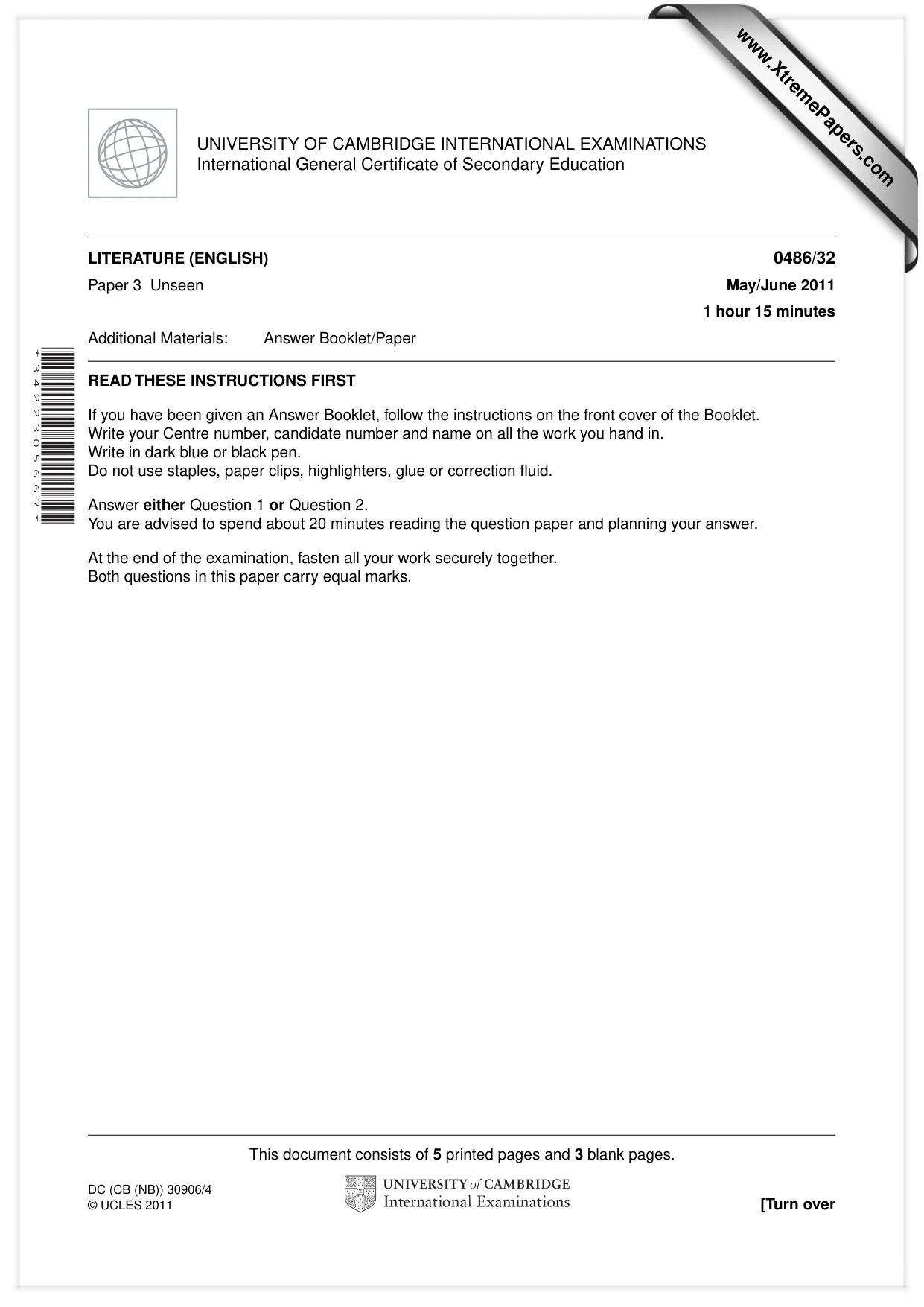
This document consists of 5 printed pages and 3 blank pages. DC (CB (NB)) 30906/4 © UCLES 2011 [Turn over UNIVERSITY OF CAMBRIDGE INTERNATIONAL EXAMINATIONS International General Certificate of Secondary Education * 3 4 2 2 3 0 5 6 6 7 * LITERATURE (ENGLISH) 0486/32 Paper 3 Unseen May/June 2011 1 hour 15 minutes Additional Materials: Answer Booklet/Paper READ THESE INSTRUCTIONS FIRST If you have been given an Answer Booklet, follow the instructions on the front cover of the Booklet. Write your Centre number, candidate number and name on all the work you hand in. Write in dark blue or black pen. Do not use staples, paper clips, highlighters, glue or correction fluid. Answer either Question 1 or Question 2. You are advised to spend about 20 minutes reading the question paper and planning your answer. At the end of the examination, fasten all your work securely together. Both questions in this paper carry equal marks. www.XtremePapers.com
Question paper, page 2
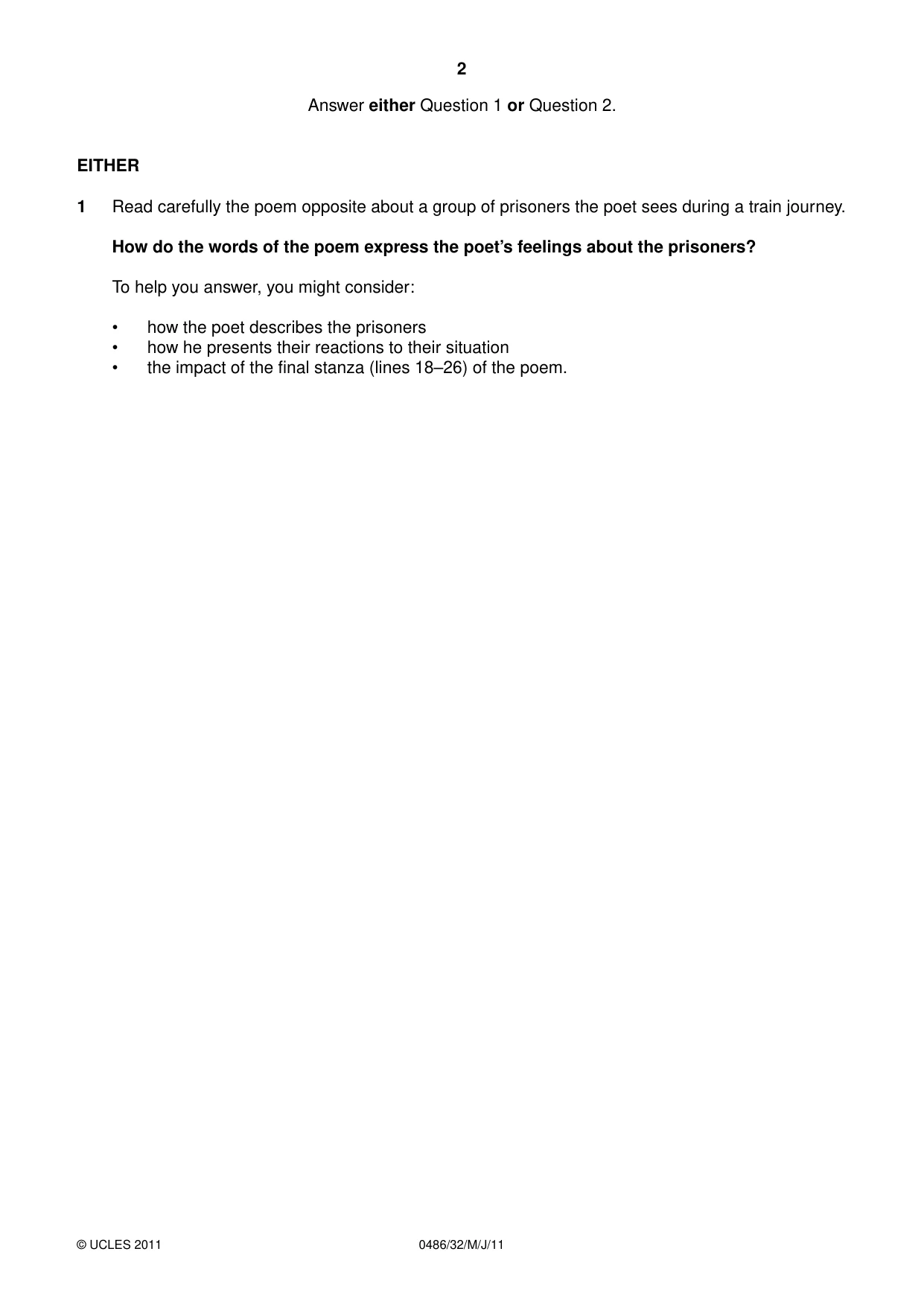
2 0486/32/M/J/11 © UCLES 2011 Answer either Question 1 or Question 2. EITHER 1 Read carefully the poem opposite about a group of prisoners the poet sees during a train journey. How do the words of the poem express the poet’s feelings about the prisoners? To help you answer, you might consider: • how the poet describes the prisoners • how he presents their reactions to their situation • the impact of the final stanza (lines 18–26) of the poem.
Question paper, page 3
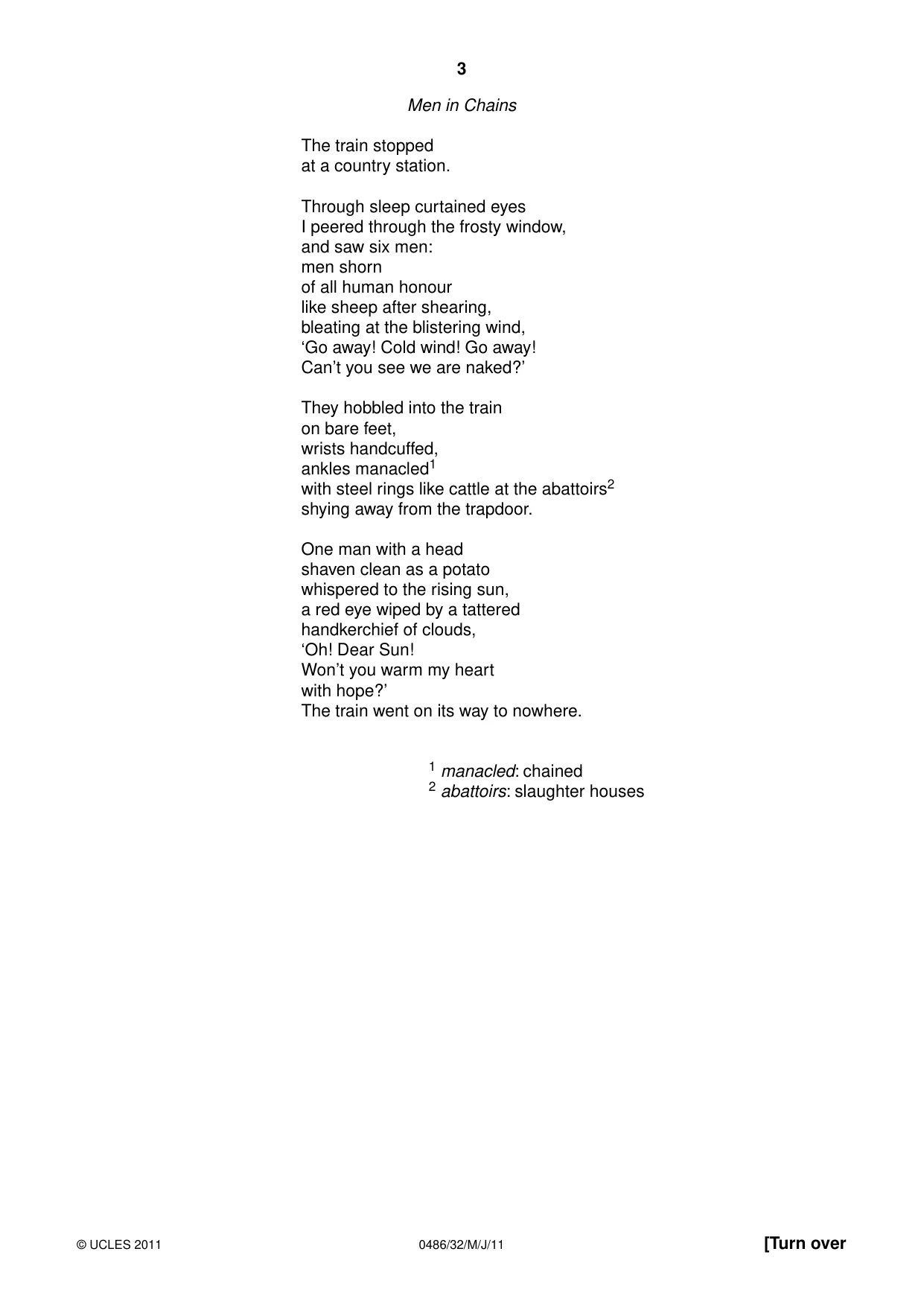
3 0486/32/M/J/11 © UCLES 2011 [Turn over Men in Chains The train stopped at a country station. Through sleep curtained eyes I peered through the frosty window, and saw six men: men shorn of all human honour like sheep after shearing, bleating at the blistering wind, ‘Go away! Cold wind! Go away! Can’t you see we are naked?’ They hobbled into the train on bare feet, wrists handcuffed, ankles manacled1 with steel rings like cattle at the abattoirs2 shying away from the trapdoor. One man with a head shaven clean as a potato whispered to the rising sun, a red eye wiped by a tattered handkerchief of clouds, ‘Oh! Dear Sun! Won’t you warm my heart with hope?’ The train went on its way to nowhere. 1 manacled: chained 2 abattoirs: slaughter houses
Question paper, page 4
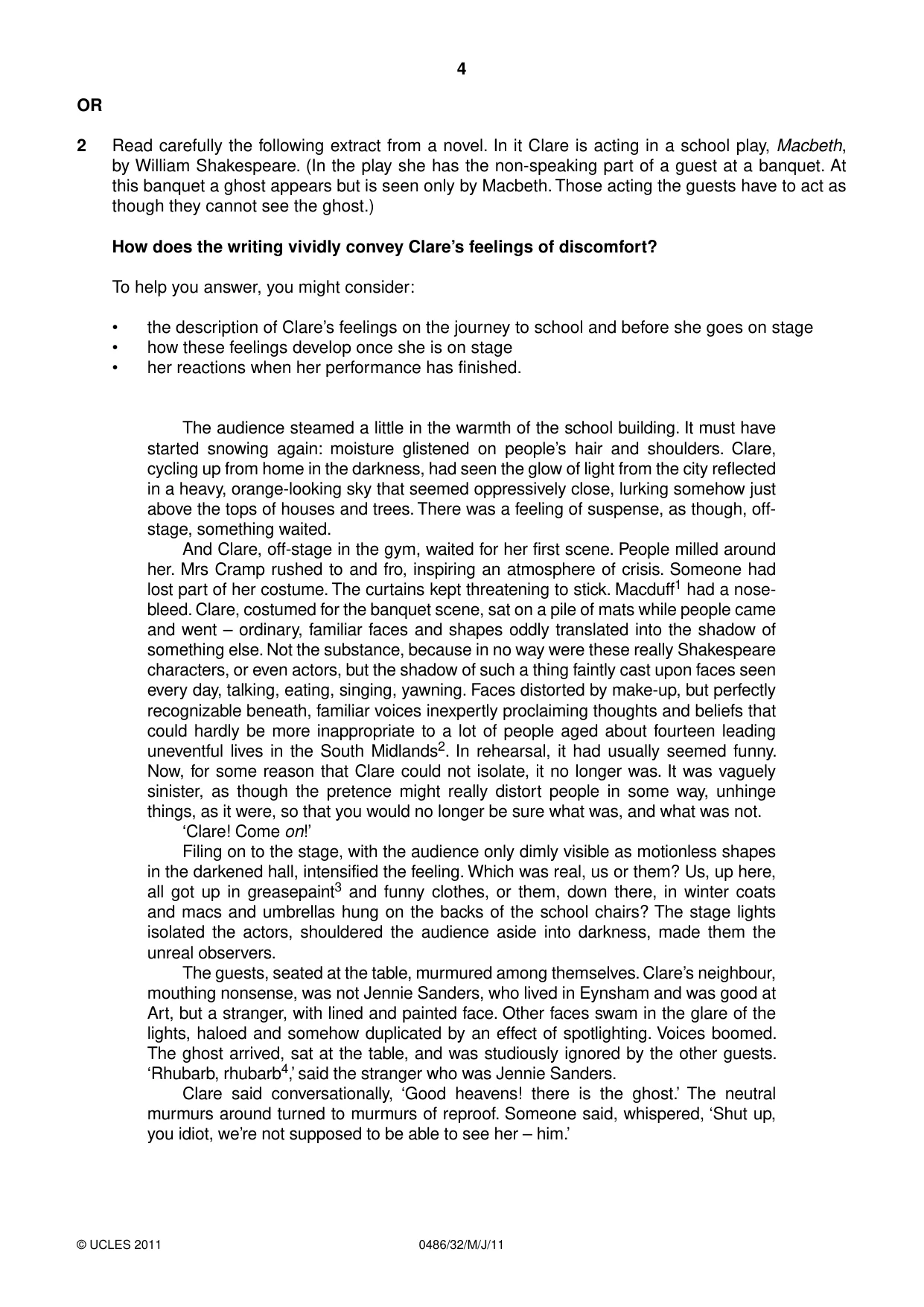
4 0486/32/M/J/11 © UCLES 2011 OR 2 Read carefully the following extract from a novel. In it Clare is acting in a school play, Macbeth, by William Shakespeare. (In the play she has the non-speaking part of a guest at a banquet. At this banquet a ghost appears but is seen only by Macbeth. Those acting the guests have to act as though they cannot see the ghost.) How does the writing vividly convey Clare’s feelings of discomfort? To help you answer, you might consider: • the description of Clare’s feelings on the journey to school and before she goes on stage • how these feelings develop once she is on stage • her reactions when her performance has finished. The audience steamed a little in the warmth of the school building. It must have started snowing again: moisture glistened on people’s hair and shoulders. Clare, cycling up from home in the darkness, had seen the glow of light from the city reflected in a heavy, orange-looking sky that seemed oppressively close, lurking somehow just above the tops of houses and trees. There was a feeling of suspense, as though, off- stage, something waited. And Clare, off-stage in the gym, waited for her first scene. People milled around her. Mrs Cramp rushed to and fro, inspiring an atmosphere of crisis. Someone had lost part of her costume. The curtains kept threatening to stick. Macduff1 had a nose- bleed. Clare, costumed for the banquet scene, sat on a pile of mats while people came and went – ordinary, familiar faces and shapes oddly translated into the shadow of something else. Not the substance, because in no way were these really Shakespeare characters, or even actors, but the shadow of such a thing faintly cast upon faces seen every day, talking, eating, singing, yawning. Faces distorted by make-up, but perfectly recognizable beneath, familiar voices inexpertly proclaiming thoughts and beliefs that could hardly be more inappropriate to a lot of people aged about fourteen leading uneventful lives in the South Midlands2. In rehearsal, it had usually seemed funny. Now, for some reason that Clare could not isolate, it no longer was. It was vaguely sinister, as though the pretence might really distort people in some way, unhinge things, as it were, so that you would no longer be sure what was, and what was not. ‘Clare! Come on!’ Filing on to the stage, with the audience only dimly visible as motionless shapes in the darkened hall, intensified the feeling. Which was real, us or them? Us, up here, all got up in greasepaint3 and funny clothes, or them, down there, in winter coats and macs and umbrellas hung on the backs of the school chairs? The stage lights isolated the actors, shouldered the audience aside into darkness, made them the unreal observers. The guests, seated at the table, murmured among themselves. Clare’s neighbour, mouthing nonsense, was not Jennie Sanders, who lived in Eynsham and was good at Art, but a stranger, with lined and painted face. Other faces swam in the glare of the lights, haloed and somehow duplicated by an effect of spotlighting. Voices boomed. The ghost arrived, sat at the table, and was studiously ignored by the other guests. ‘Rhubarb, rhubarb4,’ said the stranger who was Jennie Sanders. Clare said conversationally, ‘Good heavens! there is the ghost.’ The neutral murmurs around turned to murmurs of reproof. Someone said, whispered, ‘Shut up, you idiot, we’re not supposed to be able to see her – him.’
Question paper, page 5
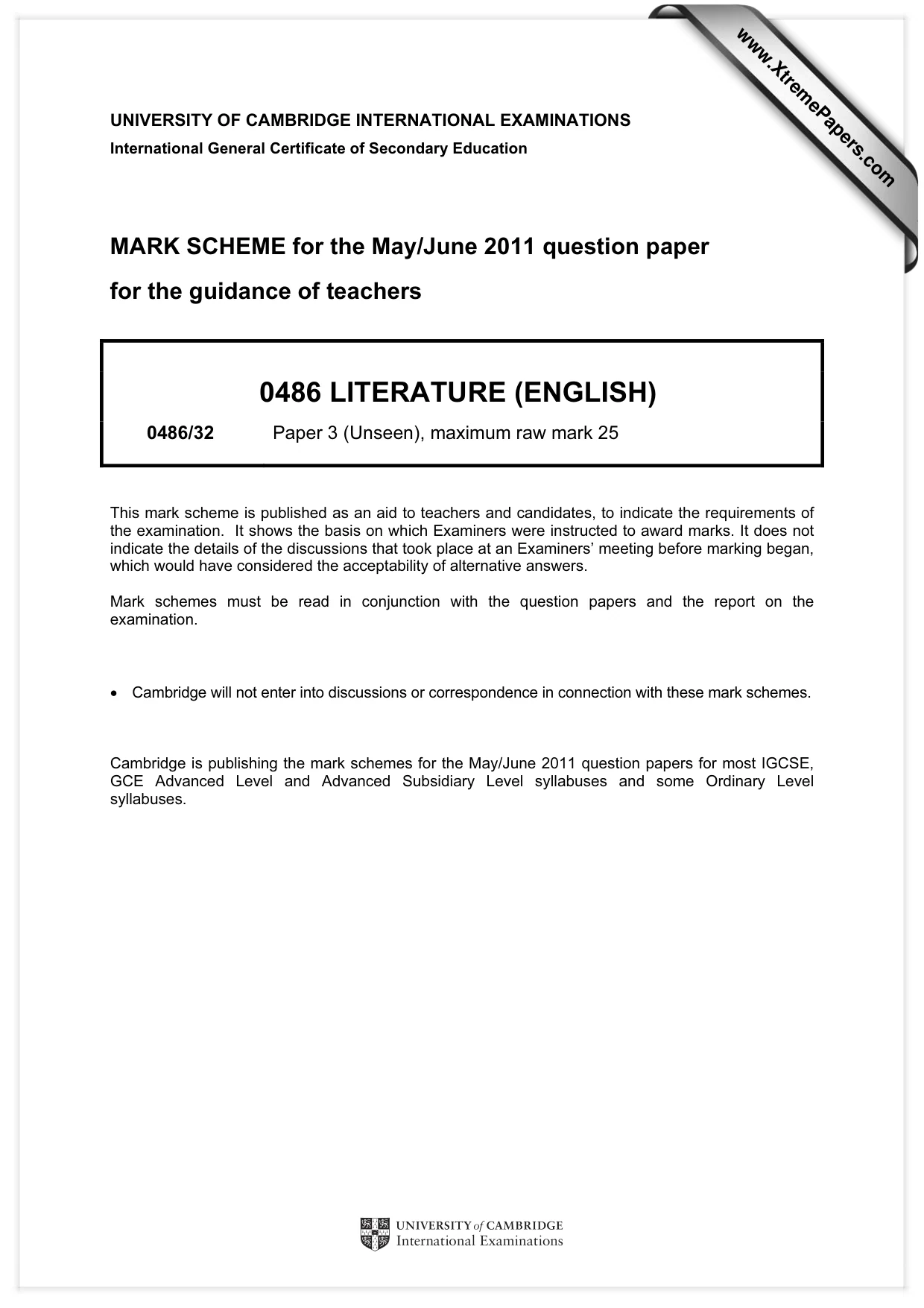
5 0486/32/M/J/11 © UCLES 2011 ‘It would be much more interesting if we did,’ said Clare. ‘Then there’d really be something to talk about.’ Beyond her, in the wings, she could see Mrs Cramp making curious gestures, soothing the air with her hands like a conductor restraining an over- active orchestra. She mouthed something: ‘Don’t talk so loud,’ it looked like. Jennie Sanders, under her paint, was registering alarm. ‘Or perhaps they did,’ said Clare thoughtfully. ‘Perhaps that’s the whole point. They all saw it, Lady Macbeth specially, but they pretended not to so Macbeth would get in a proper old state.’ Around her, the guests were gabbling feverishly. Macbeth raved at the ghost and the ghost got up and left the stage while the guests politely looked the other way. It loitered in the wings, stripping off cheesecloth and becoming Liz again. A disastrous dinner party drew to a close. The guests filed off the stage. Behind the scenes, Clare was accused by some of frivolity and others treachery. She hardly heard them: their painted faces, saying things, floated around her. Mrs Cramp appeared and said, ‘You were a very convincing guest, I must say, Clare. A bit overconvincing, maybe, but never mind,’ and then, ‘Are you feeling all right?’ Clare said, ‘Can I go home? Would it matter if I didn’t come on in the last scene?’ ‘Of course you can go, if you’re not feeling well.’ ‘I’m all right.’ It was snowing hard. She could hardly see where she went, standing up on the pedals of the bike and pushing forward into the whirling darkness. When she got home she threw the bike down on the gravel anyhow and left it, wheels still spinning, running up the steps and into the house. 1 Macduff: a character in the play 2 South Midlands: area in the centre of England 3 greasepaint: theatrical make up 4 Rhubarb, rhubarb: meaningless words actors say in crowd scenes to pretend they are having a conversation
Question paper, page 6
6 0486/32/M/J/11 © UCLES 2011 BLANK PAGE
Question paper, page 7
7 0486/32/M/J/11 © UCLES 2011 BLANK PAGE
Question paper, page 8
8 0486/32/M/J/11 © UCLES 2011 BLANK PAGE Copyright Acknowledgements: Question 1 © Mbuyiseni Oswald Mtshali; ‘Men in Chains’ in Seasons Come to Pass; OUP; 2004. Reprinted by permission of the author and Ad. Donker (Pt) Ltd Question 2 © Penelope Lively; The House in Norham Gardens; Puffin; 1974. Permission to reproduce items where third-party owned material protected by copyright is included has been sought and cleared where possible. Every reasonable effort has been made by the publisher (UCLES) to trace copyright holders, but if any items requiring clearance have unwittingly been included, the publisher will be pleased to make amends at the earliest possible opportunity. University of Cambridge International Examinations is part of the Cambridge Assessment Group. Cambridge Assessment is the brand name of University of Cambridge Local Examinations Syndicate (UCLES), which is itself a department of the University of Cambridge.
Mark scheme, page 1
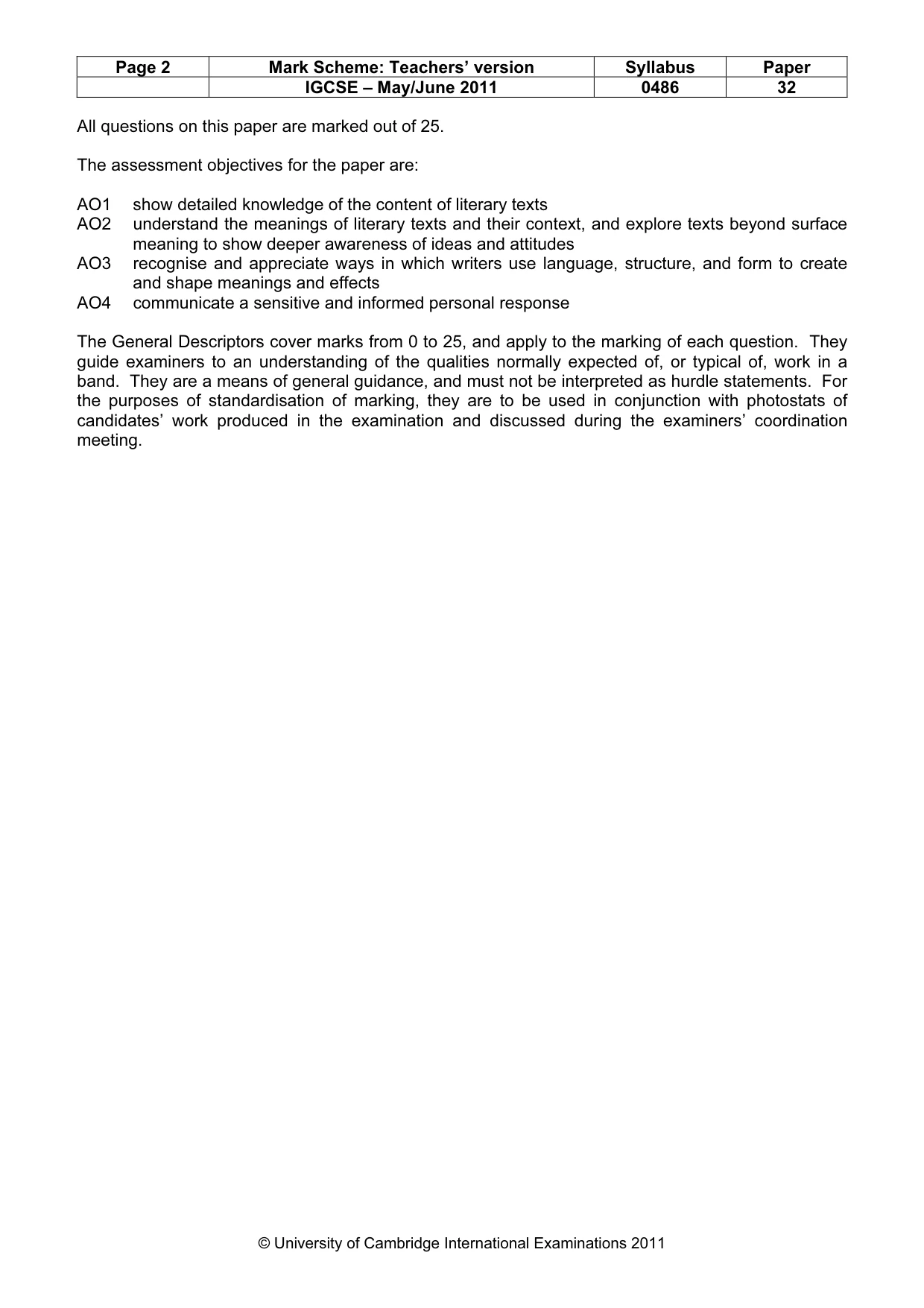
UNIVERSITY OF CAMBRIDGE INTERNATIONAL EXAMINATIONS International General Certificate of Secondary Education MARK SCHEME for the May/June 2011 question paper for the guidance of teachers 0486 LITERATURE (ENGLISH) 0486/32 Paper 3 (Unseen), maximum raw mark 25 This mark scheme is published as an aid to teachers and candidates, to indicate the requirements of the examination. It shows the basis on which Examiners were instructed to award marks. It does not indicate the details of the discussions that took place at an Examiners’ meeting before marking began, which would have considered the acceptability of alternative answers. Mark schemes must be read in conjunction with the question papers and the report on the examination. • Cambridge will not enter into discussions or correspondence in connection with these mark schemes. Cambridge is publishing the mark schemes for the May/June 2011 question papers for most IGCSE, GCE Advanced Level and Advanced Subsidiary Level syllabuses and some Ordinary Level syllabuses. www.XtremePapers.com
Mark scheme, page 2
Page 2 Mark Scheme: Teachers’ version Syllabus Paper IGCSE – May/June 2011 0486 32 © University of Cambridge International Examinations 2011 All questions on this paper are marked out of 25. The assessment objectives for the paper are: AO1 show detailed knowledge of the content of literary texts AO2 understand the meanings of literary texts and their context, and explore texts beyond surface meaning to show deeper awareness of ideas and attitudes AO3 recognise and appreciate ways in which writers use language, structure, and form to create and shape meanings and effects AO4 communicate a sensitive and informed personal response The General Descriptors cover marks from 0 to 25, and apply to the marking of each question. They guide examiners to an understanding of the qualities normally expected of, or typical of, work in a band. They are a means of general guidance, and must not be interpreted as hurdle statements. For the purposes of standardisation of marking, they are to be used in conjunction with photostats of candidates’ work produced in the examination and discussed during the examiners’ coordination meeting.
Mark scheme, page 3
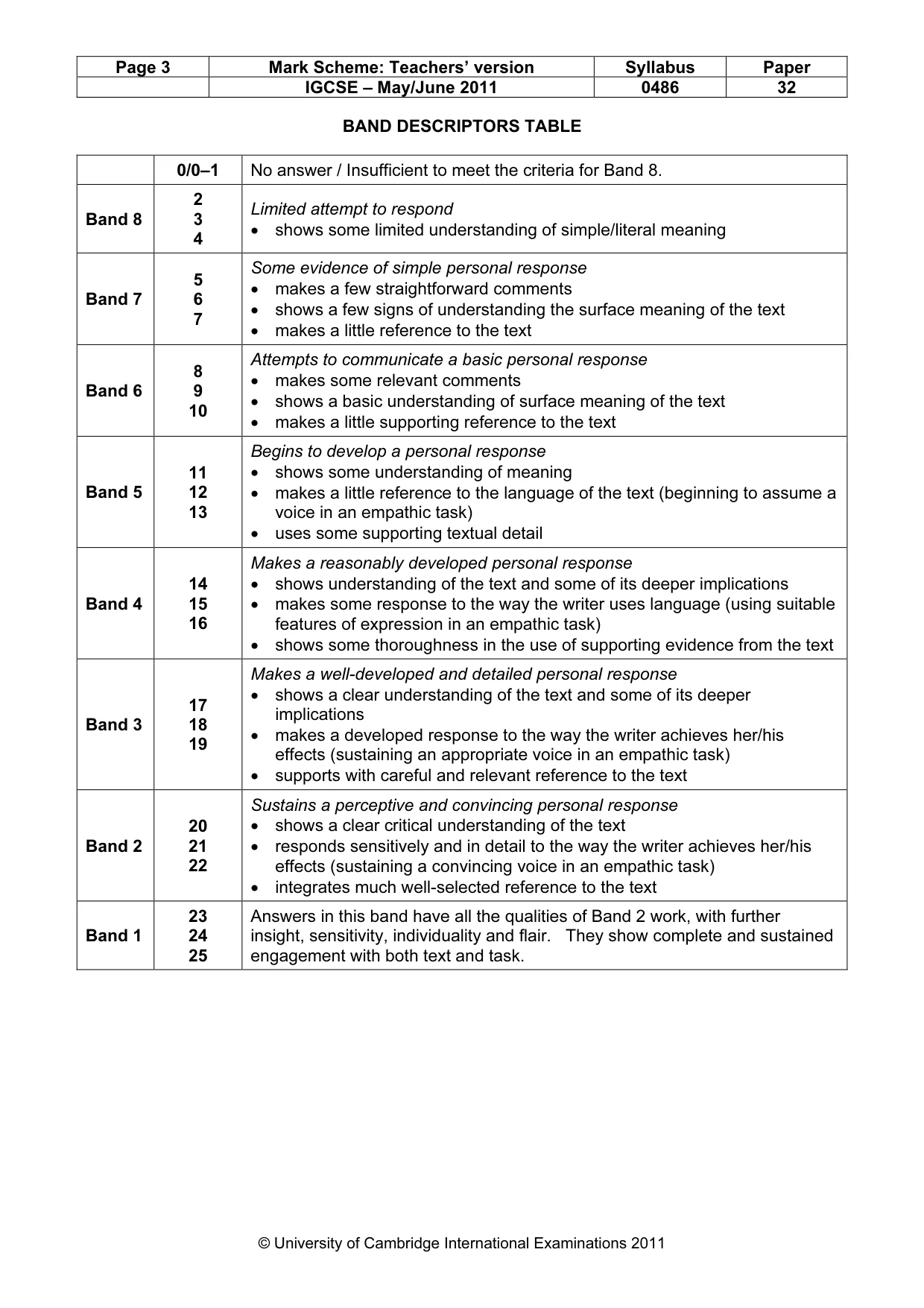
Page 3 Mark Scheme: Teachers’ version Syllabus Paper IGCSE – May/June 2011 0486 32 © University of Cambridge International Examinations 2011 BAND DESCRIPTORS TABLE 0/0–1 No answer / Insufficient to meet the criteria for Band 8. Band 8 2 3 4 Limited attempt to respond • shows some limited understanding of simple/literal meaning Band 7 5 6 7 Some evidence of simple personal response • makes a few straightforward comments • shows a few signs of understanding the surface meaning of the text • makes a little reference to the text Band 6 8 9 10 Attempts to communicate a basic personal response • makes some relevant comments • shows a basic understanding of surface meaning of the text • makes a little supporting reference to the text Band 5 11 12 13 Begins to develop a personal response • shows some understanding of meaning • makes a little reference to the language of the text (beginning to assume a voice in an empathic task) • uses some supporting textual detail Band 4 14 15 16 Makes a reasonably developed personal response • shows understanding of the text and some of its deeper implications • makes some response to the way the writer uses language (using suitable features of expression in an empathic task) • shows some thoroughness in the use of supporting evidence from the text Band 3 17 18 19 Makes a well-developed and detailed personal response • shows a clear understanding of the text and some of its deeper implications • makes a developed response to the way the writer achieves her/his effects (sustaining an appropriate voice in an empathic task) • supports with careful and relevant reference to the text Band 2 20 21 22 Sustains a perceptive and convincing personal response • shows a clear critical understanding of the text • responds sensitively and in detail to the way the writer achieves her/his effects (sustaining a convincing voice in an empathic task) • integrates much well-selected reference to the text Band 1 23 24 25 Answers in this band have all the qualities of Band 2 work, with further insight, sensitivity, individuality and flair. They show complete and sustained engagement with both text and task.
What you needed in this session
Cambridge’s own grade thresholds for 2011 May/June, Paper 3 · Variant 2. A higher threshold means an easier paper — the bar moves with how the cohort did.