Cambridge IGCSE English - Literature 0486 — 2010 Oct/Nov Paper 5 · Variant 3
0486/53/O/N/10 · 25 marks · ≈28 min
The question paper and its mark scheme, free to read here and free to download. This is Cambridge’s own paper, exactly as it was sat.
Question paper16 pages


Mark scheme10 pages
Answers below. Sit the paper first if you are practising.
Paper as text
Question paper, page 1
This document consists of 14 printed pages and 2 blank pages. DC (SM) 19874/6 © UCLES 2010 [Turn over UNIVERSITY OF CAMBRIDGE INTERNATIONAL EXAMINATIONS International General Certificate of Secondary Education READ THESE INSTRUCTIONS FIRST If you have been given an Answer Booklet, follow the instructions on the front cover of the Booklet. Write your Centre number, candidate number and name on all the work you hand in. Write in dark blue or black pen. Do not use staples, paper clips, highlighters, glue or correction fluid. Answer one question. At the end of the examination, fasten all your work securely together. All questions in this paper carry equal marks. LITERATURE (ENGLISH) 0486/53 Paper 5 October/November 2010 45 minutes Additional Materials: Answer Booklet/Paper * 8 6 6 7 7 1 2 6 4 2 * www.XtremePapers.com
Question paper, page 2
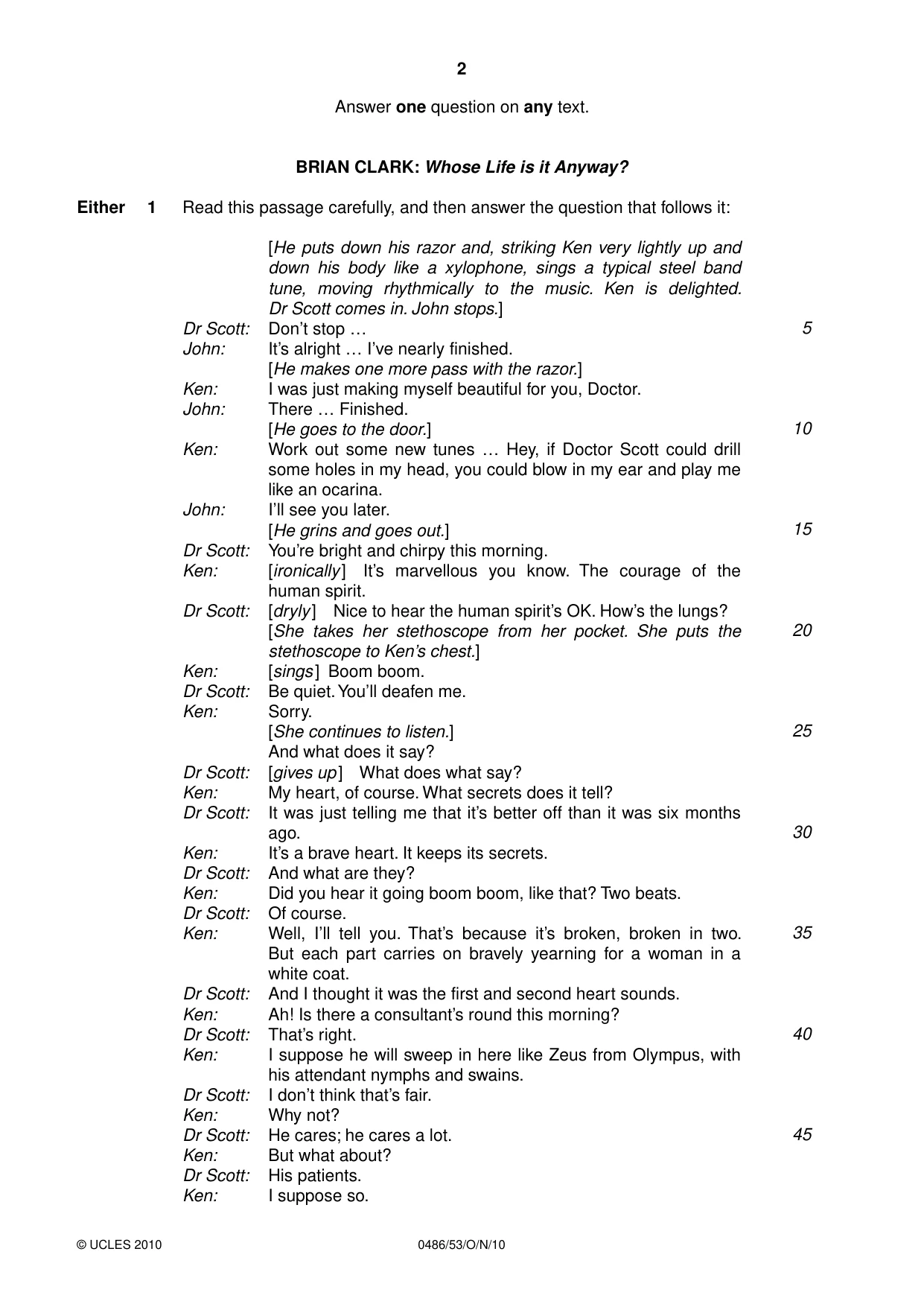
2 0486/53/O/N/10 © UCLES 2010 Answer one question on any text. BRIAN CLARK: Whose Life is it Anyway? Either 1 Read this passage carefully, and then answer the question that follows it: [He puts down his razor and, striking Ken very lightly up and down his body like a xylophone, sings a typical steel band tune, moving rhythmically to the music. Ken is delighted. Dr Scott comes in. John stops.] Dr Scott: Don’t stop … John: It’s alright … I’ve nearly finished. [He makes one more pass with the razor.] Ken: I was just making myself beautiful for you, Doctor. John: There … Finished. [He goes to the door.] Ken: Work out some new tunes … Hey, if Doctor Scott could drill some holes in my head, you could blow in my ear and play me like an ocarina. John: I’ll see you later. [He grins and goes out.] Dr Scott: You’re bright and chirpy this morning. Ken: [ironically ] It’s marvellous you know. The courage of the human spirit. Dr Scott: [dryly ] Nice to hear the human spirit’s OK. How’s the lungs? [She takes her stethoscope from her pocket. She puts the stethoscope to Ken’s chest.] Ken: [sings ] Boom boom. Dr Scott: Be quiet. You’ll deafen me. Ken: Sorry. [She continues to listen.] And what does it say? Dr Scott: [gives up ] What does what say? Ken: My heart, of course. What secrets does it tell? Dr Scott: It was just telling me that it’s better off than it was six months ago. Ken: It’s a brave heart. It keeps its secrets. Dr Scott: And what are they? Ken: Did you hear it going boom boom, like that? Two beats. Dr Scott: Of course. Ken: Well, I’ll tell you. That’s because it’s broken, broken in two. But each part carries on bravely yearning for a woman in a white coat. Dr Scott: And I thought it was the first and second heart sounds. Ken: Ah! Is there a consultant’s round this morning? Dr Scott: That’s right. Ken: I suppose he will sweep in here like Zeus from Olympus, with his attendant nymphs and swains. Dr Scott: I don’t think that’s fair. Ken: Why not? Dr Scott: He cares; he cares a lot. Ken: But what about? Dr Scott: His patients. Ken: I suppose so. 5 10 15 20 25 30 35 40 45
Question paper, page 3
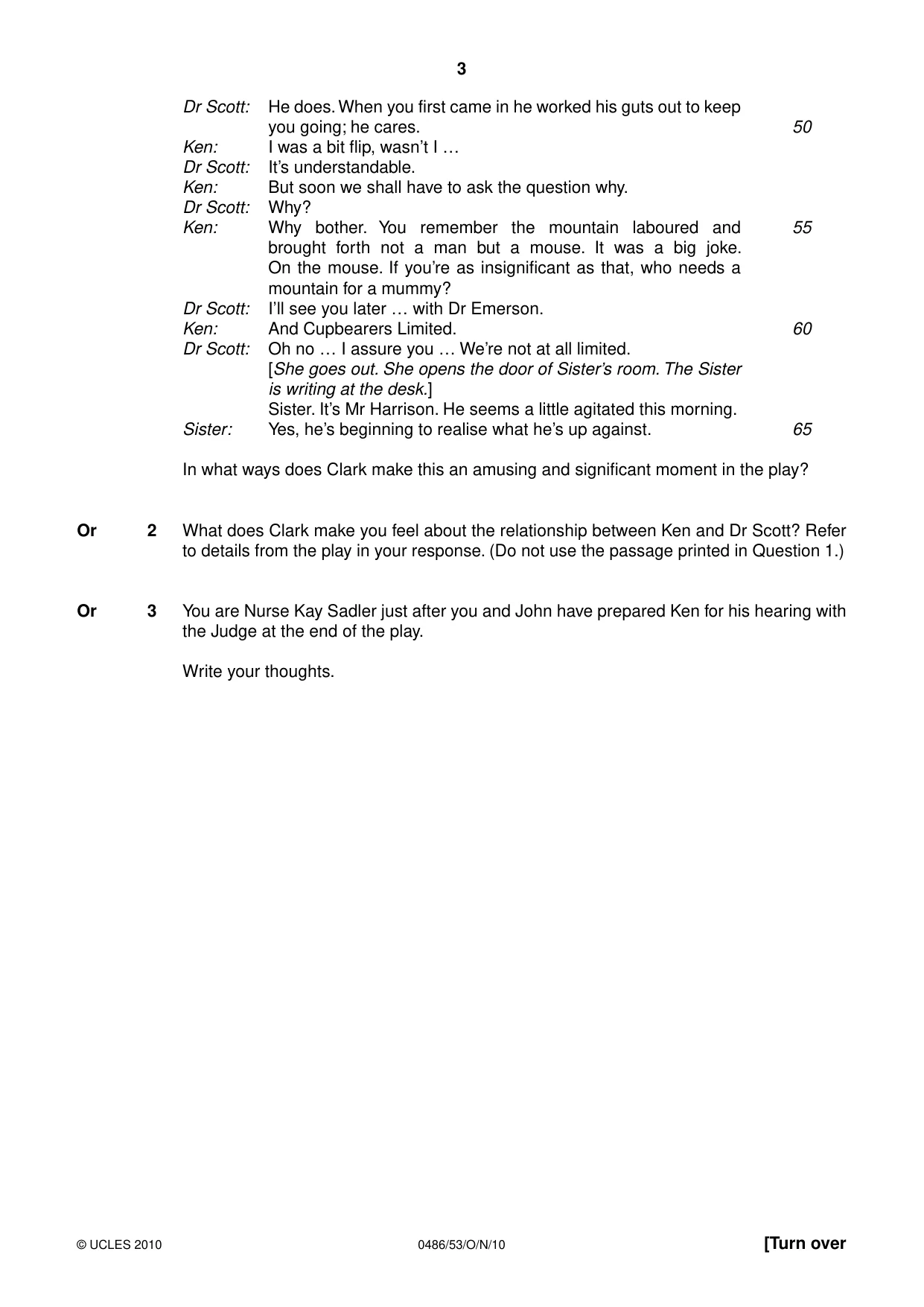
3 0486/53/O/N/10 © UCLES 2010 [Turn over Dr Scott: He does. When you first came in he worked his guts out to keep you going; he cares. Ken: I was a bit flip, wasn’t I … Dr Scott: It’s understandable. Ken: But soon we shall have to ask the question why. Dr Scott: Why? Ken: Why bother. You remember the mountain laboured and brought forth not a man but a mouse. It was a big joke. On the mouse. If you’re as insignificant as that, who needs a mountain for a mummy? Dr Scott: I’ll see you later … with Dr Emerson. Ken: And Cupbearers Limited. Dr Scott: Oh no … I assure you … We’re not at all limited. [She goes out. She opens the door of Sister’s room. The Sister is writing at the desk.] Sister. It’s Mr Harrison. He seems a little agitated this morning. Sister: Yes, he’s beginning to realise what he’s up against. In what ways does Clark make this an amusing and significant moment in the play? Or 2 What does Clark make you feel about the relationship between Ken and Dr Scott? Refer to details from the play in your response. (Do not use the passage printed in Question 1.) Or 3 You are Nurse Kay Sadler just after you and John have prepared Ken for his hearing with the Judge at the end of the play. Write your thoughts. 50 55 60 65
Question paper, page 4
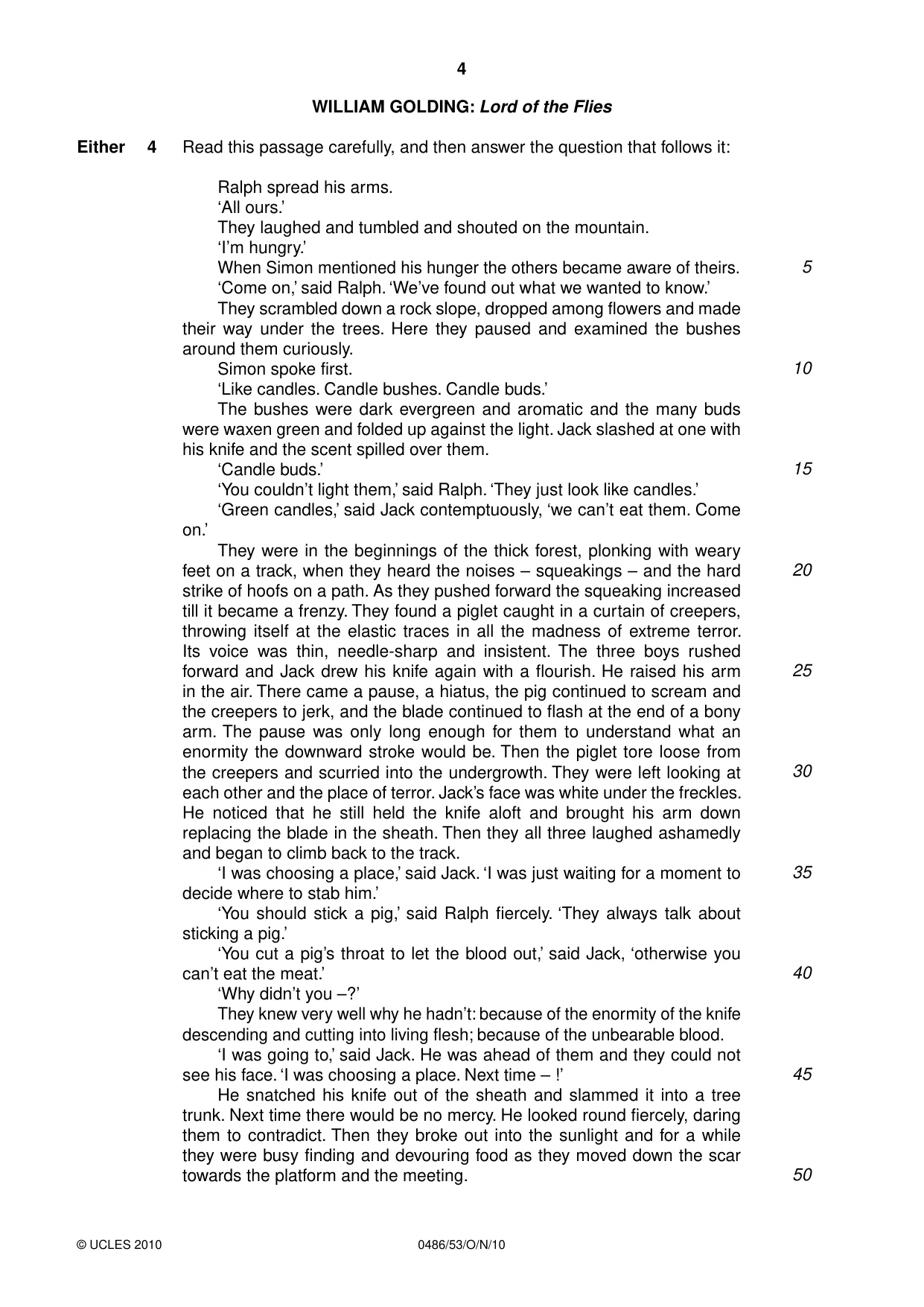
4 0486/53/O/N/10 © UCLES 2010 WILLIAM GOLDING: Lord of the Flies Either 4 Read this passage carefully, and then answer the question that follows it: Ralph spread his arms. ‘All ours.’ They laughed and tumbled and shouted on the mountain. ‘I’m hungry.’ When Simon mentioned his hunger the others became aware of theirs. ‘Come on,’ said Ralph. ‘We’ve found out what we wanted to know.’ They scrambled down a rock slope, dropped among flowers and made their way under the trees. Here they paused and examined the bushes around them curiously. Simon spoke first. ‘Like candles. Candle bushes. Candle buds.’ The bushes were dark evergreen and aromatic and the many buds were waxen green and folded up against the light. Jack slashed at one with his knife and the scent spilled over them. ‘Candle buds.’ ‘You couldn’t light them,’ said Ralph. ‘They just look like candles.’ ‘Green candles,’ said Jack contemptuously, ‘we can’t eat them. Come on.’ They were in the beginnings of the thick forest, plonking with weary feet on a track, when they heard the noises – squeakings – and the hard strike of hoofs on a path. As they pushed forward the squeaking increased till it became a frenzy. They found a piglet caught in a curtain of creepers, throwing itself at the elastic traces in all the madness of extreme terror. Its voice was thin, needle-sharp and insistent. The three boys rushed forward and Jack drew his knife again with a flourish. He raised his arm in the air. There came a pause, a hiatus, the pig continued to scream and the creepers to jerk, and the blade continued to flash at the end of a bony arm. The pause was only long enough for them to understand what an enormity the downward stroke would be. Then the piglet tore loose from the creepers and scurried into the undergrowth. They were left looking at each other and the place of terror. Jack’s face was white under the freckles. He noticed that he still held the knife aloft and brought his arm down replacing the blade in the sheath. Then they all three laughed ashamedly and began to climb back to the track. ‘I was choosing a place,’ said Jack. ‘I was just waiting for a moment to decide where to stab him.’ ‘You should stick a pig,’ said Ralph fiercely. ‘They always talk about sticking a pig.’ ‘You cut a pig’s throat to let the blood out,’ said Jack, ‘otherwise you can’t eat the meat.’ ‘Why didn’t you –?’ They knew very well why he hadn’t: because of the enormity of the knife descending and cutting into living flesh; because of the unbearable blood. ‘I was going to,’ said Jack. He was ahead of them and they could not see his face. ‘I was choosing a place. Next time – !’ He snatched his knife out of the sheath and slammed it into a tree trunk. Next time there would be no mercy. He looked round fiercely, daring them to contradict. Then they broke out into the sunlight and for a while they were busy finding and devouring food as they moved down the scar towards the platform and the meeting. 5 10 15 20 25 30 35 40 45 50
Question paper, page 5
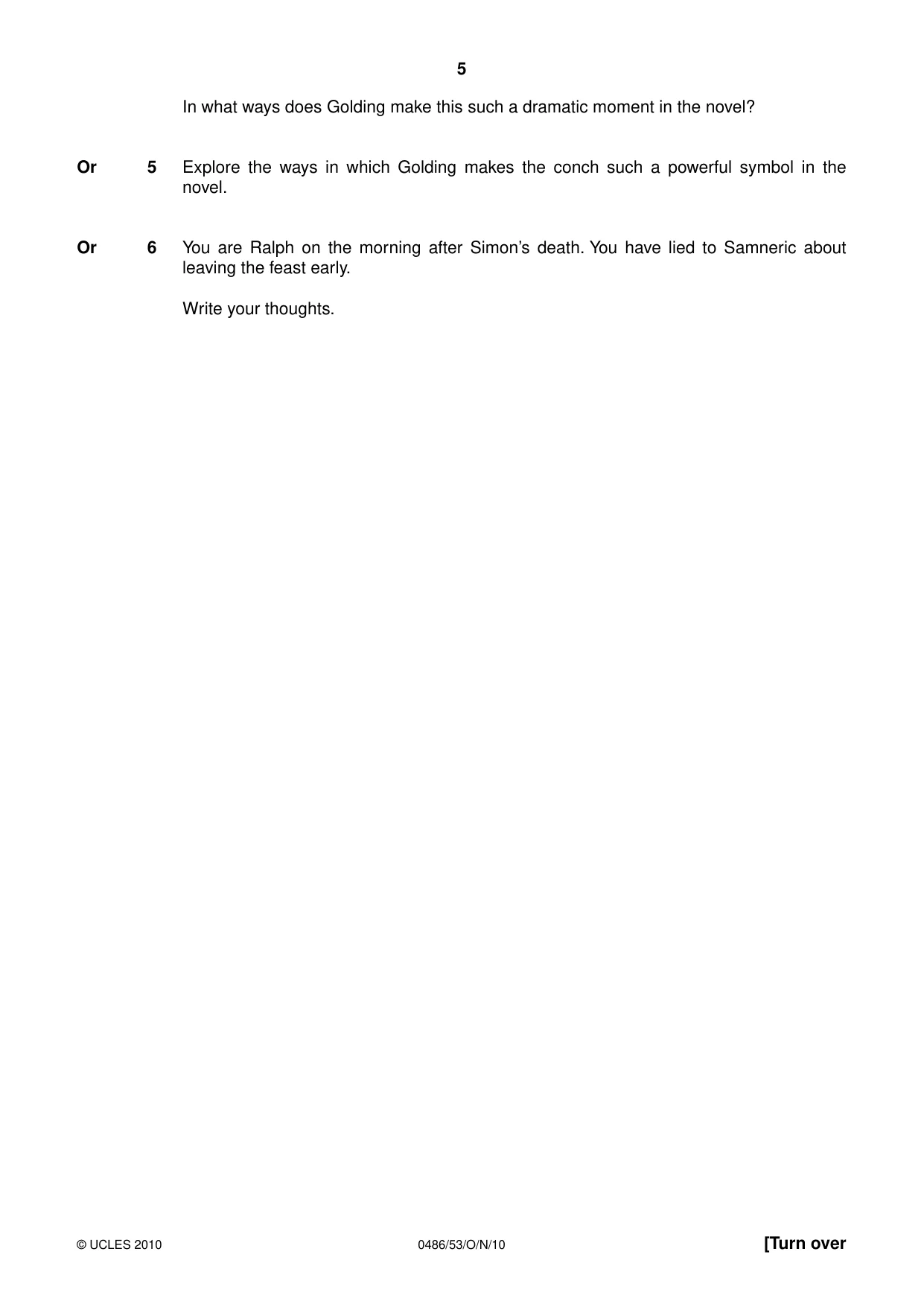
5 0486/53/O/N/10 © UCLES 2010 In what ways does Golding make this such a dramatic moment in the novel? Or 5 Explore the ways in which Golding makes the conch such a powerful symbol in the novel. Or 6 You are Ralph on the morning after Simon’s death. You have lied to Samneric about leaving the feast early. Write your thoughts. [Turn over
Question paper, page 6
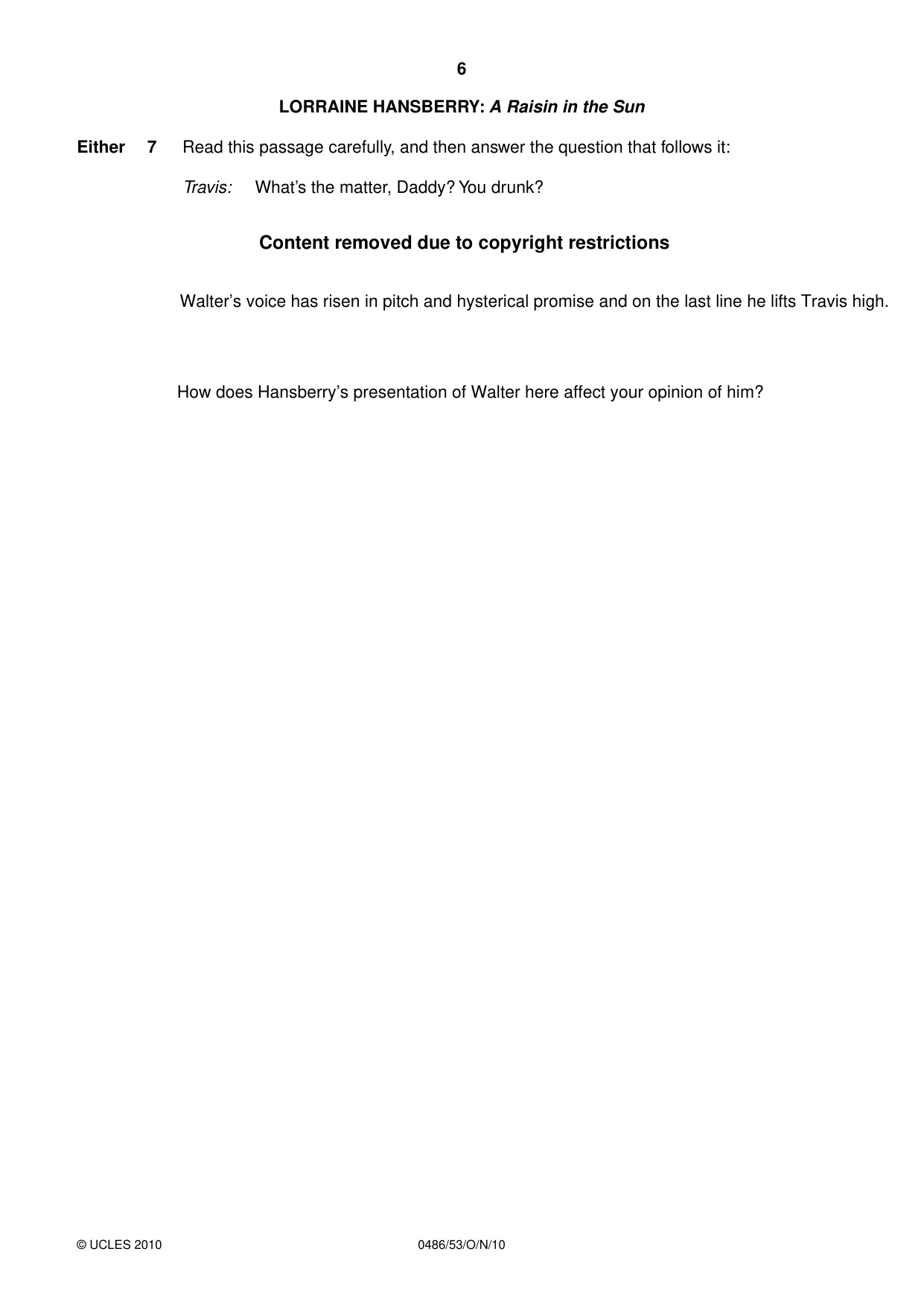
6 0486/53/O/N/10 © UCLES 2010 LORRAINE HANSBERRY: A Raisin in the Sun Either 7 Read this passage carefully, and then answer the question that follows it: Travis: What’s the matter, Daddy? You drunk? Walter’s voice has risen in pitch and hysterical promise and on the last line he lifts Travis high. How does Hansberry’s presentation of Walter here affect your opinion of him? Content removed due to copyright restrictions
Question paper, page 7
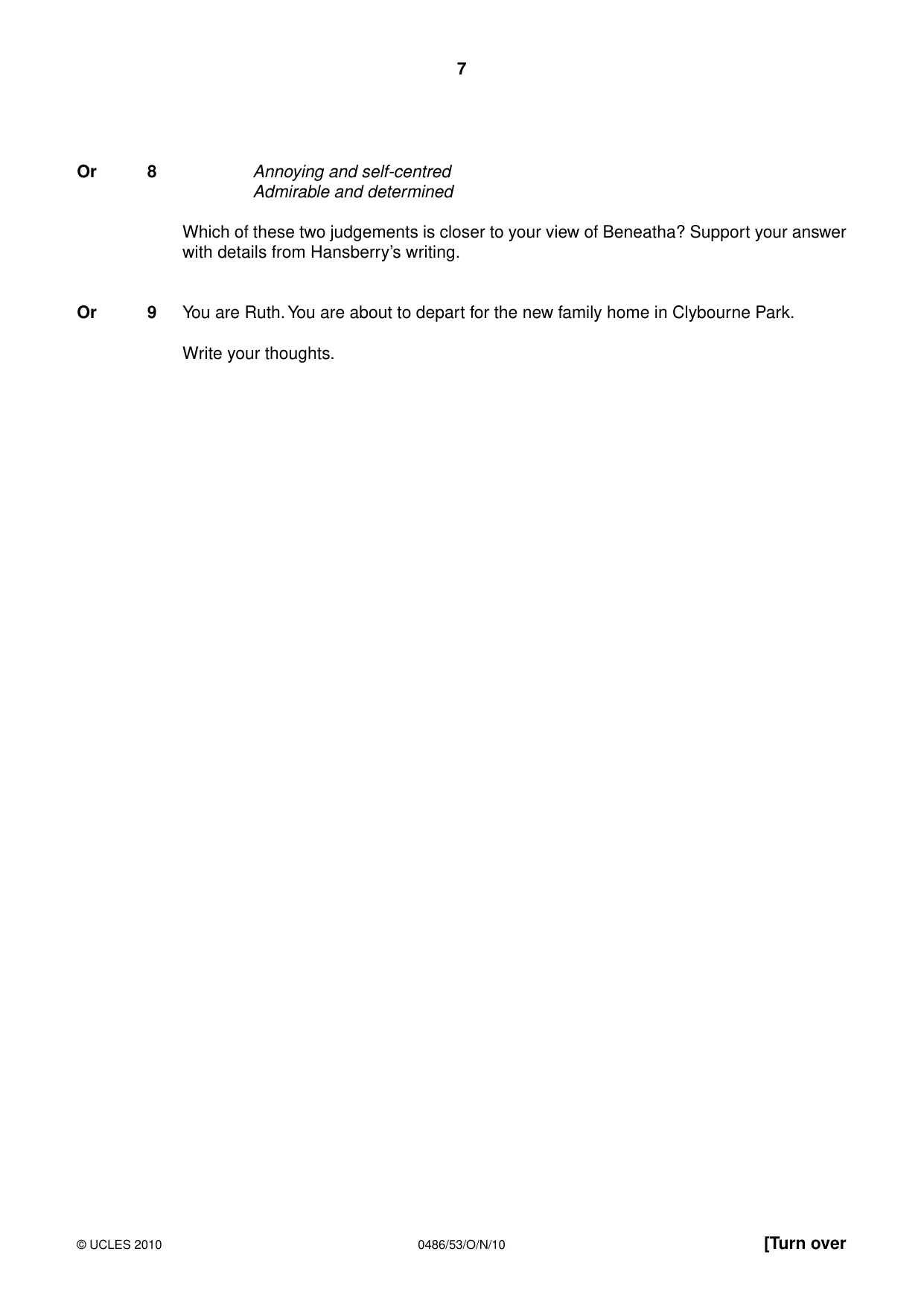
7 0486/53/O/N/10 © UCLES 2010 [Turn over Or 8 Annoying and self-centred Admirable and determined Which of these two judgements is closer to your view of Beneatha? Support your answer with details from Hansberry’s writing. Or 9 You are Ruth. You are about to depart for the new family home in Clybourne Park. Write your thoughts.
Question paper, page 8
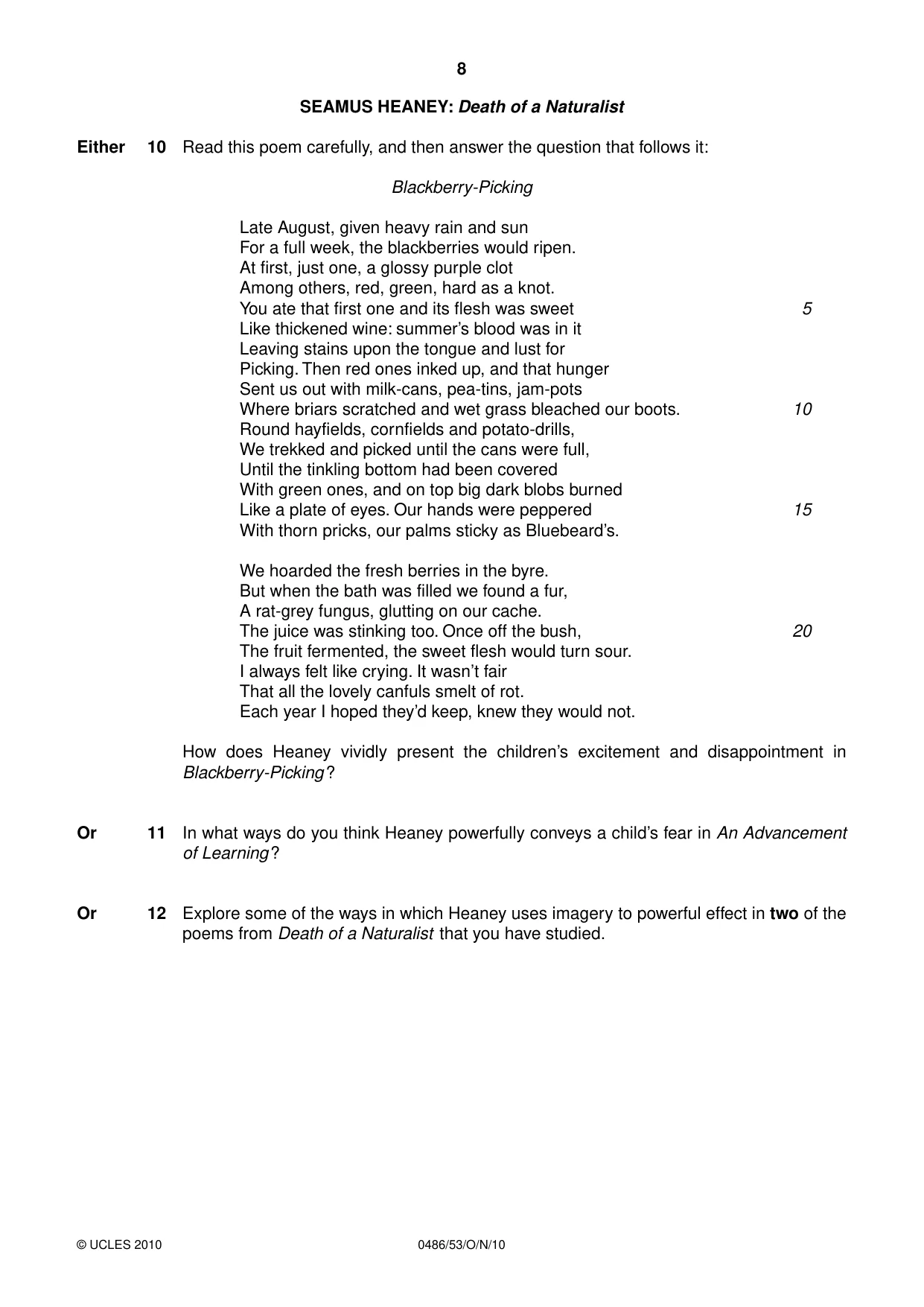
8 0486/53/O/N/10 SEAMUS HEANEY: Death of a Naturalist Either 10 Read this poem carefully, and then answer the question that follows it: Blackberry-Picking Late August, given heavy rain and sun For a full week, the blackberries would ripen. At first, just one, a glossy purple clot Among others, red, green, hard as a knot. You ate that first one and its flesh was sweet 5 Like thickened wine: summer’s blood was in it Leaving stains upon the tongue and lust for Picking. Then red ones inked up, and that hunger Sent us out with milk-cans, pea-tins, jam-pots Where briars scratched and wet grass bleached our boots. 10 Round hayfields, cornfields and potato-drills, We trekked and picked until the cans were full, Until the tinkling bottom had been covered With green ones, and on top big dark blobs burned Like a plate of eyes. Our hands were peppered 15 With thorn pricks, our palms sticky as Bluebeard’s. We hoarded the fresh berries in the byre. But when the bath was filled we found a fur, A rat-grey fungus, glutting on our cache. The juice was stinking too. Once off the bush, 20 The fruit fermented, the sweet flesh would turn sour. I always felt like crying. It wasn’t fair That all the lovely canfuls smelt of rot. Each year I hoped they’d keep, knew they would not. How does Heaney vividly present the children’s excitement and disappointment in Blackberry-Picking ? Or 11 In what ways do you think Heaney powerfully conveys a child’s fear in An Advancement of Learning ? Or 12 Explore some of the ways in which Heaney uses imagery to powerful effect in two of the poems from Death of a Naturalist that you have studied. © UCLES 2010
Question paper, page 9
9 0486/53/O/N/10 © UCLES 2010 [Turn over BLANK PAGE Turn to page 10 for Question 13. [Turn over
Question paper, page 10
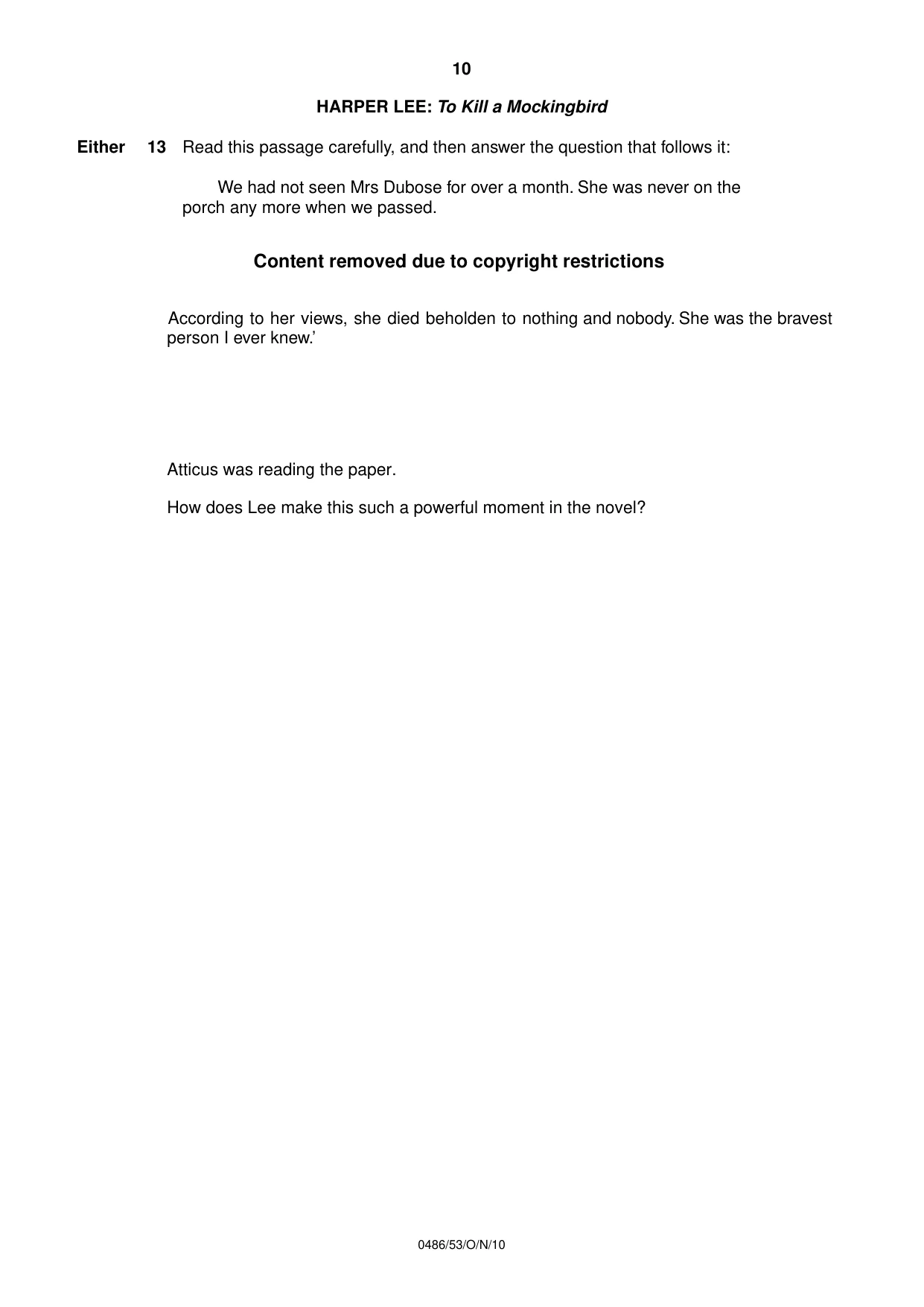
10 0486/53/O/N/10 HARPER LEE: To Kill a Mockingbird Either 13 Read this passage carefully, and then answer the question that follows it: We had not seen Mrs Dubose for over a month. She was never on the porch any more when we passed. According to her views, she died beholden to nothing and nobody. She was the bravest person I ever knew.’ Atticus was reading the paper. How does Lee make this such a powerful moment in the novel? Content removed due to copyright restrictions
Question paper, page 11
11 0486/53/O/N/10 J Or 14 Explore the ways in which Lee makes the Cunningham family so significant in the novel. Or 15 You are Mayella Ewell. You are leaving court after your cross-examination by Atticus. Write your thoughts.
Question paper, page 12
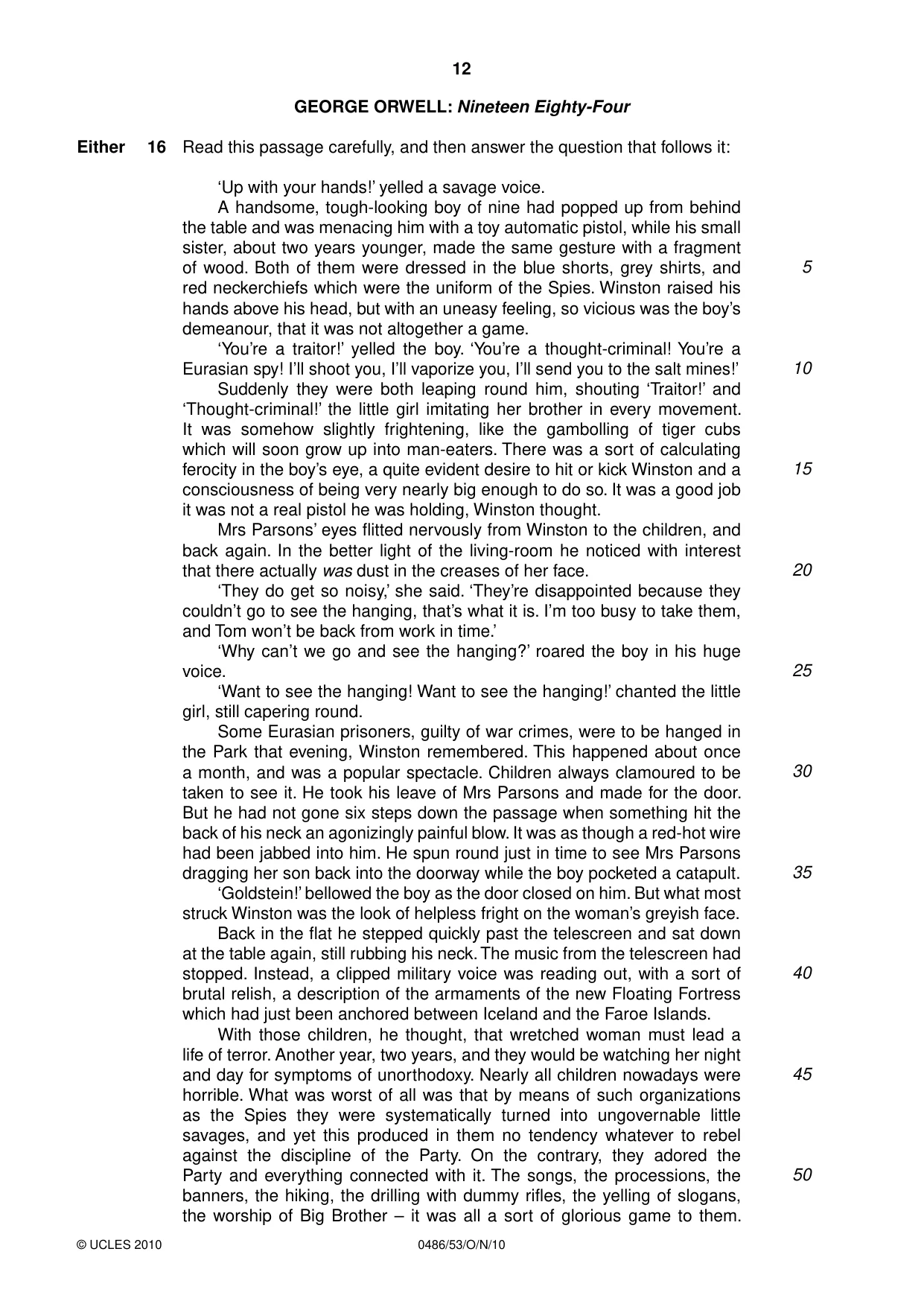
12 0486/53/O/N/10 GEORGE ORWELL: Nineteen Eighty-Four Either 16 Read this passage carefully, and then answer the question that follows it: ‘Up with your hands!’ yelled a savage voice. A handsome, tough-looking boy of nine had popped up from behind the table and was menacing him with a toy automatic pistol, while his small sister, about two years younger, made the same gesture with a fragment of wood. Both of them were dressed in the blue shorts, grey shirts, and red neckerchiefs which were the uniform of the Spies. Winston raised his hands above his head, but with an uneasy feeling, so vicious was the boy’s demeanour, that it was not altogether a game. ‘You’re a traitor!’ yelled the boy. ‘You’re a thought-criminal! You’re a Eurasian spy! I’ll shoot you, I’ll vaporize you, I’ll send you to the salt mines!’ Suddenly they were both leaping round him, shouting ‘Traitor!’ and ‘Thought-criminal!’ the little girl imitating her brother in every movement. It was somehow slightly frightening, like the gambolling of tiger cubs which will soon grow up into man-eaters. There was a sort of calculating ferocity in the boy’s eye, a quite evident desire to hit or kick Winston and a consciousness of being very nearly big enough to do so. It was a good job it was not a real pistol he was holding, Winston thought. Mrs Parsons’ eyes flitted nervously from Winston to the children, and back again. In the better light of the living-room he noticed with interest that there actually was dust in the creases of her face. ‘They do get so noisy,’ she said. ‘They’re disappointed because they couldn’t go to see the hanging, that’s what it is. I’m too busy to take them, and Tom won’t be back from work in time.’ ‘Why can’t we go and see the hanging?’ roared the boy in his huge voice. ‘Want to see the hanging! Want to see the hanging!’ chanted the little girl, still capering round. Some Eurasian prisoners, guilty of war crimes, were to be hanged in the Park that evening, Winston remembered. This happened about once a month, and was a popular spectacle. Children always clamoured to be taken to see it. He took his leave of Mrs Parsons and made for the door. But he had not gone six steps down the passage when something hit the back of his neck an agonizingly painful blow. It was as though a red-hot wire had been jabbed into him. He spun round just in time to see Mrs Parsons dragging her son back into the doorway while the boy pocketed a catapult. ‘Goldstein!’ bellowed the boy as the door closed on him. But what most struck Winston was the look of helpless fright on the woman’s greyish face. Back in the flat he stepped quickly past the telescreen and sat down at the table again, still rubbing his neck. The music from the telescreen had stopped. Instead, a clipped military voice was reading out, with a sort of brutal relish, a description of the armaments of the new Floating Fortress which had just been anchored between Iceland and the Faroe Islands. With those children, he thought, that wretched woman must lead a life of terror. Another year, two years, and they would be watching her night and day for symptoms of unorthodoxy. Nearly all children nowadays were horrible. What was worst of all was that by means of such organizations as the Spies they were systematically turned into ungovernable little savages, and yet this produced in them no tendency whatever to rebel against the discipline of the Party. On the contrary, they adored the Party and everything connected with it. The songs, the processions, the banners, the hiking, the drilling with dummy rifles, the yelling of slogans, the worship of Big Brother – it was all a sort of glorious game to them. 5 10 15 20 25 30 35 40 45 50 © UCLES 2010
Question paper, page 13
13 0486/53/O/N/10 © UCLES 2010 [Turn over All their ferocity was turned outwards, against the enemies of the State, against foreigners, traitors, saboteurs, thought-criminals. It was almost normal for people over thirty to be frightened of their own children. And with good reason, for hardly a week passed in which The Times did not carry a paragraph describing how some eavesdropping little sneak – ‘child hero’ was the phrase generally used – had overheard some compromising remark and denounced its parents to the Thought Police. How does Orwell create such a terrifying picture of children here? Or 17 Winston thinks that the reality of modern life is ‘decaying, dingy cities’ with ‘underfed people’. By close reference to two incidents show how Orwell makes the dinginess and poverty of life in Oceania particularly striking for you. Or 18 You are Julia. You have just met O’Brien for the first time. Write your thoughts. 55
Question paper, page 14
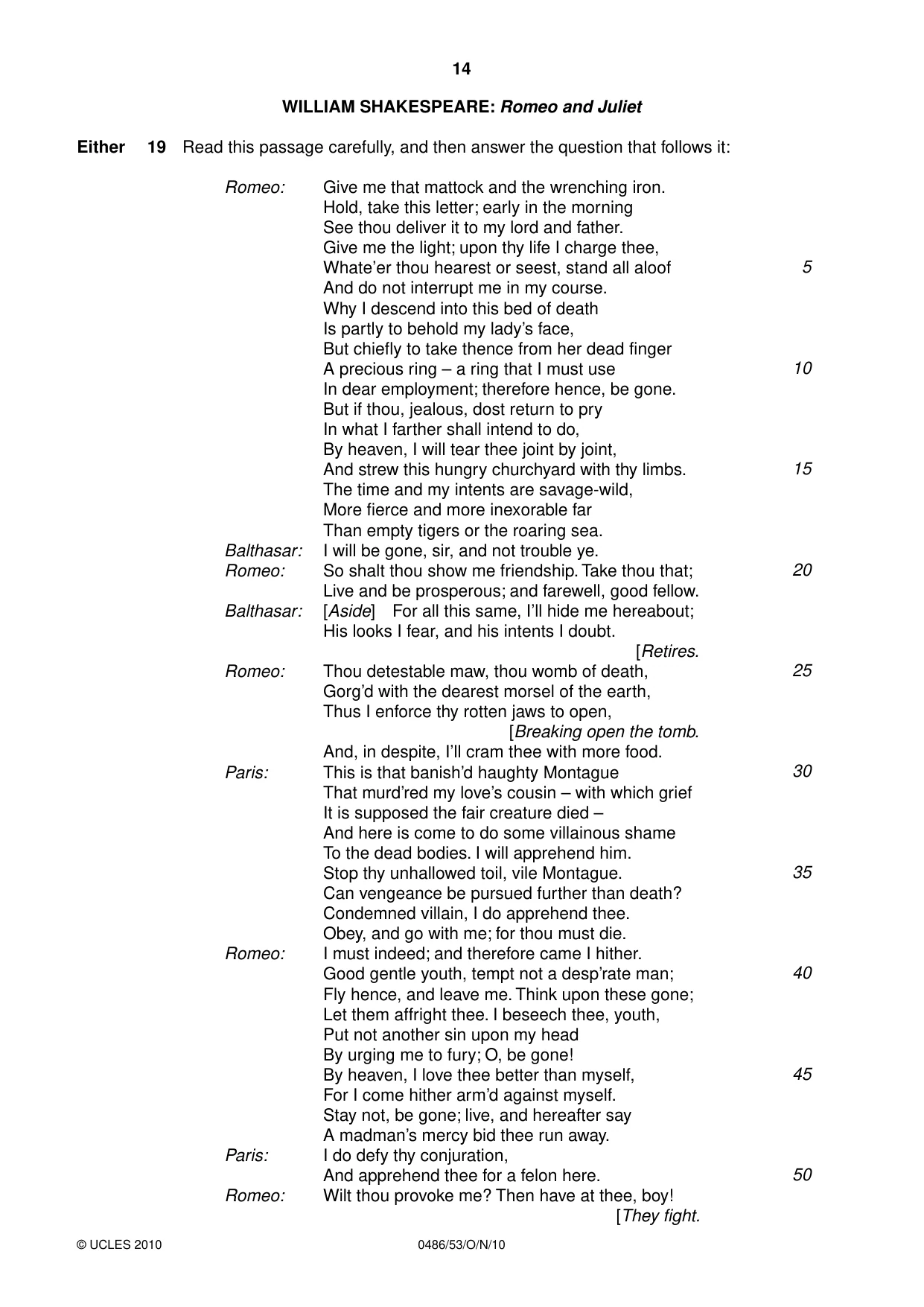
14 0486/53/O/N/10 © UCLES 2010 WILLIAM SHAKESPEARE: Romeo and Juliet Either 19 Read this passage carefully, and then answer the question that follows it: Romeo: Give me that mattock and the wrenching iron. Hold, take this letter; early in the morning See thou deliver it to my lord and father. Give me the light; upon thy life I charge thee, Whate’er thou hearest or seest, stand all aloof And do not interrupt me in my course. Why I descend into this bed of death Is partly to behold my lady’s face, But chiefly to take thence from her dead finger A precious ring – a ring that I must use In dear employment; therefore hence, be gone. But if thou, jealous, dost return to pry In what I farther shall intend to do, By heaven, I will tear thee joint by joint, And strew this hungry churchyard with thy limbs. The time and my intents are savage-wild, More fierce and more inexorable far Than empty tigers or the roaring sea. Balthasar: I will be gone, sir, and not trouble ye. Romeo: So shalt thou show me friendship. Take thou that; Live and be prosperous; and farewell, good fellow. Balthasar: [Aside] For all this same, I’ll hide me hereabout; His looks I fear, and his intents I doubt. [Retires. Romeo: Thou detestable maw, thou womb of death, Gorg’d with the dearest morsel of the earth, Thus I enforce thy rotten jaws to open, [Breaking open the tomb. And, in despite, I’ll cram thee with more food. Paris: This is that banish’d haughty Montague That murd’red my love’s cousin – with which grief It is supposed the fair creature died – And here is come to do some villainous shame To the dead bodies. I will apprehend him. Stop thy unhallowed toil, vile Montague. Can vengeance be pursued further than death? Condemned villain, I do apprehend thee. Obey, and go with me; for thou must die. Romeo: I must indeed; and therefore came I hither. Good gentle youth, tempt not a desp’rate man; Fly hence, and leave me. Think upon these gone; Let them affright thee. I beseech thee, youth, Put not another sin upon my head By urging me to fury; O, be gone! By heaven, I love thee better than myself, For I come hither arm’d against myself. Stay not, be gone; live, and hereafter say A madman’s mercy bid thee run away. Paris: I do defy thy conjuration, And apprehend thee for a felon here. Romeo: Wilt thou provoke me? Then have at thee, boy! [They fight. 5 10 15 20 25 30 35 40 45 50
Question paper, page 15
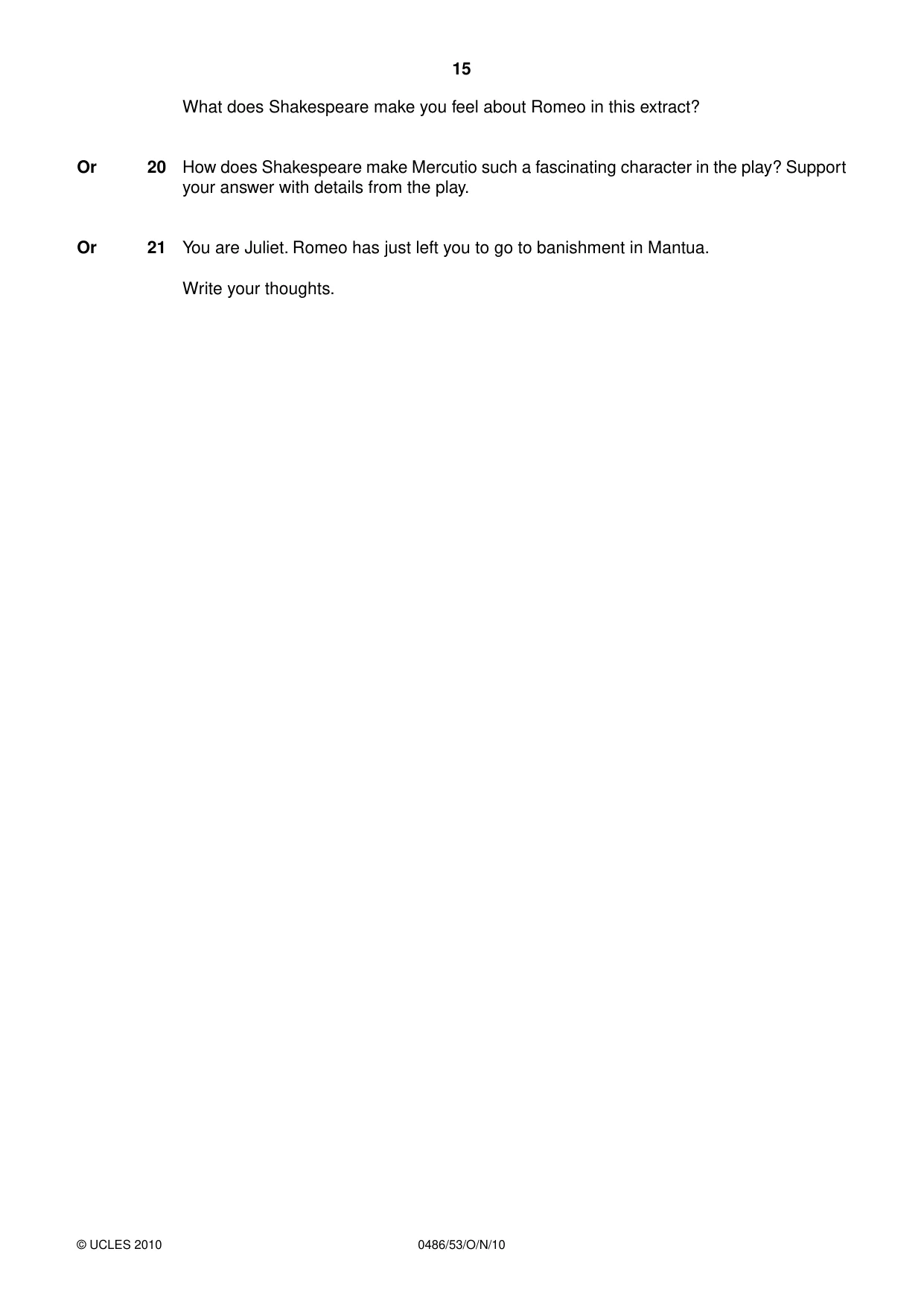
15 0486/53/O/N/10 © UCLES 2010 What does Shakespeare make you feel about Romeo in this extract? Or 20 How does Shakespeare make Mercutio such a fascinating character in the play? Support your answer with details from the play. Or 21 You are Juliet. Romeo has just left you to go to banishment in Mantua. Write your thoughts.
Question paper, page 16
16 0486/53/O/N/10 © UCLES 2010 BLANK PAGE Copyright Acknowledgements: Question 1 © Brian Clark; Whose Life is it Anyway? ; Heinemann; 1993. Question 4 © William Golding; Lord of the Flies ; Faber & Faber; 2004. Question 7 © Lorraine Hansberry; A Raisin in the Sun ; Methuen, A C Black; 2001. Question 10 © Seamus Heaney; Death of a Naturalist ; Faber & Faber; 2002. Question 13 © from To Kill a Mockingbird by Harper Lee, published by William Heinemann Ltd. Reprinted by permission of The Random House Group Ltd. Question 16 © George Orwell; Nineteen Eighty-Four ; Penguin; 1998. Permission to reproduce items where third-party owned material protected by copyright is included has been sought and cleared where possible. Every reasonable effort has been made by the publisher (UCLES) to trace copyright holders, but if any items requiring clearance have unwittingly been included, the publisher will be pleased to make amends at the earliest possible opportunity. University of Cambridge International Examinations is part of the Cambridge Assessment Group. Cambridge Assessment is the brand name of University of Cambridge Local Examinations Syndicate (UCLES), which is itself a department of the University of Cambridge.
Mark scheme, page 1
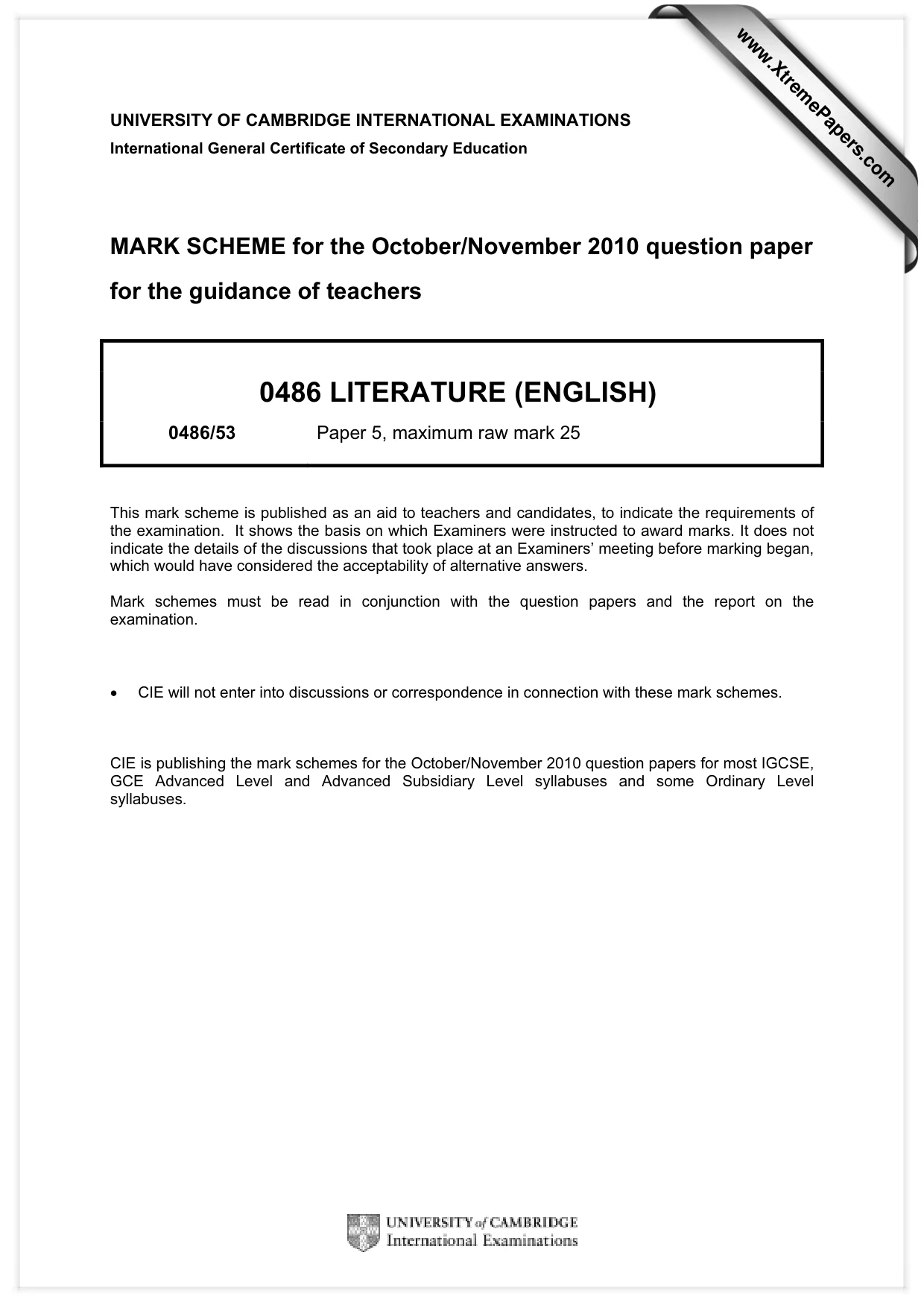
UNIVERSITY OF CAMBRIDGE INTERNATIONAL EXAMINATIONS International General Certificate of Secondary Education MARK SCHEME for the October/November 2010 question paper for the guidance of teachers 0486 LITERATURE (ENGLISH) 0486/53 Paper 5, maximum raw mark 25 This mark scheme is published as an aid to teachers and candidates, to indicate the requirements of the examination. It shows the basis on which Examiners were instructed to award marks. It does not indicate the details of the discussions that took place at an Examiners’ meeting before marking began, which would have considered the acceptability of alternative answers. Mark schemes must be read in conjunction with the question papers and the report on the examination. • CIE will not enter into discussions or correspondence in connection with these mark schemes. CIE is publishing the mark schemes for the October/November 2010 question papers for most IGCSE, GCE Advanced Level and Advanced Subsidiary Level syllabuses and some Ordinary Level syllabuses. www.XtremePapers.com
Mark scheme, page 2
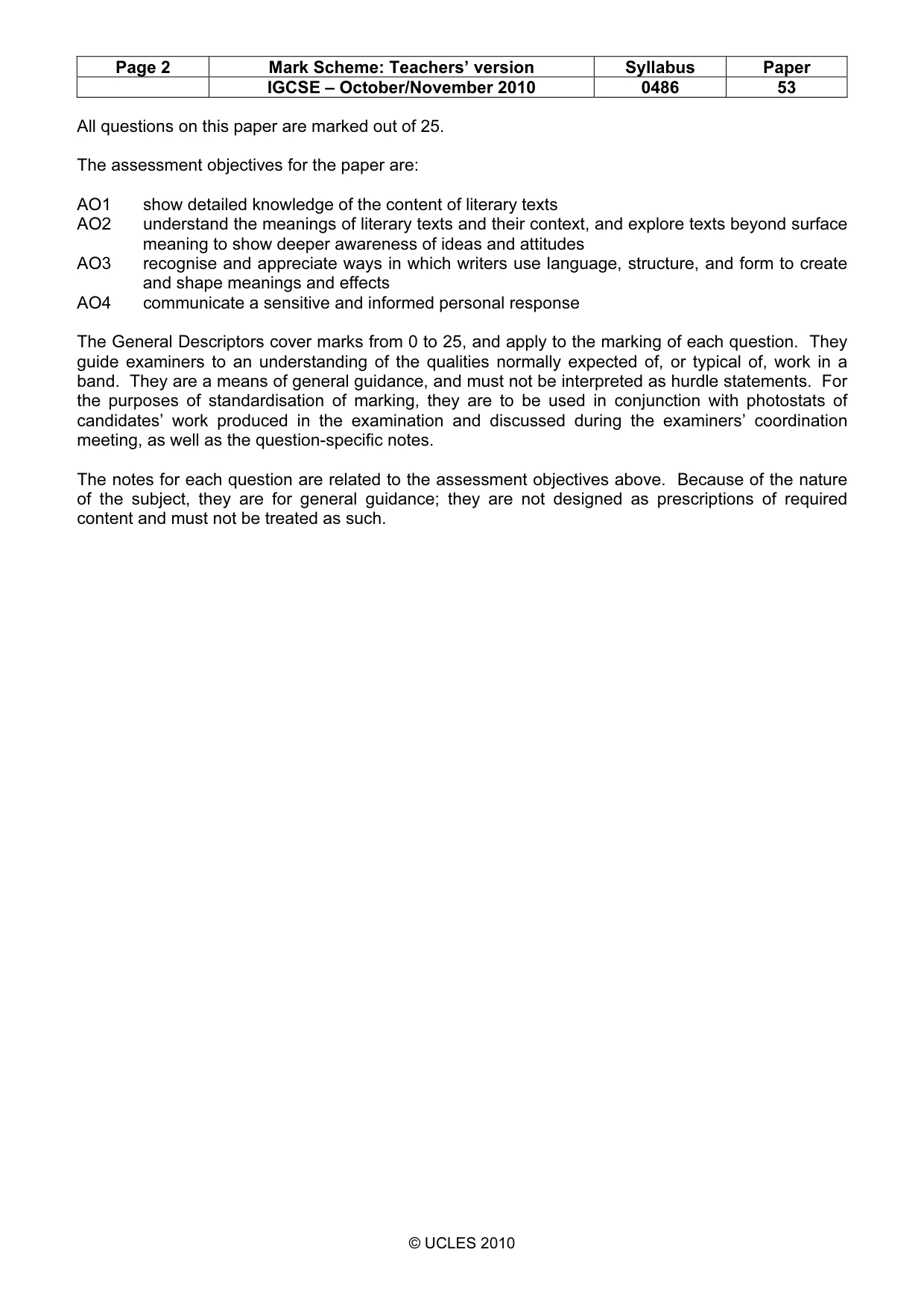
Page 2 Mark Scheme: Teachers’ version Syllabus Paper IGCSE – October/November 2010 0486 53 © UCLES 2010 All questions on this paper are marked out of 25. The assessment objectives for the paper are: AO1 show detailed knowledge of the content of literary texts AO2 understand the meanings of literary texts and their context, and explore texts beyond surface meaning to show deeper awareness of ideas and attitudes AO3 recognise and appreciate ways in which writers use language, structure, and form to create and shape meanings and effects AO4 communicate a sensitive and informed personal response The General Descriptors cover marks from 0 to 25, and apply to the marking of each question. They guide examiners to an understanding of the qualities normally expected of, or typical of, work in a band. They are a means of general guidance, and must not be interpreted as hurdle statements. For the purposes of standardisation of marking, they are to be used in conjunction with photostats of candidates’ work produced in the examination and discussed during the examiners’ coordination meeting, as well as the question-specific notes. The notes for each question are related to the assessment objectives above. Because of the nature of the subject, they are for general guidance; they are not designed as prescriptions of required content and must not be treated as such.
Mark scheme, page 3
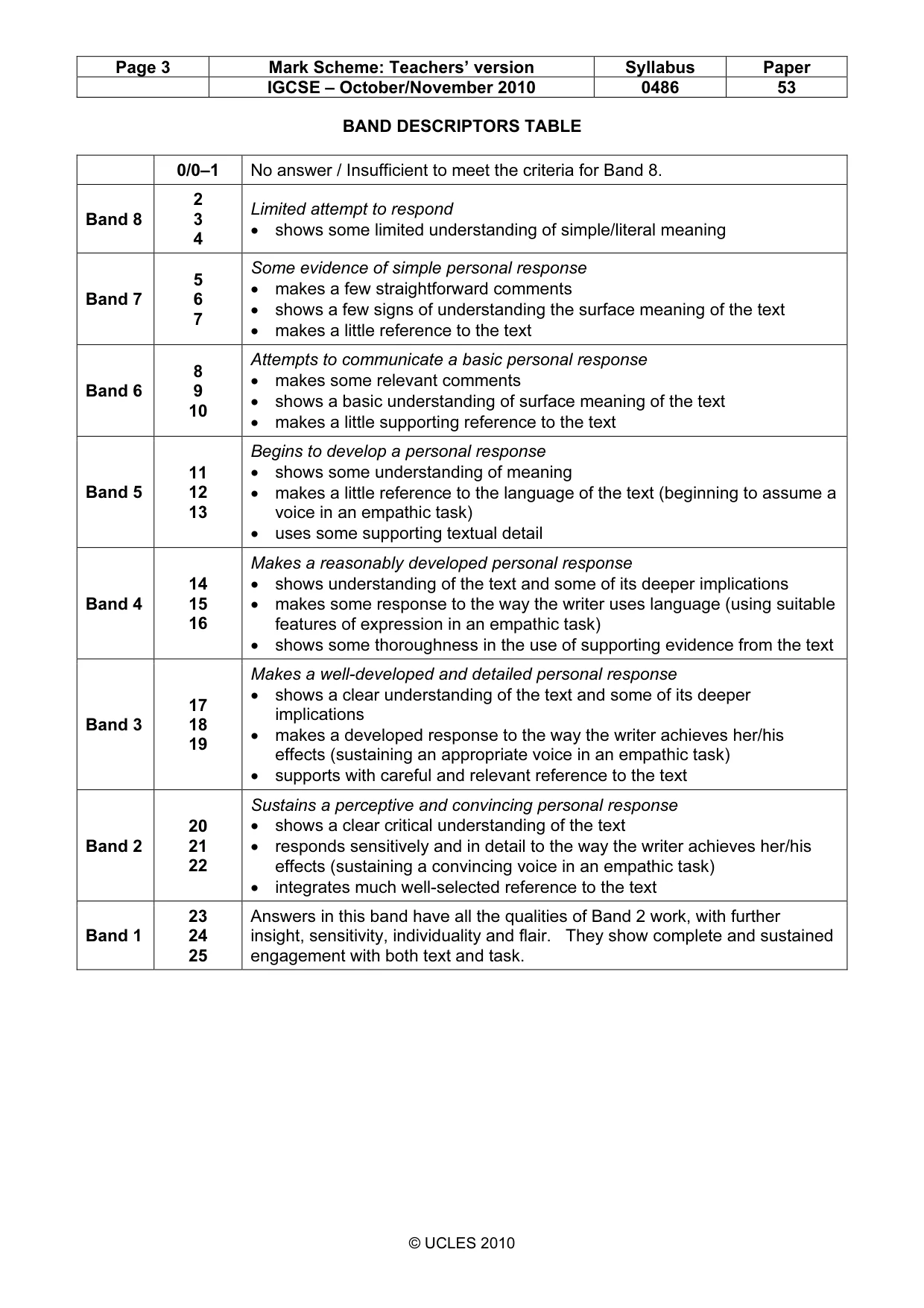
Page 3 Mark Scheme: Teachers’ version Syllabus Paper IGCSE – October/November 2010 0486 53 © UCLES 2010 BAND DESCRIPTORS TABLE 0/0–1 No answer / Insufficient to meet the criteria for Band 8. Band 8 2 3 4 Limited attempt to respond • shows some limited understanding of simple/literal meaning Band 7 5 6 7 Some evidence of simple personal response • makes a few straightforward comments • shows a few signs of understanding the surface meaning of the text • makes a little reference to the text Band 6 8 9 10 Attempts to communicate a basic personal response • makes some relevant comments • shows a basic understanding of surface meaning of the text • makes a little supporting reference to the text Band 5 11 12 13 Begins to develop a personal response • shows some understanding of meaning • makes a little reference to the language of the text (beginning to assume a voice in an empathic task) • uses some supporting textual detail Band 4 14 15 16 Makes a reasonably developed personal response • shows understanding of the text and some of its deeper implications • makes some response to the way the writer uses language (using suitable features of expression in an empathic task) • shows some thoroughness in the use of supporting evidence from the text Band 3 17 18 19 Makes a well-developed and detailed personal response • shows a clear understanding of the text and some of its deeper implications • makes a developed response to the way the writer achieves her/his effects (sustaining an appropriate voice in an empathic task) • supports with careful and relevant reference to the text Band 2 20 21 22 Sustains a perceptive and convincing personal response • shows a clear critical understanding of the text • responds sensitively and in detail to the way the writer achieves her/his effects (sustaining a convincing voice in an empathic task) • integrates much well-selected reference to the text Band 1 23 24 25 Answers in this band have all the qualities of Band 2 work, with further insight, sensitivity, individuality and flair. They show complete and sustained engagement with both text and task.
Mark scheme, page 4
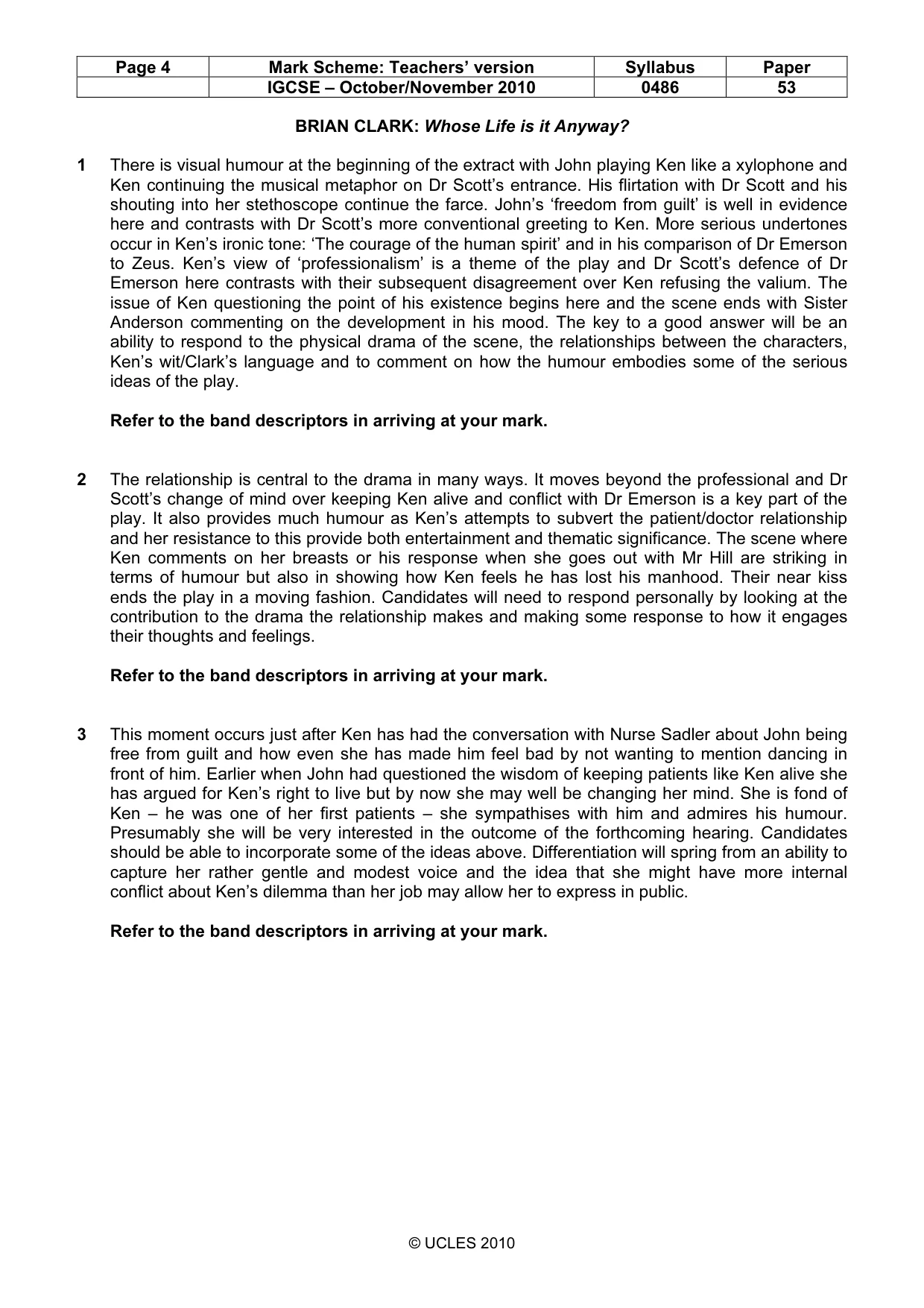
Page 4 Mark Scheme: Teachers’ version Syllabus Paper IGCSE – October/November 2010 0486 53 © UCLES 2010 BRIAN CLARK: Whose Life is it Anyway? 1 There is visual humour at the beginning of the extract with John playing Ken like a xylophone and Ken continuing the musical metaphor on Dr Scott’s entrance. His flirtation with Dr Scott and his shouting into her stethoscope continue the farce. John’s ‘freedom from guilt’ is well in evidence here and contrasts with Dr Scott’s more conventional greeting to Ken. More serious undertones occur in Ken’s ironic tone: ‘The courage of the human spirit’ and in his comparison of Dr Emerson to Zeus. Ken’s view of ‘professionalism’ is a theme of the play and Dr Scott’s defence of Dr Emerson here contrasts with their subsequent disagreement over Ken refusing the valium. The issue of Ken questioning the point of his existence begins here and the scene ends with Sister Anderson commenting on the development in his mood. The key to a good answer will be an ability to respond to the physical drama of the scene, the relationships between the characters, Ken’s wit/Clark’s language and to comment on how the humour embodies some of the serious ideas of the play. Refer to the band descriptors in arriving at your mark. 2 The relationship is central to the drama in many ways. It moves beyond the professional and Dr Scott’s change of mind over keeping Ken alive and conflict with Dr Emerson is a key part of the play. It also provides much humour as Ken’s attempts to subvert the patient/doctor relationship and her resistance to this provide both entertainment and thematic significance. The scene where Ken comments on her breasts or his response when she goes out with Mr Hill are striking in terms of humour but also in showing how Ken feels he has lost his manhood. Their near kiss ends the play in a moving fashion. Candidates will need to respond personally by looking at the contribution to the drama the relationship makes and making some response to how it engages their thoughts and feelings. Refer to the band descriptors in arriving at your mark. 3 This moment occurs just after Ken has had the conversation with Nurse Sadler about John being free from guilt and how even she has made him feel bad by not wanting to mention dancing in front of him. Earlier when John had questioned the wisdom of keeping patients like Ken alive she has argued for Ken’s right to live but by now she may well be changing her mind. She is fond of Ken – he was one of her first patients – she sympathises with him and admires his humour. Presumably she will be very interested in the outcome of the forthcoming hearing. Candidates should be able to incorporate some of the ideas above. Differentiation will spring from an ability to capture her rather gentle and modest voice and the idea that she might have more internal conflict about Ken’s dilemma than her job may allow her to express in public. Refer to the band descriptors in arriving at your mark.
Mark scheme, page 5
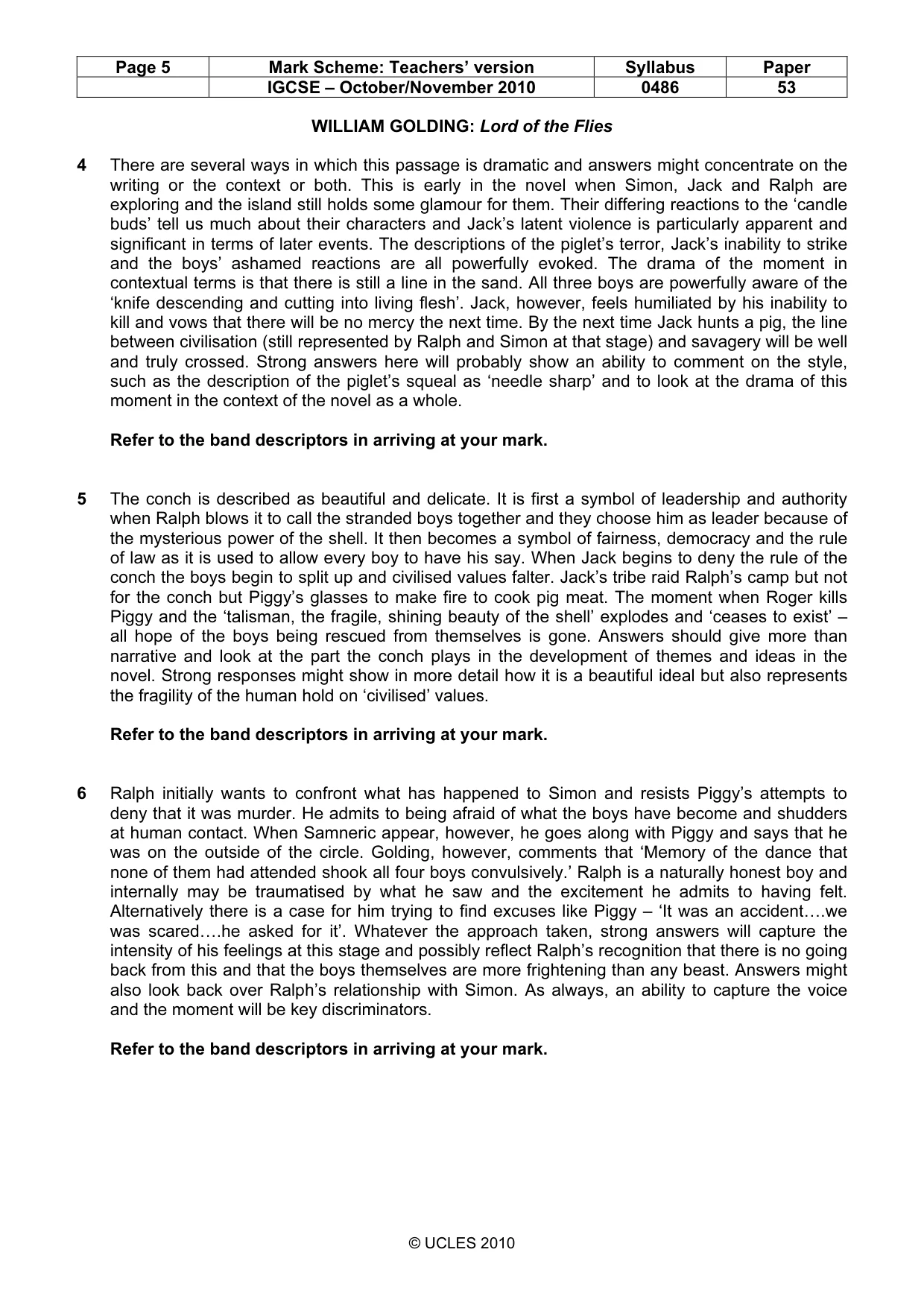
Page 5 Mark Scheme: Teachers’ version Syllabus Paper IGCSE – October/November 2010 0486 53 © UCLES 2010 WILLIAM GOLDING: Lord of the Flies 4 There are several ways in which this passage is dramatic and answers might concentrate on the writing or the context or both. This is early in the novel when Simon, Jack and Ralph are exploring and the island still holds some glamour for them. Their differing reactions to the ‘candle buds’ tell us much about their characters and Jack’s latent violence is particularly apparent and significant in terms of later events. The descriptions of the piglet’s terror, Jack’s inability to strike and the boys’ ashamed reactions are all powerfully evoked. The drama of the moment in contextual terms is that there is still a line in the sand. All three boys are powerfully aware of the ‘knife descending and cutting into living flesh’. Jack, however, feels humiliated by his inability to kill and vows that there will be no mercy the next time. By the next time Jack hunts a pig, the line between civilisation (still represented by Ralph and Simon at that stage) and savagery will be well and truly crossed. Strong answers here will probably show an ability to comment on the style, such as the description of the piglet’s squeal as ‘needle sharp’ and to look at the drama of this moment in the context of the novel as a whole. Refer to the band descriptors in arriving at your mark. 5 The conch is described as beautiful and delicate. It is first a symbol of leadership and authority when Ralph blows it to call the stranded boys together and they choose him as leader because of the mysterious power of the shell. It then becomes a symbol of fairness, democracy and the rule of law as it is used to allow every boy to have his say. When Jack begins to deny the rule of the conch the boys begin to split up and civilised values falter. Jack’s tribe raid Ralph’s camp but not for the conch but Piggy’s glasses to make fire to cook pig meat. The moment when Roger kills Piggy and the ‘talisman, the fragile, shining beauty of the shell’ explodes and ‘ceases to exist’ – all hope of the boys being rescued from themselves is gone. Answers should give more than narrative and look at the part the conch plays in the development of themes and ideas in the novel. Strong responses might show in more detail how it is a beautiful ideal but also represents the fragility of the human hold on ‘civilised’ values. Refer to the band descriptors in arriving at your mark. 6 Ralph initially wants to confront what has happened to Simon and resists Piggy’s attempts to deny that it was murder. He admits to being afraid of what the boys have become and shudders at human contact. When Samneric appear, however, he goes along with Piggy and says that he was on the outside of the circle. Golding, however, comments that ‘Memory of the dance that none of them had attended shook all four boys convulsively.’ Ralph is a naturally honest boy and internally may be traumatised by what he saw and the excitement he admits to having felt. Alternatively there is a case for him trying to find excuses like Piggy – ‘It was an accident….we was scared….he asked for it’. Whatever the approach taken, strong answers will capture the intensity of his feelings at this stage and possibly reflect Ralph’s recognition that there is no going back from this and that the boys themselves are more frightening than any beast. Answers might also look back over Ralph’s relationship with Simon. As always, an ability to capture the voice and the moment will be key discriminators. Refer to the band descriptors in arriving at your mark.
Mark scheme, page 6
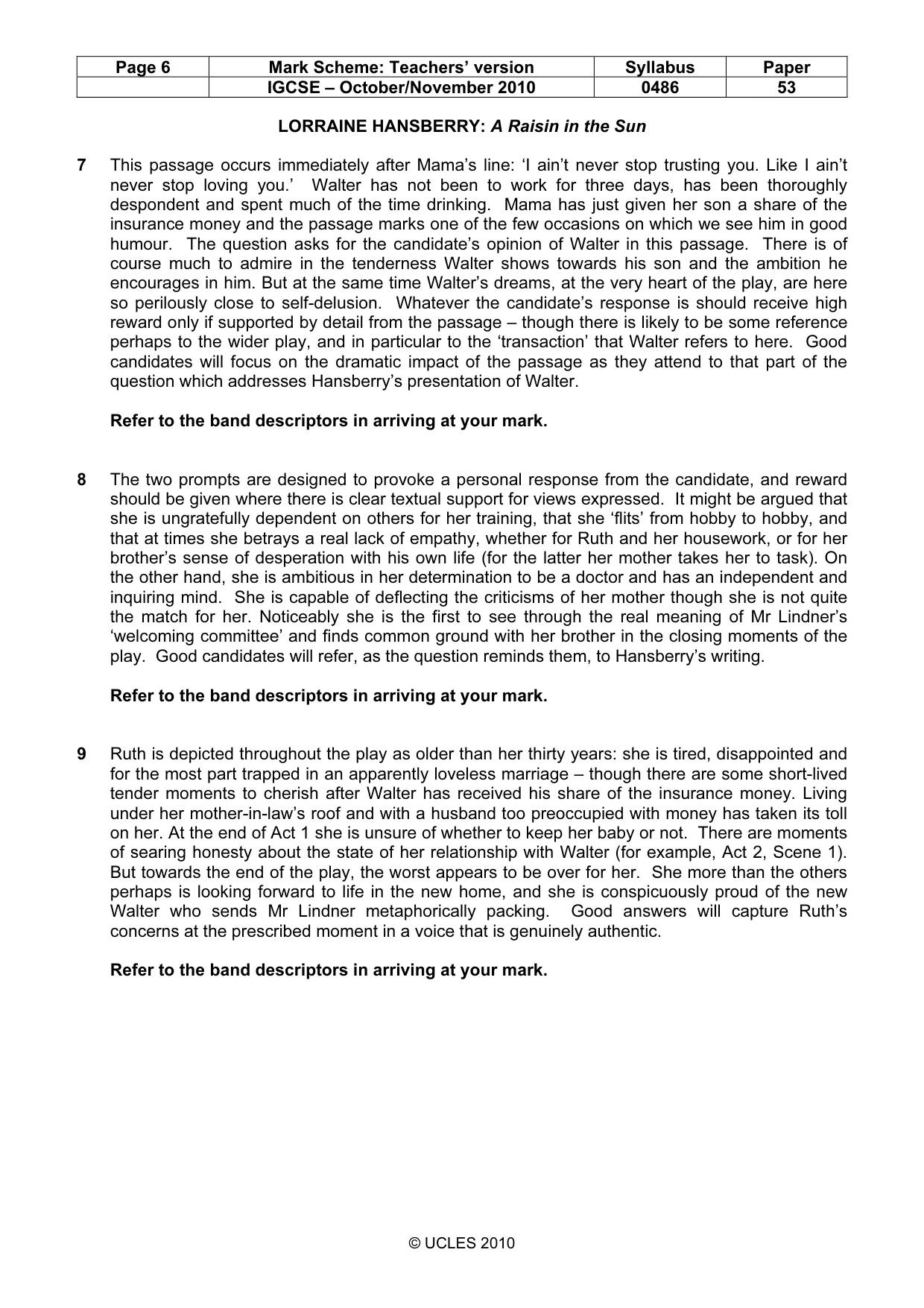
Page 6 Mark Scheme: Teachers’ version Syllabus Paper IGCSE – October/November 2010 0486 53 © UCLES 2010 LORRAINE HANSBERRY: A Raisin in the Sun 7 This passage occurs immediately after Mama’s line: ‘I ain’t never stop trusting you. Like I ain’t never stop loving you.’ Walter has not been to work for three days, has been thoroughly despondent and spent much of the time drinking. Mama has just given her son a share of the insurance money and the passage marks one of the few occasions on which we see him in good humour. The question asks for the candidate’s opinion of Walter in this passage. There is of course much to admire in the tenderness Walter shows towards his son and the ambition he encourages in him. But at the same time Walter’s dreams, at the very heart of the play, are here so perilously close to self-delusion. Whatever the candidate’s response is should receive high reward only if supported by detail from the passage – though there is likely to be some reference perhaps to the wider play, and in particular to the ‘transaction’ that Walter refers to here. Good candidates will focus on the dramatic impact of the passage as they attend to that part of the question which addresses Hansberry’s presentation of Walter. Refer to the band descriptors in arriving at your mark. 8 The two prompts are designed to provoke a personal response from the candidate, and reward should be given where there is clear textual support for views expressed. It might be argued that she is ungratefully dependent on others for her training, that she ‘flits’ from hobby to hobby, and that at times she betrays a real lack of empathy, whether for Ruth and her housework, or for her brother’s sense of desperation with his own life (for the latter her mother takes her to task). On the other hand, she is ambitious in her determination to be a doctor and has an independent and inquiring mind. She is capable of deflecting the criticisms of her mother though she is not quite the match for her. Noticeably she is the first to see through the real meaning of Mr Lindner’s ‘welcoming committee’ and finds common ground with her brother in the closing moments of the play. Good candidates will refer, as the question reminds them, to Hansberry’s writing. Refer to the band descriptors in arriving at your mark. 9 Ruth is depicted throughout the play as older than her thirty years: she is tired, disappointed and for the most part trapped in an apparently loveless marriage – though there are some short-lived tender moments to cherish after Walter has received his share of the insurance money. Living under her mother-in-law’s roof and with a husband too preoccupied with money has taken its toll on her. At the end of Act 1 she is unsure of whether to keep her baby or not. There are moments of searing honesty about the state of her relationship with Walter (for example, Act 2, Scene 1). But towards the end of the play, the worst appears to be over for her. She more than the others perhaps is looking forward to life in the new home, and she is conspicuously proud of the new Walter who sends Mr Lindner metaphorically packing. Good answers will capture Ruth’s concerns at the prescribed moment in a voice that is genuinely authentic. Refer to the band descriptors in arriving at your mark.
Mark scheme, page 7
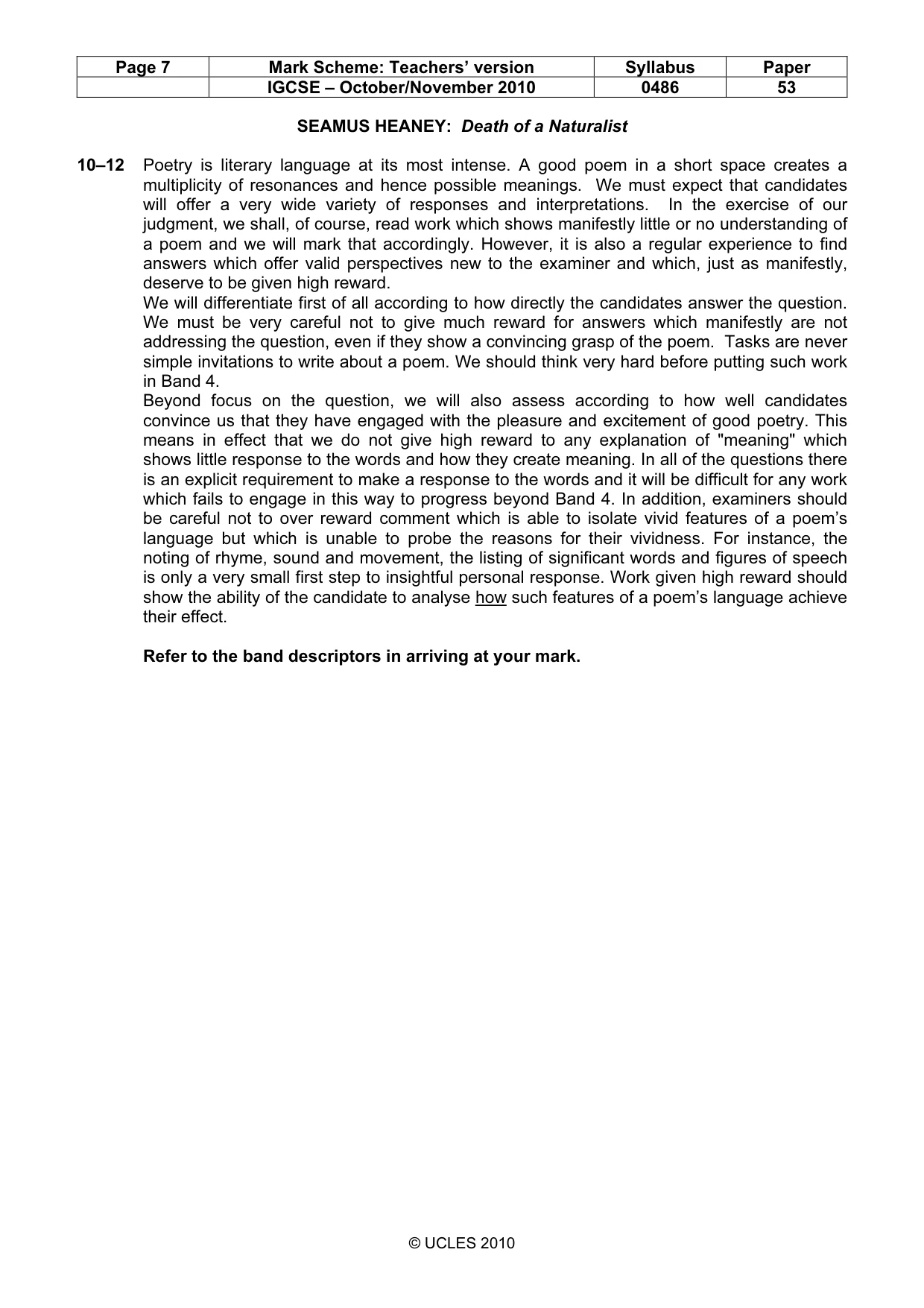
Page 7 Mark Scheme: Teachers’ version Syllabus Paper IGCSE – October/November 2010 0486 53 © UCLES 2010 SEAMUS HEANEY: Death of a Naturalist 10–12 Poetry is literary language at its most intense. A good poem in a short space creates a multiplicity of resonances and hence possible meanings. We must expect that candidates will offer a very wide variety of responses and interpretations. In the exercise of our judgment, we shall, of course, read work which shows manifestly little or no understanding of a poem and we will mark that accordingly. However, it is also a regular experience to find answers which offer valid perspectives new to the examiner and which, just as manifestly, deserve to be given high reward. We will differentiate first of all according to how directly the candidates answer the question. We must be very careful not to give much reward for answers which manifestly are not addressing the question, even if they show a convincing grasp of the poem. Tasks are never simple invitations to write about a poem. We should think very hard before putting such work in Band 4. Beyond focus on the question, we will also assess according to how well candidates convince us that they have engaged with the pleasure and excitement of good poetry. This means in effect that we do not give high reward to any explanation of "meaning" which shows little response to the words and how they create meaning. In all of the questions there is an explicit requirement to make a response to the words and it will be difficult for any work which fails to engage in this way to progress beyond Band 4. In addition, examiners should be careful not to over reward comment which is able to isolate vivid features of a poem’s language but which is unable to probe the reasons for their vividness. For instance, the noting of rhyme, sound and movement, the listing of significant words and figures of speech is only a very small first step to insightful personal response. Work given high reward should show the ability of the candidate to analyse how such features of a poem’s language achieve their effect. Refer to the band descriptors in arriving at your mark.
Mark scheme, page 8
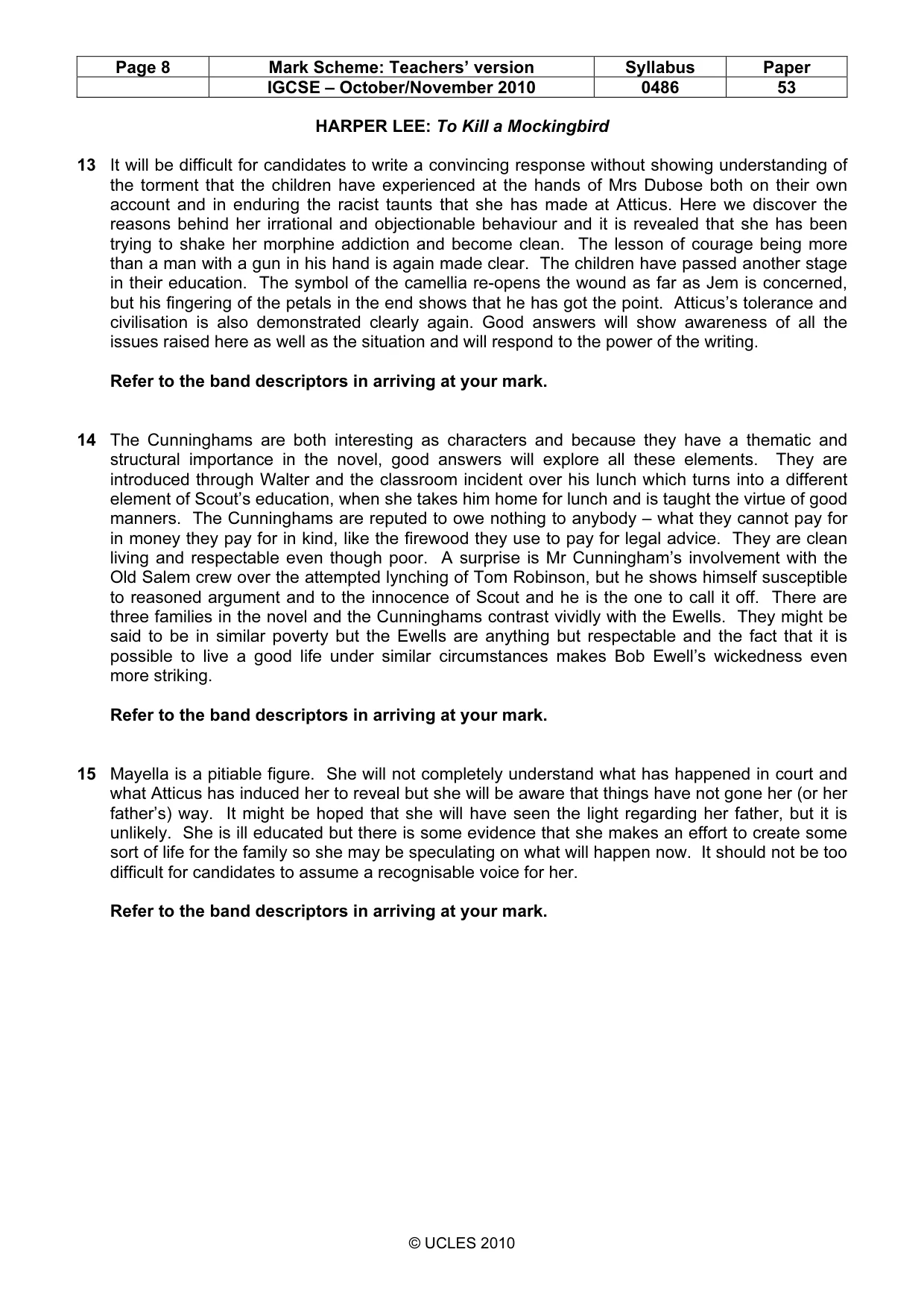
Page 8 Mark Scheme: Teachers’ version Syllabus Paper IGCSE – October/November 2010 0486 53 © UCLES 2010 HARPER LEE: To Kill a Mockingbird 13 It will be difficult for candidates to write a convincing response without showing understanding of the torment that the children have experienced at the hands of Mrs Dubose both on their own account and in enduring the racist taunts that she has made at Atticus. Here we discover the reasons behind her irrational and objectionable behaviour and it is revealed that she has been trying to shake her morphine addiction and become clean. The lesson of courage being more than a man with a gun in his hand is again made clear. The children have passed another stage in their education. The symbol of the camellia re-opens the wound as far as Jem is concerned, but his fingering of the petals in the end shows that he has got the point. Atticus’s tolerance and civilisation is also demonstrated clearly again. Good answers will show awareness of all the issues raised here as well as the situation and will respond to the power of the writing. Refer to the band descriptors in arriving at your mark. 14 The Cunninghams are both interesting as characters and because they have a thematic and structural importance in the novel, good answers will explore all these elements. They are introduced through Walter and the classroom incident over his lunch which turns into a different element of Scout’s education, when she takes him home for lunch and is taught the virtue of good manners. The Cunninghams are reputed to owe nothing to anybody – what they cannot pay for in money they pay for in kind, like the firewood they use to pay for legal advice. They are clean living and respectable even though poor. A surprise is Mr Cunningham’s involvement with the Old Salem crew over the attempted lynching of Tom Robinson, but he shows himself susceptible to reasoned argument and to the innocence of Scout and he is the one to call it off. There are three families in the novel and the Cunninghams contrast vividly with the Ewells. They might be said to be in similar poverty but the Ewells are anything but respectable and the fact that it is possible to live a good life under similar circumstances makes Bob Ewell’s wickedness even more striking. Refer to the band descriptors in arriving at your mark. 15 Mayella is a pitiable figure. She will not completely understand what has happened in court and what Atticus has induced her to reveal but she will be aware that things have not gone her (or her father’s) way. It might be hoped that she will have seen the light regarding her father, but it is unlikely. She is ill educated but there is some evidence that she makes an effort to create some sort of life for the family so she may be speculating on what will happen now. It should not be too difficult for candidates to assume a recognisable voice for her. Refer to the band descriptors in arriving at your mark.
Mark scheme, page 9
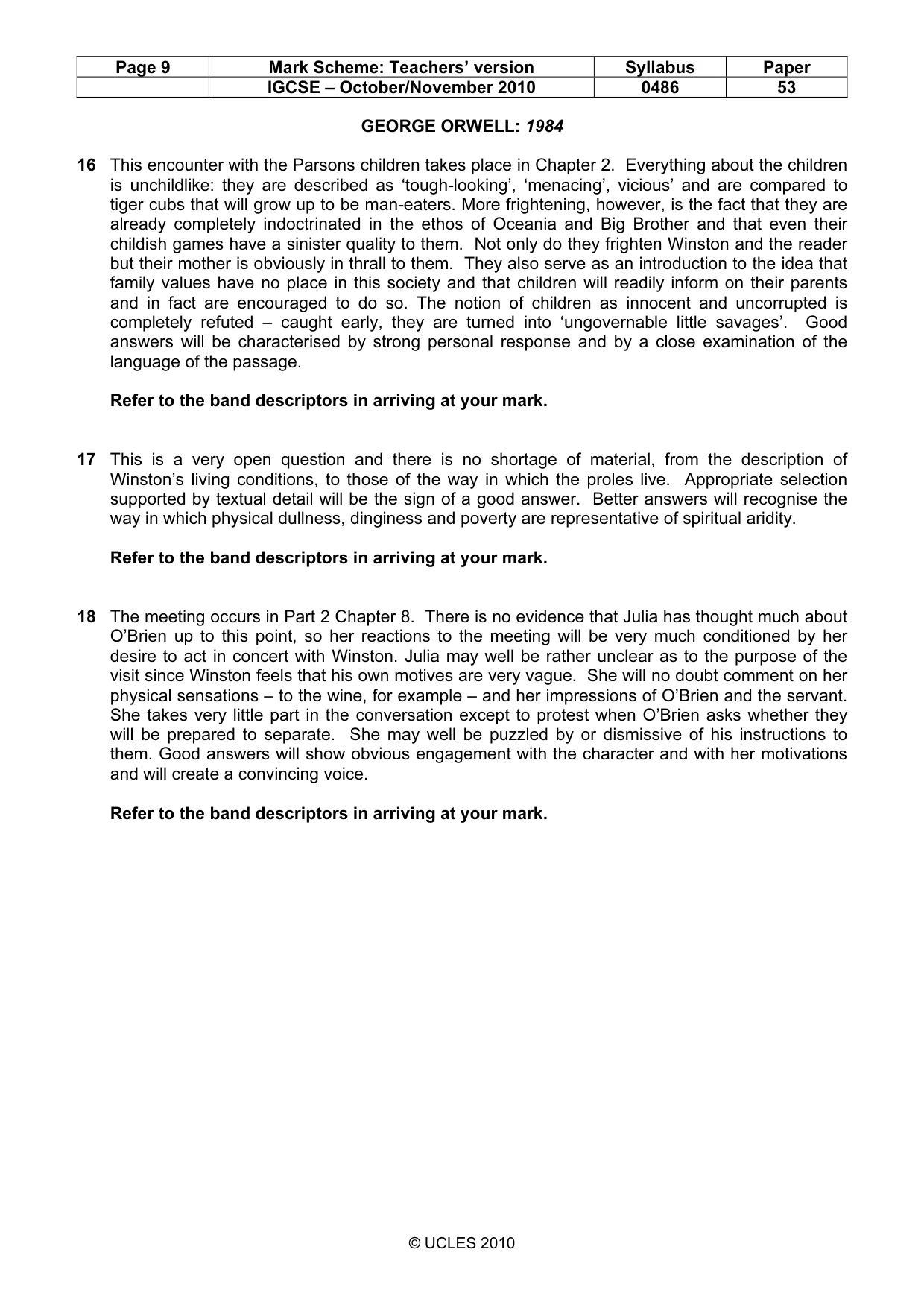
Page 9 Mark Scheme: Teachers’ version Syllabus Paper IGCSE – October/November 2010 0486 53 © UCLES 2010 GEORGE ORWELL: 1984 16 This encounter with the Parsons children takes place in Chapter 2. Everything about the children is unchildlike: they are described as ‘tough-looking’, ‘menacing’, vicious’ and are compared to tiger cubs that will grow up to be man-eaters. More frightening, however, is the fact that they are already completely indoctrinated in the ethos of Oceania and Big Brother and that even their childish games have a sinister quality to them. Not only do they frighten Winston and the reader but their mother is obviously in thrall to them. They also serve as an introduction to the idea that family values have no place in this society and that children will readily inform on their parents and in fact are encouraged to do so. The notion of children as innocent and uncorrupted is completely refuted – caught early, they are turned into ‘ungovernable little savages’. Good answers will be characterised by strong personal response and by a close examination of the language of the passage. Refer to the band descriptors in arriving at your mark. 17 This is a very open question and there is no shortage of material, from the description of Winston’s living conditions, to those of the way in which the proles live. Appropriate selection supported by textual detail will be the sign of a good answer. Better answers will recognise the way in which physical dullness, dinginess and poverty are representative of spiritual aridity. Refer to the band descriptors in arriving at your mark. 18 The meeting occurs in Part 2 Chapter 8. There is no evidence that Julia has thought much about O’Brien up to this point, so her reactions to the meeting will be very much conditioned by her desire to act in concert with Winston. Julia may well be rather unclear as to the purpose of the visit since Winston feels that his own motives are very vague. She will no doubt comment on her physical sensations – to the wine, for example – and her impressions of O’Brien and the servant. She takes very little part in the conversation except to protest when O’Brien asks whether they will be prepared to separate. She may well be puzzled by or dismissive of his instructions to them. Good answers will show obvious engagement with the character and with her motivations and will create a convincing voice. Refer to the band descriptors in arriving at your mark.
Mark scheme, page 10
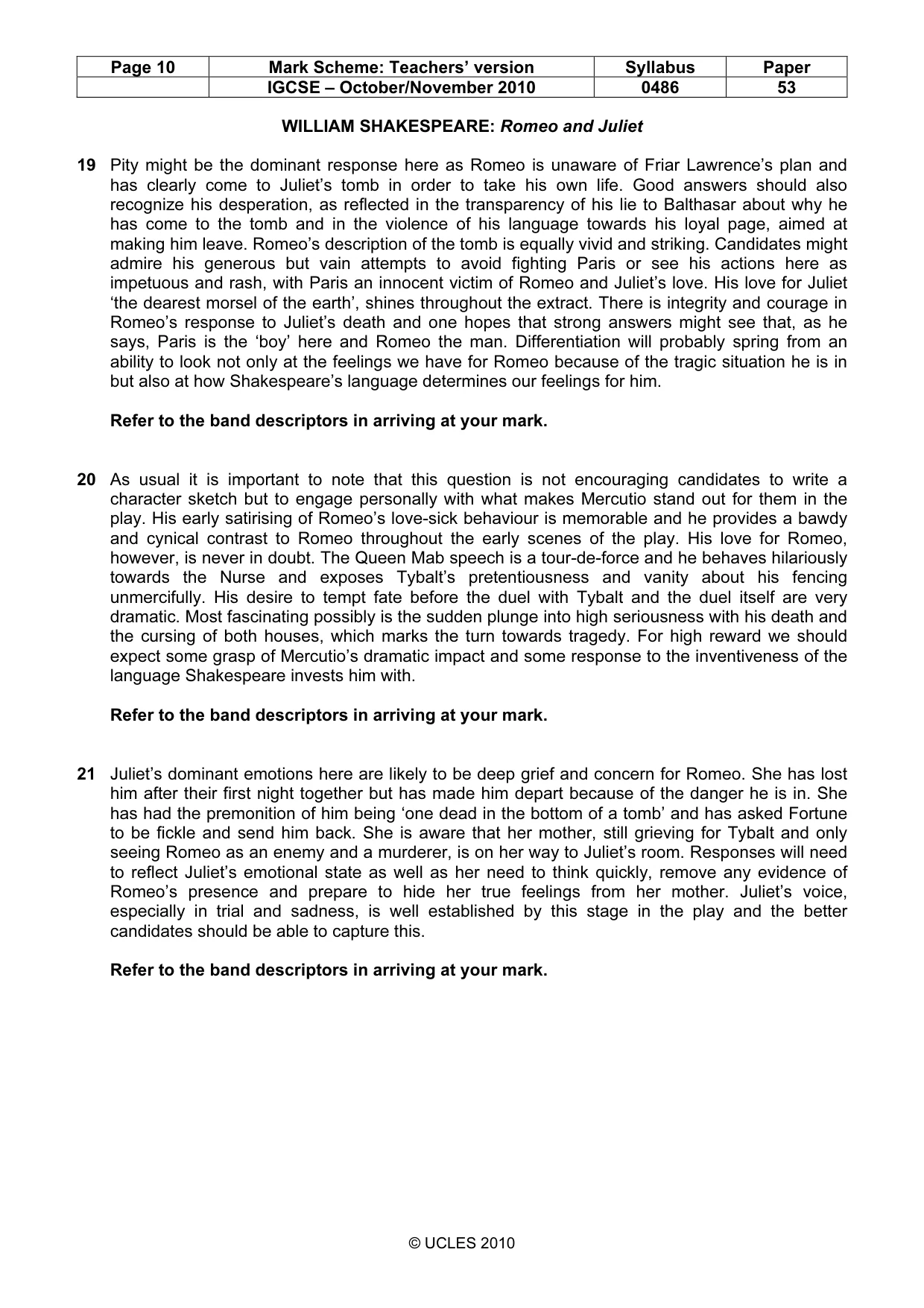
Page 10 Mark Scheme: Teachers’ version Syllabus Paper IGCSE – October/November 2010 0486 53 © UCLES 2010 WILLIAM SHAKESPEARE: Romeo and Juliet 19 Pity might be the dominant response here as Romeo is unaware of Friar Lawrence’s plan and has clearly come to Juliet’s tomb in order to take his own life. Good answers should also recognize his desperation, as reflected in the transparency of his lie to Balthasar about why he has come to the tomb and in the violence of his language towards his loyal page, aimed at making him leave. Romeo’s description of the tomb is equally vivid and striking. Candidates might admire his generous but vain attempts to avoid fighting Paris or see his actions here as impetuous and rash, with Paris an innocent victim of Romeo and Juliet’s love. His love for Juliet ‘the dearest morsel of the earth’, shines throughout the extract. There is integrity and courage in Romeo’s response to Juliet’s death and one hopes that strong answers might see that, as he says, Paris is the ‘boy’ here and Romeo the man. Differentiation will probably spring from an ability to look not only at the feelings we have for Romeo because of the tragic situation he is in but also at how Shakespeare’s language determines our feelings for him. Refer to the band descriptors in arriving at your mark. 20 As usual it is important to note that this question is not encouraging candidates to write a character sketch but to engage personally with what makes Mercutio stand out for them in the play. His early satirising of Romeo’s love-sick behaviour is memorable and he provides a bawdy and cynical contrast to Romeo throughout the early scenes of the play. His love for Romeo, however, is never in doubt. The Queen Mab speech is a tour-de-force and he behaves hilariously towards the Nurse and exposes Tybalt’s pretentiousness and vanity about his fencing unmercifully. His desire to tempt fate before the duel with Tybalt and the duel itself are very dramatic. Most fascinating possibly is the sudden plunge into high seriousness with his death and the cursing of both houses, which marks the turn towards tragedy. For high reward we should expect some grasp of Mercutio’s dramatic impact and some response to the inventiveness of the language Shakespeare invests him with. Refer to the band descriptors in arriving at your mark. 21 Juliet’s dominant emotions here are likely to be deep grief and concern for Romeo. She has lost him after their first night together but has made him depart because of the danger he is in. She has had the premonition of him being ‘one dead in the bottom of a tomb’ and has asked Fortune to be fickle and send him back. She is aware that her mother, still grieving for Tybalt and only seeing Romeo as an enemy and a murderer, is on her way to Juliet’s room. Responses will need to reflect Juliet’s emotional state as well as her need to think quickly, remove any evidence of Romeo’s presence and prepare to hide her true feelings from her mother. Juliet’s voice, especially in trial and sadness, is well established by this stage in the play and the better candidates should be able to capture this. Refer to the band descriptors in arriving at your mark.
What you needed in this session
Cambridge’s own grade thresholds for 2010 Oct/Nov, Paper 5 · Variant 3. A higher threshold means an easier paper — the bar moves with how the cohort did.