Cambridge IGCSE English - Literature 0486 — 2010 Oct/Nov Paper 5 · Variant 1
0486/51/O/N/10 · 25 marks · ≈28 min
The question paper and its mark scheme, free to read here and free to download. This is Cambridge’s own paper, exactly as it was sat.
Question paper16 pages




Mark scheme10 pages
Answers below. Sit the paper first if you are practising.
Paper as text
Question paper, page 1
This document consists of 12 printed pages and 4 blank pages. DC (CB/SH) 12893/3 © UCLES 2010 [Turn over UNIVERSITY OF CAMBRIDGE INTERNATIONAL EXAMINATIONS International General Certificate of Secondary Education READ THESE INSTRUCTIONS FIRST If you have been given an Answer Booklet, follow the instructions on the front cover of the Booklet. Write your Centre number, candidate number and name on all the work you hand in. Write in dark blue or black pen. Do not use staples, paper clips, highlighters, glue or correction fluid. Answer one question. At the end of the examination, fasten all your work securely together. All questions in this paper carry equal marks. LITERATURE (ENGLISH) 0486/51 Paper 5 October/November 2010 45 minutes Additional Materials: Answer Booklet/Paper * 1 3 4 6 5 9 4 3 8 9 * www.XtremePapers.com
Question paper, page 2
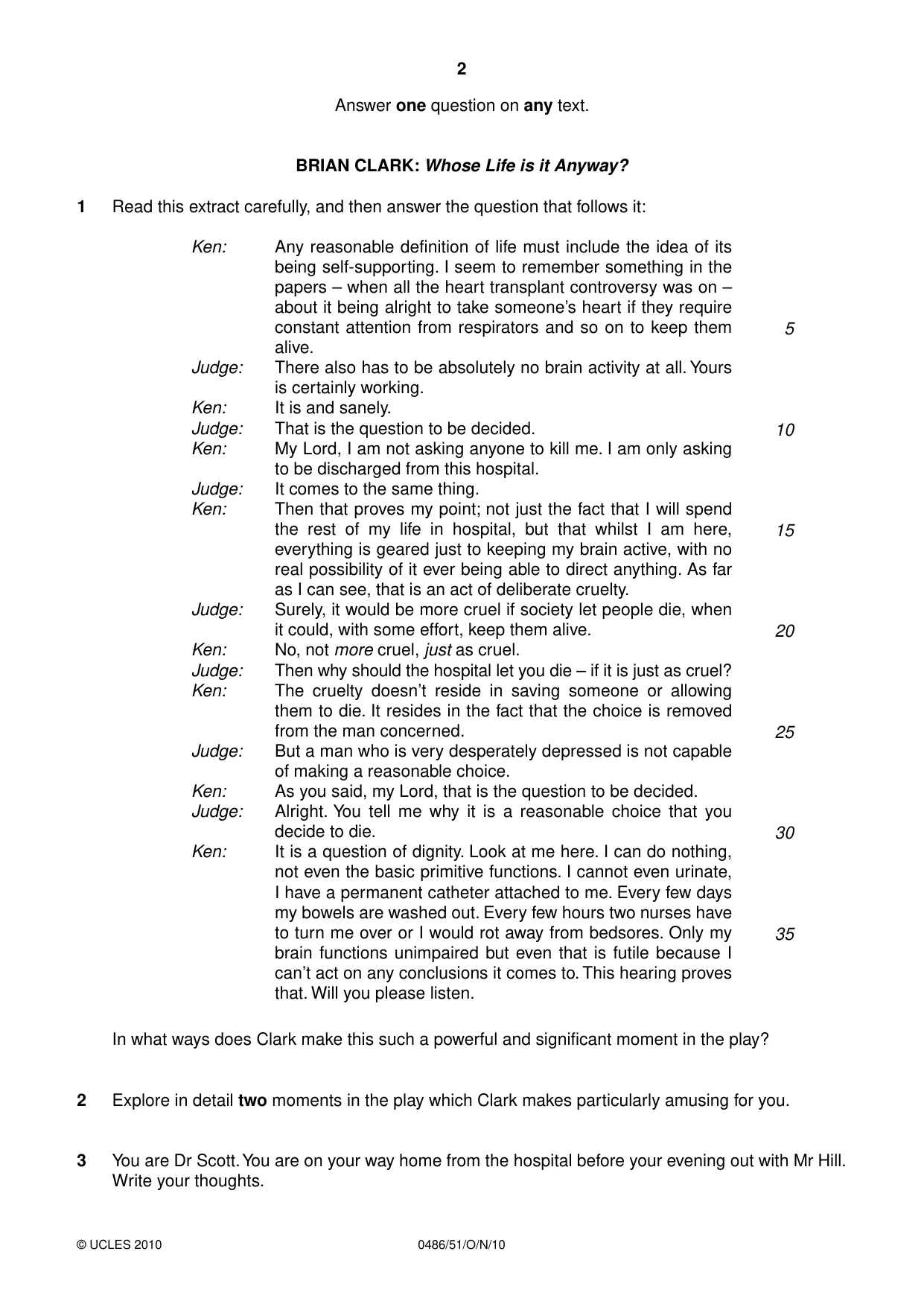
2 0486/51/O/N/10 © UCLES 2010 Answer one question on any text. BRIAN CLARK: Whose Life is it Anyway? 1 Read this extract carefully, and then answer the question that follows it: Ken: Any reasonable definition of life must include the idea of its being self-supporting. I seem to remember something in the papers – when all the heart transplant controversy was on – about it being alright to take someone’s heart if they require constant attention from respirators and so on to keep them alive. Judge: There also has to be absolutely no brain activity at all. Yours is certainly working. Ken: It is and sanely. Judge: That is the question to be decided. Ken: My Lord, I am not asking anyone to kill me. I am only asking to be discharged from this hospital. Judge: It comes to the same thing. Ken: Then that proves my point; not just the fact that I will spend the rest of my life in hospital, but that whilst I am here, everything is geared just to keeping my brain active, with no real possibility of it ever being able to direct anything. As far as I can see, that is an act of deliberate cruelty. Judge: Surely, it would be more cruel if society let people die, when it could, with some effort, keep them alive. Ken: No, not more cruel, just as cruel. Judge: Then why should the hospital let you die – if it is just as cruel? Ken: The cruelty doesn’t reside in saving someone or allowing them to die. It resides in the fact that the choice is removed from the man concerned. Judge: But a man who is very desperately depressed is not capable of making a reasonable choice. Ken: As you said, my Lord, that is the question to be decided. Judge: Alright. You tell me why it is a reasonable choice that you decide to die. Ken: It is a question of dignity. Look at me here. I can do nothing, not even the basic primitive functions. I cannot even urinate, I have a permanent catheter attached to me. Every few days my bowels are washed out. Every few hours two nurses have to turn me over or I would rot away from bedsores. Only my brain functions unimpaired but even that is futile because I can’t act on any conclusions it comes to. This hearing proves that. Will you please listen. In what ways does Clark make this such a powerful and significant moment in the play? 2 Explore in detail two moments in the play which Clark makes particularly amusing for you. 3 You are Dr Scott. You are on your way home from the hospital before your evening out with Mr Hill. Write your thoughts. 5 10 15 20 25 30 35
Question paper, page 3
3 0486/51/O/N/10 © UCLES 2010 [Turn over BLANK PAGE Turn over for question 4.
Question paper, page 4
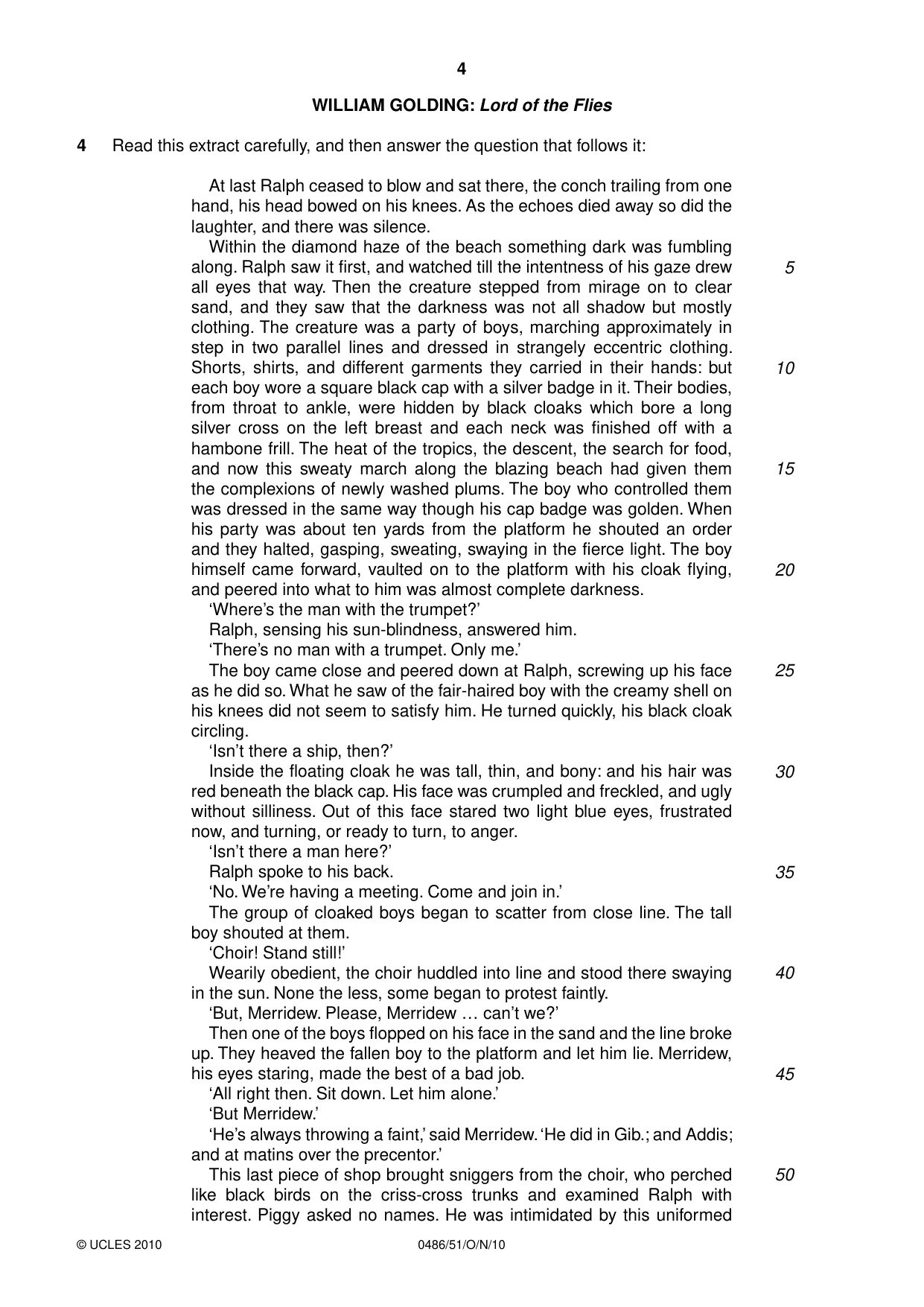
4 0486/51/O/N/10 © UCLES 2010 WILLIAM GOLDING: Lord of the Flies 4 Read this extract carefully, and then answer the question that follows it: At last Ralph ceased to blow and sat there, the conch trailing from one hand, his head bowed on his knees. As the echoes died away so did the laughter, and there was silence. Within the diamond haze of the beach something dark was fumbling along. Ralph saw it first, and watched till the intentness of his gaze drew all eyes that way. Then the creature stepped from mirage on to clear sand, and they saw that the darkness was not all shadow but mostly clothing. The creature was a party of boys, marching approximately in step in two parallel lines and dressed in strangely eccentric clothing. Shorts, shirts, and different garments they carried in their hands: but each boy wore a square black cap with a silver badge in it. Their bodies, from throat to ankle, were hidden by black cloaks which bore a long silver cross on the left breast and each neck was finished off with a hambone frill. The heat of the tropics, the descent, the search for food, and now this sweaty march along the blazing beach had given them the complexions of newly washed plums. The boy who controlled them was dressed in the same way though his cap badge was golden. When his party was about ten yards from the platform he shouted an order and they halted, gasping, sweating, swaying in the fierce light. The boy himself came forward, vaulted on to the platform with his cloak flying, and peered into what to him was almost complete darkness. ‘Where’s the man with the trumpet?’ Ralph, sensing his sun-blindness, answered him. ‘There’s no man with a trumpet. Only me.’ The boy came close and peered down at Ralph, screwing up his face as he did so. What he saw of the fair-haired boy with the creamy shell on his knees did not seem to satisfy him. He turned quickly, his black cloak circling. ‘Isn’t there a ship, then?’ Inside the floating cloak he was tall, thin, and bony: and his hair was red beneath the black cap. His face was crumpled and freckled, and ugly without silliness. Out of this face stared two light blue eyes, frustrated now, and turning, or ready to turn, to anger. ‘Isn’t there a man here?’ Ralph spoke to his back. ‘No. We’re having a meeting. Come and join in.’ The group of cloaked boys began to scatter from close line. The tall boy shouted at them. ‘Choir! Stand still!’ Wearily obedient, the choir huddled into line and stood there swaying in the sun. None the less, some began to protest faintly. ‘But, Merridew. Please, Merridew … can’t we?’ Then one of the boys flopped on his face in the sand and the line broke up. They heaved the fallen boy to the platform and let him lie. Merridew, his eyes staring, made the best of a bad job. ‘All right then. Sit down. Let him alone.’ ‘But Merridew.’ ‘He’s always throwing a faint,’ said Merridew. ‘He did in Gib.; and Addis; and at matins over the precentor.’ This last piece of shop brought sniggers from the choir, who perched like black birds on the criss-cross trunks and examined Ralph with interest. Piggy asked no names. He was intimidated by this uniformed 5 10 15 20 25 30 35 40 45 50
Question paper, page 5
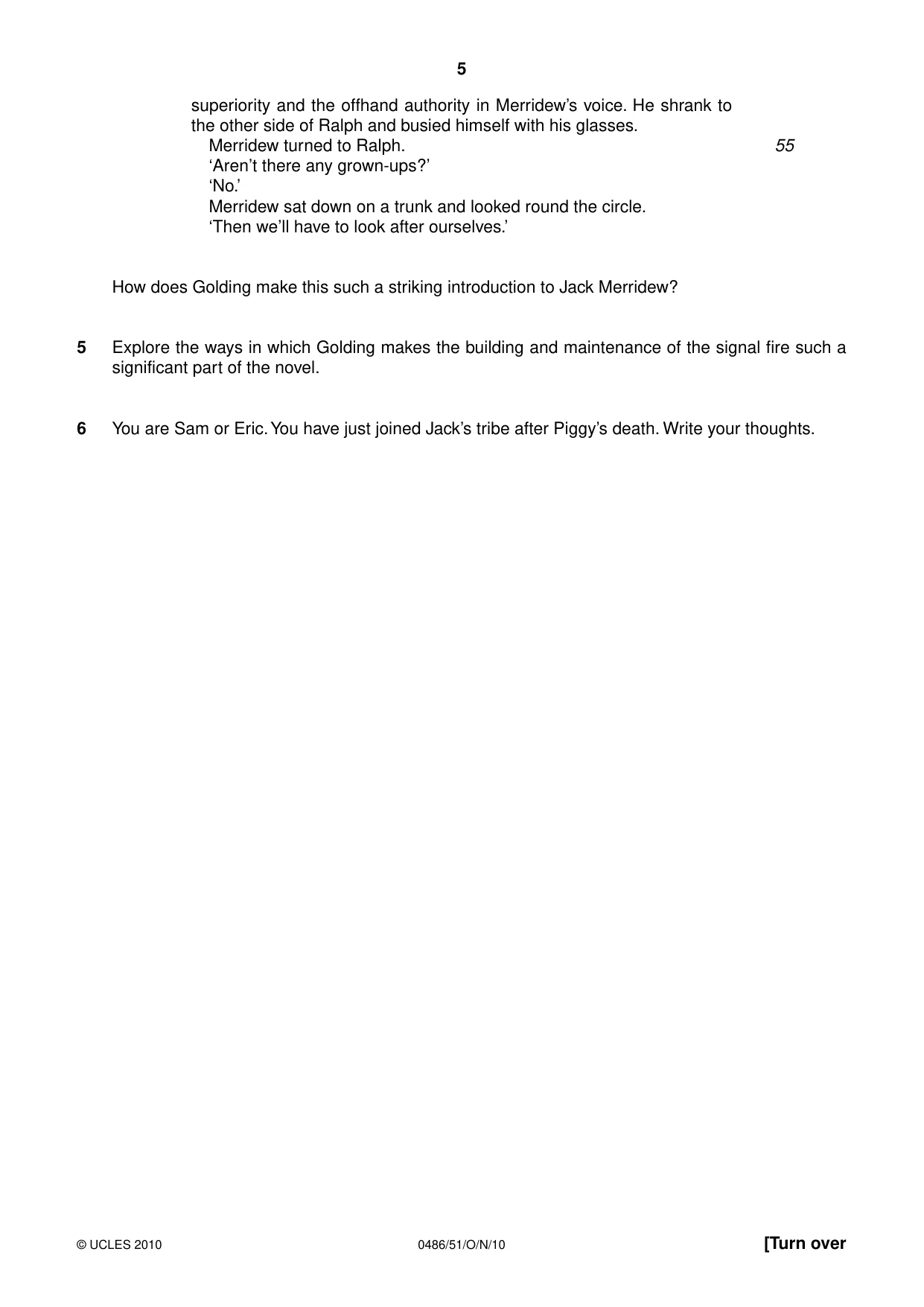
5 0486/51/O/N/10 © UCLES 2010 [Turn over superiority and the offhand authority in Merridew’s voice. He shrank to the other side of Ralph and busied himself with his glasses. Merridew turned to Ralph. ‘Aren’t there any grown-ups?’ ‘No.’ Merridew sat down on a trunk and looked round the circle. ‘Then we’ll have to look after ourselves.’ How does Golding make this such a striking introduction to Jack Merridew? 5 Explore the ways in which Golding makes the building and maintenance of the signal fire such a significant part of the novel. 6 You are Sam or Eric. You have just joined Jack’s tribe after Piggy’s death. Write your thoughts. 55
Question paper, page 6
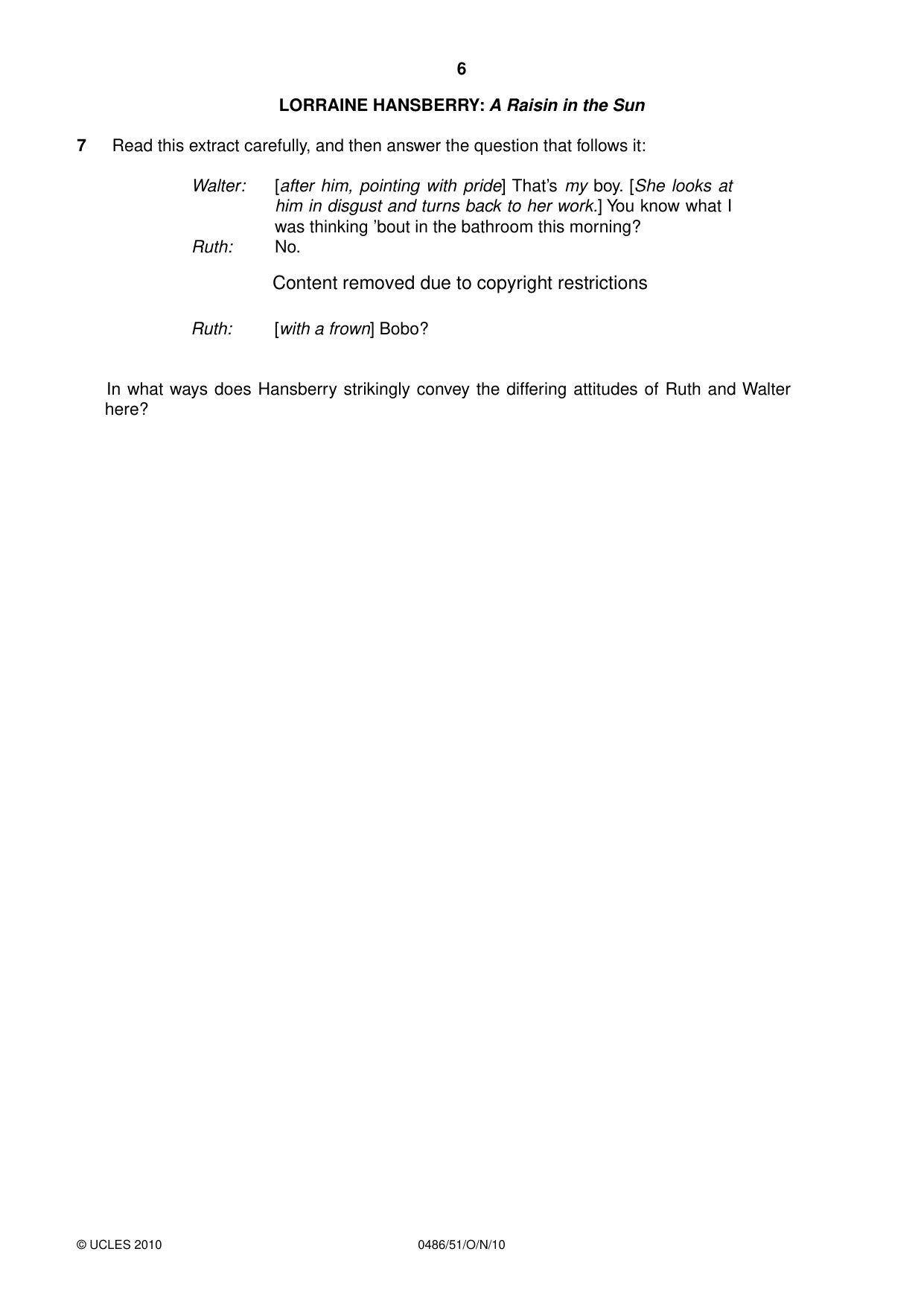
6 0486/51/O/N/10 © UCLES 2010 LORRAINE HANSBERRY: A Raisin in the Sun 7 Read this extract carefully, and then answer the question that follows it: Walter: [after him, pointing with pride] That’s my boy. [She looks at him in disgust and turns back to her work.] You know what I was thinking ’bout in the bathroom this morning? Ruth: No. Ruth: [with a frown] Bobo? In what ways does Hansberry strikingly convey the differing attitudes of Ruth and Walter here? Content removed due to copyright restrictions
Question paper, page 7
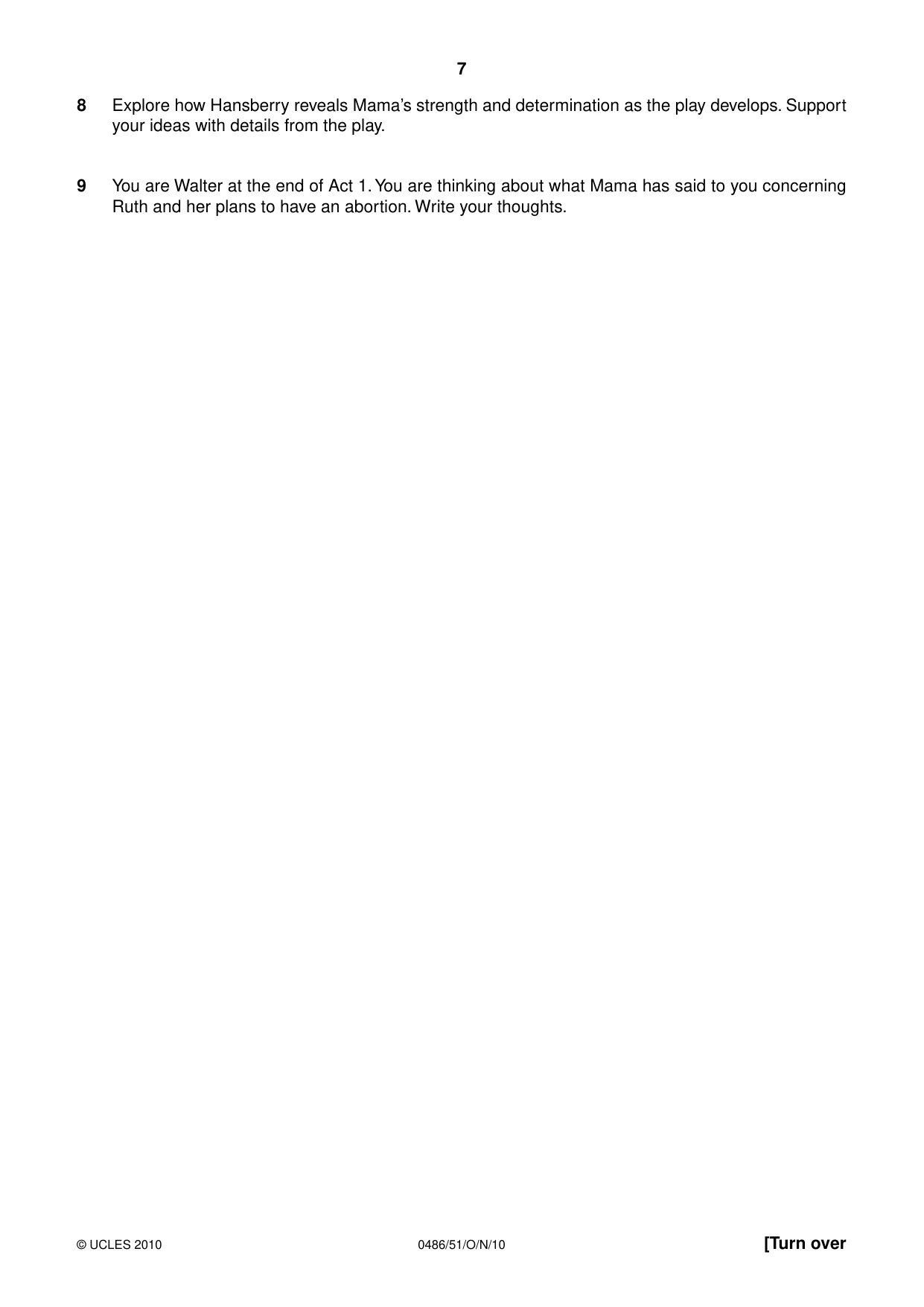
7 0486/51/O/N/10 © UCLES 2010 [Turn over 8 Explore how Hansberry reveals Mama’s strength and determination as the play develops. Support your ideas with details from the play. 9 You are Walter at the end of Act 1. You are thinking about what Mama has said to you concerning Ruth and her plans to have an abortion. Write your thoughts.
Question paper, page 8
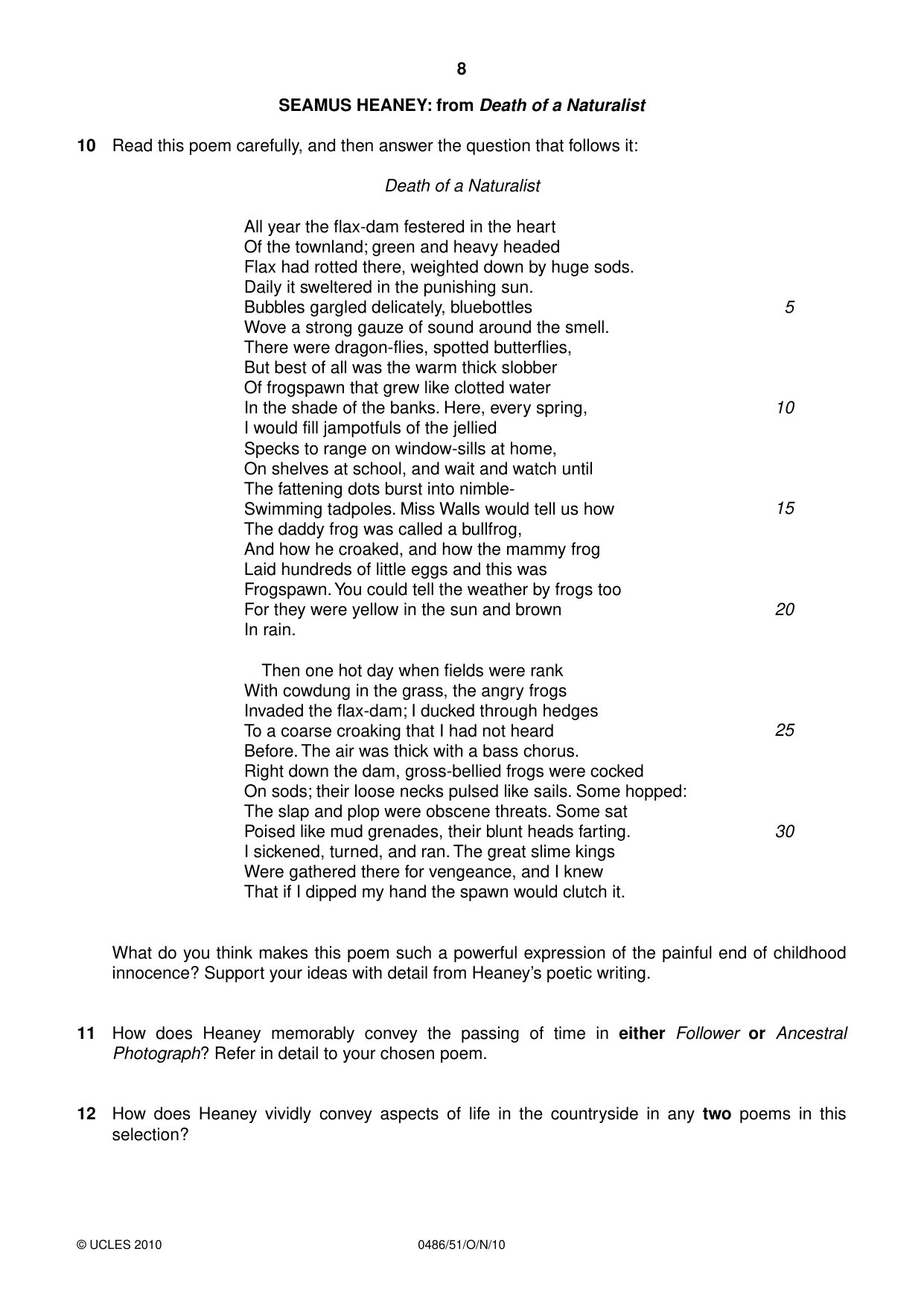
8 0486/51/O/N/10 © UCLES 2010 SEAMUS HEANEY: from Death of a Naturalist 10 Read this poem carefully, and then answer the question that follows it: Death of a Naturalist All year the flax-dam festered in the heart Of the townland; green and heavy headed Flax had rotted there, weighted down by huge sods. Daily it sweltered in the punishing sun. Bubbles gargled delicately, bluebottles Wove a strong gauze of sound around the smell. There were dragon-flies, spotted butterflies, But best of all was the warm thick slobber Of frogspawn that grew like clotted water In the shade of the banks. Here, every spring, I would fill jampotfuls of the jellied Specks to range on window-sills at home, On shelves at school, and wait and watch until The fattening dots burst into nimble- Swimming tadpoles. Miss Walls would tell us how The daddy frog was called a bullfrog, And how he croaked, and how the mammy frog Laid hundreds of little eggs and this was Frogspawn. You could tell the weather by frogs too For they were yellow in the sun and brown In rain. Then one hot day when fields were rank With cowdung in the grass, the angry frogs Invaded the flax-dam; I ducked through hedges To a coarse croaking that I had not heard Before. The air was thick with a bass chorus. Right down the dam, gross-bellied frogs were cocked On sods; their loose necks pulsed like sails. Some hopped: The slap and plop were obscene threats. Some sat Poised like mud grenades, their blunt heads farting. I sickened, turned, and ran. The great slime kings Were gathered there for vengeance, and I knew That if I dipped my hand the spawn would clutch it. What do you think makes this poem such a powerful expression of the painful end of childhood innocence? Support your ideas with detail from Heaney’s poetic writing. 11 How does Heaney memorably convey the passing of time in either Follower or Ancestral Photograph? Refer in detail to your chosen poem. 12 How does Heaney vividly convey aspects of life in the countryside in any two poems in this selection? 5 10 15 20 25 30
Question paper, page 9
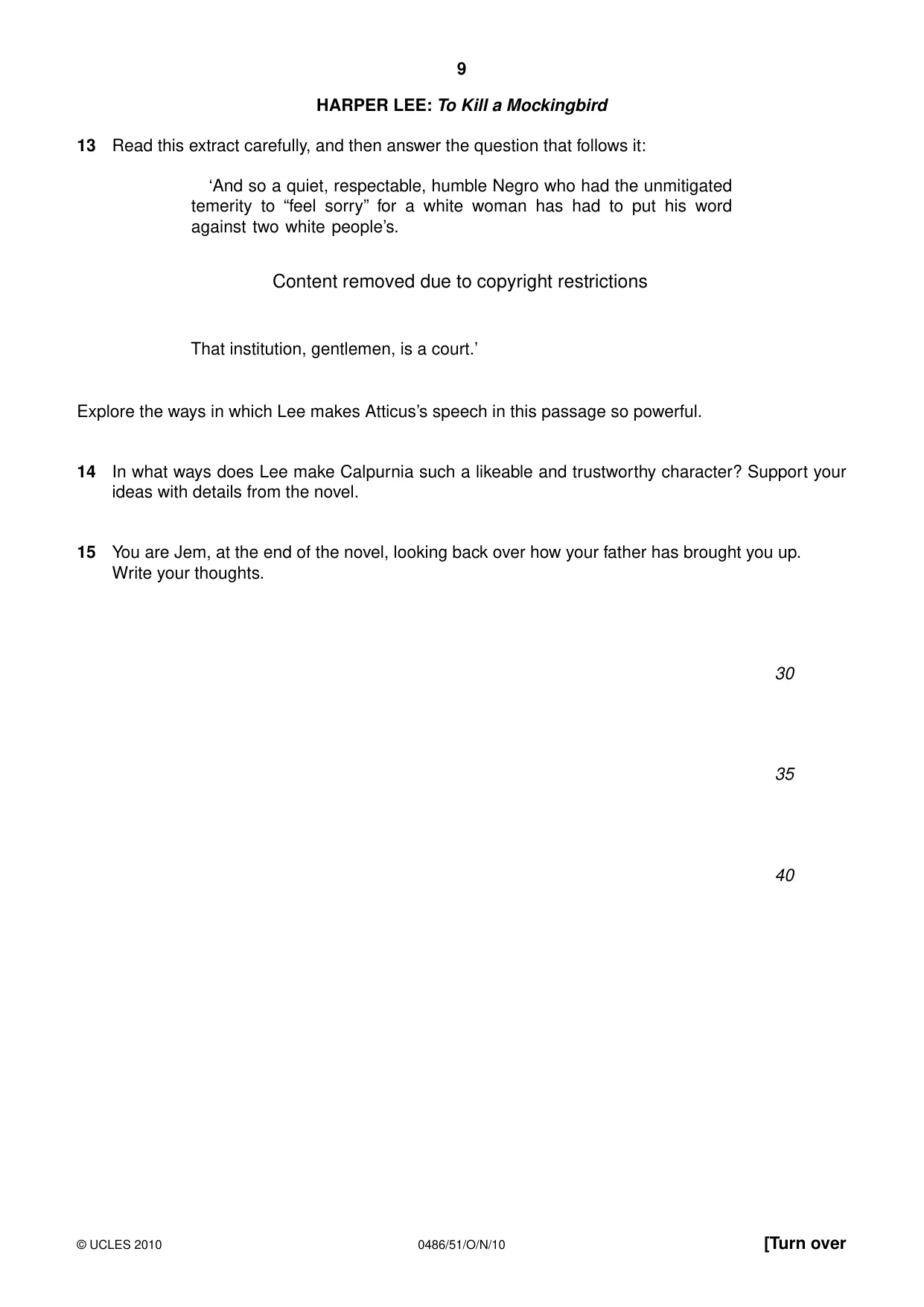
9 0486/51/O/N/10 © UCLES 2010 [Turn over HARPER LEE: To Kill a Mockingbird 13 Read this extract carefully, and then answer the question that follows it: ‘And so a quiet, respectable, humble Negro who had the unmitigated temerity to “feel sorry” for a white woman has had to put his word against two white people’s. That institution, gentlemen, is a court.’ Explore the ways in which Lee makes Atticus’s speech in this passage so powerful. 14 In what ways does Lee make Calpurnia such a likeable and trustworthy character? Support your ideas with details from the novel. 15 You are Jem, at the end of the novel, looking back over how your father has brought you up. Write your thoughts. 30 35 40 Content removed due to copyright restrictions
Question paper, page 10
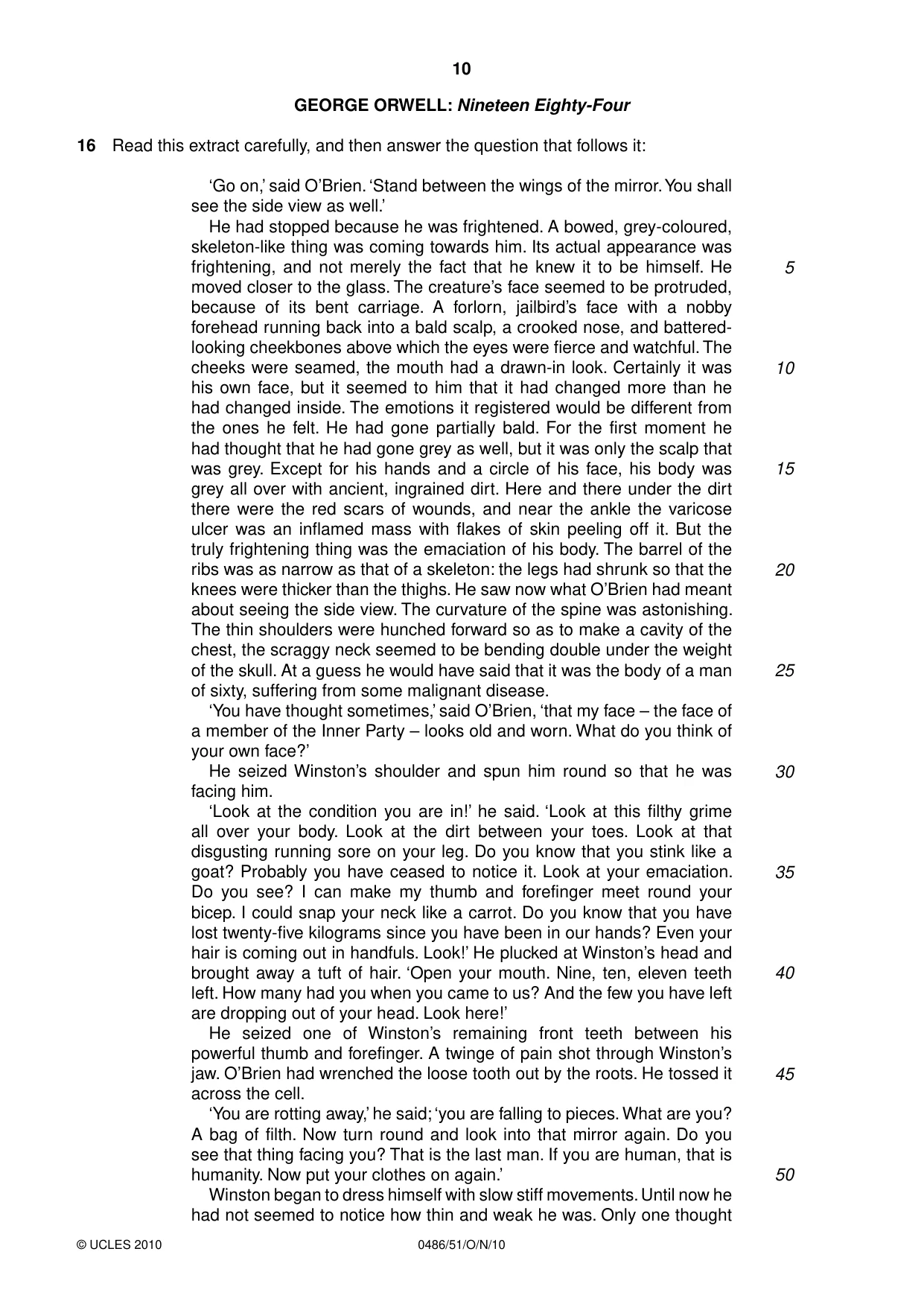
10 0486/51/O/N/10 © UCLES 2010 GEORGE ORWELL: Nineteen Eighty-Four 16 Read this extract carefully, and then answer the question that follows it: ‘Go on,’ said O’Brien. ‘Stand between the wings of the mirror. You shall see the side view as well.’ He had stopped because he was frightened. A bowed, grey-coloured, skeleton-like thing was coming towards him. Its actual appearance was frightening, and not merely the fact that he knew it to be himself. He moved closer to the glass. The creature’s face seemed to be protruded, because of its bent carriage. A forlorn, jailbird’s face with a nobby forehead running back into a bald scalp, a crooked nose, and battered- looking cheekbones above which the eyes were fierce and watchful. The cheeks were seamed, the mouth had a drawn-in look. Certainly it was his own face, but it seemed to him that it had changed more than he had changed inside. The emotions it registered would be different from the ones he felt. He had gone partially bald. For the first moment he had thought that he had gone grey as well, but it was only the scalp that was grey. Except for his hands and a circle of his face, his body was grey all over with ancient, ingrained dirt. Here and there under the dirt there were the red scars of wounds, and near the ankle the varicose ulcer was an inflamed mass with flakes of skin peeling off it. But the truly frightening thing was the emaciation of his body. The barrel of the ribs was as narrow as that of a skeleton: the legs had shrunk so that the knees were thicker than the thighs. He saw now what O’Brien had meant about seeing the side view. The curvature of the spine was astonishing. The thin shoulders were hunched forward so as to make a cavity of the chest, the scraggy neck seemed to be bending double under the weight of the skull. At a guess he would have said that it was the body of a man of sixty, suffering from some malignant disease. ‘You have thought sometimes,’ said O’Brien, ‘that my face – the face of a member of the Inner Party – looks old and worn. What do you think of your own face?’ He seized Winston’s shoulder and spun him round so that he was facing him. ‘Look at the condition you are in!’ he said. ‘Look at this filthy grime all over your body. Look at the dirt between your toes. Look at that disgusting running sore on your leg. Do you know that you stink like a goat? Probably you have ceased to notice it. Look at your emaciation. Do you see? I can make my thumb and forefinger meet round your bicep. I could snap your neck like a carrot. Do you know that you have lost twenty-five kilograms since you have been in our hands? Even your hair is coming out in handfuls. Look!’ He plucked at Winston’s head and brought away a tuft of hair. ‘Open your mouth. Nine, ten, eleven teeth left. How many had you when you came to us? And the few you have left are dropping out of your head. Look here!’ He seized one of Winston’s remaining front teeth between his powerful thumb and forefinger. A twinge of pain shot through Winston’s jaw. O’Brien had wrenched the loose tooth out by the roots. He tossed it across the cell. ‘You are rotting away,’ he said; ‘you are falling to pieces. What are you? A bag of filth. Now turn round and look into that mirror again. Do you see that thing facing you? That is the last man. If you are human, that is humanity. Now put your clothes on again.’ Winston began to dress himself with slow stiff movements. Until now he had not seemed to notice how thin and weak he was. Only one thought 5 10 15 20 25 30 35 40 45 50
Question paper, page 11
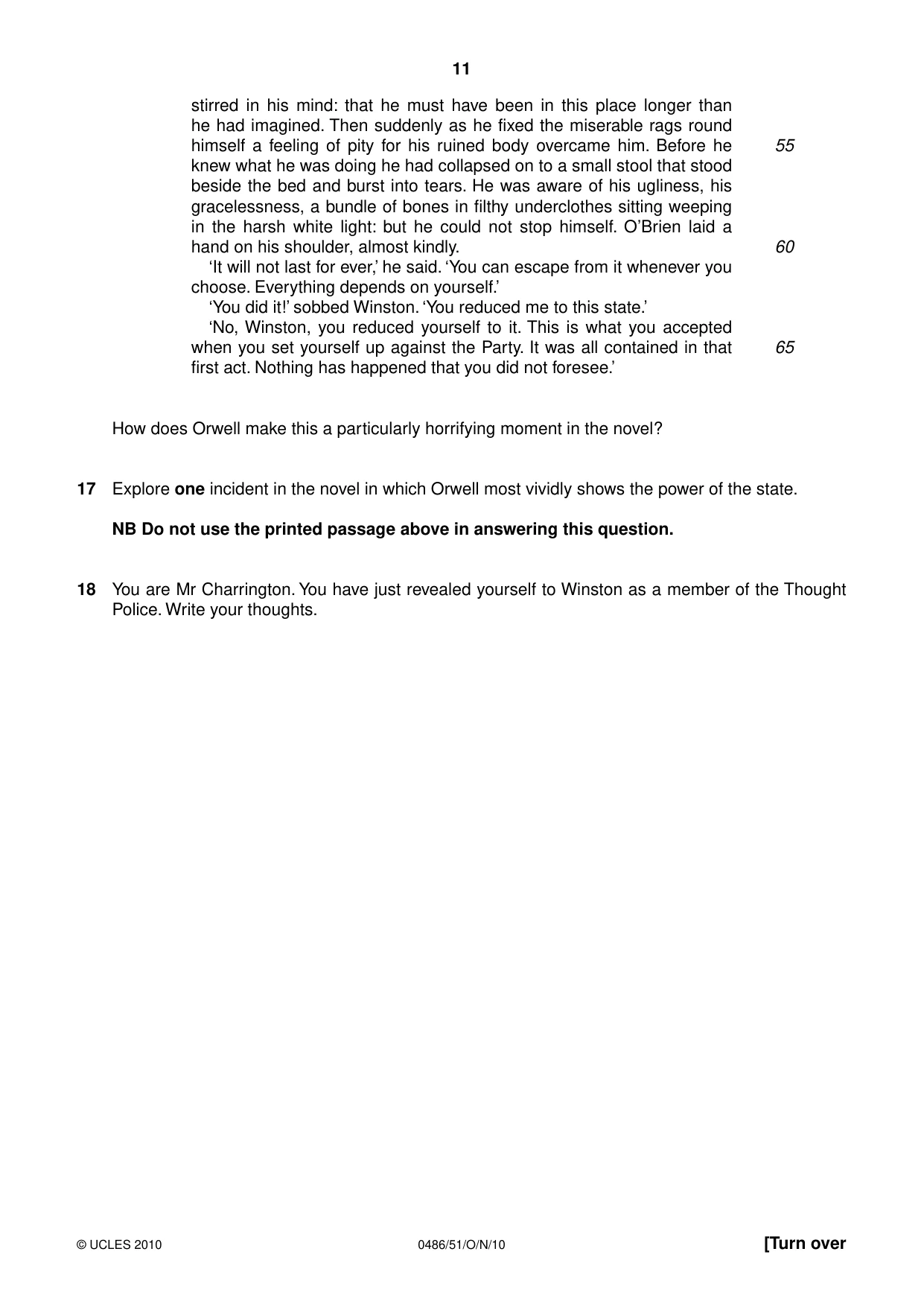
11 0486/51/O/N/10 © UCLES 2010 [Turn over stirred in his mind: that he must have been in this place longer than he had imagined. Then suddenly as he fixed the miserable rags round himself a feeling of pity for his ruined body overcame him. Before he knew what he was doing he had collapsed on to a small stool that stood beside the bed and burst into tears. He was aware of his ugliness, his gracelessness, a bundle of bones in filthy underclothes sitting weeping in the harsh white light: but he could not stop himself. O’Brien laid a hand on his shoulder, almost kindly. ‘It will not last for ever,’ he said. ‘You can escape from it whenever you choose. Everything depends on yourself.’ ‘You did it!’ sobbed Winston. ‘You reduced me to this state.’ ‘No, Winston, you reduced yourself to it. This is what you accepted when you set yourself up against the Party. It was all contained in that first act. Nothing has happened that you did not foresee.’ How does Orwell make this a particularly horrifying moment in the novel? 17 Explore one incident in the novel in which Orwell most vividly shows the power of the state. NB Do not use the printed passage above in answering this question. 18 You are Mr Charrington. You have just revealed yourself to Winston as a member of the Thought Police. Write your thoughts. 55 60 65
Question paper, page 12
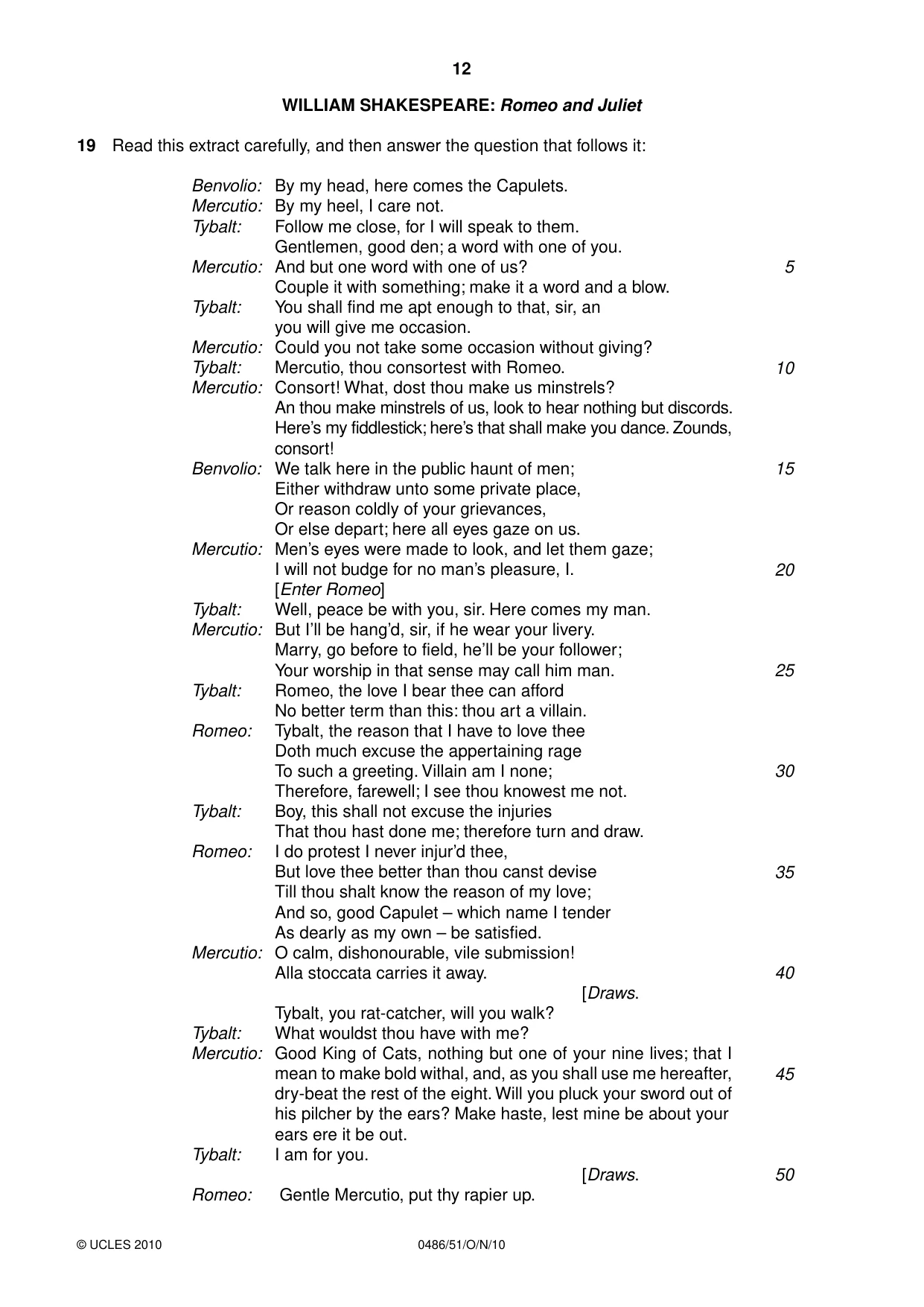
12 0486/51/O/N/10 © UCLES 2010 WILLIAM SHAKESPEARE: Romeo and Juliet 19 Read this extract carefully, and then answer the question that follows it: Benvolio: By my head, here comes the Capulets. Mercutio: By my heel, I care not. Tybalt: Follow me close, for I will speak to them. Gentlemen, good den; a word with one of you. Mercutio: And but one word with one of us? Couple it with something; make it a word and a blow. Tybalt: You shall find me apt enough to that, sir, an you will give me occasion. Mercutio: Could you not take some occasion without giving? Tybalt: Mercutio, thou consortest with Romeo. Mercutio: Consort! What, dost thou make us minstrels? An thou make minstrels of us, look to hear nothing but discords. Here’s my fiddlestick; here’s that shall make you dance. Zounds, consort! Benvolio: We talk here in the public haunt of men; Either withdraw unto some private place, Or reason coldly of your grievances, Or else depart; here all eyes gaze on us. Mercutio: Men’s eyes were made to look, and let them gaze; I will not budge for no man’s pleasure, I. [Enter Romeo] Tybalt: Well, peace be with you, sir. Here comes my man. Mercutio: But I’ll be hang’d, sir, if he wear your livery. Marry, go before to field, he’ll be your follower; Your worship in that sense may call him man. Tybalt: Romeo, the love I bear thee can afford No better term than this: thou art a villain. Romeo: Tybalt, the reason that I have to love thee Doth much excuse the appertaining rage To such a greeting. Villain am I none; Therefore, farewell; I see thou knowest me not. Tybalt: Boy, this shall not excuse the injuries That thou hast done me; therefore turn and draw. Romeo: I do protest I never injur’d thee, But love thee better than thou canst devise Till thou shalt know the reason of my love; And so, good Capulet – which name I tender As dearly as my own – be satisfied. Mercutio: O calm, dishonourable, vile submission! Alla stoccata carries it away. [Draws. Tybalt, you rat-catcher, will you walk? Tybalt: What wouldst thou have with me? Mercutio: Good King of Cats, nothing but one of your nine lives; that I mean to make bold withal, and, as you shall use me hereafter, dry-beat the rest of the eight. Will you pluck your sword out of his pilcher by the ears? Make haste, lest mine be about your ears ere it be out. Tybalt: I am for you. [Draws. Romeo: Gentle Mercutio, put thy rapier up. 5 10 15 20 25 30 35 40 45 50
Question paper, page 13
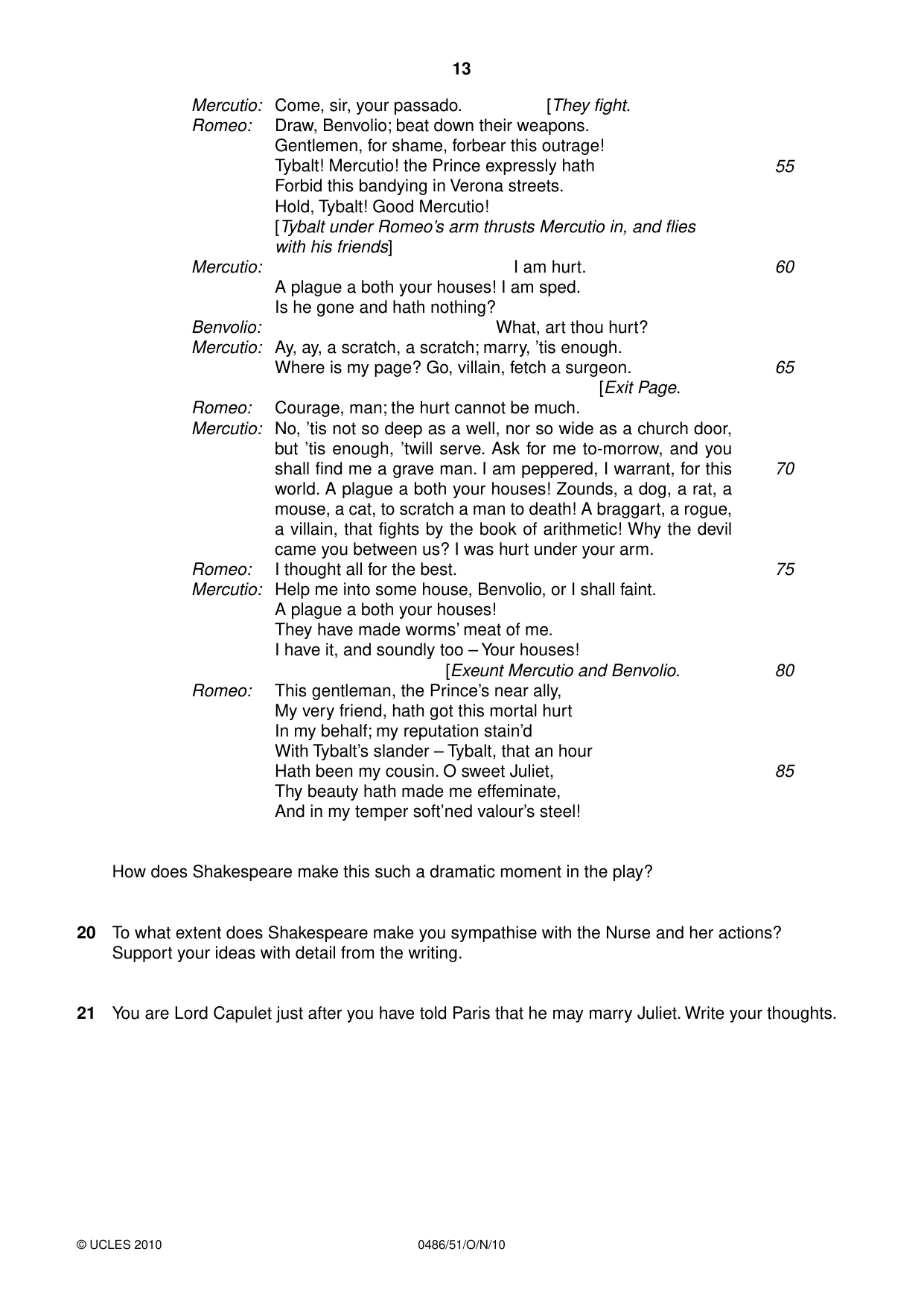
13 0486/51/O/N/10 © UCLES 2010 Mercutio: Come, sir, your passado. [They fight. Romeo: Draw, Benvolio; beat down their weapons. Gentlemen, for shame, forbear this outrage! Tybalt! Mercutio! the Prince expressly hath Forbid this bandying in Verona streets. Hold, Tybalt! Good Mercutio! [Tybalt under Romeo’s arm thrusts Mercutio in, and flies with his friends] Mercutio: I am hurt. A plague a both your houses! I am sped. Is he gone and hath nothing? Benvolio: What, art thou hurt? Mercutio: Ay, ay, a scratch, a scratch; marry, ’tis enough. Where is my page? Go, villain, fetch a surgeon. [Exit Page. Romeo: Courage, man; the hurt cannot be much. Mercutio: No, ’tis not so deep as a well, nor so wide as a church door, but ’tis enough, ’twill serve. Ask for me to-morrow, and you shall find me a grave man. I am peppered, I warrant, for this world. A plague a both your houses! Zounds, a dog, a rat, a mouse, a cat, to scratch a man to death! A braggart, a rogue, a villain, that fights by the book of arithmetic! Why the devil came you between us? I was hurt under your arm. Romeo: I thought all for the best. Mercutio: Help me into some house, Benvolio, or I shall faint. A plague a both your houses! They have made worms’ meat of me. I have it, and soundly too – Your houses! [Exeunt Mercutio and Benvolio. Romeo: This gentleman, the Prince’s near ally, My very friend, hath got this mortal hurt In my behalf; my reputation stain’d With Tybalt’s slander – Tybalt, that an hour Hath been my cousin. O sweet Juliet, Thy beauty hath made me effeminate, And in my temper soft’ned valour’s steel! How does Shakespeare make this such a dramatic moment in the play? 20 To what extent does Shakespeare make you sympathise with the Nurse and her actions? Support your ideas with detail from the writing. 21 You are Lord Capulet just after you have told Paris that he may marry Juliet. Write your thoughts. 55 60 65 70 75 80 85
Question paper, page 14
14 0486/51/O/N/10 © UCLES 2010 BLANK PAGE
Question paper, page 15
15 0486/51/O/N/10 © UCLES 2010 BLANK PAGE
Question paper, page 16
16 0486/51/O/N/10 © UCLES 2010 BLANK PAGE Copyright Acknowledgements: Question 1 © Brian Clark; Whose Life is it Anyway?; Heinemann; 1993. Question 4 © William Golding; Lord of the Flies; Faber & Faber; 2004. Question 7 © Lorraine Hansberry; A Raisin in the Sun; Methuen, A C Black; 2001. Question 10 © Seamus Heaney; Death of a Naturalist ; Faber & Faber; 2002. Question 13 © from To Kill A Mockingbird by Harper Lee, published by William Heinemann Ltd. Reprinted by permission of The Random House Group Ltd. Question 16 © George Orwell; Nineteen Eighty-Four ; Penguin; 1998. Permission to reproduce items where third-party owned material protected by copyright is included has been sought and cleared where possible. Every reasonable effort has been made by the publisher (UCLES) to trace copyright holders, but if any items requiring clearance have unwittingly been included, the publisher will be pleased to make amends at the earliest possible opportunity. University of Cambridge International Examinations is part of the Cambridge Assessment Group. Cambridge Assessment is the brand name of University of Cambridge Local Examinations Syndicate (UCLES), which is itself a department of the University of Cambridge.
Mark scheme, page 1
UNIVERSITY OF CAMBRIDGE INTERNATIONAL EXAMINATIONS International General Certificate of Secondary Education MARK SCHEME for the October/November 2010 question paper for the guidance of teachers 0486 LITERATURE (ENGLISH) 0486/51 Paper 5, maximum raw mark 25 This mark scheme is published as an aid to teachers and candidates, to indicate the requirements of the examination. It shows the basis on which Examiners were instructed to award marks. It does not indicate the details of the discussions that took place at an Examiners’ meeting before marking began, which would have considered the acceptability of alternative answers. Mark schemes must be read in conjunction with the question papers and the report on the examination. • CIE will not enter into discussions or correspondence in connection with these mark schemes. CIE is publishing the mark schemes for the October/November 2010 question papers for most IGCSE, GCE Advanced Level and Advanced Subsidiary Level syllabuses and some Ordinary Level syllabuses. www.XtremePapers.com
Mark scheme, page 2
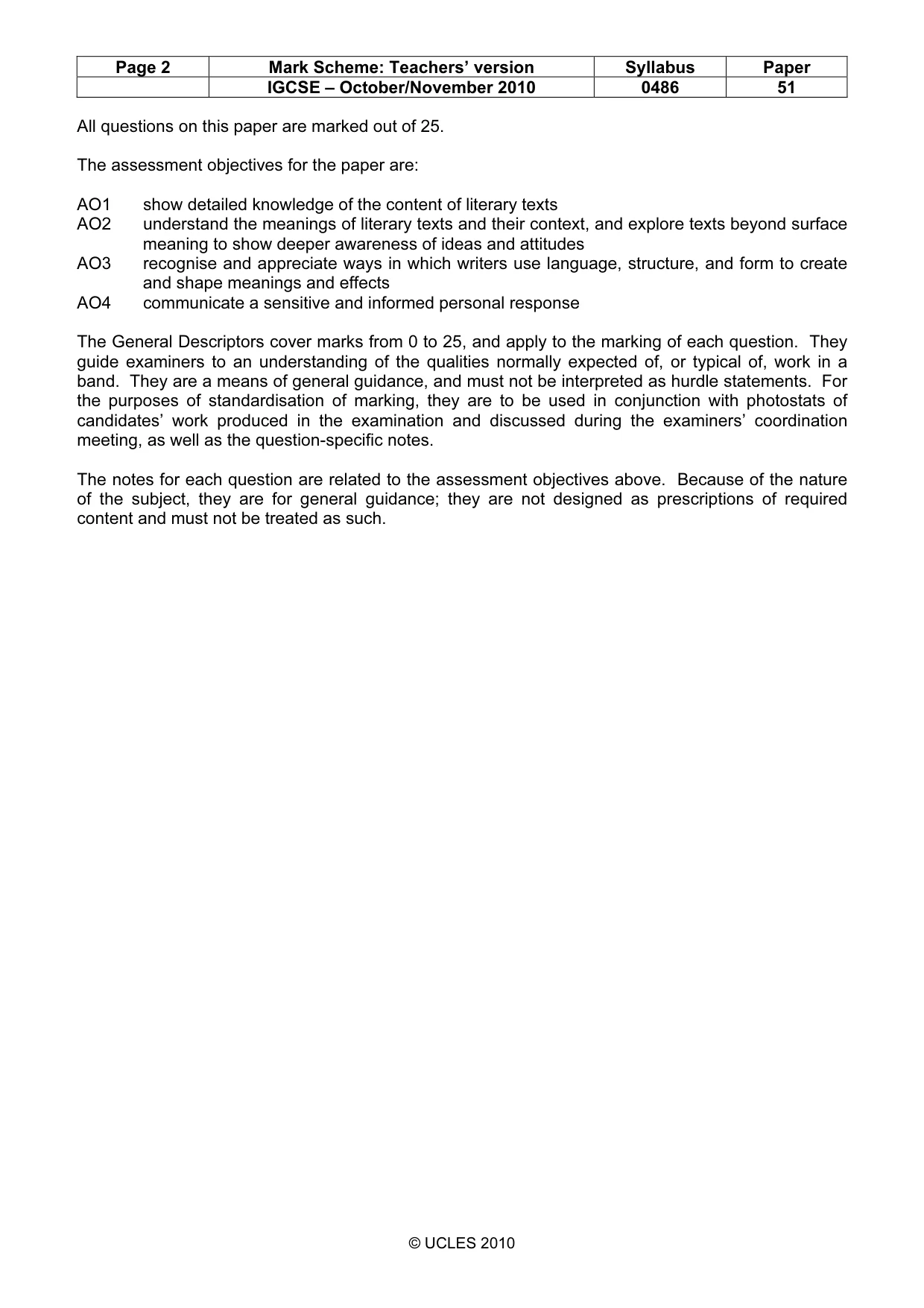
Page 2 Mark Scheme: Teachers’ version Syllabus Paper IGCSE – October/November 2010 0486 51 © UCLES 2010 All questions on this paper are marked out of 25. The assessment objectives for the paper are: AO1 show detailed knowledge of the content of literary texts AO2 understand the meanings of literary texts and their context, and explore texts beyond surface meaning to show deeper awareness of ideas and attitudes AO3 recognise and appreciate ways in which writers use language, structure, and form to create and shape meanings and effects AO4 communicate a sensitive and informed personal response The General Descriptors cover marks from 0 to 25, and apply to the marking of each question. They guide examiners to an understanding of the qualities normally expected of, or typical of, work in a band. They are a means of general guidance, and must not be interpreted as hurdle statements. For the purposes of standardisation of marking, they are to be used in conjunction with photostats of candidates’ work produced in the examination and discussed during the examiners’ coordination meeting, as well as the question-specific notes. The notes for each question are related to the assessment objectives above. Because of the nature of the subject, they are for general guidance; they are not designed as prescriptions of required content and must not be treated as such.
Mark scheme, page 3
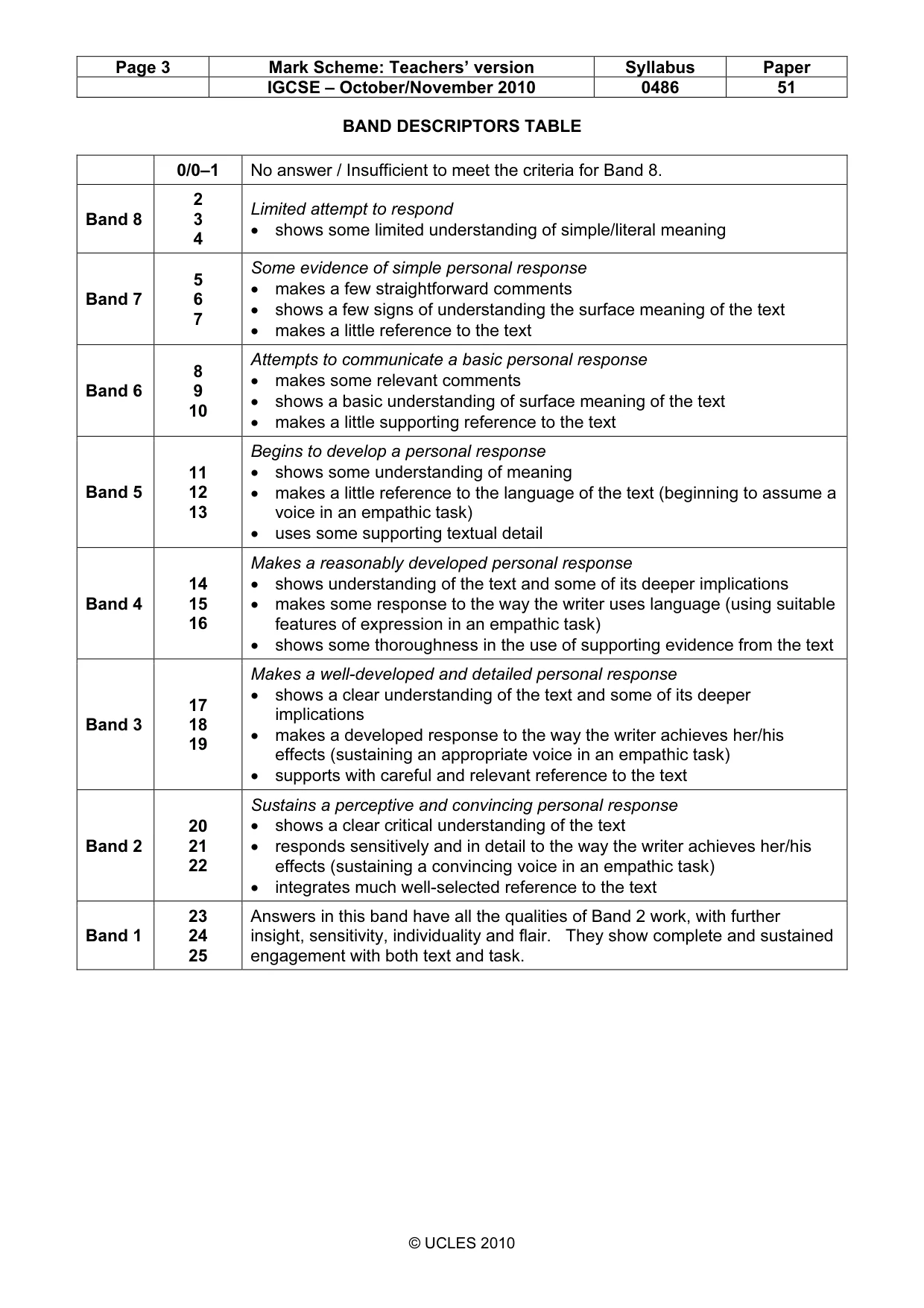
Page 3 Mark Scheme: Teachers’ version Syllabus Paper IGCSE – October/November 2010 0486 51 © UCLES 2010 BAND DESCRIPTORS TABLE 0/0–1 No answer / Insufficient to meet the criteria for Band 8. Band 8 2 3 4 Limited attempt to respond • shows some limited understanding of simple/literal meaning Band 7 5 6 7 Some evidence of simple personal response • makes a few straightforward comments • shows a few signs of understanding the surface meaning of the text • makes a little reference to the text Band 6 8 9 10 Attempts to communicate a basic personal response • makes some relevant comments • shows a basic understanding of surface meaning of the text • makes a little supporting reference to the text Band 5 11 12 13 Begins to develop a personal response • shows some understanding of meaning • makes a little reference to the language of the text (beginning to assume a voice in an empathic task) • uses some supporting textual detail Band 4 14 15 16 Makes a reasonably developed personal response • shows understanding of the text and some of its deeper implications • makes some response to the way the writer uses language (using suitable features of expression in an empathic task) • shows some thoroughness in the use of supporting evidence from the text Band 3 17 18 19 Makes a well-developed and detailed personal response • shows a clear understanding of the text and some of its deeper implications • makes a developed response to the way the writer achieves her/his effects (sustaining an appropriate voice in an empathic task) • supports with careful and relevant reference to the text Band 2 20 21 22 Sustains a perceptive and convincing personal response • shows a clear critical understanding of the text • responds sensitively and in detail to the way the writer achieves her/his effects (sustaining a convincing voice in an empathic task) • integrates much well-selected reference to the text Band 1 23 24 25 Answers in this band have all the qualities of Band 2 work, with further insight, sensitivity, individuality and flair. They show complete and sustained engagement with both text and task.
Mark scheme, page 4
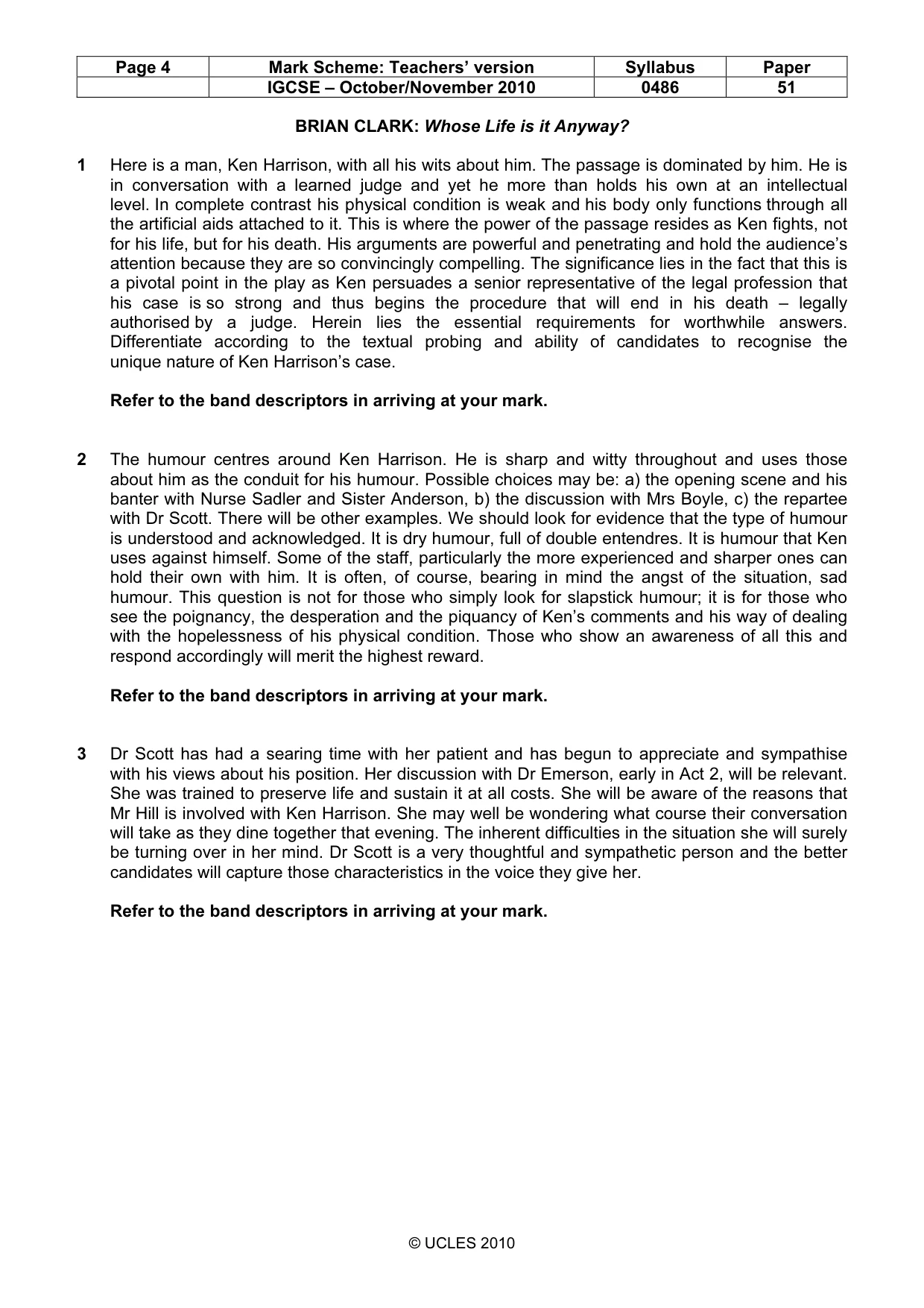
Page 4 Mark Scheme: Teachers’ version Syllabus Paper IGCSE – October/November 2010 0486 51 © UCLES 2010 BRIAN CLARK: Whose Life is it Anyway? 1 Here is a man, Ken Harrison, with all his wits about him. The passage is dominated by him. He is in conversation with a learned judge and yet he more than holds his own at an intellectual level. In complete contrast his physical condition is weak and his body only functions through all the artificial aids attached to it. This is where the power of the passage resides as Ken fights, not for his life, but for his death. His arguments are powerful and penetrating and hold the audience’s attention because they are so convincingly compelling. The significance lies in the fact that this is a pivotal point in the play as Ken persuades a senior representative of the legal profession that his case is so strong and thus begins the procedure that will end in his death – legally authorised by a judge. Herein lies the essential requirements for worthwhile answers. Differentiate according to the textual probing and ability of candidates to recognise the unique nature of Ken Harrison’s case. Refer to the band descriptors in arriving at your mark. 2 The humour centres around Ken Harrison. He is sharp and witty throughout and uses those about him as the conduit for his humour. Possible choices may be: a) the opening scene and his banter with Nurse Sadler and Sister Anderson, b) the discussion with Mrs Boyle, c) the repartee with Dr Scott. There will be other examples. We should look for evidence that the type of humour is understood and acknowledged. It is dry humour, full of double entendres. It is humour that Ken uses against himself. Some of the staff, particularly the more experienced and sharper ones can hold their own with him. It is often, of course, bearing in mind the angst of the situation, sad humour. This question is not for those who simply look for slapstick humour; it is for those who see the poignancy, the desperation and the piquancy of Ken’s comments and his way of dealing with the hopelessness of his physical condition. Those who show an awareness of all this and respond accordingly will merit the highest reward. Refer to the band descriptors in arriving at your mark. 3 Dr Scott has had a searing time with her patient and has begun to appreciate and sympathise with his views about his position. Her discussion with Dr Emerson, early in Act 2, will be relevant. She was trained to preserve life and sustain it at all costs. She will be aware of the reasons that Mr Hill is involved with Ken Harrison. She may well be wondering what course their conversation will take as they dine together that evening. The inherent difficulties in the situation she will surely be turning over in her mind. Dr Scott is a very thoughtful and sympathetic person and the better candidates will capture those characteristics in the voice they give her. Refer to the band descriptors in arriving at your mark.
Mark scheme, page 5
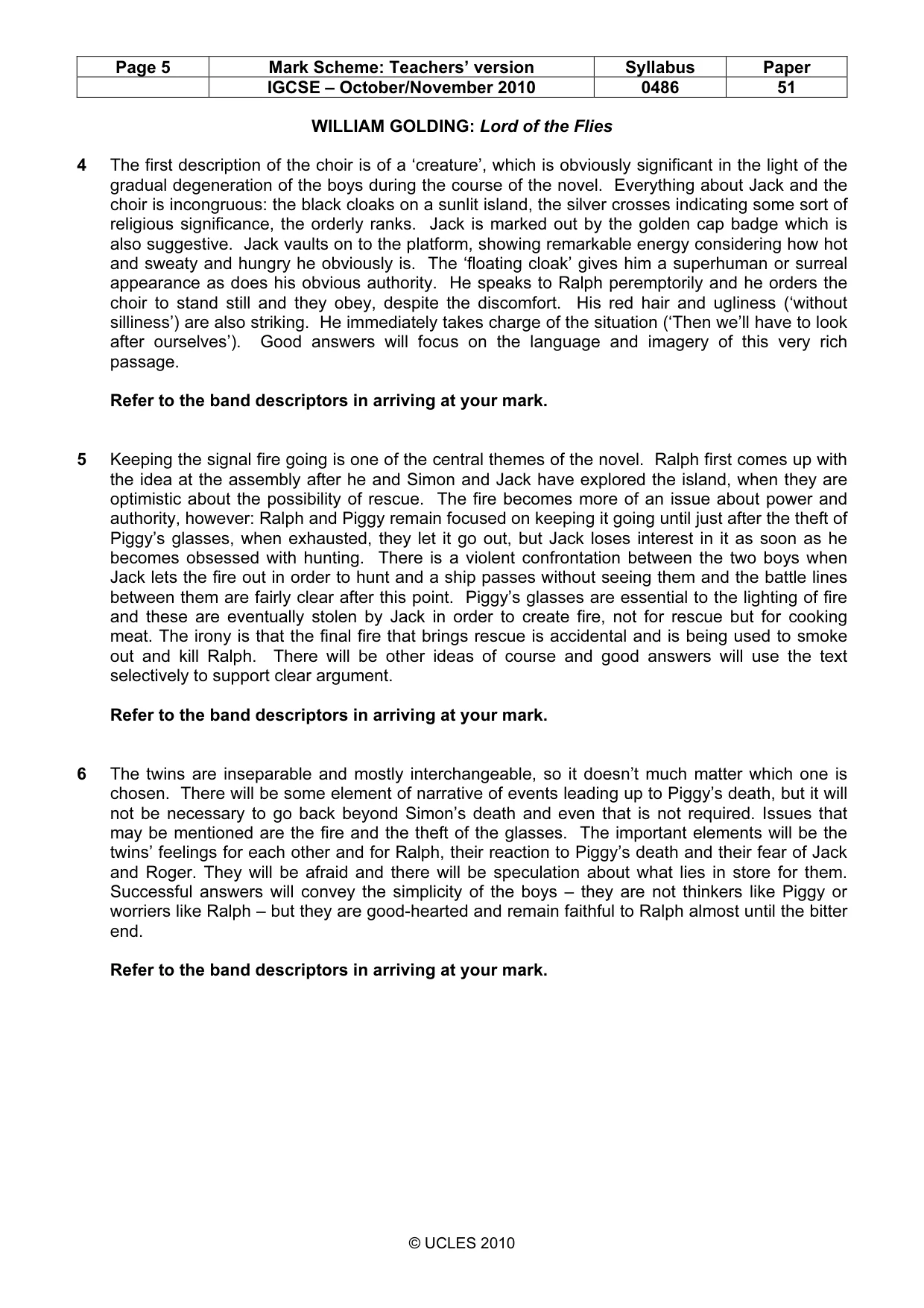
Page 5 Mark Scheme: Teachers’ version Syllabus Paper IGCSE – October/November 2010 0486 51 © UCLES 2010 WILLIAM GOLDING: Lord of the Flies 4 The first description of the choir is of a ‘creature’, which is obviously significant in the light of the gradual degeneration of the boys during the course of the novel. Everything about Jack and the choir is incongruous: the black cloaks on a sunlit island, the silver crosses indicating some sort of religious significance, the orderly ranks. Jack is marked out by the golden cap badge which is also suggestive. Jack vaults on to the platform, showing remarkable energy considering how hot and sweaty and hungry he obviously is. The ‘floating cloak’ gives him a superhuman or surreal appearance as does his obvious authority. He speaks to Ralph peremptorily and he orders the choir to stand still and they obey, despite the discomfort. His red hair and ugliness (‘without silliness’) are also striking. He immediately takes charge of the situation (‘Then we’ll have to look after ourselves’). Good answers will focus on the language and imagery of this very rich passage. Refer to the band descriptors in arriving at your mark. 5 Keeping the signal fire going is one of the central themes of the novel. Ralph first comes up with the idea at the assembly after he and Simon and Jack have explored the island, when they are optimistic about the possibility of rescue. The fire becomes more of an issue about power and authority, however: Ralph and Piggy remain focused on keeping it going until just after the theft of Piggy’s glasses, when exhausted, they let it go out, but Jack loses interest in it as soon as he becomes obsessed with hunting. There is a violent confrontation between the two boys when Jack lets the fire out in order to hunt and a ship passes without seeing them and the battle lines between them are fairly clear after this point. Piggy’s glasses are essential to the lighting of fire and these are eventually stolen by Jack in order to create fire, not for rescue but for cooking meat. The irony is that the final fire that brings rescue is accidental and is being used to smoke out and kill Ralph. There will be other ideas of course and good answers will use the text selectively to support clear argument. Refer to the band descriptors in arriving at your mark. 6 The twins are inseparable and mostly interchangeable, so it doesn’t much matter which one is chosen. There will be some element of narrative of events leading up to Piggy’s death, but it will not be necessary to go back beyond Simon’s death and even that is not required. Issues that may be mentioned are the fire and the theft of the glasses. The important elements will be the twins’ feelings for each other and for Ralph, their reaction to Piggy’s death and their fear of Jack and Roger. They will be afraid and there will be speculation about what lies in store for them. Successful answers will convey the simplicity of the boys – they are not thinkers like Piggy or worriers like Ralph – but they are good-hearted and remain faithful to Ralph almost until the bitter end. Refer to the band descriptors in arriving at your mark.
Mark scheme, page 6
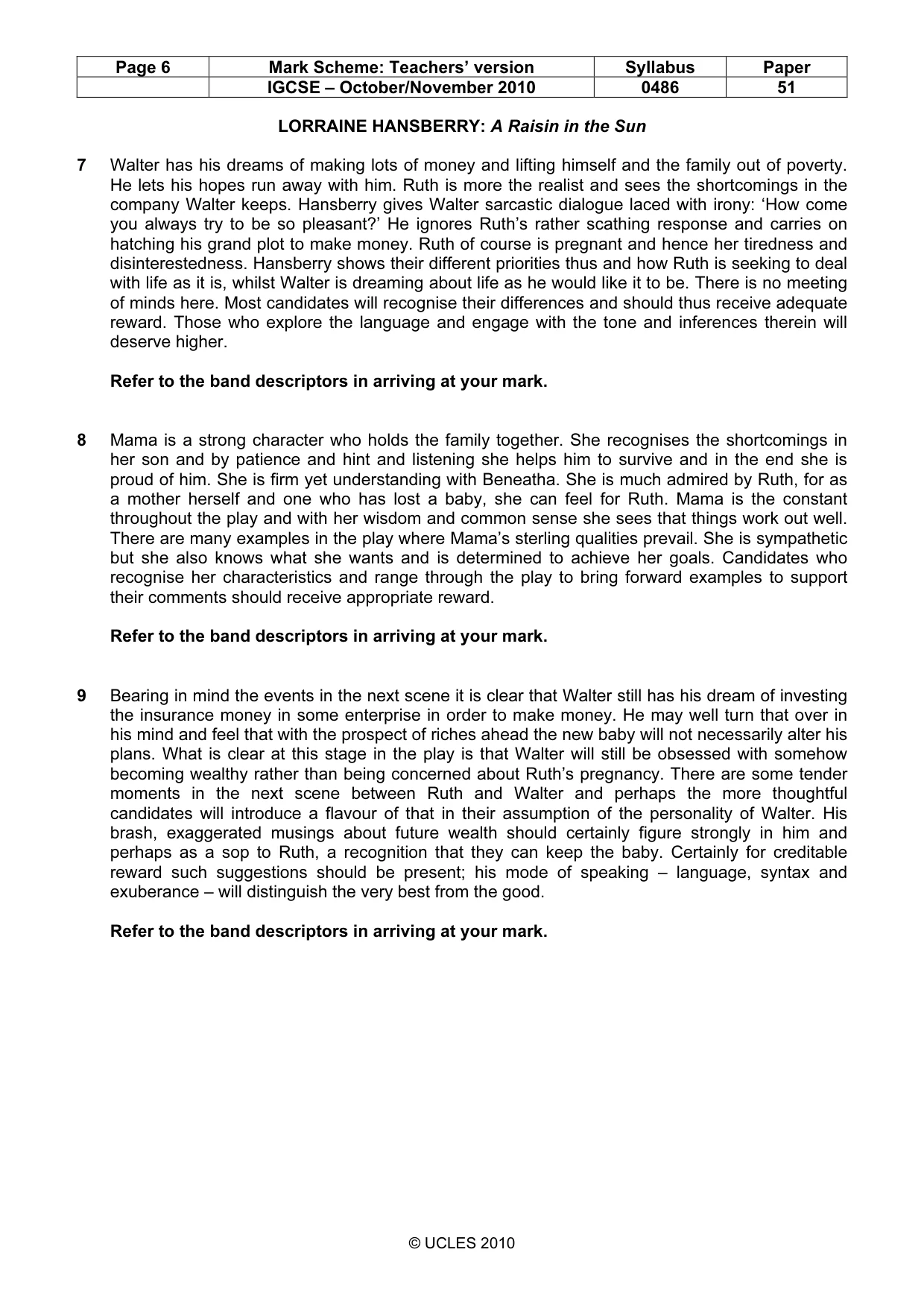
Page 6 Mark Scheme: Teachers’ version Syllabus Paper IGCSE – October/November 2010 0486 51 © UCLES 2010 LORRAINE HANSBERRY: A Raisin in the Sun 7 Walter has his dreams of making lots of money and lifting himself and the family out of poverty. He lets his hopes run away with him. Ruth is more the realist and sees the shortcomings in the company Walter keeps. Hansberry gives Walter sarcastic dialogue laced with irony: ‘How come you always try to be so pleasant?’ He ignores Ruth’s rather scathing response and carries on hatching his grand plot to make money. Ruth of course is pregnant and hence her tiredness and disinterestedness. Hansberry shows their different priorities thus and how Ruth is seeking to deal with life as it is, whilst Walter is dreaming about life as he would like it to be. There is no meeting of minds here. Most candidates will recognise their differences and should thus receive adequate reward. Those who explore the language and engage with the tone and inferences therein will deserve higher. Refer to the band descriptors in arriving at your mark. 8 Mama is a strong character who holds the family together. She recognises the shortcomings in her son and by patience and hint and listening she helps him to survive and in the end she is proud of him. She is firm yet understanding with Beneatha. She is much admired by Ruth, for as a mother herself and one who has lost a baby, she can feel for Ruth. Mama is the constant throughout the play and with her wisdom and common sense she sees that things work out well. There are many examples in the play where Mama’s sterling qualities prevail. She is sympathetic but she also knows what she wants and is determined to achieve her goals. Candidates who recognise her characteristics and range through the play to bring forward examples to support their comments should receive appropriate reward. Refer to the band descriptors in arriving at your mark. 9 Bearing in mind the events in the next scene it is clear that Walter still has his dream of investing the insurance money in some enterprise in order to make money. He may well turn that over in his mind and feel that with the prospect of riches ahead the new baby will not necessarily alter his plans. What is clear at this stage in the play is that Walter will still be obsessed with somehow becoming wealthy rather than being concerned about Ruth’s pregnancy. There are some tender moments in the next scene between Ruth and Walter and perhaps the more thoughtful candidates will introduce a flavour of that in their assumption of the personality of Walter. His brash, exaggerated musings about future wealth should certainly figure strongly in him and perhaps as a sop to Ruth, a recognition that they can keep the baby. Certainly for creditable reward such suggestions should be present; his mode of speaking – language, syntax and exuberance – will distinguish the very best from the good. Refer to the band descriptors in arriving at your mark.
Mark scheme, page 7
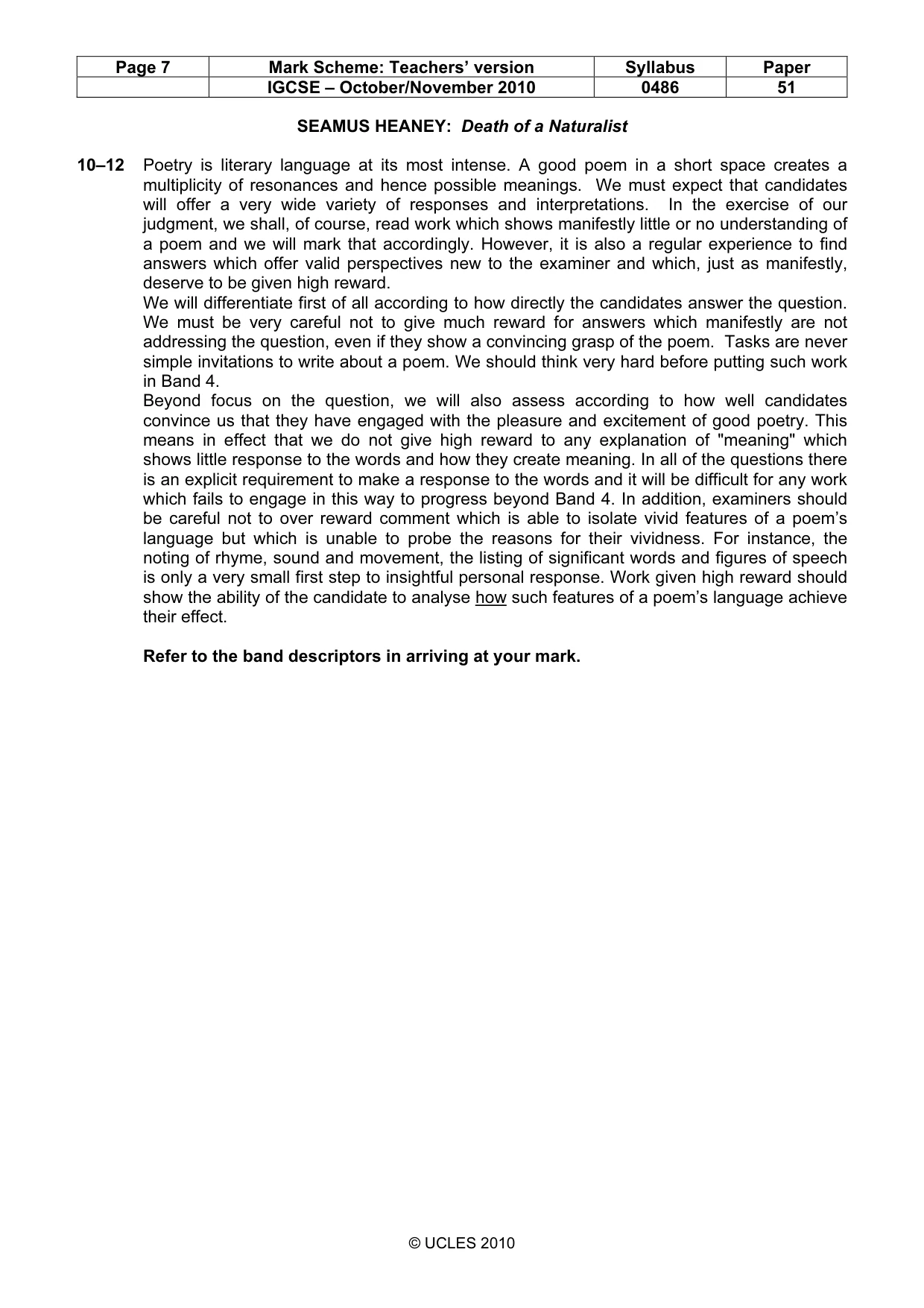
Page 7 Mark Scheme: Teachers’ version Syllabus Paper IGCSE – October/November 2010 0486 51 © UCLES 2010 SEAMUS HEANEY: Death of a Naturalist 10–12 Poetry is literary language at its most intense. A good poem in a short space creates a multiplicity of resonances and hence possible meanings. We must expect that candidates will offer a very wide variety of responses and interpretations. In the exercise of our judgment, we shall, of course, read work which shows manifestly little or no understanding of a poem and we will mark that accordingly. However, it is also a regular experience to find answers which offer valid perspectives new to the examiner and which, just as manifestly, deserve to be given high reward. We will differentiate first of all according to how directly the candidates answer the question. We must be very careful not to give much reward for answers which manifestly are not addressing the question, even if they show a convincing grasp of the poem. Tasks are never simple invitations to write about a poem. We should think very hard before putting such work in Band 4. Beyond focus on the question, we will also assess according to how well candidates convince us that they have engaged with the pleasure and excitement of good poetry. This means in effect that we do not give high reward to any explanation of "meaning" which shows little response to the words and how they create meaning. In all of the questions there is an explicit requirement to make a response to the words and it will be difficult for any work which fails to engage in this way to progress beyond Band 4. In addition, examiners should be careful not to over reward comment which is able to isolate vivid features of a poem’s language but which is unable to probe the reasons for their vividness. For instance, the noting of rhyme, sound and movement, the listing of significant words and figures of speech is only a very small first step to insightful personal response. Work given high reward should show the ability of the candidate to analyse how such features of a poem’s language achieve their effect. Refer to the band descriptors in arriving at your mark.
Mark scheme, page 8
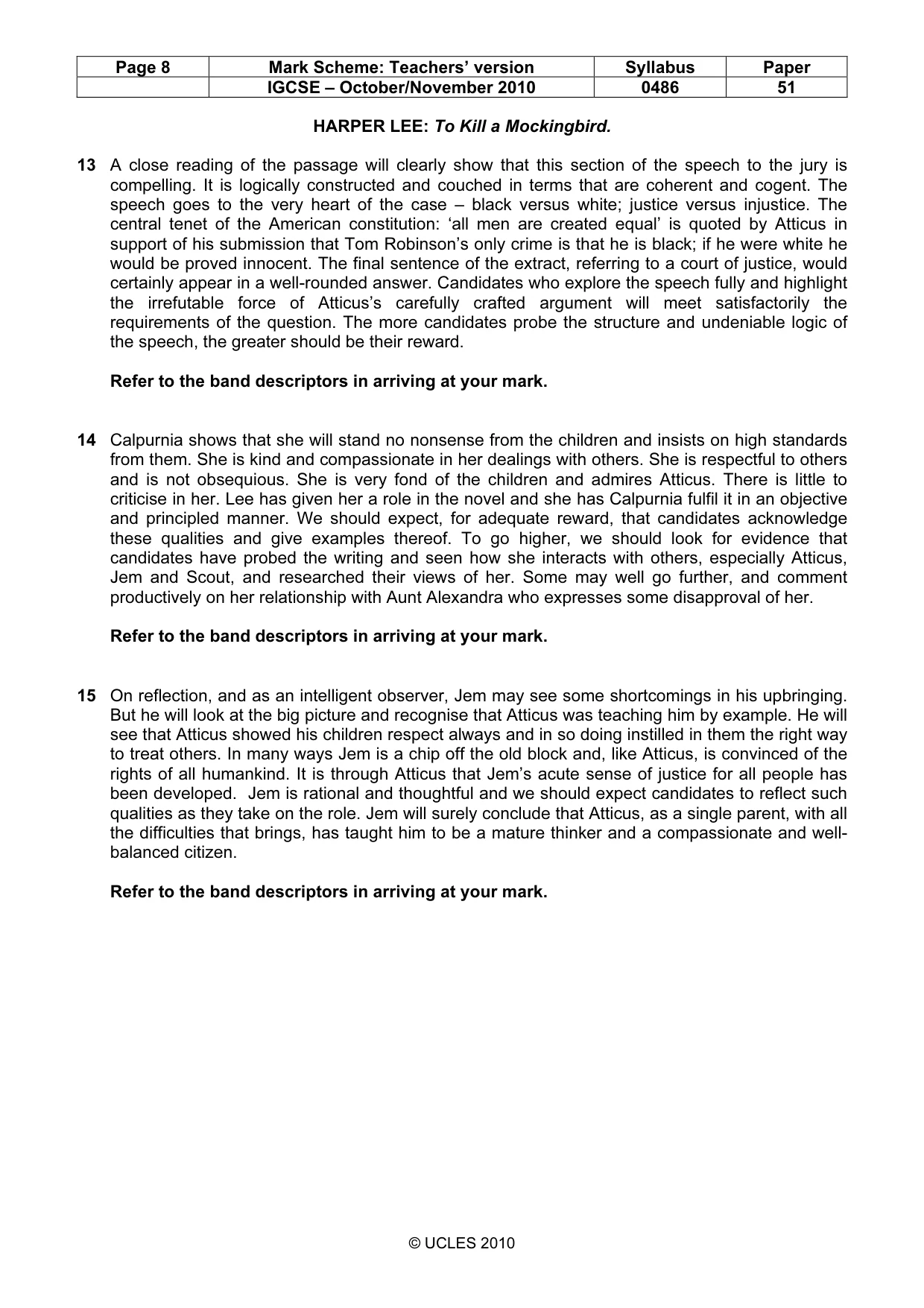
Page 8 Mark Scheme: Teachers’ version Syllabus Paper IGCSE – October/November 2010 0486 51 © UCLES 2010 HARPER LEE: To Kill a Mockingbird. 13 A close reading of the passage will clearly show that this section of the speech to the jury is compelling. It is logically constructed and couched in terms that are coherent and cogent. The speech goes to the very heart of the case – black versus white; justice versus injustice. The central tenet of the American constitution: ‘all men are created equal’ is quoted by Atticus in support of his submission that Tom Robinson’s only crime is that he is black; if he were white he would be proved innocent. The final sentence of the extract, referring to a court of justice, would certainly appear in a well-rounded answer. Candidates who explore the speech fully and highlight the irrefutable force of Atticus’s carefully crafted argument will meet satisfactorily the requirements of the question. The more candidates probe the structure and undeniable logic of the speech, the greater should be their reward. Refer to the band descriptors in arriving at your mark. 14 Calpurnia shows that she will stand no nonsense from the children and insists on high standards from them. She is kind and compassionate in her dealings with others. She is respectful to others and is not obsequious. She is very fond of the children and admires Atticus. There is little to criticise in her. Lee has given her a role in the novel and she has Calpurnia fulfil it in an objective and principled manner. We should expect, for adequate reward, that candidates acknowledge these qualities and give examples thereof. To go higher, we should look for evidence that candidates have probed the writing and seen how she interacts with others, especially Atticus, Jem and Scout, and researched their views of her. Some may well go further, and comment productively on her relationship with Aunt Alexandra who expresses some disapproval of her. Refer to the band descriptors in arriving at your mark. 15 On reflection, and as an intelligent observer, Jem may see some shortcomings in his upbringing. But he will look at the big picture and recognise that Atticus was teaching him by example. He will see that Atticus showed his children respect always and in so doing instilled in them the right way to treat others. In many ways Jem is a chip off the old block and, like Atticus, is convinced of the rights of all humankind. It is through Atticus that Jem’s acute sense of justice for all people has been developed. Jem is rational and thoughtful and we should expect candidates to reflect such qualities as they take on the role. Jem will surely conclude that Atticus, as a single parent, with all the difficulties that brings, has taught him to be a mature thinker and a compassionate and well- balanced citizen. Refer to the band descriptors in arriving at your mark.
Mark scheme, page 9
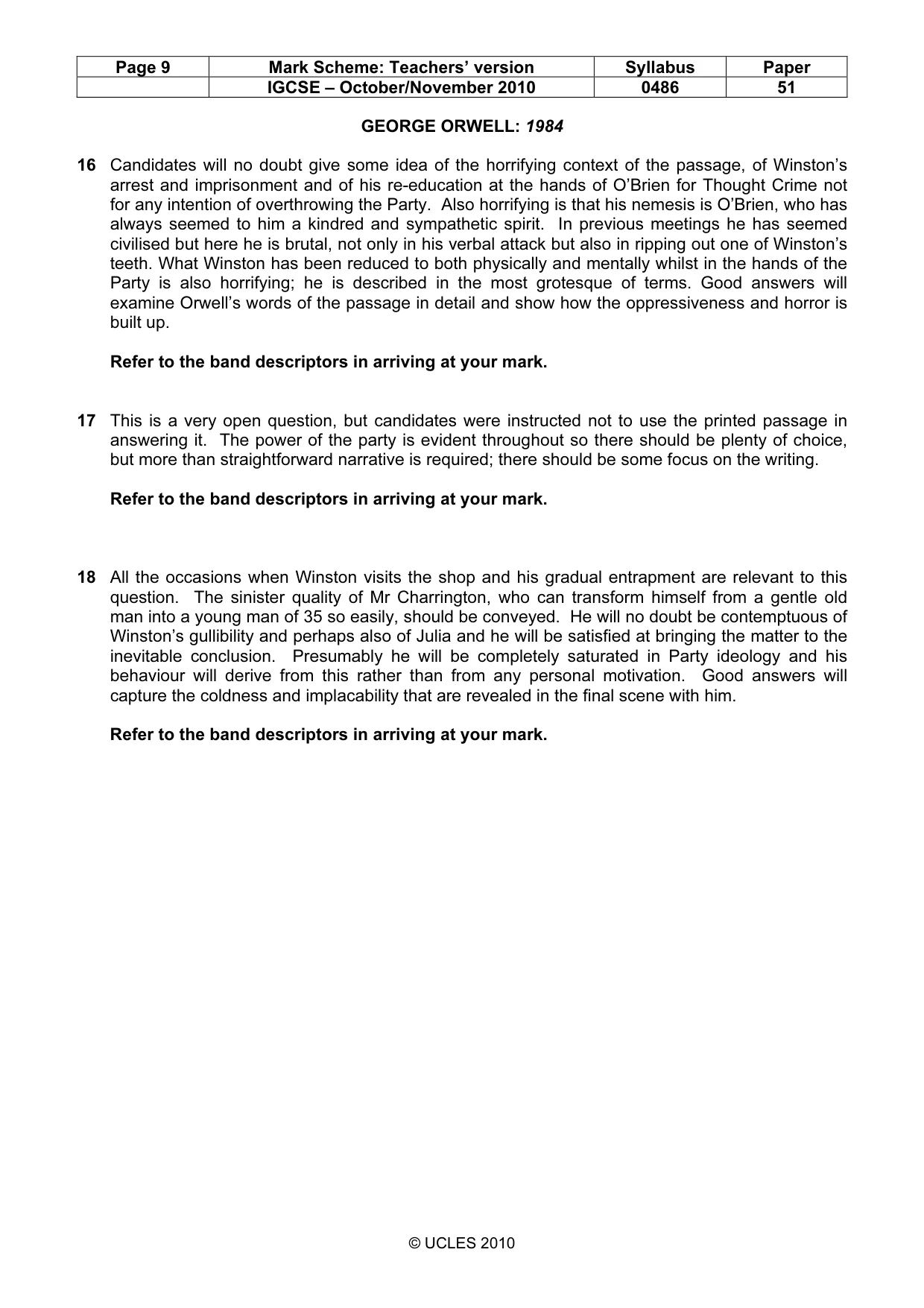
Page 9 Mark Scheme: Teachers’ version Syllabus Paper IGCSE – October/November 2010 0486 51 © UCLES 2010 GEORGE ORWELL: 1984 16 Candidates will no doubt give some idea of the horrifying context of the passage, of Winston’s arrest and imprisonment and of his re-education at the hands of O’Brien for Thought Crime not for any intention of overthrowing the Party. Also horrifying is that his nemesis is O’Brien, who has always seemed to him a kindred and sympathetic spirit. In previous meetings he has seemed civilised but here he is brutal, not only in his verbal attack but also in ripping out one of Winston’s teeth. What Winston has been reduced to both physically and mentally whilst in the hands of the Party is also horrifying; he is described in the most grotesque of terms. Good answers will examine Orwell’s words of the passage in detail and show how the oppressiveness and horror is built up. Refer to the band descriptors in arriving at your mark. 17 This is a very open question, but candidates were instructed not to use the printed passage in answering it. The power of the party is evident throughout so there should be plenty of choice, but more than straightforward narrative is required; there should be some focus on the writing. Refer to the band descriptors in arriving at your mark. 18 All the occasions when Winston visits the shop and his gradual entrapment are relevant to this question. The sinister quality of Mr Charrington, who can transform himself from a gentle old man into a young man of 35 so easily, should be conveyed. He will no doubt be contemptuous of Winston’s gullibility and perhaps also of Julia and he will be satisfied at bringing the matter to the inevitable conclusion. Presumably he will be completely saturated in Party ideology and his behaviour will derive from this rather than from any personal motivation. Good answers will capture the coldness and implacability that are revealed in the final scene with him. Refer to the band descriptors in arriving at your mark.
Mark scheme, page 10
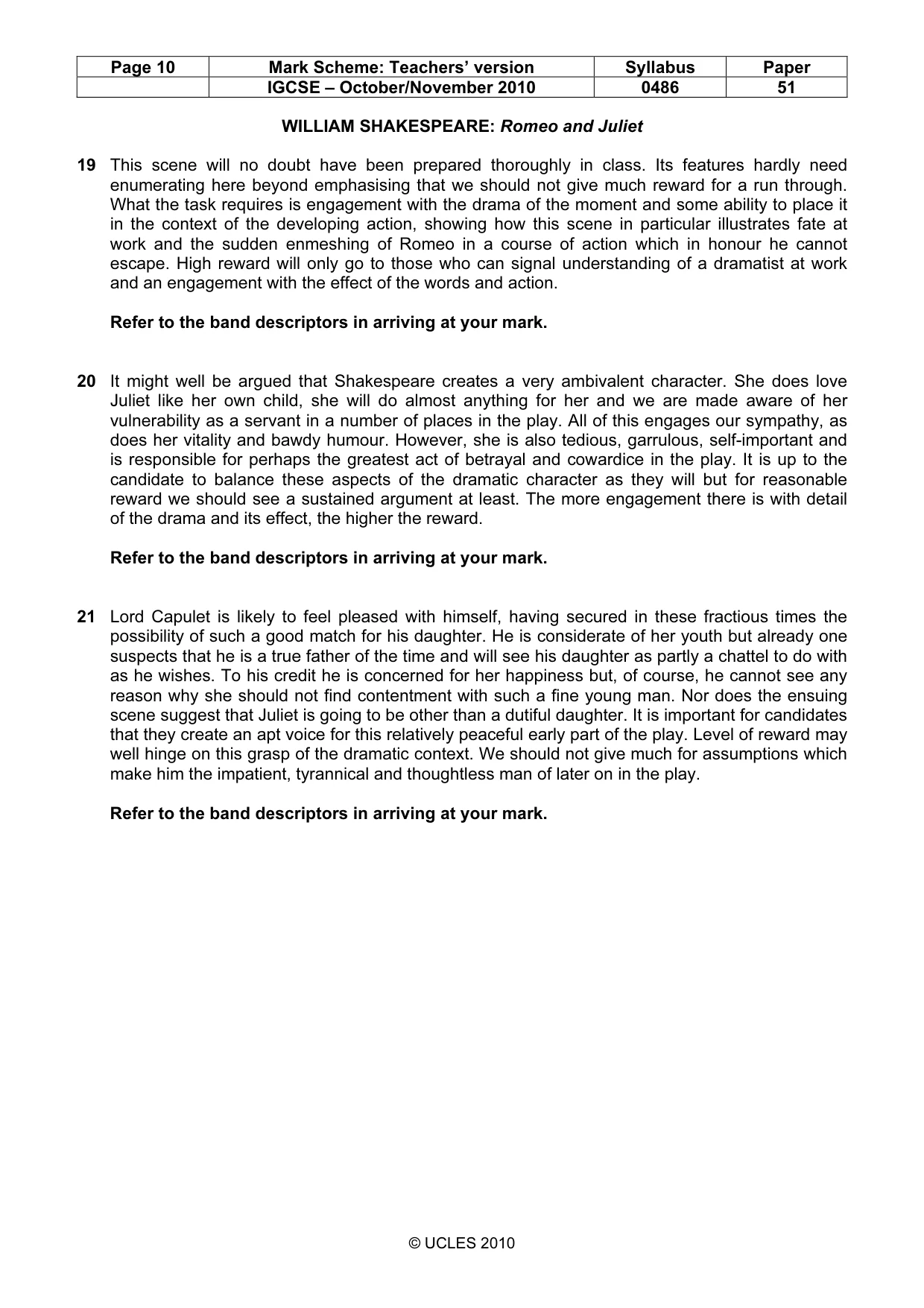
Page 10 Mark Scheme: Teachers’ version Syllabus Paper IGCSE – October/November 2010 0486 51 © UCLES 2010 WILLIAM SHAKESPEARE: Romeo and Juliet 19 This scene will no doubt have been prepared thoroughly in class. Its features hardly need enumerating here beyond emphasising that we should not give much reward for a run through. What the task requires is engagement with the drama of the moment and some ability to place it in the context of the developing action, showing how this scene in particular illustrates fate at work and the sudden enmeshing of Romeo in a course of action which in honour he cannot escape. High reward will only go to those who can signal understanding of a dramatist at work and an engagement with the effect of the words and action. Refer to the band descriptors in arriving at your mark. 20 It might well be argued that Shakespeare creates a very ambivalent character. She does love Juliet like her own child, she will do almost anything for her and we are made aware of her vulnerability as a servant in a number of places in the play. All of this engages our sympathy, as does her vitality and bawdy humour. However, she is also tedious, garrulous, self-important and is responsible for perhaps the greatest act of betrayal and cowardice in the play. It is up to the candidate to balance these aspects of the dramatic character as they will but for reasonable reward we should see a sustained argument at least. The more engagement there is with detail of the drama and its effect, the higher the reward. Refer to the band descriptors in arriving at your mark. 21 Lord Capulet is likely to feel pleased with himself, having secured in these fractious times the possibility of such a good match for his daughter. He is considerate of her youth but already one suspects that he is a true father of the time and will see his daughter as partly a chattel to do with as he wishes. To his credit he is concerned for her happiness but, of course, he cannot see any reason why she should not find contentment with such a fine young man. Nor does the ensuing scene suggest that Juliet is going to be other than a dutiful daughter. It is important for candidates that they create an apt voice for this relatively peaceful early part of the play. Level of reward may well hinge on this grasp of the dramatic context. We should not give much for assumptions which make him the impatient, tyrannical and thoughtless man of later on in the play. Refer to the band descriptors in arriving at your mark.
What you needed in this session
Cambridge’s own grade thresholds for 2010 Oct/Nov, Paper 5 · Variant 1. A higher threshold means an easier paper — the bar moves with how the cohort did.