Cambridge IGCSE English - Literature 0486 — 2013 May/June Paper 5 · Variant 3
0486/53/M/J/13
The question paper and its mark scheme, free to read here and free to download. This is Cambridge’s own paper, exactly as it was sat.
Question paper16 pages


Mark scheme3 pages
Answers below. Sit the paper first if you are practising.
Paper as text
Question paper, page 1
This document consists of 13 printed pages and 3 blank pages. DC (SJF) 86424 © UCLES 2013 [Turn over UNIVERSITY OF CAMBRIDGE INTERNATIONAL EXAMINATIONS International General Certificate of Secondary Education * 5 6 1 4 9 1 5 5 2 7 * LITERATURE (ENGLISH) 0486/53 Paper 5 May/June 2013 45 minutes Additional Materials: Answer Booklet/Paper READ THESE INSTRUCTIONS FIRST If you have been given an Answer Booklet, follow the instructions on the front cover of the Booklet. Write your Centre number, candidate number and name on all the work you hand in. Write in dark blue or black pen. Do not use staples, paper clips, highlighters, glue or correction fluid. DO NOT WRITE IN ANY BARCODES. Answer one question. At the end of the examination, fasten all your work securely together. All questions in this paper carry equal marks. www.XtremePapers.com
Question paper, page 2
2 0486/53/M/J/13 © UCLES 2013 Answer one question on any text. MAYA ANGELOU: I Know Why The Caged Bird Sings Either 1 Read this extract, and then answer the question that follows it: The weeks until graduation were filled with heady activities. A group of small children were to be presented in a play about buttercups Content removed due to copyright restrictions.
Question paper, page 3
3 0486/53/M/J/13 © UCLES 2013 [Turn over I turned to ‘Annabel Lee’ and we walked up and down the garden rows, the cool dirt between our toes, reciting the beautifully sad lines. Explore the ways in which the writing conveys Maya’s excitement to you here. Or 2 How does Angelou make the relationship between Bailey and his mother so striking? Or 3 You are Mrs. Flowers after Maya’s visit. Write your thoughts. 50 Content removed due to copyright restrictions.
Question paper, page 4
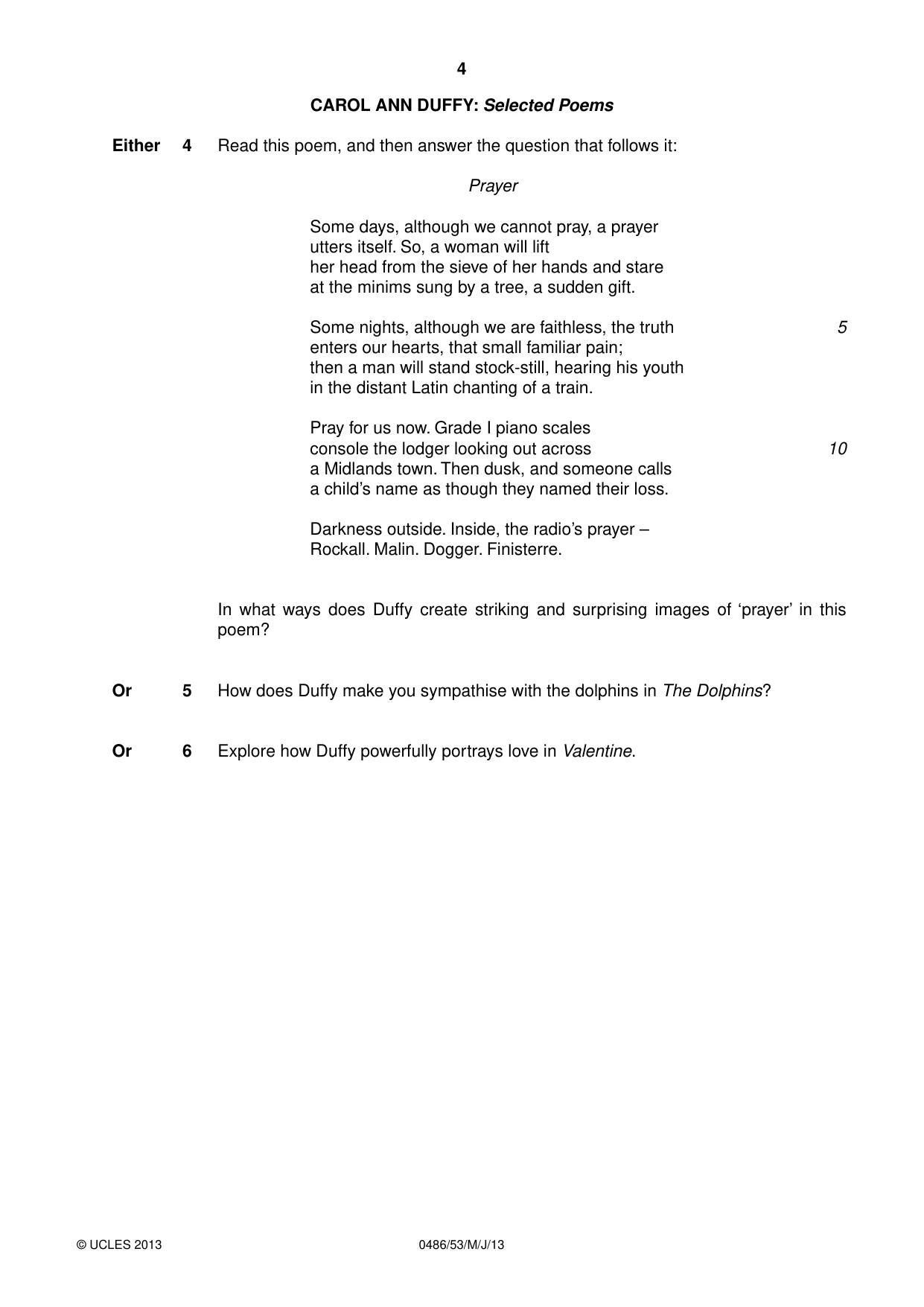
4 0486/53/M/J/13 © UCLES 2013 CAROL ANN DUFFY: Selected Poems Either 4 Read this poem, and then answer the question that follows it: Prayer Some days, although we cannot pray, a prayer utters itself. So, a woman will lift her head from the sieve of her hands and stare at the minims sung by a tree, a sudden gift. Some nights, although we are faithless, the truth enters our hearts, that small familiar pain; then a man will stand stock-still, hearing his youth in the distant Latin chanting of a train. Pray for us now. Grade I piano scales console the lodger looking out across a Midlands town. Then dusk, and someone calls a child’s name as though they named their loss. Darkness outside. Inside, the radio’s prayer – Rockall. Malin. Dogger. Finisterre. In what ways does Duffy create striking and surprising images of ‘prayer’ in this poem? Or 5 How does Duffy make you sympathise with the dolphins in The Dolphins? Or 6 Explore how Duffy powerfully portrays love in Valentine. 5 10
Question paper, page 5
5 0486/53/M/J/13 © UCLES 2013 [Turn over BLANK PAGE Turn to page 6 for Question 7.
Question paper, page 6
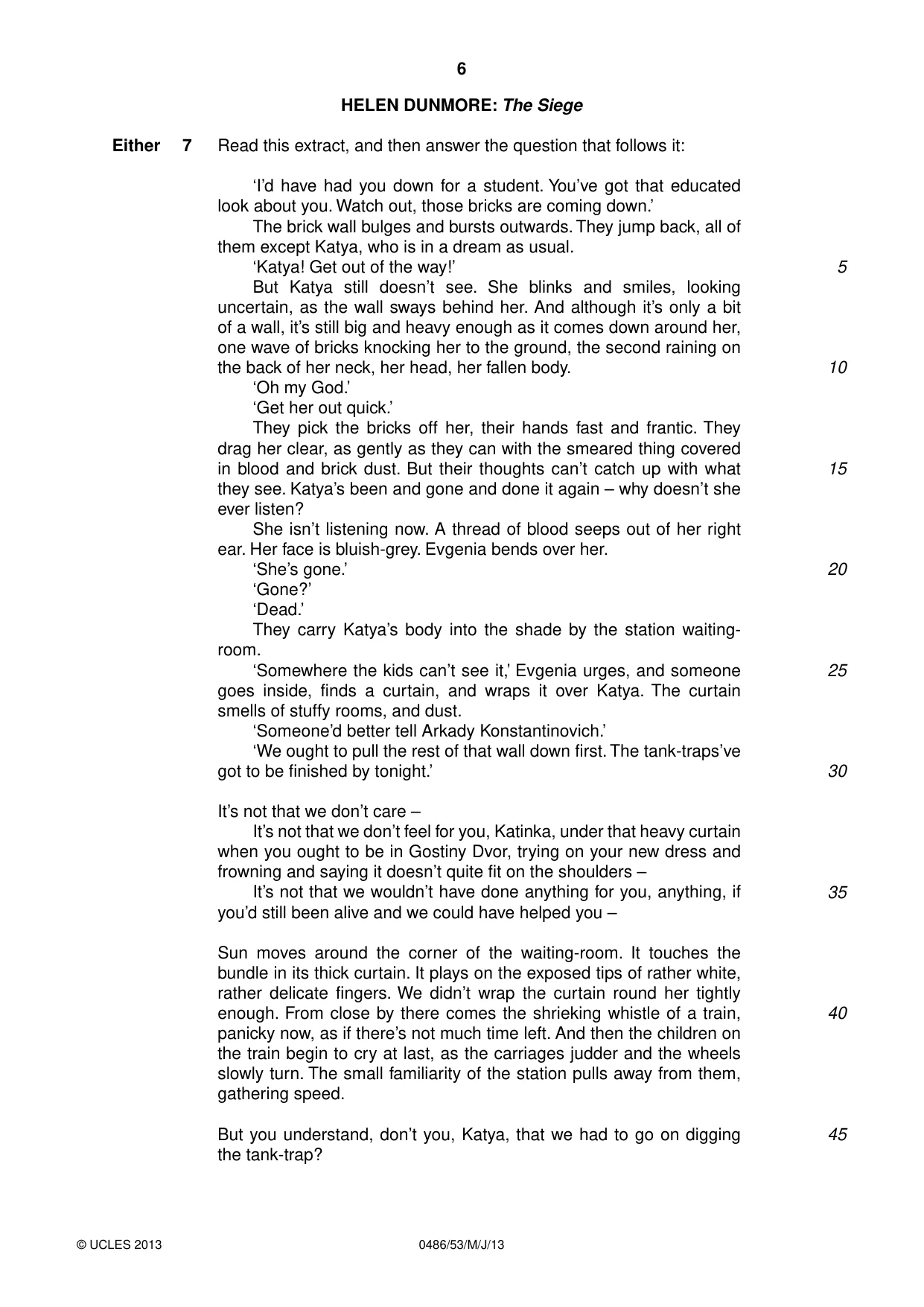
6 0486/53/M/J/13 © UCLES 2013 HELEN DUNMORE: The Siege Either 7 Read this extract, and then answer the question that follows it: ‘I’d have had you down for a student. You’ve got that educated look about you. Watch out, those bricks are coming down.’ The brick wall bulges and bursts outwards. They jump back, all of them except Katya, who is in a dream as usual. ‘Katya! Get out of the way!’ But Katya still doesn’t see. She blinks and smiles, looking uncertain, as the wall sways behind her. And although it’s only a bit of a wall, it’s still big and heavy enough as it comes down around her, one wave of bricks knocking her to the ground, the second raining on the back of her neck, her head, her fallen body. ‘Oh my God.’ ‘Get her out quick.’ They pick the bricks off her, their hands fast and frantic. They drag her clear, as gently as they can with the smeared thing covered in blood and brick dust. But their thoughts can’t catch up with what they see. Katya’s been and gone and done it again – why doesn’t she ever listen? She isn’t listening now. A thread of blood seeps out of her right ear. Her face is bluish-grey. Evgenia bends over her. ‘She’s gone.’ ‘Gone?’ ‘Dead.’ They carry Katya’s body into the shade by the station waiting- room. ‘Somewhere the kids can’t see it,’ Evgenia urges, and someone goes inside, finds a curtain, and wraps it over Katya. The curtain smells of stuffy rooms, and dust. ‘Someone’d better tell Arkady Konstantinovich.’ ‘We ought to pull the rest of that wall down first. The tank-traps’ve got to be finished by tonight.’ It’s not that we don’t care – It’s not that we don’t feel for you, Katinka, under that heavy curtain when you ought to be in Gostiny Dvor, trying on your new dress and frowning and saying it doesn’t quite fit on the shoulders – It’s not that we wouldn’t have done anything for you, anything, if you’d still been alive and we could have helped you – Sun moves around the corner of the waiting-room. It touches the bundle in its thick curtain. It plays on the exposed tips of rather white, rather delicate fingers. We didn’t wrap the curtain round her tightly enough. From close by there comes the shrieking whistle of a train, panicky now, as if there’s not much time left. And then the children on the train begin to cry at last, as the carriages judder and the wheels slowly turn. The small familiarity of the station pulls away from them, gathering speed. But you understand, don’t you, Katya, that we had to go on digging the tank-trap? 5 10 15 20 25 30 35 40 45
Question paper, page 7
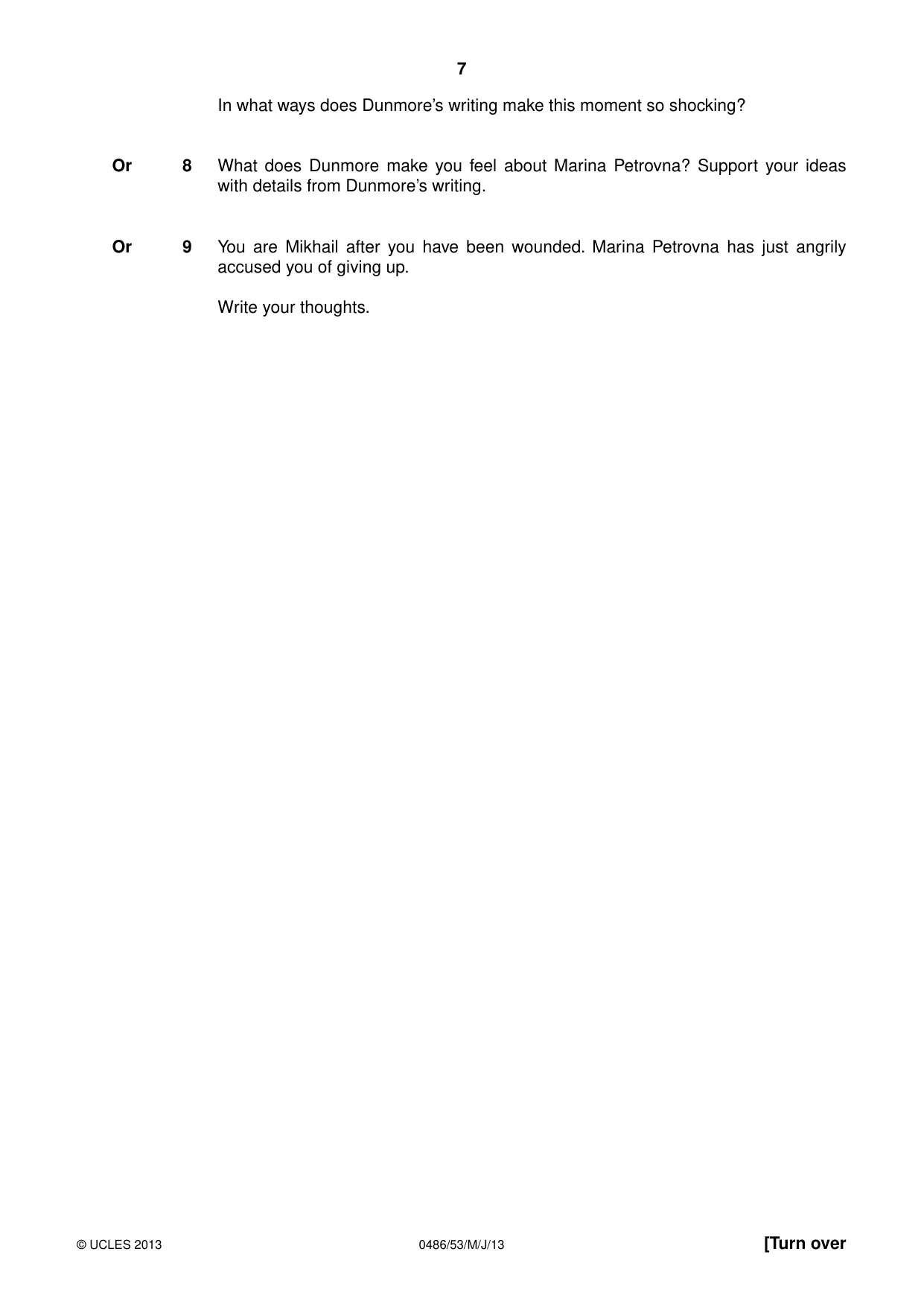
7 0486/53/M/J/13 © UCLES 2013 [Turn over In what ways does Dunmore’s writing make this moment so shocking? Or 8 What does Dunmore make you feel about Marina Petrovna? Support your ideas with details from Dunmore’s writing. Or 9 You are Mikhail after you have been wounded. Marina Petrovna has just angrily accused you of giving up. Write your thoughts.
Question paper, page 8
8 0486/53/M/J/13 © UCLES 2013 ALDOUS HUXLEY: Brave New World Either 10 Read this extract, and then answer the question that follows it: On their way back across the Channel, Bernard insisted on stopping his propeller and hovering on his helicopter screws within a hundred feet of the waves. The weather had taken a change for the Content removed due to copyright restrictions.
Question paper, page 9
9 0486/53/M/J/13 © UCLES 2013 [Turn over Don’t you understand that?’ Explore how Huxley strikingly presents the feelings of Bernard and Lenina here. Or 11 In what ways does Huxley make Helmholtz Watson such a memorable character in the novel? Or 12 You are Linda. The women on the reservation have just whipped you for your behaviour with their men. Write your thoughts. 50 Content removed due to copyright restrictions.
Question paper, page 10
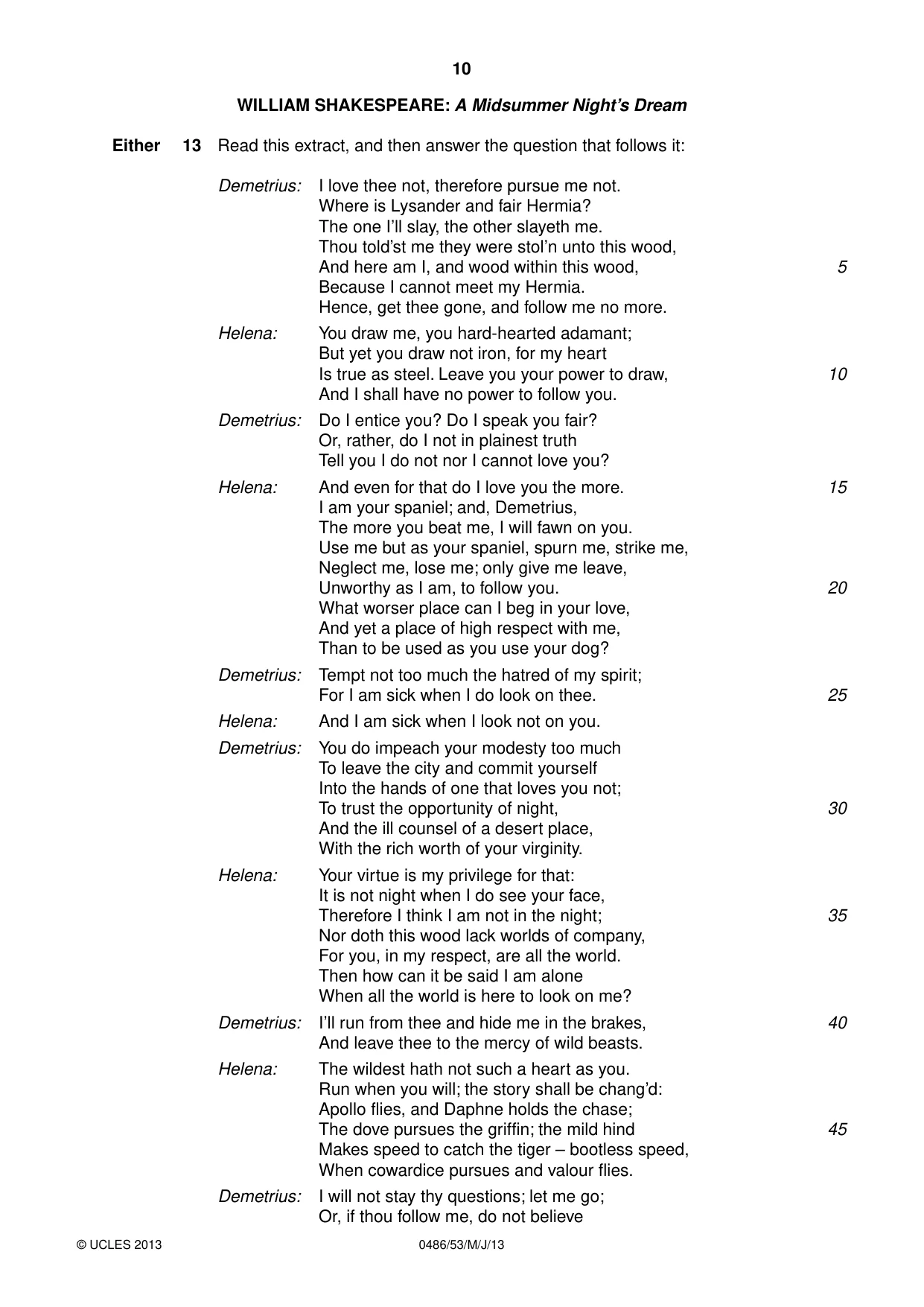
10 0486/53/M/J/13 © UCLES 2013 WILLIAM SHAKESPEARE: A Midsummer Night’s Dream Either 13 Read this extract, and then answer the question that follows it: Demetrius: I love thee not, therefore pursue me not. Where is Lysander and fair Hermia? The one I’ll slay, the other slayeth me. Thou told’st me they were stol’n unto this wood, And here am I, and wood within this wood, Because I cannot meet my Hermia. Hence, get thee gone, and follow me no more. Helena: You draw me, you hard-hearted adamant; But yet you draw not iron, for my heart Is true as steel. Leave you your power to draw, And I shall have no power to follow you. Demetrius: Do I entice you? Do I speak you fair? Or, rather, do I not in plainest truth Tell you I do not nor I cannot love you? Helena: And even for that do I love you the more. I am your spaniel; and, Demetrius, The more you beat me, I will fawn on you. Use me but as your spaniel, spurn me, strike me, Neglect me, lose me; only give me leave, Unworthy as I am, to follow you. What worser place can I beg in your love, And yet a place of high respect with me, Than to be used as you use your dog? Demetrius: Tempt not too much the hatred of my spirit; For I am sick when I do look on thee. Helena: And I am sick when I look not on you. Demetrius: You do impeach your modesty too much To leave the city and commit yourself Into the hands of one that loves you not; To trust the opportunity of night, And the ill counsel of a desert place, With the rich worth of your virginity. Helena: Your virtue is my privilege for that: It is not night when I do see your face, Therefore I think I am not in the night; Nor doth this wood lack worlds of company, For you, in my respect, are all the world. Then how can it be said I am alone When all the world is here to look on me? Demetrius: I’ll run from thee and hide me in the brakes, And leave thee to the mercy of wild beasts. Helena: The wildest hath not such a heart as you. Run when you will; the story shall be chang’d: Apollo flies, and Daphne holds the chase; The dove pursues the griffin; the mild hind Makes speed to catch the tiger – bootless speed, When cowardice pursues and valour flies. Demetrius: I will not stay thy questions; let me go; Or, if thou follow me, do not believe 5 10 15 20 25 30 35 40 45
Question paper, page 11
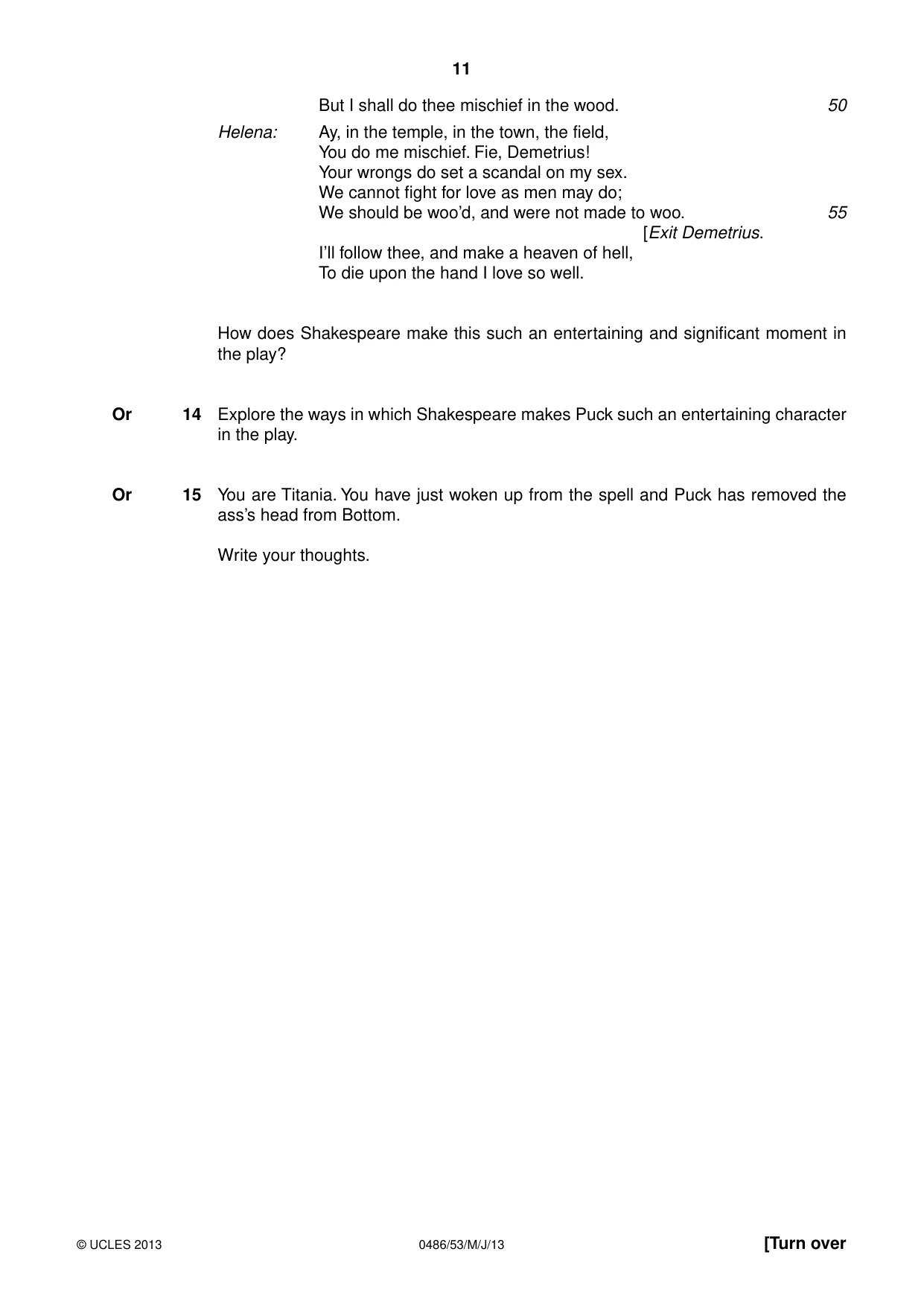
11 0486/53/M/J/13 © UCLES 2013 [Turn over But I shall do thee mischief in the wood. Helena: Ay, in the temple, in the town, the field, You do me mischief. Fie, Demetrius! Your wrongs do set a scandal on my sex. We cannot fight for love as men may do; We should be woo’d, and were not made to woo. [Exit Demetrius. I’ll follow thee, and make a heaven of hell, To die upon the hand I love so well. How does Shakespeare make this such an entertaining and significant moment in the play? Or 14 Explore the ways in which Shakespeare makes Puck such an entertaining character in the play. Or 15 You are Titania. You have just woken up from the spell and Puck has removed the ass’s head from Bottom. Write your thoughts. 50 55
Question paper, page 12
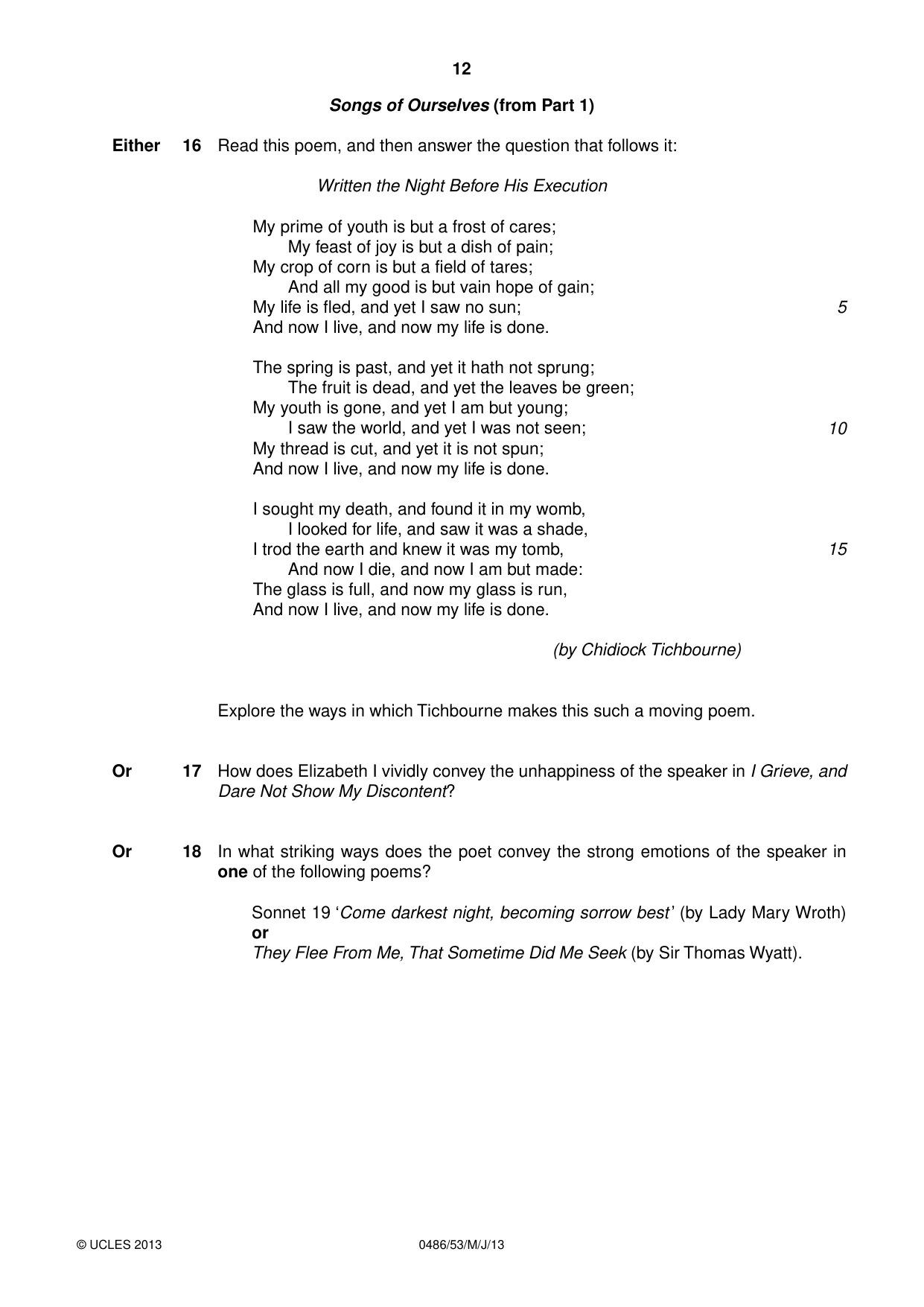
12 0486/53/M/J/13 © UCLES 2013 Songs of Ourselves (from Part 1) Either 16 Read this poem, and then answer the question that follows it: Written the Night Before His Execution My prime of youth is but a frost of cares; My feast of joy is but a dish of pain; My crop of corn is but a field of tares; And all my good is but vain hope of gain; My life is fled, and yet I saw no sun; And now I live, and now my life is done. The spring is past, and yet it hath not sprung; The fruit is dead, and yet the leaves be green; My youth is gone, and yet I am but young; I saw the world, and yet I was not seen; My thread is cut, and yet it is not spun; And now I live, and now my life is done. I sought my death, and found it in my womb, I looked for life, and saw it was a shade, I trod the earth and knew it was my tomb, And now I die, and now I am but made: The glass is full, and now my glass is run, And now I live, and now my life is done. (by Chidiock Tichbourne) Explore the ways in which Tichbourne makes this such a moving poem. Or 17 How does Elizabeth I vividly convey the unhappiness of the speaker in I Grieve, and Dare Not Show My Discontent? Or 18 In what striking ways does the poet convey the strong emotions of the speaker in one of the following poems? Sonnet 19 ‘Come darkest night, becoming sorrow best ’ (by Lady Mary Wroth) or They Flee From Me, That Sometime Did Me Seek (by Sir Thomas Wyatt). 5 10 15
Question paper, page 13
13 0486/53/M/J/13 © UCLES 2013 [Turn over BLANK PAGE Turn to page 14 for Question 19.
Question paper, page 14
14 0486/53/M/J/13 © UCLES 2013 TENNESSEE WILLIAMS: Cat on a Hot Tin Roof Either 19 Read this extract, and then answer the question that follows it: Margaret: I know! WHY! – am I so catty? – ’Cause I’m consumed Content removed due to copyright restrictions.
Question paper, page 15
15 0486/53/M/J/13 © UCLES 2013 mouth, then bursts into shrill, almost hysterical laughter. He remains grave for a moment, then grins and puts the chair down.] How does Williams dramatically convey the tension between Maggie and Brick here? Or 20 In what ways does Williams make Mae such a memorable character for you? Support your ideas by close reference to the play. Or 21 You are Brick. You are on the gallery on your own, after telling Big Daddy the truth about his cancer. Write your thoughts. 55 Content removed due to copyright restrictions.
Question paper, page 16
16 0486/53/M/J/13 © UCLES 2013 Copyright Acknowledgements: Question 1 © Maya Angelou; I Know Why The Caged Bird Sings; Copyright © 1969 and renewed 1997 by Maya Angelou. Published by Vintage. Reprinted by permission of Random House Inc. Question 4 © Prayer is taken from Stealing Manhattan by Carol Ann Duffy published by Anvil Press in 1987. Question 7 © Helen Dunmore; The Siege; Penguin Books Ltd; 2001. Question 10 © Brave New World by Aldous Huxley; Published by Chatto & Windus. Reprinted by permission of the Random House Group Ltd. Question 19 © Cat on a Hot Tin Roof by Tennessee Williams. Copyright © 1954, 1955, by The University of the South, renewed 1982, 1983 The University of the South. Reprinted by permission of New Directions Publishing Corp and Georges Borchardt, Inc. for the Estate of Tennessee Williams. Permission to reproduce items where third-party owned material protected by copyright is included has been sought and cleared where possible. Every reasonable effort has been made by the publisher (UCLES) to trace copyright holders, but if any items requiring clearance have unwittingly been included, the publisher will be pleased to make amends at the earliest possible opportunity. University of Cambridge International Examinations is part of the Cambridge Assessment Group. Cambridge Assessment is the brand name of University of Cambridge Local Examinations Syndicate (UCLES), which is itself a department of the University of Cambridge. BLANK PAGE
Mark scheme, page 1
CAMBRIDGE INTERNATIONAL EXAMINATIONS International General Certificate of Secondary Education MARK SCHEME for the May/June 2013 series 0486 LITERATURE (ENGLISH) 0486/53 Paper 5 (Set Texts: Closed Books B), maximum raw mark 25 This mark scheme is published as an aid to teachers and candidates, to indicate the requirements of the examination. It shows the basis on which Examiners were instructed to award marks. It does not indicate the details of the discussions that took place at an Examiners’ meeting before marking began, which would have considered the acceptability of alternative answers. Mark schemes should be read in conjunction with the question paper and the Principal Examiner Report for Teachers. Cambridge will not enter into discussions about these mark schemes. Cambridge is publishing the mark schemes for the May/June 2013 series for most IGCSE, GCE Advanced Level and Advanced Subsidiary Level components and some Ordinary Level components. www.XtremePapers.com
Mark scheme, page 2
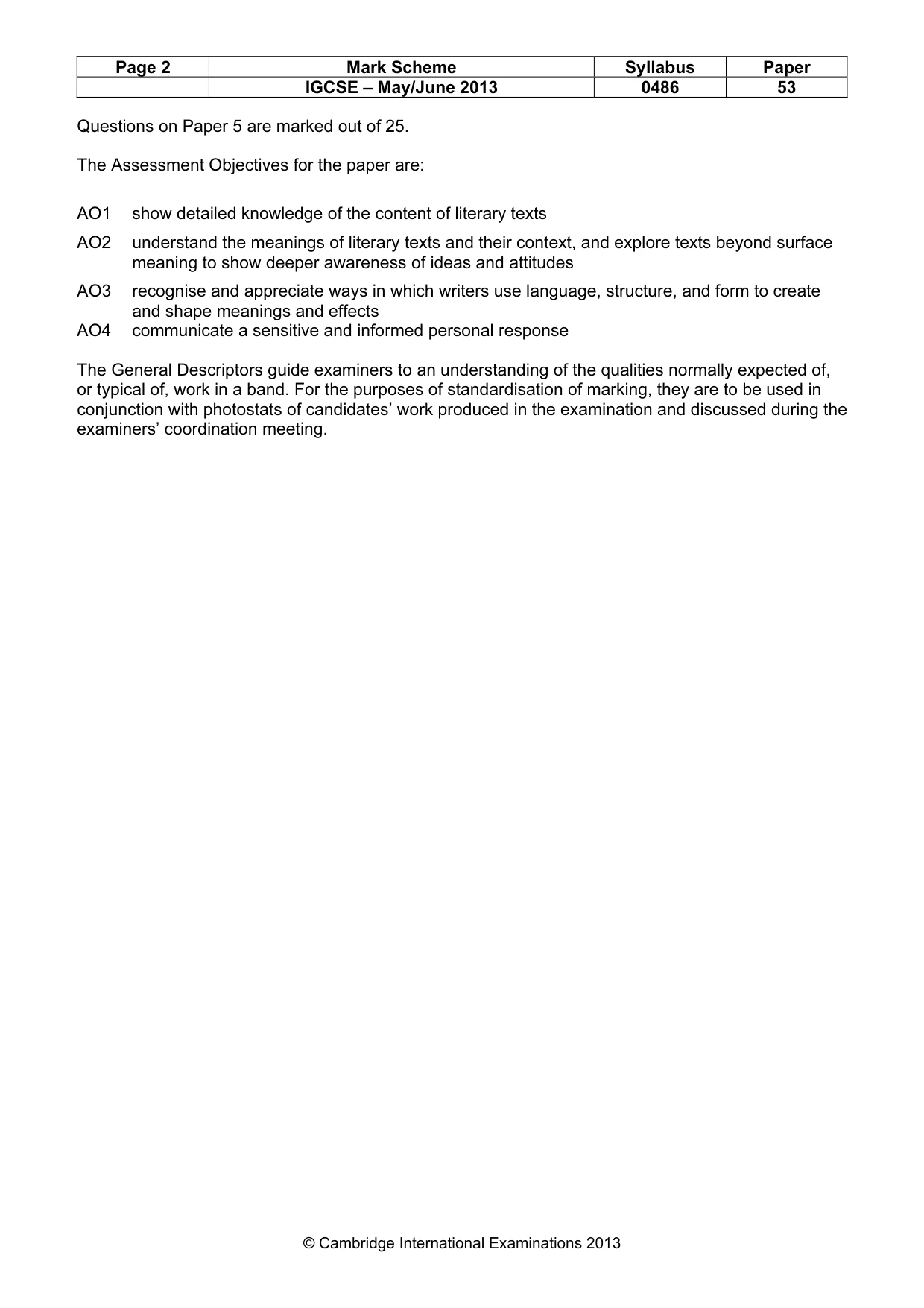
Page 2 Mark Scheme Syllabus Paper IGCSE – May/June 2013 0486 53 © Cambridge International Examinations 2013 Questions on Paper 5 are marked out of 25. The Assessment Objectives for the paper are: AO1 show detailed knowledge of the content of literary texts AO2 understand the meanings of literary texts and their context, and explore texts beyond surface meaning to show deeper awareness of ideas and attitudes AO3 recognise and appreciate ways in which writers use language, structure, and form to create and shape meanings and effects AO4 communicate a sensitive and informed personal response The General Descriptors guide examiners to an understanding of the qualities normally expected of, or typical of, work in a band. For the purposes of standardisation of marking, they are to be used in conjunction with photostats of candidates’ work produced in the examination and discussed during the examiners’ coordination meeting.
Mark scheme, page 3
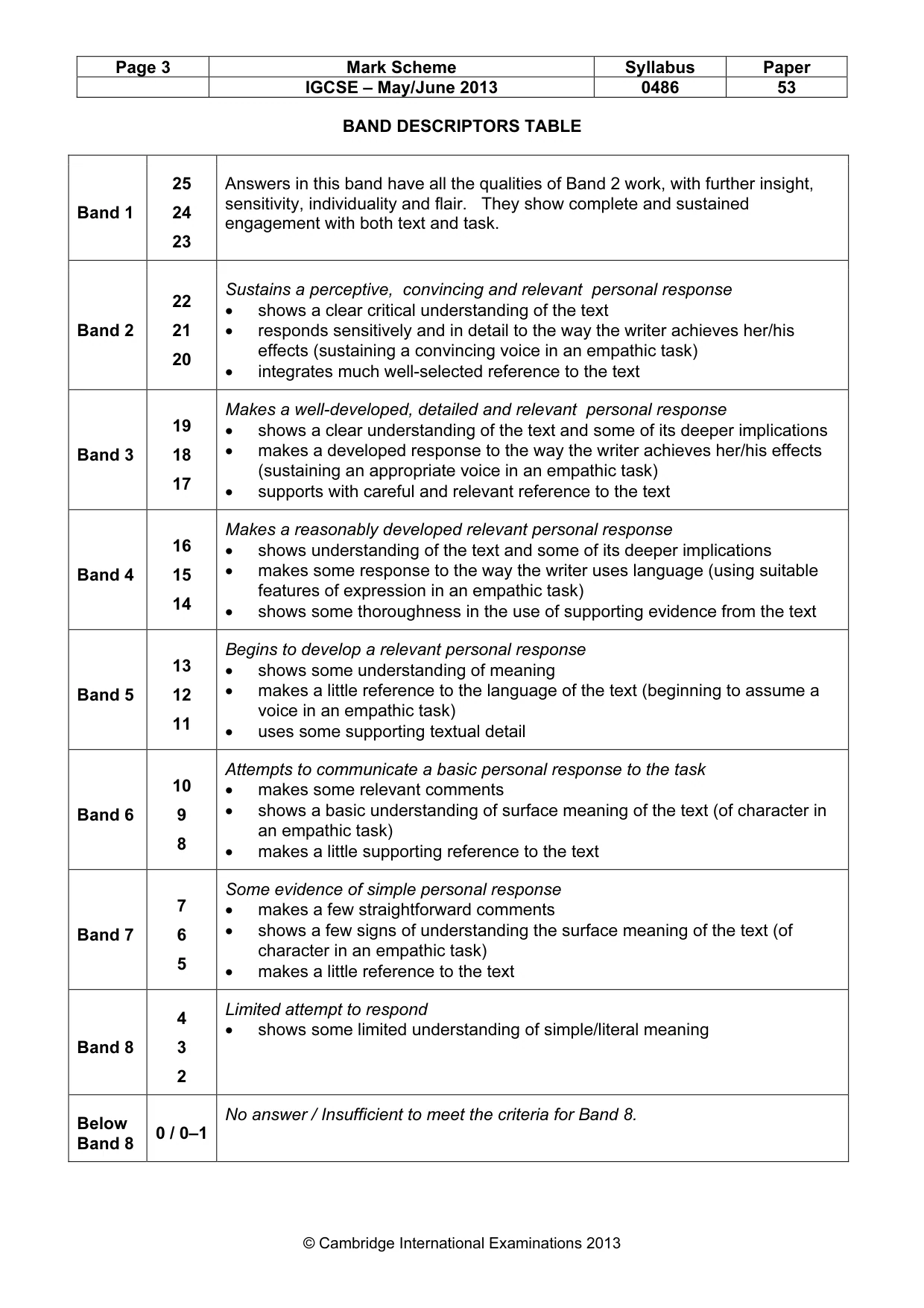
Page 3 Mark Scheme Syllabus Paper IGCSE – May/June 2013 0486 53 © Cambridge International Examinations 2013 BAND DESCRIPTORS TABLE Band 1 25 24 23 Answers in this band have all the qualities of Band 2 work, with further insight, sensitivity, individuality and flair. They show complete and sustained engagement with both text and task. Band 2 22 21 20 Sustains a perceptive, convincing and relevant personal response • shows a clear critical understanding of the text • responds sensitively and in detail to the way the writer achieves her/his effects (sustaining a convincing voice in an empathic task) • integrates much well-selected reference to the text Band 3 19 18 17 Makes a well-developed, detailed and relevant personal response • shows a clear understanding of the text and some of its deeper implications • makes a developed response to the way the writer achieves her/his effects (sustaining an appropriate voice in an empathic task) • supports with careful and relevant reference to the text Band 4 16 15 14 Makes a reasonably developed relevant personal response • shows understanding of the text and some of its deeper implications • makes some response to the way the writer uses language (using suitable features of expression in an empathic task) • shows some thoroughness in the use of supporting evidence from the text Band 5 13 12 11 Begins to develop a relevant personal response • shows some understanding of meaning • makes a little reference to the language of the text (beginning to assume a voice in an empathic task) • uses some supporting textual detail Band 6 10 9 8 Attempts to communicate a basic personal response to the task • makes some relevant comments • shows a basic understanding of surface meaning of the text (of character in an empathic task) • makes a little supporting reference to the text Band 7 7 6 5 Some evidence of simple personal response • makes a few straightforward comments • shows a few signs of understanding the surface meaning of the text (of character in an empathic task) • makes a little reference to the text Band 8 4 3 2 Limited attempt to respond • shows some limited understanding of simple/literal meaning Below Band 8 0 / 0–1 No answer / Insufficient to meet the criteria for Band 8.