Cambridge IGCSE English - Literature 0486 — 2012 May/June Paper 5 · Variant 3
0486/53/M/J/12 · 25 marks · ≈28 min
The question paper and its mark scheme, free to read here and free to download. This is Cambridge’s own paper, exactly as it was sat.
Question paper16 pages

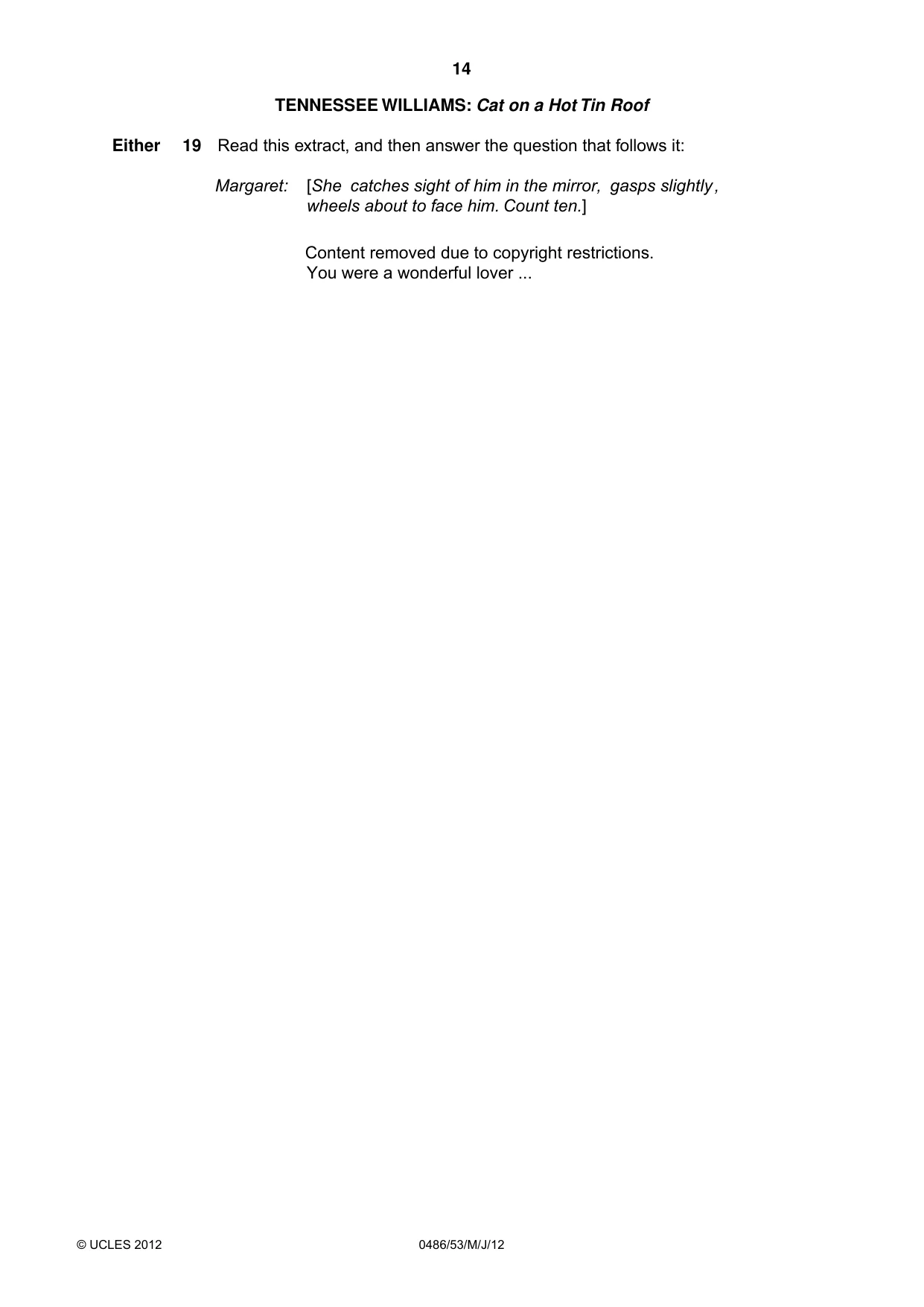
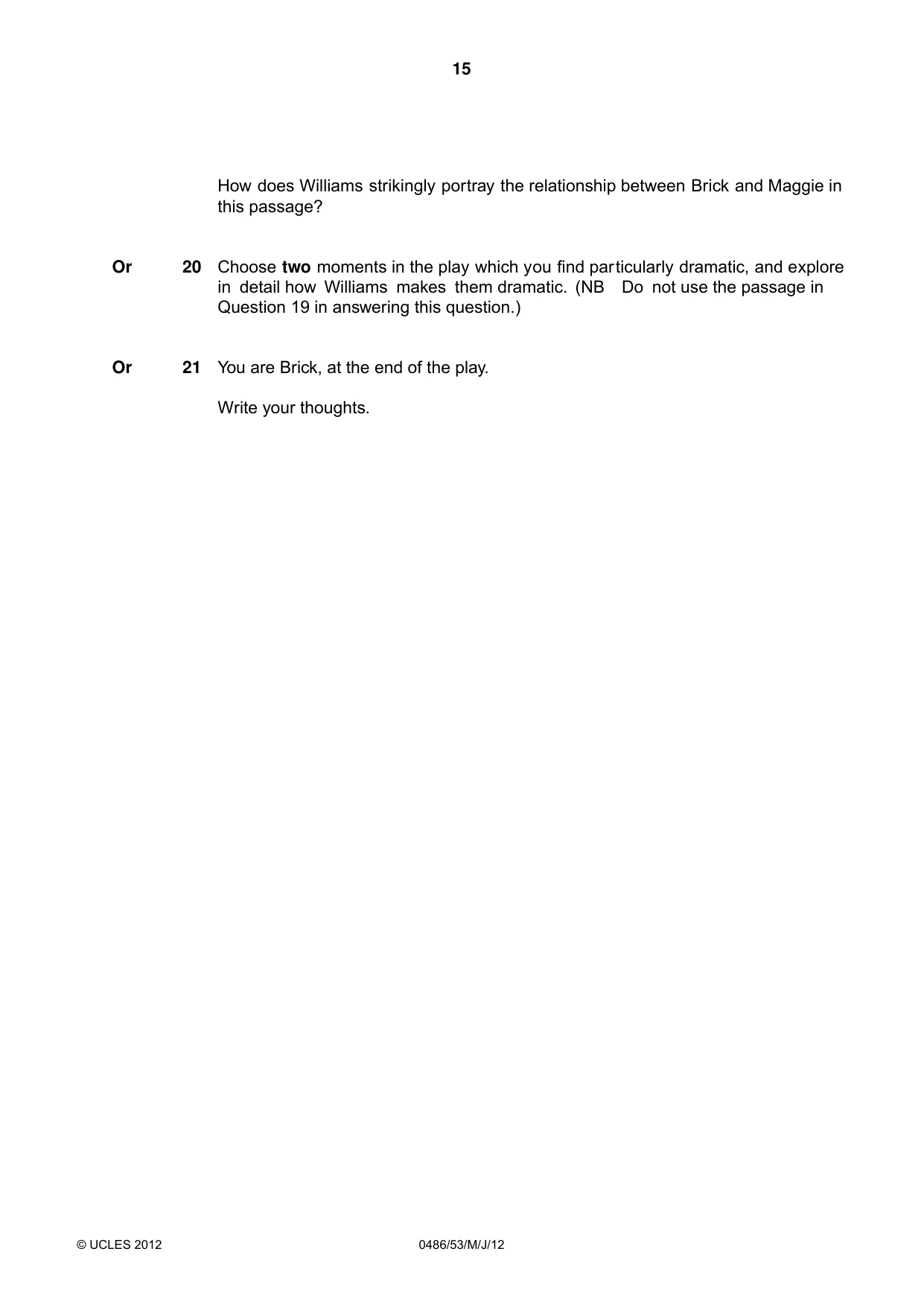
Mark scheme2 pages
Answers below. Sit the paper first if you are practising.
Paper as text
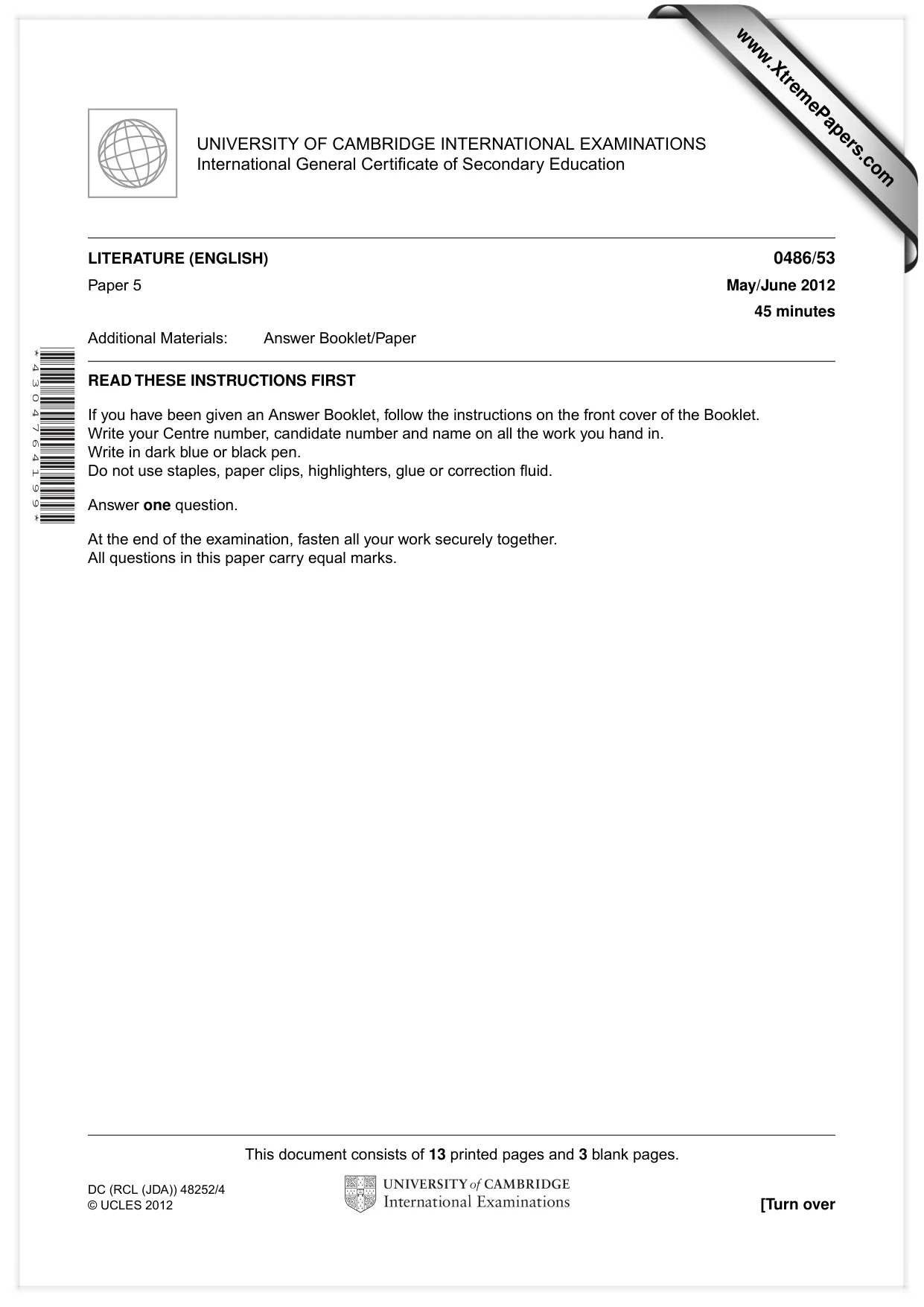
Question paper, page 1
This document consists of 13 printed pages and 3 blank pages. DC (RCL (JDA)) 48252/4 © UCLES 2012 [Turn over UNIVERSITY OF CAMBRIDGE INTERNATIONAL EXAMINATIONS International General Certificate of Secondary Education * 4 3 0 4 7 6 4 1 9 9 * LITERATURE (ENGLISH) 0486/53 Paper 5 May/June 2012 45 minutes Additional Materials: Answer Booklet/Paper READ THESE INSTRUCTIONS FIRST If you have been given an Answer Booklet, follow the instructions on the front cover of the Booklet. Write your Centre number, candidate number and name on all the work you hand in. Write in dark blue or black pen. Do not use staples, paper clips, highlighters, glue or correction fluid. Answer one question. At the end of the examination, fasten all your work securely together. All questions in this paper carry equal marks. www.XtremePapers.com
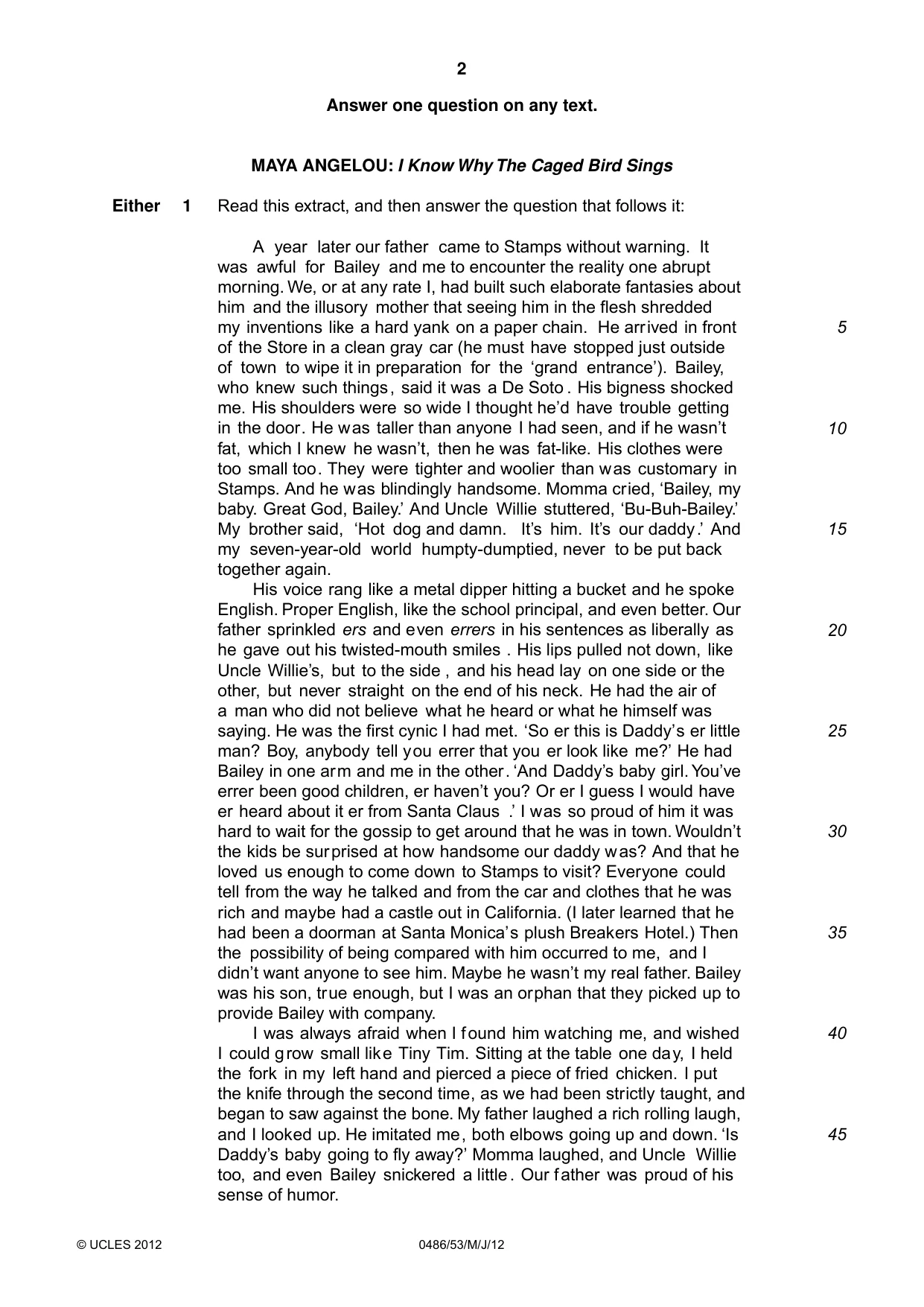
Question paper, page 2
2 0486/53/M/J/12 © UCLES 2012 Answer one question on any text. MAYA ANGELOU: I Know Why The Caged Bird Sings Either 1 Read this extract, and then answer the question that follows it: A year later our father came to Stamps without warning. It was awful for Bailey and me to encounter the reality one abrupt morning. We, or at any rate I, had built such elaborate fantasies about him and the illusory mother that seeing him in the flesh shredded my inventions like a hard yank on a paper chain. He arrived in front of the Store in a clean gray car (he must have stopped just outside of town to wipe it in preparation for the ‘grand entrance’). Bailey, who knew such things, said it was a De Soto . His bigness shocked me. His shoulders were so wide I thought he’d have trouble getting in the door. He was taller than anyone I had seen, and if he wasn’t fat, which I knew he wasn’t, then he was fat-like. His clothes were too small too. They were tighter and woolier than was customary in Stamps. And he was blindingly handsome. Momma cried, ‘Bailey, my baby. Great God, Bailey.’ And Uncle Willie stuttered, ‘Bu-Buh-Bailey.’ My brother said, ‘Hot dog and damn. It’s him. It’s our daddy.’ And my seven-year-old world humpty-dumptied, never to be put back together again. His voice rang like a metal dipper hitting a bucket and he spoke English. Proper English, like the school principal, and even better. Our father sprinkled ers and even errers in his sentences as liberally as he gave out his twisted-mouth smiles . His lips pulled not down, like Uncle Willie’s, but to the side , and his head lay on one side or the other, but never straight on the end of his neck. He had the air of a man who did not believe what he heard or what he himself was saying. He was the first cynic I had met. ‘So er this is Daddy’s er little man? Boy, anybody tell you errer that you er look like me?’ He had Bailey in one arm and me in the other. ‘And Daddy’s baby girl. You’ve errer been good children, er haven’t you? Or er I guess I would have er heard about it er from Santa Claus .’ I was so proud of him it was hard to wait for the gossip to get around that he was in town. Wouldn’t the kids be surprised at how handsome our daddy was? And that he loved us enough to come down to Stamps to visit? Everyone could tell from the way he talked and from the car and clothes that he was rich and maybe had a castle out in California. (I later learned that he had been a doorman at Santa Monica’s plush Breakers Hotel.) Then the possibility of being compared with him occurred to me, and I didn’t want anyone to see him. Maybe he wasn’t my real father. Bailey was his son, true enough, but I was an orphan that they picked up to provide Bailey with company. I was always afraid when I found him watching me, and wished I could grow small like Tiny Tim. Sitting at the table one day, I held the fork in my left hand and pierced a piece of fried chicken. I put the knife through the second time, as we had been strictly taught, and began to saw against the bone. My father laughed a rich rolling laugh, and I looked up. He imitated me, both elbows going up and down. ‘Is Daddy’s baby going to fly away?’ Momma laughed, and Uncle Willie too, and even Bailey snickered a little. Our father was proud of his sense of humor. 5 10 15 20 25 30 35 40 45
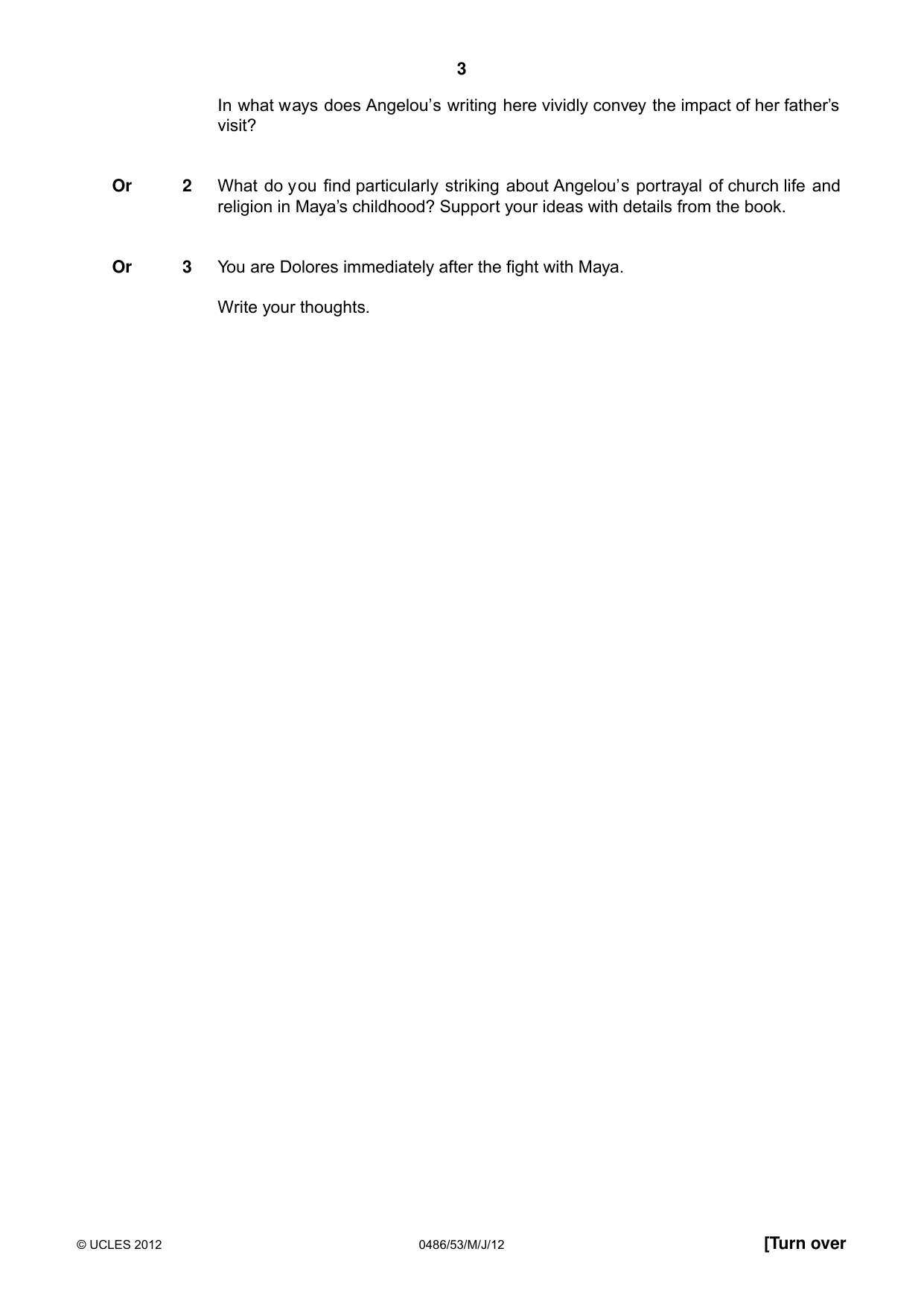
Question paper, page 3
3 0486/53/M/J/12 © UCLES 2012 [Turn over In what ways does Angelou’s writing here vividly convey the impact of her father’s visit? Or 2 What do you find particularly striking about Angelou’s portrayal of church life and religion in Maya’s childhood? Support your ideas with details from the book. Or 3 You are Dolores immediately after the fight with Maya. Write your thoughts.
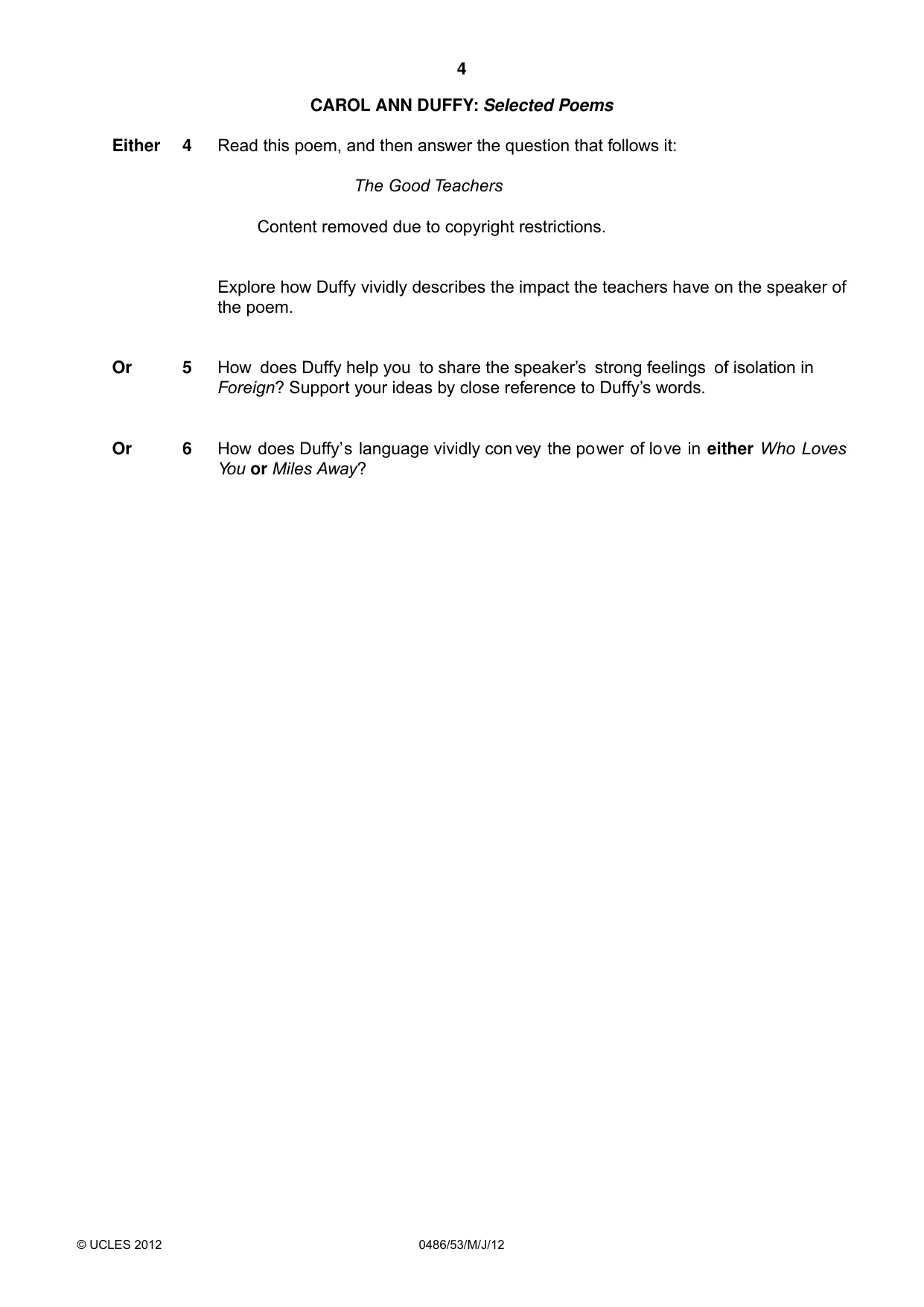
Question paper, page 4
4 0486/53/M/J/12 © UCLES 2012 CAROL ANN DUFFY: Selected Poems Either 4 Read this poem, and then answer the question that follows it: The Good Teachers Content removed due to copyright restrictions. Explore how Duffy vividly describes the impact the teachers have on the speaker of the poem. Or 5 How does Duffy help you to share the speaker’s strong feelings of isolation in Foreign? Support your ideas by close reference to Duffy’s words. Or 6 How does Duffy’s language vividly con vey the power of love in either Who Loves You or Miles Away? 15 20
Question paper, page 5
5 0486/53/M/J/12 © UCLES 2012 [Turn over BLANK PAGE Turn to page 6 for Question 7.
Question paper, page 6
6 0486/53/M/J/12 © UCLES 2012 GEORGE ORWELL: Nineteen Eighty-Four Either 7 Read this extract, and then answer the question that follows it: ‘Remain standing where you are,’ said the voice. ‘Face the door. Make no movement.’ Content removed due to copyright restrictions. ‘Room 101,’ said the officer.
Question paper, page 7
7 0486/53/M/J/12 © UCLES 2012 [Turn over Explore the ways in which Orwell makes this passage so horrifying. Or 8 How do your impressions of Julia change as the novel develops? Support your ideas with details from Orwell’s writing. Or 9 You are O’Brien, after Winston and Julia have left your apartment. Write your thoughts.
Question paper, page 8
8 0486/53/M/J/12 © UCLES 2012 ALDOUS HUXLEY: Brave New World Either 10 Read this extract, and then answer the question that follows it. After the scene in the Fertilizing Room, all upper-caste London was wild to see this delicious creature Content removed due to copyright restrictions. He shook Bernard warmly by the hand.
Question paper, page 9
9 0486/53/M/J/12 © UCLES 2012 [Turn over How does Huxley make you feel about the way Linda is treated here? Or 11 Which aspect of Brave New World ’s society does Huxley’s writing make the most disturbing for you? Support your ideas with details from the novel. (NB Do not use the passage in Question 10 in answering this question.) Or 12 You are John just after your mother, Linda, has died. Write your thoughts.
Question paper, page 10
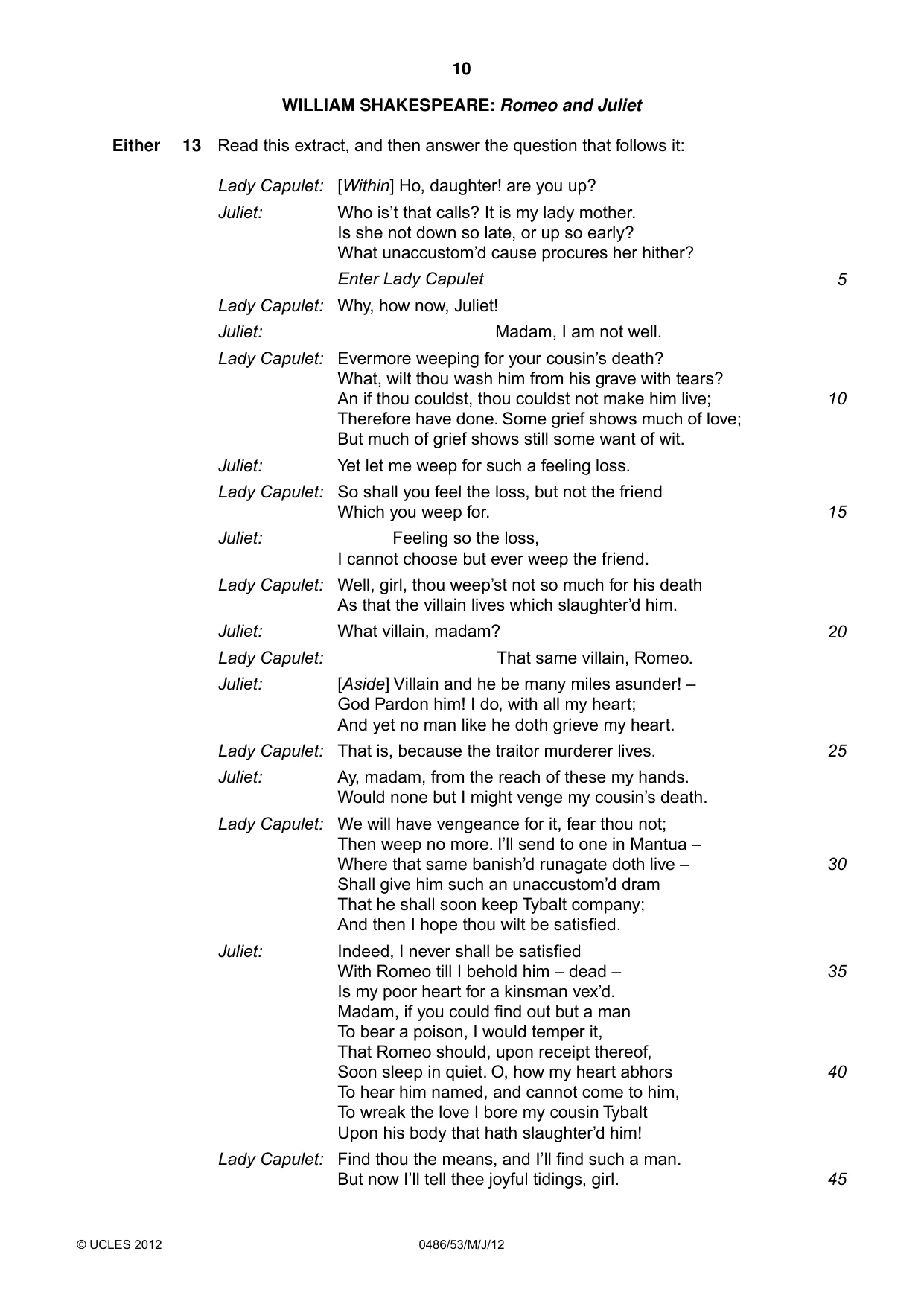
10 0486/53/M/J/12 © UCLES 2012 WILLIAM SHAKESPEARE: Romeo and Juliet Either 13 Read this extract, and then answer the question that follows it: Lady Capulet: [Within] Ho, daughter! are you up? Juliet: Who is’t that calls? It is my lady mother. Is she not down so late, or up so early? What unaccustom’d cause procures her hither? Enter Lady Capulet Lady Capulet: Why, how now, Juliet! Juliet: Madam, I am not well. Lady Capulet: Evermore weeping for your cousin’s death? What, wilt thou wash him from his grave with tears? An if thou couldst, thou couldst not make him live; Therefore have done. Some grief shows much of love; But much of grief shows still some want of wit. Juliet: Yet let me weep for such a feeling loss. Lady Capulet: So shall you feel the loss, but not the friend Which you weep for. Juliet: Feeling so the loss, I cannot choose but ever weep the friend. Lady Capulet: Well, girl, thou weep’st not so much for his death As that the villain lives which slaughter’d him. Juliet: What villain, madam? Lady Capulet: That same villain, Romeo. Juliet: [Aside] Villain and he be many miles asunder! – God Pardon him! I do, with all my heart; And yet no man like he doth grieve my heart. Lady Capulet: That is, because the traitor murderer lives. Juliet: Ay, madam, from the reach of these my hands. Would none but I might venge my cousin’s death. Lady Capulet: We will have vengeance for it, fear thou not; Then weep no more. I’ll send to one in Mantua – Where that same banish’d runagate doth live – Shall give him such an unaccustom’d dram That he shall soon keep Tybalt company; And then I hope thou wilt be satisfied. Juliet: Indeed, I never shall be satisfied With Romeo till I behold him – dead – Is my poor heart for a kinsman vex’d. Madam, if you could find out but a man To bear a poison, I would temper it, That Romeo should, upon receipt thereof, Soon sleep in quiet. O, how my heart abhors To hear him named, and cannot come to him, To wreak the love I bore my cousin Tybalt Upon his body that hath slaughter’d him! Lady Capulet: Find thou the means, and I’ll find such a man. But now I’ll tell thee joyful tidings, girl. 5 10 15 20 25 30 35 40 45
Question paper, page 11
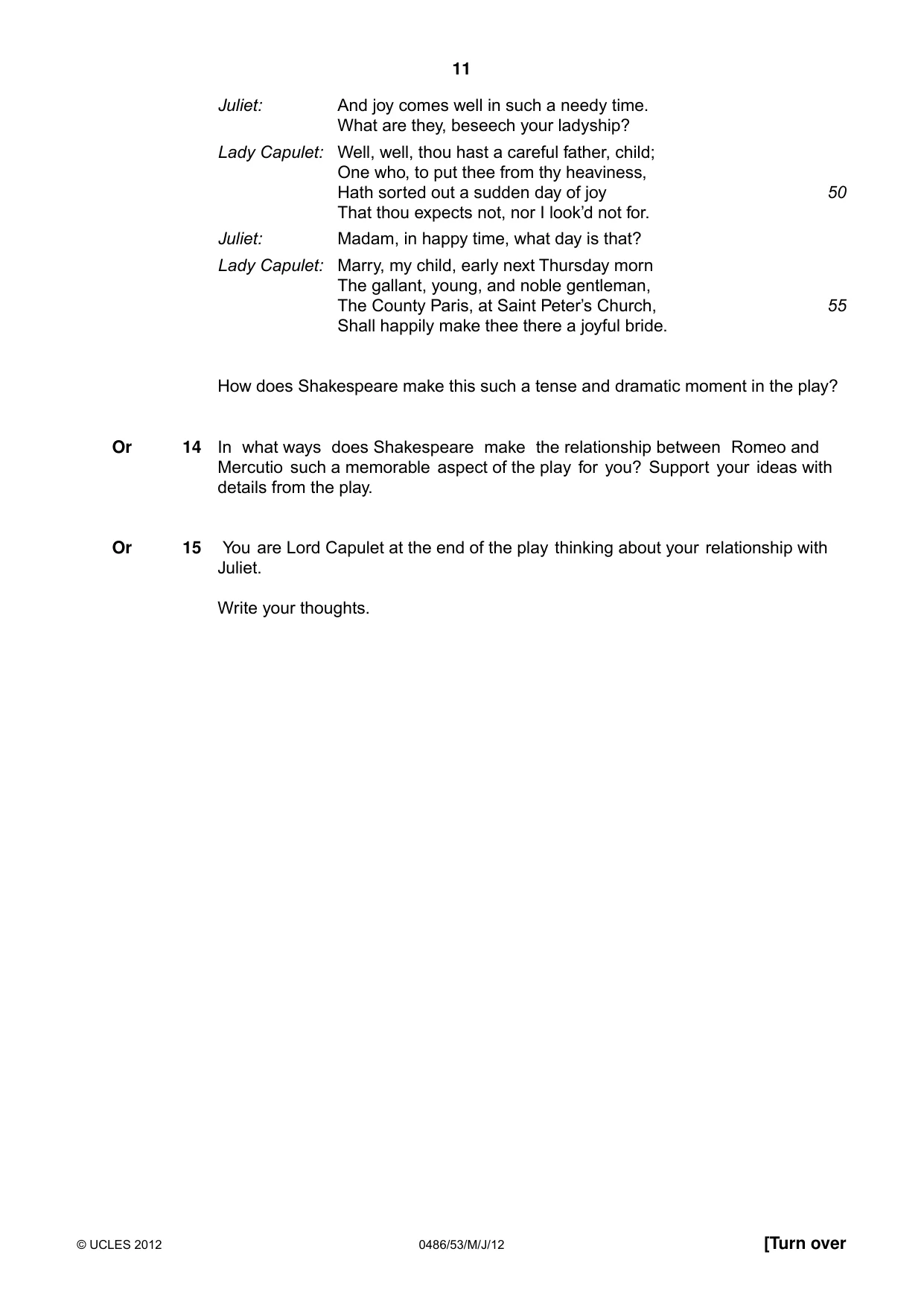
11 0486/53/M/J/12 © UCLES 2012 [Turn over Juliet: And joy comes well in such a needy time. What are they, beseech your ladyship? Lady Capulet: Well, well, thou hast a careful father, child; One who, to put thee from thy heaviness, Hath sorted out a sudden day of joy That thou expects not, nor I look’d not for. Juliet: Madam, in happy time, what day is that? Lady Capulet: Marry, my child, early next Thursday morn The gallant, young, and noble gentleman, The County Paris, at Saint Peter’s Church, Shall happily make thee there a joyful bride. How does Shakespeare make this such a tense and dramatic moment in the play? Or 14 In what ways does Shakespeare make the relationship between Romeo and Mercutio such a memorable aspect of the play for you? Support your ideas with details from the play. Or 15 You are Lord Capulet at the end of the play thinking about your relationship with Juliet. Write your thoughts. 50 55
Question paper, page 12
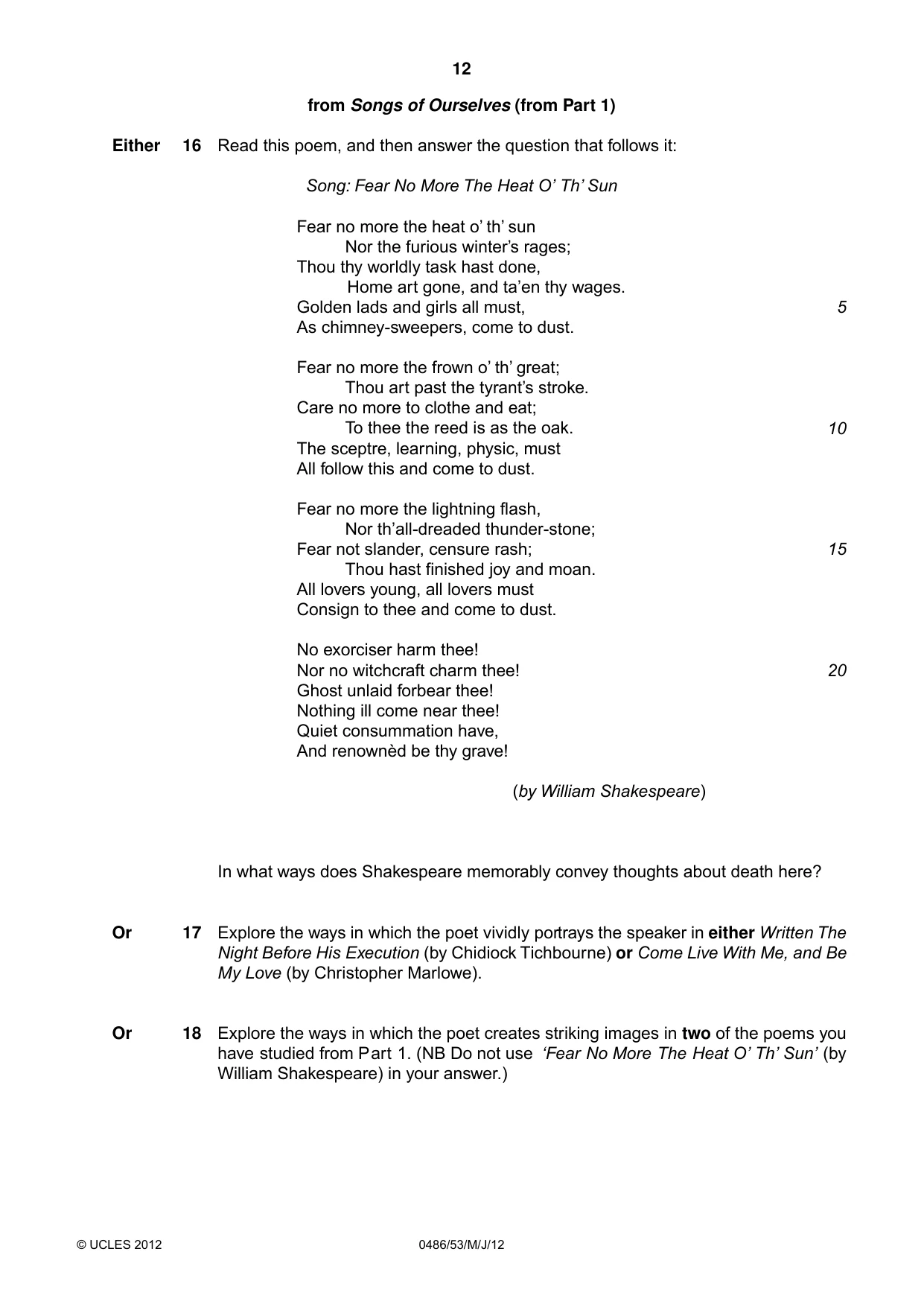
12 0486/53/M/J/12 © UCLES 2012 from Songs of Ourselves (from Part 1) Either 16 Read this poem, and then answer the question that follows it: Song: Fear No More The Heat O’ Th’ Sun Fear no more the heat o’ th’ sun Nor the furious winter’s rages; Thou thy worldly task hast done, Home art gone, and ta’en thy wages. Golden lads and girls all must, As chimney-sweepers, come to dust. Fear no more the frown o’ th’ great; Thou art past the tyrant’s stroke. Care no more to clothe and eat; To thee the reed is as the oak. The sceptre, learning, physic, must All follow this and come to dust. Fear no more the lightning flash, Nor th’all-dreaded thunder-stone; Fear not slander, censure rash; Thou hast finished joy and moan. All lovers young, all lovers must Consign to thee and come to dust. No exorciser harm thee! Nor no witchcraft charm thee! Ghost unlaid forbear thee! Nothing ill come near thee! Quiet consummation have, And renownèd be thy grave! (by William Shakespeare) In what ways does Shakespeare memorably convey thoughts about death here? Or 17 Explore the ways in which the poet vividly portrays the speaker in either Written The Night Before His Execution (by Chidiock Tichbourne) or Come Live With Me, and Be My Love (by Christopher Marlowe). Or 18 Explore the ways in which the poet creates striking images in two of the poems you have studied from Part 1. (NB Do not use ‘Fear No More The Heat O’ Th’ Sun’ (by William Shakespeare) in your answer.) 5 10 15 20
Question paper, page 13
13 0486/53/M/J/12 © UCLES 2012 [Turn over BLANK PAGE Turn to page 14 for Question 19.
Question paper, page 14
14 0486/53/M/J/12 © UCLES 2012 TENNESSEE WILLIAMS: Cat on a Hot Tin Roof Either 19 Read this extract, and then answer the question that follows it: Margaret: [She catches sight of him in the mirror, gasps slightly, wheels about to face him. Count ten.] Content removed due to copyright restrictions. You were a wonderful lover ...
Question paper, page 15
15 0486/53/M/J/12 © UCLES 2012 How does Williams strikingly portray the relationship between Brick and Maggie in this passage? Or 20 Choose two moments in the play which you find particularly dramatic, and explore in detail how Williams makes them dramatic. (NB Do not use the passage in Question 19 in answering this question.) Or 21 You are Brick, at the end of the play. Write your thoughts.
Question paper, page 16
16 0486/53/M/J/12 © UCLES 2012 BLANK PAGE Copyright Acknowledgements: Question 1 © Maya Angelou; I Know Why The Caged Bird Sings; Virago; 2007. Question 4 © Carol Ann Duffy; The Good Teachers; Selected Poems: Carol Ann Duffy; Penguin Books Ltd. Question 7 © George Orwell; 1984; Penguin Books Ltd; 1987. Question 10 © Aldous Huxley; Brave New World; Published by Vintage; Reprinted by permission of The Random House Group Ltd; 1994. Question 19 Cat On A Hot Tin Roof by Tennessee Williams. Copyright © 1954, 1955, by The University of the South, renewed 1982, 1983 The University of the South. Penguin Books Ltd; 1976. Reprinted by permisson of New Directions Publishing Corp and Georges Borchardt, Inc. for the Estate of Tennessee Williams. Permission to reproduce items where third-party owned material protected by copyright is included has been sought and cleared where possible. Every reasonable effort has been made by the publisher (UCLES) to trace copyright holders, but if any items requiring clearance have unwittingly been included, the publisher will be pleased to make amends at the earliest possible opportunity. University of Cambridge International Examinations is part of the Cambridge Assessment Group. Cambridge Local Examinations Syndicate (UCLES), which is itself a department of the University of Cambridge.
Mark scheme, page 1
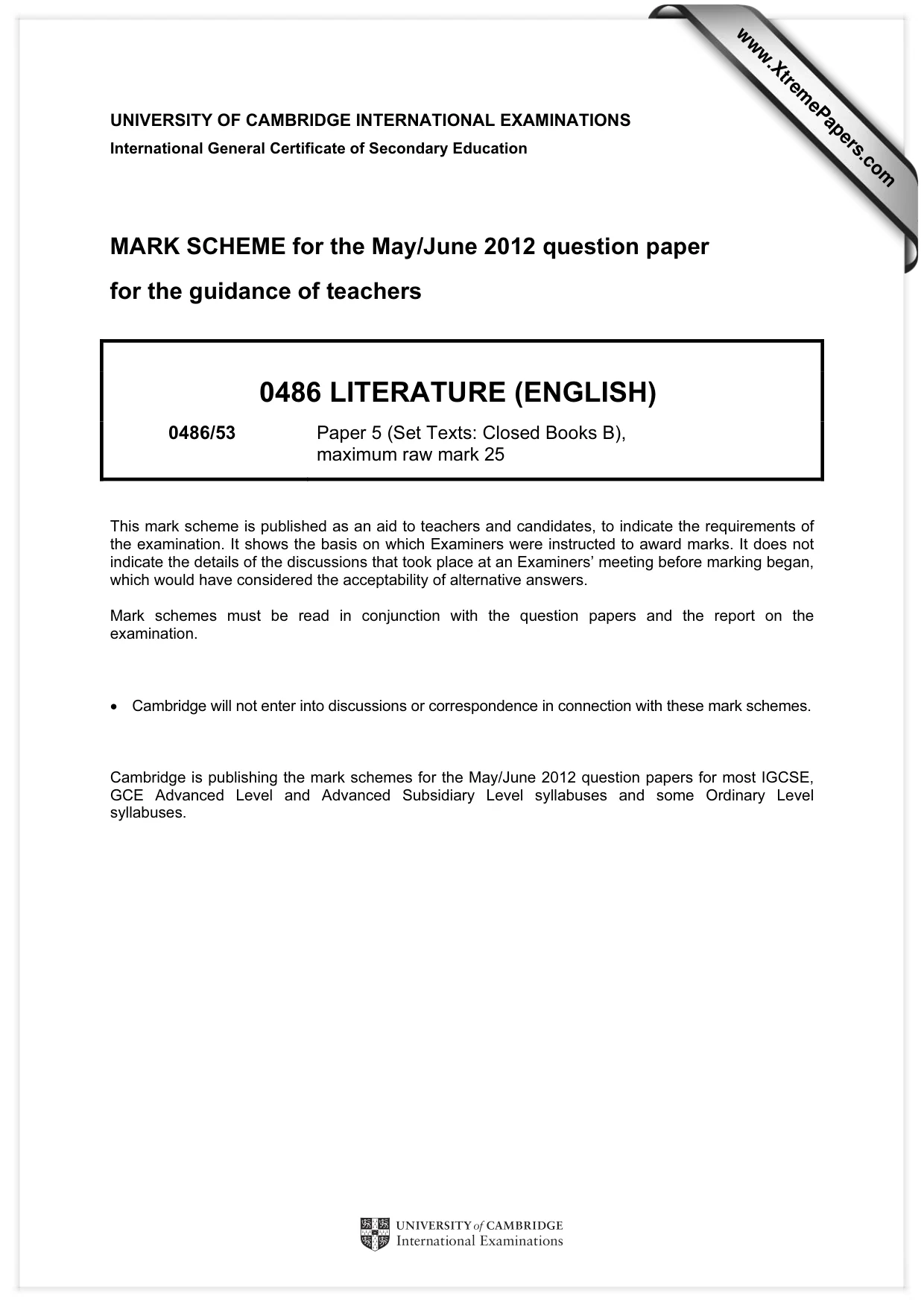
UNIVERSITY OF CAMBRIDGE INTERNATIONAL EXAMINATIONS International General Certificate of Secondary Education MARK SCHEME for the May/June 2012 question paper for the guidance of teachers 0486 LITERATURE (ENGLISH) 0486/53 Paper 5 (Set Texts: Closed Books B), maximum raw mark 25 This mark scheme is published as an aid to teachers and candidates, to indicate the requirements of the examination. It shows the basis on which Examiners were instructed to award marks. It does not indicate the details of the discussions that took place at an Examiners’ meeting before marking began, which would have considered the acceptability of alternative answers. Mark schemes must be read in conjunction with the question papers and the report on the examination. • Cambridge will not enter into discussions or correspondence in connection with these mark schemes. Cambridge is publishing the mark schemes for the May/June 2012 question papers for most IGCSE, GCE Advanced Level and Advanced Subsidiary Level syllabuses and some Ordinary Level syllabuses. www.XtremePapers.com
Mark scheme, page 2
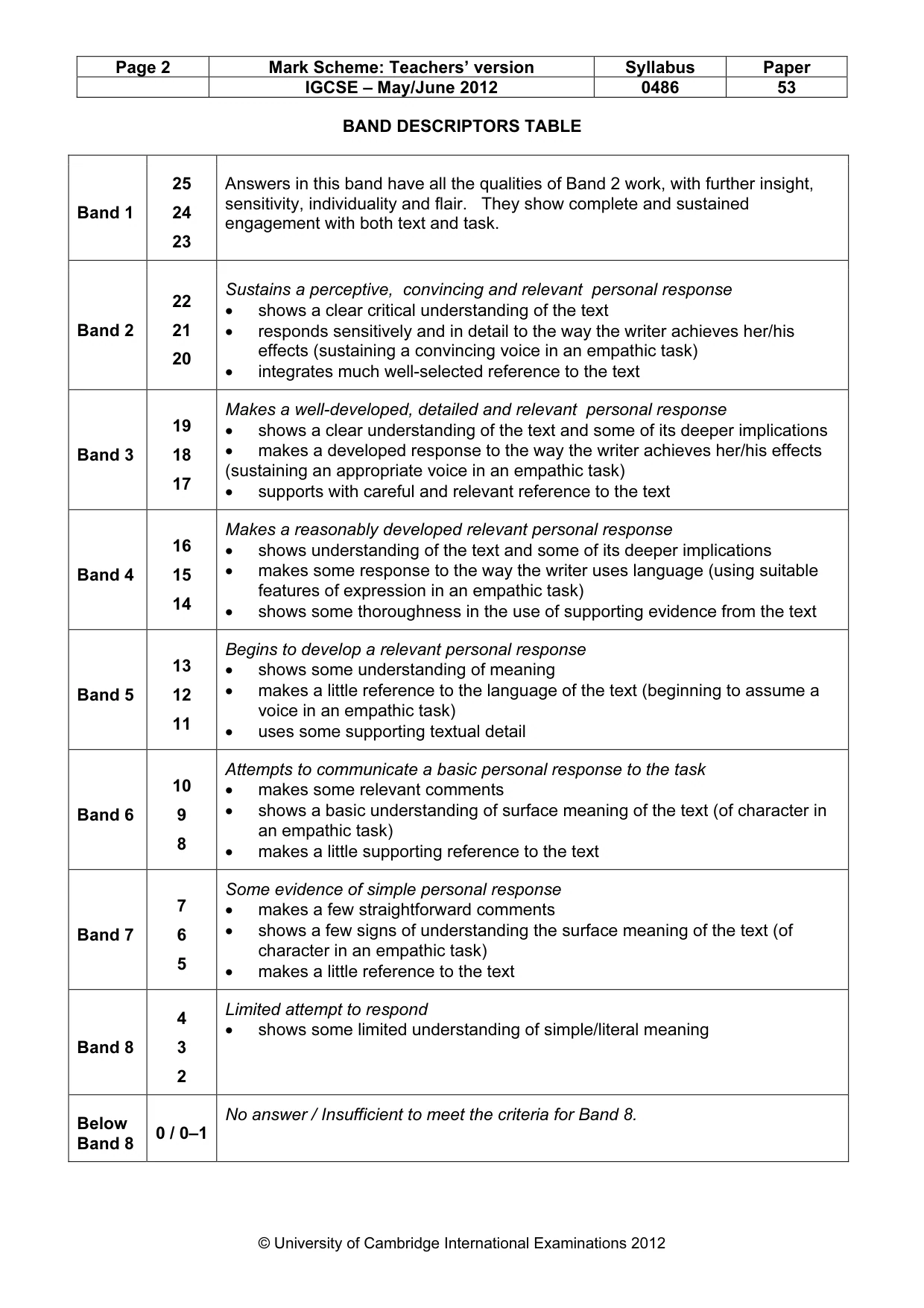
Page 2 Mark Scheme: Teachers’ version Syllabus Paper IGCSE – May/June 2012 0486 53 © University of Cambridge International Examinations 2012 BAND DESCRIPTORS TABLE Band 1 25 24 23 Answers in this band have all the qualities of Band 2 work, with further insight, sensitivity, individuality and flair. They show complete and sustained engagement with both text and task. Band 2 22 21 20 Sustains a perceptive, convincing and relevant personal response • shows a clear critical understanding of the text • responds sensitively and in detail to the way the writer achieves her/his effects (sustaining a convincing voice in an empathic task) • integrates much well-selected reference to the text Band 3 19 18 17 Makes a well-developed, detailed and relevant personal response • shows a clear understanding of the text and some of its deeper implications • makes a developed response to the way the writer achieves her/his effects (sustaining an appropriate voice in an empathic task) • supports with careful and relevant reference to the text Band 4 16 15 14 Makes a reasonably developed relevant personal response • shows understanding of the text and some of its deeper implications • makes some response to the way the writer uses language (using suitable features of expression in an empathic task) • shows some thoroughness in the use of supporting evidence from the text Band 5 13 12 11 Begins to develop a relevant personal response • shows some understanding of meaning • makes a little reference to the language of the text (beginning to assume a voice in an empathic task) • uses some supporting textual detail Band 6 10 9 8 Attempts to communicate a basic personal response to the task • makes some relevant comments • shows a basic understanding of surface meaning of the text (of character in an empathic task) • makes a little supporting reference to the text Band 7 7 6 5 Some evidence of simple personal response • makes a few straightforward comments • shows a few signs of understanding the surface meaning of the text (of character in an empathic task) • makes a little reference to the text Band 8 4 3 2 Limited attempt to respond • shows some limited understanding of simple/literal meaning Below Band 8 0 / 0–1 No answer / Insufficient to meet the criteria for Band 8.
What you needed in this session
Cambridge’s own grade thresholds for 2012 May/June, Paper 5 · Variant 3. A higher threshold means an easier paper — the bar moves with how the cohort did.