Cambridge IGCSE English - Literature 0486 — 2014 Oct/Nov Paper 5 · Variant 3
0486/53/O/N/14 · 25 marks · ≈28 min
The question paper and its mark scheme, free to read here and free to download. This is Cambridge’s own paper, exactly as it was sat.
Question paper16 pages


Mark scheme3 pages
Answers below. Sit the paper first if you are practising.
Paper as text
Question paper, page 1
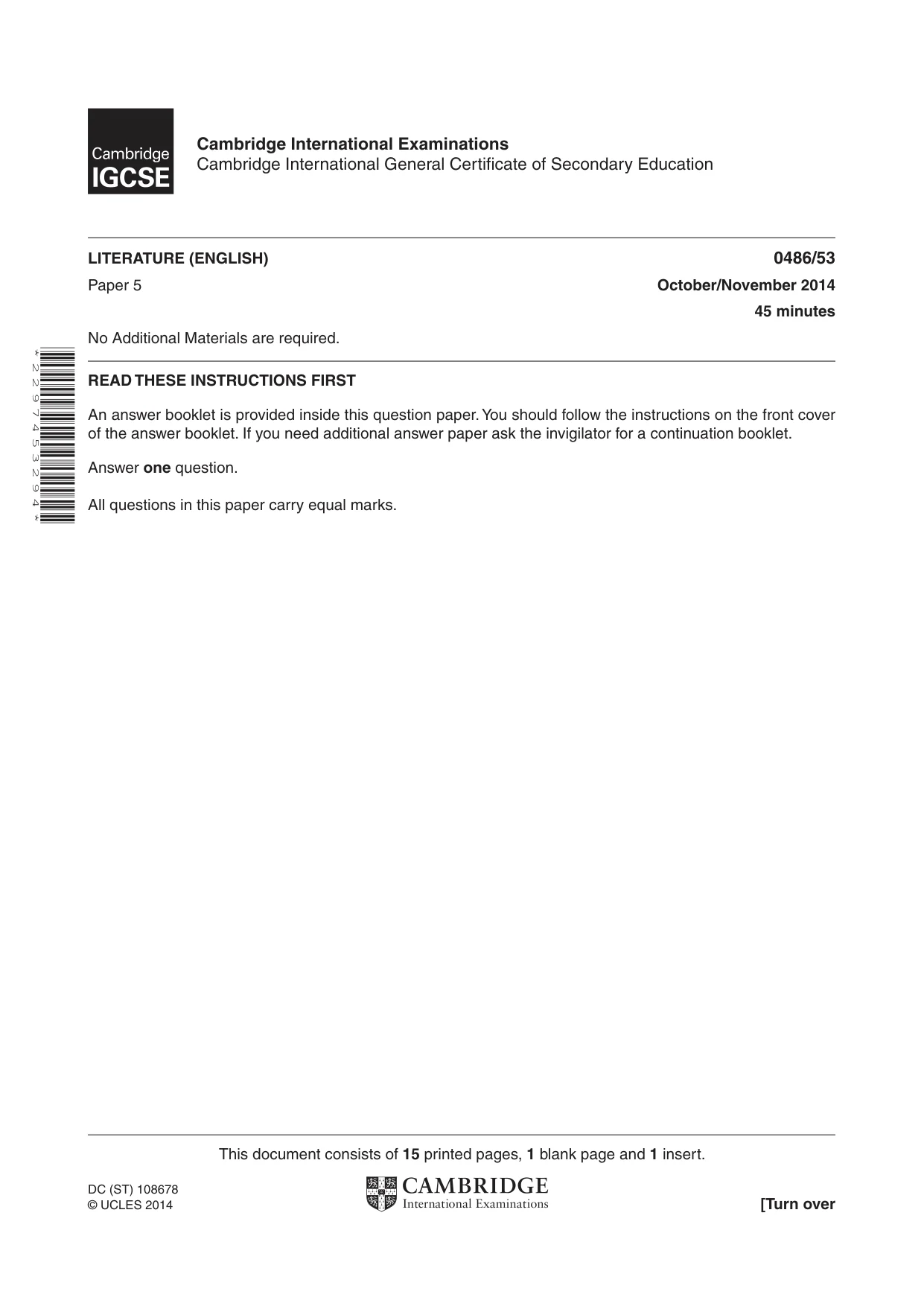
This document consists of 15 printed pages, 1 blank page and 1 insert. DC (ST) 108678 © UCLES 2014 [Turn over Cambridge International Examinations Cambridge International General Certificate of Secondary Education * 2 2 9 7 4 5 3 2 9 4 * LITERATURE (ENGLISH) 0486/53 Paper 5 October/November 2014 45 minutes No Additional Materials are required. READ THESE INSTRUCTIONS FIRST An answer booklet is provided inside this question paper. You should follow the instructions on the front cover of the answer booklet. If you need additional answer paper ask the invigilator for a continuation booklet. Answer one question. All questions in this paper carry equal marks.
Question paper, page 2
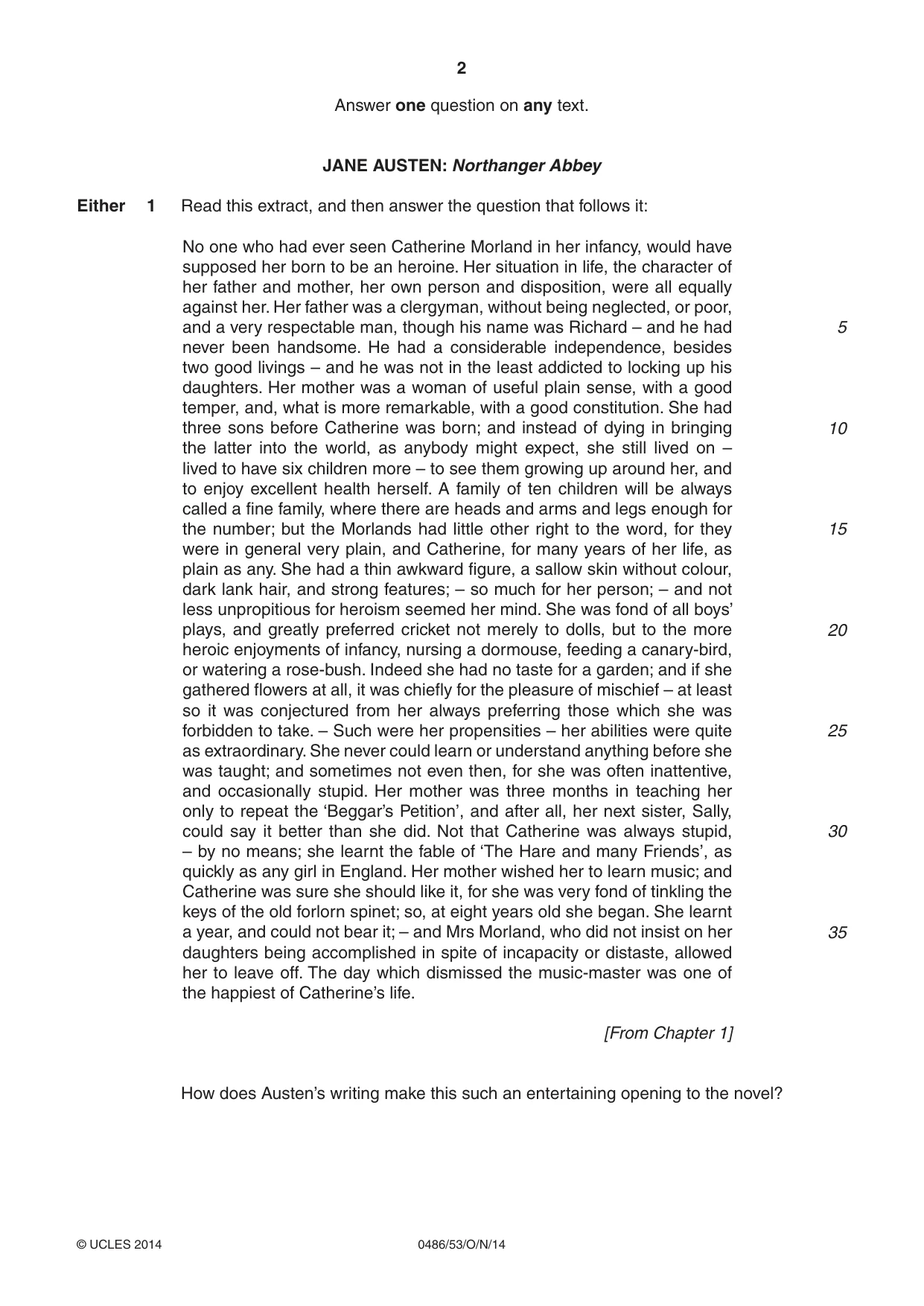
2 0486/53/O/N/14 © UCLES 2014 Answer one question on any text. JANE AUSTEN: Northanger Abbey Either 1 Read this extract, and then answer the question that follows it: No one who had ever seen Catherine Morland in her infancy, would have supposed her born to be an heroine. Her situation in life, the character of her father and mother, her own person and disposition, were all equally against her. Her father was a clergyman, without being neglected, or poor, and a very respectable man, though his name was Richard – and he had never been handsome. He had a considerable independence, besides two good livings – and he was not in the least addicted to locking up his daughters. Her mother was a woman of useful plain sense, with a good temper, and, what is more remarkable, with a good constitution. She had three sons before Catherine was born; and instead of dying in bringing the latter into the world, as anybody might expect, she still lived on – lived to have six children more – to see them growing up around her, and to enjoy excellent health herself. A family of ten children will be always called a fine family, where there are heads and arms and legs enough for the number; but the Morlands had little other right to the word, for they were in general very plain, and Catherine, for many years of her life, as plain as any. She had a thin awkward figure, a sallow skin without colour, dark lank hair, and strong features; – so much for her person; – and not less unpropitious for heroism seemed her mind. She was fond of all boys’ plays, and greatly preferred cricket not merely to dolls, but to the more heroic enjoyments of infancy, nursing a dormouse, feeding a canary-bird, or watering a rose-bush. Indeed she had no taste for a garden; and if she gathered flowers at all, it was chiefly for the pleasure of mischief – at least so it was conjectured from her always preferring those which she was forbidden to take. – Such were her propensities – her abilities were quite as extraordinary. She never could learn or understand anything before she was taught; and sometimes not even then, for she was often inattentive, and occasionally stupid. Her mother was three months in teaching her only to repeat the ‘Beggar’s Petition’, and after all, her next sister, Sally, could say it better than she did. Not that Catherine was always stupid, – by no means; she learnt the fable of ‘The Hare and many Friends’, as quickly as any girl in England. Her mother wished her to learn music; and Catherine was sure she should like it, for she was very fond of tinkling the keys of the old forlorn spinet; so, at eight years old she began. She learnt a year, and could not bear it; – and Mrs Morland, who did not insist on her daughters being accomplished in spite of incapacity or distaste, allowed her to leave off. The day which dismissed the music-master was one of the happiest of Catherine’s life. [From Chapter 1] How does Austen’s writing make this such an entertaining opening to the novel? 5 10 15 20 25 30 35
Question paper, page 3
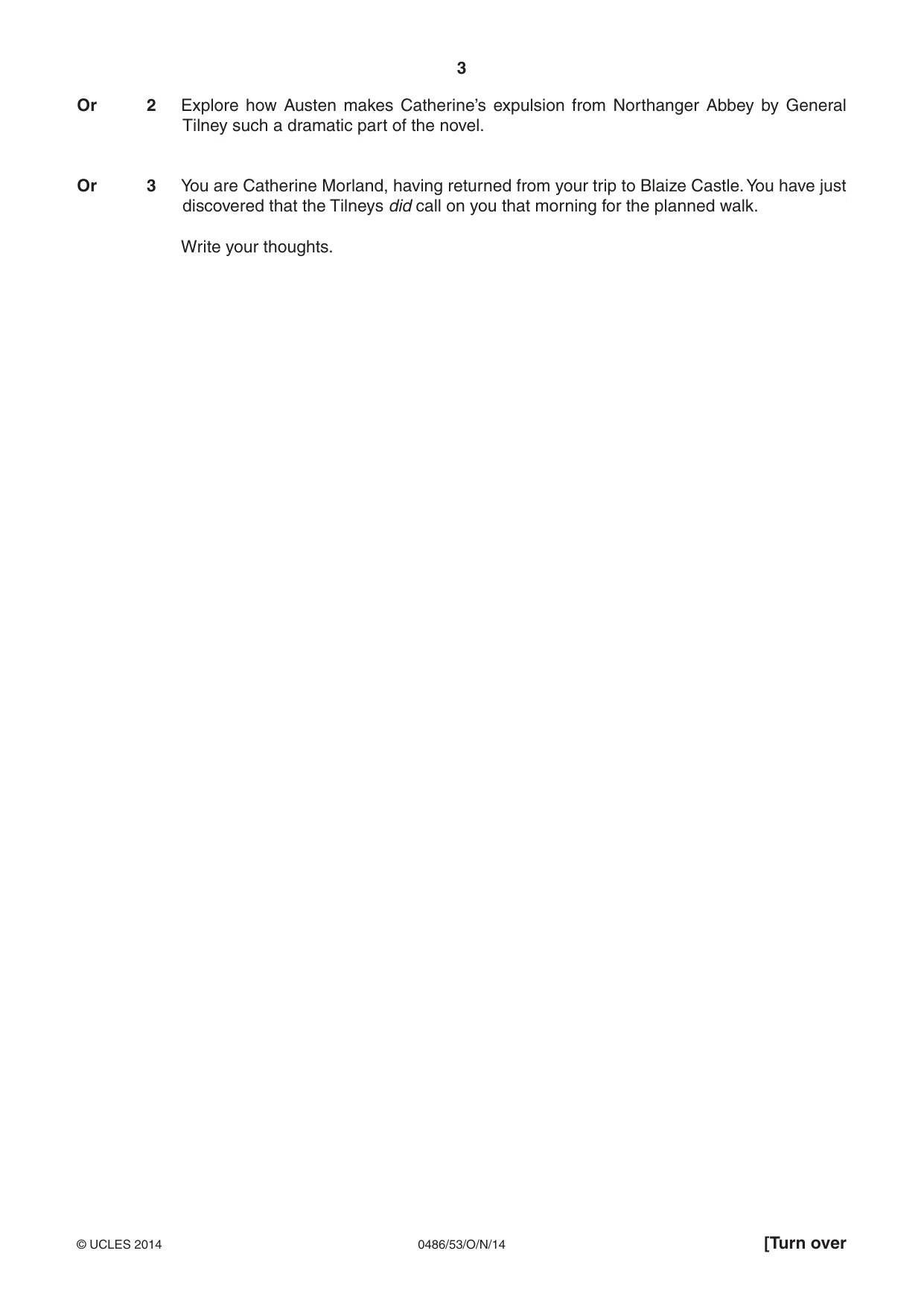
3 0486/53/O/N/14 © UCLES 2014 [Turn over Or 2 Explore how Austen makes Catherine’s expulsion from Northanger Abbey by General Tilney such a dramatic part of the novel. Or 3 You are Catherine Morland, having returned from your trip to Blaize Castle. You have just discovered that the Tilneys did call on you that morning for the planned walk. Write your thoughts.
Question paper, page 4
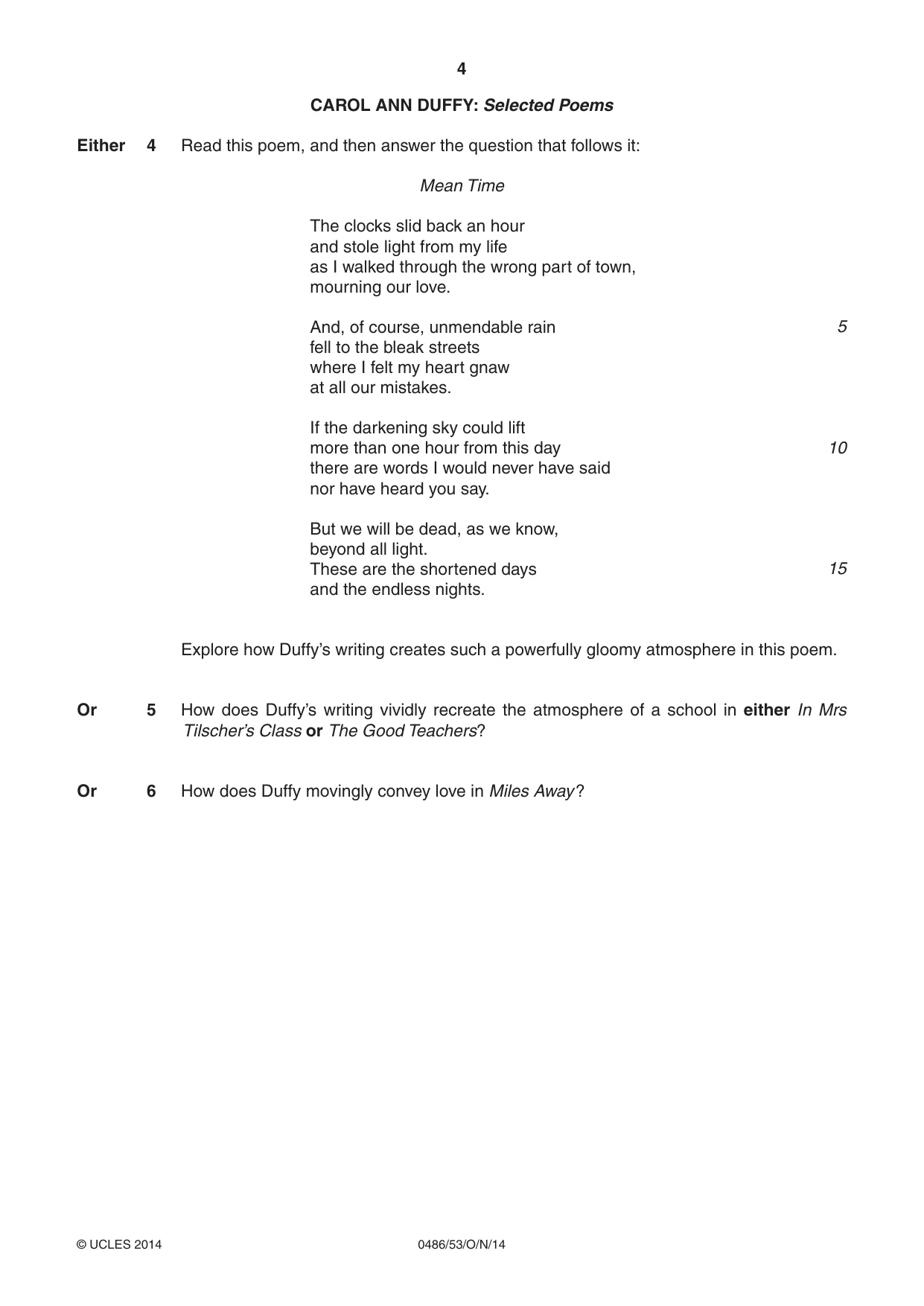
4 0486/53/O/N/14 © UCLES 2014 CAROL ANN DUFFY: Selected Poems Either 4 Read this poem, and then answer the question that follows it: Mean Time The clocks slid back an hour and stole light from my life as I walked through the wrong part of town, mourning our love. And, of course, unmendable rain fell to the bleak streets where I felt my heart gnaw at all our mistakes. If the darkening sky could lift more than one hour from this day there are words I would never have said nor have heard you say. But we will be dead, as we know, beyond all light. These are the shortened days and the endless nights. Explore how Duffy’s writing creates such a powerfully gloomy atmosphere in this poem. Or 5 How does Duffy’s writing vividly recreate the atmosphere of a school in either In Mrs Tilscher’s Class or The Good Teachers? Or 6 How does Duffy movingly convey love in Miles Away ? 5 10 15
Question paper, page 5
5 0486/53/O/N/14 © UCLES 2014 [Turn over Turn to page 6 for Question 7.
Question paper, page 6
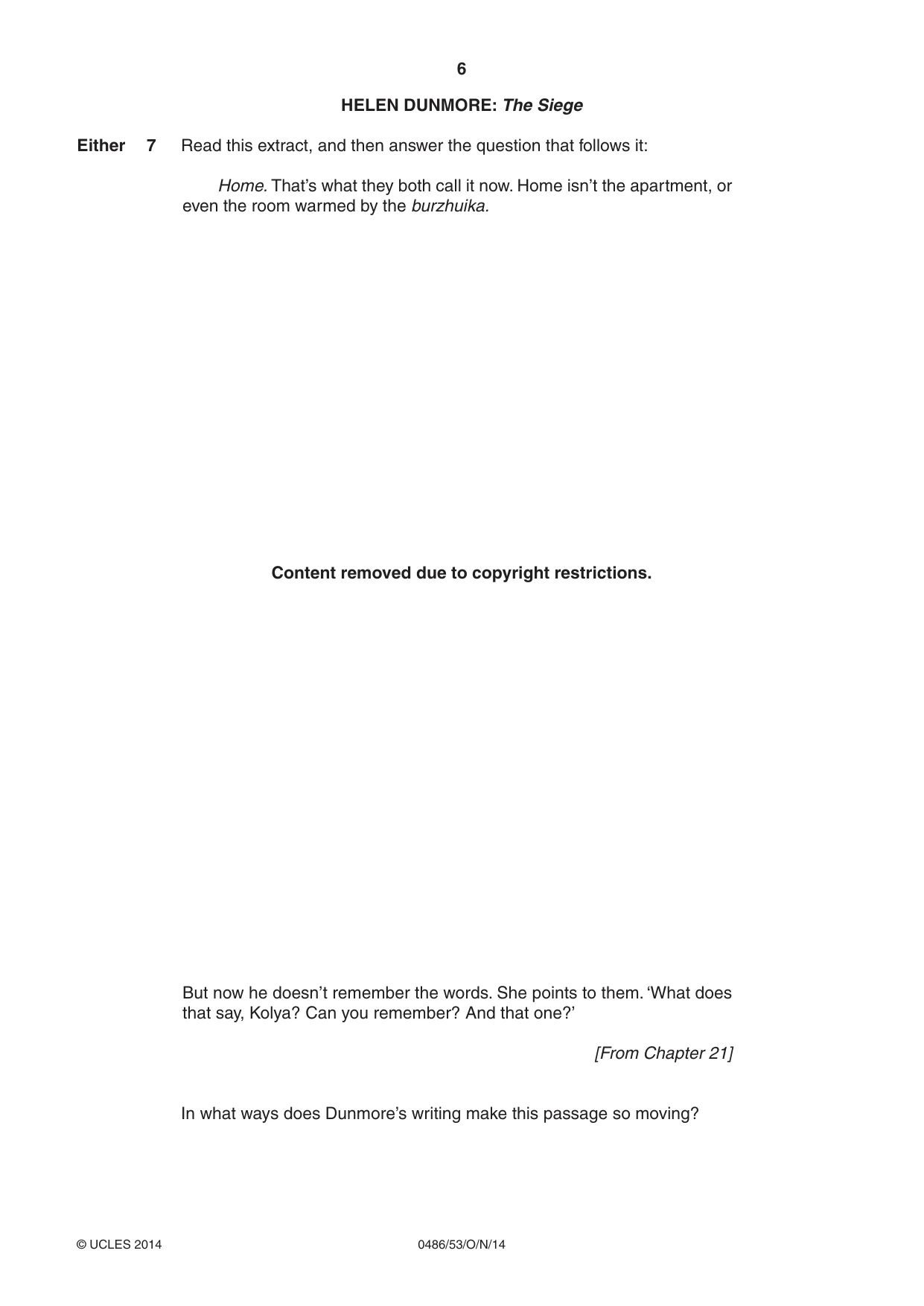
6 0486/53/O/N/14 © UCLES 2014 HELEN DUNMORE: The Siege Either 7 Read this extract, and then answer the question that follows it: Home. That’s what they both call it now. Home isn’t the apartment, or even the room warmed by the burzhuika. But now he doesn’t remember the words. She points to them. ‘What does that say, Kolya? Can you remember? And that one?’ [From Chapter 21] In what ways does Dunmore’s writing make this passage so moving? Content removed due to copyright restrictions.
Question paper, page 7
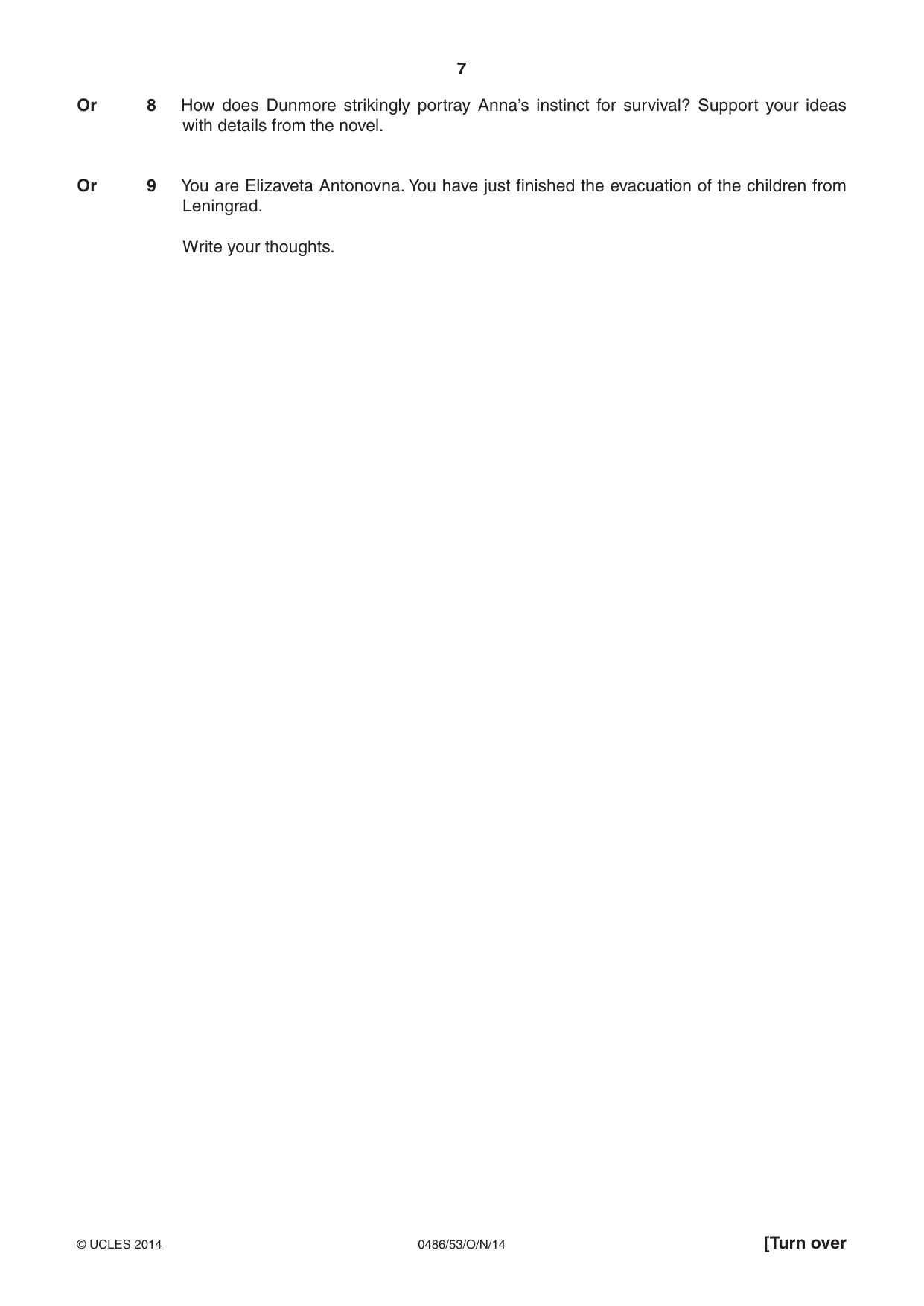
7 0486/53/O/N/14 © UCLES 2014 [Turn over Or 8 How does Dunmore strikingly portray Anna’s instinct for survival? Support your ideas with details from the novel. Or 9 You are Elizaveta Antonovna. You have just finished the evacuation of the children from Leningrad. Write your thoughts.
Question paper, page 8
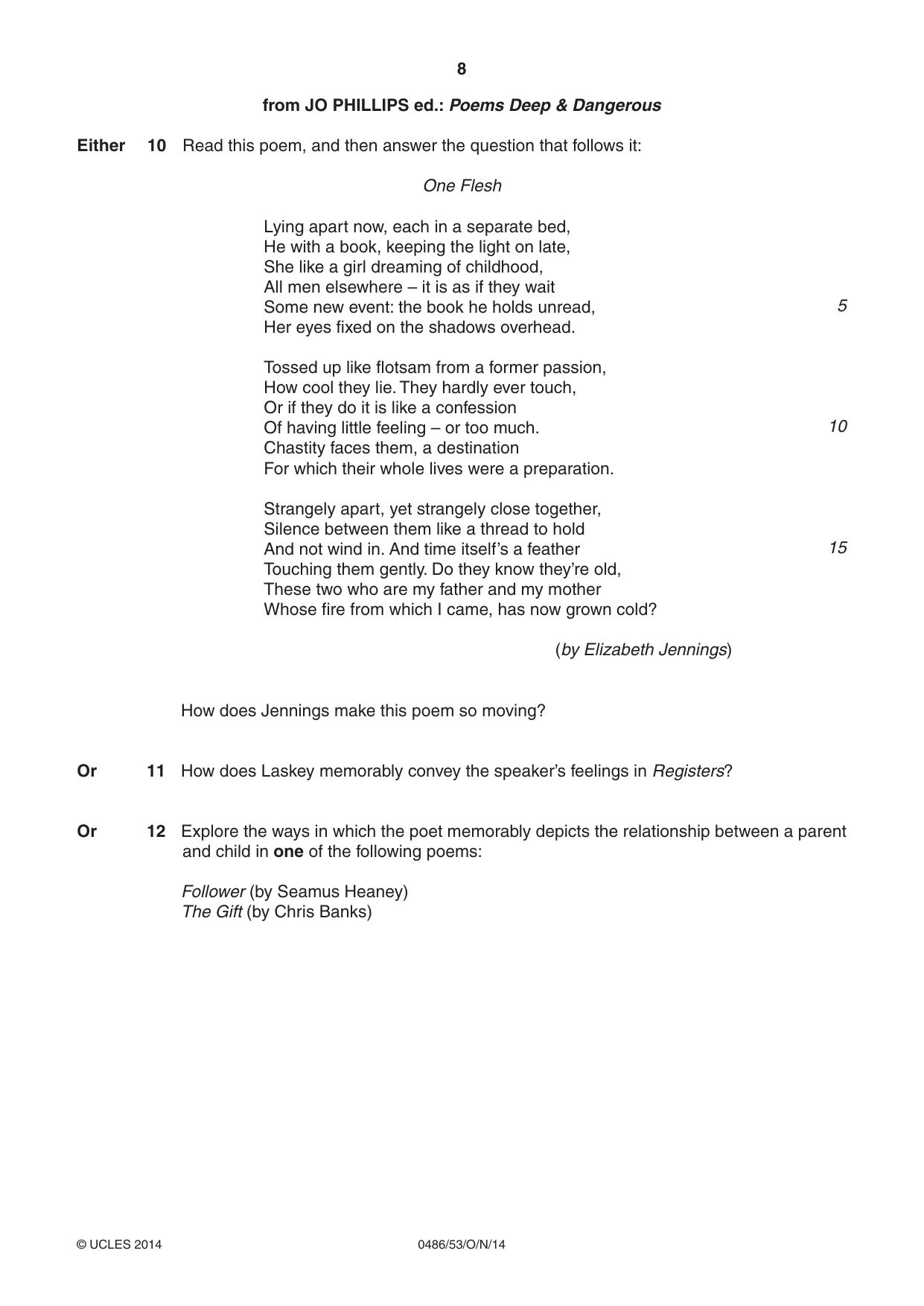
8 0486/53/O/N/14 © UCLES 2014 from JO PHILLIPS ed.: Poems Deep & Dangerous Either 10 Read this poem, and then answer the question that follows it: One Flesh Lying apart now, each in a separate bed, He with a book, keeping the light on late, She like a girl dreaming of childhood, All men elsewhere – it is as if they wait Some new event: the book he holds unread, Her eyes fixed on the shadows overhead. Tossed up like flotsam from a former passion, How cool they lie. They hardly ever touch, Or if they do it is like a confession Of having little feeling – or too much. Chastity faces them, a destination For which their whole lives were a preparation. Strangely apart, yet strangely close together, Silence between them like a thread to hold And not wind in. And time itself’s a feather Touching them gently. Do they know they’re old, These two who are my father and my mother Whose fire from which I came, has now grown cold? (by Elizabeth Jennings) How does Jennings make this poem so moving? Or 11 How does Laskey memorably convey the speaker’s feelings in Registers? Or 12 Explore the ways in which the poet memorably depicts the relationship between a parent and child in one of the following poems: Follower (by Seamus Heaney) The Gift (by Chris Banks) 5 10 15
Question paper, page 9
9 0486/53/O/N/14 © UCLES 2014 [Turn over Turn to page 10 for Question 13.
Question paper, page 10
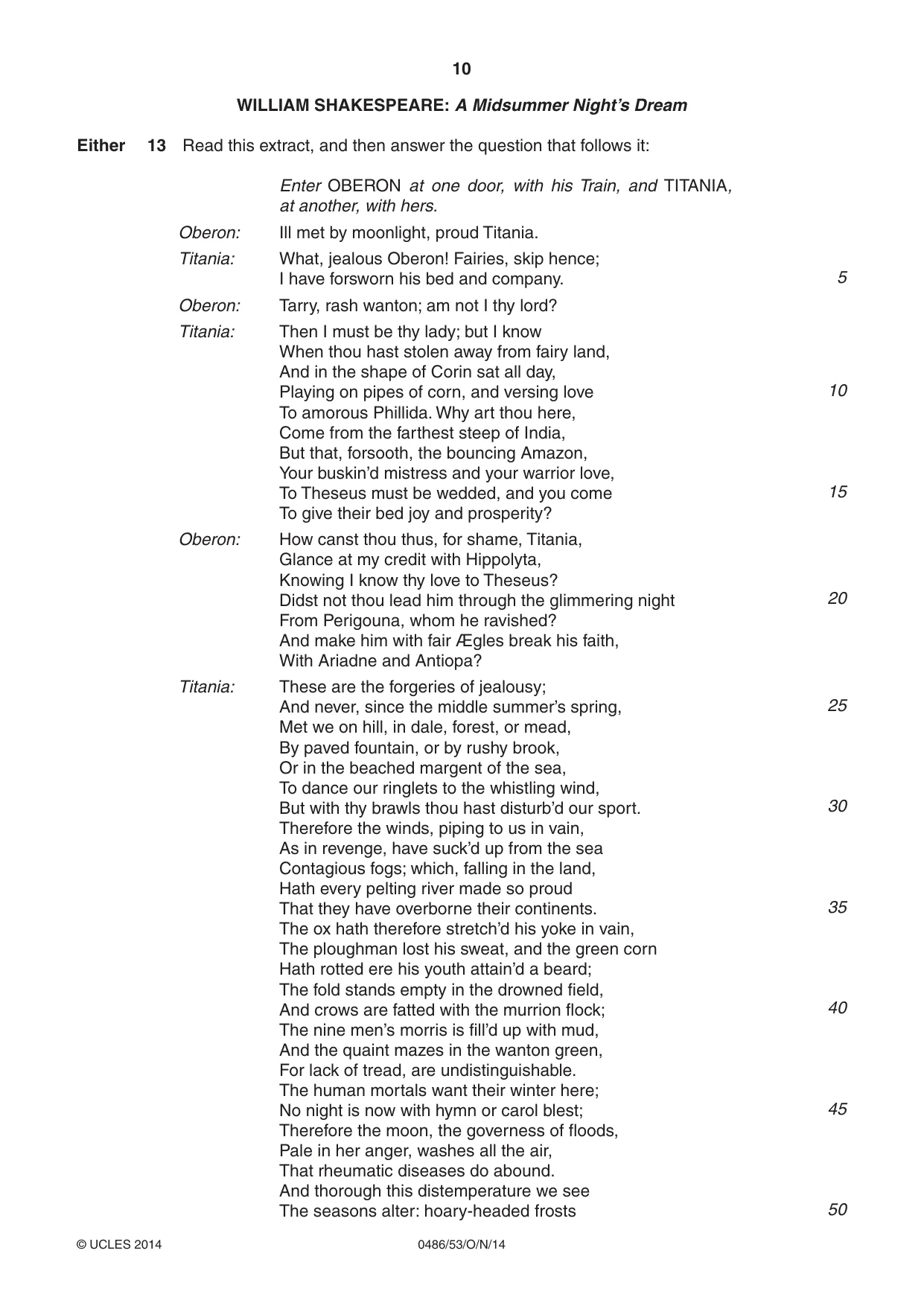
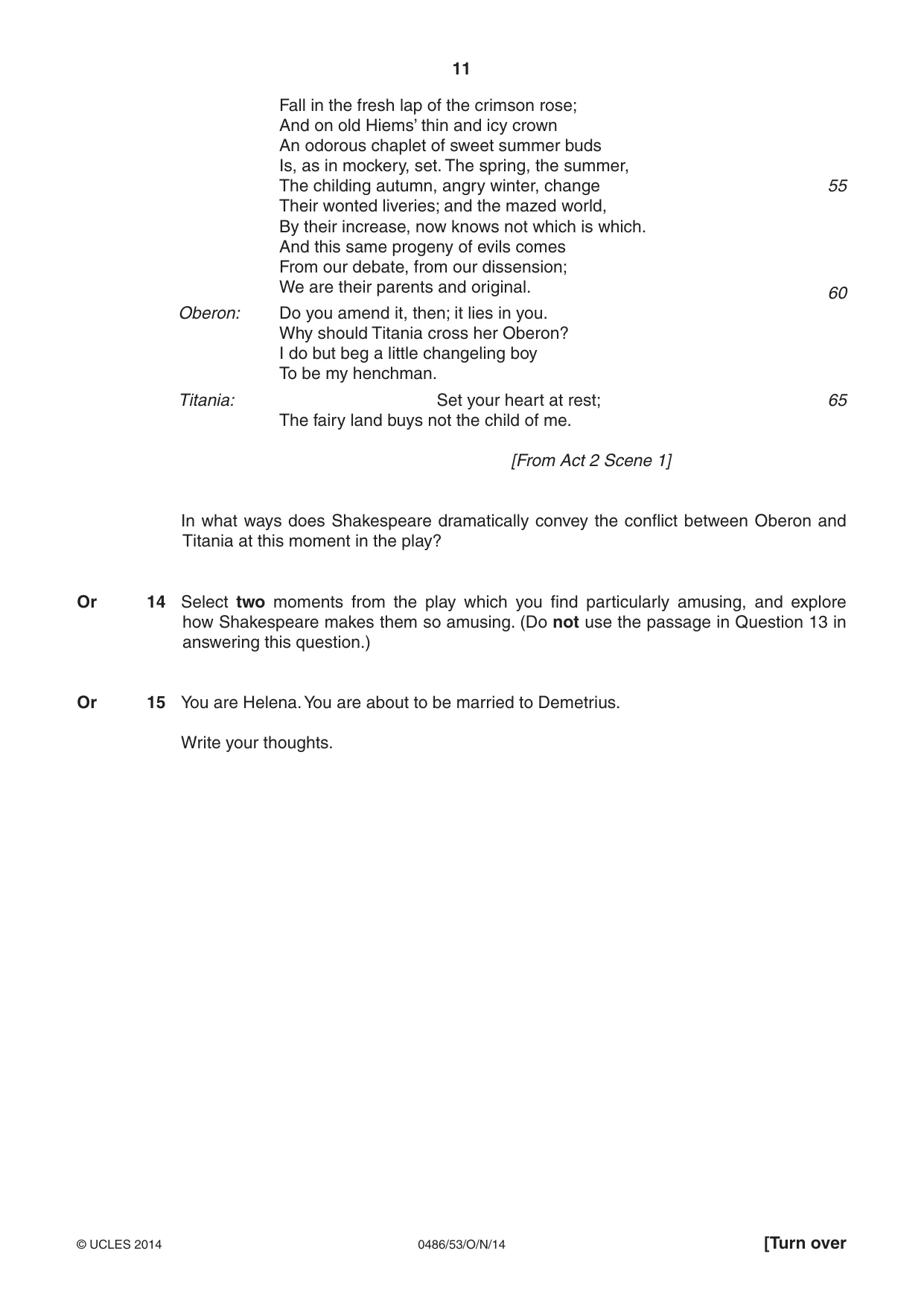
10 0486/53/O/N/14 © UCLES 2014 WILLIAM SHAKESPEARE: A Midsummer Night’s Dream Either 13 Read this extract, and then answer the question that follows it: Enter OBERON at one door, with his Train, and TITANIA, at another, with hers. Oberon: Ill met by moonlight, proud Titania. Titania: What, jealous Oberon! Fairies, skip hence; I have forsworn his bed and company. Oberon: Tarry, rash wanton; am not I thy lord? Titania: Then I must be thy lady; but I know When thou hast stolen away from fairy land, And in the shape of Corin sat all day, Playing on pipes of corn, and versing love To amorous Phillida. Why art thou here, Come from the farthest steep of India, But that, forsooth, the bouncing Amazon, Your buskin’d mistress and your warrior love, To Theseus must be wedded, and you come To give their bed joy and prosperity? Oberon: How canst thou thus, for shame, Titania, Glance at my credit with Hippolyta, Knowing I know thy love to Theseus? Didst not thou lead him through the glimmering night From Perigouna, whom he ravished? And make him with fair Ægles break his faith, With Ariadne and Antiopa? Titania: These are the forgeries of jealousy; And never, since the middle summer’s spring, Met we on hill, in dale, forest, or mead, By paved fountain, or by rushy brook, Or in the beached margent of the sea, To dance our ringlets to the whistling wind, But with thy brawls thou hast disturb’d our sport. Therefore the winds, piping to us in vain, As in revenge, have suck’d up from the sea Contagious fogs; which, falling in the land, Hath every pelting river made so proud That they have overborne their continents. The ox hath therefore stretch’d his yoke in vain, The ploughman lost his sweat, and the green corn Hath rotted ere his youth attain’d a beard; The fold stands empty in the drowned field, And crows are fatted with the murrion flock; The nine men’s morris is fill’d up with mud, And the quaint mazes in the wanton green, For lack of tread, are undistinguishable. The human mortals want their winter here; No night is now with hymn or carol blest; Therefore the moon, the governess of floods, Pale in her anger, washes all the air, That rheumatic diseases do abound. And thorough this distemperature we see The seasons alter: hoary-headed frosts 5 10 15 20 25 30 35 40 45 50
Question paper, page 11
11 0486/53/O/N/14 © UCLES 2014 [Turn over Fall in the fresh lap of the crimson rose; And on old Hiems’ thin and icy crown An odorous chaplet of sweet summer buds Is, as in mockery, set. The spring, the summer, The childing autumn, angry winter, change Their wonted liveries; and the mazed world, By their increase, now knows not which is which. And this same progeny of evils comes From our debate, from our dissension; We are their parents and original. Oberon: Do you amend it, then; it lies in you. Why should Titania cross her Oberon? I do but beg a little changeling boy To be my henchman. Titania: Set your heart at rest; The fairy land buys not the child of me. [From Act 2 Scene 1] In what ways does Shakespeare dramatically convey the conflict between Oberon and Titania at this moment in the play? Or 14 Select two moments from the play which you find particularly amusing, and explore how Shakespeare makes them so amusing. (Do not use the passage in Question 13 in answering this question.) Or 15 You are Helena. You are about to be married to Demetrius. Write your thoughts. 55 60 65
Question paper, page 12
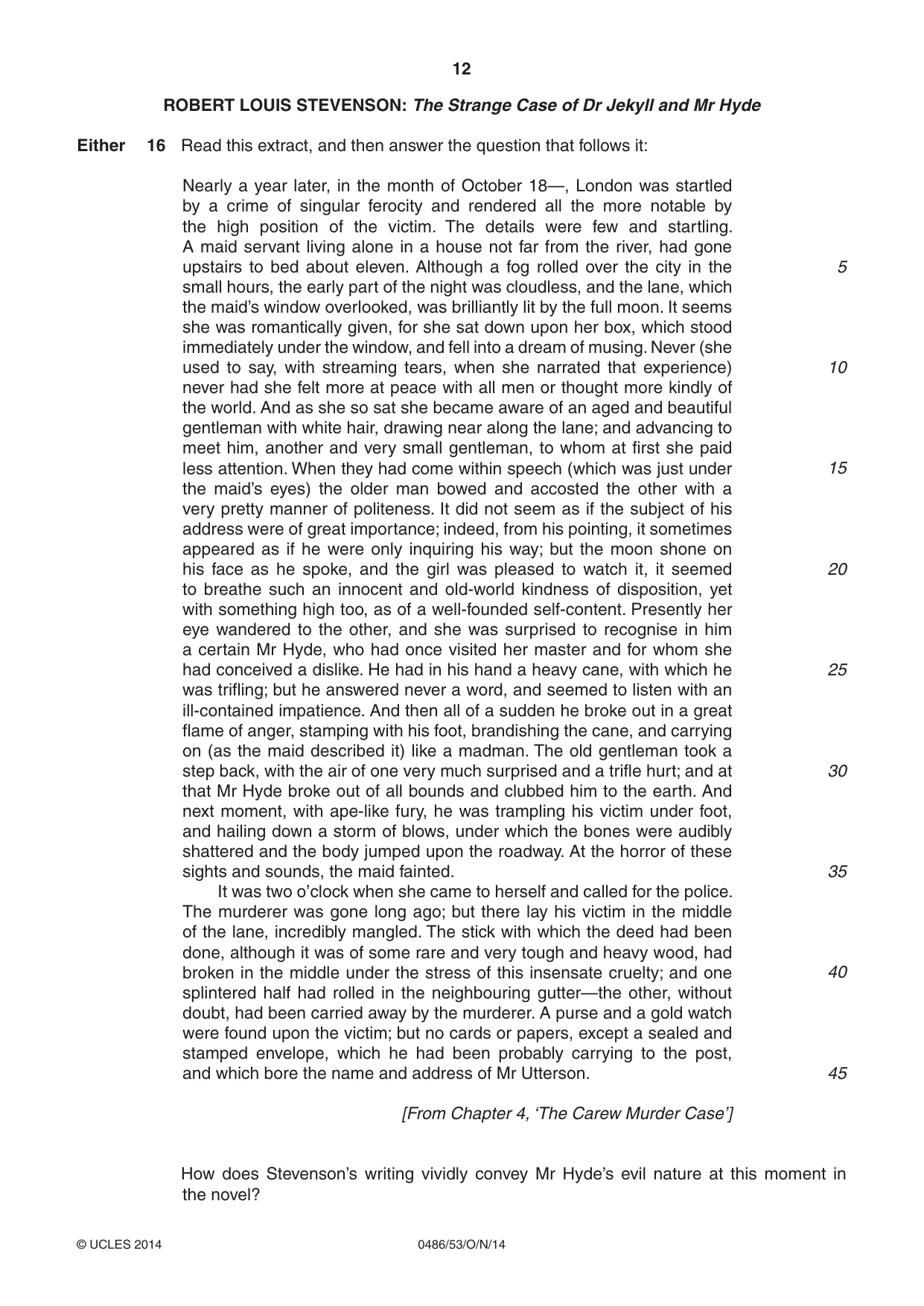
12 0486/53/O/N/14 © UCLES 2014 ROBERT LOUIS STEVENSON: The Strange Case of Dr Jekyll and Mr Hyde Either 16 Read this extract, and then answer the question that follows it: Nearly a year later, in the month of October 18—, London was startled by a crime of singular ferocity and rendered all the more notable by the high position of the victim. The details were few and startling. A maid servant living alone in a house not far from the river, had gone upstairs to bed about eleven. Although a fog rolled over the city in the small hours, the early part of the night was cloudless, and the lane, which the maid’s window overlooked, was brilliantly lit by the full moon. It seems she was romantically given, for she sat down upon her box, which stood immediately under the window, and fell into a dream of musing. Never (she used to say, with streaming tears, when she narrated that experience) never had she felt more at peace with all men or thought more kindly of the world. And as she so sat she became aware of an aged and beautiful gentleman with white hair, drawing near along the lane; and advancing to meet him, another and very small gentleman, to whom at first she paid less attention. When they had come within speech (which was just under the maid’s eyes) the older man bowed and accosted the other with a very pretty manner of politeness. It did not seem as if the subject of his address were of great importance; indeed, from his pointing, it sometimes appeared as if he were only inquiring his way; but the moon shone on his face as he spoke, and the girl was pleased to watch it, it seemed to breathe such an innocent and old-world kindness of disposition, yet with something high too, as of a well-founded self-content. Presently her eye wandered to the other, and she was surprised to recognise in him a certain Mr Hyde, who had once visited her master and for whom she had conceived a dislike. He had in his hand a heavy cane, with which he was trifling; but he answered never a word, and seemed to listen with an ill-contained impatience. And then all of a sudden he broke out in a great flame of anger, stamping with his foot, brandishing the cane, and carrying on (as the maid described it) like a madman. The old gentleman took a step back, with the air of one very much surprised and a trifle hurt; and at that Mr Hyde broke out of all bounds and clubbed him to the earth. And next moment, with ape-like fury, he was trampling his victim under foot, and hailing down a storm of blows, under which the bones were audibly shattered and the body jumped upon the roadway. At the horror of these sights and sounds, the maid fainted. It was two o’clock when she came to herself and called for the police. The murderer was gone long ago; but there lay his victim in the middle of the lane, incredibly mangled. The stick with which the deed had been done, although it was of some rare and very tough and heavy wood, had broken in the middle under the stress of this insensate cruelty; and one splintered half had rolled in the neighbouring gutter—the other, without doubt, had been carried away by the murderer. A purse and a gold watch were found upon the victim; but no cards or papers, except a sealed and stamped envelope, which he had been probably carrying to the post, and which bore the name and address of Mr Utterson. [From Chapter 4, ‘The Carew Murder Case’] How does Stevenson’s writing vividly convey Mr Hyde’s evil nature at this moment in the novel? 5 10 15 20 25 30 35 40 45
Question paper, page 13
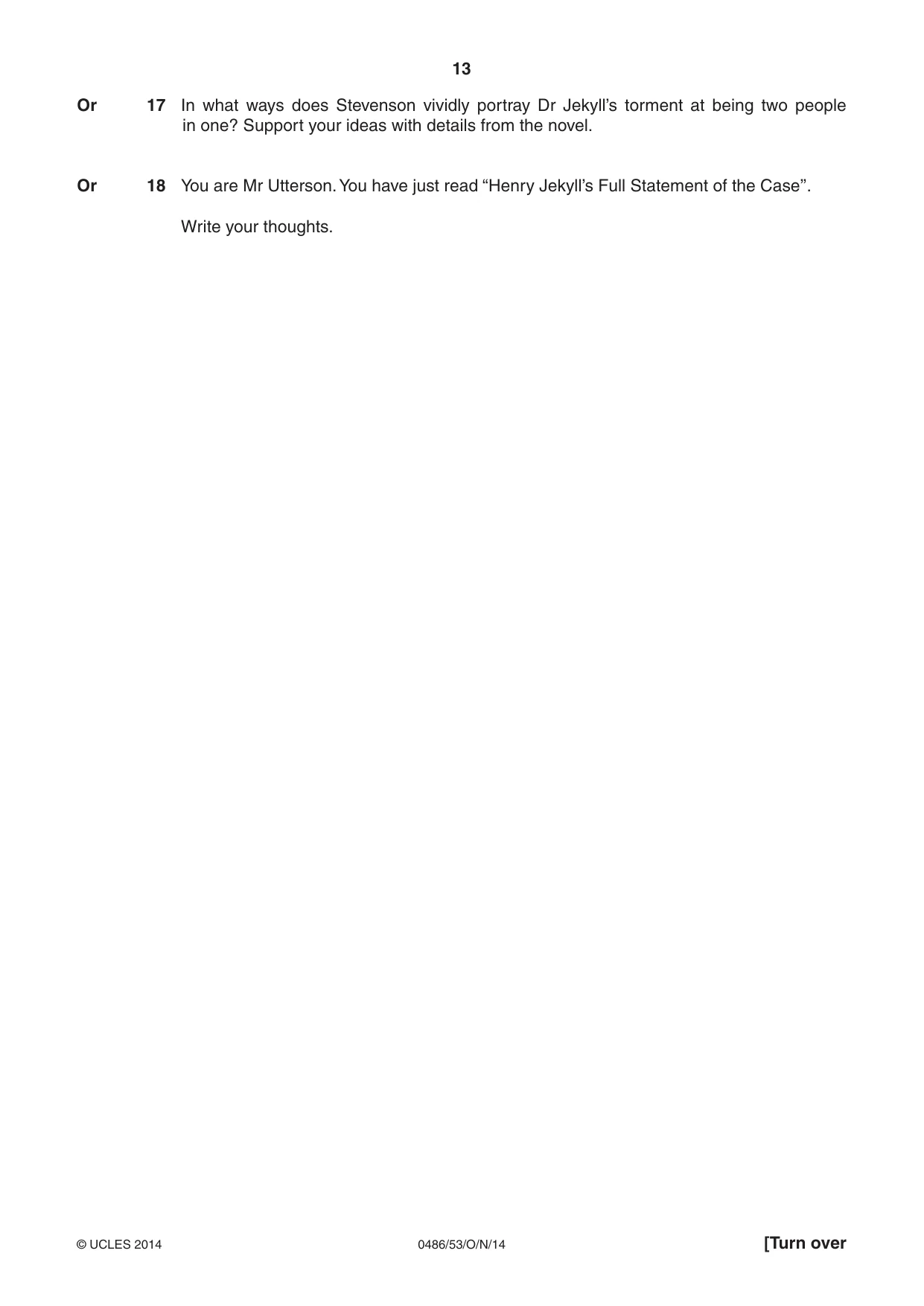
13 0486/53/O/N/14 © UCLES 2014 [Turn over Or 17 In what ways does Stevenson vividly portray Dr Jekyll’s torment at being two people in one? Support your ideas with details from the novel. Or 18 You are Mr Utterson. You have just read ‘‘Henry Jekyll’s Full Statement of the Case’’. Write your thoughts.
Question paper, page 14
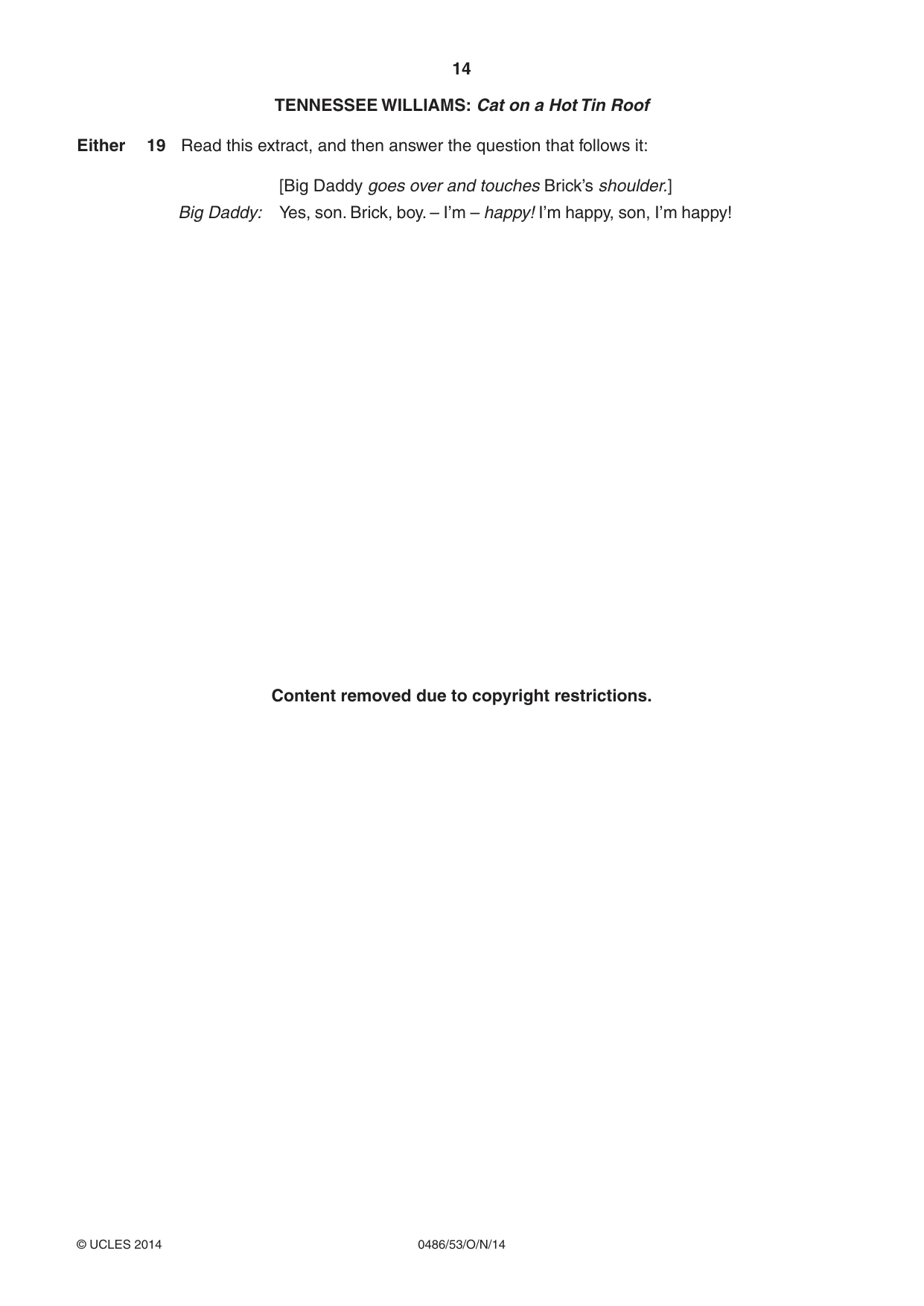
14 0486/53/O/N/14 © UCLES 2014 TENNESSEE WILLIAMS: Cat on a Hot Tin Roof Either 19 Read this extract, and then answer the question that follows it: [Big Daddy goes over and touches Brick’s shoulder.] Big Daddy: Yes, son. Brick, boy. – I’m – happy! I’m happy, son, I’m happy! Content removed due to copyright restrictions.
Question paper, page 15
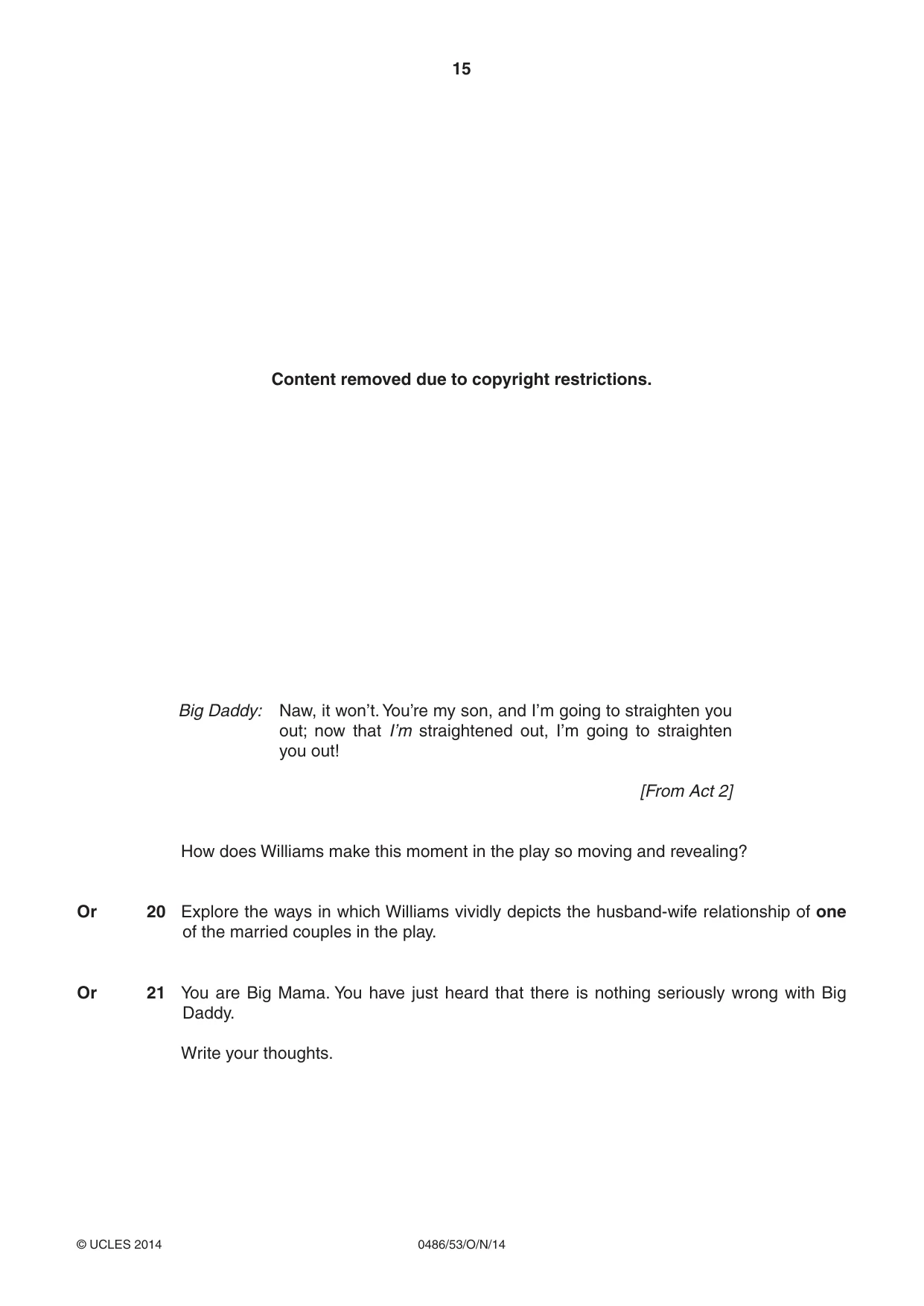
15 0486/53/O/N/14 © UCLES 2014 Big Daddy: Naw, it won’t. You’re my son, and I’m going to straighten you out; now that I’m straightened out, I’m going to straighten you out! [From Act 2] How does Williams make this moment in the play so moving and revealing? Or 20 Explore the ways in which Williams vividly depicts the husband-wife relationship of one of the married couples in the play. Or 21 You are Big Mama. You have just heard that there is nothing seriously wrong with Big Daddy. Write your thoughts. Content removed due to copyright restrictions.
Question paper, page 16
16 0486/53/O/N/14 © UCLES 2014 Copyright Acknowledgements: Question 4 © Carol Ann Duffy; Mean Time, in Selected Poems; Penguin Books Ltd; 1994. Question 7 © Helen Dunmore; The Siege; Penguin Books Ltd; 2002. Question 10 © Elizabeth Jennings; One Flesh, in ed. Jo Phillips; Poems Deep and Dangerous; Cambridge University Press; 1995. Question 19 © Cat on a Hot Tin Roof by Tennessee Williams. Copyright © 1954, 1955, by The University of the South, renewed 1982, 1983 The University of the South. Reprinted by permission of New Directions Publishing Corp and Georges Borchardt, Inc. for the Estate of Tennessee Williams. Permission to reproduce items where third-party owned material protected by copyright is included has been sought and cleared where possible. Every reasonable effort has been made by the publisher (UCLES) to trace copyright holders, but if any items requiring clearance have unwittingly been included, the publisher will be pleased to make amends at the earliest possible opportunity. Cambridge International Examinations is part of the Cambridge Assessment Group. Cambridge Assessment is the brand name of University of Cambridge Local Examinations Syndicate (UCLES), which is itself a department of the University of Cambridge. BLANK PAGE
Mark scheme, page 1
® IGCSE is the registered trademark of Cambridge International Examinations. CAMBRIDGE INTERNATIONAL EXAMINATIONS Cambridge International General Certificate of Secondary Education MARK SCHEME for the October/November 2014 series 0486 LITERATURE (ENGLISH) 0486/53 Paper 5 (Set Texts: Closed Books B), maximum raw mark 25 This mark scheme is published as an aid to teachers and candidates, to indicate the requirements of the examination. It shows the basis on which Examiners were instructed to award marks. It does not indicate the details of the discussions that took place at an Examiners’ meeting before marking began, which would have considered the acceptability of alternative answers. Mark schemes should be read in conjunction with the question paper and the Principal Examiner Report for Teachers. Cambridge will not enter into discussions about these mark schemes. Cambridge is publishing the mark schemes for the October/November 2014 series for most Cambridge IGCSE®, Cambridge International A and AS Level components and some Cambridge O Level components.
Mark scheme, page 2
Page 2 Mark Scheme Syllabus Paper Cambridge IGCSE – October/November 2014 0486 53 © Cambridge International Examinations 2014 The Assessment Objectives for the paper are: AO1 show detailed knowledge of the content of literary texts AO2 understand the meanings of literary texts and their context, and explore texts beyond surface meaning to show deeper awareness of ideas and attitudes AO3 recognise and appreciate ways in which writers use language, structure, and form to create and shape meanings and effects AO4 communicate a sensitive and informed personal response The General Descriptors cover marks from 0 to 25, and apply to the marking of each question. They guide examiners to an understanding of the qualities normally expected of, or typical of, work in a band. They are a means of general guidance, and must not be interpreted as hurdle statements.
Mark scheme, page 3
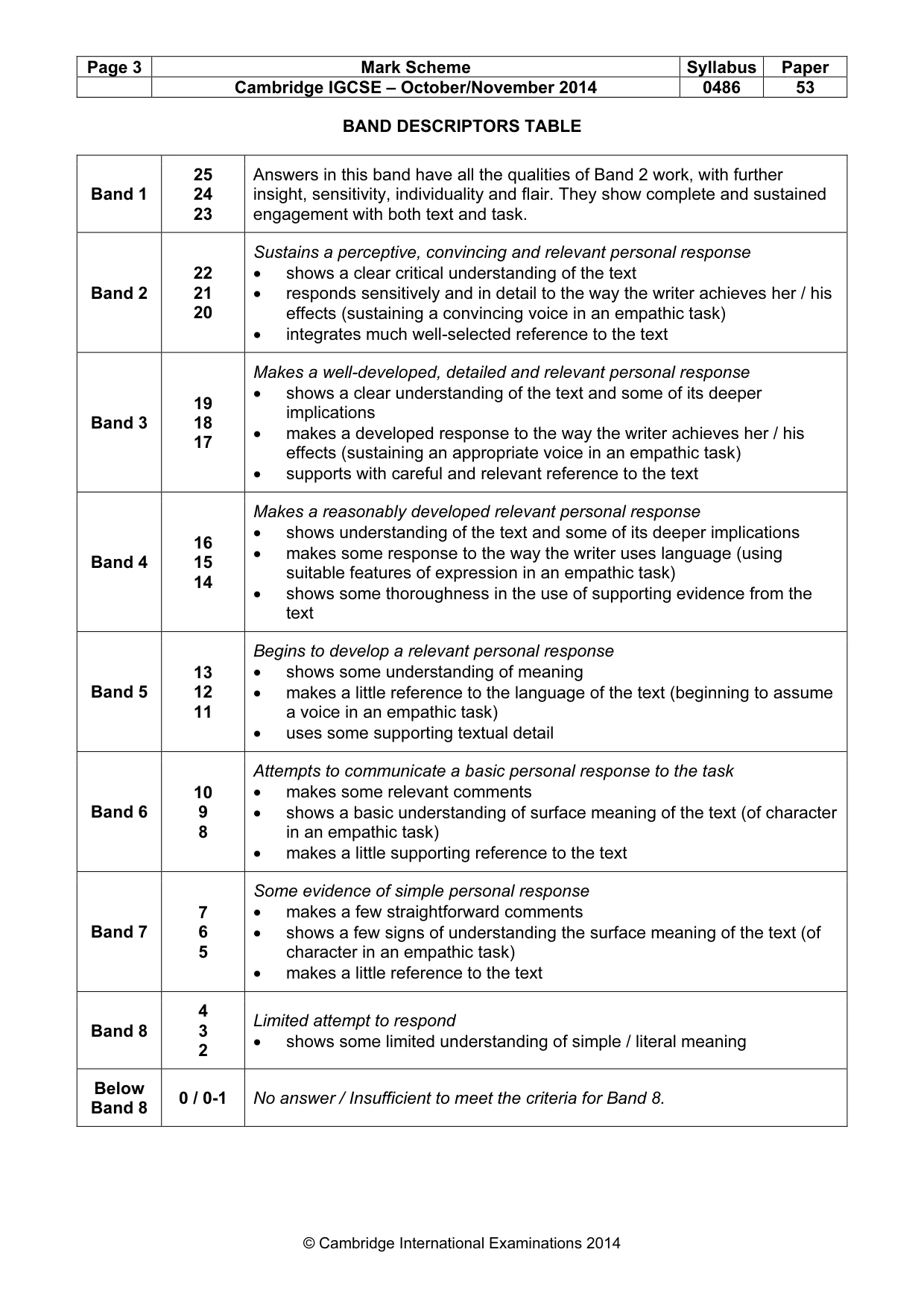
Page 3 Mark Scheme Syllabus Paper Cambridge IGCSE – October/November 2014 0486 53 © Cambridge International Examinations 2014 BAND DESCRIPTORS TABLE Band 1 25 24 23 Answers in this band have all the qualities of Band 2 work, with further insight, sensitivity, individuality and flair. They show complete and sustained engagement with both text and task. Band 2 22 21 20 Sustains a perceptive, convincing and relevant personal response • shows a clear critical understanding of the text • responds sensitively and in detail to the way the writer achieves her / his effects (sustaining a convincing voice in an empathic task) • integrates much well-selected reference to the text Band 3 19 18 17 Makes a well-developed, detailed and relevant personal response • shows a clear understanding of the text and some of its deeper implications • makes a developed response to the way the writer achieves her / his effects (sustaining an appropriate voice in an empathic task) • supports with careful and relevant reference to the text Band 4 16 15 14 Makes a reasonably developed relevant personal response • shows understanding of the text and some of its deeper implications • makes some response to the way the writer uses language (using suitable features of expression in an empathic task) • shows some thoroughness in the use of supporting evidence from the text Band 5 13 12 11 Begins to develop a relevant personal response • shows some understanding of meaning • makes a little reference to the language of the text (beginning to assume a voice in an empathic task) • uses some supporting textual detail Band 6 10 9 8 Attempts to communicate a basic personal response to the task • makes some relevant comments • shows a basic understanding of surface meaning of the text (of character in an empathic task) • makes a little supporting reference to the text Band 7 7 6 5 Some evidence of simple personal response • makes a few straightforward comments • shows a few signs of understanding the surface meaning of the text (of character in an empathic task) • makes a little reference to the text Band 8 4 3 2 Limited attempt to respond • shows some limited understanding of simple / literal meaning Below Band 8 0 / 0-1 No answer / Insufficient to meet the criteria for Band 8.
What you needed in this session
Cambridge’s own grade thresholds for 2014 Oct/Nov, Paper 5 · Variant 3. A higher threshold means an easier paper — the bar moves with how the cohort did.