Cambridge IGCSE English - Literature 0486 — 2012 May/June Paper 5 · Variant 1
0486/51/M/J/12 · 25 marks · ≈28 min
The question paper and its mark scheme, free to read here and free to download. This is Cambridge’s own paper, exactly as it was sat.
Question paper16 pages

Mark scheme2 pages
Answers below. Sit the paper first if you are practising.
Paper as text
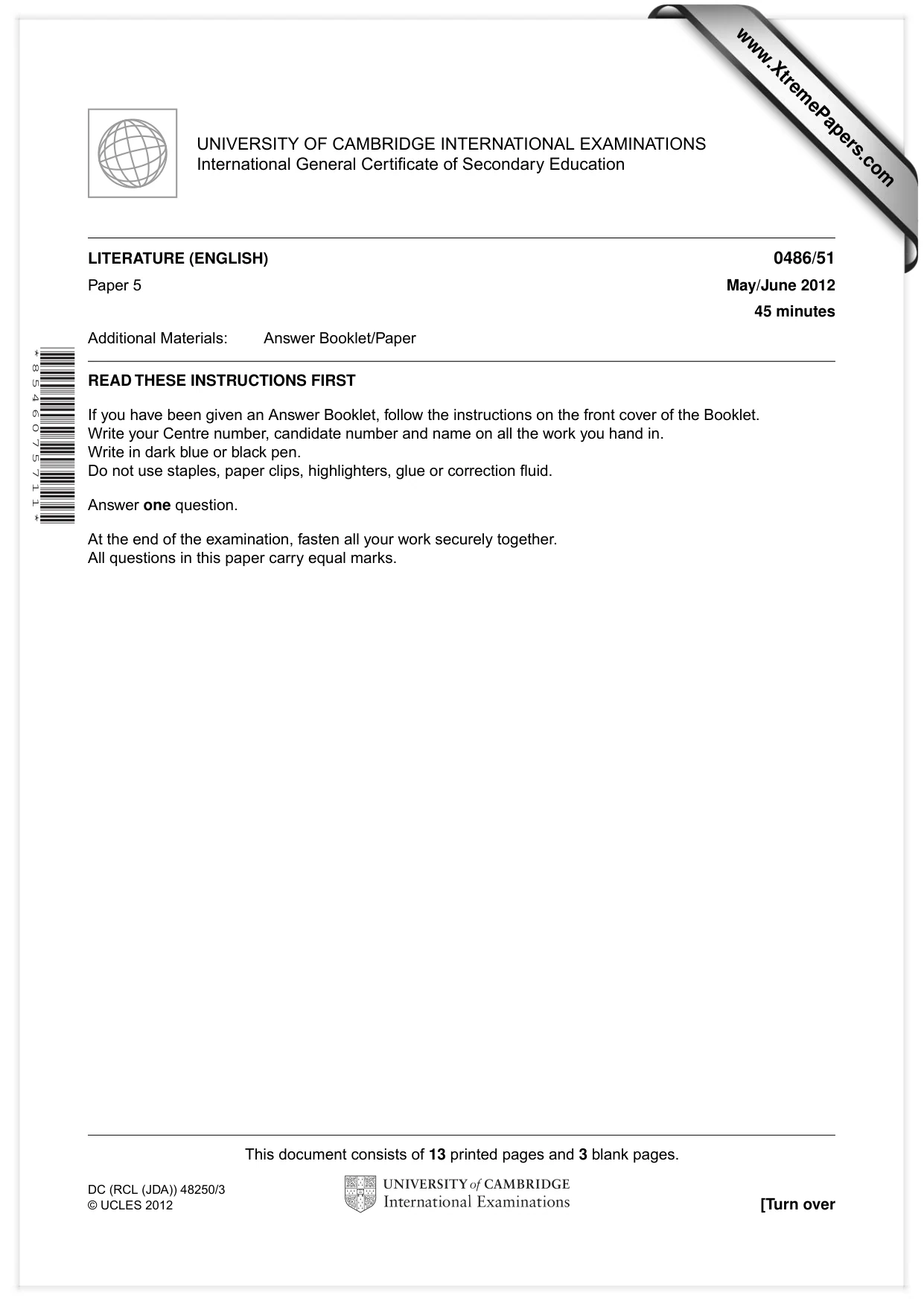
Question paper, page 1
This document consists of 13 printed pages and 3 blank pages. DC (RCL (JDA)) 48250/3 © UCLES 2012 [Turn over UNIVERSITY OF CAMBRIDGE INTERNATIONAL EXAMINATIONS International General Certificate of Secondary Education * 8 5 4 6 0 7 5 7 1 1 * LITERATURE (ENGLISH) 0486/51 Paper 5 May/June 2012 45 minutes Additional Materials: Answer Booklet/Paper READ THESE INSTRUCTIONS FIRST If you have been given an Answer Booklet, follow the instructions on the front cover of the Booklet. Write your Centre number, candidate number and name on all the work you hand in. Write in dark blue or black pen. Do not use staples, paper clips, highlighters, glue or correction fluid. Answer one question. At the end of the examination, fasten all your work securely together. All questions in this paper carry equal marks. www.XtremePapers.com
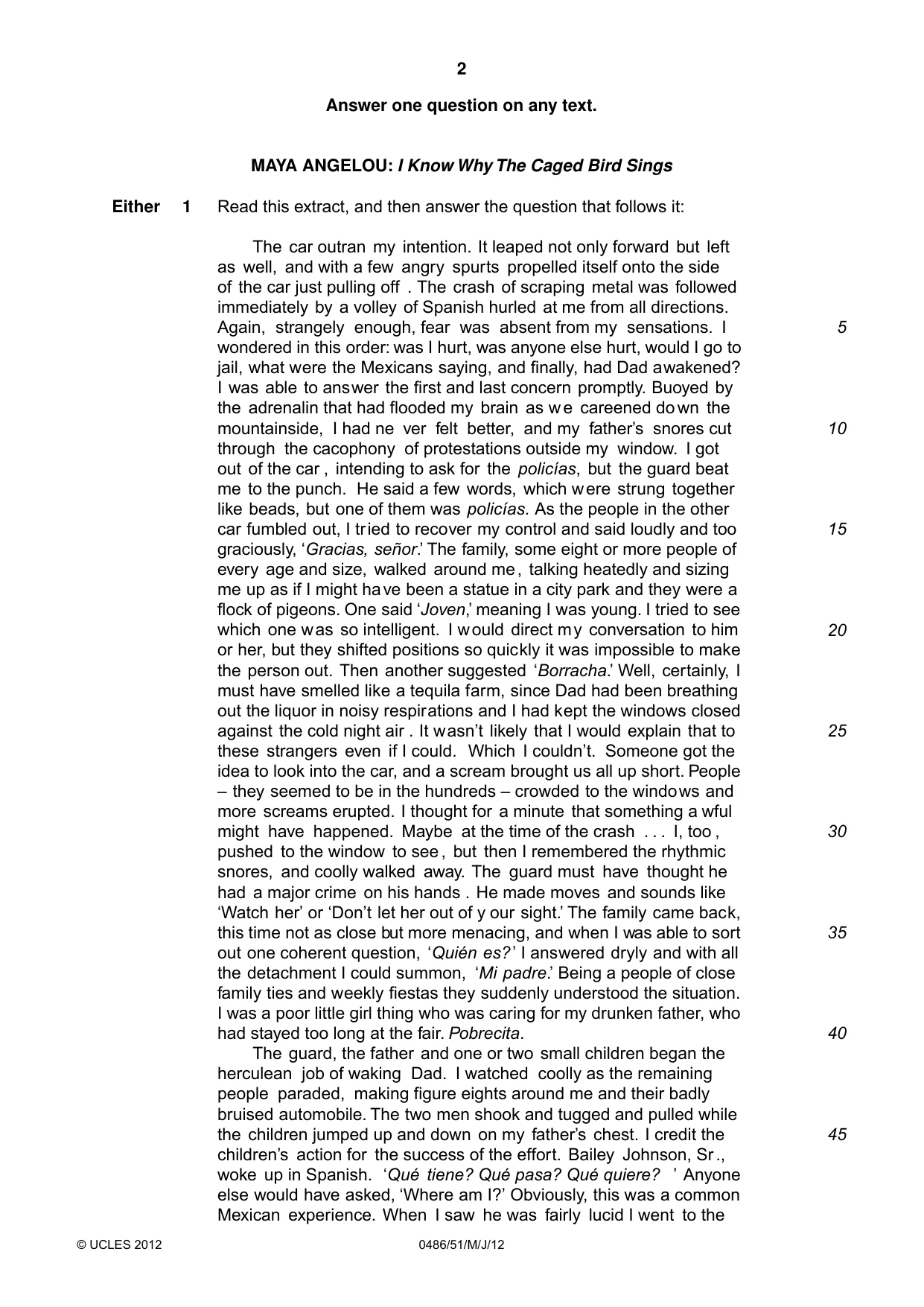
Question paper, page 2
2 0486/51/M/J/12 © UCLES 2012 Answer one question on any text. MAYA ANGELOU: I Know Why The Caged Bird Sings Either 1 Read this extract, and then answer the question that follows it: The car outran my intention. It leaped not only forward but left as well, and with a few angry spurts propelled itself onto the side of the car just pulling off . The crash of scraping metal was followed immediately by a volley of Spanish hurled at me from all directions. Again, strangely enough, fear was absent from my sensations. I wondered in this order: was I hurt, was anyone else hurt, would I go to jail, what were the Mexicans saying, and finally, had Dad awakened? I was able to answer the first and last concern promptly. Buoyed by the adrenalin that had flooded my brain as we careened down the mountainside, I had ne ver felt better, and my father’s snores cut through the cacophony of protestations outside my window. I got out of the car , intending to ask for the policías, but the guard beat me to the punch. He said a few words, which were strung together like beads, but one of them was policías. As the people in the other car fumbled out, I tried to recover my control and said loudly and too graciously, ‘Gracias, señor.’ The family, some eight or more people of every age and size, walked around me, talking heatedly and sizing me up as if I might have been a statue in a city park and they were a flock of pigeons. One said ‘Joven,’ meaning I was young. I tried to see which one was so intelligent. I would direct my conversation to him or her, but they shifted positions so quickly it was impossible to make the person out. Then another suggested ‘Borracha.’ Well, certainly, I must have smelled like a tequila farm, since Dad had been breathing out the liquor in noisy respirations and I had kept the windows closed against the cold night air . It wasn’t likely that I would explain that to these strangers even if I could. Which I couldn’t. Someone got the idea to look into the car, and a scream brought us all up short. People – they seemed to be in the hundreds – crowded to the windows and more screams erupted. I thought for a minute that something a wful might have happened. Maybe at the time of the crash . . . I, too , pushed to the window to see, but then I remembered the rhythmic snores, and coolly walked away. The guard must have thought he had a major crime on his hands . He made moves and sounds like ‘Watch her’ or ‘Don’t let her out of y our sight.’ The family came back, this time not as close but more menacing, and when I was able to sort out one coherent question, ‘Quién es? ’ I answered dryly and with all the detachment I could summon, ‘Mi padre.’ Being a people of close family ties and weekly fiestas they suddenly understood the situation. I was a poor little girl thing who was caring for my drunken father, who had stayed too long at the fair. Pobrecita. The guard, the father and one or two small children began the herculean job of waking Dad. I watched coolly as the remaining people paraded, making figure eights around me and their badly bruised automobile. The two men shook and tugged and pulled while the children jumped up and down on my father’s chest. I credit the children’s action for the success of the effort. Bailey Johnson, Sr., woke up in Spanish. ‘Qué tiene? Qué pasa? Qué quiere? ’ Anyone else would have asked, ‘Where am I?’ Obviously, this was a common Mexican experience. When I saw he was fairly lucid I went to the 5 10 15 20 25 30 35 40 45
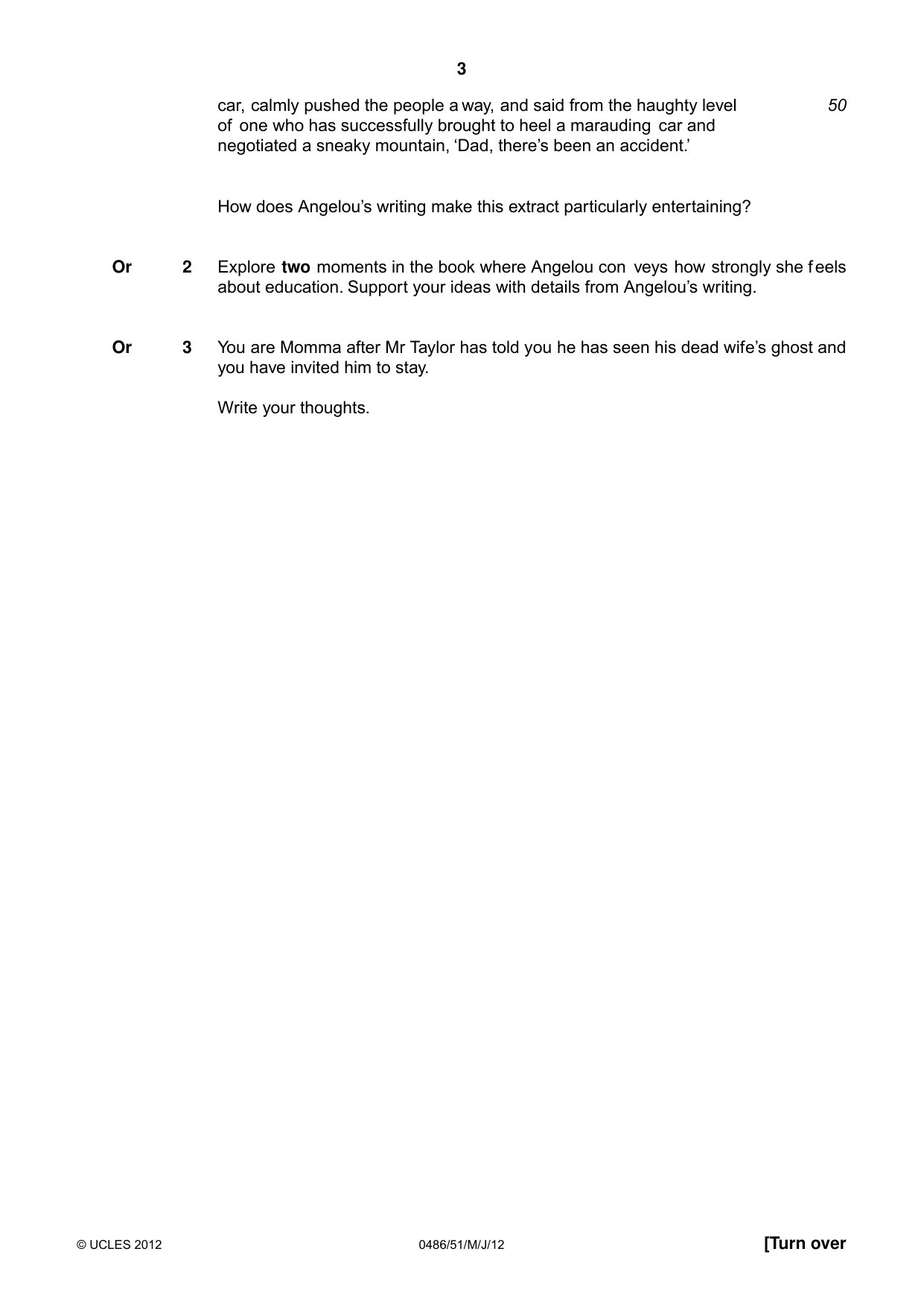
Question paper, page 3
3 0486/51/M/J/12 © UCLES 2012 [Turn over car, calmly pushed the people a way, and said from the haughty level of one who has successfully brought to heel a marauding car and negotiated a sneaky mountain, ‘Dad, there’s been an accident.’ How does Angelou’s writing make this extract particularly entertaining? Or 2 Explore two moments in the book where Angelou con veys how strongly she feels about education. Support your ideas with details from Angelou’s writing. Or 3 You are Momma after Mr Taylor has told you he has seen his dead wife’s ghost and you have invited him to stay. Write your thoughts. 50
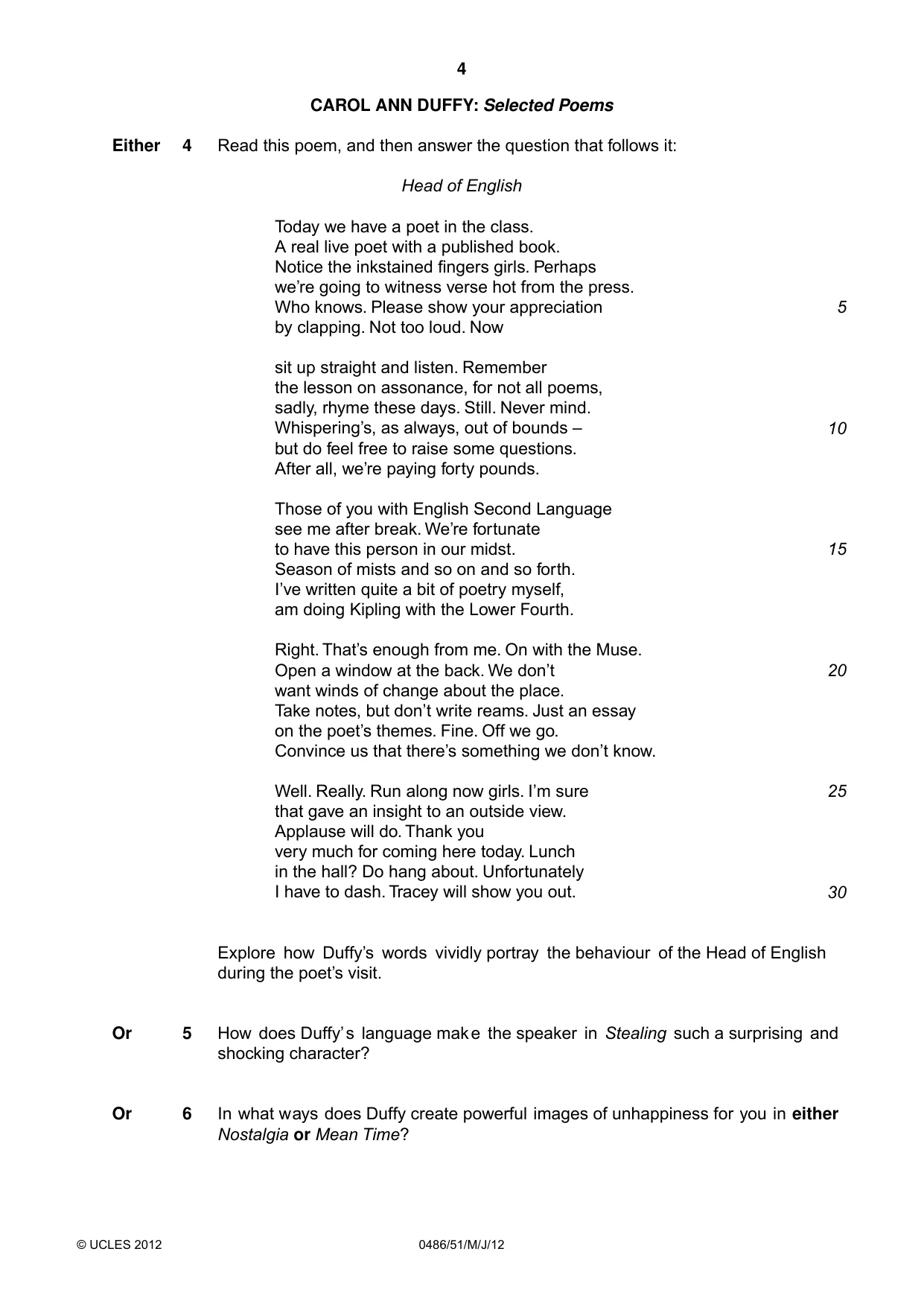
Question paper, page 4
4 0486/51/M/J/12 © UCLES 2012 CAROL ANN DUFFY: Selected Poems Either 4 Read this poem, and then answer the question that follows it: Head of English Today we have a poet in the class. A real live poet with a published book. Notice the inkstained fingers girls. Perhaps we’re going to witness verse hot from the press. Who knows. Please show your appreciation by clapping. Not too loud. Now sit up straight and listen. Remember the lesson on assonance, for not all poems, sadly, rhyme these days. Still. Never mind. Whispering’s, as always, out of bounds – but do feel free to raise some questions. After all, we’re paying forty pounds. Those of you with English Second Language see me after break. We’re fortunate to have this person in our midst. Season of mists and so on and so forth. I’ve written quite a bit of poetry myself, am doing Kipling with the Lower Fourth. Right. That’s enough from me. On with the Muse. Open a window at the back. We don’t want winds of change about the place. Take notes, but don’t write reams. Just an essay on the poet’s themes. Fine. Off we go. Convince us that there’s something we don’t know. Well. Really. Run along now girls. I’m sure that gave an insight to an outside view. Applause will do. Thank you very much for coming here today. Lunch in the hall? Do hang about. Unfortunately I have to dash. Tracey will show you out. Explore how Duffy’s words vividly portray the behaviour of the Head of English during the poet’s visit. Or 5 How does Duffy’s language make the speaker in Stealing such a surprising and shocking character? Or 6 In what ways does Duffy create powerful images of unhappiness for you in either Nostalgia or Mean Time? 5 10 15 20 25 30
Question paper, page 5
5 0486/51/M/J/12 © UCLES 2012 [Turn over BLANK PAGE Turn to page 6 for Question 7.
Question paper, page 6
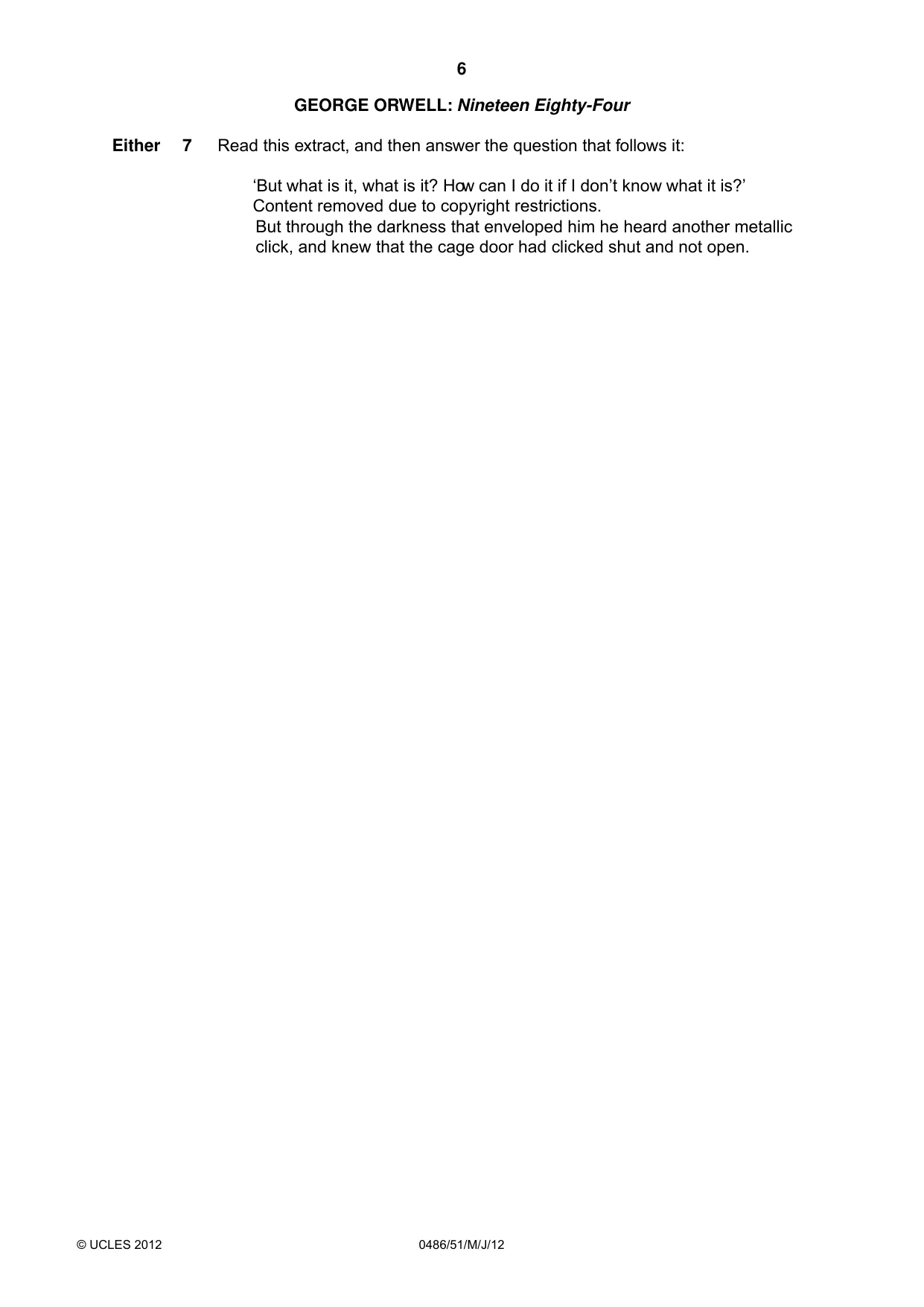
6 0486/51/M/J/12 © UCLES 2012 GEORGE ORWELL: Nineteen Eighty-Four Either 7 Read this extract, and then answer the question that follows it: ‘But what is it, what is it? How can I do it if I don’t know what it is?’ Content removed due to copyright restrictions. But through the darkness that enveloped him he heard another metallic click, and knew that the cage door had clicked shut and not open.
Question paper, page 7
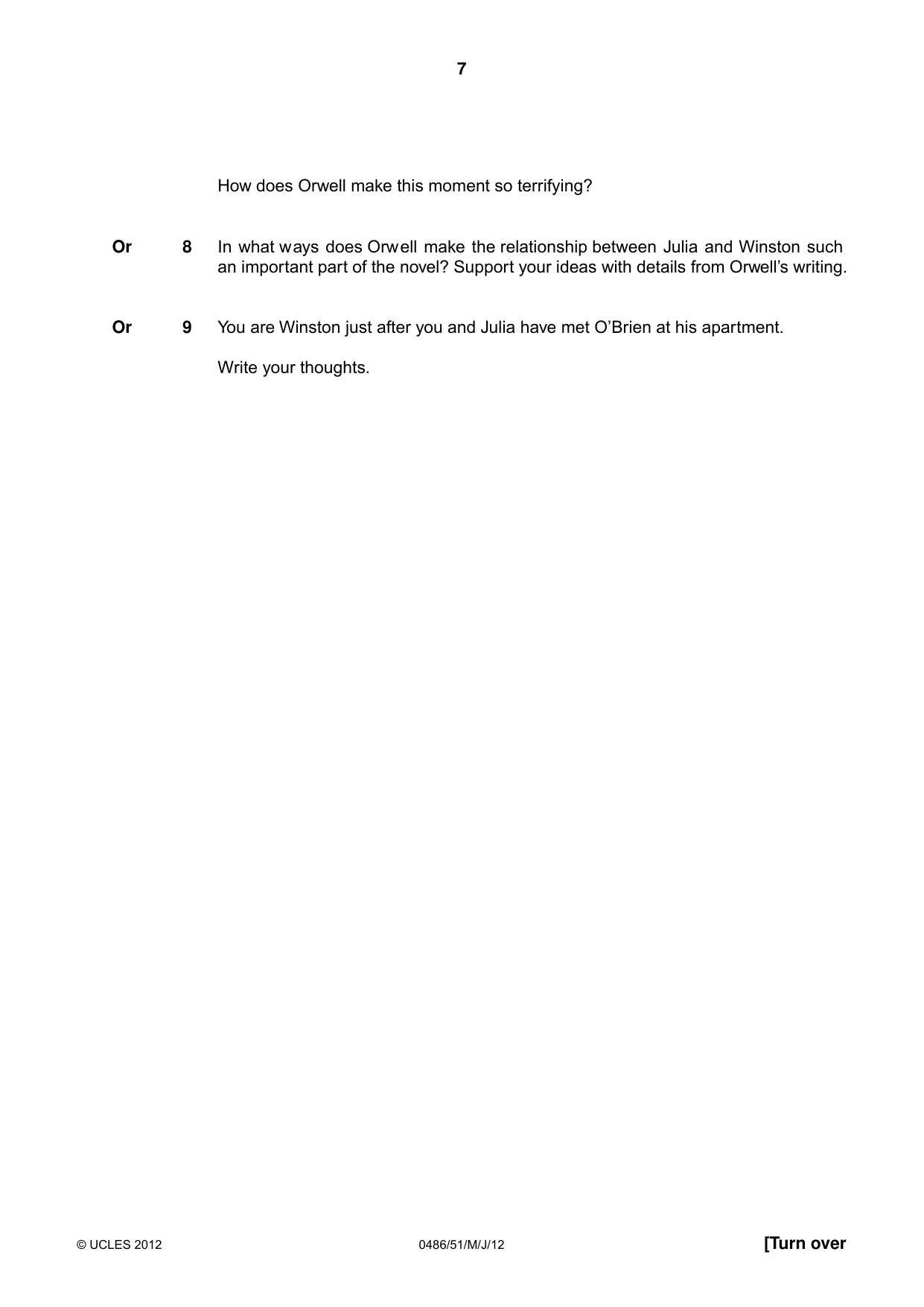
7 0486/51/M/J/12 © UCLES 2012 [Turn over How does Orwell make this moment so terrifying? Or 8 In what ways does Orwell make the relationship between Julia and Winston such an important part of the novel? Support your ideas with details from Orwell’s writing. Or 9 You are Winston just after you and Julia have met O’Brien at his apartment. Write your thoughts.
Question paper, page 8
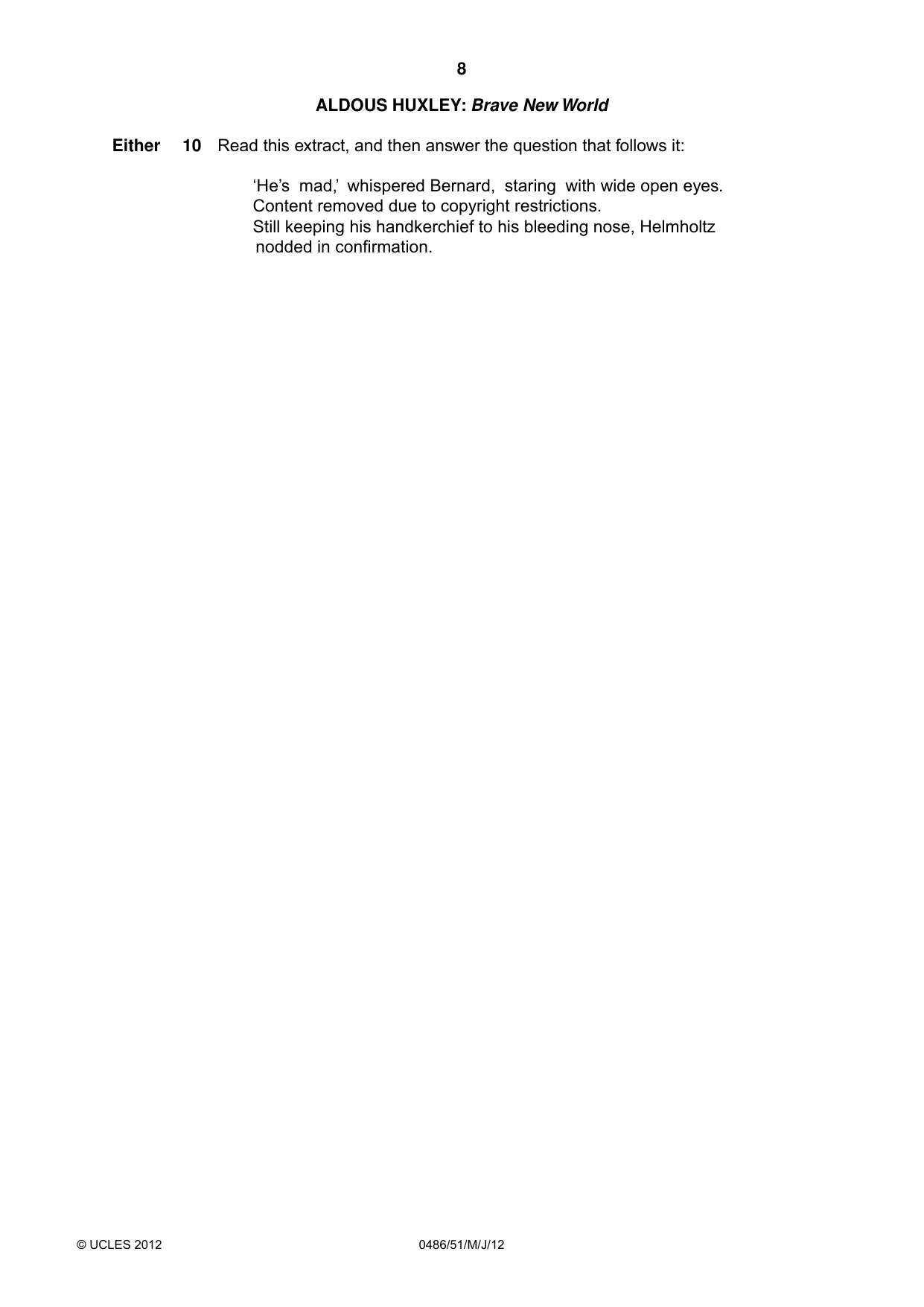
8 0486/51/M/J/12 © UCLES 2012 ALDOUS HUXLEY: Brave New World Either 10 Read this extract, and then answer the question that follows it: ‘He’s mad,’ whispered Bernard, staring with wide open eyes. Content removed due to copyright restrictions. Still keeping his handkerchief to his bleeding nose, Helmholtz nodded in confirmation.
Question paper, page 9
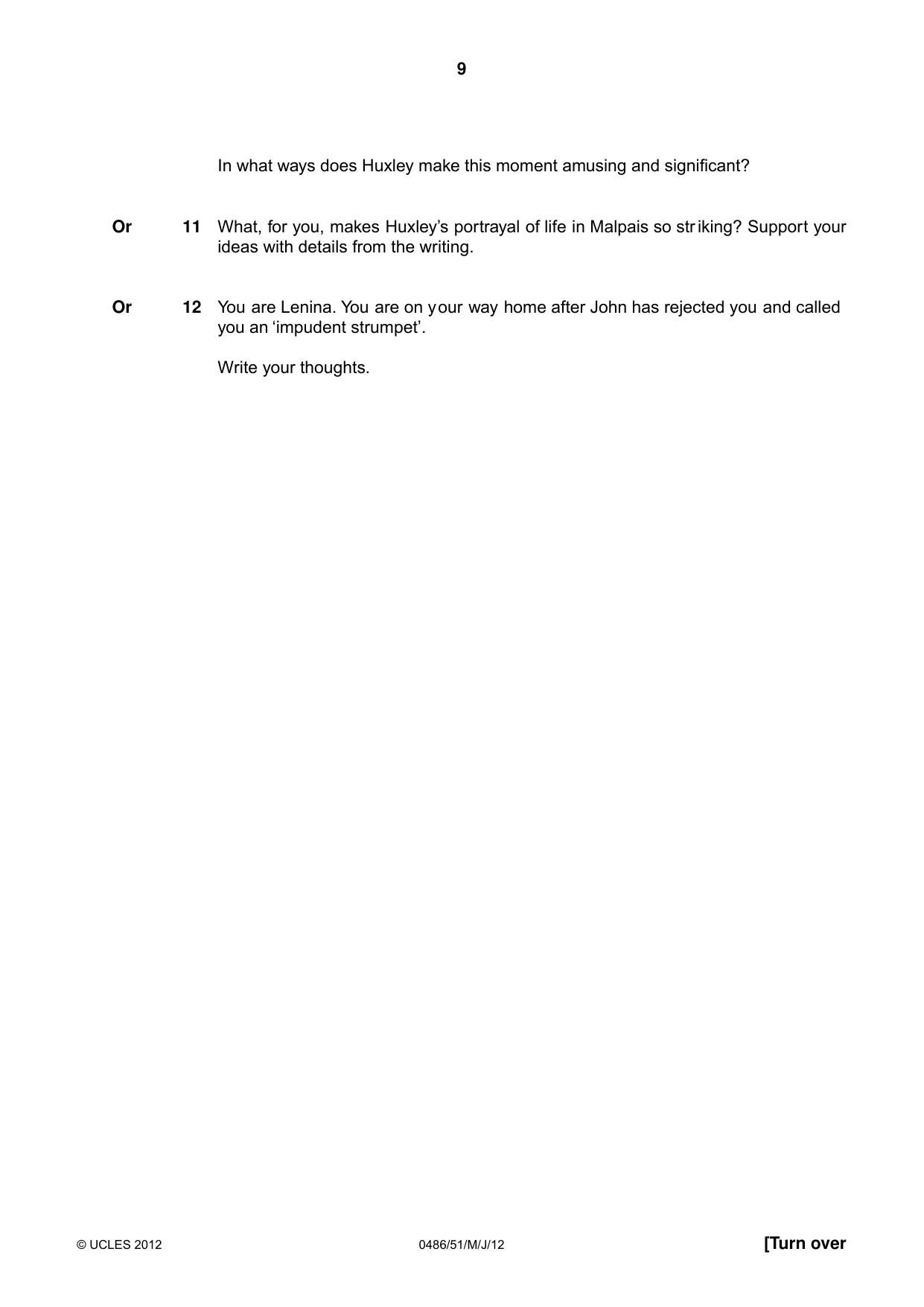
9 0486/51/M/J/12 © UCLES 2012 [Turn over In what ways does Huxley make this moment amusing and significant? Or 11 What, for you, makes Huxley’s portrayal of life in Malpais so striking? Support your ideas with details from the writing. Or 12 You are Lenina. You are on your way home after John has rejected you and called you an ‘impudent strumpet’. Write your thoughts.
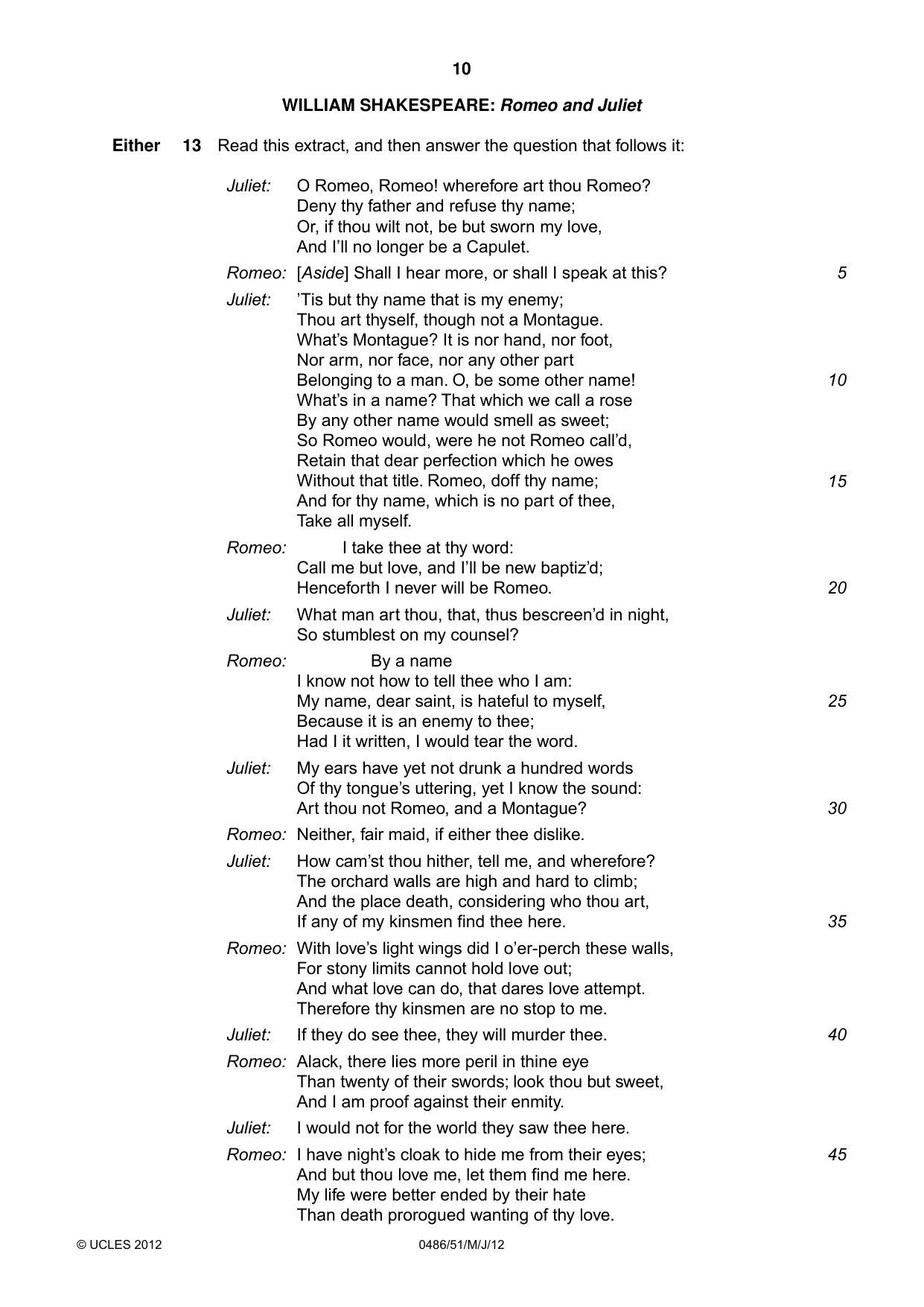
Question paper, page 10
10 0486/51/M/J/12 © UCLES 2012 WILLIAM SHAKESPEARE: Romeo and Juliet Either 13 Read this extract, and then answer the question that follows it: Juliet: O Romeo, Romeo! wherefore art thou Romeo? Deny thy father and refuse thy name; Or, if thou wilt not, be but sworn my love, And I’ll no longer be a Capulet. Romeo: [Aside] Shall I hear more, or shall I speak at this? Juliet: ’Tis but thy name that is my enemy; Thou art thyself, though not a Montague. What’s Montague? It is nor hand, nor foot, Nor arm, nor face, nor any other part Belonging to a man. O, be some other name! What’s in a name? That which we call a rose By any other name would smell as sweet; So Romeo would, were he not Romeo call’d, Retain that dear perfection which he owes Without that title. Romeo, doff thy name; And for thy name, which is no part of thee, Take all myself. Romeo: I take thee at thy word: Call me but love, and I’ll be new baptiz’d; Henceforth I never will be Romeo. Juliet: What man art thou, that, thus bescreen’d in night, So stumblest on my counsel? Romeo: By a name I know not how to tell thee who I am: My name, dear saint, is hateful to myself, Because it is an enemy to thee; Had I it written, I would tear the word. Juliet: My ears have yet not drunk a hundred words Of thy tongue’s uttering, yet I know the sound: Art thou not Romeo, and a Montague? Romeo: Neither, fair maid, if either thee dislike. Juliet: How cam’st thou hither, tell me, and wherefore? The orchard walls are high and hard to climb; And the place death, considering who thou art, If any of my kinsmen find thee here. Romeo: With love’s light wings did I o’er-perch these walls, For stony limits cannot hold love out; And what love can do, that dares love attempt. Therefore thy kinsmen are no stop to me. Juliet: If they do see thee, they will murder thee. Romeo: Alack, there lies more peril in thine eye Than twenty of their swords; look thou but sweet, And I am proof against their enmity. Juliet: I would not for the world they saw thee here. Romeo: I have night’s cloak to hide me from their eyes; And but thou love me, let them find me here. My life were better ended by their hate Than death prorogued wanting of thy love. 5 10 15 20 25 30 35 40 45
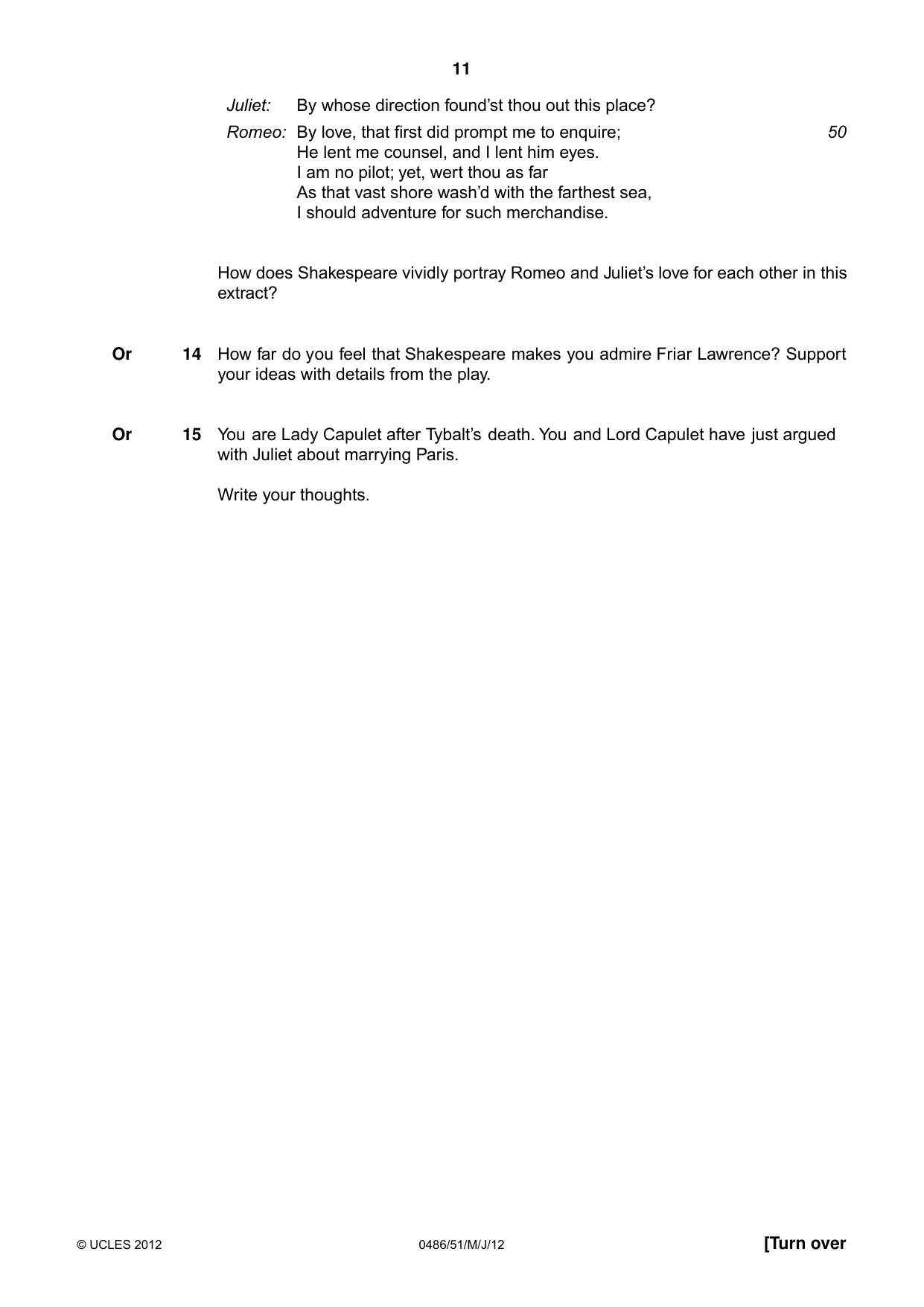
Question paper, page 11
11 0486/51/M/J/12 © UCLES 2012 [Turn over Juliet: By whose direction found’st thou out this place? Romeo: By love, that first did prompt me to enquire; He lent me counsel, and I lent him eyes. I am no pilot; yet, wert thou as far As that vast shore wash’d with the farthest sea, I should adventure for such merchandise. How does Shakespeare vividly portray Romeo and Juliet’s love for each other in this extract? Or 14 How far do you feel that Shakespeare makes you admire Friar Lawrence? Support your ideas with details from the play. Or 15 You are Lady Capulet after Tybalt’s death. You and Lord Capulet have just argued with Juliet about marrying Paris. Write your thoughts. 50
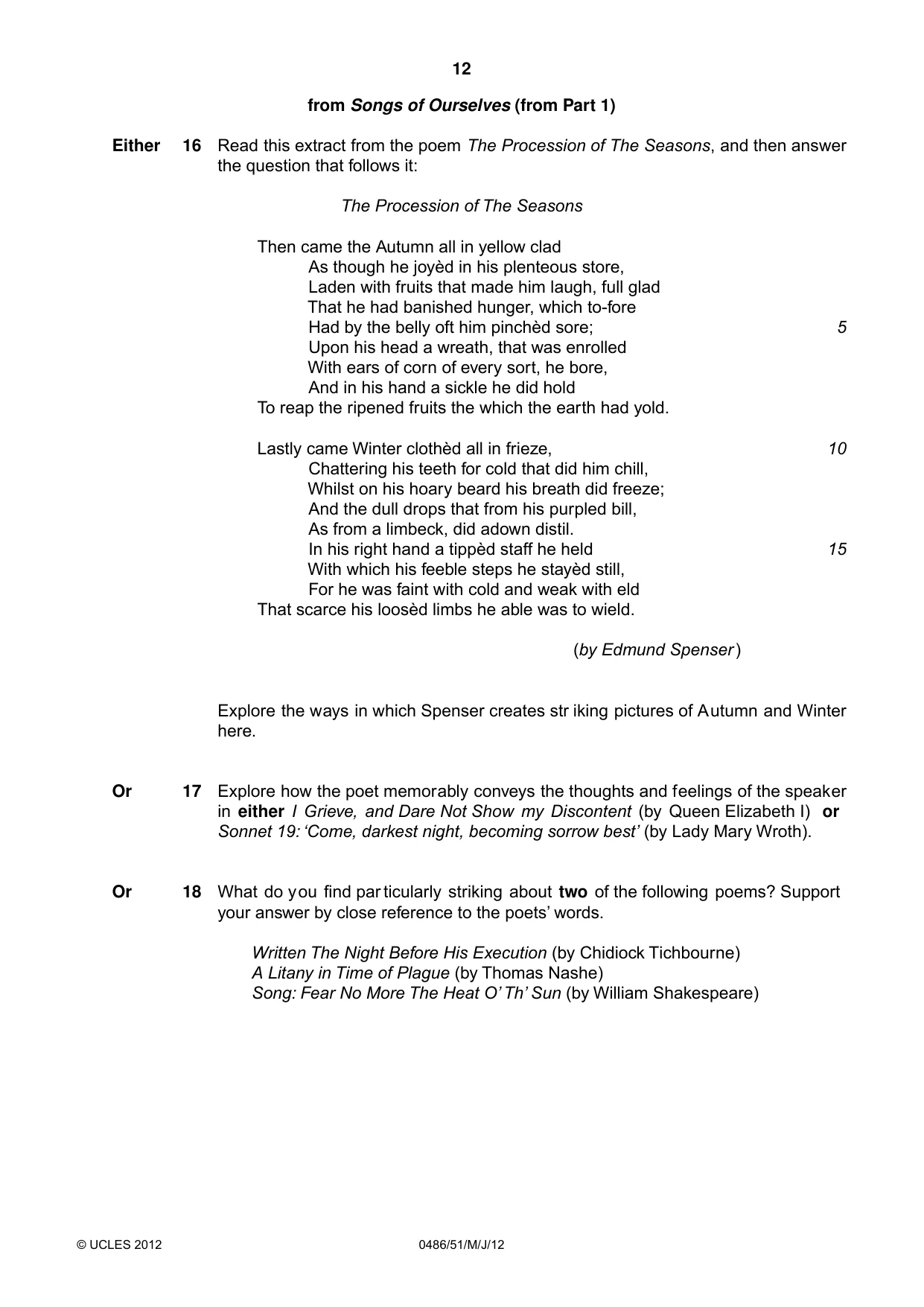
Question paper, page 12
12 0486/51/M/J/12 © UCLES 2012 from Songs of Ourselves (from Part 1) Either 16 Read this extract from the poem The Procession of The Seasons, and then answer the question that follows it: The Procession of The Seasons Then came the Autumn all in yellow clad As though he joyèd in his plenteous store, Laden with fruits that made him laugh, full glad That he had banished hunger, which to-fore Had by the belly oft him pinchèd sore; Upon his head a wreath, that was enrolled With ears of corn of every sort, he bore, And in his hand a sickle he did hold To reap the ripened fruits the which the earth had yold. Lastly came Winter clothèd all in frieze, Chattering his teeth for cold that did him chill, Whilst on his hoary beard his breath did freeze; And the dull drops that from his purpled bill, As from a limbeck, did adown distil. In his right hand a tippèd staff he held With which his feeble steps he stayèd still, For he was faint with cold and weak with eld That scarce his loosèd limbs he able was to wield. (by Edmund Spenser ) Explore the ways in which Spenser creates str iking pictures of Autumn and Winter here. Or 17 Explore how the poet memorably conveys the thoughts and feelings of the speaker in either I Grieve, and Dare Not Show my Discontent (by Queen Elizabeth I) or Sonnet 19: ‘Come, darkest night, becoming sorrow best’ (by Lady Mary Wroth). Or 18 What do you find par ticularly striking about two of the following poems? Support your answer by close reference to the poets’ words. Written The Night Before His Execution (by Chidiock Tichbourne) A Litany in Time of Plague (by Thomas Nashe) Song: Fear No More The Heat O’ Th’ Sun (by William Shakespeare) 5 10 15
Question paper, page 13
13 0486/51/M/J/12 © UCLES 2012 [Turn over BLANK PAGE Turn to page 14 for Question 19.
Question paper, page 14
14 0486/51/M/J/12 © UCLES 2012 TENNESSEE WILLIAMS: Cat on a Hot Tin Roof Either 19 Read this extract, and then answer the question that follows it: At the rise of the curtain someone is taking a shower in the bathroom, the door of which is half open. Content removed due to copyright restrictions. Brick: [appearing] No, I don’t know what they’re up to.
Question paper, page 15
15 0486/51/M/J/12 © UCLES 2012 Explore the ways in which Williams makes this a memorable opening to the play. Or 20 Explore the ways in which Williams vividly portrays the difficult relationship between Brick and Big Daddy. Or 21 You are Mae, just after the conversation in which Maggie announces she is having a baby. Write your thoughts.
Question paper, page 16
16 0486/51/M/J/12 © UCLES 2012 BLANK PAGE Copyright Acknowledgements: Question 1 Maya Angelou; I Know Why The Caged Bird Sings ; © 1969 and renewed 1997 by Maya Angelou. Published by Vintage. Reprinted by permisson of Random House Inc. Question 4 © Carol Ann Duffy; Head of English; Selected Poems; Penguin Books Ltd; 1994. Question 7 © George Orwell; 1984 ; Penguin Classics; 1987. Question 10 Aldous Huxley; Brave New World ; Published by Vintage. Reprinted by permission of The Random House Group Ltd; 1994. Question 19 Cat On A Hot Tin Roof byTennessee Williams. Copyright © 1954, 1955, by The University of the South, renewed 1982, 1983 by The University of the South. Published by Penguin Books Ltd; 1976. Reprinted by permission of New Directions Publishing Corp and Georges Borchardt, Inc. for The Estate of Tennessee Williams. Permission to reproduce items where third-party owned material protected by copyright is included has been sought and cleared where possible. Every reasonable effort has been made b y the publisher (UCLES) to trace copyright holders, but if any items requiring clearance have unwittingly been included, the publisher will be pleased to make amends at the earliest possible opportunity. University of Cambridge International Examinations is part of the Cambridge Assessment Group Cambridge Local Examinations Syndicate (UCLES), which is itself a department of the University of Cambridge.
Mark scheme, page 1
UNIVERSITY OF CAMBRIDGE INTERNATIONAL EXAMINATIONS International General Certificate of Secondary Education MARK SCHEME for the May/June 2012 question paper for the guidance of teachers 0486 LITERATURE (ENGLISH) 0486/51 Paper 5 (Set Texts: Closed Books B), maximum raw mark 25 This mark scheme is published as an aid to teachers and candidates, to indicate the requirements of the examination. It shows the basis on which Examiners were instructed to award marks. It does not indicate the details of the discussions that took place at an Examiners’ meeting before marking began, which would have considered the acceptability of alternative answers. Mark schemes must be read in conjunction with the question papers and the report on the examination. • Cambridge will not enter into discussions or correspondence in connection with these mark schemes. Cambridge is publishing the mark schemes for the May/June 2012 question papers for most IGCSE, GCE Advanced Level and Advanced Subsidiary Level syllabuses and some Ordinary Level syllabuses. www.XtremePapers.com
Mark scheme, page 2
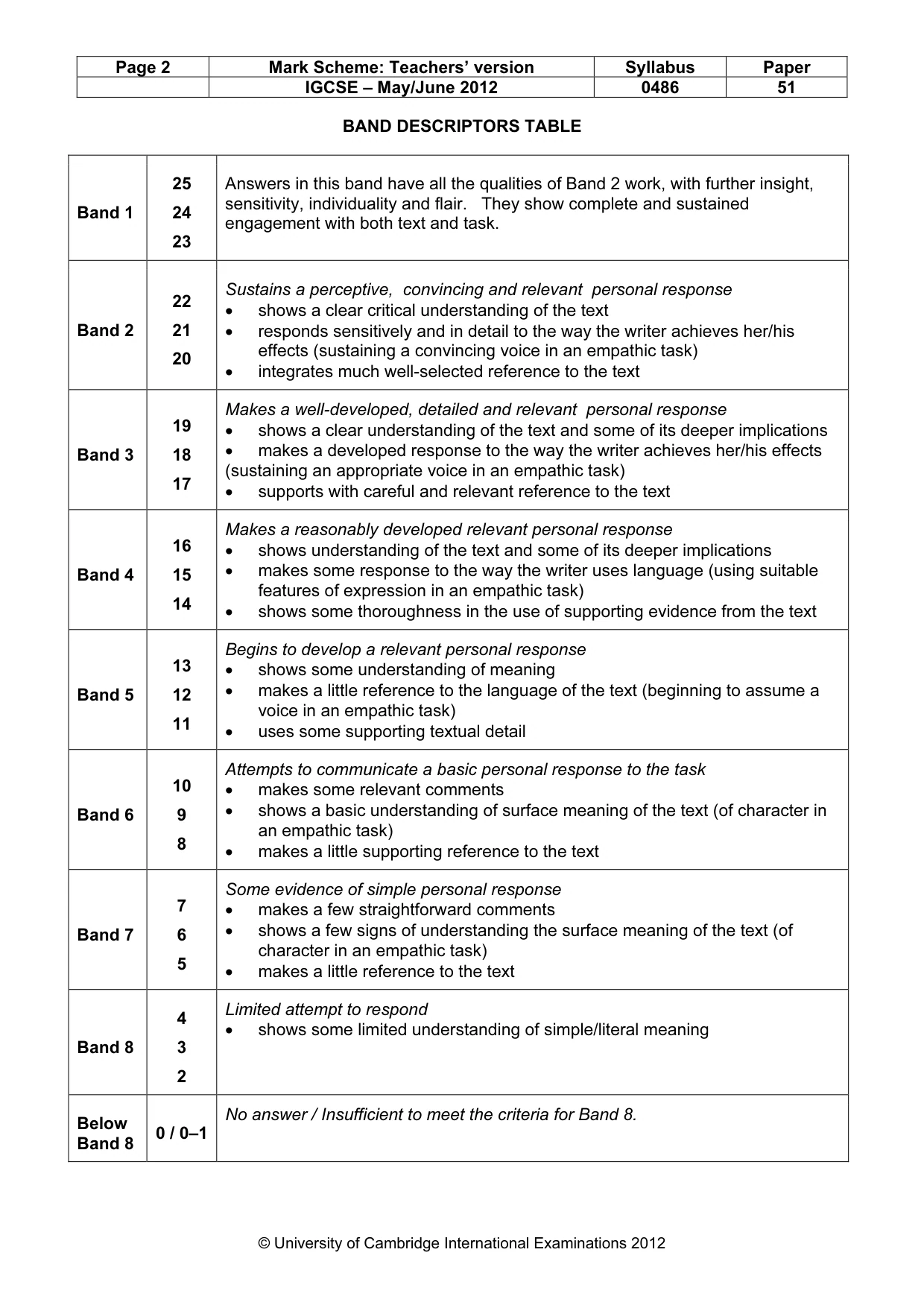
Page 2 Mark Scheme: Teachers’ version Syllabus Paper IGCSE – May/June 2012 0486 51 © University of Cambridge International Examinations 2012 BAND DESCRIPTORS TABLE Band 1 25 24 23 Answers in this band have all the qualities of Band 2 work, with further insight, sensitivity, individuality and flair. They show complete and sustained engagement with both text and task. Band 2 22 21 20 Sustains a perceptive, convincing and relevant personal response • shows a clear critical understanding of the text • responds sensitively and in detail to the way the writer achieves her/his effects (sustaining a convincing voice in an empathic task) • integrates much well-selected reference to the text Band 3 19 18 17 Makes a well-developed, detailed and relevant personal response • shows a clear understanding of the text and some of its deeper implications • makes a developed response to the way the writer achieves her/his effects (sustaining an appropriate voice in an empathic task) • supports with careful and relevant reference to the text Band 4 16 15 14 Makes a reasonably developed relevant personal response • shows understanding of the text and some of its deeper implications • makes some response to the way the writer uses language (using suitable features of expression in an empathic task) • shows some thoroughness in the use of supporting evidence from the text Band 5 13 12 11 Begins to develop a relevant personal response • shows some understanding of meaning • makes a little reference to the language of the text (beginning to assume a voice in an empathic task) • uses some supporting textual detail Band 6 10 9 8 Attempts to communicate a basic personal response to the task • makes some relevant comments • shows a basic understanding of surface meaning of the text (of character in an empathic task) • makes a little supporting reference to the text Band 7 7 6 5 Some evidence of simple personal response • makes a few straightforward comments • shows a few signs of understanding the surface meaning of the text (of character in an empathic task) • makes a little reference to the text Band 8 4 3 2 Limited attempt to respond • shows some limited understanding of simple/literal meaning Below Band 8 0 / 0–1 No answer / Insufficient to meet the criteria for Band 8.
What you needed in this session
Cambridge’s own grade thresholds for 2012 May/June, Paper 5 · Variant 1. A higher threshold means an easier paper — the bar moves with how the cohort did.