Cambridge IGCSE English - Literature 0486 — 2013 Oct/Nov Paper 5 · Variant 1
0486/51/O/N/13 · 25 marks · ≈28 min
The question paper and its mark scheme, free to read here and free to download. This is Cambridge’s own paper, exactly as it was sat.
Question paper16 pages
Mark scheme3 pages
Answers below. Sit the paper first if you are practising.
Paper as text
Question paper, page 1
This document consists of 13 printed pages and 3 blank pages. DC (SJF) 91818 © UCLES 2013 [Turn over UNIVERSITY OF CAMBRIDGE INTERNATIONAL EXAMINATIONS International General Certificate of Secondary Education * 6 7 9 8 3 2 1 9 9 6 * LITERATURE (ENGLISH) 0486/51 Paper 5 October/November 2013 45 minutes Additional Materials: Answer Booklet/Paper READ THESE INSTRUCTIONS FIRST If you have been given an Answer Booklet, follow the instructions on the front cover of the Booklet. Write your Centre number, candidate number and name on all the work you hand in. Write in dark blue or black pen. Do not use staples, paper clips, highlighters, glue or correction fluid. DO NOT WRITE IN ANY BARCODES. Answer one question. At the end of the examination, fasten all your work securely together. All questions in this paper carry equal marks. www.XtremePapers.com
Question paper, page 2
2 0486/51/O/N/13 © UCLES 2013 Answer one question on any text. MAYA ANGELOU: I Know Why The Caged Bird Sings Either 1 Read this extract, and then answer the question that follows it: ‘Last night, after I said my prayers, I lay down on the bed. Content removed due to copyright restrictions.
Question paper, page 3
3 0486/51/O/N/13 © UCLES 2013 [Turn over I tell you I was purt’ near scared stiff.’ How does Angelou’s writing make this passage so entertaining? Or 2 Explore two moments in the book which make you particularly angry at the way Maya is treated. Support your ideas with details from Angelou’s writing. Or 3 You are Bailey, after the church service where Sister Monroe has told Reverend Thomas to “Preach it!”. Write your thoughts. Content removed due to copyright restrictions.
Question paper, page 4
4 0486/51/O/N/13 © UCLES 2013 CAROL ANN DUFFY: Selected Poems Either 4 Read this poem, and then answer the question that follows it: The Dolphins World is what you swim in, or dance, it is simple. There is a man and our mind knows we will die here. How do Duffy’s words convey a powerful impression of the dolphin’s feelings in this poem? Or 5 In what ways does Duffy powerfully convey feelings of loss in Nostalgia? Or 6 What do you find entertaining about the portrayal of a poet’s visit to a school in Head of English? Support your ideas with reference to Duffy’s writing. Content removed due to copyright restrictions.
Question paper, page 5
5 0486/51/O/N/13 © UCLES 2013 [Turn over BLANK PAGE Turn over for Question 7.
Question paper, page 6
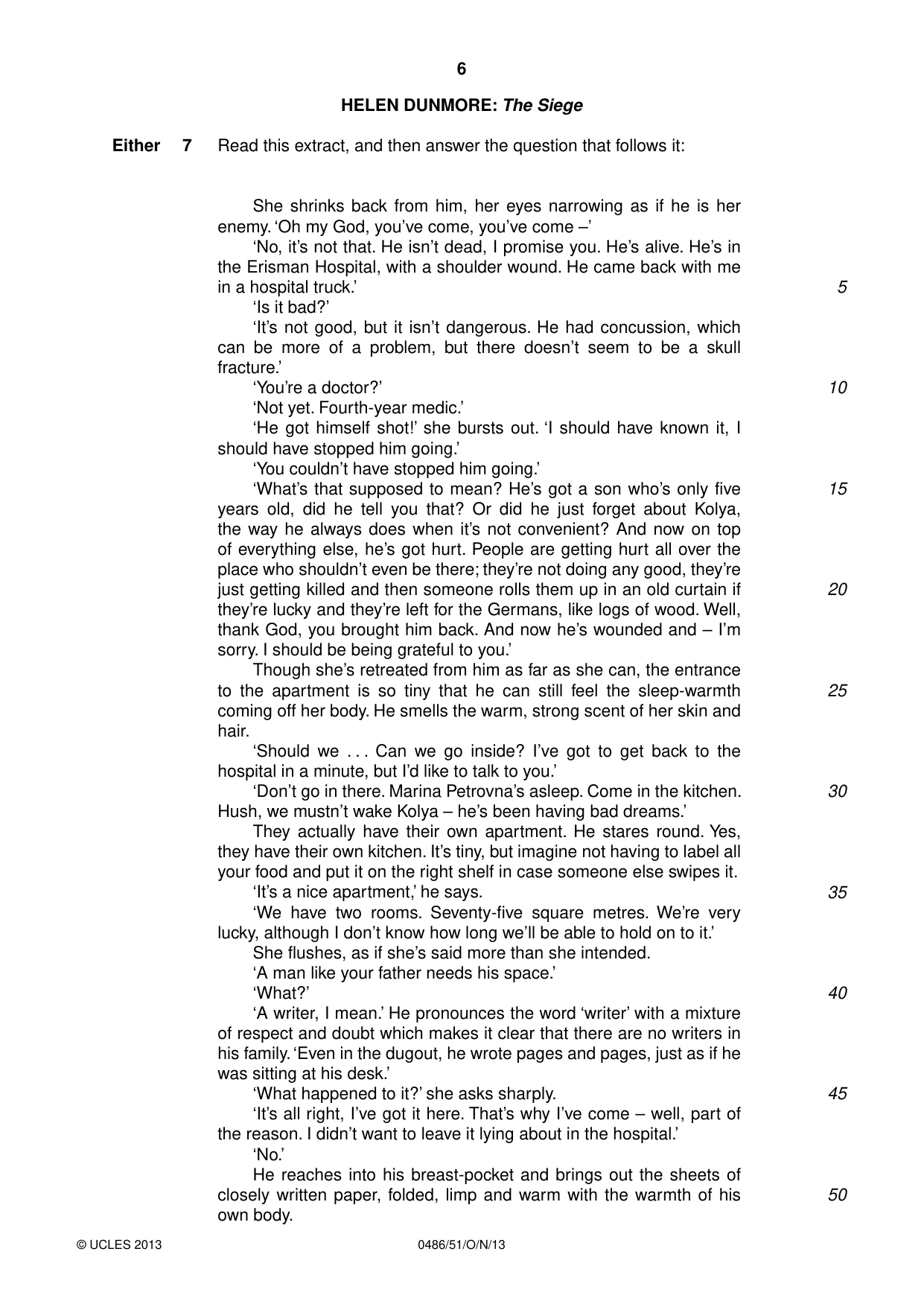
6 0486/51/O/N/13 © UCLES 2013 HELEN DUNMORE: The Siege Either 7 Read this extract, and then answer the question that follows it: She shrinks back from him, her eyes narrowing as if he is her enemy. ‘Oh my God, you’ve come, you’ve come –’ ‘No, it’s not that. He isn’t dead, I promise you. He’s alive. He’s in the Erisman Hospital, with a shoulder wound. He came back with me in a hospital truck.’ ‘Is it bad?’ ‘It’s not good, but it isn’t dangerous. He had concussion, which can be more of a problem, but there doesn’t seem to be a skull fracture.’ ‘You’re a doctor?’ ‘Not yet. Fourth-year medic.’ ‘He got himself shot!’ she bursts out. ‘I should have known it, I should have stopped him going.’ ‘You couldn’t have stopped him going.’ ‘What’s that supposed to mean? He’s got a son who’s only five years old, did he tell you that? Or did he just forget about Kolya, the way he always does when it’s not convenient? And now on top of everything else, he’s got hurt. People are getting hurt all over the place who shouldn’t even be there; they’re not doing any good, they’re just getting killed and then someone rolls them up in an old curtain if they’re lucky and they’re left for the Germans, like logs of wood. Well, thank God, you brought him back. And now he’s wounded and – I’m sorry. I should be being grateful to you.’ Though she’s retreated from him as far as she can, the entrance to the apartment is so tiny that he can still feel the sleep-warmth coming off her body. He smells the warm, strong scent of her skin and hair. ‘Should we . . . Can we go inside? I’ve got to get back to the hospital in a minute, but I’d like to talk to you.’ ‘Don’t go in there. Marina Petrovna’s asleep. Come in the kitchen. Hush, we mustn’t wake Kolya – he’s been having bad dreams.’ They actually have their own apartment. He stares round. Yes, they have their own kitchen. It’s tiny, but imagine not having to label all your food and put it on the right shelf in case someone else swipes it. ‘It’s a nice apartment,’ he says. ‘We have two rooms. Seventy-five square metres. We’re very lucky, although I don’t know how long we’ll be able to hold on to it.’ She flushes, as if she’s said more than she intended. ‘A man like your father needs his space.’ ‘What?’ ‘A writer, I mean.’ He pronounces the word ‘writer’ with a mixture of respect and doubt which makes it clear that there are no writers in his family. ‘Even in the dugout, he wrote pages and pages, just as if he was sitting at his desk.’ ‘What happened to it?’ she asks sharply. ‘It’s all right, I’ve got it here. That’s why I’ve come – well, part of the reason. I didn’t want to leave it lying about in the hospital.’ ‘No.’ He reaches into his breast-pocket and brings out the sheets of closely written paper, folded, limp and warm with the warmth of his own body. 5 10 15 20 25 30 35 40 45 50
Question paper, page 7
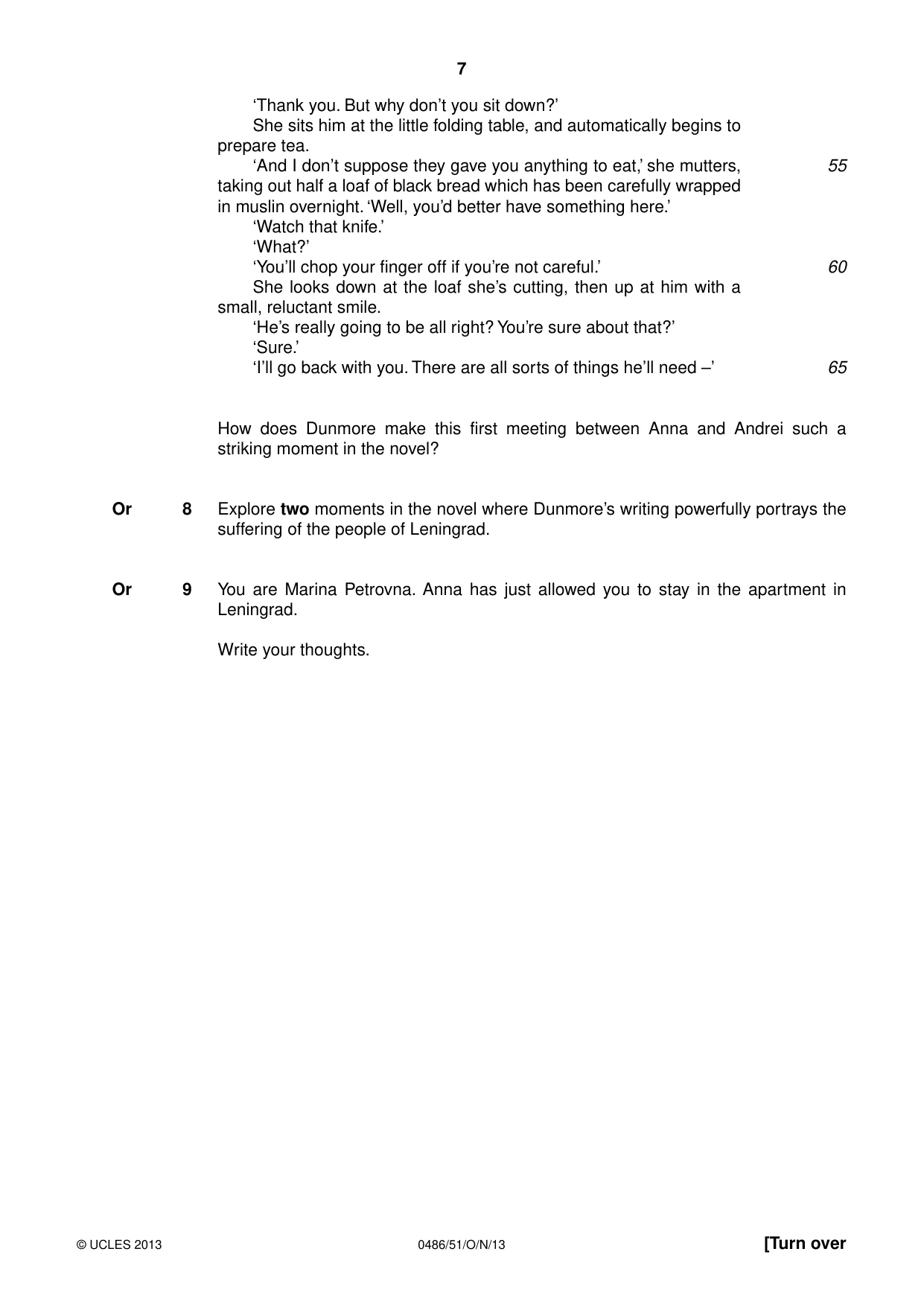
7 0486/51/O/N/13 © UCLES 2013 [Turn over ‘Thank you. But why don’t you sit down?’ She sits him at the little folding table, and automatically begins to prepare tea. ‘And I don’t suppose they gave you anything to eat,’ she mutters, taking out half a loaf of black bread which has been carefully wrapped in muslin overnight. ‘Well, you’d better have something here.’ ‘Watch that knife.’ ‘What?’ ‘You’ll chop your finger off if you’re not careful.’ She looks down at the loaf she’s cutting, then up at him with a small, reluctant smile. ‘He’s really going to be all right? You’re sure about that?’ ‘Sure.’ ‘I’ll go back with you. There are all sorts of things he’ll need –’ How does Dunmore make this first meeting between Anna and Andrei such a striking moment in the novel? Or 8 Explore two moments in the novel where Dunmore’s writing powerfully portrays the suffering of the people of Leningrad. Or 9 You are Marina Petrovna. Anna has just allowed you to stay in the apartment in Leningrad. Write your thoughts. 55 60 65
Question paper, page 8
8 0486/51/O/N/13 © UCLES 2013 ALDOUS HUXLEY: Brave New World Either 10 Read this extract, and then answer the question that follows it: ‘I don’t think you ought to see things like that,’ he said, making Content removed due to copyright restrictions.
Question paper, page 9
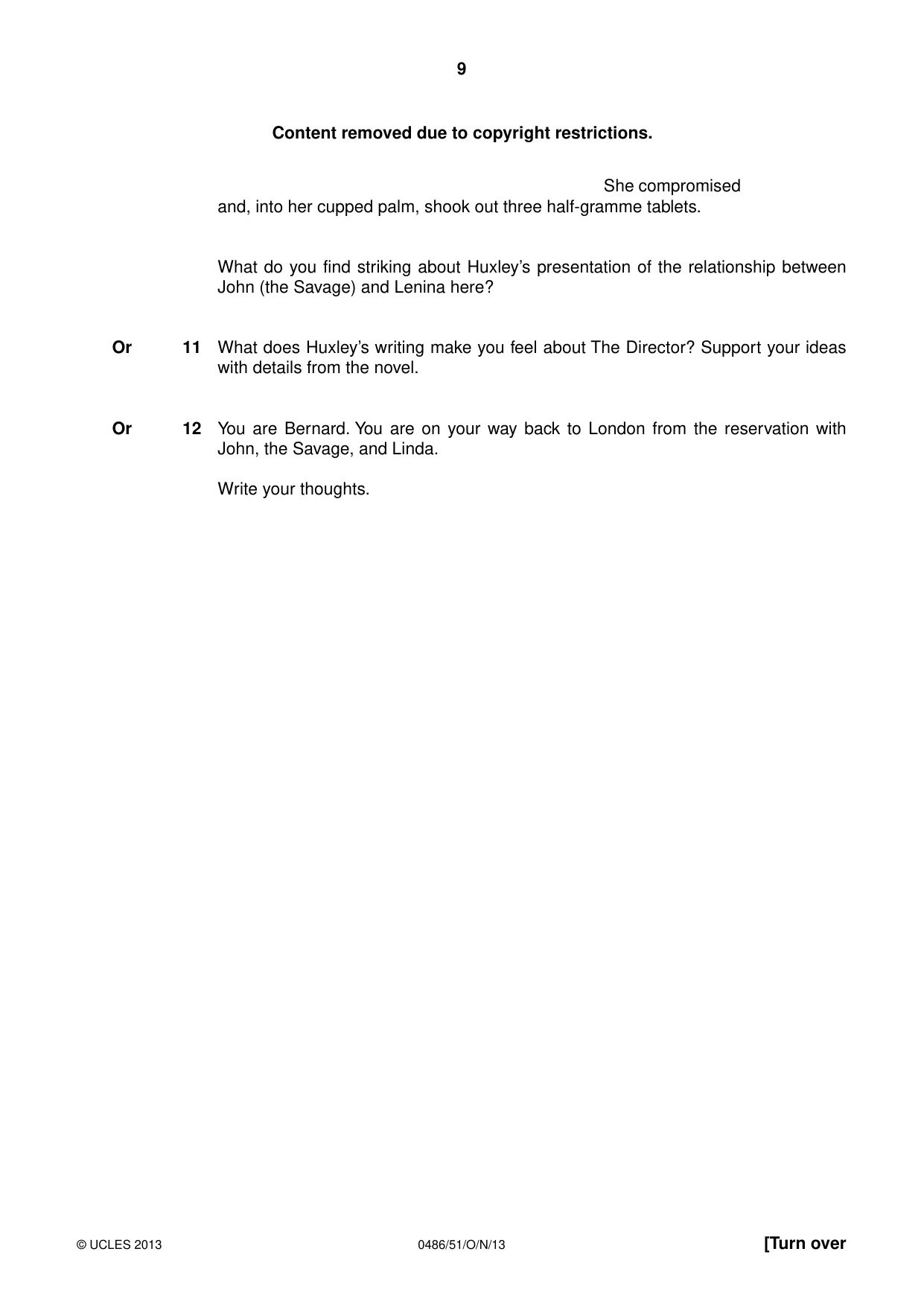
9 0486/51/O/N/13 © UCLES 2013 [Turn over She compromised and, into her cupped palm, shook out three half-gramme tablets. What do you find striking about Huxley’s presentation of the relationship between John (the Savage) and Lenina here? Or 11 What does Huxley’s writing make you feel about The Director? Support your ideas with details from the novel. Or 12 You are Bernard. You are on your way back to London from the reservation with John, the Savage, and Linda. Write your thoughts. Content removed due to copyright restrictions.
Question paper, page 10
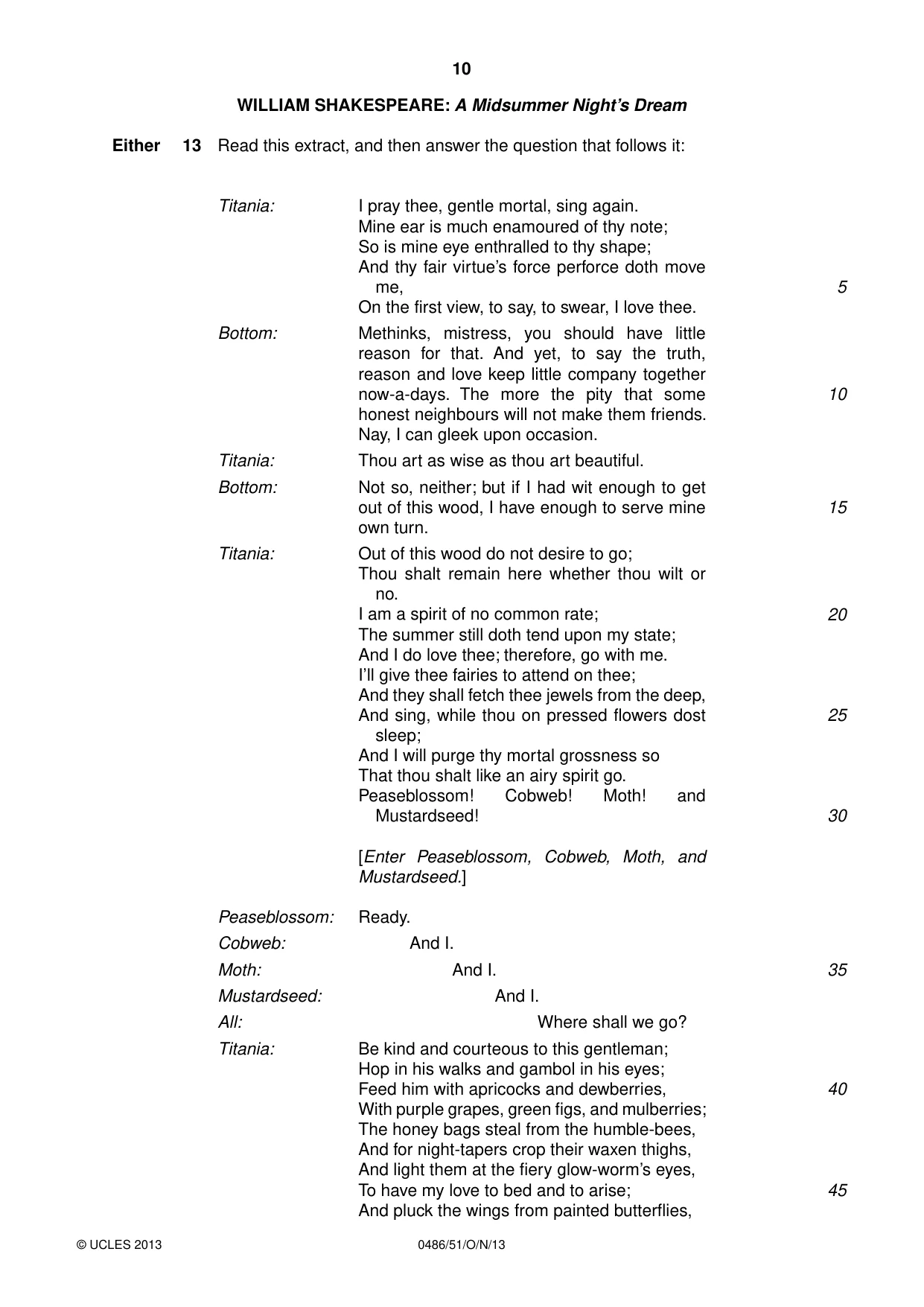
10 0486/51/O/N/13 © UCLES 2013 WILLIAM SHAKESPEARE: A Midsummer Night’s Dream Either 13 Read this extract, and then answer the question that follows it: Titania: I pray thee, gentle mortal, sing again. Mine ear is much enamoured of thy note; So is mine eye enthralled to thy shape; And thy fair virtue’s force perforce doth move me, On the first view, to say, to swear, I love thee. Bottom: Methinks, mistress, you should have little reason for that. And yet, to say the truth, reason and love keep little company together now-a-days. The more the pity that some honest neighbours will not make them friends. Nay, I can gleek upon occasion. Titania: Thou art as wise as thou art beautiful. Bottom: Not so, neither; but if I had wit enough to get out of this wood, I have enough to serve mine own turn. Titania: Out of this wood do not desire to go; Thou shalt remain here whether thou wilt or no. I am a spirit of no common rate; The summer still doth tend upon my state; And I do love thee; therefore, go with me. I’ll give thee fairies to attend on thee; And they shall fetch thee jewels from the deep, And sing, while thou on pressed flowers dost sleep; And I will purge thy mortal grossness so That thou shalt like an airy spirit go. Peaseblossom! Cobweb! Moth! and Mustardseed! [Enter Peaseblossom, Cobweb, Moth, and Mustardseed.] Peaseblossom: Ready. Cobweb: And I. Moth: And I. Mustardseed: And I. All: Where shall we go? Titania: Be kind and courteous to this gentleman; Hop in his walks and gambol in his eyes; Feed him with apricocks and dewberries, With purple grapes, green figs, and mulberries; The honey bags steal from the humble-bees, And for night-tapers crop their waxen thighs, And light them at the fiery glow-worm’s eyes, To have my love to bed and to arise; And pluck the wings from painted butterflies, 5 10 15 20 25 30 35 40 45
Question paper, page 11
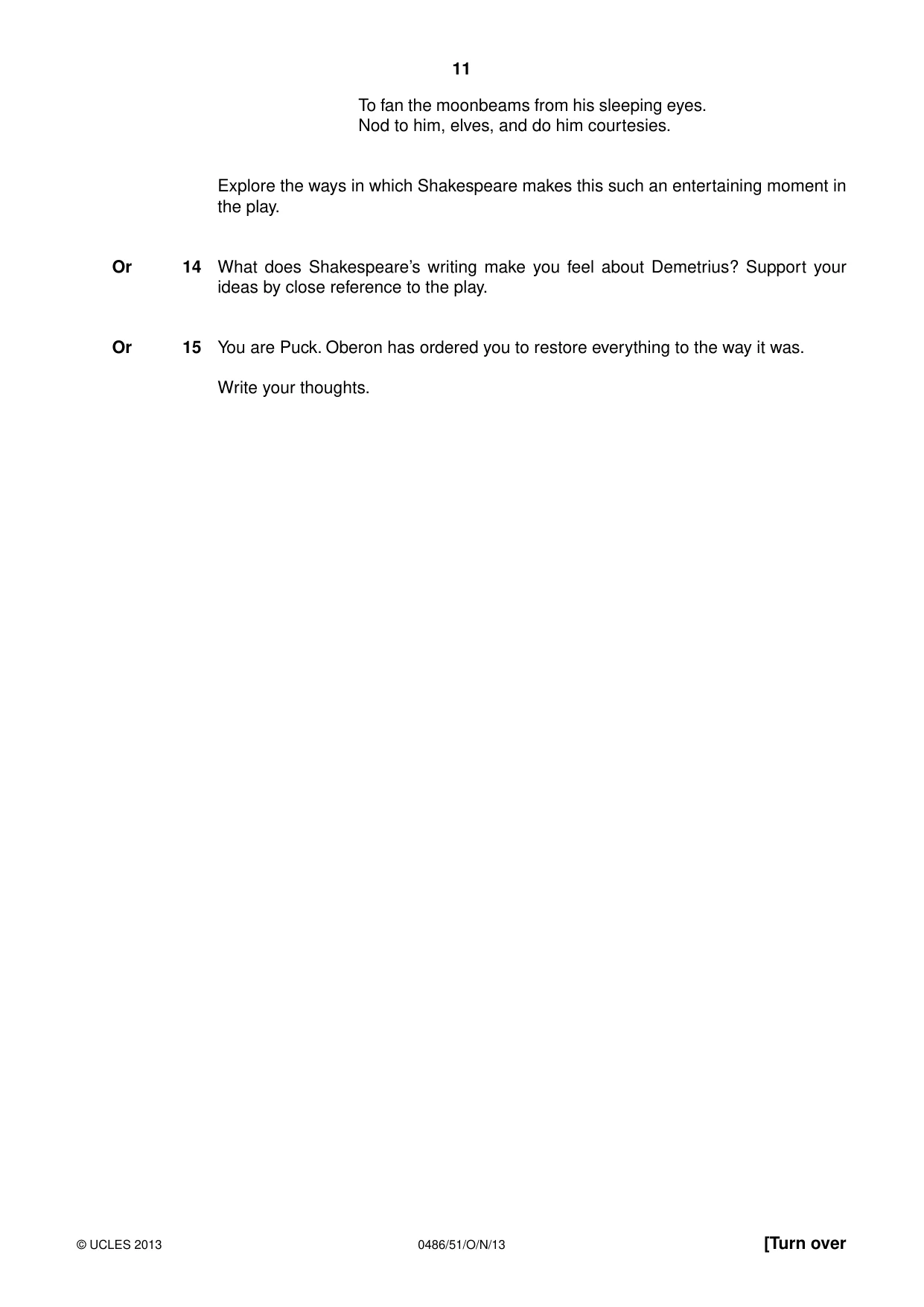
11 0486/51/O/N/13 © UCLES 2013 [Turn over To fan the moonbeams from his sleeping eyes. Nod to him, elves, and do him courtesies. Explore the ways in which Shakespeare makes this such an entertaining moment in the play. Or 14 What does Shakespeare’s writing make you feel about Demetrius? Support your ideas by close reference to the play. Or 15 You are Puck. Oberon has ordered you to restore everything to the way it was. Write your thoughts.
Question paper, page 12
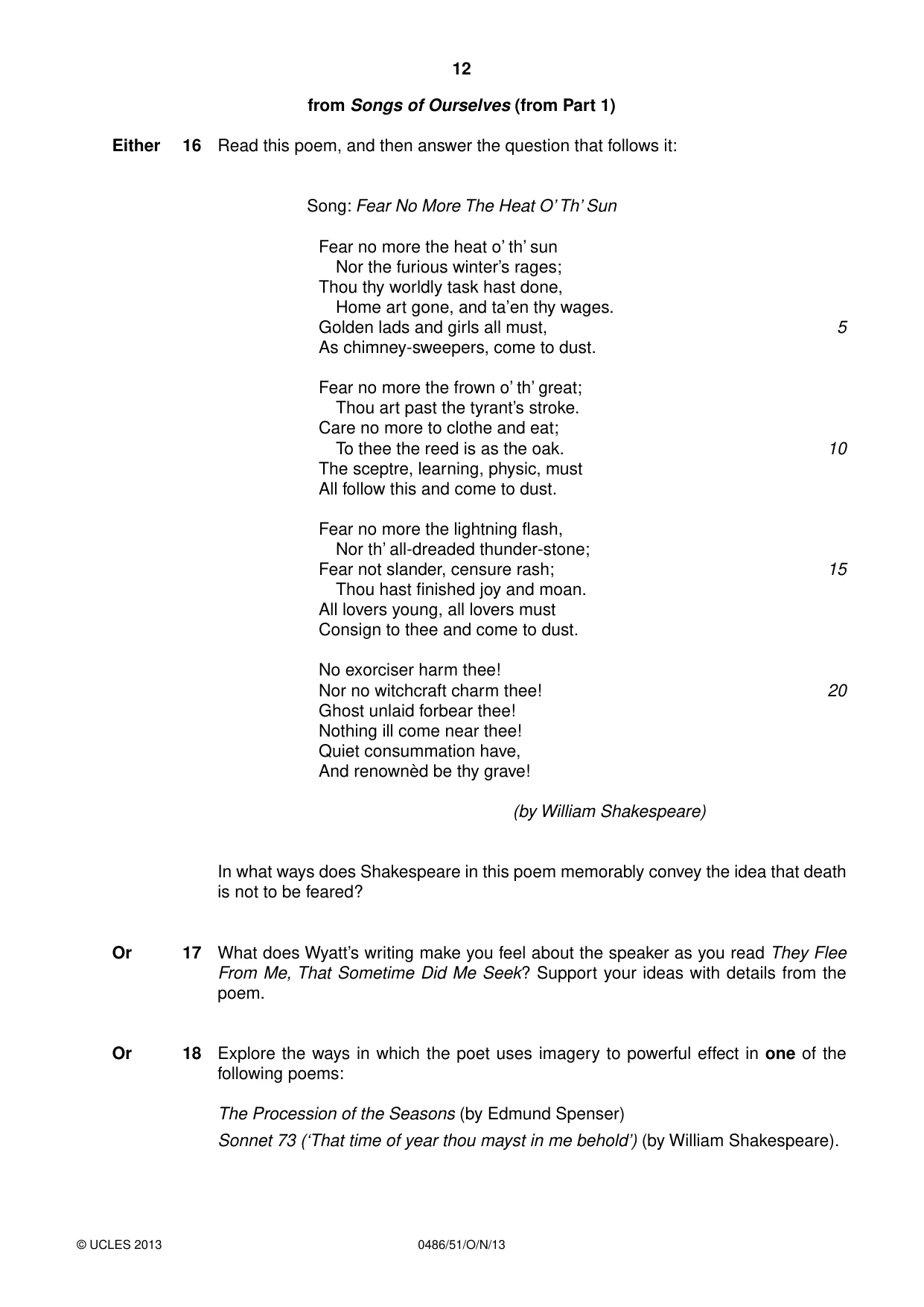
12 0486/51/O/N/13 © UCLES 2013 from Songs of Ourselves (from Part 1) Either 16 Read this poem, and then answer the question that follows it: Song: Fear No More The Heat O’ Th’ Sun Fear no more the heat o’ th’ sun Nor the furious winter’s rages; Thou thy worldly task hast done, Home art gone, and ta’en thy wages. Golden lads and girls all must, As chimney-sweepers, come to dust. Fear no more the frown o’ th’ great; Thou art past the tyrant’s stroke. Care no more to clothe and eat; To thee the reed is as the oak. The sceptre, learning, physic, must All follow this and come to dust. Fear no more the lightning flash, Nor th’ all-dreaded thunder-stone; Fear not slander, censure rash; Thou hast finished joy and moan. All lovers young, all lovers must Consign to thee and come to dust. No exorciser harm thee! Nor no witchcraft charm thee! Ghost unlaid forbear thee! Nothing ill come near thee! Quiet consummation have, And renownèd be thy grave! (by William Shakespeare) In what ways does Shakespeare in this poem memorably convey the idea that death is not to be feared? Or 17 What does Wyatt’s writing make you feel about the speaker as you read They Flee From Me, That Sometime Did Me Seek? Support your ideas with details from the poem. Or 18 Explore the ways in which the poet uses imagery to powerful effect in one of the following poems: The Procession of the Seasons (by Edmund Spenser) Sonnet 73 (‘That time of year thou mayst in me behold’) (by William Shakespeare). 5 10 15 20
Question paper, page 13
13 0486/51/O/N/13 © UCLES 2013 [Turn over BLANK PAGE Turn over for Question 19.
Question paper, page 14
14 0486/51/O/N/13 © UCLES 2013 TENNESSEE WILLIAMS: Cat on a Hot Tin Roof Either 19 Read this extract, and then answer the question that follows it: Big Daddy: Has someone been lying to you? Content removed due to copyright restrictions.
Question paper, page 15
15 0486/51/O/N/13 © UCLES 2013 Brick: I’m sorry, Big Daddy. How does Williams make this such a dramatic and significant moment in the play? Or 20 In what ways does Williams make Maggie such a fascinating character? Support your ideas by close reference to the play. Or 21 You are Big Mama, at the end of the play. Write your thoughts. Content removed due to copyright restrictions.
Question paper, page 16
16 0486/51/O/N/13 © UCLES 2013 Copyright Acknowledgements: Question 1 © Maya Angelou; I Know Why The Caged Bird Sings; Copyright © 1969 and renewed 1997 by Maya Angelou. Published by Vintage. Reprinted by permission of Random House Inc. Question 4 © Carol Ann Duffy; The Dolphins, in Selected Poems; Penguin Books Ltd; 1994. Question 7 © Helen Dunmore; The Siege; Penguin Books Ltd; 2001; By permission of A P Watt Ltd on behalf of Helen Dunmore. Question 10 © from Brave New World by Aldous Huxley, published by Chatto & Windus. Reprinted by permission of The Random House Group Ltd. Question 19 © Cat on a Hot Tin Roof by Tennessee Williams. Copyright © 1954, 1955, by The University of the South, renewed 1982, 1983 The University of the South. Reprinted by permission of New Directions Publishing Corp and Georges Borchardt, Inc. for the Estate of Tennessee Williams. Permission to reproduce items where third-party owned material protected by copyright is included has been sought and cleared where possible. Every reasonable effort has been made by the publisher (UCLES) to trace copyright holders, but if any items requiring clearance have unwittingly been included, the publisher will be pleased to make amends at the earliest possible opportunity. Cambridge International Examinations is part of the Cambridge Assessment Group. Cambridge Assessment is the brand name of University of Cambridge Local Examinations Syndicate (UCLES), which is itself a department of the University of Cambridge. BLANK PAGE
Mark scheme, page 1
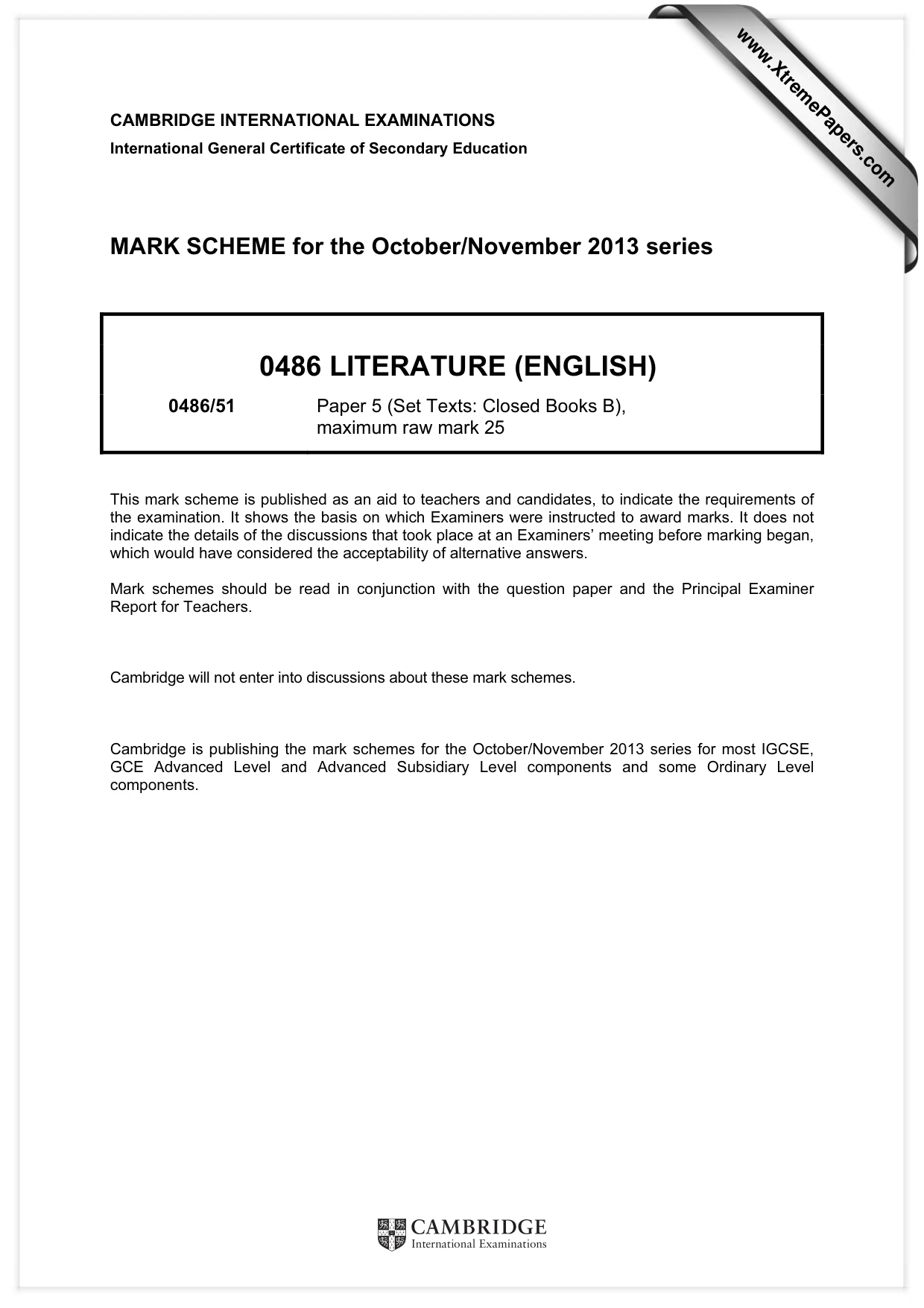
CAMBRIDGE INTERNATIONAL EXAMINATIONS International General Certificate of Secondary Education MARK SCHEME for the October/November 2013 series 0486 LITERATURE (ENGLISH) 0486/51 Paper 5 (Set Texts: Closed Books B), maximum raw mark 25 This mark scheme is published as an aid to teachers and candidates, to indicate the requirements of the examination. It shows the basis on which Examiners were instructed to award marks. It does not indicate the details of the discussions that took place at an Examiners’ meeting before marking began, which would have considered the acceptability of alternative answers. Mark schemes should be read in conjunction with the question paper and the Principal Examiner Report for Teachers. Cambridge will not enter into discussions about these mark schemes. Cambridge is publishing the mark schemes for the October/November 2013 series for most IGCSE, GCE Advanced Level and Advanced Subsidiary Level components and some Ordinary Level components. www.XtremePapers.com
Mark scheme, page 2
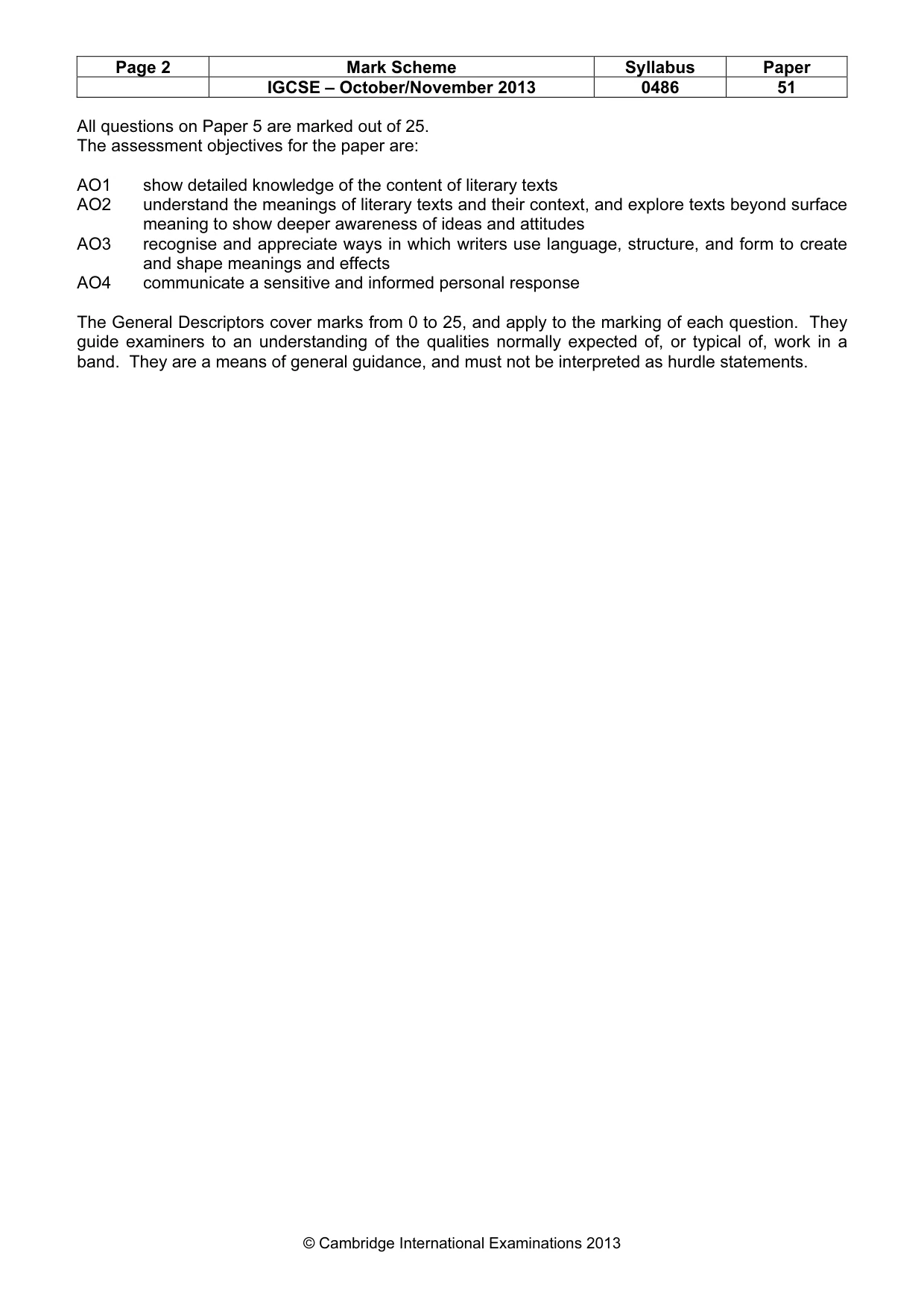
Page 2 Mark Scheme Syllabus Paper IGCSE – October/November 2013 0486 51 © Cambridge International Examinations 2013 All questions on Paper 5 are marked out of 25. The assessment objectives for the paper are: AO1 show detailed knowledge of the content of literary texts AO2 understand the meanings of literary texts and their context, and explore texts beyond surface meaning to show deeper awareness of ideas and attitudes AO3 recognise and appreciate ways in which writers use language, structure, and form to create and shape meanings and effects AO4 communicate a sensitive and informed personal response The General Descriptors cover marks from 0 to 25, and apply to the marking of each question. They guide examiners to an understanding of the qualities normally expected of, or typical of, work in a band. They are a means of general guidance, and must not be interpreted as hurdle statements.
Mark scheme, page 3
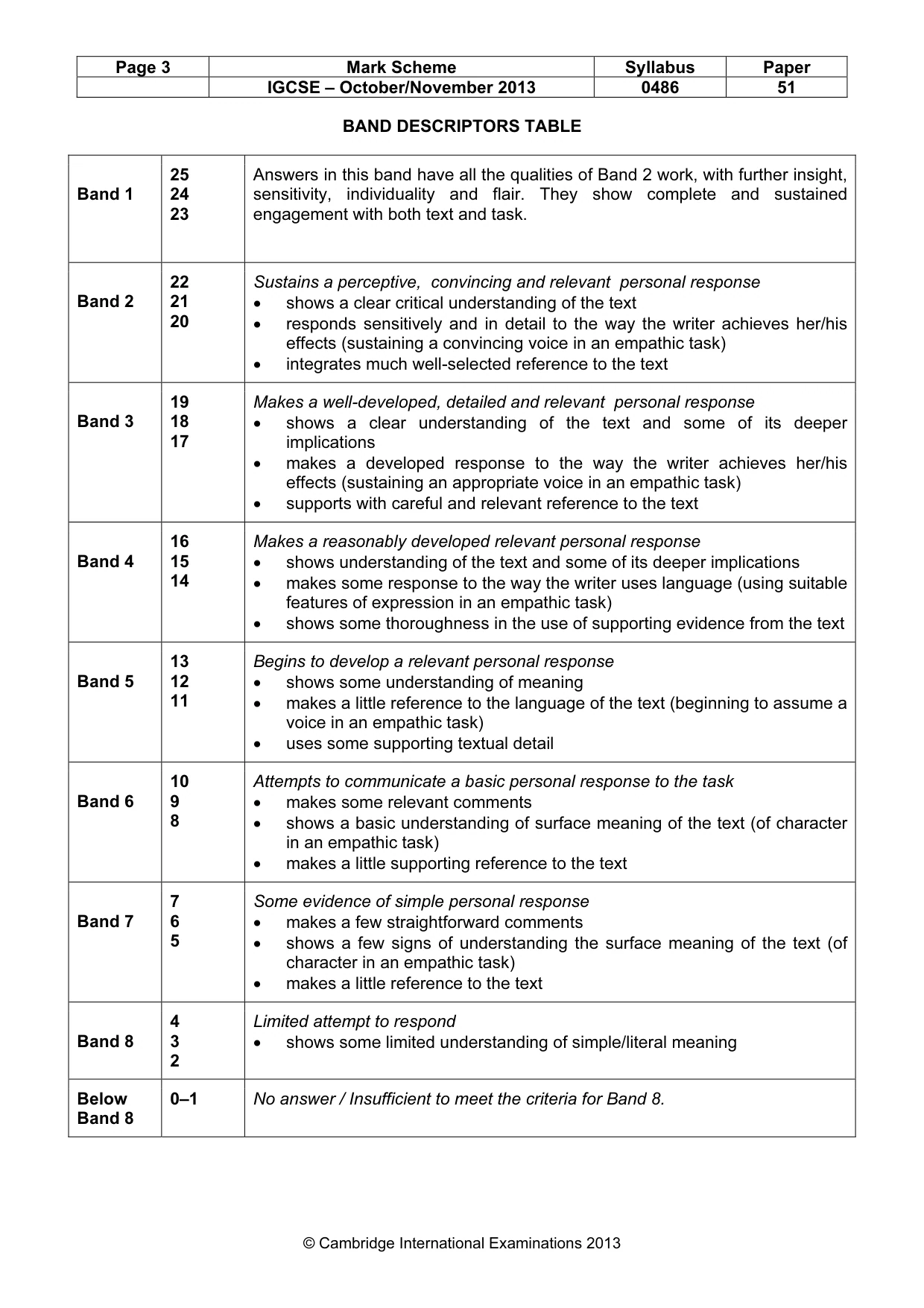
Page 3 Mark Scheme Syllabus Paper IGCSE – October/November 2013 0486 51 © Cambridge International Examinations 2013 BAND DESCRIPTORS TABLE Band 1 25 24 23 Answers in this band have all the qualities of Band 2 work, with further insight, sensitivity, individuality and flair. They show complete and sustained engagement with both text and task. Band 2 22 21 20 Sustains a perceptive, convincing and relevant personal response • shows a clear critical understanding of the text • responds sensitively and in detail to the way the writer achieves her/his effects (sustaining a convincing voice in an empathic task) • integrates much well-selected reference to the text Band 3 19 18 17 Makes a well-developed, detailed and relevant personal response • shows a clear understanding of the text and some of its deeper implications • makes a developed response to the way the writer achieves her/his effects (sustaining an appropriate voice in an empathic task) • supports with careful and relevant reference to the text Band 4 16 15 14 Makes a reasonably developed relevant personal response • shows understanding of the text and some of its deeper implications • makes some response to the way the writer uses language (using suitable features of expression in an empathic task) • shows some thoroughness in the use of supporting evidence from the text Band 5 13 12 11 Begins to develop a relevant personal response • shows some understanding of meaning • makes a little reference to the language of the text (beginning to assume a voice in an empathic task) • uses some supporting textual detail Band 6 10 9 8 Attempts to communicate a basic personal response to the task • makes some relevant comments • shows a basic understanding of surface meaning of the text (of character in an empathic task) • makes a little supporting reference to the text Band 7 7 6 5 Some evidence of simple personal response • makes a few straightforward comments • shows a few signs of understanding the surface meaning of the text (of character in an empathic task) • makes a little reference to the text Band 8 4 3 2 Limited attempt to respond • shows some limited understanding of simple/literal meaning Below Band 8 0–1 No answer / Insufficient to meet the criteria for Band 8.
What you needed in this session
Cambridge’s own grade thresholds for 2013 Oct/Nov, Paper 5 · Variant 1. A higher threshold means an easier paper — the bar moves with how the cohort did.