Cambridge IGCSE English - Literature 0486 — 2011 May/June Paper 5 · Variant 1
0486/51/M/J/11 · 25 marks · ≈28 min
The question paper and its mark scheme, free to read here and free to download. This is Cambridge’s own paper, exactly as it was sat.
Question paper16 pages


Mark scheme3 pages
Answers below. Sit the paper first if you are practising.
Paper as text
Question paper, page 1
This document consists of 12 printed pages and 4 blank pages. DC (CB (NB)) 30923/3 © UCLES 2011 [Turn over UNIVERSITY OF CAMBRIDGE INTERNATIONAL EXAMINATIONS International General Certificate of Secondary Education * 7 3 1 3 4 2 6 7 6 2 * LITERATURE (ENGLISH) 0486/51 Paper 5 May/June 2011 45 minutes Additional Materials: Answer Booklet/Paper READ THESE INSTRUCTIONS FIRST If you have been given an Answer Booklet, follow the instructions on the front cover of the Booklet. Write your Centre number, candidate number and name on all the work you hand in. Write in dark blue or black pen. Do not use staples, paper clips, highlighters, glue or correction fluid. Answer one question. At the end of the examination, fasten all your work securely together. All questions in this paper carry equal marks. www.XtremePapers.com
Question paper, page 2
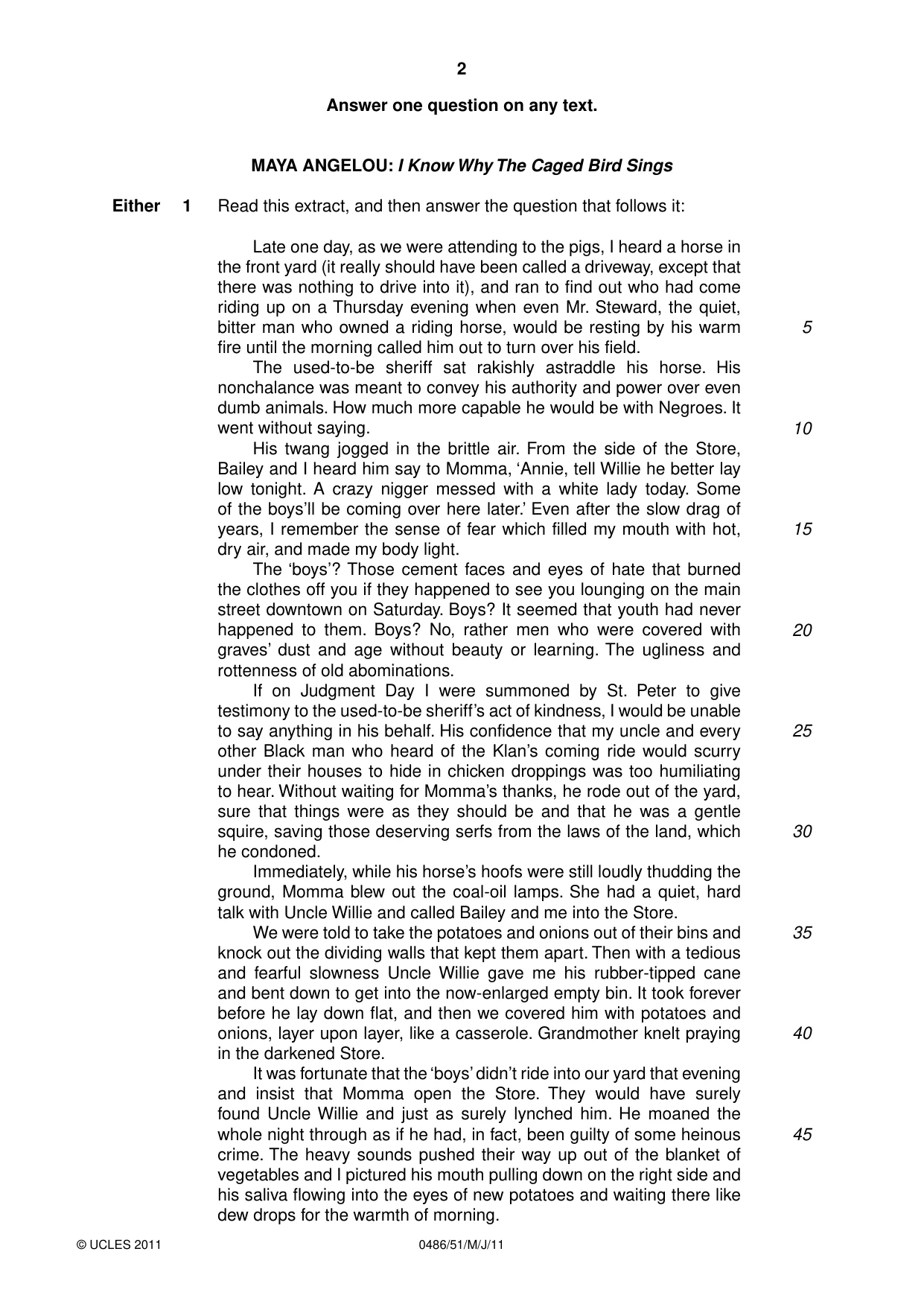
2 0486/51/M/J/11 © UCLES 2011 Answer one question on any text. MAYA ANGELOU: I Know Why The Caged Bird Sings Either 1 Read this extract, and then answer the question that follows it: Late one day, as we were attending to the pigs, I heard a horse in the front yard (it really should have been called a driveway, except that there was nothing to drive into it), and ran to find out who had come riding up on a Thursday evening when even Mr. Steward, the quiet, bitter man who owned a riding horse, would be resting by his warm fire until the morning called him out to turn over his field. The used-to-be sheriff sat rakishly astraddle his horse. His nonchalance was meant to convey his authority and power over even dumb animals. How much more capable he would be with Negroes. It went without saying. His twang jogged in the brittle air. From the side of the Store, Bailey and I heard him say to Momma, ‘Annie, tell Willie he better lay low tonight. A crazy nigger messed with a white lady today. Some of the boys’ll be coming over here later.’ Even after the slow drag of years, I remember the sense of fear which filled my mouth with hot, dry air, and made my body light. The ‘boys’? Those cement faces and eyes of hate that burned the clothes off you if they happened to see you lounging on the main street downtown on Saturday. Boys? It seemed that youth had never happened to them. Boys? No, rather men who were covered with graves’ dust and age without beauty or learning. The ugliness and rottenness of old abominations. If on Judgment Day I were summoned by St. Peter to give testimony to the used-to-be sheriff’s act of kindness, I would be unable to say anything in his behalf. His confidence that my uncle and every other Black man who heard of the Klan’s coming ride would scurry under their houses to hide in chicken droppings was too humiliating to hear. Without waiting for Momma’s thanks, he rode out of the yard, sure that things were as they should be and that he was a gentle squire, saving those deserving serfs from the laws of the land, which he condoned. Immediately, while his horse’s hoofs were still loudly thudding the ground, Momma blew out the coal-oil lamps. She had a quiet, hard talk with Uncle Willie and called Bailey and me into the Store. We were told to take the potatoes and onions out of their bins and knock out the dividing walls that kept them apart. Then with a tedious and fearful slowness Uncle Willie gave me his rubber-tipped cane and bent down to get into the now-enlarged empty bin. It took forever before he lay down flat, and then we covered him with potatoes and onions, layer upon layer, like a casserole. Grandmother knelt praying in the darkened Store. It was fortunate that the ‘boys’ didn’t ride into our yard that evening and insist that Momma open the Store. They would have surely found Uncle Willie and just as surely lynched him. He moaned the whole night through as if he had, in fact, been guilty of some heinous crime. The heavy sounds pushed their way up out of the blanket of vegetables and I pictured his mouth pulling down on the right side and his saliva flowing into the eyes of new potatoes and waiting there like dew drops for the warmth of morning. 5 10 15 20 25 30 35 40 45
Question paper, page 3
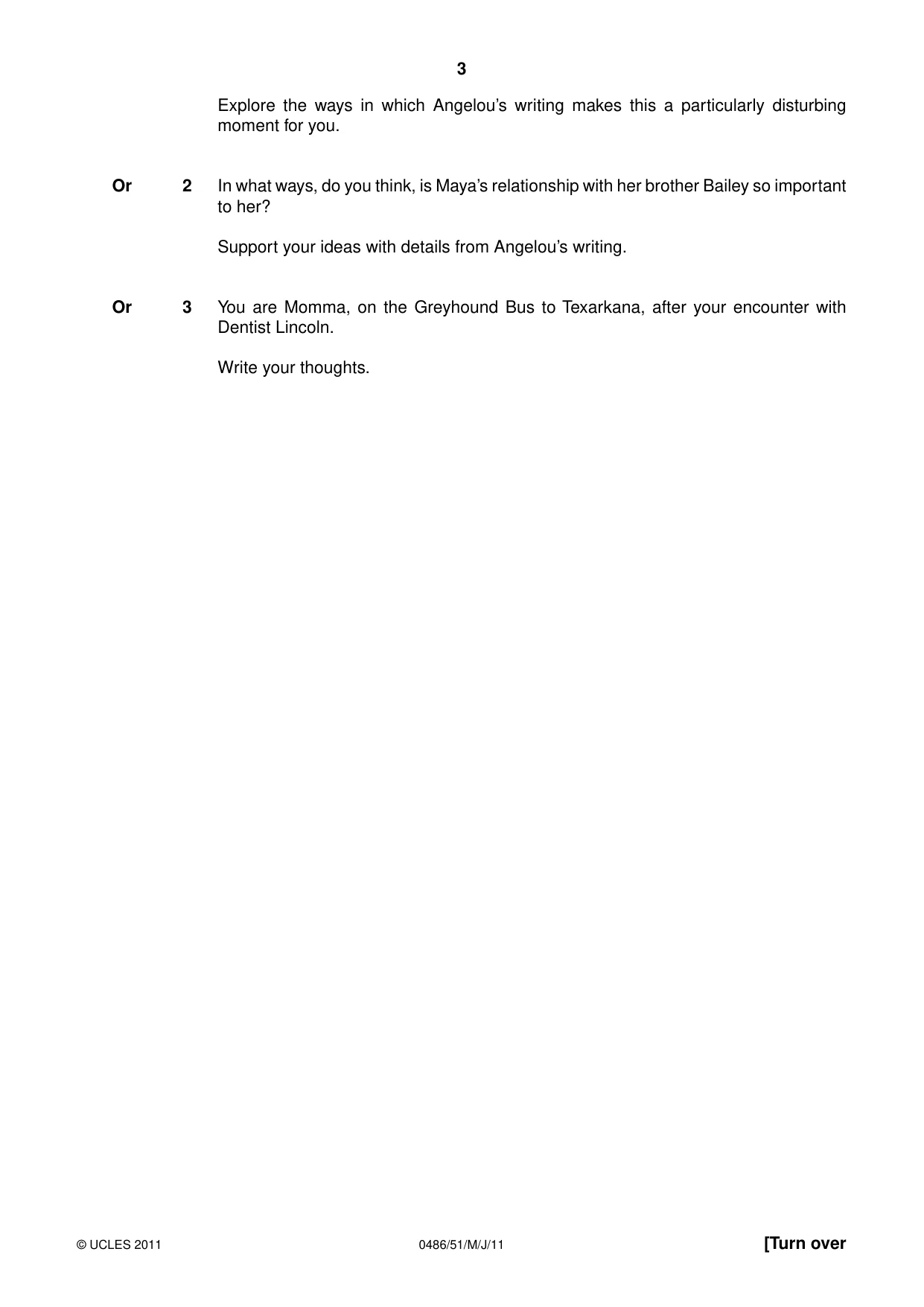
3 0486/51/M/J/11 © UCLES 2011 [Turn over Explore the ways in which Angelou’s writing makes this a particularly disturbing moment for you. Or 2 In what ways, do you think, is Maya’s relationship with her brother Bailey so important to her? Support your ideas with details from Angelou’s writing. Or 3 You are Momma, on the Greyhound Bus to Texarkana, after your encounter with Dentist Lincoln. Write your thoughts.
Question paper, page 4
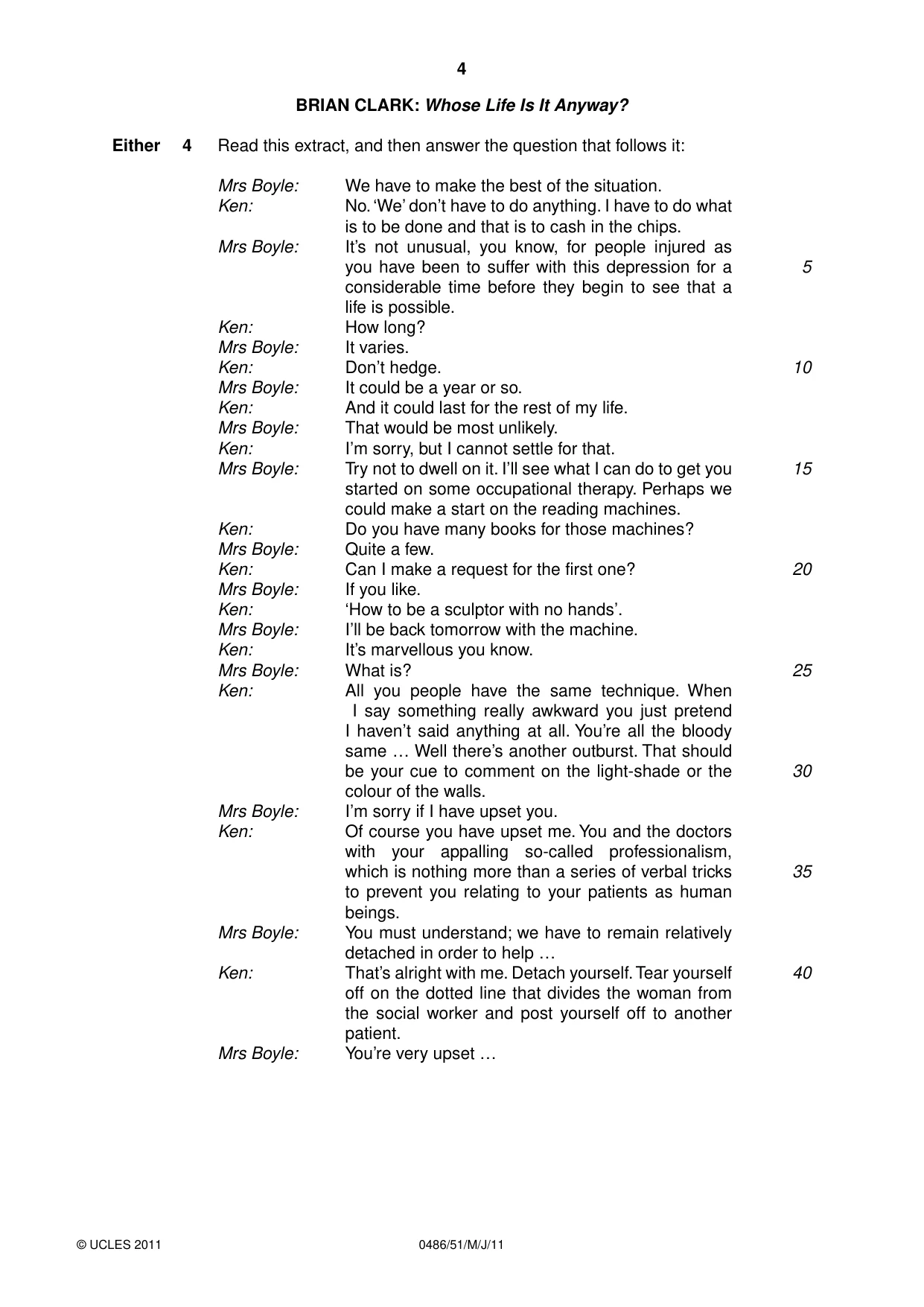
4 0486/51/M/J/11 © UCLES 2011 BRIAN CLARK: Whose Life Is It Anyway? Either 4 Read this extract, and then answer the question that follows it: Mrs Boyle: We have to make the best of the situation. Ken: No. ‘We’ don’t have to do anything. I have to do what is to be done and that is to cash in the chips. Mrs Boyle: It’s not unusual, you know, for people injured as you have been to suffer with this depression for a considerable time before they begin to see that a life is possible. Ken: How long? Mrs Boyle: It varies. Ken: Don’t hedge. Mrs Boyle: It could be a year or so. Ken: And it could last for the rest of my life. Mrs Boyle: That would be most unlikely. Ken: I’m sorry, but I cannot settle for that. Mrs Boyle: Try not to dwell on it. I’ll see what I can do to get you started on some occupational therapy. Perhaps we could make a start on the reading machines. Ken: Do you have many books for those machines? Mrs Boyle: Quite a few. Ken: Can I make a request for the first one? Mrs Boyle: If you like. Ken: ‘How to be a sculptor with no hands’. Mrs Boyle: I’ll be back tomorrow with the machine. Ken: It’s marvellous you know. Mrs Boyle: What is? Ken: All you people have the same technique. When I say something really awkward you just pretend I haven’t said anything at all. You’re all the bloody same … Well there’s another outburst. That should be your cue to comment on the light-shade or the colour of the walls. Mrs Boyle: I’m sorry if I have upset you. Ken: Of course you have upset me. You and the doctors with your appalling so-called professionalism, which is nothing more than a series of verbal tricks to prevent you relating to your patients as human beings. Mrs Boyle: You must understand; we have to remain relatively detached in order to help … Ken: That’s alright with me. Detach yourself. Tear yourself off on the dotted line that divides the woman from the social worker and post yourself off to another patient. Mrs Boyle: You’re very upset … 5 10 15 20 25 30 35 40
Question paper, page 5
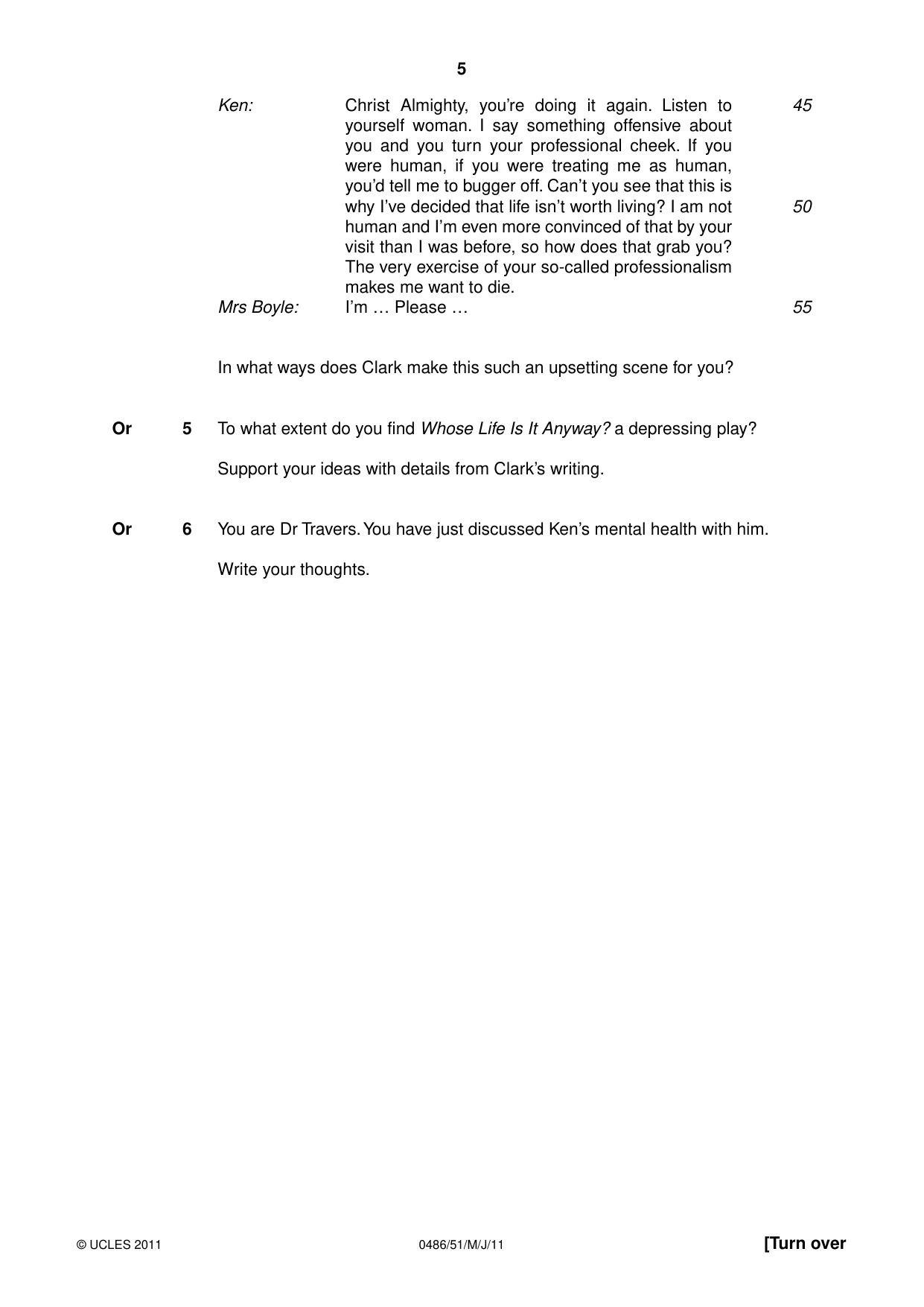
5 0486/51/M/J/11 © UCLES 2011 [Turn over Ken: Christ Almighty, you’re doing it again. Listen to yourself woman. I say something offensive about you and you turn your professional cheek. If you were human, if you were treating me as human, you’d tell me to bugger off. Can’t you see that this is why I’ve decided that life isn’t worth living? I am not human and I’m even more convinced of that by your visit than I was before, so how does that grab you? The very exercise of your so-called professionalism makes me want to die. Mrs Boyle: I’m … Please … In what ways does Clark make this such an upsetting scene for you? Or 5 To what extent do you find Whose Life Is It Anyway? a depressing play? Support your ideas with details from Clark’s writing. Or 6 You are Dr Travers. You have just discussed Ken’s mental health with him. Write your thoughts. 45 50 55
Question paper, page 6
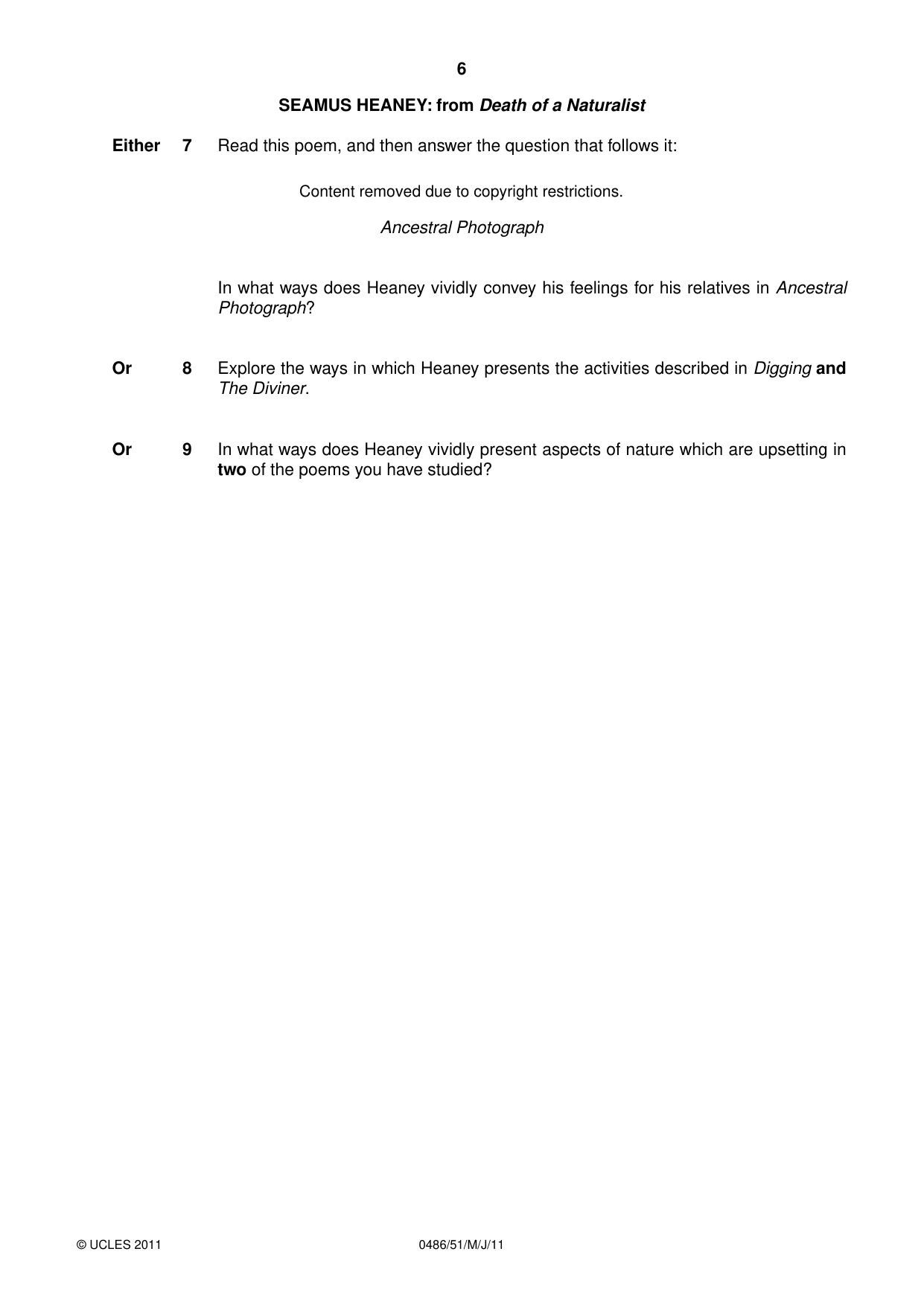
6 0486/51/M/J/11 © UCLES 2011 SEAMUS HEANEY: from Death of a Naturalist Either 7 Read this poem, and then answer the question that follows it: Ancestral Photograph In what ways does Heaney vividly convey his feelings for his relatives in Ancestral Photograph? Or 8 Explore the ways in which Heaney presents the activities described in Digging and The Diviner. Or 9 In what ways does Heaney vividly present aspects of nature which are upsetting in two of the poems you have studied? Content removed due to copyright restrictions.
Question paper, page 7
7 0486/51/M/J/11 © UCLES 2011 [Turn over BLANK PAGE Turn to page 8 for Question 10.
Question paper, page 8
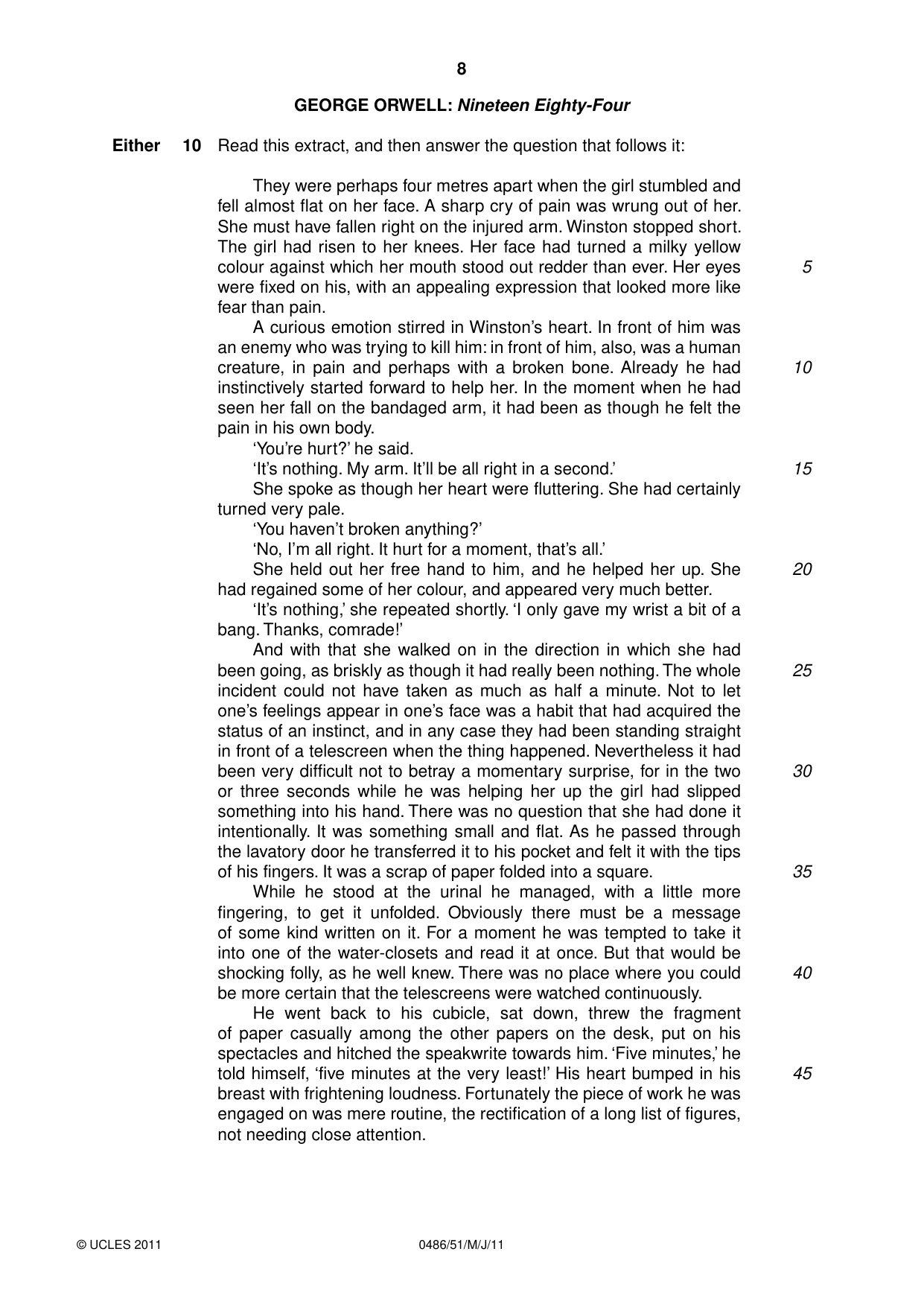
8 0486/51/M/J/11 © UCLES 2011 GEORGE ORWELL: Nineteen Eighty-Four Either 10 Read this extract, and then answer the question that follows it: They were perhaps four metres apart when the girl stumbled and fell almost flat on her face. A sharp cry of pain was wrung out of her. She must have fallen right on the injured arm. Winston stopped short. The girl had risen to her knees. Her face had turned a milky yellow colour against which her mouth stood out redder than ever. Her eyes were fixed on his, with an appealing expression that looked more like fear than pain. A curious emotion stirred in Winston’s heart. In front of him was an enemy who was trying to kill him: in front of him, also, was a human creature, in pain and perhaps with a broken bone. Already he had instinctively started forward to help her. In the moment when he had seen her fall on the bandaged arm, it had been as though he felt the pain in his own body. ‘You’re hurt?’ he said. ‘It’s nothing. My arm. It’ll be all right in a second.’ She spoke as though her heart were fluttering. She had certainly turned very pale. ‘You haven’t broken anything?’ ‘No, I’m all right. It hurt for a moment, that’s all.’ She held out her free hand to him, and he helped her up. She had regained some of her colour, and appeared very much better. ‘It’s nothing,’ she repeated shortly. ‘I only gave my wrist a bit of a bang. Thanks, comrade!’ And with that she walked on in the direction in which she had been going, as briskly as though it had really been nothing. The whole incident could not have taken as much as half a minute. Not to let one’s feelings appear in one’s face was a habit that had acquired the status of an instinct, and in any case they had been standing straight in front of a telescreen when the thing happened. Nevertheless it had been very difficult not to betray a momentary surprise, for in the two or three seconds while he was helping her up the girl had slipped something into his hand. There was no question that she had done it intentionally. It was something small and flat. As he passed through the lavatory door he transferred it to his pocket and felt it with the tips of his fingers. It was a scrap of paper folded into a square. While he stood at the urinal he managed, with a little more fingering, to get it unfolded. Obviously there must be a message of some kind written on it. For a moment he was tempted to take it into one of the water-closets and read it at once. But that would be shocking folly, as he well knew. There was no place where you could be more certain that the telescreens were watched continuously. He went back to his cubicle, sat down, threw the fragment of paper casually among the other papers on the desk, put on his spectacles and hitched the speakwrite towards him. ‘Five minutes,’ he told himself, ‘five minutes at the very least!’ His heart bumped in his breast with frightening loudness. Fortunately the piece of work he was engaged on was mere routine, the rectification of a long list of figures, not needing close attention. 5 10 15 20 25 30 35 40 45
Question paper, page 9
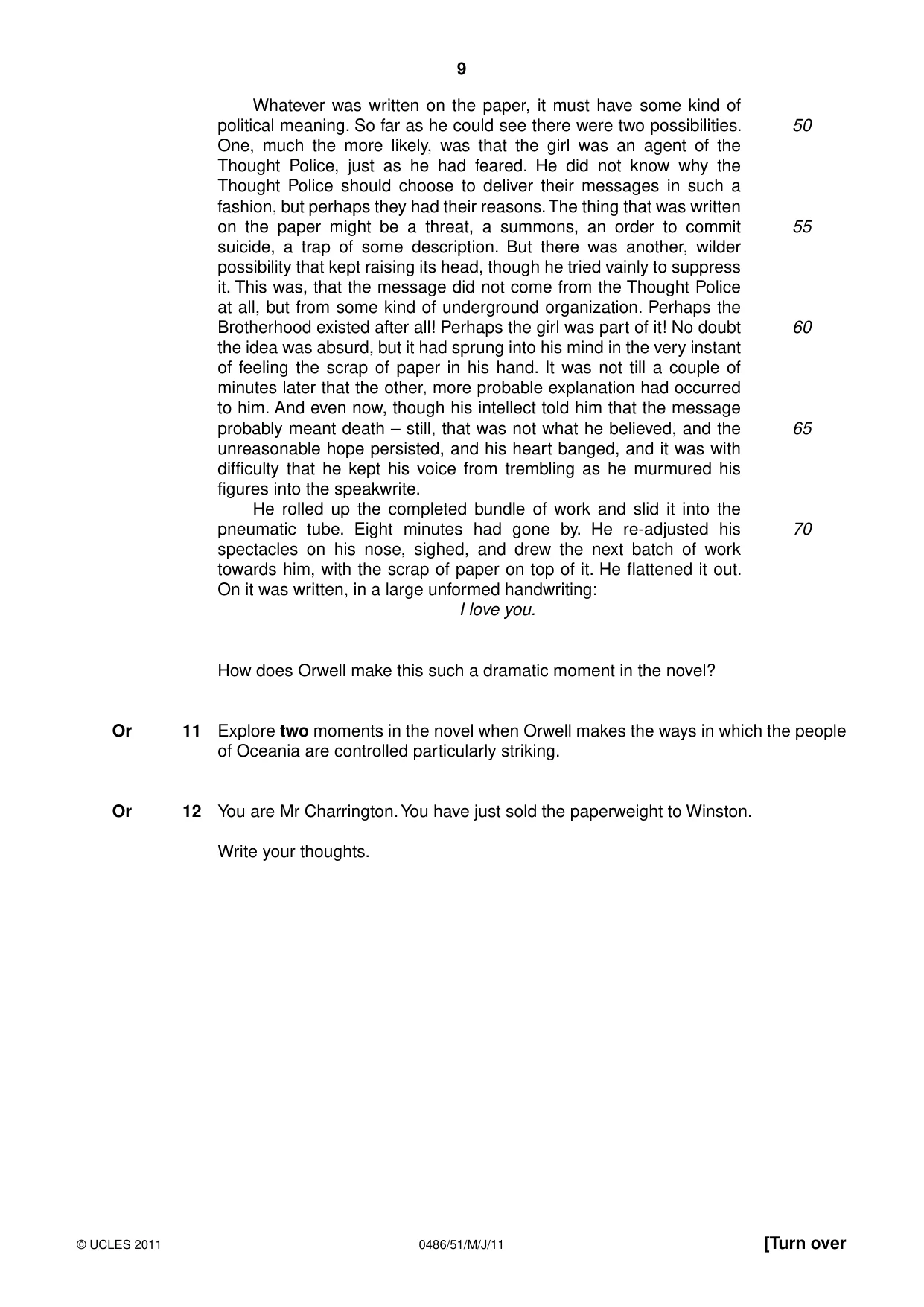
9 0486/51/M/J/11 © UCLES 2011 [Turn over Whatever was written on the paper, it must have some kind of political meaning. So far as he could see there were two possibilities. One, much the more likely, was that the girl was an agent of the Thought Police, just as he had feared. He did not know why the Thought Police should choose to deliver their messages in such a fashion, but perhaps they had their reasons. The thing that was written on the paper might be a threat, a summons, an order to commit suicide, a trap of some description. But there was another, wilder possibility that kept raising its head, though he tried vainly to suppress it. This was, that the message did not come from the Thought Police at all, but from some kind of underground organization. Perhaps the Brotherhood existed after all! Perhaps the girl was part of it! No doubt the idea was absurd, but it had sprung into his mind in the very instant of feeling the scrap of paper in his hand. It was not till a couple of minutes later that the other, more probable explanation had occurred to him. And even now, though his intellect told him that the message probably meant death – still, that was not what he believed, and the unreasonable hope persisted, and his heart banged, and it was with difficulty that he kept his voice from trembling as he murmured his figures into the speakwrite. He rolled up the completed bundle of work and slid it into the pneumatic tube. Eight minutes had gone by. He re-adjusted his spectacles on his nose, sighed, and drew the next batch of work towards him, with the scrap of paper on top of it. He flattened it out. On it was written, in a large unformed handwriting: I love you. How does Orwell make this such a dramatic moment in the novel? Or 11 Explore two moments in the novel when Orwell makes the ways in which the people of Oceania are controlled particularly striking. Or 12 You are Mr Charrington. You have just sold the paperweight to Winston. Write your thoughts. 50 55 60 65 70
Question paper, page 10
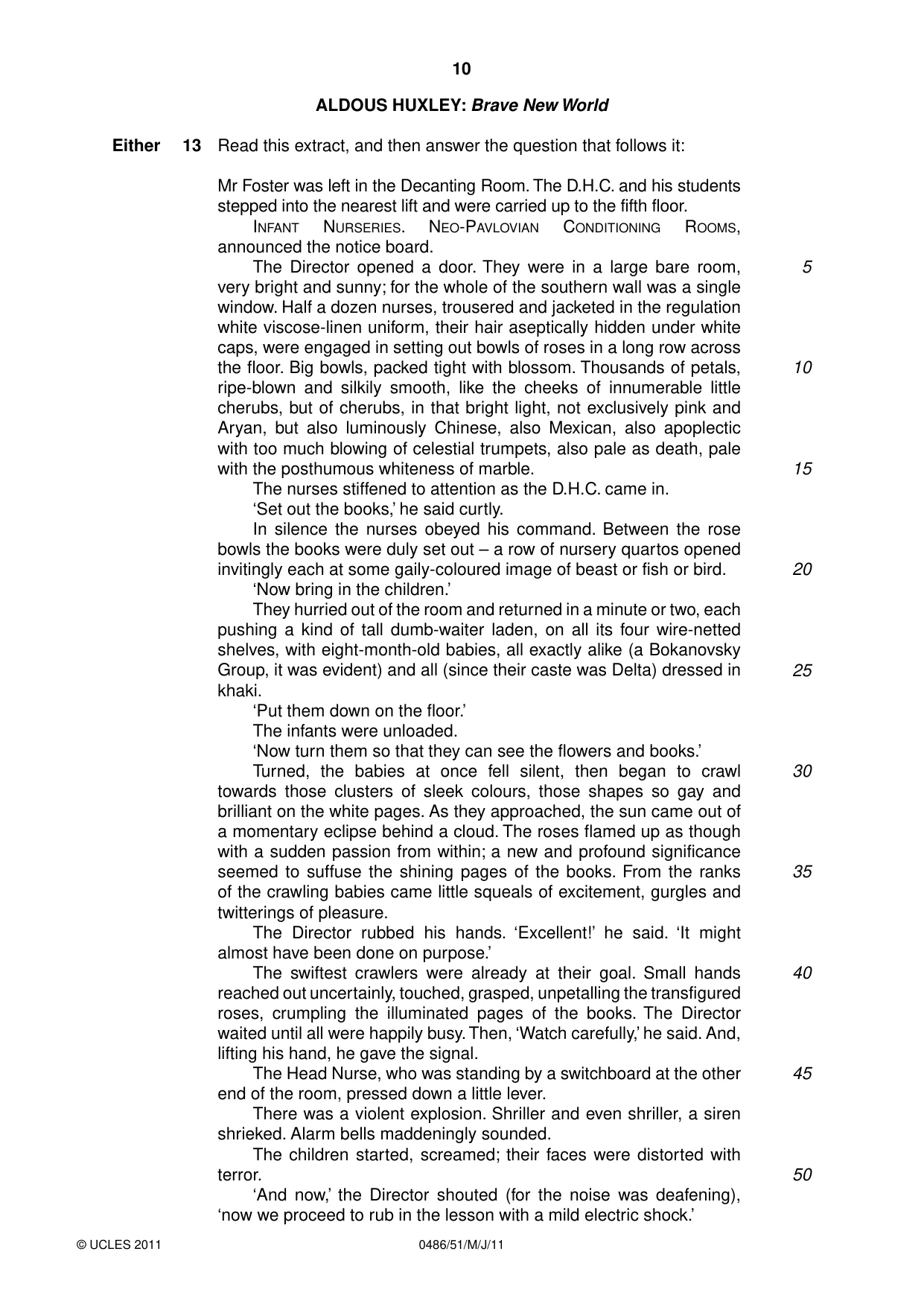
10 0486/51/M/J/11 © UCLES 2011 ALDOUS HUXLEY: Brave New World Either 13 Read this extract, and then answer the question that follows it: Mr Foster was left in the Decanting Room. The D.H.C. and his students stepped into the nearest lift and were carried up to the fifth floor. INFANT NURSERIES. NEO-PAVLOVIAN CONDITIONING ROOMS, announced the notice board. The Director opened a door. They were in a large bare room, very bright and sunny; for the whole of the southern wall was a single window. Half a dozen nurses, trousered and jacketed in the regulation white viscose-linen uniform, their hair aseptically hidden under white caps, were engaged in setting out bowls of roses in a long row across the floor. Big bowls, packed tight with blossom. Thousands of petals, ripe-blown and silkily smooth, like the cheeks of innumerable little cherubs, but of cherubs, in that bright light, not exclusively pink and Aryan, but also luminously Chinese, also Mexican, also apoplectic with too much blowing of celestial trumpets, also pale as death, pale with the posthumous whiteness of marble. The nurses stiffened to attention as the D.H.C. came in. ‘Set out the books,’ he said curtly. In silence the nurses obeyed his command. Between the rose bowls the books were duly set out – a row of nursery quartos opened invitingly each at some gaily-coloured image of beast or fish or bird. ‘Now bring in the children.’ They hurried out of the room and returned in a minute or two, each pushing a kind of tall dumb-waiter laden, on all its four wire-netted shelves, with eight-month-old babies, all exactly alike (a Bokanovsky Group, it was evident) and all (since their caste was Delta) dressed in khaki. ‘Put them down on the floor.’ The infants were unloaded. ‘Now turn them so that they can see the flowers and books.’ Turned, the babies at once fell silent, then began to crawl towards those clusters of sleek colours, those shapes so gay and brilliant on the white pages. As they approached, the sun came out of a momentary eclipse behind a cloud. The roses flamed up as though with a sudden passion from within; a new and profound significance seemed to suffuse the shining pages of the books. From the ranks of the crawling babies came little squeals of excitement, gurgles and twitterings of pleasure. The Director rubbed his hands. ‘Excellent!’ he said. ‘It might almost have been done on purpose.’ The swiftest crawlers were already at their goal. Small hands reached out uncertainly, touched, grasped, unpetalling the transfigured roses, crumpling the illuminated pages of the books. The Director waited until all were happily busy. Then, ‘Watch carefully,’ he said. And, lifting his hand, he gave the signal. The Head Nurse, who was standing by a switchboard at the other end of the room, pressed down a little lever. There was a violent explosion. Shriller and even shriller, a siren shrieked. Alarm bells maddeningly sounded. The children started, screamed; their faces were distorted with terror. ‘And now,’ the Director shouted (for the noise was deafening), ‘now we proceed to rub in the lesson with a mild electric shock.’ 5 10 15 20 25 30 35 40 45 50
Question paper, page 11
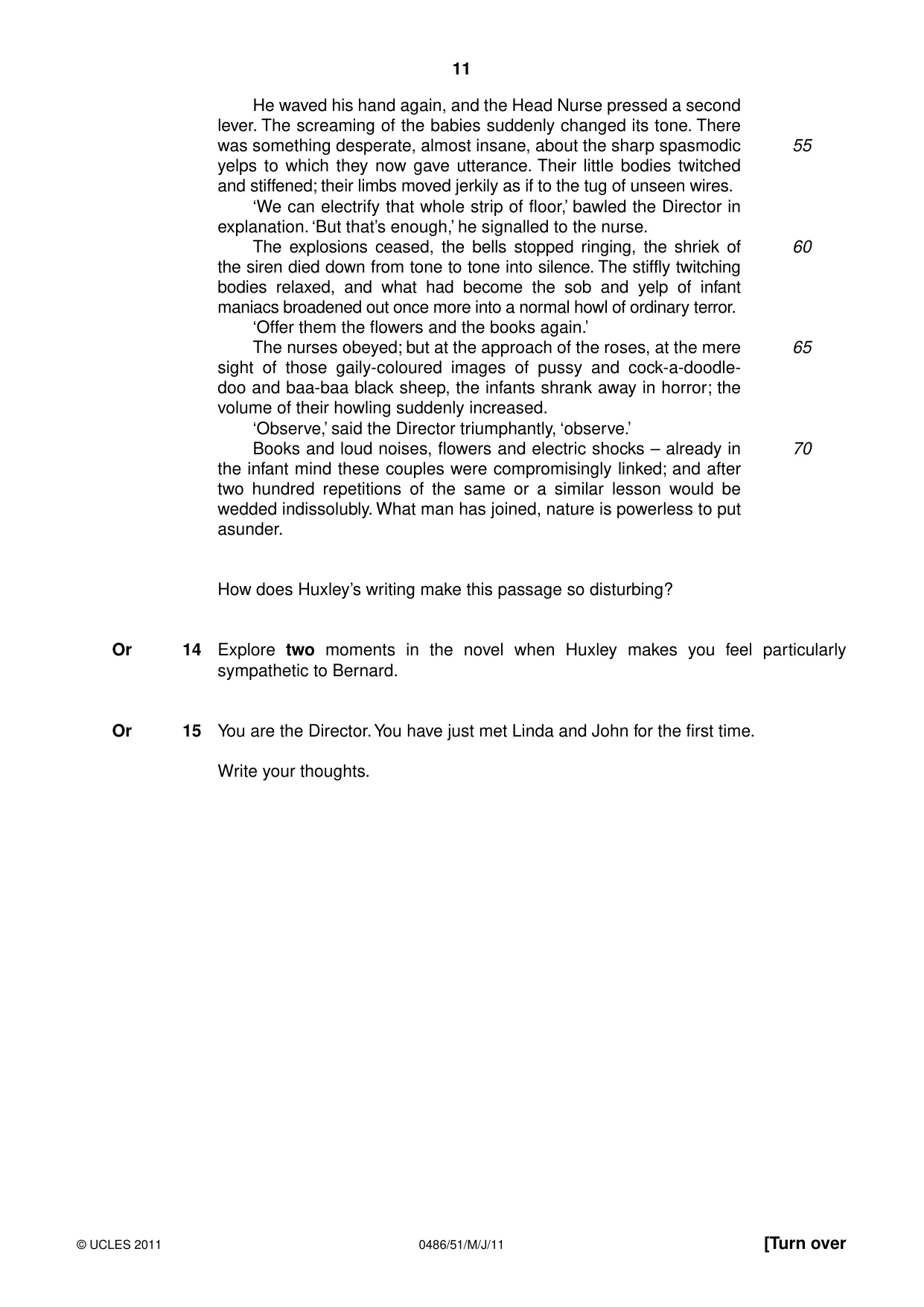
11 0486/51/M/J/11 © UCLES 2011 [Turn over He waved his hand again, and the Head Nurse pressed a second lever. The screaming of the babies suddenly changed its tone. There was something desperate, almost insane, about the sharp spasmodic yelps to which they now gave utterance. Their little bodies twitched and stiffened; their limbs moved jerkily as if to the tug of unseen wires. ‘We can electrify that whole strip of floor,’ bawled the Director in explanation. ‘But that’s enough,’ he signalled to the nurse. The explosions ceased, the bells stopped ringing, the shriek of the siren died down from tone to tone into silence. The stiffly twitching bodies relaxed, and what had become the sob and yelp of infant maniacs broadened out once more into a normal howl of ordinary terror. ‘Offer them the flowers and the books again.’ The nurses obeyed; but at the approach of the roses, at the mere sight of those gaily-coloured images of pussy and cock-a-doodle- doo and baa-baa black sheep, the infants shrank away in horror; the volume of their howling suddenly increased. ‘Observe,’ said the Director triumphantly, ‘observe.’ Books and loud noises, flowers and electric shocks – already in the infant mind these couples were compromisingly linked; and after two hundred repetitions of the same or a similar lesson would be wedded indissolubly. What man has joined, nature is powerless to put asunder. How does Huxley’s writing make this passage so disturbing? Or 14 Explore two moments in the novel when Huxley makes you feel particularly sympathetic to Bernard. Or 15 You are the Director. You have just met Linda and John for the first time. Write your thoughts. 55 60 65 70
Question paper, page 12
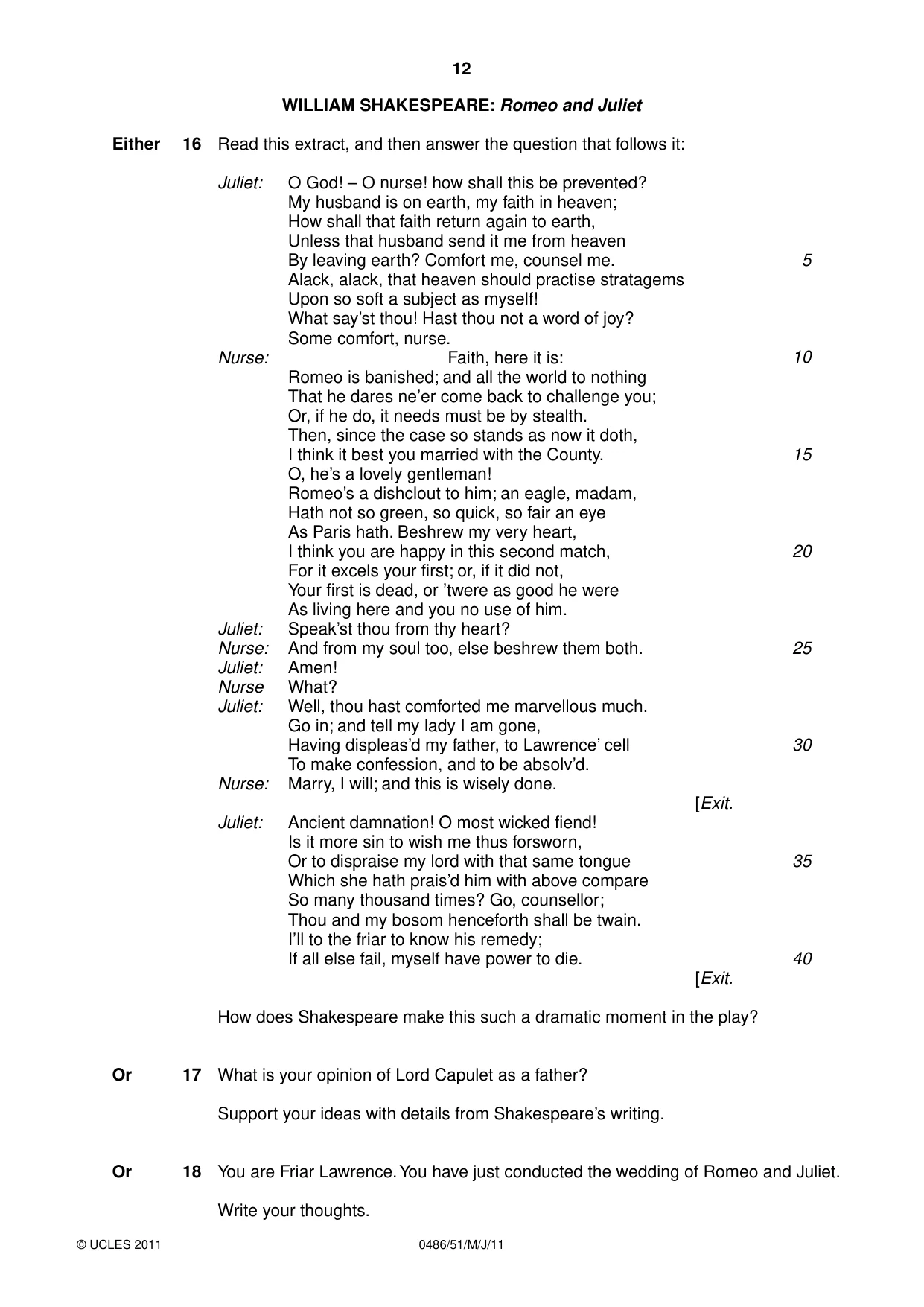
12 0486/51/M/J/11 © UCLES 2011 WILLIAM SHAKESPEARE: Romeo and Juliet Either 16 Read this extract, and then answer the question that follows it: Juliet: O God! – O nurse! how shall this be prevented? My husband is on earth, my faith in heaven; How shall that faith return again to earth, Unless that husband send it me from heaven By leaving earth? Comfort me, counsel me. Alack, alack, that heaven should practise stratagems Upon so soft a subject as myself! What say’st thou! Hast thou not a word of joy? Some comfort, nurse. Nurse: Faith, here it is: Romeo is banished; and all the world to nothing That he dares ne’er come back to challenge you; Or, if he do, it needs must be by stealth. Then, since the case so stands as now it doth, I think it best you married with the County. O, he’s a lovely gentleman! Romeo’s a dishclout to him; an eagle, madam, Hath not so green, so quick, so fair an eye As Paris hath. Beshrew my very heart, I think you are happy in this second match, For it excels your first; or, if it did not, Your first is dead, or ’twere as good he were As living here and you no use of him. Juliet: Speak’st thou from thy heart? Nurse: And from my soul too, else beshrew them both. Juliet: Amen! Nurse What? Juliet: Well, thou hast comforted me marvellous much. Go in; and tell my lady I am gone, Having displeas’d my father, to Lawrence’ cell To make confession, and to be absolv’d. Nurse: Marry, I will; and this is wisely done. [Exit. Juliet: Ancient damnation! O most wicked fiend! Is it more sin to wish me thus forsworn, Or to dispraise my lord with that same tongue Which she hath prais’d him with above compare So many thousand times? Go, counsellor; Thou and my bosom henceforth shall be twain. I’ll to the friar to know his remedy; If all else fail, myself have power to die. [Exit. How does Shakespeare make this such a dramatic moment in the play? Or 17 What is your opinion of Lord Capulet as a father? Support your ideas with details from Shakespeare’s writing. Or 18 You are Friar Lawrence. You have just conducted the wedding of Romeo and Juliet. Write your thoughts. 5 10 15 20 25 30 35 40
Question paper, page 13
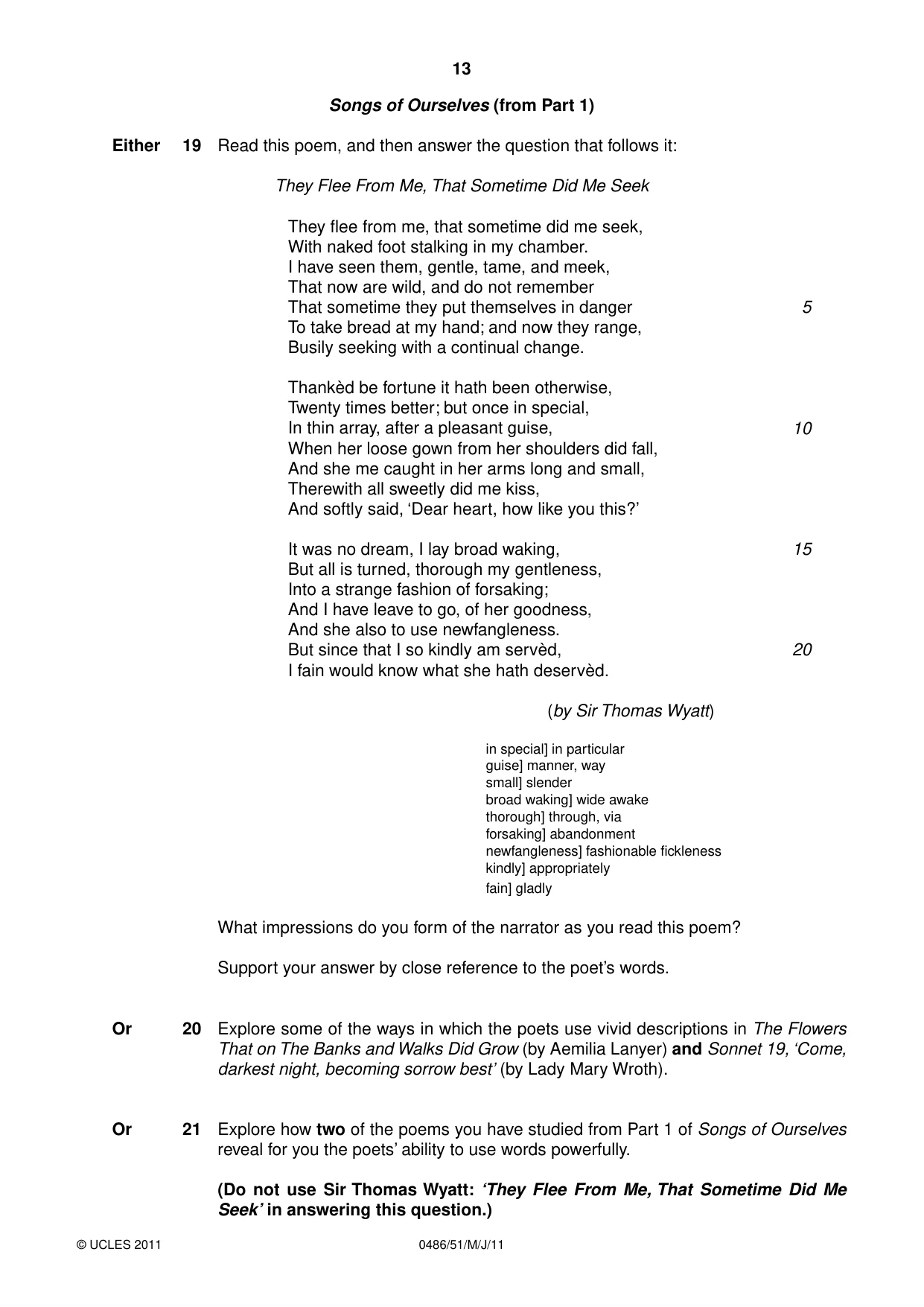
13 0486/51/M/J/11 © UCLES 2011 Songs of Ourselves (from Part 1) Either 19 Read this poem, and then answer the question that follows it: They Flee From Me, That Sometime Did Me Seek They flee from me, that sometime did me seek, With naked foot stalking in my chamber. I have seen them, gentle, tame, and meek, That now are wild, and do not remember That sometime they put themselves in danger To take bread at my hand; and now they range, Busily seeking with a continual change. Thankèd be fortune it hath been otherwise, Twenty times better; but once in special, In thin array, after a pleasant guise, When her loose gown from her shoulders did fall, And she me caught in her arms long and small, Therewith all sweetly did me kiss, And softly said, ‘Dear heart, how like you this?’ It was no dream, I lay broad waking, But all is turned, thorough my gentleness, Into a strange fashion of forsaking; And I have leave to go, of her goodness, And she also to use newfangleness. But since that I so kindly am servèd, I fain would know what she hath deservèd. (by Sir Thomas Wyatt) in special] in particular guise] manner, way small] slender broad waking] wide awake thorough] through, via forsaking] abandonment newfangleness] fashionable fickleness kindly] appropriately fain] gladly What impressions do you form of the narrator as you read this poem? Support your answer by close reference to the poet’s words. Or 20 Explore some of the ways in which the poets use vivid descriptions in The Flowers That on The Banks and Walks Did Grow (by Aemilia Lanyer) and Sonnet 19, ‘Come, darkest night, becoming sorrow best’ (by Lady Mary Wroth). Or 21 Explore how two of the poems you have studied from Part 1 of Songs of Ourselves reveal for you the poets’ ability to use words powerfully. (Do not use Sir Thomas Wyatt: ‘They Flee From Me, That Sometime Did Me Seek’ in answering this question.) 5 10 15 20
Question paper, page 14
14 0486/51/M/J/11 © UCLES 2011 BLANK PAGE
Question paper, page 15
15 0486/51/M/J/11 © UCLES 2011 BLANK PAGE
Question paper, page 16
16 0486/51/M/J/11 © UCLES 2011 Copyright Acknowledgements: Question 1 © Maya Angelou; I Know Why The Caged Bird Sings; Virago Press; 1984. Question 4 © Brian Clarke; Whose Life is it Anyway; Amberlane Press; 1978. Question 7 © Seamus Heaney; Death of a Naturalist; Faber & Faber; 1966. Question 10 © George Orwell; Nineteen Eighty-Four; Penguin; 1949. Question 13 © Aldous Huxley; Brave New World; Penguin; 1932. Permission to reproduce items where third-party owned material protected by copyright is included has been sought and cleared where possible. Every reasonable effort has been made by the publisher (UCLES) to trace copyright holders, but if any items requiring clearance have unwittingly been included, the publisher will be pleased to make amends at the earliest possible opportunity. University of Cambridge International Examinations is part of the Cambridge Assessment Group. Cambridge Assessment is the brand name of University of Cambridge Local Examinations Syndicate (UCLES), which is itself a department of the University of Cambridge. BLANK PAGE
Mark scheme, page 1
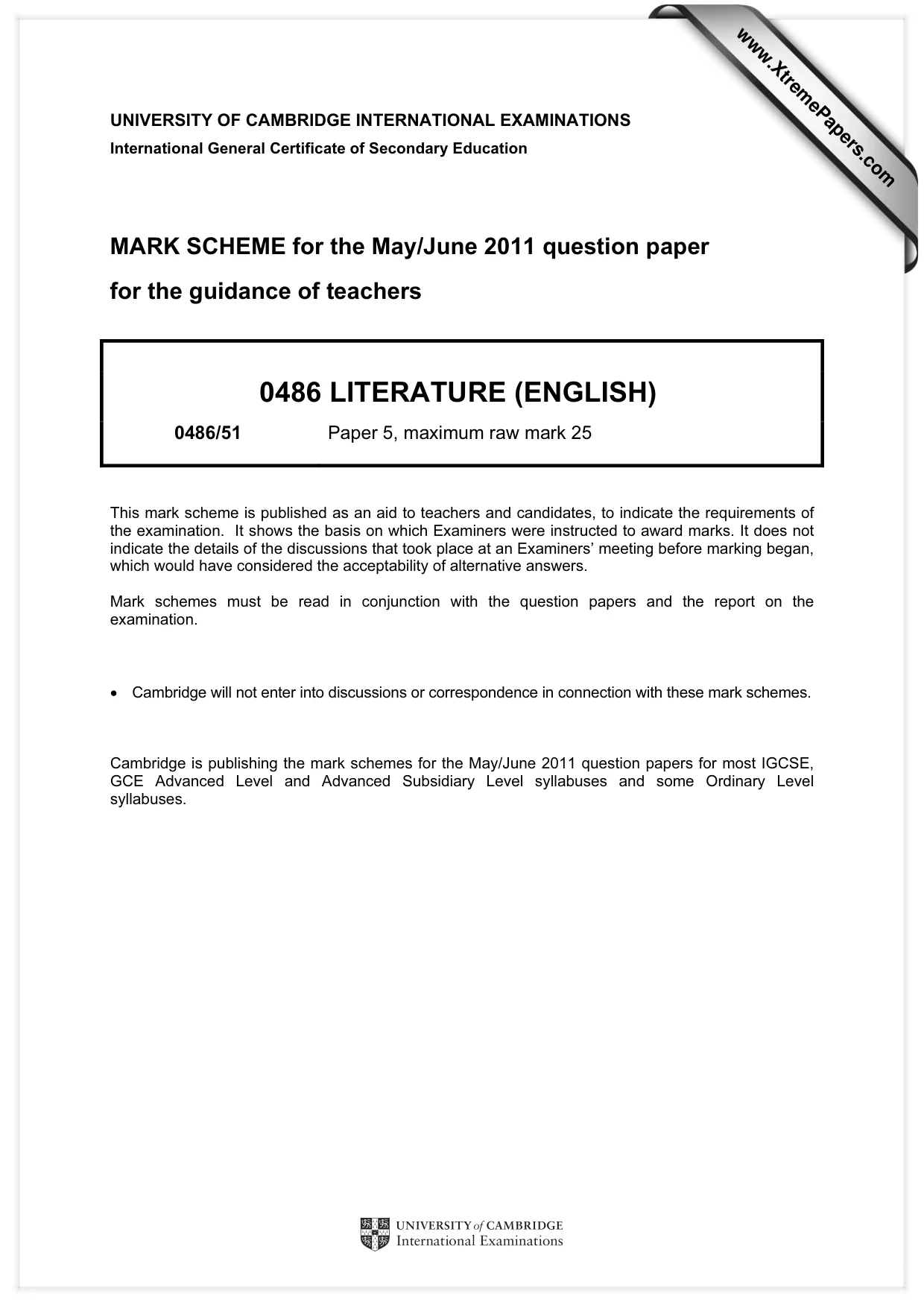
UNIVERSITY OF CAMBRIDGE INTERNATIONAL EXAMINATIONS International General Certificate of Secondary Education MARK SCHEME for the May/June 2011 question paper for the guidance of teachers 0486 LITERATURE (ENGLISH) 0486/51 Paper 5, maximum raw mark 25 This mark scheme is published as an aid to teachers and candidates, to indicate the requirements of the examination. It shows the basis on which Examiners were instructed to award marks. It does not indicate the details of the discussions that took place at an Examiners’ meeting before marking began, which would have considered the acceptability of alternative answers. Mark schemes must be read in conjunction with the question papers and the report on the examination. • Cambridge will not enter into discussions or correspondence in connection with these mark schemes. Cambridge is publishing the mark schemes for the May/June 2011 question papers for most IGCSE, GCE Advanced Level and Advanced Subsidiary Level syllabuses and some Ordinary Level syllabuses. www.XtremePapers.com
Mark scheme, page 2
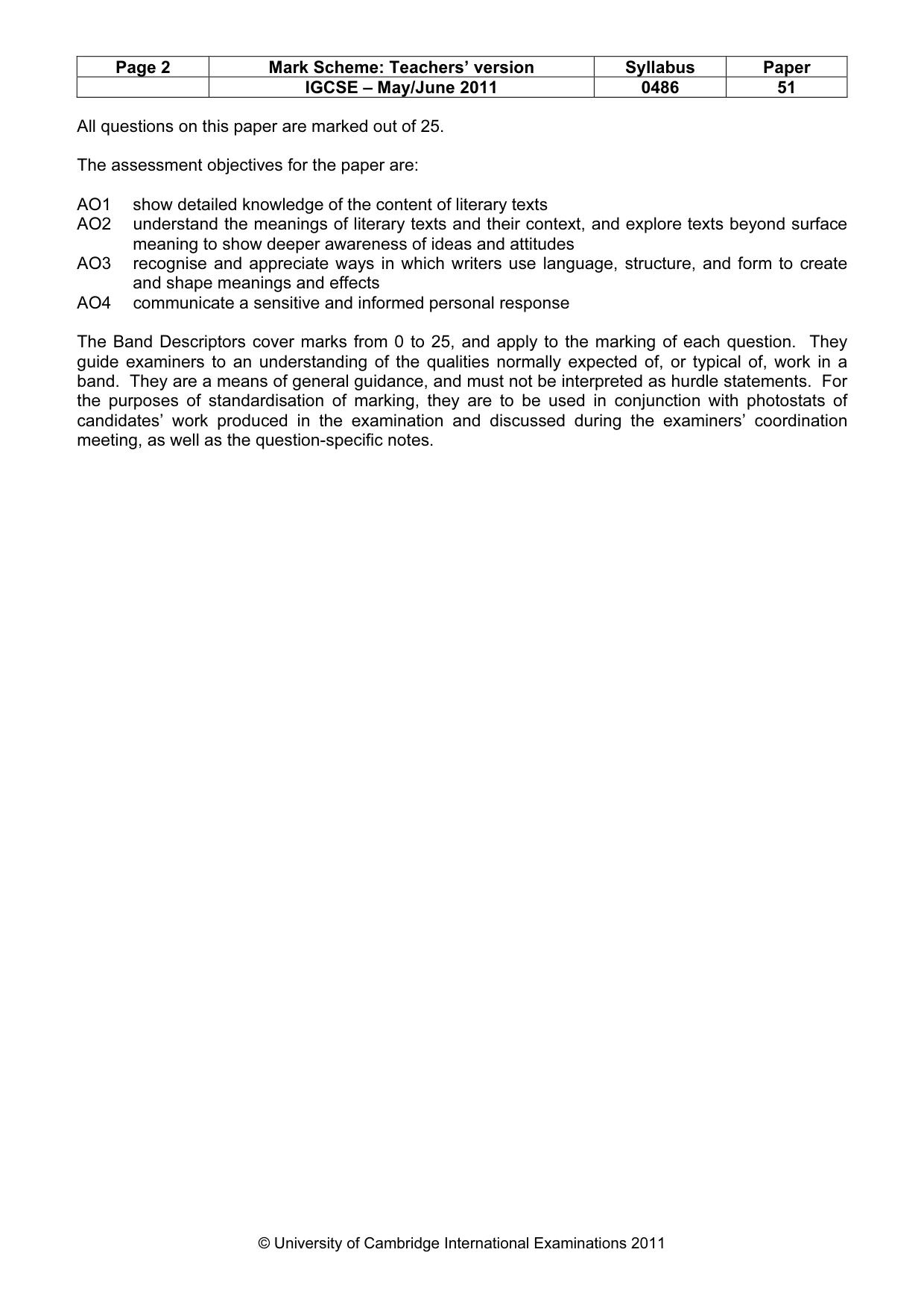
Page 2 Mark Scheme: Teachers’ version Syllabus Paper IGCSE – May/June 2011 0486 51 © University of Cambridge International Examinations 2011 All questions on this paper are marked out of 25. The assessment objectives for the paper are: AO1 show detailed knowledge of the content of literary texts AO2 understand the meanings of literary texts and their context, and explore texts beyond surface meaning to show deeper awareness of ideas and attitudes AO3 recognise and appreciate ways in which writers use language, structure, and form to create and shape meanings and effects AO4 communicate a sensitive and informed personal response The Band Descriptors cover marks from 0 to 25, and apply to the marking of each question. They guide examiners to an understanding of the qualities normally expected of, or typical of, work in a band. They are a means of general guidance, and must not be interpreted as hurdle statements. For the purposes of standardisation of marking, they are to be used in conjunction with photostats of candidates’ work produced in the examination and discussed during the examiners’ coordination meeting, as well as the question-specific notes.
Mark scheme, page 3
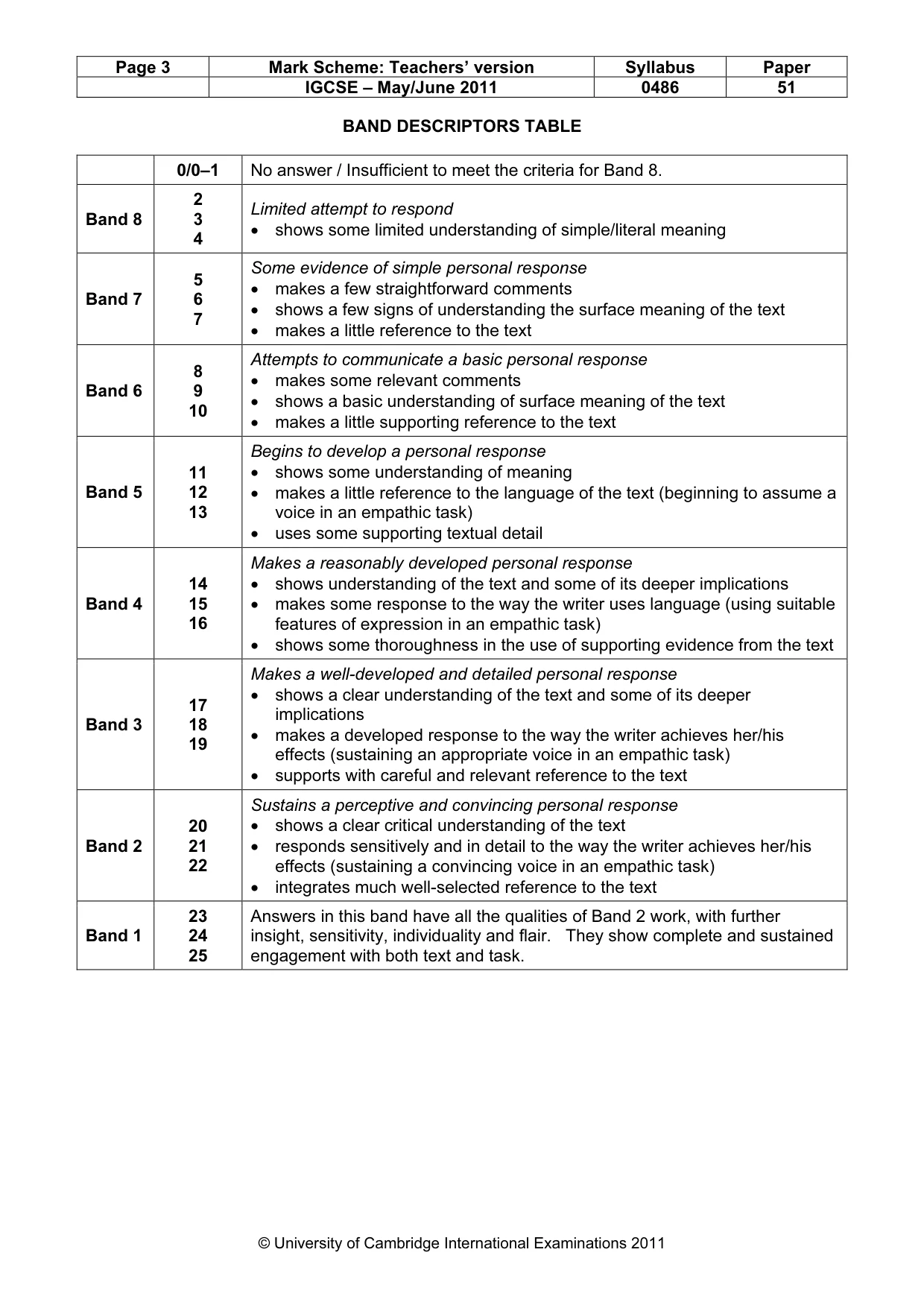
Page 3 Mark Scheme: Teachers’ version Syllabus Paper IGCSE – May/June 2011 0486 51 © University of Cambridge International Examinations 2011 BAND DESCRIPTORS TABLE 0/0–1 No answer / Insufficient to meet the criteria for Band 8. Band 8 2 3 4 Limited attempt to respond • shows some limited understanding of simple/literal meaning Band 7 5 6 7 Some evidence of simple personal response • makes a few straightforward comments • shows a few signs of understanding the surface meaning of the text • makes a little reference to the text Band 6 8 9 10 Attempts to communicate a basic personal response • makes some relevant comments • shows a basic understanding of surface meaning of the text • makes a little supporting reference to the text Band 5 11 12 13 Begins to develop a personal response • shows some understanding of meaning • makes a little reference to the language of the text (beginning to assume a voice in an empathic task) • uses some supporting textual detail Band 4 14 15 16 Makes a reasonably developed personal response • shows understanding of the text and some of its deeper implications • makes some response to the way the writer uses language (using suitable features of expression in an empathic task) • shows some thoroughness in the use of supporting evidence from the text Band 3 17 18 19 Makes a well-developed and detailed personal response • shows a clear understanding of the text and some of its deeper implications • makes a developed response to the way the writer achieves her/his effects (sustaining an appropriate voice in an empathic task) • supports with careful and relevant reference to the text Band 2 20 21 22 Sustains a perceptive and convincing personal response • shows a clear critical understanding of the text • responds sensitively and in detail to the way the writer achieves her/his effects (sustaining a convincing voice in an empathic task) • integrates much well-selected reference to the text Band 1 23 24 25 Answers in this band have all the qualities of Band 2 work, with further insight, sensitivity, individuality and flair. They show complete and sustained engagement with both text and task.
What you needed in this session
Cambridge’s own grade thresholds for 2011 May/June, Paper 5 · Variant 1. A higher threshold means an easier paper — the bar moves with how the cohort did.