Cambridge IGCSE English - Literature 0486 — 2010 May/June Paper 5 · Variant 2
0486/52/M/J/10 · 25 marks · ≈28 min
The question paper and its mark scheme, free to read here and free to download. This is Cambridge’s own paper, exactly as it was sat.
Question paper16 pages


Mark scheme10 pages
Answers below. Sit the paper first if you are practising.
Paper as text
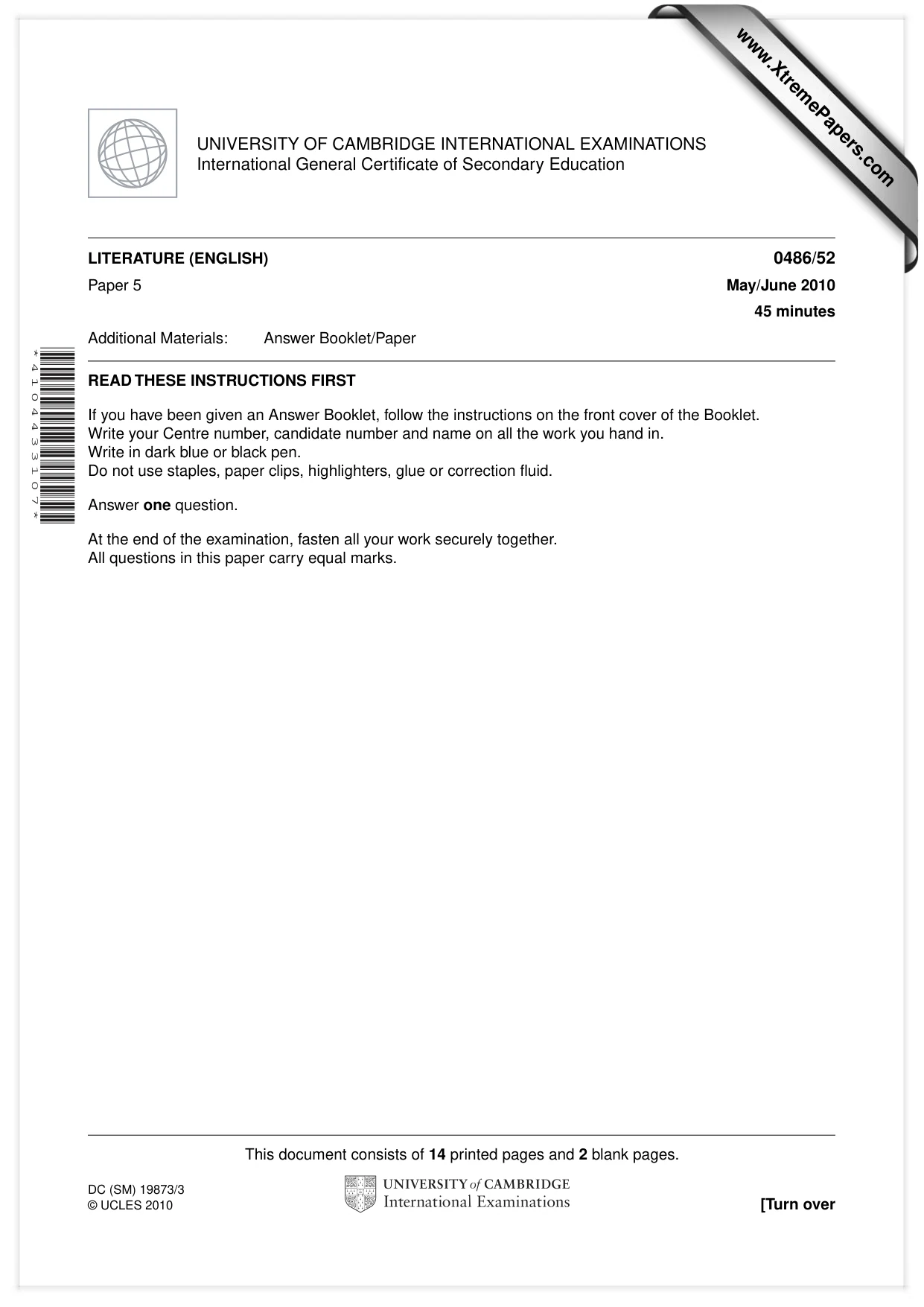
Question paper, page 1
This document consists of 14 printed pages and 2 blank pages. DC (SM) 19873/3 © UCLES 2010 [Turn over UNIVERSITY OF CAMBRIDGE INTERNATIONAL EXAMINATIONS International General Certificate of Secondary Education READ THESE INSTRUCTIONS FIRST If you have been given an Answer Booklet, follow the instructions on the front cover of the Booklet. Write your Centre number, candidate number and name on all the work you hand in. Write in dark blue or black pen. Do not use staples, paper clips, highlighters, glue or correction fluid. Answer one question. At the end of the examination, fasten all your work securely together. All questions in this paper carry equal marks. LITERATURE (ENGLISH) 0486/52 Paper 5 May/June 2010 45 minutes Additional Materials: Answer Booklet/Paper * 4 1 0 4 4 3 3 1 0 7 * www.XtremePapers.com
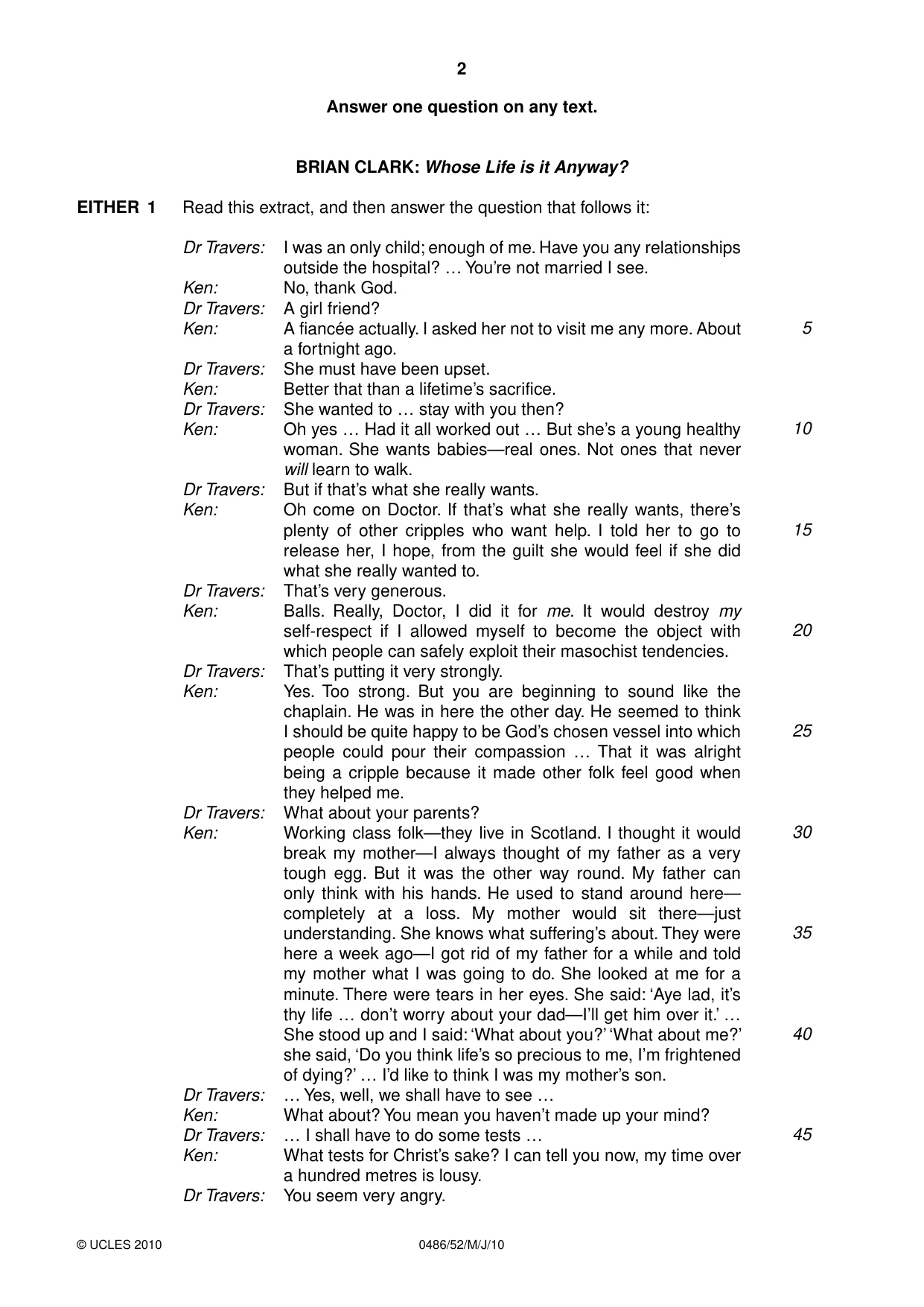
Question paper, page 2
2 0486/52/M/J/10 © UCLES 2010 Answer one question on any text. BRIAN CLARK: Whose Life is it Anyway? EITHER 1 Read this extract, and then answer the question that follows it: Dr Travers: I was an only child; enough of me. Have you any relationships outside the hospital? … You’re not married I see. Ken: No, thank God. Dr Travers: A girl friend? Ken: A fiancée actually. I asked her not to visit me any more. About a fortnight ago. Dr Travers: She must have been upset. Ken: Better that than a lifetime’s sacrifice. Dr Travers: She wanted to … stay with you then? Ken: Oh yes … Had it all worked out … But she’s a young healthy woman. She wants babies—real ones. Not ones that never will learn to walk. Dr Travers: But if that’s what she really wants. Ken: Oh come on Doctor. If that’s what she really wants, there’s plenty of other cripples who want help. I told her to go to release her, I hope, from the guilt she would feel if she did what she really wanted to. Dr Travers: That’s very generous. Ken: Balls. Really, Doctor, I did it for me. It would destroy my self-respect if I allowed myself to become the object with which people can safely exploit their masochist tendencies. Dr Travers: That’s putting it very strongly. Ken: Yes. Too strong. But you are beginning to sound like the chaplain. He was in here the other day. He seemed to think I should be quite happy to be God’s chosen vessel into which people could pour their compassion … That it was alright being a cripple because it made other folk feel good when they helped me. Dr Travers: What about your parents? Ken: Working class folk—they live in Scotland. I thought it would break my mother—I always thought of my father as a very tough egg. But it was the other way round. My father can only think with his hands. He used to stand around here— completely at a loss. My mother would sit there—just understanding. She knows what suffering’s about. They were here a week ago—I got rid of my father for a while and told my mother what I was going to do. She looked at me for a minute. There were tears in her eyes. She said: ‘Aye lad, it’s thy life … don’t worry about your dad—I’ll get him over it.’ … She stood up and I said: ‘What about you?’ ‘What about me?’ she said, ‘Do you think life’s so precious to me, I’m frightened of dying?’ … I’d like to think I was my mother’s son. Dr Travers: … Yes, well, we shall have to see … Ken: What about? You mean you haven’t made up your mind? Dr Travers: … I shall have to do some tests … Ken: What tests for Christ’s sake? I can tell you now, my time over a hundred metres is lousy. Dr Travers: You seem very angry. 5 10 15 20 25 30 35 40 45
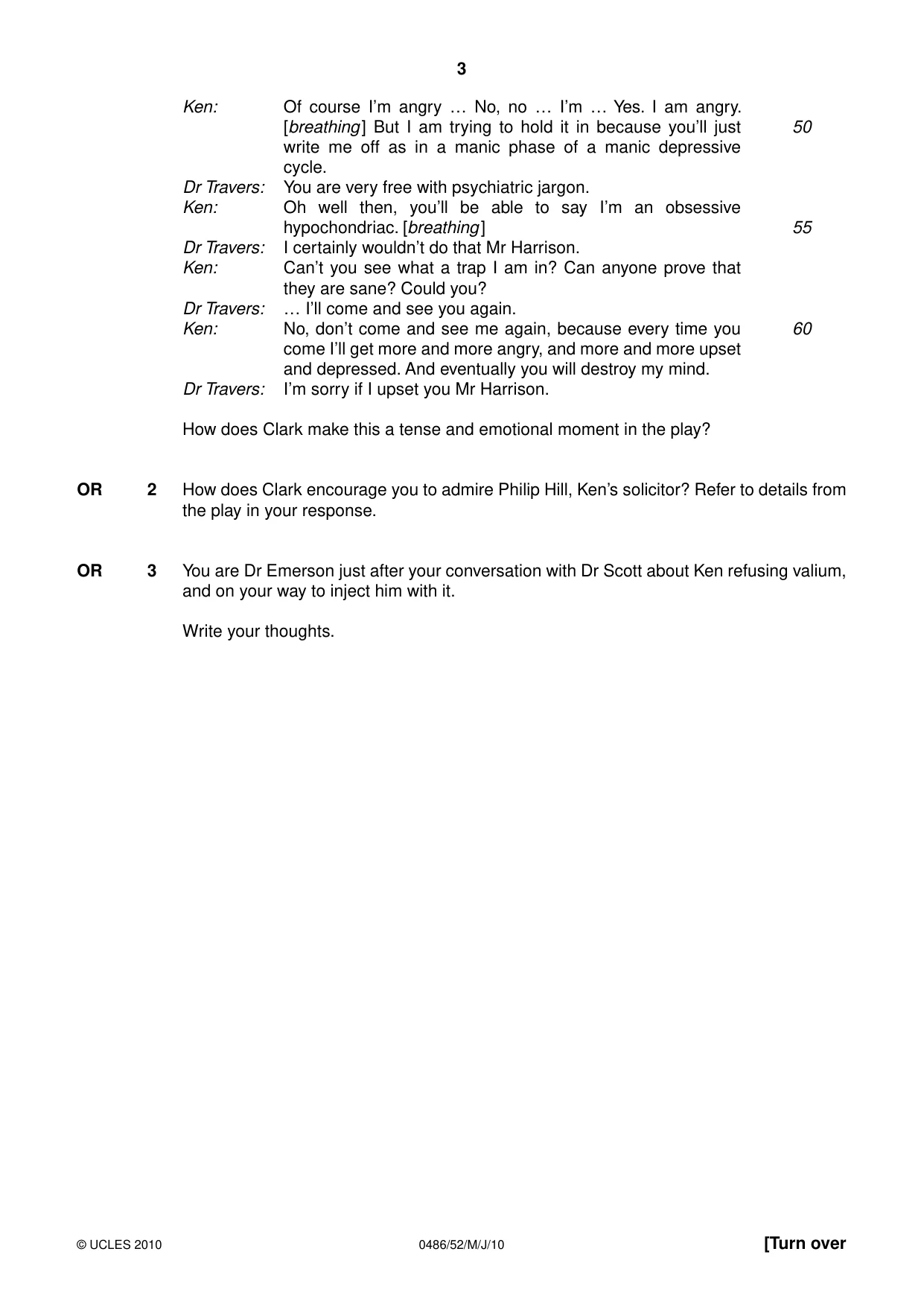
Question paper, page 3
3 0486/52/M/J/10 © UCLES 2010 [Turn over Ken: Of course I’m angry … No, no … I’m … Yes. I am angry. [breathing ] But I am trying to hold it in because you’ll just write me off as in a manic phase of a manic depressive cycle. Dr Travers: You are very free with psychiatric jargon. Ken: Oh well then, you’ll be able to say I’m an obsessive hypochondriac. [breathing ] Dr Travers: I certainly wouldn’t do that Mr Harrison. Ken: Can’t you see what a trap I am in? Can anyone prove that they are sane? Could you? Dr Travers: … I’ll come and see you again. Ken: No, don’t come and see me again, because every time you come I’ll get more and more angry, and more and more upset and depressed. And eventually you will destroy my mind. Dr Travers: I’m sorry if I upset you Mr Harrison. How does Clark make this a tense and emotional moment in the play? OR 2 How does Clark encourage you to admire Philip Hill, Ken’s solicitor? Refer to details from the play in your response. OR 3 You are Dr Emerson just after your conversation with Dr Scott about Ken refusing valium, and on your way to inject him with it. Write your thoughts. 50 55 60
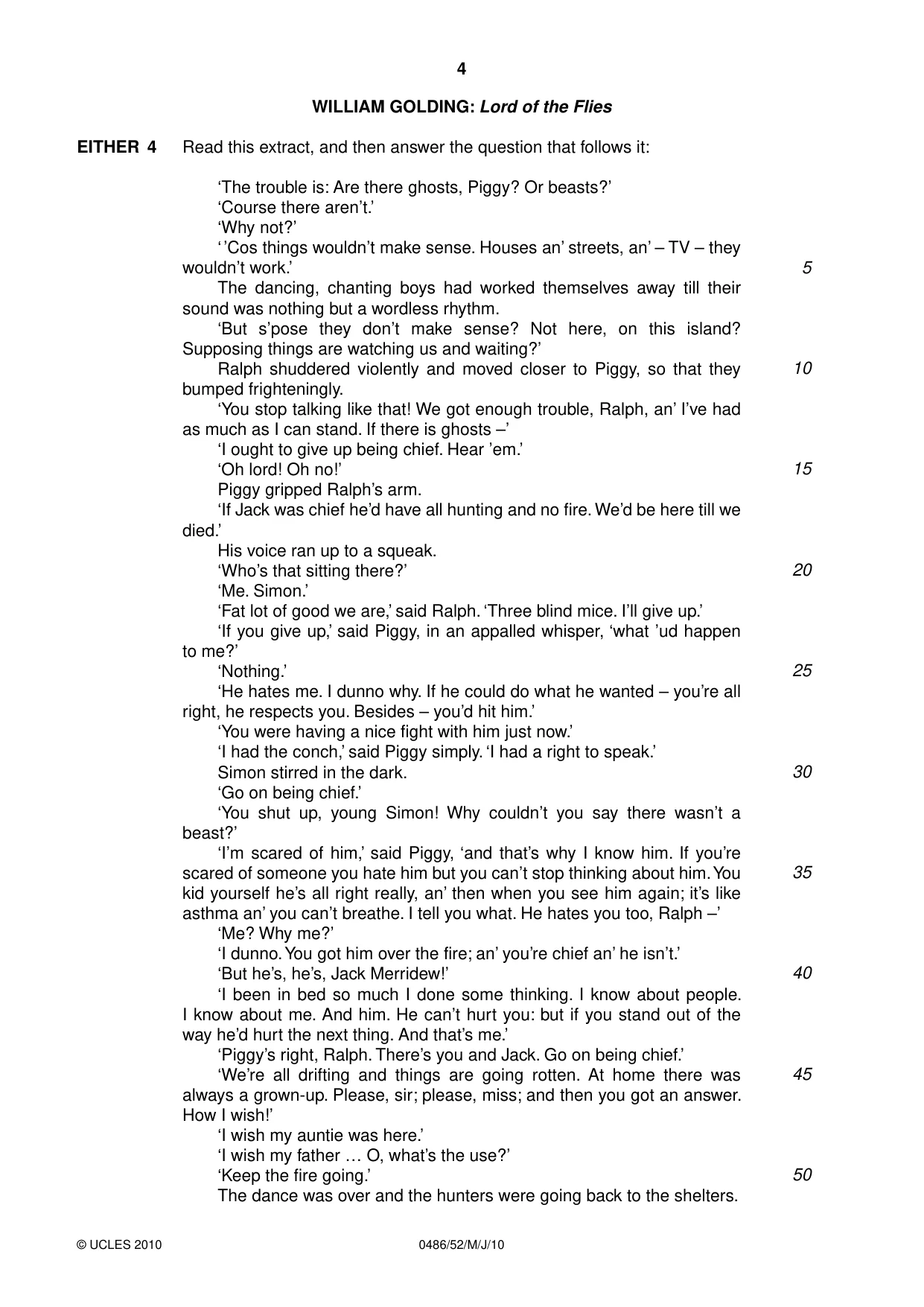
Question paper, page 4
4 0486/52/M/J/10 © UCLES 2010 WILLIAM GOLDING: Lord of the Flies EITHER 4 Read this extract, and then answer the question that follows it: ‘The trouble is: Are there ghosts, Piggy? Or beasts?’ ‘Course there aren’t.’ ‘Why not?’ ‘ ’Cos things wouldn’t make sense. Houses an’ streets, an’ – TV – they wouldn’t work.’ The dancing, chanting boys had worked themselves away till their sound was nothing but a wordless rhythm. ‘But s’pose they don’t make sense? Not here, on this island? Supposing things are watching us and waiting?’ Ralph shuddered violently and moved closer to Piggy, so that they bumped frighteningly. ‘You stop talking like that! We got enough trouble, Ralph, an’ I’ve had as much as I can stand. If there is ghosts –’ ‘I ought to give up being chief. Hear ’em.’ ‘Oh lord! Oh no!’ Piggy gripped Ralph’s arm. ‘If Jack was chief he’d have all hunting and no fire. We’d be here till we died.’ His voice ran up to a squeak. ‘Who’s that sitting there?’ ‘Me. Simon.’ ‘Fat lot of good we are,’ said Ralph. ‘Three blind mice. I’ll give up.’ ‘If you give up,’ said Piggy, in an appalled whisper, ‘what ’ud happen to me?’ ‘Nothing.’ ‘He hates me. I dunno why. If he could do what he wanted – you’re all right, he respects you. Besides – you’d hit him.’ ‘You were having a nice fight with him just now.’ ‘I had the conch,’ said Piggy simply. ‘I had a right to speak.’ Simon stirred in the dark. ‘Go on being chief.’ ‘You shut up, young Simon! Why couldn’t you say there wasn’t a beast?’ ‘I’m scared of him,’ said Piggy, ‘and that’s why I know him. If you’re scared of someone you hate him but you can’t stop thinking about him. You kid yourself he’s all right really, an’ then when you see him again; it’s like asthma an’ you can’t breathe. I tell you what. He hates you too, Ralph –’ ‘Me? Why me?’ ‘I dunno. You got him over the fire; an’ you’re chief an’ he isn’t.’ ‘But he’s, he’s, Jack Merridew!’ ‘I been in bed so much I done some thinking. I know about people. I know about me. And him. He can’t hurt you: but if you stand out of the way he’d hurt the next thing. And that’s me.’ ‘Piggy’s right, Ralph. There’s you and Jack. Go on being chief.’ ‘We’re all drifting and things are going rotten. At home there was always a grown-up. Please, sir; please, miss; and then you got an answer. How I wish!’ ‘I wish my auntie was here.’ ‘I wish my father … O, what’s the use?’ ‘Keep the fire going.’ The dance was over and the hunters were going back to the shelters. 5 10 15 20 25 30 35 40 45 50
Question paper, page 5
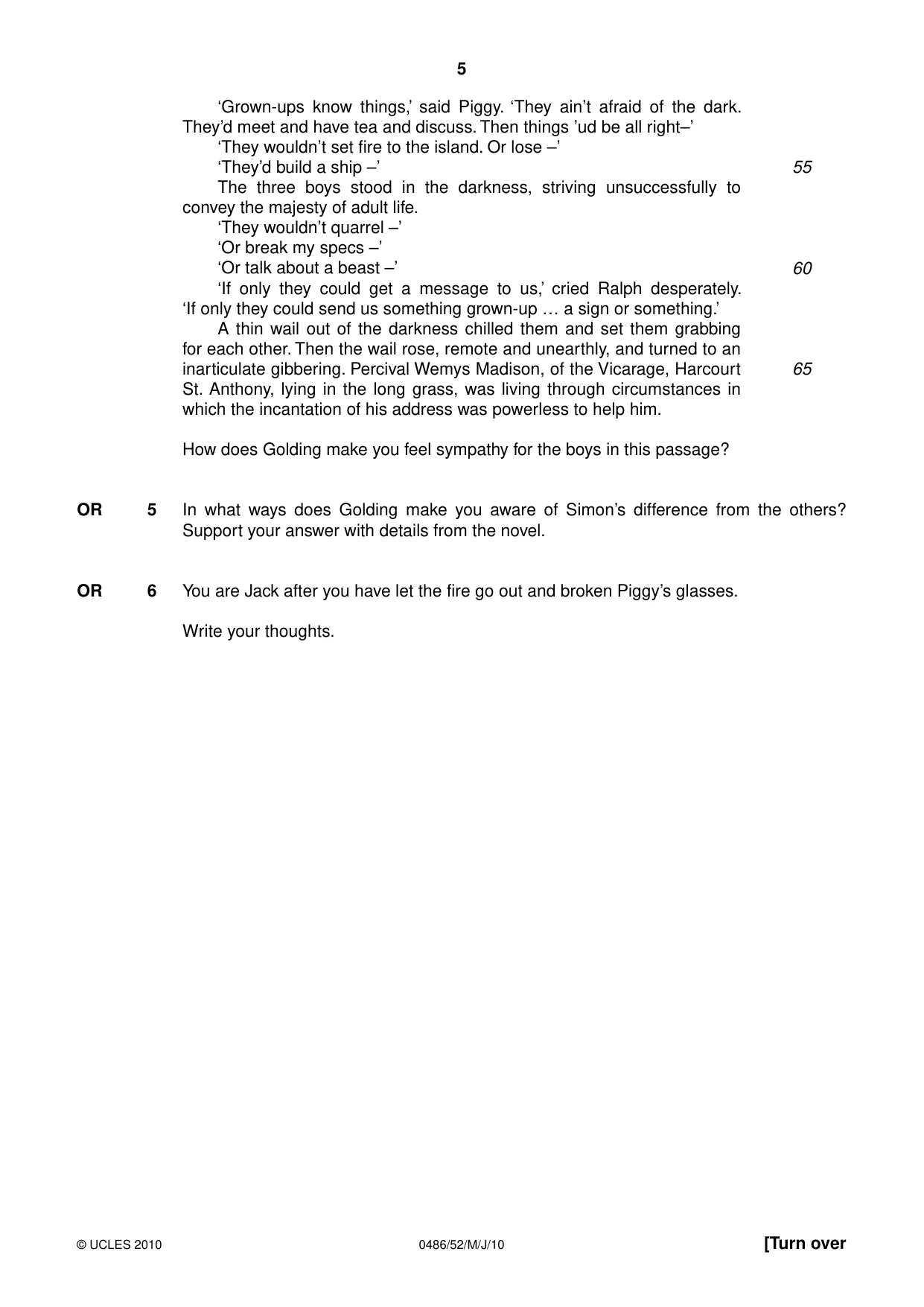
5 0486/52/M/J/10 © UCLES 2010 ‘Grown-ups know things,’ said Piggy. ‘They ain’t afraid of the dark. They’d meet and have tea and discuss. Then things ’ud be all right–’ ‘They wouldn’t set fire to the island. Or lose –’ ‘They’d build a ship –’ The three boys stood in the darkness, striving unsuccessfully to convey the majesty of adult life. ‘They wouldn’t quarrel –’ ‘Or break my specs –’ ‘Or talk about a beast –’ ‘If only they could get a message to us,’ cried Ralph desperately. ‘If only they could send us something grown-up … a sign or something.’ A thin wail out of the darkness chilled them and set them grabbing for each other. Then the wail rose, remote and unearthly, and turned to an inarticulate gibbering. Percival Wemys Madison, of the Vicarage, Harcourt St. Anthony, lying in the long grass, was living through circumstances in which the incantation of his address was powerless to help him. How does Golding make you feel sympathy for the boys in this passage? OR 5 In what ways does Golding make you aware of Simon’s difference from the others? Support your answer with details from the novel. OR 6 You are Jack after you have let the fire go out and broken Piggy’s glasses. Write your thoughts. 55 60 65 [Turn over
Question paper, page 6
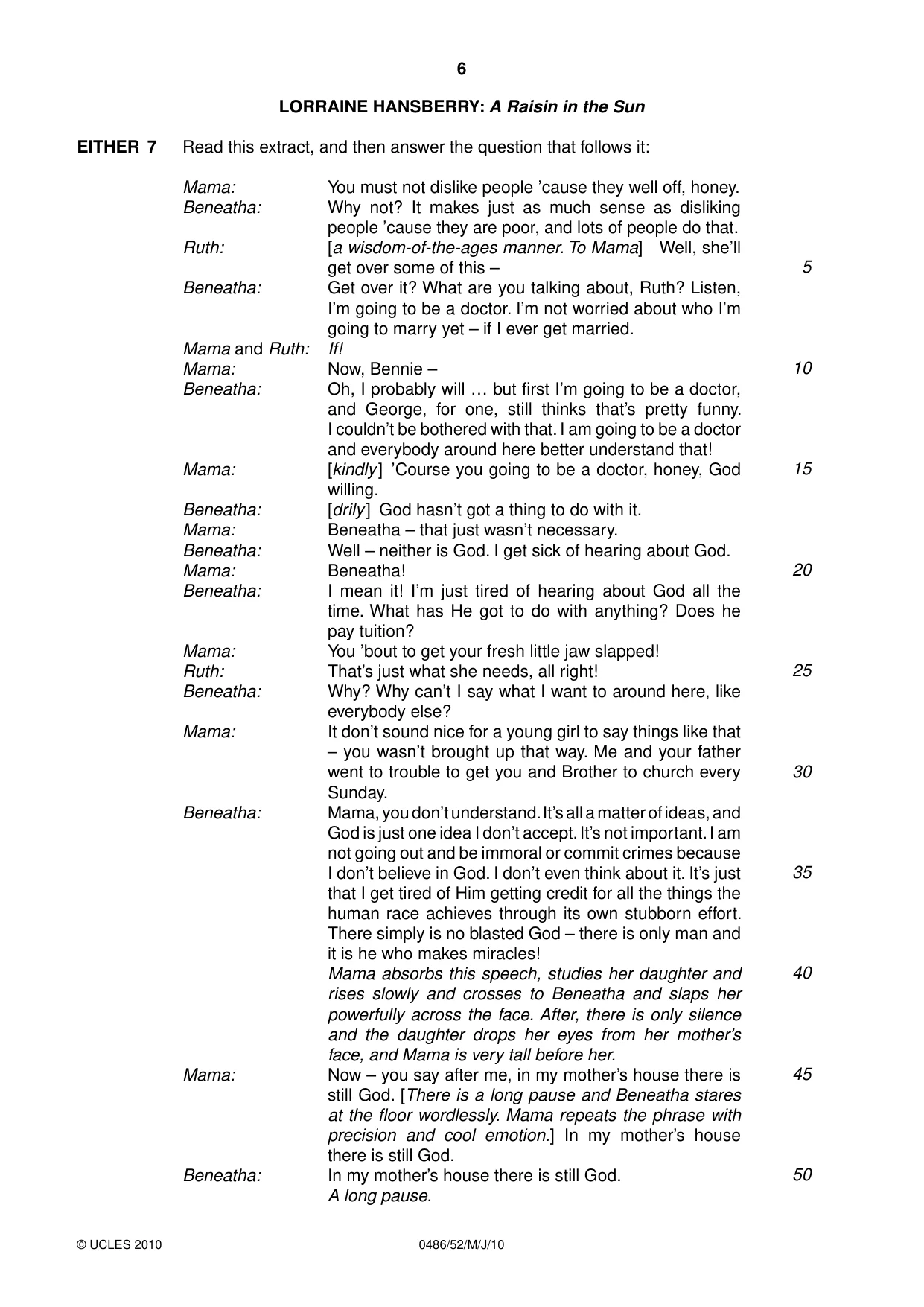
6 0486/52/M/J/10 © UCLES 2010 LORRAINE HANSBERRY: A Raisin in the Sun EITHER 7 Read this extract, and then answer the question that follows it: Mama: You must not dislike people ’cause they well off, honey. Beneatha: Why not? It makes just as much sense as disliking people ’cause they are poor, and lots of people do that. Ruth: [a wisdom-of-the-ages manner. To Mama] Well, she’ll get over some of this – Beneatha: Get over it? What are you talking about, Ruth? Listen, I’m going to be a doctor. I’m not worried about who I’m going to marry yet – if I ever get married. Mama and Ruth: If! Mama: Now, Bennie – Beneatha: Oh, I probably will … but first I’m going to be a doctor, and George, for one, still thinks that’s pretty funny. I couldn’t be bothered with that. I am going to be a doctor and everybody around here better understand that! Mama: [kindly ] ’Course you going to be a doctor, honey, God willing. Beneatha: [drily ] God hasn’t got a thing to do with it. Mama: Beneatha – that just wasn’t necessary. Beneatha: Well – neither is God. I get sick of hearing about God. Mama: Beneatha! Beneatha: I mean it! I’m just tired of hearing about God all the time. What has He got to do with anything? Does he pay tuition? Mama: You ’bout to get your fresh little jaw slapped! Ruth: That’s just what she needs, all right! Beneatha: Why? Why can’t I say what I want to around here, like everybody else? Mama: It don’t sound nice for a young girl to say things like that – you wasn’t brought up that way. Me and your father went to trouble to get you and Brother to church every Sunday. Beneatha: Mama, you don’t understand. It’s all a matter of ideas, and God is just one idea I don’t accept. It’s not important. I am not going out and be immoral or commit crimes because I don’t believe in God. I don’t even think about it. It’s just that I get tired of Him getting credit for all the things the human race achieves through its own stubborn effort. There simply is no blasted God – there is only man and it is he who makes miracles! Mama absorbs this speech, studies her daughter and rises slowly and crosses to Beneatha and slaps her powerfully across the face. After, there is only silence and the daughter drops her eyes from her mother’s face, and Mama is very tall before her. Mama: Now – you say after me, in my mother’s house there is still God. [There is a long pause and Beneatha stares at the floor wordlessly. Mama repeats the phrase with precision and cool emotion.] In my mother’s house there is still God. Beneatha: In my mother’s house there is still God. A long pause. 5 10 15 20 25 30 35 40 45 50
Question paper, page 7
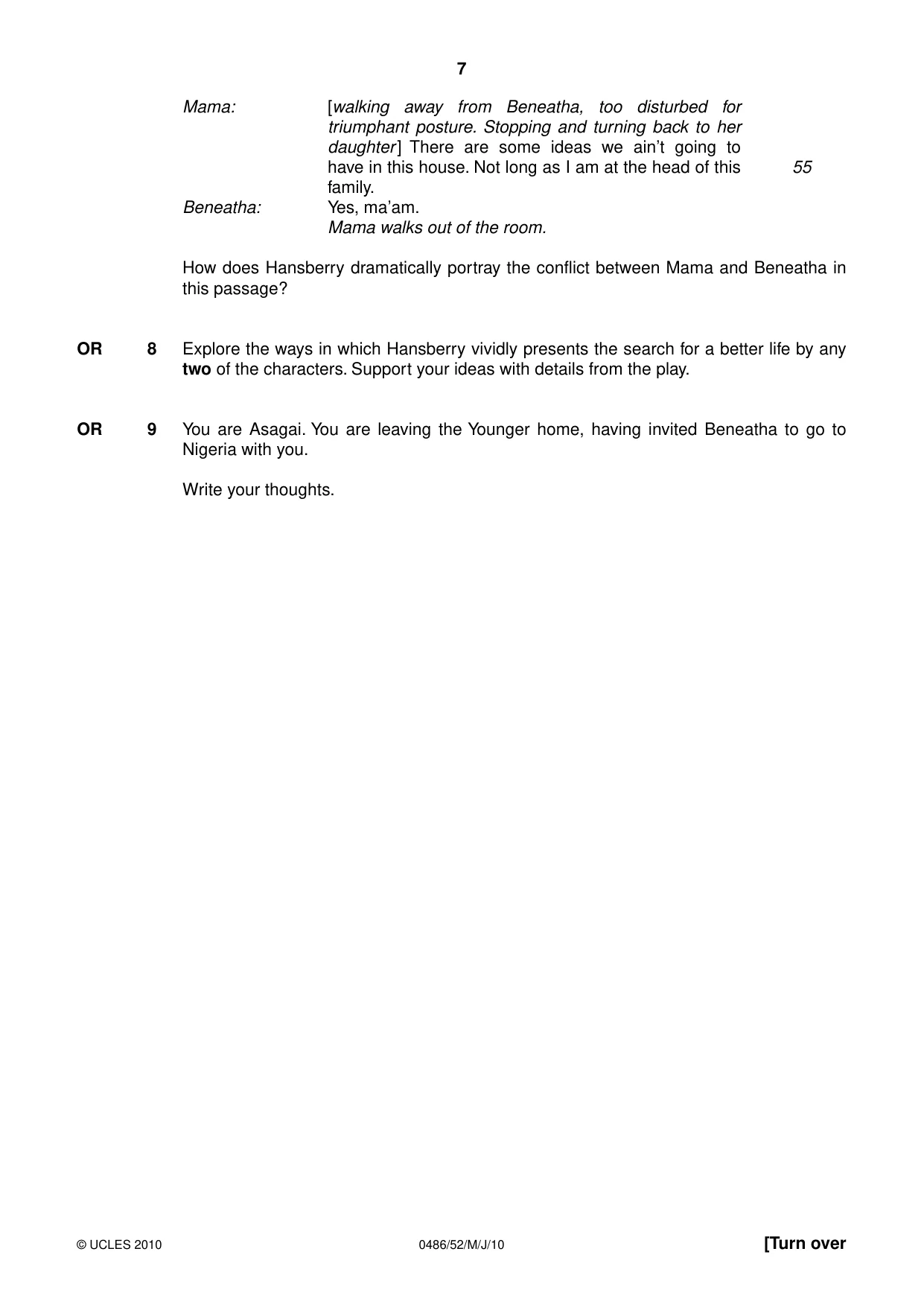
7 0486/52/M/J/10 © UCLES 2010 [Turn over Mama: [walking away from Beneatha, too disturbed for triumphant posture. Stopping and turning back to her daughter ] There are some ideas we ain’t going to have in this house. Not long as I am at the head of this family. Beneatha: Yes, ma’am. Mama walks out of the room. How does Hansberry dramatically portray the conflict between Mama and Beneatha in this passage? OR 8 Explore the ways in which Hansberry vividly presents the search for a better life by any two of the characters. Support your ideas with details from the play. OR 9 You are Asagai. You are leaving the Younger home, having invited Beneatha to go to Nigeria with you. Write your thoughts. 55
Question paper, page 8
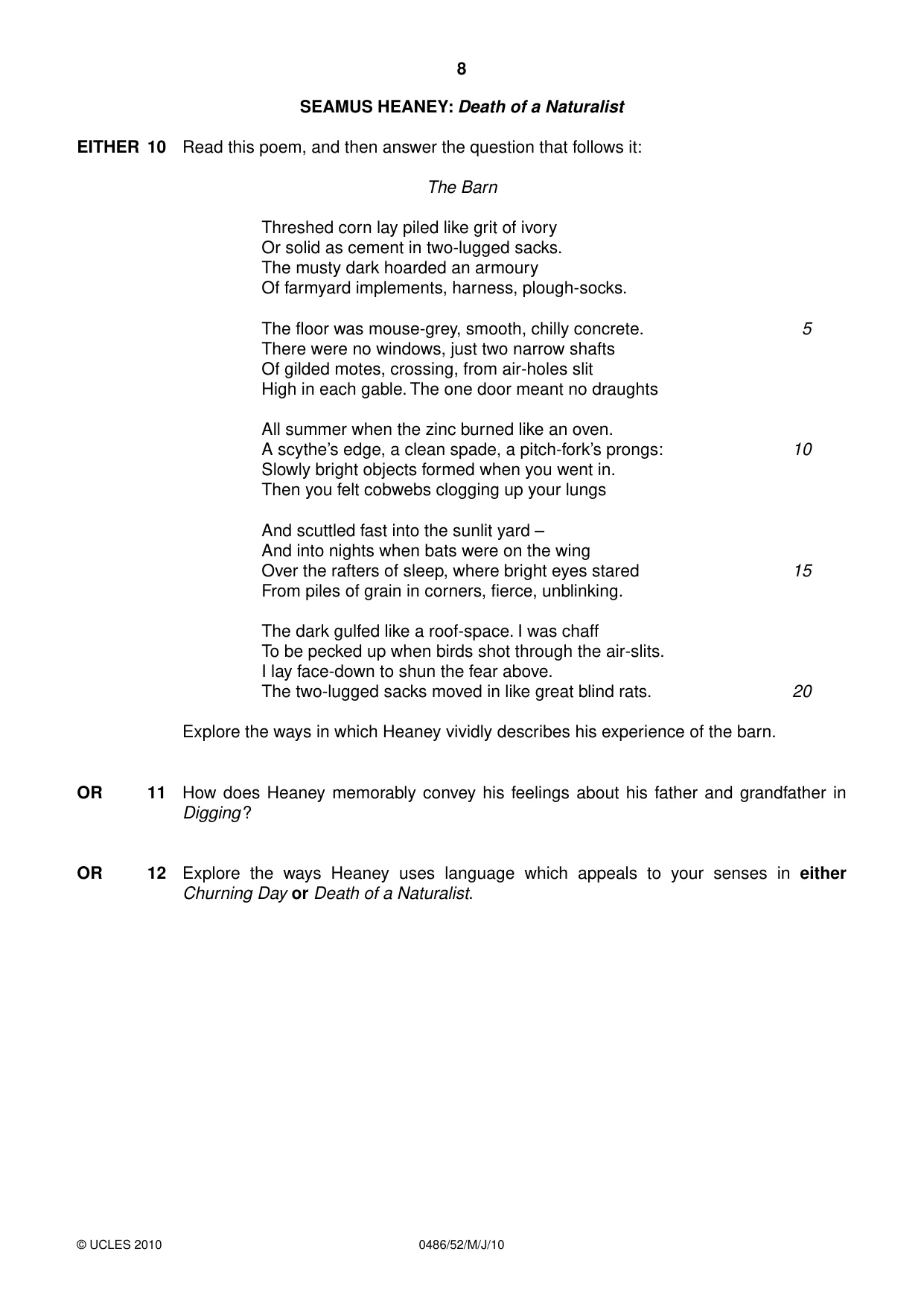
8 0486/52/M/J/10 SEAMUS HEANEY: Death of a Naturalist EITHER 10 Read this poem, and then answer the question that follows it: The Barn Threshed corn lay piled like grit of ivory Or solid as cement in two-lugged sacks. The musty dark hoarded an armoury Of farmyard implements, harness, plough-socks. The floor was mouse-grey, smooth, chilly concrete. 5 There were no windows, just two narrow shafts Of gilded motes, crossing, from air-holes slit High in each gable. The one door meant no draughts All summer when the zinc burned like an oven. A scythe’s edge, a clean spade, a pitch-fork’s prongs: 10 Slowly bright objects formed when you went in. Then you felt cobwebs clogging up your lungs And scuttled fast into the sunlit yard – And into nights when bats were on the wing Over the rafters of sleep, where bright eyes stared 15 From piles of grain in corners, fierce, unblinking. The dark gulfed like a roof-space. I was chaff To be pecked up when birds shot through the air-slits. I lay face-down to shun the fear above. The two-lugged sacks moved in like great blind rats. 20 Explore the ways in which Heaney vividly describes his experience of the barn. OR 11 How does Heaney memorably convey his feelings about his father and grandfather in Digging ? OR 12 Explore the ways Heaney uses language which appeals to your senses in either Churning Day or Death of a Naturalist. © UCLES 2010
Question paper, page 9
9 0486/52/M/J/10 © UCLES 2010 [Turn over BLANK PAGE Turn over for question 13. [Turn over
Question paper, page 10
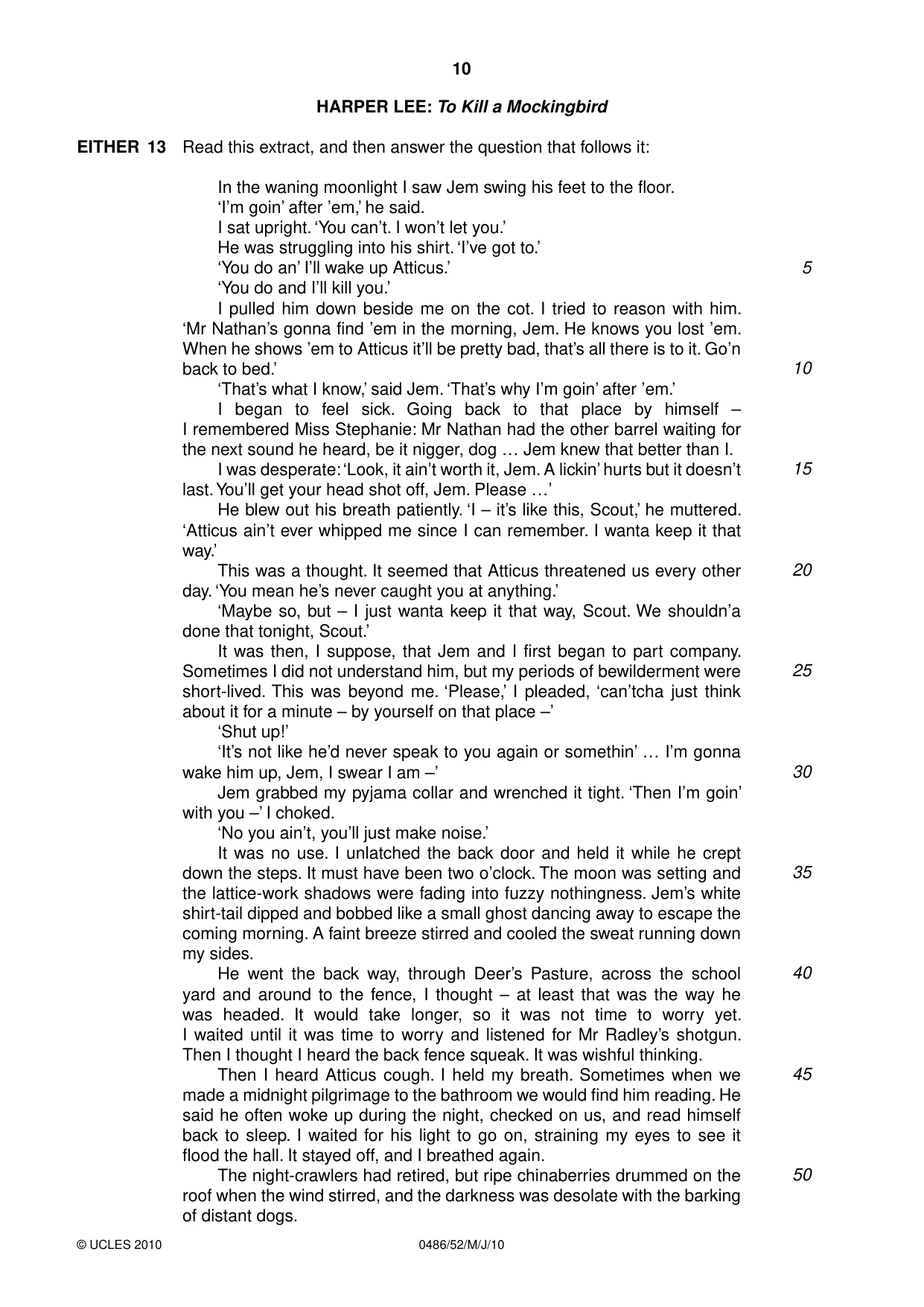
10 0486/52/M/J/10 HARPER LEE: To Kill a Mockingbird EITHER 13 Read this extract, and then answer the question that follows it: In the waning moonlight I saw Jem swing his feet to the floor. ‘I’m goin’ after ’em,’ he said. I sat upright. ‘You can’t. I won’t let you.’ He was struggling into his shirt. ‘I’ve got to.’ ‘You do an’ I’ll wake up Atticus.’ ‘You do and I’ll kill you.’ I pulled him down beside me on the cot. I tried to reason with him. ‘Mr Nathan’s gonna find ’em in the morning, Jem. He knows you lost ’em. When he shows ’em to Atticus it’ll be pretty bad, that’s all there is to it. Go’n back to bed.’ ‘That’s what I know,’ said Jem. ‘That’s why I’m goin’ after ’em.’ I began to feel sick. Going back to that place by himself – I remembered Miss Stephanie: Mr Nathan had the other barrel waiting for the next sound he heard, be it nigger, dog … Jem knew that better than I. I was desperate: ‘Look, it ain’t worth it, Jem. A lickin’ hurts but it doesn’t last. You’ll get your head shot off, Jem. Please …’ He blew out his breath patiently. ‘I – it’s like this, Scout,’ he muttered. ‘Atticus ain’t ever whipped me since I can remember. I wanta keep it that way.’ This was a thought. It seemed that Atticus threatened us every other day. ‘You mean he’s never caught you at anything.’ ‘Maybe so, but – I just wanta keep it that way, Scout. We shouldn’a done that tonight, Scout.’ It was then, I suppose, that Jem and I first began to part company. Sometimes I did not understand him, but my periods of bewilderment were short-lived. This was beyond me. ‘Please,’ I pleaded, ‘can’tcha just think about it for a minute – by yourself on that place –’ ‘Shut up!’ ‘It’s not like he’d never speak to you again or somethin’ … I’m gonna wake him up, Jem, I swear I am –’ Jem grabbed my pyjama collar and wrenched it tight. ‘Then I’m goin’ with you –’ I choked. ‘No you ain’t, you’ll just make noise.’ It was no use. I unlatched the back door and held it while he crept down the steps. It must have been two o’clock. The moon was setting and the lattice-work shadows were fading into fuzzy nothingness. Jem’s white shirt-tail dipped and bobbed like a small ghost dancing away to escape the coming morning. A faint breeze stirred and cooled the sweat running down my sides. He went the back way, through Deer’s Pasture, across the school yard and around to the fence, I thought – at least that was the way he was headed. It would take longer, so it was not time to worry yet. I waited until it was time to worry and listened for Mr Radley’s shotgun. Then I thought I heard the back fence squeak. It was wishful thinking. Then I heard Atticus cough. I held my breath. Sometimes when we made a midnight pilgrimage to the bathroom we would find him reading. He said he often woke up during the night, checked on us, and read himself back to sleep. I waited for his light to go on, straining my eyes to see it flood the hall. It stayed off, and I breathed again. The night-crawlers had retired, but ripe chinaberries drummed on the roof when the wind stirred, and the darkness was desolate with the barking of distant dogs. 5 10 15 20 25 30 35 40 45 50 © UCLES 2010
Question paper, page 11
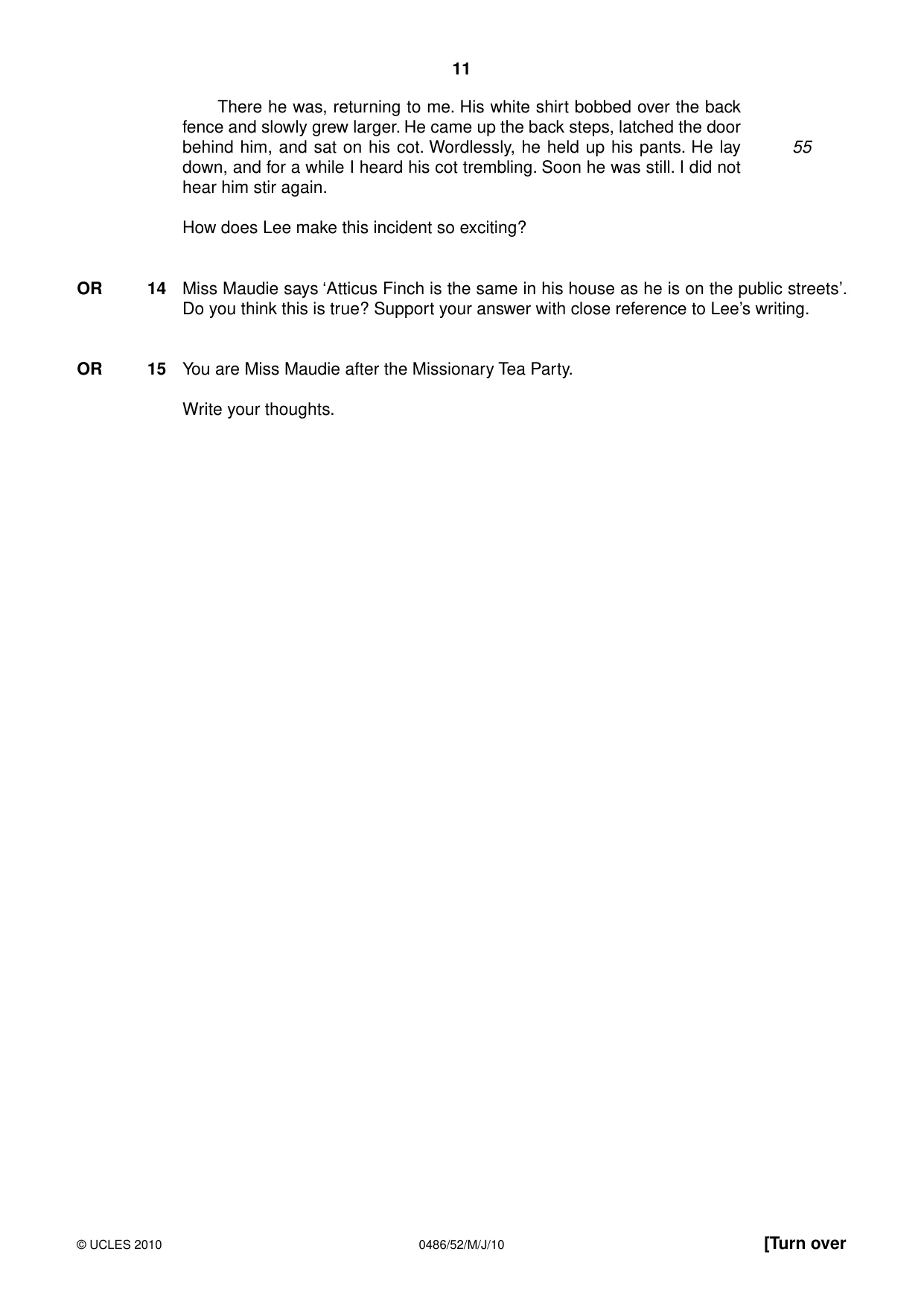
11 0486/52/M/J/10 There he was, returning to me. His white shirt bobbed over the back fence and slowly grew larger. He came up the back steps, latched the door behind him, and sat on his cot. Wordlessly, he held up his pants. He lay down, and for a while I heard his cot trembling. Soon he was still. I did not hear him stir again. How does Lee make this incident so exciting? OR 14 Miss Maudie says ‘Atticus Finch is the same in his house as he is on the public streets’. Do you think this is true? Support your answer with close reference to Lee’s writing. OR 15 You are Miss Maudie after the Missionary Tea Party. Write your thoughts. 55 © UCLES 2010 [Turn over
Question paper, page 12
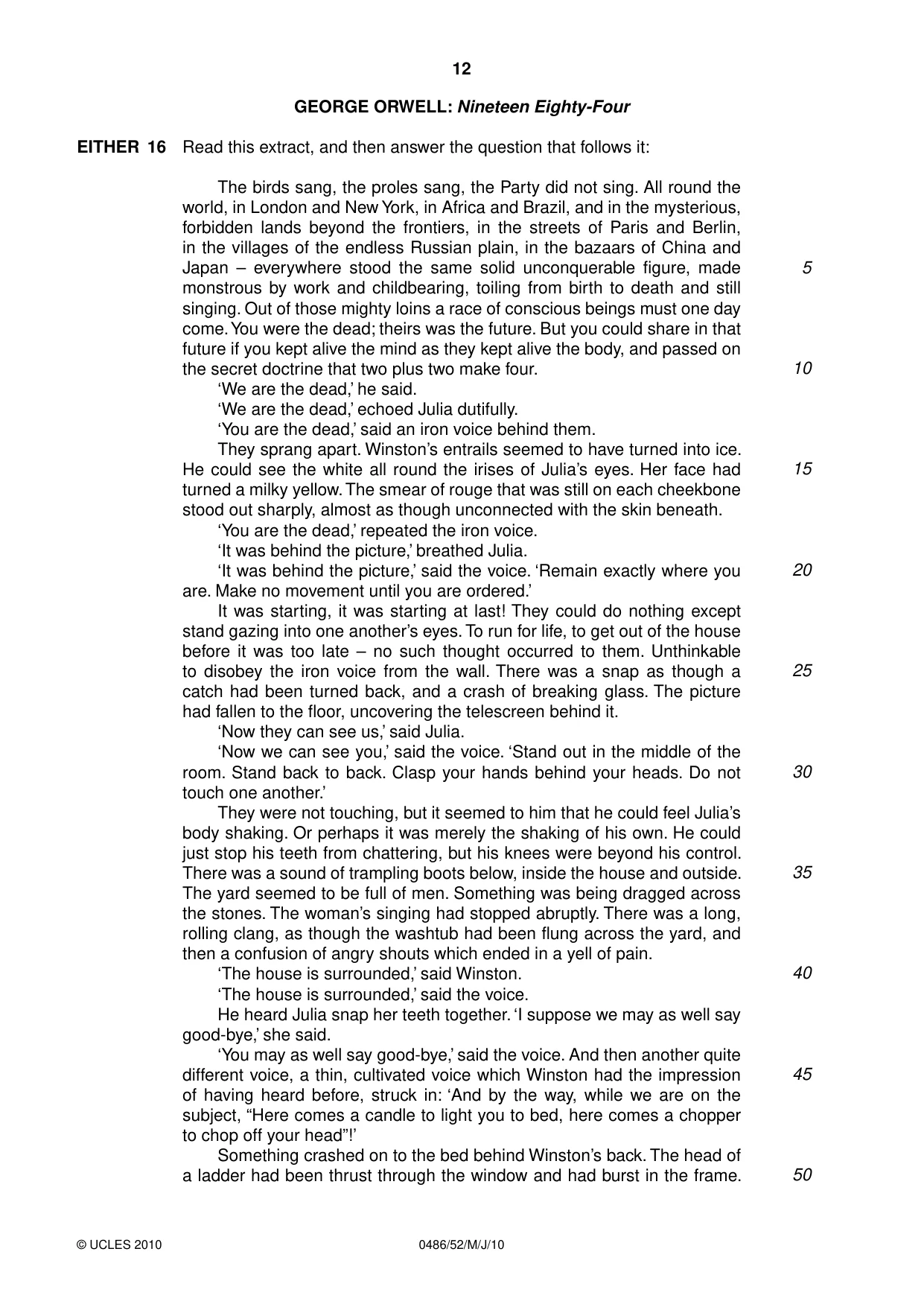
12 0486/52/M/J/10 GEORGE ORWELL: Nineteen Eighty-Four EITHER 16 Read this extract, and then answer the question that follows it: The birds sang, the proles sang, the Party did not sing. All round the world, in London and New York, in Africa and Brazil, and in the mysterious, forbidden lands beyond the frontiers, in the streets of Paris and Berlin, in the villages of the endless Russian plain, in the bazaars of China and Japan – everywhere stood the same solid unconquerable figure, made monstrous by work and childbearing, toiling from birth to death and still singing. Out of those mighty loins a race of conscious beings must one day come. You were the dead; theirs was the future. But you could share in that future if you kept alive the mind as they kept alive the body, and passed on the secret doctrine that two plus two make four. ‘We are the dead,’ he said. ‘We are the dead,’ echoed Julia dutifully. ‘You are the dead,’ said an iron voice behind them. They sprang apart. Winston’s entrails seemed to have turned into ice. He could see the white all round the irises of Julia’s eyes. Her face had turned a milky yellow. The smear of rouge that was still on each cheekbone stood out sharply, almost as though unconnected with the skin beneath. ‘You are the dead,’ repeated the iron voice. ‘It was behind the picture,’ breathed Julia. ‘It was behind the picture,’ said the voice. ‘Remain exactly where you are. Make no movement until you are ordered.’ It was starting, it was starting at last! They could do nothing except stand gazing into one another’s eyes. To run for life, to get out of the house before it was too late – no such thought occurred to them. Unthinkable to disobey the iron voice from the wall. There was a snap as though a catch had been turned back, and a crash of breaking glass. The picture had fallen to the floor, uncovering the telescreen behind it. ‘Now they can see us,’ said Julia. ‘Now we can see you,’ said the voice. ‘Stand out in the middle of the room. Stand back to back. Clasp your hands behind your heads. Do not touch one another.’ They were not touching, but it seemed to him that he could feel Julia’s body shaking. Or perhaps it was merely the shaking of his own. He could just stop his teeth from chattering, but his knees were beyond his control. There was a sound of trampling boots below, inside the house and outside. The yard seemed to be full of men. Something was being dragged across the stones. The woman’s singing had stopped abruptly. There was a long, rolling clang, as though the washtub had been flung across the yard, and then a confusion of angry shouts which ended in a yell of pain. ‘The house is surrounded,’ said Winston. ‘The house is surrounded,’ said the voice. He heard Julia snap her teeth together. ‘I suppose we may as well say good-bye,’ she said. ‘You may as well say good-bye,’ said the voice. And then another quite different voice, a thin, cultivated voice which Winston had the impression of having heard before, struck in: ‘And by the way, while we are on the subject, “Here comes a candle to light you to bed, here comes a chopper to chop off your head”!’ Something crashed on to the bed behind Winston’s back. The head of a ladder had been thrust through the window and had burst in the frame. 5 10 15 20 25 30 35 40 45 50 © UCLES 2010
Question paper, page 13
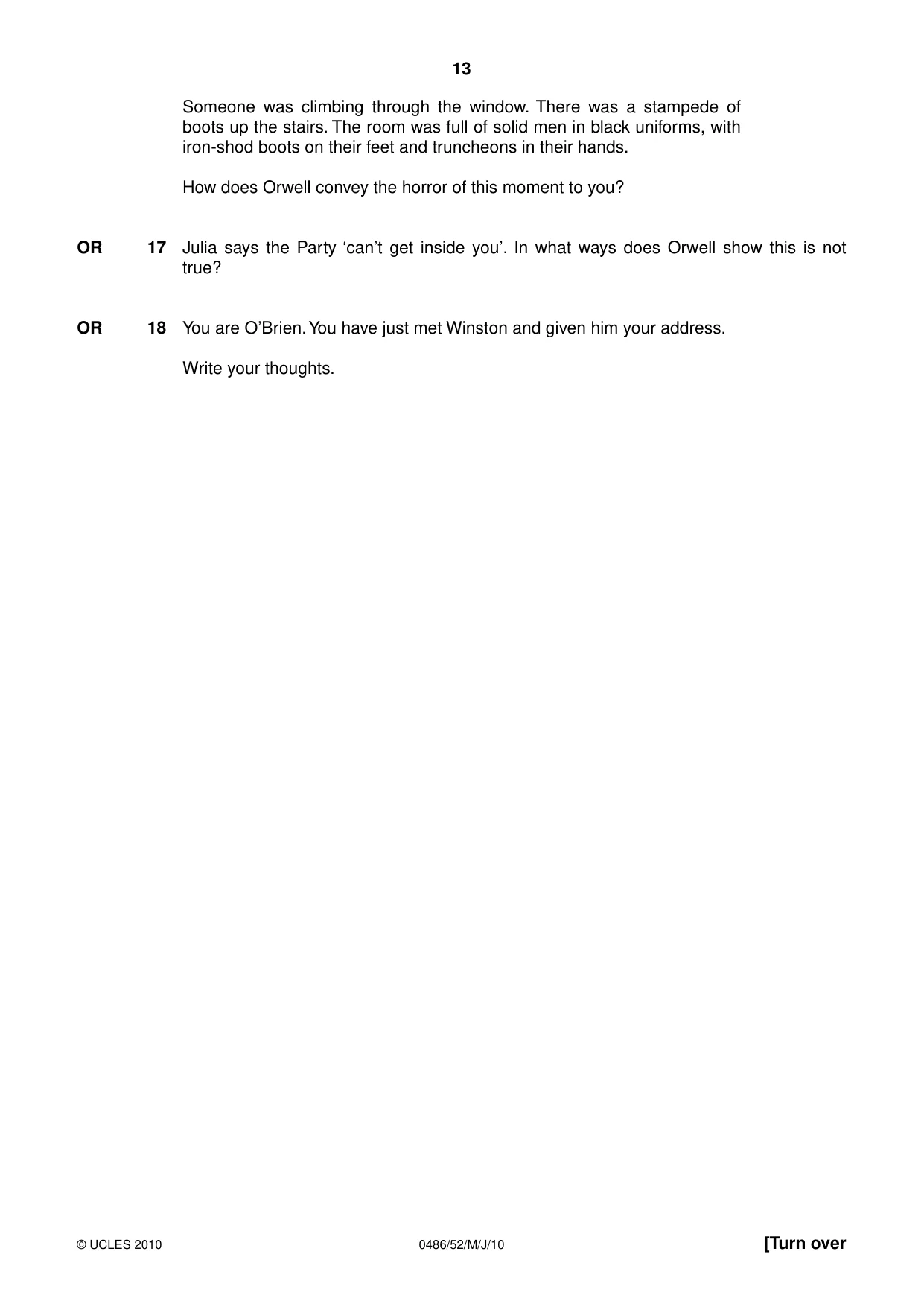
13 0486/52/M/J/10 © UCLES 2010 [Turn over Someone was climbing through the window. There was a stampede of boots up the stairs. The room was full of solid men in black uniforms, with iron-shod boots on their feet and truncheons in their hands. How does Orwell convey the horror of this moment to you? OR 17 Julia says the Party ‘can’t get inside you’. In what ways does Orwell show this is not true? OR 18 You are O’Brien. You have just met Winston and given him your address. Write your thoughts.
Question paper, page 14
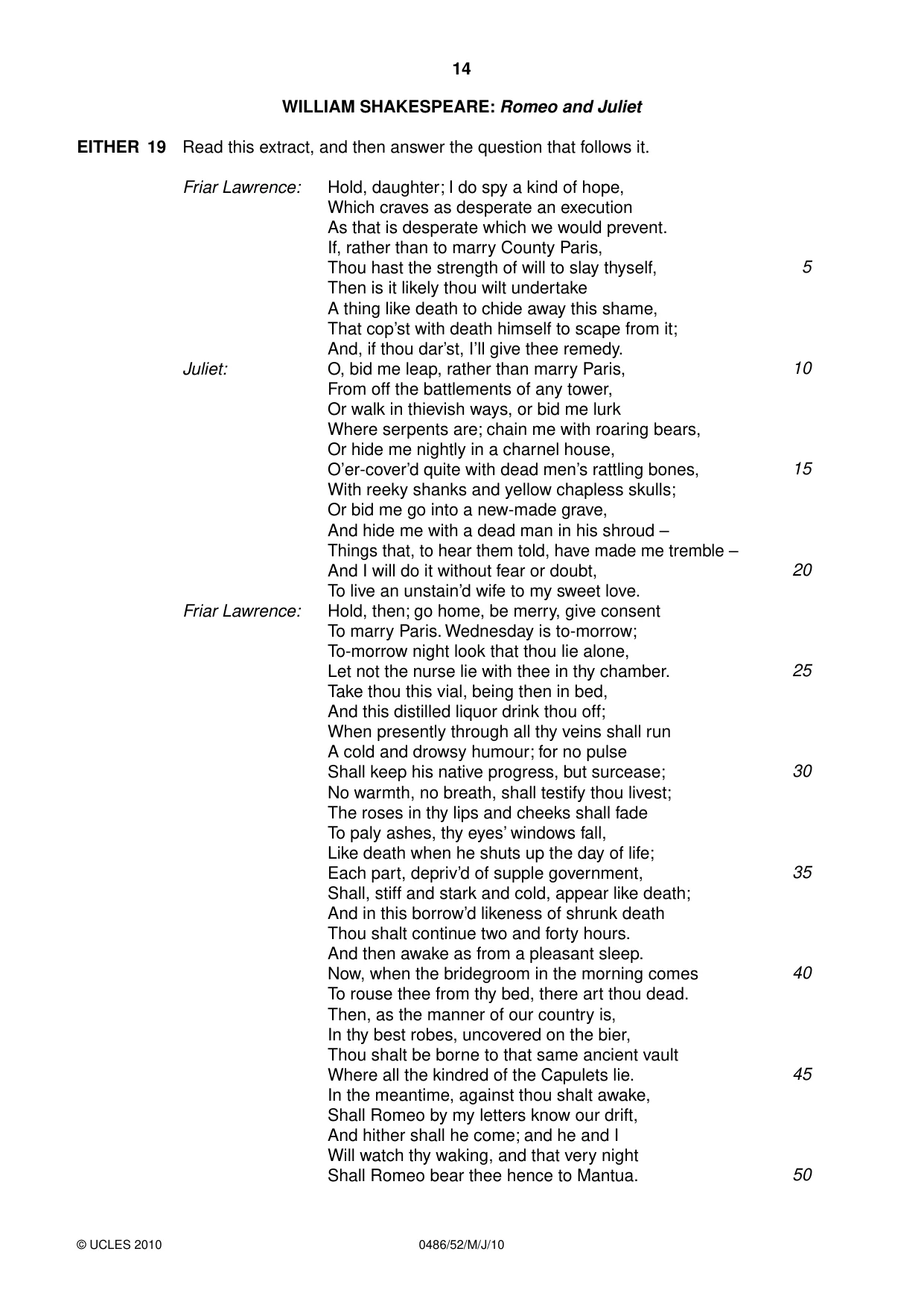
14 0486/52/M/J/10 © UCLES 2010 WILLIAM SHAKESPEARE: Romeo and Juliet EITHER 19 Read this extract, and then answer the question that follows it. Friar Lawrence: Hold, daughter; I do spy a kind of hope, Which craves as desperate an execution As that is desperate which we would prevent. If, rather than to marry County Paris, Thou hast the strength of will to slay thyself, Then is it likely thou wilt undertake A thing like death to chide away this shame, That cop’st with death himself to scape from it; And, if thou dar’st, I’ll give thee remedy. Juliet: O, bid me leap, rather than marry Paris, From off the battlements of any tower, Or walk in thievish ways, or bid me lurk Where serpents are; chain me with roaring bears, Or hide me nightly in a charnel house, O’er-cover’d quite with dead men’s rattling bones, With reeky shanks and yellow chapless skulls; Or bid me go into a new-made grave, And hide me with a dead man in his shroud – Things that, to hear them told, have made me tremble – And I will do it without fear or doubt, To live an unstain’d wife to my sweet love. Friar Lawrence: Hold, then; go home, be merry, give consent To marry Paris. Wednesday is to-morrow; To-morrow night look that thou lie alone, Let not the nurse lie with thee in thy chamber. Take thou this vial, being then in bed, And this distilled liquor drink thou off; When presently through all thy veins shall run A cold and drowsy humour; for no pulse Shall keep his native progress, but surcease; No warmth, no breath, shall testify thou livest; The roses in thy lips and cheeks shall fade To paly ashes, thy eyes’ windows fall, Like death when he shuts up the day of life; Each part, depriv’d of supple government, Shall, stiff and stark and cold, appear like death; And in this borrow’d likeness of shrunk death Thou shalt continue two and forty hours. And then awake as from a pleasant sleep. Now, when the bridegroom in the morning comes To rouse thee from thy bed, there art thou dead. Then, as the manner of our country is, In thy best robes, uncovered on the bier, Thou shalt be borne to that same ancient vault Where all the kindred of the Capulets lie. In the meantime, against thou shalt awake, Shall Romeo by my letters know our drift, And hither shall he come; and he and I Will watch thy waking, and that very night Shall Romeo bear thee hence to Mantua. 5 10 15 20 25 30 35 40 45 50
Question paper, page 15
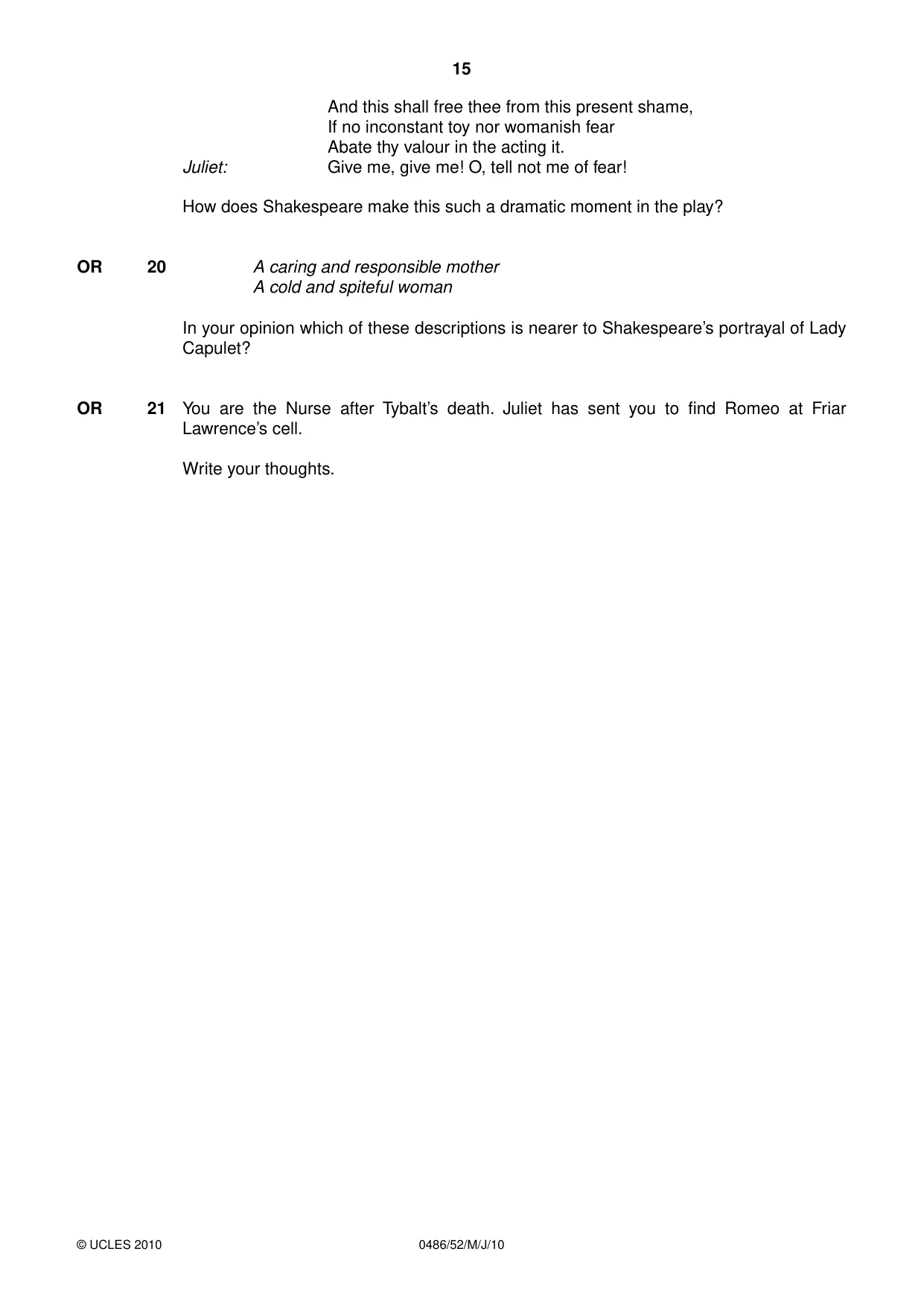
15 0486/52/M/J/10 © UCLES 2010 And this shall free thee from this present shame, If no inconstant toy nor womanish fear Abate thy valour in the acting it. Juliet: Give me, give me! O, tell not me of fear! How does Shakespeare make this such a dramatic moment in the play? OR 20 A caring and responsible mother A cold and spiteful woman In your opinion which of these descriptions is nearer to Shakespeare’s portrayal of Lady Capulet? OR 21 You are the Nurse after Tybalt’s death. Juliet has sent you to find Romeo at Friar Lawrence’s cell. Write your thoughts.
Question paper, page 16
16 0486/52/M/J/10 © UCLES 2010 BLANK PAGE Copyright Acknowledgements: Question 1 © Brian Clark; Whose Life is it Anyway? Heinemann; 1993. Question 7 © Lorraine Hansberry; A Raisin in the Sun ; Methuen Drama, A & C Black; 2001. Question 13 © from To Kill a Mockingbird by Harper Lee, published by William Heinemann Ltd. Reprinted by permission of The Random House Group Ltd. Permission to reproduce items where third-party owned material protected by copyright is included has been sought and cleared where possible. Every reasonable effort has been made by the publisher (UCLES) to trace copyright holders, but if any items requiring clearance have unwittingly been included, the publisher will be pleased to make amends at the earliest possible opportunity. University of Cambridge International Examinations is part of the Cambridge Assessment Group. Cambridge Assessment is the brand name of University of Cambridge Local Examinations Syndicate (UCLES), which is itself a department of the University of Cambridge.
Mark scheme, page 1
UNIVERSITY OF CAMBRIDGE INTERNATIONAL EXAMINATIONS International General Certificate of Secondary Education MARK SCHEME for the May/June 2010 question paper for the guidance of teachers 0486 LITERATURE (ENGLISH) 0486/52 Paper 52, maximum raw mark 25 This mark scheme is published as an aid to teachers and candidates, to indicate the requirements of the examination. It shows the basis on which Examiners were instructed to award marks. It does not indicate the details of the discussions that took place at an Examiners’ meeting before marking began, which would have considered the acceptability of alternative answers. Mark schemes must be read in conjunction with the question papers and the report on the examination. • CIE will not enter into discussions or correspondence in connection with these mark schemes. CIE is publishing the mark schemes for the May/June 2010 question papers for most IGCSE, GCE Advanced Level and Advanced Subsidiary Level syllabuses and some Ordinary Level syllabuses. www.XtremePapers.com
Mark scheme, page 2
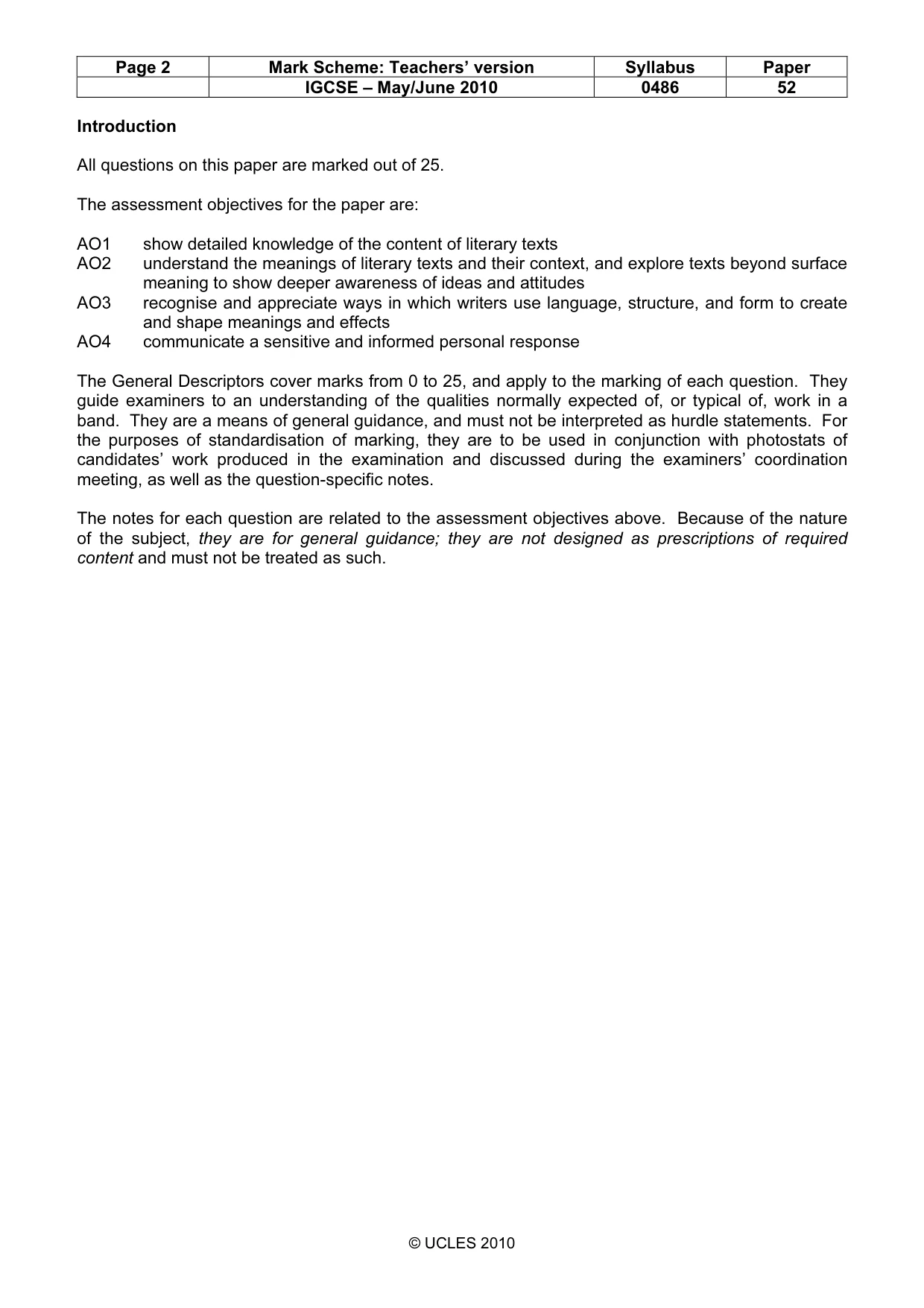
Page 2 Mark Scheme: Teachers’ version Syllabus Paper IGCSE – May/June 2010 0486 52 © UCLES 2010 Introduction All questions on this paper are marked out of 25. The assessment objectives for the paper are: AO1 show detailed knowledge of the content of literary texts AO2 understand the meanings of literary texts and their context, and explore texts beyond surface meaning to show deeper awareness of ideas and attitudes AO3 recognise and appreciate ways in which writers use language, structure, and form to create and shape meanings and effects AO4 communicate a sensitive and informed personal response The General Descriptors cover marks from 0 to 25, and apply to the marking of each question. They guide examiners to an understanding of the qualities normally expected of, or typical of, work in a band. They are a means of general guidance, and must not be interpreted as hurdle statements. For the purposes of standardisation of marking, they are to be used in conjunction with photostats of candidates’ work produced in the examination and discussed during the examiners’ coordination meeting, as well as the question-specific notes. The notes for each question are related to the assessment objectives above. Because of the nature of the subject, they are for general guidance; they are not designed as prescriptions of required content and must not be treated as such.
Mark scheme, page 3
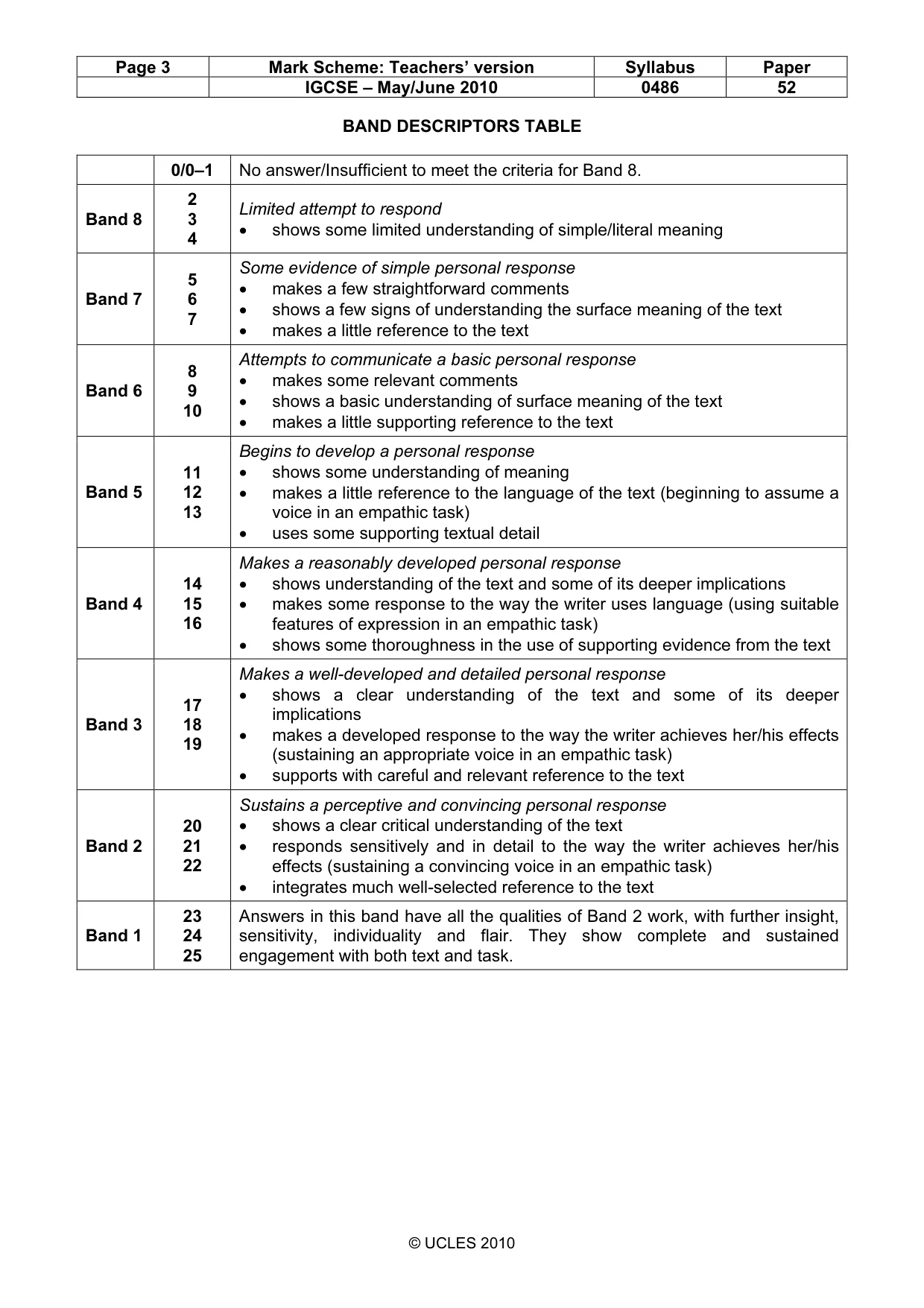
Page 3 Mark Scheme: Teachers’ version Syllabus Paper IGCSE – May/June 2010 0486 52 © UCLES 2010 BAND DESCRIPTORS TABLE 0/0–1 No answer/Insufficient to meet the criteria for Band 8. Band 8 2 3 4 Limited attempt to respond • shows some limited understanding of simple/literal meaning Band 7 5 6 7 Some evidence of simple personal response • makes a few straightforward comments • shows a few signs of understanding the surface meaning of the text • makes a little reference to the text Band 6 8 9 10 Attempts to communicate a basic personal response • makes some relevant comments • shows a basic understanding of surface meaning of the text • makes a little supporting reference to the text Band 5 11 12 13 Begins to develop a personal response • shows some understanding of meaning • makes a little reference to the language of the text (beginning to assume a voice in an empathic task) • uses some supporting textual detail Band 4 14 15 16 Makes a reasonably developed personal response • shows understanding of the text and some of its deeper implications • makes some response to the way the writer uses language (using suitable features of expression in an empathic task) • shows some thoroughness in the use of supporting evidence from the text Band 3 17 18 19 Makes a well-developed and detailed personal response • shows a clear understanding of the text and some of its deeper implications • makes a developed response to the way the writer achieves her/his effects (sustaining an appropriate voice in an empathic task) • supports with careful and relevant reference to the text Band 2 20 21 22 Sustains a perceptive and convincing personal response • shows a clear critical understanding of the text • responds sensitively and in detail to the way the writer achieves her/his effects (sustaining a convincing voice in an empathic task) • integrates much well-selected reference to the text Band 1 23 24 25 Answers in this band have all the qualities of Band 2 work, with further insight, sensitivity, individuality and flair. They show complete and sustained engagement with both text and task.
Mark scheme, page 4
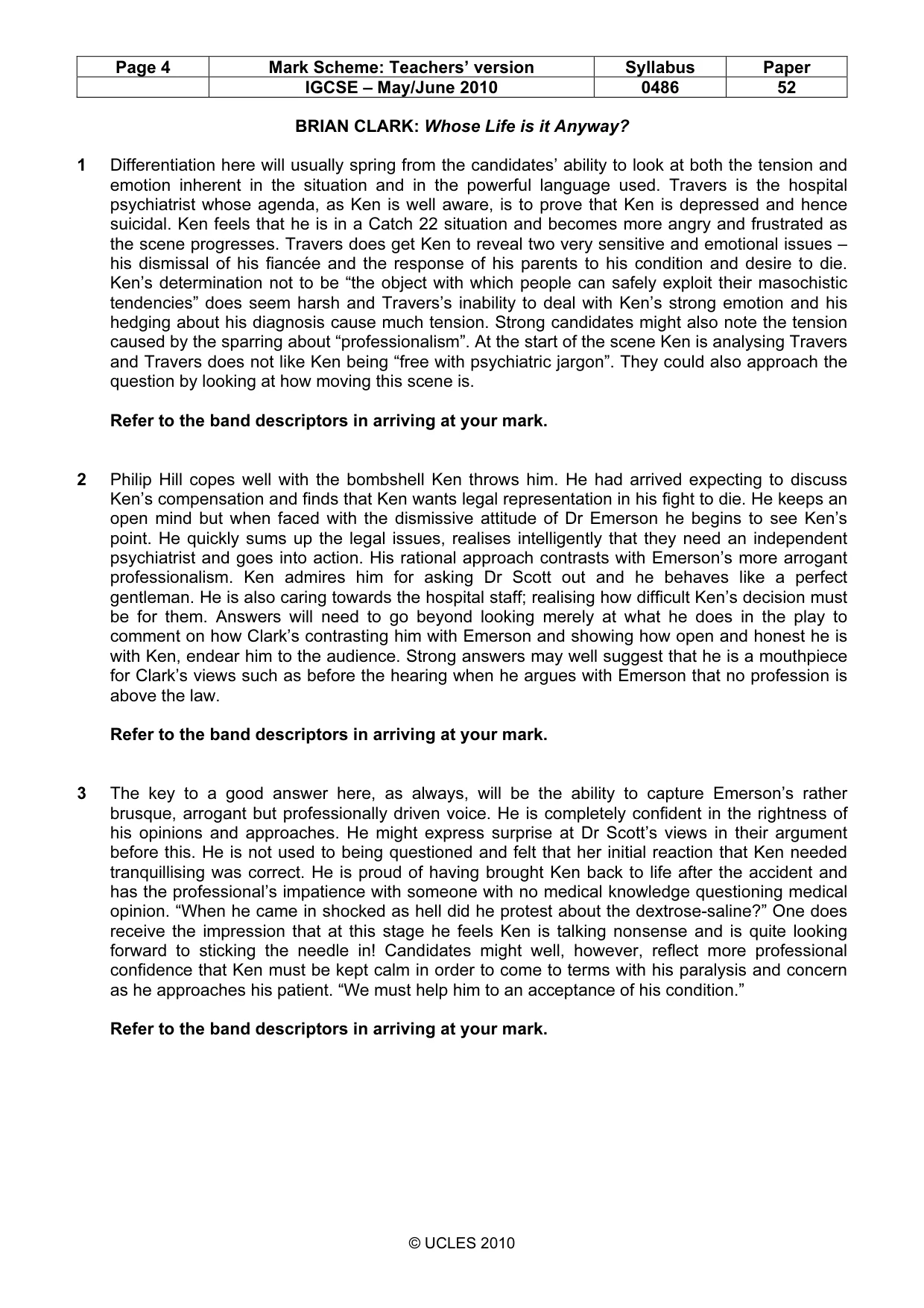
Page 4 Mark Scheme: Teachers’ version Syllabus Paper IGCSE – May/June 2010 0486 52 © UCLES 2010 BRIAN CLARK: Whose Life is it Anyway? 1 Differentiation here will usually spring from the candidates’ ability to look at both the tension and emotion inherent in the situation and in the powerful language used. Travers is the hospital psychiatrist whose agenda, as Ken is well aware, is to prove that Ken is depressed and hence suicidal. Ken feels that he is in a Catch 22 situation and becomes more angry and frustrated as the scene progresses. Travers does get Ken to reveal two very sensitive and emotional issues – his dismissal of his fiancée and the response of his parents to his condition and desire to die. Ken’s determination not to be “the object with which people can safely exploit their masochistic tendencies” does seem harsh and Travers’s inability to deal with Ken’s strong emotion and his hedging about his diagnosis cause much tension. Strong candidates might also note the tension caused by the sparring about “professionalism”. At the start of the scene Ken is analysing Travers and Travers does not like Ken being “free with psychiatric jargon”. They could also approach the question by looking at how moving this scene is. Refer to the band descriptors in arriving at your mark. 2 Philip Hill copes well with the bombshell Ken throws him. He had arrived expecting to discuss Ken’s compensation and finds that Ken wants legal representation in his fight to die. He keeps an open mind but when faced with the dismissive attitude of Dr Emerson he begins to see Ken’s point. He quickly sums up the legal issues, realises intelligently that they need an independent psychiatrist and goes into action. His rational approach contrasts with Emerson’s more arrogant professionalism. Ken admires him for asking Dr Scott out and he behaves like a perfect gentleman. He is also caring towards the hospital staff; realising how difficult Ken’s decision must be for them. Answers will need to go beyond looking merely at what he does in the play to comment on how Clark’s contrasting him with Emerson and showing how open and honest he is with Ken, endear him to the audience. Strong answers may well suggest that he is a mouthpiece for Clark’s views such as before the hearing when he argues with Emerson that no profession is above the law. Refer to the band descriptors in arriving at your mark. 3 The key to a good answer here, as always, will be the ability to capture Emerson’s rather brusque, arrogant but professionally driven voice. He is completely confident in the rightness of his opinions and approaches. He might express surprise at Dr Scott’s views in their argument before this. He is not used to being questioned and felt that her initial reaction that Ken needed tranquillising was correct. He is proud of having brought Ken back to life after the accident and has the professional’s impatience with someone with no medical knowledge questioning medical opinion. “When he came in shocked as hell did he protest about the dextrose-saline?” One does receive the impression that at this stage he feels Ken is talking nonsense and is quite looking forward to sticking the needle in! Candidates might well, however, reflect more professional confidence that Ken must be kept calm in order to come to terms with his paralysis and concern as he approaches his patient. “We must help him to an acceptance of his condition.” Refer to the band descriptors in arriving at your mark.
Mark scheme, page 5
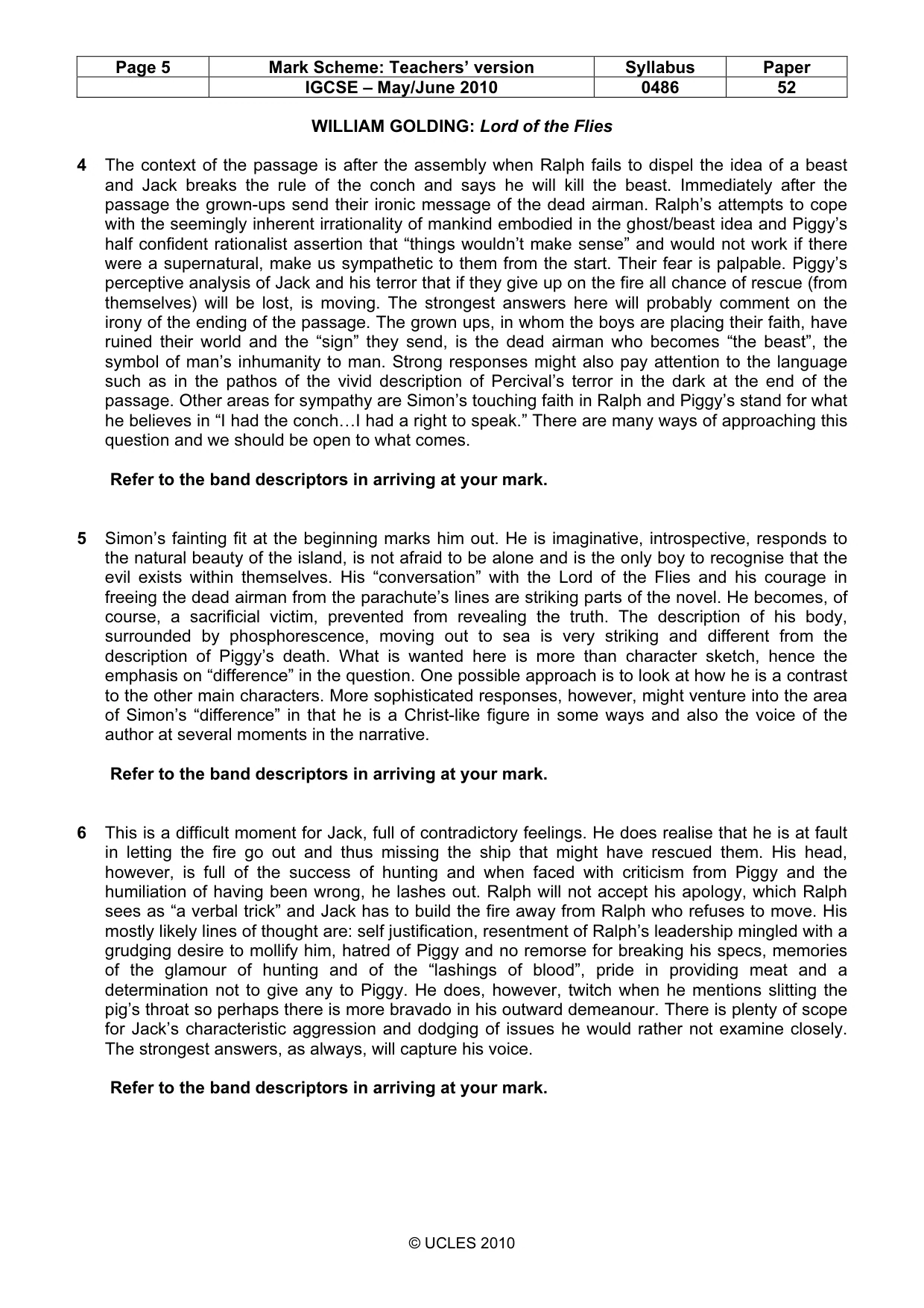
Page 5 Mark Scheme: Teachers’ version Syllabus Paper IGCSE – May/June 2010 0486 52 © UCLES 2010 WILLIAM GOLDING: Lord of the Flies 4 The context of the passage is after the assembly when Ralph fails to dispel the idea of a beast and Jack breaks the rule of the conch and says he will kill the beast. Immediately after the passage the grown-ups send their ironic message of the dead airman. Ralph’s attempts to cope with the seemingly inherent irrationality of mankind embodied in the ghost/beast idea and Piggy’s half confident rationalist assertion that “things wouldn’t make sense” and would not work if there were a supernatural, make us sympathetic to them from the start. Their fear is palpable. Piggy’s perceptive analysis of Jack and his terror that if they give up on the fire all chance of rescue (from themselves) will be lost, is moving. The strongest answers here will probably comment on the irony of the ending of the passage. The grown ups, in whom the boys are placing their faith, have ruined their world and the “sign” they send, is the dead airman who becomes “the beast”, the symbol of man’s inhumanity to man. Strong responses might also pay attention to the language such as in the pathos of the vivid description of Percival’s terror in the dark at the end of the passage. Other areas for sympathy are Simon’s touching faith in Ralph and Piggy’s stand for what he believes in “I had the conch…I had a right to speak.” There are many ways of approaching this question and we should be open to what comes. Refer to the band descriptors in arriving at your mark. 5 Simon’s fainting fit at the beginning marks him out. He is imaginative, introspective, responds to the natural beauty of the island, is not afraid to be alone and is the only boy to recognise that the evil exists within themselves. His “conversation” with the Lord of the Flies and his courage in freeing the dead airman from the parachute’s lines are striking parts of the novel. He becomes, of course, a sacrificial victim, prevented from revealing the truth. The description of his body, surrounded by phosphorescence, moving out to sea is very striking and different from the description of Piggy’s death. What is wanted here is more than character sketch, hence the emphasis on “difference” in the question. One possible approach is to look at how he is a contrast to the other main characters. More sophisticated responses, however, might venture into the area of Simon’s “difference” in that he is a Christ-like figure in some ways and also the voice of the author at several moments in the narrative. Refer to the band descriptors in arriving at your mark. 6 This is a difficult moment for Jack, full of contradictory feelings. He does realise that he is at fault in letting the fire go out and thus missing the ship that might have rescued them. His head, however, is full of the success of hunting and when faced with criticism from Piggy and the humiliation of having been wrong, he lashes out. Ralph will not accept his apology, which Ralph sees as “a verbal trick” and Jack has to build the fire away from Ralph who refuses to move. His mostly likely lines of thought are: self justification, resentment of Ralph’s leadership mingled with a grudging desire to mollify him, hatred of Piggy and no remorse for breaking his specs, memories of the glamour of hunting and of the “lashings of blood”, pride in providing meat and a determination not to give any to Piggy. He does, however, twitch when he mentions slitting the pig’s throat so perhaps there is more bravado in his outward demeanour. There is plenty of scope for Jack’s characteristic aggression and dodging of issues he would rather not examine closely. The strongest answers, as always, will capture his voice. Refer to the band descriptors in arriving at your mark.
Mark scheme, page 6
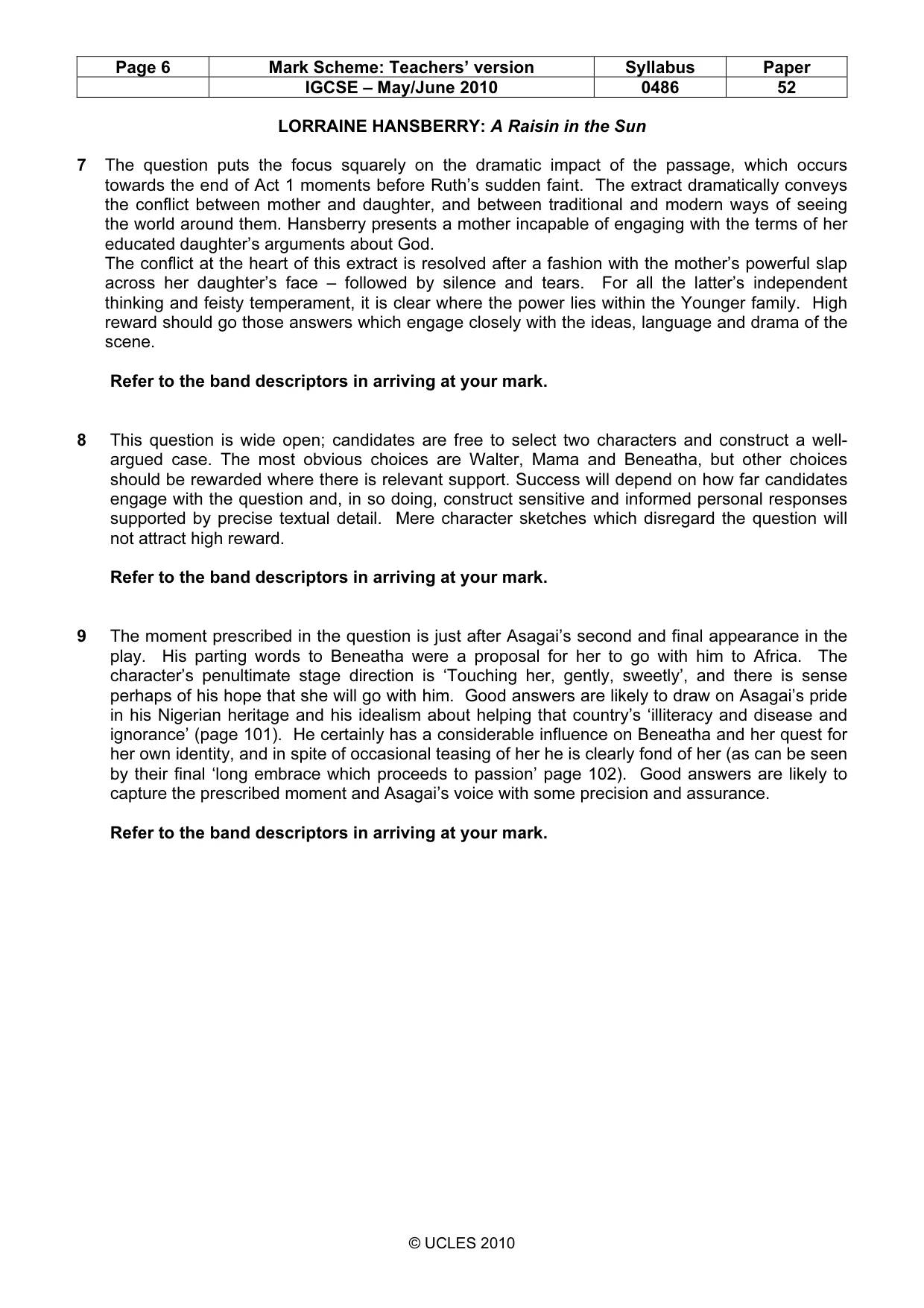
Page 6 Mark Scheme: Teachers’ version Syllabus Paper IGCSE – May/June 2010 0486 52 © UCLES 2010 LORRAINE HANSBERRY: A Raisin in the Sun 7 The question puts the focus squarely on the dramatic impact of the passage, which occurs towards the end of Act 1 moments before Ruth’s sudden faint. The extract dramatically conveys the conflict between mother and daughter, and between traditional and modern ways of seeing the world around them. Hansberry presents a mother incapable of engaging with the terms of her educated daughter’s arguments about God. The conflict at the heart of this extract is resolved after a fashion with the mother’s powerful slap across her daughter’s face – followed by silence and tears. For all the latter’s independent thinking and feisty temperament, it is clear where the power lies within the Younger family. High reward should go those answers which engage closely with the ideas, language and drama of the scene. Refer to the band descriptors in arriving at your mark. 8 This question is wide open; candidates are free to select two characters and construct a well- argued case. The most obvious choices are Walter, Mama and Beneatha, but other choices should be rewarded where there is relevant support. Success will depend on how far candidates engage with the question and, in so doing, construct sensitive and informed personal responses supported by precise textual detail. Mere character sketches which disregard the question will not attract high reward. Refer to the band descriptors in arriving at your mark. 9 The moment prescribed in the question is just after Asagai’s second and final appearance in the play. His parting words to Beneatha were a proposal for her to go with him to Africa. The character’s penultimate stage direction is ‘Touching her, gently, sweetly’, and there is sense perhaps of his hope that she will go with him. Good answers are likely to draw on Asagai’s pride in his Nigerian heritage and his idealism about helping that country’s ‘illiteracy and disease and ignorance’ (page 101). He certainly has a considerable influence on Beneatha and her quest for her own identity, and in spite of occasional teasing of her he is clearly fond of her (as can be seen by their final ‘long embrace which proceeds to passion’ page 102). Good answers are likely to capture the prescribed moment and Asagai’s voice with some precision and assurance. Refer to the band descriptors in arriving at your mark.
Mark scheme, page 7
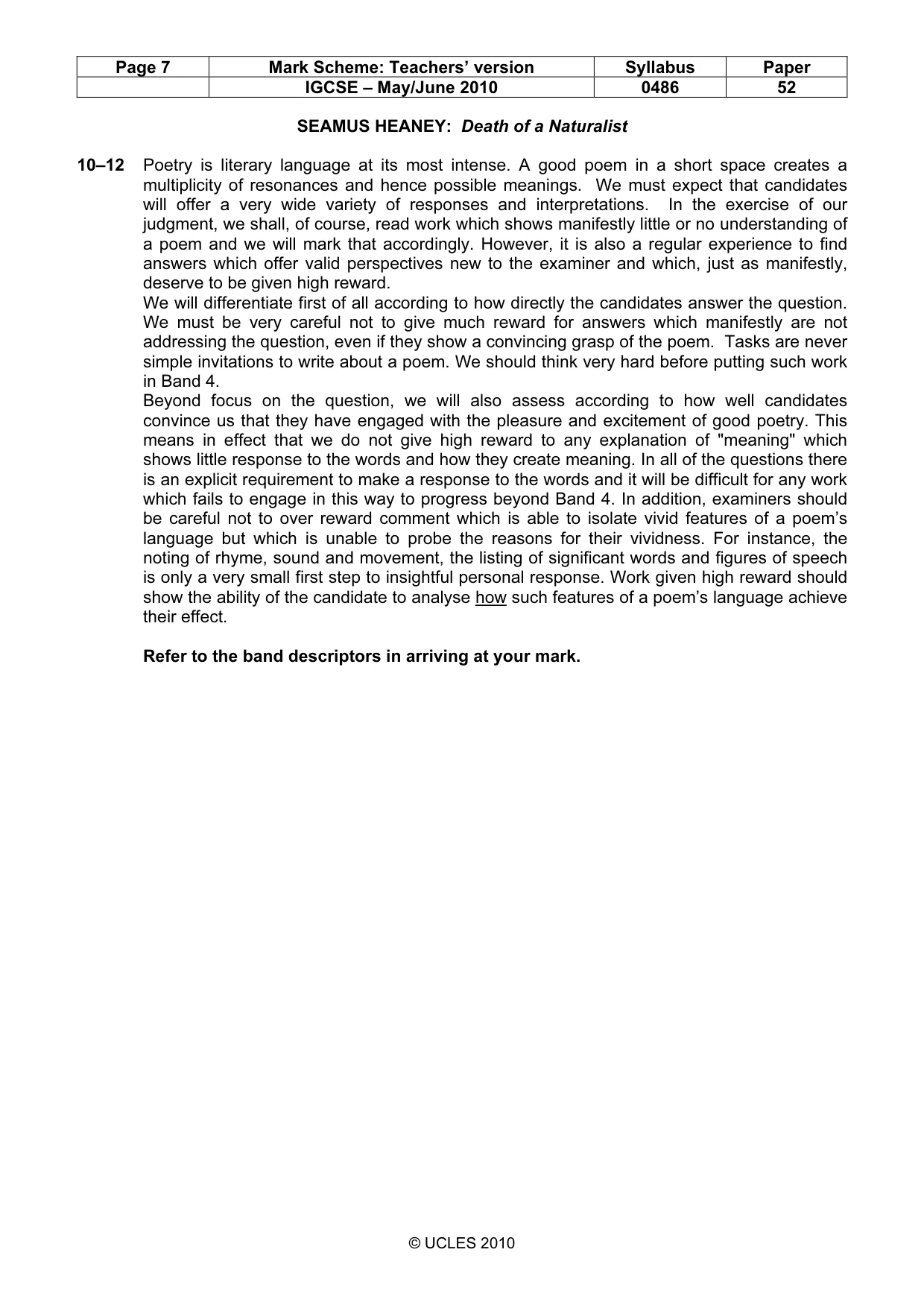
Page 7 Mark Scheme: Teachers’ version Syllabus Paper IGCSE – May/June 2010 0486 52 © UCLES 2010 SEAMUS HEANEY: Death of a Naturalist 10–12 Poetry is literary language at its most intense. A good poem in a short space creates a multiplicity of resonances and hence possible meanings. We must expect that candidates will offer a very wide variety of responses and interpretations. In the exercise of our judgment, we shall, of course, read work which shows manifestly little or no understanding of a poem and we will mark that accordingly. However, it is also a regular experience to find answers which offer valid perspectives new to the examiner and which, just as manifestly, deserve to be given high reward. We will differentiate first of all according to how directly the candidates answer the question. We must be very careful not to give much reward for answers which manifestly are not addressing the question, even if they show a convincing grasp of the poem. Tasks are never simple invitations to write about a poem. We should think very hard before putting such work in Band 4. Beyond focus on the question, we will also assess according to how well candidates convince us that they have engaged with the pleasure and excitement of good poetry. This means in effect that we do not give high reward to any explanation of "meaning" which shows little response to the words and how they create meaning. In all of the questions there is an explicit requirement to make a response to the words and it will be difficult for any work which fails to engage in this way to progress beyond Band 4. In addition, examiners should be careful not to over reward comment which is able to isolate vivid features of a poem’s language but which is unable to probe the reasons for their vividness. For instance, the noting of rhyme, sound and movement, the listing of significant words and figures of speech is only a very small first step to insightful personal response. Work given high reward should show the ability of the candidate to analyse how such features of a poem’s language achieve their effect. Refer to the band descriptors in arriving at your mark.
Mark scheme, page 8
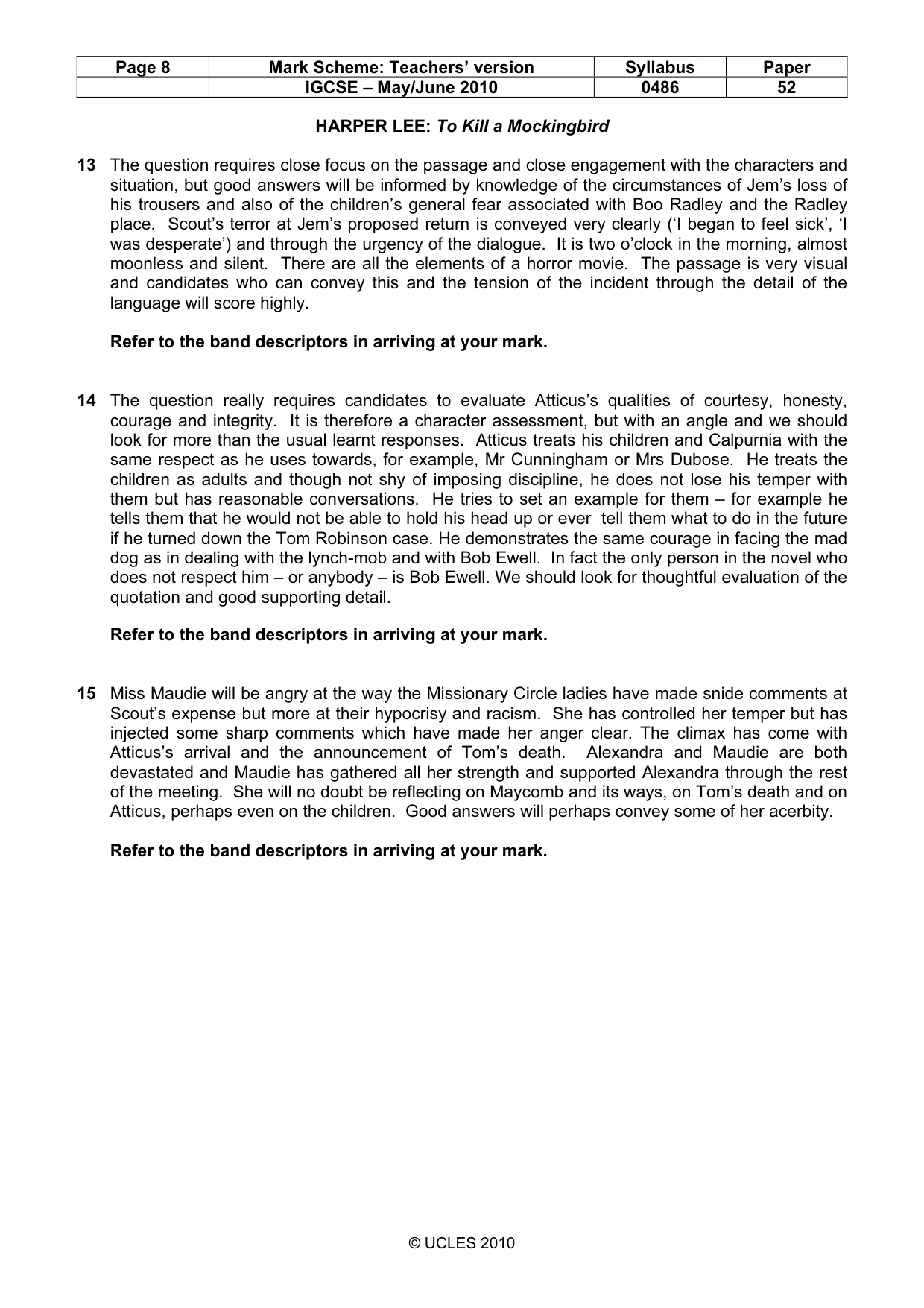
Page 8 Mark Scheme: Teachers’ version Syllabus Paper IGCSE – May/June 2010 0486 52 © UCLES 2010 HARPER LEE: To Kill a Mockingbird 13 The question requires close focus on the passage and close engagement with the characters and situation, but good answers will be informed by knowledge of the circumstances of Jem’s loss of his trousers and also of the children’s general fear associated with Boo Radley and the Radley place. Scout’s terror at Jem’s proposed return is conveyed very clearly (‘I began to feel sick’, ‘I was desperate’) and through the urgency of the dialogue. It is two o’clock in the morning, almost moonless and silent. There are all the elements of a horror movie. The passage is very visual and candidates who can convey this and the tension of the incident through the detail of the language will score highly. Refer to the band descriptors in arriving at your mark. 14 The question really requires candidates to evaluate Atticus’s qualities of courtesy, honesty, courage and integrity. It is therefore a character assessment, but with an angle and we should look for more than the usual learnt responses. Atticus treats his children and Calpurnia with the same respect as he uses towards, for example, Mr Cunningham or Mrs Dubose. He treats the children as adults and though not shy of imposing discipline, he does not lose his temper with them but has reasonable conversations. He tries to set an example for them – for example he tells them that he would not be able to hold his head up or ever tell them what to do in the future if he turned down the Tom Robinson case. He demonstrates the same courage in facing the mad dog as in dealing with the lynch-mob and with Bob Ewell. In fact the only person in the novel who does not respect him – or anybody – is Bob Ewell. We should look for thoughtful evaluation of the quotation and good supporting detail. Refer to the band descriptors in arriving at your mark. 15 Miss Maudie will be angry at the way the Missionary Circle ladies have made snide comments at Scout’s expense but more at their hypocrisy and racism. She has controlled her temper but has injected some sharp comments which have made her anger clear. The climax has come with Atticus’s arrival and the announcement of Tom’s death. Alexandra and Maudie are both devastated and Maudie has gathered all her strength and supported Alexandra through the rest of the meeting. She will no doubt be reflecting on Maycomb and its ways, on Tom’s death and on Atticus, perhaps even on the children. Good answers will perhaps convey some of her acerbity. Refer to the band descriptors in arriving at your mark.
Mark scheme, page 9
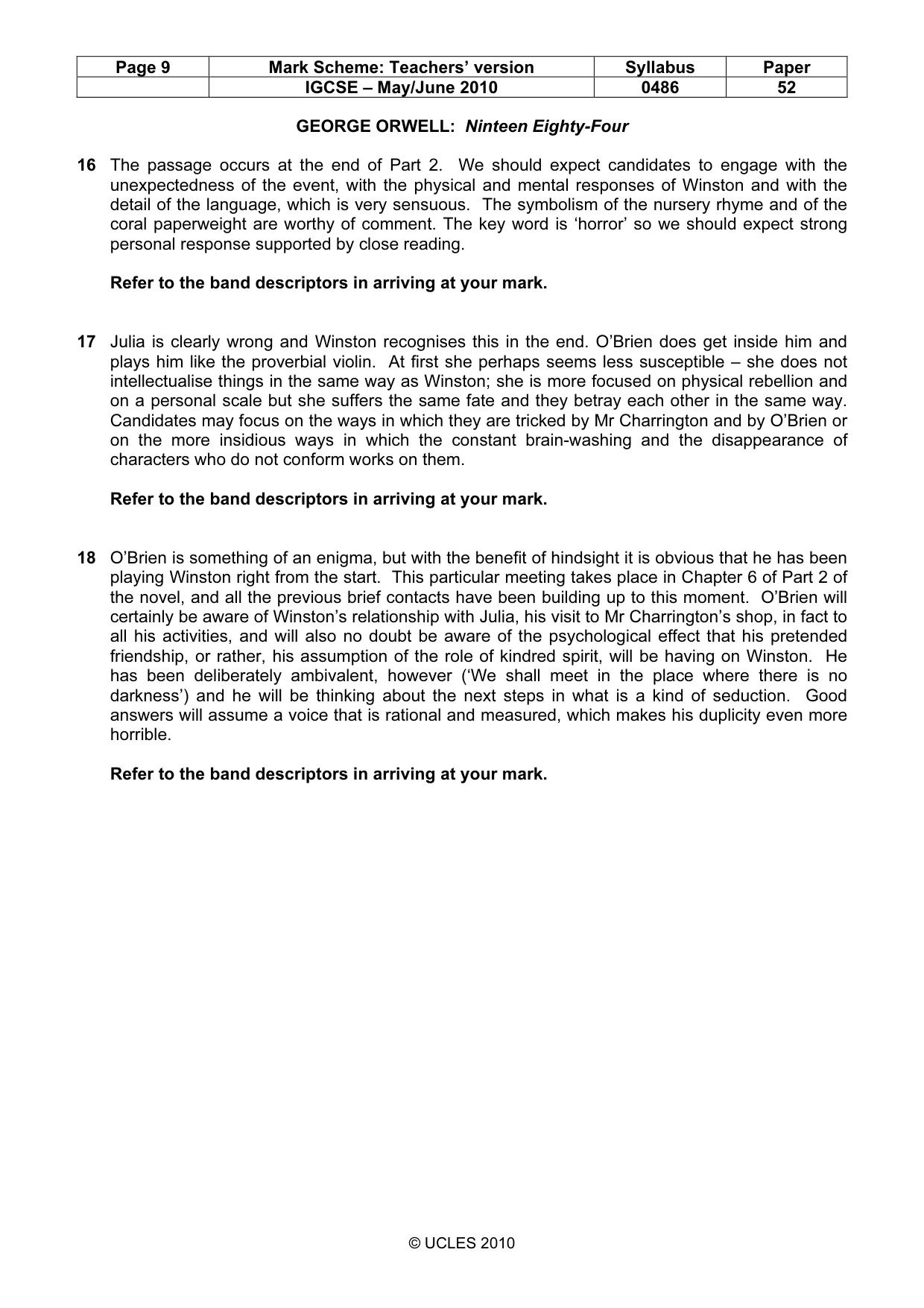
Page 9 Mark Scheme: Teachers’ version Syllabus Paper IGCSE – May/June 2010 0486 52 © UCLES 2010 GEORGE ORWELL: Ninteen Eighty-Four 16 The passage occurs at the end of Part 2. We should expect candidates to engage with the unexpectedness of the event, with the physical and mental responses of Winston and with the detail of the language, which is very sensuous. The symbolism of the nursery rhyme and of the coral paperweight are worthy of comment. The key word is ‘horror’ so we should expect strong personal response supported by close reading. Refer to the band descriptors in arriving at your mark. 17 Julia is clearly wrong and Winston recognises this in the end. O’Brien does get inside him and plays him like the proverbial violin. At first she perhaps seems less susceptible – she does not intellectualise things in the same way as Winston; she is more focused on physical rebellion and on a personal scale but she suffers the same fate and they betray each other in the same way. Candidates may focus on the ways in which they are tricked by Mr Charrington and by O’Brien or on the more insidious ways in which the constant brain-washing and the disappearance of characters who do not conform works on them. Refer to the band descriptors in arriving at your mark. 18 O’Brien is something of an enigma, but with the benefit of hindsight it is obvious that he has been playing Winston right from the start. This particular meeting takes place in Chapter 6 of Part 2 of the novel, and all the previous brief contacts have been building up to this moment. O’Brien will certainly be aware of Winston’s relationship with Julia, his visit to Mr Charrington’s shop, in fact to all his activities, and will also no doubt be aware of the psychological effect that his pretended friendship, or rather, his assumption of the role of kindred spirit, will be having on Winston. He has been deliberately ambivalent, however (‘We shall meet in the place where there is no darkness’) and he will be thinking about the next steps in what is a kind of seduction. Good answers will assume a voice that is rational and measured, which makes his duplicity even more horrible. Refer to the band descriptors in arriving at your mark.
Mark scheme, page 10
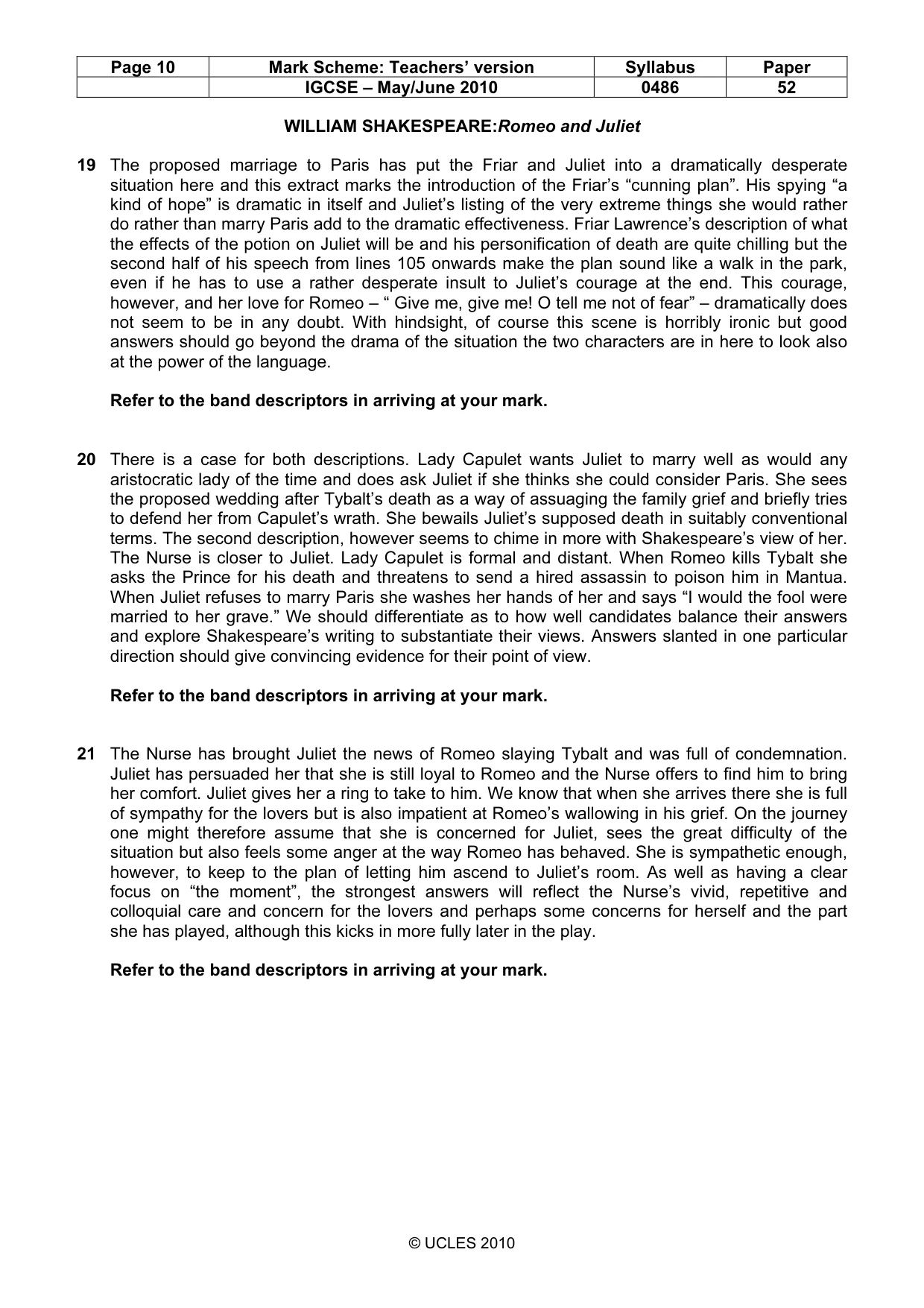
Page 10 Mark Scheme: Teachers’ version Syllabus Paper IGCSE – May/June 2010 0486 52 © UCLES 2010 WILLIAM SHAKESPEARE:Romeo and Juliet 19 The proposed marriage to Paris has put the Friar and Juliet into a dramatically desperate situation here and this extract marks the introduction of the Friar’s “cunning plan”. His spying “a kind of hope” is dramatic in itself and Juliet’s listing of the very extreme things she would rather do rather than marry Paris add to the dramatic effectiveness. Friar Lawrence’s description of what the effects of the potion on Juliet will be and his personification of death are quite chilling but the second half of his speech from lines 105 onwards make the plan sound like a walk in the park, even if he has to use a rather desperate insult to Juliet’s courage at the end. This courage, however, and her love for Romeo – “ Give me, give me! O tell me not of fear” – dramatically does not seem to be in any doubt. With hindsight, of course this scene is horribly ironic but good answers should go beyond the drama of the situation the two characters are in here to look also at the power of the language. Refer to the band descriptors in arriving at your mark. 20 There is a case for both descriptions. Lady Capulet wants Juliet to marry well as would any aristocratic lady of the time and does ask Juliet if she thinks she could consider Paris. She sees the proposed wedding after Tybalt’s death as a way of assuaging the family grief and briefly tries to defend her from Capulet’s wrath. She bewails Juliet’s supposed death in suitably conventional terms. The second description, however seems to chime in more with Shakespeare’s view of her. The Nurse is closer to Juliet. Lady Capulet is formal and distant. When Romeo kills Tybalt she asks the Prince for his death and threatens to send a hired assassin to poison him in Mantua. When Juliet refuses to marry Paris she washes her hands of her and says “I would the fool were married to her grave.” We should differentiate as to how well candidates balance their answers and explore Shakespeare’s writing to substantiate their views. Answers slanted in one particular direction should give convincing evidence for their point of view. Refer to the band descriptors in arriving at your mark. 21 The Nurse has brought Juliet the news of Romeo slaying Tybalt and was full of condemnation. Juliet has persuaded her that she is still loyal to Romeo and the Nurse offers to find him to bring her comfort. Juliet gives her a ring to take to him. We know that when she arrives there she is full of sympathy for the lovers but is also impatient at Romeo’s wallowing in his grief. On the journey one might therefore assume that she is concerned for Juliet, sees the great difficulty of the situation but also feels some anger at the way Romeo has behaved. She is sympathetic enough, however, to keep to the plan of letting him ascend to Juliet’s room. As well as having a clear focus on “the moment”, the strongest answers will reflect the Nurse’s vivid, repetitive and colloquial care and concern for the lovers and perhaps some concerns for herself and the part she has played, although this kicks in more fully later in the play. Refer to the band descriptors in arriving at your mark.
What you needed in this session
Cambridge’s own grade thresholds for 2010 May/June, Paper 5 · Variant 2. A higher threshold means an easier paper — the bar moves with how the cohort did.