Cambridge IGCSE English - Literature 0486 — 2014 Oct/Nov Paper 5 · Variant 2
0486/52/O/N/14 · 25 marks · ≈28 min
The question paper and its mark scheme, free to read here and free to download. This is Cambridge’s own paper, exactly as it was sat.
Question paper16 pages



Mark scheme3 pages
Answers below. Sit the paper first if you are practising.
Paper as text
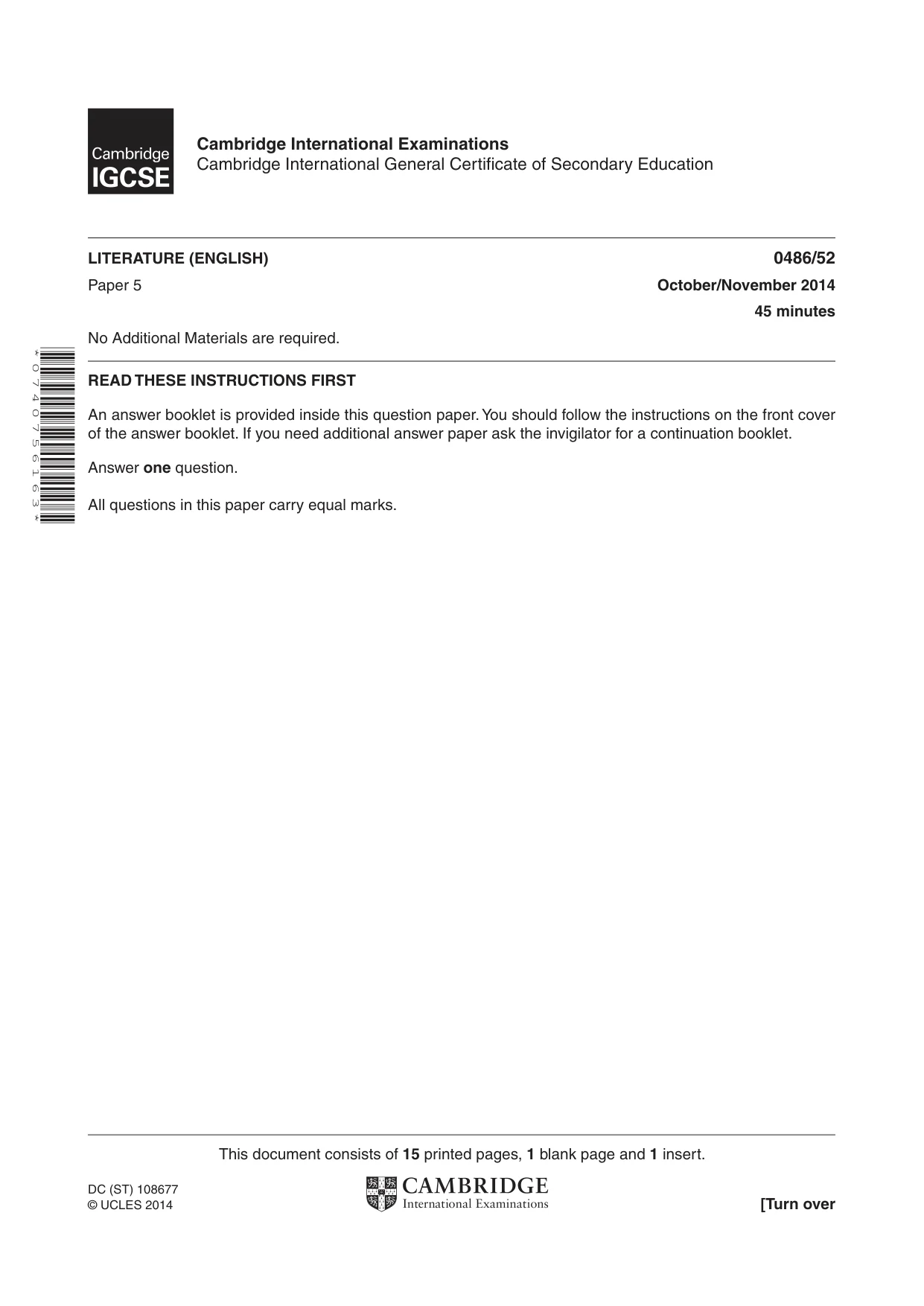
Question paper, page 1
This document consists of 15 printed pages, 1 blank page and 1 insert. DC (ST) 108677 © UCLES 2014 [Turn over Cambridge International Examinations Cambridge International General Certificate of Secondary Education * 0 7 4 0 7 5 6 1 6 3 * LITERATURE (ENGLISH) 0486/52 Paper 5 October/November 2014 45 minutes No Additional Materials are required. READ THESE INSTRUCTIONS FIRST An answer booklet is provided inside this question paper. You should follow the instructions on the front cover of the answer booklet. If you need additional answer paper ask the invigilator for a continuation booklet. Answer one question. All questions in this paper carry equal marks.
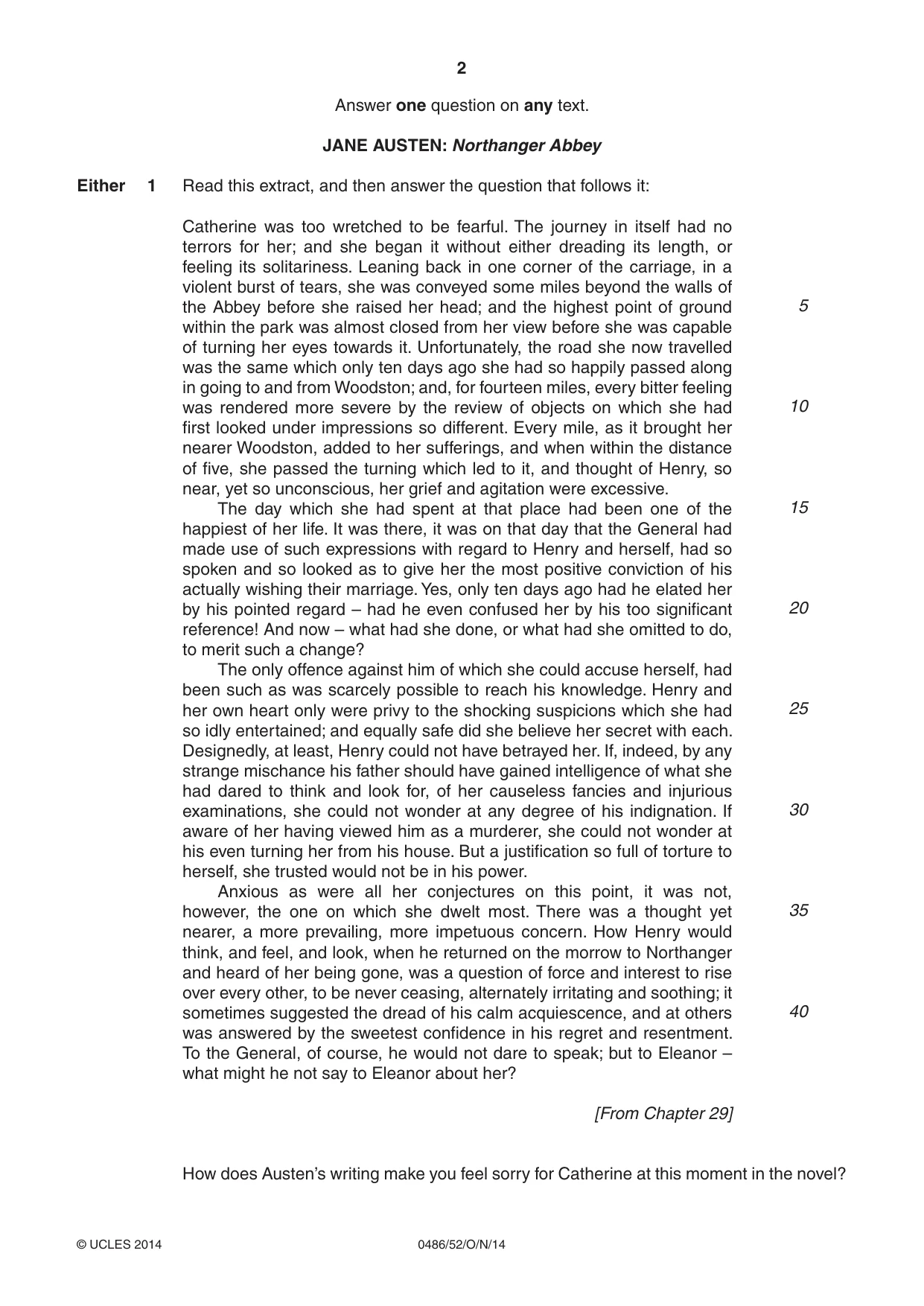
Question paper, page 2
2 0486/52/O/N/14 © UCLES 2014 Answer one question on any text. JANE AUSTEN: Northanger Abbey Either 1 Read this extract, and then answer the question that follows it: Catherine was too wretched to be fearful. The journey in itself had no terrors for her; and she began it without either dreading its length, or feeling its solitariness. Leaning back in one corner of the carriage, in a violent burst of tears, she was conveyed some miles beyond the walls of the Abbey before she raised her head; and the highest point of ground within the park was almost closed from her view before she was capable of turning her eyes towards it. Unfortunately, the road she now travelled was the same which only ten days ago she had so happily passed along in going to and from Woodston; and, for fourteen miles, every bitter feeling was rendered more severe by the review of objects on which she had first looked under impressions so different. Every mile, as it brought her nearer Woodston, added to her sufferings, and when within the distance of five, she passed the turning which led to it, and thought of Henry, so near, yet so unconscious, her grief and agitation were excessive. The day which she had spent at that place had been one of the happiest of her life. It was there, it was on that day that the General had made use of such expressions with regard to Henry and herself, had so spoken and so looked as to give her the most positive conviction of his actually wishing their marriage. Yes, only ten days ago had he elated her by his pointed regard – had he even confused her by his too significant reference! And now – what had she done, or what had she omitted to do, to merit such a change? The only offence against him of which she could accuse herself, had been such as was scarcely possible to reach his knowledge. Henry and her own heart only were privy to the shocking suspicions which she had so idly entertained; and equally safe did she believe her secret with each. Designedly, at least, Henry could not have betrayed her. If, indeed, by any strange mischance his father should have gained intelligence of what she had dared to think and look for, of her causeless fancies and injurious examinations, she could not wonder at any degree of his indignation. If aware of her having viewed him as a murderer, she could not wonder at his even turning her from his house. But a justification so full of torture to herself, she trusted would not be in his power. Anxious as were all her conjectures on this point, it was not, however, the one on which she dwelt most. There was a thought yet nearer, a more prevailing, more impetuous concern. How Henry would think, and feel, and look, when he returned on the morrow to Northanger and heard of her being gone, was a question of force and interest to rise over every other, to be never ceasing, alternately irritating and soothing; it sometimes suggested the dread of his calm acquiescence, and at others was answered by the sweetest confidence in his regret and resentment. To the General, of course, he would not dare to speak; but to Eleanor – what might he not say to Eleanor about her? [From Chapter 29] How does Austen’s writing make you feel sorry for Catherine at this moment in the novel? 5 10 15 20 25 30 35 40
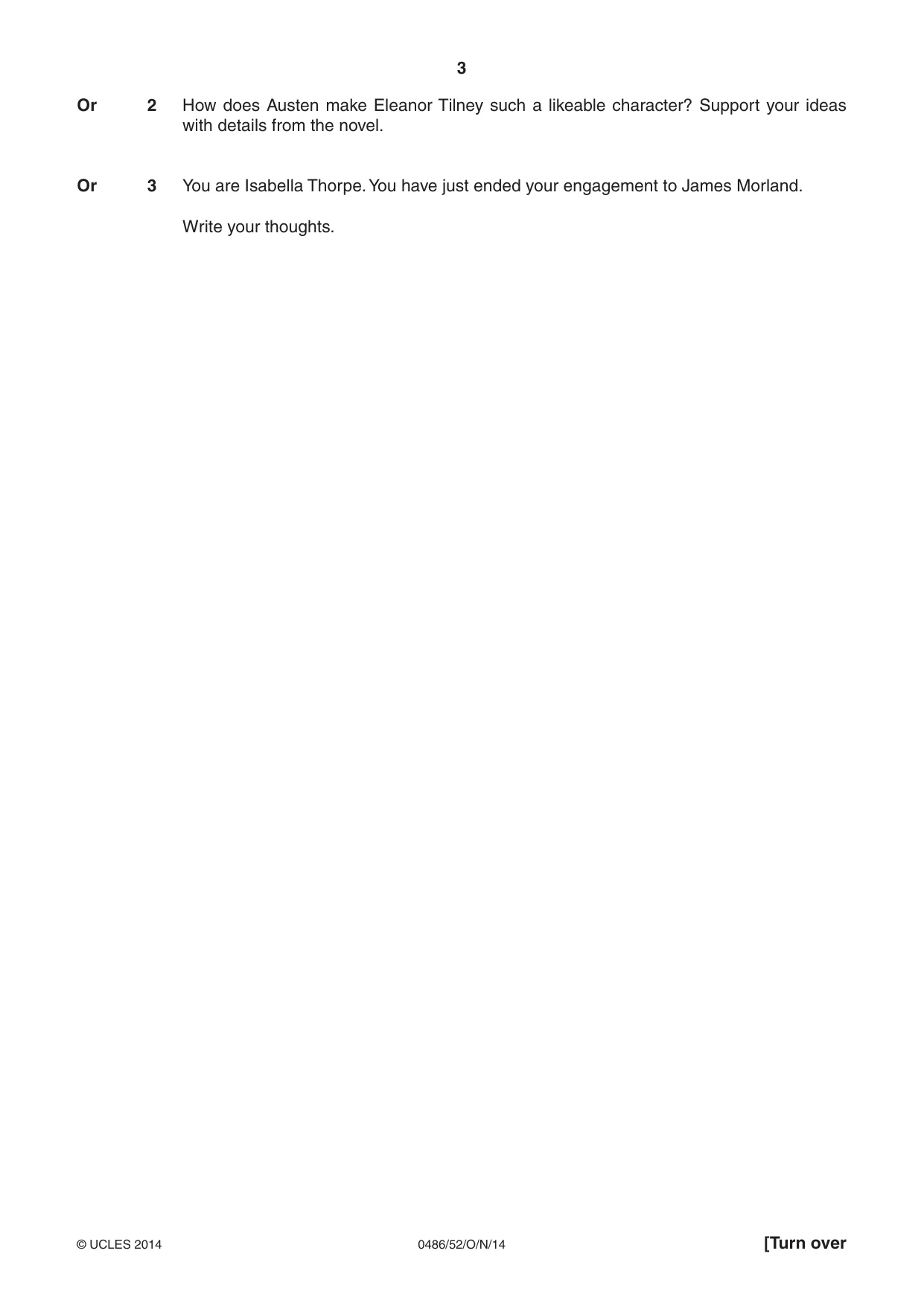
Question paper, page 3
3 0486/52/O/N/14 © UCLES 2014 [Turn over Or 2 How does Austen make Eleanor Tilney such a likeable character? Support your ideas with details from the novel. Or 3 You are Isabella Thorpe. You have just ended your engagement to James Morland. Write your thoughts.
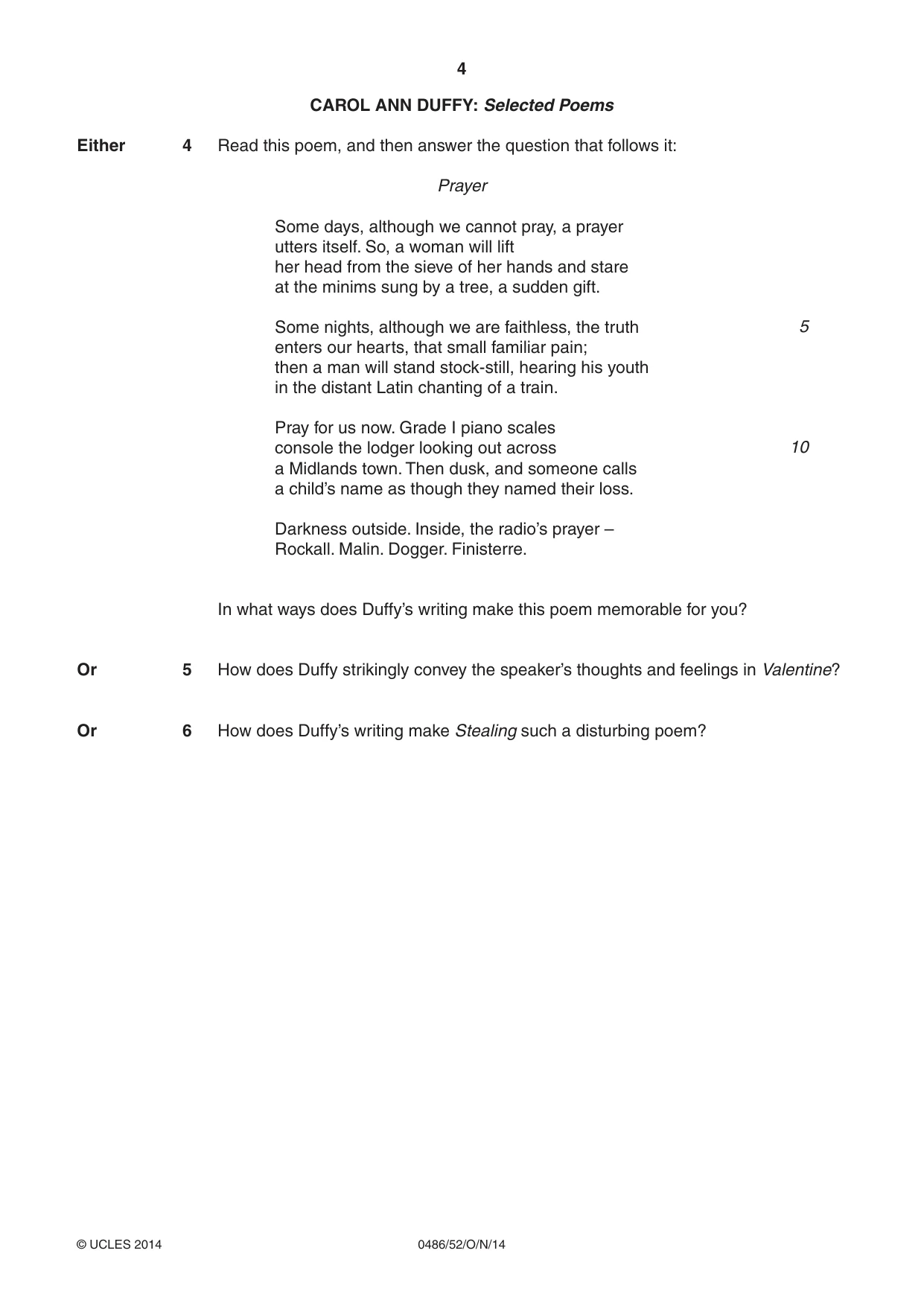
Question paper, page 4
4 0486/52/O/N/14 © UCLES 2014 CAROL ANN DUFFY: Selected Poems Either 4 Read this poem, and then answer the question that follows it: Prayer Some days, although we cannot pray, a prayer utters itself. So, a woman will lift her head from the sieve of her hands and stare at the minims sung by a tree, a sudden gift. Some nights, although we are faithless, the truth enters our hearts, that small familiar pain; then a man will stand stock-still, hearing his youth in the distant Latin chanting of a train. Pray for us now. Grade I piano scales console the lodger looking out across a Midlands town. Then dusk, and someone calls a child’s name as though they named their loss. Darkness outside. Inside, the radio’s prayer – Rockall. Malin. Dogger. Finisterre. In what ways does Duffy’s writing make this poem memorable for you? Or 5 How does Duffy strikingly convey the speaker’s thoughts and feelings in Valentine? Or 6 How does Duffy’s writing make Stealing such a disturbing poem? 5 10
Question paper, page 5
5 0486/52/O/N/14 © UCLES 2014 [Turn over Turn to page 6 for Question 7.
Question paper, page 6
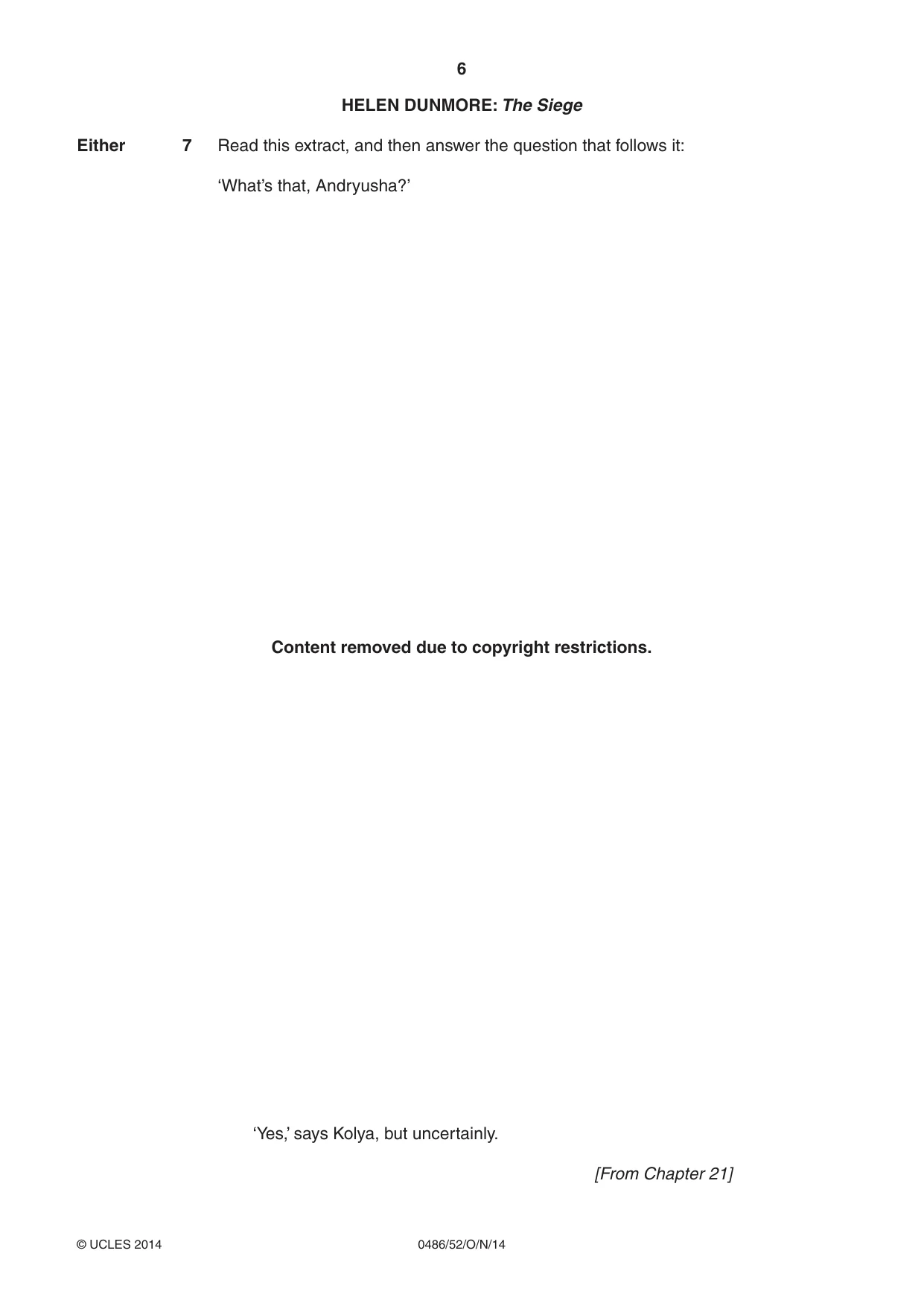
6 0486/52/O/N/14 © UCLES 2014 HELEN DUNMORE: The Siege Either 7 Read this extract, and then answer the question that follows it: ‘What’s that, Andryusha?’ ‘Yes,’ says Kolya, but uncertainly. [From Chapter 21] Content removed due to copyright restrictions.
Question paper, page 7
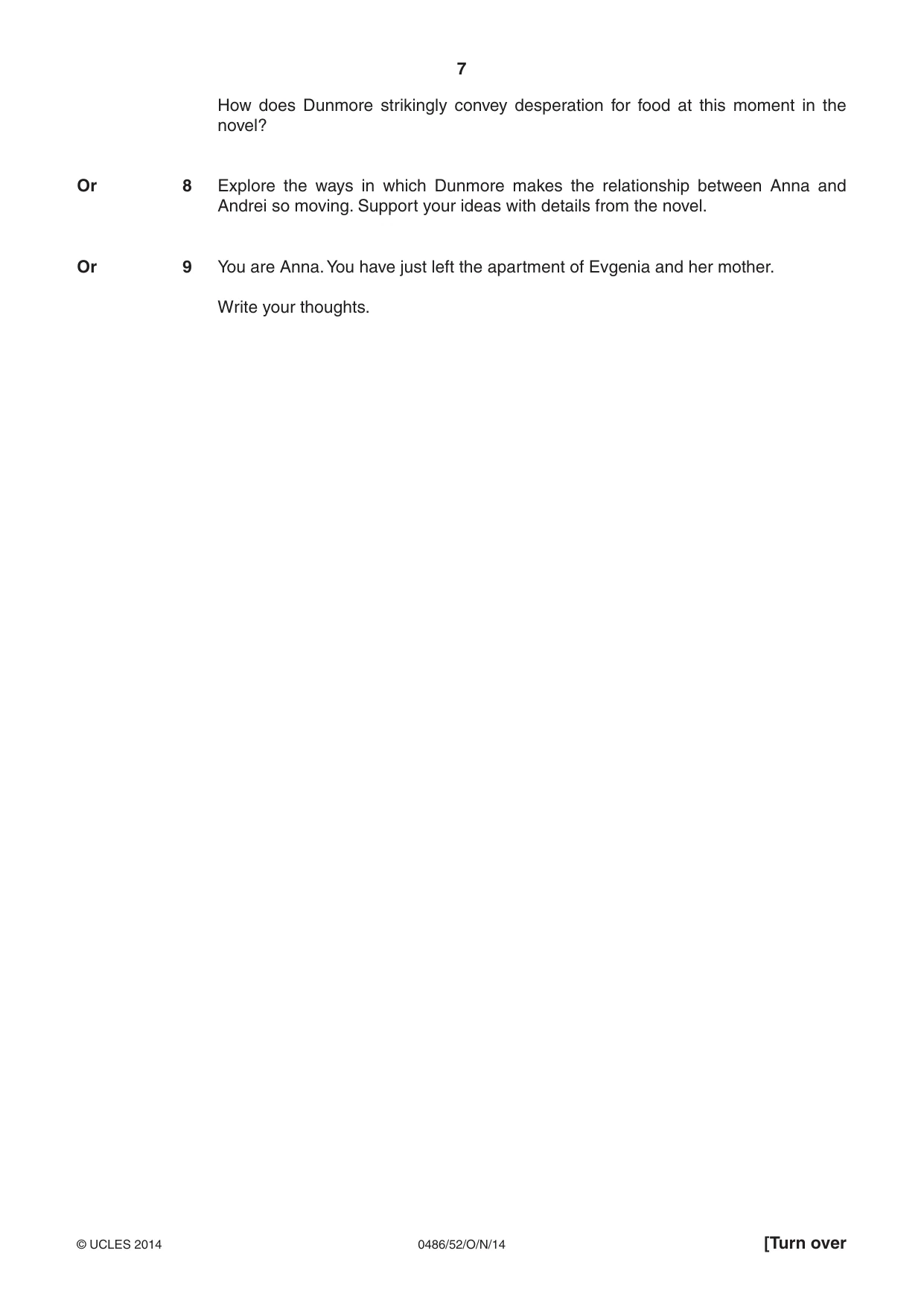
7 0486/52/O/N/14 © UCLES 2014 [Turn over How does Dunmore strikingly convey desperation for food at this moment in the novel? Or 8 Explore the ways in which Dunmore makes the relationship between Anna and Andrei so moving. Support your ideas with details from the novel. Or 9 You are Anna. You have just left the apartment of Evgenia and her mother. Write your thoughts.
Question paper, page 8
8 0486/52/O/N/14 © UCLES 2014 from JO PHILLIPS ed.: Poems Deep & Dangerous Either 10 Read this poem, and then answer the question that follows it: Follower My father worked with a horse-plough, Behind me, and will not go away. (by Seamus Heaney) What vivid impressions of the father and son does Heaney create for you as you read this poem? Or 11 How does Arnold memorably present feelings of loneliness and despair in To Marguerite? Or 12 Explore the ways in which the poet memorably conveys the thoughts and feelings of the speaker in one of the following sonnets: I wish I could remember that first day (by Christina Rossetti) Shall I Compare Thee …? (by William Shakespeare) Content removed due to copyright restrictions.
Question paper, page 9
9 0486/52/O/N/14 © UCLES 2014 [Turn over Turn to page 10 for Question 13.
Question paper, page 10
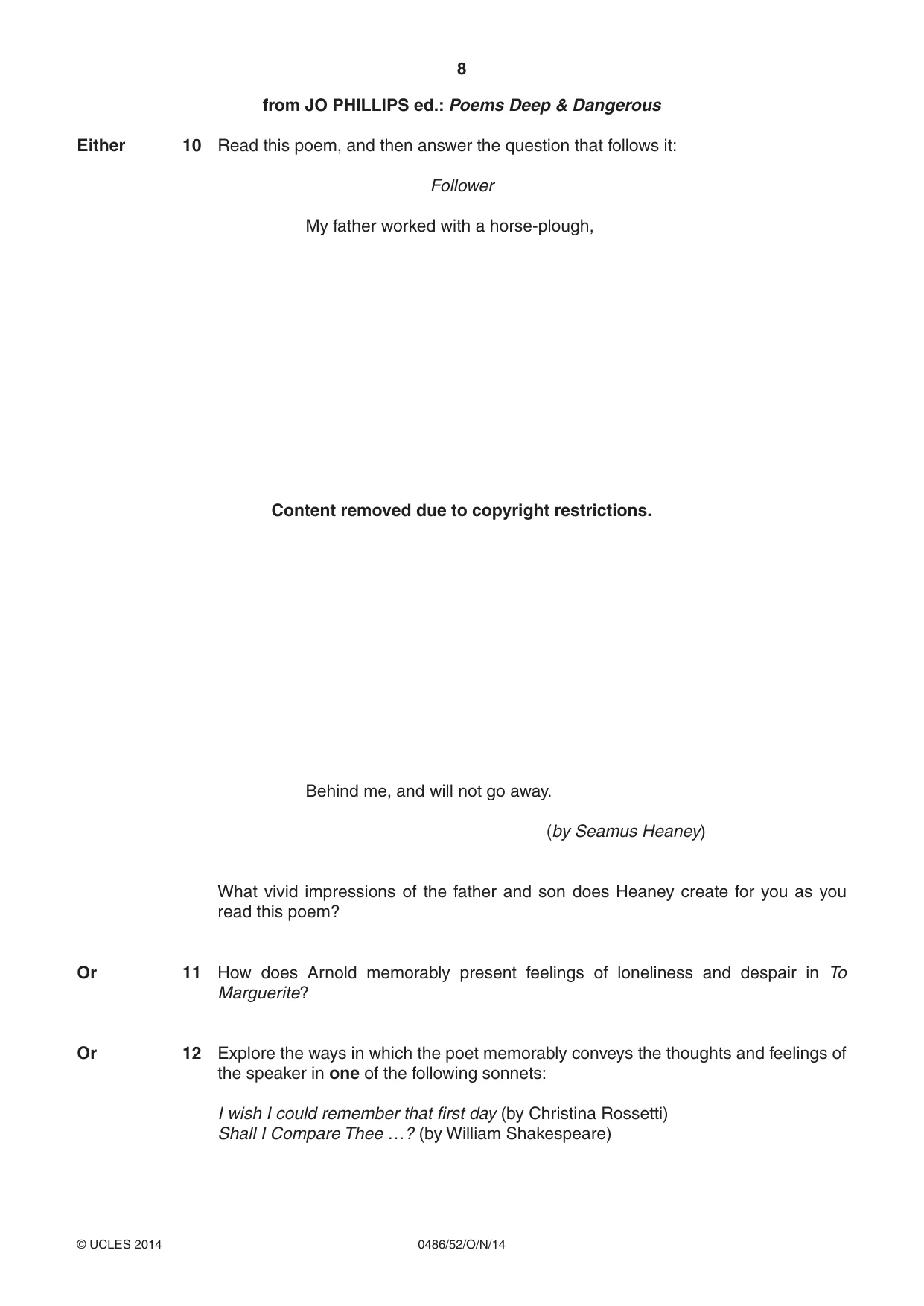
10 0486/52/O/N/14 © UCLES 2014 WILLIAM SHAKESPEARE: A Midsummer Night’s Dream Either 13 Read this extract, and then answer the question that follows it: Bottom: Masters, you ought to consider with yourself to bring in – God shield us! – a lion among ladies is a most dreadful thing; for there is not a more fearful wild-fowl than your lion living; and we ought to look to’t. Snout: Therefore another prologue must tell he is not a lion. Bottom: Nay, you must name his name, and half his face must be seen through the lion’s neck; and he himself must speak through, saying thus, or to the same defect: ‘Ladies,’ or ‘Fair ladies, I would wish you’ or ‘I would request you’ or ‘I would entreat you not to fear, not to tremble. My life for yours! If you think I come hither as a lion, it were pity of my life. No, I am no such thing; I am a man as other men are’. And there, indeed, let him name his name, and tell them plainly he is Snug the joiner. Quince: Well, it shall be so. But there is two hard things – that is, to bring the moonlight into a chamber; for, you know, Pyramus and Thisby meet by moonlight. Snout: Doth the moon shine that night we play our play? Bottom: A calendar, a calendar! Look in the almanack; find out moonshine, find out moonshine. Quince: Yes, it doth shine that night. Bottom: Why, then may you leave a casement of the great chamber window, where we play, open; and the moon may shine in at the casement. Quince: Ay; or else one must come in with a bush of thorns and a lantern, and say he comes to disfigure or to present the person of Moonshine. Then there is another thing: we must have a wall in the great chamber; for Pyramus and Thisby, says the story, did talk through the chink of a wall. Snout: You can never bring in a wall. What say you, Bottom? Bottom: Some man or other must present Wall; and let him have some plaster, or some loam, or some rough-cast about him, to signify wall; and let him hold his fingers thus, and through that cranny shall Pyramus and Thisby whisper. Quince: If that may be, then all is well. Come, sit down, every mother’s son, and rehearse your parts. Pyramus, you begin; when you have spoken your speech, enter into that brake; and so every one according to his cue. Enter PUCK behind. Puck: What hempen homespuns have we swagg’ring here, So near the cradle of the Fairy Queen? What, a play toward! I’ll be an auditor; An actor too perhaps, if I see cause. Quince: Speak, Pyramus. Thisby, stand forth. Bottom: Thisby, the flowers of odious savours sweet – Quince: ‘Odious’ – odorous! Bottom: — odours savours sweet; So hath thy breath, my dearest Thisby dear. But hark, a voice! Stay thou but here awhile, And by and by I will to thee appear. [Exit. 5 10 15 20 25 30 35 40 45 50
Question paper, page 11
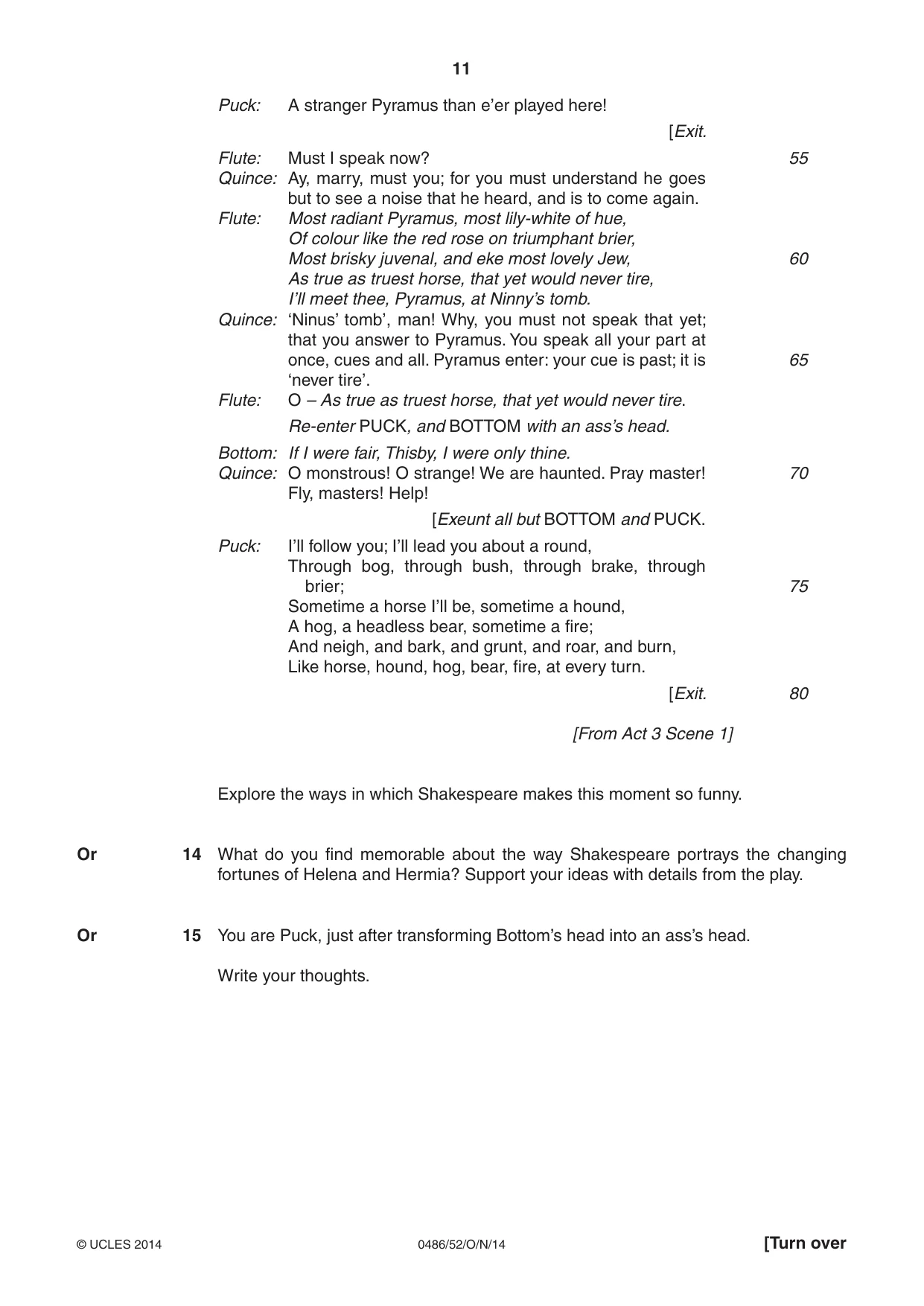
11 0486/52/O/N/14 © UCLES 2014 [Turn over Puck: A stranger Pyramus than e’er played here! [Exit. Flute: Must I speak now? Quince: Ay, marry, must you; for you must understand he goes but to see a noise that he heard, and is to come again. Flute: Most radiant Pyramus, most lily-white of hue, Of colour like the red rose on triumphant brier, Most brisky juvenal, and eke most lovely Jew, As true as truest horse, that yet would never tire, I’ll meet thee, Pyramus, at Ninny’s tomb. Quince: ‘Ninus’ tomb’, man! Why, you must not speak that yet; that you answer to Pyramus. You speak all your part at once, cues and all. Pyramus enter: your cue is past; it is ‘never tire’. Flute: O – As true as truest horse, that yet would never tire. Re-enter PUCK, and BOTTOM with an ass’s head. Bottom: If I were fair, Thisby, I were only thine. Quince: O monstrous! O strange! We are haunted. Pray master! Fly, masters! Help! [Exeunt all but BOTTOM and PUCK. Puck: I’ll follow you; I’ll lead you about a round, Through bog, through bush, through brake, through brier; Sometime a horse I’ll be, sometime a hound, A hog, a headless bear, sometime a fire; And neigh, and bark, and grunt, and roar, and burn, Like horse, hound, hog, bear, fire, at every turn. [Exit. [From Act 3 Scene 1] Explore the ways in which Shakespeare makes this moment so funny. Or 14 What do you find memorable about the way Shakespeare portrays the changing fortunes of Helena and Hermia? Support your ideas with details from the play. Or 15 You are Puck, just after transforming Bottom’s head into an ass’s head. Write your thoughts. 55 60 65 70 75 80
Question paper, page 12
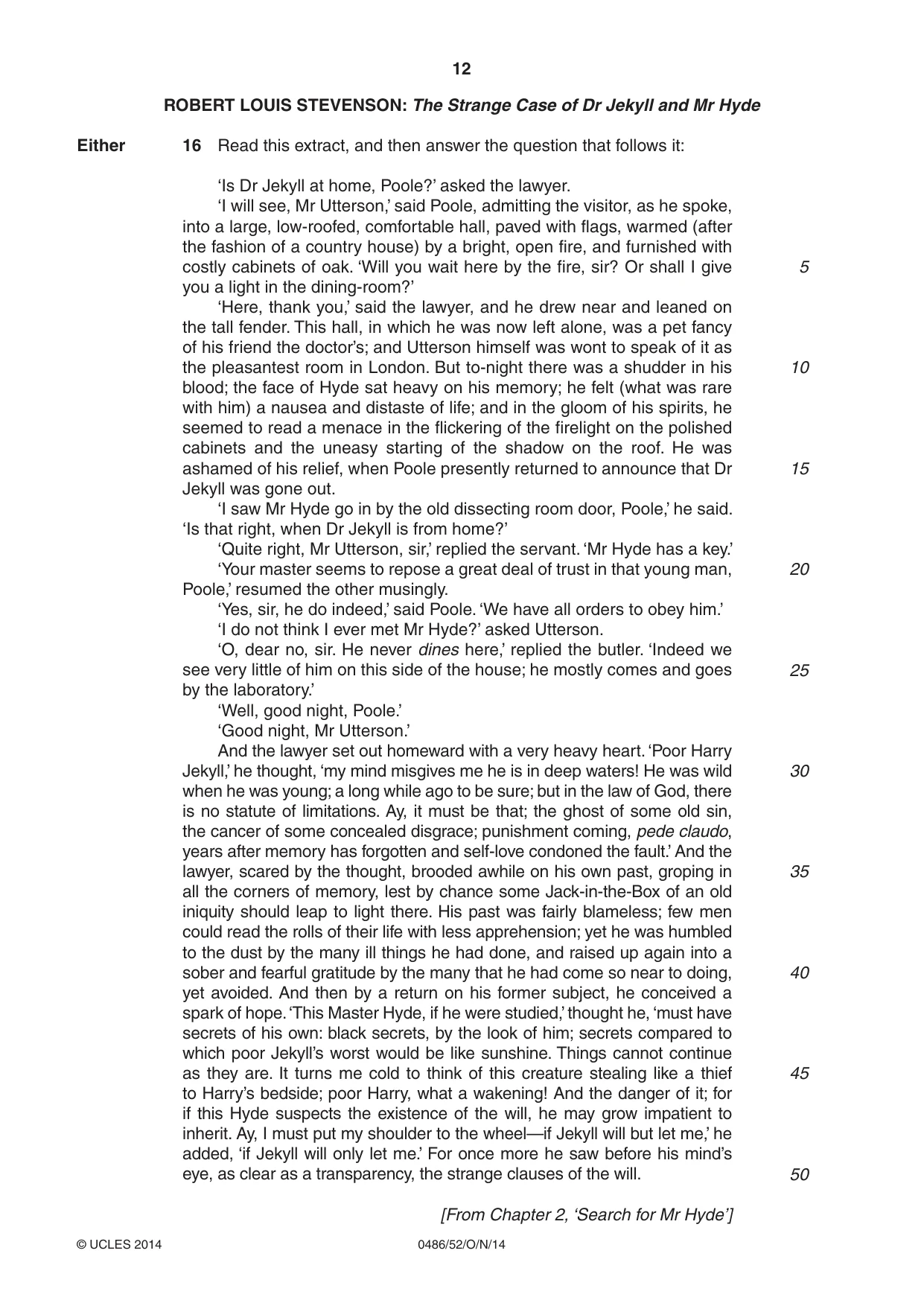
12 0486/52/O/N/14 © UCLES 2014 ROBERT LOUIS STEVENSON: The Strange Case of Dr Jekyll and Mr Hyde Either 16 Read this extract, and then answer the question that follows it: ‘Is Dr Jekyll at home, Poole?’ asked the lawyer. ‘I will see, Mr Utterson,’ said Poole, admitting the visitor, as he spoke, into a large, low-roofed, comfortable hall, paved with flags, warmed (after the fashion of a country house) by a bright, open fire, and furnished with costly cabinets of oak. ‘Will you wait here by the fire, sir? Or shall I give you a light in the dining-room?’ ‘Here, thank you,’ said the lawyer, and he drew near and leaned on the tall fender. This hall, in which he was now left alone, was a pet fancy of his friend the doctor’s; and Utterson himself was wont to speak of it as the pleasantest room in London. But to-night there was a shudder in his blood; the face of Hyde sat heavy on his memory; he felt (what was rare with him) a nausea and distaste of life; and in the gloom of his spirits, he seemed to read a menace in the flickering of the firelight on the polished cabinets and the uneasy starting of the shadow on the roof. He was ashamed of his relief, when Poole presently returned to announce that Dr Jekyll was gone out. ‘I saw Mr Hyde go in by the old dissecting room door, Poole,’ he said. ‘Is that right, when Dr Jekyll is from home?’ ‘Quite right, Mr Utterson, sir,’ replied the servant. ‘Mr Hyde has a key.’ ‘Your master seems to repose a great deal of trust in that young man, Poole,’ resumed the other musingly. ‘Yes, sir, he do indeed,’ said Poole. ‘We have all orders to obey him.’ ‘I do not think I ever met Mr Hyde?’ asked Utterson. ‘O, dear no, sir. He never dines here,’ replied the butler. ‘Indeed we see very little of him on this side of the house; he mostly comes and goes by the laboratory.’ ‘Well, good night, Poole.’ ‘Good night, Mr Utterson.’ And the lawyer set out homeward with a very heavy heart. ‘Poor Harry Jekyll,’ he thought, ‘my mind misgives me he is in deep waters! He was wild when he was young; a long while ago to be sure; but in the law of God, there is no statute of limitations. Ay, it must be that; the ghost of some old sin, the cancer of some concealed disgrace; punishment coming, pede claudo, years after memory has forgotten and self-love condoned the fault.’ And the lawyer, scared by the thought, brooded awhile on his own past, groping in all the corners of memory, lest by chance some Jack-in-the-Box of an old iniquity should leap to light there. His past was fairly blameless; few men could read the rolls of their life with less apprehension; yet he was humbled to the dust by the many ill things he had done, and raised up again into a sober and fearful gratitude by the many that he had come so near to doing, yet avoided. And then by a return on his former subject, he conceived a spark of hope. ‘This Master Hyde, if he were studied,’ thought he, ‘must have secrets of his own: black secrets, by the look of him; secrets compared to which poor Jekyll’s worst would be like sunshine. Things cannot continue as they are. It turns me cold to think of this creature stealing like a thief to Harry’s bedside; poor Harry, what a wakening! And the danger of it; for if this Hyde suspects the existence of the will, he may grow impatient to inherit. Ay, I must put my shoulder to the wheel—if Jekyll will but let me,’ he added, ‘if Jekyll will only let me.’ For once more he saw before his mind’s eye, as clear as a transparency, the strange clauses of the will. [From Chapter 2, ‘Search for Mr Hyde’] 5 10 15 20 25 30 35 40 45 50
Question paper, page 13
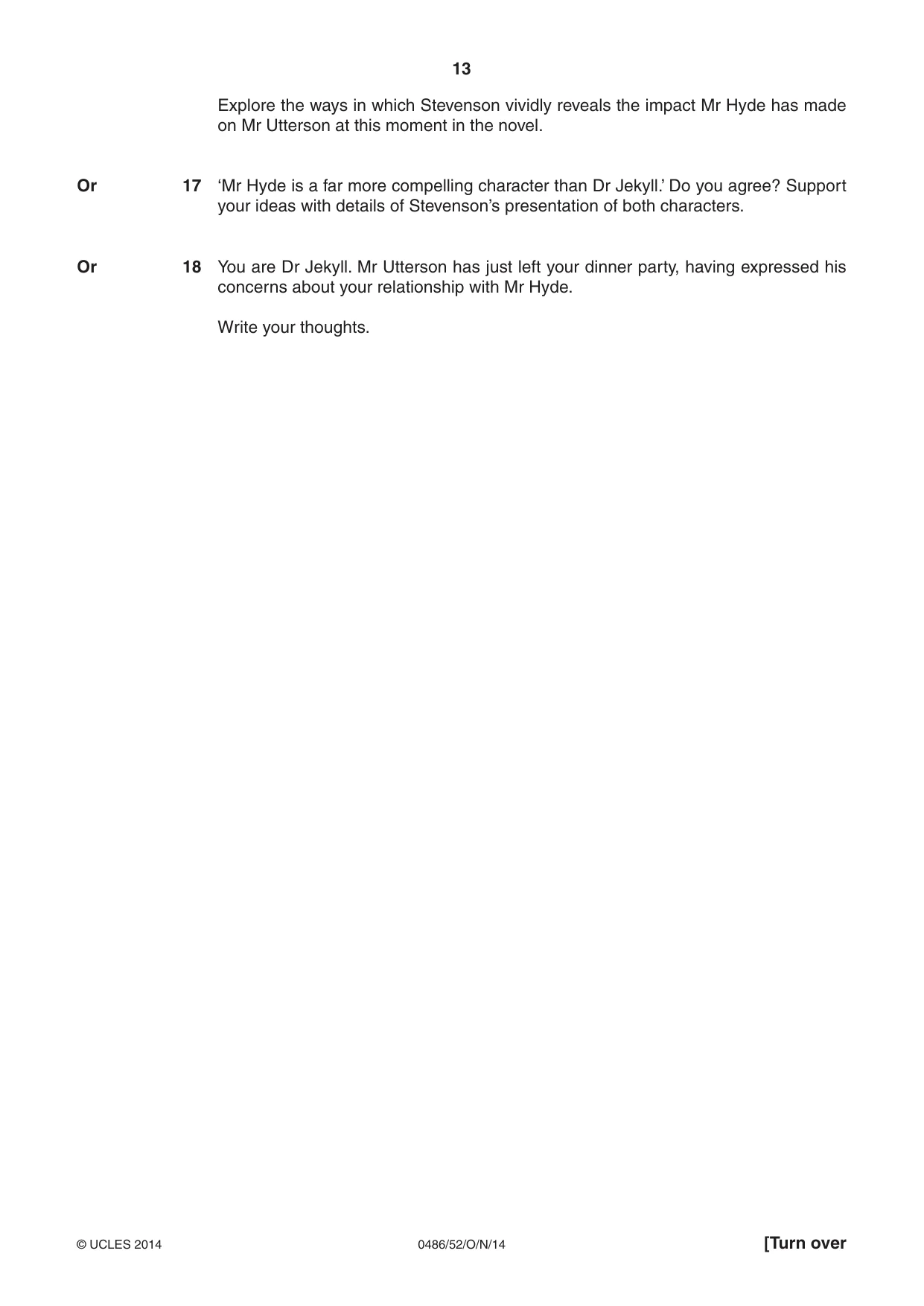
13 0486/52/O/N/14 © UCLES 2014 [Turn over Explore the ways in which Stevenson vividly reveals the impact Mr Hyde has made on Mr Utterson at this moment in the novel. Or 17 ‘Mr Hyde is a far more compelling character than Dr Jekyll.’ Do you agree? Support your ideas with details of Stevenson’s presentation of both characters. Or 18 You are Dr Jekyll. Mr Utterson has just left your dinner party, having expressed his concerns about your relationship with Mr Hyde. Write your thoughts.
Question paper, page 14
14 0486/52/O/N/14 © UCLES 2014 TENNESSEE WILLIAMS: Cat on a Hot Tin Roof Either 19 Read this extract, and then answer the question that follows it: Big Daddy: I got a surprise for those women. I’m not gonna let it go for a long time yet if that’s what they’re waiting for. Content removed due to copyright restrictions.
Question paper, page 15
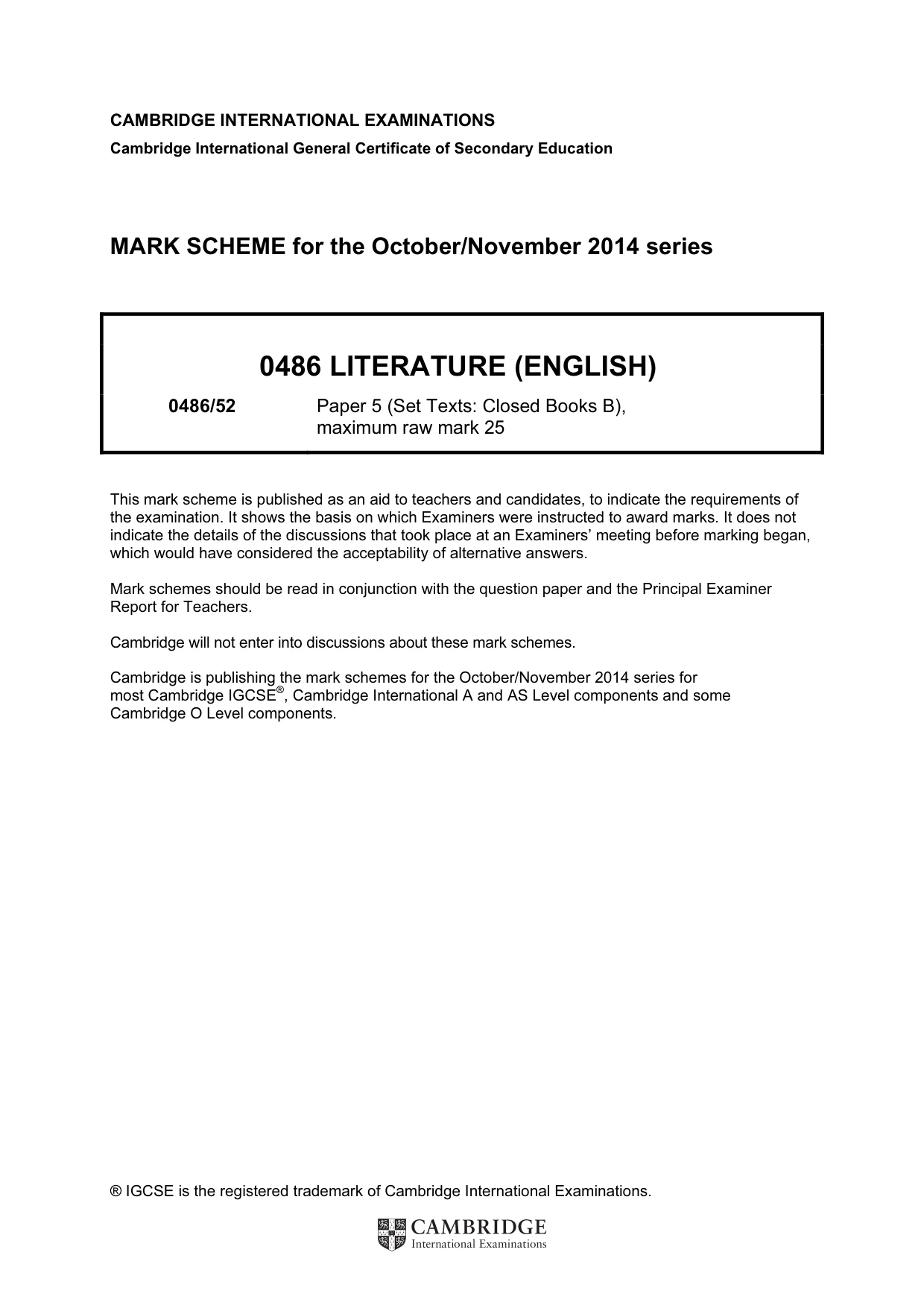
15 0486/52/O/N/14 © UCLES 2014 Brick: Yes, sir, yes, I know. [From Act 2] In what ways does Williams make this such a dramatic and significant moment in the play? Or 20 How does Williams strikingly portray Maggie’s feelings on two different occasions in the play? Or 21 You are Mae, as the birthday party for Big Daddy is about to begin. Write your thoughts. Content removed due to copyright restrictions.
Question paper, page 16
16 0486/52/O/N/14 © UCLES 2014 BLANK PAGE Copyright Acknowledgements: Question 4 © Carol Ann Duffy; Prayer, in Selected Poems; Penguin Books Ltd; 1994. Question 7 © Helen Dunmore; The Siege; Penguin Books Ltd; 2002. Question 10 © Seamus Heaney; Follower, in ed. Jo Phillips; Poems Deep and Dangerous; Cambridge University Press; 1995. Question 19 © Cat on a Hot Tin Roof by Tennessee Williams. Copyright © 1954, 1955, by The University of the South, renewed 1982, 1983 The University of the South. Reprinted by permission of New Directions Publishing Corp and Georges Borchardt, Inc. for the Estate of Tennessee Williams. Permission to reproduce items where third-party owned material protected by copyright is included has been sought and cleared where possible. Every reasonable effort has been made by the publisher (UCLES) to trace copyright holders, but if any items requiring clearance have unwittingly been included, the publisher will be pleased to make amends at the earliest possible opportunity. Cambridge International Examinations is part of the Cambridge Assessment Group. Cambridge Assessment is the brand name of University of Cambridge Local Examinations Syndicate (UCLES), which is itself a department of the University of Cambridge.
Mark scheme, page 1
® IGCSE is the registered trademark of Cambridge International Examinations. CAMBRIDGE INTERNATIONAL EXAMINATIONS Cambridge International General Certificate of Secondary Education MARK SCHEME for the October/November 2014 series 0486 LITERATURE (ENGLISH) 0486/52 Paper 5 (Set Texts: Closed Books B), maximum raw mark 25 This mark scheme is published as an aid to teachers and candidates, to indicate the requirements of the examination. It shows the basis on which Examiners were instructed to award marks. It does not indicate the details of the discussions that took place at an Examiners’ meeting before marking began, which would have considered the acceptability of alternative answers. Mark schemes should be read in conjunction with the question paper and the Principal Examiner Report for Teachers. Cambridge will not enter into discussions about these mark schemes. Cambridge is publishing the mark schemes for the October/November 2014 series for most Cambridge IGCSE®, Cambridge International A and AS Level components and some Cambridge O Level components.
Mark scheme, page 2
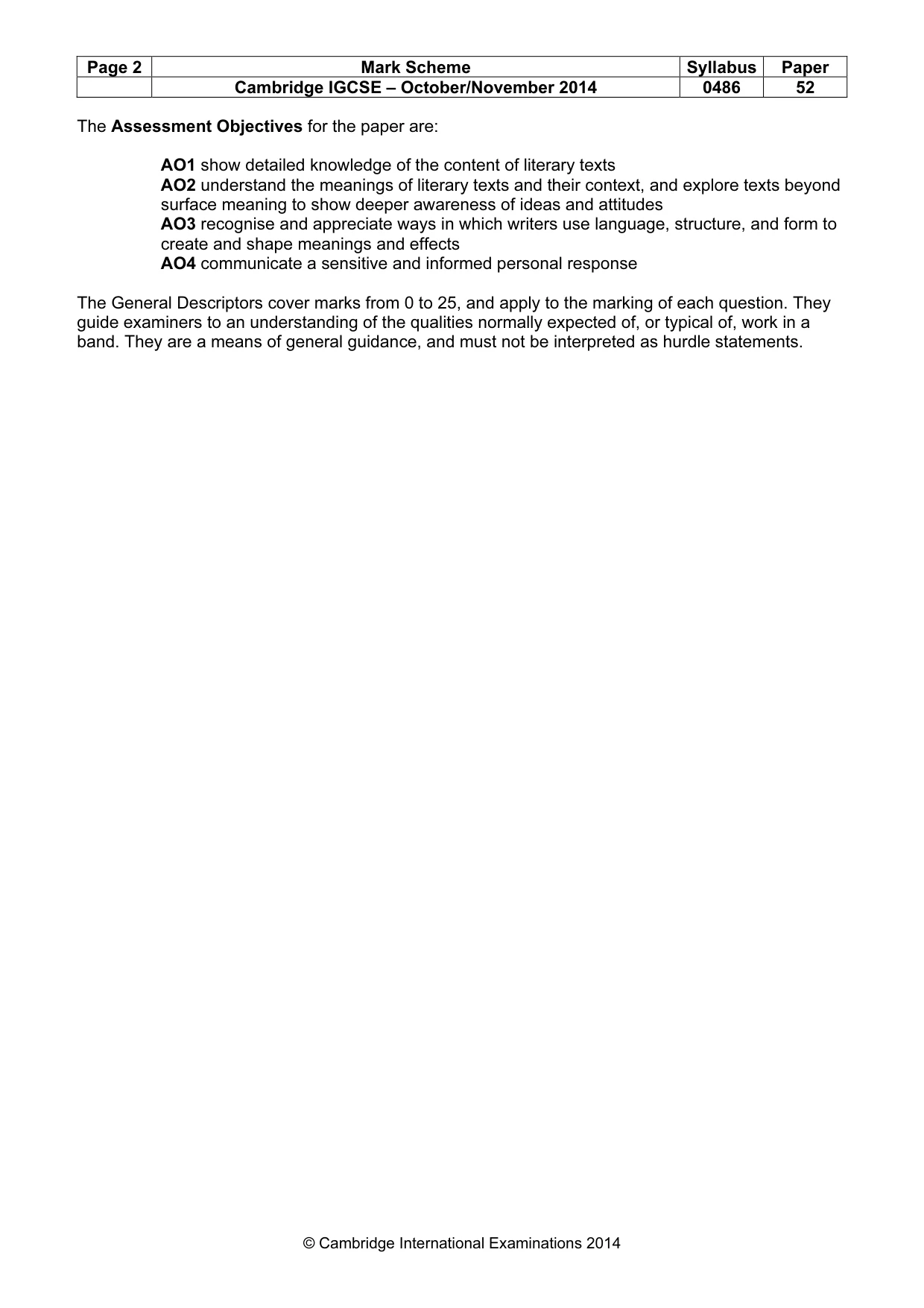
Page 2 Mark Scheme Syllabus Paper Cambridge IGCSE – October/November 2014 0486 52 © Cambridge International Examinations 2014 The Assessment Objectives for the paper are: AO1 show detailed knowledge of the content of literary texts AO2 understand the meanings of literary texts and their context, and explore texts beyond surface meaning to show deeper awareness of ideas and attitudes AO3 recognise and appreciate ways in which writers use language, structure, and form to create and shape meanings and effects AO4 communicate a sensitive and informed personal response The General Descriptors cover marks from 0 to 25, and apply to the marking of each question. They guide examiners to an understanding of the qualities normally expected of, or typical of, work in a band. They are a means of general guidance, and must not be interpreted as hurdle statements.
Mark scheme, page 3
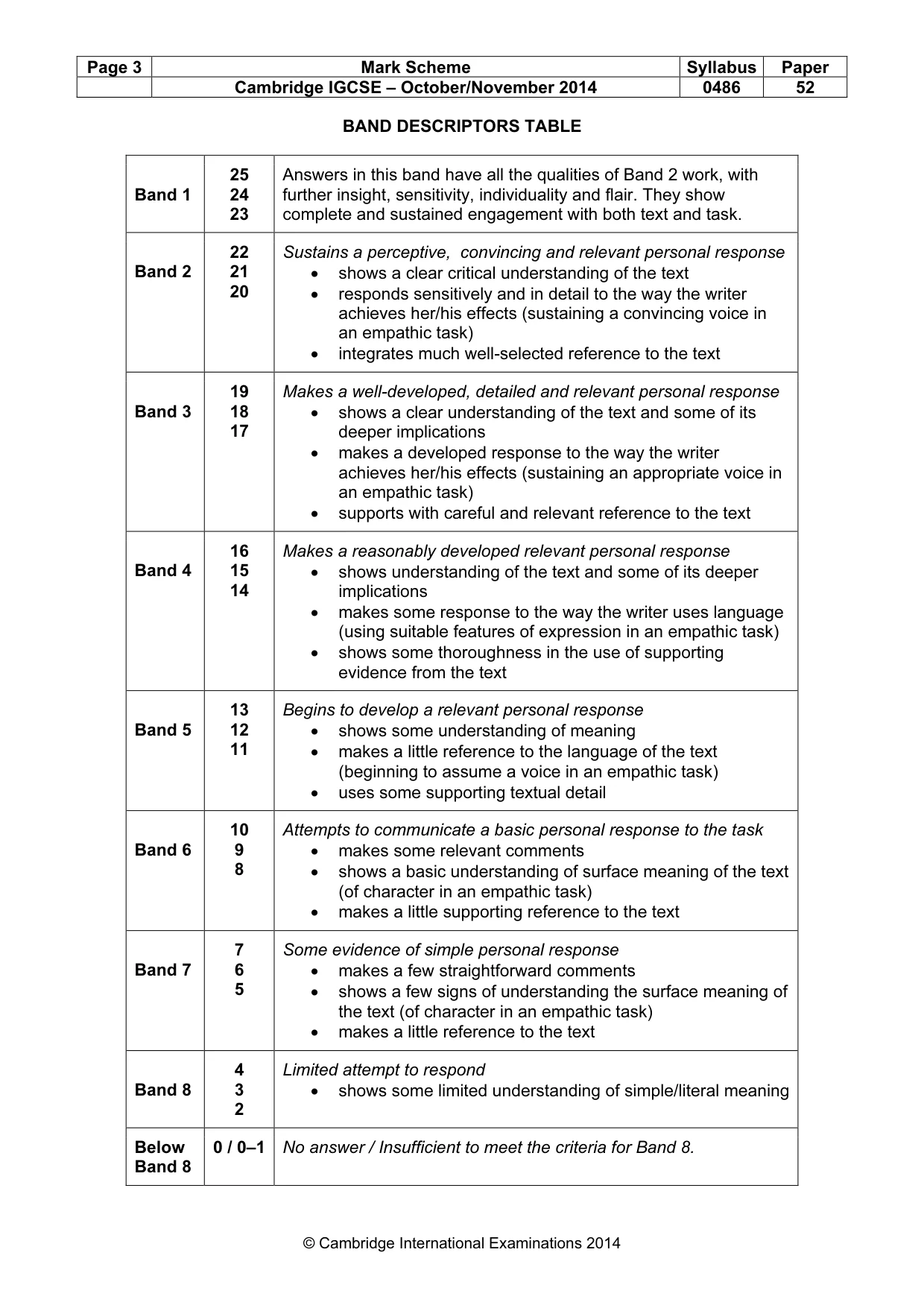
Page 3 Mark Scheme Syllabus Paper Cambridge IGCSE – October/November 2014 0486 52 © Cambridge International Examinations 2014 BAND DESCRIPTORS TABLE Band 1 25 24 23 Answers in this band have all the qualities of Band 2 work, with further insight, sensitivity, individuality and flair. They show complete and sustained engagement with both text and task. Band 2 22 21 20 Sustains a perceptive, convincing and relevant personal response • shows a clear critical understanding of the text • responds sensitively and in detail to the way the writer achieves her/his effects (sustaining a convincing voice in an empathic task) • integrates much well-selected reference to the text Band 3 19 18 17 Makes a well-developed, detailed and relevant personal response • shows a clear understanding of the text and some of its deeper implications • makes a developed response to the way the writer achieves her/his effects (sustaining an appropriate voice in an empathic task) • supports with careful and relevant reference to the text Band 4 16 15 14 Makes a reasonably developed relevant personal response • shows understanding of the text and some of its deeper implications • makes some response to the way the writer uses language (using suitable features of expression in an empathic task) • shows some thoroughness in the use of supporting evidence from the text Band 5 13 12 11 Begins to develop a relevant personal response • shows some understanding of meaning • makes a little reference to the language of the text (beginning to assume a voice in an empathic task) • uses some supporting textual detail Band 6 10 9 8 Attempts to communicate a basic personal response to the task • makes some relevant comments • shows a basic understanding of surface meaning of the text (of character in an empathic task) • makes a little supporting reference to the text Band 7 7 6 5 Some evidence of simple personal response • makes a few straightforward comments • shows a few signs of understanding the surface meaning of the text (of character in an empathic task) • makes a little reference to the text Band 8 4 3 2 Limited attempt to respond • shows some limited understanding of simple/literal meaning Below Band 8 0 / 0–1 No answer / Insufficient to meet the criteria for Band 8.
What you needed in this session
Cambridge’s own grade thresholds for 2014 Oct/Nov, Paper 5 · Variant 2. A higher threshold means an easier paper — the bar moves with how the cohort did.