Cambridge IGCSE English - Literature 0486 — 2011 May/June Paper 5 · Variant 2
0486/52/M/J/11 · 25 marks · ≈28 min
The question paper and its mark scheme, free to read here and free to download. This is Cambridge’s own paper, exactly as it was sat.
Question paper16 pages

Mark scheme3 pages
Answers below. Sit the paper first if you are practising.
Paper as text
Question paper, page 1
This document consists of 13 printed pages and 3 blank pages. DC (CB (NB)) 30924/2 © UCLES 2011 [Turn over UNIVERSITY OF CAMBRIDGE INTERNATIONAL EXAMINATIONS International General Certificate of Secondary Education * 7 0 7 4 4 3 8 1 0 5 * LITERATURE (ENGLISH) 0486/52 Paper 5 May/June 2011 45 minutes Additional Materials: Answer Booklet/Paper READ THESE INSTRUCTIONS FIRST If you have been given an Answer Booklet, follow the instructions on the front cover of the Booklet. Write your Centre number, candidate number and name on all the work you hand in. Write in dark blue or black pen. Do not use staples, paper clips, highlighters, glue or correction fluid. Answer one question. At the end of the examination, fasten all your work securely together. All questions in this paper carry equal marks. www.XtremePapers.com
Question paper, page 2
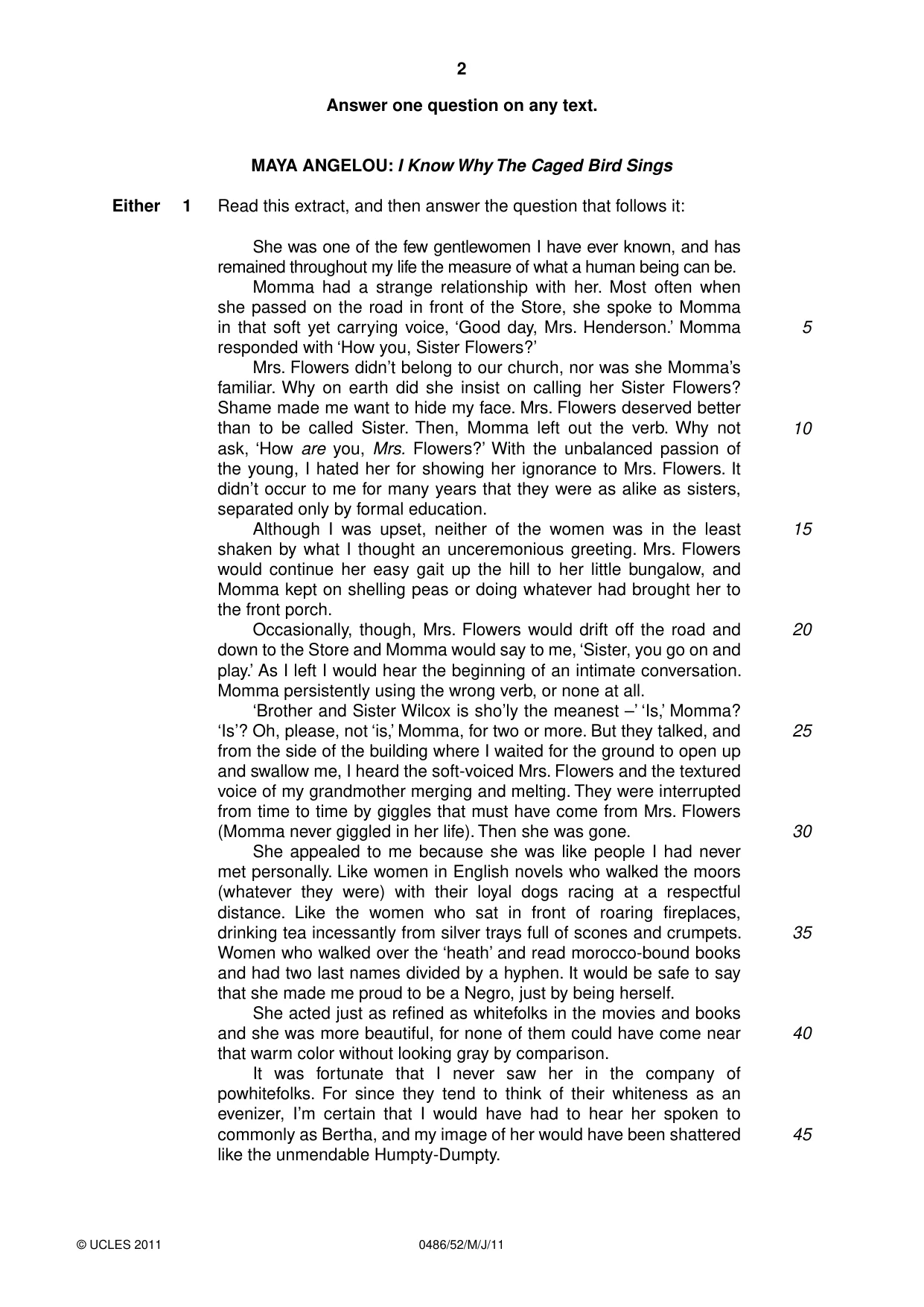
2 0486/52/M/J/11 © UCLES 2011 Answer one question on any text. MAYA ANGELOU: I Know Why The Caged Bird Sings Either 1 Read this extract, and then answer the question that follows it: She was one of the few gentlewomen I have ever known, and has remained throughout my life the measure of what a human being can be. Momma had a strange relationship with her. Most often when she passed on the road in front of the Store, she spoke to Momma in that soft yet carrying voice, ‘Good day, Mrs. Henderson.’ Momma responded with ‘How you, Sister Flowers?’ Mrs. Flowers didn’t belong to our church, nor was she Momma’s familiar. Why on earth did she insist on calling her Sister Flowers? Shame made me want to hide my face. Mrs. Flowers deserved better than to be called Sister. Then, Momma left out the verb. Why not ask, ‘How are you, Mrs. Flowers?’ With the unbalanced passion of the young, I hated her for showing her ignorance to Mrs. Flowers. It didn’t occur to me for many years that they were as alike as sisters, separated only by formal education. Although I was upset, neither of the women was in the least shaken by what I thought an unceremonious greeting. Mrs. Flowers would continue her easy gait up the hill to her little bungalow, and Momma kept on shelling peas or doing whatever had brought her to the front porch. Occasionally, though, Mrs. Flowers would drift off the road and down to the Store and Momma would say to me, ‘Sister, you go on and play.’ As I left I would hear the beginning of an intimate conversation. Momma persistently using the wrong verb, or none at all. ‘Brother and Sister Wilcox is sho’ly the meanest –’ ‘Is,’ Momma? ‘Is’? Oh, please, not ‘is,’ Momma, for two or more. But they talked, and from the side of the building where I waited for the ground to open up and swallow me, I heard the soft-voiced Mrs. Flowers and the textured voice of my grandmother merging and melting. They were interrupted from time to time by giggles that must have come from Mrs. Flowers (Momma never giggled in her life). Then she was gone. She appealed to me because she was like people I had never met personally. Like women in English novels who walked the moors (whatever they were) with their loyal dogs racing at a respectful distance. Like the women who sat in front of roaring fireplaces, drinking tea incessantly from silver trays full of scones and crumpets. Women who walked over the ‘heath’ and read morocco-bound books and had two last names divided by a hyphen. It would be safe to say that she made me proud to be a Negro, just by being herself. She acted just as refined as whitefolks in the movies and books and she was more beautiful, for none of them could have come near that warm color without looking gray by comparison. It was fortunate that I never saw her in the company of powhitefolks. For since they tend to think of their whiteness as an evenizer, I’m certain that I would have had to hear her spoken to commonly as Bertha, and my image of her would have been shattered like the unmendable Humpty-Dumpty. 5 10 15 20 25 30 35 40 45
Question paper, page 3
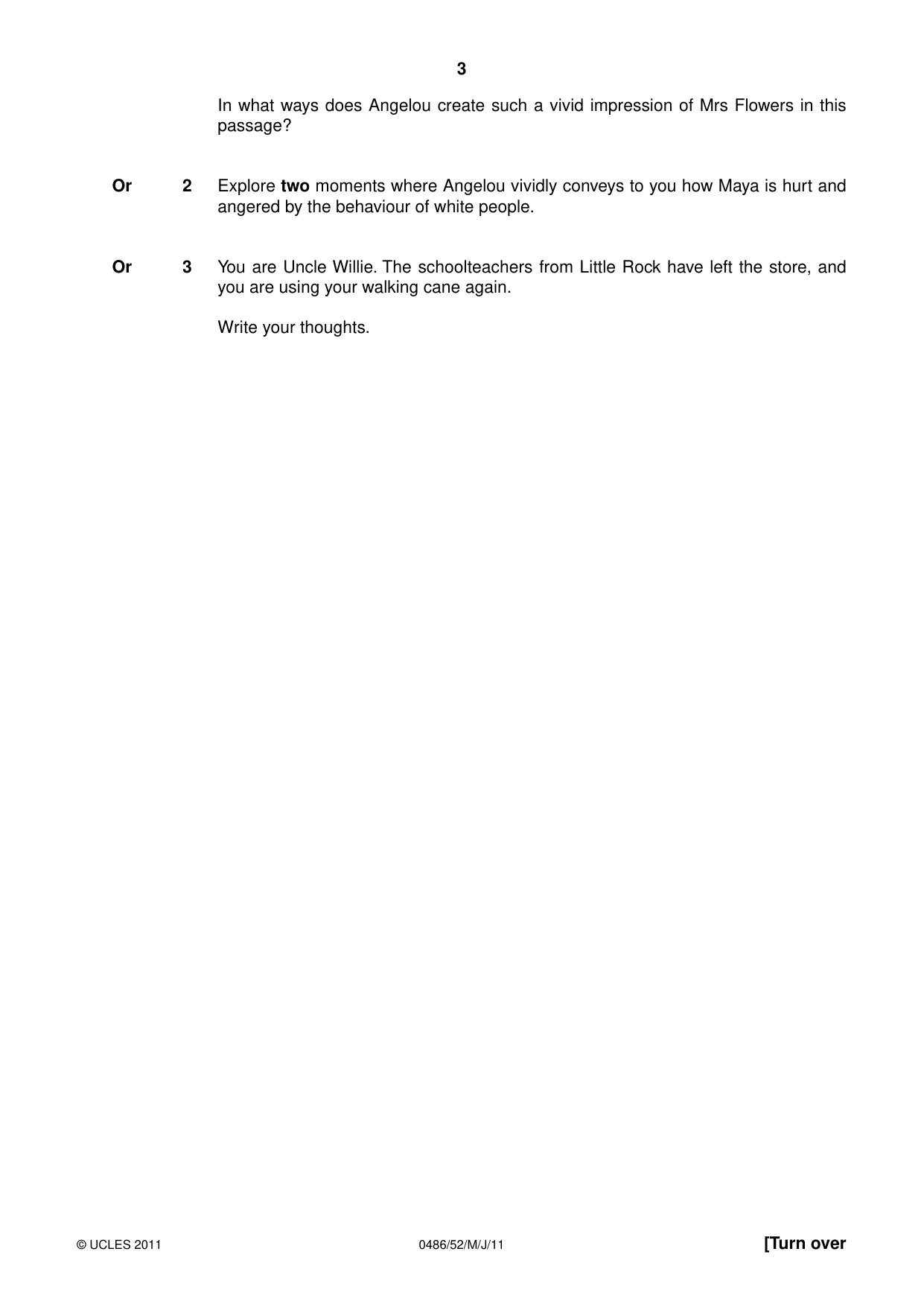
3 0486/52/M/J/11 © UCLES 2011 [Turn over In what ways does Angelou create such a vivid impression of Mrs Flowers in this passage? Or 2 Explore two moments where Angelou vividly conveys to you how Maya is hurt and angered by the behaviour of white people. Or 3 You are Uncle Willie. The schoolteachers from Little Rock have left the store, and you are using your walking cane again. Write your thoughts.
Question paper, page 4
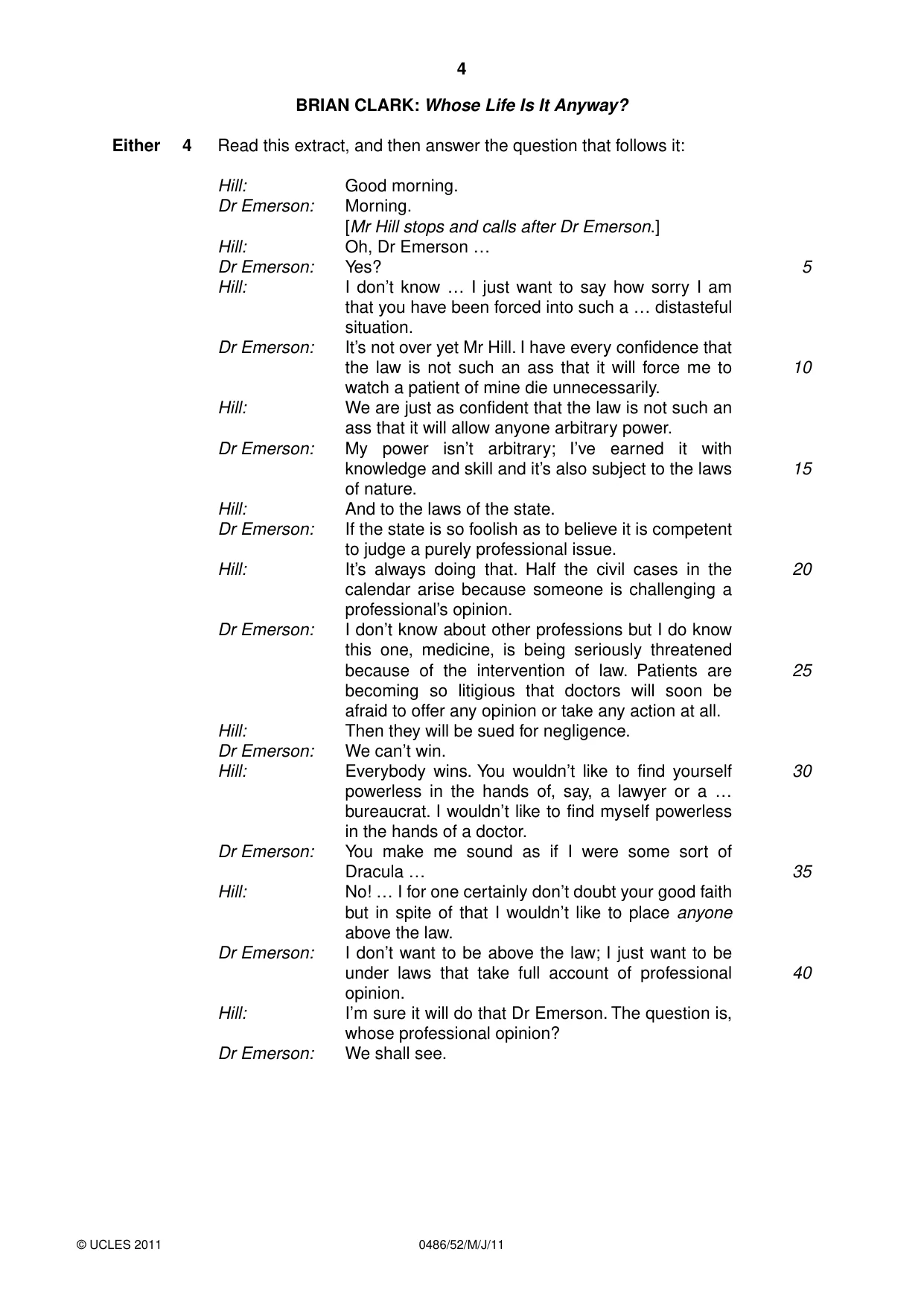
4 0486/52/M/J/11 © UCLES 2011 BRIAN CLARK: Whose Life Is It Anyway? Either 4 Read this extract, and then answer the question that follows it: Hill: Good morning. Dr Emerson: Morning. [Mr Hill stops and calls after Dr Emerson.] Hill: Oh, Dr Emerson … Dr Emerson: Yes? Hill: I don’t know … I just want to say how sorry I am that you have been forced into such a … distasteful situation. Dr Emerson: It’s not over yet Mr Hill. I have every confidence that the law is not such an ass that it will force me to watch a patient of mine die unnecessarily. Hill: We are just as confident that the law is not such an ass that it will allow anyone arbitrary power. Dr Emerson: My power isn’t arbitrary; I’ve earned it with knowledge and skill and it’s also subject to the laws of nature. Hill: And to the laws of the state. Dr Emerson: If the state is so foolish as to believe it is competent to judge a purely professional issue. Hill: It’s always doing that. Half the civil cases in the calendar arise because someone is challenging a professional’s opinion. Dr Emerson: I don’t know about other professions but I do know this one, medicine, is being seriously threatened because of the intervention of law. Patients are becoming so litigious that doctors will soon be afraid to offer any opinion or take any action at all. Hill: Then they will be sued for negligence. Dr Emerson: We can’t win. Hill: Everybody wins. You wouldn’t like to find yourself powerless in the hands of, say, a lawyer or a … bureaucrat. I wouldn’t like to find myself powerless in the hands of a doctor. Dr Emerson: You make me sound as if I were some sort of Dracula … Hill: No! … I for one certainly don’t doubt your good faith but in spite of that I wouldn’t like to place anyone above the law. Dr Emerson: I don’t want to be above the law; I just want to be under laws that take full account of professional opinion. Hill: I’m sure it will do that Dr Emerson. The question is, whose professional opinion? Dr Emerson: We shall see. 5 10 15 20 25 30 35 40
Question paper, page 5
5 0486/52/M/J/11 © UCLES 2011 [Turn over In what ways does Clark create tension and suspense for you here? Or 5 How do you think Clark makes Ken Harrison such a vividly dramatic character? Support your ideas with details from the play. Or 6 You are Dr Scott in the hospital after your meal with Philip Hill. Ken has just told you he will continue his fight to die. Write your thoughts.
Question paper, page 6
6 0486/52/M/J/11 © UCLES 2011 SEAMUS HEANEY: from Death of a Naturalist Either 7 Read this poem, and then answer the question that follows it: content removed due to copyright restrictions. Follower Explore the ways in which Heaney memorably communicates his feelings about his father in Follower. Or 8 How does Heaney strikingly convey a child’s fears in The Barn and Death of a Naturalist? Or 9 How does Heaney use the sounds of words to powerful effect in two of the poems you have studied? Do not use ‘Follower ’ in answering this question. 10 15 20
Question paper, page 7
7 0486/52/M/J/11 © UCLES 2011 [Turn over BLANK PAGE Turn to page 8 for Question 10.
Question paper, page 8
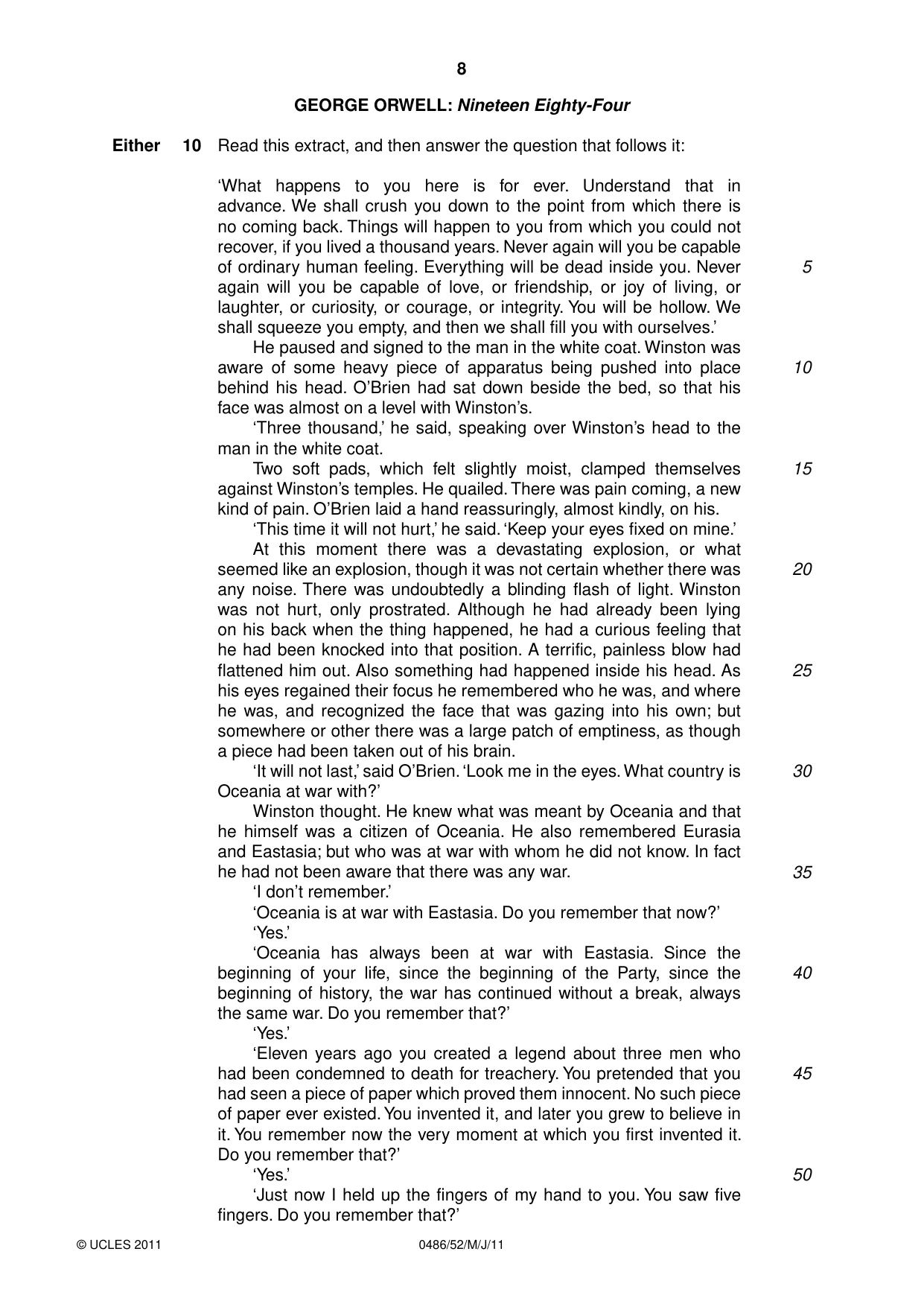
8 0486/52/M/J/11 © UCLES 2011 GEORGE ORWELL: Nineteen Eighty-Four Either 10 Read this extract, and then answer the question that follows it: ‘What happens to you here is for ever. Understand that in advance. We shall crush you down to the point from which there is no coming back. Things will happen to you from which you could not recover, if you lived a thousand years. Never again will you be capable of ordinary human feeling. Everything will be dead inside you. Never again will you be capable of love, or friendship, or joy of living, or laughter, or curiosity, or courage, or integrity. You will be hollow. We shall squeeze you empty, and then we shall fill you with ourselves.’ He paused and signed to the man in the white coat. Winston was aware of some heavy piece of apparatus being pushed into place behind his head. O’Brien had sat down beside the bed, so that his face was almost on a level with Winston’s. ‘Three thousand,’ he said, speaking over Winston’s head to the man in the white coat. Two soft pads, which felt slightly moist, clamped themselves against Winston’s temples. He quailed. There was pain coming, a new kind of pain. O’Brien laid a hand reassuringly, almost kindly, on his. ‘This time it will not hurt,’ he said. ‘Keep your eyes fixed on mine.’ At this moment there was a devastating explosion, or what seemed like an explosion, though it was not certain whether there was any noise. There was undoubtedly a blinding flash of light. Winston was not hurt, only prostrated. Although he had already been lying on his back when the thing happened, he had a curious feeling that he had been knocked into that position. A terrific, painless blow had flattened him out. Also something had happened inside his head. As his eyes regained their focus he remembered who he was, and where he was, and recognized the face that was gazing into his own; but somewhere or other there was a large patch of emptiness, as though a piece had been taken out of his brain. ‘It will not last,’ said O’Brien. ‘Look me in the eyes. What country is Oceania at war with?’ Winston thought. He knew what was meant by Oceania and that he himself was a citizen of Oceania. He also remembered Eurasia and Eastasia; but who was at war with whom he did not know. In fact he had not been aware that there was any war. ‘I don’t remember.’ ‘Oceania is at war with Eastasia. Do you remember that now?’ ‘Yes.’ ‘Oceania has always been at war with Eastasia. Since the beginning of your life, since the beginning of the Party, since the beginning of history, the war has continued without a break, always the same war. Do you remember that?’ ‘Yes.’ ‘Eleven years ago you created a legend about three men who had been condemned to death for treachery. You pretended that you had seen a piece of paper which proved them innocent. No such piece of paper ever existed. You invented it, and later you grew to believe in it. You remember now the very moment at which you first invented it. Do you remember that?’ ‘Yes.’ ‘Just now I held up the fingers of my hand to you. You saw five fingers. Do you remember that?’ 5 10 15 20 25 30 35 40 45 50
Question paper, page 9
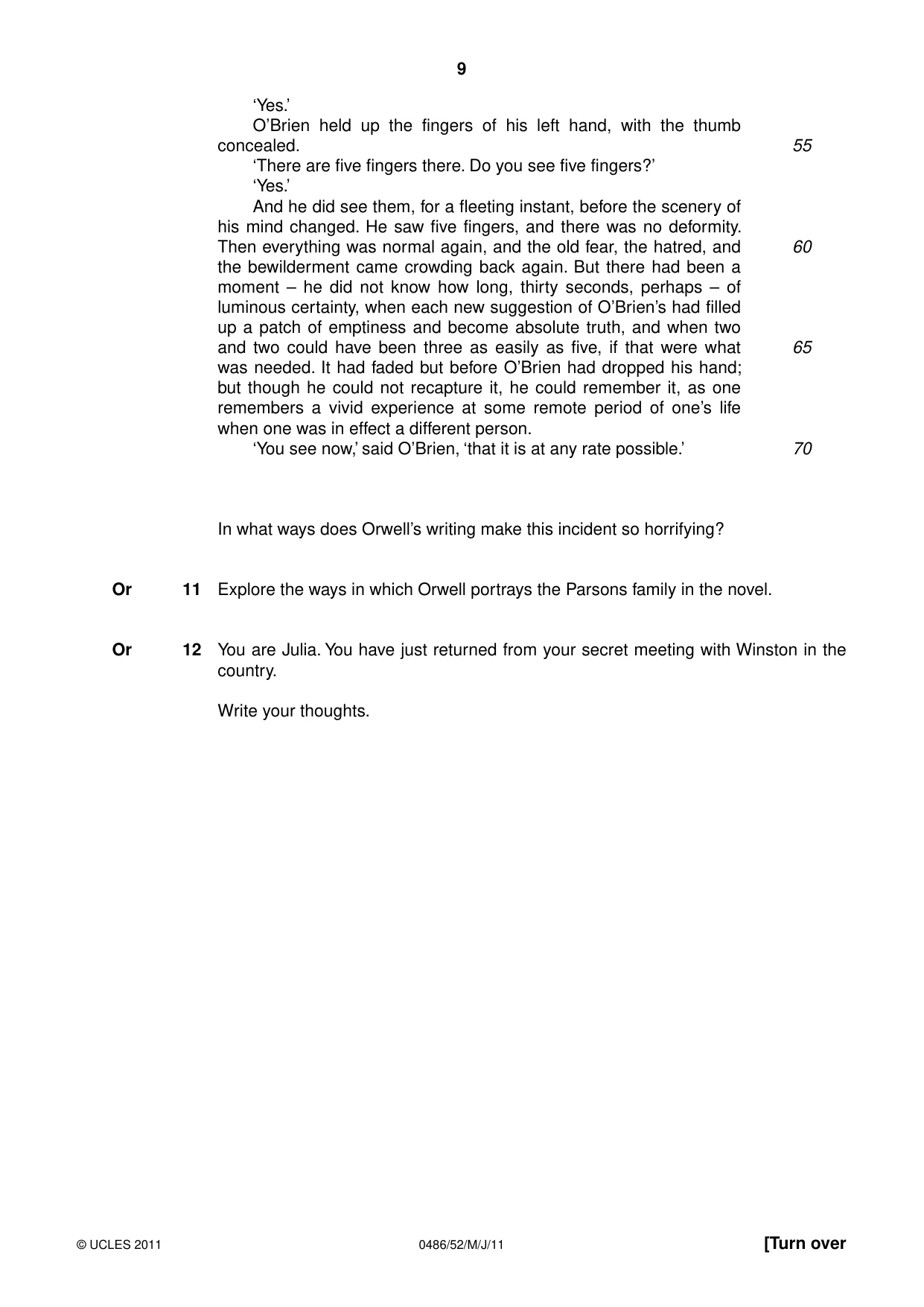
9 0486/52/M/J/11 © UCLES 2011 [Turn over ‘Yes.’ O’Brien held up the fingers of his left hand, with the thumb concealed. ‘There are five fingers there. Do you see five fingers?’ ‘Yes.’ And he did see them, for a fleeting instant, before the scenery of his mind changed. He saw five fingers, and there was no deformity. Then everything was normal again, and the old fear, the hatred, and the bewilderment came crowding back again. But there had been a moment – he did not know how long, thirty seconds, perhaps – of luminous certainty, when each new suggestion of O’Brien’s had filled up a patch of emptiness and become absolute truth, and when two and two could have been three as easily as five, if that were what was needed. It had faded but before O’Brien had dropped his hand; but though he could not recapture it, he could remember it, as one remembers a vivid experience at some remote period of one’s life when one was in effect a different person. ‘You see now,’ said O’Brien, ‘that it is at any rate possible.’ In what ways does Orwell’s writing make this incident so horrifying? Or 11 Explore the ways in which Orwell portrays the Parsons family in the novel. Or 12 You are Julia. You have just returned from your secret meeting with Winston in the country. Write your thoughts. 55 60 65 70
Question paper, page 10
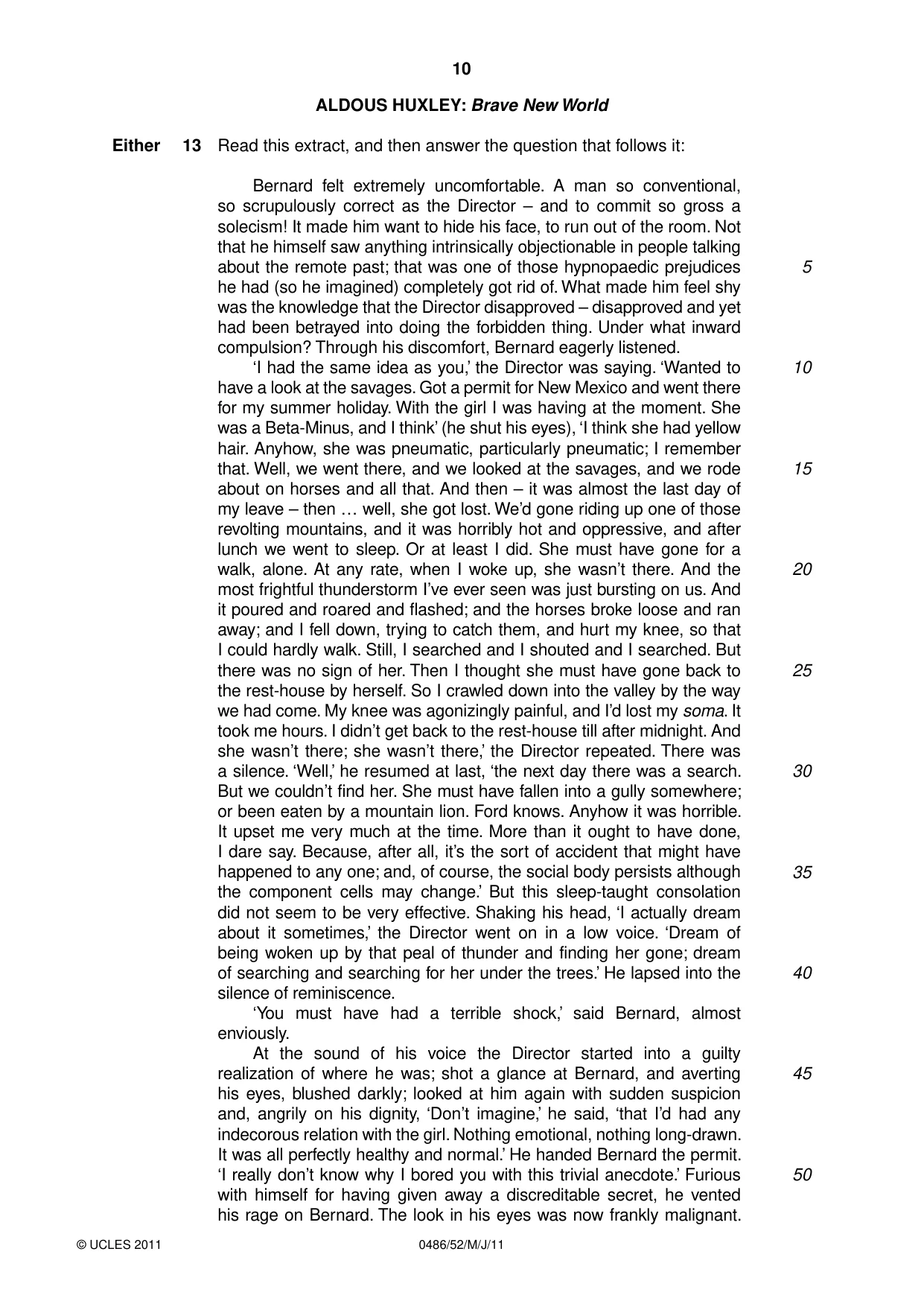
10 0486/52/M/J/11 © UCLES 2011 ALDOUS HUXLEY: Brave New World Either 13 Read this extract, and then answer the question that follows it: Bernard felt extremely uncomfortable. A man so conventional, so scrupulously correct as the Director – and to commit so gross a solecism! It made him want to hide his face, to run out of the room. Not that he himself saw anything intrinsically objectionable in people talking about the remote past; that was one of those hypnopaedic prejudices he had (so he imagined) completely got rid of. What made him feel shy was the knowledge that the Director disapproved – disapproved and yet had been betrayed into doing the forbidden thing. Under what inward compulsion? Through his discomfort, Bernard eagerly listened. ‘I had the same idea as you,’ the Director was saying. ‘Wanted to have a look at the savages. Got a permit for New Mexico and went there for my summer holiday. With the girl I was having at the moment. She was a Beta-Minus, and I think’ (he shut his eyes), ‘I think she had yellow hair. Anyhow, she was pneumatic, particularly pneumatic; I remember that. Well, we went there, and we looked at the savages, and we rode about on horses and all that. And then – it was almost the last day of my leave – then … well, she got lost. We’d gone riding up one of those revolting mountains, and it was horribly hot and oppressive, and after lunch we went to sleep. Or at least I did. She must have gone for a walk, alone. At any rate, when I woke up, she wasn’t there. And the most frightful thunderstorm I’ve ever seen was just bursting on us. And it poured and roared and flashed; and the horses broke loose and ran away; and I fell down, trying to catch them, and hurt my knee, so that I could hardly walk. Still, I searched and I shouted and I searched. But there was no sign of her. Then I thought she must have gone back to the rest-house by herself. So I crawled down into the valley by the way we had come. My knee was agonizingly painful, and I’d lost my soma. It took me hours. I didn’t get back to the rest-house till after midnight. And she wasn’t there; she wasn’t there,’ the Director repeated. There was a silence. ‘Well,’ he resumed at last, ‘the next day there was a search. But we couldn’t find her. She must have fallen into a gully somewhere; or been eaten by a mountain lion. Ford knows. Anyhow it was horrible. It upset me very much at the time. More than it ought to have done, I dare say. Because, after all, it’s the sort of accident that might have happened to any one; and, of course, the social body persists although the component cells may change.’ But this sleep-taught consolation did not seem to be very effective. Shaking his head, ‘I actually dream about it sometimes,’ the Director went on in a low voice. ‘Dream of being woken up by that peal of thunder and finding her gone; dream of searching and searching for her under the trees.’ He lapsed into the silence of reminiscence. ‘You must have had a terrible shock,’ said Bernard, almost enviously. At the sound of his voice the Director started into a guilty realization of where he was; shot a glance at Bernard, and averting his eyes, blushed darkly; looked at him again with sudden suspicion and, angrily on his dignity, ‘Don’t imagine,’ he said, ‘that I’d had any indecorous relation with the girl. Nothing emotional, nothing long-drawn. It was all perfectly healthy and normal.’ He handed Bernard the permit. ‘I really don’t know why I bored you with this trivial anecdote.’ Furious with himself for having given away a discreditable secret, he vented his rage on Bernard. The look in his eyes was now frankly malignant. 5 10 15 20 25 30 35 40 45 50
Question paper, page 11
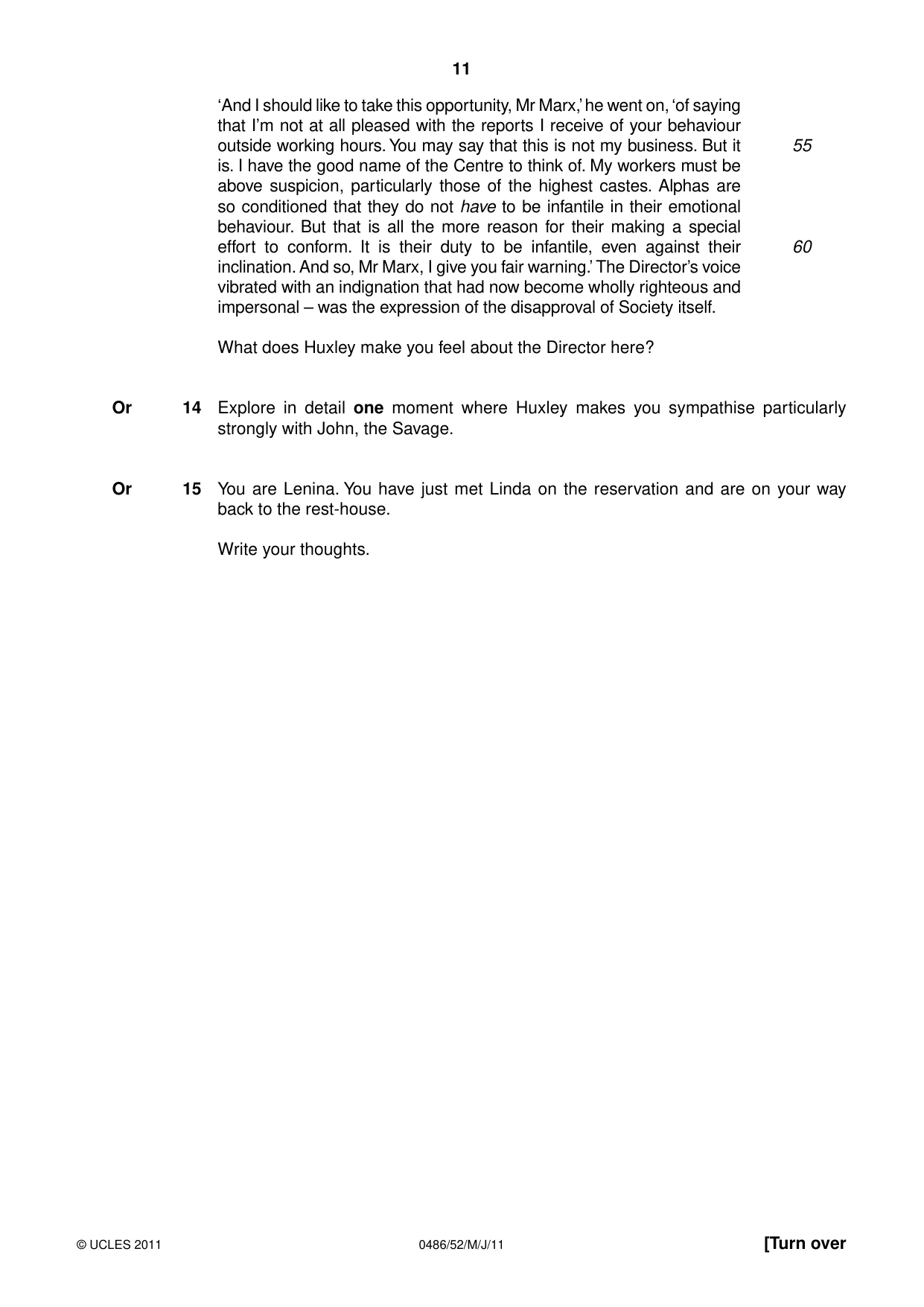
11 0486/52/M/J/11 © UCLES 2011 [Turn over ‘And I should like to take this opportunity, Mr Marx,’ he went on, ‘of saying that I’m not at all pleased with the reports I receive of your behaviour outside working hours. You may say that this is not my business. But it is. I have the good name of the Centre to think of. My workers must be above suspicion, particularly those of the highest castes. Alphas are so conditioned that they do not have to be infantile in their emotional behaviour. But that is all the more reason for their making a special effort to conform. It is their duty to be infantile, even against their inclination. And so, Mr Marx, I give you fair warning.’ The Director’s voice vibrated with an indignation that had now become wholly righteous and impersonal – was the expression of the disapproval of Society itself. What does Huxley make you feel about the Director here? Or 14 Explore in detail one moment where Huxley makes you sympathise particularly strongly with John, the Savage. Or 15 You are Lenina. You have just met Linda on the reservation and are on your way back to the rest-house. Write your thoughts. 55 60
Question paper, page 12
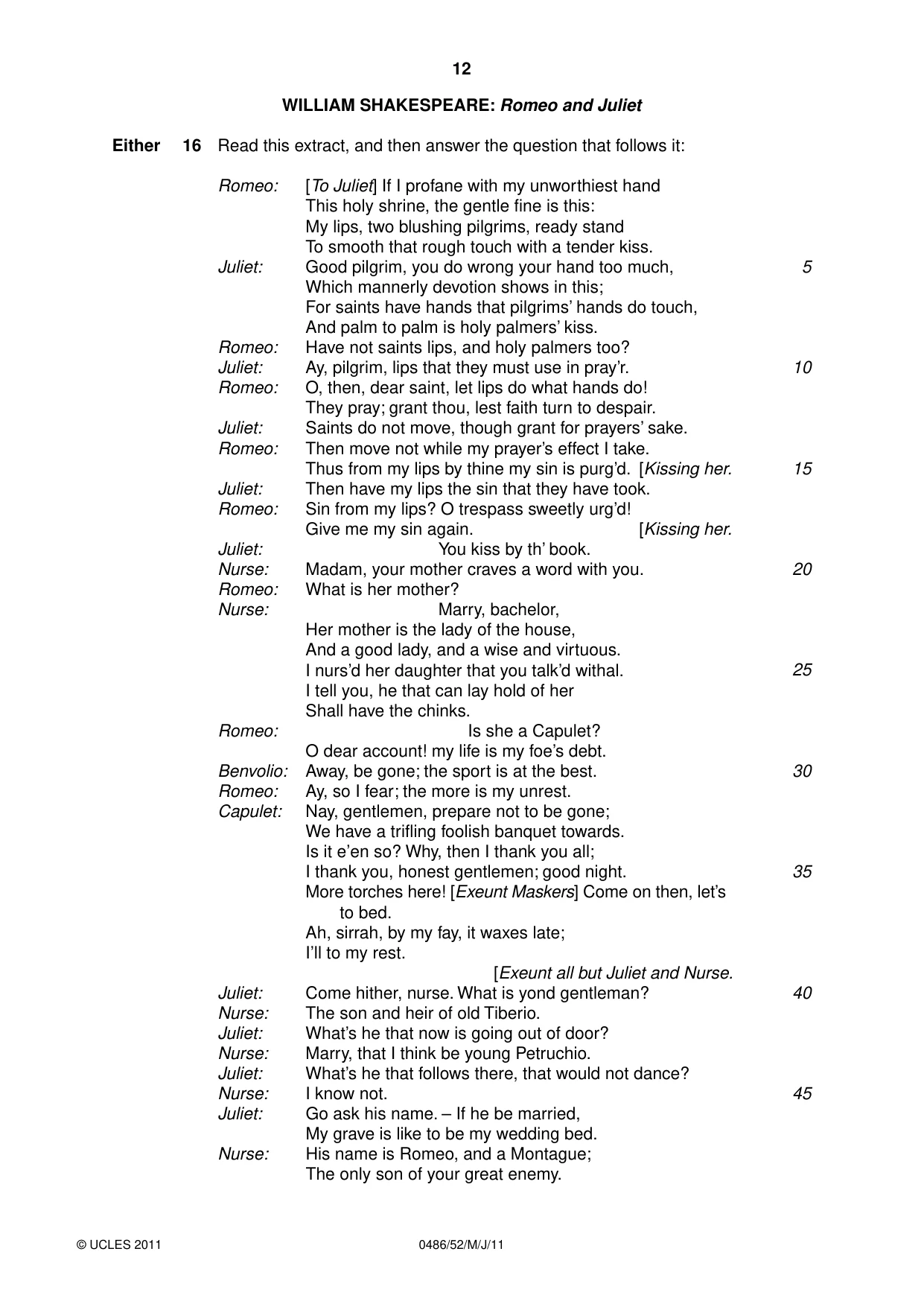
12 0486/52/M/J/11 © UCLES 2011 WILLIAM SHAKESPEARE: Romeo and Juliet Either 16 Read this extract, and then answer the question that follows it: Romeo: [To Juliet] If I profane with my unworthiest hand This holy shrine, the gentle fine is this: My lips, two blushing pilgrims, ready stand To smooth that rough touch with a tender kiss. Juliet: Good pilgrim, you do wrong your hand too much, Which mannerly devotion shows in this; For saints have hands that pilgrims’ hands do touch, And palm to palm is holy palmers’ kiss. Romeo: Have not saints lips, and holy palmers too? Juliet: Ay, pilgrim, lips that they must use in pray’r. Romeo: O, then, dear saint, let lips do what hands do! They pray; grant thou, lest faith turn to despair. Juliet: Saints do not move, though grant for prayers’ sake. Romeo: Then move not while my prayer’s effect I take. Thus from my lips by thine my sin is purg’d. [Kissing her. Juliet: Then have my lips the sin that they have took. Romeo: Sin from my lips? O trespass sweetly urg’d! Give me my sin again. [Kissing her. Juliet: You kiss by th’ book. Nurse: Madam, your mother craves a word with you. Romeo: What is her mother? Nurse: Marry, bachelor, Her mother is the lady of the house, And a good lady, and a wise and virtuous. I nurs’d her daughter that you talk’d withal. I tell you, he that can lay hold of her Shall have the chinks. Romeo: Is she a Capulet? O dear account! my life is my foe’s debt. Benvolio: Away, be gone; the sport is at the best. Romeo: Ay, so I fear; the more is my unrest. Capulet: Nay, gentlemen, prepare not to be gone; We have a trifling foolish banquet towards. Is it e’en so? Why, then I thank you all; I thank you, honest gentlemen; good night. More torches here! [Exeunt Maskers] Come on then, let’s to bed. Ah, sirrah, by my fay, it waxes late; I’ll to my rest. [Exeunt all but Juliet and Nurse. Juliet: Come hither, nurse. What is yond gentleman? Nurse: The son and heir of old Tiberio. Juliet: What’s he that now is going out of door? Nurse: Marry, that I think be young Petruchio. Juliet: What’s he that follows there, that would not dance? Nurse: I know not. Juliet: Go ask his name. – If he be married, My grave is like to be my wedding bed. Nurse: His name is Romeo, and a Montague; The only son of your great enemy. 5 10 15 20 25 30 35 40 45
Question paper, page 13
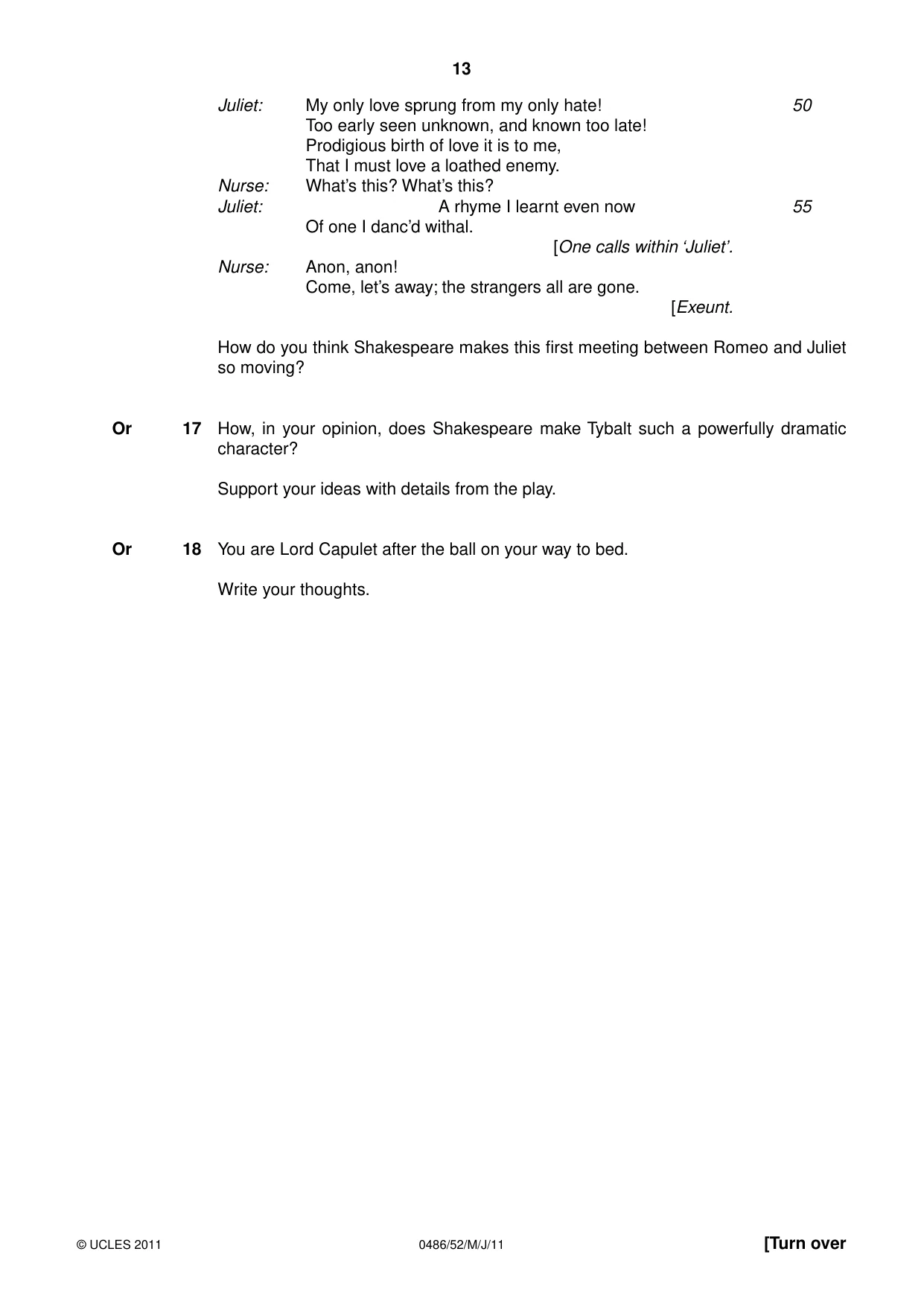
13 0486/52/M/J/11 © UCLES 2011 [Turn over Juliet: My only love sprung from my only hate! Too early seen unknown, and known too late! Prodigious birth of love it is to me, That I must love a loathed enemy. Nurse: What’s this? What’s this? Juliet: A rhyme I learnt even now Of one I danc’d withal. [One calls within ‘Juliet’. Nurse: Anon, anon! Come, let’s away; the strangers all are gone. [Exeunt. How do you think Shakespeare makes this first meeting between Romeo and Juliet so moving? Or 17 How, in your opinion, does Shakespeare make Tybalt such a powerfully dramatic character? Support your ideas with details from the play. Or 18 You are Lord Capulet after the ball on your way to bed. Write your thoughts. 50 55
Question paper, page 14
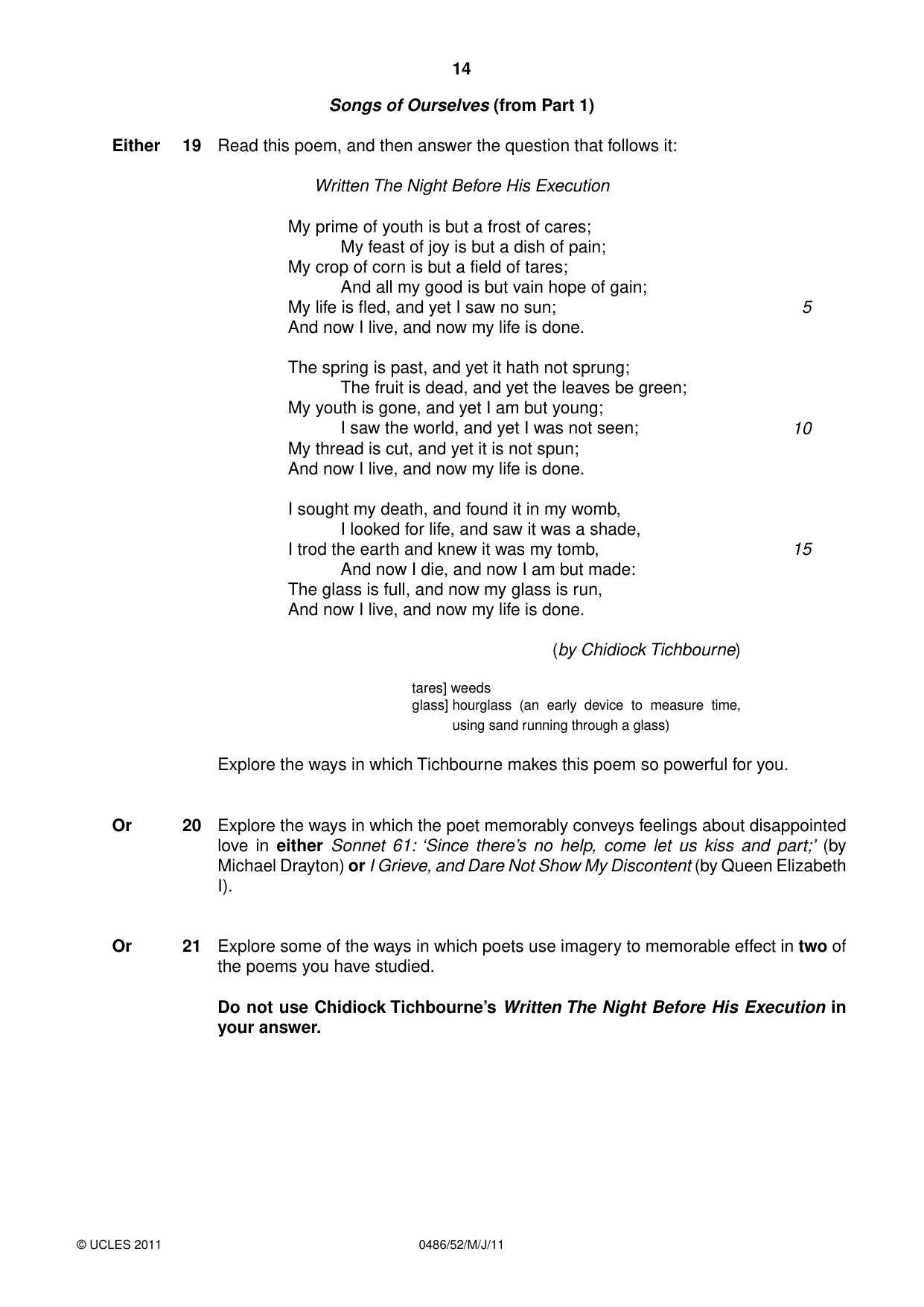
14 0486/52/M/J/11 © UCLES 2011 Songs of Ourselves (from Part 1) Either 19 Read this poem, and then answer the question that follows it: Written The Night Before His Execution My prime of youth is but a frost of cares; My feast of joy is but a dish of pain; My crop of corn is but a field of tares; And all my good is but vain hope of gain; My life is fled, and yet I saw no sun; And now I live, and now my life is done. The spring is past, and yet it hath not sprung; The fruit is dead, and yet the leaves be green; My youth is gone, and yet I am but young; I saw the world, and yet I was not seen; My thread is cut, and yet it is not spun; And now I live, and now my life is done. I sought my death, and found it in my womb, I looked for life, and saw it was a shade, I trod the earth and knew it was my tomb, And now I die, and now I am but made: The glass is full, and now my glass is run, And now I live, and now my life is done. (by Chidiock Tichbourne) tares] weeds glass] hourglass (an early device to measure time, using sand running through a glass) Explore the ways in which Tichbourne makes this poem so powerful for you. Or 20 Explore the ways in which the poet memorably conveys feelings about disappointed love in either Sonnet 61: ‘Since there’s no help, come let us kiss and part;’ (by Michael Drayton) or I Grieve, and Dare Not Show My Discontent (by Queen Elizabeth I). Or 21 Explore some of the ways in which poets use imagery to memorable effect in two of the poems you have studied. Do not use Chidiock Tichbourne’s Written The Night Before His Execution in your answer. 5 10 15
Question paper, page 15
15 0486/52/M/J/11 © UCLES 2011 BLANK PAGE
Question paper, page 16
16 0486/52/M/J/11 © UCLES 2011 Copyright Acknowledgements: Question 1 © Maya Angelou; I Know Why The Caged Bird Sings; Virago Press; 1984. Question 4 © Brian Clarke; Whose Life is it Anyway; Amberlane Press; 1978. Question 7 © Seamus Heaney; Death of a Naturalist; Faber & Faber; 1966. Question 10 © George Orwell; Nineteen Eighty-Four; Penguin; 1949. Question 13 © Aldous Huxley; Brave New World; Penguin; 1932. Permission to reproduce items where third-party owned material protected by copyright is included has been sought and cleared where possible. Every reasonable effort has been made by the publisher (UCLES) to trace copyright holders, but if any items requiring clearance have unwittingly been included, the publisher will be pleased to make amends at the earliest possible opportunity. University of Cambridge International Examinations is part of the Cambridge Assessment Group. Cambridge Assessment is the brand name of University of Cambridge Local Examinations Syndicate (UCLES), which is itself a department of the University of Cambridge. BLANK PAGE
Mark scheme, page 1
UNIVERSITY OF CAMBRIDGE INTERNATIONAL EXAMINATIONS International General Certificate of Secondary Education MARK SCHEME for the May/June 2011 question paper for the guidance of teachers 0486 LITERATURE (ENGLISH) 0486/52 Paper 5, maximum raw mark 25 This mark scheme is published as an aid to teachers and candidates, to indicate the requirements of the examination. It shows the basis on which Examiners were instructed to award marks. It does not indicate the details of the discussions that took place at an Examiners’ meeting before marking began, which would have considered the acceptability of alternative answers. Mark schemes must be read in conjunction with the question papers and the report on the examination. • Cambridge will not enter into discussions or correspondence in connection with these mark schemes. Cambridge is publishing the mark schemes for the May/June 2011 question papers for most IGCSE, GCE Advanced Level and Advanced Subsidiary Level syllabuses and some Ordinary Level syllabuses. www.XtremePapers.com
Mark scheme, page 2
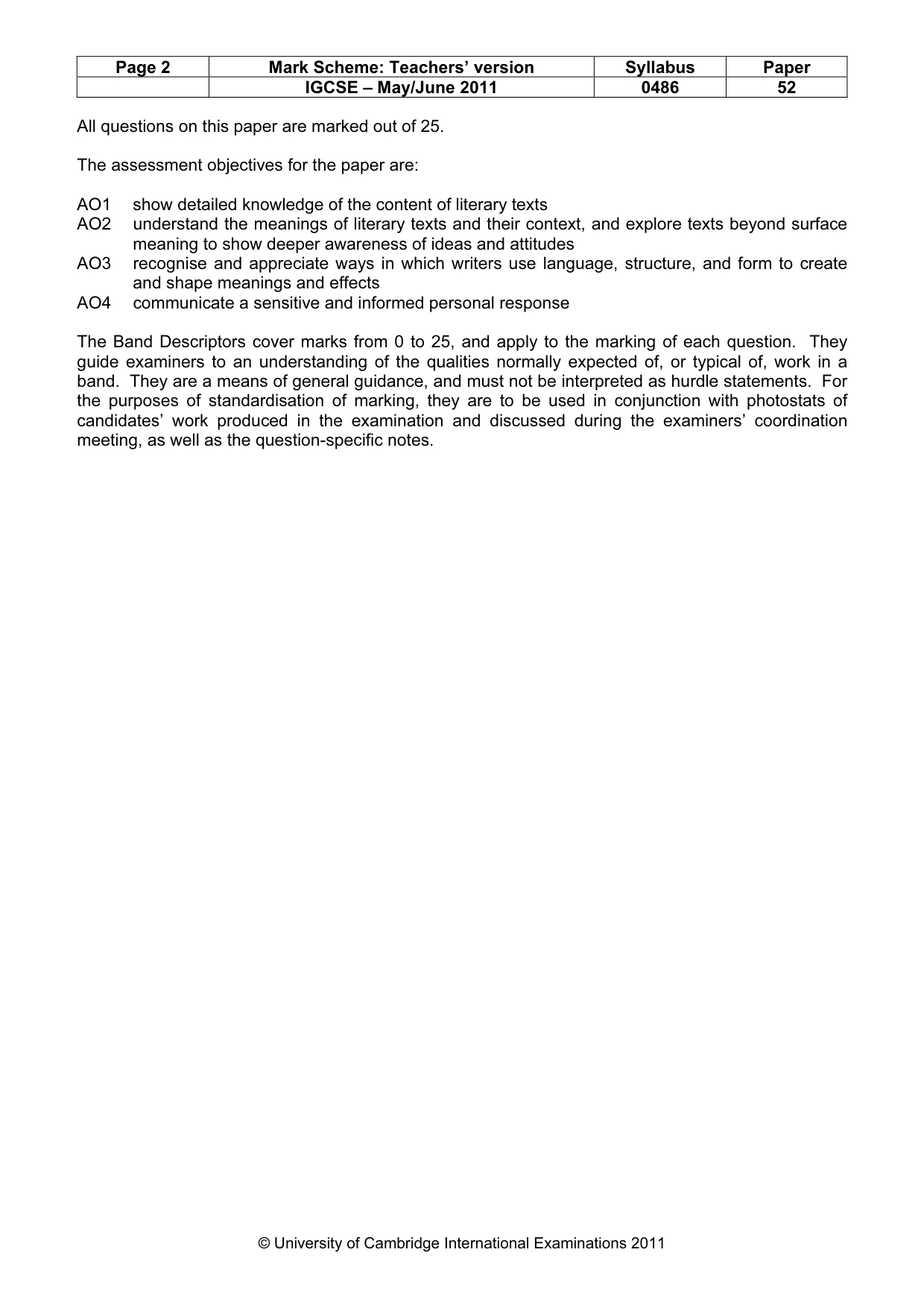
Page 2 Mark Scheme: Teachers’ version Syllabus Paper IGCSE – May/June 2011 0486 52 © University of Cambridge International Examinations 2011 All questions on this paper are marked out of 25. The assessment objectives for the paper are: AO1 show detailed knowledge of the content of literary texts AO2 understand the meanings of literary texts and their context, and explore texts beyond surface meaning to show deeper awareness of ideas and attitudes AO3 recognise and appreciate ways in which writers use language, structure, and form to create and shape meanings and effects AO4 communicate a sensitive and informed personal response The Band Descriptors cover marks from 0 to 25, and apply to the marking of each question. They guide examiners to an understanding of the qualities normally expected of, or typical of, work in a band. They are a means of general guidance, and must not be interpreted as hurdle statements. For the purposes of standardisation of marking, they are to be used in conjunction with photostats of candidates’ work produced in the examination and discussed during the examiners’ coordination meeting, as well as the question-specific notes.
Mark scheme, page 3
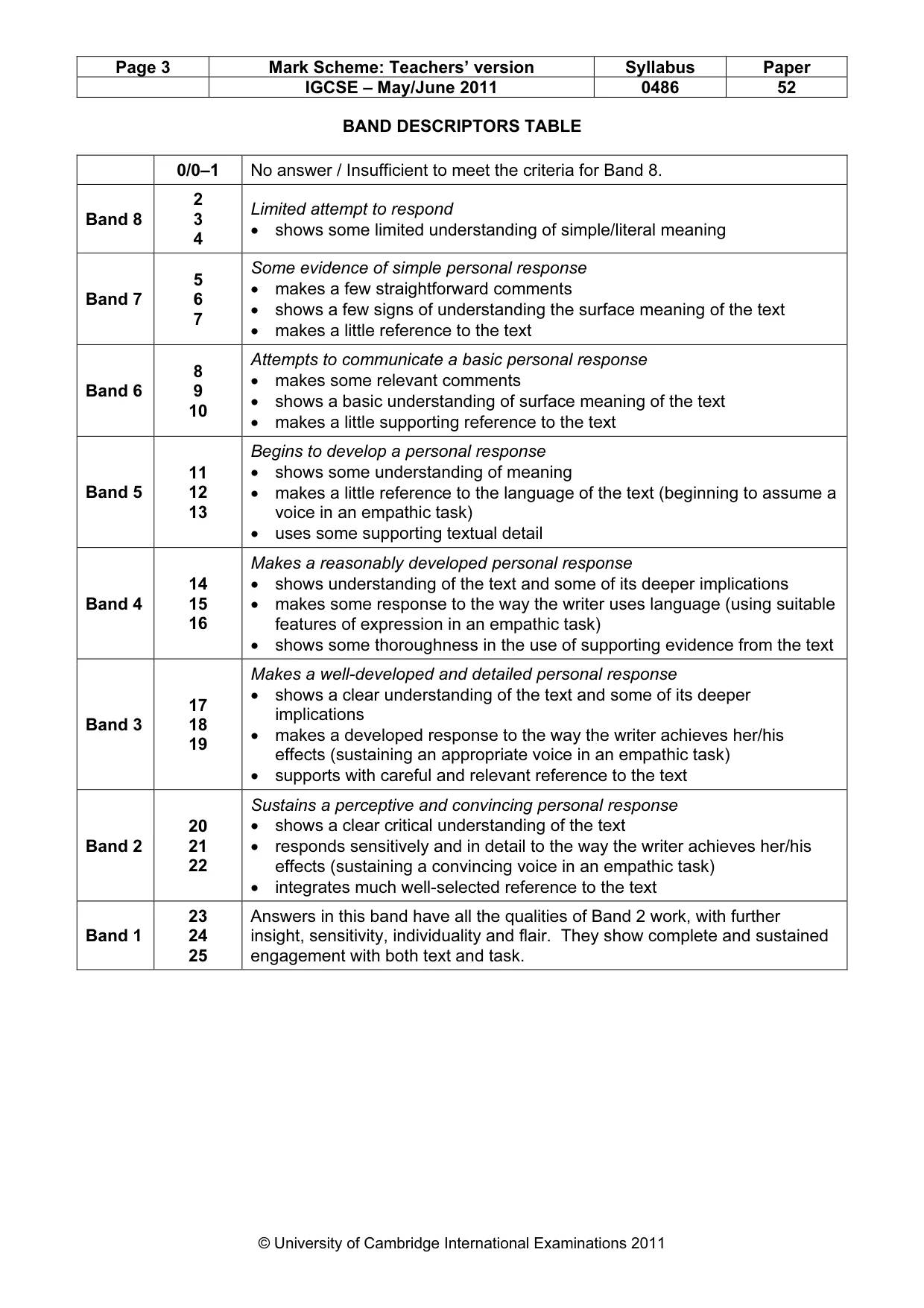
Page 3 Mark Scheme: Teachers’ version Syllabus Paper IGCSE – May/June 2011 0486 52 © University of Cambridge International Examinations 2011 BAND DESCRIPTORS TABLE 0/0–1 No answer / Insufficient to meet the criteria for Band 8. Band 8 2 3 4 Limited attempt to respond • shows some limited understanding of simple/literal meaning Band 7 5 6 7 Some evidence of simple personal response • makes a few straightforward comments • shows a few signs of understanding the surface meaning of the text • makes a little reference to the text Band 6 8 9 10 Attempts to communicate a basic personal response • makes some relevant comments • shows a basic understanding of surface meaning of the text • makes a little supporting reference to the text Band 5 11 12 13 Begins to develop a personal response • shows some understanding of meaning • makes a little reference to the language of the text (beginning to assume a voice in an empathic task) • uses some supporting textual detail Band 4 14 15 16 Makes a reasonably developed personal response • shows understanding of the text and some of its deeper implications • makes some response to the way the writer uses language (using suitable features of expression in an empathic task) • shows some thoroughness in the use of supporting evidence from the text Band 3 17 18 19 Makes a well-developed and detailed personal response • shows a clear understanding of the text and some of its deeper implications • makes a developed response to the way the writer achieves her/his effects (sustaining an appropriate voice in an empathic task) • supports with careful and relevant reference to the text Band 2 20 21 22 Sustains a perceptive and convincing personal response • shows a clear critical understanding of the text • responds sensitively and in detail to the way the writer achieves her/his effects (sustaining a convincing voice in an empathic task) • integrates much well-selected reference to the text Band 1 23 24 25 Answers in this band have all the qualities of Band 2 work, with further insight, sensitivity, individuality and flair. They show complete and sustained engagement with both text and task.
What you needed in this session
Cambridge’s own grade thresholds for 2011 May/June, Paper 5 · Variant 2. A higher threshold means an easier paper — the bar moves with how the cohort did.