Cambridge IGCSE English - Literature 0486 — 2013 Oct/Nov Paper 5 · Variant 2
0486/52/O/N/13 · 25 marks · ≈28 min
The question paper and its mark scheme, free to read here and free to download. This is Cambridge’s own paper, exactly as it was sat.
Question paper16 pages


Mark scheme3 pages
Answers below. Sit the paper first if you are practising.
Paper as text
Question paper, page 1
This document consists of 13 printed pages and 3 blank pages. DC (NF) 91819 © UCLES 2013 [Turn over UNIVERSITY OF CAMBRIDGE INTERNATIONAL EXAMINATIONS International General Certificate of Secondary Education * 3 9 4 0 9 7 0 5 9 1 * LITERATURE (ENGLISH) 0486/52 Paper 5 October/November 2013 45 minutes Additional Materials: Answer Booklet/Paper READ THESE INSTRUCTIONS FIRST If you have been given an Answer Booklet, follow the instructions on the front cover of the Booklet. Write your Centre number, candidate number and name on all the work you hand in. Write in dark blue or black pen. Do not use staples, paper clips, highlighters, glue or correction fluid. DO NOT WRITE IN ANY BARCODES. Answer one question. At the end of the examination, fasten all your work securely together. All questions in this paper carry equal marks. www.XtremePapers.com
Question paper, page 2
2 0486/52/O/N/13 © UCLES 2013 Answer one question on any text. MAYA ANGELOU: I Know Why The Caged Bird Sings Either 1 Read this extract, and then answer the question that follows it: ‘Have a seat, Marguerite. Over there by the table.’ She car ried a platter covered with a tea towel. Although she warned that she hadn’t tried her hand at baking sweets for some time, I was certain that like everything else about her the cookies would be perfect. They were flat round wafers, slightly browned on the edges and butter-yellow in the center. With the cold lemonade they were sufficient for childhood’s lifelong diet. Remembering my manners, I took nice little lady-like bites off the edges. She said she had made them expressly for me and that she had a few in the kitchen that I could take home to my brother. So I jammed one whole cake in my mouth and the rough crumbs scratched the insides of my jaws, and if I hadn’t had to swallow, it would have been a dream come true. As I ate she began the first of what we later called ‘my lessons in living.’ She said that I must always be intolerant of ignorance but understanding of illiteracy. That some people, unable to go to school, were more educated and even more intelligent than college professors. She encouraged me to listen carefully to what country people called mother wit. That in those homely sayings was couched the collective wisdom of generations. When I finished the cookies she brushed off the table and brought a thick, small book from the bookcase. I had read A Tale of Two Cities and found it up to my standards as a roman tic novel. She opened the first page and I heard poetry for the first time in my life. ‘It was the best of times and the worst of times . . .’ Her voice slid in and curved down through and over the words. She was nearly singing. I wanted to look at the pages. Were they the same that I had read? Or were there notes, music, lined on the pages, as in a hymn book? Her sounds began cas cading gently. I knew from listening to a thousand preachers that she was nearing the end of her reading, and I hadn’t really heard, heard to understand, a single word. ‘How do you like that?’ It occurred to me that she expected a response. The sweet vanilla flavor was still on my tongue and her reading was a wonder in my ears. I had to speak. I said, ‘Yes, ma’am.’ It was the least I could do, but it was the most also. ‘There’s one more thing. Take this book of poems and memorize one for me. Next time you pay me a visit, I want you to recite.’ I have tried often to search behind the sophistication of years for the enchantment I so easily found in those gifts. The essence escapes but its aura remains. To be allowed, no, invited, into the private lives of strangers, and to share their joys and fears, was a chance to exchange the Southern bitter wormwood for a cup of mead with Beowulf or a hot cup of tea and milk with Oliver Twist. When I said aloud, ‘It is a far, far better thing that I do, than I have ever done . . .’ tears of love filled my eyes at my selflessness. On that first day, I ran down the hill and into the road (few cars ever came along it) and had the good sense to stop run ning before I reached the Store. 5 10 15 20 25 30 35 40 45 Content removed due to copyright restrictions.
Question paper, page 3
3 0486/52/O/N/13 © UCLES 2013 [Turn over I was liked, and what a difference it made. I was respected not as Mrs. Henderson’s grandchild or Bailey’s sister but for just being Marguerite Johnson. How does Angelou’s writing here vividly convey the impact of Maya’s visit to Mrs. Flowers? Or 2 What do you find particularly striking about the ways in which white people are portrayed in the book? Support your ideas with details from Angelou’s writing. Or 3 You are Miss Glory. Maya has just dropped Mrs. Cullinan’s casserole dish. Write your thoughts.
Question paper, page 4
4 0486/52/O/N/13 © UCLES 2013 CAROL ANN DUFFY: Selected Poems Either 4 Read this poem, and then answer the question that follows it: Who Loves You I worry about you travelling in those mystical machines. Every day people fall from the clouds, dead. Breathe in and out and in and out easy. Safety, safely, safe home. Your photograph is in the fridge, smiles when the light comes on. All the time people are burnt in the public places. Rest where the cool trees drop to a gentle shade. Safety, safely, safe home. Don’t lie down on the sands where the hole in the sky is. Too many people being gnawed to shreds. Send me your voice however it comes across oceans. Safety, safely, safe home. The loveless men and homeless boys are out there and angry. Nightly people end their lives in the shortcut. Walk in the light, steadily hurry towards me. Safety, safely, safe home. (Who loves you?) Safety, safely, safe home. How does Duffy memorably convey feelings of love in this poem? Or 5 How does Duffy’s language vividly present the experiences of a family moving from one country to another in Originally ? Or 6 In what ways does Duffy powerfully portray the speaker’s feelings in Stealing? 5 10 15 Content removed due to copyright restrictions.
Question paper, page 5
5 0486/52/O/N/13 © UCLES 2013 [Turn over BLANK PAGE Turn over for Question 7.
Question paper, page 6
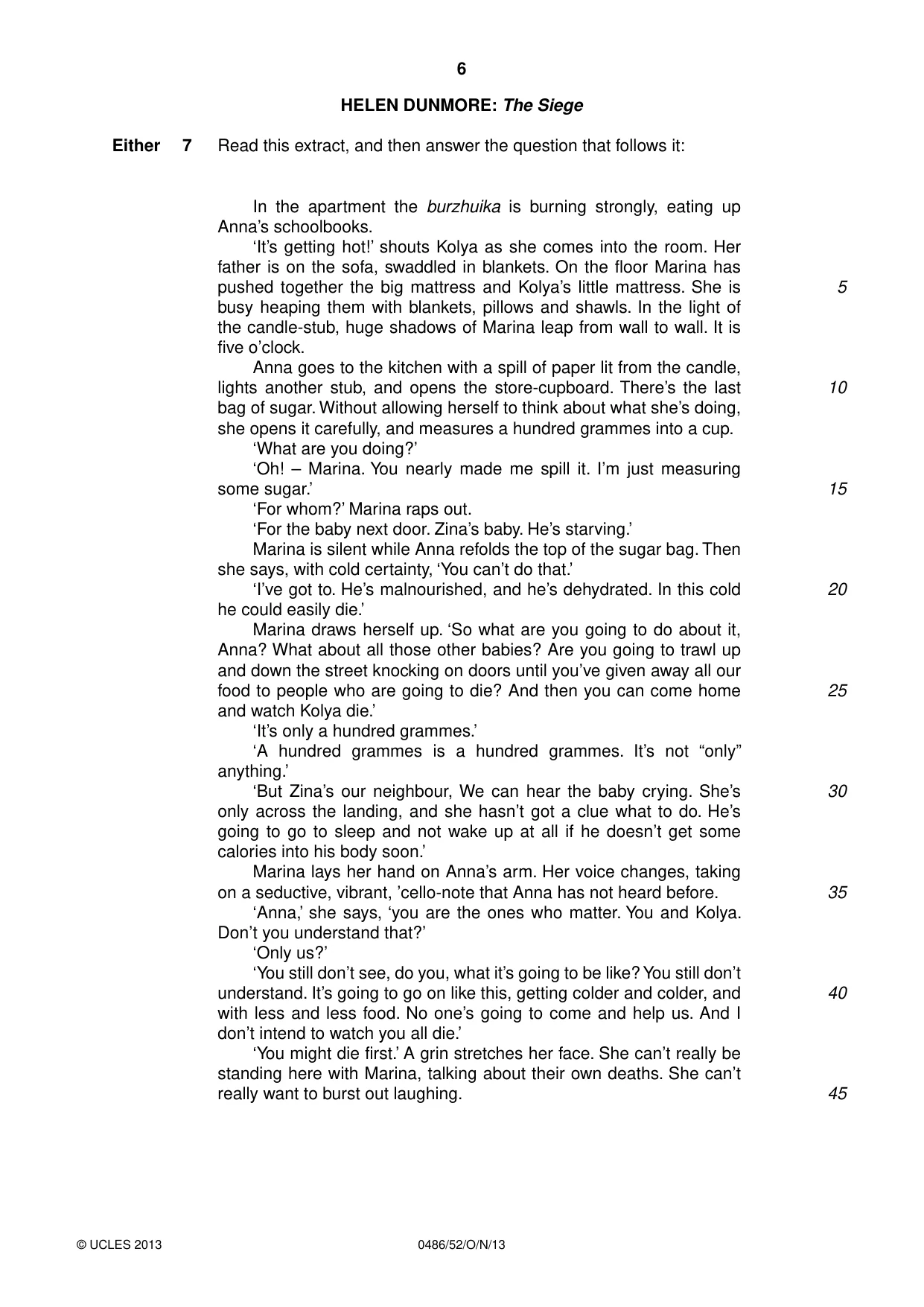
6 0486/52/O/N/13 © UCLES 2013 HELEN DUNMORE: The Siege Either 7 Read this extract, and then answer the question that follows it: In the apartment the burzhuika is burning strongly, eating up Anna’s schoolbooks. ‘It’s getting hot!’ shouts Kolya as she comes into the room. Her father is on the sofa, swaddled in blankets. On the floor Marina has pushed together the big mattress and Kolya’s little mattress. She is busy heaping them with blankets, pillows and shawls. In the light of the candle-stub, huge shadows of Marina leap from wall to wall. It is five o’clock. Anna goes to the kitchen with a spill of paper lit from the candle, lights another stub, and opens the store-cupboard. There’s the last bag of sugar. Without allowing herself to think about what she’s doing, she opens it carefully, and measures a hundred grammes into a cup. ‘What are you doing?’ ‘Oh! – Marina. You nearly made me spill it. I’m just measuring some sugar.’ ‘For whom?’ Marina raps out. ‘For the baby next door. Zina’s baby. He’s starving.’ Marina is silent while Anna refolds the top of the sugar bag. Then she says, with cold certainty, ‘You can’t do that.’ ‘I’ve got to. He’s malnourished, and he’s dehydrated. In this cold he could easily die.’ Marina draws herself up. ‘So what are you going to do about it, Anna? What about all those other babies? Are you going to trawl up and down the street knocking on doors until you’ve given away all our food to people who are going to die? And then you can come home and watch Kolya die.’ ‘It’s only a hundred grammes.’ ‘A hundred grammes is a hundred grammes. It’s not “only” anything.’ ‘But Zina’s our neighbour, We can hear the baby crying. She’s only across the landing, and she hasn’t got a clue what to do. He’s going to go to sleep and not wake up at all if he doesn’t get some calories into his body soon.’ Marina lays her hand on Anna’s arm. Her voice changes, taking on a seductive, vibrant, ’cello-note that Anna has not heard before. ‘Anna,’ she says, ‘you are the ones who matter. You and Kolya. Don’t you understand that?’ ‘Only us?’ ‘You still don’t see, do you, what it’s going to be like? You still don’t understand. It’s going to go on like this, getting colder and colder, and with less and less food. No one’s going to come and help us. And I don’t intend to watch you all die.’ ‘You might die first.’ A grin stretches her face. She can’t really be standing here with Marina, talking about their own deaths. She can’t really want to burst out laughing. 5 10 15 20 25 30 35 40 45
Question paper, page 7
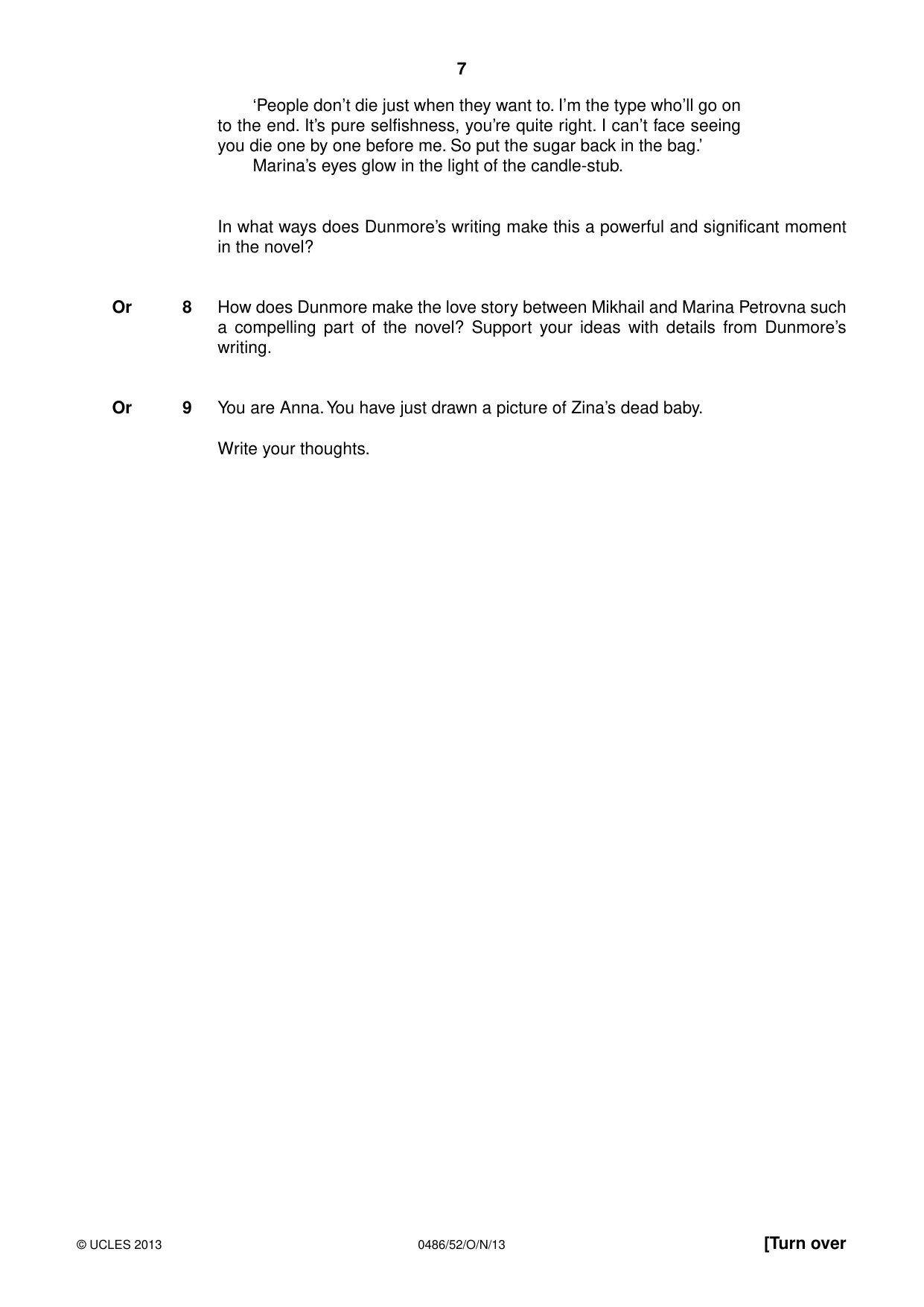
7 0486/52/O/N/13 © UCLES 2013 [Turn over ‘People don’t die just when they want to. I’m the type who’ll go on to the end. It’s pure selfishness, you’re quite right. I can’t face seeing you die one by one before me. So put the sugar back in the bag.’ Marina’s eyes glow in the light of the candle-stub. In what ways does Dunmore’s writing make this a powerful and significant moment in the novel? Or 8 How does Dunmore make the love story between Mikhail and Marina Petrovna such a compelling part of the novel? Support your ideas with details from Dunmore’s writing. Or 9 You are Anna. You have just drawn a picture of Zina’s dead baby. Write your thoughts.
Question paper, page 8
8 0486/52/O/N/13 © UCLES 2013 ALDOUS HUXLEY: Brave New World Either 10 Read this extract, and then answer the question that follows it: The lift was crowded with men from the Alpha Changing Rooms, and Lenina’s entry was greeted by many friendly nods and smiles. She was a popular girl and, at one time or another, had spent a night with almost all of them. They were dear boys, she thought, as she returned their salutations. Charming boys! Still, she did wish that George Edzel’s ears weren’t quite so big (perhaps he’d been given just a spot too much parathyroid at metre 328?). And looking at Benito Hoover, she couldn’t help remembering that he was really too hairy when he took his clothes off. Turning, with eyes a little saddened by the recollection of Benito’s curly blackness, she saw in a corner the small thin body, the melancholy face of Bernard Marx. ‘Bernard!’ she stepped up to him. ‘I was looking for you.’ Her voice rang clear above the hum of the mounting lift. The others looked round curiously. ‘I wanted to talk to you about our New Mexico plan.’ Out of the tail of her eye she could see Benito Hoover gaping with astonishment. The gape annoyed her. ‘Surprised I shouldn’t be begging to go with him again!’ she said to herself. Then aloud, and more warmly than ever, ‘I’d simply love to come with you for a week in July,’ she went on. (Anyhow, she was publicly proving her unfaithfulness to Henry. Fanny ought to be pleased, even though it was Bernard.) ‘That is,’ Lenina gave him her most deliciously significant smile, ‘if you still want to have me.’ Bernard’s pale face flushed. ‘What on earth for?’ she wondered, astonished, but at the same time touched by this strange tribute to her power. ‘Hadn’t we better talk about it somewhere else?’ he stammered, looking horribly uncomfortable. ‘As though I’d been saying something shocking,’ thought Lenina. ‘He couldn’t look more upset if I’d made a dirty joke – asked him who his mother was, or something like that.’ ‘I mean, with all these people about . . .’ He was choked with confusion. Lenina’s laugh was frank and wholly unmalicious. ‘How funny you are!’ she said; and she quite genuinely did think him funny. ‘You’ll give me at least a week’s warning, won’t you,’ she went on in another tone. ‘I suppose we take the Blue Pacific Rocket? Does it start from the Charing-T Tower? Or is it from Hampstead?’ Before Bernard could answer, the lift came to a standstill. ‘Roof!’ called a creaking voice. The liftman was a small simian creature, dressed in the black tunic of an Epsilon-Minus Semi-Moron. ‘Roof!’ He flung open the gates. The warm glory of afternoon sunlight made him start and blink his eyes. ‘Oh, roof!’ he repeated in a voice of rapture. He was as though suddenly and joyfully awakened from a dark annihilating stupor. ‘Roof!’ He smiled up with a kind of doggily expectant adoration into the faces of his passengers. Talking and laughing together, they stepped out into the light. The liftman looked after them. 5 10 15 20 25 30 35 40 45 50 Content removed due to copyright restrictions.
Question paper, page 9
9 0486/52/O/N/13 © UCLES 2013 [Turn over ‘Roof?’ he said once more, questioningly. Then a bell rang, and from the ceiling of the lift a loud speaker began, very softly and yet very imperiously, to issue its commands. ‘Go down,’ it said, ‘go down. Floor Eighteen. Go down, go down. Floor Eighteen. Go down, go . . .’ The liftman slammed the gates, touched a button and instantly dropped back into the droning twilight of the well, the twilight of his own habitual stupor. How does Huxley’s writing make this moment both amusing and significant? Or 11 To what extent does Huxley make you feel that the people in the Brave New World society are happy? Support your ideas with details from the novel. Or 12 You are John, the Savage. You have locked yourself in your room and are refusing to attend Bernard’s party. Write your thoughts. 55 Content removed due to copyright restrictions.
Question paper, page 10
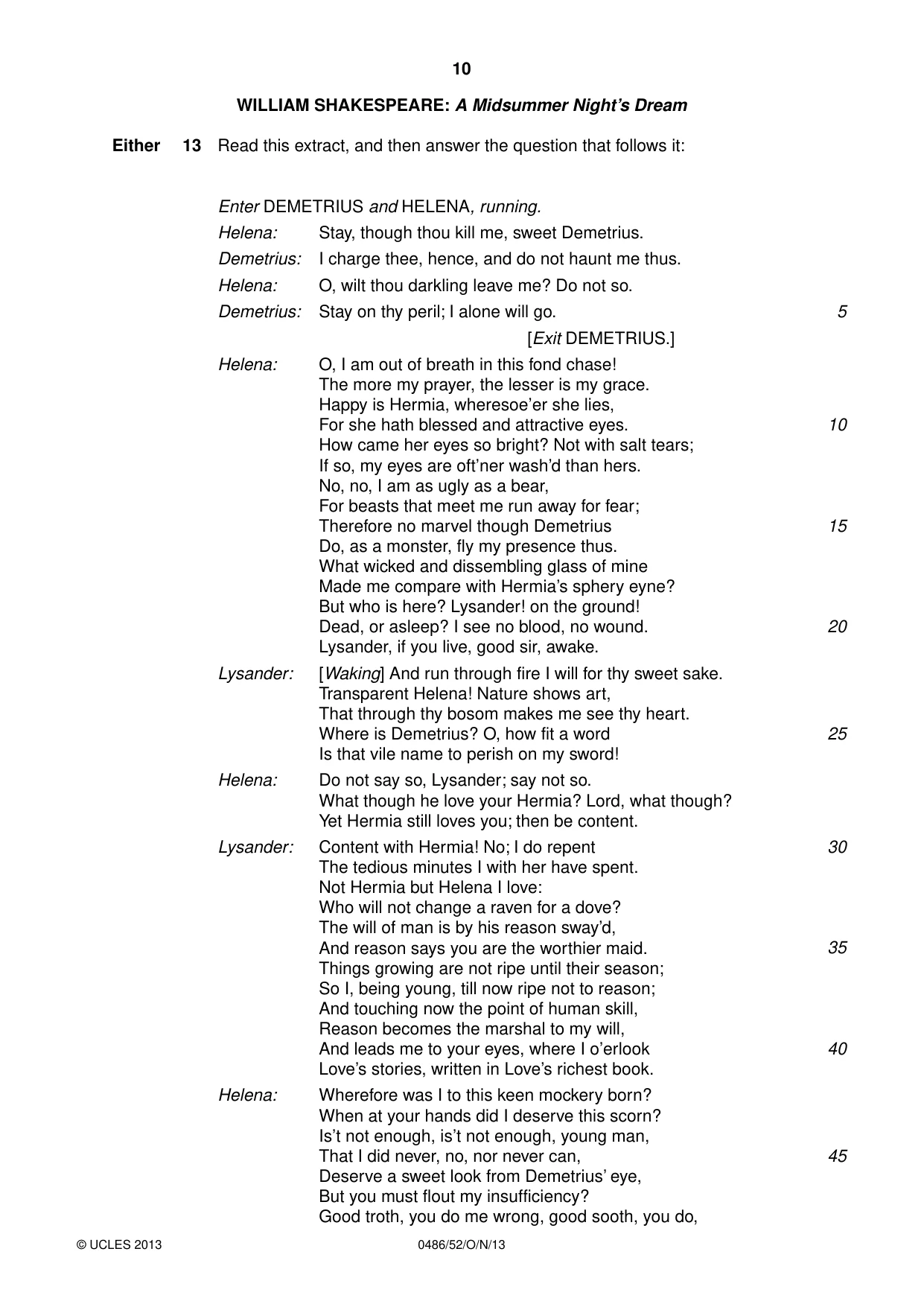
10 0486/52/O/N/13 © UCLES 2013 WILLIAM SHAKESPEARE: A Midsummer Night’s Dream Either 13 Read this extract, and then answer the question that follows it: Enter DEMETRIUS and HELENA, running. Helena: Stay, though thou kill me, sweet Demetrius. Demetrius: I charge thee, hence, and do not haunt me thus. Helena: O, wilt thou darkling leave me? Do not so. Demetrius: Stay on thy peril; I alone will go. [Exit DEMETRIUS.] Helena: O, I am out of breath in this fond chase! The more my prayer, the lesser is my grace. Happy is Hermia, wheresoe’er she lies, For she hath blessed and attractive eyes. How came her eyes so bright? Not with salt tears; If so, my eyes are oft’ner wash’d than hers. No, no, I am as ugly as a bear, For beasts that meet me run away for fear; Therefore no marvel though Demetrius Do, as a monster, fly my presence thus. What wicked and dissembling glass of mine Made me compare with Hermia’s sphery eyne? But who is here? Lysander! on the ground! Dead, or asleep? I see no blood, no wound. Lysander, if you live, good sir, awake. Lysander: [Waking] And run through fire I will for thy sweet sake. Transparent Helena! Nature shows art, That through thy bosom makes me see thy heart. Where is Demetrius? O, how fit a word Is that vile name to perish on my sword! Helena: Do not say so, Lysander; say not so. What though he love your Hermia? Lord, what though? Yet Hermia still loves you; then be content. Lysander: Content with Hermia! No; I do repent The tedious minutes I with her have spent. Not Hermia but Helena I love: Who will not change a raven for a dove? The will of man is by his reason sway’d, And reason says you are the worthier maid. Things growing are not ripe until their season; So I, being young, till now ripe not to reason; And touching now the point of human skill, Reason becomes the marshal to my will, And leads me to your eyes, where I o’erlook Love’s stories, written in Love’s richest book. Helena: Wherefore was I to this keen mockery born? When at your hands did I deserve this scorn? Is’t not enough, is’t not enough, young man, That I did never, no, nor never can, Deserve a sweet look from Demetrius’ eye, But you must flout my insufficiency? Good troth, you do me wrong, good sooth, you do, 5 10 15 20 25 30 35 40 45
Question paper, page 11
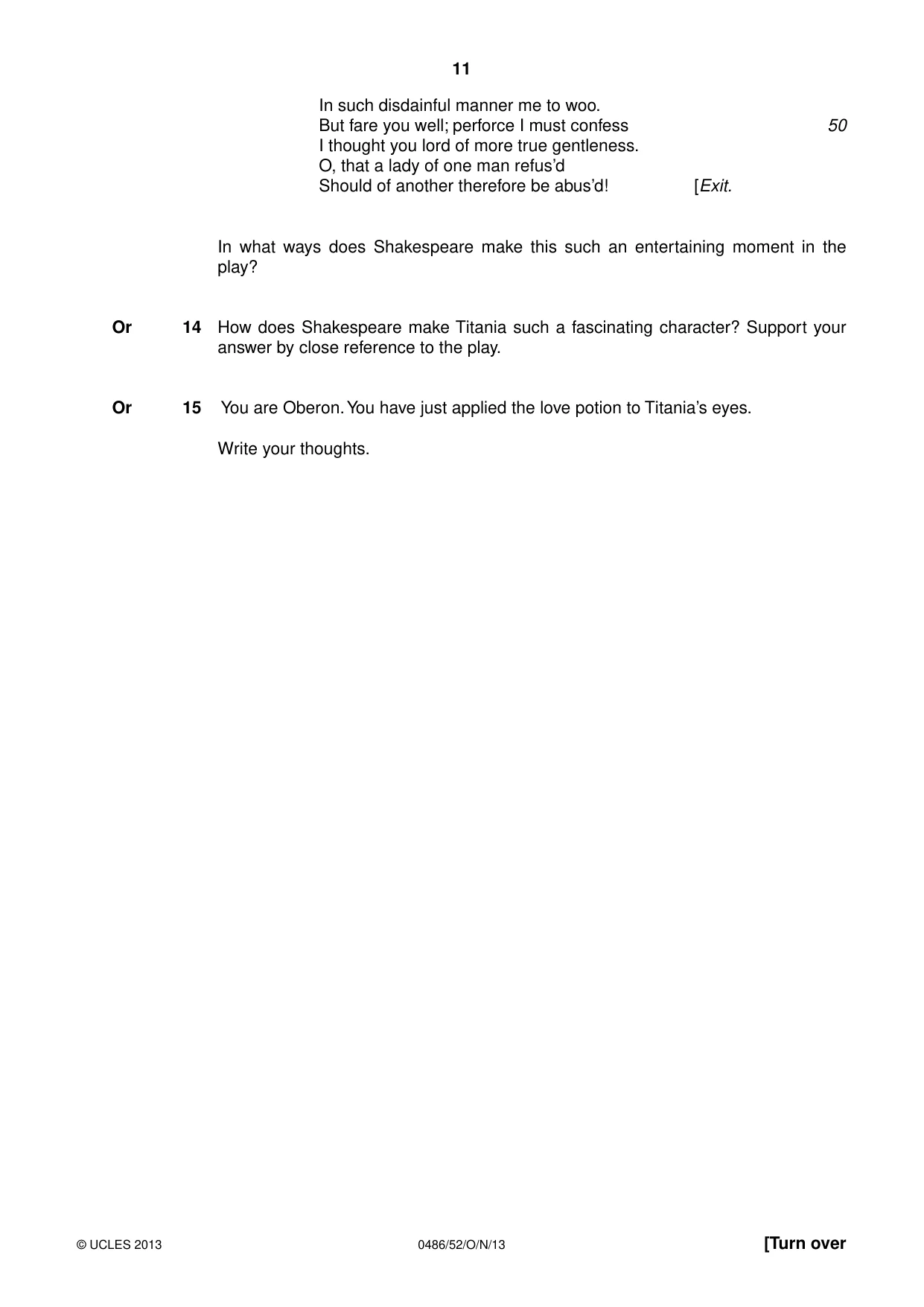
11 0486/52/O/N/13 © UCLES 2013 [Turn over In such disdainful manner me to woo. But fare you well; perforce I must confess I thought you lord of more true gentleness. O, that a lady of one man refus’d Should of another therefore be abus’d! [Exit. In what ways does Shakespeare make this such an entertaining moment in the play? Or 14 How does Shakespeare make Titania such a fascinating character? Support your answer by close reference to the play. Or 15 You are Oberon. You have just applied the love potion to Titania’s eyes. Write your thoughts. 50
Question paper, page 12
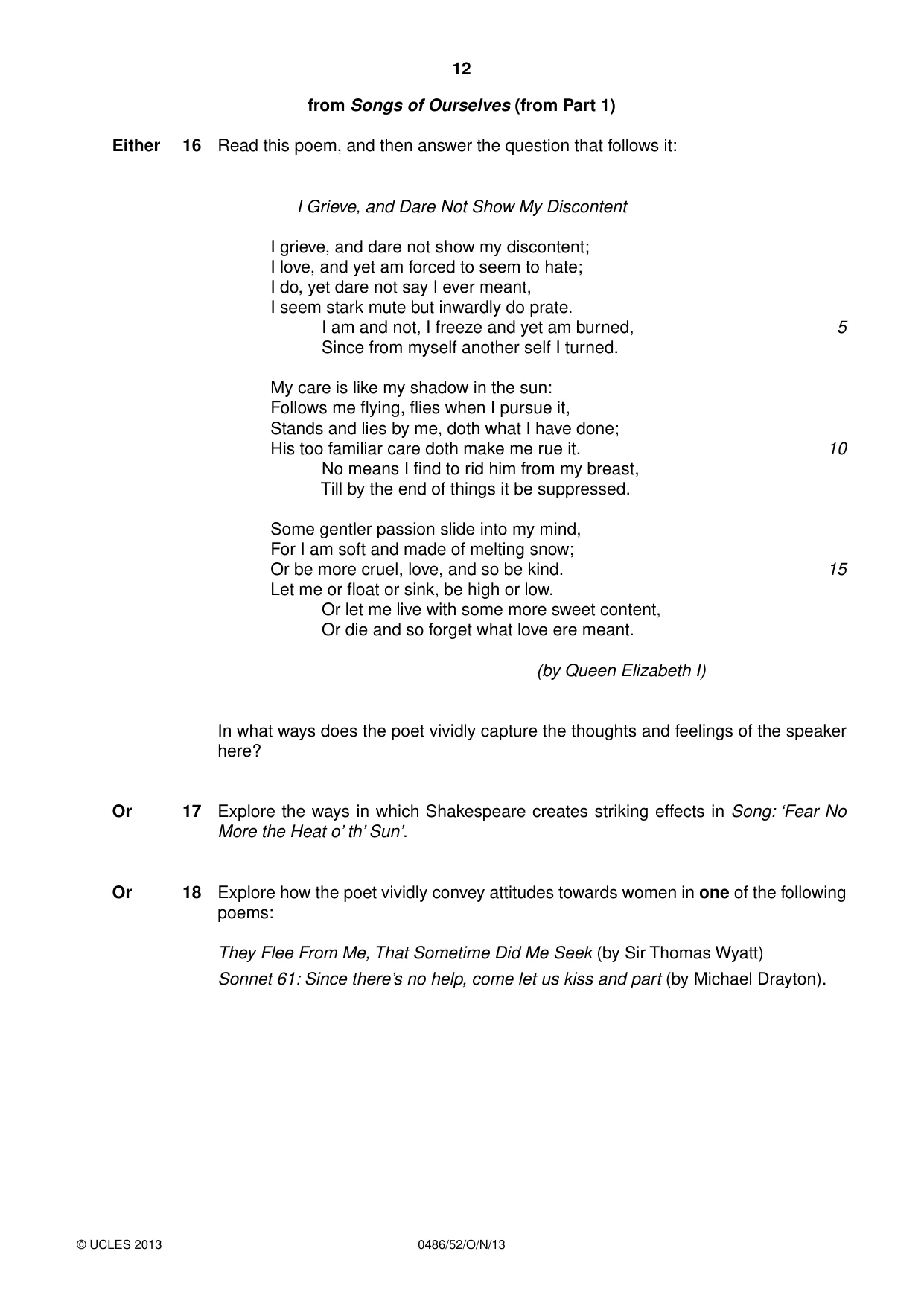
12 0486/52/O/N/13 © UCLES 2013 from Songs of Ourselves (from Part 1) Either 16 Read this poem, and then answer the question that follows it: I Grieve, and Dare Not Show My Discontent I grieve, and dare not show my discontent; I love, and yet am forced to seem to hate; I do, yet dare not say I ever meant, I seem stark mute but inwardly do prate. I am and not, I freeze and yet am burned, Since from myself another self I turned. My care is like my shadow in the sun: Follows me flying, flies when I pursue it, Stands and lies by me, doth what I have done; His too familiar care doth make me rue it. No means I find to rid him from my breast, Till by the end of things it be suppressed. Some gentler passion slide into my mind, For I am soft and made of melting snow; Or be more cruel, love, and so be kind. Let me or float or sink, be high or low. Or let me live with some more sweet content, Or die and so forget what love ere meant. (by Queen Elizabeth I) In what ways does the poet vividly capture the thoughts and feelings of the speaker here? Or 17 Explore the ways in which Shakespeare creates striking effects in Song: ‘Fear No More the Heat o’ th’ Sun’. Or 18 Explore how the poet vividly convey attitudes towards women in one of the following poems: They Flee From Me, That Sometime Did Me Seek (by Sir Thomas Wyatt) Sonnet 61: Since there’s no help, come let us kiss and part (by Michael Drayton). 5 10 15
Question paper, page 13
13 0486/52/O/N/13 © UCLES 2013 [Turn over BLANK PAGE Turn over for Question 19.
Question paper, page 14
14 0486/52/O/N/13 © UCLES 2013 TENNESSEE WILLIAMS: Cat on a Hot Tin Roof Either 19 Read this extract, and then answer the question that follows it: Big Daddy: And I’m not dying of cancer which you thought I was dying of. Ain’t that so? Didn’t you think that I was dying of cancer, Ida? [Almost everybody is out on the gallery but the two old people glaring at each other across the blazing cake. BIG MAMA’s chest heaves and she presses a fat fist to her mouth. BIG DADDY continues, hoarsely ] Ain’t that so, Ida? Didn’t you have an idea I was dying of cancer and now you could take control of this place and everything on it? I got that impression, I seemed to get that impression. Your loud voice everywhere, your fat old body butting in here and there! Big Mama: Hush! The Preacher! Big Daddy: Rut the goddam preacher! [ BIG MAMA gasps loudly and sits down on the sofa which is almost too small for her.] Did you hear what I said? I said rut the goddam preacher! [Somebody closes the gallery doors from outside just as there is a burst of fireworks and excited cries from the children.] Big Mama: I never seen you act like this before and I can’t think what’s got in you! Big Daddy: I went through all that laboratory and operation and all just so I would know if you or me was boss here! Well, now it turns out that I am and you ain’t – and that’s my birthday present – and my cake and champagne! – because for three years now you been gradually taking over. Bossing. Talking. Sashaying your fat old body around the place I made! I made this place! I was overseer on it! I was the overseer on the old Straw and Ochello plantation. I quit school at ten! I quit school at ten years old and went to work like a nigger in the fields. And I rose to be overseer of the Straw and Ochello plantation. And old Straw died and I was Ochello’s partner and the place got bigger and bigger and bigger and bigger and bigger! I did all that myself with no goddam help from you, and now you think you’re just about to take over. Well, I am just about to tell you that you are not just about to take over, you are not just about to take over a God damn thing. Is that clear to you, Ida? Is that very plain to you, now? Is that understood completely? I been through the laboratory from A to Z. I’ve had the goddam exploratory operation, and nothing is wrong with me but a spastic colon – made spastic, I guess, by disgust ! By all the goddam lies and liars that I have had to put up with, and all the 5 10 15 20 25 30 35 40 45 Content removed due to copyright restrictions.
Question paper, page 15
15 0486/52/O/N/13 © UCLES 2013 goddam hypoc risy that I lived with all these forty years that we been livin’ together! Hey! Ida! Blow out the candles on the birthday cake! Purse up your lips and draw a deep breath and blow out the goddam candles on the cake! Big Mama: Oh, Big Daddy, oh, oh, oh, Big Daddy! Big Daddy: What’s the matter with you? Big Mama: In all these years you never believed that I loved you?? Big Daddy: Huh? Big Mama: And I did, I did so much, I did love you! – I even loved your hate and your hardness, Big Daddy! [She sobs and rushes awkwardly out on to the gallery.] Big Daddy: [to himself ] Wouldn’t it be funny if that was true . . . [A pause is followed by a burst of light in the sky from the fireworks.] In what ways does Williams strikingly convey the relationship between Big Daddy and Big Mama at this moment in the play? Or 20 Explore two moments in the play which Williams makes particularly powerful for you. NB Do not use the passage in Question 19 in answering this question. Or 21 You are Brick, at the beginning of the play. Maggie has not yet entered the bedroom. You are thinking about your life. Write your thoughts. 50 55 60 Content removed due to copyright restrictions.
Question paper, page 16
16 0486/52/O/N/13 © UCLES 2013 BLANK PAGE Copyright Acknowledgements: Question 1 © Maya Angelou; I Know Why The Caged Bird Sings; Copyright © 1969 and renewed 1997 by Maya Angelou. Published by Vintage. Reprinted by permission of Random House Inc. Question 4 © Carol Ann Duffy; Who Loves You?, in Selected Poems; Penguin Books Ltd; 1994. Question 7 © Helen Dunmore; The Siege; Penguin Books Ltd; 2001; By permission of A P Watt Ltd on behalf of Helen Dunmore. Question 10 © from Brave New World by Aldous Huxley, published by Chatto & Windus. Reprinted by permission of The Random House Group Ltd. Question 19 © Cat on a Hot Tin Roof by Tennessee Williams. Copyright © 1954, 1955, by The University of the South, renewed 1982, 1983 The University of the South. Reprinted by permission of New Directions Publishing Corp and Georges Borchardt, Inc. for the Estate of Tennessee Williams. Permission to reproduce items where third-party owned material protected by copyright is included has been sought and cleared where possible. Every reasonable effort has been made by the publisher (UCLES) to trace copyright holders, but if any items requiring clearance have unwittingly been included, the publisher will be pleased to make amends at the earliest possible opportunity. Cambridge International Examinations is part of the Cambridge Assessment Group. Cambridge Assessment is the brand name of University of Cambridge Local Examinations Syndicate (UCLES), which is itself a department of the University of Cambridge.
Mark scheme, page 1
CAMBRIDGE INTERNATIONAL EXAMINATIONS International General Certificate of Secondary Education MARK SCHEME for the October/November 2013 series 0486 LITERATURE (ENGLISH) 0486/52 Paper 5 (Set Texts: Closed Books B), maximum raw mark 25 This mark scheme is published as an aid to teachers and candidates, to indicate the requirements of the examination. It shows the basis on which Examiners were instructed to award marks. It does not indicate the details of the discussions that took place at an Examiners’ meeting before marking began, which would have considered the acceptability of alternative answers. Mark schemes should be read in conjunction with the question paper and the Principal Examiner Report for Teachers. Cambridge will not enter into discussions about these mark schemes. Cambridge is publishing the mark schemes for the October/November 2013 series for most IGCSE, GCE Advanced Level and Advanced Subsidiary Level components and some Ordinary Level components. www.XtremePapers.com
Mark scheme, page 2
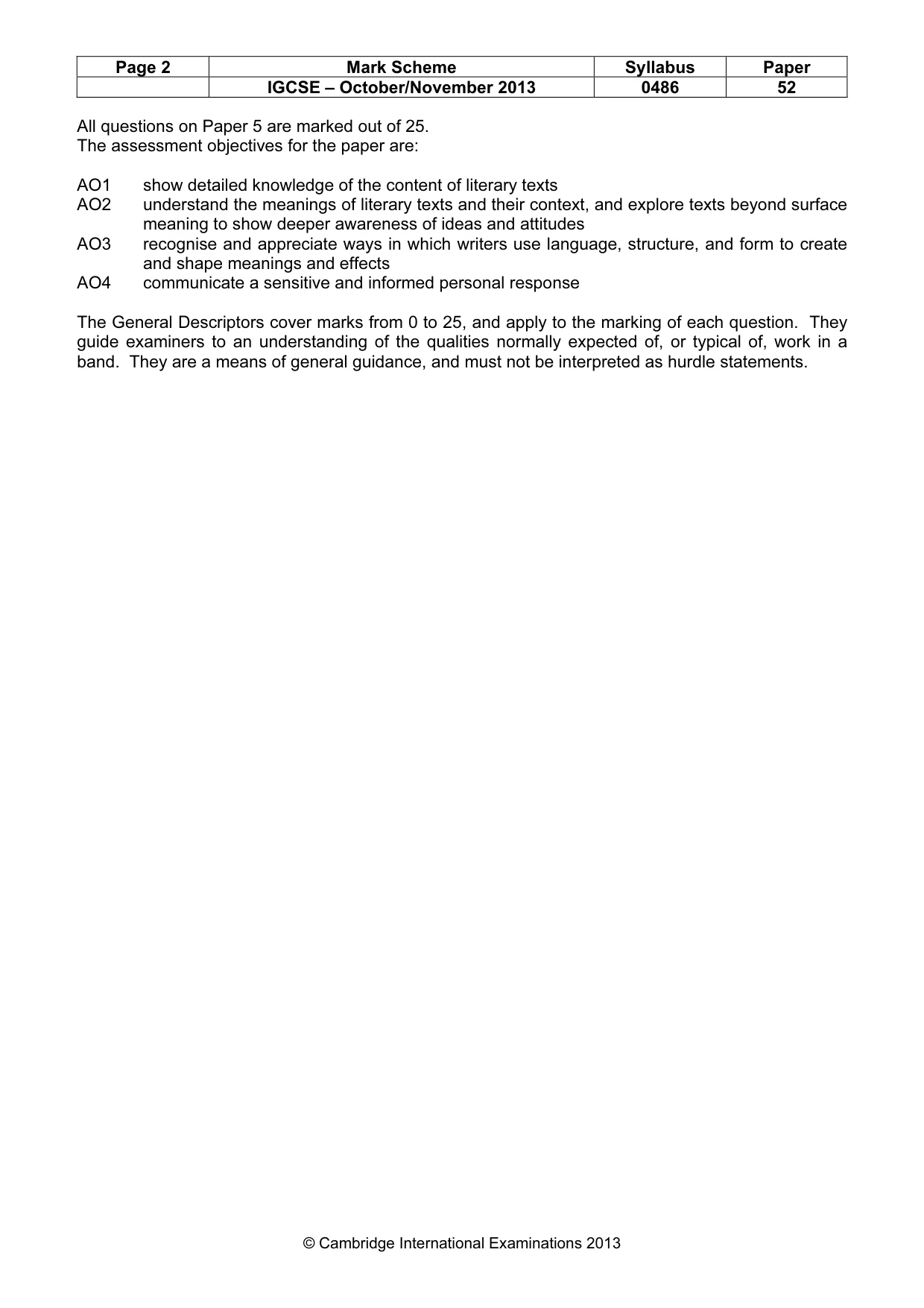
Page 2 Mark Scheme Syllabus Paper IGCSE – October/November 2013 0486 52 © Cambridge International Examinations 2013 All questions on Paper 5 are marked out of 25. The assessment objectives for the paper are: AO1 show detailed knowledge of the content of literary texts AO2 understand the meanings of literary texts and their context, and explore texts beyond surface meaning to show deeper awareness of ideas and attitudes AO3 recognise and appreciate ways in which writers use language, structure, and form to create and shape meanings and effects AO4 communicate a sensitive and informed personal response The General Descriptors cover marks from 0 to 25, and apply to the marking of each question. They guide examiners to an understanding of the qualities normally expected of, or typical of, work in a band. They are a means of general guidance, and must not be interpreted as hurdle statements.
Mark scheme, page 3
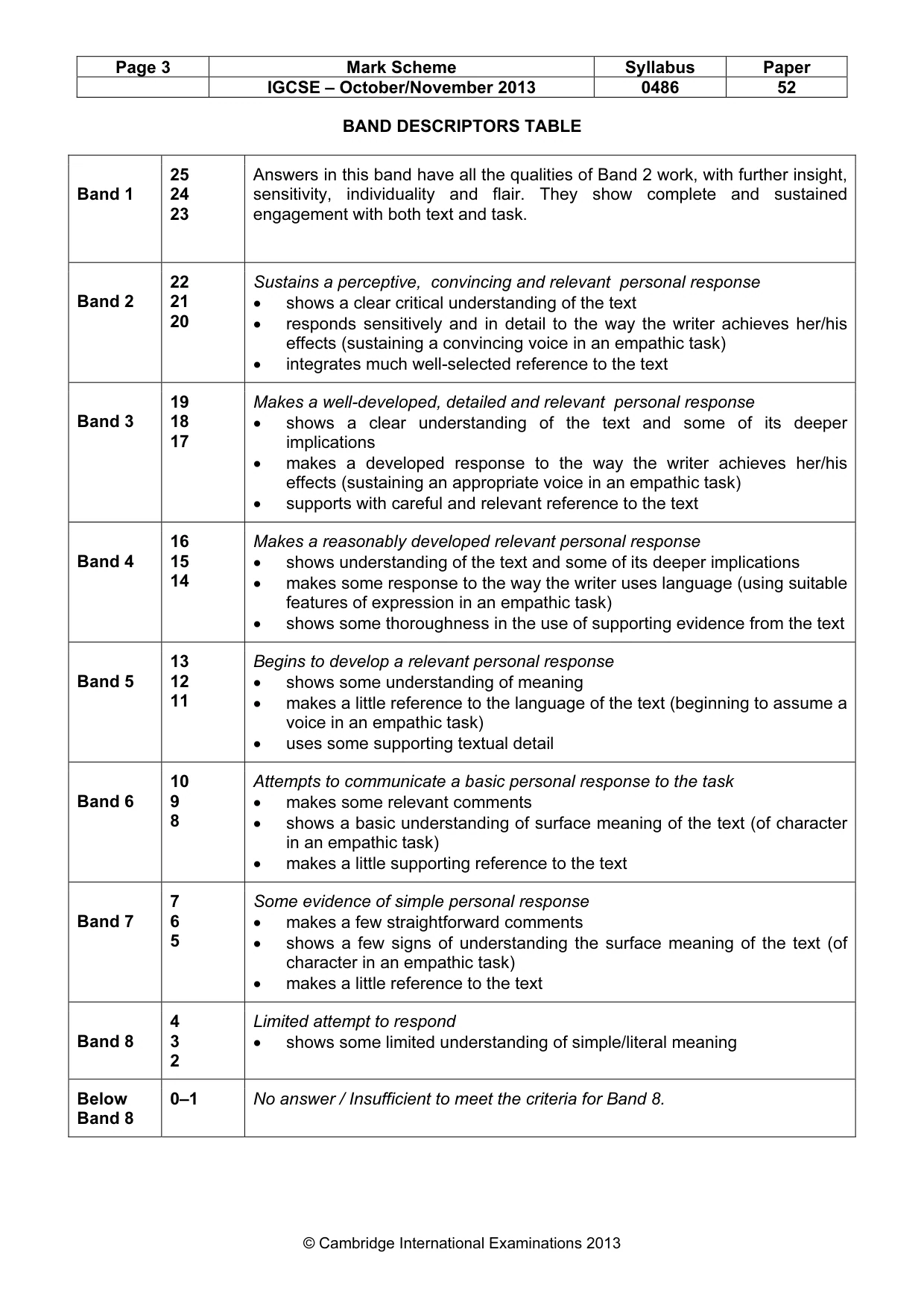
Page 3 Mark Scheme Syllabus Paper IGCSE – October/November 2013 0486 52 © Cambridge International Examinations 2013 BAND DESCRIPTORS TABLE Band 1 25 24 23 Answers in this band have all the qualities of Band 2 work, with further insight, sensitivity, individuality and flair. They show complete and sustained engagement with both text and task. Band 2 22 21 20 Sustains a perceptive, convincing and relevant personal response • shows a clear critical understanding of the text • responds sensitively and in detail to the way the writer achieves her/his effects (sustaining a convincing voice in an empathic task) • integrates much well-selected reference to the text Band 3 19 18 17 Makes a well-developed, detailed and relevant personal response • shows a clear understanding of the text and some of its deeper implications • makes a developed response to the way the writer achieves her/his effects (sustaining an appropriate voice in an empathic task) • supports with careful and relevant reference to the text Band 4 16 15 14 Makes a reasonably developed relevant personal response • shows understanding of the text and some of its deeper implications • makes some response to the way the writer uses language (using suitable features of expression in an empathic task) • shows some thoroughness in the use of supporting evidence from the text Band 5 13 12 11 Begins to develop a relevant personal response • shows some understanding of meaning • makes a little reference to the language of the text (beginning to assume a voice in an empathic task) • uses some supporting textual detail Band 6 10 9 8 Attempts to communicate a basic personal response to the task • makes some relevant comments • shows a basic understanding of surface meaning of the text (of character in an empathic task) • makes a little supporting reference to the text Band 7 7 6 5 Some evidence of simple personal response • makes a few straightforward comments • shows a few signs of understanding the surface meaning of the text (of character in an empathic task) • makes a little reference to the text Band 8 4 3 2 Limited attempt to respond • shows some limited understanding of simple/literal meaning Below Band 8 0–1 No answer / Insufficient to meet the criteria for Band 8.
What you needed in this session
Cambridge’s own grade thresholds for 2013 Oct/Nov, Paper 5 · Variant 2. A higher threshold means an easier paper — the bar moves with how the cohort did.