Cambridge IGCSE English - Literature 0486 — 2010 May/June Paper 5 · Variant 1
0486/51/M/J/10 · 25 marks · ≈28 min
The question paper and its mark scheme, free to read here and free to download. This is Cambridge’s own paper, exactly as it was sat.
Question paper16 pages






Mark scheme10 pages
Answers below. Sit the paper first if you are practising.
Paper as text
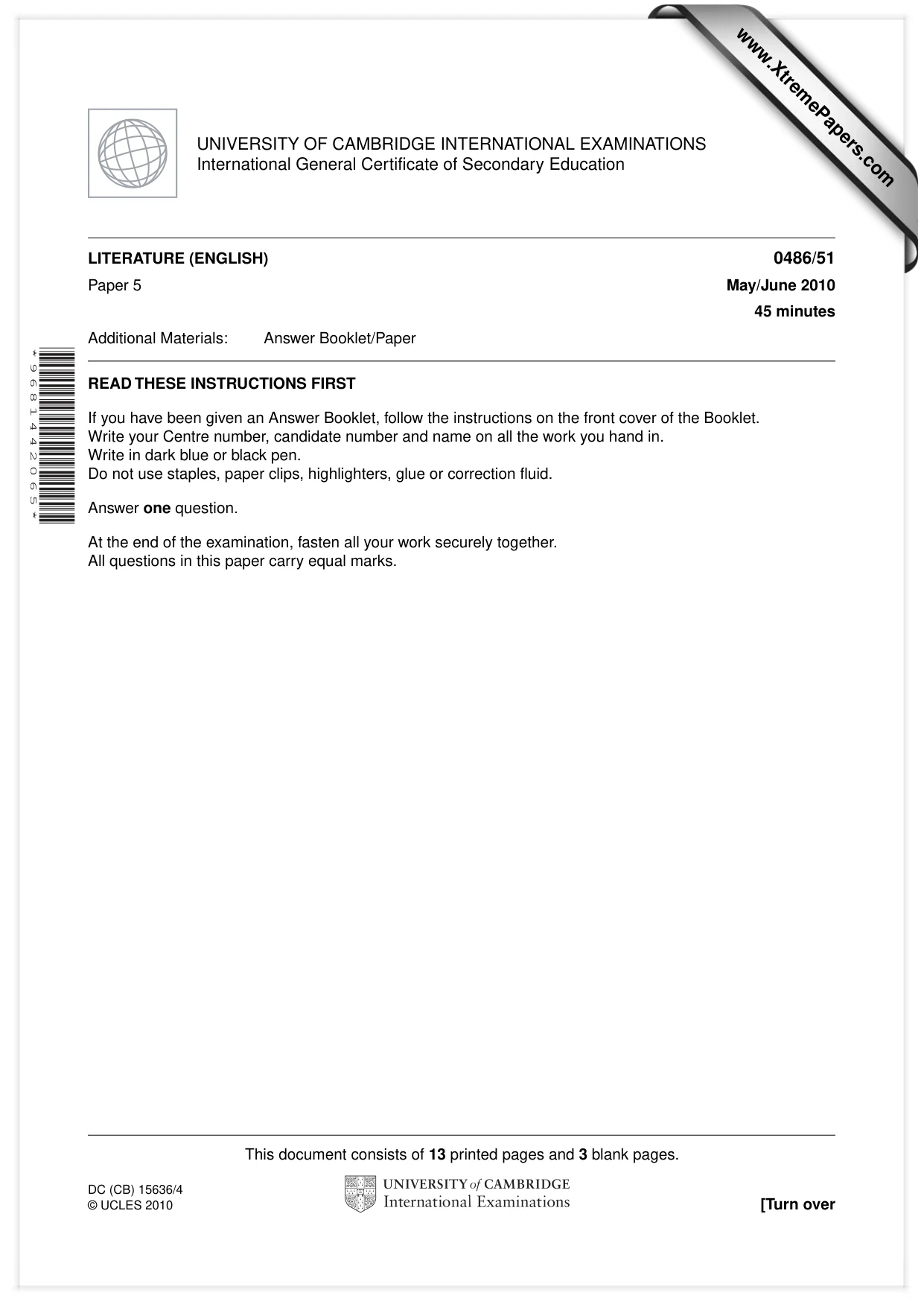
Question paper, page 1
This document consists of 13 printed pages and 3 blank pages. DC (CB) 15636/4 © UCLES 2010 [Turn over UNIVERSITY OF CAMBRIDGE INTERNATIONAL EXAMINATIONS International General Certificate of Secondary Education READ THESE INSTRUCTIONS FIRST If you have been given an Answer Booklet, follow the instructions on the front cover of the Booklet. Write your Centre number, candidate number and name on all the work you hand in. Write in dark blue or black pen. Do not use staples, paper clips, highlighters, glue or correction fluid. Answer one question. At the end of the examination, fasten all your work securely together. All questions in this paper carry equal marks. * 9 6 8 1 4 4 2 0 6 5 * LITERATURE (ENGLISH) 0486/51 Paper 5 May/June 2010 45 minutes Additional Materials: Answer Booklet/Paper www.XtremePapers.com
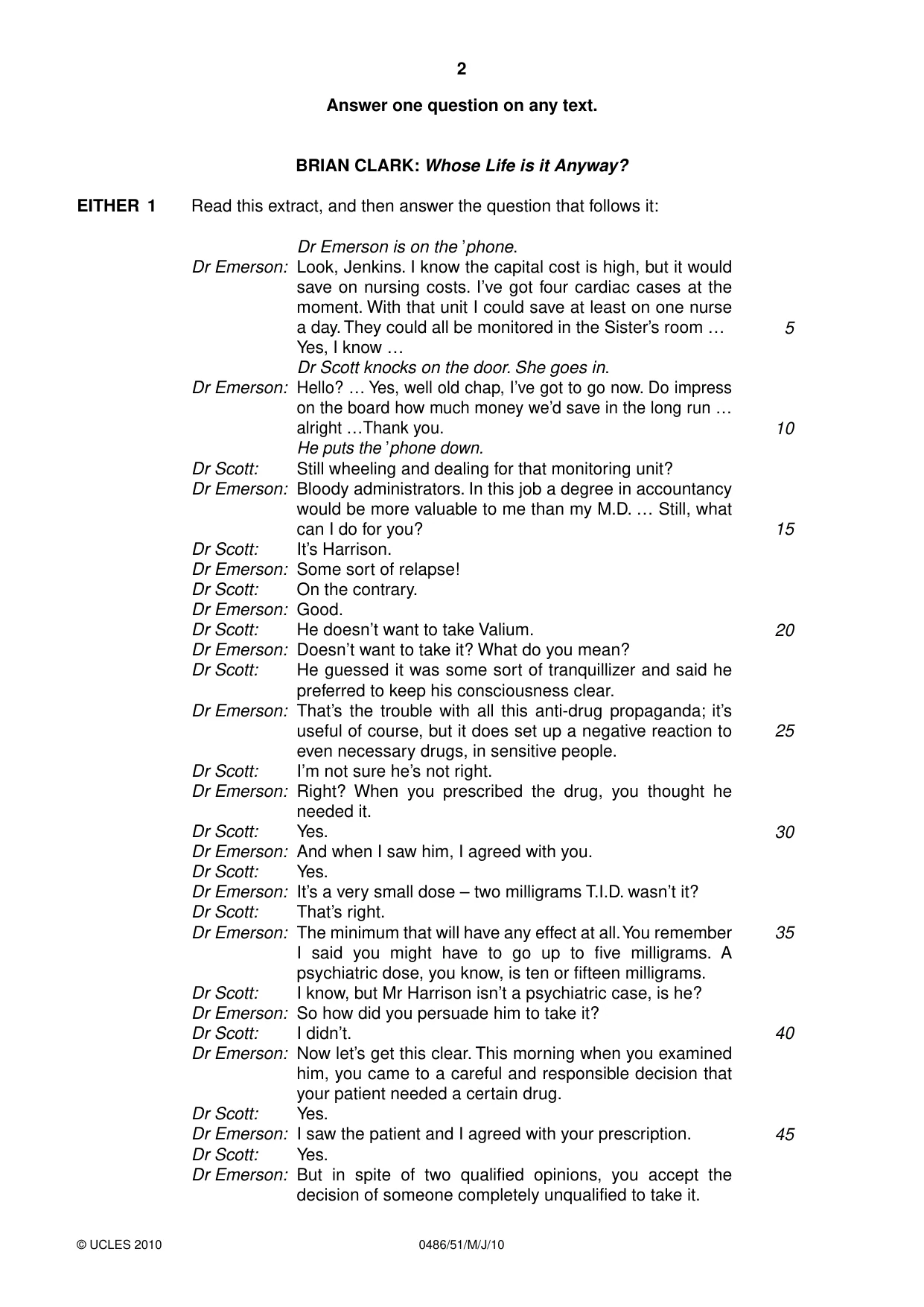
Question paper, page 2
2 0486/51/M/J/10 © UCLES 2010 Answer one question on any text. BRIAN CLARK: Whose Life is it Anyway? EITHER 1 Read this extract, and then answer the question that follows it: Dr Emerson is on the ’phone. Dr Emerson: Look, Jenkins. I know the capital cost is high, but it would save on nursing costs. I’ve got four cardiac cases at the moment. With that unit I could save at least on one nurse a day. They could all be monitored in the Sister’s room … Yes, I know … Dr Scott knocks on the door. She goes in. Dr Emerson: Hello? … Yes, well old chap, I’ve got to go now. Do impress on the board how much money we’d save in the long run … alright …Thank you. He puts the ’phone down. Dr Scott: Still wheeling and dealing for that monitoring unit? Dr Emerson: Bloody administrators. In this job a degree in accountancy would be more valuable to me than my M.D. … Still, what can I do for you? Dr Scott: It’s Harrison. Dr Emerson: Some sort of relapse! Dr Scott: On the contrary. Dr Emerson: Good. Dr Scott: He doesn’t want to take Valium. Dr Emerson: Doesn’t want to take it? What do you mean? Dr Scott: He guessed it was some sort of tranquillizer and said he preferred to keep his consciousness clear. Dr Emerson: That’s the trouble with all this anti-drug propaganda; it’s useful of course, but it does set up a negative reaction to even necessary drugs, in sensitive people. Dr Scott: I’m not sure he’s not right. Dr Emerson: Right? When you prescribed the drug, you thought he needed it. Dr Scott: Yes. Dr Emerson: And when I saw him, I agreed with you. Dr Scott: Yes. Dr Emerson: It’s a very small dose – two milligrams T.I.D. wasn’t it? Dr Scott: That’s right. Dr Emerson: The minimum that will have any effect at all. You remember I said you might have to go up to five milligrams. A psychiatric dose, you know, is ten or fifteen milligrams. Dr Scott: I know, but Mr Harrison isn’t a psychiatric case, is he? Dr Emerson: So how did you persuade him to take it? Dr Scott: I didn’t. Dr Emerson: Now let’s get this clear. This morning when you examined him, you came to a careful and responsible decision that your patient needed a certain drug. Dr Scott: Yes. Dr Emerson: I saw the patient and I agreed with your prescription. Dr Scott: Yes. Dr Emerson: But in spite of two qualified opinions, you accept the decision of someone completely unqualified to take it. 5 10 15 20 25 30 35 40 45
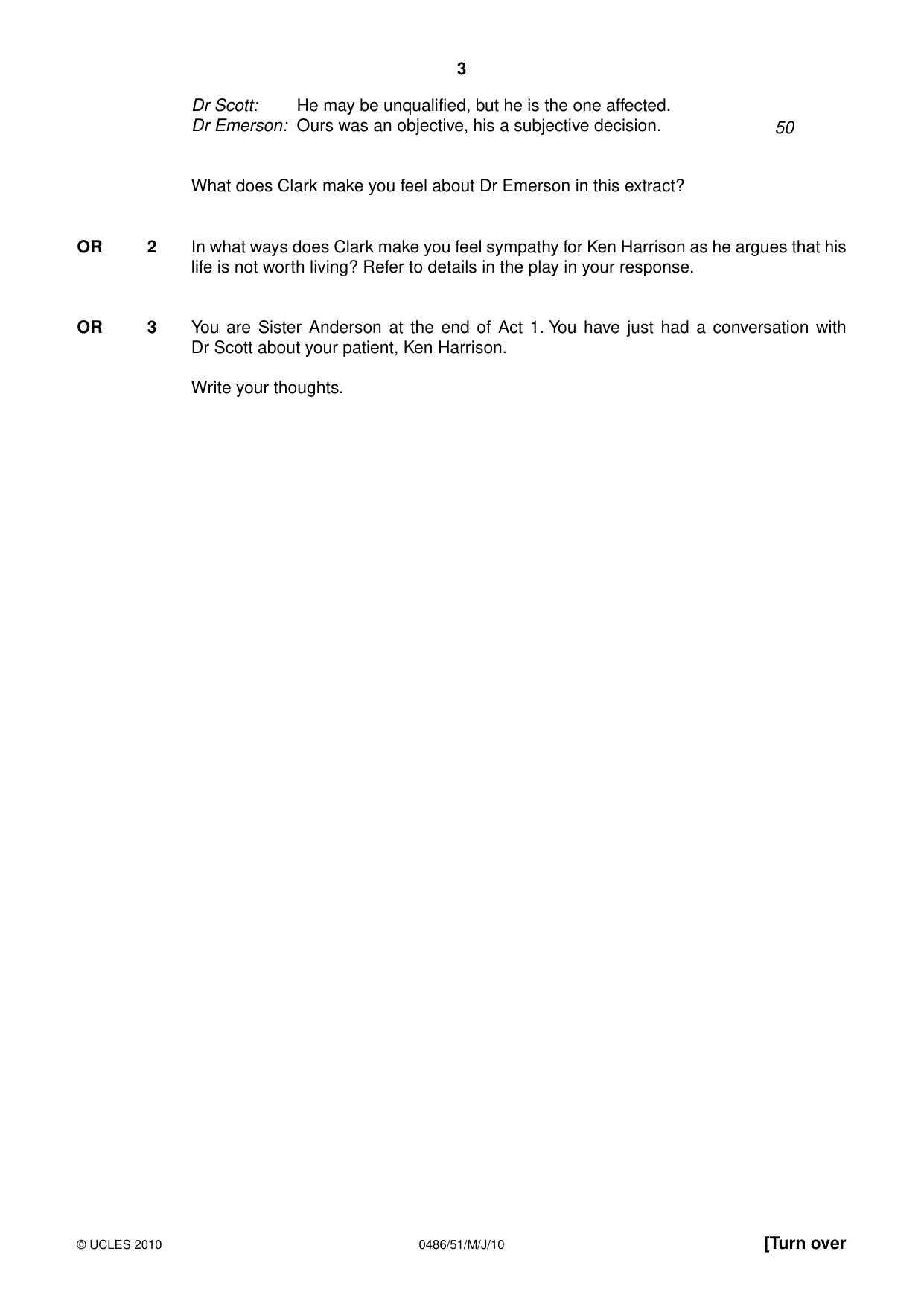
Question paper, page 3
3 0486/51/M/J/10 © UCLES 2010 [Turn over Dr Scott: He may be unqualified, but he is the one affected. Dr Emerson: Ours was an objective, his a subjective decision. What does Clark make you feel about Dr Emerson in this extract? OR 2 In what ways does Clark make you feel sympathy for Ken Harrison as he argues that his life is not worth living? Refer to details in the play in your response. OR 3 You are Sister Anderson at the end of Act 1. You have just had a conversation with Dr Scott about your patient, Ken Harrison. Write your thoughts. 50
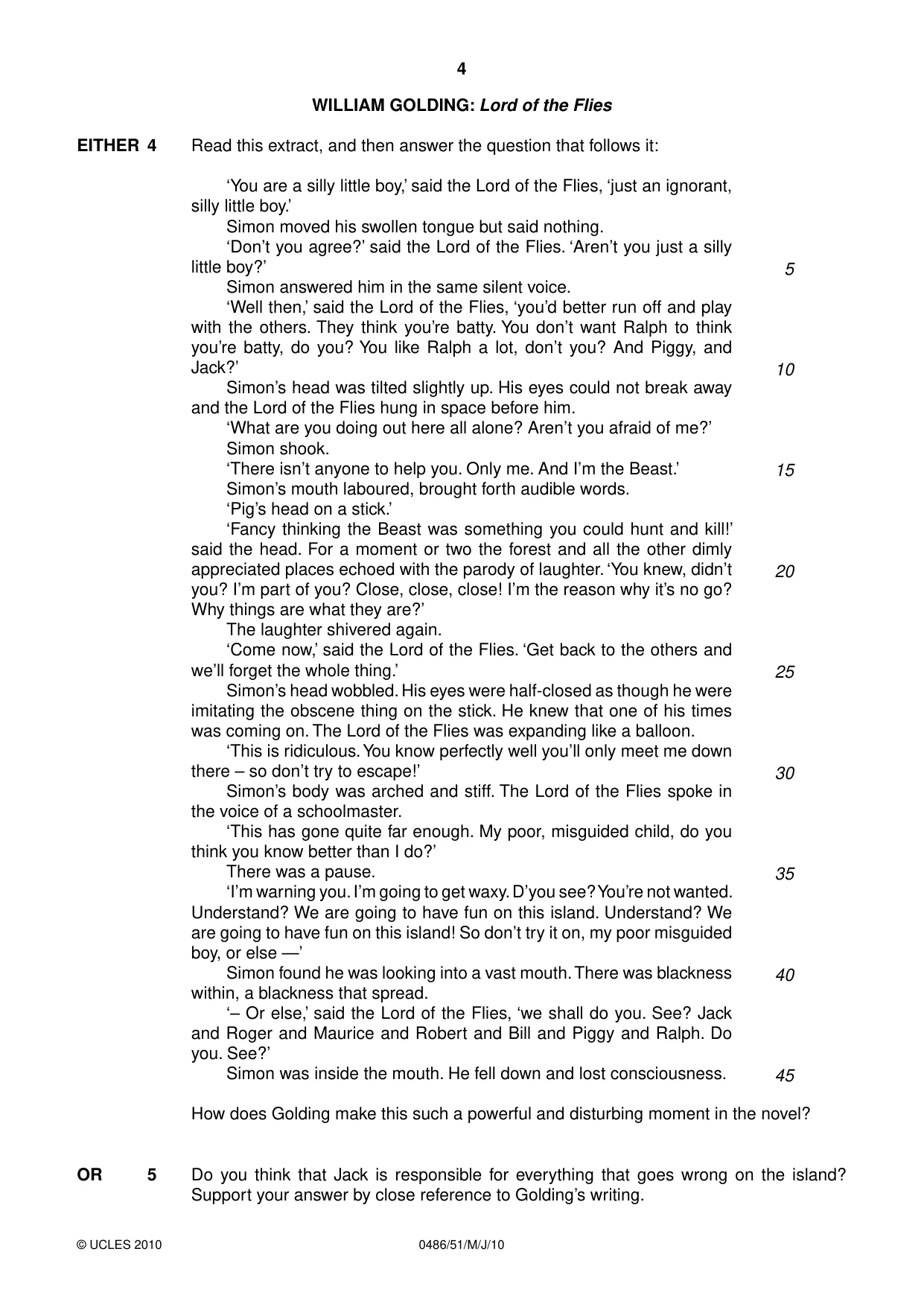
Question paper, page 4
4 0486/51/M/J/10 © UCLES 2010 WILLIAM GOLDING: Lord of the Flies EITHER 4 Read this extract, and then answer the question that follows it: ‘You are a silly little boy,’ said the Lord of the Flies, ‘just an ignorant, silly little boy.’ Simon moved his swollen tongue but said nothing. ‘Don’t you agree?’ said the Lord of the Flies. ‘Aren’t you just a silly little boy?’ Simon answered him in the same silent voice. ‘Well then,’ said the Lord of the Flies, ‘you’d better run off and play with the others. They think you’re batty. You don’t want Ralph to think you’re batty, do you? You like Ralph a lot, don’t you? And Piggy, and Jack?’ Simon’s head was tilted slightly up. His eyes could not break away and the Lord of the Flies hung in space before him. ‘What are you doing out here all alone? Aren’t you afraid of me?’ Simon shook. ‘There isn’t anyone to help you. Only me. And I’m the Beast.’ Simon’s mouth laboured, brought forth audible words. ‘Pig’s head on a stick.’ ‘Fancy thinking the Beast was something you could hunt and kill!’ said the head. For a moment or two the forest and all the other dimly appreciated places echoed with the parody of laughter. ‘You knew, didn’t you? I’m part of you? Close, close, close! I’m the reason why it’s no go? Why things are what they are?’ The laughter shivered again. ‘Come now,’ said the Lord of the Flies. ‘Get back to the others and we’ll forget the whole thing.’ Simon’s head wobbled. His eyes were half-closed as though he were imitating the obscene thing on the stick. He knew that one of his times was coming on. The Lord of the Flies was expanding like a balloon. ‘This is ridiculous. You know perfectly well you’ll only meet me down there – so don’t try to escape!’ Simon’s body was arched and stiff. The Lord of the Flies spoke in the voice of a schoolmaster. ‘This has gone quite far enough. My poor, misguided child, do you think you know better than I do?’ There was a pause. ‘I’m warning you. I’m going to get waxy. D’you see? You’re not wanted. Understand? We are going to have fun on this island. Understand? We are going to have fun on this island! So don’t try it on, my poor misguided boy, or else —’ Simon found he was looking into a vast mouth. There was blackness within, a blackness that spread. ‘– Or else,’ said the Lord of the Flies, ‘we shall do you. See? Jack and Roger and Maurice and Robert and Bill and Piggy and Ralph. Do you. See?’ Simon was inside the mouth. He fell down and lost consciousness. How does Golding make this such a powerful and disturbing moment in the novel? OR 5 Do you think that Jack is responsible for everything that goes wrong on the island? Support your answer by close reference to Golding’s writing. 5 10 15 20 25 30 35 40 45
Question paper, page 5
5 0486/51/M/J/10 © UCLES 2010 [Turn over OR 6 You are Piggy. Jack and the hunters have killed their first animal and you have just eaten your first piece of meat since arriving on the island. Write your thoughts.
Question paper, page 6
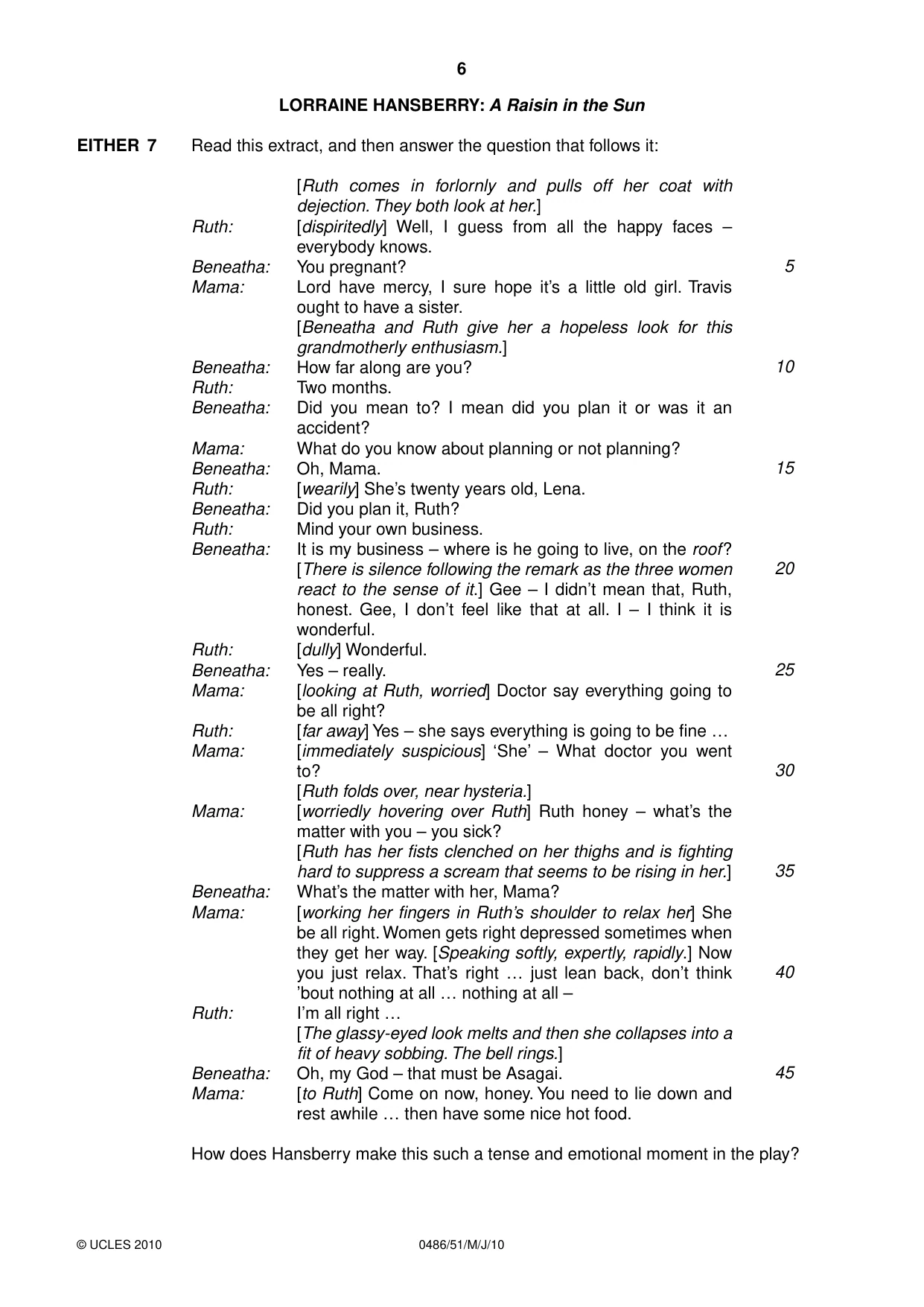
6 0486/51/M/J/10 © UCLES 2010 LORRAINE HANSBERRY: A Raisin in the Sun EITHER 7 Read this extract, and then answer the question that follows it: [Ruth comes in forlornly and pulls off her coat with dejection. They both look at her.] Ruth: [dispiritedly] Well, I guess from all the happy faces – everybody knows. Beneatha: You pregnant? Mama: Lord have mercy, I sure hope it’s a little old girl. Travis ought to have a sister. [Beneatha and Ruth give her a hopeless look for this grandmotherly enthusiasm.] Beneatha: How far along are you? Ruth: Two months. Beneatha: Did you mean to? I mean did you plan it or was it an accident? Mama: What do you know about planning or not planning? Beneatha: Oh, Mama. Ruth: [wearily] She’s twenty years old, Lena. Beneatha: Did you plan it, Ruth? Ruth: Mind your own business. Beneatha: It is my business – where is he going to live, on the roof? [There is silence following the remark as the three women react to the sense of it.] Gee – I didn’t mean that, Ruth, honest. Gee, I don’t feel like that at all. I – I think it is wonderful. Ruth: [dully] Wonderful. Beneatha: Yes – really. Mama: [looking at Ruth, worried] Doctor say everything going to be all right? Ruth: [far away] Yes – she says everything is going to be fine … Mama: [immediately suspicious] ‘She’ – What doctor you went to? [Ruth folds over, near hysteria.] Mama: [worriedly hovering over Ruth] Ruth honey – what’s the matter with you – you sick? [Ruth has her fists clenched on her thighs and is fighting hard to suppress a scream that seems to be rising in her.] Beneatha: What’s the matter with her, Mama? Mama: [working her fingers in Ruth’s shoulder to relax her] She be all right. Women gets right depressed sometimes when they get her way. [Speaking softly, expertly, rapidly.] Now you just relax. That’s right … just lean back, don’t think ’bout nothing at all … nothing at all – Ruth: I’m all right … [The glassy-eyed look melts and then she collapses into a fit of heavy sobbing. The bell rings.] Beneatha: Oh, my God – that must be Asagai. Mama: [to Ruth] Come on now, honey. You need to lie down and rest awhile … then have some nice hot food. How does Hansberry make this such a tense and emotional moment in the play? 5 10 15 20 25 30 35 40 45
Question paper, page 7
7 0486/51/M/J/10 © UCLES 2010 [Turn over OR 8 Does Hansberry make you feel any sympathy for Walter after he has been robbed of his intended investment by Willy? Support your ideas with details from the play. OR 9 You are Mama at the end of the play, thinking about your new home. Write your thoughts.
Question paper, page 8
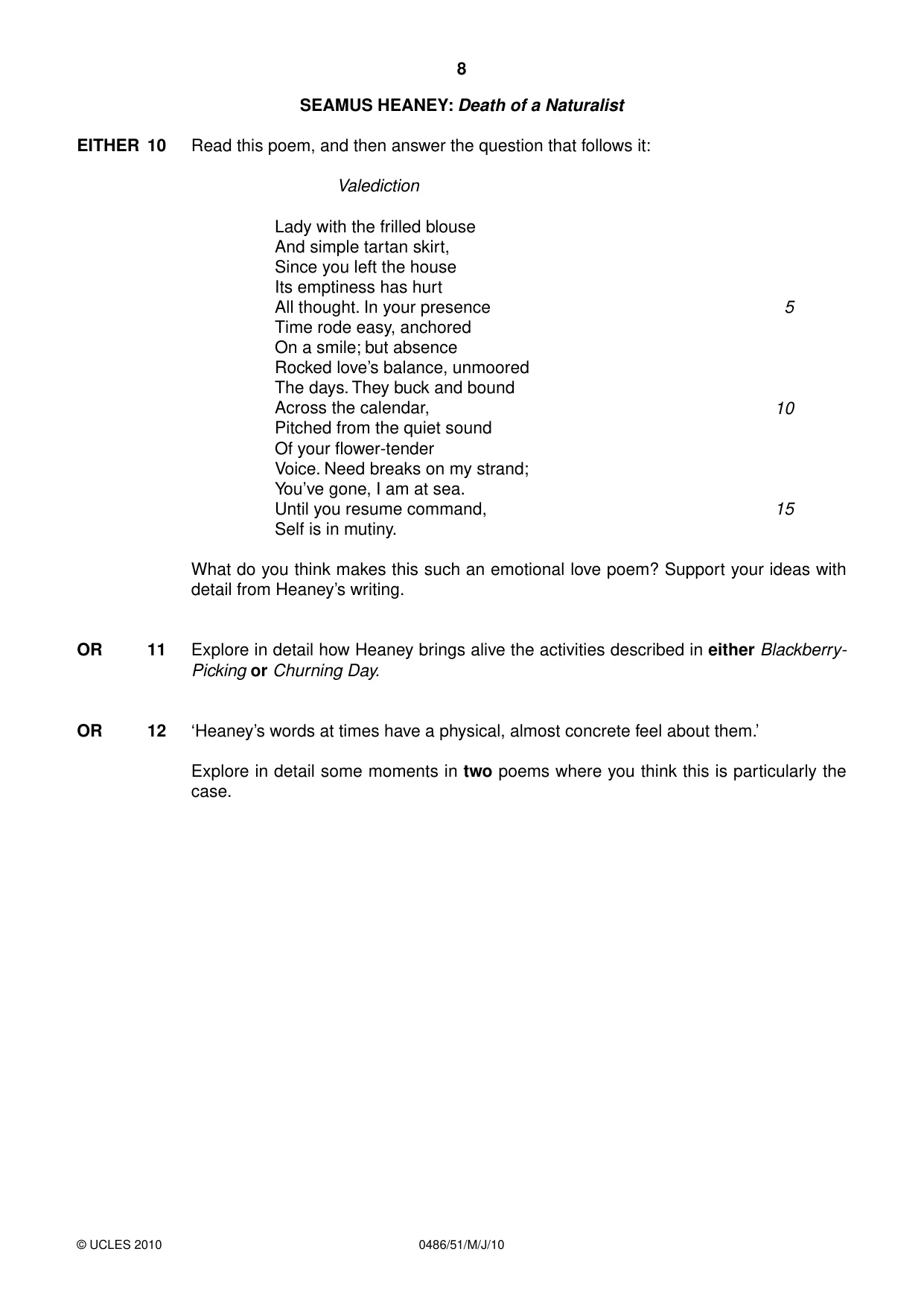
8 0486/51/M/J/10 © UCLES 2010 SEAMUS HEANEY: Death of a Naturalist EITHER 10 Read this poem, and then answer the question that follows it: Valediction Lady with the frilled blouse And simple tartan skirt, Since you left the house Its emptiness has hurt All thought. In your presence Time rode easy, anchored On a smile; but absence Rocked love’s balance, unmoored The days. They buck and bound Across the calendar, Pitched from the quiet sound Of your flower-tender Voice. Need breaks on my strand; You’ve gone, I am at sea. Until you resume command, Self is in mutiny. What do you think makes this such an emotional love poem? Support your ideas with detail from Heaney’s writing. OR 11 Explore in detail how Heaney brings alive the activities described in either Blackberry- Picking or Churning Day. OR 12 ‘Heaney’s words at times have a physical, almost concrete feel about them.’ Explore in detail some moments in two poems where you think this is particularly the case. 5 10 15
Question paper, page 9
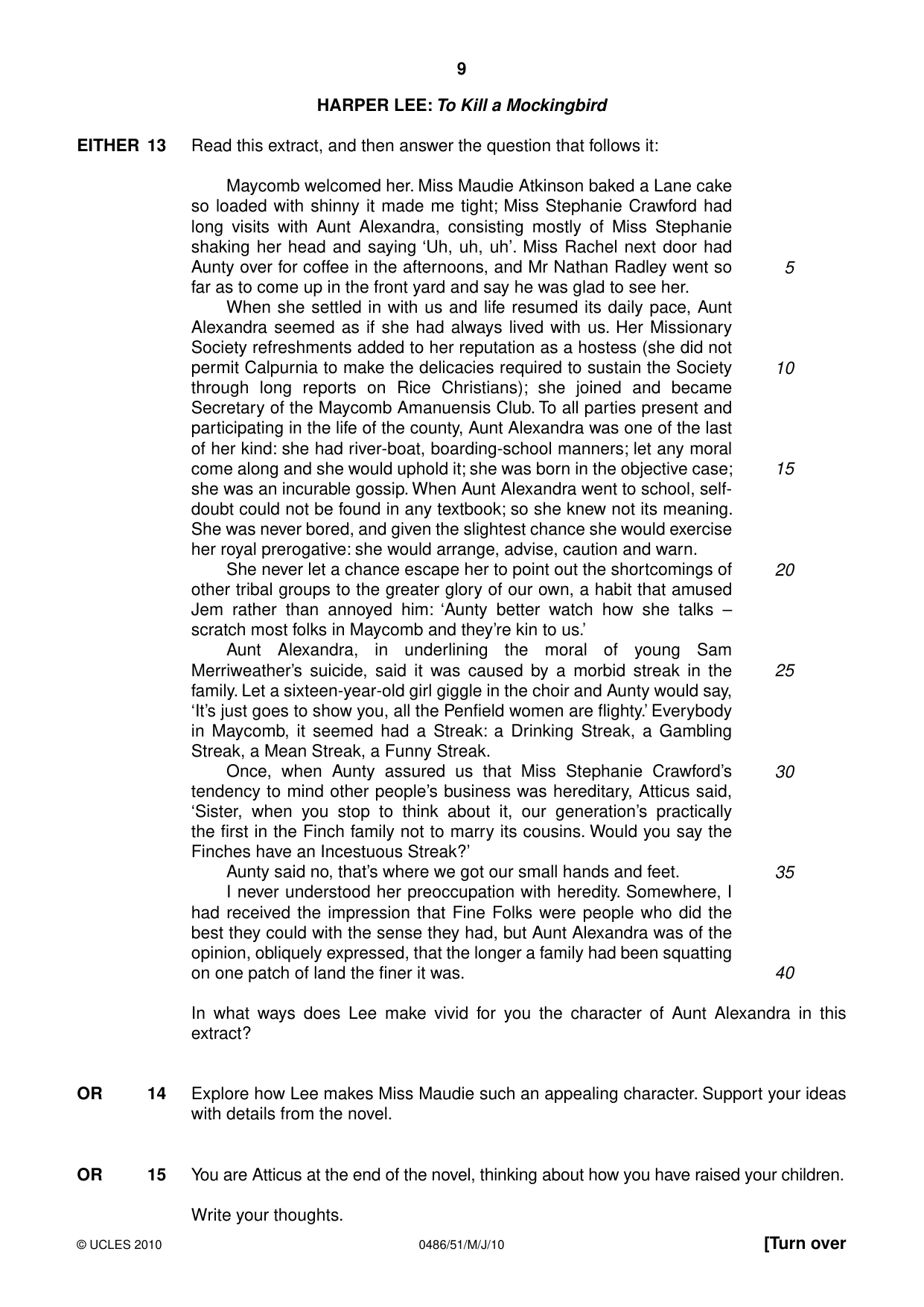
9 0486/51/M/J/10 © UCLES 2010 [Turn over HARPER LEE: To Kill a Mockingbird EITHER 13 Read this extract, and then answer the question that follows it: Maycomb welcomed her. Miss Maudie Atkinson baked a Lane cake so loaded with shinny it made me tight; Miss Stephanie Crawford had long visits with Aunt Alexandra, consisting mostly of Miss Stephanie shaking her head and saying ‘Uh, uh, uh’. Miss Rachel next door had Aunty over for coffee in the afternoons, and Mr Nathan Radley went so far as to come up in the front yard and say he was glad to see her. When she settled in with us and life resumed its daily pace, Aunt Alexandra seemed as if she had always lived with us. Her Missionary Society refreshments added to her reputation as a hostess (she did not permit Calpurnia to make the delicacies required to sustain the Society through long reports on Rice Christians); she joined and became Secretary of the Maycomb Amanuensis Club. To all parties present and participating in the life of the county, Aunt Alexandra was one of the last of her kind: she had river-boat, boarding-school manners; let any moral come along and she would uphold it; she was born in the objective case; she was an incurable gossip. When Aunt Alexandra went to school, self- doubt could not be found in any textbook; so she knew not its meaning. She was never bored, and given the slightest chance she would exercise her royal prerogative: she would arrange, advise, caution and warn. She never let a chance escape her to point out the shortcomings of other tribal groups to the greater glory of our own, a habit that amused Jem rather than annoyed him: ‘Aunty better watch how she talks – scratch most folks in Maycomb and they’re kin to us.’ Aunt Alexandra, in underlining the moral of young Sam Merriweather’s suicide, said it was caused by a morbid streak in the family. Let a sixteen-year-old girl giggle in the choir and Aunty would say, ‘It’s just goes to show you, all the Penfield women are flighty.’ Everybody in Maycomb, it seemed had a Streak: a Drinking Streak, a Gambling Streak, a Mean Streak, a Funny Streak. Once, when Aunty assured us that Miss Stephanie Crawford’s tendency to mind other people’s business was hereditary, Atticus said, ‘Sister, when you stop to think about it, our generation’s practically the first in the Finch family not to marry its cousins. Would you say the Finches have an Incestuous Streak?’ Aunty said no, that’s where we got our small hands and feet. I never understood her preoccupation with heredity. Somewhere, I had received the impression that Fine Folks were people who did the best they could with the sense they had, but Aunt Alexandra was of the opinion, obliquely expressed, that the longer a family had been squatting on one patch of land the finer it was. In what ways does Lee make vivid for you the character of Aunt Alexandra in this extract? OR 14 Explore how Lee makes Miss Maudie such an appealing character. Support your ideas with details from the novel. OR 15 You are Atticus at the end of the novel, thinking about how you have raised your children. Write your thoughts. 5 10 15 20 25 30 35 40
Question paper, page 10
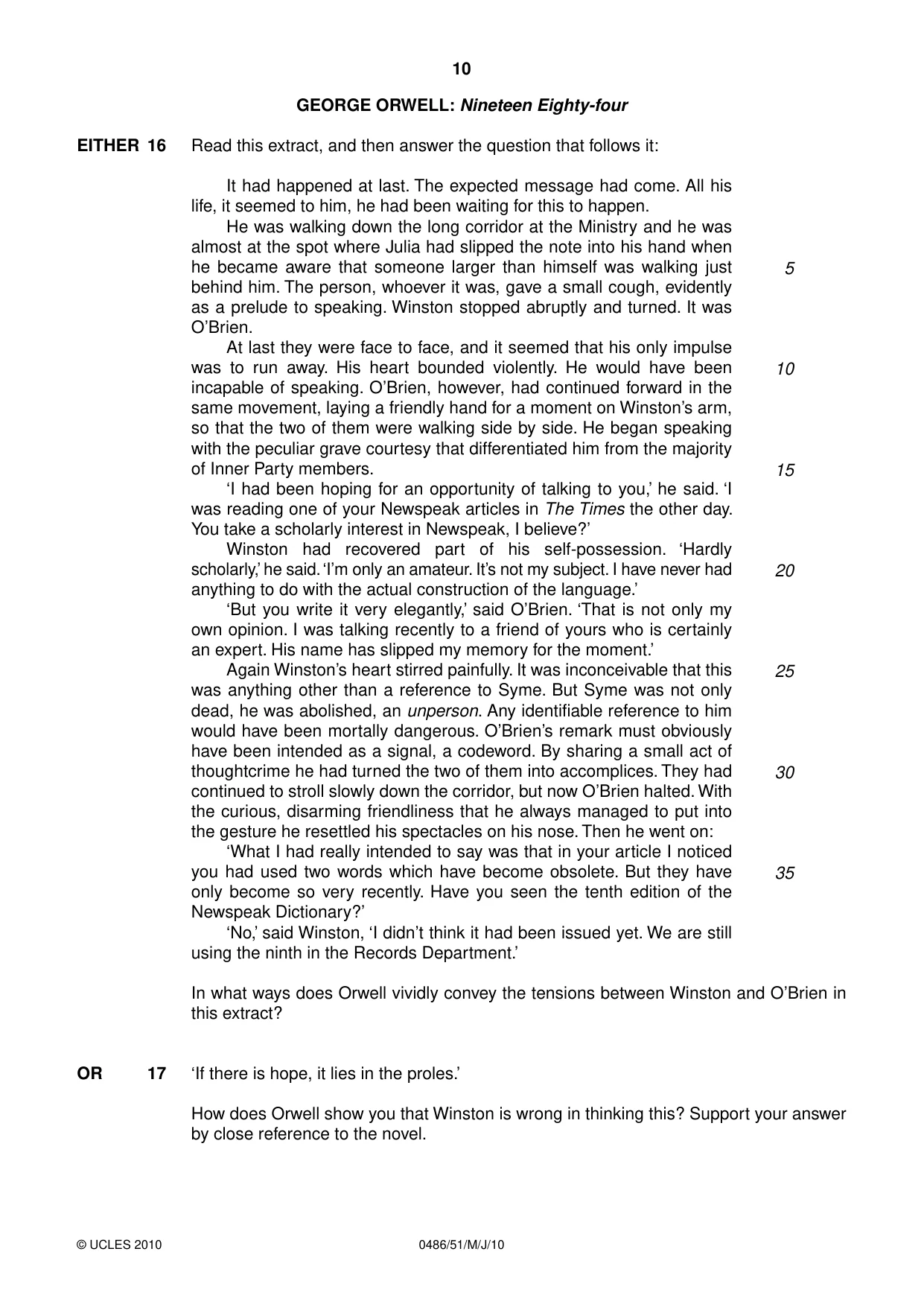
10 0486/51/M/J/10 © UCLES 2010 GEORGE ORWELL: Nineteen Eighty-four EITHER 16 Read this extract, and then answer the question that follows it: It had happened at last. The expected message had come. All his life, it seemed to him, he had been waiting for this to happen. He was walking down the long corridor at the Ministry and he was almost at the spot where Julia had slipped the note into his hand when he became aware that someone larger than himself was walking just behind him. The person, whoever it was, gave a small cough, evidently as a prelude to speaking. Winston stopped abruptly and turned. It was O’Brien. At last they were face to face, and it seemed that his only impulse was to run away. His heart bounded violently. He would have been incapable of speaking. O’Brien, however, had continued forward in the same movement, laying a friendly hand for a moment on Winston’s arm, so that the two of them were walking side by side. He began speaking with the peculiar grave courtesy that differentiated him from the majority of Inner Party members. ‘I had been hoping for an opportunity of talking to you,’ he said. ‘I was reading one of your Newspeak articles in The Times the other day. You take a scholarly interest in Newspeak, I believe?’ Winston had recovered part of his self-possession. ‘Hardly scholarly,’ he said. ‘I’m only an amateur. It’s not my subject. I have never had anything to do with the actual construction of the language.’ ‘But you write it very elegantly,’ said O’Brien. ‘That is not only my own opinion. I was talking recently to a friend of yours who is certainly an expert. His name has slipped my memory for the moment.’ Again Winston’s heart stirred painfully. It was inconceivable that this was anything other than a reference to Syme. But Syme was not only dead, he was abolished, an unperson. Any identifiable reference to him would have been mortally dangerous. O’Brien’s remark must obviously have been intended as a signal, a codeword. By sharing a small act of thoughtcrime he had turned the two of them into accomplices. They had continued to stroll slowly down the corridor, but now O’Brien halted. With the curious, disarming friendliness that he always managed to put into the gesture he resettled his spectacles on his nose. Then he went on: ‘What I had really intended to say was that in your article I noticed you had used two words which have become obsolete. But they have only become so very recently. Have you seen the tenth edition of the Newspeak Dictionary?’ ‘No,’ said Winston, ‘I didn’t think it had been issued yet. We are still using the ninth in the Records Department.’ In what ways does Orwell vividly convey the tensions between Winston and O’Brien in this extract? OR 17 ‘If there is hope, it lies in the proles.’ How does Orwell show you that Winston is wrong in thinking this? Support your answer by close reference to the novel. 5 10 15 20 25 30 35
Question paper, page 11
11 0486/51/M/J/10 © UCLES 2010 [Turn over OR 18 You are Julia. You have just arranged to meet Winston for the first time in Victory Square. Write your thoughts.
Question paper, page 12
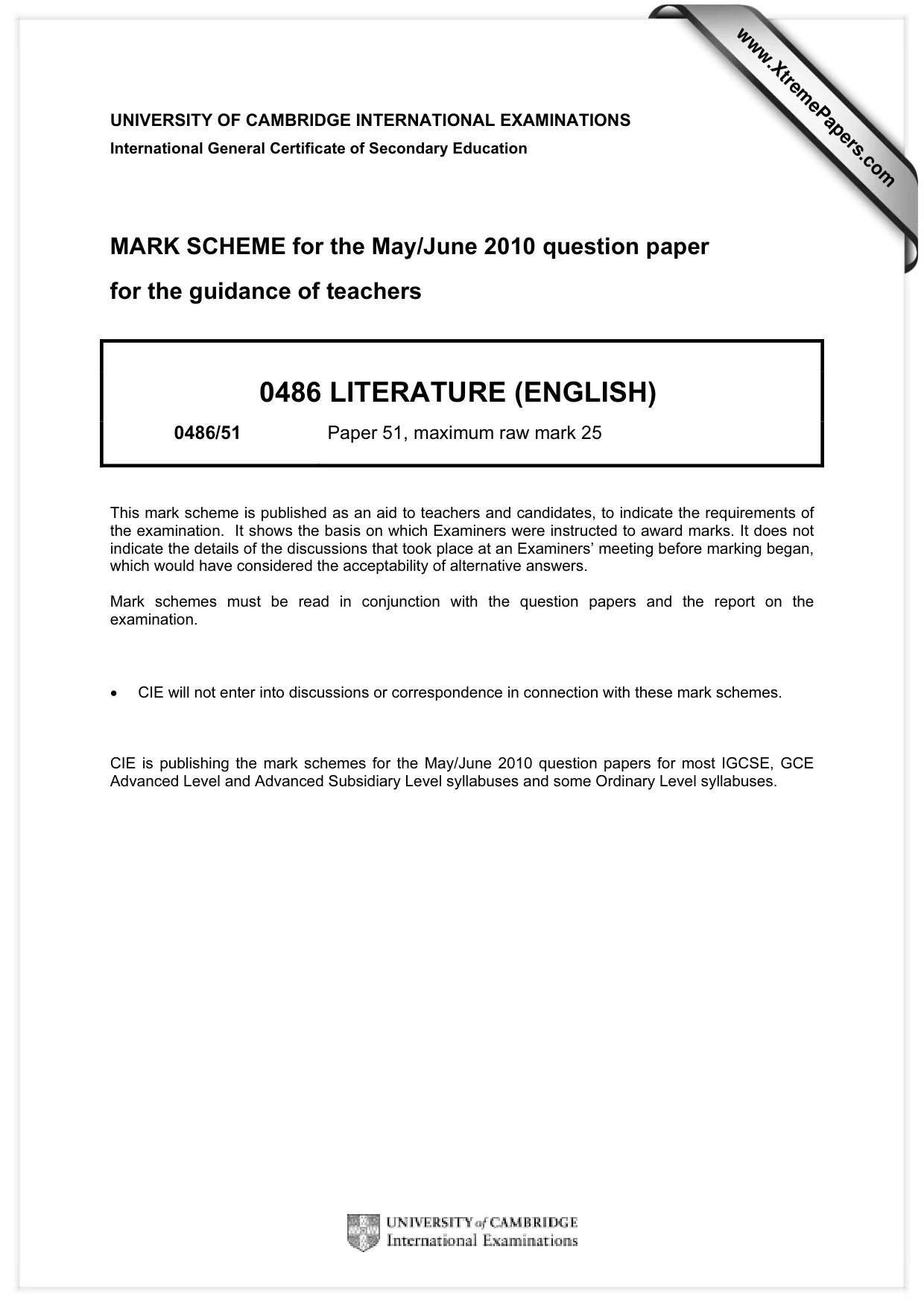
12 0486/51/M/J/10 © UCLES 2010 5 10 15 20 25 30 35 40 45 50 WILLIAM SHAKESPEARE: Romeo and Juliet EITHER 19 Read this extract, and then answer the question that follows it: Lady Capulet: Nurse, where’s my daughter? Call her forth to me. Nurse: Now, by my maidenhead at twelve year old, I bade her come. What, lamb! what, lady-bird! God forbid! Where’s this girl? What, Juliet! Enter Juliet. Juliet: How now, who calls? Nurse: Your mother. Juliet: Madam, I am here. What is your will? Lady Capulet: This is the matter. Nurse, give leave awhile, We must talk in secret. Nurse, come back again; I have rememb’red me, thou’s hear our counsel. Thou knowest my daughter’s of a pretty age. Nurse: Faith, I can tell her age unto an hour. Lady Capulet: She’s not fourteen. Nurse: I’ll lay fourteen of my teeth – And yet, to my teen be it spoken, I have but four – She’s not fourteen. How long is it now To Lammas-tide? Lady Capulet: A fortnight and odd days. Nurse: Even or odd, of all days in the year, Come Lammas Eve at night shall she be fourteen. Susan and she – God rest all Christian souls! – Were of an age. Well, Susan is with God; She was too good for me. But, as I said, On Lammas Eve at night shall she be fourteen; That shall she, marry; I remember it well. ’Tis since the earthquake now eleven years; And she was wean’d – I never shall forget it – Of all the days of the year, upon that day; For I had then laid wormwood to my dug, Sitting in the sun under the dove-house wall; My lord and you were then at Mantua. Nay, I do bear a brain. But, as I said, When it did taste the wormwood on the nipple Of my dug, and felt it bitter, pretty fool, To see it tetchy, and fall out with the dug! Shake, quoth the dove-house. ’Twas no need, I trow, To bid me trudge. And since that time it is eleven years; For then she could stand high-lone; nay, by th’ rood, She could have run and waddled all about; For even the day before, she broke her brow; And then my husband – God be with his soul! ’A was a merry man – took up the child. ‘Yea,’ quoth he ‘dost thou fall upon thy face? Thou wilt fall backward when thou hast more wit, Wilt thou not, Jule?’ And, by my holidam, The pretty wretch left crying, and said ‘Ay’. To see, now, how a jest shall come about! I warrant, an I should live a thousand years,
Question paper, page 13
13 0486/51/M/J/10 © UCLES 2010 55 60 I never should forget it: ‘Wilt thou not, Jule?’ quoth he; And, pretty fool, it stinted, and said ‘Ay’. Lady Capulet: Enough of this; I pray thee hold thy peace. Nurse: Yes, madam. Yet I cannot choose but laugh To think it should leave crying and say ‘Ay’. And yet, I warrant, it had upon it brow A bump as big as a young cock’rel’s stone – A perilous knock; and it cried bitterly. ‘Yea,’ quoth my husband ‘fall’st upon thy face? Thou wilt fall backward when thou comest to age; Wilt thou not, Jule?’ It stinted, and said ‘Ay’. Juliet: And stint thou too, I pray thee, nurse, say I. Nurse: Peace, I have done. God mark thee to his grace! What impressions of the Nurse do you think Shakespeare creates here? Support your views with details from the extract. OR 20 A heroic and tragic young lover A foolish and rash youth In your opinion which of these descriptions is nearer to the truth of Shakespeare’s portrayal of Romeo? Support your opinions with details from the writing. OR 21 You are Friar Lawrence at the end of the play. You are about to explain your actions to the Prince. Write your thoughts.
Question paper, page 14
14 0486/51/M/J/10 © UCLES 2010 BLANK PAGE
Question paper, page 15
15 0486/51/M/J/10 © UCLES 2010 BLANK PAGE
Question paper, page 16
16 0486/51/M/J/10 © UCLES 2010 Copyright Acknowledgements: Question 1 © Brian Clark; Whose Life is it Anyway? Heinemann; 1993. Question 7 © Lorraine Hansberry; A Raisin in the Sun; Methuen Drama, A& C Black; 2001. Question 13 © from To Kill A Mockingbird by Harper Lee, published by William Heinemann Ltd. Reprinted by permission of The Random House Group Ltd. Permission to reproduce items where third-party owned material protected by copyright is included has been sought and cleared where possible. Every reasonable effort has been made by the publisher (UCLES) to trace copyright holders, but if any items requiring clearance have unwittingly been included, the publisher will be pleased to make amends at the earliest possible opportunity. University of Cambridge International Examinations is part of the Cambridge Assessment Group. Cambridge Assessment is the brand name of University of Cambridge Local Examinations Syndicate (UCLES), which is itself a department of the University of Cambridge. BLANK PAGE
Mark scheme, page 1
UNIVERSITY OF CAMBRIDGE INTERNATIONAL EXAMINATIONS International General Certificate of Secondary Education MARK SCHEME for the May/June 2010 question paper for the guidance of teachers 0486 LITERATURE (ENGLISH) 0486/51 Paper 51, maximum raw mark 25 This mark scheme is published as an aid to teachers and candidates, to indicate the requirements of the examination. It shows the basis on which Examiners were instructed to award marks. It does not indicate the details of the discussions that took place at an Examiners’ meeting before marking began, which would have considered the acceptability of alternative answers. Mark schemes must be read in conjunction with the question papers and the report on the examination. • CIE will not enter into discussions or correspondence in connection with these mark schemes. CIE is publishing the mark schemes for the May/June 2010 question papers for most IGCSE, GCE Advanced Level and Advanced Subsidiary Level syllabuses and some Ordinary Level syllabuses. www.XtremePapers.com
Mark scheme, page 2
Page 2 Mark Scheme: Teachers’ version Syllabus Paper IGCSE – May/June 2010 0486 51 © UCLES 2010 Introduction All questions on this paper are marked out of 25. The assessment objectives for the paper are: AO1 show detailed knowledge of the content of literary texts AO2 understand the meanings of literary texts and their context, and explore texts beyond surface meaning to show deeper awareness of ideas and attitudes AO3 recognise and appreciate ways in which writers use language, structure, and form to create and shape meanings and effects AO4 communicate a sensitive and informed personal response The General Descriptors cover marks from 0 to 25, and apply to the marking of each question. They guide examiners to an understanding of the qualities normally expected of, or typical of, work in a band. They are a means of general guidance, and must not be interpreted as hurdle statements. For the purposes of standardisation of marking, they are to be used in conjunction with photostats of candidates’ work produced in the examination and discussed during the examiners’ coordination meeting, as well as the question-specific notes. The notes for each question are related to the assessment objectives above. Because of the nature of the subject, they are for general guidance; they are not designed as prescriptions of required content and must not be treated as such.
Mark scheme, page 3
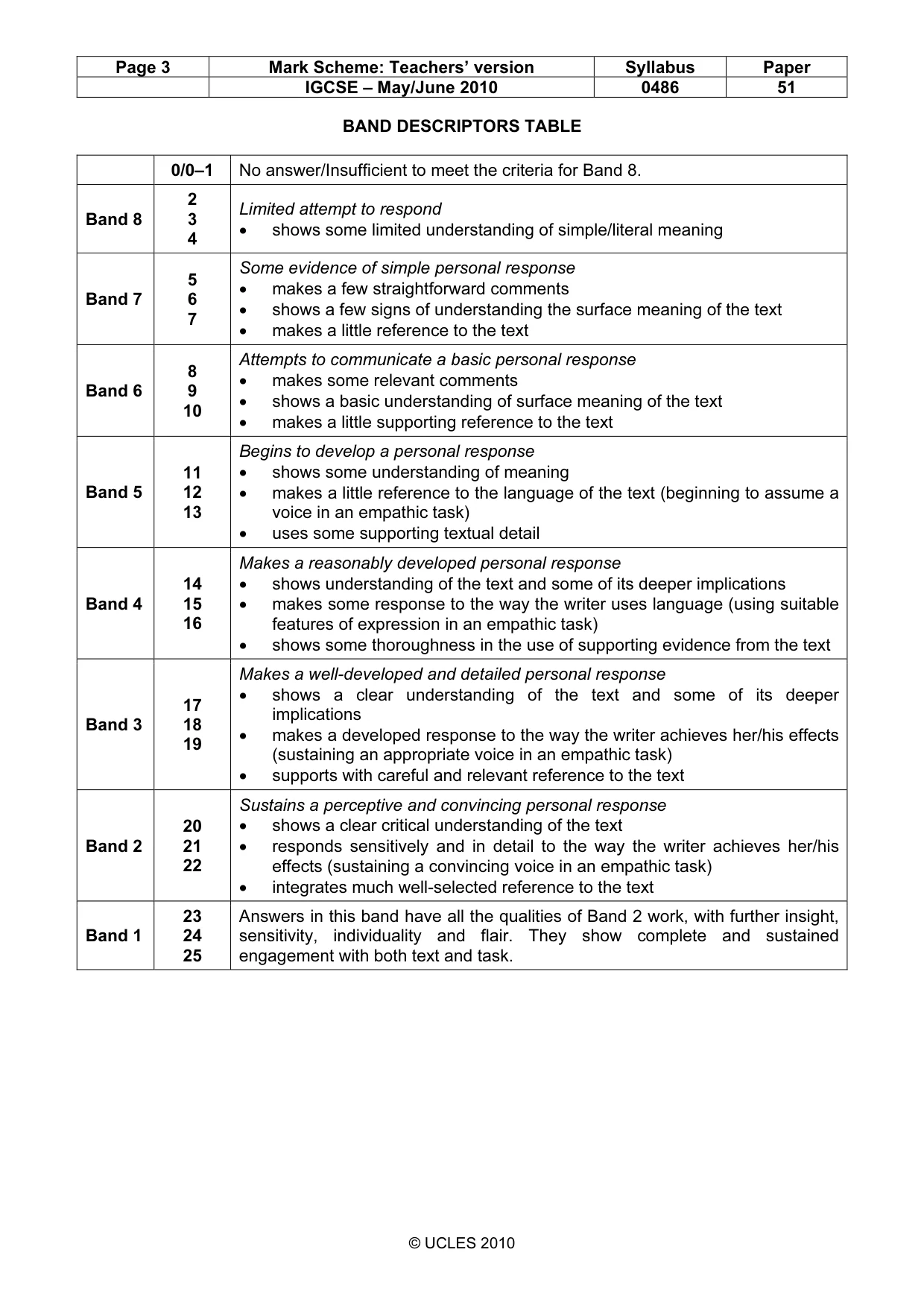
Page 3 Mark Scheme: Teachers’ version Syllabus Paper IGCSE – May/June 2010 0486 51 © UCLES 2010 BAND DESCRIPTORS TABLE 0/0–1 No answer/Insufficient to meet the criteria for Band 8. Band 8 2 3 4 Limited attempt to respond • shows some limited understanding of simple/literal meaning Band 7 5 6 7 Some evidence of simple personal response • makes a few straightforward comments • shows a few signs of understanding the surface meaning of the text • makes a little reference to the text Band 6 8 9 10 Attempts to communicate a basic personal response • makes some relevant comments • shows a basic understanding of surface meaning of the text • makes a little supporting reference to the text Band 5 11 12 13 Begins to develop a personal response • shows some understanding of meaning • makes a little reference to the language of the text (beginning to assume a voice in an empathic task) • uses some supporting textual detail Band 4 14 15 16 Makes a reasonably developed personal response • shows understanding of the text and some of its deeper implications • makes some response to the way the writer uses language (using suitable features of expression in an empathic task) • shows some thoroughness in the use of supporting evidence from the text Band 3 17 18 19 Makes a well-developed and detailed personal response • shows a clear understanding of the text and some of its deeper implications • makes a developed response to the way the writer achieves her/his effects (sustaining an appropriate voice in an empathic task) • supports with careful and relevant reference to the text Band 2 20 21 22 Sustains a perceptive and convincing personal response • shows a clear critical understanding of the text • responds sensitively and in detail to the way the writer achieves her/his effects (sustaining a convincing voice in an empathic task) • integrates much well-selected reference to the text Band 1 23 24 25 Answers in this band have all the qualities of Band 2 work, with further insight, sensitivity, individuality and flair. They show complete and sustained engagement with both text and task.
Mark scheme, page 4
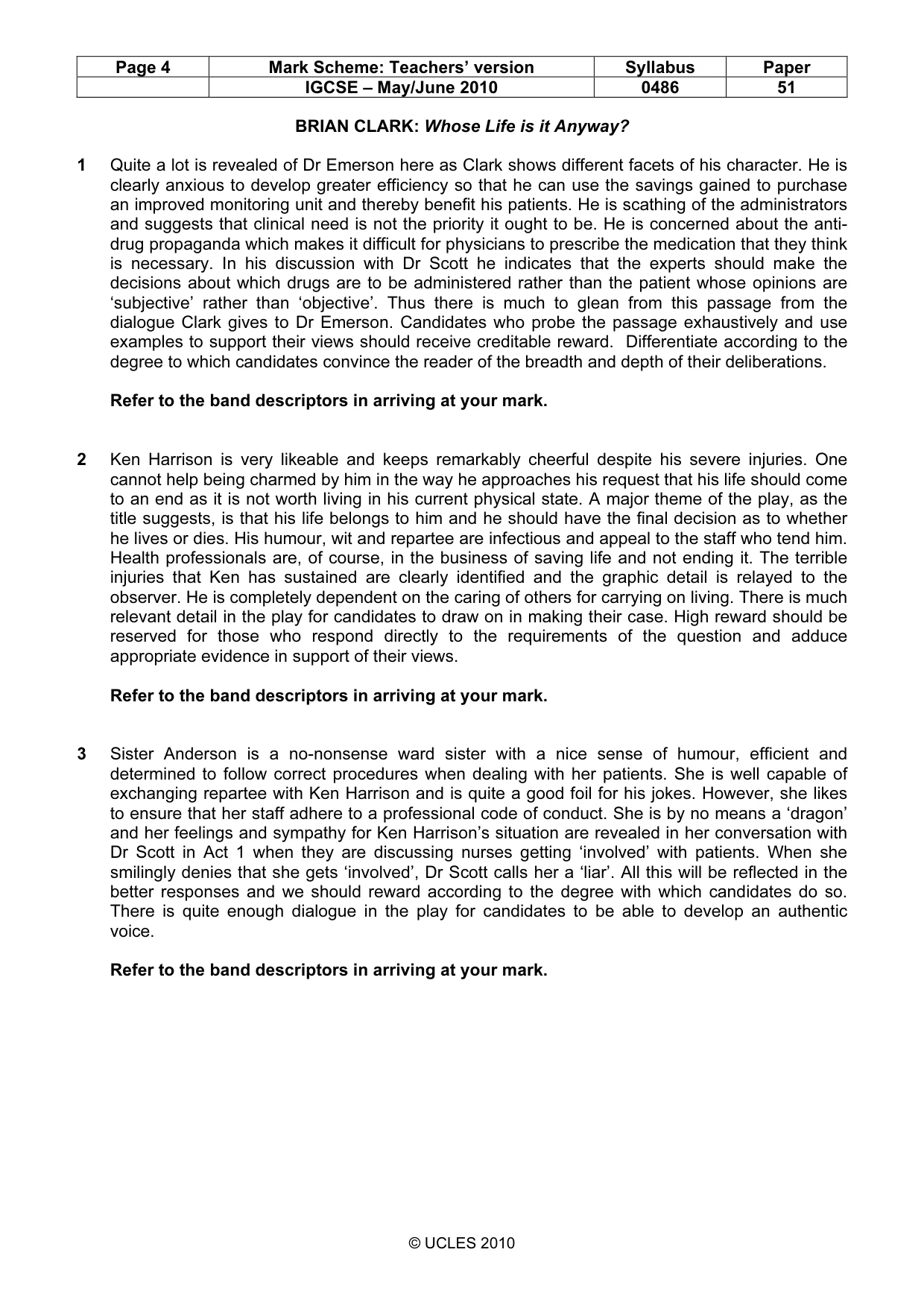
Page 4 Mark Scheme: Teachers’ version Syllabus Paper IGCSE – May/June 2010 0486 51 © UCLES 2010 BRIAN CLARK: Whose Life is it Anyway? 1 Quite a lot is revealed of Dr Emerson here as Clark shows different facets of his character. He is clearly anxious to develop greater efficiency so that he can use the savings gained to purchase an improved monitoring unit and thereby benefit his patients. He is scathing of the administrators and suggests that clinical need is not the priority it ought to be. He is concerned about the anti- drug propaganda which makes it difficult for physicians to prescribe the medication that they think is necessary. In his discussion with Dr Scott he indicates that the experts should make the decisions about which drugs are to be administered rather than the patient whose opinions are ‘subjective’ rather than ‘objective’. Thus there is much to glean from this passage from the dialogue Clark gives to Dr Emerson. Candidates who probe the passage exhaustively and use examples to support their views should receive creditable reward. Differentiate according to the degree to which candidates convince the reader of the breadth and depth of their deliberations. Refer to the band descriptors in arriving at your mark. 2 Ken Harrison is very likeable and keeps remarkably cheerful despite his severe injuries. One cannot help being charmed by him in the way he approaches his request that his life should come to an end as it is not worth living in his current physical state. A major theme of the play, as the title suggests, is that his life belongs to him and he should have the final decision as to whether he lives or dies. His humour, wit and repartee are infectious and appeal to the staff who tend him. Health professionals are, of course, in the business of saving life and not ending it. The terrible injuries that Ken has sustained are clearly identified and the graphic detail is relayed to the observer. He is completely dependent on the caring of others for carrying on living. There is much relevant detail in the play for candidates to draw on in making their case. High reward should be reserved for those who respond directly to the requirements of the question and adduce appropriate evidence in support of their views. Refer to the band descriptors in arriving at your mark. 3 Sister Anderson is a no-nonsense ward sister with a nice sense of humour, efficient and determined to follow correct procedures when dealing with her patients. She is well capable of exchanging repartee with Ken Harrison and is quite a good foil for his jokes. However, she likes to ensure that her staff adhere to a professional code of conduct. She is by no means a ‘dragon’ and her feelings and sympathy for Ken Harrison’s situation are revealed in her conversation with Dr Scott in Act 1 when they are discussing nurses getting ‘involved’ with patients. When she smilingly denies that she gets ‘involved’, Dr Scott calls her a ‘liar’. All this will be reflected in the better responses and we should reward according to the degree with which candidates do so. There is quite enough dialogue in the play for candidates to be able to develop an authentic voice. Refer to the band descriptors in arriving at your mark.
Mark scheme, page 5
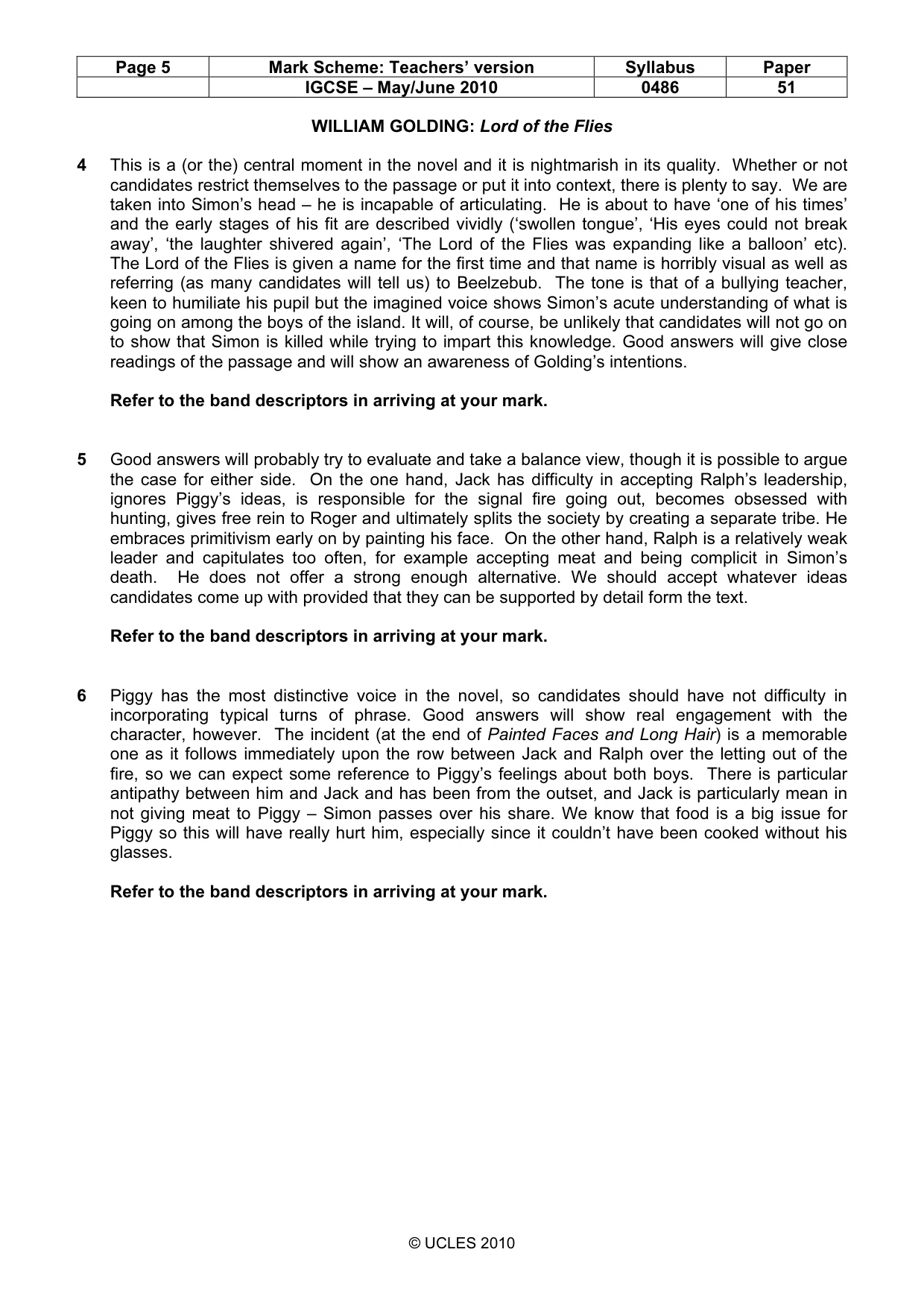
Page 5 Mark Scheme: Teachers’ version Syllabus Paper IGCSE – May/June 2010 0486 51 © UCLES 2010 WILLIAM GOLDING: Lord of the Flies 4 This is a (or the) central moment in the novel and it is nightmarish in its quality. Whether or not candidates restrict themselves to the passage or put it into context, there is plenty to say. We are taken into Simon’s head – he is incapable of articulating. He is about to have ‘one of his times’ and the early stages of his fit are described vividly (‘swollen tongue’, ‘His eyes could not break away’, ‘the laughter shivered again’, ‘The Lord of the Flies was expanding like a balloon’ etc). The Lord of the Flies is given a name for the first time and that name is horribly visual as well as referring (as many candidates will tell us) to Beelzebub. The tone is that of a bullying teacher, keen to humiliate his pupil but the imagined voice shows Simon’s acute understanding of what is going on among the boys of the island. It will, of course, be unlikely that candidates will not go on to show that Simon is killed while trying to impart this knowledge. Good answers will give close readings of the passage and will show an awareness of Golding’s intentions. Refer to the band descriptors in arriving at your mark. 5 Good answers will probably try to evaluate and take a balance view, though it is possible to argue the case for either side. On the one hand, Jack has difficulty in accepting Ralph’s leadership, ignores Piggy’s ideas, is responsible for the signal fire going out, becomes obsessed with hunting, gives free rein to Roger and ultimately splits the society by creating a separate tribe. He embraces primitivism early on by painting his face. On the other hand, Ralph is a relatively weak leader and capitulates too often, for example accepting meat and being complicit in Simon’s death. He does not offer a strong enough alternative. We should accept whatever ideas candidates come up with provided that they can be supported by detail form the text. Refer to the band descriptors in arriving at your mark. 6 Piggy has the most distinctive voice in the novel, so candidates should have not difficulty in incorporating typical turns of phrase. Good answers will show real engagement with the character, however. The incident (at the end of Painted Faces and Long Hair) is a memorable one as it follows immediately upon the row between Jack and Ralph over the letting out of the fire, so we can expect some reference to Piggy’s feelings about both boys. There is particular antipathy between him and Jack and has been from the outset, and Jack is particularly mean in not giving meat to Piggy – Simon passes over his share. We know that food is a big issue for Piggy so this will have really hurt him, especially since it couldn’t have been cooked without his glasses. Refer to the band descriptors in arriving at your mark.
Mark scheme, page 6
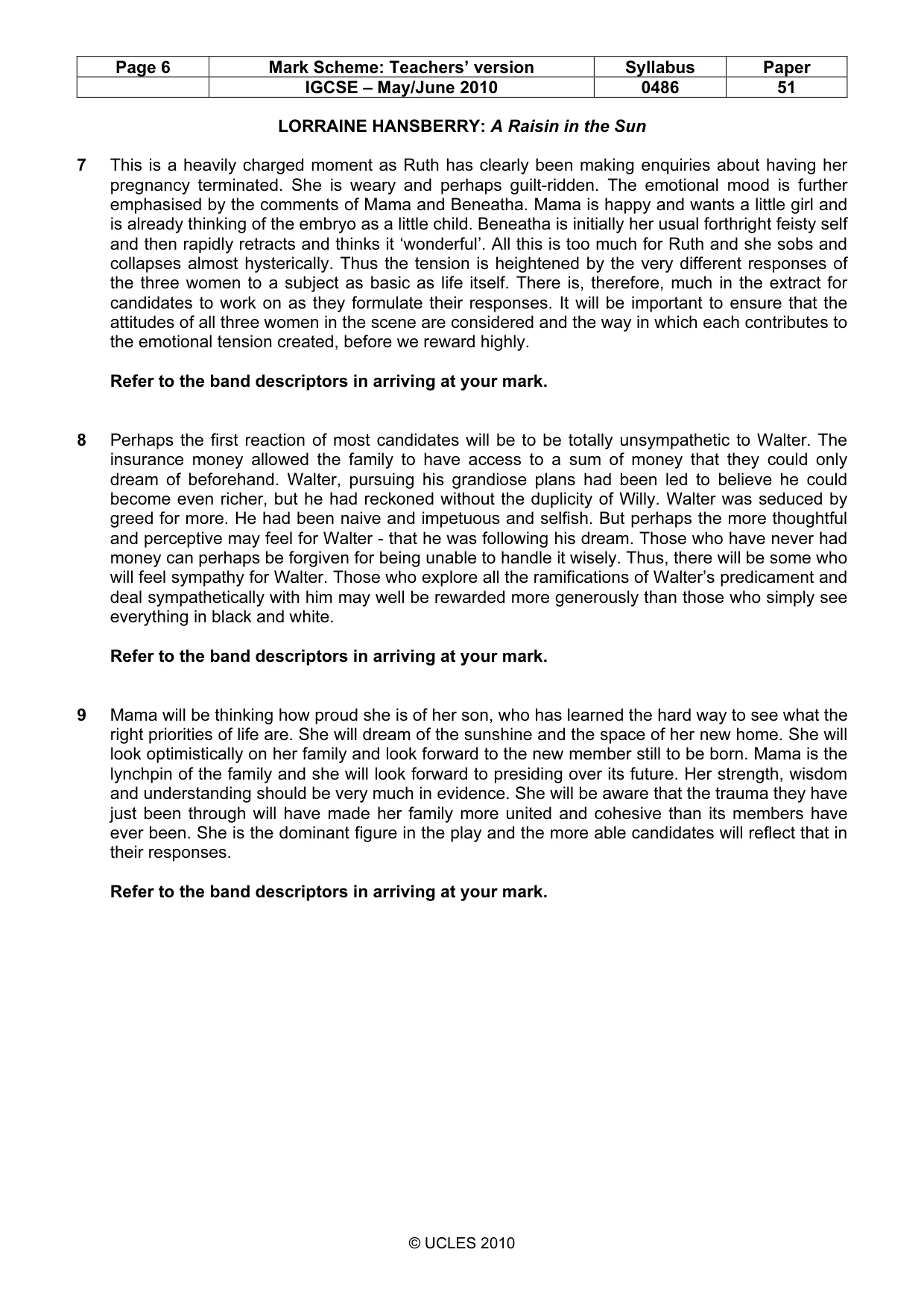
Page 6 Mark Scheme: Teachers’ version Syllabus Paper IGCSE – May/June 2010 0486 51 © UCLES 2010 LORRAINE HANSBERRY: A Raisin in the Sun 7 This is a heavily charged moment as Ruth has clearly been making enquiries about having her pregnancy terminated. She is weary and perhaps guilt-ridden. The emotional mood is further emphasised by the comments of Mama and Beneatha. Mama is happy and wants a little girl and is already thinking of the embryo as a little child. Beneatha is initially her usual forthright feisty self and then rapidly retracts and thinks it ‘wonderful’. All this is too much for Ruth and she sobs and collapses almost hysterically. Thus the tension is heightened by the very different responses of the three women to a subject as basic as life itself. There is, therefore, much in the extract for candidates to work on as they formulate their responses. It will be important to ensure that the attitudes of all three women in the scene are considered and the way in which each contributes to the emotional tension created, before we reward highly. Refer to the band descriptors in arriving at your mark. 8 Perhaps the first reaction of most candidates will be to be totally unsympathetic to Walter. The insurance money allowed the family to have access to a sum of money that they could only dream of beforehand. Walter, pursuing his grandiose plans had been led to believe he could become even richer, but he had reckoned without the duplicity of Willy. Walter was seduced by greed for more. He had been naive and impetuous and selfish. But perhaps the more thoughtful and perceptive may feel for Walter - that he was following his dream. Those who have never had money can perhaps be forgiven for being unable to handle it wisely. Thus, there will be some who will feel sympathy for Walter. Those who explore all the ramifications of Walter’s predicament and deal sympathetically with him may well be rewarded more generously than those who simply see everything in black and white. Refer to the band descriptors in arriving at your mark. 9 Mama will be thinking how proud she is of her son, who has learned the hard way to see what the right priorities of life are. She will dream of the sunshine and the space of her new home. She will look optimistically on her family and look forward to the new member still to be born. Mama is the lynchpin of the family and she will look forward to presiding over its future. Her strength, wisdom and understanding should be very much in evidence. She will be aware that the trauma they have just been through will have made her family more united and cohesive than its members have ever been. She is the dominant figure in the play and the more able candidates will reflect that in their responses. Refer to the band descriptors in arriving at your mark.
Mark scheme, page 7
Page 7 Mark Scheme: Teachers’ version Syllabus Paper IGCSE – May/June 2010 0486 51 © UCLES 2010 SEAMUS HEANEY: Death of a Naturalist 10–12 Poetry is literary language at its most intense. A good poem in a short space creates a multiplicity of resonances and hence possible meanings. We must expect that candidates will offer a very wide variety of responses and interpretations. In the exercise of our judgment, we shall, of course, read work which shows manifestly little or no understanding of a poem and we will mark that accordingly. However, it is also a regular experience to find answers which offer valid perspectives new to the examiner and which, just as manifestly, deserve to be given high reward. We will differentiate first of all according to how directly the candidates answer the question. We must be very careful not to give much reward for answers which manifestly are not addressing the question, even if they show a convincing grasp of the poem. Tasks are never simple invitations to write about a poem. We should think very hard before putting such work in Band 4. Beyond focus on the question, we will also assess according to how well candidates convince us that they have engaged with the pleasure and excitement of good poetry. This means in effect that we do not give high reward to any explanation of "meaning" which shows little response to the words and how they create meaning. In all of the questions there is an explicit requirement to make a response to the words and it will be difficult for any work which fails to engage in this way to progress beyond Band 4. In addition, examiners should be careful not to over reward comment which is able to isolate vivid features of a poem’s language but which is unable to probe the reasons for their vividness. For instance, the noting of rhyme, sound and movement, the listing of significant words and figures of speech is only a very small first step to insightful personal response. Work given high reward should show the ability of the candidate to analyse how such features of a poem’s language achieve their effect. Refer to the band descriptors in arriving at your mark.
Mark scheme, page 8
Page 8 Mark Scheme: Teachers’ version Syllabus Paper IGCSE – May/June 2010 0486 51 © UCLES 2010 HARPER LEE: To Kill a Mockingbird 13 Aunt Alexandra is clearly a strong woman with very strong opinions and those opinions are very firmly entrenched. There is much material in the passage for candidates to bring to bear on their comments: ‘she did not permit Calpurnia to make the delicacies…’; ‘she had river-boat, boarding- school manners; let any moral come along and she would uphold it; she was born in the objective case.’ These last two are particularly apposite and surely the sharper candidates will see the irony and implied humour in them. She did not know the meaning of self-doubt. At the end of the second paragraph is a gem of a statement: ‘She was never bored, and given the slightest chance she would exercise her royal prerogative: she would arrange, advise, caution and warn.’ The comment on ‘other tribal groups’ is especially revealing. This is an extract loaded with incisive implications and thinly veiled sarcasm. There are rich seams for the more perspicacious to mine. We shall surely find the means of clear differentiation between the good and the outstanding in our candidates’ offerings. Refer to the band descriptors in arriving at your mark. 14 Miss Maudie is a very positive character. Lee gives her a nice sense of humour and there is very little to criticise in her. She abhors small-time gossip, shows no colour prejudice, respects the children and does not talk down to them. She is firm in her opinions about justice and religion. She does not like extremists and detests those who use religion as a weapon against their fellow human beings. She speaks crisply and clearly and laces her comments with humour and forbearance. She recognises Atticus’s integrity and sense of justice for all. Thus, this is a straightforward task for those who know the book well and can recognise Miss Maudie’s characteristics - and equally importantly - provide appropriate evidence from the novel to support their views. Bearing all this in mind, differentiation should be relatively easy to achieve. Refer to the band descriptors in arriving at your mark. 15 Atticus’s qualities are commendable. But as he reflects on the way he has brought up his children, he will surely question some of the decisions he has made about them. Did he subject them to possible danger in the stance he took with regard to Tom Robinson? He will clearly remember the incident with Bob Ewell when both children were attacked. Should they have attended the court proceedings? Were they given too much freedom? Were they treated more like adults than children? These considerations will surely go through his mind as he ponders this question. He will also see their many attractive characteristics – their thoughtfulness, their courage and, especially with regard to Jem, their concern for each other. Of course, the voice will be decisive in determining the level of reward to be apportioned, but this empathic question also merits many textual echoes and references if candidates are to score highly. Refer to the band descriptors in arriving at your mark.
Mark scheme, page 9
Page 9 Mark Scheme: Teachers’ version Syllabus Paper IGCSE – May/June 2010 0486 51 © UCLES 2010 GEORGE ORWELL: Ninteen Eighty-Four 16 The passage is taken from Part Two, Chapter 6 Winston has clearly been anticipating and hoping for this meeting and from the outset O’Brien is portrayed as the dominant figure, ‘someone larger than himself’ (Winston) in every sense. There is an almost god-like quality to O’Brien, which renders Winston incapable of speech he is so much in awe. O’Brien’s demeanour is friendly and dignified, however, and Winston almost recovers his composure, but the oblique reference to Syme indicates that this conversation has hidden agendas and puts him on edge again. O’Brien’s disingenuousness is clear, but Winston so wants to believe in his friendship and in him as a kindred spirit, that he does not want to believe it. Key to this incident, however is that the meeting exactly parallels the meeting with Julia only this time the note is openly passed in front of the telescreen, so is Winston meant to see it as approval or as a threat? Though there is no direct instruction to refer outside the passage good answers will be informed by knowledge of the rest of the text and of the way in which O’Brien ‘plays’ Winston throughout. They will examine the writing in some detail. Refer to the band descriptors in arriving at your mark. 17 There is never any evidence that the proles will rebel and bring down the party. They are presented as the lowest of the low even though they are 85% of the population. The Party does not even waste effort or time on indoctrination. Syme represents the party view that they are not human beings and that ‘by 2050 all real knowledge of Oldspeak will have disappeared’ so they will not be able to read or form ideas. Winston has memories of a small riot in a market which indicates their potential power, but they show no indication of organising themselves in order to use it. The Party clearly sees no threat in them, just leaving them to their own devices, so presumably they have nothing to rebel against. Winston himself sees the absurdity of the idea but clings on to it. There is a central episode just before Winston finds Mr Charrington’s shop, which demonstrates the uselessness of the idea; the lottery is of more interest to the proles than the air raid, and the visit to the pub indicates the complete lack of memory of earlier and better times. Even the old man’s memory is ‘nothing more than a rubbish heap of details. Refer to the band descriptors in arriving at your mark. 18 Candidates should draw on their knowledge of Julia throughout the novel to create a convincing voice. It will be interesting to see how they interpret her motivation and feelings for Winston – after all, she makes the first move in passing the note to him and the note is not only a surprise to Winston, but also to the reader. We are led to believe that there is little that is physically attractive about him so that it is difficult to see how such strong feelings have arisen but candidates will come up with their own theories as to how she has come to sense that he is a kindred spirit. Her reading of his reactions to her first approach and in the cafeteria will be vital. She will also have her views on the Party. Though at this point she has not visited Mr Charrington’s room, candidates may well speculate about how the relationship is likely to proceed. Good answers will show engagement with the character and will create a convincing voice. Refer to the band descriptors in arriving at your mark.
Mark scheme, page 10
Page 10 Mark Scheme: Teachers’ version Syllabus Paper IGCSE – May/June 2010 0486 51 © UCLES 2010 WILLIAM SHAKESPEARE:Romeo and Juliet 19 Most of the attributes of the Nurse are in this extract, ranging form the loving and the loveable to the annoying and the self important. The important thing is that we are not given a general character sketch with the passing nod at the extract. We shall expect the candidate even for reasonable reward to engage with the detail of the passage and for there to be some evidence of response to her very characteristic modes of speech. For high reward we shall look for that to be a central feature of the answer. Refer to the band descriptors in arriving at your mark. 20 Again the format of the task demands judgment and argument and not just a run through of features of the character and we should not give even reasonable reward to candidates who do not conduct some form of developed argument based on the two descriptions. Clearly there are features in the dramatic creation which fit either and we should accept any opinion heavily weighted to one or the other, provided it is well supported. However, the better answers will probably achieve some sort of balance, at least recognising the truth of both somewhere in the play. In addition, for high reward we shall require close engagement with the detail of the drama and its language. Refer to the band descriptors in arriving at your mark. 21 Friar Lawrence will be in some trepidation as to what awaits him. He will also be experiencing feelings of considerable guilt concerning his role in the marriage of the young lovers. Being a man of God, he is resigned to whatever punishment may be meted out and it could be harsh given his deep involvment. However, as his speech to the Prince shows, he determines to conceal nothing and to throw himself on the mercy of the ruler. Since he is Friar Lawrence, a man who is capable of tortuous thought, he may well think of a number of mitigations of his conduct but what is clear from his speech is that he determines on clarity and directness for once. Basically he will tell everything as it happened. Reasonable reward will go to those who grasp his state of mind with some credible detail. Those who catch the Friar’s characteristic priestly and philosophic tones will deserve higher reward. Refer to the band descriptors in arriving at your mark.
What you needed in this session
Cambridge’s own grade thresholds for 2010 May/June, Paper 5 · Variant 1. A higher threshold means an easier paper — the bar moves with how the cohort did.