Cambridge IGCSE English - Literature 0486 — 2010 May/June Paper 4 · Variant 2
0486/42/M/J/10 · 75 marks · ≈84 min
The question paper and its mark scheme, free to read here and free to download. This is Cambridge’s own paper, exactly as it was sat.
Question paper32 pages







Mark scheme17 pages
Answers below. Sit the paper first if you are practising.
Paper as text
Question paper, page 1
This document consists of 28 printed pages and 4 blank pages. DC (SM) 23354/2 © UCLES 2010 [Turn over UNIVERSITY OF CAMBRIDGE INTERNATIONAL EXAMINATIONS International General Certificate of Secondary Education READ THESE INSTRUCTIONS FIRST If you have been given an Answer Booklet, follow the instructions on the front cover of the Booklet. Write your Centre number, candidate number and name on all the work you hand in. Write in dark blue or black pen. Do not use staples, paper clips, highlighters, glue or correction fluid. Answer three questions: one question from Section A, one question from Section B, and one question from Section C. Answer at least one passage-based question (marked *) and at least one essay/empathic question. At the end of the examination, fasten all your work securely together. All questions in this paper carry equal marks. LITERATURE (ENGLISH) 0486/42 Paper 4 May/June 2010 2 hours 15 minutes Additional Materials: Answer Booklet/Paper * 8 7 3 9 1 3 8 8 4 0 * www.XtremePapers.com
Question paper, page 2
2 0486/42/M/J/10 © UCLES 2010 BLANK PAGE
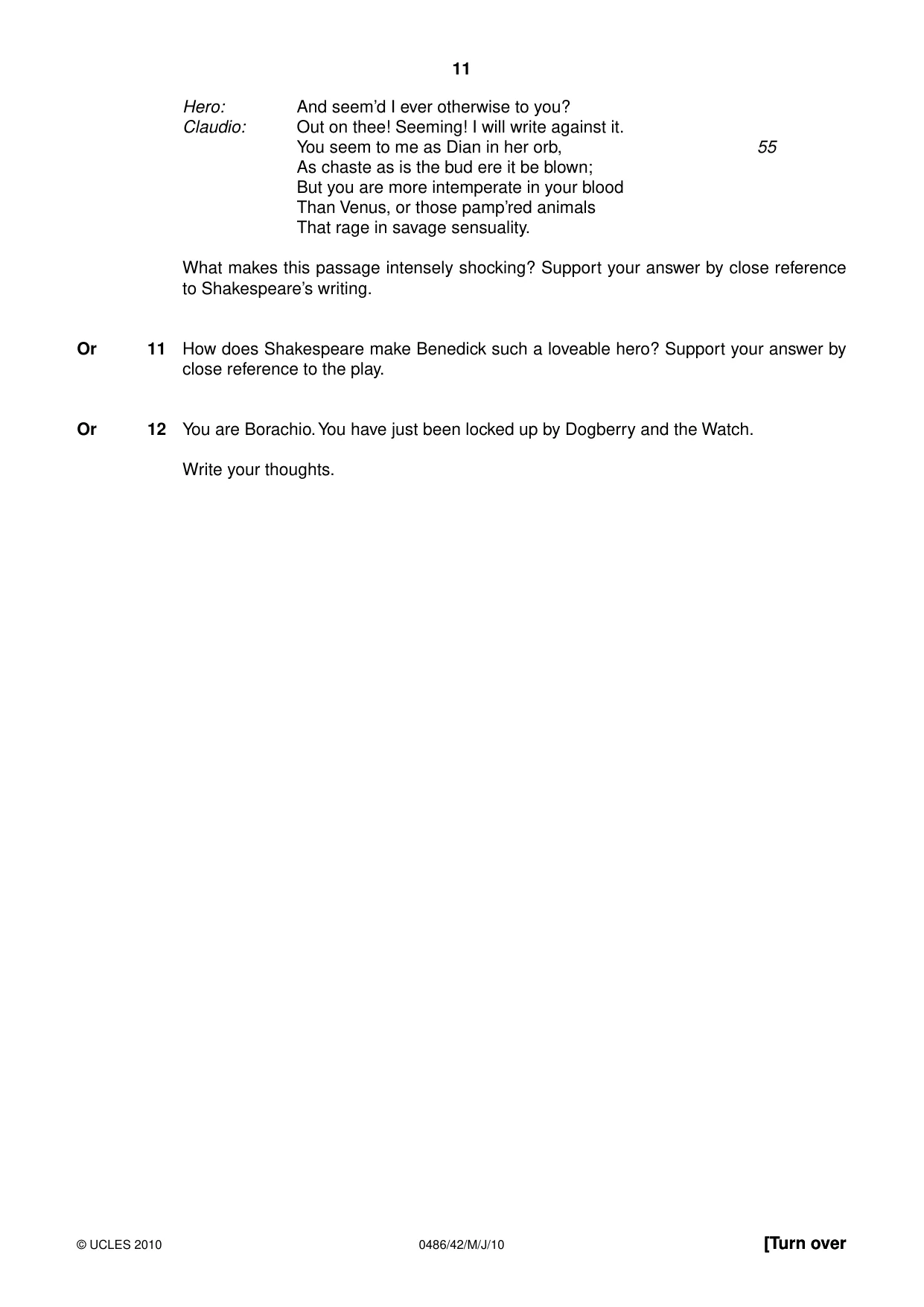
Question paper, page 3
3 0486/42/M/J/10 © UCLES 2010 [Turn over CONTENTS Section A: Drama text question numbers page[s] Alan Ayckbourn: A Small Family Business *1, 2, 3 pages 4–5 Charlotte Keatley: My Mother Said I Never Should *4, 5, 6 pages 6–7 Arthur Miller: The Crucible *7, 8, 9 pages 8–9 William Shakespeare: Much Ado About Nothing *10, 11, 12 pages 10–11 William Shakespeare: Richard III *13, 14, 15 pages 12–13 R.C. Sherriff: Journey’s End *16, 17, 18 pages 14–15 Section B: Poetry text question numbers page[s] Songs of Ourselves: from Part 3 *19, 20, 21 page 16 John Keats: Poems *22, 23, 24 page 17 Section C: Prose text question numbers page[s] Jane Austen: Pride and Prejudice *25, 26, 27 pages 18–19 Ian Cross: The God Boy *28, 29, 30 pages 20–21 Anita Desai: Games at Twilight and Other Stories *31, 32, 33 pages 22–23 Thomas Hardy: Far from the Madding Crowd *34, 35, 36 page 24 Bessie Head: When Rain Clouds Gather *37, 38, 39 page 25 Edith Wharton: Ethan Frome *40, 41, 42 pages 26–27 from Stories of Ourselves *43, 44, 45 pages 28–29
Question paper, page 4
4 0486/42/M/J/10 © UCLES 2010 SECTION A: DRAMA ALAN AYCKBOURN: A Small Family Business Either * 1 Read this extract, and then answer the question that follows it. JACK thunders up the stairs. GIORGIO, hearing this, dives for the near bedroom, looks round, panic-stricken, and decides, with a certain unoriginality, to hide in the fitted wardrobe. He slides open the door and is all but engulfed in ANITA’s numerous frocks that spring from their confined, undersized quarters. Giorgio: Ah! [He fights his way in with difficulty ] Jack: [reaching the landing ] Cliff! I know you’re here! Anita: [following him upstairs ] Jack, he’s not up there, I swear he isn’t. Jack! Giorgio: [during this] Oh, Madonna santissima, fa che non mi spari. Te ne prego, non lasciare che mi ammazzi. Unable to close the door, GIORGIO crouches behind the dresses, muttering a prayer. JACK enters the bedroom and stops short as he hears this. Jack: Who’s that in there? That’s not Cliff. Anita: I told you it wasn’t. Jack: Who is it, then? Anita: It’s Giorgio. Jack: That Italian? The one I met the other night? Anita: No, that was Uberto. This is his youngest brother, Giorgio. Jack: How many of them are there? Anita: Five. Jack: Five? Anita: Uberto, Vincenzo, Orlando, Lotario and Giorgio. Jack: All called Rivetti? Anita: Yes. Jack: And you’re working your way through them all, are you? Anita: Mind your own business … Jack: This is very much my business, Anita. I have one or two urgent matters of my own to discuss with the Rivettis … [advancing on the cupboard ] Oy, you! Out! A terrified scream from GIORGIO. Anita: Don’t frighten him, Jack, he’s only a kid. He hasn’t done any harm. He’s a good boy, he’s very religious … Jack: Yes, I can see he is. Says his prayers regularly in married women’s wardrobes. Anita, does Cliff know this is going on? Anita: May I get dressed, please, Jack? Jack: Poor bastard. He doesn’t, does he? He’s down there playing his darts match and he hasn’t got a clue, has he? Anita: Please let me get dressed, Jack. Jack: What’s this doing to Cliff? What’s it done to him already? Ask yourself, Anita. What is this doing to yourself as a human being? Your husband’s due back any minute, you’ve got a fourteen- year-old Catholic Boy Scout in your cupboard and you don’t give a stuff, do you? You defy belief. Anita: [wearily ] Oh, God. Hold on a minute, Jack, I’ll go and put on some organ music. 5 10 15 20 25 30 35 40 45
Question paper, page 5
5 0486/42/M/J/10 © UCLES 2010 Jack: I’m not a prude. If people want to bore themselves rigid with soft-porn movies or read newspapers full of tits, I don’t mind. I don’t want to interfere with that. But surely somewhere, Anita, there’s got to be a minimum level of decent human behaviour, hasn’t there? Beneath which none of us sink? Like not screwing around in your own marriage bed with men who are busy swindling your own family out of thousands of pounds? Something around that level, eh? Anita: [calmly ] Oh, I see. That’s what all this is about. Sorry, Jack, I was being a bit slow. My mind was still on other things. CLIFF comes in the front door and closes it. How does Ayckbourn make this confrontation between Jack and Anita so funny? Or 2 What do you think makes Harriet and Desmond such an amusing pair of characters? Support your ideas with details from Ayckbourn’s writing. Or 3 You are Jack coming home at the beginning of the play. Write your thoughts. 50 55 [Turn over
Question paper, page 6
6 0486/42/M/J/10 © UCLES 2010 CHARLOTTE KEATLEY: My Mother Said I Never Should Either * 4 Read this extract, and then answer the question that follows it. The Wasteground, a place where girls come to play. Enter four girls, each dressed contemporary to her own generation, singing: My Mother said I never should, Play with the gypsies in the wood, If I did, she would say, Naughty girl to disobey! Rosie: [chanting ] What are little girls made of? [Coaxing DORIS to answer.] Ssh … Margaret: Her Mummy’s all right – She gave us lemonade. [Pause.] Rosie: … She’ll split on us though. Then we’ll be outlaws. Jackie: Go away, baby. DORIS cries. In what ways do you think Keatley makes this a good introduction to the play? Content removed due to copyright restrictions
Question paper, page 7
7 0486/42/M/J/10 © UCLES 2010 [Turn over Or 5 Explore how Keatley presents the changes in the relationship between Jackie and Rosie as the play develops. Refer in detail to the play in your answer. Or 6 You are Doris. You have just learnt that your husband, Jack, has bequeathed everything to your granddaughter, Jackie. Write your thoughts.
Question paper, page 8
8 0486/42/M/J/10 ARTHUR MILLER: The Crucible Either * 7 Read this extract, and then answer the question that follows it. Putnam: [at the moment he is intent upon getting PARRIS, for whom he has only contempt, to move toward the abyss] Mr Parris, I have taken your part in all contention here, and I would continue; but I cannot if you hold back in this. There are hurtful, vengeful spirits layin’ hands on these children. Parris: But, Thomas, you cannot— Putnam: Ann! Tell Mr Parris what you have done. Mrs Putnam: Reverend Parris, I have laid seven babies unbaptized in the earth. Believe me, sir, you never saw more hearty babies born. And yet, each would wither in my arms the very night of their birth. I have spoke nothin’, but my heart has clamoured intimations. And now, this year, my Ruth, my only—I see her turning strange. A secret child she has become this year, and shrivels like a sucking mouth were pullin’ on her life too. And so I thought to send her to your Tituba— Parris: To Tituba! What may Tituba—? Mrs Putnam: Tituba knows how to speak to the dead, Mr Parris. Parris: Goody Ann, it is a formidable sin to conjure up the dead! Mrs Putnam: I take it on my soul, but who else may surely tell us what person murdered my babies? Parris: [horrified ] Woman! Mrs Putnam: They were murdered, Mr Parris! And mark this proof! Mark it! Last night my Ruth were ever so close to their little spirits; I know it, sir. For how else is she struck dumb now except some power of darkness would stop her mouth? It is a marvellous sign, Mr Parris! Putnam: Don’t you understand it, sir? There is a murdering witch among us, bound to keep herself in the dark. [PARRIS turns to BETTY, a frantic terror rising in him.] Let your enemies make of it what they will, you cannot blink it more. Parris: [to ABIGAIL] Then you were conjuring spirits last night. Abigail: [whispering ] Not I, sir—Tituba and Ruth. Parris: [turns now, with new fear, and goes to BETTY, looks down at her, and then gazing off ] Oh, Abigail, what proper payment for my charity! Now I am undone. Putnam: You are not undone! Let you take hold there. Wait for no one to charge you—declare it yourself. You have discovered witchcraft— Parris: In my house? In my house, Thomas? They will topple me with this! They will make of it a— Enter MERCY LEWIS, the Putnam’s servant, a fat, sly, merciless girl of eighteen. Mercy: Your pardons. I only thought to see how Betty is. Putnam: Why aren’t you home? Who’s with Ruth? Mercy: Her grandma come. She’s improved a little, I think—she give a powerful sneeze before. Mrs Putnam: Ah, there’s a sign of life? Mercy: I’d fear no more, Goody Putnam. It were a grand sneeze; another like it will shake her wits together, I’m sure. [She goes to the bed to look.] © UCLES 2010 5 10 15 20 25 30 35 40 45 50
Question paper, page 9
9 0486/42/M/J/10 © UCLES 2010 [Turn over Parris: Will you leave me now, Thomas? I would pray a while alone. Abigail: Uncle, you’ve prayed since midnight. Why do you not go down and— Parris: No—no. [To PUTNAM] I have no answer for that crowd. I’ll wait till Mr Hale arrives. [To get MRS PUTNAM to leave.] If you will, Goody Ann… Putnam: Now look you, sir. Let you strike out against the Devil, and the village will bless you for it! Come down, speak to them—pray with them. They’re thirsting for your word, Mister! Surely you’ll pray with them. Parris: [swayed ] I’ll lead them in a psalm, but let you say nothing of witchcraft yet. I will not discuss it. The cause is yet unknown. I have had enough contention since I came; I want no more. Mrs Putnam: Mercy, you go home to Ruth, d’y’hear? Mercy: Aye, mum. MRS PUTNAM goes out. How does Miller dramatically convey in this passage the tensions and hatreds in Salem? Or 8 A loyal and loving wife A cold and unforgiving woman Which is closer to your view of Elizabeth Proctor? Support your argument with details from Miller’s writing. Or 9 You are Reverend Parris at the end of the play. Proctor has just been hanged. Write your thoughts. [Turn over 55 60 65
Question paper, page 10
10 0486/42/M/J/10 WILLIAM SHAKESPEARE: Much Ado About Nothing Either * 10 Read this extract, and then answer the question that follows it. Leonato: Come, Friar Francis, be brief; only to the plain form of marriage, and you shall recount their particular duties afterwards. Friar: You come hither, my lord, to marry this lady? Claudio: No. Leonato: To be married to her, friar! You come to marry her. Friar: Lady, you come hither to be married to this count? Hero: I do. Friar: If either of you know any inward impediment why you should not be conjoined, I charge you, on your souls, to utter it. Claudio: Know you any, Hero? Hero: None, my lord. Friar: Know you any, Count? Leonato: I dare make his answer, None. Claudio: O, what men dare do! What men may do! What men daily do, not knowing what they do! Benedick: How now! Interjections? Why, then, some be of laughing, as, ah, ha, he! Claudio: Stand thee by, friar. Father, by your leave: Will you with free and unconstrained soul Give me this maid, your daughter? Leonato: As freely, son, as God did give her me. Claudio: And what have I to give you back whose worth May counterpoise this rich and precious gift? Don Pedro: Nothing, unless you render her again. Claudio: Sweet Prince, you learn me noble thankfulness. There, Leonato, take her back again; Give not this rotten orange to your friend; She’s but the sign and semblance of her honour. Behold how like a maid she blushes here. O, what authority and show of truth Can cunning sin cover itself withal! Comes not that blood as modest evidence To witness simple virtue? Would you not swear, All you that see her, that she were a maid By these exterior shows? But she is none: She knows the heat of a luxurious bed; Her blush is guiltiness, not modesty. Leonato: What do you mean, my lord? Claudio: Not to be married, Not to knit my soul to an approved wanton. Leonato: Dear, my lord, if you, in your own proof, Have vanquish’d the resistance of her youth, And made defeat of her virginity – Claudio: I know what you would say. If I have known her, You will say she did embrace me as a husband, And so extenuate the ’forehand sin. No, Leonato. I never tempted her with word too large But, as a brother to his sister, show’d Bashful sincerity and comely love. 5 10 15 20 25 30 35 40 45 50 © UCLES 2010
Question paper, page 11
11 0486/42/M/J/10 © UCLES 2010 [Turn over Hero: And seem’d I ever otherwise to you? Claudio: Out on thee! Seeming! I will write against it. You seem to me as Dian in her orb, As chaste as is the bud ere it be blown; But you are more intemperate in your blood Than Venus, or those pamp’red animals That rage in savage sensuality. What makes this passage intensely shocking? Support your answer by close reference to Shakespeare’s writing. Or 11 How does Shakespeare make Benedick such a loveable hero? Support your answer by close reference to the play. Or 12 You are Borachio. You have just been locked up by Dogberry and the Watch. Write your thoughts. 55 [Turn over
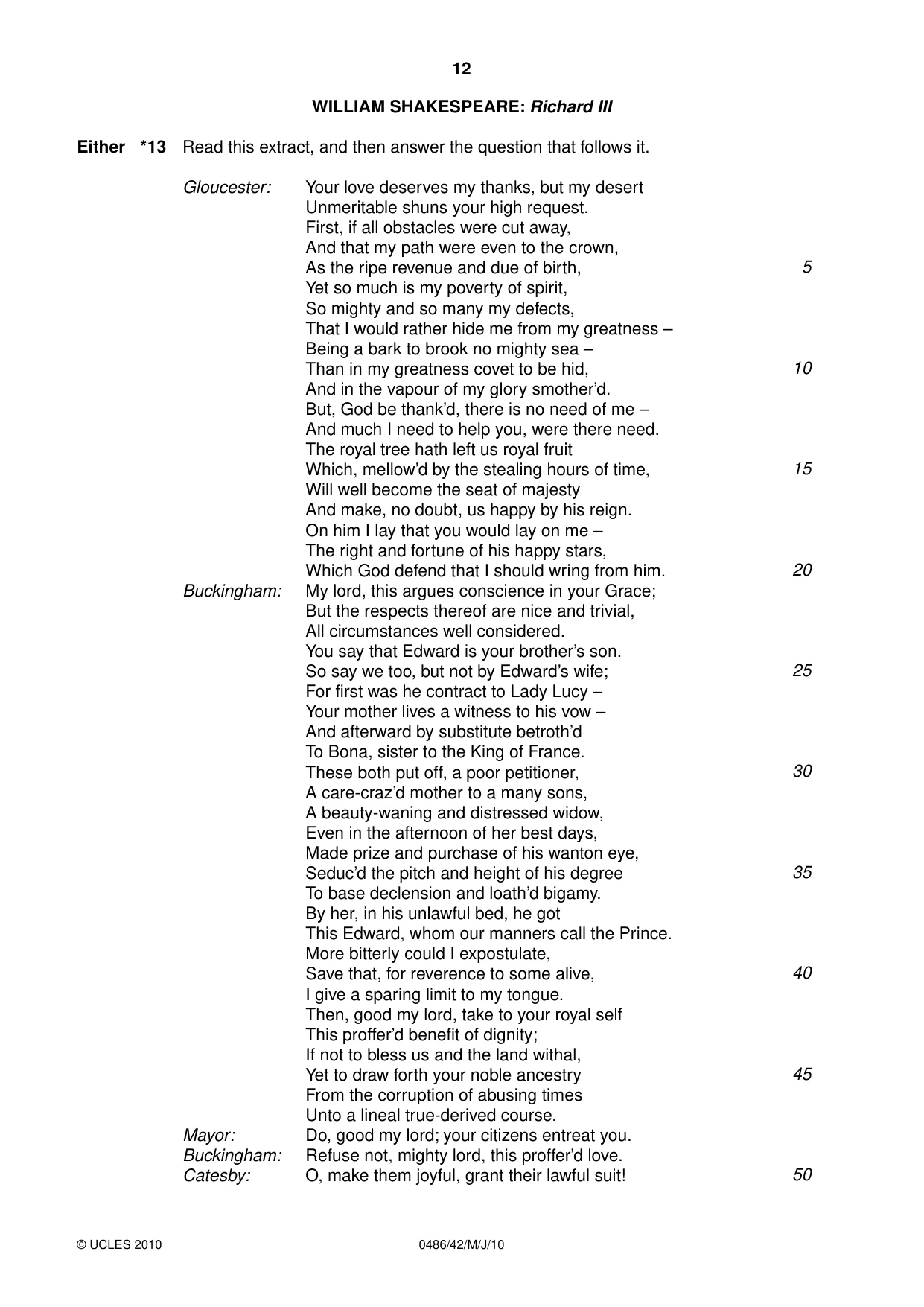
Question paper, page 12
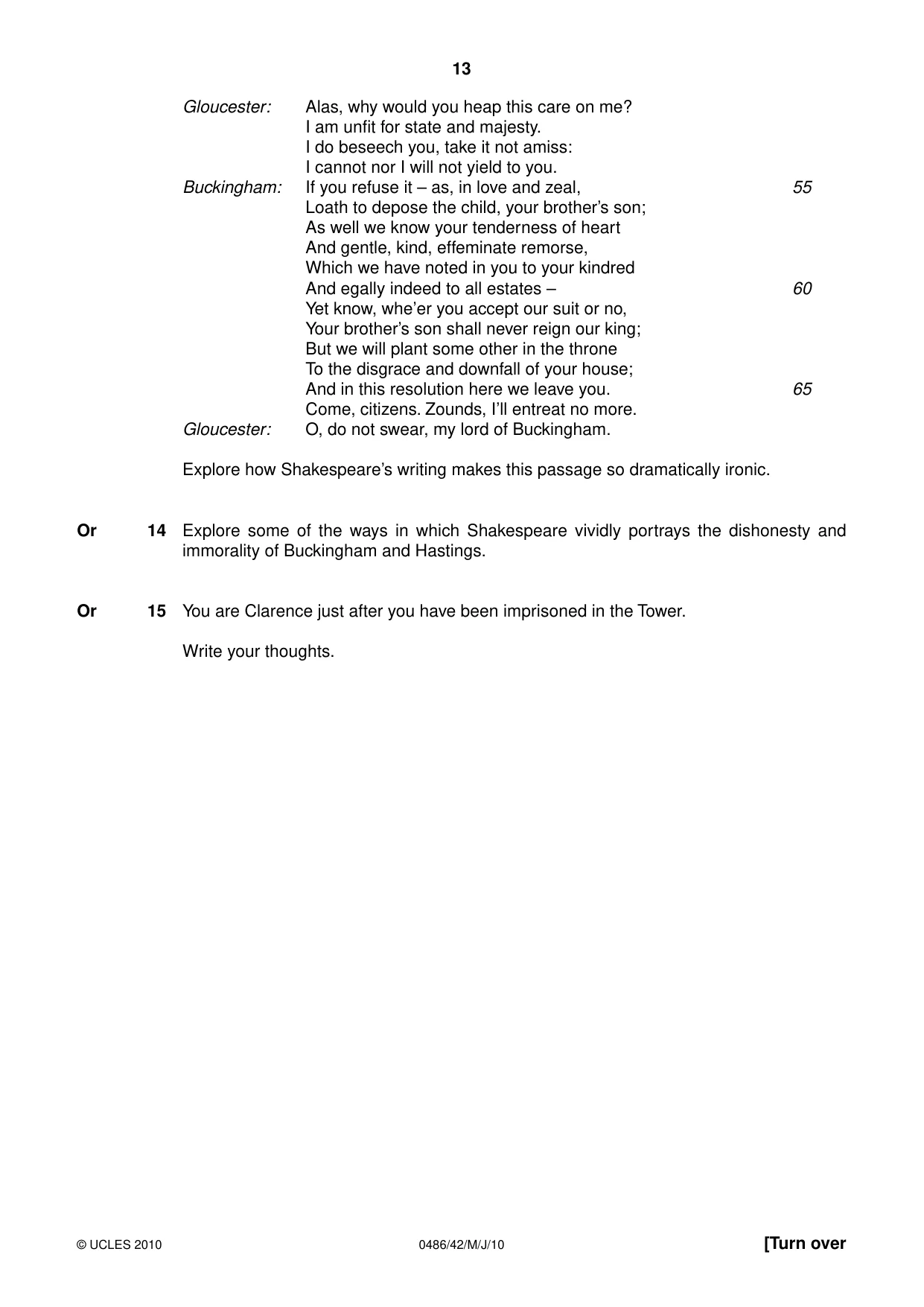
12 0486/42/M/J/10 WILLIAM SHAKESPEARE: Richard III Either * 13 Read this extract, and then answer the question that follows it. Gloucester: Your love deserves my thanks, but my desert Unmeritable shuns your high request. First, if all obstacles were cut away, And that my path were even to the crown, As the ripe revenue and due of birth, Yet so much is my poverty of spirit, So mighty and so many my defects, That I would rather hide me from my greatness – Being a bark to brook no mighty sea – Than in my greatness covet to be hid, And in the vapour of my glory smother’d. But, God be thank’d, there is no need of me – And much I need to help you, were there need. The royal tree hath left us royal fruit Which, mellow’d by the stealing hours of time, Will well become the seat of majesty And make, no doubt, us happy by his reign. On him I lay that you would lay on me – The right and fortune of his happy stars, Which God defend that I should wring from him. Buckingham: My lord, this argues conscience in your Grace; But the respects thereof are nice and trivial, All circumstances well considered. You say that Edward is your brother’s son. So say we too, but not by Edward’s wife; For first was he contract to Lady Lucy – Your mother lives a witness to his vow – And afterward by substitute betroth’d To Bona, sister to the King of France. These both put off, a poor petitioner, A care-craz’d mother to a many sons, A beauty-waning and distressed widow, Even in the afternoon of her best days, Made prize and purchase of his wanton eye, Seduc’d the pitch and height of his degree To base declension and loath’d bigamy. By her, in his unlawful bed, he got This Edward, whom our manners call the Prince. More bitterly could I expostulate, Save that, for reverence to some alive, I give a sparing limit to my tongue. Then, good my lord, take to your royal self This proffer’d benefit of dignity; If not to bless us and the land withal, Yet to draw forth your noble ancestry From the corruption of abusing times Unto a lineal true-derived course. Mayor: Do, good my lord; your citizens entreat you. Buckingham: Refuse not, mighty lord, this proffer’d love. Catesby: O, make them joyful, grant their lawful suit! © UCLES 2010 5 10 15 20 25 30 35 40 45 50
Question paper, page 13
13 0486/42/M/J/10 © UCLES 2010 [Turn over Gloucester: Alas, why would you heap this care on me? I am unfit for state and majesty. I do beseech you, take it not amiss: I cannot nor I will not yield to you. Buckingham: If you refuse it – as, in love and zeal, Loath to depose the child, your brother’s son; As well we know your tenderness of heart And gentle, kind, effeminate remorse, Which we have noted in you to your kindred And egally indeed to all estates – Yet know, whe’er you accept our suit or no, Your brother’s son shall never reign our king; But we will plant some other in the throne To the disgrace and downfall of your house; And in this resolution here we leave you. Come, citizens. Zounds, I’ll entreat no more. Gloucester: O, do not swear, my lord of Buckingham. Explore how Shakespeare’s writing makes this passage so dramatically ironic. Or 14 Explore some of the ways in which Shakespeare vividly portrays the dishonesty and immorality of Buckingham and Hastings. Or 15 You are Clarence just after you have been imprisoned in the Tower. Write your thoughts. 55 60 65
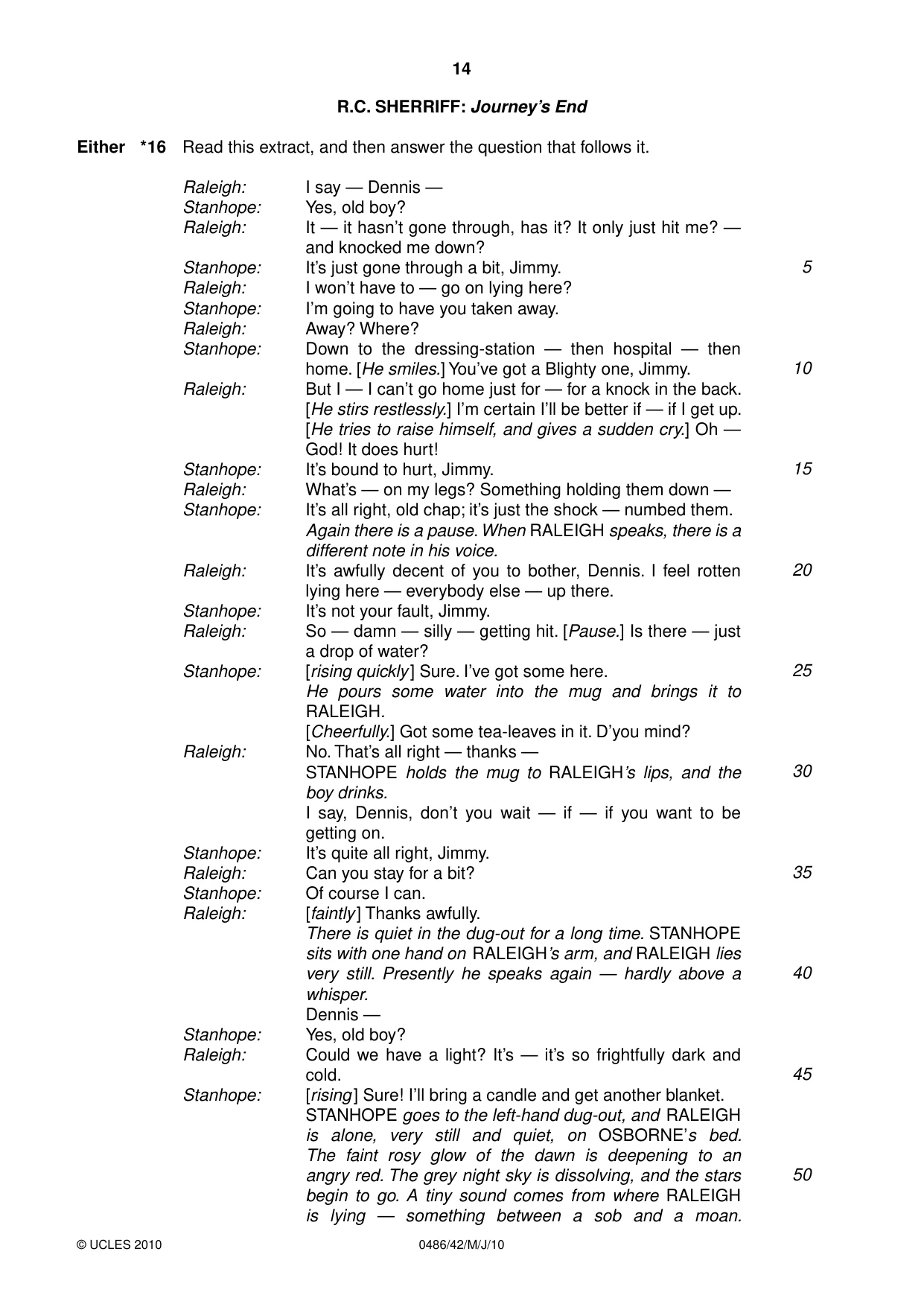
Question paper, page 14
14 0486/42/M/J/10 © UCLES 2010 R.C. SHERRIFF: Journey’s End Either * 16 Read this extract, and then answer the question that follows it. Raleigh: I say — Dennis — Stanhope: Yes, old boy? Raleigh: It — it hasn’t gone through, has it? It only just hit me? — and knocked me down? Stanhope: It’s just gone through a bit, Jimmy. Raleigh: I won’t have to — go on lying here? Stanhope: I’m going to have you taken away. Raleigh: Away? Where? Stanhope: Down to the dressing-station — then hospital — then home. [He smiles.] You’ve got a Blighty one, Jimmy. Raleigh: But I — I can’t go home just for — for a knock in the back. [He stirs restlessly.] I’m certain I’ll be better if — if I get up. [He tries to raise himself, and gives a sudden cry.] Oh — God! It does hurt! Stanhope: It’s bound to hurt, Jimmy. Raleigh: What’s — on my legs? Something holding them down — Stanhope: It’s all right, old chap; it’s just the shock — numbed them. Again there is a pause. When RALEIGH speaks, there is a different note in his voice. Raleigh: It’s awfully decent of you to bother, Dennis. I feel rotten lying here — everybody else — up there. Stanhope: It’s not your fault, Jimmy. Raleigh: So — damn — silly — getting hit. [Pause.] Is there — just a drop of water? Stanhope: [rising quickly ] Sure. I’ve got some here. He pours some water into the mug and brings it to RALEIGH. [Cheerfully.] Got some tea-leaves in it. D’you mind? Raleigh: No. That’s all right — thanks — STANHOPE holds the mug to RALEIGH’s lips, and the boy drinks. I say, Dennis, don’t you wait — if — if you want to be getting on. Stanhope: It’s quite all right, Jimmy. Raleigh: Can you stay for a bit? Stanhope: Of course I can. Raleigh: [faintly ] Thanks awfully. There is quiet in the dug-out for a long time. STANHOPE sits with one hand on RALEIGH’s arm, and RALEIGH lies very still. Presently he speaks again — hardly above a whisper. Dennis — Stanhope: Yes, old boy? Raleigh: Could we have a light? It’s — it’s so frightfully dark and cold. Stanhope: [rising ] Sure! I’ll bring a candle and get another blanket. STANHOPE goes to the left-hand dug-out, and RALEIGH is alone, very still and quiet, on OSBORNE’s bed. The faint rosy glow of the dawn is deepening to an angry red. The grey night sky is dissolving, and the stars begin to go. A tiny sound comes from where RALEIGH is lying — something between a sob and a moan. 5 10 15 20 25 30 35 40 45 50
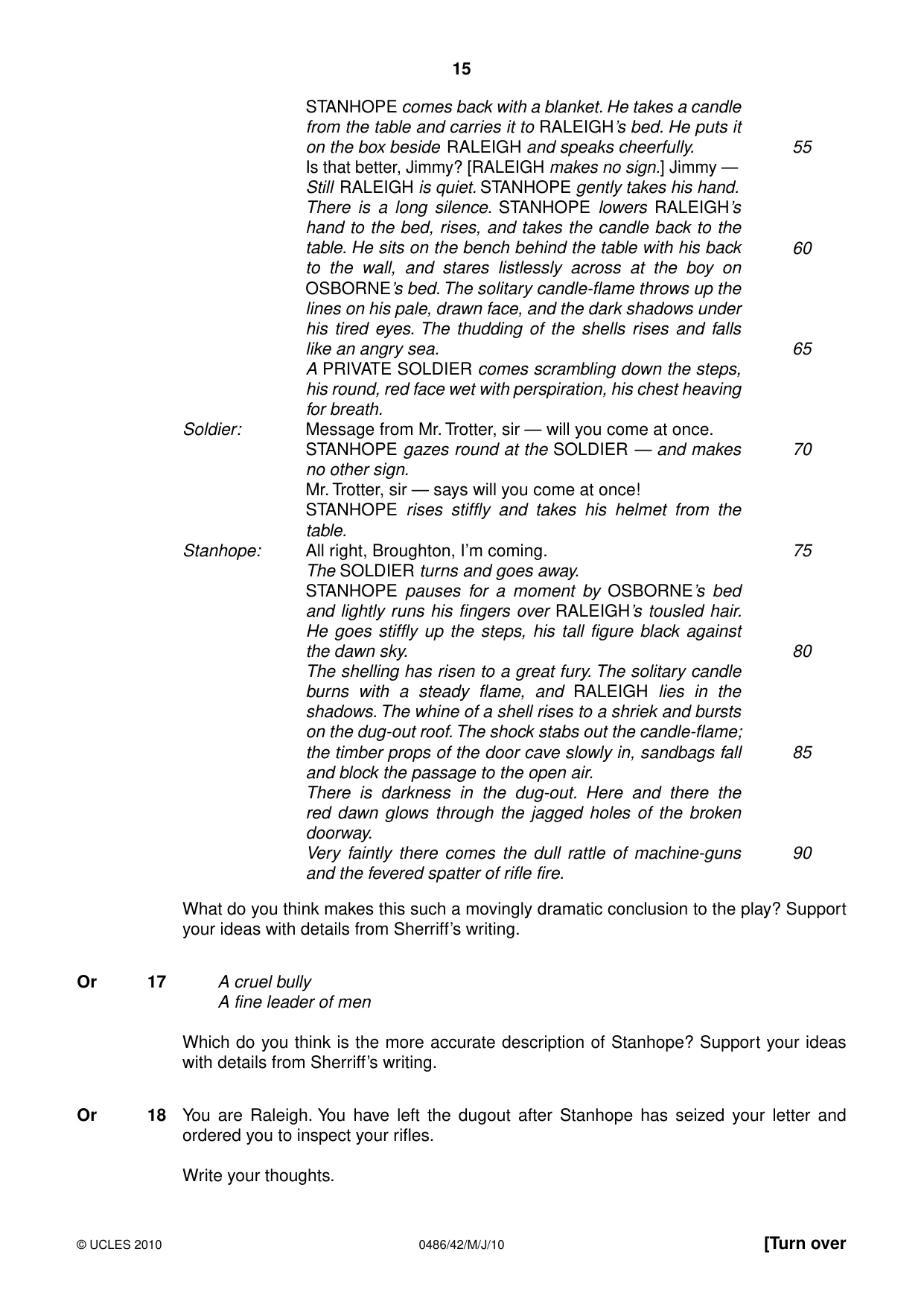
Question paper, page 15
15 0486/42/M/J/10 © UCLES 2010 [Turn over STANHOPE comes back with a blanket. He takes a candle from the table and carries it to RALEIGH’s bed. He puts it on the box beside RALEIGH and speaks cheerfully. Is that better, Jimmy? [RALEIGH makes no sign.] Jimmy — Still RALEIGH is quiet. STANHOPE gently takes his hand. There is a long silence. STANHOPE lowers RALEIGH’s hand to the bed, rises, and takes the candle back to the table. He sits on the bench behind the table with his back to the wall, and stares listlessly across at the boy on OSBORNE’s bed. The solitary candle-flame throws up the lines on his pale, drawn face, and the dark shadows under his tired eyes. The thudding of the shells rises and falls like an angry sea. A PRIVATE SOLDIER comes scrambling down the steps, his round, red face wet with perspiration, his chest heaving for breath. Soldier: Message from Mr. Trotter, sir — will you come at once. STANHOPE gazes round at the SOLDIER — and makes no other sign. Mr. Trotter, sir — says will you come at once! STANHOPE rises stiffly and takes his helmet from the table. Stanhope: All right, Broughton, I’m coming. The SOLDIER turns and goes away. STANHOPE pauses for a moment by OSBORNE’s bed and lightly runs his fingers over RALEIGH’s tousled hair. He goes stiffly up the steps, his tall figure black against the dawn sky. The shelling has risen to a great fury. The solitary candle burns with a steady flame, and RALEIGH lies in the shadows. The whine of a shell rises to a shriek and bursts on the dug-out roof. The shock stabs out the candle-flame; the timber props of the door cave slowly in, sandbags fall and block the passage to the open air. There is darkness in the dug-out. Here and there the red dawn glows through the jagged holes of the broken doorway. Very faintly there comes the dull rattle of machine-guns and the fevered spatter of rifle fire. What do you think makes this such a movingly dramatic conclusion to the play? Support your ideas with details from Sherriff’s writing. Or 17 A cruel bully A fine leader of men Which do you think is the more accurate description of Stanhope? Support your ideas with details from Sherriff’s writing. Or 18 You are Raleigh. You have left the dugout after Stanhope has seized your letter and ordered you to inspect your rifles. Write your thoughts. 55 60 65 70 75 80 85 90
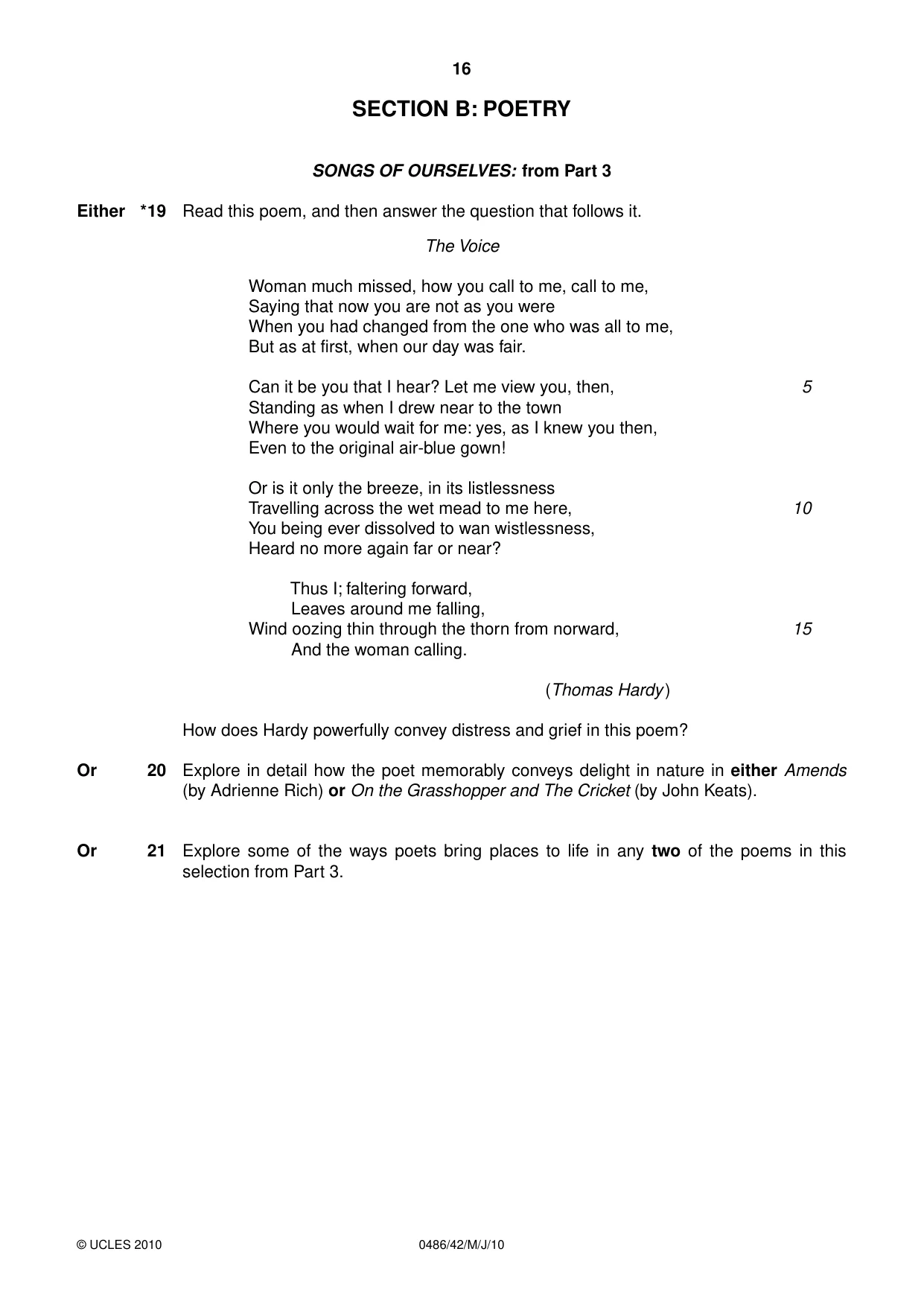
Question paper, page 16
16 0486/42/M/J/10 © UCLES 2010 SECTION B: POETRY SONGS OF OURSELVES: from Part 3 Either * 19 Read this poem, and then answer the question that follows it. The Voice Woman much missed, how you call to me, call to me, Saying that now you are not as you were When you had changed from the one who was all to me, But as at first, when our day was fair. Can it be you that I hear? Let me view you, then, 5 Standing as when I drew near to the town Where you would wait for me: yes, as I knew you then, Even to the original air-blue gown! Or is it only the breeze, in its listlessness Travelling across the wet mead to me here, 10 You being ever dissolved to wan wistlessness, Heard no more again far or near? Thus I; faltering forward, Leaves around me falling, Wind oozing thin through the thorn from norward, 15 And the woman calling. (Thomas Hardy ) How does Hardy powerfully convey distress and grief in this poem? Or 20 Explore in detail how the poet memorably conveys delight in nature in either Amends (by Adrienne Rich) or On the Grasshopper and The Cricket (by John Keats). Or 21 Explore some of the ways poets bring places to life in any two of the poems in this selection from Part 3.
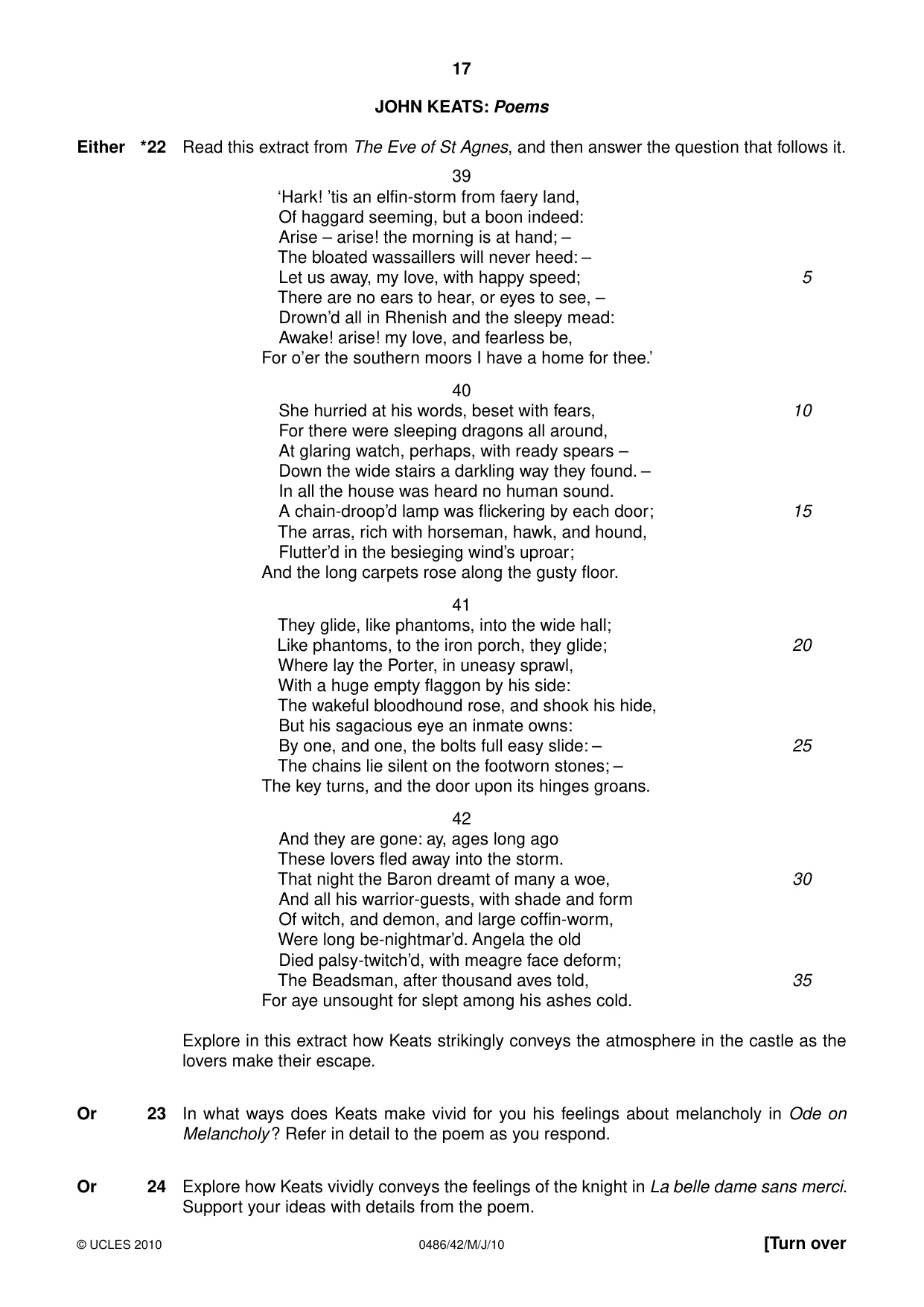
Question paper, page 17
17 0486/42/M/J/10 © UCLES 2010 [Turn over JOHN KEATS: Poems Either * 22 Read this extract from The Eve of St Agnes, and then answer the question that follows it. 39 ‘Hark! ’tis an elfin-storm from faery land, Of haggard seeming, but a boon indeed: Arise – arise! the morning is at hand; – The bloated wassaillers will never heed: – Let us away, my love, with happy speed; 5 There are no ears to hear, or eyes to see, – Drown’d all in Rhenish and the sleepy mead: Awake! arise! my love, and fearless be, For o’er the southern moors I have a home for thee.’ 40 She hurried at his words, beset with fears, 10 For there were sleeping dragons all around, At glaring watch, perhaps, with ready spears – Down the wide stairs a darkling way they found. – In all the house was heard no human sound. A chain-droop’d lamp was flickering by each door; 15 The arras, rich with horseman, hawk, and hound, Flutter’d in the besieging wind’s uproar; And the long carpets rose along the gusty floor. 41 They glide, like phantoms, into the wide hall; Like phantoms, to the iron porch, they glide; 20 Where lay the Porter, in uneasy sprawl, With a huge empty flaggon by his side: The wakeful bloodhound rose, and shook his hide, But his sagacious eye an inmate owns: By one, and one, the bolts full easy slide: – 25 The chains lie silent on the footworn stones; – The key turns, and the door upon its hinges groans. 42 And they are gone: ay, ages long ago These lovers fled away into the storm. That night the Baron dreamt of many a woe, 30 And all his warrior-guests, with shade and form Of witch, and demon, and large coffin-worm, Were long be-nightmar’d. Angela the old Died palsy-twitch’d, with meagre face deform; The Beadsman, after thousand aves told, 35 For aye unsought for slept among his ashes cold. Explore in this extract how Keats strikingly conveys the atmosphere in the castle as the lovers make their escape. Or 23 In what ways does Keats make vivid for you his feelings about melancholy in Ode on Melancholy ? Refer in detail to the poem as you respond. Or 24 Explore how Keats vividly conveys the feelings of the knight in La belle dame sans merci. Support your ideas with details from the poem.
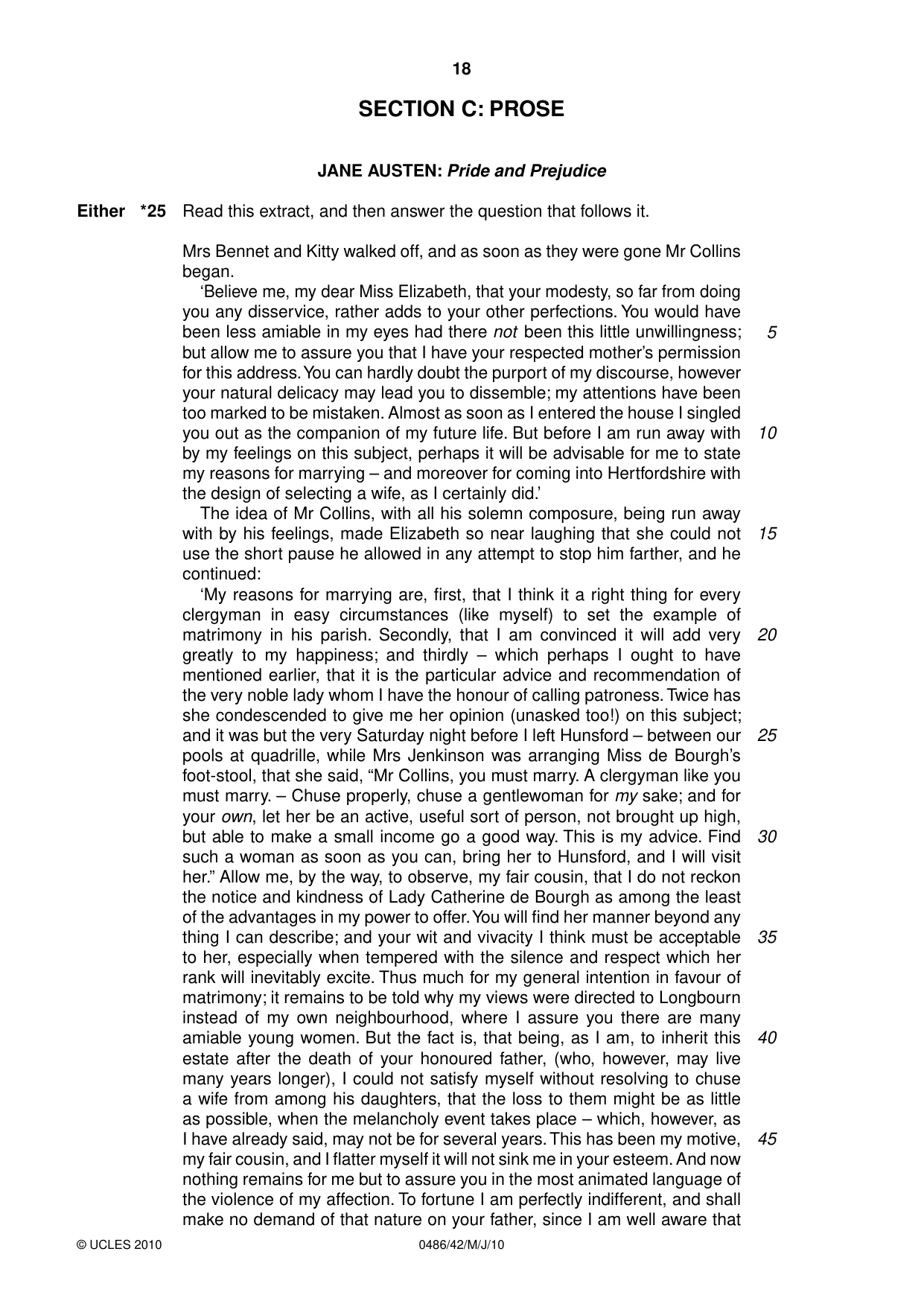
Question paper, page 18
18 0486/42/M/J/10 © UCLES 2010 SECTION C: PROSE JANE AUSTEN: Pride and Prejudice Either * 25 Read this extract, and then answer the question that follows it. Mrs Bennet and Kitty walked off, and as soon as they were gone Mr Collins began. ‘Believe me, my dear Miss Elizabeth, that your modesty, so far from doing you any disservice, rather adds to your other perfections. You would have been less amiable in my eyes had there not been this little unwillingness; but allow me to assure you that I have your respected mother’s permission for this address. You can hardly doubt the purport of my discourse, however your natural delicacy may lead you to dissemble; my attentions have been too marked to be mistaken. Almost as soon as I entered the house I singled you out as the companion of my future life. But before I am run away with by my feelings on this subject, perhaps it will be advisable for me to state my reasons for marrying – and moreover for coming into Hertfordshire with the design of selecting a wife, as I certainly did.’ The idea of Mr Collins, with all his solemn composure, being run away with by his feelings, made Elizabeth so near laughing that she could not use the short pause he allowed in any attempt to stop him farther, and he continued: ‘My reasons for marrying are, first, that I think it a right thing for every clergyman in easy circumstances (like myself) to set the example of matrimony in his parish. Secondly, that I am convinced it will add very greatly to my happiness; and thirdly – which perhaps I ought to have mentioned earlier, that it is the particular advice and recommendation of the very noble lady whom I have the honour of calling patroness. Twice has she condescended to give me her opinion (unasked too!) on this subject; and it was but the very Saturday night before I left Hunsford – between our pools at quadrille, while Mrs Jenkinson was arranging Miss de Bourgh’s foot-stool, that she said, “Mr Collins, you must marry. A clergyman like you must marry. – Chuse properly, chuse a gentlewoman for my sake; and for your own, let her be an active, useful sort of person, not brought up high, but able to make a small income go a good way. This is my advice. Find such a woman as soon as you can, bring her to Hunsford, and I will visit her.” Allow me, by the way, to observe, my fair cousin, that I do not reckon the notice and kindness of Lady Catherine de Bourgh as among the least of the advantages in my power to offer. You will find her manner beyond any thing I can describe; and your wit and vivacity I think must be acceptable to her, especially when tempered with the silence and respect which her rank will inevitably excite. Thus much for my general intention in favour of matrimony; it remains to be told why my views were directed to Longbourn instead of my own neighbourhood, where I assure you there are many amiable young women. But the fact is, that being, as I am, to inherit this estate after the death of your honoured father, (who, however, may live many years longer), I could not satisfy myself without resolving to chuse a wife from among his daughters, that the loss to them might be as little as possible, when the melancholy event takes place – which, however, as I have already said, may not be for several years. This has been my motive, my fair cousin, and I flatter myself it will not sink me in your esteem. And now nothing remains for me but to assure you in the most animated language of the violence of my affection. To fortune I am perfectly indifferent, and shall make no demand of that nature on your father, since I am well aware that 5 10 15 20 25 30 35 40 45
Question paper, page 19
19 0486/42/M/J/10 © UCLES 2010 [Turn over it could not be complied with; and that one thousand pounds in the 4 per cents, which will not be yours till after your mother’s decease, is all that you may ever be entitled to. On that head, therefore, I shall be uniformly silent; and you may assure yourself that no ungenerous reproach shall ever pass my lips when we are married.’ It was absolutely necessary to interrupt him now. What does Austen make you feel about Mr Collins here as he proposes to Elizabeth? Support your views with details from the writing. Or 26 How does Austen make Elizabeth Bennet such an appealing and lively character? Support your ideas with details from the writing. Or 27 You are Mr Bennet after the end of the novel. Elizabeth is married and you are in your study. Write your thoughts. 50 55
Question paper, page 20
20 0486/42/M/J/10 © UCLES 2010 IAN CROSS: The God Boy Either * 28 Read this extract, and then answer the question that follows it. Not sure whether I liked him in such a mood—honestly, you would have thought he was at a football match, and his team was winning—I picked up my schoolbag from my bedroom, gave my face a quick rub-over in the bathroom, streaked back down to the kitchen, anxious to be out and about. Dad had gone back upstairs, and Mum was finishing clearing the table. ‘All serene,’ I said. ‘Am I all spit and polish?’ I was trying to cheer her up, you see. She wiped her hands on a tea towel and took a deep breath as she looked at me. Even if I say it myself, I couldn’t help noticing that the sight of me seemed to do her good. For a minute there, a look came across her face, as though she had suddenly thought of something cheerful. I think of her most at those times, when I was standing before her, and she looking me over, so tall and strong-looking, with sometimes a bit of a smile on her face, other times putting her hands out to hold me by the shoulders, eyeing me up and down, fixing up my collar, or making me roll up my sleeves properly; times like this morning, nearly the last morning of all, when she made me feel that nothing too bad could ever happen to me while she was around, and that she would always be there when I came home from school. ‘That shirt is lasting well,’ she said. ‘Now keep yourself clean until Father Gilligan comes.’ Father Gilligan came to school once a week for confessions, and she was always keen on my clothes being clean for him. I pretty well always had to wear a clean white shirt, as I did this day, for his coming. It certainly made it hard after school though; a white shirt is a handicap when you want to muck around. ‘It’ll be as clean as when I put it on,’ I told her. I felt almost sick with wanting to tell her how I felt, and because I couldn’t think of words to suit my feelings, I came up with the next-best thing. ‘I’ll go down to see Molly if you really want me to, Mum,’ I said. ‘I don’t really want you to go,’ she said quickly. So quickly that it seemed the words were right there on the tip of her tongue. ‘Sometimes Mum knows what is best, that’s all. But you forget all about it for a while yet. Forget all about it.’ ‘All right,’ I said, though what she said was mixed up. She knew best, she didn’t really want me to go, yet she suggested that I should go. ‘And don’t say a word about this to your father. Not a word.’ That came out quickly, too, and louder, and I blushed, thinking of the morning before. She gave me a peck on the forehead as Dad came back down the stairs, just bumped me with her lips, and I went back out to the passage and out the back door. How does Cross make this brief moment of contact between Jimmy and his mother deeply moving? 5 10 15 20 25 30 35 40
Question paper, page 21
21 0486/42/M/J/10 © UCLES 2010 [Turn over Or 29 How do you think Cross in his portrayal of Jimmy makes a rude and violent child such a sympathetic figure? Support your ideas with details from the writing. Or 30 You are Jack Crannery (‘Bloody Jack’) after Jimmy has hit you with a stone. You have told him never to come to the wharf again and he has gone. Write your thoughts.
Question paper, page 22
22 0486/42/M/J/10 © UCLES 2010 ANITA DESAI: Games at Twilight and Other Stories Either * 31 Read this extract from Private Tuition by Mr Bose, and then answer the question that follows it. Mr Bose gave his private tuition out on the balcony, in the evenings, in the belief that, since it faced south, the river Hooghly would send it a wavering breeze or two to drift over the rooftops, through the washing and the few pots of tulsi and marigold that his wife had placed precariously on the balcony rail, to cool him, fan him, soothe him. But there was no breeze: it was hot, the air hung upon them like a damp towel, gagging him and, speaking through this gag, he tiredly intoned the Sanskrit verses that should, he felt, have been roared out on a hill-top at sunrise. ‘Aum. Usa va asvasya medhyasya sirah …’ It came out, of course, a mumble. Asked to translate, his pupil, too, scowled as he had done, thrust his fist through his hair and mumbled: ‘Aum is the dawn and the head of a horse …’ Mr Bose protested in a low wail. ‘What horse, my boy? What horse?’ The boy rolled his eyes sullenly. ‘I don’t know, sir, it doesn’t say.’ Mr Bose looked at him in disbelief. He was the son of a Brahmin priest who himself instructed him in the Mahabharata all morning, turning him over to Mr Bose only in the evening when he set out to officiate at weddings, puja and other functions for which he was so much in demand on account of his stately bearing, his calm and inscrutable face and his sensuous voice that so suited the Sanskrit language in which he, almost always, discoursed. And this was his son – this Pritam with his red-veined eyes and oiled locks, his stumbling fingers and shuffling feet that betrayed his secret life, its scruffiness, its gutters and drains full of resentment and destruction. Mr Bose suddenly remembered how he had seen him, from the window of a bus that had come to a standstill on the street due to a fist fight between the conductor and a passenger, Pritam slipping up the stairs, through the door, into a neon-lit bar off Park Street. ‘The sacrificial horse,’ Mr Bose explained with forced patience. ‘Have you heard of Asvamedha, Pritam, the royal horse that was let loose to run through the kingdom before it returned to the capital and was sacrificed by the king?’ The boy gave him a look of such malice that Mr Bose bit the end of his moustache and fell silent, shuffling through the pages. ‘Read on, then,’ he mumbled and listened, for a while, as Pritam blundered heavily through the Sanskrit verses that rolled off his father’s experienced tongue, and even Mr Bose’s shy one, with such felicity. When he could not bear it any longer, he turned his head, slightly, just enough to be able to look out of the corner of his eye through the open door, down the unlit passage at the end of which, in the small, dimly lit kitchen, his wife sat kneading dough for bread, their child at her side. Her head was bowed so that some of her hair had freed itself of the long steel pins he hated so much and hung about her pale, narrow face. The red border of her sari was the only stripe of colour in that smoky scene. The child beside her had his back turned to the door so that Mr Bose could see his little brown buttocks under the short white shirt, squashed firmly down upon the woven mat. Mr Bose wondered what it was that kept him so quiet – perhaps his mother had given him a lump of dough to mould into some thick and satisfying shape. Both of them seemed bound together and held down in some deeply absorbing act from which he was excluded. He would have liked to break in and join them. 5 10 15 20 25 30 35 40 45
Question paper, page 23
23 0486/42/M/J/10 © UCLES 2010 [Turn over How does Desai memorably create in this opening to the story the boredom and frustrations of Mr Bose’s life? Support your ideas with details from the writing. Or 32 In Studies in the Park how does Desai vividly convey the pressure that Suno feels he is under and the ways in which he seeks to escape it? Or 33 You are the artist in Sale. Your visitors have gone and you have to explain to your wife what has happened. Write your thoughts.
Question paper, page 24
24 0486/42/M/J/10 © UCLES 2010 THOMAS HARDY: Far from the Madding Crowd Either * 34 Read this extract, and then answer the question that follows it. He looked hard into her eyes when she raised them for a moment; Bathsheba looked down again, for his gaze was too strong to be received point-blank with her own. But she had obliquely noticed that he was young and slim, and that he wore three chevrons upon his sleeve. Bathsheba pulled again. ‘You are a prisoner, miss; it is no use blinking the matter,’ said the soldier drily. ‘I must cut your dress if you are in such a hurry.’ ‘Yes – please do!’ she exclaimed helplessly. ‘It wouldn’t be necessary if you could wait a moment’; and he unwound a cord from the little wheel. She withdrew her own hand, but, whether by accident or design, he touched it. Bathsheba was vexed; she hardly knew why. His unravelling went on, but it nevertheless seemed coming to no end. She looked at him again. ‘Thank you for the sight of such a beautiful face!’ said the young sergeant, without ceremony. She coloured with embarrassment. ‘ ’Twas unwillingly shown,’ she replied stiffly, and with as much dignity – which was very little – as she could infuse into a position of captivity. ‘I like you the better for that incivility, miss,’ he said. ‘I should have liked – I wish – you had never shown yourself to me by intruding here!’ She pulled again, and the gathers of her dress began to give way like lilliputian musketry. ‘I deserve the chastisement your words give me. But why should such a fair and dutiful girl have such an aversion to her father’s sex?’ ‘Go on your way, please.’ ‘What, Beauty, and drag you after me? Do but look; I never saw such a tangle!’ ‘O, ’tis shameful of you; you have been making it worse on purpose to keep me here – you have!’ ‘Indeed, I don’t think so,’ said the sergeant, with a merry twinkle. ‘I tell you you have!’ she exclaimed, in high temper. ‘I insist upon undoing it. Now, allow me!’ ‘Certainly, miss; I am not of steel.’ He added a sigh which had as much archness in it as a sigh could possess without losing its nature altogether. ‘I am thankful for beauty, even when ’tis thrown to me like a bone to a dog. These moments will be over too soon!’ She closed her lips in a determined silence. Explore the ways in which Hardy strikingly presents Sergeant Troy in this passage. Or 35 Caring and considerate Selfish and thoughtless In what ways do you think both descriptions apply to Hardy’s portrayal of Bathsheba? Or 36 You are Boldwood. You have just left Bathsheba’s house after reading the notice of her marriage to Troy. Write your thoughts. 5 10 15 20 25 30 35
Question paper, page 25
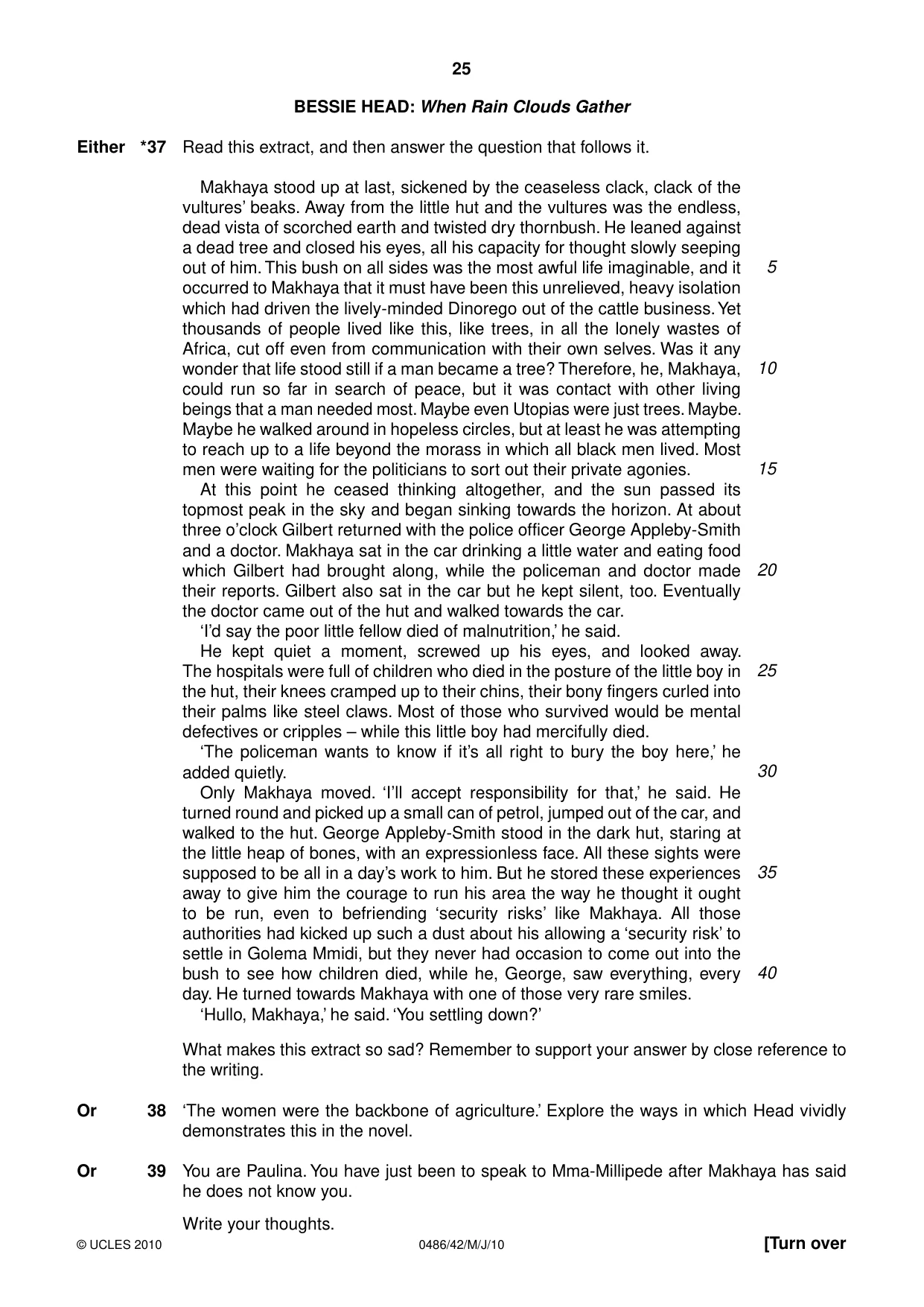
25 0486/42/M/J/10 © UCLES 2010 [Turn over BESSIE HEAD: When Rain Clouds Gather Either * 37 Read this extract, and then answer the question that follows it. Makhaya stood up at last, sickened by the ceaseless clack, clack of the vultures’ beaks. Away from the little hut and the vultures was the endless, dead vista of scorched earth and twisted dry thornbush. He leaned against a dead tree and closed his eyes, all his capacity for thought slowly seeping out of him. This bush on all sides was the most awful life imaginable, and it occurred to Makhaya that it must have been this unrelieved, heavy isolation which had driven the lively-minded Dinorego out of the cattle business. Yet thousands of people lived like this, like trees, in all the lonely wastes of Africa, cut off even from communication with their own selves. Was it any wonder that life stood still if a man became a tree? Therefore, he, Makhaya, could run so far in search of peace, but it was contact with other living beings that a man needed most. Maybe even Utopias were just trees. Maybe. Maybe he walked around in hopeless circles, but at least he was attempting to reach up to a life beyond the morass in which all black men lived. Most men were waiting for the politicians to sort out their private agonies. At this point he ceased thinking altogether, and the sun passed its topmost peak in the sky and began sinking towards the horizon. At about three o’clock Gilbert returned with the police officer George Appleby-Smith and a doctor. Makhaya sat in the car drinking a little water and eating food which Gilbert had brought along, while the policeman and doctor made their reports. Gilbert also sat in the car but he kept silent, too. Eventually the doctor came out of the hut and walked towards the car. ‘I’d say the poor little fellow died of malnutrition,’ he said. He kept quiet a moment, screwed up his eyes, and looked away. The hospitals were full of children who died in the posture of the little boy in the hut, their knees cramped up to their chins, their bony fingers curled into their palms like steel claws. Most of those who survived would be mental defectives or cripples – while this little boy had mercifully died. ‘The policeman wants to know if it’s all right to bury the boy here,’ he added quietly. Only Makhaya moved. ‘I’ll accept responsibility for that,’ he said. He turned round and picked up a small can of petrol, jumped out of the car, and walked to the hut. George Appleby-Smith stood in the dark hut, staring at the little heap of bones, with an expressionless face. All these sights were supposed to be all in a day’s work to him. But he stored these experiences away to give him the courage to run his area the way he thought it ought to be run, even to befriending ‘security risks’ like Makhaya. All those authorities had kicked up such a dust about his allowing a ‘security risk’ to settle in Golema Mmidi, but they never had occasion to come out into the bush to see how children died, while he, George, saw everything, every day. He turned towards Makhaya with one of those very rare smiles. ‘Hullo, Makhaya,’ he said. ‘You settling down?’ What makes this extract so sad? Remember to support your answer by close reference to the writing. Or 38 ‘The women were the backbone of agriculture.’ Explore the ways in which Head vividly demonstrates this in the novel. Or 39 You are Paulina. You have just been to speak to Mma-Millipede after Makhaya has said he does not know you. Write your thoughts. 5 10 15 20 25 30 35 40
Question paper, page 26
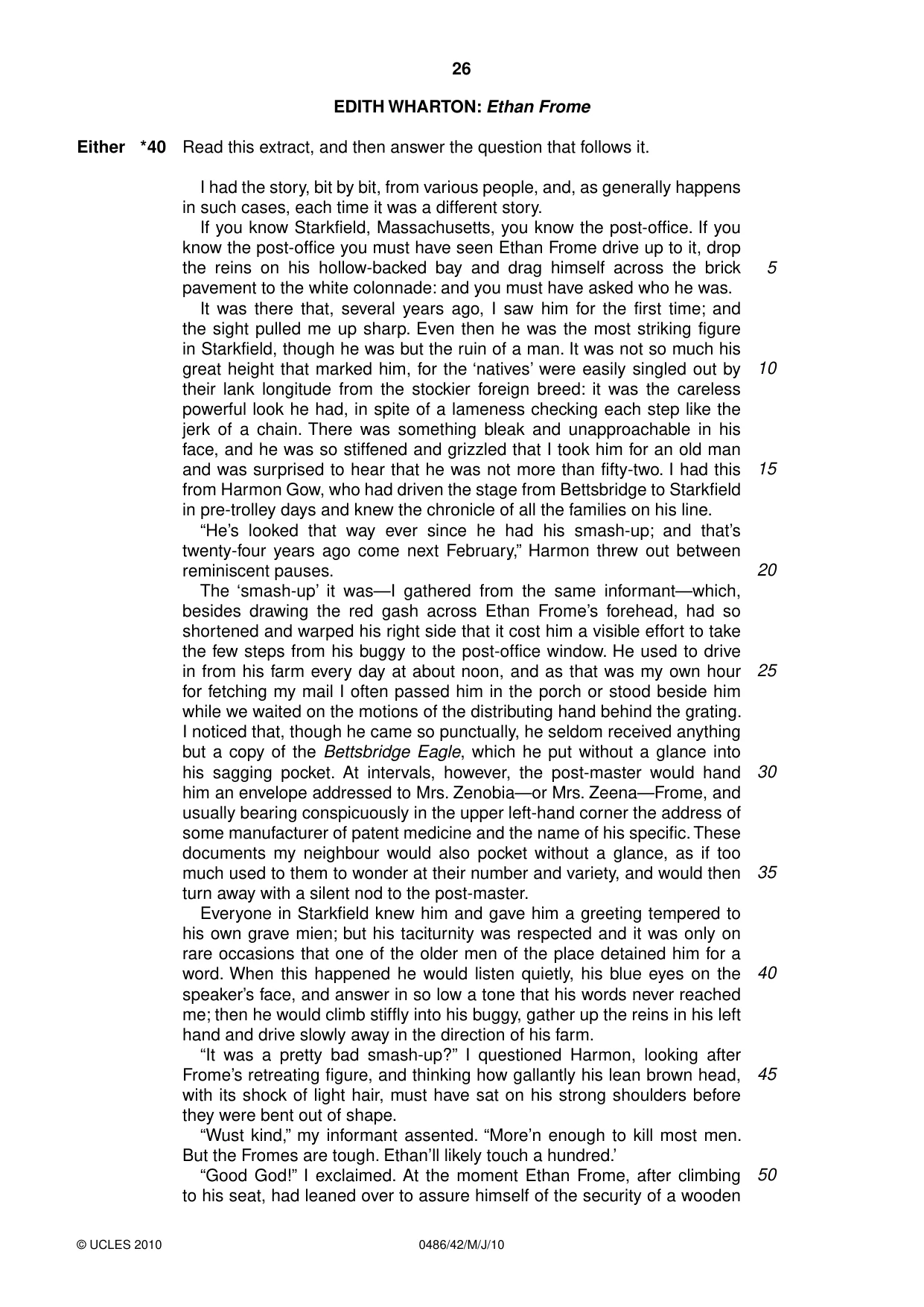
26 0486/42/M/J/10 © UCLES 2010 EDITH WHARTON: Ethan Frome Either * 40 Read this extract, and then answer the question that follows it. I had the story, bit by bit, from various people, and, as generally happens in such cases, each time it was a different story. If you know Starkfield, Massachusetts, you know the post-office. If you know the post-office you must have seen Ethan Frome drive up to it, drop the reins on his hollow-backed bay and drag himself across the brick pavement to the white colonnade: and you must have asked who he was. It was there that, several years ago, I saw him for the first time; and the sight pulled me up sharp. Even then he was the most striking figure in Starkfield, though he was but the ruin of a man. It was not so much his great height that marked him, for the ‘natives’ were easily singled out by their lank longitude from the stockier foreign breed: it was the careless powerful look he had, in spite of a lameness checking each step like the jerk of a chain. There was something bleak and unapproachable in his face, and he was so stiffened and grizzled that I took him for an old man and was surprised to hear that he was not more than fifty-two. I had this from Harmon Gow, who had driven the stage from Bettsbridge to Starkfield in pre-trolley days and knew the chronicle of all the families on his line. “He’s looked that way ever since he had his smash-up; and that’s twenty-four years ago come next February,” Harmon threw out between reminiscent pauses. The ‘smash-up’ it was—I gathered from the same informant—which, besides drawing the red gash across Ethan Frome’s forehead, had so shortened and warped his right side that it cost him a visible effort to take the few steps from his buggy to the post-office window. He used to drive in from his farm every day at about noon, and as that was my own hour for fetching my mail I often passed him in the porch or stood beside him while we waited on the motions of the distributing hand behind the grating. I noticed that, though he came so punctually, he seldom received anything but a copy of the Bettsbridge Eagle, which he put without a glance into his sagging pocket. At intervals, however, the post-master would hand him an envelope addressed to Mrs. Zenobia—or Mrs. Zeena—Frome, and usually bearing conspicuously in the upper left-hand corner the address of some manufacturer of patent medicine and the name of his specific. These documents my neighbour would also pocket without a glance, as if too much used to them to wonder at their number and variety, and would then turn away with a silent nod to the post-master. Everyone in Starkfield knew him and gave him a greeting tempered to his own grave mien; but his taciturnity was respected and it was only on rare occasions that one of the older men of the place detained him for a word. When this happened he would listen quietly, his blue eyes on the speaker’s face, and answer in so low a tone that his words never reached me; then he would climb stiffly into his buggy, gather up the reins in his left hand and drive slowly away in the direction of his farm. “It was a pretty bad smash-up?” I questioned Harmon, looking after Frome’s retreating figure, and thinking how gallantly his lean brown head, with its shock of light hair, must have sat on his strong shoulders before they were bent out of shape. “Wust kind,” my informant assented. “More’n enough to kill most men. But the Fromes are tough. Ethan’ll likely touch a hundred.’ “Good God!” I exclaimed. At the moment Ethan Frome, after climbing to his seat, had leaned over to assure himself of the security of a wooden 5 10 15 20 25 30 35 40 45 50
Question paper, page 27
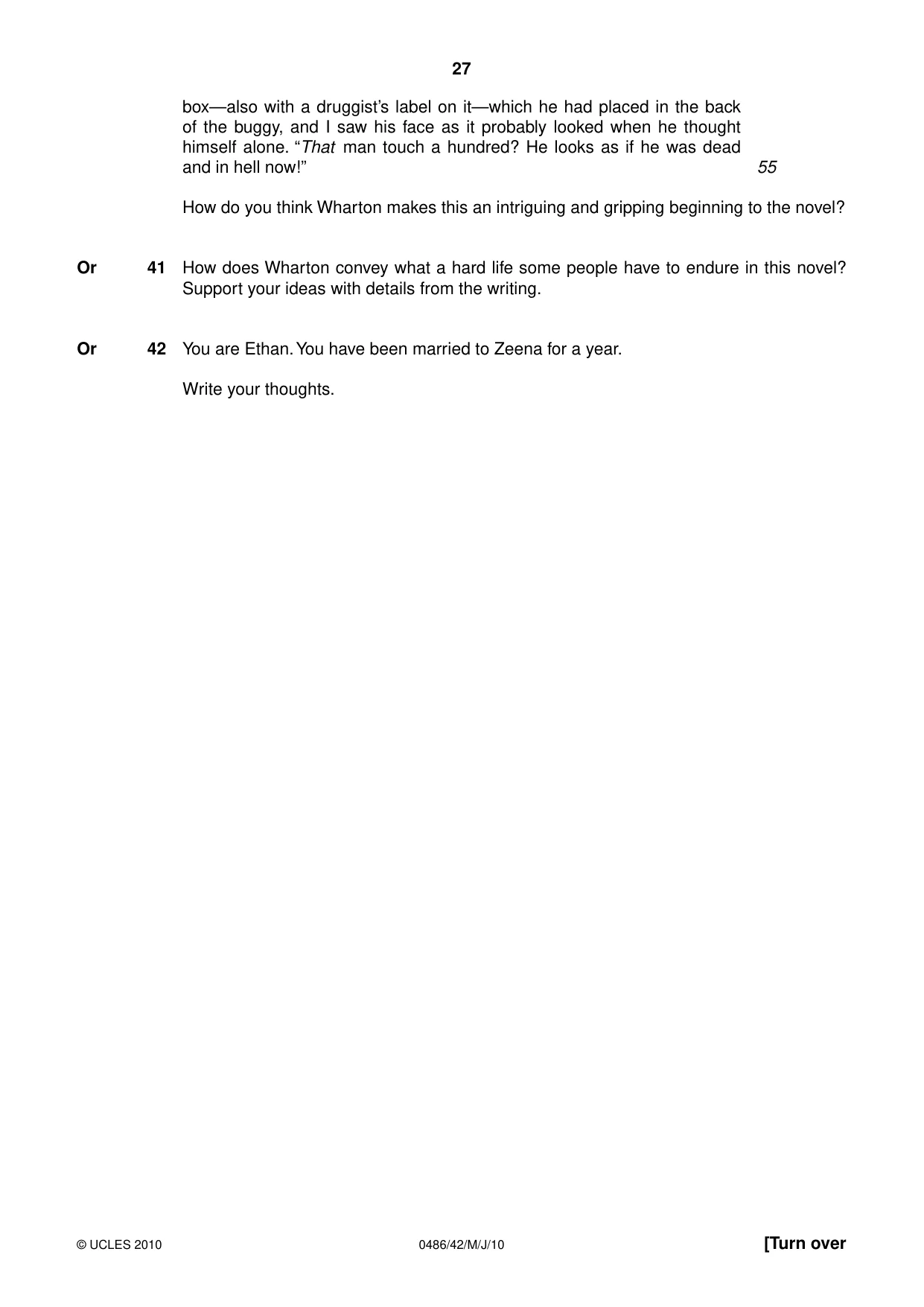
27 0486/42/M/J/10 © UCLES 2010 [Turn over box—also with a druggist’s label on it—which he had placed in the back of the buggy, and I saw his face as it probably looked when he thought himself alone. “That man touch a hundred? He looks as if he was dead and in hell now!” How do you think Wharton makes this an intriguing and gripping beginning to the novel? Or 41 How does Wharton convey what a hard life some people have to endure in this novel? Support your ideas with details from the writing. Or 42 You are Ethan. You have been married to Zeena for a year. Write your thoughts. 55
Question paper, page 28
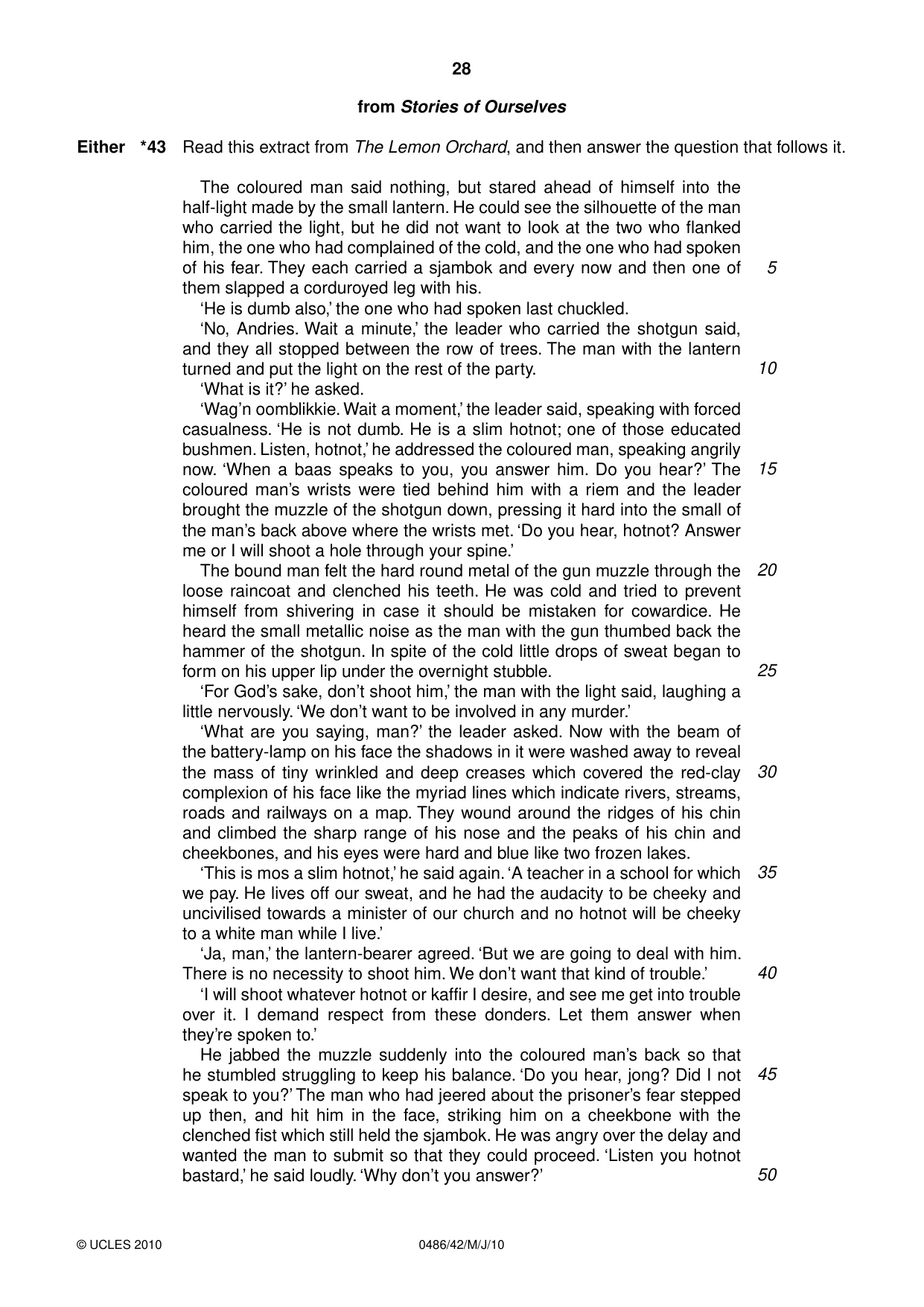
28 0486/42/M/J/10 © UCLES 2010 from Stories of Ourselves Either * 43 Read this extract from The Lemon Orchard, and then answer the question that follows it. The coloured man said nothing, but stared ahead of himself into the half-light made by the small lantern. He could see the silhouette of the man who carried the light, but he did not want to look at the two who flanked him, the one who had complained of the cold, and the one who had spoken of his fear. They each carried a sjambok and every now and then one of them slapped a corduroyed leg with his. ‘He is dumb also,’ the one who had spoken last chuckled. ‘No, Andries. Wait a minute,’ the leader who carried the shotgun said, and they all stopped between the row of trees. The man with the lantern turned and put the light on the rest of the party. ‘What is it?’ he asked. ‘Wag’n oomblikkie. Wait a moment,’ the leader said, speaking with forced casualness. ‘He is not dumb. He is a slim hotnot; one of those educated bushmen. Listen, hotnot,’ he addressed the coloured man, speaking angrily now. ‘When a baas speaks to you, you answer him. Do you hear?’ The coloured man’s wrists were tied behind him with a riem and the leader brought the muzzle of the shotgun down, pressing it hard into the small of the man’s back above where the wrists met. ‘Do you hear, hotnot? Answer me or I will shoot a hole through your spine.’ The bound man felt the hard round metal of the gun muzzle through the loose raincoat and clenched his teeth. He was cold and tried to prevent himself from shivering in case it should be mistaken for cowardice. He heard the small metallic noise as the man with the gun thumbed back the hammer of the shotgun. In spite of the cold little drops of sweat began to form on his upper lip under the overnight stubble. ‘For God’s sake, don’t shoot him,’ the man with the light said, laughing a little nervously. ‘We don’t want to be involved in any murder.’ ‘What are you saying, man?’ the leader asked. Now with the beam of the battery-lamp on his face the shadows in it were washed away to reveal the mass of tiny wrinkled and deep creases which covered the red-clay complexion of his face like the myriad lines which indicate rivers, streams, roads and railways on a map. They wound around the ridges of his chin and climbed the sharp range of his nose and the peaks of his chin and cheekbones, and his eyes were hard and blue like two frozen lakes. ‘This is mos a slim hotnot,’ he said again. ‘A teacher in a school for which we pay. He lives off our sweat, and he had the audacity to be cheeky and uncivilised towards a minister of our church and no hotnot will be cheeky to a white man while I live.’ ‘Ja, man,’ the lantern-bearer agreed. ‘But we are going to deal with him. There is no necessity to shoot him. We don’t want that kind of trouble.’ ‘I will shoot whatever hotnot or kaffir I desire, and see me get into trouble over it. I demand respect from these donders. Let them answer when they’re spoken to.’ He jabbed the muzzle suddenly into the coloured man’s back so that he stumbled struggling to keep his balance. ‘Do you hear, jong? Did I not speak to you?’ The man who had jeered about the prisoner’s fear stepped up then, and hit him in the face, striking him on a cheekbone with the clenched fist which still held the sjambok. He was angry over the delay and wanted the man to submit so that they could proceed. ‘Listen you hotnot bastard,’ he said loudly. ‘Why don’t you answer?’ 5 10 15 20 25 30 35 40 45 50
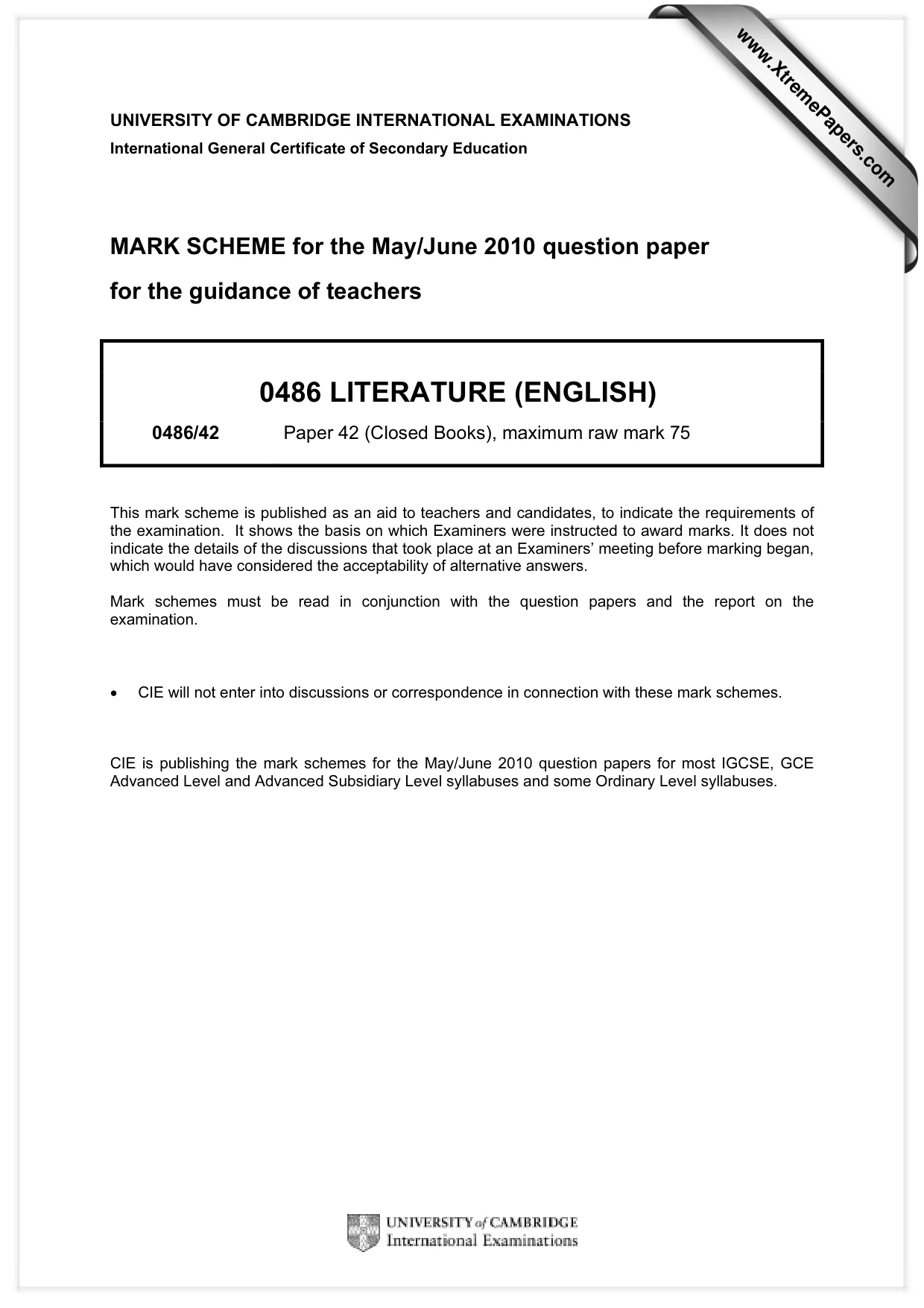
Question paper, page 29
29 0486/42/M/J/10 © UCLES 2010 The man stumbled, caught himself and stood in the rambling shadow of one of the lemon trees. The lantern-light swung on him and he looked away from the centre of the beam. He was afraid the leader would shoot him in anger and he had no wish to die. He straightened up and looked away from them. How does La Guma make you feel sympathy for the coloured man here? Or 44 What do you find particularly striking about the ways in which Bradbury presents a vision of the future in There Will Come Soft Rains ? Support your answer by close reference to the story. Or 45 You are Aunt Mary in Secrets. You have just discovered that your nephew has read your letters. Write your thoughts. 55
Question paper, page 30
30 0486/42/M/J/10 © UCLES 2010 BLANK PAGE
Question paper, page 31
31 0486/42/M/J/10 © UCLES 2010 BLANK PAGE
Question paper, page 32
32 0486/42/M/J/10 © UCLES 2010 BLANK PAGE Copyright Acknowledgements: Question 1 © Alan Ayckbourn; A Small Family Business ; Casarotto Ramsay & Associates Ltd. Question 4 © Charlotte Keatley; My Mother Said I Never Should ; Methuen. Question 7 © The Wylie Agency; Arthur Miller; The Crucible. Question 16 © R.C. Sherriff; Journey’s End ; Penguin. Question 28 © Ian Cross; The God Boy ; Penguin New Zealand. Question 31 © Anita Desai; Games at Twilight ; Vintage. Question 37 © Bessie Head; When Rain Clouds Gather ; Heinemann, Windmill Series. Permission to reproduce items where third-party owned material protected by copyright is included has been sought and cleared where possible. Every reasonable effort has been made by the publisher (UCLES) to trace copyright holders, but if any items requiring clearance have unwittingly been included, the publisher will be pleased to make amends at the earliest possible opportunity. University of Cambridge International Examinations is part of the Cambridge Assessment Group. Cambridge Assessment is the brand name of University of Cambridge Local Examinations Syndicate (UCLES), which is itself a department of the University of Cambridge.
Mark scheme, page 1
UNIVERSITY OF CAMBRIDGE INTERNATIONAL EXAMINATIONS International General Certificate of Secondary Education MARK SCHEME for the May/June 2010 question paper for the guidance of teachers 0486 LITERATURE (ENGLISH) 0486/42 Paper 42 (Closed Books), maximum raw mark 75 This mark scheme is published as an aid to teachers and candidates, to indicate the requirements of the examination. It shows the basis on which Examiners were instructed to award marks. It does not indicate the details of the discussions that took place at an Examiners’ meeting before marking began, which would have considered the acceptability of alternative answers. Mark schemes must be read in conjunction with the question papers and the report on the examination. • CIE will not enter into discussions or correspondence in connection with these mark schemes. CIE is publishing the mark schemes for the May/June 2010 question papers for most IGCSE, GCE Advanced Level and Advanced Subsidiary Level syllabuses and some Ordinary Level syllabuses. www.XtremePapers.com
Mark scheme, page 2
Page 2 Mark Scheme: Teachers’ version Syllabus Paper IGCSE – May/June 2010 0486 42 © UCLES 2010 All questions on this paper are marked out of 25. The assessment objectives for the paper are: AO1 show detailed knowledge of the content of literary texts AO2 understand the meanings of literary texts and their context, and explore texts beyond surface meaning to show deeper awareness of ideas and attitudes AO3 recognise and appreciate ways in which writers use language, structure, and form to create and shape meanings and effects AO4 communicate a sensitive and informed personal response The General Descriptors cover marks from 0 to 25, and apply to the marking of each question. They guide examiners to an understanding of the qualities normally expected of, or typical of, work in a band. They are a means of general guidance, and must not be interpreted as hurdle statements. For the purposes of standardisation of marking, they are to be used in conjunction with photostats of candidates’ work produced in the examination and discussed during the examiners’ coordination meeting, as well as the question-specific notes. The notes for each question are related to the assessment objectives above. Because of the nature of the subject, they are for general guidance; they are not designed as prescriptions of required content and must not be treated as such.
Mark scheme, page 3
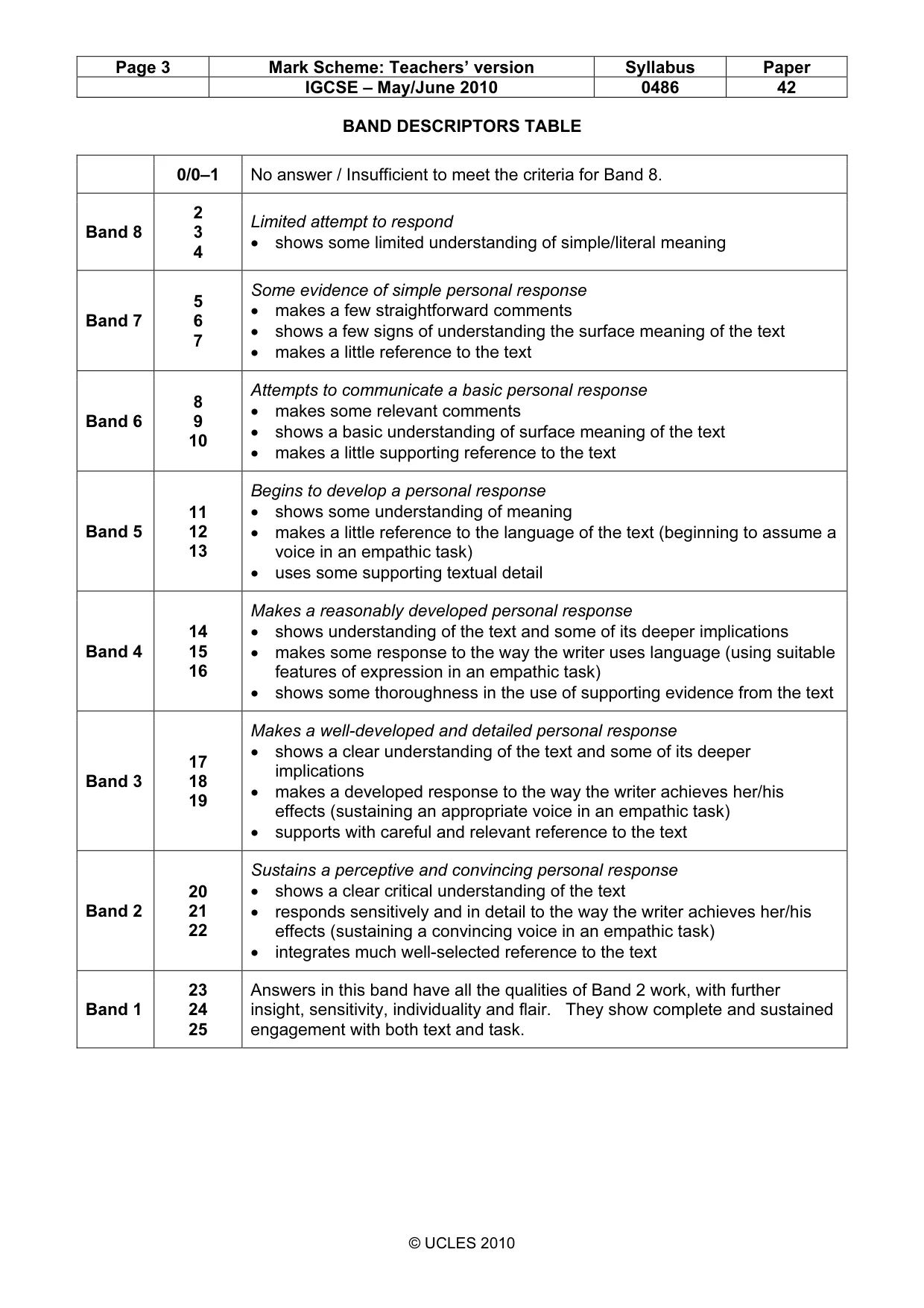
Page 3 Mark Scheme: Teachers’ version Syllabus Paper IGCSE – May/June 2010 0486 42 © UCLES 2010 BAND DESCRIPTORS TABLE 0/0–1 No answer / Insufficient to meet the criteria for Band 8. Band 8 2 3 4 Limited attempt to respond • shows some limited understanding of simple/literal meaning Band 7 5 6 7 Some evidence of simple personal response • makes a few straightforward comments • shows a few signs of understanding the surface meaning of the text • makes a little reference to the text Band 6 8 9 10 Attempts to communicate a basic personal response • makes some relevant comments • shows a basic understanding of surface meaning of the text • makes a little supporting reference to the text Band 5 11 12 13 Begins to develop a personal response • shows some understanding of meaning • makes a little reference to the language of the text (beginning to assume a voice in an empathic task) • uses some supporting textual detail Band 4 14 15 16 Makes a reasonably developed personal response • shows understanding of the text and some of its deeper implications • makes some response to the way the writer uses language (using suitable features of expression in an empathic task) • shows some thoroughness in the use of supporting evidence from the text Band 3 17 18 19 Makes a well-developed and detailed personal response • shows a clear understanding of the text and some of its deeper implications • makes a developed response to the way the writer achieves her/his effects (sustaining an appropriate voice in an empathic task) • supports with careful and relevant reference to the text Band 2 20 21 22 Sustains a perceptive and convincing personal response • shows a clear critical understanding of the text • responds sensitively and in detail to the way the writer achieves her/his effects (sustaining a convincing voice in an empathic task) • integrates much well-selected reference to the text Band 1 23 24 25 Answers in this band have all the qualities of Band 2 work, with further insight, sensitivity, individuality and flair. They show complete and sustained engagement with both text and task.
Mark scheme, page 4
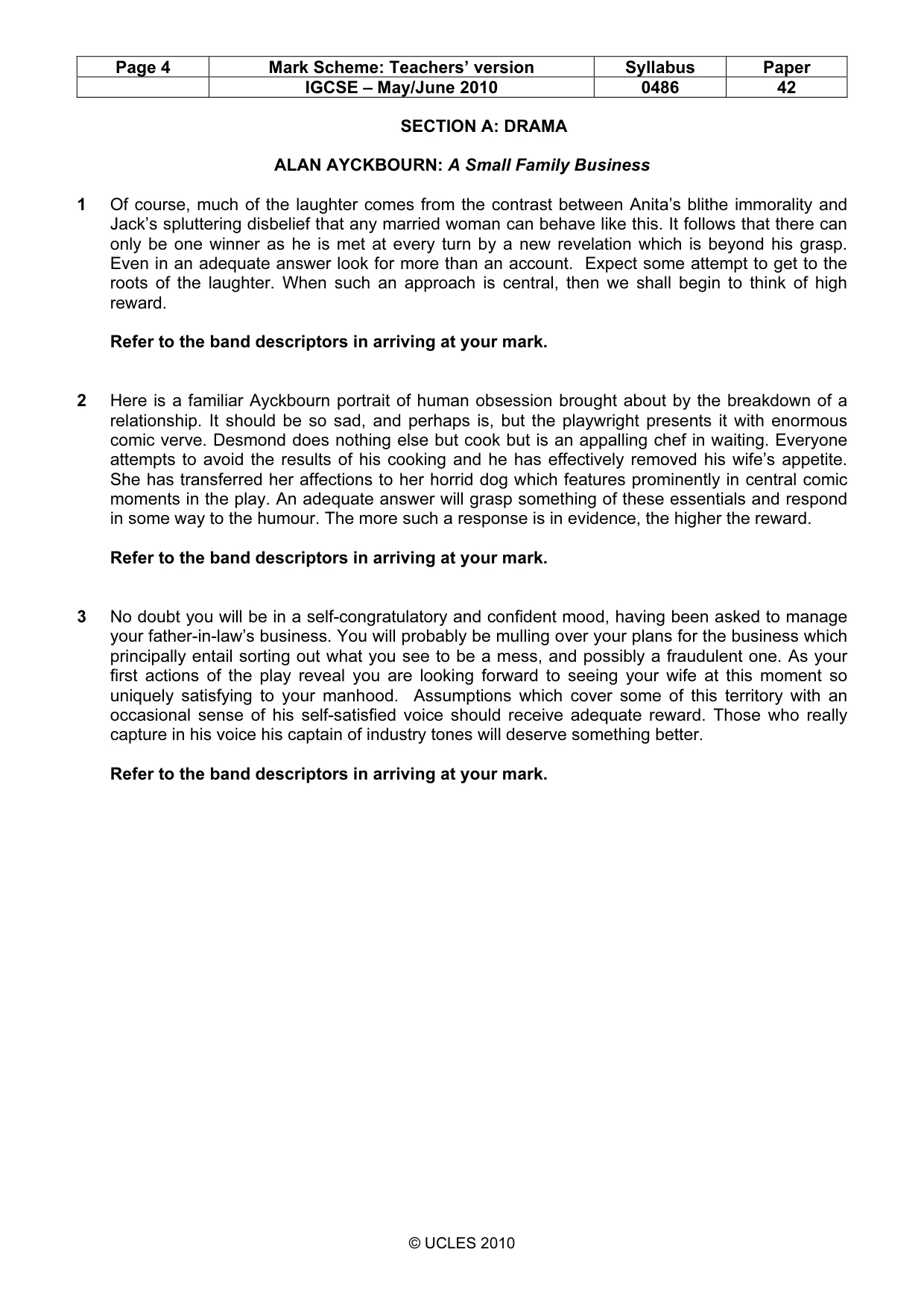
Page 4 Mark Scheme: Teachers’ version Syllabus Paper IGCSE – May/June 2010 0486 42 © UCLES 2010 SECTION A: DRAMA ALAN AYCKBOURN: A Small Family Business 1 Of course, much of the laughter comes from the contrast between Anita’s blithe immorality and Jack’s spluttering disbelief that any married woman can behave like this. It follows that there can only be one winner as he is met at every turn by a new revelation which is beyond his grasp. Even in an adequate answer look for more than an account. Expect some attempt to get to the roots of the laughter. When such an approach is central, then we shall begin to think of high reward. Refer to the band descriptors in arriving at your mark. 2 Here is a familiar Ayckbourn portrait of human obsession brought about by the breakdown of a relationship. It should be so sad, and perhaps is, but the playwright presents it with enormous comic verve. Desmond does nothing else but cook but is an appalling chef in waiting. Everyone attempts to avoid the results of his cooking and he has effectively removed his wife’s appetite. She has transferred her affections to her horrid dog which features prominently in central comic moments in the play. An adequate answer will grasp something of these essentials and respond in some way to the humour. The more such a response is in evidence, the higher the reward. Refer to the band descriptors in arriving at your mark. 3 No doubt you will be in a self-congratulatory and confident mood, having been asked to manage your father-in-law’s business. You will probably be mulling over your plans for the business which principally entail sorting out what you see to be a mess, and possibly a fraudulent one. As your first actions of the play reveal you are looking forward to seeing your wife at this moment so uniquely satisfying to your manhood. Assumptions which cover some of this territory with an occasional sense of his self-satisfied voice should receive adequate reward. Those who really capture in his voice his captain of industry tones will deserve something better. Refer to the band descriptors in arriving at your mark.
Mark scheme, page 5
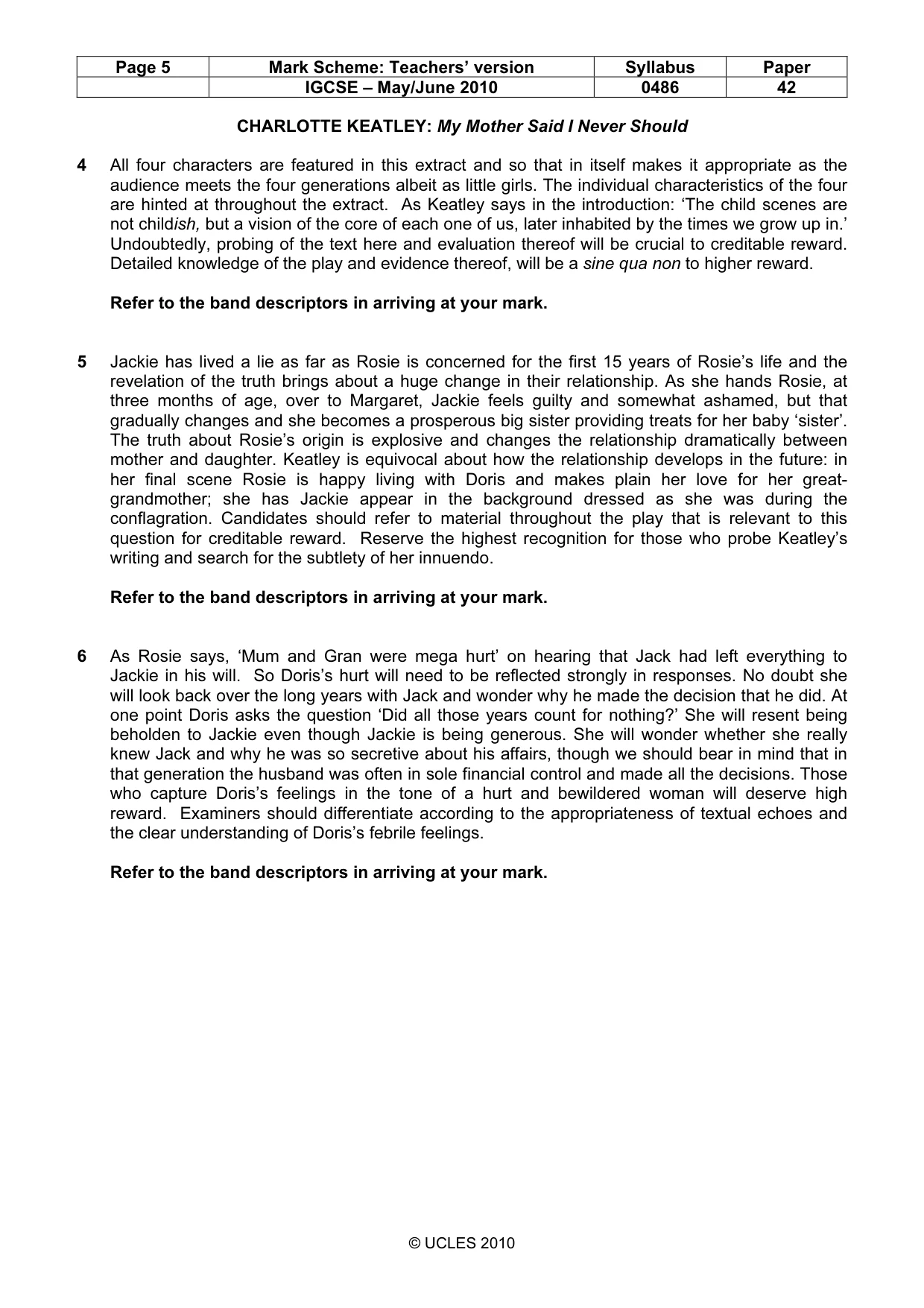
Page 5 Mark Scheme: Teachers’ version Syllabus Paper IGCSE – May/June 2010 0486 42 © UCLES 2010 CHARLOTTE KEATLEY: My Mother Said I Never Should 4 All four characters are featured in this extract and so that in itself makes it appropriate as the audience meets the four generations albeit as little girls. The individual characteristics of the four are hinted at throughout the extract. As Keatley says in the introduction: ‘The child scenes are not childish, but a vision of the core of each one of us, later inhabited by the times we grow up in.’ Undoubtedly, probing of the text here and evaluation thereof will be crucial to creditable reward. Detailed knowledge of the play and evidence thereof, will be a sine qua non to higher reward. Refer to the band descriptors in arriving at your mark. 5 Jackie has lived a lie as far as Rosie is concerned for the first 15 years of Rosie’s life and the revelation of the truth brings about a huge change in their relationship. As she hands Rosie, at three months of age, over to Margaret, Jackie feels guilty and somewhat ashamed, but that gradually changes and she becomes a prosperous big sister providing treats for her baby ‘sister’. The truth about Rosie’s origin is explosive and changes the relationship dramatically between mother and daughter. Keatley is equivocal about how the relationship develops in the future: in her final scene Rosie is happy living with Doris and makes plain her love for her great- grandmother; she has Jackie appear in the background dressed as she was during the conflagration. Candidates should refer to material throughout the play that is relevant to this question for creditable reward. Reserve the highest recognition for those who probe Keatley’s writing and search for the subtlety of her innuendo. Refer to the band descriptors in arriving at your mark. 6 As Rosie says, ‘Mum and Gran were mega hurt’ on hearing that Jack had left everything to Jackie in his will. So Doris’s hurt will need to be reflected strongly in responses. No doubt she will look back over the long years with Jack and wonder why he made the decision that he did. At one point Doris asks the question ‘Did all those years count for nothing?’ She will resent being beholden to Jackie even though Jackie is being generous. She will wonder whether she really knew Jack and why he was so secretive about his affairs, though we should bear in mind that in that generation the husband was often in sole financial control and made all the decisions. Those who capture Doris’s feelings in the tone of a hurt and bewildered woman will deserve high reward. Examiners should differentiate according to the appropriateness of textual echoes and the clear understanding of Doris’s febrile feelings. Refer to the band descriptors in arriving at your mark.
Mark scheme, page 6
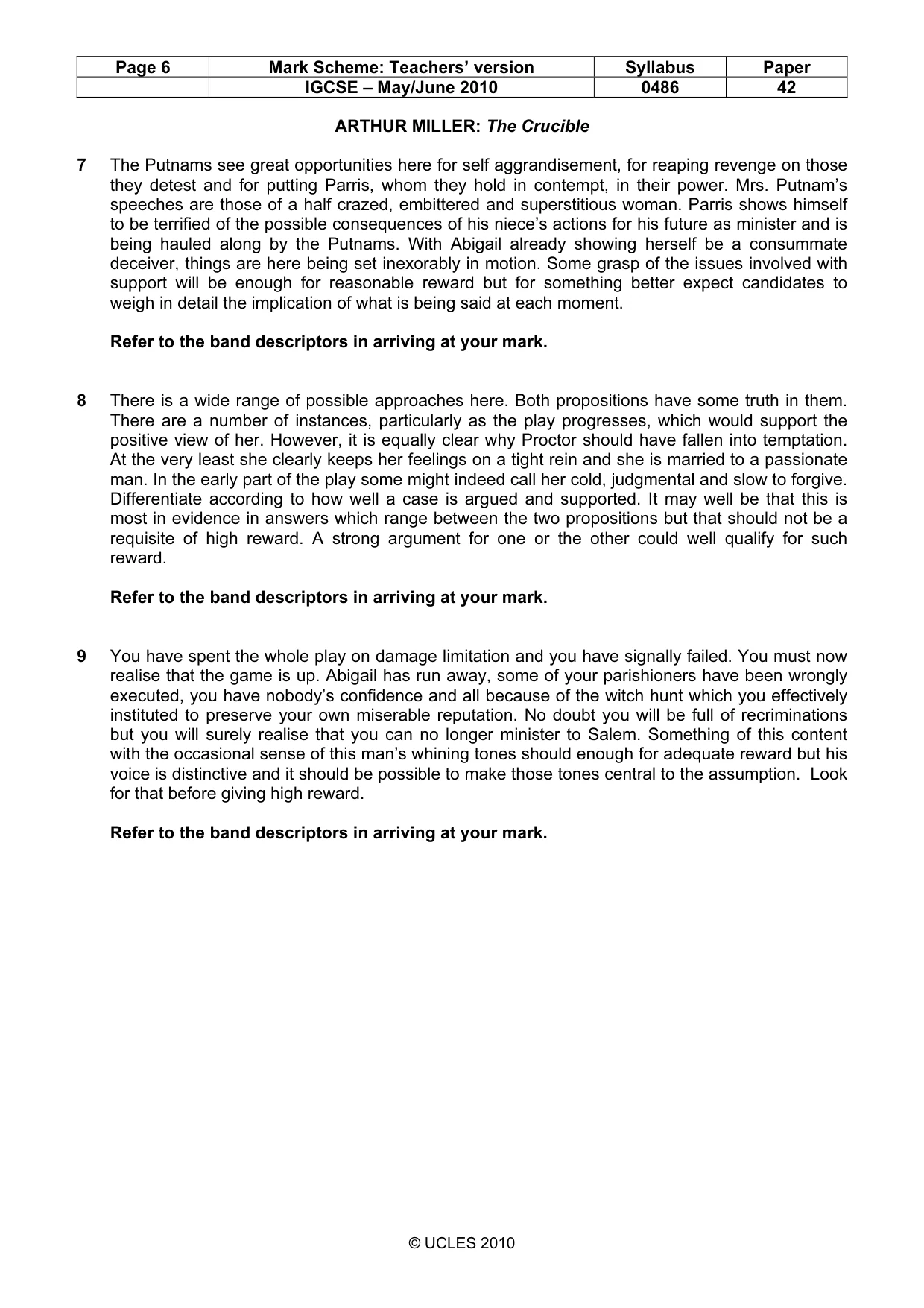
Page 6 Mark Scheme: Teachers’ version Syllabus Paper IGCSE – May/June 2010 0486 42 © UCLES 2010 ARTHUR MILLER: The Crucible 7 The Putnams see great opportunities here for self aggrandisement, for reaping revenge on those they detest and for putting Parris, whom they hold in contempt, in their power. Mrs. Putnam’s speeches are those of a half crazed, embittered and superstitious woman. Parris shows himself to be terrified of the possible consequences of his niece’s actions for his future as minister and is being hauled along by the Putnams. With Abigail already showing herself be a consummate deceiver, things are here being set inexorably in motion. Some grasp of the issues involved with support will be enough for reasonable reward but for something better expect candidates to weigh in detail the implication of what is being said at each moment. Refer to the band descriptors in arriving at your mark. 8 There is a wide range of possible approaches here. Both propositions have some truth in them. There are a number of instances, particularly as the play progresses, which would support the positive view of her. However, it is equally clear why Proctor should have fallen into temptation. At the very least she clearly keeps her feelings on a tight rein and she is married to a passionate man. In the early part of the play some might indeed call her cold, judgmental and slow to forgive. Differentiate according to how well a case is argued and supported. It may well be that this is most in evidence in answers which range between the two propositions but that should not be a requisite of high reward. A strong argument for one or the other could well qualify for such reward. Refer to the band descriptors in arriving at your mark. 9 You have spent the whole play on damage limitation and you have signally failed. You must now realise that the game is up. Abigail has run away, some of your parishioners have been wrongly executed, you have nobody’s confidence and all because of the witch hunt which you effectively instituted to preserve your own miserable reputation. No doubt you will be full of recriminations but you will surely realise that you can no longer minister to Salem. Something of this content with the occasional sense of this man’s whining tones should enough for adequate reward but his voice is distinctive and it should be possible to make those tones central to the assumption. Look for that before giving high reward. Refer to the band descriptors in arriving at your mark.
Mark scheme, page 7
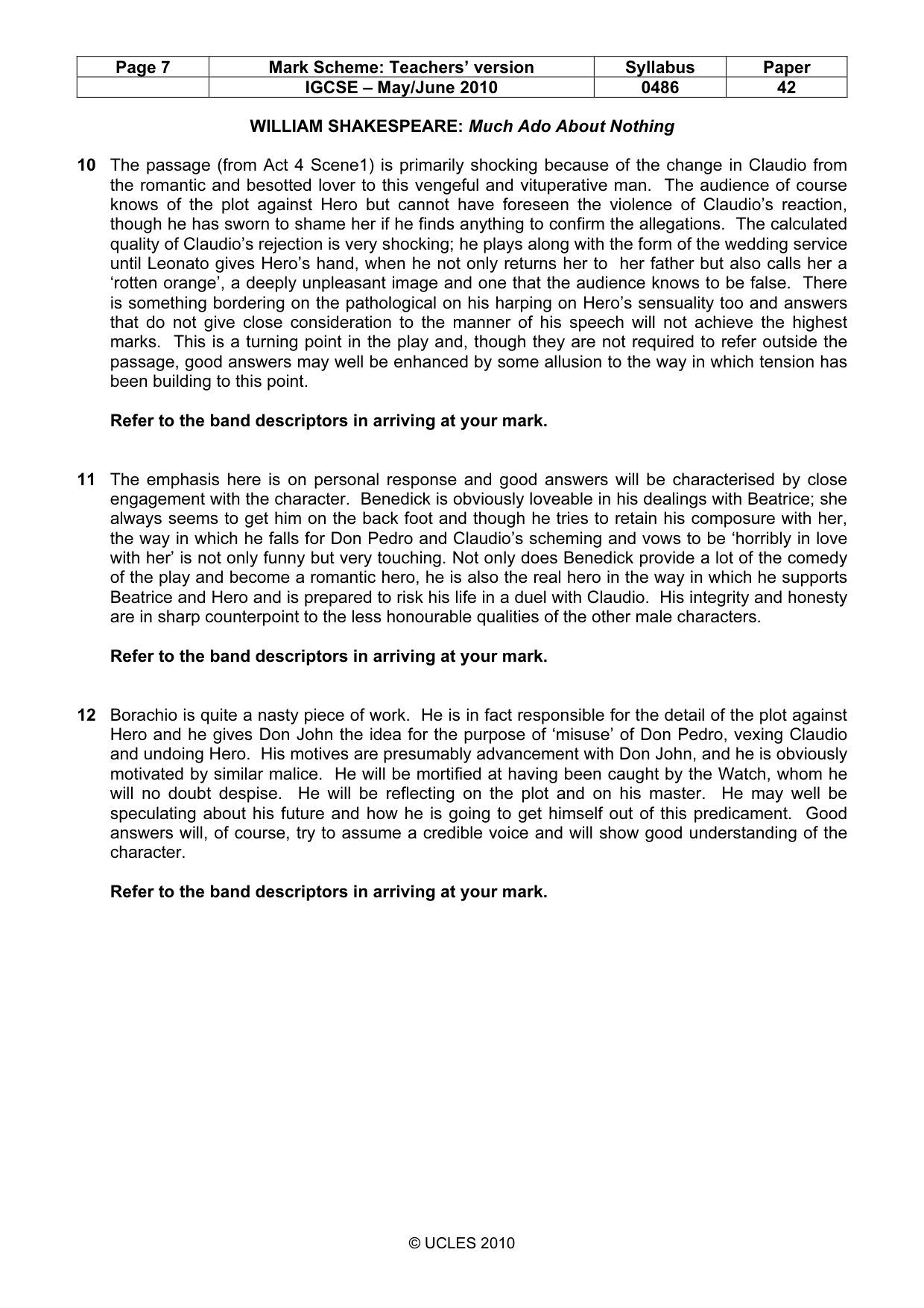
Page 7 Mark Scheme: Teachers’ version Syllabus Paper IGCSE – May/June 2010 0486 42 © UCLES 2010 WILLIAM SHAKESPEARE: Much Ado About Nothing 10 The passage (from Act 4 Scene1) is primarily shocking because of the change in Claudio from the romantic and besotted lover to this vengeful and vituperative man. The audience of course knows of the plot against Hero but cannot have foreseen the violence of Claudio’s reaction, though he has sworn to shame her if he finds anything to confirm the allegations. The calculated quality of Claudio’s rejection is very shocking; he plays along with the form of the wedding service until Leonato gives Hero’s hand, when he not only returns her to her father but also calls her a ‘rotten orange’, a deeply unpleasant image and one that the audience knows to be false. There is something bordering on the pathological on his harping on Hero’s sensuality too and answers that do not give close consideration to the manner of his speech will not achieve the highest marks. This is a turning point in the play and, though they are not required to refer outside the passage, good answers may well be enhanced by some allusion to the way in which tension has been building to this point. Refer to the band descriptors in arriving at your mark. 11 The emphasis here is on personal response and good answers will be characterised by close engagement with the character. Benedick is obviously loveable in his dealings with Beatrice; she always seems to get him on the back foot and though he tries to retain his composure with her, the way in which he falls for Don Pedro and Claudio’s scheming and vows to be ‘horribly in love with her’ is not only funny but very touching. Not only does Benedick provide a lot of the comedy of the play and become a romantic hero, he is also the real hero in the way in which he supports Beatrice and Hero and is prepared to risk his life in a duel with Claudio. His integrity and honesty are in sharp counterpoint to the less honourable qualities of the other male characters. Refer to the band descriptors in arriving at your mark. 12 Borachio is quite a nasty piece of work. He is in fact responsible for the detail of the plot against Hero and he gives Don John the idea for the purpose of ‘misuse’ of Don Pedro, vexing Claudio and undoing Hero. His motives are presumably advancement with Don John, and he is obviously motivated by similar malice. He will be mortified at having been caught by the Watch, whom he will no doubt despise. He will be reflecting on the plot and on his master. He may well be speculating about his future and how he is going to get himself out of this predicament. Good answers will, of course, try to assume a credible voice and will show good understanding of the character. Refer to the band descriptors in arriving at your mark.
Mark scheme, page 8
Page 8 Mark Scheme: Teachers’ version Syllabus Paper IGCSE – May/June 2010 0486 42 © UCLES 2010 WILLIAM SHAKESPEARE: Richard III 13 There is much material here which the candidate may use to point up the delicious ironies of this charade. Of course, Richard is acting a part quite unlike his true personality, that of a man deeply reluctant to take the throne whilst all the time Buckingham is the honest broker intent on the good of the kingdom and dismayed by this reluctance. Of course, the wicked glee with which this duo is acting out this drama within a drama is exemplified by Gloucester’s apparently final line. A clear understanding of the situation and how at moments that conveys a completely different meaning to the meaning the Mayor and the citizens give to it should be enough for adequate reward. Once the candidate can begin to engage with the sly humour and the outrageousness of it all, then we shall go higher. Refer to the band descriptors in arriving at your mark. 14 Shakespeare portrays Buckingham, Hastings, Stanley and Rivers as a truly dreadful bunch and through them strikingly shows why the kingdom has suffered from decades of turmoil. Jockeying for personal power is mainly what they are about and they will murder to achieve it. Occasionally they do have qualms about what they are doing, or being asked to do, but these moments are rare. It is one of the reasons why we are almost sympathetic to Richard. At least he is not a hypocrite and not for one moment thinks his conduct morally defensible. The key word here is vividly. Examiners should not give high reward to answers, however detailed in content, which do not engage with the dramatic power of Shakespeare’s creations. Refer to the band descriptors in arriving at your mark. 15 There are two things which are key to Clarence’s possible thoughts. One is hatred for the people who he thinks have put him in the Tower, to wit the Queen and her family. The other will no doubt centre on his brother, who, of course, put into his mind the previous piece of ‘information’. Clarence will see him as his potential saviour, as a true brother. For an answer to receive adequate reward this material must be present but perhaps the key to higher reward will be communication of Clarence’s weak and gullible personality. He really is a sheep amongst wolves and fear will no doubt be prominent in his voice. Refer to the band descriptors in arriving at your mark.
Mark scheme, page 9
Page 9 Mark Scheme: Teachers’ version Syllabus Paper IGCSE – May/June 2010 0486 42 © UCLES 2010 R. C. SHERRIFF: Journey’s End 16 This is a task which asks candidates to look at a passage with minimal dialogue, unusually demanding imaginative visualisation of what the stage directions deliver. Indeed, the absence of dialogue is part of the poignancy of the scene. Raleigh literally passes quietly away; Stanhope is silent in his misery but conveys it in his actions. The obliteration of the dug-out bringing the play to an end speaks for itself; journey’s end. Expect evidence of engagement with the dramatic force of these events before giving adequate reward. The more a candidate can draw out the dramatic significances and almost unbearable poignancy of the scene, the higher the reward. Refer to the band descriptors in arriving at your mark. 17 There is ample evidence for either proposition. There are moments, particularly in regard to Raleigh and perhaps Hibbert, where Stanhope’s ingrained habits of command tip into something profoundly cruel and bullying. However, since much of the play is about the terrible pressures of command in war, there will probably be a majority who will at least qualify such a judgement. There are a number of moments when he shows quite clearly why he is in command. As so often in this kind of question a candidate should engage precisely with the task’s parameters to gain adequate reward. Character sketches, however detailed, should not receive even adequate reward. Answers which range over the possibilities may declare themselves as worthy of high reward but we should not require such balance for this kind of reward. Strong argument for either might make it into this area. Refer to the band descriptors in arriving at your mark. 18 Raleigh is clearly in a state of distress and the reasons for this are obvious. He has been humiliated by his hero. He has seen a side of Stanhope he never could have imagined to be there. Perhaps most hurtful and humiliating though, given that he is a public schoolboy who has been taught to keep his emotions well under wraps, is to have his hero worship for Stanhope revealed to the object of his worship. Will he be angry? Probably not, bewildered no doubt. However, perhaps we should allow some spark as he leaves his school days behind. Refer to the band descriptors in arriving at your mark.
Mark scheme, page 10
Page 10 Mark Scheme: Teachers’ version Syllabus Paper IGCSE – May/June 2010 0486 42 © UCLES 2010 SECTION B: POETRY 19–24 Poetry is literary language at its most intense. A poem in a short space creates a multiplicity of resonances and hence possible meanings. We must expect that candidates will offer a very wide variety of responses and interpretations and as examiners must at all times keep a totally open mind when assessing work on a poem. In the exercise of our judgment, we shall, of course, read work which shows manifestly little or no understanding of a poem and we will mark that accordingly. However, it should also be a regular experience to find answers which offer valid perspectives new to the examiner and which, just as manifestly, deserve to be given high reward. We will differentiate first of all according to how directly the candidates answer the question. Where questions prescribe the poems from which the candidates should choose this is to ensure that the candidate is writing on a poem appropriate to the question. It is also designed to send a strong signal to candidates that they are taking a large risk going into the examination with only one or two poems which they are determined to fit to a question. The problem can be that some will choose a question because the poem they wish to write about appears in the list rather than because they can answer the question. We must be very careful not to give much reward for answers which manifestly are not addressing the question, even if they show a convincing grasp of the poem. Do not over-reward such run throughs and do not forget that all the tasks demand that the candidate engage with the poem through a specific route; they are never simple invitations to write about a poem. We should think very hard before putting such work in Band 3. Beyond focus on the question, we will also assess according to how well candidates convince us that they have engaged with the pleasure and excitement of good poetry. This means in effect that we do NOT give high reward to any explanation of "meaning" which shows little response to the words and how they create meaning. In all of the questions there is an explicit requirement to make a response to the words and it will be difficult for any work which fails to engage in this way to progress beyond Band 3. In addition, examiners should be careful not to over-reward comment which is able to isolate vivid features of a poem’s language but which is unable to probe the reasons for their vividness. For instance, the noting of rhyme, sound and movement, the listing of significant words and figures of speech is only a very small first step to insightful personal response. Work given high reward should show the ability of the candidate to analyse how such features of a poem’s language achieve their effect. Refer to the band descriptors in arriving at your mark.
Mark scheme, page 11
Page 11 Mark Scheme: Teachers’ version Syllabus Paper IGCSE – May/June 2010 0486 42 © UCLES 2010 SECTION C: PROSE JANE AUSTEN: Pride and Prejudice 25 One will hope that most candidates will recognise that this is a passage of unsurpassed ridicule. Collins’s impenetrable self-regard and conceit, his ludicrous certainty that he represents a superb match for Elizabeth, all mark him down as one of the great fools of literature. His assurance of violence of his affection is a particularly delicious moment of irony. However, just to remind the reader of what a marriage to such a man would entail, the speech also ends on a very unpleasant note of what virtually amounts to blackmail. He is a fool but in no way a loveable one. A clear grasp of the ironies of the passage should be enough for a reasonable mark but reserve high reward to those who engage in detail with the ironies of Austen’s writing. Refer to the band descriptors in arriving at your mark. 26 The challenge of this task is twofold. It is to respond to the character’s vivacity and energy as the words appealing and lively make plain, as well as engaging with the ways in which Austen’s writing makes it so. Examiners should not give even adequate reward to answers which in effect do no more than record the character’s features. Conversely look out for those who relish her delightful personality and who are able to support their argument with pertinent detail. Of course, the latter will differ from answer to answer and examiners should not become prescriptive in their expectations as to which details should appear in an answer. Refer to the band descriptors in arriving at your mark. 27 Mr. Bennet will be a happy man and also a relieved one. Not so long ago he was facing disaster, now he sees his two worthwhile daughters married to the men of their choice and in Elizabeth’s case to a man he has come to value and admire. Nothing is likely to please him more than to see his favourite and most admired daughter so happily wedded. Such obviously is going to be the basis of any adequate assumption but one would hope that the better candidates will show themselves by catching his wry tones with perhaps the occasional ironic noting of such things as his wife’s notable change of attitude towards Darcy and much else. There should be much scope for creating a recognisable voice here and high reward should not be given without it being manifestly present. Refer to the band descriptors in arriving at your mark.
Mark scheme, page 12
Page 12 Mark Scheme: Teachers’ version Syllabus Paper IGCSE – May/June 2010 0486 42 © UCLES 2010 IAN CROSS: The God Boy 28 It is what is not spoken which is so poignant here. Clearly both want to say something overtly loving to one another but cannot find the words. Through Jimmy we learn that this is a rare moment of cheerfulness for the mother and that it always relates to her son and most definitely not her husband. The context is sad also because we guess from the husband’s cheerful demeanour that he is about to bring off a great coup in his battle for the child’s affections, based typically on spending money the family cannot afford. As usual, we shall differentiate according to how well the candidate engages with detail and conveys the reasons for being moved by what is happening. A narrative description of the scene should not receive a satisfactory reward. The more there is appreciation of Cross’s writing, the higher the reward. Refer to the band descriptors in arriving at your mark. 29 There are a number of reasons which could be advanced. The most obvious and probably the most popular are the facts of his home situation which emerge quite quickly in the novel. It is clear that his unhappiness creates tensions which emerge in frequent anti-social behaviour, a notch or two up from what might be expected to be the usual behaviour of the young growing male. The fact that he only dimly understands what is going on adds to the sympathy. Another line could be, of course, that the reader naturally responds to his energy, curiosity and humour, particularly in the context of his domestic life. Whatever is the chosen route taken by the candidate, examiners should differentiate according to the way the argument is developed and supported by detail. For the highest reward expect a close engagement with Cross’s writing. Refer to the band descriptors in arriving at your mark. 30 Jack Crannery thinks he has seen everything in his disappointing life but this is something which not even he expected. What he sees as the betrayals of his life have led him into a life of solitariness until this strange boy crossed his path. He thought he had struck up almost a paternal relationship with the boy, and then this. Shock, growling anger will no doubt be the predominant feelings but perhaps reflection will follow. Something of these feelings with relevant knowledge of the situation will be enough for adequate reward but for something better we should expect something of the man’s laconic personality to come through in the voice. Refer to the band descriptors in arriving at your mark.
Mark scheme, page 13
Page 13 Mark Scheme: Teachers’ version Syllabus Paper IGCSE – May/June 2010 0486 42 © UCLES 2010 ANITA DESAI: Games at Twilight 31 Everything conspires here to communicate the misery of Mr. Bose’s life. Even the weather that evening seems to oppress his spirit. Further oppression is hardly required when he has to teach this rebellious youth intent on taking out the hatred he feels for his father on the gentle Bose. Furthermore, Bose is cut off from his family at this precious moment of the day and has to look on whilst mother and child bond and enjoy one another’s company. Candidates who explore some of this with detailed support will be worthy of receiving adequate reward but for something higher expect a real attempt to respond to what makes it memorable writing. Refer to the band descriptors in arriving at your mark. 32 This is a straightforward task which requires a close knowledge of the detail of the story and how it develops. For adequate reward the candidate should move beyond description and narrative to at least some awareness of how Desai creates a sense of the tension building on Suno. There is a proliferation of detail which will show this. For higher reward look for engagement with the way the writing vividly communicates the young man’s thoughts and tone of voice in such things as his exasperation with his parents, his mounting sense of claustrophobia in the home and the peace he finds in the park by effectively hiding from the challenges facing him. Refer to the band descriptors in arriving at your mark. 33 You will be at your wits’ end. You have had a fruitless time. You have been talking to people who have not had the slightest understanding of your artistic aims and have been finally completely unappreciative of your work. You will no doubt be feeling full of self pity not least because you will now have to explain to your wife just how it was that you were so poor at selling your work and why the state of the family remains desperate. Perhaps you will catch at the straw offered by the man at the end of the story but you know what a straw that is and so will your wife. Something of the above content will ensure adequate reward but for higher reward the man’s mixture of desperation and self pity, coupled with his contempt for the philistines who have just left, should come through. Refer to the band descriptors in arriving at your mark.
Mark scheme, page 14
Page 14 Mark Scheme: Teachers’ version Syllabus Paper IGCSE – May/June 2010 0486 42 © UCLES 2010 THOMAS HARDY: Far from the Madding Crowd Note: please be aware that there are several different editions of this text and the content varies slightly. 34 Hardy presents Troy as a tantalising mixture: he is bold: ‘You are a prisoner, miss...’ He is playfully flattering: ‘Thank you for the sight of such a beautiful face!’ He is mockingly self-critical: ‘I deserve the chastisement your words give me.’ He is daring as he invokes her father in his attempts to attract her; ‘Why should such a fair and dutiful girl have such an aversion to her father’s sex?’ There are many such illuminating references in Hardy’s writing here. Clearly, for high reward a thorough exploration of Hardy’s words is essential. Those who capture the wit, playfulness, and egotistical charm of this intelligent and self-promoting character will deserve the highest recognition. Remember to refer to the photostats and band descriptors to arrive at your mark. Refer to the band descriptors in arriving at your mark. 35 There are elements in both descriptions which may well apply to Bathsheba. She is certainly a spirited young woman early on in the novel as she takes on the farm single-handedly and holds her own against her male fellow farmers. She is playful and lively with Gabriel. She sends Boldwood a valentine. As the novel progresses she matures and becomes more circumspect. She cares for others, notably Fanny, and Gabriel when he loses his sheep. She is besotted with Troy and it is here that her self-centredness is seen as she resents his relationship with Fanny even after her death. She is unfeeling and thoughtless here too. Perhaps the more percipient may regard this as honesty as opposed to Troy’s show of emotion brought on by guilt. Reward highly those who identify such examples and use Hardy’s text to support their views. Remember to refer to the photostats and band descriptors to arrive at your mark. Refer to the band descriptors in arriving at your mark. 36 Boldwood would be mortified. He has just endured the wicked deception perpetrated upon him by Troy. He will be furious and planning some form of revenge. His thoughts may be somewhat incoherent. He may dwell on Bathsheba and wonder how she could marry such a rogue. He will be seething with anger and his mind will be in a turmoil at the way he has been duped and made a fool of by Troy. Those who capture Boldwood’s fury and frustration will deserve creditable reward. Reserve the highest recognition for those who convey something of the rage and obsessive passion he has for Bathsheba and his hatred of Troy. Remember to refer to the photostats and band descriptors to arrive at your mark. Refer to the band descriptors in arriving at your mark.
Mark scheme, page 15
Page 15 Mark Scheme: Teachers’ version Syllabus Paper IGCSE – May/June 2010 0486 42 © UCLES 2010 BESSIE HEAD: When Rain Clouds Gather 37 It will be very difficult to answer this question effectively without at least setting the scene. Anxieties have been growing for Paulina’s son since he has not appeared back in the village despite the drought. Rankoane (and therefore the reader) knows that Paulina’s son is suffering from tuberculosis and that his chances of survival are very remote. Makhaya’s and George’s search for him has ended in the inevitable discovery of his death. The passage is terribly sad because of the vision of the small boy, dying alone in the hostile environment, because of Makhaya’s grief on behalf of Paulina and also because of the emblematic nature of the death which seems to symbolise the failed hopes of all African cattle farmers. George’s reaction, though perhaps a little more detached than Makhaya’s, is also profound. Expect close examination of the words of the passage and of the way Head takes us into the thoughts of the characters. It is a very visual passage and hopefully the best answers will respond to the sensuous nature of the descriptions. Refer to the band descriptors in arriving at your mark. 38 There will be various ways of approaching this question but it is inescapable that Head makes women the centre of society in Golema Mmidi. At the beginning of the novel she says that the men take charge of the cattle but the women are the ‘tillers of the earth’. Cattle herding/droving is ultimately almost destroyed by the drought and the men spend a great deal of time arguing the issues with the Chief. Gilbert’s plans for educating the villagers to grow other crops are frustrated by the fact that only the men have access to his classes but once he introduces the plan for growing tobacco the women seize on it with enthusiasm. Certainly the women take charge of the day-to-day provisioning for their families and are more sympathetic to the idea of co-operative working, so that the tobacco farming becomes a great success. Arguably without the women’s efforts the village would not have survived. Refer to the band descriptors in arriving at your mark. 39 This incident occurs in Chapter 6. Paulina is attracted to Makhaya as soon as she sees him, but he does not respond to her first overture when she sends her daughter to greet him. She will no doubt be mortified at being rebuffed, but she is a proud woman and will not be easily deterred. Besides, Mma Millipede has been somewhat reassuring. Paulina is an enterprising type and she may well be thinking about her strategy from this point on as well as speculating about what makes Makhaya behave as he does. She may also be reflecting on her life before coming to the village. Refer to the band descriptors in arriving at your mark.
Mark scheme, page 16
Page 16 Mark Scheme: Teachers’ version Syllabus Paper IGCSE – May/June 2010 0486 42 © UCLES 2010 EDITH WHARTON: Ethan Frome 40 A good start to a story, of course, sets out to intrigue and that is what is accomplished here, giving the reader just enough information but also not enough, leaving many unanswered questions in the narrator’s mind. The narrator does not suggest that he is an avid observer of the social scene but the picture of Ethan is sufficiently startling and the way in which in final line he expresses horror at the idea of the man’s living to a hundred conveys much about some truly awful personal history which demands further investigation. The task obviously demands more than simple description. Even for adequate reward expect some attempt to explore how the author works to interest the reader and to foster the urge to read on. For higher reward that exploration must be prominent. Refer to the band descriptors in arriving at your mark. 41 Perhaps the task should have said most people rather than some people since there is no shortage of candidates for the hard life. Indeed, it appears that it is only Eady who seems to find the way to make consistent money in this world. No doubt most answers will centre upon Frome and his troubles but there are other examples of hardship which may feature in answers which show a range of knowledge. In the present of the novel, there are a number of worthies from earlier times whom life has left in reduced circumstances. Differentiate according to how well a developing argument is supported with detail and at the highest level how deeply the candidate engages with the ways in which Wharton conveys the miserable existences of these people. Refer to the band descriptors in arriving at your mark. 42 A year is the time in which it has taken Zeena to reveal her true character and to show that the energy she showed during Ethan’s mother’s last illness was quite unusual. He thought that she would enliven his life and enable him to escape his rural life. Now the silence he married her to avoid has returned, Zeena has no desire to move and he is trapped for good. Much of this disappointment will no doubt surface in the adequate answer and the better assumptions will communicate Ethan’s growing despair as life closes down on him. Refer to the band descriptors in arriving at your mark.
Mark scheme, page 17
Page 17 Mark Scheme: Teachers’ version Syllabus Paper IGCSE – May/June 2010 0486 42 © UCLES 2010 Stories of Ourselves 43 This is a very powerful piece of writing. Candidates are not required to refer outside the passage but answers will be enhanced by some indication of events leading up to this point. The story is quite short so should be well known. Sympathy is largely aroused by the unpleasantness of the coloured man’s captors conveyed through their appearance (the leader’s face is described in very minute detail and his eyes are like ‘two frozen lakes’), their weapons and the abusive way in which they speak to him. They appear uneducated from their syntax and from knowledge of the rest of the story, we know that the prisoner is an educated man. He is bound, cold, afraid and they are physically abusing him yet he retains some dignity. The best answers will examine the writing in detail. Refer to the band descriptors in arriving at your mark. 44 We require more than a narrative here. The key to a good answer will be well selected detail and an exploration of the writing and way in which the story is put together. The tone of the piece might be described as elegiac, almost biblical in places, and the descriptions are extremely visual and sensuous. Of course the dominant impression is one of a lack of human life. The house, i.e. the machines have taken over; the only indication of life being a dog and the odd bird and the mice ‘sensing decay at last’. Man has created the machines for his convenience and now has been overcome by them. The Sarah Teasdale poem has come to pass – ‘No one would mind…If mankind perished utterly’. Refer to the band descriptors in arriving at your mark. 45 Aunt Mary is an intriguing character. In the first part of the story she is almost the ideal maiden aunt; she is detached but kindly, encourages her nephew’s stamp collecting, answers his questions and generally has time for him. We learn about the tragedy of her lost love through the letters he finds and from his point of view, so some imaginative engagement is required to empathise with her and the anger she unleashes on him when she discovers that he has read them. It may well be that the violence of her response to this invasion of her privacy is perhaps a release of all her pent-up feelings at the loss of John – not to the war but to the church. We should expect her to be reminiscing about John and their love and also on her feelings at the time as well as on her feelings towards the boy. She dies without being reconciled to him, but perhaps there will be regret in that. Refer to the band descriptors in arriving at your mark.
What you needed in this session
Cambridge’s own grade thresholds for 2010 May/June, Paper 4 · Variant 2. A higher threshold means an easier paper — the bar moves with how the cohort did.