Cambridge IGCSE English - Literature 0486 — 2009 Oct/Nov Paper 3 · Variant 1
0486/31/O/N/09 · 20 marks · ≈23 min
The question paper and its mark scheme, free to read here and free to download. This is Cambridge’s own paper, exactly as it was sat.
Question paper8 pages



Mark scheme6 pages
Answers below. Sit the paper first if you are practising.
Paper as text
Question paper, page 1
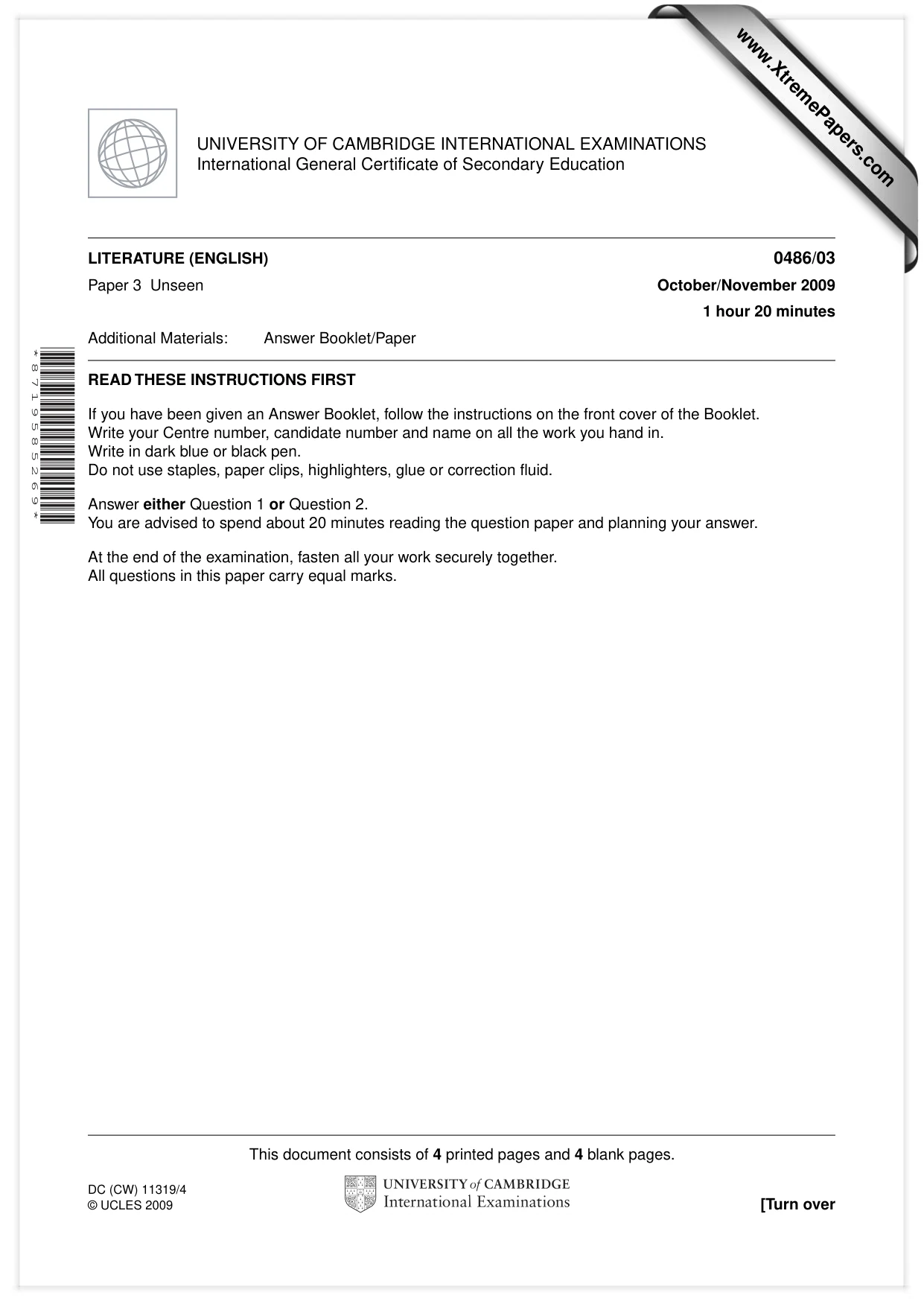
This document consists of 4 printed pages and 4 blank pages. DC (CW) 11319/4 © UCLES 2009 [Turn over UNIVERSITY OF CAMBRIDGE INTERNATIONAL EXAMINATIONS International General Certificate of Secondary Education READ THESE INSTRUCTIONS FIRST If you have been given an Answer Booklet, follow the instructions on the front cover of the Booklet. Write your Centre number, candidate number and name on all the work you hand in. Write in dark blue or black pen. Do not use staples, paper clips, highlighters, glue or correction fluid. Answer either Question 1 or Question 2. You are advised to spend about 20 minutes reading the question paper and planning your answer. At the end of the examination, fasten all your work securely together. All questions in this paper carry equal marks. * 8 7 1 9 5 8 5 2 6 9 * LITERATURE (ENGLISH) 0486/03 Paper 3 Unseen October/November 2009 1 hour 20 minutes Additional Materials: Answer Booklet/Paper www.XtremePapers.com
Question paper, page 3
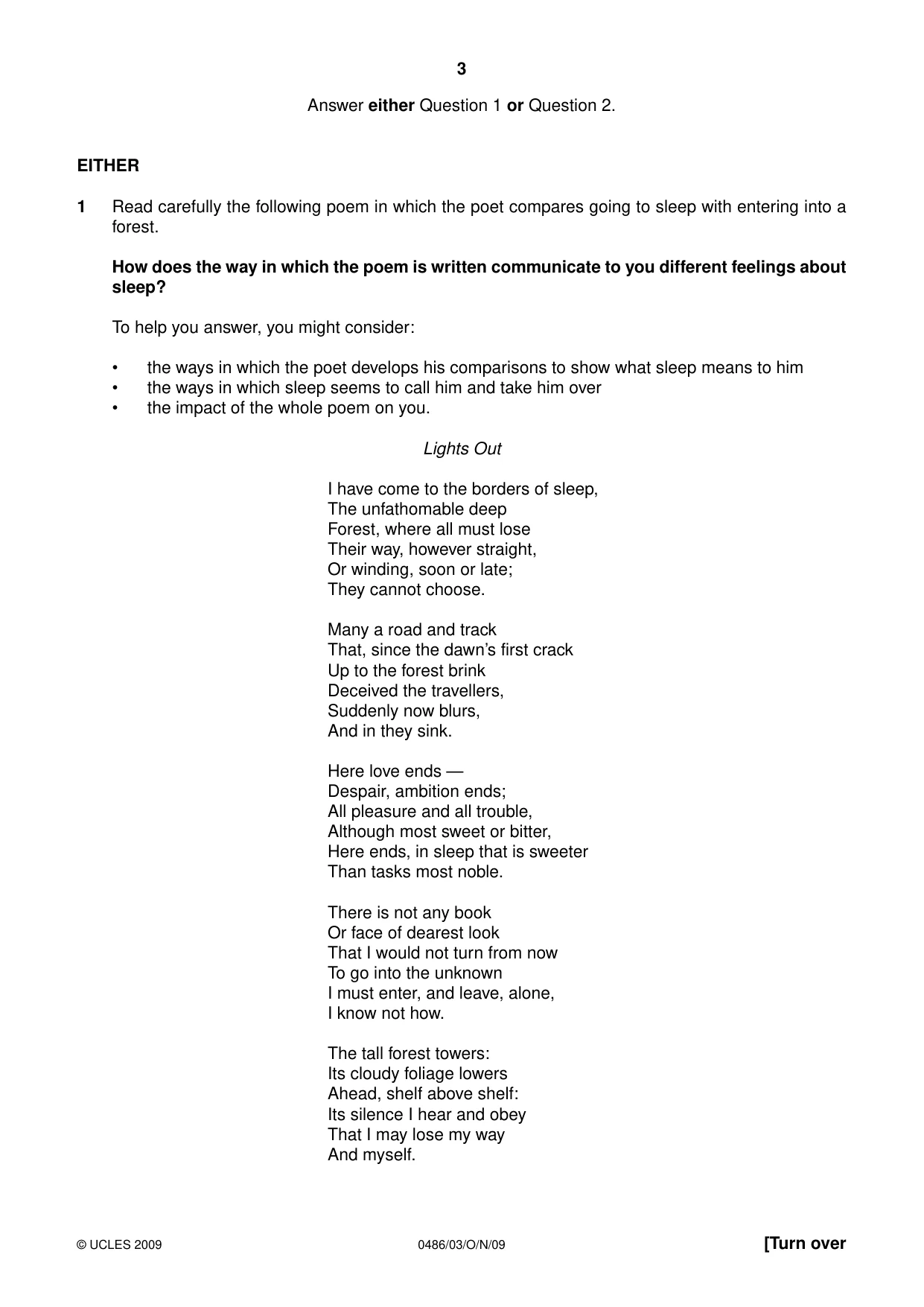
3 0486/03/O/N/09 © UCLES 2009 [Turn over Answer either Question 1 or Question 2. EITHER 1 Read carefully the following poem in which the poet compares going to sleep with entering into a forest. How does the way in which the poem is written communicate to you different feelings about sleep? To help you answer, you might consider: • the ways in which the poet develops his comparisons to show what sleep means to him • the ways in which sleep seems to call him and take him over • the impact of the whole poem on you. Lights Out I have come to the borders of sleep, The unfathomable deep Forest, where all must lose Their way, however straight, Or winding, soon or late; They cannot choose. Many a road and track That, since the dawn’s first crack Up to the forest brink Deceived the travellers, Suddenly now blurs, And in they sink. Here love ends — Despair, ambition ends; All pleasure and all trouble, Although most sweet or bitter, Here ends, in sleep that is sweeter Than tasks most noble. There is not any book Or face of dearest look That I would not turn from now To go into the unknown I must enter, and leave, alone, I know not how. The tall forest towers: Its cloudy foliage lowers Ahead, shelf above shelf: Its silence I hear and obey That I may lose my way And myself.
Question paper, page 4
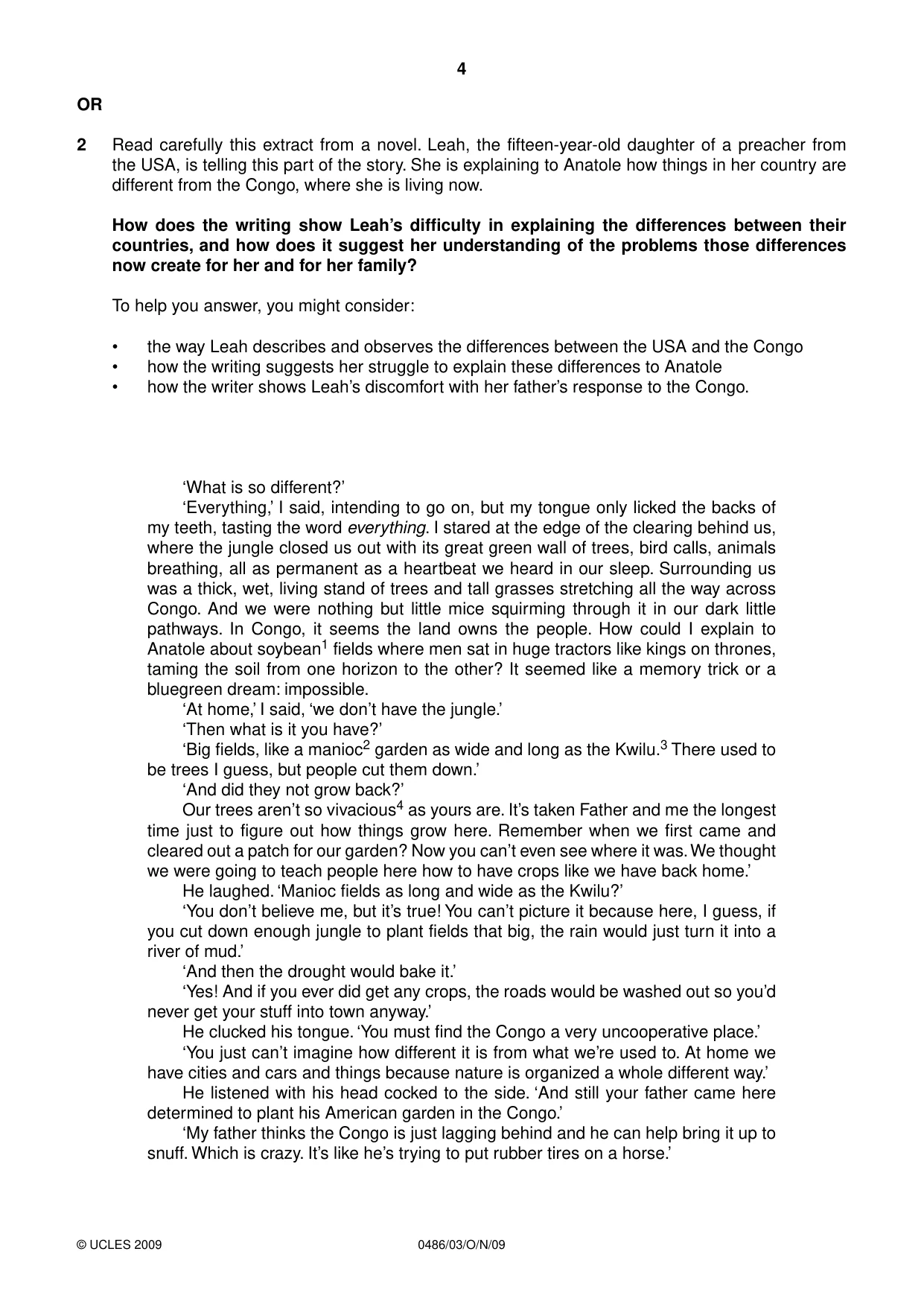
4 0486/03/O/N/09 © UCLES 2009 OR 2 Read carefully this extract from a novel. Leah, the fifteen-year-old daughter of a preacher from the USA, is telling this part of the story. She is explaining to Anatole how things in her country are different from the Congo, where she is living now. How does the writing show Leah’s difficulty in explaining the differences between their countries, and how does it suggest her understanding of the problems those differences now create for her and for her family? To help you answer, you might consider: • the way Leah describes and observes the differences between the USA and the Congo • how the writing suggests her struggle to explain these differences to Anatole • how the writer shows Leah’s discomfort with her father’s response to the Congo. ‘What is so different?’ ‘Everything,’ I said, intending to go on, but my tongue only licked the backs of my teeth, tasting the word everything. I stared at the edge of the clearing behind us, where the jungle closed us out with its great green wall of trees, bird calls, animals breathing, all as permanent as a heartbeat we heard in our sleep. Surrounding us was a thick, wet, living stand of trees and tall grasses stretching all the way across Congo. And we were nothing but little mice squirming through it in our dark little pathways. In Congo, it seems the land owns the people. How could I explain to Anatole about soybean1 fields where men sat in huge tractors like kings on thrones, taming the soil from one horizon to the other? It seemed like a memory trick or a bluegreen dream: impossible. ‘At home,’ I said, ‘we don’t have the jungle.’ ‘Then what is it you have?’ ‘Big fields, like a manioc2 garden as wide and long as the Kwilu.3 There used to be trees I guess, but people cut them down.’ ‘And did they not grow back?’ Our trees aren’t so vivacious4 as yours are. It’s taken Father and me the longest time just to figure out how things grow here. Remember when we first came and cleared out a patch for our garden? Now you can’t even see where it was. We thought we were going to teach people here how to have crops like we have back home.’ He laughed. ‘Manioc fields as long and wide as the Kwilu?’ ‘You don’t believe me, but it’s true! You can’t picture it because here, I guess, if you cut down enough jungle to plant fields that big, the rain would just turn it into a river of mud.’ ‘And then the drought would bake it.’ ‘Yes! And if you ever did get any crops, the roads would be washed out so you’d never get your stuff into town anyway.’ He clucked his tongue. ‘You must find the Congo a very uncooperative place.’ ‘You just can’t imagine how different it is from what we’re used to. At home we have cities and cars and things because nature is organized a whole different way.’ He listened with his head cocked to the side. ‘And still your father came here determined to plant his American garden in the Congo.’ ‘My father thinks the Congo is just lagging behind and he can help bring it up to snuff. Which is crazy. It’s like he’s trying to put rubber tires on a horse.’
Question paper, page 5
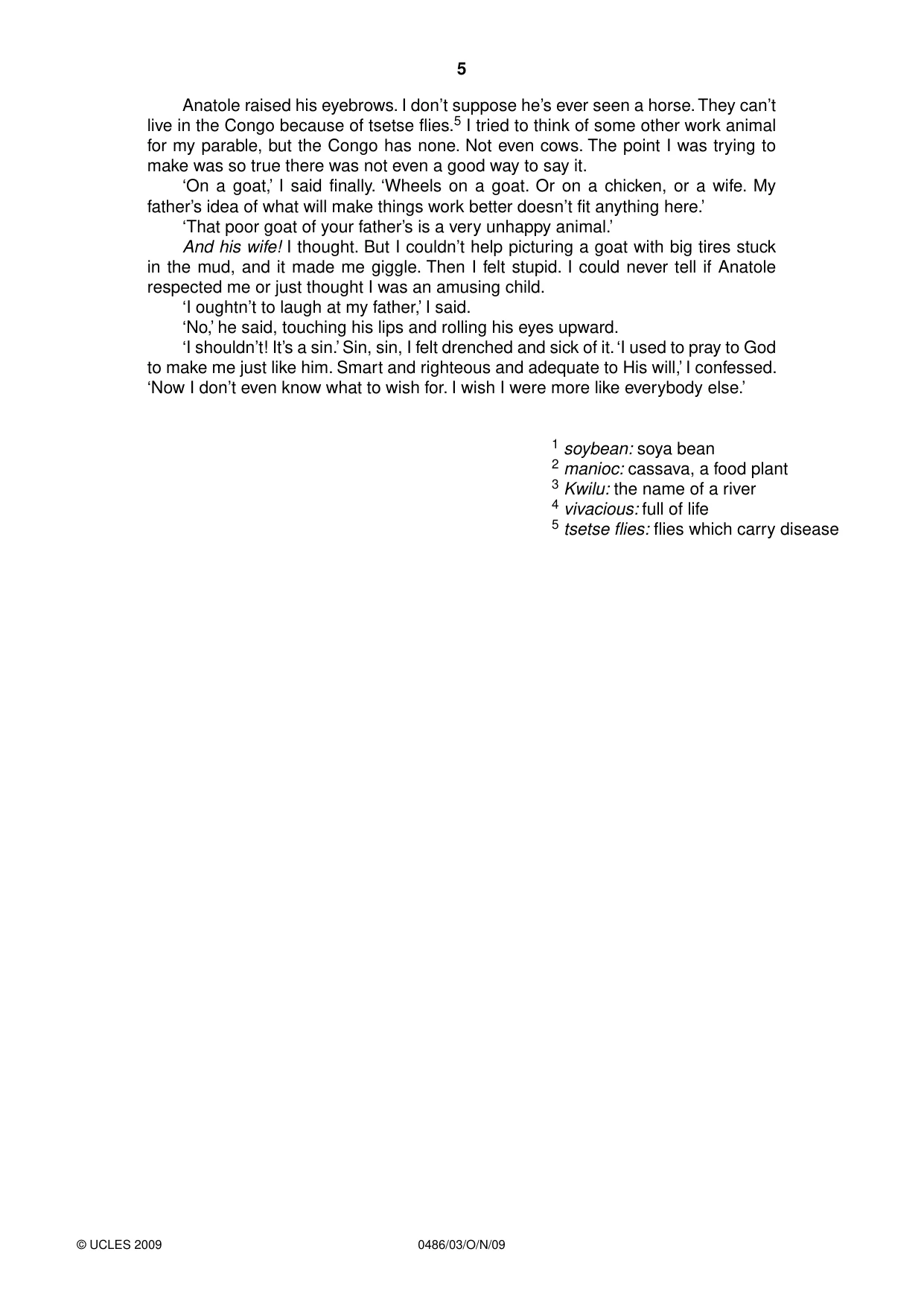
5 0486/03/O/N/09 © UCLES 2009 Anatole raised his eyebrows. I don’t suppose he’s ever seen a horse. They can’t live in the Congo because of tsetse flies.5 I tried to think of some other work animal for my parable, but the Congo has none. Not even cows. The point I was trying to make was so true there was not even a good way to say it. ‘On a goat,’ I said finally. ‘Wheels on a goat. Or on a chicken, or a wife. My father’s idea of what will make things work better doesn’t fit anything here.’ ‘That poor goat of your father’s is a very unhappy animal.’ And his wife! I thought. But I couldn’t help picturing a goat with big tires stuck in the mud, and it made me giggle. Then I felt stupid. I could never tell if Anatole respected me or just thought I was an amusing child. ‘I oughtn’t to laugh at my father,’ I said. ‘No,’ he said, touching his lips and rolling his eyes upward. ‘I shouldn’t! It’s a sin.’ Sin, sin, I felt drenched and sick of it. ‘I used to pray to God to make me just like him. Smart and righteous and adequate to His will,’ I confessed. ‘Now I don’t even know what to wish for. I wish I were more like everybody else.’ 1 soybean: soya bean 2 manioc: cassava, a food plant 3 Kwilu: the name of a river 4 vivacious: full of life 5 tsetse flies: flies which carry disease
Question paper, page 8
8 0486/03/O/N/09 BLANK PAGE Copyright Acknowledgements: Question 2 © Barbara Kingsolver; The Poisonwood Bible ; Faber & Faber Ltd; 1998. Permission to reproduce items where third-party owned material protected by copyright is included has been sought and cleared where possible. Every reasonable effort has been made by the publisher (UCLES) to trace copyright holders, but if any items requiring clearance have unwittingly been included, the publisher will be pleased to make amends at the earliest possible opportunity. University of Cambridge International Examinations is part of the Cambridge Assessment Group. Cambridge Assessment is the brand name of University of Cambridge Local Examinations Syndicate (UCLES), which is itself a department of the University of Cambridge.
Mark scheme, page 1
UNIVERSITY OF CAMBRIDGE INTERNATIONAL EXAMINATIONS International General Certificate of Secondary Education MARK SCHEME for the October/November 2009 question paper for the guidance of teachers 0486 LITERATURE (ENGLISH) 0486/03 Paper 3 (Alternative to Coursework), maximum raw mark 20 This mark scheme is published as an aid to teachers and candidates, to indicate the requirements of the examination. It shows the basis on which Examiners were instructed to award marks. It does not indicate the details of the discussions that took place at an Examiners’ meeting before marking began, which would have considered the acceptability of alternative answers. Mark schemes must be read in conjunction with the question papers and the report on the examination. • CIE will not enter into discussions or correspondence in connection with these mark schemes. CIE is publishing the mark schemes for the October/November 2009 question papers for most IGCSE, GCE Advanced Level and Advanced Subsidiary Level syllabuses and some Ordinary Level syllabuses. www.XtremePapers.com
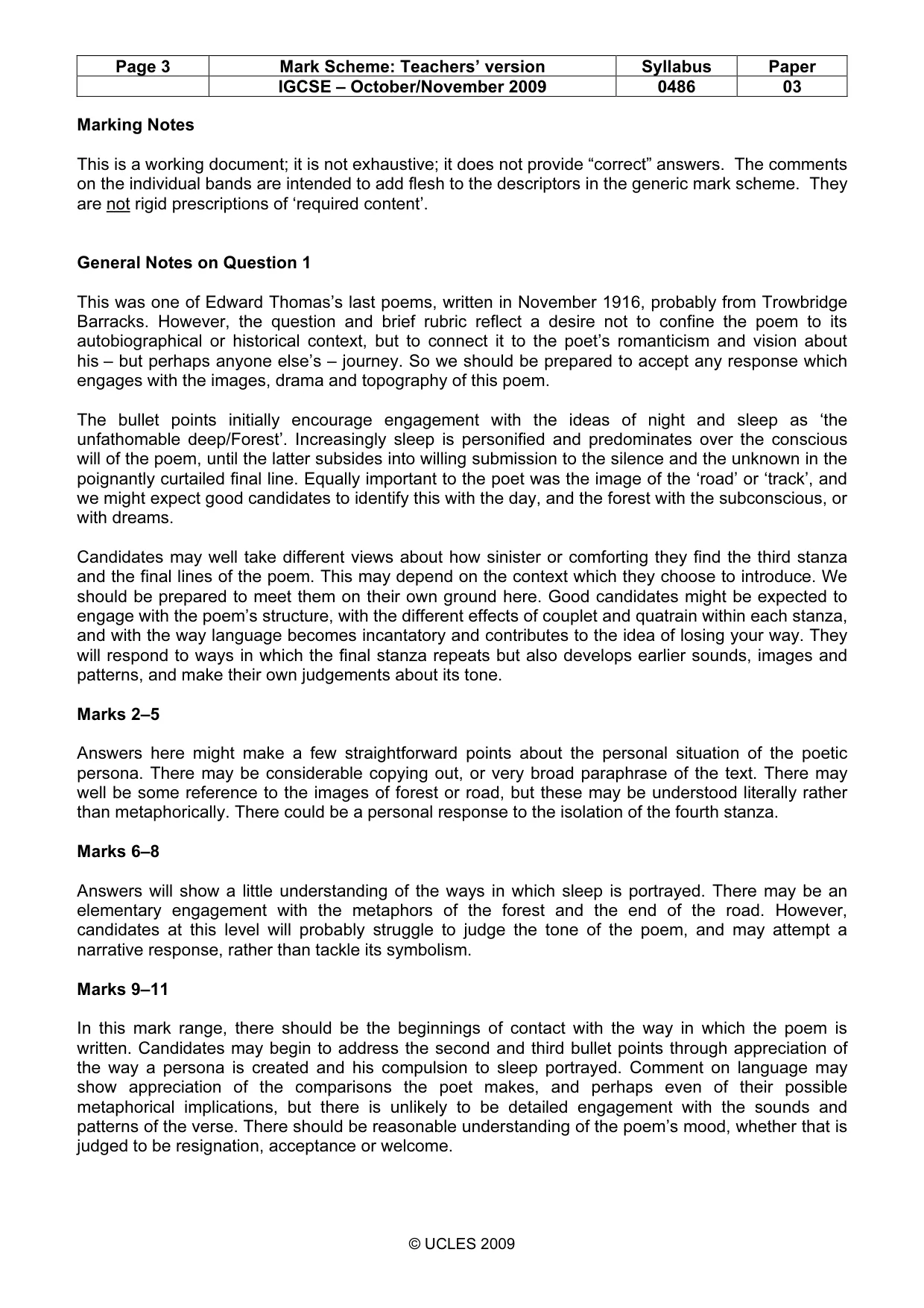
Mark scheme, page 2
Page 2 Mark Scheme: Teachers’ version Syllabus Paper IGCSE – October/November 2009 0486 03 © UCLES 2009 General Descriptors The descriptors are an attempt to guide examiners to an understanding of the qualities normally expected of, or ‘typical’ of work in the band. Together with the marking notes specific to the passage/poem set, they form a means of general guidance. Band 9 0–1 The answer does not meet the criteria for Band 8 Band 8 2–3 Candidates will – Show just a very little awareness of … Band 7 4–5 Candidates will – make a few straightforward points about… Band 6 6–8 Candidates will – make some straightforward points about… show a little understanding of Band 5 9–11 Candidates will – begin to develop a response… show some understanding of… Band 4 12–14 Candidates will – make a sensible response… show reasonable understanding of… show a little awareness of the way language works. Band 3 15–17 Candidates will – make a considered, sustained response. show clear understanding of … show some awareness of the way language works… Band 1/2 18–20 Candidates will – sustain a perceptive, convincing response show extensive understanding respond sensitively to the way language works.
Mark scheme, page 3
Page 3 Mark Scheme: Teachers’ version Syllabus Paper IGCSE – October/November 2009 0486 03 © UCLES 2009 Marking Notes This is a working document; it is not exhaustive; it does not provide “correct” answers. The comments on the individual bands are intended to add flesh to the descriptors in the generic mark scheme. They are not rigid prescriptions of ‘required content’. General Notes on Question 1 This was one of Edward Thomas’s last poems, written in November 1916, probably from Trowbridge Barracks. However, the question and brief rubric reflect a desire not to confine the poem to its autobiographical or historical context, but to connect it to the poet’s romanticism and vision about his – but perhaps anyone else’s – journey. So we should be prepared to accept any response which engages with the images, drama and topography of this poem. The bullet points initially encourage engagement with the ideas of night and sleep as ‘the unfathomable deep/Forest’. Increasingly sleep is personified and predominates over the conscious will of the poem, until the latter subsides into willing submission to the silence and the unknown in the poignantly curtailed final line. Equally important to the poet was the image of the ‘road’ or ‘track’, and we might expect good candidates to identify this with the day, and the forest with the subconscious, or with dreams. Candidates may well take different views about how sinister or comforting they find the third stanza and the final lines of the poem. This may depend on the context which they choose to introduce. We should be prepared to meet them on their own ground here. Good candidates might be expected to engage with the poem’s structure, with the different effects of couplet and quatrain within each stanza, and with the way language becomes incantatory and contributes to the idea of losing your way. They will respond to ways in which the final stanza repeats but also develops earlier sounds, images and patterns, and make their own judgements about its tone. Marks 2–5 Answers here might make a few straightforward points about the personal situation of the poetic persona. There may be considerable copying out, or very broad paraphrase of the text. There may well be some reference to the images of forest or road, but these may be understood literally rather than metaphorically. There could be a personal response to the isolation of the fourth stanza. Marks 6–8 Answers will show a little understanding of the ways in which sleep is portrayed. There may be an elementary engagement with the metaphors of the forest and the end of the road. However, candidates at this level will probably struggle to judge the tone of the poem, and may attempt a narrative response, rather than tackle its symbolism. Marks 9–11 In this mark range, there should be the beginnings of contact with the way in which the poem is written. Candidates may begin to address the second and third bullet points through appreciation of the way a persona is created and his compulsion to sleep portrayed. Comment on language may show appreciation of the comparisons the poet makes, and perhaps even of their possible metaphorical implications, but there is unlikely to be detailed engagement with the sounds and patterns of the verse. There should be reasonable understanding of the poem’s mood, whether that is judged to be resignation, acceptance or welcome.
Mark scheme, page 4
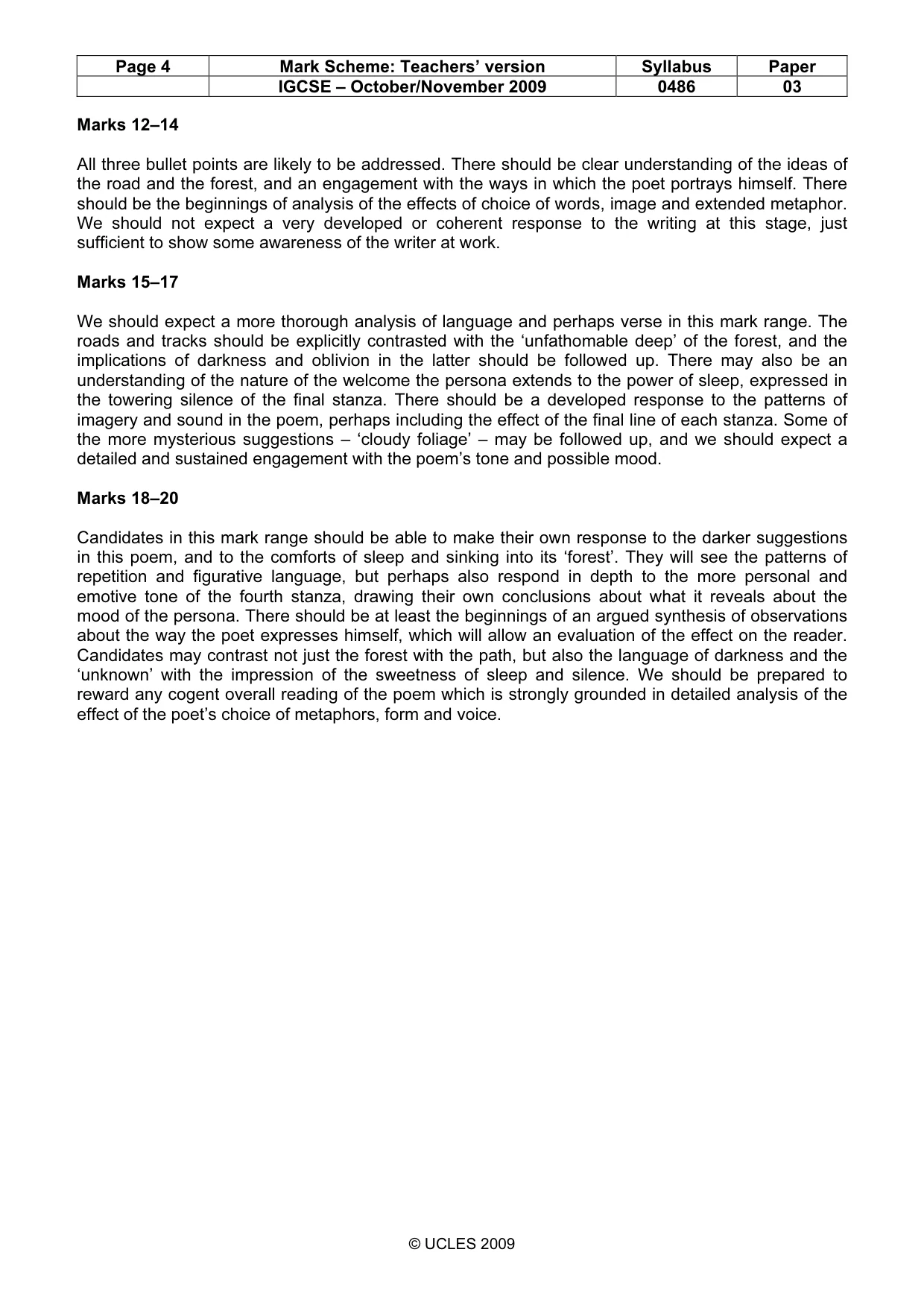
Page 4 Mark Scheme: Teachers’ version Syllabus Paper IGCSE – October/November 2009 0486 03 © UCLES 2009 Marks 12–14 All three bullet points are likely to be addressed. There should be clear understanding of the ideas of the road and the forest, and an engagement with the ways in which the poet portrays himself. There should be the beginnings of analysis of the effects of choice of words, image and extended metaphor. We should not expect a very developed or coherent response to the writing at this stage, just sufficient to show some awareness of the writer at work. Marks 15–17 We should expect a more thorough analysis of language and perhaps verse in this mark range. The roads and tracks should be explicitly contrasted with the ‘unfathomable deep’ of the forest, and the implications of darkness and oblivion in the latter should be followed up. There may also be an understanding of the nature of the welcome the persona extends to the power of sleep, expressed in the towering silence of the final stanza. There should be a developed response to the patterns of imagery and sound in the poem, perhaps including the effect of the final line of each stanza. Some of the more mysterious suggestions – ‘cloudy foliage’ – may be followed up, and we should expect a detailed and sustained engagement with the poem’s tone and possible mood. Marks 18–20 Candidates in this mark range should be able to make their own response to the darker suggestions in this poem, and to the comforts of sleep and sinking into its ‘forest’. They will see the patterns of repetition and figurative language, but perhaps also respond in depth to the more personal and emotive tone of the fourth stanza, drawing their own conclusions about what it reveals about the mood of the persona. There should be at least the beginnings of an argued synthesis of observations about the way the poet expresses himself, which will allow an evaluation of the effect on the reader. Candidates may contrast not just the forest with the path, but also the language of darkness and the ‘unknown’ with the impression of the sweetness of sleep and silence. We should be prepared to reward any cogent overall reading of the poem which is strongly grounded in detailed analysis of the effect of the poet’s choice of metaphors, form and voice.
Mark scheme, page 5
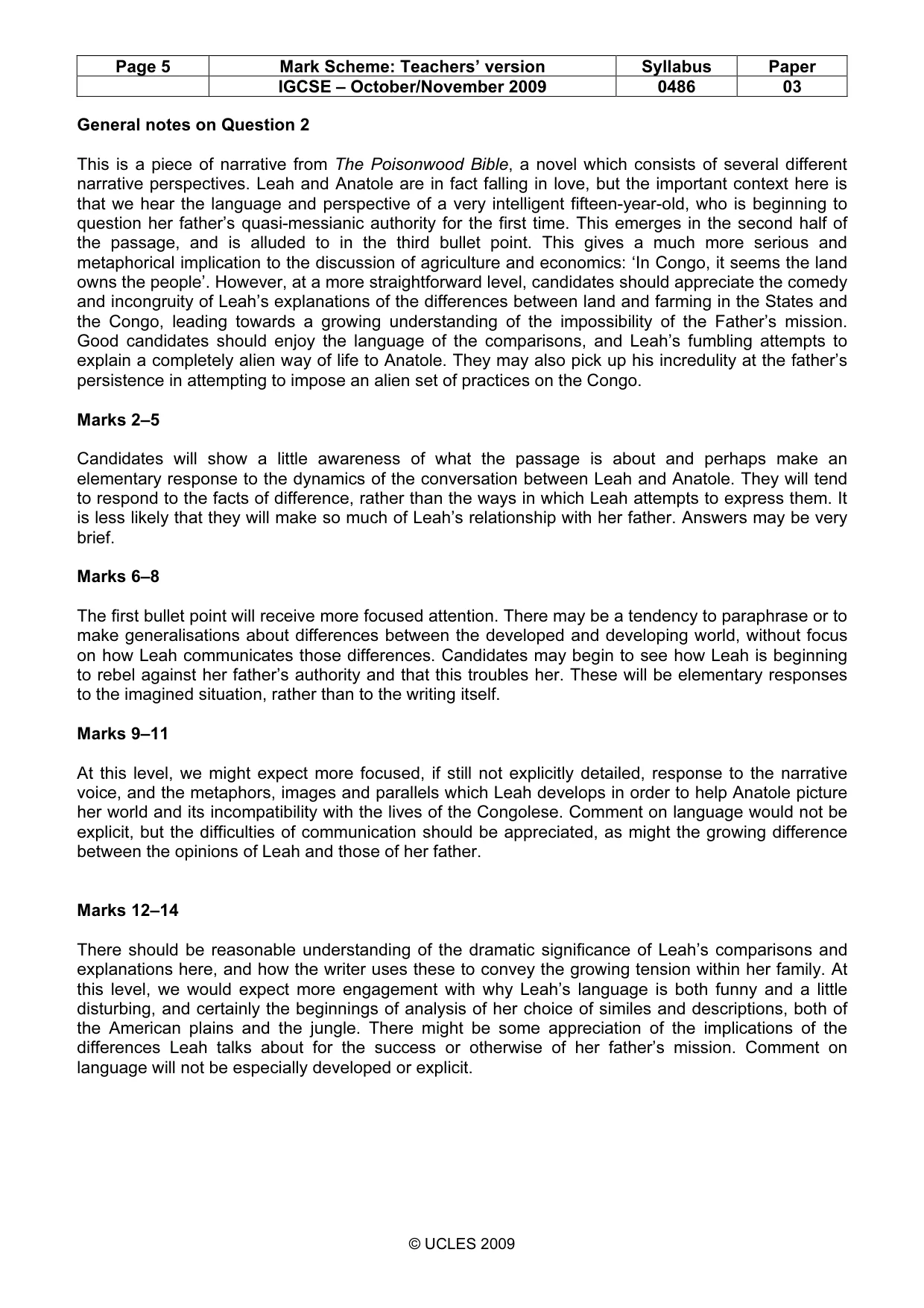
Page 5 Mark Scheme: Teachers’ version Syllabus Paper IGCSE – October/November 2009 0486 03 © UCLES 2009 General notes on Question 2 This is a piece of narrative from The Poisonwood Bible, a novel which consists of several different narrative perspectives. Leah and Anatole are in fact falling in love, but the important context here is that we hear the language and perspective of a very intelligent fifteen-year-old, who is beginning to question her father’s quasi-messianic authority for the first time. This emerges in the second half of the passage, and is alluded to in the third bullet point. This gives a much more serious and metaphorical implication to the discussion of agriculture and economics: ‘In Congo, it seems the land owns the people’. However, at a more straightforward level, candidates should appreciate the comedy and incongruity of Leah’s explanations of the differences between land and farming in the States and the Congo, leading towards a growing understanding of the impossibility of the Father’s mission. Good candidates should enjoy the language of the comparisons, and Leah’s fumbling attempts to explain a completely alien way of life to Anatole. They may also pick up his incredulity at the father’s persistence in attempting to impose an alien set of practices on the Congo. Marks 2–5 Candidates will show a little awareness of what the passage is about and perhaps make an elementary response to the dynamics of the conversation between Leah and Anatole. They will tend to respond to the facts of difference, rather than the ways in which Leah attempts to express them. It is less likely that they will make so much of Leah’s relationship with her father. Answers may be very brief. Marks 6–8 The first bullet point will receive more focused attention. There may be a tendency to paraphrase or to make generalisations about differences between the developed and developing world, without focus on how Leah communicates those differences. Candidates may begin to see how Leah is beginning to rebel against her father’s authority and that this troubles her. These will be elementary responses to the imagined situation, rather than to the writing itself. Marks 9–11 At this level, we might expect more focused, if still not explicitly detailed, response to the narrative voice, and the metaphors, images and parallels which Leah develops in order to help Anatole picture her world and its incompatibility with the lives of the Congolese. Comment on language would not be explicit, but the difficulties of communication should be appreciated, as might the growing difference between the opinions of Leah and those of her father. Marks 12–14 There should be reasonable understanding of the dramatic significance of Leah’s comparisons and explanations here, and how the writer uses these to convey the growing tension within her family. At this level, we would expect more engagement with why Leah’s language is both funny and a little disturbing, and certainly the beginnings of analysis of her choice of similes and descriptions, both of the American plains and the jungle. There might be some appreciation of the implications of the differences Leah talks about for the success or otherwise of her father’s mission. Comment on language will not be especially developed or explicit.
Mark scheme, page 6
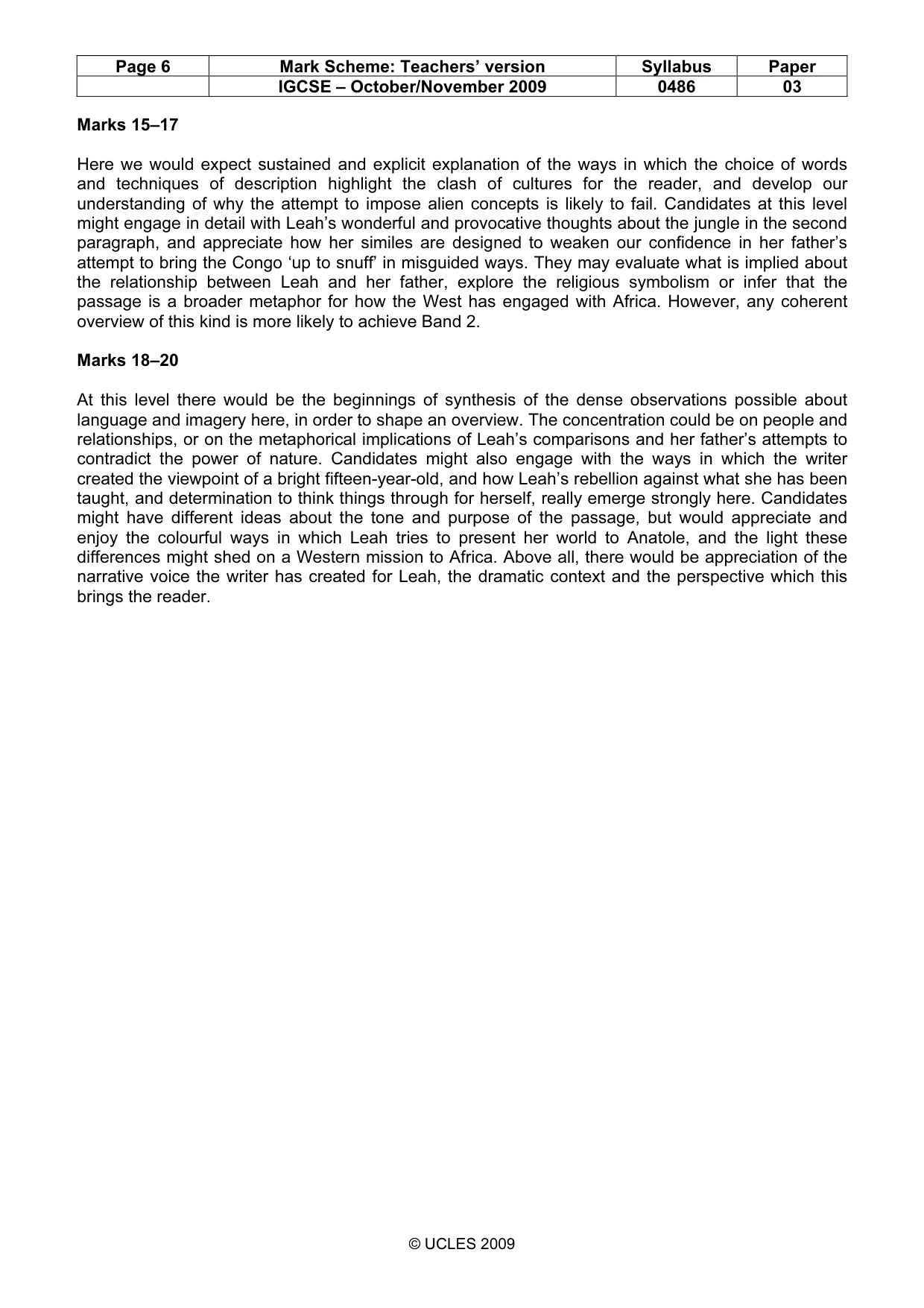
Page 6 Mark Scheme: Teachers’ version Syllabus Paper IGCSE – October/November 2009 0486 03 © UCLES 2009 Marks 15–17 Here we would expect sustained and explicit explanation of the ways in which the choice of words and techniques of description highlight the clash of cultures for the reader, and develop our understanding of why the attempt to impose alien concepts is likely to fail. Candidates at this level might engage in detail with Leah’s wonderful and provocative thoughts about the jungle in the second paragraph, and appreciate how her similes are designed to weaken our confidence in her father’s attempt to bring the Congo ‘up to snuff’ in misguided ways. They may evaluate what is implied about the relationship between Leah and her father, explore the religious symbolism or infer that the passage is a broader metaphor for how the West has engaged with Africa. However, any coherent overview of this kind is more likely to achieve Band 2. Marks 18–20 At this level there would be the beginnings of synthesis of the dense observations possible about language and imagery here, in order to shape an overview. The concentration could be on people and relationships, or on the metaphorical implications of Leah’s comparisons and her father’s attempts to contradict the power of nature. Candidates might also engage with the ways in which the writer created the viewpoint of a bright fifteen-year-old, and how Leah’s rebellion against what she has been taught, and determination to think things through for herself, really emerge strongly here. Candidates might have different ideas about the tone and purpose of the passage, but would appreciate and enjoy the colourful ways in which Leah tries to present her world to Anatole, and the light these differences might shed on a Western mission to Africa. Above all, there would be appreciation of the narrative voice the writer has created for Leah, the dramatic context and the perspective which this brings the reader.
What you needed in this session
Cambridge’s own grade thresholds for 2009 Oct/Nov, Paper 3 · Variant 1. A higher threshold means an easier paper — the bar moves with how the cohort did.