Cambridge IGCSE English - Literature 0486 — 2008 Oct/Nov Paper 3 · Variant 1
0486/31/O/N/08 · 20 marks · ≈23 min
The question paper and its mark scheme, free to read here and free to download. This is Cambridge’s own paper, exactly as it was sat.
Question paper8 pages



Mark scheme6 pages
Answers below. Sit the paper first if you are practising.
Paper as text
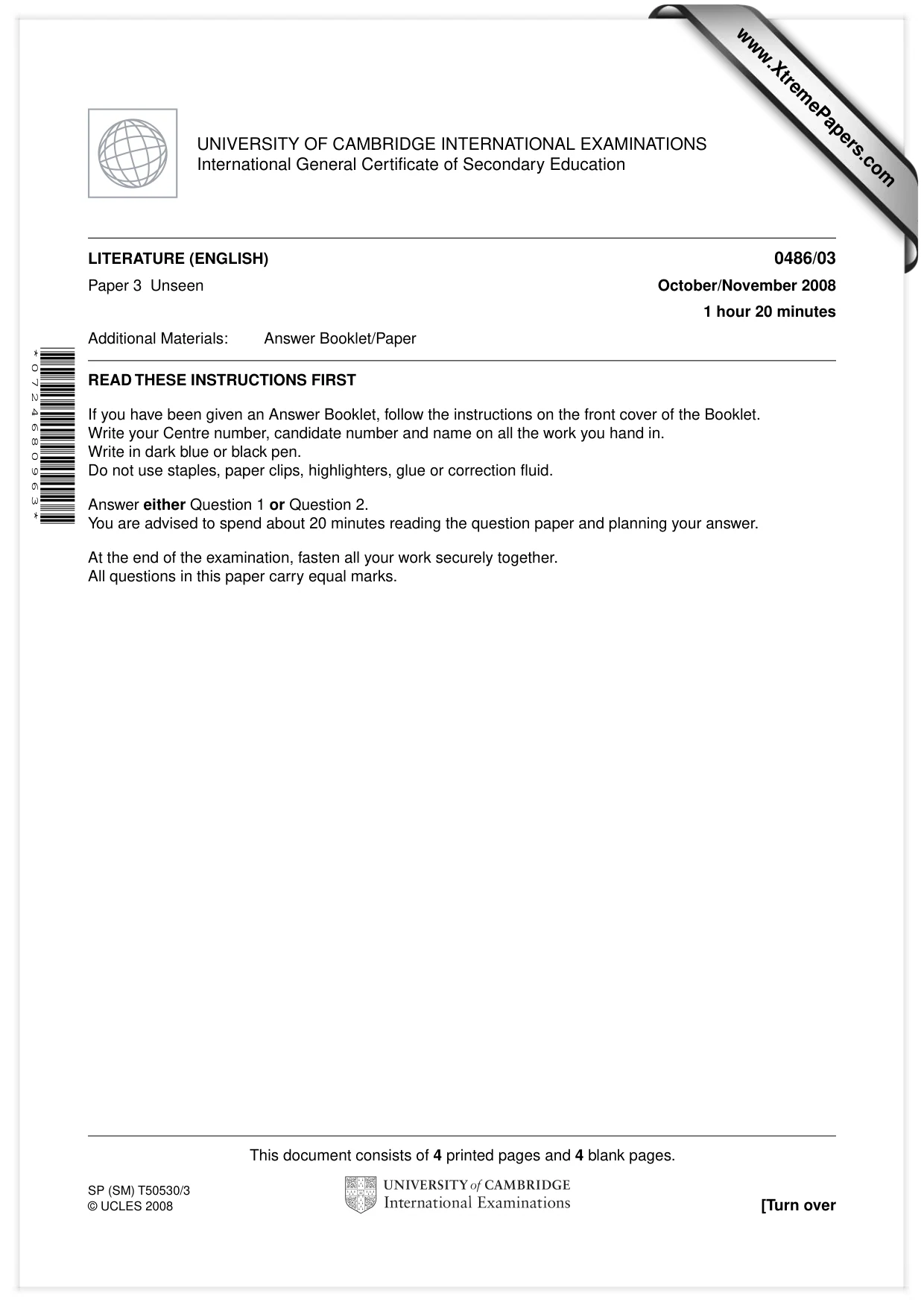
Question paper, page 1
This document consists of 4 printed pages and 4 blank pages. SP (SM) T50530/3 © UCLES 2008 [Turn over UNIVERSITY OF CAMBRIDGE INTERNATIONAL EXAMINATIONS International General Certificate of Secondary Education READ THESE INSTRUCTIONS FIRST If you have been given an Answer Booklet, follow the instructions on the front cover of the Booklet. Write your Centre number, candidate number and name on all the work you hand in. Write in dark blue or black pen. Do not use staples, paper clips, highlighters, glue or correction fluid. Answer either Question 1 or Question 2. You are advised to spend about 20 minutes reading the question paper and planning your answer. At the end of the examination, fasten all your work securely together. All questions in this paper carry equal marks. * 0 7 2 4 6 8 0 9 6 3 * LITERATURE (ENGLISH) 0486/03 Paper 3 Unseen October/November 2008 1 hour 20 minutes Additional Materials: Answer Booklet/Paper www.XtremePapers.com
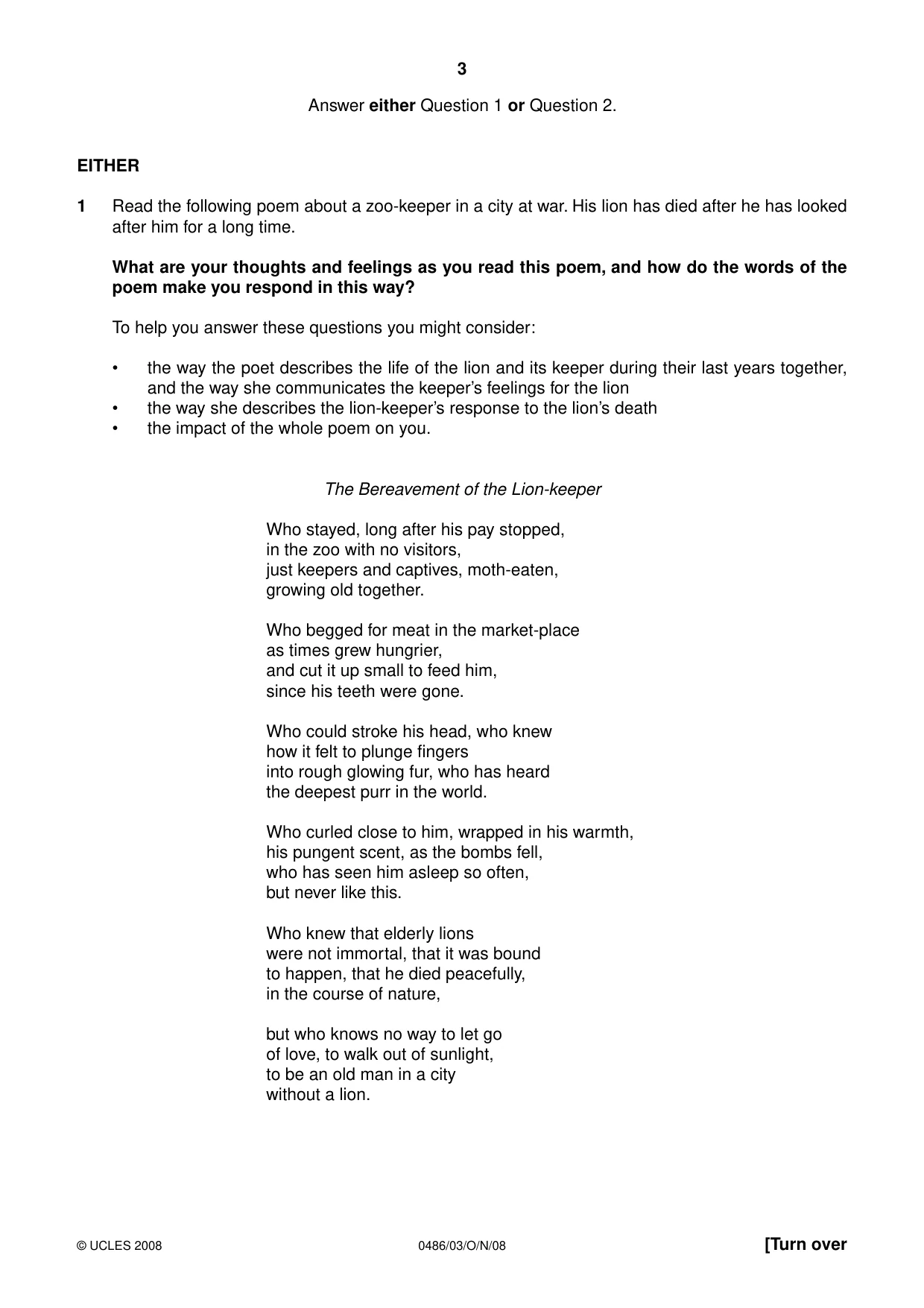
Question paper, page 3
3 0486/03/O/N/08 © UCLES 2008 [Turn over Answer either Question 1 or Question 2. EITHER 1 Read the following poem about a zoo-keeper in a city at war. His lion has died after he has looked after him for a long time. What are your thoughts and feelings as you read this poem, and how do the words of the poem make you respond in this way? To help you answer these questions you might consider: • the way the poet describes the life of the lion and its keeper during their last years together, and the way she communicates the keeper’s feelings for the lion • the way she describes the lion-keeper’s response to the lion’s death • the impact of the whole poem on you. The Bereavement of the Lion-keeper Who stayed, long after his pay stopped, in the zoo with no visitors, just keepers and captives, moth-eaten, growing old together. Who begged for meat in the market-place as times grew hungrier, and cut it up small to feed him, since his teeth were gone. Who could stroke his head, who knew how it felt to plunge fingers into rough glowing fur, who has heard the deepest purr in the world. Who curled close to him, wrapped in his warmth, his pungent scent, as the bombs fell, who has seen him asleep so often, but never like this. Who knew that elderly lions were not immortal, that it was bound to happen, that he died peacefully, in the course of nature, but who knows no way to let go of love, to walk out of sunlight, to be an old man in a city without a lion.
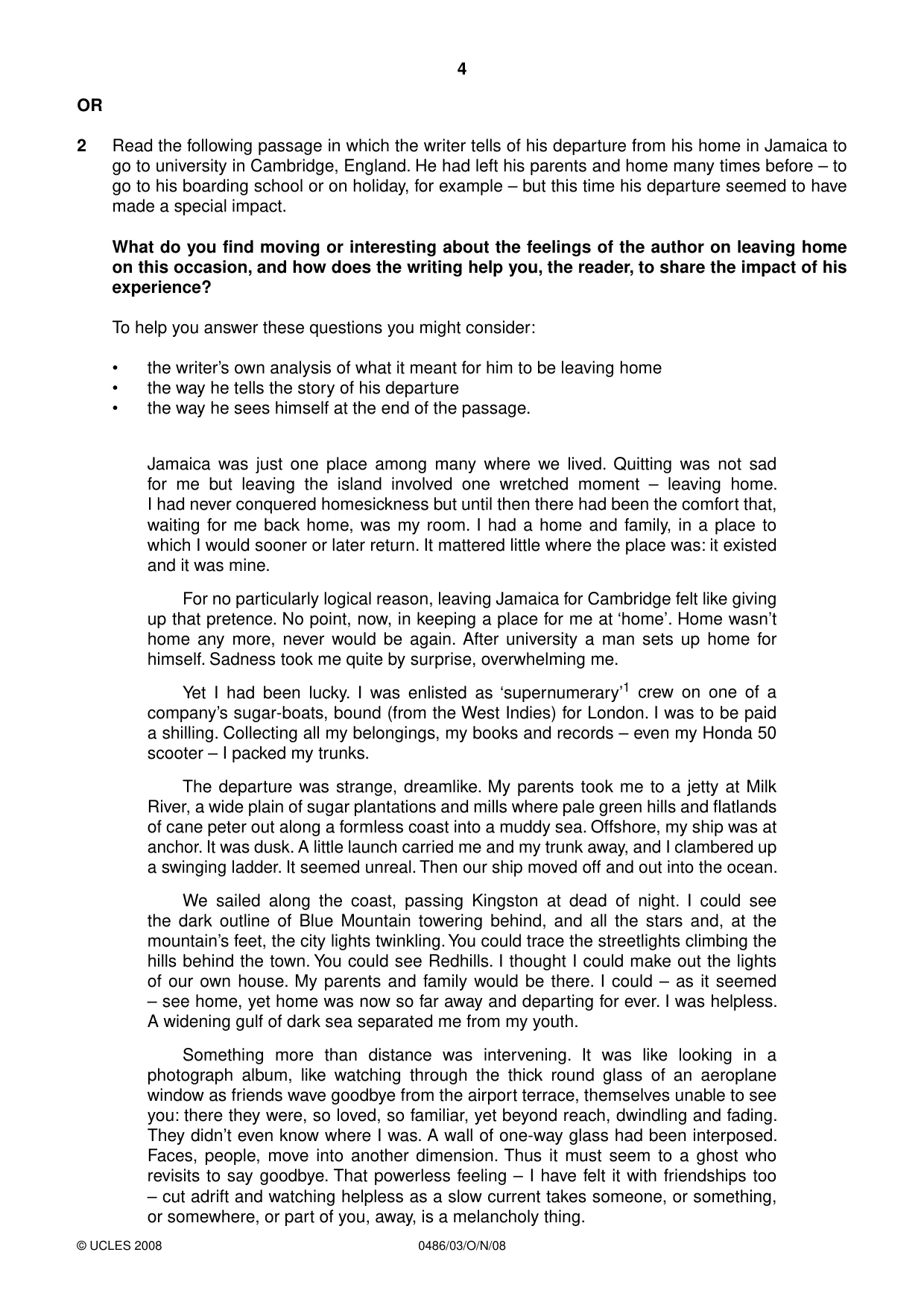
Question paper, page 4
4 0486/03/O/N/08 © UCLES 2008 OR 2 Read the following passage in which the writer tells of his departure from his home in Jamaica to go to university in Cambridge, England. He had left his parents and home many times before – to go to his boarding school or on holiday, for example – but this time his departure seemed to have made a special impact. What do you find moving or interesting about the feelings of the author on leaving home on this occasion, and how does the writing help you, the reader, to share the impact of his experience? To help you answer these questions you might consider: • the writer’s own analysis of what it meant for him to be leaving home • the way he tells the story of his departure • the way he sees himself at the end of the passage. Jamaica was just one place among many where we lived. Quitting was not sad for me but leaving the island involved one wretched moment – leaving home. I had never conquered homesickness but until then there had been the comfort that, waiting for me back home, was my room. I had a home and family, in a place to which I would sooner or later return. It mattered little where the place was: it existed and it was mine. For no particularly logical reason, leaving Jamaica for Cambridge felt like giving up that pretence. No point, now, in keeping a place for me at ‘home’. Home wasn’t home any more, never would be again. After university a man sets up home for himself. Sadness took me quite by surprise, overwhelming me. Yet I had been lucky. I was enlisted as ‘supernumerary’1 crew on one of a company’s sugar-boats, bound (from the West Indies) for London. I was to be paid a shilling. Collecting all my belongings, my books and records – even my Honda 50 scooter – I packed my trunks. The departure was strange, dreamlike. My parents took me to a jetty at Milk River, a wide plain of sugar plantations and mills where pale green hills and flatlands of cane peter out along a formless coast into a muddy sea. Offshore, my ship was at anchor. It was dusk. A little launch carried me and my trunk away, and I clambered up a swinging ladder. It seemed unreal. Then our ship moved off and out into the ocean. We sailed along the coast, passing Kingston at dead of night. I could see the dark outline of Blue Mountain towering behind, and all the stars and, at the mountain’s feet, the city lights twinkling. You could trace the streetlights climbing the hills behind the town. You could see Redhills. I thought I could make out the lights of our own house. My parents and family would be there. I could – as it seemed – see home, yet home was now so far away and departing for ever. I was helpless. A widening gulf of dark sea separated me from my youth. Something more than distance was intervening. It was like looking in a photograph album, like watching through the thick round glass of an aeroplane window as friends wave goodbye from the airport terrace, themselves unable to see you: there they were, so loved, so familiar, yet beyond reach, dwindling and fading. They didn’t even know where I was. A wall of one-way glass had been interposed. Faces, people, move into another dimension. Thus it must seem to a ghost who revisits to say goodbye. That powerless feeling – I have felt it with friendships too – cut adrift and watching helpless as a slow current takes someone, or something, or somewhere, or part of you, away, is a melancholy thing.
Question paper, page 5
5 0486/03/O/N/08 © UCLES 2008 And a lucky, lucky boy, with a place at Cambridge University, a free passage to England, a loving family, every kind of security, a quick enough wit to live on, innumerable narrow escapes behind and more ahead, sat in his quite ridiculously grand cabin, the ‘owner’s suite’, and cried. I was at sea, and all at sea. I was to stay all at sea for longer than the voyage to England. Which took three weeks. The ship’s engines kept breaking down. In the August heat in a heaving and windless Atlantic, surrounded by whales, I discovered a loathing which I shall never shake off, for the stink of warm molasses.2 1supernumerary: extra to the official crew 2molasses: thick syrup obtained from sugar
Question paper, page 8
8 0486/03/O/N/08 Copyright Acknowledgements: Question 1 © Sheenagh Pugh; The Bereavement of the Lion-keeper. Question 2 © Matthew Parris; Chance Witness: An Outsider’s Life in Politics ; Penguin Books; 2003. Permission to reproduce items where third-party owned material protected by copyright is included has been sought and cleared where possible. Every reasonable effort has been made by the publisher (UCLES) to trace copyright holders, but if any items requiring clearance have unwittingly been included, the publisher will be pleased to make amends at the earliest possible opportunity. University of Cambridge International Examinations is part of the Cambridge Assessment Group. Cambridge Assessment is the brand name of University of Cambridge Local Examinations Syndicate (UCLES), which is itself a department of the University of Cambridge. BLANK PAGE
Mark scheme, page 1
UNIVERSITY OF CAMBRIDGE INTERNATIONAL EXAMINATIONS International General Certificate of Secondary Education MARK SCHEME for the October/November 2008 question paper 0486 LITERATURE (ENGLISH) 0486/03 Paper 3 (Alternative to Coursework), maximum raw mark 20 This mark scheme is published as an aid to teachers and candidates, to indicate the requirements of the examination. It shows the basis on which Examiners were instructed to award marks. It does not indicate the details of the discussions that took place at an Examiners’ meeting before marking began. All Examiners are instructed that alternative correct answers and unexpected approaches in candidates’ scripts must be given marks that fairly reflect the relevant knowledge and skills demonstrated. Mark schemes must be read in conjunction with the question papers and the report on the examination. • CIE will not enter into discussions or correspondence in connection with these mark schemes. CIE is publishing the mark schemes for the October/November 2008 question papers for most IGCSE, GCE Advanced Level and Advanced Subsidiary Level syllabuses and some Ordinary Level syllabuses. www.XtremePapers.com
Mark scheme, page 2
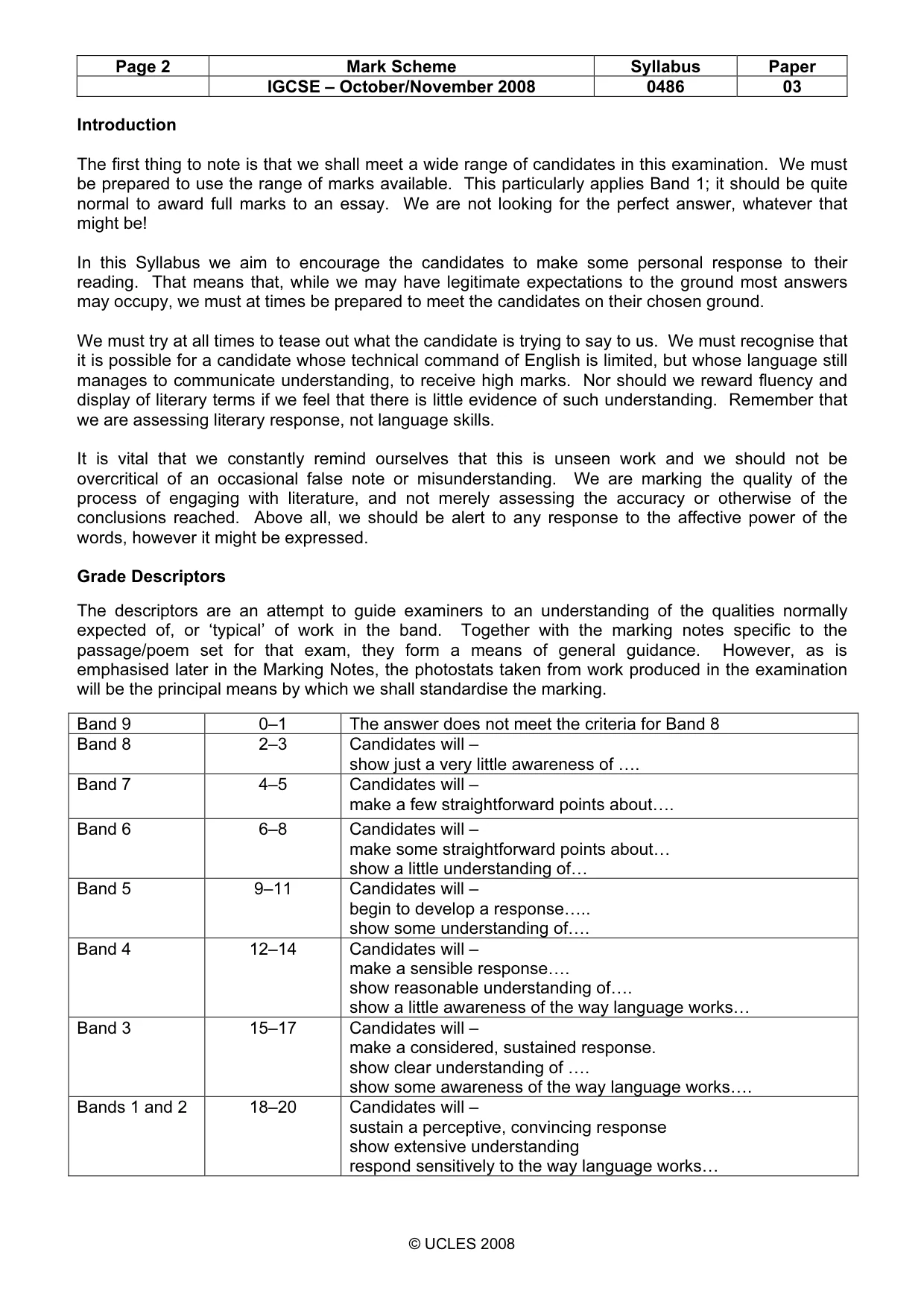
Page 2 Mark Scheme Syllabus Paper IGCSE – October/November 2008 0486 03 © UCLES 2008 Introduction The first thing to note is that we shall meet a wide range of candidates in this examination. We must be prepared to use the range of marks available. This particularly applies Band 1; it should be quite normal to award full marks to an essay. We are not looking for the perfect answer, whatever that might be! In this Syllabus we aim to encourage the candidates to make some personal response to their reading. That means that, while we may have legitimate expectations to the ground most answers may occupy, we must at times be prepared to meet the candidates on their chosen ground. We must try at all times to tease out what the candidate is trying to say to us. We must recognise that it is possible for a candidate whose technical command of English is limited, but whose language still manages to communicate understanding, to receive high marks. Nor should we reward fluency and display of literary terms if we feel that there is little evidence of such understanding. Remember that we are assessing literary response, not language skills. It is vital that we constantly remind ourselves that this is unseen work and we should not be overcritical of an occasional false note or misunderstanding. We are marking the quality of the process of engaging with literature, and not merely assessing the accuracy or otherwise of the conclusions reached. Above all, we should be alert to any response to the affective power of the words, however it might be expressed. Grade Descriptors The descriptors are an attempt to guide examiners to an understanding of the qualities normally expected of, or ‘typical’ of work in the band. Together with the marking notes specific to the passage/poem set for that exam, they form a means of general guidance. However, as is emphasised later in the Marking Notes, the photostats taken from work produced in the examination will be the principal means by which we shall standardise the marking. Band 9 0–1 The answer does not meet the criteria for Band 8 Band 8 2–3 Candidates will – show just a very little awareness of …. Band 7 4–5 Candidates will – make a few straightforward points about…. Band 6 6–8 Candidates will – make some straightforward points about… show a little understanding of… Band 5 9–11 Candidates will – begin to develop a response….. show some understanding of…. Band 4 12–14 Candidates will – make a sensible response…. show reasonable understanding of…. show a little awareness of the way language works… Band 3 15–17 Candidates will – make a considered, sustained response. show clear understanding of …. show some awareness of the way language works…. Bands 1 and 2 18–20 Candidates will – sustain a perceptive, convincing response show extensive understanding respond sensitively to the way language works…
Mark scheme, page 3
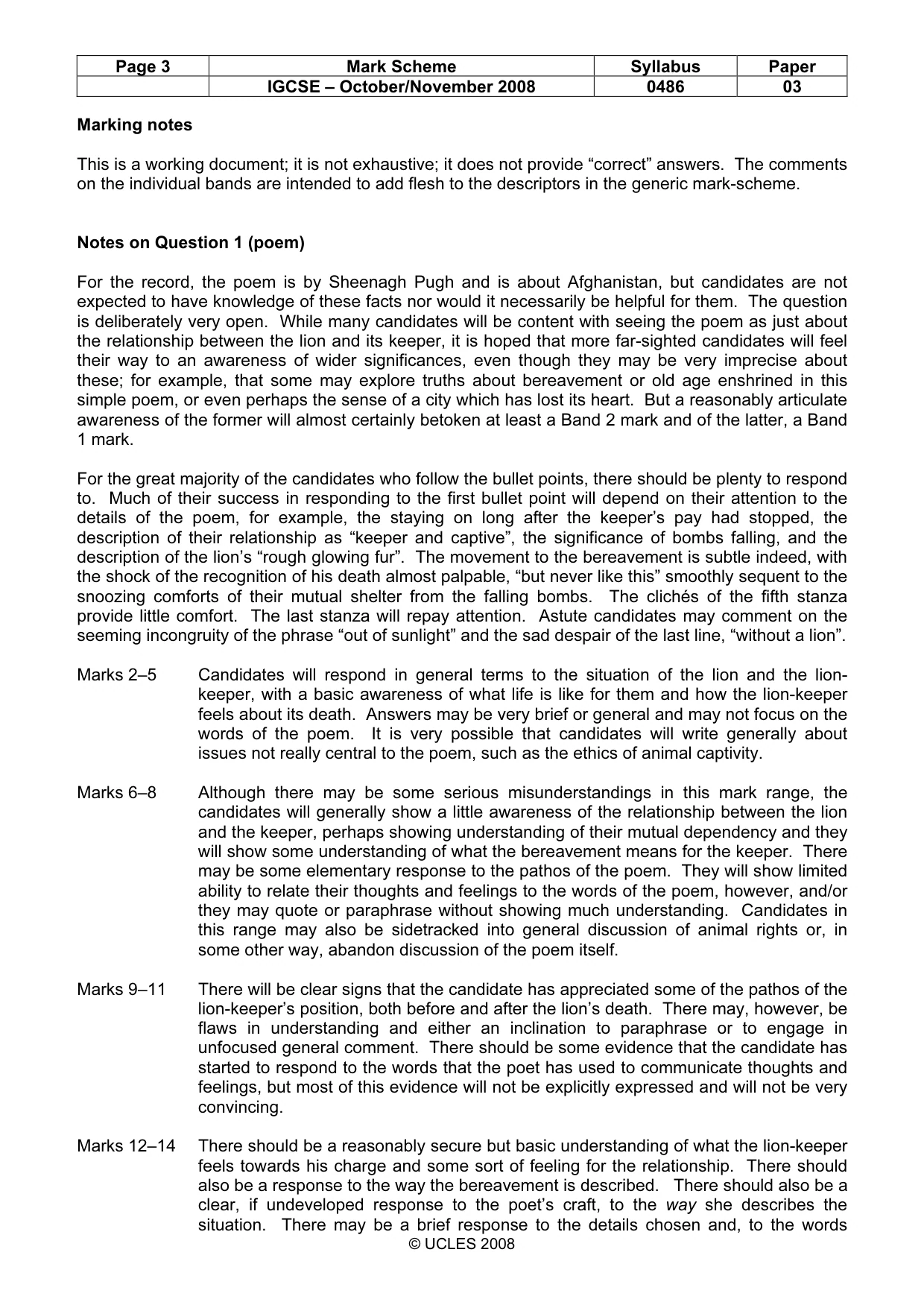
Page 3 Mark Scheme Syllabus Paper IGCSE – October/November 2008 0486 03 © UCLES 2008 Marking notes This is a working document; it is not exhaustive; it does not provide “correct” answers. The comments on the individual bands are intended to add flesh to the descriptors in the generic mark-scheme. Notes on Question 1 (poem) For the record, the poem is by Sheenagh Pugh and is about Afghanistan, but candidates are not expected to have knowledge of these facts nor would it necessarily be helpful for them. The question is deliberately very open. While many candidates will be content with seeing the poem as just about the relationship between the lion and its keeper, it is hoped that more far-sighted candidates will feel their way to an awareness of wider significances, even though they may be very imprecise about these; for example, that some may explore truths about bereavement or old age enshrined in this simple poem, or even perhaps the sense of a city which has lost its heart. But a reasonably articulate awareness of the former will almost certainly betoken at least a Band 2 mark and of the latter, a Band 1 mark. For the great majority of the candidates who follow the bullet points, there should be plenty to respond to. Much of their success in responding to the first bullet point will depend on their attention to the details of the poem, for example, the staying on long after the keeper’s pay had stopped, the description of their relationship as “keeper and captive”, the significance of bombs falling, and the description of the lion’s “rough glowing fur”. The movement to the bereavement is subtle indeed, with the shock of the recognition of his death almost palpable, “but never like this” smoothly sequent to the snoozing comforts of their mutual shelter from the falling bombs. The clichés of the fifth stanza provide little comfort. The last stanza will repay attention. Astute candidates may comment on the seeming incongruity of the phrase “out of sunlight” and the sad despair of the last line, “without a lion”. Marks 2–5 Candidates will respond in general terms to the situation of the lion and the lion- keeper, with a basic awareness of what life is like for them and how the lion-keeper feels about its death. Answers may be very brief or general and may not focus on the words of the poem. It is very possible that candidates will write generally about issues not really central to the poem, such as the ethics of animal captivity. Marks 6–8 Although there may be some serious misunderstandings in this mark range, the candidates will generally show a little awareness of the relationship between the lion and the keeper, perhaps showing understanding of their mutual dependency and they will show some understanding of what the bereavement means for the keeper. There may be some elementary response to the pathos of the poem. They will show limited ability to relate their thoughts and feelings to the words of the poem, however, and/or they may quote or paraphrase without showing much understanding. Candidates in this range may also be sidetracked into general discussion of animal rights or, in some other way, abandon discussion of the poem itself. Marks 9–11 There will be clear signs that the candidate has appreciated some of the pathos of the lion-keeper’s position, both before and after the lion’s death. There may, however, be flaws in understanding and either an inclination to paraphrase or to engage in unfocused general comment. There should be some evidence that the candidate has started to respond to the words that the poet has used to communicate thoughts and feelings, but most of this evidence will not be explicitly expressed and will not be very convincing. Marks 12–14 There should be a reasonably secure but basic understanding of what the lion-keeper feels towards his charge and some sort of feeling for the relationship. There should also be a response to the way the bereavement is described. There should also be a clear, if undeveloped response to the poet’s craft, to the way she describes the situation. There may be a brief response to the details chosen and, to the words
Mark scheme, page 4
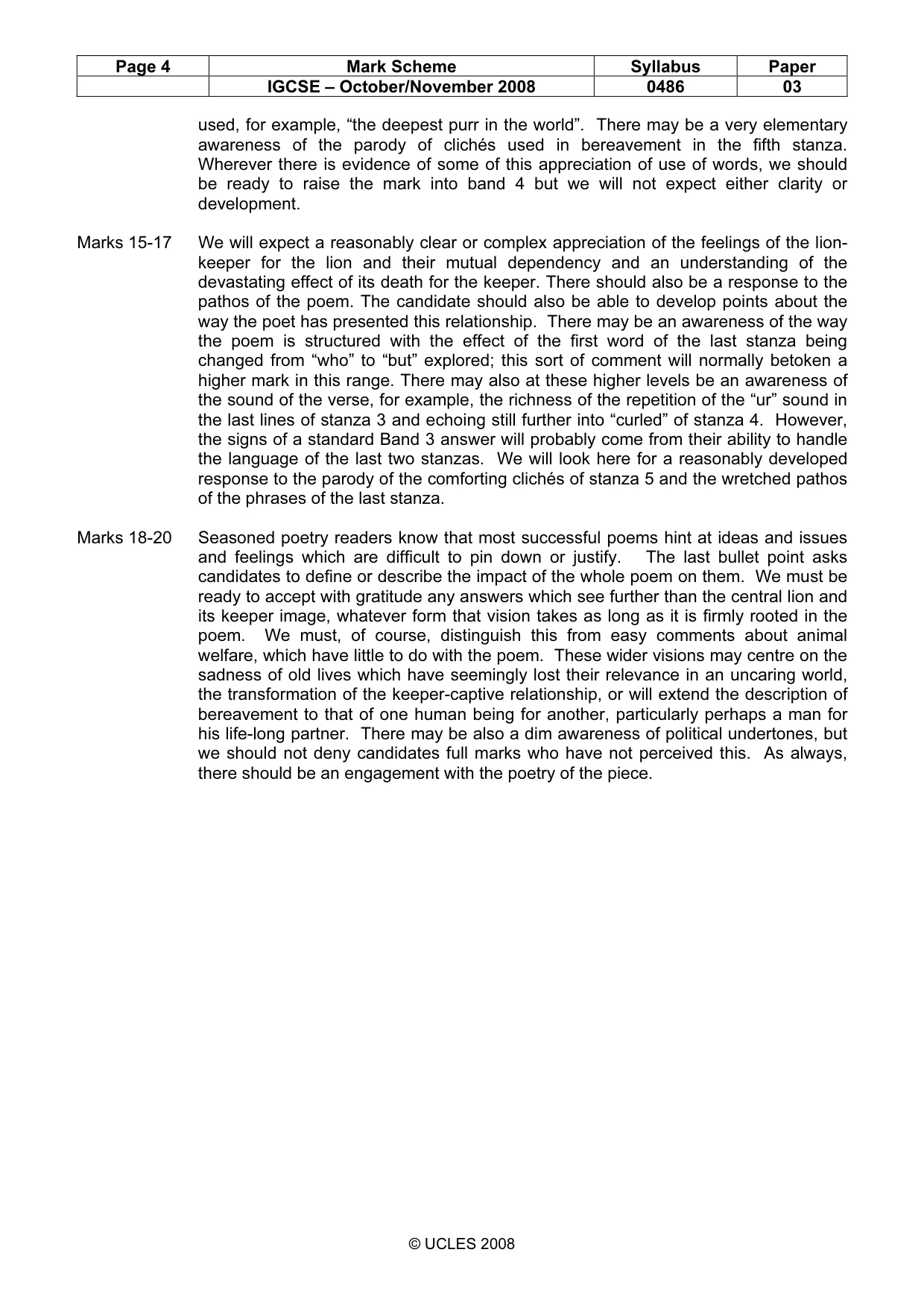
Page 4 Mark Scheme Syllabus Paper IGCSE – October/November 2008 0486 03 © UCLES 2008 used, for example, “the deepest purr in the world”. There may be a very elementary awareness of the parody of clichés used in bereavement in the fifth stanza. Wherever there is evidence of some of this appreciation of use of words, we should be ready to raise the mark into band 4 but we will not expect either clarity or development. Marks 15-17 We will expect a reasonably clear or complex appreciation of the feelings of the lion- keeper for the lion and their mutual dependency and an understanding of the devastating effect of its death for the keeper. There should also be a response to the pathos of the poem. The candidate should also be able to develop points about the way the poet has presented this relationship. There may be an awareness of the way the poem is structured with the effect of the first word of the last stanza being changed from “who” to “but” explored; this sort of comment will normally betoken a higher mark in this range. There may also at these higher levels be an awareness of the sound of the verse, for example, the richness of the repetition of the “ur” sound in the last lines of stanza 3 and echoing still further into “curled” of stanza 4. However, the signs of a standard Band 3 answer will probably come from their ability to handle the language of the last two stanzas. We will look here for a reasonably developed response to the parody of the comforting clichés of stanza 5 and the wretched pathos of the phrases of the last stanza. Marks 18-20 Seasoned poetry readers know that most successful poems hint at ideas and issues and feelings which are difficult to pin down or justify. The last bullet point asks candidates to define or describe the impact of the whole poem on them. We must be ready to accept with gratitude any answers which see further than the central lion and its keeper image, whatever form that vision takes as long as it is firmly rooted in the poem. We must, of course, distinguish this from easy comments about animal welfare, which have little to do with the poem. These wider visions may centre on the sadness of old lives which have seemingly lost their relevance in an uncaring world, the transformation of the keeper-captive relationship, or will extend the description of bereavement to that of one human being for another, particularly perhaps a man for his life-long partner. There may be also a dim awareness of political undertones, but we should not deny candidates full marks who have not perceived this. As always, there should be an engagement with the poetry of the piece.
Mark scheme, page 5
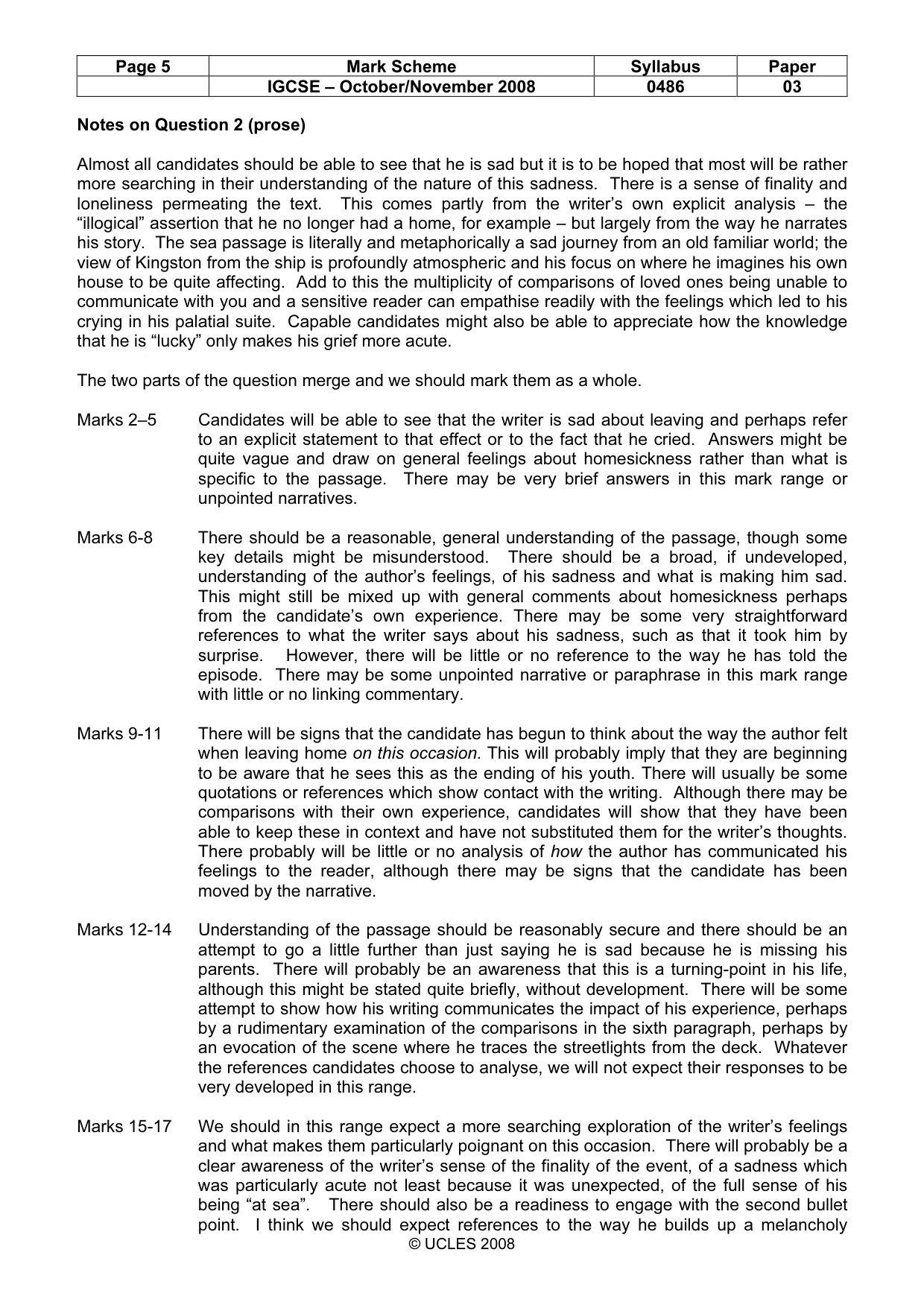
Page 5 Mark Scheme Syllabus Paper IGCSE – October/November 2008 0486 03 © UCLES 2008 Notes on Question 2 (prose) Almost all candidates should be able to see that he is sad but it is to be hoped that most will be rather more searching in their understanding of the nature of this sadness. There is a sense of finality and loneliness permeating the text. This comes partly from the writer’s own explicit analysis – the “illogical” assertion that he no longer had a home, for example – but largely from the way he narrates his story. The sea passage is literally and metaphorically a sad journey from an old familiar world; the view of Kingston from the ship is profoundly atmospheric and his focus on where he imagines his own house to be quite affecting. Add to this the multiplicity of comparisons of loved ones being unable to communicate with you and a sensitive reader can empathise readily with the feelings which led to his crying in his palatial suite. Capable candidates might also be able to appreciate how the knowledge that he is “lucky” only makes his grief more acute. The two parts of the question merge and we should mark them as a whole. Marks 2–5 Candidates will be able to see that the writer is sad about leaving and perhaps refer to an explicit statement to that effect or to the fact that he cried. Answers might be quite vague and draw on general feelings about homesickness rather than what is specific to the passage. There may be very brief answers in this mark range or unpointed narratives. Marks 6-8 There should be a reasonable, general understanding of the passage, though some key details might be misunderstood. There should be a broad, if undeveloped, understanding of the author’s feelings, of his sadness and what is making him sad. This might still be mixed up with general comments about homesickness perhaps from the candidate’s own experience. There may be some very straightforward references to what the writer says about his sadness, such as that it took him by surprise. However, there will be little or no reference to the way he has told the episode. There may be some unpointed narrative or paraphrase in this mark range with little or no linking commentary. Marks 9-11 There will be signs that the candidate has begun to think about the way the author felt when leaving home on this occasion. This will probably imply that they are beginning to be aware that he sees this as the ending of his youth. There will usually be some quotations or references which show contact with the writing. Although there may be comparisons with their own experience, candidates will show that they have been able to keep these in context and have not substituted them for the writer’s thoughts. There probably will be little or no analysis of how the author has communicated his feelings to the reader, although there may be signs that the candidate has been moved by the narrative. Marks 12-14 Understanding of the passage should be reasonably secure and there should be an attempt to go a little further than just saying he is sad because he is missing his parents. There will probably be an awareness that this is a turning-point in his life, although this might be stated quite briefly, without development. There will be some attempt to show how his writing communicates the impact of his experience, perhaps by a rudimentary examination of the comparisons in the sixth paragraph, perhaps by an evocation of the scene where he traces the streetlights from the deck. Whatever the references candidates choose to analyse, we will not expect their responses to be very developed in this range. Marks 15-17 We should in this range expect a more searching exploration of the writer’s feelings and what makes them particularly poignant on this occasion. There will probably be a clear awareness of the writer’s sense of the finality of the event, of a sadness which was particularly acute not least because it was unexpected, of the full sense of his being “at sea”. There should also be a readiness to engage with the second bullet point. I think we should expect references to the way he builds up a melancholy
Mark scheme, page 6
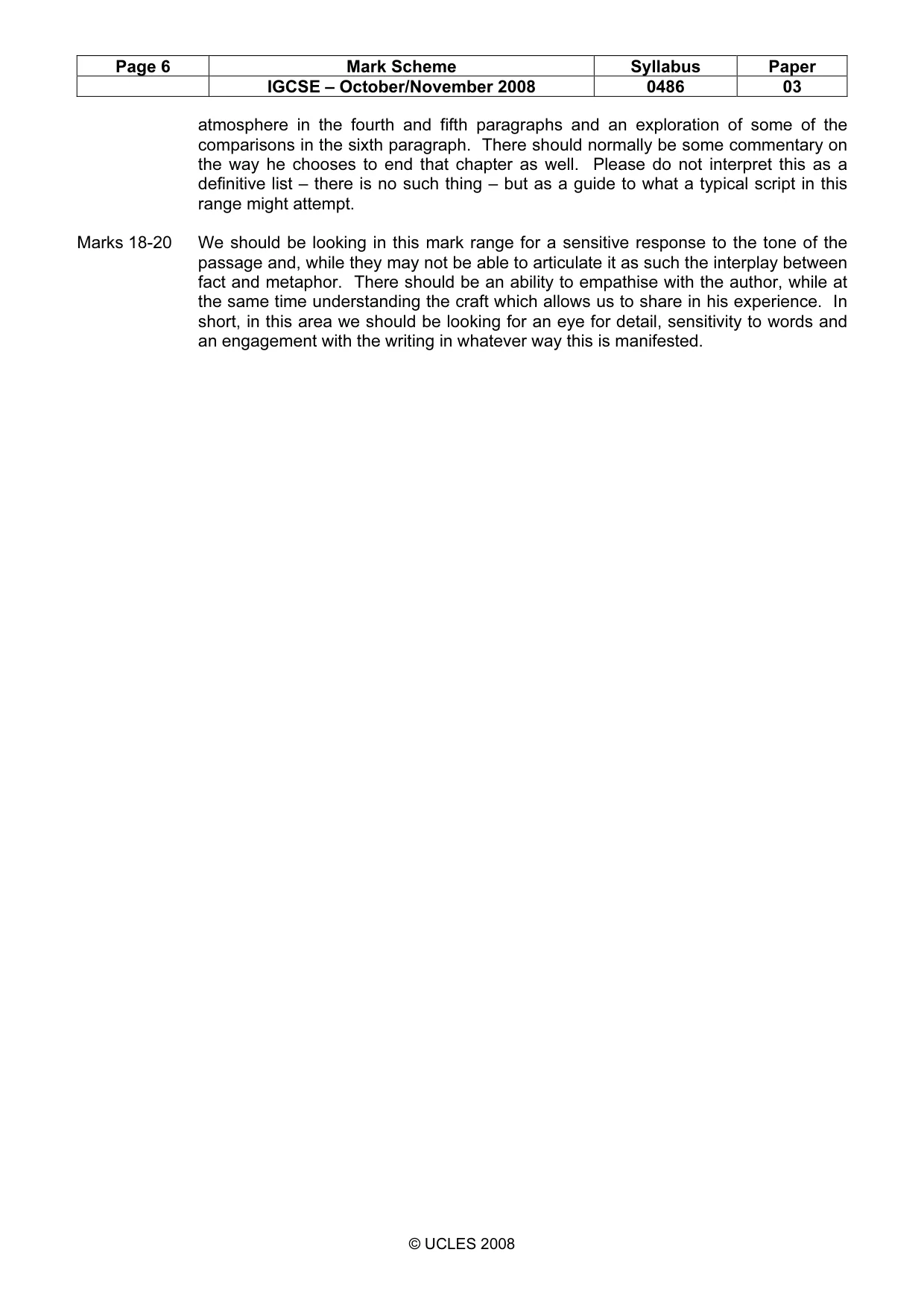
Page 6 Mark Scheme Syllabus Paper IGCSE – October/November 2008 0486 03 © UCLES 2008 atmosphere in the fourth and fifth paragraphs and an exploration of some of the comparisons in the sixth paragraph. There should normally be some commentary on the way he chooses to end that chapter as well. Please do not interpret this as a definitive list – there is no such thing – but as a guide to what a typical script in this range might attempt. Marks 18-20 We should be looking in this mark range for a sensitive response to the tone of the passage and, while they may not be able to articulate it as such the interplay between fact and metaphor. There should be an ability to empathise with the author, while at the same time understanding the craft which allows us to share in his experience. In short, in this area we should be looking for an eye for detail, sensitivity to words and an engagement with the writing in whatever way this is manifested.
What you needed in this session
Cambridge’s own grade thresholds for 2008 Oct/Nov, Paper 3 · Variant 1. A higher threshold means an easier paper — the bar moves with how the cohort did.