Cambridge IGCSE English - Literature 0486 — 2008 May/June Paper 3 · Variant 1
0486/31/M/J/08 · 20 marks · ≈23 min
The question paper and its mark scheme, free to read here and free to download. This is Cambridge’s own paper, exactly as it was sat.
Question paper4 pages
Mark scheme6 pages
Answers below. Sit the paper first if you are practising.
Paper as text
Question paper, page 1
This document consists of 3 printed pages and 1 blank page. SP (SM) 50341/2 © UCLES 2008 [Turn over UNIVERSITY OF CAMBRIDGE INTERNATIONAL EXAMINATIONS International General Certificate of Secondary Education READ THESE INSTRUCTIONS FIRST If you have been given an Answer Booklet, follow the instructions on the front cover of the Booklet. Write your Centre number, candidate number and name on all the work you hand in. Write in dark blue or black pen. Do not use staples, paper clips, highlighters, glue or correction fluid. Answer either Question 1 or Question 2. You are advised to spend about 20 minutes reading the question paper and planning your answer. At the end of the examination, fasten all your work securely together. All questions in this paper carry equal marks. * 7 9 4 8 4 5 3 5 6 7 * LITERATURE (ENGLISH) 0486/03 Paper 3 Unseen May/June 2008 1 hour 20 minutes Additional Materials: Answer Booklet/Paper www.XtremePapers.com
Question paper, page 2
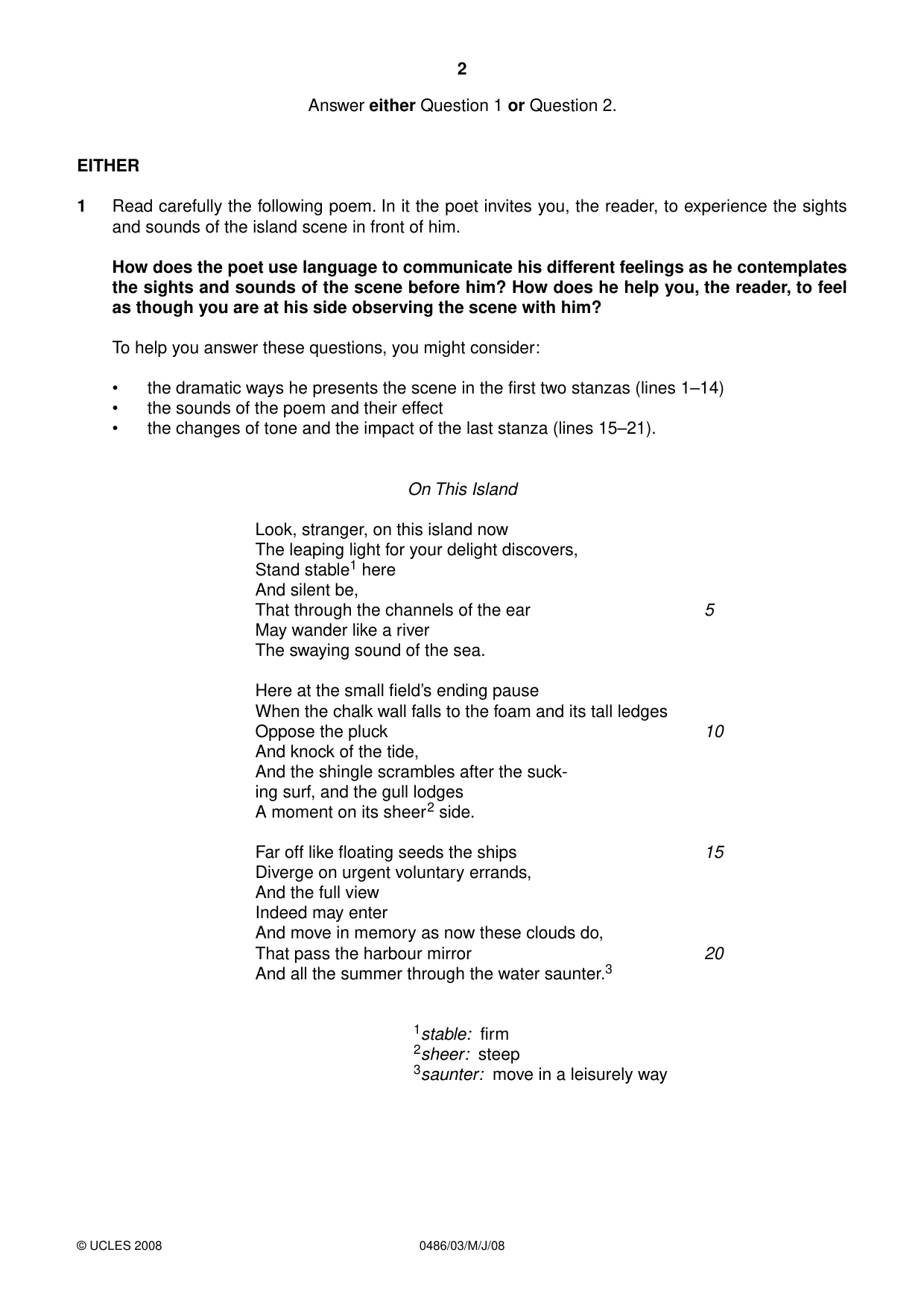
2 0486/03/M/J/08 © UCLES 2008 Answer either Question 1 or Question 2. EITHER 1 Read carefully the following poem. In it the poet invites you, the reader, to experience the sights and sounds of the island scene in front of him. How does the poet use language to communicate his different feelings as he contemplates the sights and sounds of the scene before him? How does he help you, the reader, to feel as though you are at his side observing the scene with him? To help you answer these questions, you might consider: • the dramatic ways he presents the scene in the first two stanzas (lines 1–14) • the sounds of the poem and their effect • the changes of tone and the impact of the last stanza (lines 15–21). On This Island Look, stranger, on this island now The leaping light for your delight discovers, Stand stable1 here And silent be, That through the channels of the ear 5 May wander like a river The swaying sound of the sea. Here at the small field’s ending pause When the chalk wall falls to the foam and its tall ledges Oppose the pluck 10 And knock of the tide, And the shingle scrambles after the suck- ing surf, and the gull lodges A moment on its sheer 2 side. Far off like floating seeds the ships 15 Diverge on urgent voluntary errands, And the full view Indeed may enter And move in memory as now these clouds do, That pass the harbour mirror 20 And all the summer through the water saunter.3 1stable: firm 2sheer: steep 3saunter: move in a leisurely way
Question paper, page 3
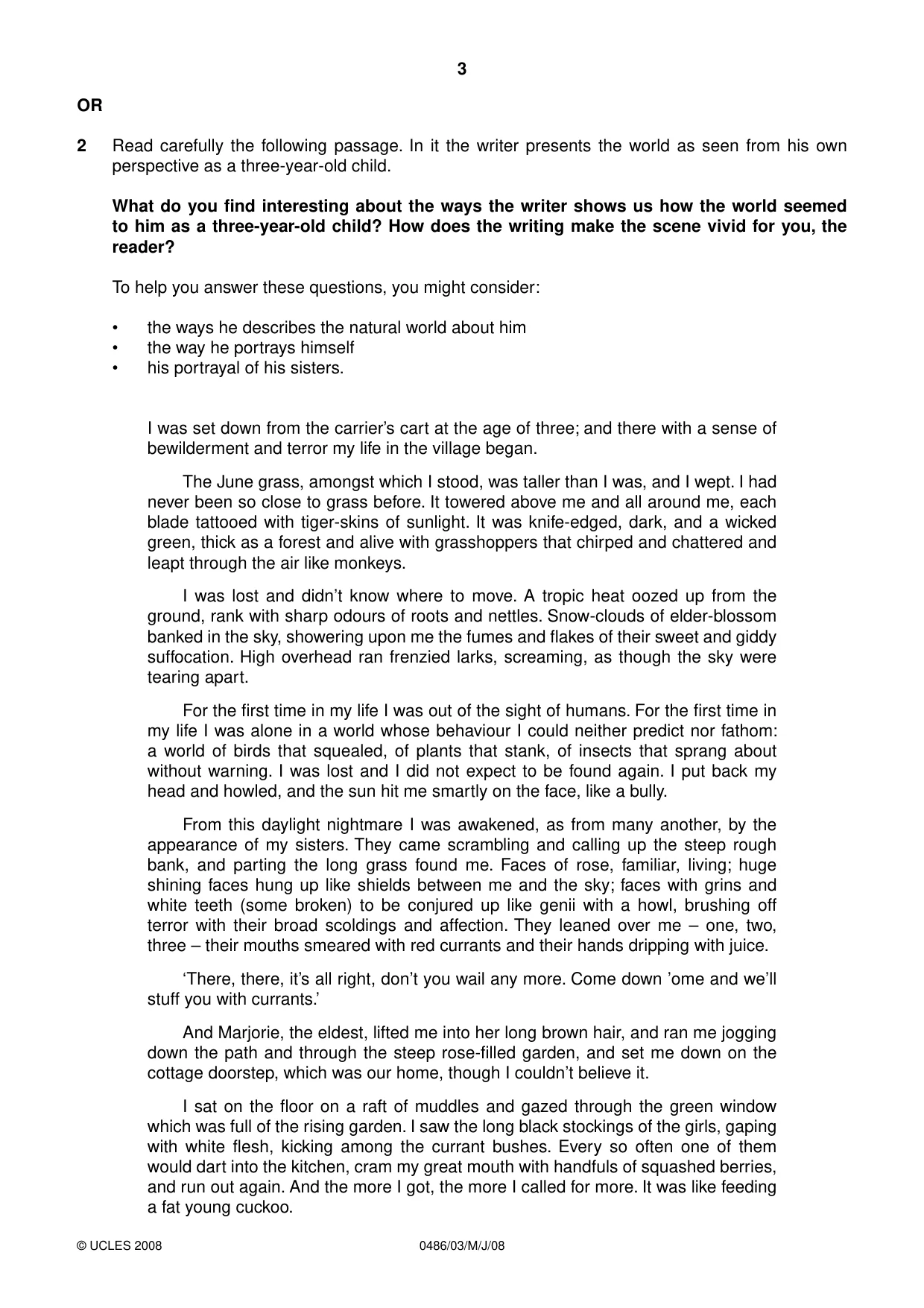
3 0486/03/M/J/08 © UCLES 2008 OR 2 Read carefully the following passage. In it the writer presents the world as seen from his own perspective as a three-year-old child. What do you find interesting about the ways the writer shows us how the world seemed to him as a three-year-old child? How does the writing make the scene vivid for you, the reader? To help you answer these questions, you might consider: • the ways he describes the natural world about him • the way he portrays himself • his portrayal of his sisters. I was set down from the carrier’s cart at the age of three; and there with a sense of bewilderment and terror my life in the village began. The June grass, amongst which I stood, was taller than I was, and I wept. I had never been so close to grass before. It towered above me and all around me, each blade tattooed with tiger-skins of sunlight. It was knife-edged, dark, and a wicked green, thick as a forest and alive with grasshoppers that chirped and chattered and leapt through the air like monkeys. I was lost and didn’t know where to move. A tropic heat oozed up from the ground, rank with sharp odours of roots and nettles. Snow-clouds of elder-blossom banked in the sky, showering upon me the fumes and flakes of their sweet and giddy suffocation. High overhead ran frenzied larks, screaming, as though the sky were tearing apart. For the first time in my life I was out of the sight of humans. For the first time in my life I was alone in a world whose behaviour I could neither predict nor fathom: a world of birds that squealed, of plants that stank, of insects that sprang about without warning. I was lost and I did not expect to be found again. I put back my head and howled, and the sun hit me smartly on the face, like a bully. From this daylight nightmare I was awakened, as from many another, by the appearance of my sisters. They came scrambling and calling up the steep rough bank, and parting the long grass found me. Faces of rose, familiar, living; huge shining faces hung up like shields between me and the sky; faces with grins and white teeth (some broken) to be conjured up like genii with a howl, brushing off terror with their broad scoldings and affection. They leaned over me – one, two, three – their mouths smeared with red currants and their hands dripping with juice. ‘There, there, it’s all right, don’t you wail any more. Come down ’ome and we’ll stuff you with currants.’ And Marjorie, the eldest, lifted me into her long brown hair, and ran me jogging down the path and through the steep rose-filled garden, and set me down on the cottage doorstep, which was our home, though I couldn’t believe it. I sat on the floor on a raft of muddles and gazed through the green window which was full of the rising garden. I saw the long black stockings of the girls, gaping with white flesh, kicking among the currant bushes. Every so often one of them would dart into the kitchen, cram my great mouth with handfuls of squashed berries, and run out again. And the more I got, the more I called for more. It was like feeding a fat young cuckoo.
Question paper, page 4
4 0486/03/M/J/08 BLANK PAGE Copyright Acknowledgements: Question 1 © W. H. Auden; On This Island. Question 2 Reprinted by permission of PFD on behalf of The Estate of Laurie Lee © Laurie Lee, 1959. Permission to reproduce items where third-party owned material protected by copyright is included has been sought and cleared where possible. Every reasonable effort has been made by the publisher (UCLES) to trace copyright holders, but if any items requiring clearance have unwittingly been included, the publisher will be pleased to make amends at the earliest possible opportunity. University of Cambridge International Examinations is part of the Cambridge Assessment Group. Cambridge Assessment is the brand name of University of Cambridge Local Examinations Syndicate (UCLES), which is itself a department of the University of Cambridge.
Mark scheme, page 1
UNIVERSITY OF CAMBRIDGE INTERNATIONAL EXAMINATIONS International General Certificate of Secondary Education MARK SCHEME for the May/June 2008 question paper 0486 LITERATURE (ENGLISH) 0486/03 Paper 3 (Alternative to Coursework), maximum raw mark 20 This mark scheme is published as an aid to teachers and candidates, to indicate the requirements of the examination. It shows the basis on which Examiners were instructed to award marks. It does not indicate the details of the discussions that took place at an Examiners’ meeting before marking began. All Examiners are instructed that alternative correct answers and unexpected approaches in candidates’ scripts must be given marks that fairly reflect the relevant knowledge and skills demonstrated. Mark schemes must be read in conjunction with the question papers and the report on the examination. • CIE will not enter into discussions or correspondence in connection with these mark schemes. CIE is publishing the mark schemes for the May/June 2008 question papers for most IGCSE, GCE Advanced Level and Advanced Subsidiary Level syllabuses and some Ordinary Level syllabuses. www.XtremePapers.com
Mark scheme, page 2
Page 2 Mark Scheme Syllabus Paper IGCSE – May/June 2008 0486 03 © UCLES 2008 Grade Descriptors The descriptors are an attempt to guide examiners to an understanding of the qualities normally expected of, or ‘typical’ of work in the band. They must not be interpreted as hurdle statements. Together with the marking notes specific to the passage/poem set for that exam, they form a means of general guidance. However, as is emphasised later in the Marking Notes, the photostats taken from work produced in the examination will be the principal means by which we shall standardise the marking. In this Syllabus we aim to encourage the candidates to make some personal response to their reading. That means that, while we may have legitimate expectations to the ground most answers may occupy, we must at times be prepared to meet the candidates on their chosen ground. We must try at all times to tease out what the candidate is trying to say to us. We must recognise that it is possible for a candidate whose technical command of English is limited, but whose language still manages to communicate understanding, to receive high marks. Nor should we reward fluency and display of literary terms if we feel that there is little evidence of such understanding. Of course, those who have linguistic capabilities of a high order are more likely to be able to convince us that they have insight, but please remember that we are looking for literary response, not language skills. Other areas of IGCSE assess the latter very well. It is vital that we constantly remind ourselves that this is unseen work and we should not be overcritical of an occasional false note or misunderstanding. We are marking the quality of the process of engaging with literature, and not merely assessing the accuracy or otherwise of the conclusions reached. Above all, we should be alert to any response to the affective power of the words, however it might be expressed. Band 9 0–1 The answer does not meet the criteria for Band 8 Band 8 2–3 Candidates will – Show just a very little awareness of …. Band 7 4–5 Candidates will – make a few straightforward points about…. Band 6 6–8 Candidates will – make some straightforward points about… show a little understanding of Band 5 9–11 Candidates will – begin to develop a response….. show some understanding of…. Band 4 12–14 Candidates will – make a sensible response…. show reasonable understanding of…. show a little awareness of the way language works. Band 3 15–17 Candidates will – make a considered, sustained response. show clear understanding of …. show some awareness of the way language works…. Bands 1 and 2 18–20 Candidates will – sustain a perceptive, convincing response show extensive understanding respond sensitively to the way language works
Mark scheme, page 3
Page 3 Mark Scheme Syllabus Paper IGCSE – May/June 2008 0486 03 © UCLES 2008 Question 1 The two questions are very closely related and should be marked as a unit. The focus of both questions is on how the poem has the effect is does. So, those answers which merely describe the scene, however prettily, should be given limited reward. The bullet points may encourage candidates to take the poem chronologically although the first does refer to the first two stanzas and the second bullet point refers to all three. The first two stanzas are probably more easily commented on than the last. It is hoped, however, that many of the candidates will be able to respond to the change of mood of the last verse, although it is likely that only the best answers will be able to deal with it effectively. Readers often have difficulty when reading this poem in deciding where Auden’s (physical) standpoint is! Are we on the island or are we on another piece of land, possibly the mainland, looking out to it? This might puzzle candidates as who exactly is meant by stranger. For this exam, this does not really need to concern us in the slightest. In the end, what we are examining in this exercise is the candidate’s sensitivity to the way Auden uses words. There is plenty to say about this with reference to this beautiful poem. Above all, the poem is musical. We cannot expect precise metrical analyses to unlock the secrets of its lyrical characteristics, but we should reward generously any attempts to pinpoint the way the verse is arranged, the way syllables are stressed, and the onomatopoeic arrangement of sounds which show Auden at the height of his poetic powers. Marks 2–5 B7/8 Candidates will show some awareness of what the scene is like, referring perhaps to some of the sights and sounds. They may not refer at all to the second question. Answers will probably be very brief and/or rely heavily on the words of the original to the extent that they are little short of copying out. Marks 6–8 B6 Answers should show some understanding of the content of the poem and be able to select some of the sights and sounds. However, they will probably not be able to relate these details to the way the poet uses language nor really show implicitly that they have appreciated this. They will probably be unable to deal with the second question beyond saying that he is talking to the reader. There may be a lack of understanding on how to use the text; they may either make very little reference to specific words and phrases or conversely they may use it indiscriminately or paraphrase excessively. There may be serious errors of understanding in this range. Marks 9–11 B5 There should be a reasonably clear response to the sights and sounds of the poem and the different feelings they invoke. Some sensitivity to language will be probably apparent from the way they write, perhaps by their selection of quotation or by creative paraphrase. However, in this range, we might not expect there to be much analytical comment. There should be some attempt to tackle both questions but their answer to the second will probably be very basic. We should expect at least two of the bullet points to be covered, but again perhaps not analytically. There may be errors of understanding in this mark range, but basic understanding of the whole should be secure.
Mark scheme, page 4
Page 4 Mark Scheme Syllabus Paper IGCSE – May/June 2008 0486 03 © UCLES 2008 Marks 12–14 B4 There should be a reasonably clear response to the different feelings evoked by some of the language describing the sights and sounds of the island and a basic attempt to show how Auden’s poetry has communicated this. Typically in this range, candidates will identify some of the simpler images, for example, ‘like floating seeds’. It is hoped that they will also be able to select examples of onomatopoeia like ‘scrambles after the sucking surf’. If they follow the bullet points, they may be able, in response to the first, identify the monosyllabic imperative (but not necessarily using those words) with which the poet boldly engages the reader’s interest or the vertiginous descriptions of the second verse. There will normally be a very sketchy awareness of the change of tone in the last verse. However, we will expect little development in this range of any of the points made. Marks 15–17 B3 Both questions should be answered adequately and the candidate should show a capacity to make developed points and present a reasonably cohesive answer. There may be more emphasis on the ‘feelings’ of the poet here rather than a concentration just on the sights and sounds. For example, a good answer might move through an identification of the thrill of the beauty, the feelings of peacefulness, the awe at the majesty of the heights, the dreaminess of the last stanza. We should expect attention to each of the bullet points. There should be a response to the drama of the scene, with perhaps an awareness of the theatricality of the presentation, a description of the hushed way he acts as a sort of guide to the delights of the area. There should be an awareness of the change of tone of the last verse with a rudimentary attempt at showing how the words have effected this. Marks 18–20 B1/2 We should be looking for a good appreciation of the poetry before we award a mark in this range. If any candidate can make a reasonably convincing analysis of the metrical subtleties of the verse, we should be delighted, but we should not expect this. Rather we should be alert for any response to the movement of the verse, however this is articulated. Capable answers will also have the confidence not to pin down all the meanings too securely. However the best candidates might tackle the final stanza’s vagaries, essentially, we are, as always, looking for engagement with the poetry, signs that they know how to reach out and make it their own property.
Mark scheme, page 5
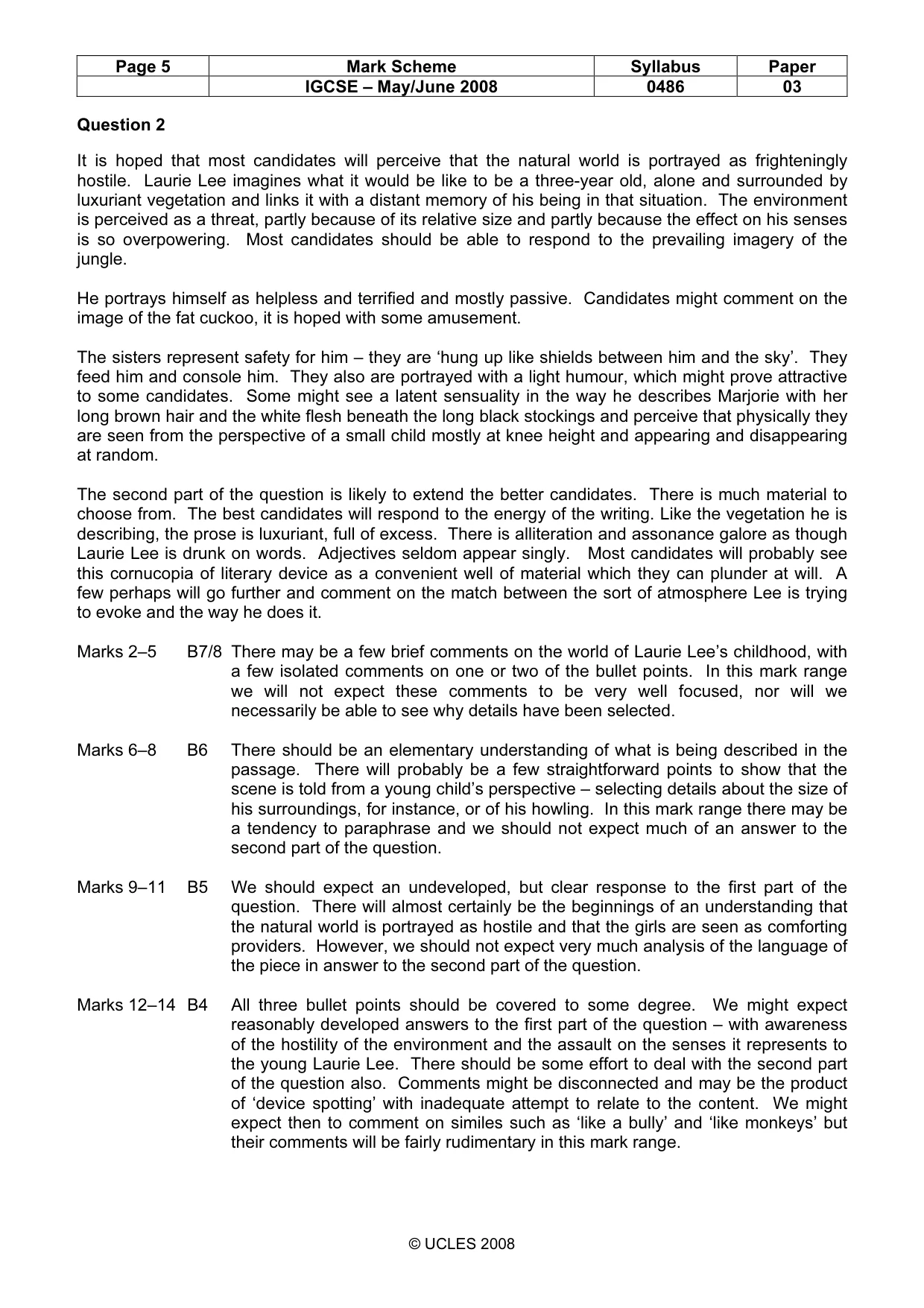
Page 5 Mark Scheme Syllabus Paper IGCSE – May/June 2008 0486 03 © UCLES 2008 Question 2 It is hoped that most candidates will perceive that the natural world is portrayed as frighteningly hostile. Laurie Lee imagines what it would be like to be a three-year old, alone and surrounded by luxuriant vegetation and links it with a distant memory of his being in that situation. The environment is perceived as a threat, partly because of its relative size and partly because the effect on his senses is so overpowering. Most candidates should be able to respond to the prevailing imagery of the jungle. He portrays himself as helpless and terrified and mostly passive. Candidates might comment on the image of the fat cuckoo, it is hoped with some amusement. The sisters represent safety for him – they are ‘hung up like shields between him and the sky’. They feed him and console him. They also are portrayed with a light humour, which might prove attractive to some candidates. Some might see a latent sensuality in the way he describes Marjorie with her long brown hair and the white flesh beneath the long black stockings and perceive that physically they are seen from the perspective of a small child mostly at knee height and appearing and disappearing at random. The second part of the question is likely to extend the better candidates. There is much material to choose from. The best candidates will respond to the energy of the writing. Like the vegetation he is describing, the prose is luxuriant, full of excess. There is alliteration and assonance galore as though Laurie Lee is drunk on words. Adjectives seldom appear singly. Most candidates will probably see this cornucopia of literary device as a convenient well of material which they can plunder at will. A few perhaps will go further and comment on the match between the sort of atmosphere Lee is trying to evoke and the way he does it. Marks 2–5 B7/8 There may be a few brief comments on the world of Laurie Lee’s childhood, with a few isolated comments on one or two of the bullet points. In this mark range we will not expect these comments to be very well focused, nor will we necessarily be able to see why details have been selected. Marks 6–8 B6 There should be an elementary understanding of what is being described in the passage. There will probably be a few straightforward points to show that the scene is told from a young child’s perspective – selecting details about the size of his surroundings, for instance, or of his howling. In this mark range there may be a tendency to paraphrase and we should not expect much of an answer to the second part of the question. Marks 9–11 B5 We should expect an undeveloped, but clear response to the first part of the question. There will almost certainly be the beginnings of an understanding that the natural world is portrayed as hostile and that the girls are seen as comforting providers. However, we should not expect very much analysis of the language of the piece in answer to the second part of the question. Marks 12–14 B4 All three bullet points should be covered to some degree. We might expect reasonably developed answers to the first part of the question – with awareness of the hostility of the environment and the assault on the senses it represents to the young Laurie Lee. There should be some effort to deal with the second part of the question also. Comments might be disconnected and may be the product of ‘device spotting’ with inadequate attempt to relate to the content. We might expect then to comment on similes such as ‘like a bully’ and ‘like monkeys’ but their comments will be fairly rudimentary in this mark range.
Mark scheme, page 6
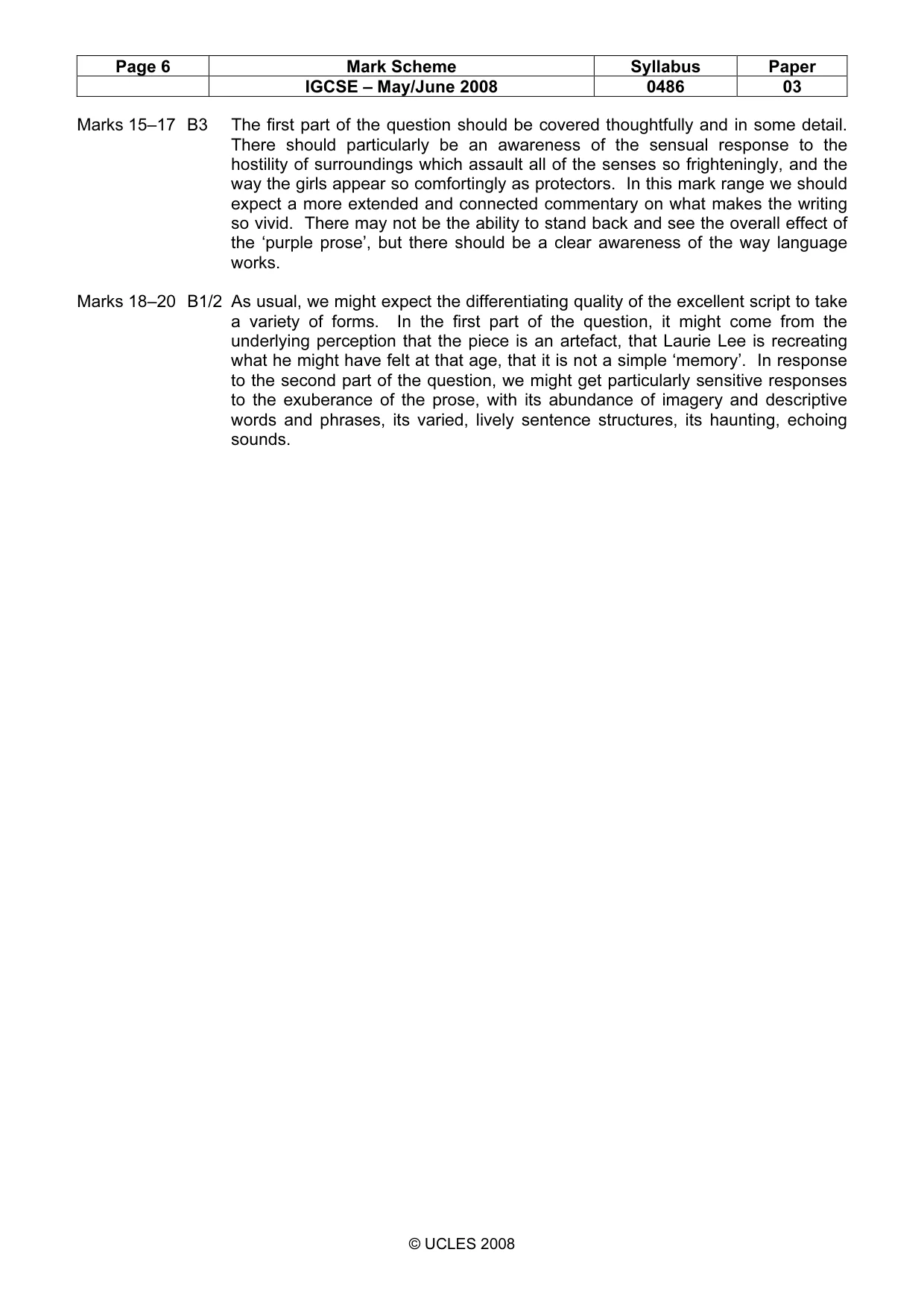
Page 6 Mark Scheme Syllabus Paper IGCSE – May/June 2008 0486 03 © UCLES 2008 Marks 15–17 B3 The first part of the question should be covered thoughtfully and in some detail. There should particularly be an awareness of the sensual response to the hostility of surroundings which assault all of the senses so frighteningly, and the way the girls appear so comfortingly as protectors. In this mark range we should expect a more extended and connected commentary on what makes the writing so vivid. There may not be the ability to stand back and see the overall effect of the ‘purple prose’, but there should be a clear awareness of the way language works. Marks 18–20 B1/2 As usual, we might expect the differentiating quality of the excellent script to take a variety of forms. In the first part of the question, it might come from the underlying perception that the piece is an artefact, that Laurie Lee is recreating what he might have felt at that age, that it is not a simple ‘memory’. In response to the second part of the question, we might get particularly sensitive responses to the exuberance of the prose, with its abundance of imagery and descriptive words and phrases, its varied, lively sentence structures, its haunting, echoing sounds.
What you needed in this session
Cambridge’s own grade thresholds for 2008 May/June, Paper 3 · Variant 1. A higher threshold means an easier paper — the bar moves with how the cohort did.