Cambridge IGCSE English - Literature 0486 — 2007 Oct/Nov Paper 3 · Variant 1
0486/31/O/N/07 · 20 marks · ≈23 min
The question paper and its mark scheme, free to read here and free to download. This is Cambridge’s own paper, exactly as it was sat.
Question paper8 pages




Mark scheme5 pages
Answers below. Sit the paper first if you are practising.
Paper as text
Question paper, page 1
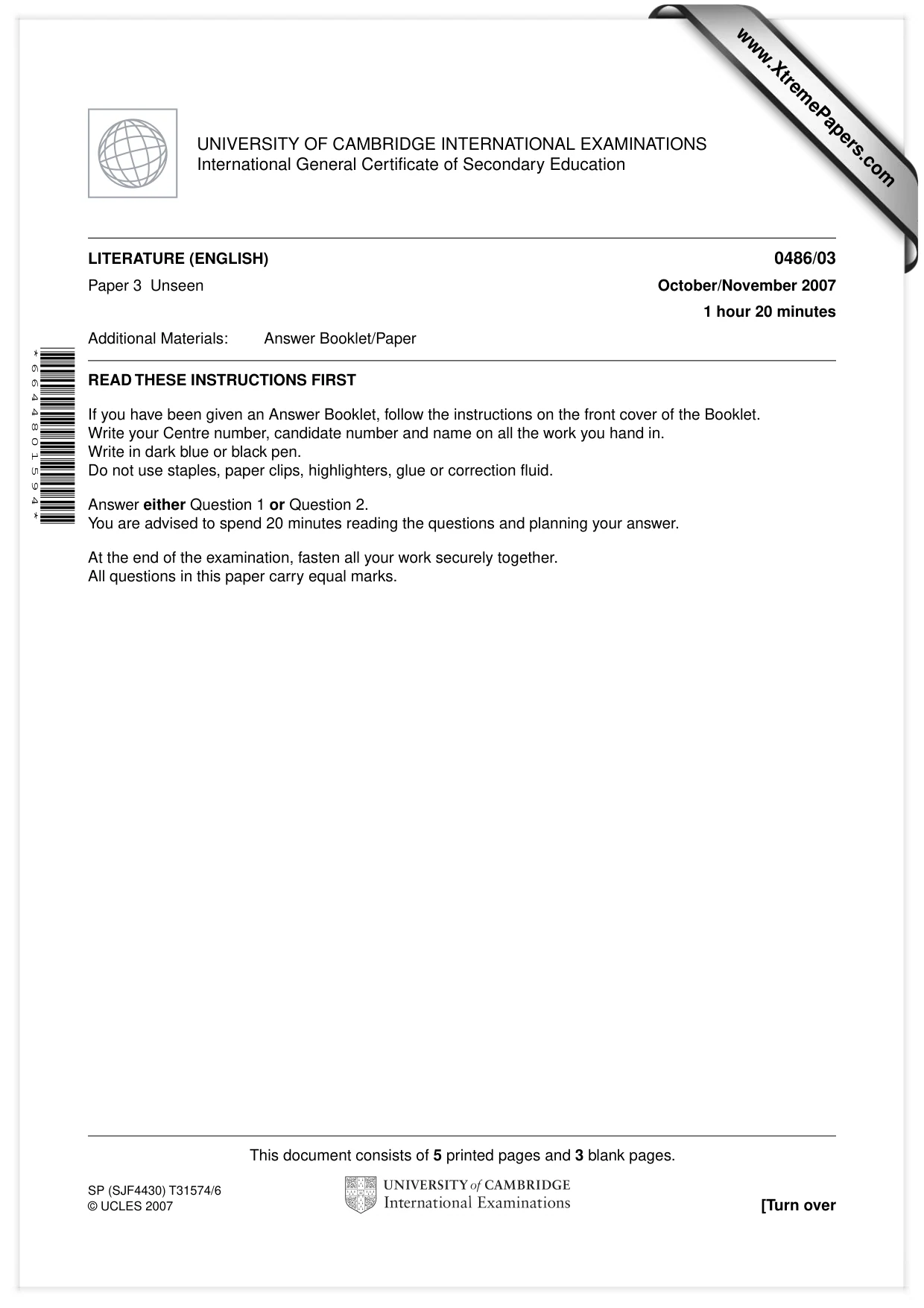
This document consists of 5 printed pages and 3 blank pages. SP (SJF4430) T31574/6 © UCLES 2007 [Turn over UNIVERSITY OF CAMBRIDGE INTERNATIONAL EXAMINATIONS International General Certificate of Secondary Education READ THESE INSTRUCTIONS FIRST If you have been given an Answer Booklet, follow the instructions on the front cover of the Booklet. Write your Centre number, candidate number and name on all the work you hand in. Write in dark blue or black pen. Do not use staples, paper clips, highlighters, glue or correction fluid. Answer either Question 1 or Question 2. You are advised to spend 20 minutes reading the questions and planning your answer. At the end of the examination, fasten all your work securely together. All questions in this paper carry equal marks. * 6 6 4 4 8 0 1 5 9 4 * LITERATURE (ENGLISH) 0486/03 Paper 3 Unseen October/November 2007 1 hour 20 minutes Additional Materials: Answer Booklet/Paper www.XtremePapers.com
Question paper, page 2
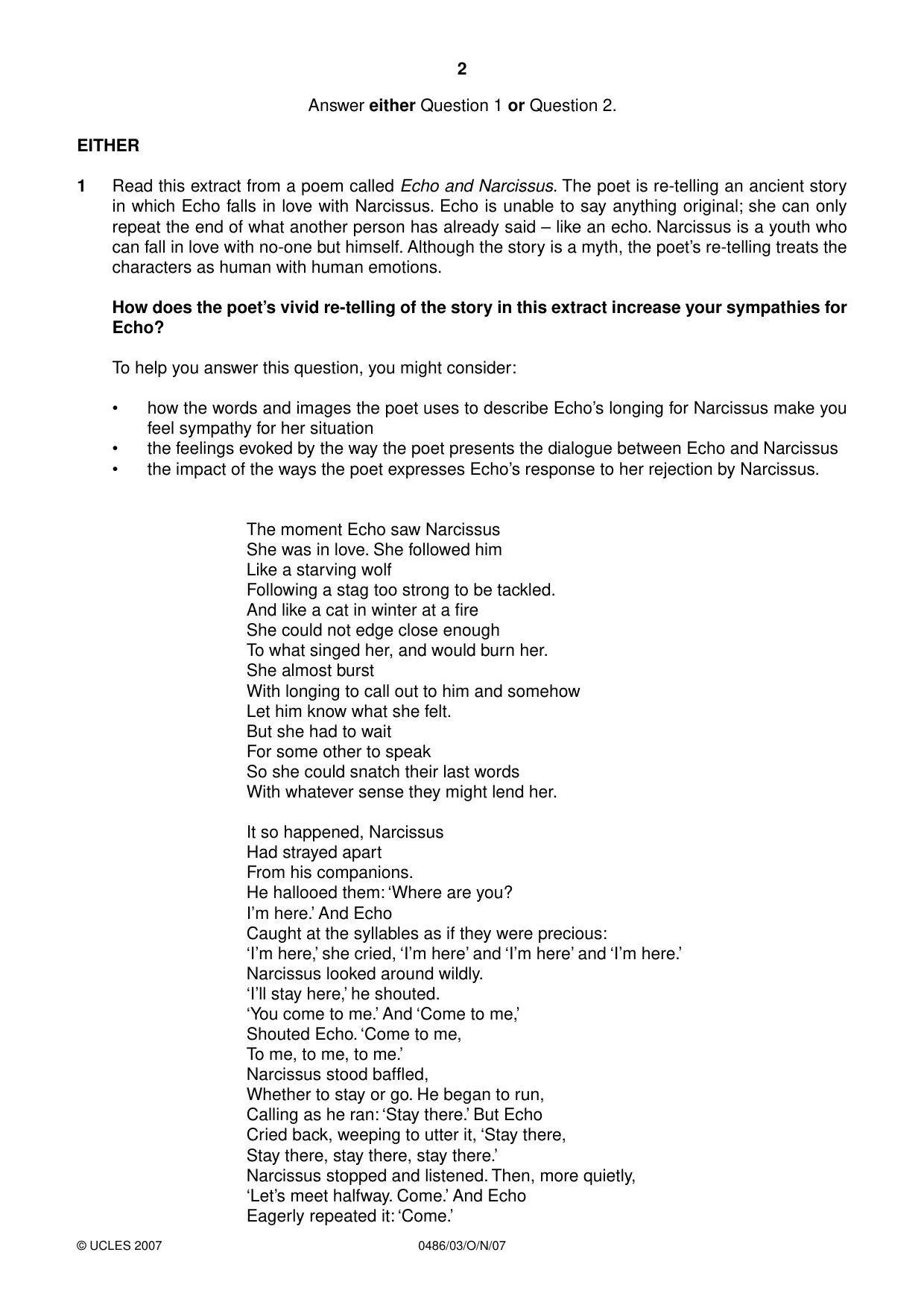
2 0486/03/O/N/07 © UCLES 2007 Answer either Question 1 or Question 2. EITHER 1 Read this extract from a poem called Echo and Narcissus. The poet is re-telling an ancient story in which Echo falls in love with Narcissus. Echo is unable to say anything original; she can only repeat the end of what another person has already said – like an echo. Narcissus is a youth who can fall in love with no-one but himself. Although the story is a myth, the poet’s re-telling treats the characters as human with human emotions. How does the poet’s vivid re-telling of the story in this extract increase your sympathies for Echo? To help you answer this question, you might consider: • how the words and images the poet uses to describe Echo’s longing for Narcissus make you feel sympathy for her situation • the feelings evoked by the way the poet presents the dialogue between Echo and Narcissus • the impact of the ways the poet expresses Echo’s response to her rejection by Narcissus. The moment Echo saw Narcissus She was in love. She followed him Like a starving wolf Following a stag too strong to be tackled. And like a cat in winter at a fire She could not edge close enough To what singed her, and would burn her. She almost burst With longing to call out to him and somehow Let him know what she felt. But she had to wait For some other to speak So she could snatch their last words With whatever sense they might lend her. It so happened, Narcissus Had strayed apart From his companions. He hallooed them: ‘Where are you? I’m here.’ And Echo Caught at the syllables as if they were precious: ‘I’m here,’ she cried, ‘I’m here’ and ‘I’m here’ and ‘I’m here.’ Narcissus looked around wildly. ‘I’ll stay here,’ he shouted. ‘You come to me.’ And ‘Come to me,’ Shouted Echo. ‘Come to me, To me, to me, to me.’ Narcissus stood baffled, Whether to stay or go. He began to run, Calling as he ran: ‘Stay there.’ But Echo Cried back, weeping to utter it, ‘Stay there, Stay there, stay there, stay there.’ Narcissus stopped and listened. Then, more quietly, ‘Let’s meet halfway. Come.’ And Echo Eagerly repeated it: ‘Come.’
Question paper, page 3
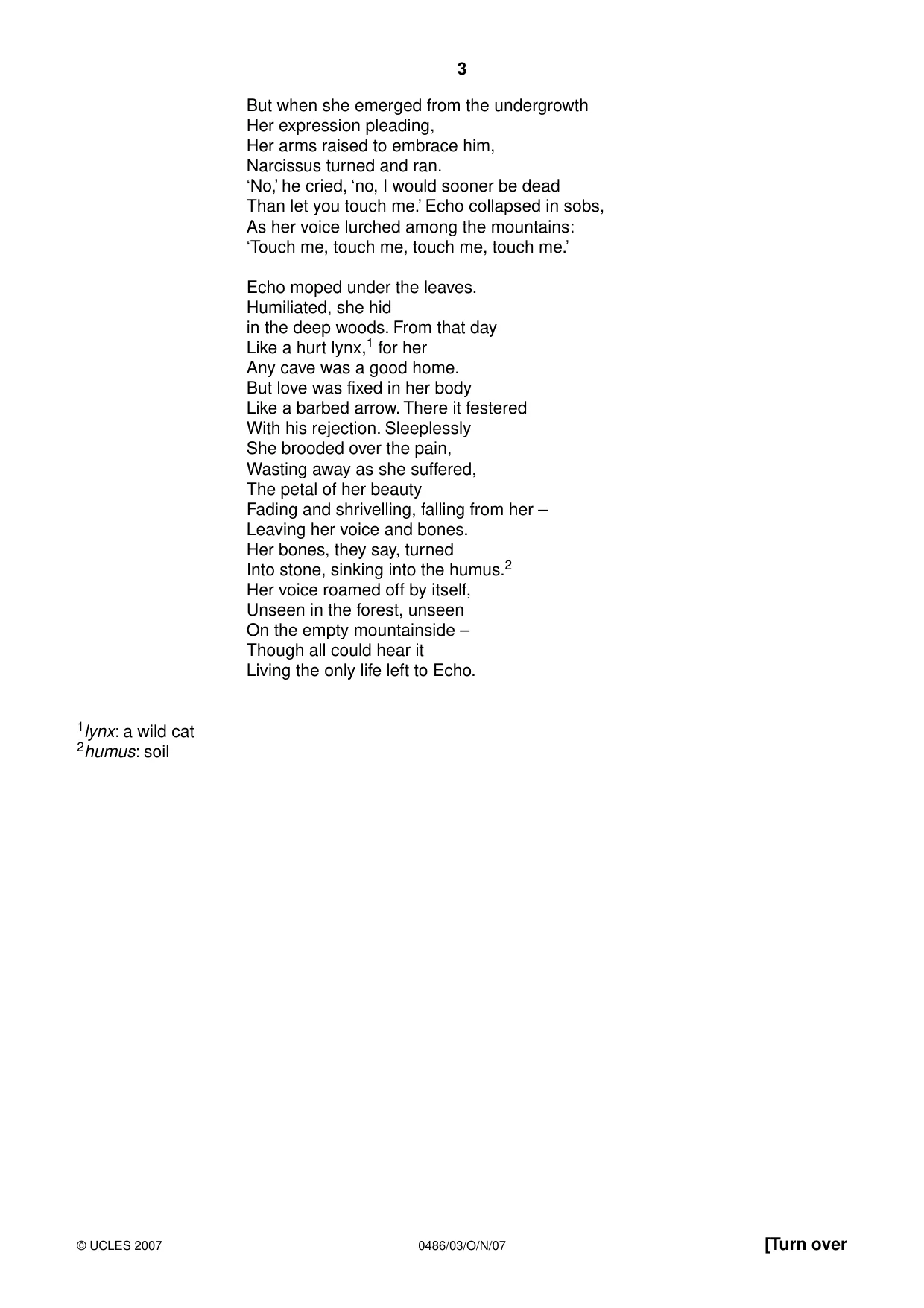
3 0486/03/O/N/07 © UCLES 2007 [Turn over But when she emerged from the undergrowth Her expression pleading, Her arms raised to embrace him, Narcissus turned and ran. ‘No,’ he cried, ‘no, I would sooner be dead Than let you touch me.’ Echo collapsed in sobs, As her voice lurched among the mountains: ‘Touch me, touch me, touch me, touch me.’ Echo moped under the leaves. Humiliated, she hid in the deep woods. From that day Like a hurt lynx,1 for her Any cave was a good home. But love was fixed in her body Like a barbed arrow. There it festered With his rejection. Sleeplessly She brooded over the pain, Wasting away as she suffered, The petal of her beauty Fading and shrivelling, falling from her – Leaving her voice and bones. Her bones, they say, turned Into stone, sinking into the humus.2 Her voice roamed off by itself, Unseen in the forest, unseen On the empty mountainside – Though all could hear it Living the only life left to Echo. 1lynx: a wild cat 2humus: soil
Question paper, page 4
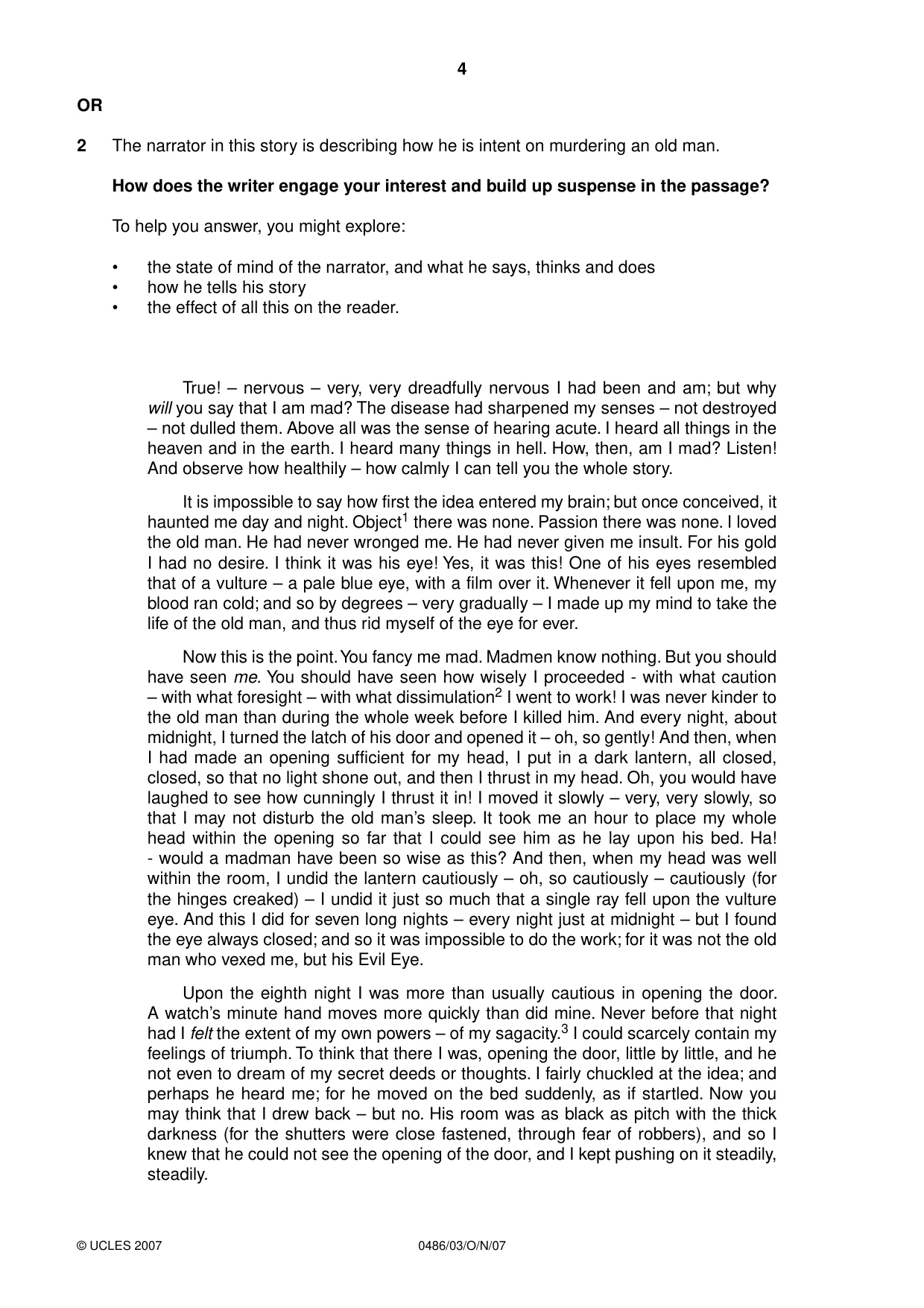
4 0486/03/O/N/07 © UCLES 2007 OR 2 The narrator in this story is describing how he is intent on murdering an old man. How does the writer engage your interest and build up suspense in the passage? To help you answer, you might explore: • the state of mind of the narrator, and what he says, thinks and does • how he tells his story • the effect of all this on the reader. True! – nervous – very, very dreadfully nervous I had been and am; but why will you say that I am mad? The disease had sharpened my senses – not destroyed – not dulled them. Above all was the sense of hearing acute. I heard all things in the heaven and in the earth. I heard many things in hell. How, then, am I mad? Listen! And observe how healthily – how calmly I can tell you the whole story. It is impossible to say how first the idea entered my brain; but once conceived, it haunted me day and night. Object1 there was none. Passion there was none. I loved the old man. He had never wronged me. He had never given me insult. For his gold I had no desire. I think it was his eye! Yes, it was this! One of his eyes resembled that of a vulture – a pale blue eye, with a film over it. Whenever it fell upon me, my blood ran cold; and so by degrees – very gradually – I made up my mind to take the life of the old man, and thus rid myself of the eye for ever. Now this is the point. You fancy me mad. Madmen know nothing. But you should have seen me. You should have seen how wisely I proceeded - with what caution – with what foresight – with what dissimulation2 I went to work! I was never kinder to the old man than during the whole week before I killed him. And every night, about midnight, I turned the latch of his door and opened it – oh, so gently! And then, when I had made an opening sufficient for my head, I put in a dark lantern, all closed, closed, so that no light shone out, and then I thrust in my head. Oh, you would have laughed to see how cunningly I thrust it in! I moved it slowly – very, very slowly, so that I may not disturb the old man’s sleep. It took me an hour to place my whole head within the opening so far that I could see him as he lay upon his bed. Ha! - would a madman have been so wise as this? And then, when my head was well within the room, I undid the lantern cautiously – oh, so cautiously – cautiously (for the hinges creaked) – I undid it just so much that a single ray fell upon the vulture eye. And this I did for seven long nights – every night just at midnight – but I found the eye always closed; and so it was impossible to do the work; for it was not the old man who vexed me, but his Evil Eye. Upon the eighth night I was more than usually cautious in opening the door. A watch’s minute hand moves more quickly than did mine. Never before that night had I felt the extent of my own powers – of my sagacity.3 I could scarcely contain my feelings of triumph. To think that there I was, opening the door, little by little, and he not even to dream of my secret deeds or thoughts. I fairly chuckled at the idea; and perhaps he heard me; for he moved on the bed suddenly, as if startled. Now you may think that I drew back – but no. His room was as black as pitch with the thick darkness (for the shutters were close fastened, through fear of robbers), and so I knew that he could not see the opening of the door, and I kept pushing on it steadily, steadily.
Question paper, page 5
5 0486/03/O/N/07 © UCLES 2007 I had my head in, and was about to open the lantern, when my thumb slipped upon the tin fastening, and the old man sprang up in the bed, crying out – ‘Who’s there?’ 1Object: motive or purpose 2dissimulation: deceit or pretending 3sagacity: great intelligence
Question paper, page 8
8 0486/03/O/N/07 Copyright Acknowledgements: Question 1 © Ted Hughes; ‘Echo and Narcissus’; Tales from Ovid: Twenty-four Passages from the “Metamorphoses”, Faber and Faber, 1997. Permission to reproduce items where third-party owned material protected by copyright is included has been sought and cleared where possible. Every reasonable effort has been made by the publisher (UCLES) to trace copyright holders, but if any items requiring clearance have unwittingly been included, the publisher will be pleased to make amends at the earliest possible opportunity. University of Cambridge International Examinations is part of the Cambridge Assessment Group. Cambridge Assessment is the brand name of University of Cambridge Local Examinations Syndicate (UCLES), which is itself a department of the University of Cambridge. BLANK PAGE
Mark scheme, page 1
UNIVERSITY OF CAMBRIDGE INTERNATIONAL EXAMINATIONS International General Certificate of Secondary Education MARK SCHEME for the October/November 2007 question paper 0486 LITERATURE (ENGLISH) 0486/03 Paper 3 (Alternative to Coursework), maximum raw mark 20 This mark scheme is published as an aid to teachers and candidates, to indicate the requirements of the examination. It shows the basis on which Examiners were instructed to award marks. It does not indicate the details of the discussions that took place at an Examiners’ meeting before marking began. All Examiners are instructed that alternative correct answers and unexpected approaches in candidates’ scripts must be given marks that fairly reflect the relevant knowledge and skills demonstrated. Mark schemes must be read in conjunction with the question papers and the report on the examination. • CIE will not enter into discussions or correspondence in connection with these mark schemes. CIE is publishing the mark schemes for the October/November 2007 question papers for most IGCSE, GCE Advanced Level and Advanced Subsidiary Level syllabuses and some Ordinary Level syllabuses. www.XtremePapers.com
Mark scheme, page 2
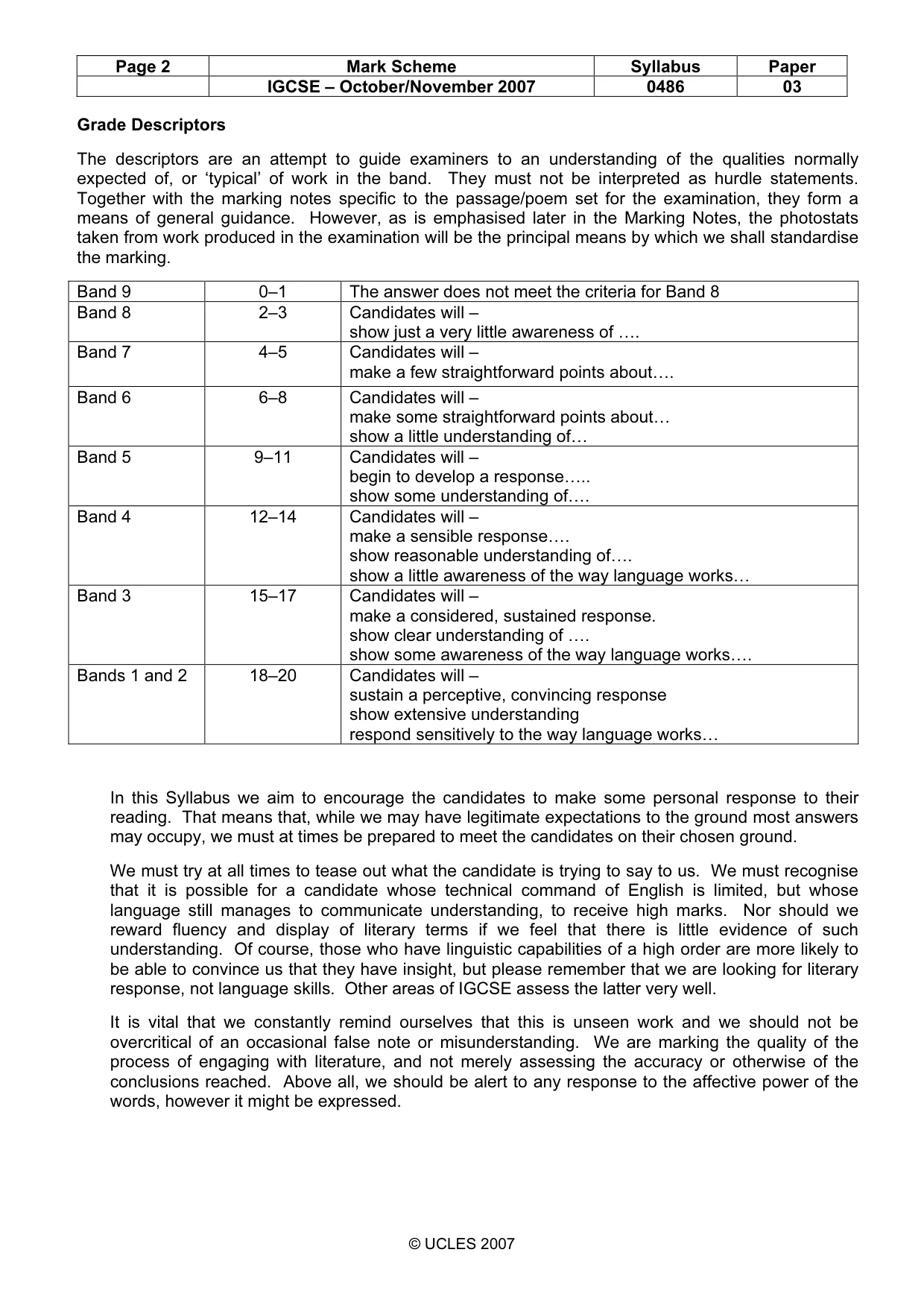
Page 2 Mark Scheme Syllabus Paper IGCSE – October/November 2007 0486 03 © UCLES 2007 Grade Descriptors The descriptors are an attempt to guide examiners to an understanding of the qualities normally expected of, or ‘typical’ of work in the band. They must not be interpreted as hurdle statements. Together with the marking notes specific to the passage/poem set for the examination, they form a means of general guidance. However, as is emphasised later in the Marking Notes, the photostats taken from work produced in the examination will be the principal means by which we shall standardise the marking. In this Syllabus we aim to encourage the candidates to make some personal response to their reading. That means that, while we may have legitimate expectations to the ground most answers may occupy, we must at times be prepared to meet the candidates on their chosen ground. We must try at all times to tease out what the candidate is trying to say to us. We must recognise that it is possible for a candidate whose technical command of English is limited, but whose language still manages to communicate understanding, to receive high marks. Nor should we reward fluency and display of literary terms if we feel that there is little evidence of such understanding. Of course, those who have linguistic capabilities of a high order are more likely to be able to convince us that they have insight, but please remember that we are looking for literary response, not language skills. Other areas of IGCSE assess the latter very well. It is vital that we constantly remind ourselves that this is unseen work and we should not be overcritical of an occasional false note or misunderstanding. We are marking the quality of the process of engaging with literature, and not merely assessing the accuracy or otherwise of the conclusions reached. Above all, we should be alert to any response to the affective power of the words, however it might be expressed. Band 9 0–1 The answer does not meet the criteria for Band 8 Band 8 2–3 Candidates will – show just a very little awareness of …. Band 7 4–5 Candidates will – make a few straightforward points about…. Band 6 6–8 Candidates will – make some straightforward points about… show a little understanding of… Band 5 9–11 Candidates will – begin to develop a response….. show some understanding of…. Band 4 12–14 Candidates will – make a sensible response…. show reasonable understanding of…. show a little awareness of the way language works… Band 3 15–17 Candidates will – make a considered, sustained response. show clear understanding of …. show some awareness of the way language works…. Bands 1 and 2 18–20 Candidates will – sustain a perceptive, convincing response show extensive understanding respond sensitively to the way language works…
Mark scheme, page 3
Page 3 Mark Scheme Syllabus Paper IGCSE – October/November 2007 0486 03 © UCLES 2007 This is a working document; it is not exhaustive; it does not provide “correct” answers. The Marking Notes can only provide “best guesses” about how the questions will work out and is subject to revision after we have looked at a wide range of scripts. The comments on the individual bands are intended to add flesh to the descriptors in the generic mark-scheme. General Notes on Question 1 It is not expected that the candidates will quibble about who ‘the poet’ actually is. It is hoped that either they will ignore the question of identity or will treat ‘the poet’ as a conflation of Ovid and Hughes. The words might be said to be Hughes’s words, the narrative and the imagery, Ovid’s. If anyone does choose to try to separate them, we should be amazed and delighted. The question focuses on the human emotions in the story and the way Hughes/Ovid makes them seem so intense. Echo can be seen as the lonely, jilted would-be lover. She also suffers in extremis from a situation that of having to follow the male lead in all social intercourse. The bullet points, on this occasion, follow the narrative chronologically. They focus on the way the poet has told the story and the highest marks should go to the candidates who have appreciated Hughes’s use of words and the variety of poetic techniques which enhance the pathos of the narrative. Marks 2–5 There will probably be a general response to the situation rather than the writing in answers in this band. Narrative answers, with little direct emphasis on the pathos, are likely to abound in this band. Answers might be obscure and/or brief. There may be significant errors of understanding. Marks 6–8 There should be a clear focus on the pathos in this band but more emphasis on describing the situation of Echo and almost none on the poet’s use of words. Alternatively, there may be answers which refer to literary techniques but cannot relate these to the question as it stands. Answers in this range will often paraphrase parts of the poem. There may be errors of understanding. Marks 9–11 There should be some attempt to come to terms with the question. There should be a clear understanding of the situation and why Echo finds it so painful. There will be some sign that the candidate has appreciated the words and images used by the poet, but we must be ready to accept that this might not be explicitly expressed. Very creative paraphrases might be more appropriately placed in a higher band, but typically in this band, we might see flat, selective paraphrases echoing relevant details of the narrative, but not fully bringing out their poignancy. If candidates do manage to make some elementary comments on the use of language, we will not expect them to be very convincing in this mark range. Marks 12–14 There should be a response to Echo’s misery and an attempt to make something of the first two bullet points at least. However, comments will be very basic in this mark area. On the first bullet point, characteristically, we might expect a brief comment on at least one of the similes in the first stanza and perhaps some comment on a word such as ‘snatch’ or ‘burst’ to show her desperation. In response to the second bullet point, it is hoped that there would be some appreciation of the frenzied repetition of phrases but again, the commentary will not be developed. We must be ready to reward creative paraphrase which shows indirectly that the candidate has appreciated the poetry of the narrative.
Mark scheme, page 4
Page 4 Mark Scheme Syllabus Paper IGCSE – October/November 2007 0486 03 © UCLES 2007 Marks 15–17 In this mark range, we might expect a more developed treatment of each of the bullet points. The last stanza should prove a treasure trove for candidates who are able to make a more developed response to language. The sad description of Echo wasting away, unseen and uncomforted is very moving. The accumulative images of her decline are worthy of extended comment. There should, in this range, be a sensitive awareness to the pathos at each stage of the poem. Marks 18–20 There might, in this range, be a more developed understanding and empathy with the roots of Echo’s unhappiness, her inability because of circumstance to let her feelings be known in the first instance; the frustration of unrequited love; her brief hopes – raised only to be dashed again; the frantic dialogue; the humiliation of the rejection; the desperation at the end. Candidates in this area might declare themselves by their more precise dissection of her feelings and their ability to relate their comments on language and narrative technique to this deeper understanding. As always, we will reserve the very highest marks for those who have engaged deeply with the poetry of the narrative, and have responded to the ebb and flow of the verse. General Notes on Question 2 The two aspects of the task – to demonstrate how Poe engages the reader’s interest and builds up suspense – should be taken as one for the purpose of marking. We should not be worried if candidates blur the distinction between them. What may prove problematic is if candidates cannot see that Poe is creating an unreliable narrator or cannot see that Poe himself is not the narrator. There may be exceptions to this, but a script is extremely unlikely to reach the 9–11 band range if it has not (even with the aid of the bullet points) understood this basic starting-point. Once this has been appreciated, differentiation will probably derive from the ability of the candidate to move through the bullet points, from a perception that the narrator is indeed mad, to analysis of what he says and does that shows he is mad, to an examination of the style of the piece, the jerkiness of the prose, the compulsive repetitions, the overwrought emphases. As ever, the best answers will show the ability to tie these strands together and reveal a personal engagement with the passage. It might be possible for able candidates to stand back critically from this passage and, while showing what Poe is attempting, to be less than enthusiastic about the melodramatic result. The question does not encourage this approach, but if we find any candidates confident enough to plough their own furrow, we should be ready to reward. Marks 2–5 There will probably be a general response to the situation rather than the writing in this band. For the higher marks in the range there will be some details brought to bear. There may be little idea that the narrator is a creation of Poe. We might see, in this range, a straightforward and unsubtle narration of the story with little or no attempt to show the effect on the reader. Answers may also be very brief. Marks 6–8 There may be an elementary response to some of the things the narrator says, thinks and does but they will normally be taken at face value. For example, candidates might note that he is ‘nervous’ but be unable to link this with his denial that he is mad. They may be unable to perceive that his crime is essentially motiveless. While we will expect some elementary or hesitant treatment of the first two bullet points, we will not expect very much – or any - response to the third. We may also see in this mark range a straightforward narration of the ‘story’ with only an implication of how the reader will be affected by it from the way it is retold, and no specific analysis. There may also be serious misunderstandings evident in this range.
Mark scheme, page 5
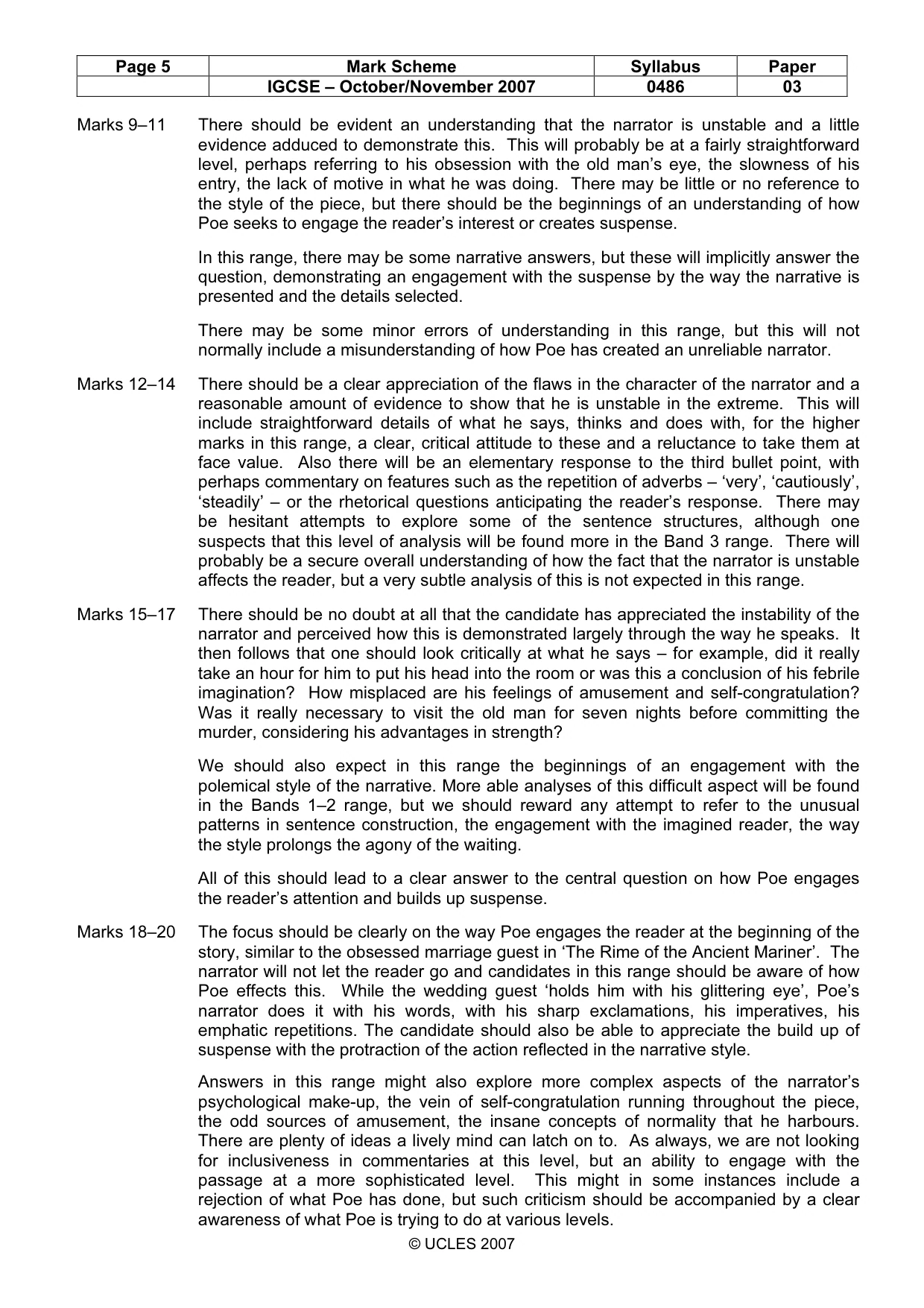
Page 5 Mark Scheme Syllabus Paper IGCSE – October/November 2007 0486 03 © UCLES 2007 Marks 9–11 There should be evident an understanding that the narrator is unstable and a little evidence adduced to demonstrate this. This will probably be at a fairly straightforward level, perhaps referring to his obsession with the old man’s eye, the slowness of his entry, the lack of motive in what he was doing. There may be little or no reference to the style of the piece, but there should be the beginnings of an understanding of how Poe seeks to engage the reader’s interest or creates suspense. In this range, there may be some narrative answers, but these will implicitly answer the question, demonstrating an engagement with the suspense by the way the narrative is presented and the details selected. There may be some minor errors of understanding in this range, but this will not normally include a misunderstanding of how Poe has created an unreliable narrator. Marks 12–14 There should be a clear appreciation of the flaws in the character of the narrator and a reasonable amount of evidence to show that he is unstable in the extreme. This will include straightforward details of what he says, thinks and does with, for the higher marks in this range, a clear, critical attitude to these and a reluctance to take them at face value. Also there will be an elementary response to the third bullet point, with perhaps commentary on features such as the repetition of adverbs – ‘very’, ‘cautiously’, ‘steadily’ – or the rhetorical questions anticipating the reader’s response. There may be hesitant attempts to explore some of the sentence structures, although one suspects that this level of analysis will be found more in the Band 3 range. There will probably be a secure overall understanding of how the fact that the narrator is unstable affects the reader, but a very subtle analysis of this is not expected in this range. Marks 15–17 There should be no doubt at all that the candidate has appreciated the instability of the narrator and perceived how this is demonstrated largely through the way he speaks. It then follows that one should look critically at what he says – for example, did it really take an hour for him to put his head into the room or was this a conclusion of his febrile imagination? How misplaced are his feelings of amusement and self-congratulation? Was it really necessary to visit the old man for seven nights before committing the murder, considering his advantages in strength? We should also expect in this range the beginnings of an engagement with the polemical style of the narrative. More able analyses of this difficult aspect will be found in the Bands 1–2 range, but we should reward any attempt to refer to the unusual patterns in sentence construction, the engagement with the imagined reader, the way the style prolongs the agony of the waiting. All of this should lead to a clear answer to the central question on how Poe engages the reader’s attention and builds up suspense. Marks 18–20 The focus should be clearly on the way Poe engages the reader at the beginning of the story, similar to the obsessed marriage guest in ‘The Rime of the Ancient Mariner’. The narrator will not let the reader go and candidates in this range should be aware of how Poe effects this. While the wedding guest ‘holds him with his glittering eye’, Poe’s narrator does it with his words, with his sharp exclamations, his imperatives, his emphatic repetitions. The candidate should also be able to appreciate the build up of suspense with the protraction of the action reflected in the narrative style. Answers in this range might also explore more complex aspects of the narrator’s psychological make-up, the vein of self-congratulation running throughout the piece, the odd sources of amusement, the insane concepts of normality that he harbours. There are plenty of ideas a lively mind can latch on to. As always, we are not looking for inclusiveness in commentaries at this level, but an ability to engage with the passage at a more sophisticated level. This might in some instances include a rejection of what Poe has done, but such criticism should be accompanied by a clear awareness of what Poe is trying to do at various levels.
What you needed in this session
Cambridge’s own grade thresholds for 2007 Oct/Nov, Paper 3 · Variant 1. A higher threshold means an easier paper — the bar moves with how the cohort did.