Cambridge IGCSE English - Literature 0486 — 2007 May/June Paper 3 · Variant 1
0486/31/M/J/07 · 20 marks · ≈23 min
The question paper and its mark scheme, free to read here and free to download. This is Cambridge’s own paper, exactly as it was sat.
Question paper8 pages




Mark scheme5 pages
Answers below. Sit the paper first if you are practising.
Paper as text
Question paper, page 1
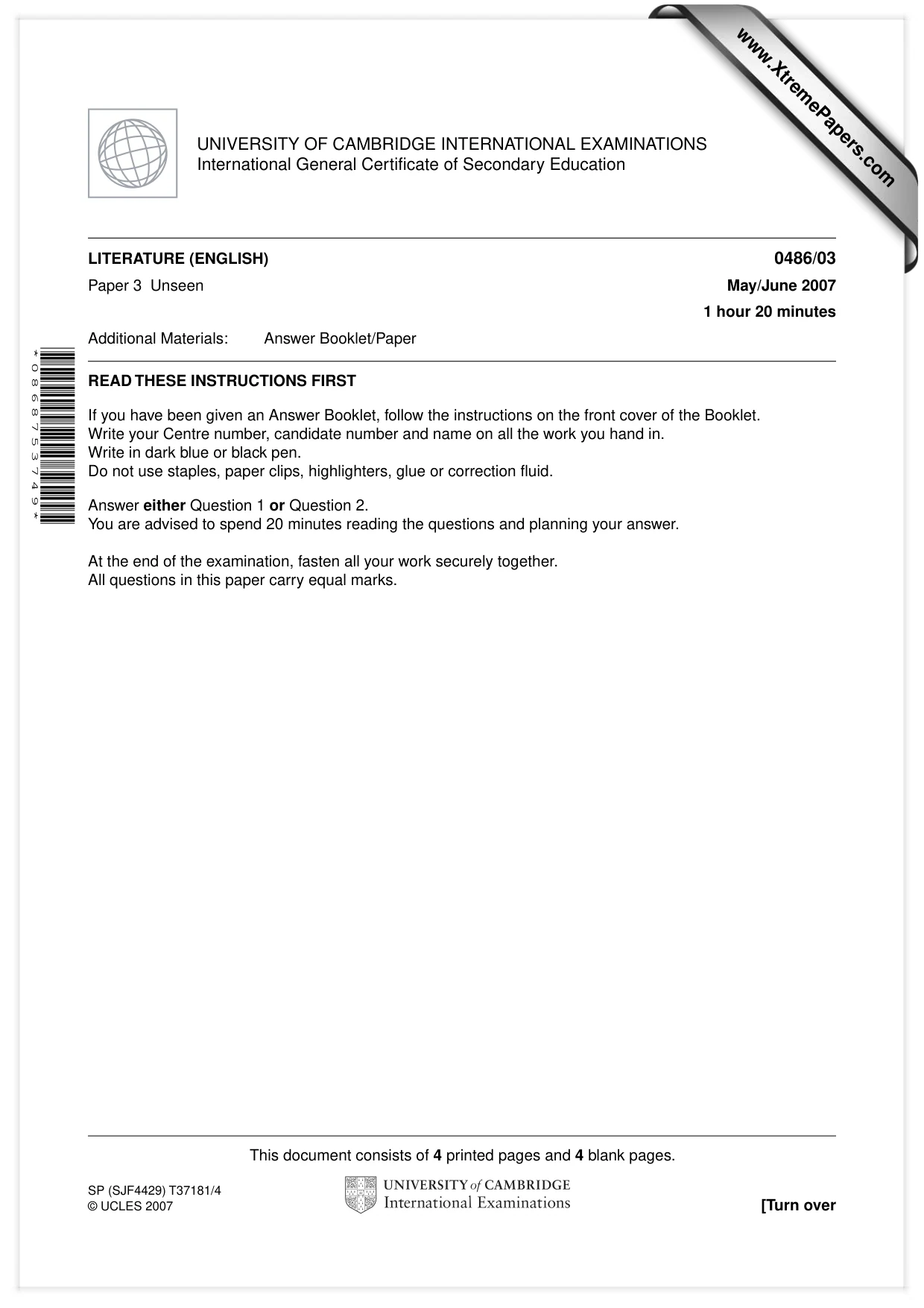
This document consists of 4 printed pages and 4 blank pages. SP (SJF4429) T37181/4 © UCLES 2007 [Turn over UNIVERSITY OF CAMBRIDGE INTERNATIONAL EXAMINATIONS International General Certificate of Secondary Education READ THESE INSTRUCTIONS FIRST If you have been given an Answer Booklet, follow the instructions on the front cover of the Booklet. Write your Centre number, candidate number and name on all the work you hand in. Write in dark blue or black pen. Do not use staples, paper clips, highlighters, glue or correction fluid. Answer either Question 1 or Question 2. You are advised to spend 20 minutes reading the questions and planning your answer. At the end of the examination, fasten all your work securely together. All questions in this paper carry equal marks. * 0 8 6 8 7 5 3 7 4 9 * LITERATURE (ENGLISH) 0486/03 Paper 3 Unseen May/June 2007 1 hour 20 minutes Additional Materials: Answer Booklet/Paper www.XtremePapers.com
Question paper, page 3
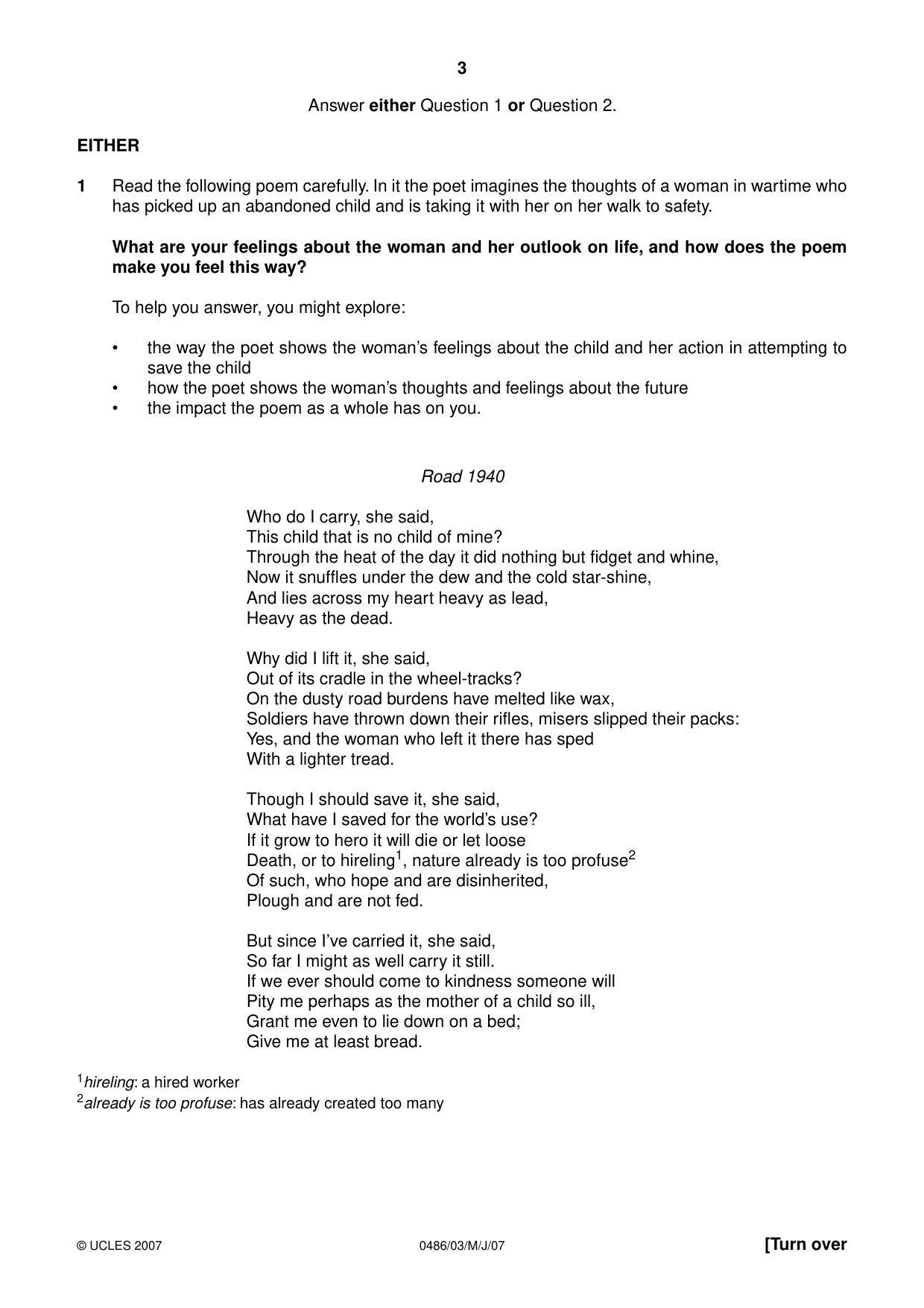
3 0486/03/M/J/07 © UCLES 2007 [Turn over Answer either Question 1 or Question 2. EITHER 1 Read the following poem carefully. In it the poet imagines the thoughts of a woman in wartime who has picked up an abandoned child and is taking it with her on her walk to safety. What are your feelings about the woman and her outlook on life, and how does the poem make you feel this way? To help you answer, you might explore: • the way the poet shows the woman’s feelings about the child and her action in attempting to save the child • how the poet shows the woman’s thoughts and feelings about the future • the impact the poem as a whole has on you. Road 1940 Who do I carry, she said, This child that is no child of mine? Through the heat of the day it did nothing but fidget and whine, Now it snuffles under the dew and the cold star-shine, And lies across my heart heavy as lead, Heavy as the dead. Why did I lift it, she said, Out of its cradle in the wheel-tracks? On the dusty road burdens have melted like wax, Soldiers have thrown down their rifles, misers slipped their packs: Yes, and the woman who left it there has sped With a lighter tread. Though I should save it, she said, What have I saved for the world’s use? If it grow to hero it will die or let loose Death, or to hireling1, nature already is too profuse2 Of such, who hope and are disinherited, Plough and are not fed. But since I’ve carried it, she said, So far I might as well carry it still. If we ever should come to kindness someone will Pity me perhaps as the mother of a child so ill, Grant me even to lie down on a bed; Give me at least bread. 1hireling: a hired worker 2already is too profuse: has already created too many
Question paper, page 4
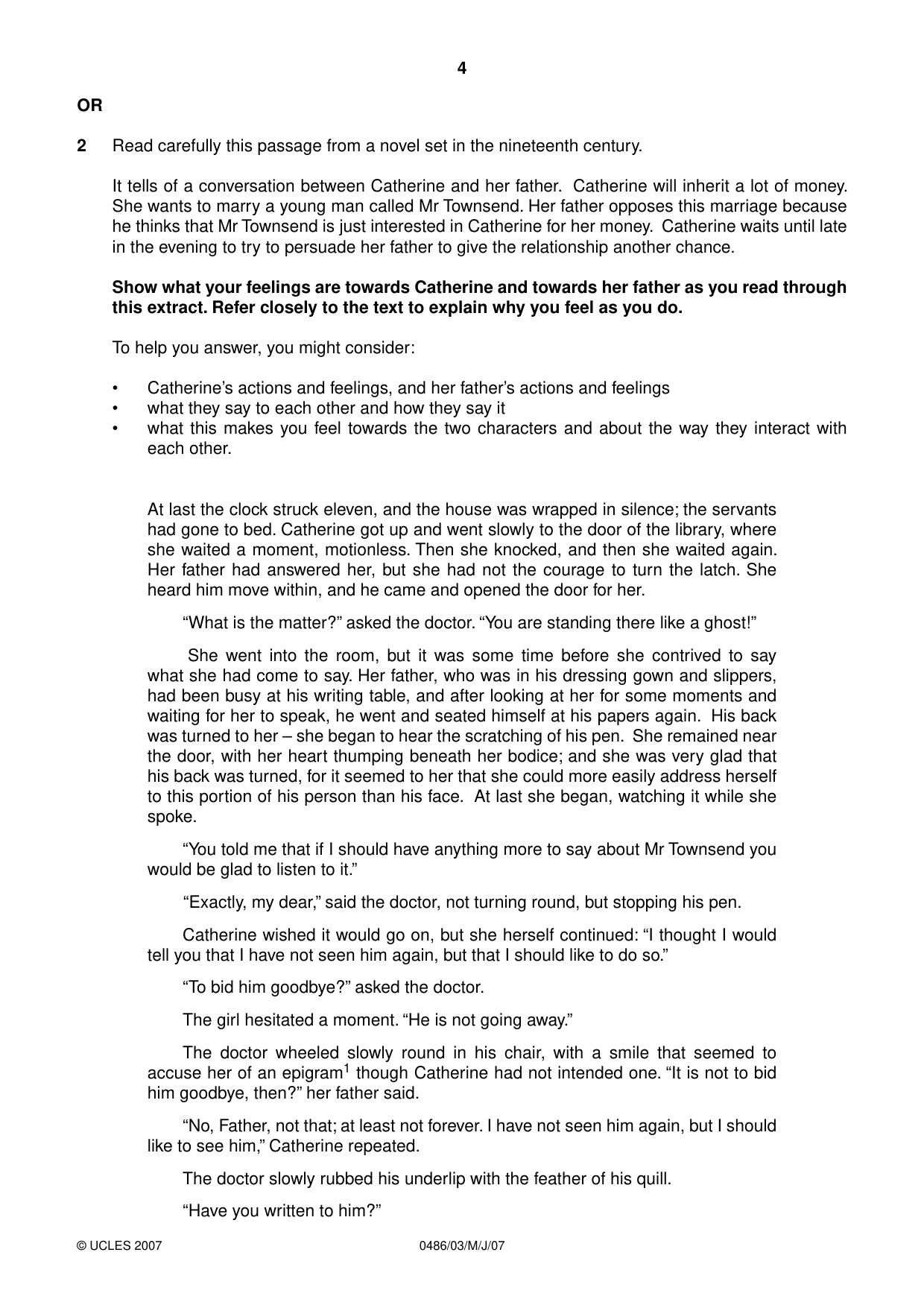
4 0486/03/M/J/07 © UCLES 2007 OR 2 Read carefully this passage from a novel set in the nineteenth century. It tells of a conversation between Catherine and her father. Catherine will inherit a lot of money. She wants to marry a young man called Mr Townsend. Her father opposes this marriage because he thinks that Mr Townsend is just interested in Catherine for her money. Catherine waits until late in the evening to try to persuade her father to give the relationship another chance. Show what your feelings are towards Catherine and towards her father as you read through this extract. Refer closely to the text to explain why you feel as you do. To help you answer, you might consider: • Catherine’s actions and feelings, and her father’s actions and feelings • what they say to each other and how they say it • what this makes you feel towards the two characters and about the way they interact with each other. At last the clock struck eleven, and the house was wrapped in silence; the servants had gone to bed. Catherine got up and went slowly to the door of the library, where she waited a moment, motionless. Then she knocked, and then she waited again. Her father had answered her, but she had not the courage to turn the latch. She heard him move within, and he came and opened the door for her. “What is the matter?” asked the doctor. “You are standing there like a ghost!” She went into the room, but it was some time before she contrived to say what she had come to say. Her father, who was in his dressing gown and slippers, had been busy at his writing table, and after looking at her for some moments and waiting for her to speak, he went and seated himself at his papers again. His back was turned to her – she began to hear the scratching of his pen. She remained near the door, with her heart thumping beneath her bodice; and she was very glad that his back was turned, for it seemed to her that she could more easily address herself to this portion of his person than his face. At last she began, watching it while she spoke. “You told me that if I should have anything more to say about Mr Townsend you would be glad to listen to it.” “Exactly, my dear,” said the doctor, not turning round, but stopping his pen. Catherine wished it would go on, but she herself continued: “I thought I would tell you that I have not seen him again, but that I should like to do so.” “To bid him goodbye?” asked the doctor. The girl hesitated a moment. “He is not going away.” The doctor wheeled slowly round in his chair, with a smile that seemed to accuse her of an epigram1 though Catherine had not intended one. “It is not to bid him goodbye, then?” her father said. “No, Father, not that; at least not forever. I have not seen him again, but I should like to see him,” Catherine repeated. The doctor slowly rubbed his underlip with the feather of his quill. “Have you written to him?”
Question paper, page 5
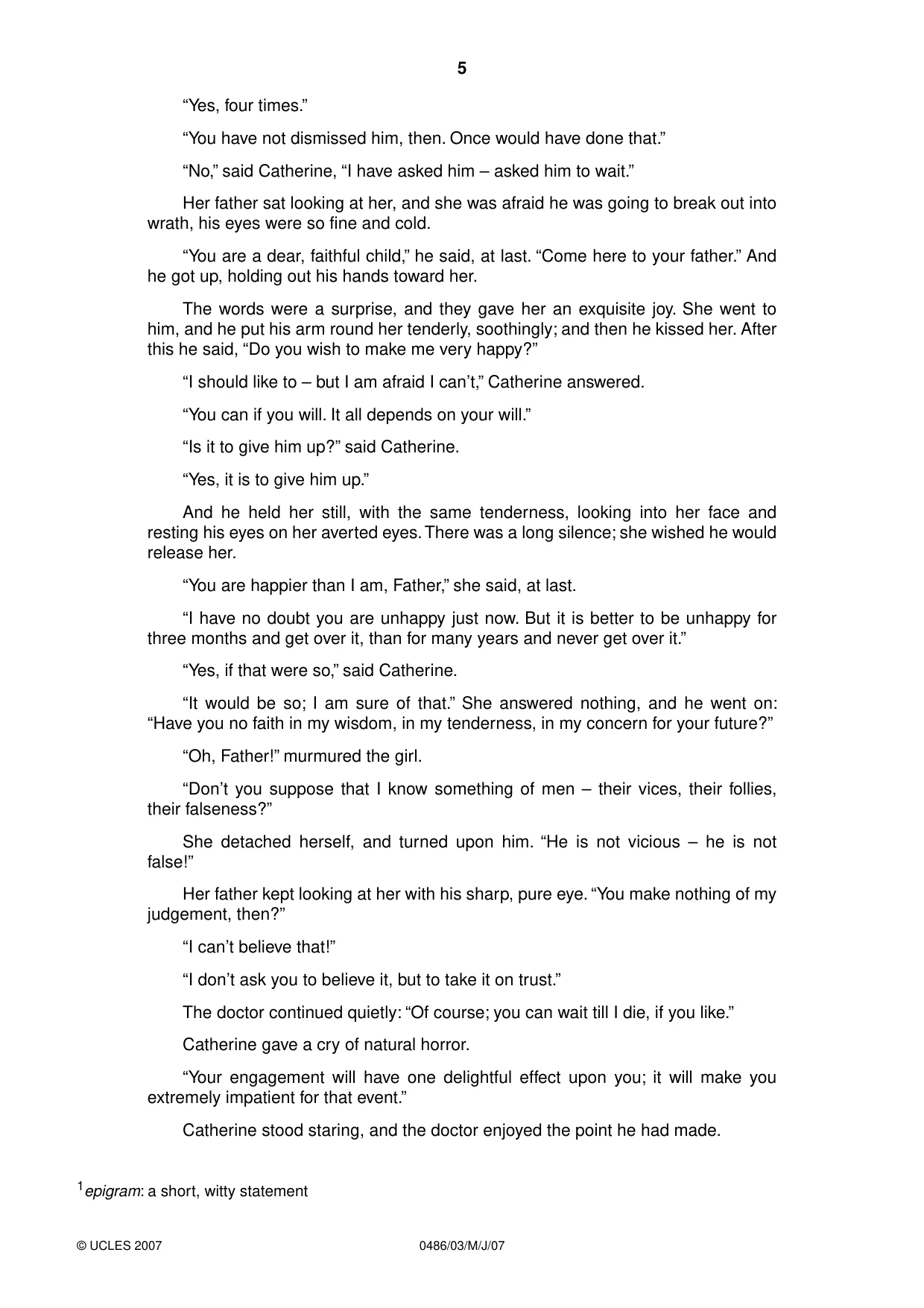
5 0486/03/M/J/07 © UCLES 2007 “Yes, four times.” “You have not dismissed him, then. Once would have done that.” “No,” said Catherine, “I have asked him – asked him to wait.” Her father sat looking at her, and she was afraid he was going to break out into wrath, his eyes were so fine and cold. “You are a dear, faithful child,” he said, at last. “Come here to your father.” And he got up, holding out his hands toward her. The words were a surprise, and they gave her an exquisite joy. She went to him, and he put his arm round her tenderly, soothingly; and then he kissed her. After this he said, “Do you wish to make me very happy?” “I should like to – but I am afraid I can’t,” Catherine answered. “You can if you will. It all depends on your will.” “Is it to give him up?” said Catherine. “Yes, it is to give him up.” And he held her still, with the same tenderness, looking into her face and resting his eyes on her averted eyes. There was a long silence; she wished he would release her. “You are happier than I am, Father,” she said, at last. “I have no doubt you are unhappy just now. But it is better to be unhappy for three months and get over it, than for many years and never get over it.” “Yes, if that were so,” said Catherine. “It would be so; I am sure of that.” She answered nothing, and he went on: “Have you no faith in my wisdom, in my tenderness, in my concern for your future?” “Oh, Father!” murmured the girl. “Don’t you suppose that I know something of men – their vices, their follies, their falseness?” She detached herself, and turned upon him. “He is not vicious – he is not false!” Her father kept looking at her with his sharp, pure eye. “You make nothing of my judgement, then?” “I can’t believe that!” “I don’t ask you to believe it, but to take it on trust.” The doctor continued quietly: “Of course; you can wait till I die, if you like.” Catherine gave a cry of natural horror. “Your engagement will have one delightful effect upon you; it will make you extremely impatient for that event.” Catherine stood staring, and the doctor enjoyed the point he had made. 1epigram: a short, witty statement
Question paper, page 8
8 Copyright Acknowledgements: Question 1 © Sylvia Townsend Warner. Permission to reproduce items where third-party owned material protected by copyright is included has been sought and cleared where possible. Every reasonable effort has been made by the publisher (UCLES) to trace copyright holders, but if any items requiring clearance have unwittingly been included, the publisher will be pleased to make amends at the earliest possible opportunity. University of Cambridge International Examinations is part of the Cambridge Assessment Group. Cambridge Assessment is the brand name of University of Cambridge Local Examinations Syndicate (UCLES), which is itself a department of the University of Cambridge. BLANK PAGE 0486/03/M/J/07
Mark scheme, page 1
UNIVERSITY OF CAMBRIDGE INTERNATIONAL EXAMINATIONS International General Certificate of Secondary Education MARK SCHEME for the May/June 2007 question paper 0486 LITERATURE (ENGLISH) 0486/03 Paper 3 (Alternative to Coursework), maximum raw mark 20 This mark scheme is published as an aid to teachers and candidates, to indicate the requirements of the examination. It shows the basis on which Examiners were instructed to award marks. It does not indicate the details of the discussions that took place at an Examiners’ meeting before marking began. All Examiners are instructed that alternative correct answers and unexpected approaches in candidates’ scripts must be given marks that fairly reflect the relevant knowledge and skills demonstrated. Mark schemes must be read in conjunction with the question papers and the report on the examination. • CIE will not enter into discussions or correspondence in connection with these mark schemes. CIE is publishing the mark schemes for the May/June 2007 question papers for most IGCSE, GCE Advanced Level and Advanced Subsidiary Level syllabuses and some Ordinary Level syllabuses. www.XtremePapers.com
Mark scheme, page 2
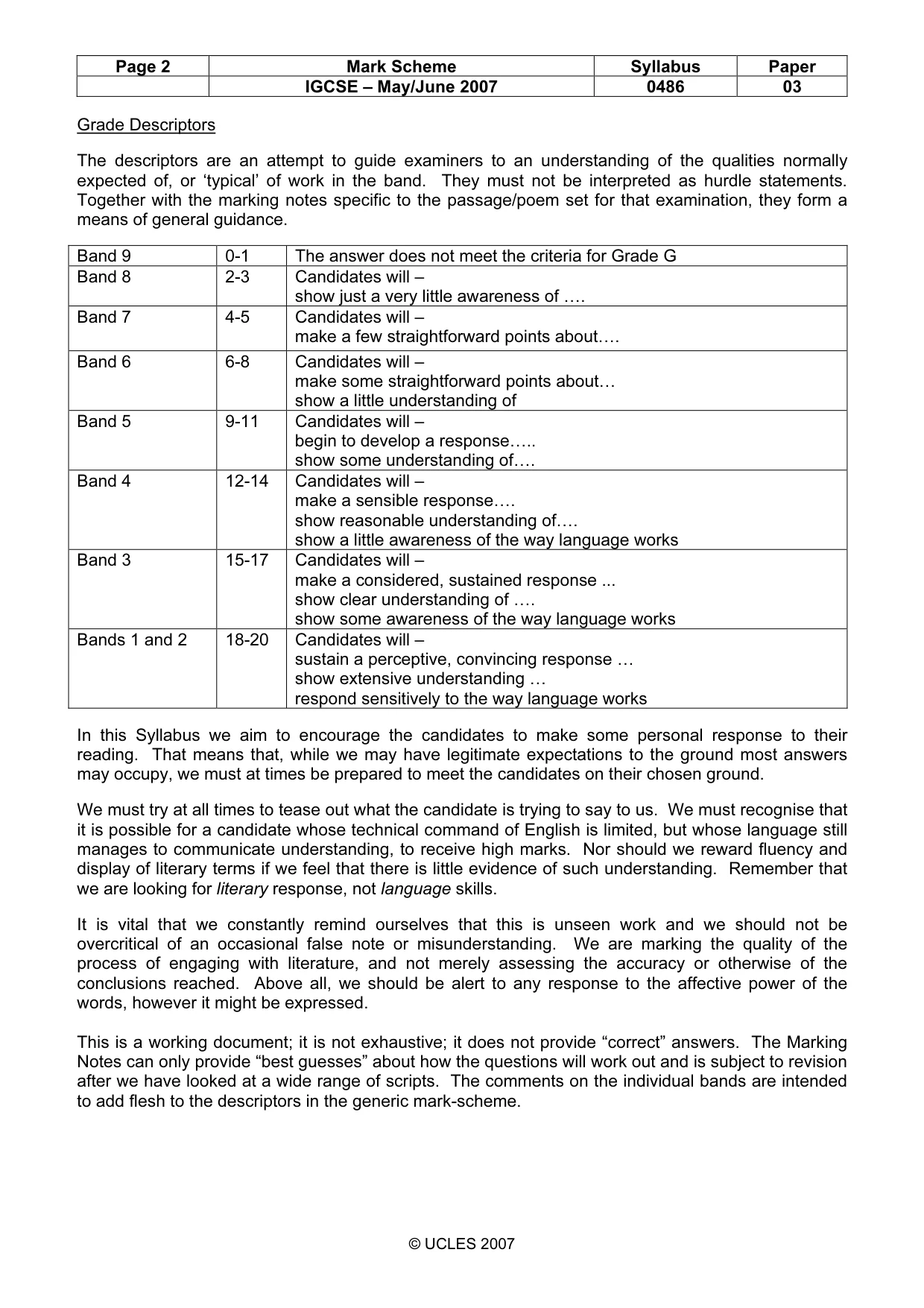
Page 2 Mark Scheme Syllabus Paper IGCSE – May/June 2007 0486 03 © UCLES 2007 Grade Descriptors The descriptors are an attempt to guide examiners to an understanding of the qualities normally expected of, or ‘typical’ of work in the band. They must not be interpreted as hurdle statements. Together with the marking notes specific to the passage/poem set for that examination, they form a means of general guidance. In this Syllabus we aim to encourage the candidates to make some personal response to their reading. That means that, while we may have legitimate expectations to the ground most answers may occupy, we must at times be prepared to meet the candidates on their chosen ground. We must try at all times to tease out what the candidate is trying to say to us. We must recognise that it is possible for a candidate whose technical command of English is limited, but whose language still manages to communicate understanding, to receive high marks. Nor should we reward fluency and display of literary terms if we feel that there is little evidence of such understanding. Remember that we are looking for literary response, not language skills. It is vital that we constantly remind ourselves that this is unseen work and we should not be overcritical of an occasional false note or misunderstanding. We are marking the quality of the process of engaging with literature, and not merely assessing the accuracy or otherwise of the conclusions reached. Above all, we should be alert to any response to the affective power of the words, however it might be expressed. This is a working document; it is not exhaustive; it does not provide “correct” answers. The Marking Notes can only provide “best guesses” about how the questions will work out and is subject to revision after we have looked at a wide range of scripts. The comments on the individual bands are intended to add flesh to the descriptors in the generic mark-scheme. Band 9 0-1 The answer does not meet the criteria for Grade G Band 8 2-3 Candidates will – show just a very little awareness of …. Band 7 4-5 Candidates will – make a few straightforward points about…. Band 6 6-8 Candidates will – make some straightforward points about… show a little understanding of Band 5 9-11 Candidates will – begin to develop a response….. show some understanding of…. Band 4 12-14 Candidates will – make a sensible response…. show reasonable understanding of…. show a little awareness of the way language works Band 3 15-17 Candidates will – make a considered, sustained response ... show clear understanding of …. show some awareness of the way language works Bands 1 and 2 18-20 Candidates will – sustain a perceptive, convincing response … show extensive understanding … respond sensitively to the way language works
Mark scheme, page 3
Page 3 Mark Scheme Syllabus Paper IGCSE – May/June 2007 0486 03 © UCLES 2007 Question 1 A careless response to the introduction to the poem might lead the unwary to thinking of her as a heroine saving children, but more thorough scrutiny of the words of the poem should soon lead the candidate to a more complex line of enquiry. The first three stanzas each start with a question – not rhetorical – they are genuine and searching enough – and the questions are followed by world-weary responses which are quite chilling if one is convinced by them, though some candidates might not be entirely so. The short final lines of each stanza are also very powerful and we should reward candidates who perceive this either explicitly or implicitly. The task deliberately treats the refugee woman as quite separate from Sylvia Townsend Warner, though it is recognised that many of the attitudes, particularly in the third stanza, may indeed be hers. Marks 2–5 Answers here might make a few straightforward points about the basic situation in the poem and express some feelings about the woman, perhaps without having really understood some aspects of the poem. They may not have understood the stated reason for the woman taking the child and/or their answers might be extremely brief and undeveloped. Marks 6–8 Answers will show a very elementary understanding of the woman’s feelings, making a few straightforward points to show an appreciation of the burden the child represents to her. They may perceive that she questions why she has taken on this burden. In this range, there will generally be a lack of engagement with the writing. Candidates might give a general personal response to the situation which does not quite fit the words of the poem. Alternatively, candidates in this area might use the words of the poem too much, without any accompanying commentary to answer the question more directly. Marks 9–11 There will be signs that the candidate has developed her/his personal response to the plight of the woman and her thoughts and feelings. There should be evidence of some contact with the writing but this need not be explicitly developed. For example, there should be some indication that the woman is not particularly sympathetic to the baby, with perhaps a simple quotation to support this, but there will probably not be a further note to show how the words made them reach their conclusion. We should expect either reasonable coverage of the first bullet point or less secure coverage of the first two points. Marks 12–14 The basic understanding of the poem should be secure, though understanding of the third stanza particularly might well be flawed. There should be a rudimentary response to the way the poet has used words, perhaps responding to the rhyming similes in the first stanza, the use of questions, the monosyllabic power of the last lines of the last two stanzas etc. We should not expect a very developed response to the writing in this mark range, just sufficient to show some awareness of the writer at work.
Mark scheme, page 4
Page 4 Mark Scheme Syllabus Paper IGCSE – May/June 2007 0486 03 © UCLES 2007 Marks 15–17 There should be a reasonably developed response to the various strands of the poem suggested by the bullet points. This might include a response to: the instinct for self- preservation which leads people to give up those items which are most precious to them, including the mother her baby, the soldier his rifle and the miser his material possessions. They might note that ultimately she says that she takes the child for exactly the same reason, to enhance her prospect of self-preservation. There may be the beginnings of an argument that, while the woman speaks disparagingly about the child, her actions belie her words. The essay might also include an awareness of her distrust of the world’s values – if the boy were to survive, what future would he enjoy? Will he create more bloodshed, or be slaughtered at a later date? Or be one of the working masses whose labour is imperfectly rewarded? These are more complex ideas and we should not be expecting a very clear analysis of them in this mark range, more a recognition that they exist. Comments on language in this mark range will normally be more developed. Marks 18–20 In this mark range we should expect to find a more confident understanding of the ideas above and a response to the power of the verse. Candidates should relate the various strands of the poem, seeing how the woman’s experience of the world has made her hard, cynical and weary. Perhaps also, they will be able to see the force, in the last few lines, of the word, “kindness”, the first word in the poem to contain any ray of hope whatsoever, the force of “even”, as though this would be an unexpected luxury, and the devastating force of the last line of the poem with the phrase, “at least bread” to emphasise the reduction of her aspirations – to the most basic requirement for existence. At the very highest level, we may hope for a recognition of how the structure of the poem emphasises the poignancy of the devastating consequences of War for the innocent. Question 2 The parts of the question may perhaps best be treated together and should certainly be marked as a unit. The question might seem to encourage a chronological approach – even a narrative approach – so we must be ready to distinguish between narratives which are firmly focused on the question and those which are unpointed or purely “factual”. Further guidance on these difficult distinctions is to be found under the grade descriptions. It is expected that most candidates will feel sympathy for Catherine and some degree of abhorrence for the way her father treats her. Differentiation will probably derive from how searchingly the candidate pursues this basic response, perhaps seeing some element of “tough” love underpinning the father’s reaction and/or a naivety in Catherine’s personality which might justify his actions, or perhaps analysing closely the manipulative words which the father employs to ensure his will prevails. The question is very open and our assessment must, as always, be based not on what the candidates’ judgement is but on the literary appreciation which leads them to form their view. Clearly, they must select detail to support their views and this selection must be justified according to their thesis, but good answers are likely to include a developed discussion of: • Catherine’s and her father’s behaviour on her entry into the room • the confused signals he gives out when he takes her in his arms and kisses her • the emotional blackmail he knows will work on her on the second page.
Mark scheme, page 5
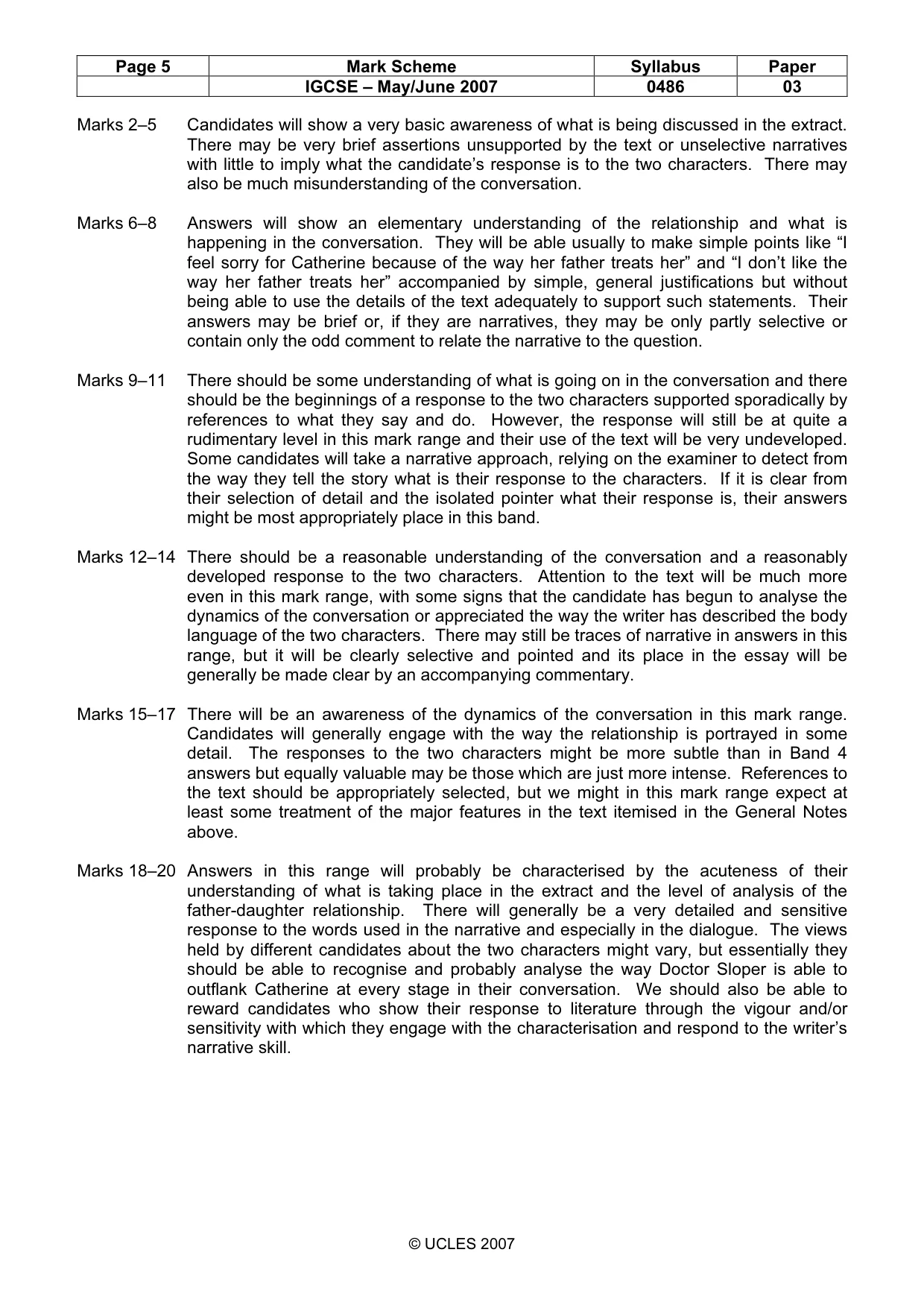
Page 5 Mark Scheme Syllabus Paper IGCSE – May/June 2007 0486 03 © UCLES 2007 Marks 2–5 Candidates will show a very basic awareness of what is being discussed in the extract. There may be very brief assertions unsupported by the text or unselective narratives with little to imply what the candidate’s response is to the two characters. There may also be much misunderstanding of the conversation. Marks 6–8 Answers will show an elementary understanding of the relationship and what is happening in the conversation. They will be able usually to make simple points like “I feel sorry for Catherine because of the way her father treats her” and “I don’t like the way her father treats her” accompanied by simple, general justifications but without being able to use the details of the text adequately to support such statements. Their answers may be brief or, if they are narratives, they may be only partly selective or contain only the odd comment to relate the narrative to the question. Marks 9–11 There should be some understanding of what is going on in the conversation and there should be the beginnings of a response to the two characters supported sporadically by references to what they say and do. However, the response will still be at quite a rudimentary level in this mark range and their use of the text will be very undeveloped. Some candidates will take a narrative approach, relying on the examiner to detect from the way they tell the story what is their response to the characters. If it is clear from their selection of detail and the isolated pointer what their response is, their answers might be most appropriately place in this band. Marks 12–14 There should be a reasonable understanding of the conversation and a reasonably developed response to the two characters. Attention to the text will be much more even in this mark range, with some signs that the candidate has begun to analyse the dynamics of the conversation or appreciated the way the writer has described the body language of the two characters. There may still be traces of narrative in answers in this range, but it will be clearly selective and pointed and its place in the essay will be generally be made clear by an accompanying commentary. Marks 15–17 There will be an awareness of the dynamics of the conversation in this mark range. Candidates will generally engage with the way the relationship is portrayed in some detail. The responses to the two characters might be more subtle than in Band 4 answers but equally valuable may be those which are just more intense. References to the text should be appropriately selected, but we might in this mark range expect at least some treatment of the major features in the text itemised in the General Notes above. Marks 18–20 Answers in this range will probably be characterised by the acuteness of their understanding of what is taking place in the extract and the level of analysis of the father-daughter relationship. There will generally be a very detailed and sensitive response to the words used in the narrative and especially in the dialogue. The views held by different candidates about the two characters might vary, but essentially they should be able to recognise and probably analyse the way Doctor Sloper is able to outflank Catherine at every stage in their conversation. We should also be able to reward candidates who show their response to literature through the vigour and/or sensitivity with which they engage with the characterisation and respond to the writer’s narrative skill.
What you needed in this session
Cambridge’s own grade thresholds for 2007 May/June, Paper 3 · Variant 1. A higher threshold means an easier paper — the bar moves with how the cohort did.