Cambridge IGCSE English - Literature 0486 — 2006 May/June Paper 3 · Variant 1
0486/31/M/J/06 · 20 marks · ≈23 min
The question paper and its mark scheme, free to read here and free to download. This is Cambridge’s own paper, exactly as it was sat.
Question paper4 pages

Mark scheme5 pages
Answers below. Sit the paper first if you are practising.
Paper as text
Question paper, page 1
This document consists of 3 printed pages and 1 blank page. SP (SJF4031) T03756/3 © UCLES 2006 [Turn over UNIVERSITY OF CAMBRIDGE INTERNATIONAL EXAMINATIONS International General Certificate of Secondary Education LITERATURE (ENGLISH) 0486/03 Paper 3 Alternative to Coursework (Unseen) May/June 2006 1 hour Additional Materials: Answer Booklet/Paper READ THESE INSTRUCTIONS FIRST If you have been given an Answer Booklet, follow the instructions on the front cover of the Booklet. Write your Centre number, candidate number and name on all the work you hand in. Write in dark blue or black pen. Do not use staples, paper clips, highlighters, glue or correction fluid. Answer the question. At the end of the examination, fasten all your work securely together. www.XtremePapers.com
Question paper, page 2
2 0486/03/M/J/06 © UCLES 2006 In this story, Conrad has left his car near the ‘red zone’ – a no-parking area – of the city in which he works. He comes back to find that some people are enjoying watching it being towed away. Read the passage below carefully and then explore how the writing makes you feel sympathy for Conrad and how it is amusing at the same time. You should include in your answer a response to: • Conrad’s situation • the characters and the words they use • the way the incident is narrated. It occurred to Conrad, with a start, that whatever was going on, it was in the red zone in front of where he had parked the Hyundai. The gawkers1 blocked his view. He hurried forward and joined them. He found himself staring at the broad beam2 of a giant in a cowboy hat, who was leaning over, attaching a tow chain to a car that had both front wheels up on the curb, right in the middle of the red zone, barely a foot from the fire hydrant – – and in that instant Conrad realised it was his car, his little Hyundai Excel. In the middle of the red zone! Up on the curb! Impossible! – and yet there it was. There was a ticket under the windshield wiper. Standing on the sidewalk, right beside the car, following the tow truck operator’s progress, was a meter maid,3 easily identifiable by her uniform, a short-sleeved powder-blue shirt and navy-blue pants. She was probably in early middle age, so stout that the flesh of her upper arms stretched the hems of her sleeves. She held a walkie-talkie radio up to her mouth. She had a terrific set of Chinese-red press-on nails on her fingers. Conrad approached from the side. He was scarcely eighteen inches from her, but she didn’t give him so much as a flicker of an eye. “Excuse me!” he said. No response. Much louder: “Excuse me!” The walkie-talkie still at her ear, she cut him a glance that said Don’t bother me. “Miss!” said Conrad. She gave him a withering look and said, “Can’t you see I’m transmitting?” The terribly official-sounding word, transmitting, brought him up short, and he turned toward the tow truck driver. By now the big man had secured the tow chain beneath the Hyundai and was standing up, and you could see just how enormous he really was. He was a mountain of flesh with the sun-beaten, lard-grilled look of a roustabout,4 clear down to the immense ring of keys hanging from a belt loop beneath the bulge of his belly on one side of his jeans and the cluster of novelty key fobs on the other: a tiny wrench, a disposable butane lighter, a pair of dice, a plastic figurine of Mickey Mouse and Minnie Mouse doing the tango, a miniature duelling pistol, and a little silvery skull with fangs instead of eyeteeth. Conrad jumped between the fire hydrant and the fender of the Hyundai and over the tow chain and rushed up to him. “Hey! – sir! – this is my car! Whattaya doing?” Scarcely looking at him, not even pausing, the giant said, “Towin’ it outta the red zone.”
Question paper, page 3
3 0486/03/M/J/06 He said it in a bored way that made it clear he had said the same thing, or something very close to it, a thousand times before, to a thousand other frantic, befuddled, and above all, helpless automobile owners. He was now heading for the driver’s-side front door with the shaft of metal he had taken from the truck. It was a length of spring steel. Conrad recognised it immediately. It was a device known as a Slim Jim, used to slip through the window seals of locked cars to release the lock mechanisms from the inside. “Wait a minute! Please!” But the giant was already inserting the Slim Jim between the glass and the frame. “You’re gonna break the glass! I’ve got the keys right here! I can open the door!” “Nobody’s breakin’ any glass,” said the giant in the same bored voice, without looking at him. In no time he had sprung the lock, opened the door, and was reaching inside, doing something with the steering wheel. “Please!” said Conrad. “It’s my car! I’ve got the keys! I can move it!” The giant didn’t even look at him. Utterly nonplussed, Conrad swung back toward the sidewalk to appeal to the meter maid. She wasn’t looking at him, either. She was writing something in her summons book. By now the knot of gawkers had grown into a real crowd. They were revved up, ready for some action, eager for the beano,5 now that the hapless owner of the automobile had materialized and was acting suitably dismayed, frightened, anguished, and frustrated. This time Conrad yelled at the meter maid: “Hey! Miss! ” She looked up and he jumped back over the tow chain and went straight to her. “Please – you gotta tell me what’s going on! This is my car!” She began studying the summons pad and gestured towards the Hyundai without looking at Conrad. “Car’s in the red zone – and up on the sidewalk.” Conrad raised his hands in frustration. “But I didn’t park in the red zone! I swear! Look, miss, listen – I was all the way back there, on the other side of the line!” “Well, exactly the way it’s sittin’ right now, that’s exactly the way it was sittin’ when I called the dispatcher.” She said this in a reasonable enough tone, but it inspired a couple of unh-hunnnhs and heghhegggghhs among the gawkers, and she became aware she had an audience. So she added, “And I never seen a car drive itself into a red zone yet.” “Woooo-eeee,” said one of the gawkers and another said, “Ohhhh yeah,” all in the eternal spirit of ‘Let’s You and Him Fight’. 1 gawkers: people staring mindlessly 2 beam: bottom 3 meter maid: traffic warden 4 roustabout: a labourer 5 beano: entertainment, fun © UCLES 2006
Question paper, page 4
4 0486/03/M/J/06 BLANK PAGE Copyright Acknowledgements: Passage © From A Man in Full by Tom Wolfe, published by Jonathan Cape. Reprinted by permission of The Random House Group Ltd. Permission to reproduce items where third-party owned material protected by copyright is included has been sought and cleared where possible. Every reasonable effort has been made by the publisher (UCLES) to trace copyright holders, but if any items requiring clearance have unwittingly been included, the publisher will be pleased to make amends at the earliest possible opportunity. University of Cambridge International Examinations is part of the University of Cambridge Local Examinations Syndicate (UCLES), which is itself a department of the University of Cambridge.
Mark scheme, page 1
UNIVERSITY OF CAMBRIDGE INTERNATIONAL EXAMINATIONS International General Certificate of Secondary Education MARK SCHEME for the May/June 2006 question paper 0486 LITERATURE (ENGLISH) 0486/03 Paper 3, Maximum raw mark 20 These mark schemes are published as an aid to teachers and students, to indicate the requirements of the examination. They show the basis on which Examiners were initially instructed to award marks. They do not indicate the details of the discussions that took place at an Examiners’ meeting before marking began. Any substantial changes to the mark scheme that arose from these discussions will be recorded in the published Report on the Examination. All Examiners are instructed that alternative correct answers and unexpected approaches in candidates’ scripts must be given marks that fairly reflect the relevant knowledge and skills demonstrated. Mark schemes must be read in conjunction with the question papers and the Report on the Examination. The minimum marks in these components needed for various grades were previously published with these mark schemes, but are now instead included in the Report on the Examination for this session. • CIE will not enter into discussion or correspondence in connection with these mark schemes. CIE is publishing the mark schemes for the May/June 2006 question papers for most IGCSE and GCE Advanced Level and Advanced Subsidiary Level syllabuses and some Ordinary Level syllabuses. www.XtremePapers.com
Mark scheme, page 2
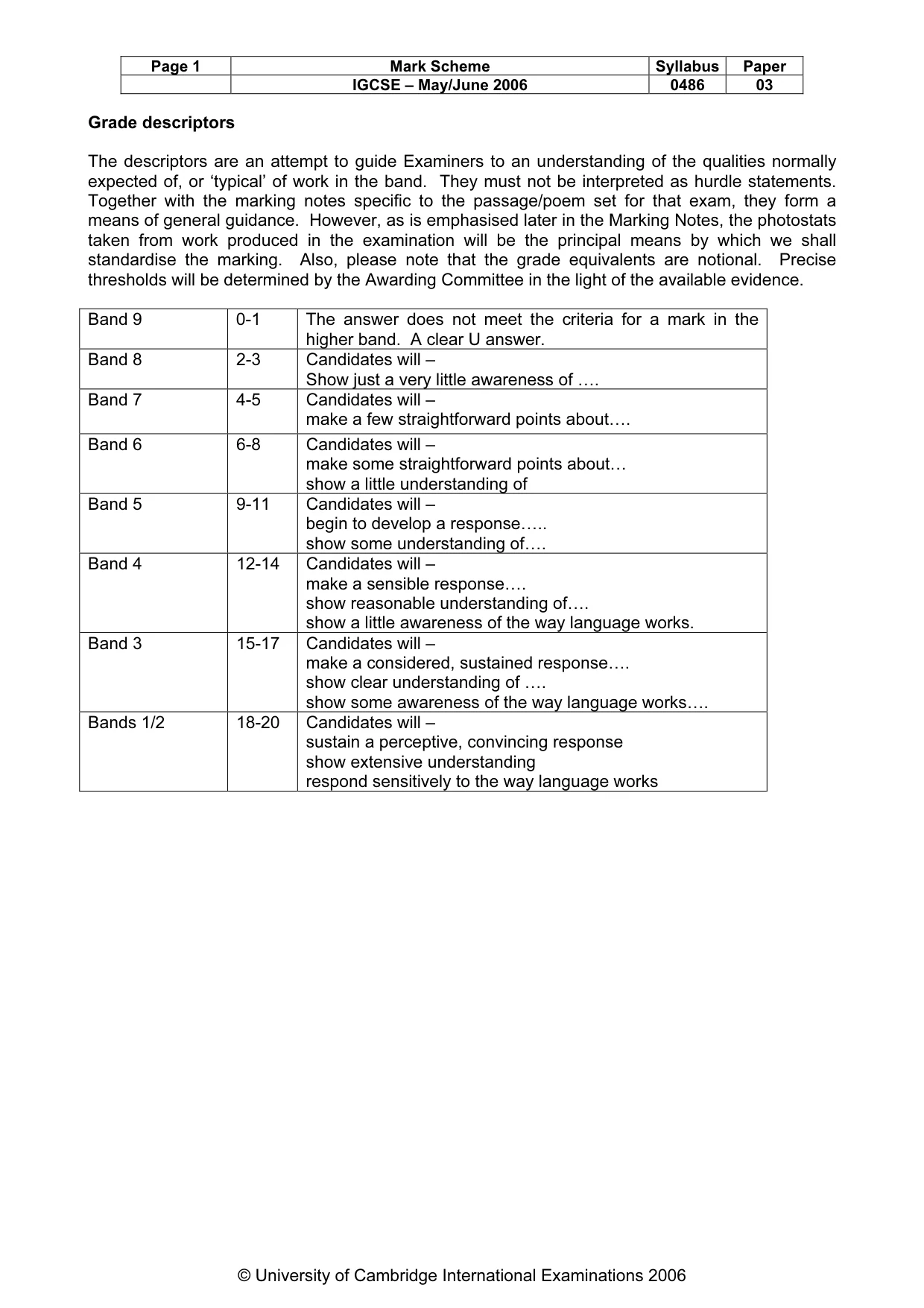
Page 1 Mark Scheme Syllabus Paper IGCSE – May/June 2006 0486 03 © University of Cambridge International Examinations 2006 Grade descriptors The descriptors are an attempt to guide Examiners to an understanding of the qualities normally expected of, or ‘typical’ of work in the band. They must not be interpreted as hurdle statements. Together with the marking notes specific to the passage/poem set for that exam, they form a means of general guidance. However, as is emphasised later in the Marking Notes, the photostats taken from work produced in the examination will be the principal means by which we shall standardise the marking. Also, please note that the grade equivalents are notional. Precise thresholds will be determined by the Awarding Committee in the light of the available evidence. Band 9 0-1 The answer does not meet the criteria for a mark in the higher band. A clear U answer. Band 8 2-3 Candidates will – Show just a very little awareness of …. Band 7 4-5 Candidates will – make a few straightforward points about…. Band 6 6-8 Candidates will – make some straightforward points about… show a little understanding of Band 5 9-11 Candidates will – begin to develop a response….. show some understanding of…. Band 4 12-14 Candidates will – make a sensible response…. show reasonable understanding of…. show a little awareness of the way language works. Band 3 15-17 Candidates will – make a considered, sustained response…. show clear understanding of …. show some awareness of the way language works…. Bands 1/2 18-20 Candidates will – sustain a perceptive, convincing response show extensive understanding respond sensitively to the way language works
Mark scheme, page 3
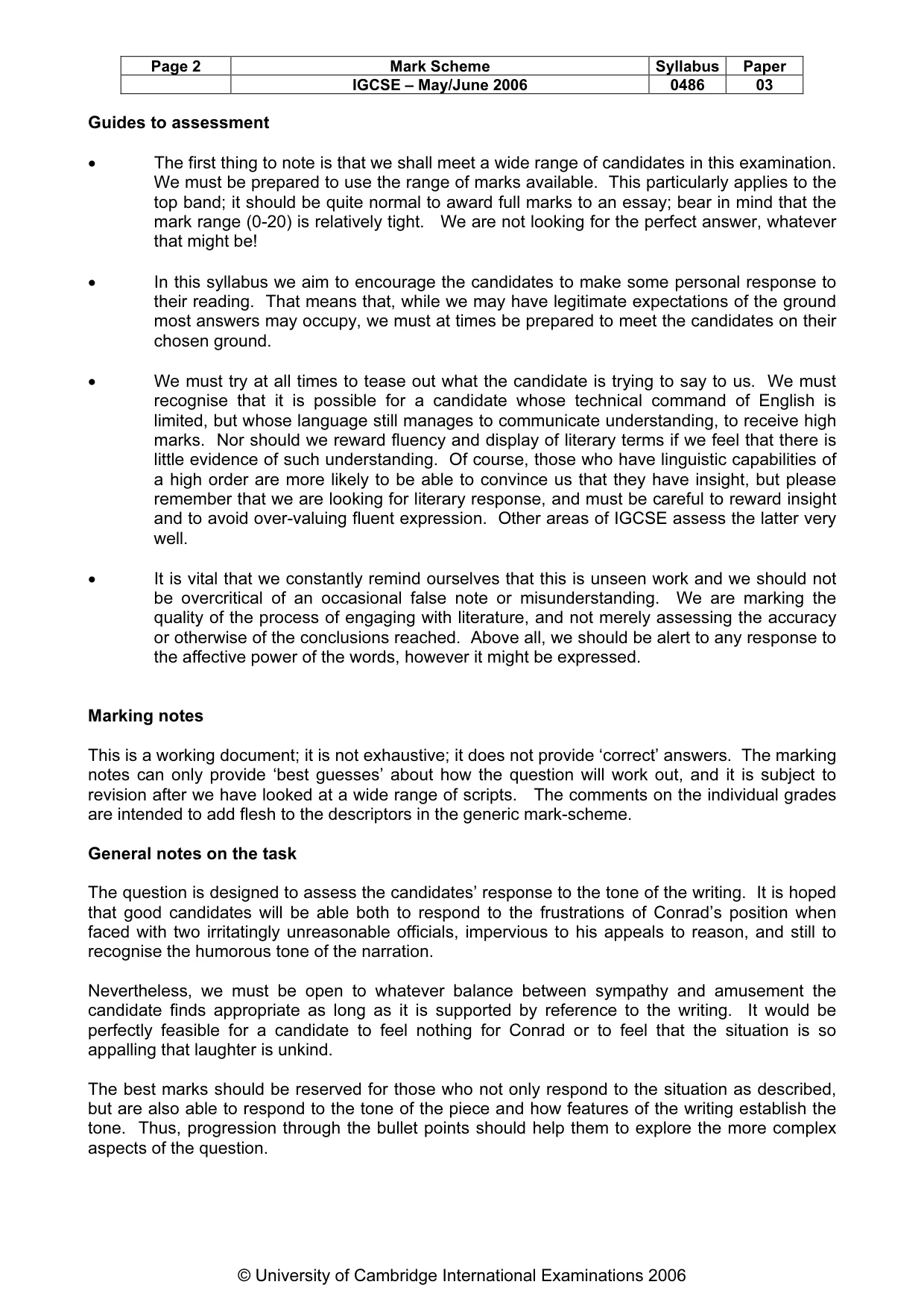
Page 2 Mark Scheme Syllabus Paper IGCSE – May/June 2006 0486 03 © University of Cambridge International Examinations 2006 Guides to assessment • The first thing to note is that we shall meet a wide range of candidates in this examination. We must be prepared to use the range of marks available. This particularly applies to the top band; it should be quite normal to award full marks to an essay; bear in mind that the mark range (0-20) is relatively tight. We are not looking for the perfect answer, whatever that might be! • In this syllabus we aim to encourage the candidates to make some personal response to their reading. That means that, while we may have legitimate expectations of the ground most answers may occupy, we must at times be prepared to meet the candidates on their chosen ground. • We must try at all times to tease out what the candidate is trying to say to us. We must recognise that it is possible for a candidate whose technical command of English is limited, but whose language still manages to communicate understanding, to receive high marks. Nor should we reward fluency and display of literary terms if we feel that there is little evidence of such understanding. Of course, those who have linguistic capabilities of a high order are more likely to be able to convince us that they have insight, but please remember that we are looking for literary response, and must be careful to reward insight and to avoid over-valuing fluent expression. Other areas of IGCSE assess the latter very well. • It is vital that we constantly remind ourselves that this is unseen work and we should not be overcritical of an occasional false note or misunderstanding. We are marking the quality of the process of engaging with literature, and not merely assessing the accuracy or otherwise of the conclusions reached. Above all, we should be alert to any response to the affective power of the words, however it might be expressed. Marking notes This is a working document; it is not exhaustive; it does not provide ‘correct’ answers. The marking notes can only provide ‘best guesses’ about how the question will work out, and it is subject to revision after we have looked at a wide range of scripts. The comments on the individual grades are intended to add flesh to the descriptors in the generic mark-scheme. General notes on the task The question is designed to assess the candidates’ response to the tone of the writing. It is hoped that good candidates will be able both to respond to the frustrations of Conrad’s position when faced with two irritatingly unreasonable officials, impervious to his appeals to reason, and still to recognise the humorous tone of the narration. Nevertheless, we must be open to whatever balance between sympathy and amusement the candidate finds appropriate as long as it is supported by reference to the writing. It would be perfectly feasible for a candidate to feel nothing for Conrad or to feel that the situation is so appalling that laughter is unkind. The best marks should be reserved for those who not only respond to the situation as described, but are also able to respond to the tone of the piece and how features of the writing establish the tone. Thus, progression through the bullet points should help them to explore the more complex aspects of the question.
Mark scheme, page 4
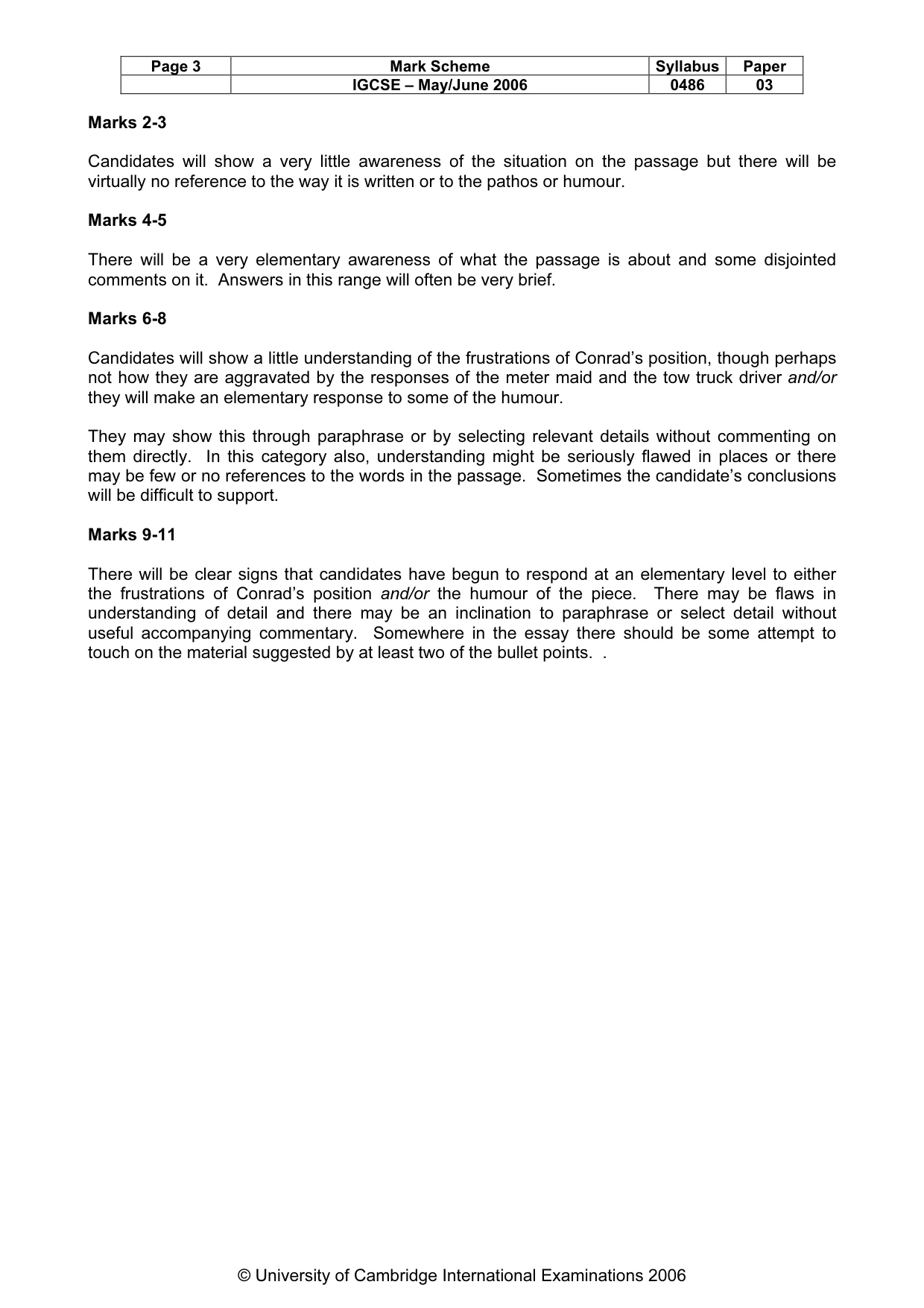
Page 3 Mark Scheme Syllabus Paper IGCSE – May/June 2006 0486 03 © University of Cambridge International Examinations 2006 Marks 2-3 Candidates will show a very little awareness of the situation on the passage but there will be virtually no reference to the way it is written or to the pathos or humour. Marks 4-5 There will be a very elementary awareness of what the passage is about and some disjointed comments on it. Answers in this range will often be very brief. Marks 6-8 Candidates will show a little understanding of the frustrations of Conrad’s position, though perhaps not how they are aggravated by the responses of the meter maid and the tow truck driver and/or they will make an elementary response to some of the humour. They may show this through paraphrase or by selecting relevant details without commenting on them directly. In this category also, understanding might be seriously flawed in places or there may be few or no references to the words in the passage. Sometimes the candidate’s conclusions will be difficult to support. Marks 9-11 There will be clear signs that candidates have begun to respond at an elementary level to either the frustrations of Conrad’s position and/or the humour of the piece. There may be flaws in understanding of detail and there may be an inclination to paraphrase or select detail without useful accompanying commentary. Somewhere in the essay there should be some attempt to touch on the material suggested by at least two of the bullet points. .
Mark scheme, page 5
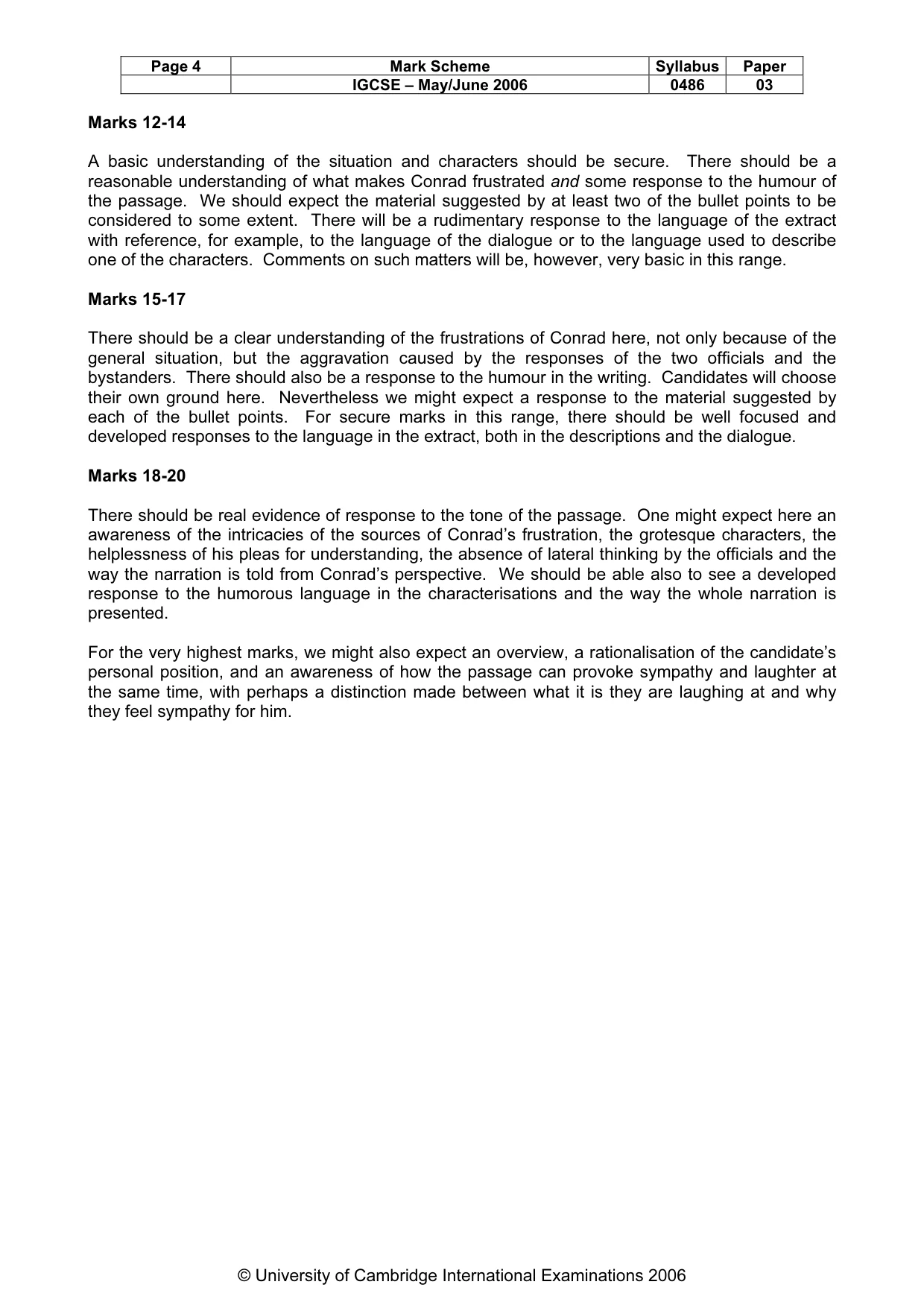
Page 4 Mark Scheme Syllabus Paper IGCSE – May/June 2006 0486 03 © University of Cambridge International Examinations 2006 Marks 12-14 A basic understanding of the situation and characters should be secure. There should be a reasonable understanding of what makes Conrad frustrated and some response to the humour of the passage. We should expect the material suggested by at least two of the bullet points to be considered to some extent. There will be a rudimentary response to the language of the extract with reference, for example, to the language of the dialogue or to the language used to describe one of the characters. Comments on such matters will be, however, very basic in this range. Marks 15-17 There should be a clear understanding of the frustrations of Conrad here, not only because of the general situation, but the aggravation caused by the responses of the two officials and the bystanders. There should also be a response to the humour in the writing. Candidates will choose their own ground here. Nevertheless we might expect a response to the material suggested by each of the bullet points. For secure marks in this range, there should be well focused and developed responses to the language in the extract, both in the descriptions and the dialogue. Marks 18-20 There should be real evidence of response to the tone of the passage. One might expect here an awareness of the intricacies of the sources of Conrad’s frustration, the grotesque characters, the helplessness of his pleas for understanding, the absence of lateral thinking by the officials and the way the narration is told from Conrad’s perspective. We should be able also to see a developed response to the humorous language in the characterisations and the way the whole narration is presented. For the very highest marks, we might also expect an overview, a rationalisation of the candidate’s personal position, and an awareness of how the passage can provoke sympathy and laughter at the same time, with perhaps a distinction made between what it is they are laughing at and why they feel sympathy for him.
What you needed in this session
Cambridge’s own grade thresholds for 2006 May/June, Paper 3 · Variant 1. A higher threshold means an easier paper — the bar moves with how the cohort did.