Cambridge IGCSE English - Literature 0486 — 2005 Oct/Nov Paper 3 · Variant 1
0486/31/O/N/05
The question paper and its mark scheme, free to read here and free to download. This is Cambridge’s own paper, exactly as it was sat.
Question paper4 pages
Mark scheme4 pages
Answers below. Sit the paper first if you are practising.
Paper as text
Question paper, page 1
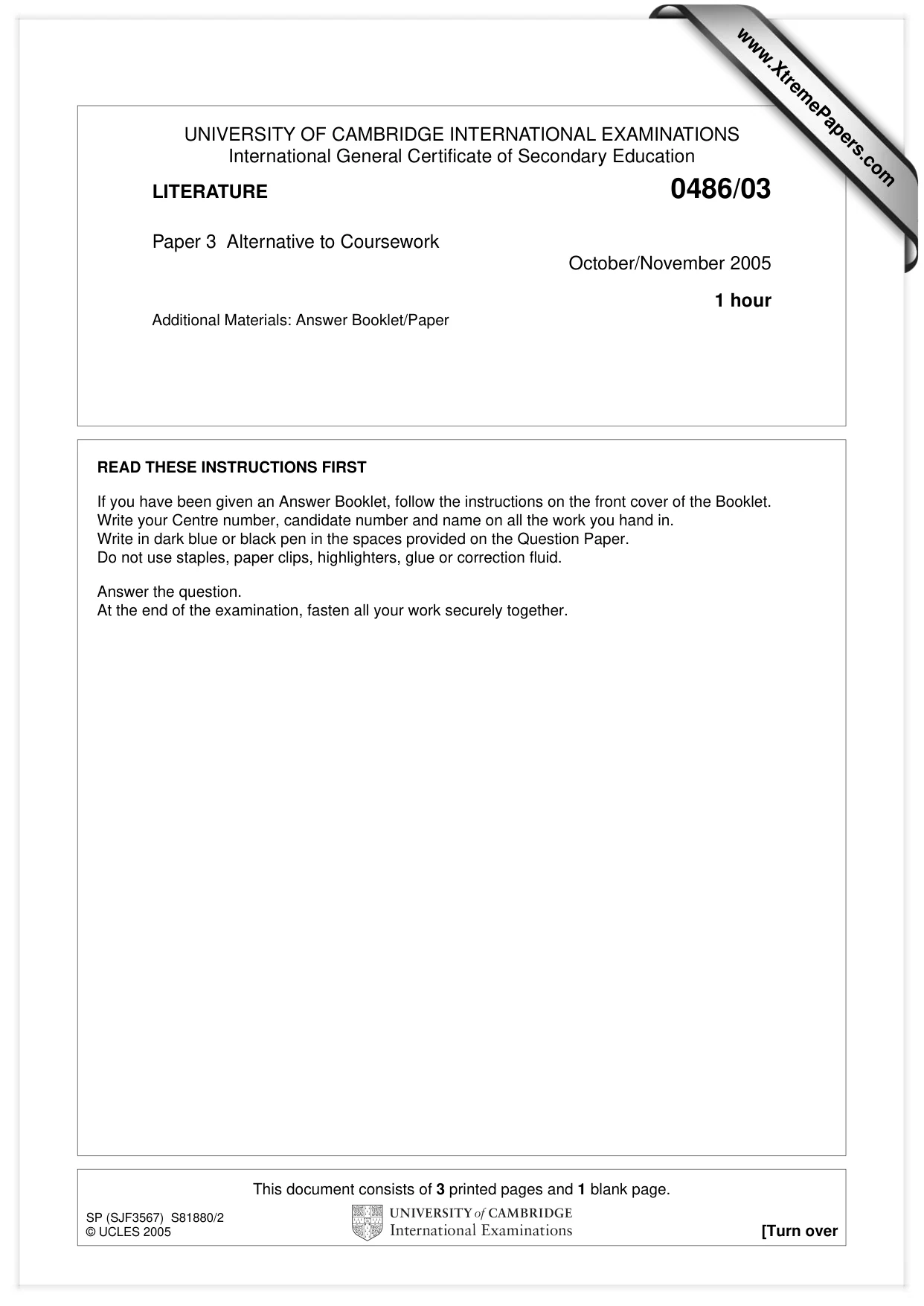
This document consists of 3 printed pages and 1 blank page. SP (SJF3567) S81880/2 © UCLES 2005 [Turn over UNIVERSITY OF CAMBRIDGE INTERNATIONAL EXAMINATIONS International General Certificate of Secondary Education LITERATURE 0486/03 Paper 3 Alternative to Coursework October/November 2005 1 hour Additional Materials: Answer Booklet/Paper READ THESE INSTRUCTIONS FIRST If you have been given an Answer Booklet, follow the instructions on the front cover of the Booklet. Write your Centre number, candidate number and name on all the work you hand in. Write in dark blue or black pen in the spaces provided on the Question Paper. Do not use staples, paper clips, highlighters, glue or correction fluid. Answer the question. At the end of the examination, fasten all your work securely together. www.XtremePapers.com
Question paper, page 2
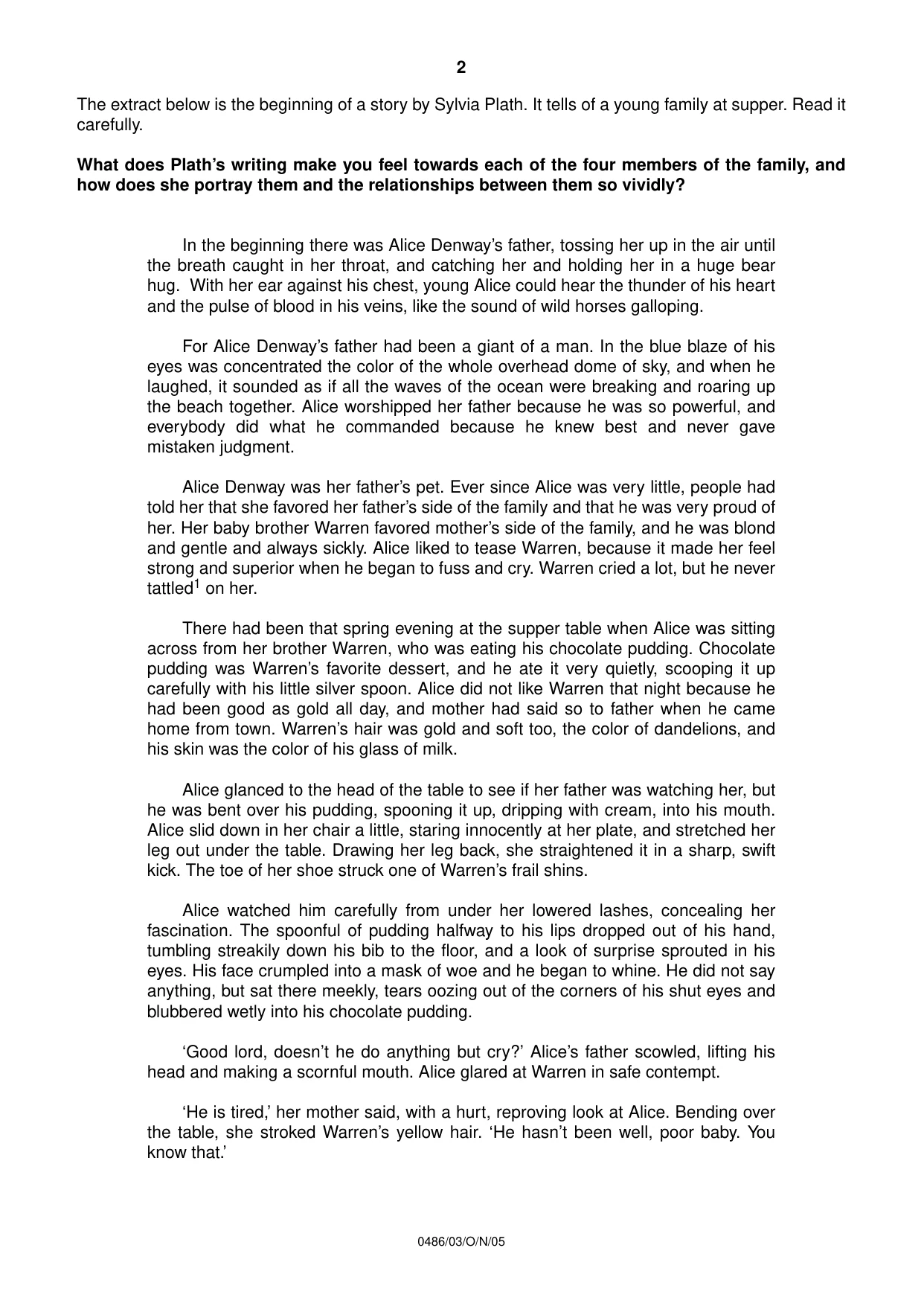
2 0486/03/O/N/05 The extract below is the beginning of a story by Sylvia Plath. It tells of a young family at supper. Read it carefully. What does Plath’s writing make you feel towards each of the four members of the family, and how does she portray them and the relationships between them so vividly? In the beginning there was Alice Denway’s father, tossing her up in the air until the breath caught in her throat, and catching her and holding her in a huge bear hug. With her ear against his chest, young Alice could hear the thunder of his heart and the pulse of blood in his veins, like the sound of wild horses galloping. For Alice Denway’s father had been a giant of a man. In the blue blaze of his eyes was concentrated the color of the whole overhead dome of sky, and when he laughed, it sounded as if all the waves of the ocean were breaking and roaring up the beach together. Alice worshipped her father because he was so powerful, and everybody did what he commanded because he knew best and never gave mistaken judgment. Alice Denway was her father’s pet. Ever since Alice was very little, people had told her that she favored her father’s side of the family and that he was very proud of her. Her baby brother Warren favored mother’s side of the family, and he was blond and gentle and always sickly. Alice liked to tease Warren, because it made her feel strong and superior when he began to fuss and cry. Warren cried a lot, but he never tattled1 on her. There had been that spring evening at the supper table when Alice was sitting across from her brother Warren, who was eating his chocolate pudding. Chocolate pudding was Warren’s favorite dessert, and he ate it very quietly, scooping it up carefully with his little silver spoon. Alice did not like Warren that night because he had been good as gold all day, and mother had said so to father when he came home from town. Warren’s hair was gold and soft too, the color of dandelions, and his skin was the color of his glass of milk. Alice glanced to the head of the table to see if her father was watching her, but he was bent over his pudding, spooning it up, dripping with cream, into his mouth. Alice slid down in her chair a little, staring innocently at her plate, and stretched her leg out under the table. Drawing her leg back, she straightened it in a sharp, swift kick. The toe of her shoe struck one of Warren’s frail shins. Alice watched him carefully from under her lowered lashes, concealing her fascination. The spoonful of pudding halfway to his lips dropped out of his hand, tumbling streakily down his bib to the floor, and a look of surprise sprouted in his eyes. His face crumpled into a mask of woe and he began to whine. He did not say anything, but sat there meekly, tears oozing out of the corners of his shut eyes and blubbered wetly into his chocolate pudding. ‘Good lord, doesn’t he do anything but cry?’ Alice’s father scowled, lifting his head and making a scornful mouth. Alice glared at Warren in safe contempt. ‘He is tired,’ her mother said, with a hurt, reproving look at Alice. Bending over the table, she stroked Warren’s yellow hair. ‘He hasn’t been well, poor baby. You know that.’
Question paper, page 3
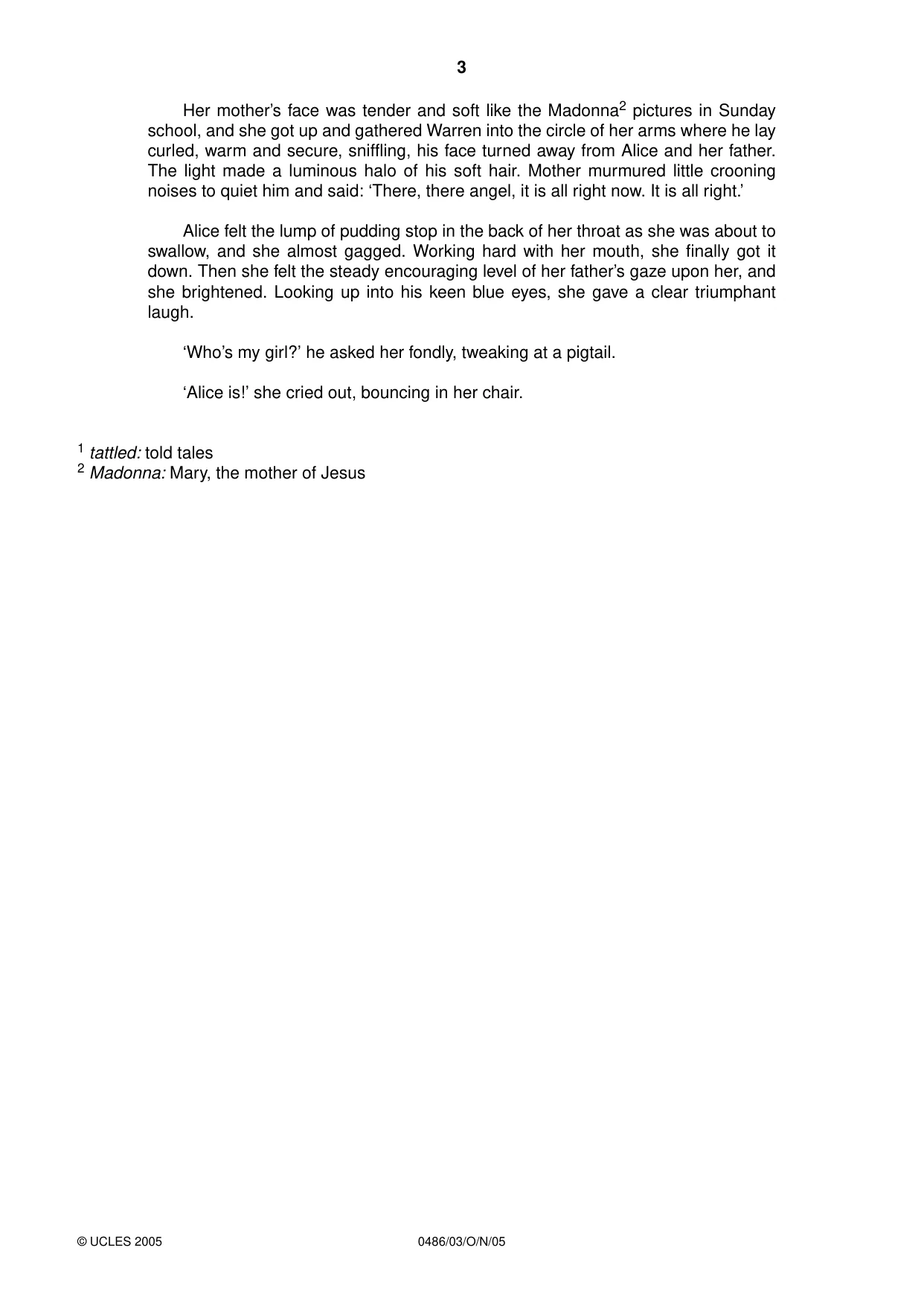
3 0486/03/O/N/05 Her mother’s face was tender and soft like the Madonna2 pictures in Sunday school, and she got up and gathered Warren into the circle of her arms where he lay curled, warm and secure, sniffling, his face turned away from Alice and her father. The light made a luminous halo of his soft hair. Mother murmured little crooning noises to quiet him and said: ‘There, there angel, it is all right now. It is all right.’ Alice felt the lump of pudding stop in the back of her throat as she was about to swallow, and she almost gagged. Working hard with her mouth, she finally got it down. Then she felt the steady encouraging level of her father’s gaze upon her, and she brightened. Looking up into his keen blue eyes, she gave a clear triumphant laugh. ‘Who’s my girl?’ he asked her fondly, tweaking at a pigtail. ‘Alice is!’ she cried out, bouncing in her chair. 1 tattled: told tales 2 Madonna: Mary, the mother of Jesus © UCLES 2005
Question paper, page 4
4 0486/03/O/N/05 BLANK PAGE Copyright Acknowledgements: Question 1 Sylvia Plath; Johnny Panic and the Bible of Dreams; Faber and Faber Ltd, 1977. Copyright © Estate of Sylvia Plath and Ted Hughes. Permission to reproduce items where third-party owned material protected by copyright is included has been sought and cleared where possible. Every reasonable effort has been made by the publisher (UCLES) to trace copyright holders, but if any items requiring clearance have unwittingly been included, the publisher will be pleased to make amends at the earliest possible opportunity. University of Cambridge International Examinations is part of the University of Cambridge Local Examinations Syndicate (UCLES), which is itself a department of the University of Cambridge.
Mark scheme, page 1
UNIVERSITY OF CAMBRIDGE INTERNATIONAL EXAMINATIONS International General Certificate of Secondary Education MARK SCHEME for the November 2005 question paper 0486 LITERATURE (ENGLISH) 0486/03 Paper 3 (Alternative to Coursework) Maximum mark 20 This mark scheme is published as an aid to teachers and students, to indicate the requirements of the examination. It shows the basis on which Examiners were initially instructed to award marks. They do not indicate the details of the discussions that took place at an Examiners’ meeting before marking began. Any substantial changes to the mark scheme that arose from these discussions will be recorded in the published Report on the Examination. All Examiners are instructed that alternative correct answers and unexpected approaches in candidates’ scripts must be given marks that fairly reflect the relevant knowledge and skills demonstrated. Mark schemes must be read in conjunction with the question papers and the Report on the Examination. The minimum marks in these components needed for various grades were previously published with these mark schemes, but are now instead included in the Report on the Examination for this session. • CIE will not enter into discussion or correspondence in connection with these mark schemes. CIE is publishing the mark schemes for the November 2005 question papers for most IGCSE and GCE Advanced Level and Advanced Subsidiary Level syllabuses and some Ordinary Level syllabuses. www.XtremePapers.com
Mark scheme, page 2
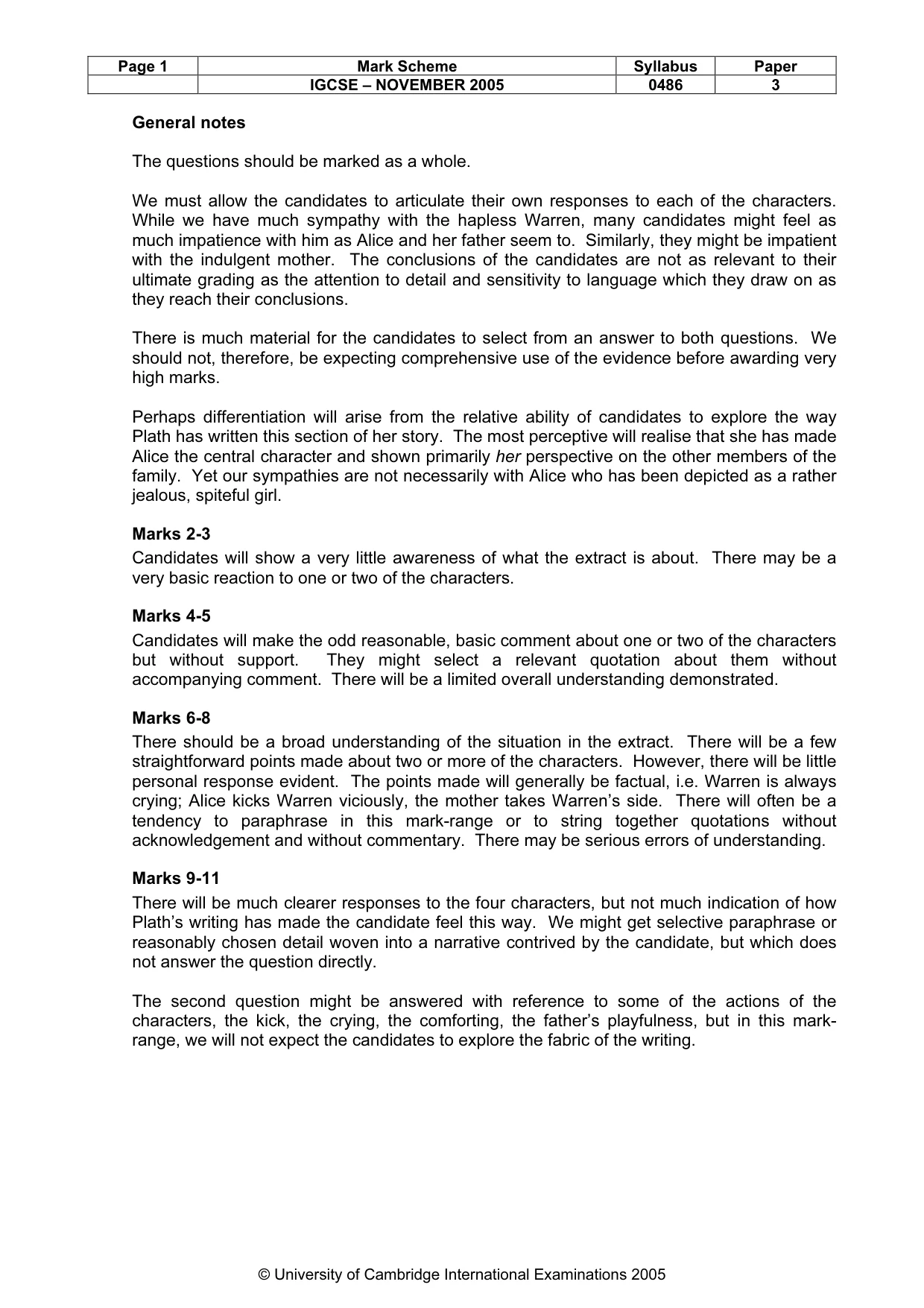
Page 1 Mark Scheme Syllabus Paper IGCSE – NOVEMBER 2005 0486 3 © University of Cambridge International Examinations 2005 General notes The questions should be marked as a whole. We must allow the candidates to articulate their own responses to each of the characters. While we have much sympathy with the hapless Warren, many candidates might feel as much impatience with him as Alice and her father seem to. Similarly, they might be impatient with the indulgent mother. The conclusions of the candidates are not as relevant to their ultimate grading as the attention to detail and sensitivity to language which they draw on as they reach their conclusions. There is much material for the candidates to select from an answer to both questions. We should not, therefore, be expecting comprehensive use of the evidence before awarding very high marks. Perhaps differentiation will arise from the relative ability of candidates to explore the way Plath has written this section of her story. The most perceptive will realise that she has made Alice the central character and shown primarily her perspective on the other members of the family. Yet our sympathies are not necessarily with Alice who has been depicted as a rather jealous, spiteful girl. Marks 2-3 Candidates will show a very little awareness of what the extract is about. There may be a very basic reaction to one or two of the characters. Marks 4-5 Candidates will make the odd reasonable, basic comment about one or two of the characters but without support. They might select a relevant quotation about them without accompanying comment. There will be a limited overall understanding demonstrated. Marks 6-8 There should be a broad understanding of the situation in the extract. There will be a few straightforward points made about two or more of the characters. However, there will be little personal response evident. The points made will generally be factual, i.e. Warren is always crying; Alice kicks Warren viciously, the mother takes Warren’s side. There will often be a tendency to paraphrase in this mark-range or to string together quotations without acknowledgement and without commentary. There may be serious errors of understanding. Marks 9-11 There will be much clearer responses to the four characters, but not much indication of how Plath’s writing has made the candidate feel this way. We might get selective paraphrase or reasonably chosen detail woven into a narrative contrived by the candidate, but which does not answer the question directly. The second question might be answered with reference to some of the actions of the characters, the kick, the crying, the comforting, the father’s playfulness, but in this mark- range, we will not expect the candidates to explore the fabric of the writing.
Mark scheme, page 3
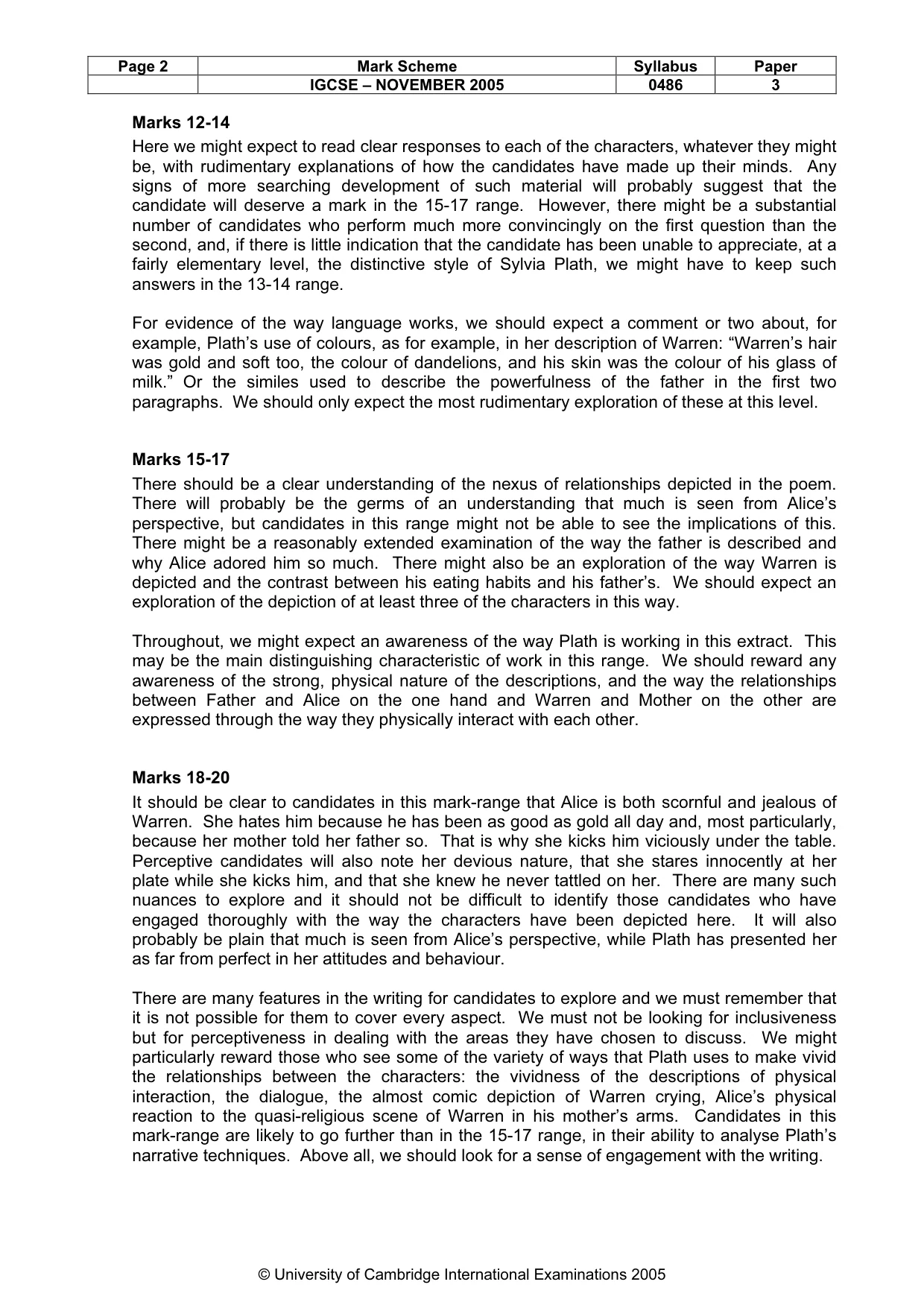
Page 2 Mark Scheme Syllabus Paper IGCSE – NOVEMBER 2005 0486 3 © University of Cambridge International Examinations 2005 Marks 12-14 Here we might expect to read clear responses to each of the characters, whatever they might be, with rudimentary explanations of how the candidates have made up their minds. Any signs of more searching development of such material will probably suggest that the candidate will deserve a mark in the 15-17 range. However, there might be a substantial number of candidates who perform much more convincingly on the first question than the second, and, if there is little indication that the candidate has been unable to appreciate, at a fairly elementary level, the distinctive style of Sylvia Plath, we might have to keep such answers in the 13-14 range. For evidence of the way language works, we should expect a comment or two about, for example, Plath’s use of colours, as for example, in her description of Warren: “Warren’s hair was gold and soft too, the colour of dandelions, and his skin was the colour of his glass of milk.” Or the similes used to describe the powerfulness of the father in the first two paragraphs. We should only expect the most rudimentary exploration of these at this level. Marks 15-17 There should be a clear understanding of the nexus of relationships depicted in the poem. There will probably be the germs of an understanding that much is seen from Alice’s perspective, but candidates in this range might not be able to see the implications of this. There might be a reasonably extended examination of the way the father is described and why Alice adored him so much. There might also be an exploration of the way Warren is depicted and the contrast between his eating habits and his father’s. We should expect an exploration of the depiction of at least three of the characters in this way. Throughout, we might expect an awareness of the way Plath is working in this extract. This may be the main distinguishing characteristic of work in this range. We should reward any awareness of the strong, physical nature of the descriptions, and the way the relationships between Father and Alice on the one hand and Warren and Mother on the other are expressed through the way they physically interact with each other. Marks 18-20 It should be clear to candidates in this mark-range that Alice is both scornful and jealous of Warren. She hates him because he has been as good as gold all day and, most particularly, because her mother told her father so. That is why she kicks him viciously under the table. Perceptive candidates will also note her devious nature, that she stares innocently at her plate while she kicks him, and that she knew he never tattled on her. There are many such nuances to explore and it should not be difficult to identify those candidates who have engaged thoroughly with the way the characters have been depicted here. It will also probably be plain that much is seen from Alice’s perspective, while Plath has presented her as far from perfect in her attitudes and behaviour. There are many features in the writing for candidates to explore and we must remember that it is not possible for them to cover every aspect. We must not be looking for inclusiveness but for perceptiveness in dealing with the areas they have chosen to discuss. We might particularly reward those who see some of the variety of ways that Plath uses to make vivid the relationships between the characters: the vividness of the descriptions of physical interaction, the dialogue, the almost comic depiction of Warren crying, Alice’s physical reaction to the quasi-religious scene of Warren in his mother’s arms. Candidates in this mark-range are likely to go further than in the 15-17 range, in their ability to analyse Plath’s narrative techniques. Above all, we should look for a sense of engagement with the writing.
Mark scheme, page 4
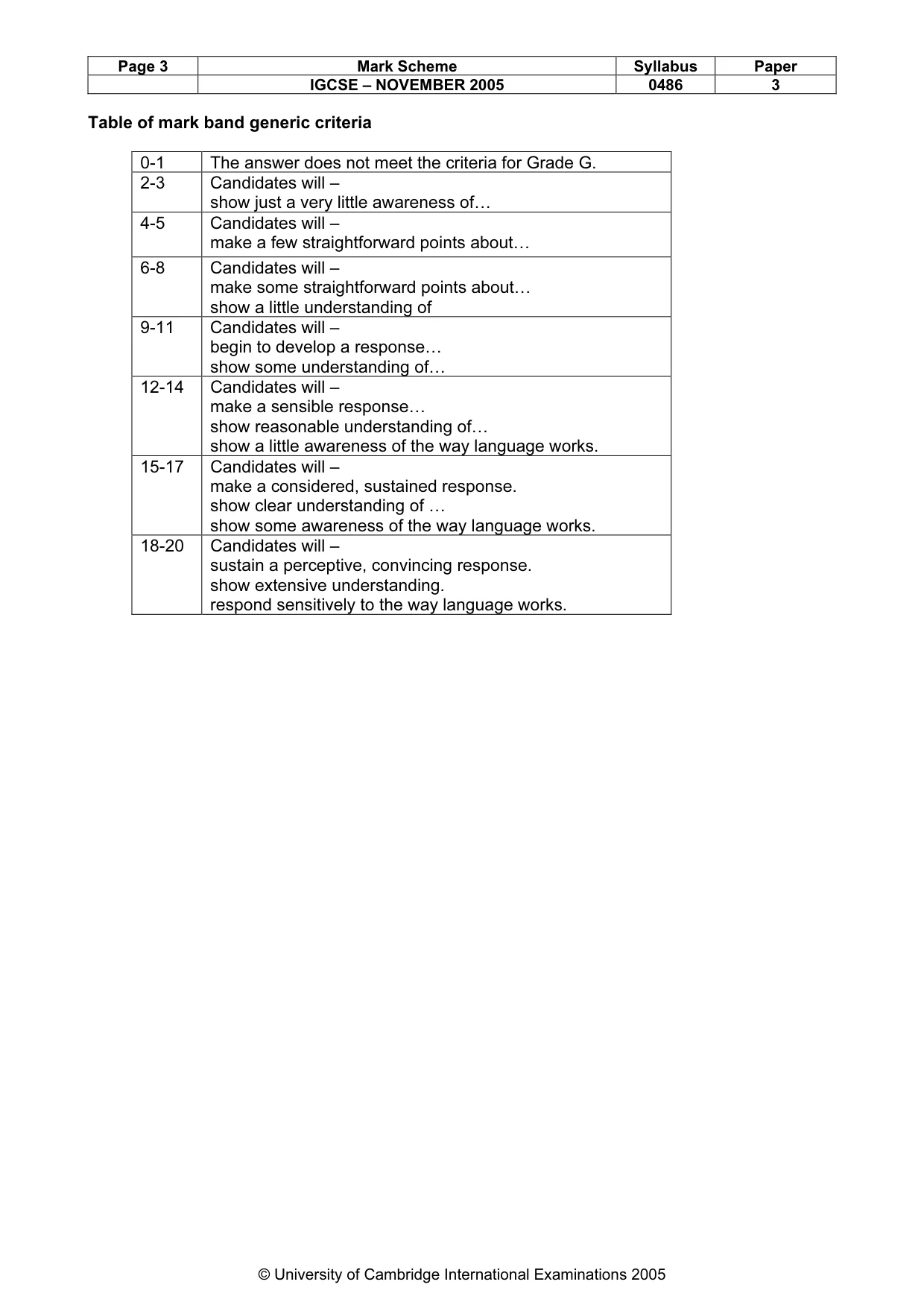
Page 3 Mark Scheme Syllabus Paper IGCSE – NOVEMBER 2005 0486 3 © University of Cambridge International Examinations 2005 Table of mark band generic criteria 0-1 The answer does not meet the criteria for Grade G. 2-3 Candidates will – show just a very little awareness of… 4-5 Candidates will – make a few straightforward points about… 6-8 Candidates will – make some straightforward points about… show a little understanding of 9-11 Candidates will – begin to develop a response… show some understanding of… 12-14 Candidates will – make a sensible response… show reasonable understanding of… show a little awareness of the way language works. 15-17 Candidates will – make a considered, sustained response. show clear understanding of … show some awareness of the way language works. 18-20 Candidates will – sustain a perceptive, convincing response. show extensive understanding. respond sensitively to the way language works.