Cambridge IGCSE English - Literature 0486 — 2005 May/June Paper 3 · Variant 1
0486/31/M/J/05
The question paper and its mark scheme, free to read here and free to download. This is Cambridge’s own paper, exactly as it was sat.
Question paper2 pages
Mark scheme6 pages
Answers below. Sit the paper first if you are practising.
Paper as text
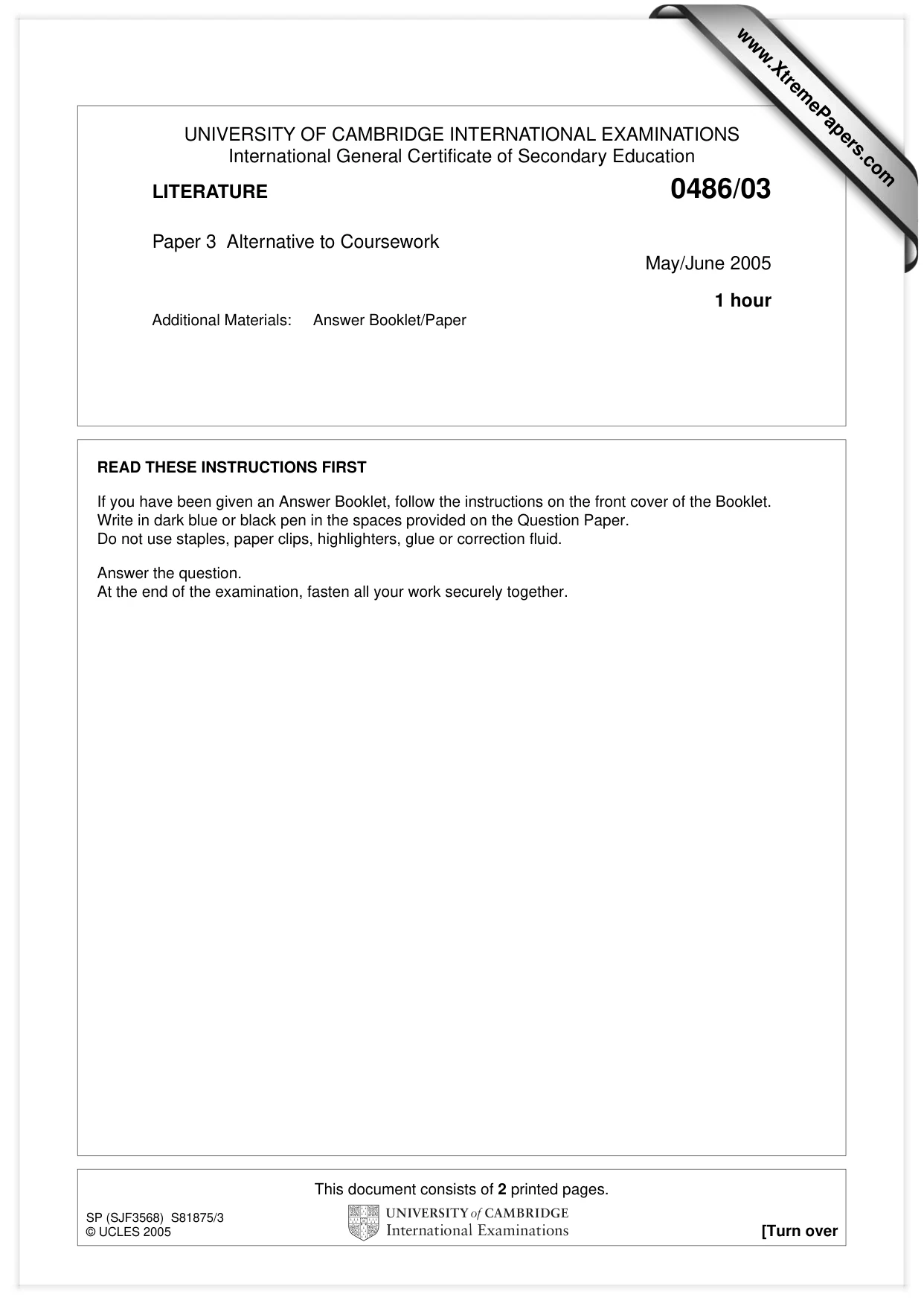
Question paper, page 1
This document consists of 2 printed pages. SP (SJF3568) S81875/3 © UCLES 2005 [Turn over UNIVERSITY OF CAMBRIDGE INTERNATIONAL EXAMINATIONS International General Certificate of Secondary Education LITERATURE 0486/03 Paper 3 Alternative to Coursework May/June 2005 1 hour Additional Materials: Answer Booklet/Paper READ THESE INSTRUCTIONS FIRST If you have been given an Answer Booklet, follow the instructions on the front cover of the Booklet. Write in dark blue or black pen in the spaces provided on the Question Paper. Do not use staples, paper clips, highlighters, glue or correction fluid. Answer the question. At the end of the examination, fasten all your work securely together. www.XtremePapers.com
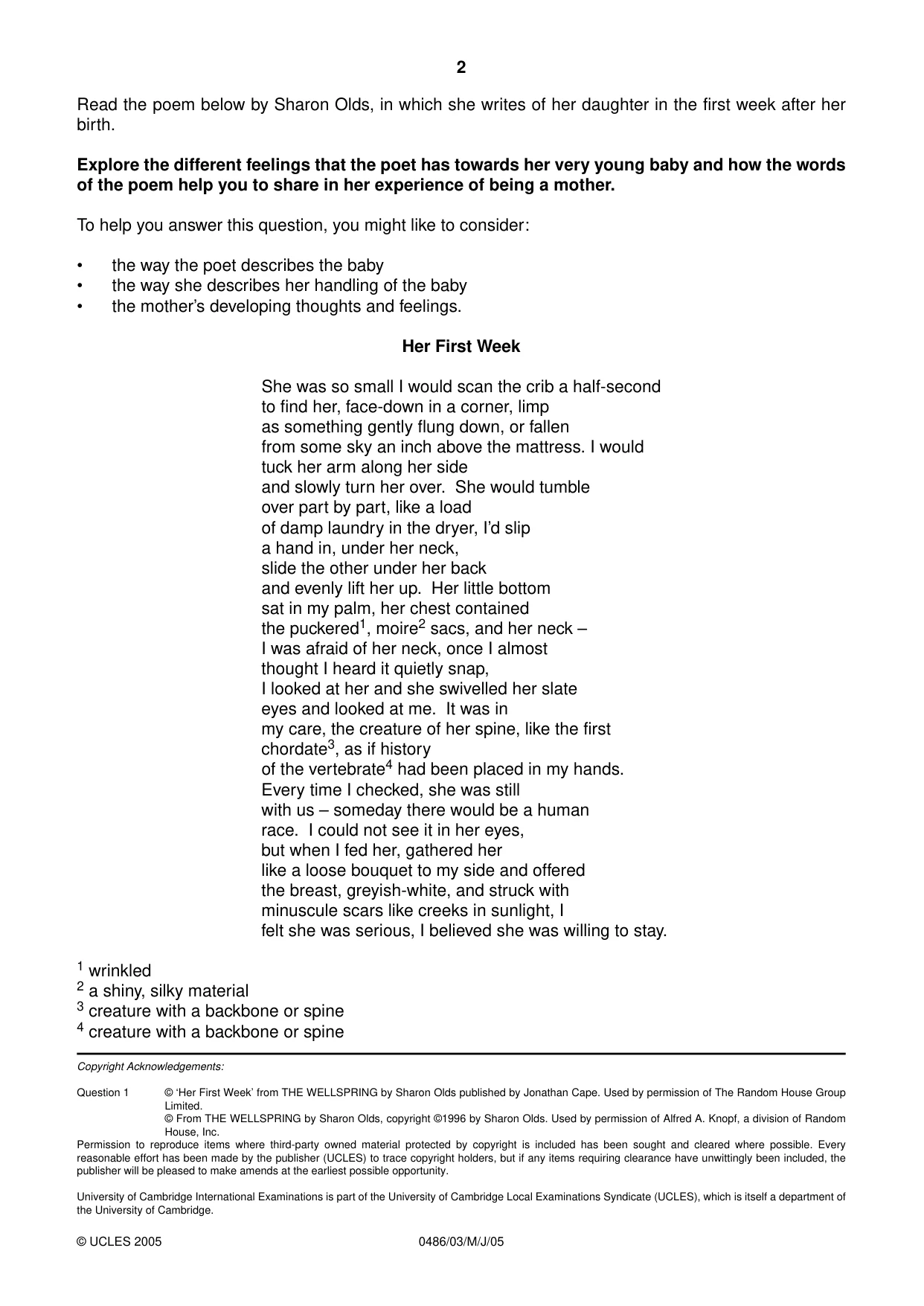
Question paper, page 2
2 0486/03/M/J/05 © UCLES 2005 Read the poem below by Sharon Olds, in which she writes of her daughter in the first week after her birth. Explore the different feelings that the poet has towards her very young baby and how the words of the poem help you to share in her experience of being a mother. To help you answer this question, you might like to consider: • the way the poet describes the baby • the way she describes her handling of the baby • the mother’s developing thoughts and feelings. Her First Week She was so small I would scan the crib a half-second to find her, face-down in a corner, limp as something gently flung down, or fallen from some sky an inch above the mattress. I would tuck her arm along her side and slowly turn her over. She would tumble over part by part, like a load of damp laundry in the dryer, I’d slip a hand in, under her neck, slide the other under her back and evenly lift her up. Her little bottom sat in my palm, her chest contained the puckered1, moire2 sacs, and her neck – I was afraid of her neck, once I almost thought I heard it quietly snap, I looked at her and she swivelled her slate eyes and looked at me. It was in my care, the creature of her spine, like the first chordate3, as if history of the vertebrate4 had been placed in my hands. Every time I checked, she was still with us – someday there would be a human race. I could not see it in her eyes, but when I fed her, gathered her like a loose bouquet to my side and offered the breast, greyish-white, and struck with minuscule scars like creeks in sunlight, I felt she was serious, I believed she was willing to stay. 1 wrinkled 2 a shiny, silky material 3 creature with a backbone or spine 4 creature with a backbone or spine Copyright Acknowledgements: Question 1 © ‘Her First Week’ from THE WELLSPRING by Sharon Olds published by Jonathan Cape. Used by permission of The Random House Group Limited. © From THE WELLSPRING by Sharon Olds, copyright ©1996 by Sharon Olds. Used by permission of Alfred A. Knopf, a division of Random House, Inc. Permission to reproduce items where third-party owned material protected by copyright is included has been sought and cleared where possible. Every reasonable effort has been made by the publisher (UCLES) to trace copyright holders, but if any items requiring clearance have unwittingly been included, the publisher will be pleased to make amends at the earliest possible opportunity. University of Cambridge International Examinations is part of the University of Cambridge Local Examinations Syndicate (UCLES), which is itself a department of the University of Cambridge.
Mark scheme, page 1
UNIVERSITY OF CAMBRIDGE INTERNATIONAL EXAMINATIONS International General Certificate of Secondary Education MARK SCHEME for the June 2005 question paper 0486 LITERATURE (ENGLISH) 0486/03 Paper 3 (Alternative to Coursework), maximum mark 20 This mark scheme is published as an aid to teachers and students, to indicate the requirements of the examination. It shows the basis on which Examiners were initially instructed to award marks. They do not indicate the details of the discussions that took place at an Examiners’ meeting before marking began. Any substantial changes to the mark scheme that arose from these discussions will be recorded in the published Report on the Examination. All Examiners are instructed that alternative correct answers and unexpected approaches in candidates’ scripts must be given marks that fairly reflect the relevant knowledge and skills demonstrated. Mark schemes must be read in conjunction with the question papers and the Report on the Examination. • CIE will not enter into discussion or correspondence in connection with these mark schemes. CIE is publishing the mark schemes for the June 2005 question papers for most IGCSE and GCE Advanced Level and Advanced Subsidiary Level syllabuses and some Ordinary Level syllabuses. www.XtremePapers.com
Mark scheme, page 2
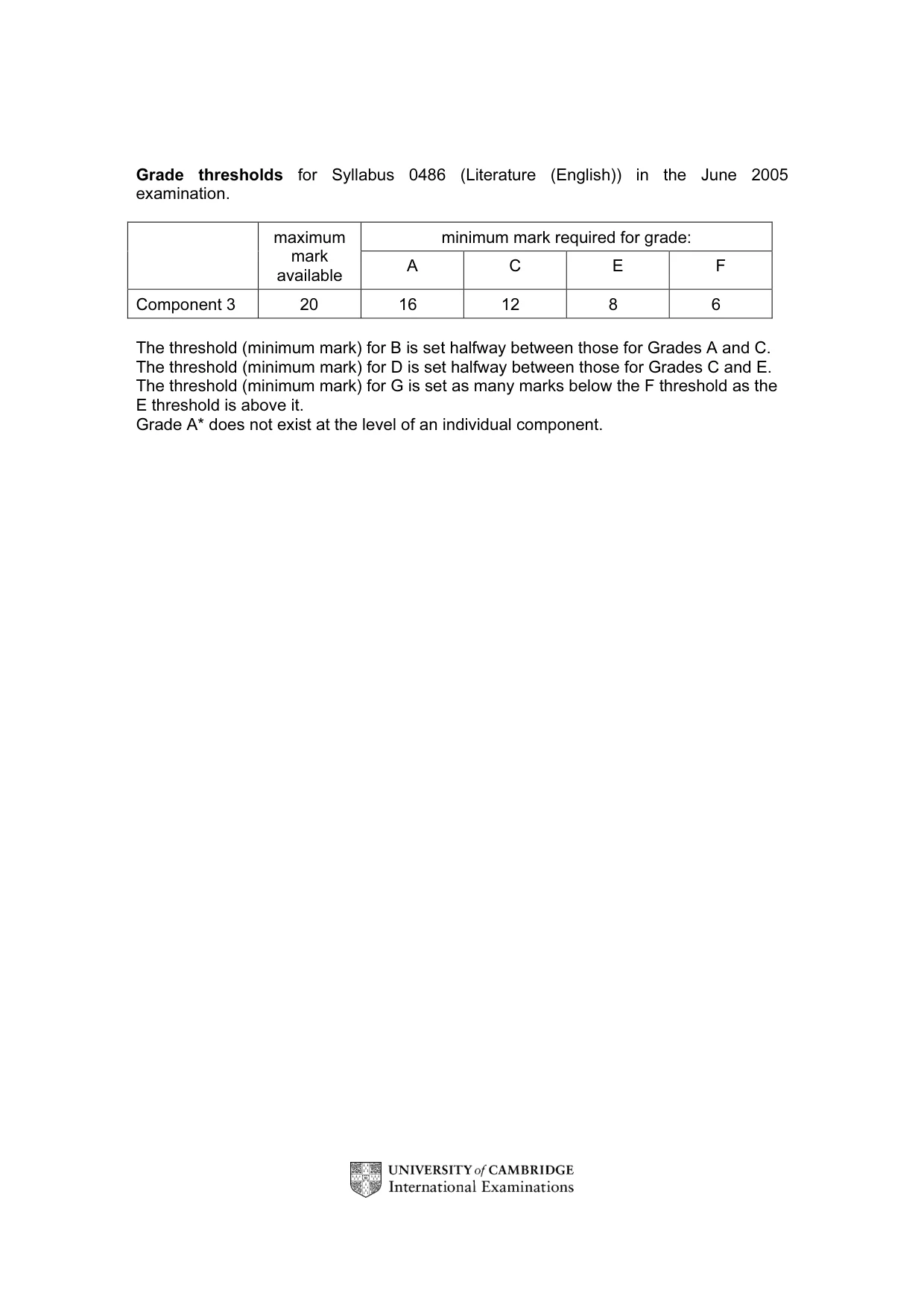
Grade thresholds for Syllabus 0486 (Literature (English)) in the June 2005 examination. minimum mark required for grade: maximum mark available A C E F Component 3 20 16 12 8 6 The threshold (minimum mark) for B is set halfway between those for Grades A and C. The threshold (minimum mark) for D is set halfway between those for Grades C and E. The threshold (minimum mark) for G is set as many marks below the F threshold as the E threshold is above it. Grade A* does not exist at the level of an individual component.
Mark scheme, page 3
June 2005 IGCSE MARK SCHEME MAXIMUM MARK: 20 SYLLABUS/COMPONENT: 0486/03 LITERATURE (ENGLISH) Paper 3 (Alternative to Coursework)
Mark scheme, page 4
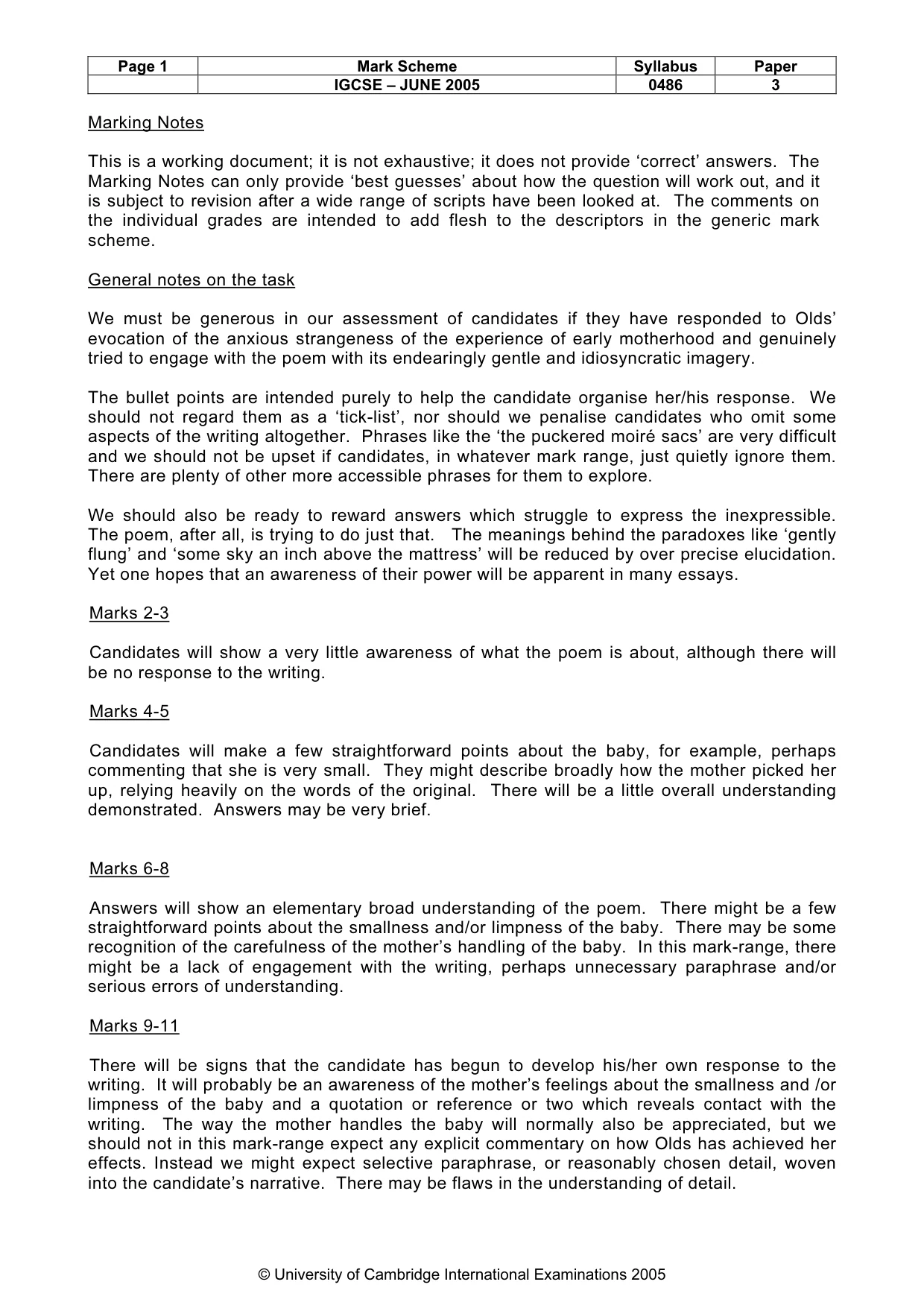
Page 1 Mark Scheme Syllabus Paper IGCSE – JUNE 2005 0486 3 © University of Cambridge International Examinations 2005 Marking Notes This is a working document; it is not exhaustive; it does not provide ‘correct’ answers. The Marking Notes can only provide ‘best guesses’ about how the question will work out, and it is subject to revision after a wide range of scripts have been looked at. The comments on the individual grades are intended to add flesh to the descriptors in the generic mark scheme. General notes on the task We must be generous in our assessment of candidates if they have responded to Olds’ evocation of the anxious strangeness of the experience of early motherhood and genuinely tried to engage with the poem with its endearingly gentle and idiosyncratic imagery. The bullet points are intended purely to help the candidate organise her/his response. We should not regard them as a ‘tick-list’, nor should we penalise candidates who omit some aspects of the writing altogether. Phrases like the ‘the puckered moiré sacs’ are very difficult and we should not be upset if candidates, in whatever mark range, just quietly ignore them. There are plenty of other more accessible phrases for them to explore. We should also be ready to reward answers which struggle to express the inexpressible. The poem, after all, is trying to do just that. The meanings behind the paradoxes like ‘gently flung’ and ‘some sky an inch above the mattress’ will be reduced by over precise elucidation. Yet one hopes that an awareness of their power will be apparent in many essays. Marks 2-3 Candidates will show a very little awareness of what the poem is about, although there will be no response to the writing. Marks 4-5 Candidates will make a few straightforward points about the baby, for example, perhaps commenting that she is very small. They might describe broadly how the mother picked her up, relying heavily on the words of the original. There will be a little overall understanding demonstrated. Answers may be very brief. Marks 6-8 Answers will show an elementary broad understanding of the poem. There might be a few straightforward points about the smallness and/or limpness of the baby. There may be some recognition of the carefulness of the mother’s handling of the baby. In this mark-range, there might be a lack of engagement with the writing, perhaps unnecessary paraphrase and/or serious errors of understanding. Marks 9-11 There will be signs that the candidate has begun to develop his/her own response to the writing. It will probably be an awareness of the mother’s feelings about the smallness and /or limpness of the baby and a quotation or reference or two which reveals contact with the writing. The way the mother handles the baby will normally also be appreciated, but we should not in this mark-range expect any explicit commentary on how Olds has achieved her effects. Instead we might expect selective paraphrase, or reasonably chosen detail, woven into the candidate’s narrative. There may be flaws in the understanding of detail.
Mark scheme, page 5
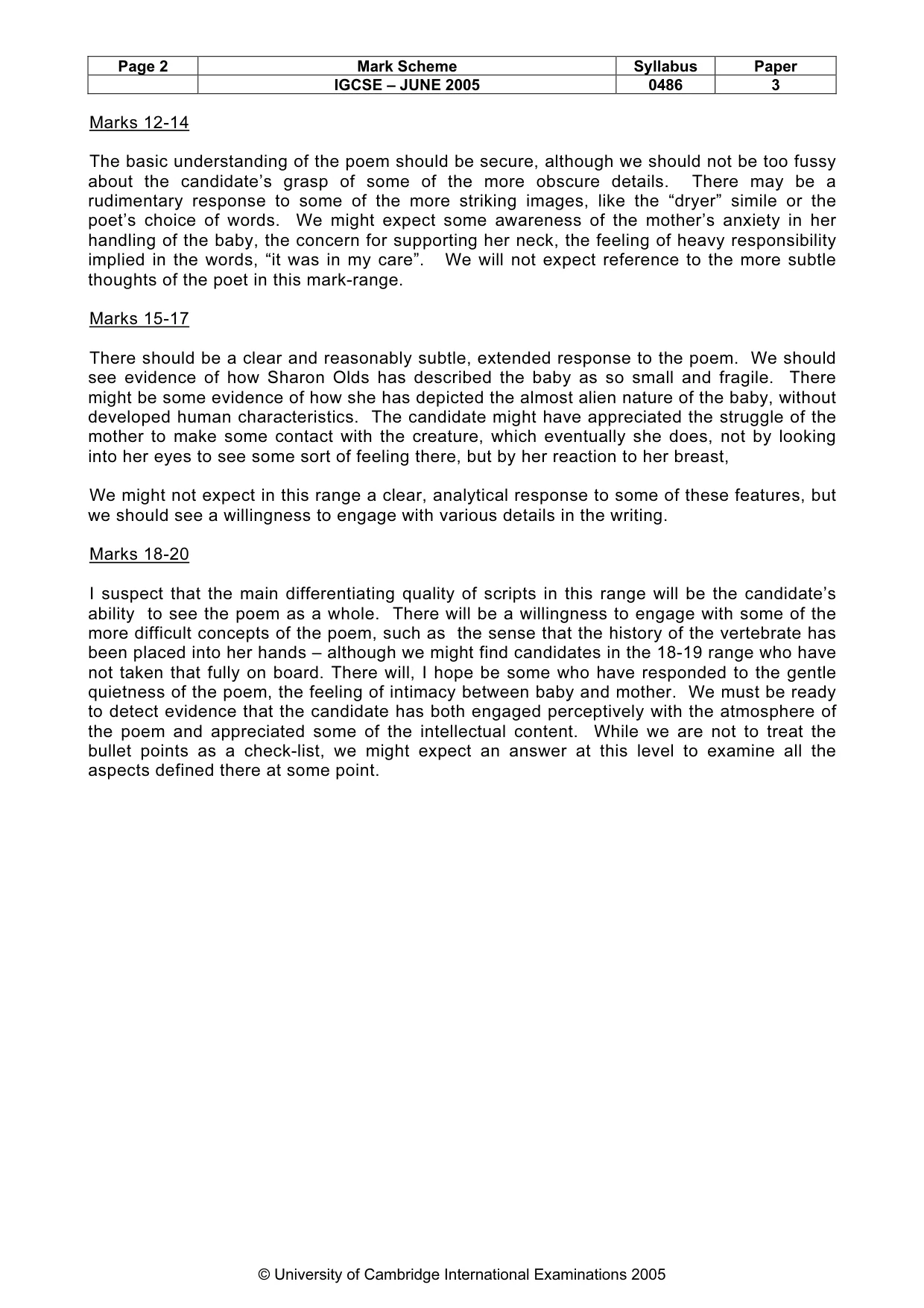
Page 2 Mark Scheme Syllabus Paper IGCSE – JUNE 2005 0486 3 © University of Cambridge International Examinations 2005 Marks 12-14 The basic understanding of the poem should be secure, although we should not be too fussy about the candidate’s grasp of some of the more obscure details. There may be a rudimentary response to some of the more striking images, like the “dryer” simile or the poet’s choice of words. We might expect some awareness of the mother’s anxiety in her handling of the baby, the concern for supporting her neck, the feeling of heavy responsibility implied in the words, “it was in my care”. We will not expect reference to the more subtle thoughts of the poet in this mark-range. Marks 15-17 There should be a clear and reasonably subtle, extended response to the poem. We should see evidence of how Sharon Olds has described the baby as so small and fragile. There might be some evidence of how she has depicted the almost alien nature of the baby, without developed human characteristics. The candidate might have appreciated the struggle of the mother to make some contact with the creature, which eventually she does, not by looking into her eyes to see some sort of feeling there, but by her reaction to her breast, We might not expect in this range a clear, analytical response to some of these features, but we should see a willingness to engage with various details in the writing. Marks 18-20 I suspect that the main differentiating quality of scripts in this range will be the candidate’s ability to see the poem as a whole. There will be a willingness to engage with some of the more difficult concepts of the poem, such as the sense that the history of the vertebrate has been placed into her hands – although we might find candidates in the 18-19 range who have not taken that fully on board. There will, I hope be some who have responded to the gentle quietness of the poem, the feeling of intimacy between baby and mother. We must be ready to detect evidence that the candidate has both engaged perceptively with the atmosphere of the poem and appreciated some of the intellectual content. While we are not to treat the bullet points as a check-list, we might expect an answer at this level to examine all the aspects defined there at some point.
Mark scheme, page 6
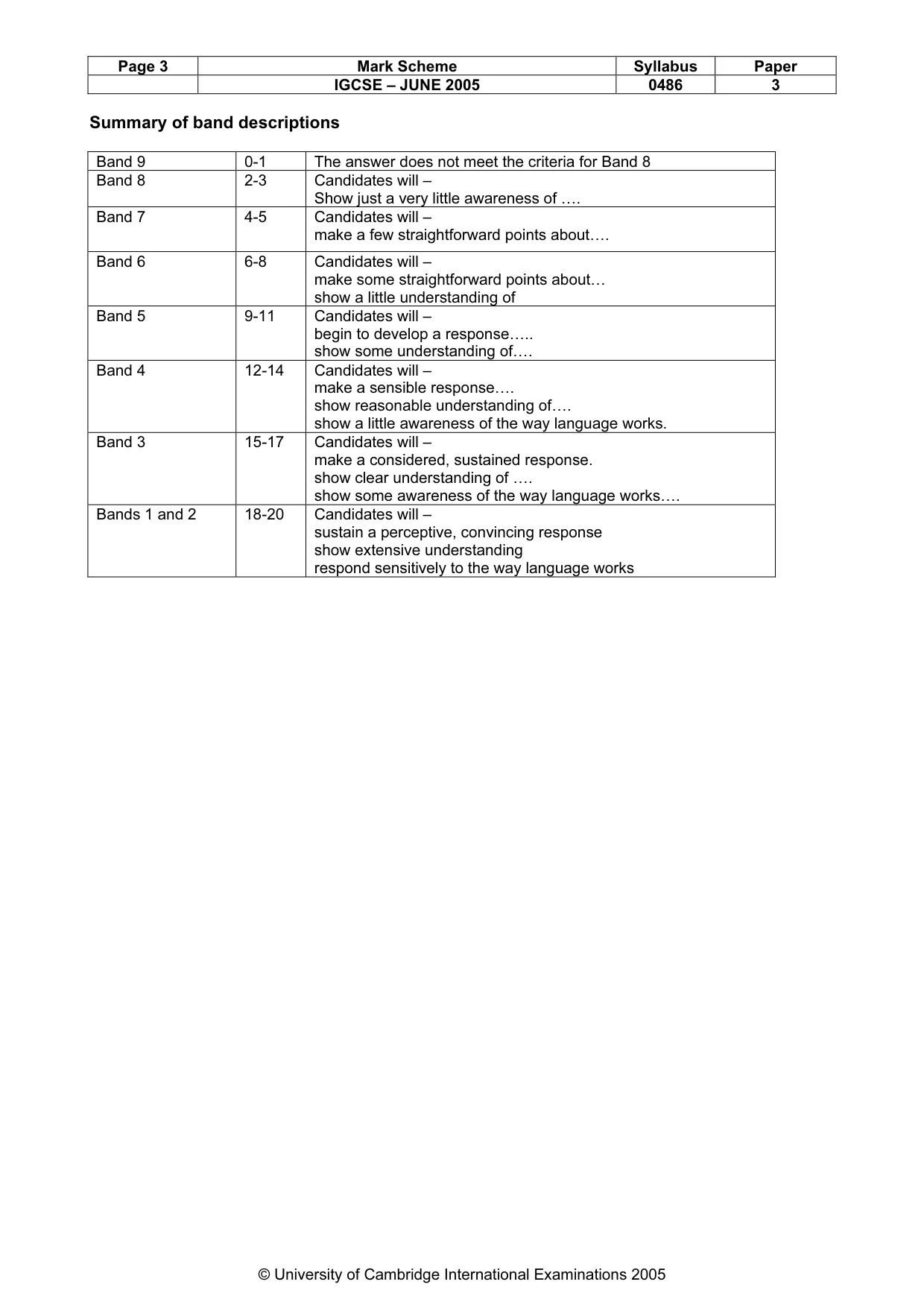
Page 3 Mark Scheme Syllabus Paper IGCSE – JUNE 2005 0486 3 © University of Cambridge International Examinations 2005 Summary of band descriptions Band 9 0-1 The answer does not meet the criteria for Band 8 Band 8 2-3 Candidates will – Show just a very little awareness of …. Band 7 4-5 Candidates will – make a few straightforward points about…. Band 6 6-8 Candidates will – make some straightforward points about… show a little understanding of Band 5 9-11 Candidates will – begin to develop a response….. show some understanding of…. Band 4 12-14 Candidates will – make a sensible response…. show reasonable understanding of…. show a little awareness of the way language works. Band 3 15-17 Candidates will – make a considered, sustained response. show clear understanding of …. show some awareness of the way language works…. Bands 1 and 2 18-20 Candidates will – sustain a perceptive, convincing response show extensive understanding respond sensitively to the way language works