Cambridge IGCSE English - Literature 0486 — 2004 May/June Paper 3 · Variant 1
0486/31/M/J/04
The question paper and its mark scheme, free to read here and free to download. This is Cambridge’s own paper, exactly as it was sat.
Question paper2 pages
Mark scheme
No mark scheme is in the library for this paper.
Paper as text
Question paper, page 1
UNIVERSITY OF CAMBRIDGE INTERNATIONAL EXAMINATIONS International General Certificate of Secondary Education LITERATURE 0486/03 Paper 3 Alternative to Coursework May/June 2004 1 hour Additional Materials: Answer Booklet/Paper READ THESE INSTRUCTIONS FIRST if you have been given an Answer Booklet, follow the instructions on the front cover of the Booklet. Write in dark blue or black pen on both sides of the paper. Do not use staples, paper clips, highlighters, glue or correction fluid. Answer the question. At the end of the examination, fasten all your work securely together. This document consists of 2 printed pages. SP (AT) $68241/1 RS UNIVERSITY of CAMBRIDGE @UCLES 2004 ¥ International Examinations {Turn over
Question paper, page 2
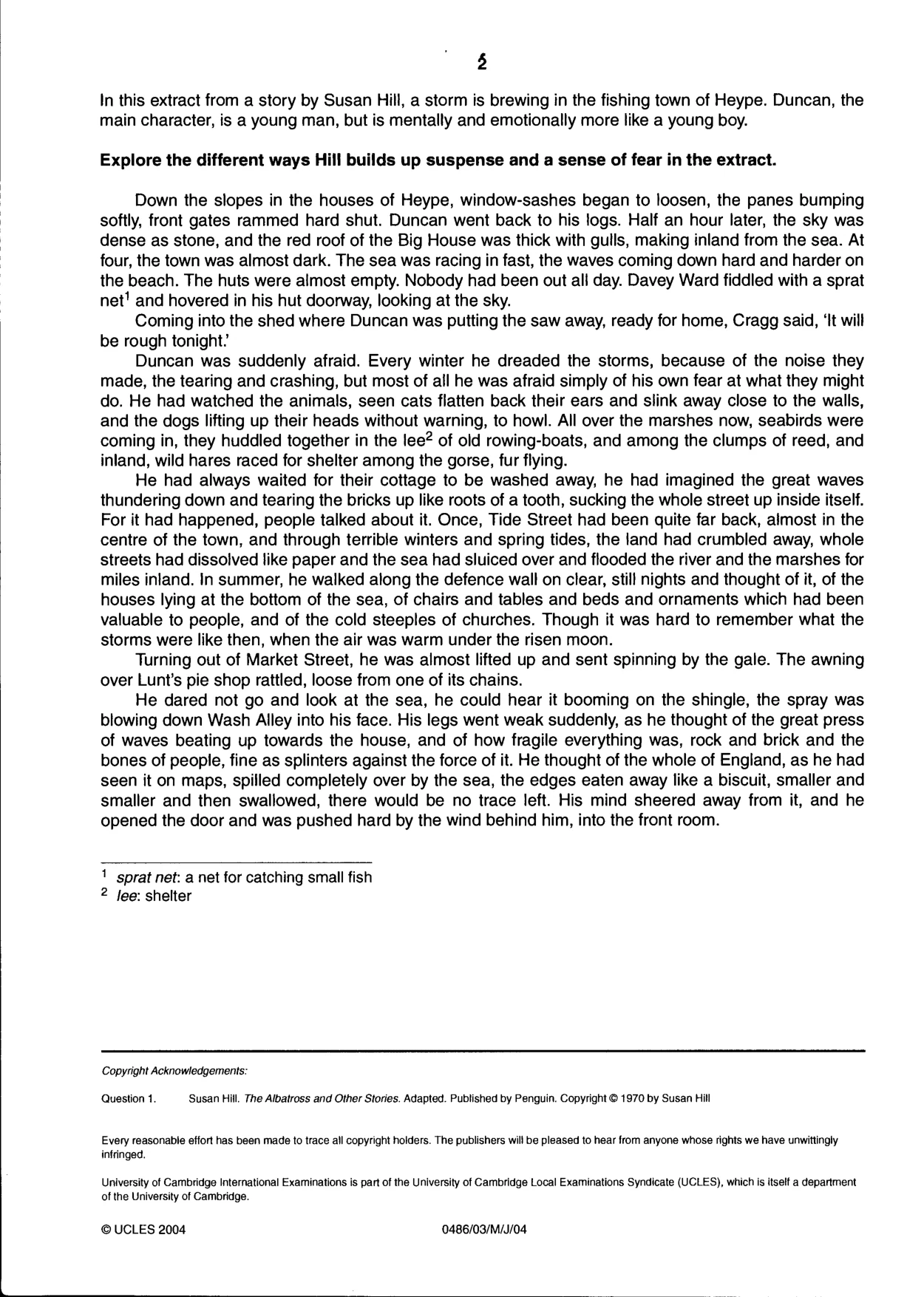
4 In this extract from a story by Susan Hill, a storm is brewing in the fishing town of Heype. Duncan, the main character, is a young man, but is mentally and emotionally more like a young boy. Explore the different ways Hill builds up suspense and a sense of fear in the extract. Down the slopes in the houses of Heype, window-sashes began to loosen, the panes bumping softly, front gates rammed hard shut. Duncan went back to his logs. Half an hour later, the sky was dense as stone, and the red roof of the Big House was thick with gulls, making inland from the sea. At four, the town was almost dark. The sea was racing in fast, the waves coming down hard and harder on the beach. The huts were almost empty. Nobody had been out all day. Davey Ward fiddled with a sprat net’ and hovered in his hut doorway, looking at the sky. Coming into the shed where Duncan was putting the saw away, ready for home, Cragg said, ‘It will be rough tonight. Duncan was suddenly afraid. Every winter he dreaded the storms, because of the noise they made, the tearing and crashing, but most of all he was afraid simply of his own fear at what they might do. He had watched the animals, seen cats flatten back their ears and slink away close to the walls, and the dogs lifting up their heads without warning, to howl. All over the marshes now, seabirds were coming in, they huddled together in the lee? of old rowing-boats, and among the clumps of reed, and inland, wild hares raced for shelter among the gorse, fur flying. He had always waited for their cottage to be washed away, he had imagined the great waves thundering down and tearing the bricks up like roots of a tooth, sucking the whole street up inside itself. For it had happened, people talked about it. Once, Tide Street had been quite far back, almost in the centre of the town, and through terrible winters and spring tides, the land had crumbled away, whole streets had dissolved like paper and the sea had sluiced over and flooded the river and the marshes for miles inland. In summer, he walked along the defence wall on clear, still nights and thought of it, of the houses lying at the bottom of the sea, of chairs and tables and beds and ornaments which had been valuable to people, and of the cold steeples of churches. Though it was hard to remember what the storms were like then, when the air was warm under the risen moon. Turning out of Market Street, he was almost lifted up and sent spinning by the gale. The awning over Lunt’s pie shop rattled, loose from one of its chains. He dared not go and look at the sea, he could hear it booming on the shingle, the spray was blowing down Wash Alley into his face. His legs went weak suddenly, as he thought of the great press of waves beating up towards the house, and of how fragile everything was, rock and brick and the bones of people, fine as splinters against the force of it. He thought of the whole of England, as he had seen it on maps, spilled completely over by the sea, the edges eaten away like a biscuit, smaller and smaller and then swallowed, there would be no trace left. His mind sheered away from it, and he opened the door and was pushed hard by the wind behind him, into the front room. 1 sprat net: a net for catching small fish 2 Jee: shelter Copyright Acknowledgements: Question 4 Susan Hill. The Albatross and Other Stories. Adapted. Published by Penguin. Copyright © 1970 by Susan Hill Every reasonable effort has been made to trace all copyright holders. The publishers will be pleased to hear from anyone whose rights we have unwittingly infringed, University of Cambridge International Examinations is part of the University of Cambridge Local Examinations Syndicate (UCLES), which is itselt a department of the University of Cambridge. © UCLES 2004 0486/03/M/J/04