Cambridge IGCSE English - Literature 0486 — 2002 Oct/Nov Paper 3 · Variant 1
0486/31/O/N/02
The question paper and its mark scheme, free to read here and free to download. This is Cambridge’s own paper, exactly as it was sat.
Question paper2 pages
Mark scheme2 pages
Answers below. Sit the paper first if you are practising.
Paper as text
Question paper, page 1
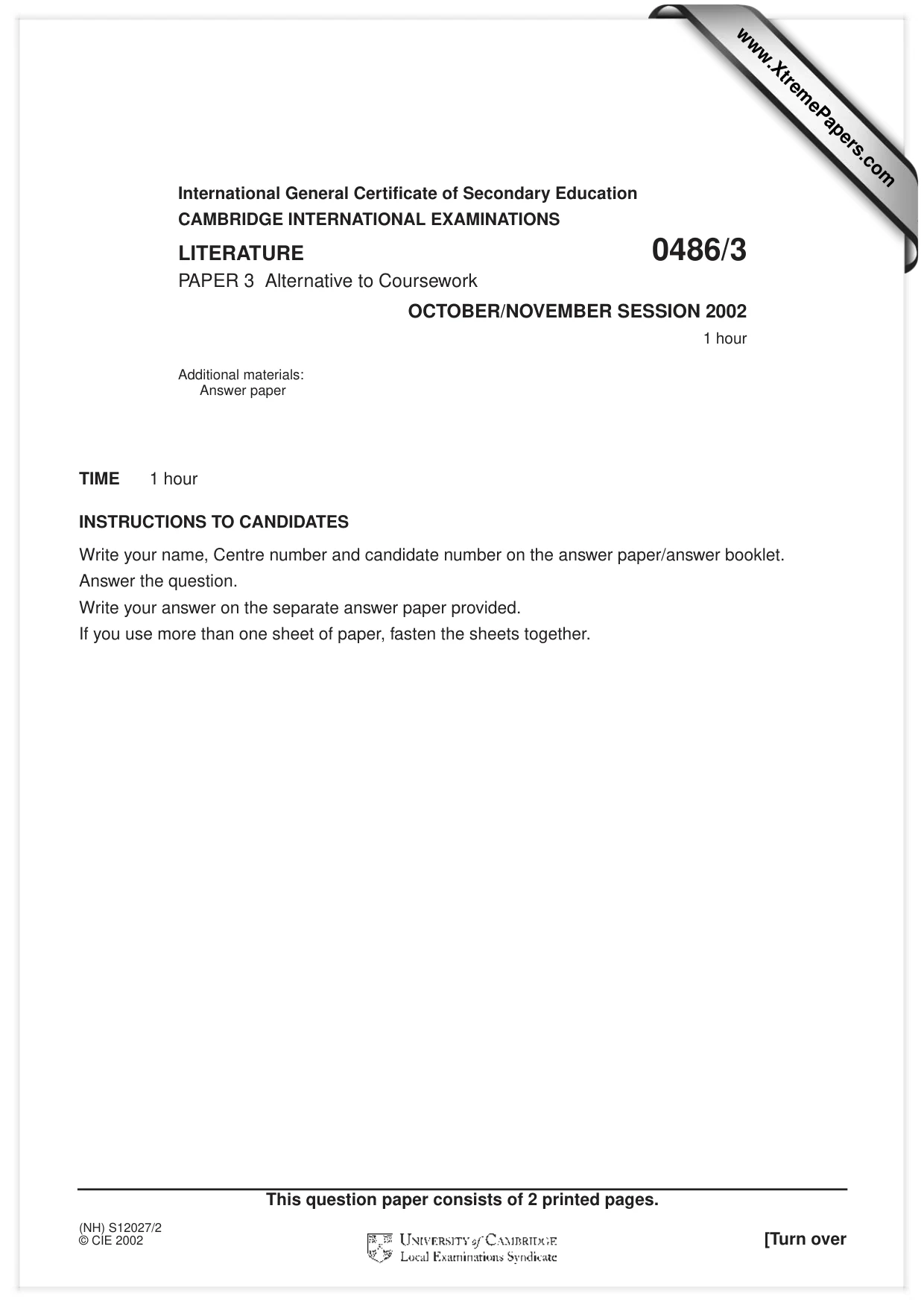
TIME 1 hour INSTRUCTIONS TO CANDIDATES Write your name, Centre number and candidate number on the answer paper/answer booklet. Answer the question. Write your answer on the separate answer paper provided. If you use more than one sheet of paper, fasten the sheets together. International General Certificate of Secondary Education CAMBRIDGE INTERNATIONAL EXAMINATIONS LITERATURE 0486/3 PAPER 3 Alternative to Coursework OCTOBER/NOVEMBER SESSION 2002 1 hour Additional materials: Answer paper This question paper consists of 2 printed pages. (NH) S12027/2 © CIE 2002 [Turn over www.XtremePapers.com
Question paper, page 2
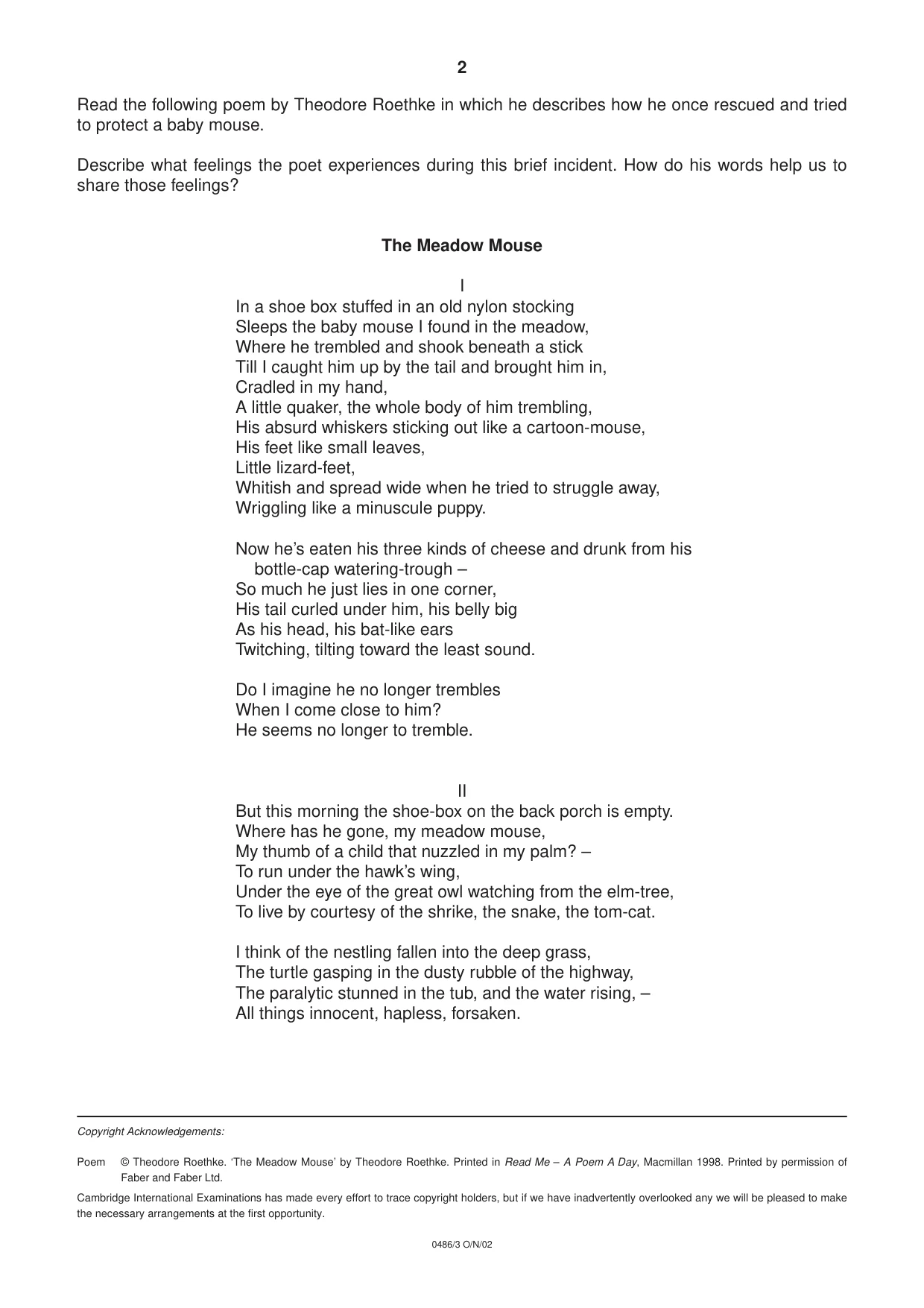
2 0486/3 O/N/02 Read the following poem by Theodore Roethke in which he describes how he once rescued and tried to protect a baby mouse. Describe what feelings the poet experiences during this brief incident. How do his words help us to share those feelings? The Meadow Mouse I In a shoe box stuffed in an old nylon stocking Sleeps the baby mouse I found in the meadow, Where he trembled and shook beneath a stick Till I caught him up by the tail and brought him in, Cradled in my hand, A little quaker, the whole body of him trembling, His absurd whiskers sticking out like a cartoon-mouse, His feet like small leaves, Little lizard-feet, Whitish and spread wide when he tried to struggle away, Wriggling like a minuscule puppy. Now he’s eaten his three kinds of cheese and drunk from his bottle-cap watering-trough – So much he just lies in one corner, His tail curled under him, his belly big As his head, his bat-like ears Twitching, tilting toward the least sound. Do I imagine he no longer trembles When I come close to him? He seems no longer to tremble. II But this morning the shoe-box on the back porch is empty. Where has he gone, my meadow mouse, My thumb of a child that nuzzled in my palm? – To run under the hawk’s wing, Under the eye of the great owl watching from the elm-tree, To live by courtesy of the shrike, the snake, the tom-cat. I think of the nestling fallen into the deep grass, The turtle gasping in the dusty rubble of the highway, The paralytic stunned in the tub, and the water rising, – All things innocent, hapless, forsaken. Copyright Acknowledgements: Poem © Theodore Roethke. ‘The Meadow Mouse’ by Theodore Roethke. Printed in Read Me – A Poem A Day, Macmillan 1998. Printed by permission of Faber and Faber Ltd. Cambridge International Examinations has made every effort to trace copyright holders, but if we have inadvertently overlooked any we will be pleased to make the necessary arrangements at the first opportunity.
Mark scheme, page 1
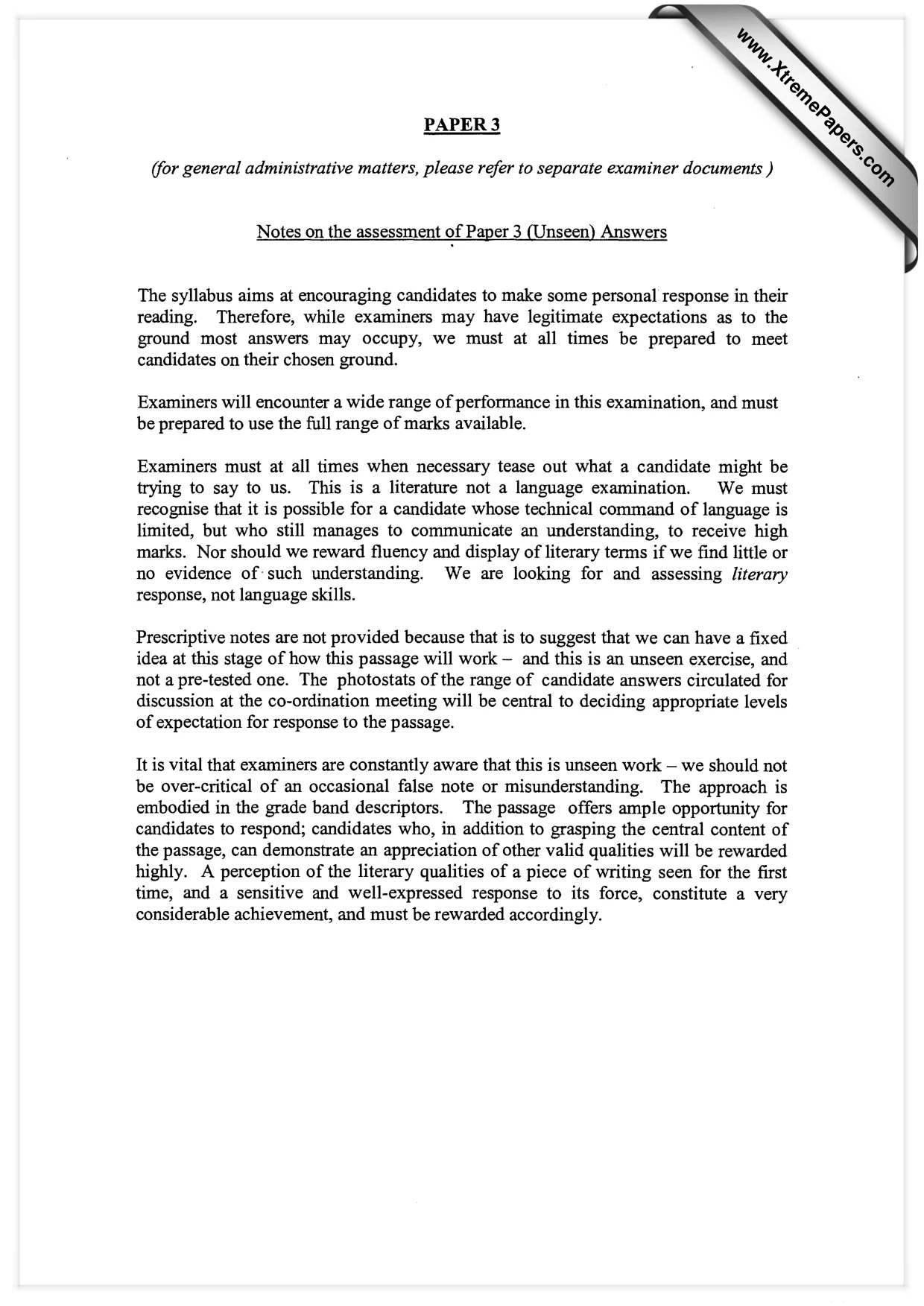
PAPER 3 (for general administrative matters, please refer to separate examiner documents ) Notes on the assessment of Paper 3 (Unseen) Answers The syllabus aims at encouraging candidates to make some personal response in their reading. Therefore, while examiners may have legitimate expectations as to the ground most answers may occupy, we must at all times be prepared to meet candidates on their chosen ground. Examiners will encounter a wide range of performance in this examination, and must be prepared to use the full range of marks available. Examiners must at all times when necessary tease out what a candidate might be trying to say to us. This is a literature not a language examination. We must recognise that it is possible for a candidate whose technical command of language is limited, but who still manages to communicate an understanding, to receive high marks. Nor should we reward fluency and display of literary terms if we find little or no evidence of such understanding. We are looking for and assessing literary response, not language skills. Prescriptive notes are not provided because that is to suggest that we can have a fixed idea at this stage of how this passage will work — and this is an unseen exercise, and not a pre-tested one. The photostats of the range of candidate answers circulated for discussion at the co-ordination meeting will be central to deciding appropriate levels of expectation for response to the passage. It is vital that examiners are constantly aware that this is unseen work — we should not be over-critical of an occasional false note or misunderstanding. The approach is embodied in the grade band descriptors. The passage offers ample opportunity for candidates to respond; candidates who, in addition to grasping the central content of the passage, can demonstrate an appreciation of other valid qualities will be rewarded highly. A perception of the literary qualities of a piece of writing seen for the first time, and a sensitive and well-expressed response to its force, constitute a very considerable achievement, and must be rewarded accordingly.
Mark scheme, page 2
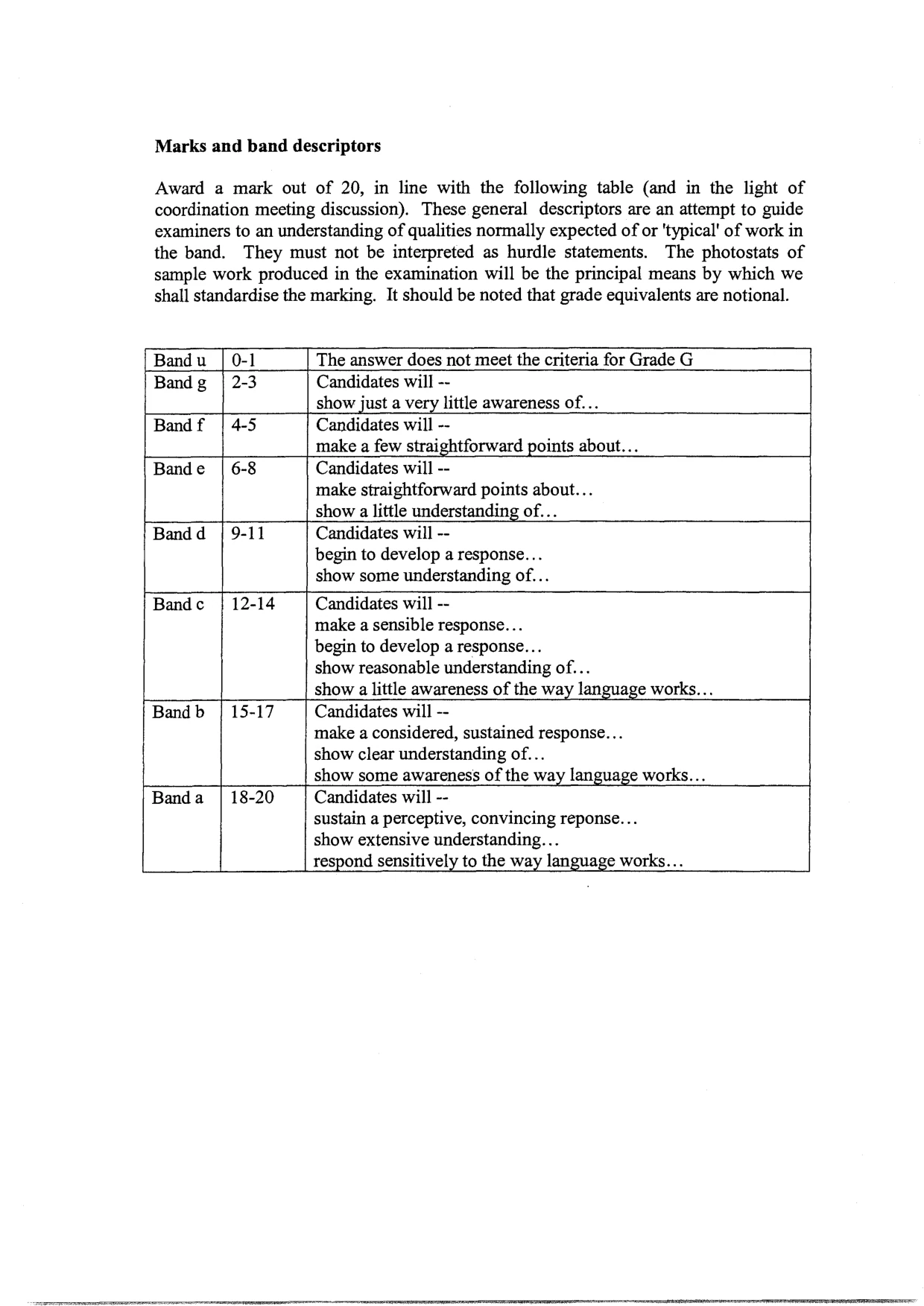
Marks and band descriptors Award a mark out of 20, in line with the following table (and in the light of coordination meeting discussion). These general descriptors are an attempt to guide examiners to an understanding of qualities normally expected of or 'typical' of work in the band. They must not be interpreted as hurdle statements. The photostats of sample work produced in the examination will be the principal means by which we shall standardise the marking. It should be noted that grade equivalents are notional. Bandu_| 0-1 The answer does not meet the criteria for Grade G Band g | 2-3 Candidates will -- show just a very little awareness of... Bandf | 4-5 Candidates will -- make a few straightforward points about... Bande | 6-8 Candidates will -- make straightforward points about... | show a little understanding of... Bandd | 9-11 Candidates will -- begin to develop a response... show some understanding of... Bandc | 12-14 Candidates will -- make a sensible response... begin to develop a response... show reasonable understanding of... show a little awareness of the way language works... Bandb | 15-17 Candidates will -- make a considered, sustained response... show clear understanding of... show some awareness of the way language works... Banda | 18-20 | Candidates will - sustain a perceptive, convincing reponse... show extensive understanding... respond sensitively to the way language works...