Cambridge IGCSE Economics 0455 — 2008 Oct/Nov Paper 4 · Variant 1
0455/41/O/N/08 · 7 questions · 80 marks · ≈90 min
The question paper and its mark scheme, free to read here and free to download. This is Cambridge’s own paper, exactly as it was sat.
Question paper8 pages



Mark scheme4 pages
Answers below. Sit the paper first if you are practising.
Questions as text
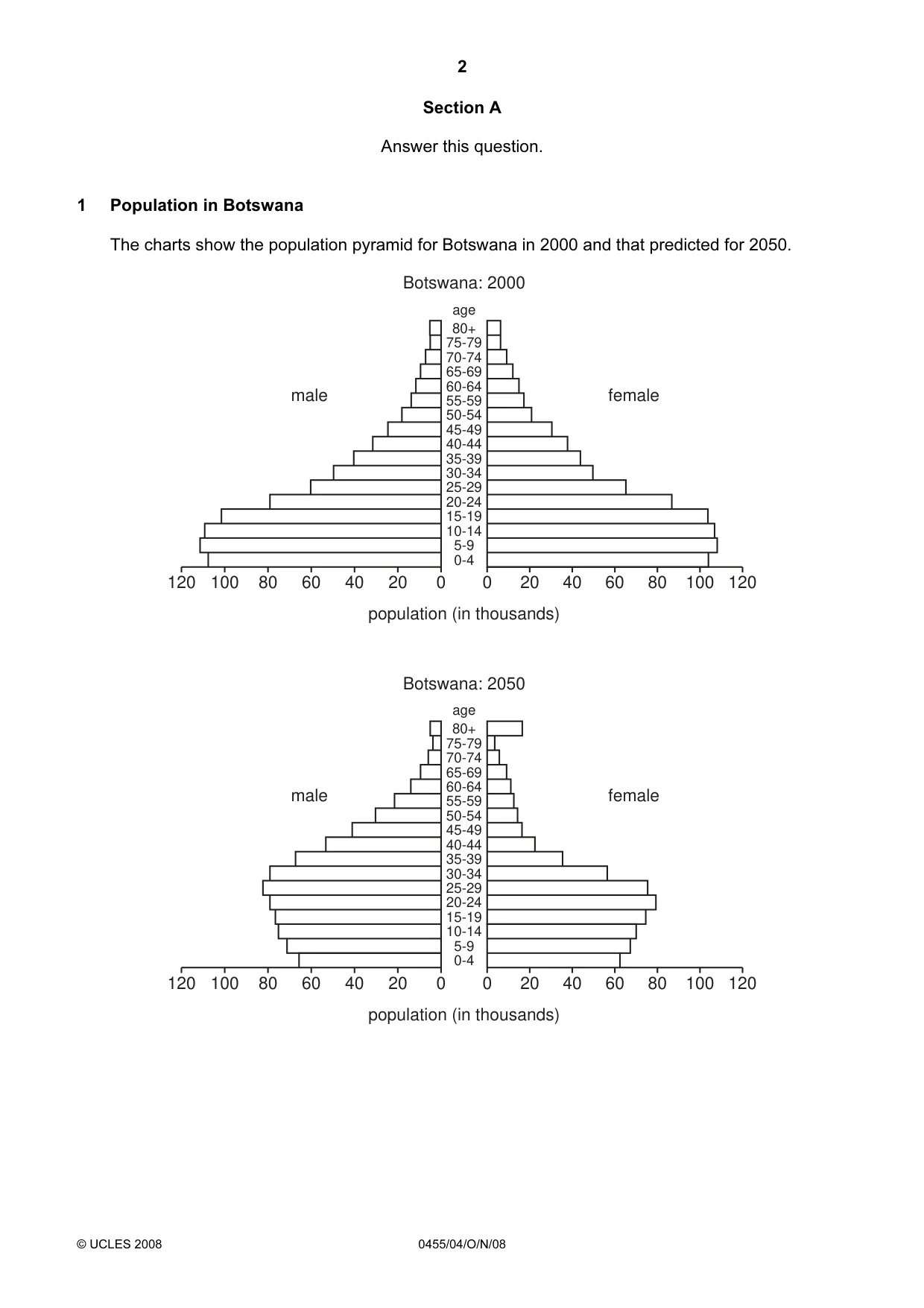
Q1 · Population in Botswana The charts show the population pyramid for Botswana in 2000 and…
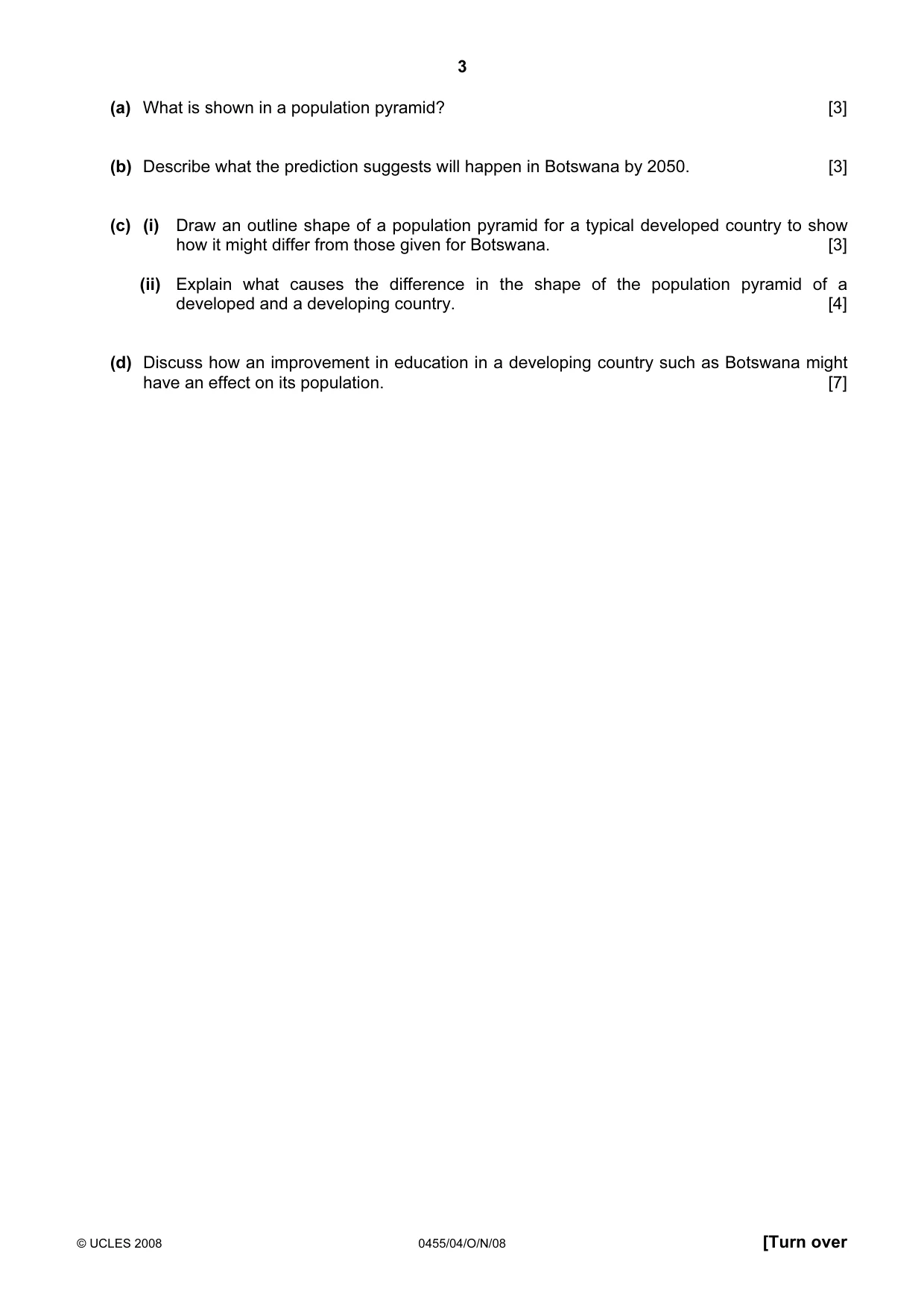
1 Population in Botswana The charts show the population pyramid for Botswana in 2000 and that predicted for 2050. Botswana: 2000 age 80+ 75-79 70-74 65-69 60-64 male 55-59 female 50-54 45-49 40-44 35-39 30-34 25-29 20-24 15-19 10-14 5-9 0-4 120 100 80 60 40 20 0 0 20 40 60 80 100 120 population (in thousands) Botswana: 2050 age 80+ 75-79 70-74 65-69 60-64 male 55-59 female 50-54 45-49 40-44 35-39 30-34 25-29 20-24 15-19 10-14 5-9 0-4 120 100 80 60 40 20 0 0 20 40 60 80 100 120 population (in thousands) (a) What is shown in a population pyramid? [3] (b) Describe what the prediction suggests will happen in Botswana by 2050. [3] (c) (i) Draw an outline shape of a population pyramid for a typical developed country to show how it might differ from those given for Botswana. [3] (ii) Explain what causes the difference in the shape of the population pyramid of a developed and a developing country. [4] (d) Discuss how an improvement in education in a developing country such as Botswana might have an effect on its population. [7]
Mark scheme: 1 (a) A diagram which shows the number of males and females (1) within different age groups (1) in the population of a particular country at a given time (1). [3] (b) The prediction suggests that the number in the lower age range will decline, those in the middle age ranges will increase but those in the higher age ranges will increase slightly for males but not for females – except at the very top. There is a possibility that the overall population will fall. [3] (c) (i) Diagram for a pyramid with more even shape. 1 mark for labels/numbering, 1 mark for recognising there will be more people at the older age ranges and 1 mark for recognising there will probably be proportionately fewer people in the lower age ranges. [3] (ii) The difference reflects the changes in the birth and death rates. The birth rate will be lower than an undeveloped country, death rate will be lower and more will live until an older age. This may be due to differences in health care, education, employment structures and social conditions. There may also be differences in migration. [4] (d) Education will affect people’s knowledge of health matters – especially important when compared with Botswana where AIDS is very common. There may be improved education for women which will affect their attitudes to child bearing and also give them employment opportunities. It will depend though on whether there are sufficient resources and developed infrastructure for the girls to go to school. In some countries girls spend hours each day walking to fetch water and do not have the time to then walk to school. There may be more skilled workers and this may involve geographical mobility or migration which will change cultural practices. Many girls are currently removed from school to look after the family especially if there is illness. [7] Award up to 4 marks for an essentially quantitative and/or micro approach; award 5 marks or above for an essentially qualitative and/or macro approach.
Q2 · Explain why different income groups might have a different pattern of spending and saving
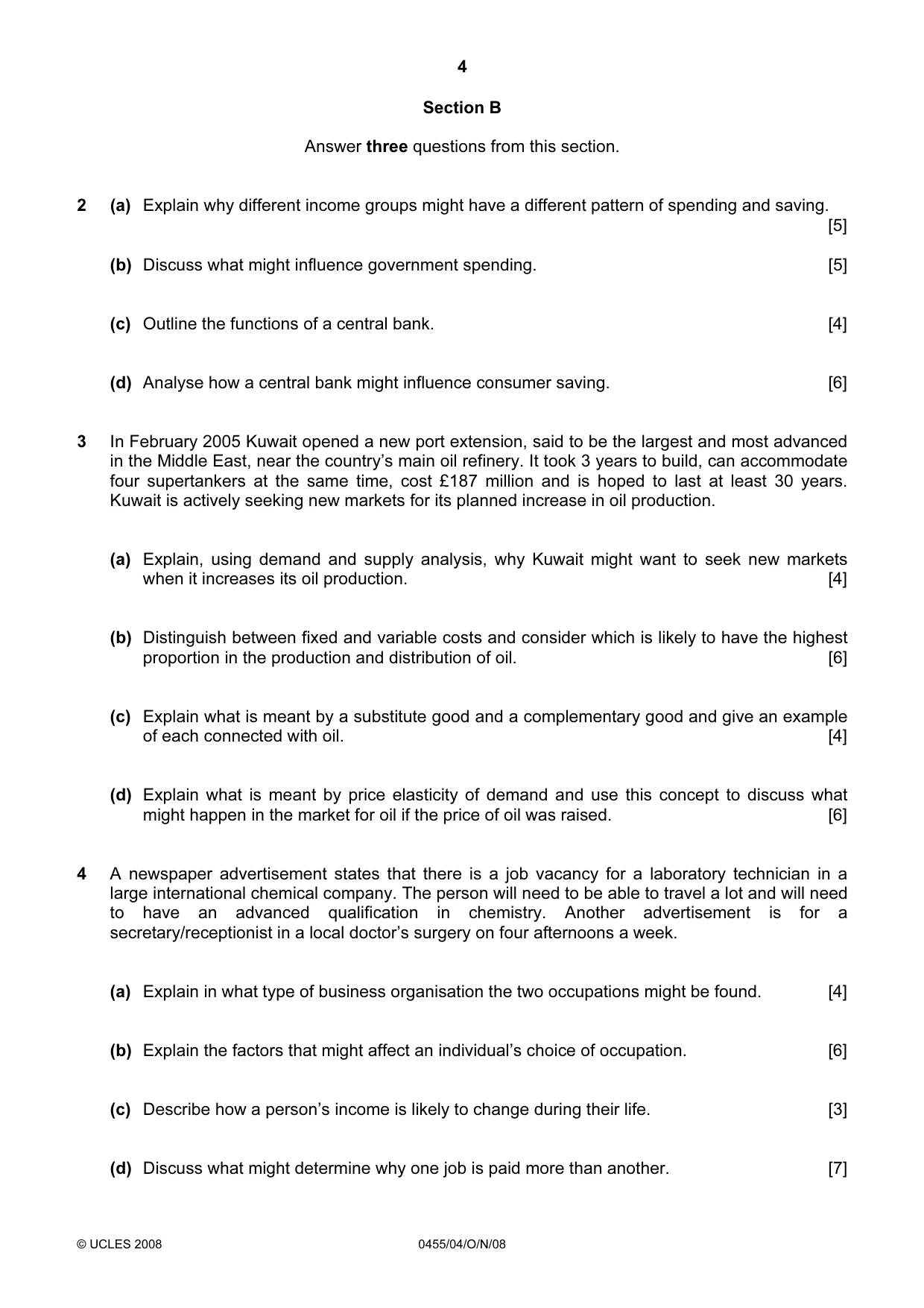
2 (a) Explain why different income groups might have a different pattern of spending and saving. [5] (b) Discuss what might influence government spending. [5] (c) Outline the functions of a central bank. [4] (d) Analyse how a central bank might influence consumer saving. [6]
Mark scheme: 2 (a) Explanation of the reasons for saving, spending, balance of necessities, luxuries, short term versus long term, likelihood of using credit. [5] (b) Discussion of the need to promote economic growth, control inflation, correct adverse changes in the balance of payments, alter the distribution of income, prevent excess inflation. Candidates could briefly debate which of the aims might be more significant. Accept any other valid influences. [5] (c) Outline the role of a central bank in determining interest rates, being the government’s bank, controlling the money supply. [4] (d) Candidates might not know the multiplier but should be able to analyse how a change in interest rates – rise or fall – might affect the level of saving, with comments as to why. Accept any other valid influences. [6] IGCSE – October/November 2008 0455 04
Q3 · In February 2005 Kuwait opened a new port extension, said to be the largest and most…
3 In February 2005 Kuwait opened a new port extension, said to be the largest and most advanced in the Middle East, near the country’s main oil refinery. It took 3 years to build, can accommodate four supertankers at the same time, cost £187 million and is hoped to last at least 30 years. Kuwait is actively seeking new markets for its planned increase in oil production. (a) Explain, using demand and supply analysis, why Kuwait might want to seek new markets when it increases its oil production. [4] (b) Distinguish between fixed and variable costs and consider which is likely to have the highest proportion in the production and distribution of oil. [6] (c) Explain what is meant by a substitute good and a complementary good and give an example of each connected with oil. [4] (d) Explain what is meant by price elasticity of demand and use this concept to discuss what might happen in the market for oil if the price of oil was raised. [6]
Mark scheme: 3 (a) Increase in supply causes prices to fall. Need to increase (shift) demand if price is to remain the same. It also needs to try to recover the huge expenditure on the new port extension. [4] Candidates do not have to include a diagram to gain maximum marks. If they include a diagram, however, with no explanation, they can gain no more than 2 marks. (b) Definition referring to changes in output (3). Huge investment in fixed equipment makes it likely that fixed costs will be a higher proportion, certainly in the production. Relative proportion might be more debateable in the distribution. Could give examples of each cost (3). [6] (c) Explanation of substitute and complementary goods (2). Relevant examples (2). [4] (d) Definition (2). Oil is likely to be price-inelastic so revenue/expenditure is likely to rise. However, in the long term, alternatives to oil may be used as new technology is developed (4). [6]
Q4 · A newspaper advertisement states that there is a job vacancy for a laboratory technician…
4 A newspaper advertisement states that there is a job vacancy for a laboratory technician in a large international chemical company. The person will need to be able to travel a lot and will need to have an advanced qualification in chemistry. Another advertisement is for a secretary/receptionist in a local doctor’s surgery on four afternoons a week. (a) Explain in what type of business organisation the two occupations might be found. [4] (b) Explain the factors that might affect an individual’s choice of occupation. [6] (c) Describe how a person’s income is likely to change during their life. [3] (d) Discuss what might determine why one job is paid more than another. [7]
Mark scheme: 4 (a) The first is likely to be a public limited company/multi-national (2) and the second a sole trader or partnership (2). Explanation of each type. [4] Vague comments on business sectors rather than business organisations can gain no more than 1 mark. (b) Wage and non-wage factors, travelling, timing, career prospects, location, working environment. A list of factors can gain no more than 3 marks. [6] (c) Description of an increase in earnings as career progresses, maybe promotion, maybe move to different jobs, then lower income after retirement, but may have income from investments, or other non-earned income. [3] (d) Discussion of supply and demand factors for labour, could mention balance of skill/non- skilled, male/female, public/private, occupational sector, training. An answer which fails to discuss demand and supply can gain no more than 4 marks. [7]
Q5 · Investment spending is undertaken by both the private sector and the public sector
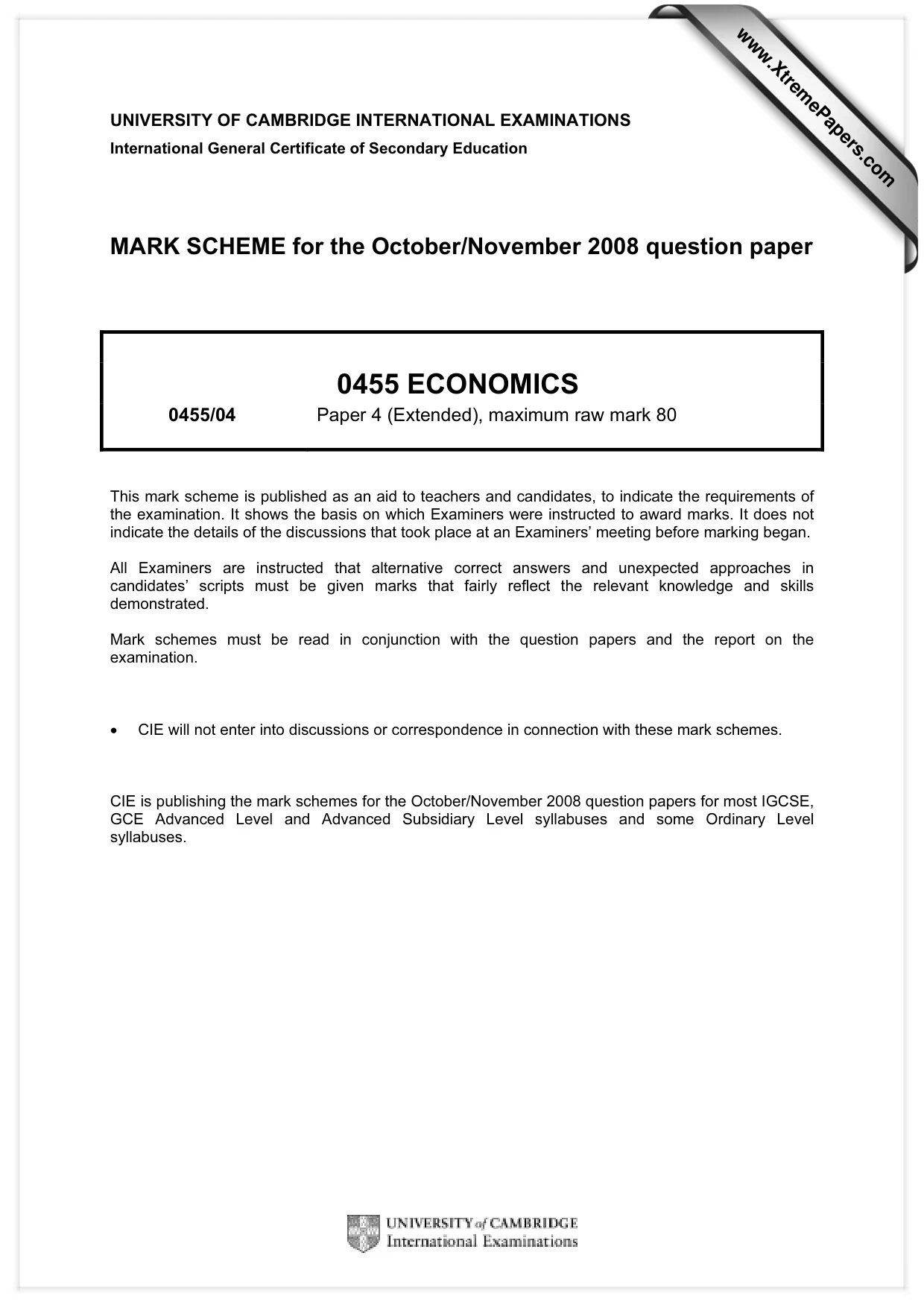
5 Investment spending is undertaken by both the private sector and the public sector. (a) Use examples to distinguish between private sector and public sector investment spending. [4] (b) Explain why investment spending is important for an economy. [6] (c) What is the difference between a mixed economy and a market economy? [4] (d) Explain how economic growth might change the relative importance of the primary, secondary and service sectors. [6]
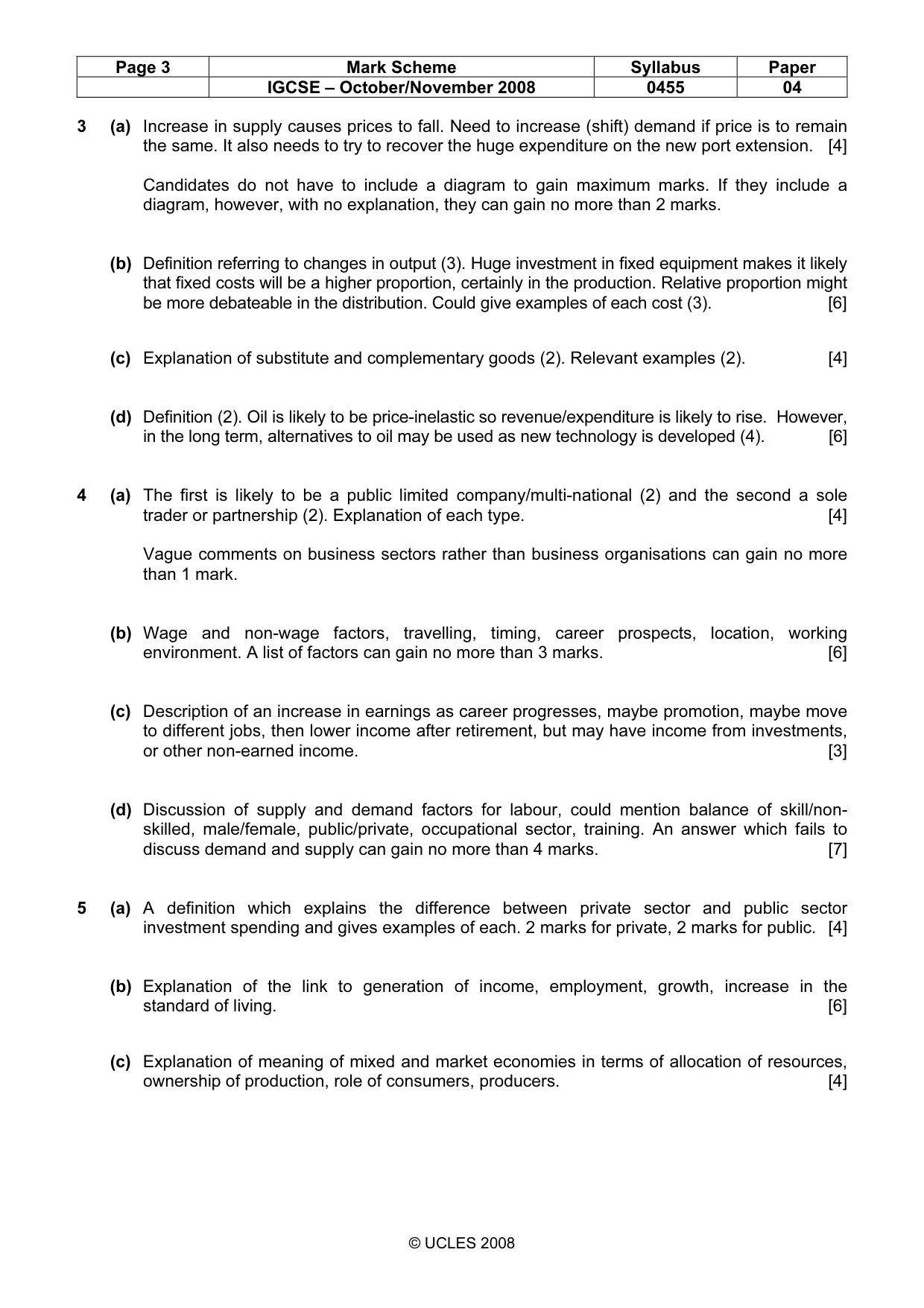
Mark scheme: 5 (a) A definition which explains the difference between private sector and public sector investment spending and gives examples of each. 2 marks for private, 2 marks for public. [4] (b) Explanation of the link to generation of income, employment, growth, increase in the standard of living. [6] (c) Explanation of meaning of mixed and market economies in terms of allocation of resources, ownership of production, role of consumers, producers. [4] IGCSE – October/November 2008 0455 04 (d) Explanation of the effects of growth in terms of increased incomes and changes in demand. Consideration of the shift in emphasis of the sectors away from primary traditionally, towards secondary then tertiary, but now often directly towards tertiary. Examples could be given – maybe in terms of tourism, or telephone sales and customer service centres. Candidates could mention that there would be a shift in emphasis within the tertiary sector from traditional domestic employment towards professional, entertainment or government occupations. [6]
Q6 · Low inflation and low unemployment are often aims of government policy
6 Low inflation and low unemployment are often aims of government policy. (a) What is meant by inflation? [3] (b) Explain how inflation is measured. [7] (c) Describe two reasons why there might be changes in the level of unemployment in a country. [4] (d) Discuss why governments might be concerned to keep the rate of unemployment low. [6]
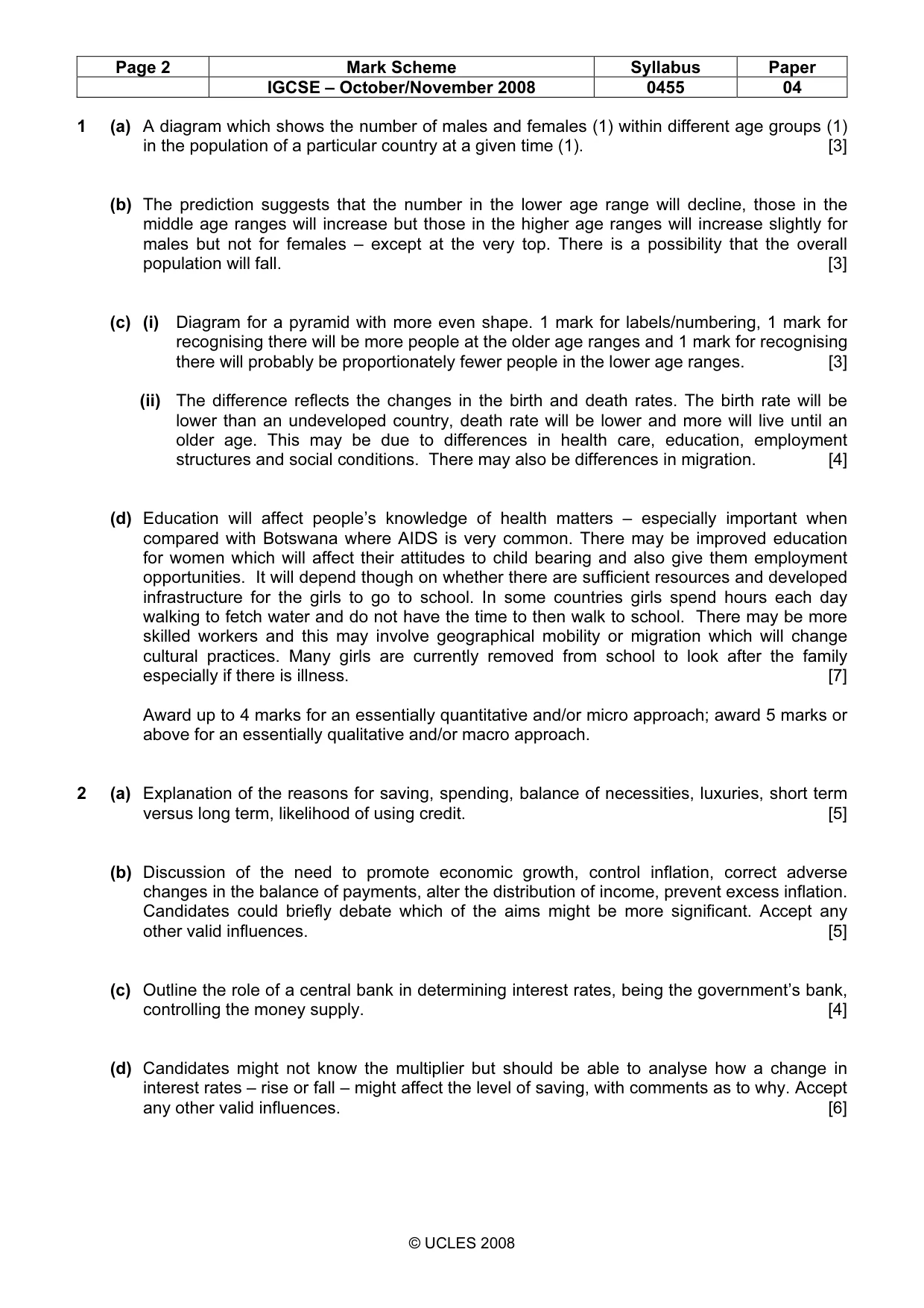
Mark scheme: 6 (a) A persistent or sustained (1) rise (1) in the general (1) level of prices. [3] Candidates who write about a fall in the value/purchasing power of money, which is really a consequence of inflation, can be awarded 1 mark. (b) Explanation of the use of the price index, base year, average household, basket of goods, weighted items, change from one period to another. [7] (c) Description of any two reasons for a change in unemployment. Note that this might mean a decrease as well as an increase in unemployment. Reasons could include changes in the structure of industry and services, changes in demand, changes in frictional or seasonal employment, changes in government expenditure in public services. 2 marks for each. [4] (d) Discussion of the reasons for the aim of low unemployment could, for example, include reference to economic growth caused by higher employment; to the reduction in government payment of benefits that occur if unemployment is reduced leaving more expenditure available for alternative programmes; to the desire to raise incomes and standards of living; to the resulting increase in tax income the government receives if employment increases. [6]
Q7 · Kenya and Tanzania have fishing rights in their coastal waters which contain large…
7 Kenya and Tanzania have fishing rights in their coastal waters which contain large numbers of commercial fish species. The fish are being caught illegally by boats from other African and Far Eastern countries. The European Union has negotiated to buy a share of the fishing rights for its own fishing companies and help control the industry in which there is a lack of capital and corrupt practices. However, the fear is that there will still be overfishing and not enough money will reach the Kenyan and Tanzanian economies. (a) Explain why developing countries such as Kenya and Tanzania might need the intervention of foreign companies. [4] (b) Is intervention by a foreign multi-national always beneficial for a country? [6] (c) Explain two policies a country might use in international trade to protect its home industries. [4] (d) If a country has a rich natural resource, should it exploit or conserve it? [6]
Mark scheme: 7 (a) No local capital, poor use of resources. Maybe no administrative organisation or, as in this case, corrupt organisation. [4] (b) It may create jobs, income, improvements in standards of living, but money may just go abroad, employment in more senior posts may not be of local people, local resources may be used and other countries benefit more. A one-sided answer can gain a maximum of 4 marks. [6] The question does not explicitly refer to economic effects, so non-economic effects can be accepted. (c) Explanation of two of the following: tariffs, quotas, embargoes, regulations, subsidies, exchange controls. [4] (d) Debate about the use of a resource, how the development is monitored and where the gains from exploiting the resource go, long term versus short term, trade aspects, consideration of whether it has other resources it might use or whether it is dependent on a particular resource, whether the resource is renewable. A one-sided answer can gain a maximum of 4 marks. [6]
More questions on Differences in economic development between countries
What was in this paper
The subtopics covered by these 7 questions, and how many questions each got. Open one in a new tab to see every Cambridge question on it.
What you needed in this session
Cambridge’s own grade thresholds for 2008 Oct/Nov, Paper 4 · Variant 1. A higher threshold means an easier paper — the bar moves with how the cohort did.