Cambridge IGCSE Economics 0455 — 2005 May/June Paper 4 · Variant 1
0455/41/M/J/05
The question paper and its mark scheme, free to read here and free to download. This is Cambridge’s own paper, exactly as it was sat.
Question paper4 pages
Mark scheme6 pages
Answers below. Sit the paper first if you are practising.
Paper as text
Question paper, page 1
This document consists of 4 pages. SP (SJF3518) S80963/4 © UCLES 2005 [Turn over UNIVERSITY OF CAMBRIDGE INTERNATIONAL EXAMINATIONS International General Certificate of Secondary Education ECONOMICS 0455/04 Paper 4 Structured Questions May/June 2005 2 hours Additional Materials: Answer Booklet/Paper READ THESE INSTRUCTIONS FIRST If you have been given an Answer Booklet, follow the instructions on the front cover of the Booklet. Write your Centre number, candidate number and name on all the work you hand in. Write in dark blue or black pen on both sides of the paper. You may use a soft pencil for any diagrams, graphs, music or rough working. Do not use staples, paper clips, highlighters, glue or correction fluid. Answer Question 1 (Section A) and any three questions from Section B. At the end of the examination, fasten all your work securely together. The number of marks is given in brackets [ ] at the end of each question or part question. www.XtremePapers.com
Question paper, page 2
2 0455/04/M/J/05 Section A Answer this question. 1 European recession In 2003 Germany, Italy and the Netherlands were in a period of recession. GDP in Germany fell by 0.2% between January and April, and by 0.1% between April and June. The recession spread to Italy, which is dependent on Germany as a market for its exports. The weakest of the three was the Netherlands, where output fell by 0.5% between April and June following a fall for the previous eight months. The German government planned to encourage consumer spending by introducing cuts in both indirect and direct taxation. It also approved measures to increase employment opportunities. (a) Why does the article refer to the Netherlands as the weakest economy? [2] (b) Explain what is meant by GDP. [3] (c) Using examples, describe the difference between direct and indirect taxes. [4] (d) How might a reduction in taxation help any two macro-economic aims of a government? [6] (e) Why might a government wish to increase employment opportunities? [5] © UCLES 2005
Question paper, page 3
3 0455/04/M/J/05 [Turn over Section B Answer any three questions. 2 (a) Distinguish between a quota and a subsidy. [5] (b) Explain, using a demand and supply diagram, what effect would be likely to occur in a market if the government introduced a subsidy on the production of a good. [5] (c) Explain what is meant by price elasticity of demand. [3] (d) In 2003, some tobacco growers in the US wanted to raise prices but a spokesman said the tobacco industry was no longer in a position where it could increase prices in order to increase revenue. Use the concept of price elasticity of demand to discuss what the spokesman meant. [7] 3 A major computer company announced in 2003 that its profits had fallen. (a) Explain what might cause profits to fall. [5] (b) There are some very large computer companies. How might a firm become large? [5] (c) Some companies are often said to benefit from economies of scale. Briefly describe three types of economies of scale that a computer company might experience. [6] (d) Discuss why a company might change its use of different factors of production. [4] 4 Some workers work long hours but earn little because the rate they receive for each hour worked is very low. (a) Why do you think a worker would be prepared to work for very low wages? [5] (b) What reasons might make a worker decide to move to another job at the same rate of pay? [5] (c) Some workers belong to a trade union. Explain how membership of a trade union might be beneficial to a worker. [5] (d) An older skilled worker’s pattern of spending and saving is likely to be different from that of a younger unskilled worker. Discuss why. [5] © UCLES 2005
Question paper, page 4
4 0455/04/M/J/05 5 Changes in the rate of exchange meant that exports of goods from Egypt decreased as they became more expensive in other countries. (a) Explain what is meant by a rate of exchange. [3] (b) If exports from Egypt became more expensive, how might that affect production and employment both in Egypt and in countries importing Egyptian goods? [7] (c) Describe the structure of the balance of payments of a country. [4] (d) Discuss what might lead to an improvement in the balance of payments of a country. [6] 6 (a) Explain what is meant by a market system. [5] (b) Discuss when it might be desirable for a government to act as a producer of goods or services. [6] (c) Sometimes the government does not act as a producer of goods and services but still influences private producers. Explain how it might do this. [9] 7 (a) In developing countries the standard of living is often lower than the standard of living in developed countries. Identify four indicators that might confirm this. [4] (b) Sometimes there is much poverty in developing countries. Discuss reasons why this might be so. [6] (c) Discuss how the standard of living in a developing country might be improved. [10] © UCLES 2005 Copyright Acknowledgements: Question 1. © Eric Pfanner, International Herald Tribune, August 15, 2003. Permission to reproduce items where third-party owned material protected by copyright is included has been sought and cleared where possible. Every reasonable effort has been made by the publisher (UCLES) to trace copyright holders, but if any items requiring clearance have unwittingly been included, the publisher will be pleased to make amends at the earliest possible opportunity. University of Cambridge International Examinations is part of the University of Cambridge Local Examinations Syndicate (UCLES), which is itself a department of the University of Cambridge.
Mark scheme, page 1
UNIVERSITY OF CAMBRIDGE INTERNATIONAL EXAMINATIONS International General Certificate of Secondary Education MARK SCHEME for the June 2005 question papers 0455 ECONOMICS 0455/04 Paper 4 (Extended), maximum mark 80 These mark schemes are published as an aid to teachers and students, to indicate the requirements of the examination. They show the basis on which Examiners were initially instructed to award marks. They do not indicate the details of the discussions that took place at an Examiners’ meeting before marking began. Any substantial changes to the mark scheme that arose from these discussions will be recorded in the published Report on the Examination. All Examiners are instructed that alternative correct answers and unexpected approaches in candidates’ scripts must be given marks that fairly reflect the relevant knowledge and skills demonstrated. Mark schemes must be read in conjunction with the question papers and the Report on the Examination. • CIE will not enter into discussion or correspondence in connection with these mark schemes. CIE is publishing the mark schemes for the June 2005 question papers for most IGCSE and GCE Advanced Level and Advanced Subsidiary Level syllabuses and some Ordinary Level syllabuses. www.XtremePapers.com
Mark scheme, page 2
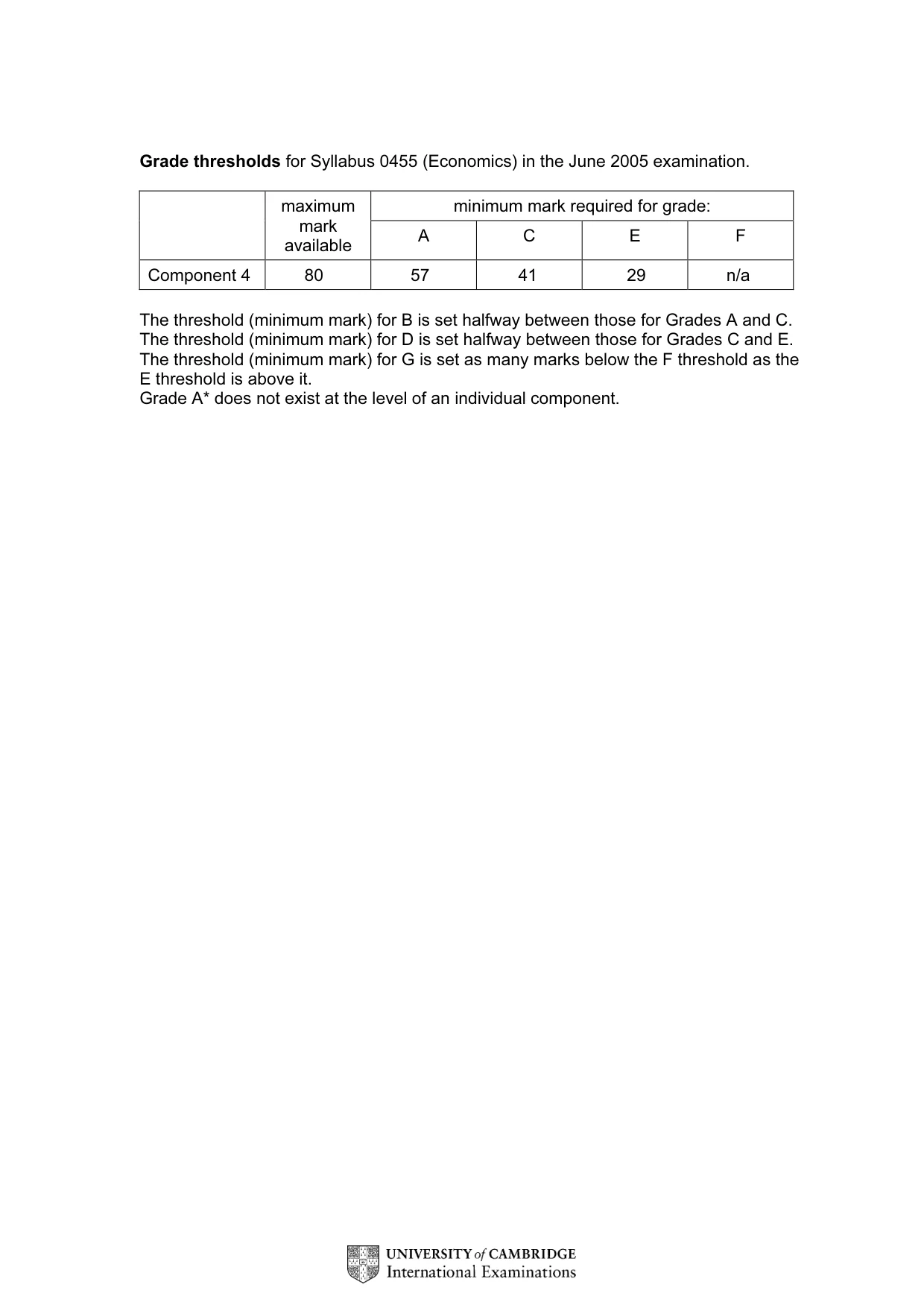
Grade thresholds for Syllabus 0455 (Economics) in the June 2005 examination. minimum mark required for grade: maximum mark available A C E F Component 4 80 57 41 29 n/a The threshold (minimum mark) for B is set halfway between those for Grades A and C. The threshold (minimum mark) for D is set halfway between those for Grades C and E. The threshold (minimum mark) for G is set as many marks below the F threshold as the E threshold is above it. Grade A* does not exist at the level of an individual component.
Mark scheme, page 3
June 2005 IGCSE MARK SCHEME MAXIMUM MARK: 80 SYLLABUS/COMPONENT: 0455/04 ECONOMICS (Extended)
Mark scheme, page 4
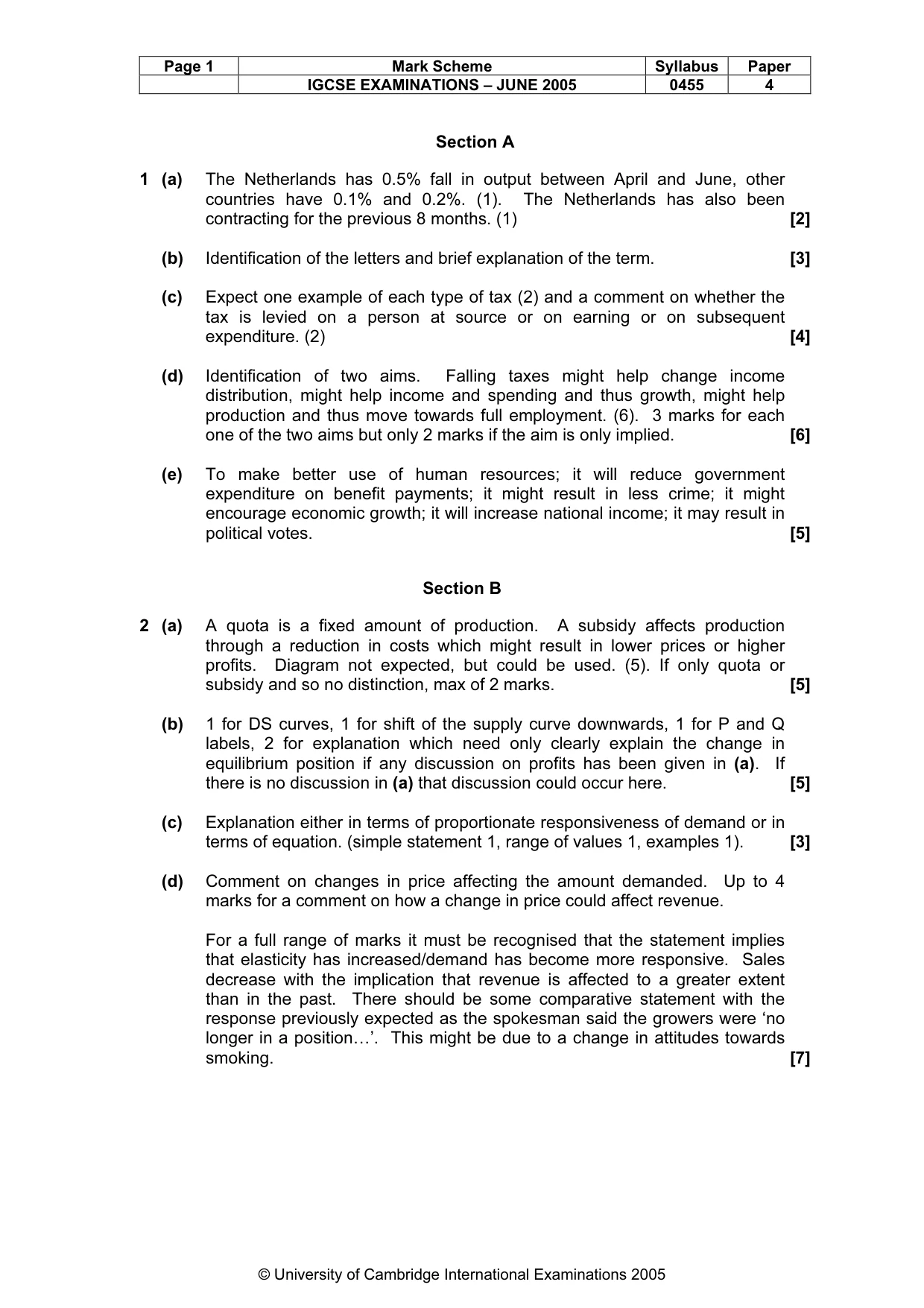
Page 1 Mark Scheme Syllabus Paper IGCSE EXAMINATIONS – JUNE 2005 0455 4 © University of Cambridge International Examinations 2005 Section A 1 (a) The Netherlands has 0.5% fall in output between April and June, other countries have 0.1% and 0.2%. (1). The Netherlands has also been contracting for the previous 8 months. (1) [2] (b) Identification of the letters and brief explanation of the term. [3] (c) Expect one example of each type of tax (2) and a comment on whether the tax is levied on a person at source or on earning or on subsequent expenditure. (2) [4] (d) Identification of two aims. Falling taxes might help change income distribution, might help income and spending and thus growth, might help production and thus move towards full employment. (6). 3 marks for each one of the two aims but only 2 marks if the aim is only implied. [6] (e) To make better use of human resources; it will reduce government expenditure on benefit payments; it might result in less crime; it might encourage economic growth; it will increase national income; it may result in political votes. [5] Section B 2 (a) A quota is a fixed amount of production. A subsidy affects production through a reduction in costs which might result in lower prices or higher profits. Diagram not expected, but could be used. (5). If only quota or subsidy and so no distinction, max of 2 marks. [5] (b) 1 for DS curves, 1 for shift of the supply curve downwards, 1 for P and Q labels, 2 for explanation which need only clearly explain the change in equilibrium position if any discussion on profits has been given in (a). If there is no discussion in (a) that discussion could occur here. [5] (c) Explanation either in terms of proportionate responsiveness of demand or in terms of equation. (simple statement 1, range of values 1, examples 1). [3] (d) Comment on changes in price affecting the amount demanded. Up to 4 marks for a comment on how a change in price could affect revenue. For a full range of marks it must be recognised that the statement implies that elasticity has increased/demand has become more responsive. Sales decrease with the implication that revenue is affected to a greater extent than in the past. There should be some comparative statement with the response previously expected as the spokesman said the growers were ‘no longer in a position…’. This might be due to a change in attitudes towards smoking. [7]
Mark scheme, page 5
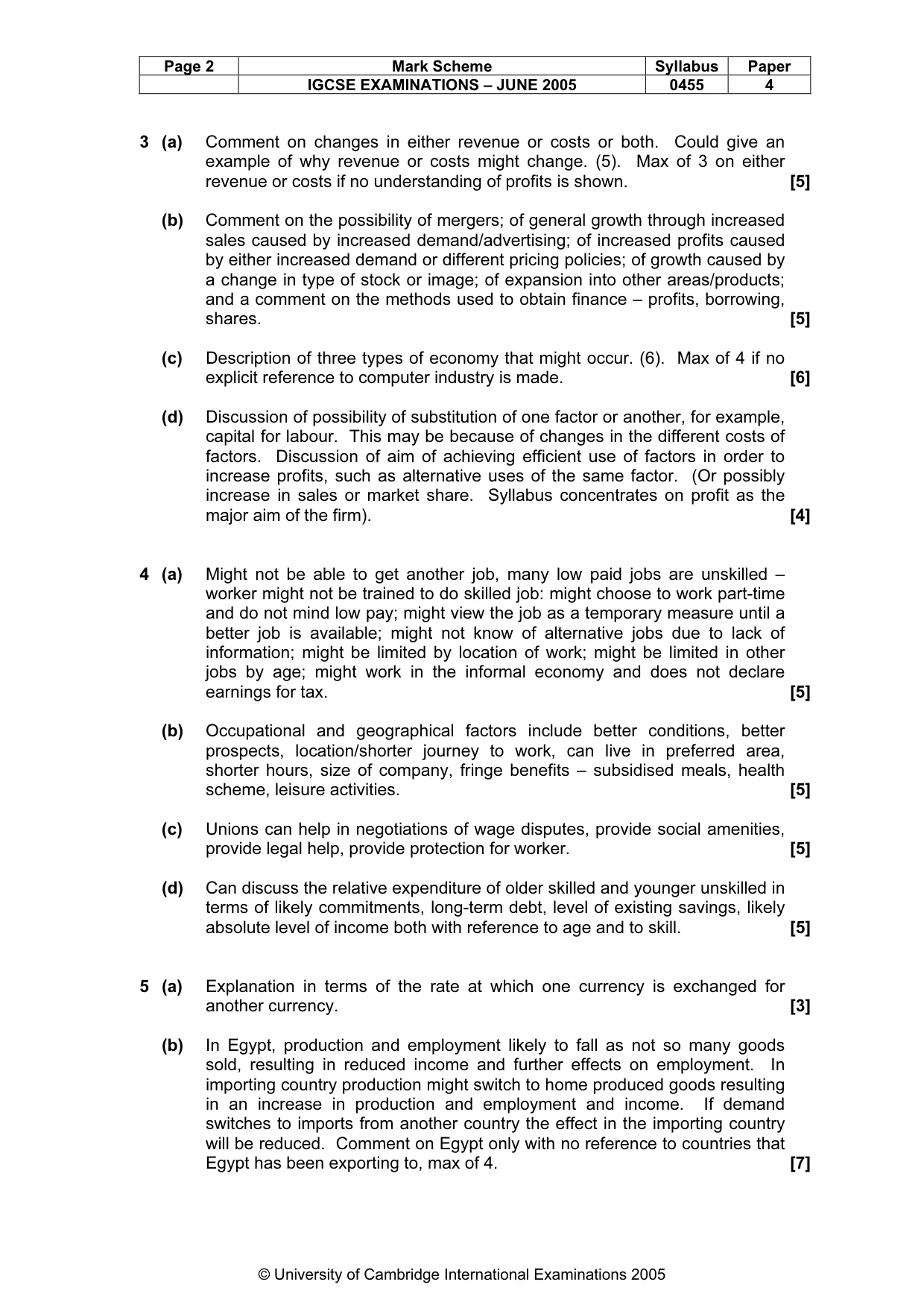
Page 2 Mark Scheme Syllabus Paper IGCSE EXAMINATIONS – JUNE 2005 0455 4 © University of Cambridge International Examinations 2005 3 (a) Comment on changes in either revenue or costs or both. Could give an example of why revenue or costs might change. (5). Max of 3 on either revenue or costs if no understanding of profits is shown. [5] (b) Comment on the possibility of mergers; of general growth through increased sales caused by increased demand/advertising; of increased profits caused by either increased demand or different pricing policies; of growth caused by a change in type of stock or image; of expansion into other areas/products; and a comment on the methods used to obtain finance – profits, borrowing, shares. [5] (c) Description of three types of economy that might occur. (6). Max of 4 if no explicit reference to computer industry is made. [6] (d) Discussion of possibility of substitution of one factor or another, for example, capital for labour. This may be because of changes in the different costs of factors. Discussion of aim of achieving efficient use of factors in order to increase profits, such as alternative uses of the same factor. (Or possibly increase in sales or market share. Syllabus concentrates on profit as the major aim of the firm). [4] 4 (a) Might not be able to get another job, many low paid jobs are unskilled – worker might not be trained to do skilled job: might choose to work part-time and do not mind low pay; might view the job as a temporary measure until a better job is available; might not know of alternative jobs due to lack of information; might be limited by location of work; might be limited in other jobs by age; might work in the informal economy and does not declare earnings for tax. [5] (b) Occupational and geographical factors include better conditions, better prospects, location/shorter journey to work, can live in preferred area, shorter hours, size of company, fringe benefits – subsidised meals, health scheme, leisure activities. [5] (c) Unions can help in negotiations of wage disputes, provide social amenities, provide legal help, provide protection for worker. [5] (d) Can discuss the relative expenditure of older skilled and younger unskilled in terms of likely commitments, long-term debt, level of existing savings, likely absolute level of income both with reference to age and to skill. [5] 5 (a) Explanation in terms of the rate at which one currency is exchanged for another currency. [3] (b) In Egypt, production and employment likely to fall as not so many goods sold, resulting in reduced income and further effects on employment. In importing country production might switch to home produced goods resulting in an increase in production and employment and income. If demand switches to imports from another country the effect in the importing country will be reduced. Comment on Egypt only with no reference to countries that Egypt has been exporting to, max of 4. [7]
Mark scheme, page 6
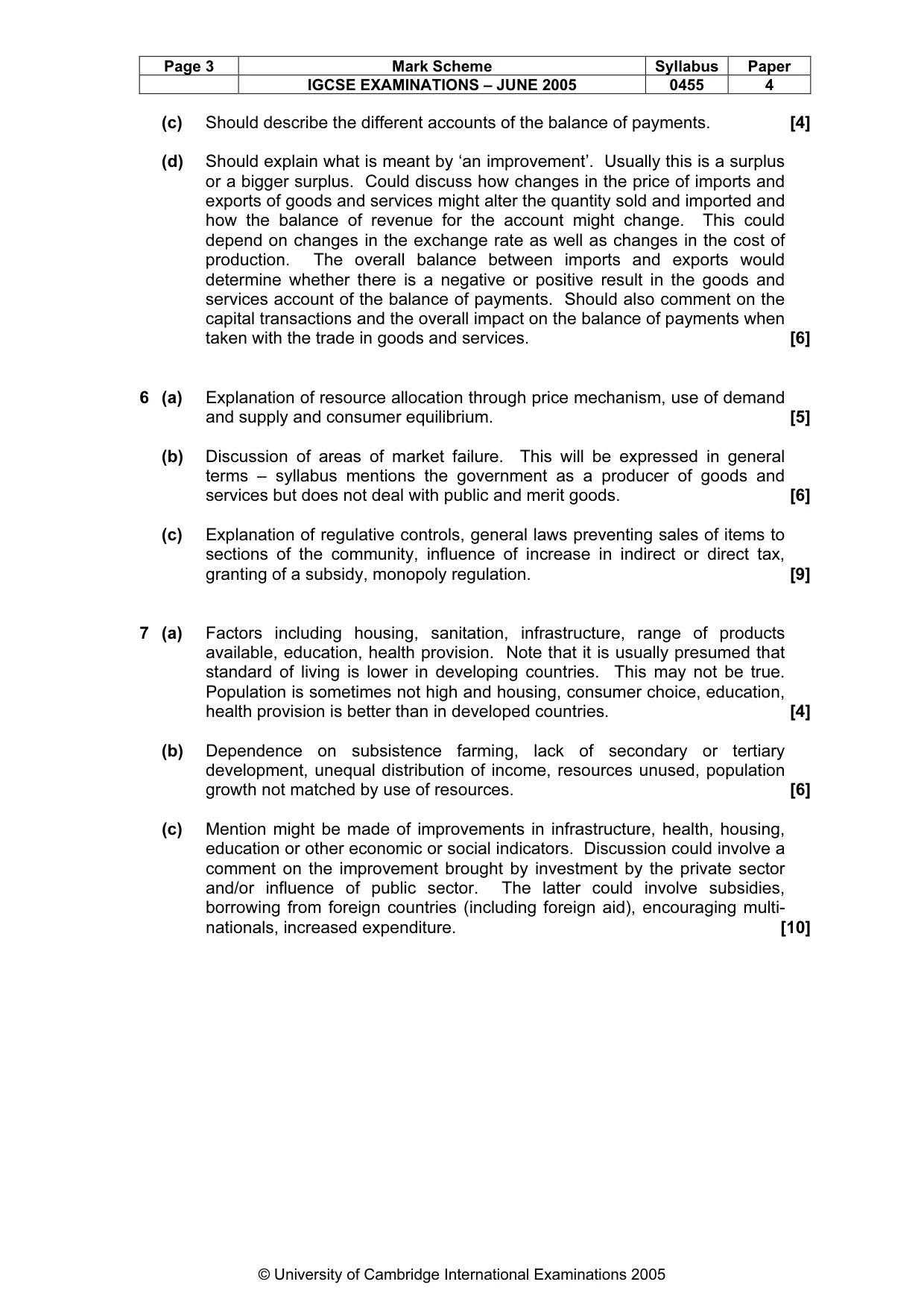
Page 3 Mark Scheme Syllabus Paper IGCSE EXAMINATIONS – JUNE 2005 0455 4 © University of Cambridge International Examinations 2005 (c) Should describe the different accounts of the balance of payments. [4] (d) Should explain what is meant by ‘an improvement’. Usually this is a surplus or a bigger surplus. Could discuss how changes in the price of imports and exports of goods and services might alter the quantity sold and imported and how the balance of revenue for the account might change. This could depend on changes in the exchange rate as well as changes in the cost of production. The overall balance between imports and exports would determine whether there is a negative or positive result in the goods and services account of the balance of payments. Should also comment on the capital transactions and the overall impact on the balance of payments when taken with the trade in goods and services. [6] 6 (a) Explanation of resource allocation through price mechanism, use of demand and supply and consumer equilibrium. [5] (b) Discussion of areas of market failure. This will be expressed in general terms – syllabus mentions the government as a producer of goods and services but does not deal with public and merit goods. [6] (c) Explanation of regulative controls, general laws preventing sales of items to sections of the community, influence of increase in indirect or direct tax, granting of a subsidy, monopoly regulation. [9] 7 (a) Factors including housing, sanitation, infrastructure, range of products available, education, health provision. Note that it is usually presumed that standard of living is lower in developing countries. This may not be true. Population is sometimes not high and housing, consumer choice, education, health provision is better than in developed countries. [4] (b) Dependence on subsistence farming, lack of secondary or tertiary development, unequal distribution of income, resources unused, population growth not matched by use of resources. [6] (c) Mention might be made of improvements in infrastructure, health, housing, education or other economic or social indicators. Discussion could involve a comment on the improvement brought by investment by the private sector and/or influence of public sector. The latter could involve subsidies, borrowing from foreign countries (including foreign aid), encouraging multi- nationals, increased expenditure. [10]