Cambridge IGCSE Economics 0455 — 2007 May/June Paper 4 · Variant 1
0455/41/M/J/07 · 7 questions · 80 marks · ≈90 min
The question paper and its mark scheme, free to read here and free to download. This is Cambridge’s own paper, exactly as it was sat.
Question paper4 pages
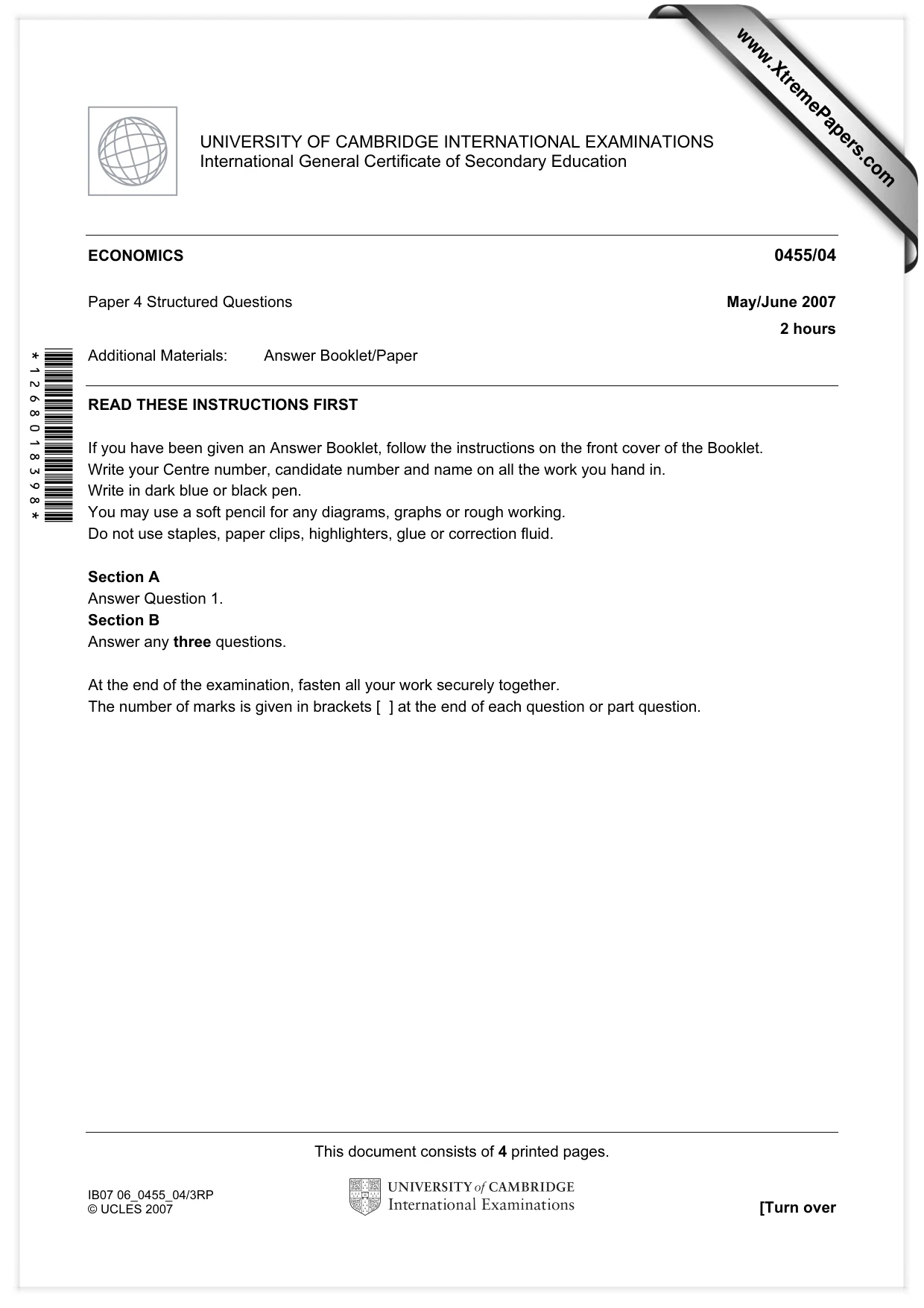
Mark scheme4 pages
Answers below. Sit the paper first if you are practising.
Questions as text
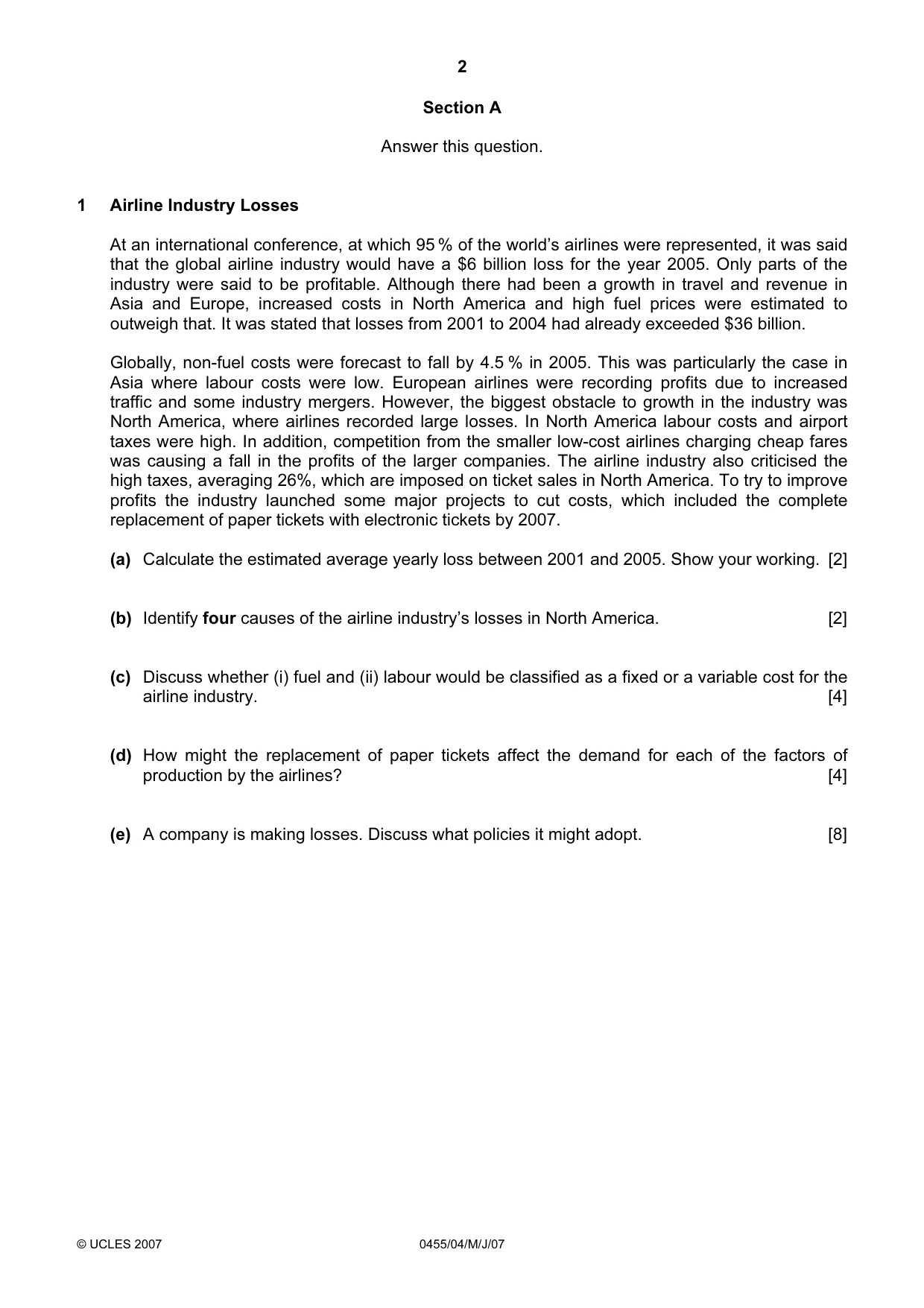
Q1 · Airline Industry Losses At an international conference, at which 95 % of the world’s…
1 Airline Industry Losses At an international conference, at which 95 % of the world’s airlines were represented, it was said that the global airline industry would have a $6 billion loss for the year 2005. Only parts of the industry were said to be profitable. Although there had been a growth in travel and revenue in Asia and Europe, increased costs in North America and high fuel prices were estimated to outweigh that. It was stated that losses from 2001 to 2004 had already exceeded $36 billion. Globally, non-fuel costs were forecast to fall by 4.5 % in 2005. This was particularly the case in Asia where labour costs were low. European airlines were recording profits due to increased traffic and some industry mergers. However, the biggest obstacle to growth in the industry was North America, where airlines recorded large losses. In North America labour costs and airport taxes were high. In addition, competition from the smaller low-cost airlines charging cheap fares was causing a fall in the profits of the larger companies. The airline industry also criticised the high taxes, averaging 26%, which are imposed on ticket sales in North America. To try to improve profits the industry launched some major projects to cut costs, which included the complete replacement of paper tickets with electronic tickets by 2007. (a) Calculate the estimated average yearly loss between 2001 and 2005. Show your working. [2] (b) Identify four causes of the airline industry’s losses in North America. [2] (c) Discuss whether (i) fuel and (ii) labour would be classified as a fixed or a variable cost for the airline industry. [4] (d) How might the replacement of paper tickets affect the demand for each of the factors of production by the airlines? [4] (e) A company is making losses. Discuss what policies it might adopt. [8]
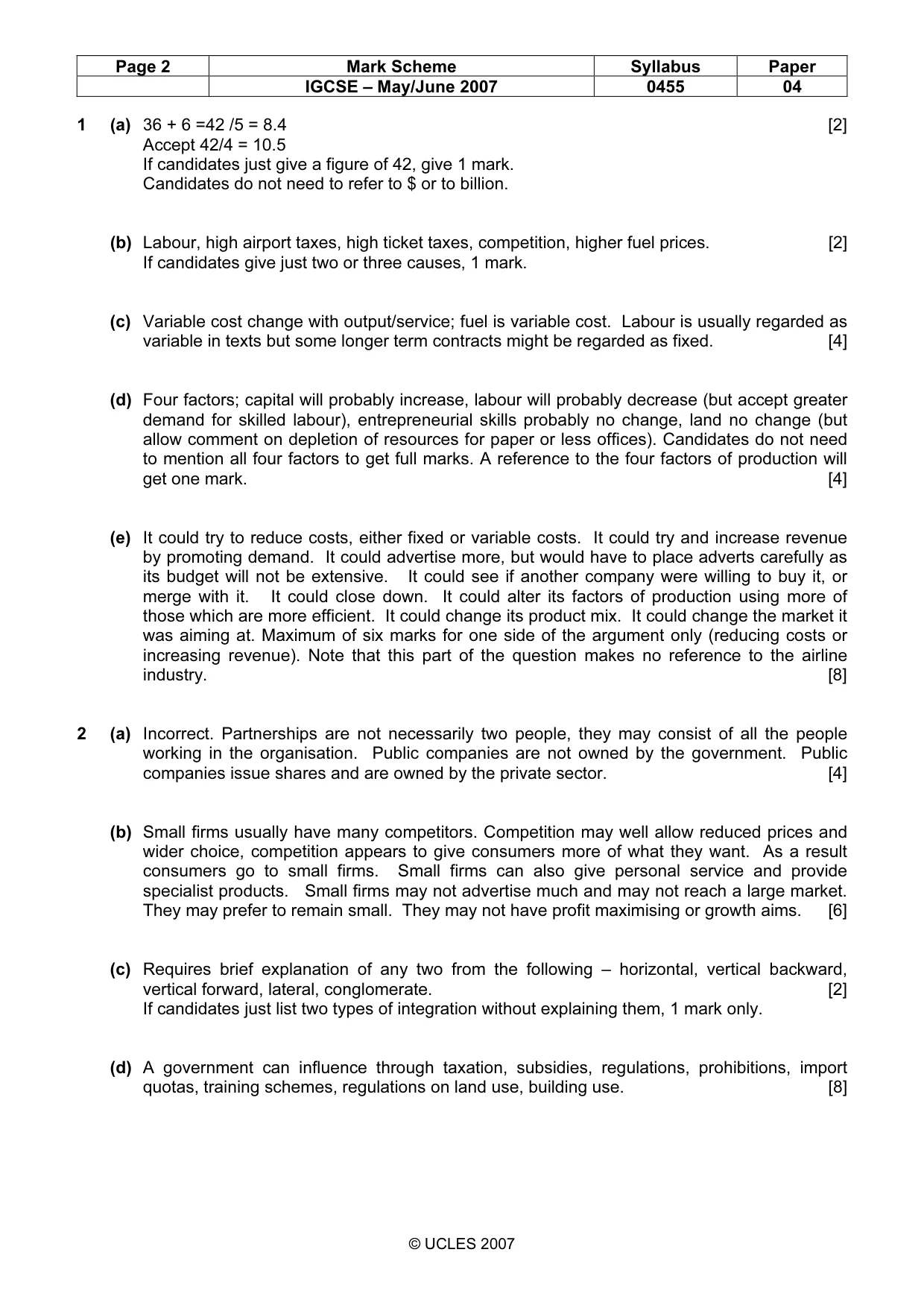
Mark scheme: 1 (a) 36 + 6 =42 /5 = 8.4 [2] Accept 42/4 = 10.5 If candidates just give a figure of 42, give 1 mark. Candidates do not need to refer to $ or to billion. (b) Labour, high airport taxes, high ticket taxes, competition, higher fuel prices. [2] If candidates give just two or three causes, 1 mark. (c) Variable cost change with output/service; fuel is variable cost. Labour is usually regarded as variable in texts but some longer term contracts might be regarded as fixed. [4] (d) Four factors; capital will probably increase, labour will probably decrease (but accept greater demand for skilled labour), entrepreneurial skills probably no change, land no change (but allow comment on depletion of resources for paper or less offices). Candidates do not need to mention all four factors to get full marks. A reference to the four factors of production will get one mark. [4] (e) It could try to reduce costs, either fixed or variable costs. It could try and increase revenue by promoting demand. It could advertise more, but would have to place adverts carefully as its budget will not be extensive. It could see if another company were willing to buy it, or merge with it. It could close down. It could alter its factors of production using more of those which are more efficient. It could change its product mix. It could change the market it was aiming at. Maximum of six marks for one side of the argument only (reducing costs or increasing revenue). Note that this part of the question makes no reference to the airline industry. [8]
Q2 · Partnerships are owned by only two people while public companies are owned by the…
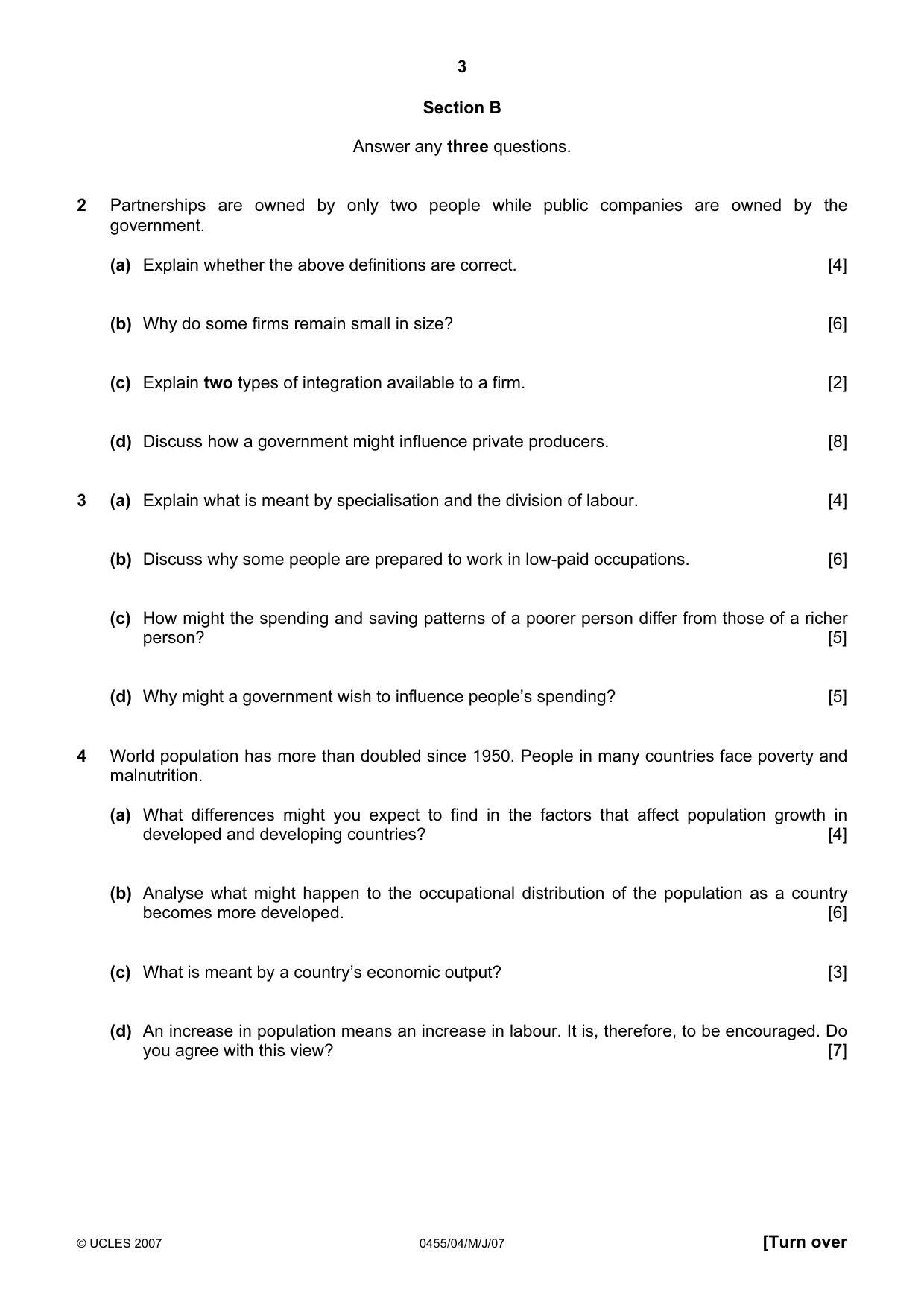
2 Partnerships are owned by only two people while public companies are owned by the government. (a) Explain whether the above definitions are correct. [4] (b) Why do some firms remain small in size? [6] (c) Explain two types of integration available to a firm. [2] (d) Discuss how a government might influence private producers. [8]
Mark scheme: 2 (a) Incorrect. Partnerships are not necessarily two people, they may consist of all the people working in the organisation. Public companies are not owned by the government. Public companies issue shares and are owned by the private sector. [4] (b) Small firms usually have many competitors. Competition may well allow reduced prices and wider choice, competition appears to give consumers more of what they want. As a result consumers go to small firms. Small firms can also give personal service and provide specialist products. Small firms may not advertise much and may not reach a large market. They may prefer to remain small. They may not have profit maximising or growth aims. [6] (c) Requires brief explanation of any two from the following – horizontal, vertical backward, vertical forward, lateral, conglomerate. [2] If candidates just list two types of integration without explaining them, 1 mark only. (d) A government can influence through taxation, subsidies, regulations, prohibitions, import quotas, training schemes, regulations on land use, building use. [8] IGCSE – May/June 2007 0455 04
Q3 · Explain what is meant by specialisation and the division of labour
3 (a) Explain what is meant by specialisation and the division of labour. [4] (b) Discuss why some people are prepared to work in low-paid occupations. [6] (c) How might the spending and saving patterns of a poorer person differ from those of a richer person? [5] (d) Why might a government wish to influence people’s spending? [5]
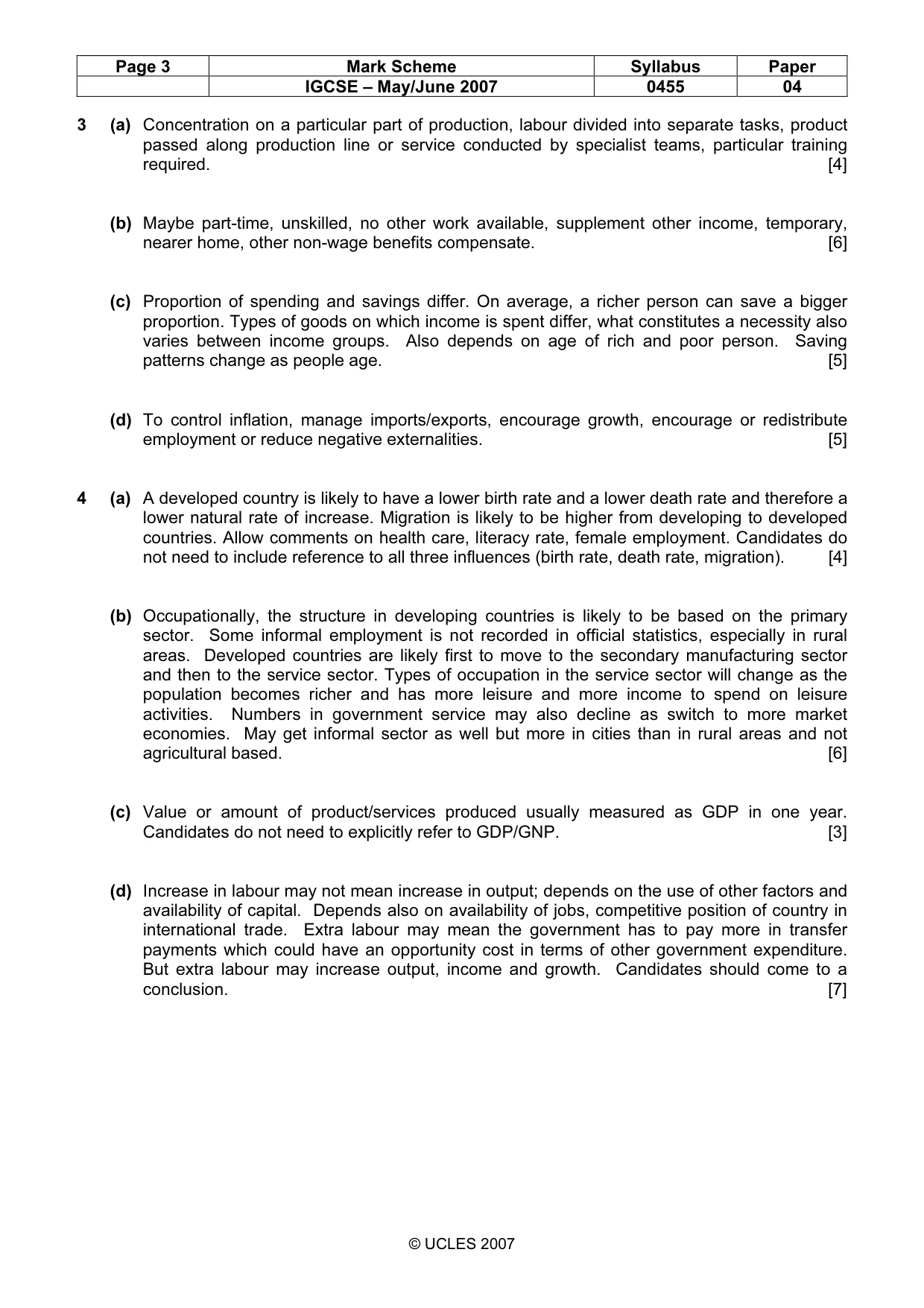
Mark scheme: 3 (a) Concentration on a particular part of production, labour divided into separate tasks, product passed along production line or service conducted by specialist teams, particular training required. [4] (b) Maybe part-time, unskilled, no other work available, supplement other income, temporary, nearer home, other non-wage benefits compensate. [6] (c) Proportion of spending and savings differ. On average, a richer person can save a bigger proportion. Types of goods on which income is spent differ, what constitutes a necessity also varies between income groups. Also depends on age of rich and poor person. Saving patterns change as people age. [5] (d) To control inflation, manage imports/exports, encourage growth, encourage or redistribute employment or reduce negative externalities. [5]
Q4 · World population has more than doubled since 1950
4 World population has more than doubled since 1950. People in many countries face poverty and malnutrition. (a) What differences might you expect to find in the factors that affect population growth in developed and developing countries? [4] (b) Analyse what might happen to the occupational distribution of the population as a country becomes more developed. [6] (c) What is meant by a country’s economic output? [3] (d) An increase in population means an increase in labour. It is, therefore, to be encouraged. Do you agree with this view? [7]
Mark scheme: 4 (a) A developed country is likely to have a lower birth rate and a lower death rate and therefore a lower natural rate of increase. Migration is likely to be higher from developing to developed countries. Allow comments on health care, literacy rate, female employment. Candidates do not need to include reference to all three influences (birth rate, death rate, migration). [4] (b) Occupationally, the structure in developing countries is likely to be based on the primary sector. Some informal employment is not recorded in official statistics, especially in rural areas. Developed countries are likely first to move to the secondary manufacturing sector and then to the service sector. Types of occupation in the service sector will change as the population becomes richer and has more leisure and more income to spend on leisure activities. Numbers in government service may also decline as switch to more market economies. May get informal sector as well but more in cities than in rural areas and not agricultural based. [6] (c) Value or amount of product/services produced usually measured as GDP in one year. Candidates do not need to explicitly refer to GDP/GNP. [3] (d) Increase in labour may not mean increase in output; depends on the use of other factors and availability of capital. Depends also on availability of jobs, competitive position of country in international trade. Extra labour may mean the government has to pay more in transfer payments which could have an opportunity cost in terms of other government expenditure. But extra labour may increase output, income and growth. Candidates should come to a conclusion. [7] IGCSE – May/June 2007 0455 04
Q5 · In 2005 Namibia entered into trade agreements with France, Italy and Austria
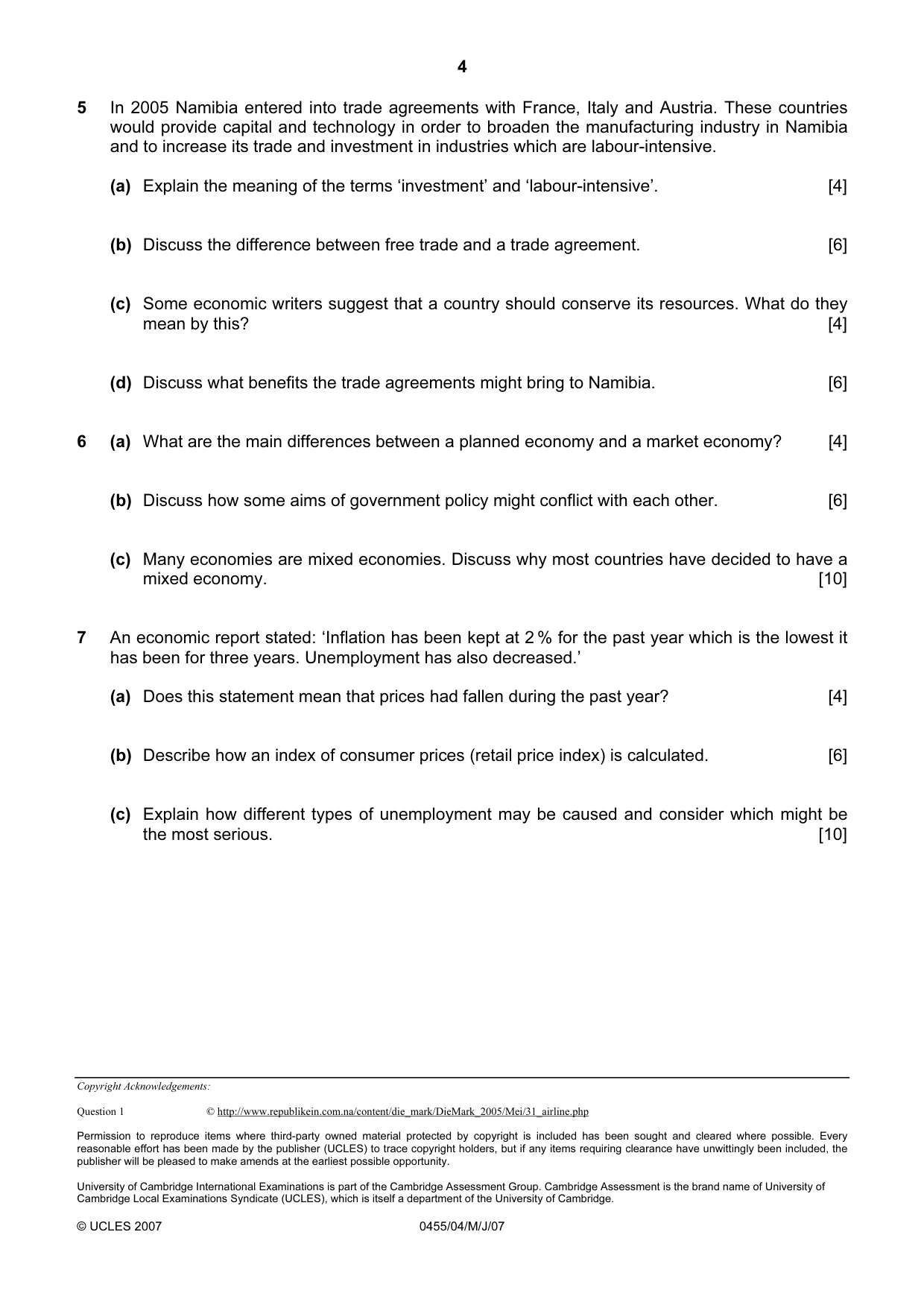
5 In 2005 Namibia entered into trade agreements with France, Italy and Austria. These countries would provide capital and technology in order to broaden the manufacturing industry in Namibia and to increase its trade and investment in industries which are labour-intensive. (a) Explain the meaning of the terms ‘investment’ and ‘labour-intensive’. [4] (b) Discuss the difference between free trade and a trade agreement. [6] (c) Some economic writers suggest that a country should conserve its resources. What do they mean by this? [4] (d) Discuss what benefits the trade agreements might bring to Namibia. [6]
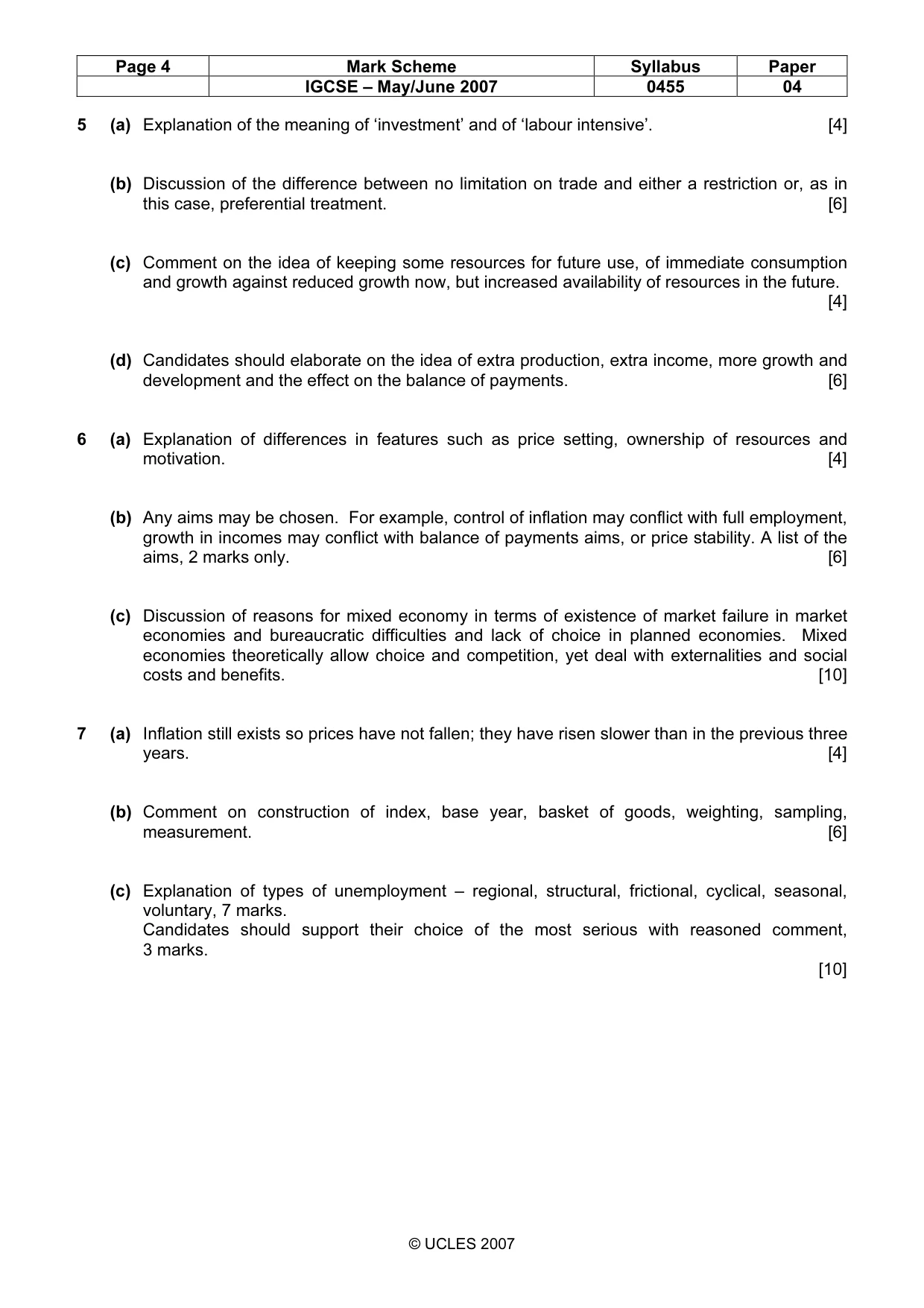
Mark scheme: 5 (a) Explanation of the meaning of ‘investment’ and of ‘labour intensive’. [4] (b) Discussion of the difference between no limitation on trade and either a restriction or, as in this case, preferential treatment. [6] (c) Comment on the idea of keeping some resources for future use, of immediate consumption and growth against reduced growth now, but increased availability of resources in the future. [4] (d) Candidates should elaborate on the idea of extra production, extra income, more growth and development and the effect on the balance of payments. [6]
Q6 · What are the main differences between a planned economy and a market economy?
6 (a) What are the main differences between a planned economy and a market economy? [4] (b) Discuss how some aims of government policy might conflict with each other. [6] (c) Many economies are mixed economies. Discuss why most countries have decided to have a mixed economy. [10]
Mark scheme: 6 (a) Explanation of differences in features such as price setting, ownership of resources and motivation. [4] (b) Any aims may be chosen. For example, control of inflation may conflict with full employment, growth in incomes may conflict with balance of payments aims, or price stability. A list of the aims, 2 marks only. [6] (c) Discussion of reasons for mixed economy in terms of existence of market failure in market economies and bureaucratic difficulties and lack of choice in planned economies. Mixed economies theoretically allow choice and competition, yet deal with externalities and social costs and benefits. [10]
Q7 · An economic report stated: ‘Inflation has been kept at 2 % for the past year which is the…
7 An economic report stated: ‘Inflation has been kept at 2 % for the past year which is the lowest it has been for three years. Unemployment has also decreased.’ (a) Does this statement mean that prices had fallen during the past year? [4] (b) Describe how an index of consumer prices (retail price index) is calculated. [6] (c) Explain how different types of unemployment may be caused and consider which might be the most serious. [10]
Mark scheme: 7 (a) Inflation still exists so prices have not fallen; they have risen slower than in the previous three years. [4] (b) Comment on construction of index, base year, basket of goods, weighting, sampling, measurement. [6] (c) Explanation of types of unemployment – regional, structural, frictional, cyclical, seasonal, voluntary, 7 marks. Candidates should support their choice of the most serious with reasoned comment, 3 marks. [10]
What was in this paper
The subtopics covered by these 7 questions, and how many questions each got. Open one in a new tab to see every Cambridge question on it.
What you needed in this session
Cambridge’s own grade thresholds for 2007 May/June, Paper 4 · Variant 1. A higher threshold means an easier paper — the bar moves with how the cohort did.