Cambridge IGCSE Economics 0455 — 2006 May/June Paper 4 · Variant 1
0455/41/M/J/06 · 80 marks · ≈90 min
The question paper and its mark scheme, free to read here and free to download. This is Cambridge’s own paper, exactly as it was sat.
Question paper4 pages
Mark scheme3 pages
Answers below. Sit the paper first if you are practising.
Paper as text
Question paper, page 1
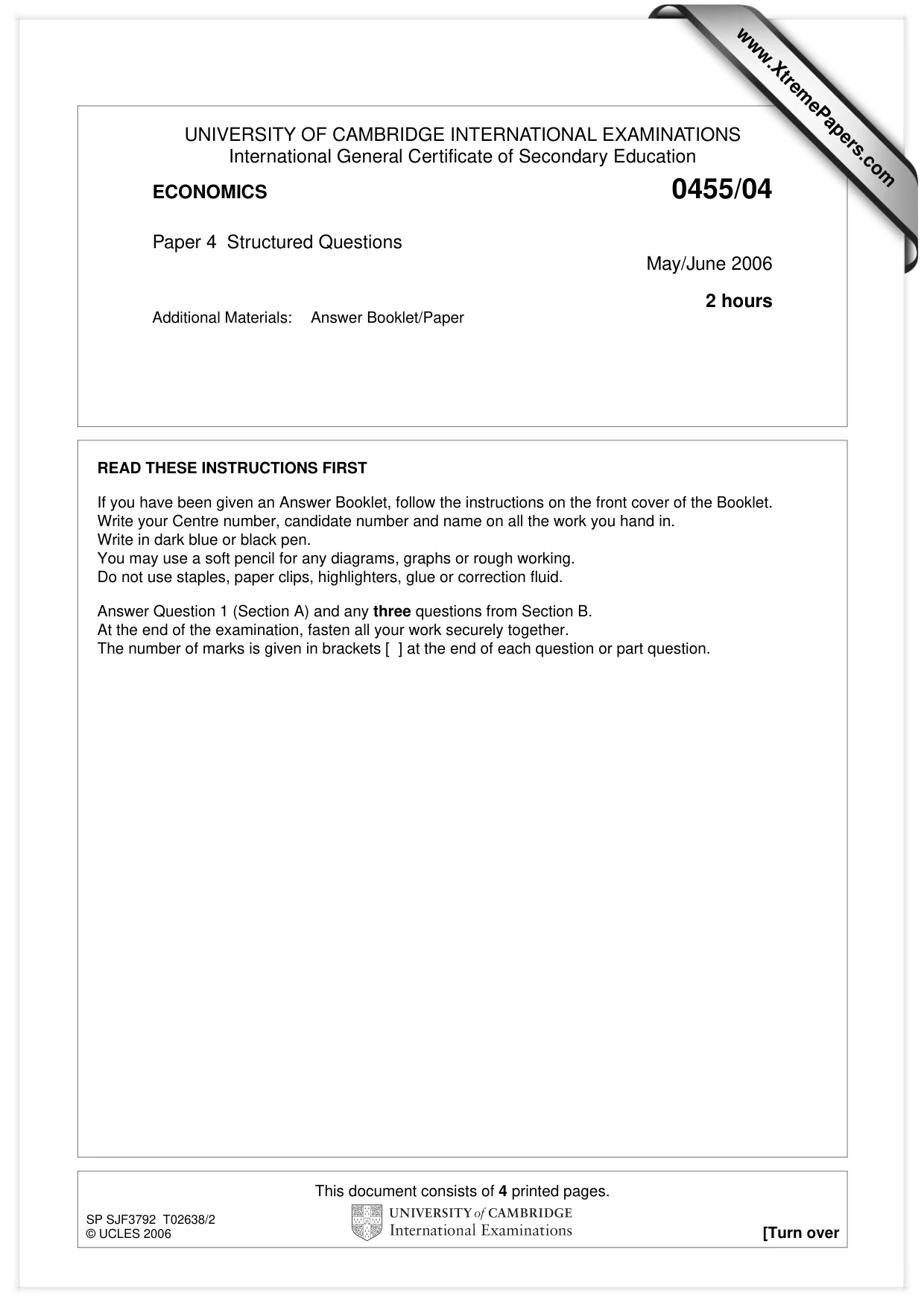
This document consists of 4 printed pages. SP SJF3792 T02638/2 © UCLES 2006 [Turn over UNIVERSITY OF CAMBRIDGE INTERNATIONAL EXAMINATIONS International General Certificate of Secondary Education ECONOMICS 0455/04 Paper 4 Structured Questions May/June 2006 2 hours Additional Materials: Answer Booklet/Paper READ THESE INSTRUCTIONS FIRST If you have been given an Answer Booklet, follow the instructions on the front cover of the Booklet. Write your Centre number, candidate number and name on all the work you hand in. Write in dark blue or black pen. You may use a soft pencil for any diagrams, graphs or rough working. Do not use staples, paper clips, highlighters, glue or correction fluid. Answer Question 1 (Section A) and any three questions from Section B. At the end of the examination, fasten all your work securely together. The number of marks is given in brackets [ ] at the end of each question or part question. www.XtremePapers.com
Question paper, page 2
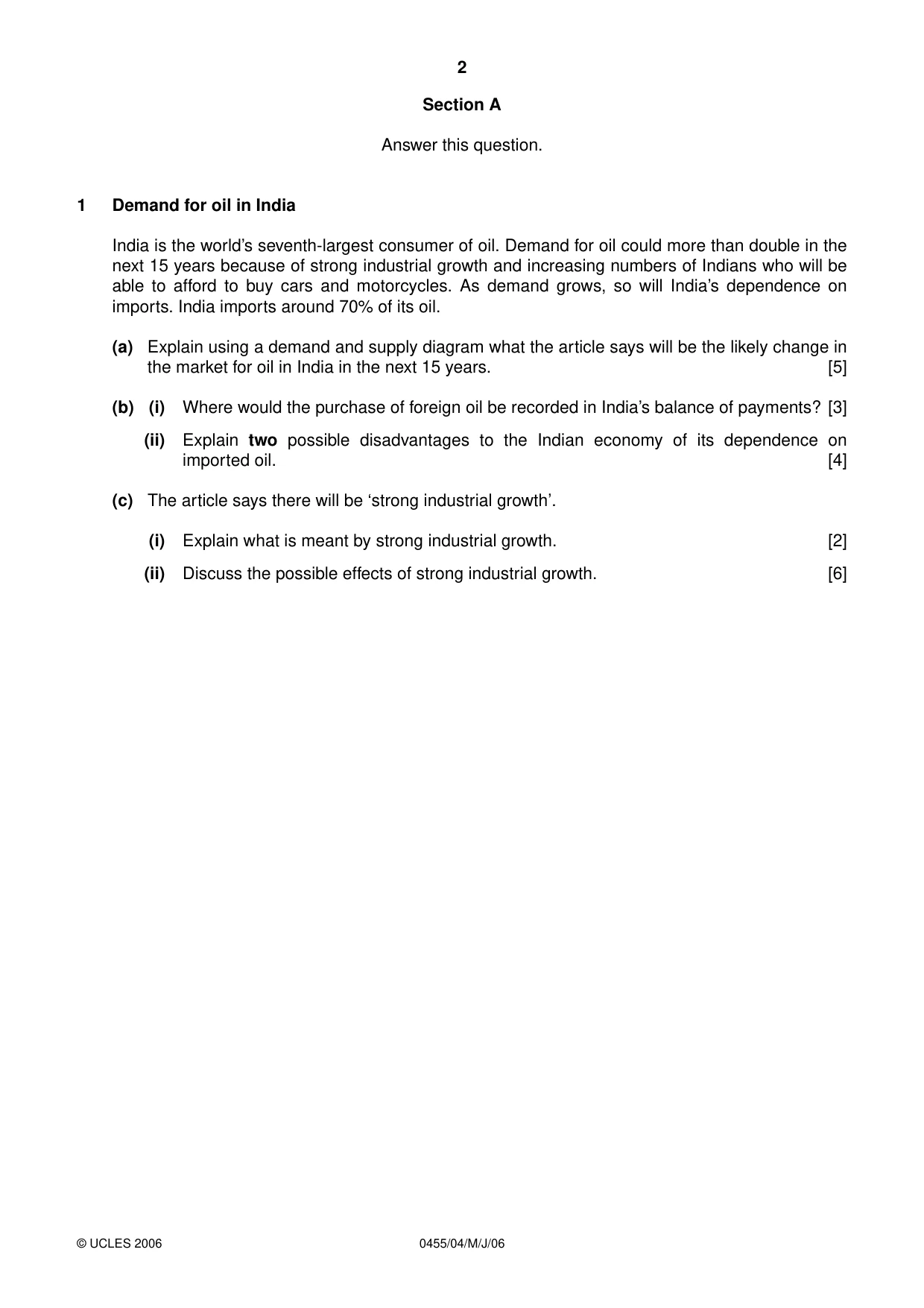
2 0455/04/M/J/06 Section A Answer this question. 1 Demand for oil in India India is the world’s seventh-largest consumer of oil. Demand for oil could more than double in the next 15 years because of strong industrial growth and increasing numbers of Indians who will be able to afford to buy cars and motorcycles. As demand grows, so will India’s dependence on imports. India imports around 70% of its oil. (a) Explain using a demand and supply diagram what the article says will be the likely change in the market for oil in India in the next 15 years. [5] (b) (i) Where would the purchase of foreign oil be recorded in India’s balance of payments? [3] (ii) Explain two possible disadvantages to the Indian economy of its dependence on imported oil. [4] (c) The article says there will be ‘strong industrial growth’. (i) Explain what is meant by strong industrial growth. [2] (ii) Discuss the possible effects of strong industrial growth. [6] © UCLES 2006
Question paper, page 3
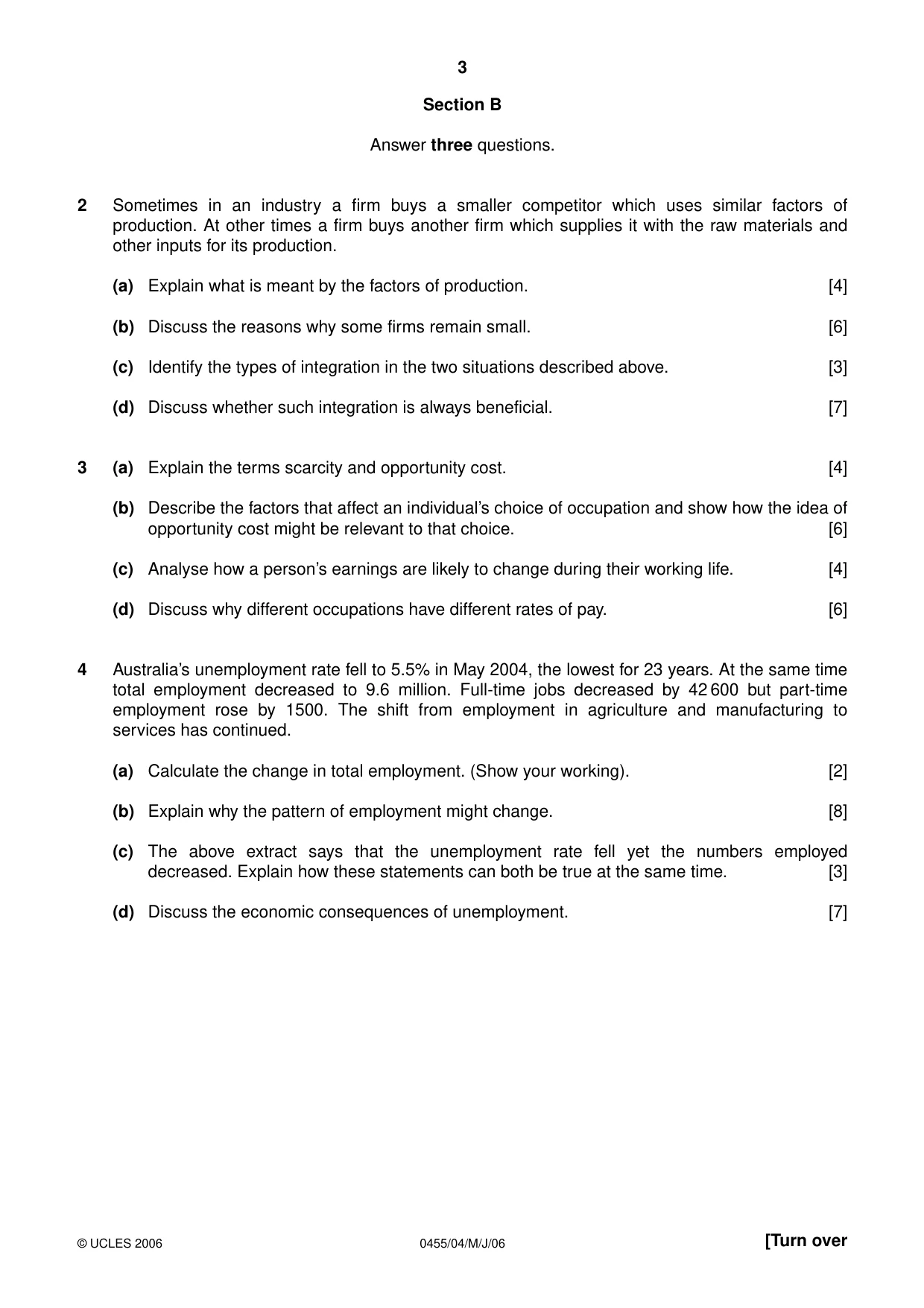
3 0455/04/M/J/06 [Turn over Section B Answer three questions. 2 Sometimes in an industry a firm buys a smaller competitor which uses similar factors of production. At other times a firm buys another firm which supplies it with the raw materials and other inputs for its production. (a) Explain what is meant by the factors of production. [4] (b) Discuss the reasons why some firms remain small. [6] (c) Identify the types of integration in the two situations described above. [3] (d) Discuss whether such integration is always beneficial. [7] 3 (a) Explain the terms scarcity and opportunity cost. [4] (b) Describe the factors that affect an individual’s choice of occupation and show how the idea of opportunity cost might be relevant to that choice. [6] (c) Analyse how a person’s earnings are likely to change during their working life. [4] (d) Discuss why different occupations have different rates of pay. [6] 4 Australia’s unemployment rate fell to 5.5% in May 2004, the lowest for 23 years. At the same time total employment decreased to 9.6 million. Full-time jobs decreased by 42 600 but part-time employment rose by 1500. The shift from employment in agriculture and manufacturing to services has continued. (a) Calculate the change in total employment. (Show your working). [2] (b) Explain why the pattern of employment might change. [8] (c) The above extract says that the unemployment rate fell yet the numbers employed decreased. Explain how these statements can both be true at the same time. [3] (d) Discuss the economic consequences of unemployment. [7] © UCLES 2006
Question paper, page 4
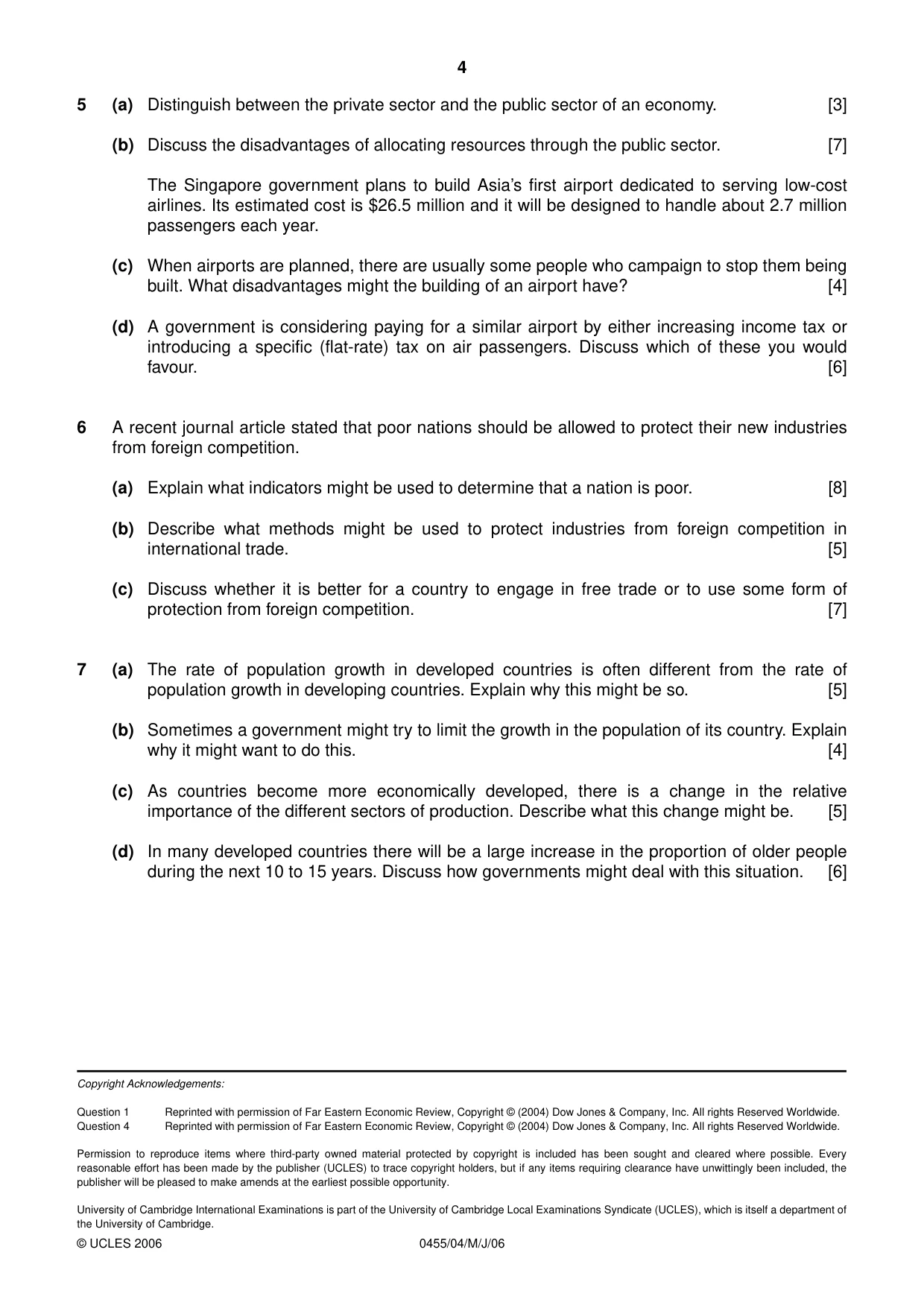
4 0455/04/M/J/06 5 (a) Distinguish between the private sector and the public sector of an economy. [3] (b) Discuss the disadvantages of allocating resources through the public sector. [7] The Singapore government plans to build Asia’s first airport dedicated to serving low-cost airlines. Its estimated cost is $26.5 million and it will be designed to handle about 2.7 million passengers each year. (c) When airports are planned, there are usually some people who campaign to stop them being built. What disadvantages might the building of an airport have? [4] (d) A government is considering paying for a similar airport by either increasing income tax or introducing a specific (flat-rate) tax on air passengers. Discuss which of these you would favour. [6] 6 A recent journal article stated that poor nations should be allowed to protect their new industries from foreign competition. (a) Explain what indicators might be used to determine that a nation is poor. [8] (b) Describe what methods might be used to protect industries from foreign competition in international trade. [5] (c) Discuss whether it is better for a country to engage in free trade or to use some form of protection from foreign competition. [7] 7 (a) The rate of population growth in developed countries is often different from the rate of population growth in developing countries. Explain why this might be so. [5] (b) Sometimes a government might try to limit the growth in the population of its country. Explain why it might want to do this. [4] (c) As countries become more economically developed, there is a change in the relative importance of the different sectors of production. Describe what this change might be. [5] (d) In many developed countries there will be a large increase in the proportion of older people during the next 10 to 15 years. Discuss how governments might deal with this situation. [6] © UCLES 2006 Copyright Acknowledgements: Question 1 Reprinted with permission of Far Eastern Economic Review, Copyright © (2004) Dow Jones & Company, Inc. All rights Reserved Worldwide. Question 4 Reprinted with permission of Far Eastern Economic Review, Copyright © (2004) Dow Jones & Company, Inc. All rights Reserved Worldwide. Permission to reproduce items where third-party owned material protected by copyright is included has been sought and cleared where possible. Every reasonable effort has been made by the publisher (UCLES) to trace copyright holders, but if any items requiring clearance have unwittingly been included, the publisher will be pleased to make amends at the earliest possible opportunity. University of Cambridge International Examinations is part of the University of Cambridge Local Examinations Syndicate (UCLES), which is itself a department of the University of Cambridge.
Mark scheme, page 1
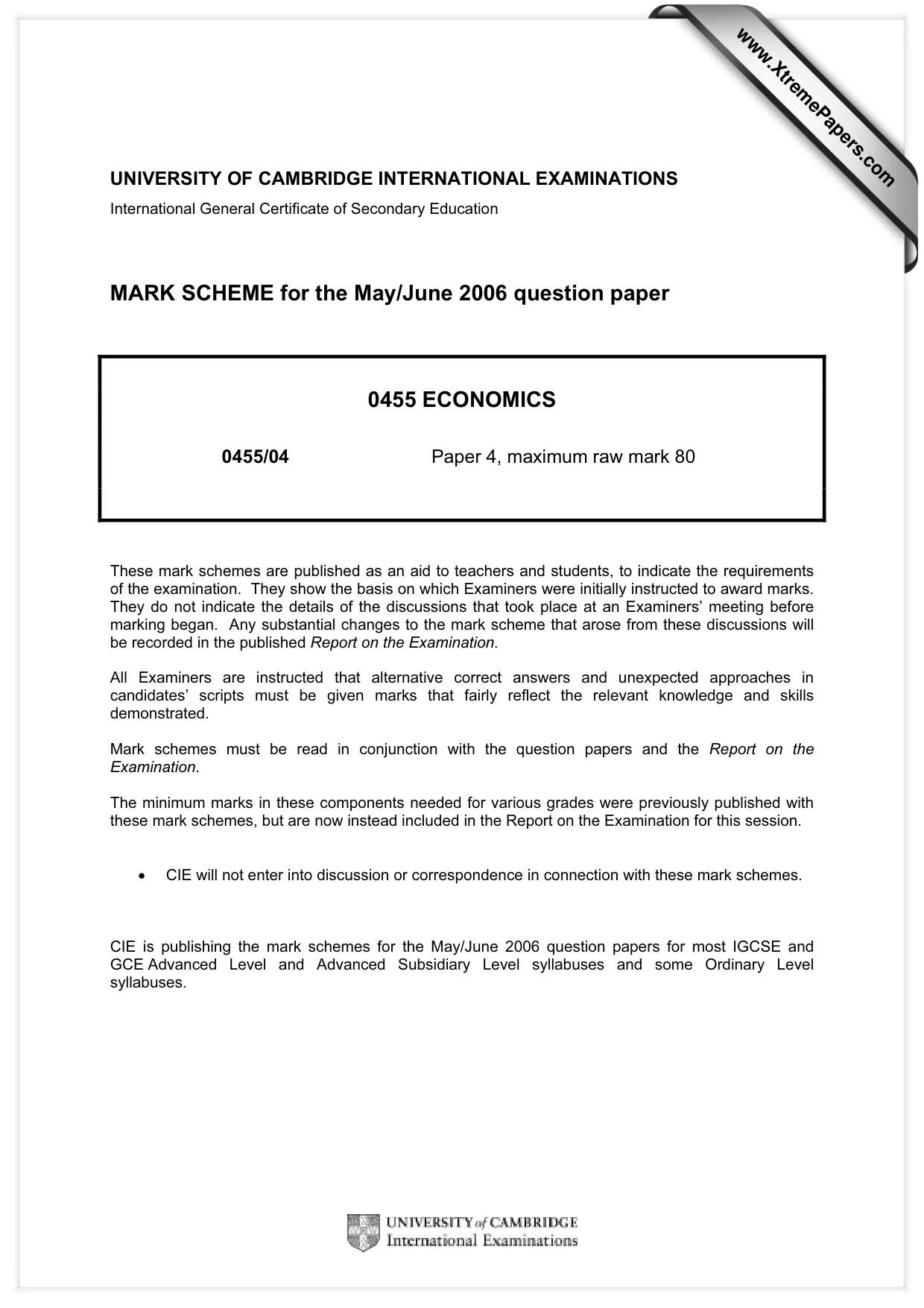
UNIVERSITY OF CAMBRIDGE INTERNATIONAL EXAMINATIONS International General Certificate of Secondary Education MARK SCHEME for the May/June 2006 question paper 0455 ECONOMICS 0455/04 Paper 4, maximum raw mark 80 These mark schemes are published as an aid to teachers and students, to indicate the requirements of the examination. They show the basis on which Examiners were initially instructed to award marks. They do not indicate the details of the discussions that took place at an Examiners’ meeting before marking began. Any substantial changes to the mark scheme that arose from these discussions will be recorded in the published Report on the Examination. All Examiners are instructed that alternative correct answers and unexpected approaches in candidates’ scripts must be given marks that fairly reflect the relevant knowledge and skills demonstrated. Mark schemes must be read in conjunction with the question papers and the Report on the Examination. The minimum marks in these components needed for various grades were previously published with these mark schemes, but are now instead included in the Report on the Examination for this session. • CIE will not enter into discussion or correspondence in connection with these mark schemes. CIE is publishing the mark schemes for the May/June 2006 question papers for most IGCSE and GCE Advanced Level and Advanced Subsidiary Level syllabuses and some Ordinary Level syllabuses. www.XtremePapers.com
Mark scheme, page 2
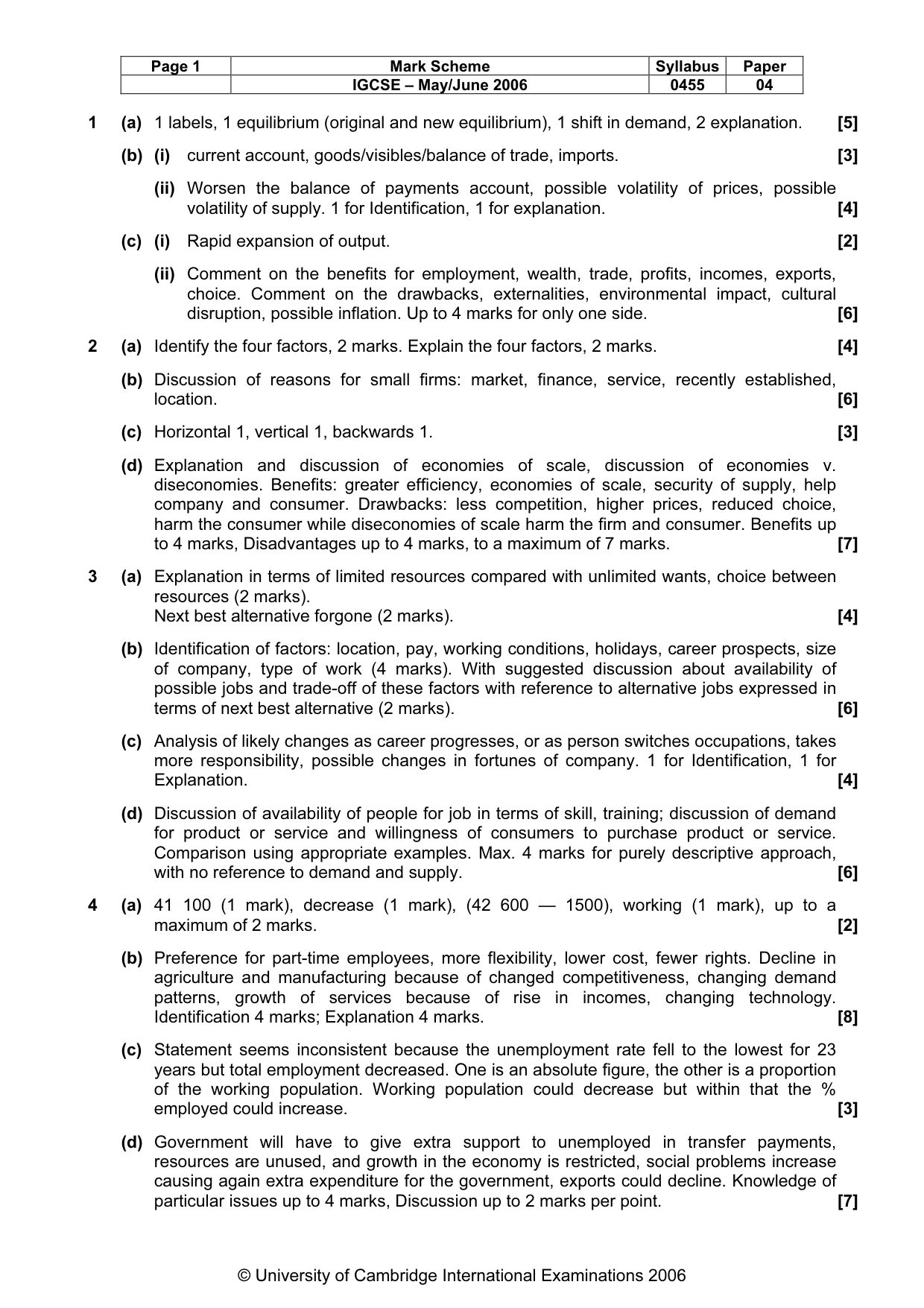
Page 1 Mark Scheme Syllabus Paper IGCSE – May/June 2006 0455 04 © University of Cambridge International Examinations 2006 1 (a) 1 labels, 1 equilibrium (original and new equilibrium), 1 shift in demand, 2 explanation. [5] (b) (i) current account, goods/visibles/balance of trade, imports. [3] (ii) Worsen the balance of payments account, possible volatility of prices, possible volatility of supply. 1 for Identification, 1 for explanation. [4] (c) (i) Rapid expansion of output. [2] (ii) Comment on the benefits for employment, wealth, trade, profits, incomes, exports, choice. Comment on the drawbacks, externalities, environmental impact, cultural disruption, possible inflation. Up to 4 marks for only one side. [6] 2 (a) Identify the four factors, 2 marks. Explain the four factors, 2 marks. [4] (b) Discussion of reasons for small firms: market, finance, service, recently established, location. [6] (c) Horizontal 1, vertical 1, backwards 1. [3] (d) Explanation and discussion of economies of scale, discussion of economies v. diseconomies. Benefits: greater efficiency, economies of scale, security of supply, help company and consumer. Drawbacks: less competition, higher prices, reduced choice, harm the consumer while diseconomies of scale harm the firm and consumer. Benefits up to 4 marks, Disadvantages up to 4 marks, to a maximum of 7 marks. [7] 3 (a) Explanation in terms of limited resources compared with unlimited wants, choice between resources (2 marks). Next best alternative forgone (2 marks). [4] (b) Identification of factors: location, pay, working conditions, holidays, career prospects, size of company, type of work (4 marks). With suggested discussion about availability of possible jobs and trade-off of these factors with reference to alternative jobs expressed in terms of next best alternative (2 marks). [6] (c) Analysis of likely changes as career progresses, or as person switches occupations, takes more responsibility, possible changes in fortunes of company. 1 for Identification, 1 for Explanation. [4] (d) Discussion of availability of people for job in terms of skill, training; discussion of demand for product or service and willingness of consumers to purchase product or service. Comparison using appropriate examples. Max. 4 marks for purely descriptive approach, with no reference to demand and supply. [6] 4 (a) 41 100 (1 mark), decrease (1 mark), (42 600 — 1500), working (1 mark), up to a maximum of 2 marks. [2] (b) Preference for part-time employees, more flexibility, lower cost, fewer rights. Decline in agriculture and manufacturing because of changed competitiveness, changing demand patterns, growth of services because of rise in incomes, changing technology. Identification 4 marks; Explanation 4 marks. [8] (c) Statement seems inconsistent because the unemployment rate fell to the lowest for 23 years but total employment decreased. One is an absolute figure, the other is a proportion of the working population. Working population could decrease but within that the % employed could increase. [3] (d) Government will have to give extra support to unemployed in transfer payments, resources are unused, and growth in the economy is restricted, social problems increase causing again extra expenditure for the government, exports could decline. Knowledge of particular issues up to 4 marks, Discussion up to 2 marks per point. [7]
Mark scheme, page 3
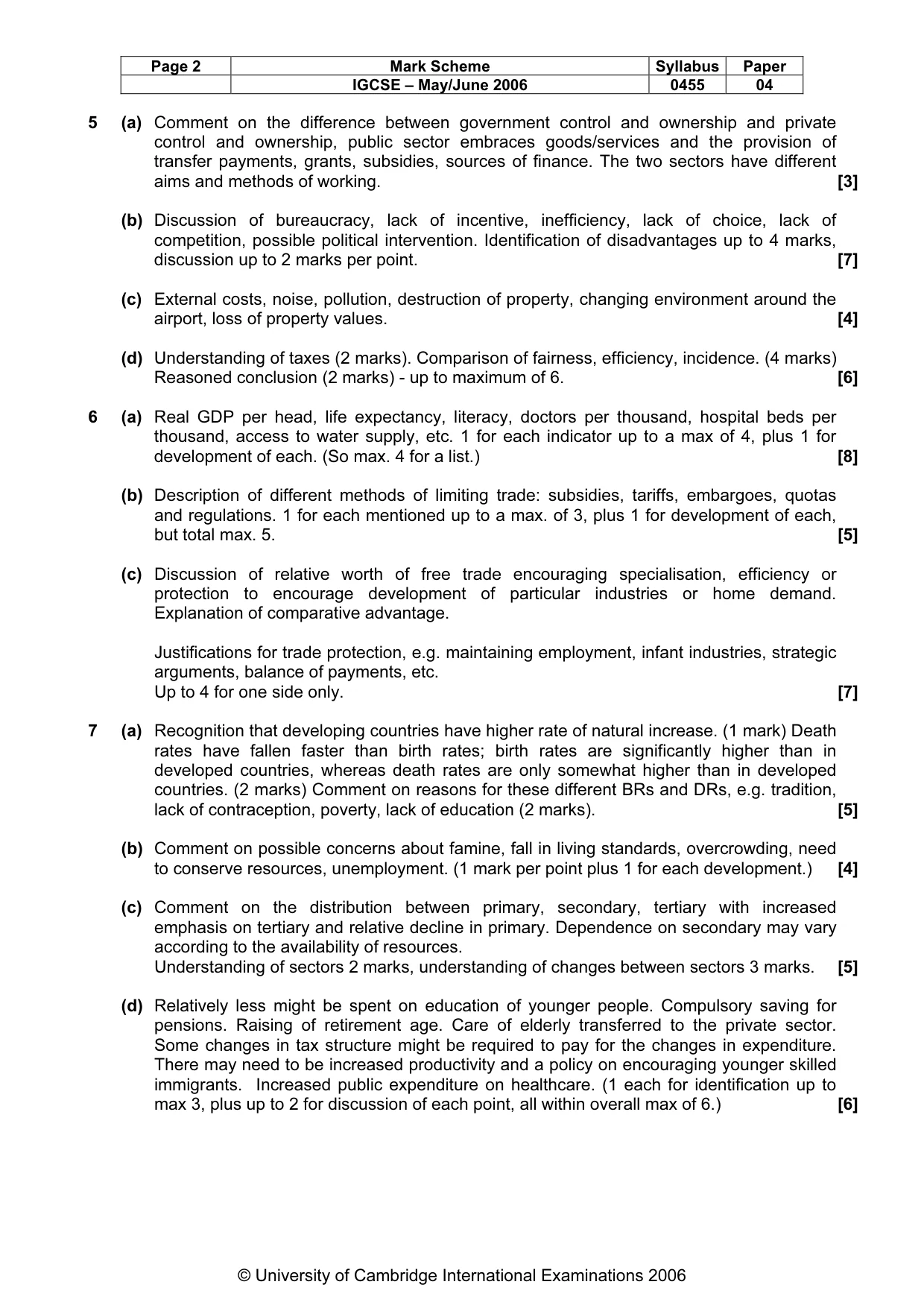
Page 2 Mark Scheme Syllabus Paper IGCSE – May/June 2006 0455 04 © University of Cambridge International Examinations 2006 5 (a) Comment on the difference between government control and ownership and private control and ownership, public sector embraces goods/services and the provision of transfer payments, grants, subsidies, sources of finance. The two sectors have different aims and methods of working. [3] (b) Discussion of bureaucracy, lack of incentive, inefficiency, lack of choice, lack of competition, possible political intervention. Identification of disadvantages up to 4 marks, discussion up to 2 marks per point. [7] (c) External costs, noise, pollution, destruction of property, changing environment around the airport, loss of property values. [4] (d) Understanding of taxes (2 marks). Comparison of fairness, efficiency, incidence. (4 marks) Reasoned conclusion (2 marks) - up to maximum of 6. [6] 6 (a) Real GDP per head, life expectancy, literacy, doctors per thousand, hospital beds per thousand, access to water supply, etc. 1 for each indicator up to a max of 4, plus 1 for development of each. (So max. 4 for a list.) [8] (b) Description of different methods of limiting trade: subsidies, tariffs, embargoes, quotas and regulations. 1 for each mentioned up to a max. of 3, plus 1 for development of each, but total max. 5. [5] (c) Discussion of relative worth of free trade encouraging specialisation, efficiency or protection to encourage development of particular industries or home demand. Explanation of comparative advantage. Justifications for trade protection, e.g. maintaining employment, infant industries, strategic arguments, balance of payments, etc. Up to 4 for one side only. [7] 7 (a) Recognition that developing countries have higher rate of natural increase. (1 mark) Death rates have fallen faster than birth rates; birth rates are significantly higher than in developed countries, whereas death rates are only somewhat higher than in developed countries. (2 marks) Comment on reasons for these different BRs and DRs, e.g. tradition, lack of contraception, poverty, lack of education (2 marks). [5] (b) Comment on possible concerns about famine, fall in living standards, overcrowding, need to conserve resources, unemployment. (1 mark per point plus 1 for each development.) [4] (c) Comment on the distribution between primary, secondary, tertiary with increased emphasis on tertiary and relative decline in primary. Dependence on secondary may vary according to the availability of resources. Understanding of sectors 2 marks, understanding of changes between sectors 3 marks. [5] (d) Relatively less might be spent on education of younger people. Compulsory saving for pensions. Raising of retirement age. Care of elderly transferred to the private sector. Some changes in tax structure might be required to pay for the changes in expenditure. There may need to be increased productivity and a policy on encouraging younger skilled immigrants. Increased public expenditure on healthcare. (1 each for identification up to max 3, plus up to 2 for discussion of each point, all within overall max of 6.) [6]
What you needed in this session
Cambridge’s own grade thresholds for 2006 May/June, Paper 4 · Variant 1. A higher threshold means an easier paper — the bar moves with how the cohort did.