Cambridge IGCSE Economics 0455 — 2008 May/June Paper 4 · Variant 1
0455/41/M/J/08 · 7 questions · 80 marks · ≈90 min
The question paper and its mark scheme, free to read here and free to download. This is Cambridge’s own paper, exactly as it was sat.
Question paper4 pages
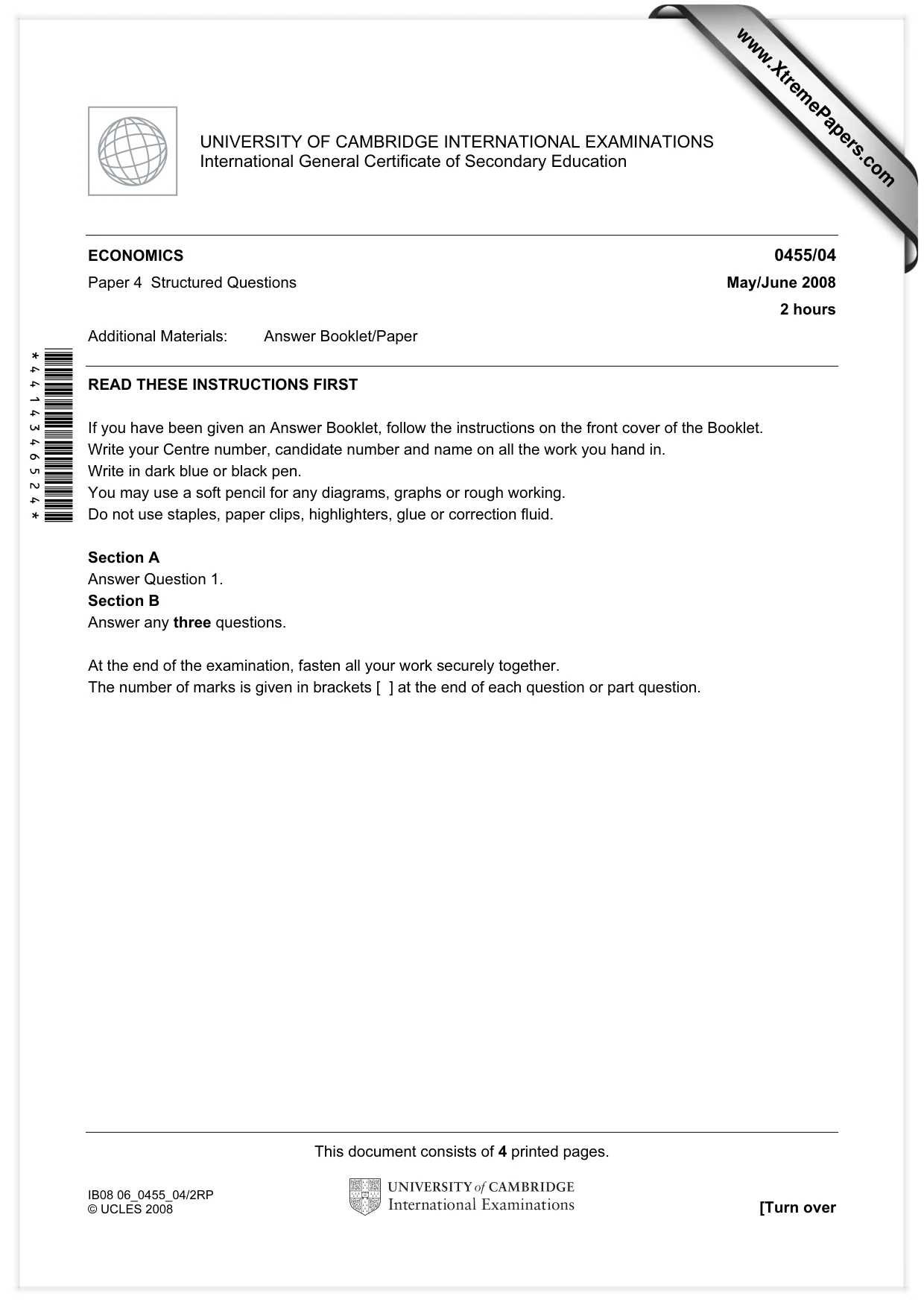
Mark scheme5 pages
Answers below. Sit the paper first if you are practising.

Questions as text
Q1 · UK railway operation GNER is one of a number of companies that operate trains in the UK
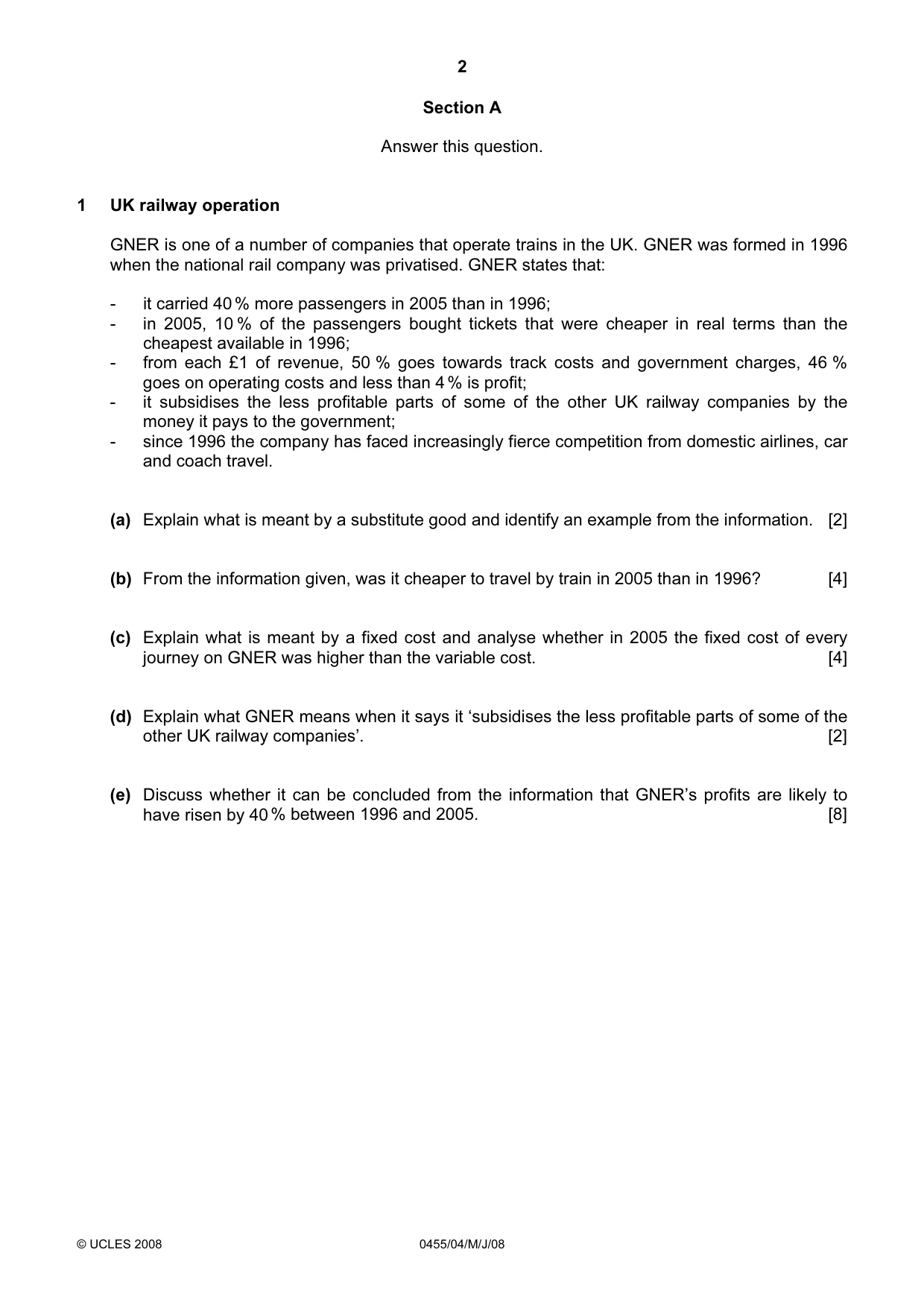
1 UK railway operation GNER is one of a number of companies that operate trains in the UK. GNER was formed in 1996 when the national rail company was privatised. GNER states that: - it carried 40 % more passengers in 2005 than in 1996; - in 2005, 10 % of the passengers bought tickets that were cheaper in real terms than the cheapest available in 1996; - from each £1 of revenue, 50 % goes towards track costs and government charges, 46 % goes on operating costs and less than 4 % is profit; - it subsidises the less profitable parts of some of the other UK railway companies by the money it pays to the government; - since 1996 the company has faced increasingly fierce competition from domestic airlines, car and coach travel. (a) Explain what is meant by a substitute good and identify an example from the information. [2] (b) From the information given, was it cheaper to travel by train in 2005 than in 1996? [4] (c) Explain what is meant by a fixed cost and analyse whether in 2005 the fixed cost of every journey on GNER was higher than the variable cost. [4] (d) Explain what GNER means when it says it ‘subsidises the less profitable parts of some of the other UK railway companies’. [2] (e) Discuss whether it can be concluded from the information that GNER’s profits are likely to have risen by 40 % between 1996 and 2005. [8]
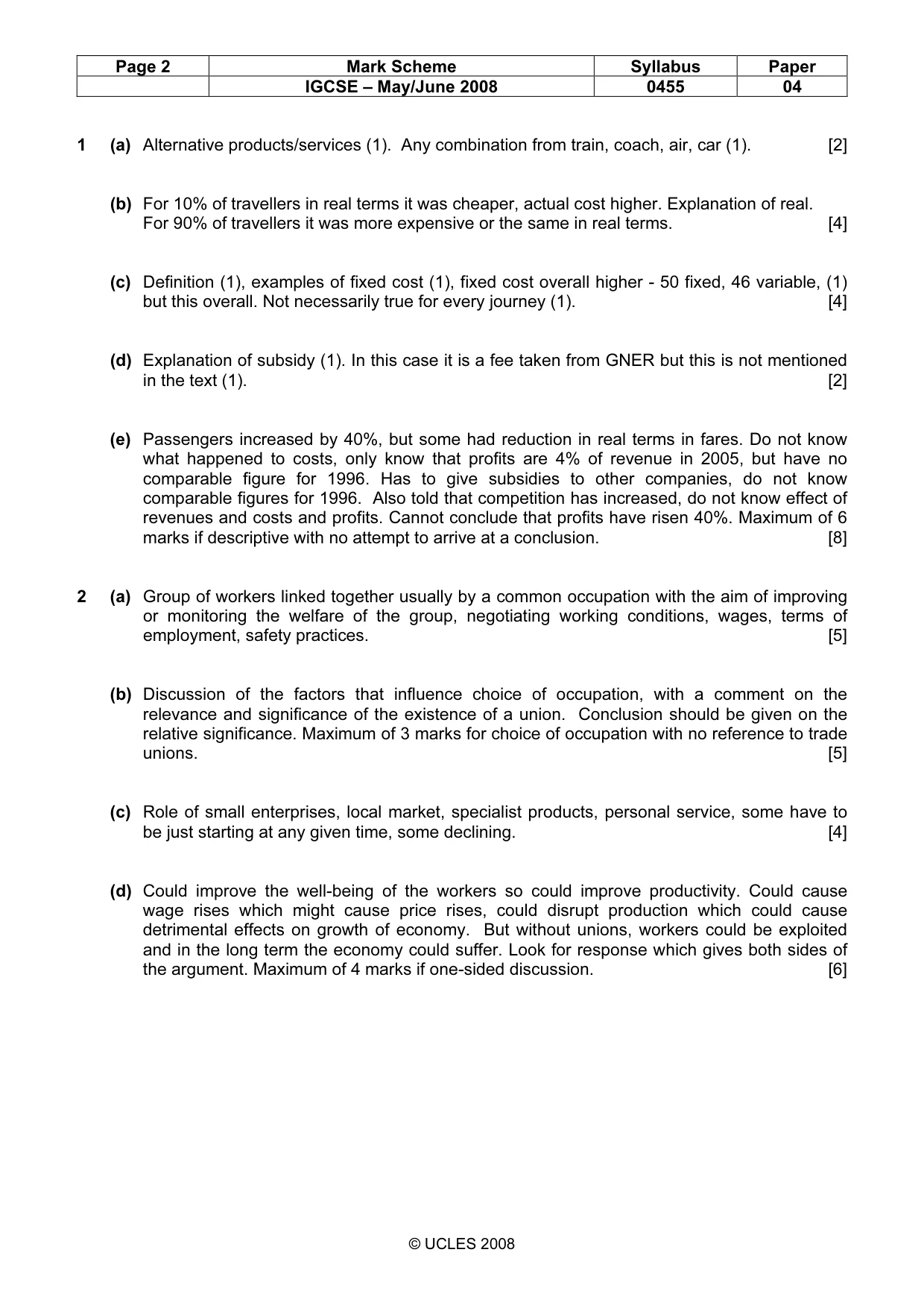
Mark scheme: 1 (a) Alternative products/services (1). Any combination from train, coach, air, car (1). [2] (b) For 10% of travellers in real terms it was cheaper, actual cost higher. Explanation of real. For 90% of travellers it was more expensive or the same in real terms. [4] (c) Definition (1), examples of fixed cost (1), fixed cost overall higher - 50 fixed, 46 variable, (1) but this overall. Not necessarily true for every journey (1). [4] (d) Explanation of subsidy (1). In this case it is a fee taken from GNER but this is not mentioned in the text (1). [2] (e) Passengers increased by 40%, but some had reduction in real terms in fares. Do not know what happened to costs, only know that profits are 4% of revenue in 2005, but have no comparable figure for 1996. Has to give subsidies to other companies, do not know comparable figures for 1996. Also told that competition has increased, do not know effect of revenues and costs and profits. Cannot conclude that profits have risen 40%. Maximum of 6 marks if descriptive with no attempt to arrive at a conclusion. [8]
Q2 · Explain what is meant by a trade union and describe its functions
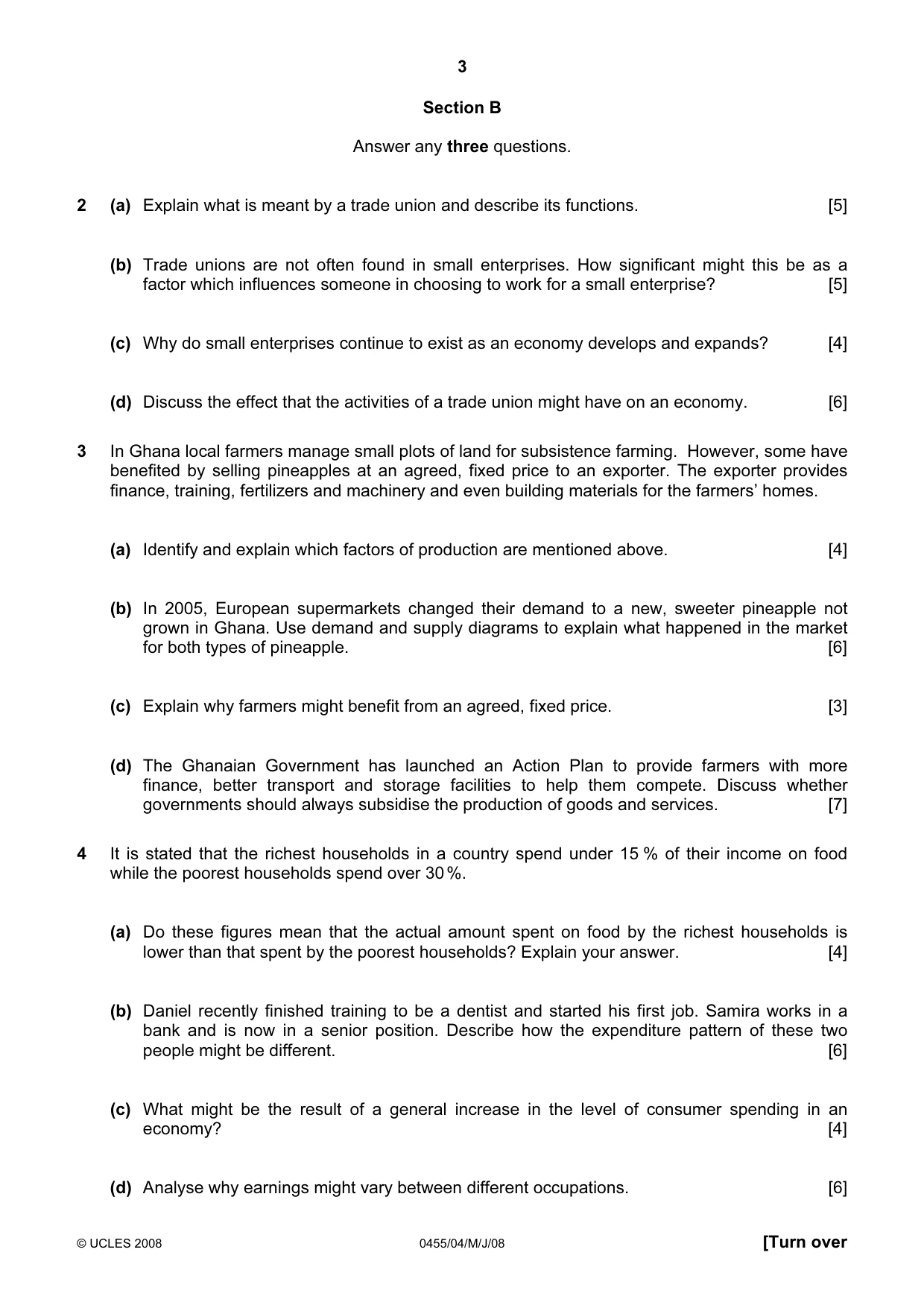
2 (a) Explain what is meant by a trade union and describe its functions. [5] (b) Trade unions are not often found in small enterprises. How significant might this be as a factor which influences someone in choosing to work for a small enterprise? [5] (c) Why do small enterprises continue to exist as an economy develops and expands? [4] (d) Discuss the effect that the activities of a trade union might have on an economy. [6]
Mark scheme: 2 (a) Group of workers linked together usually by a common occupation with the aim of improving or monitoring the welfare of the group, negotiating working conditions, wages, terms of employment, safety practices. [5] (b) Discussion of the factors that influence choice of occupation, with a comment on the relevance and significance of the existence of a union. Conclusion should be given on the relative significance. Maximum of 3 marks for choice of occupation with no reference to trade unions. [5] (c) Role of small enterprises, local market, specialist products, personal service, some have to be just starting at any given time, some declining. [4] (d) Could improve the well-being of the workers so could improve productivity. Could cause wage rises which might cause price rises, could disrupt production which could cause detrimental effects on growth of economy. But without unions, workers could be exploited and in the long term the economy could suffer. Look for response which gives both sides of the argument. Maximum of 4 marks if one-sided discussion. [6] IGCSE – May/June 2008 0455 04
Q3 · In Ghana local farmers manage small plots of land for subsistence farming
3 In Ghana local farmers manage small plots of land for subsistence farming. However, some have benefited by selling pineapples at an agreed, fixed price to an exporter. The exporter provides finance, training, fertilizers and machinery and even building materials for the farmers’ homes. (a) Identify and explain which factors of production are mentioned above. [4] (b) In 2005, European supermarkets changed their demand to a new, sweeter pineapple not grown in Ghana. Use demand and supply diagrams to explain what happened in the market for both types of pineapple. [6] (c) Explain why farmers might benefit from an agreed, fixed price. [3] (d) The Ghanaian Government has launched an Action Plan to provide farmers with more finance, better transport and storage facilities to help them compete. Discuss whether governments should always subsidise the production of goods and services. [7]
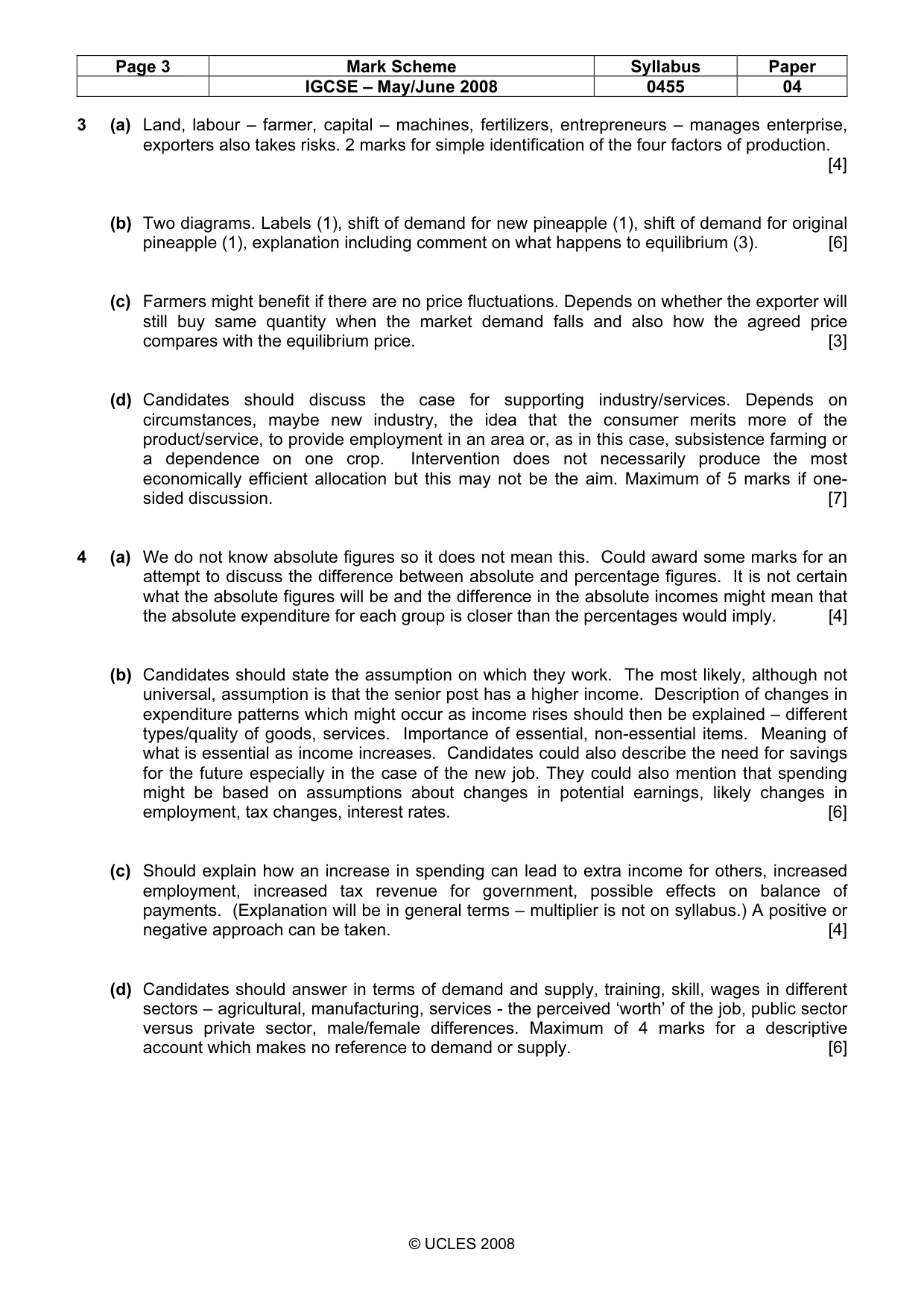
Mark scheme: 3 (a) Land, labour – farmer, capital – machines, fertilizers, entrepreneurs – manages enterprise, exporters also takes risks. 2 marks for simple identification of the four factors of production. [4] (b) Two diagrams. Labels (1), shift of demand for new pineapple (1), shift of demand for original pineapple (1), explanation including comment on what happens to equilibrium (3). [6] (c) Farmers might benefit if there are no price fluctuations. Depends on whether the exporter will still buy same quantity when the market demand falls and also how the agreed price compares with the equilibrium price. [3] (d) Candidates should discuss the case for supporting industry/services. Depends on circumstances, maybe new industry, the idea that the consumer merits more of the product/service, to provide employment in an area or, as in this case, subsistence farming or a dependence on one crop. Intervention does not necessarily produce the most economically efficient allocation but this may not be the aim. Maximum of 5 marks if one- sided discussion. [7]
Q4 · It is stated that the richest households in a country spend under 15 % of their income on…
4 It is stated that the richest households in a country spend under 15 % of their income on food while the poorest households spend over 30 %. (a) Do these figures mean that the actual amount spent on food by the richest households is lower than that spent by the poorest households? Explain your answer. [4] (b) Daniel recently finished training to be a dentist and started his first job. Samira works in a bank and is now in a senior position. Describe how the expenditure pattern of these two people might be different. [6] (c) What might be the result of a general increase in the level of consumer spending in an economy? [4] (d) Analyse why earnings might vary between different occupations. [6]
Mark scheme: 4 (a) We do not know absolute figures so it does not mean this. Could award some marks for an attempt to discuss the difference between absolute and percentage figures. It is not certain what the absolute figures will be and the difference in the absolute incomes might mean that the absolute expenditure for each group is closer than the percentages would imply. [4] (b) Candidates should state the assumption on which they work. The most likely, although not universal, assumption is that the senior post has a higher income. Description of changes in expenditure patterns which might occur as income rises should then be explained – different types/quality of goods, services. Importance of essential, non-essential items. Meaning of what is essential as income increases. Candidates could also describe the need for savings for the future especially in the case of the new job. They could also mention that spending might be based on assumptions about changes in potential earnings, likely changes in employment, tax changes, interest rates. [6] (c) Should explain how an increase in spending can lead to extra income for others, increased employment, increased tax revenue for government, possible effects on balance of payments. (Explanation will be in general terms – multiplier is not on syllabus.) A positive or negative approach can be taken. [4] (d) Candidates should answer in terms of demand and supply, training, skill, wages in different sectors – agricultural, manufacturing, services - the perceived ‘worth’ of the job, public sector versus private sector, male/female differences. Maximum of 4 marks for a descriptive account which makes no reference to demand or supply. [6] IGCSE – May/June 2008 0455 04
Q5 · Using examples, describe the difference between direct and indirect taxes
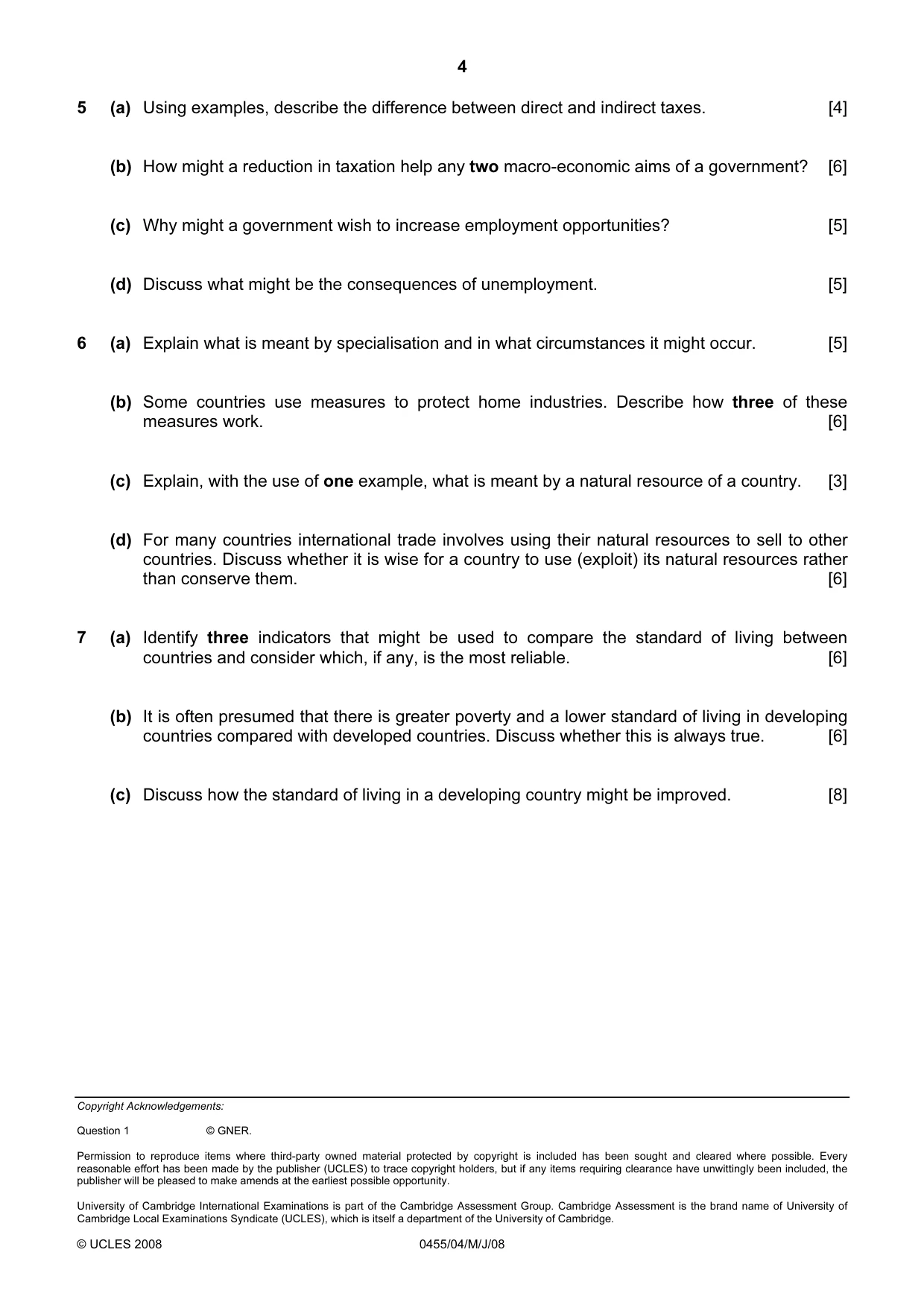
5 (a) Using examples, describe the difference between direct and indirect taxes. [4] (b) How might a reduction in taxation help any two macro-economic aims of a government? [6] (c) Why might a government wish to increase employment opportunities? [5] (d) Discuss what might be the consequences of unemployment. [5]
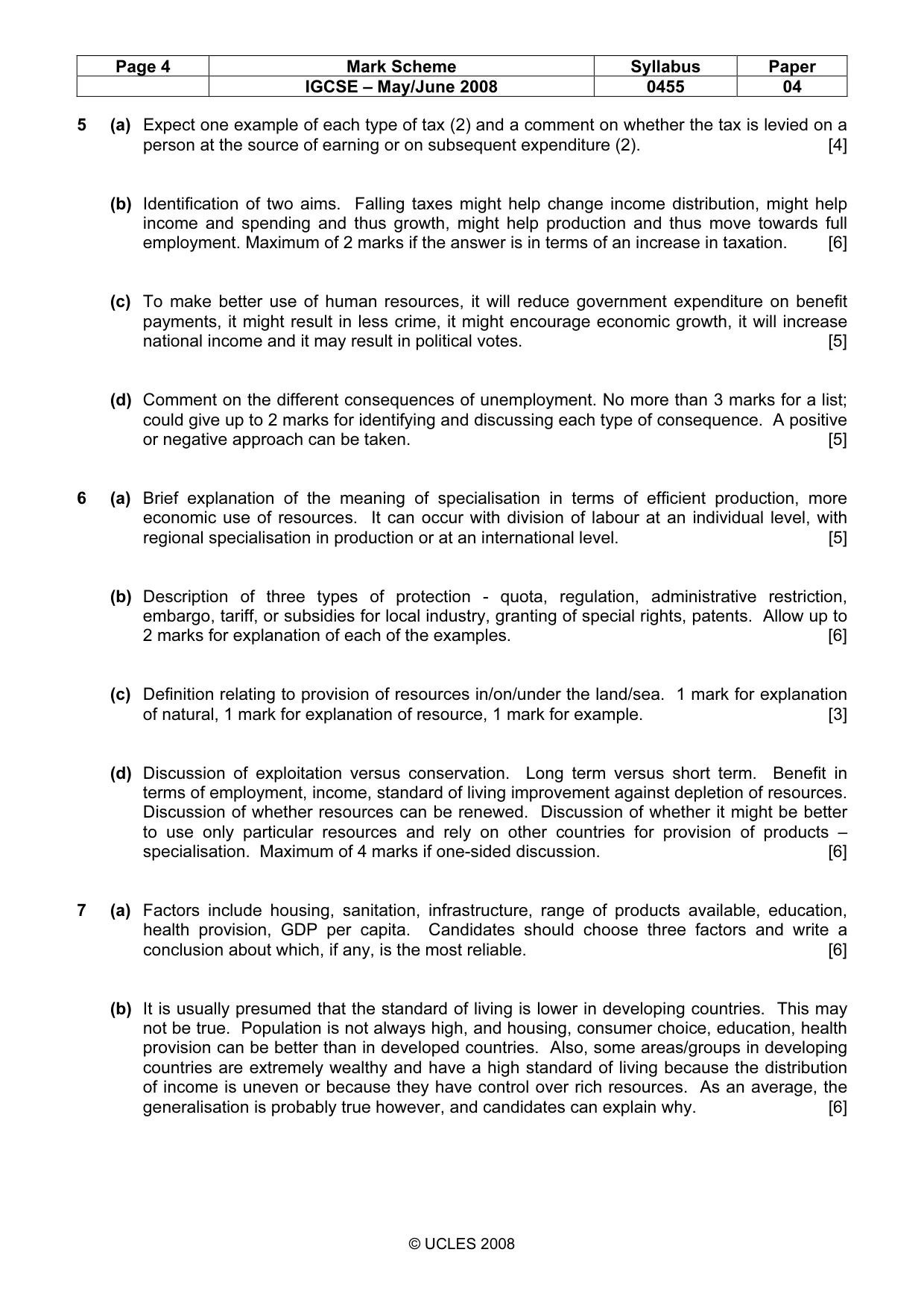
Mark scheme: 5 (a) Expect one example of each type of tax (2) and a comment on whether the tax is levied on a person at the source of earning or on subsequent expenditure (2). [4] (b) Identification of two aims. Falling taxes might help change income distribution, might help income and spending and thus growth, might help production and thus move towards full employment. Maximum of 2 marks if the answer is in terms of an increase in taxation. [6] (c) To make better use of human resources, it will reduce government expenditure on benefit payments, it might result in less crime, it might encourage economic growth, it will increase national income and it may result in political votes. [5] (d) Comment on the different consequences of unemployment. No more than 3 marks for a list; could give up to 2 marks for identifying and discussing each type of consequence. A positive or negative approach can be taken. [5]
Q6 · Explain what is meant by specialisation and in what circumstances it might occur
6 (a) Explain what is meant by specialisation and in what circumstances it might occur. [5] (b) Some countries use measures to protect home industries. Describe how three of these measures work. [6] (c) Explain, with the use of one example, what is meant by a natural resource of a country. [3] (d) For many countries international trade involves using their natural resources to sell to other countries. Discuss whether it is wise for a country to use (exploit) its natural resources rather than conserve them. [6]
Mark scheme: 6 (a) Brief explanation of the meaning of specialisation in terms of efficient production, more economic use of resources. It can occur with division of labour at an individual level, with regional specialisation in production or at an international level. [5] (b) Description of three types of protection - quota, regulation, administrative restriction, embargo, tariff, or subsidies for local industry, granting of special rights, patents. Allow up to 2 marks for explanation of each of the examples. [6] (c) Definition relating to provision of resources in/on/under the land/sea. 1 mark for explanation of natural, 1 mark for explanation of resource, 1 mark for example. [3] (d) Discussion of exploitation versus conservation. Long term versus short term. Benefit in terms of employment, income, standard of living improvement against depletion of resources. Discussion of whether resources can be renewed. Discussion of whether it might be better to use only particular resources and rely on other countries for provision of products – specialisation. Maximum of 4 marks if one-sided discussion. [6]
Q7 · Identify three indicators that might be used to compare the standard of living between…
7 (a) Identify three indicators that might be used to compare the standard of living between countries and consider which, if any, is the most reliable. [6] (b) It is often presumed that there is greater poverty and a lower standard of living in developing countries compared with developed countries. Discuss whether this is always true. [6] (c) Discuss how the standard of living in a developing country might be improved. [8]
Mark scheme: 7 (a) Factors include housing, sanitation, infrastructure, range of products available, education, health provision, GDP per capita. Candidates should choose three factors and write a conclusion about which, if any, is the most reliable. [6] (b) It is usually presumed that the standard of living is lower in developing countries. This may not be true. Population is not always high, and housing, consumer choice, education, health provision can be better than in developed countries. Also, some areas/groups in developing countries are extremely wealthy and have a high standard of living because the distribution of income is uneven or because they have control over rich resources. As an average, the generalisation is probably true however, and candidates can explain why. [6] IGCSE – May/June 2008 0455 04 (c) Mention might be made of improvements in infrastructure, health, housing, education or other economic or social indicators. (Up to 5 marks.) Discussion could involve a comment on the improvement brought by investment by private sector and/or influence of public sector. The latter could involve subsidies, borrowing from foreign countries, encouraging multi-nationals, increased expenditure. (Up to 5 marks.) [8]
More questions on Differences in economic development between countries
What was in this paper
The subtopics covered by these 7 questions, and how many questions each got. Open one in a new tab to see every Cambridge question on it.
What you needed in this session
Cambridge’s own grade thresholds for 2008 May/June, Paper 4 · Variant 1. A higher threshold means an easier paper — the bar moves with how the cohort did.