Cambridge IGCSE Economics 0455 — 2005 Oct/Nov Paper 4 · Variant 1
0455/41/O/N/05
The question paper and its mark scheme, free to read here and free to download. This is Cambridge’s own paper, exactly as it was sat.
Question paper4 pages
Mark scheme4 pages
Answers below. Sit the paper first if you are practising.
Paper as text
Question paper, page 1
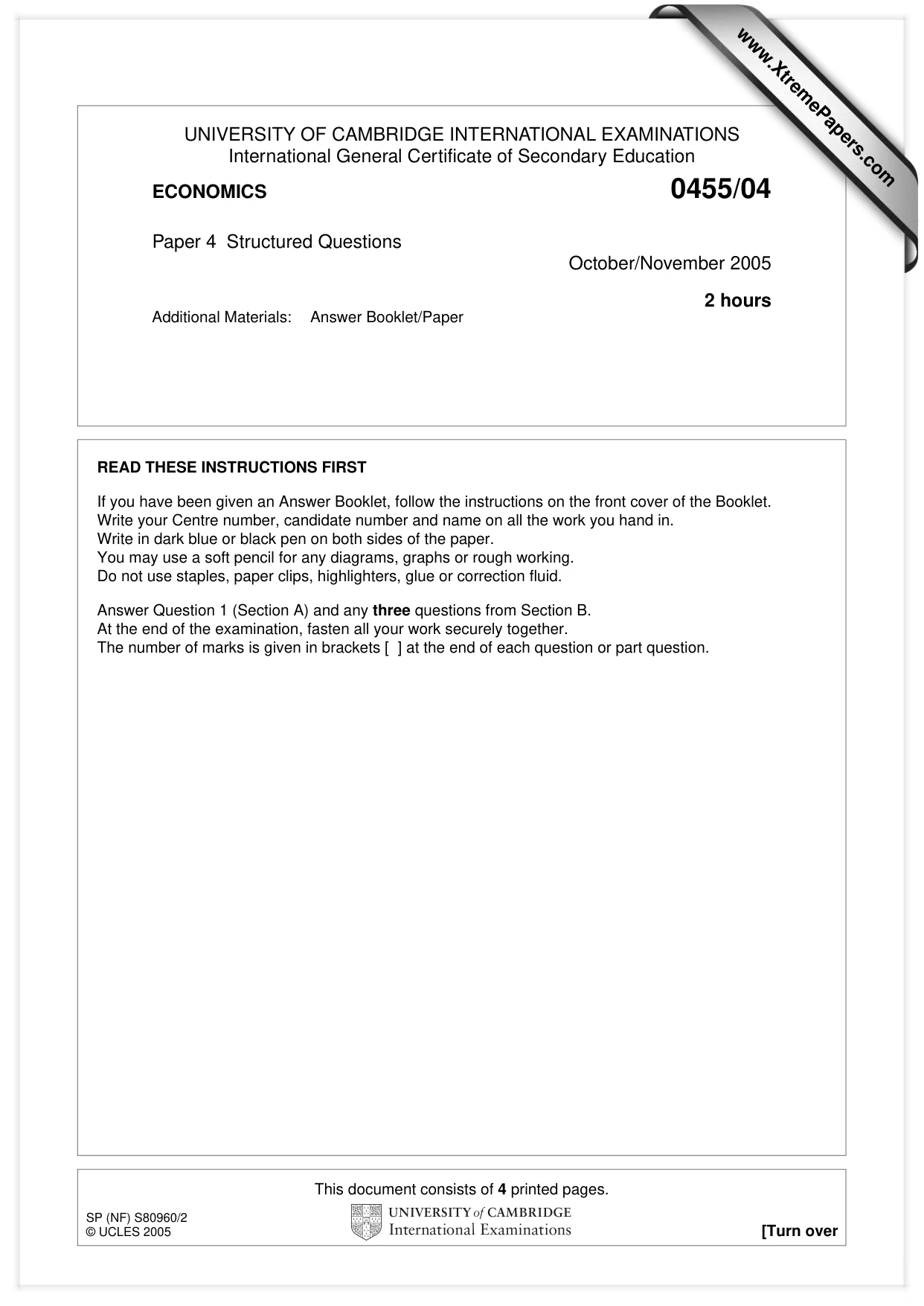
This document consists of 4 printed pages. SP (NF) S80960/2 © UCLES 2005 [Turn over UNIVERSITY OF CAMBRIDGE INTERNATIONAL EXAMINATIONS International General Certificate of Secondary Education ECONOMICS 0455/04 Paper 4 Structured Questions October/November 2005 2 hours Additional Materials: Answer Booklet/Paper READ THESE INSTRUCTIONS FIRST If you have been given an Answer Booklet, follow the instructions on the front cover of the Booklet. Write your Centre number, candidate number and name on all the work you hand in. Write in dark blue or black pen on both sides of the paper. You may use a soft pencil for any diagrams, graphs or rough working. Do not use staples, paper clips, highlighters, glue or correction fluid. Answer Question 1 (Section A) and any three questions from Section B. At the end of the examination, fasten all your work securely together. The number of marks is given in brackets [ ] at the end of each question or part question. www.XtremePapers.com
Question paper, page 2
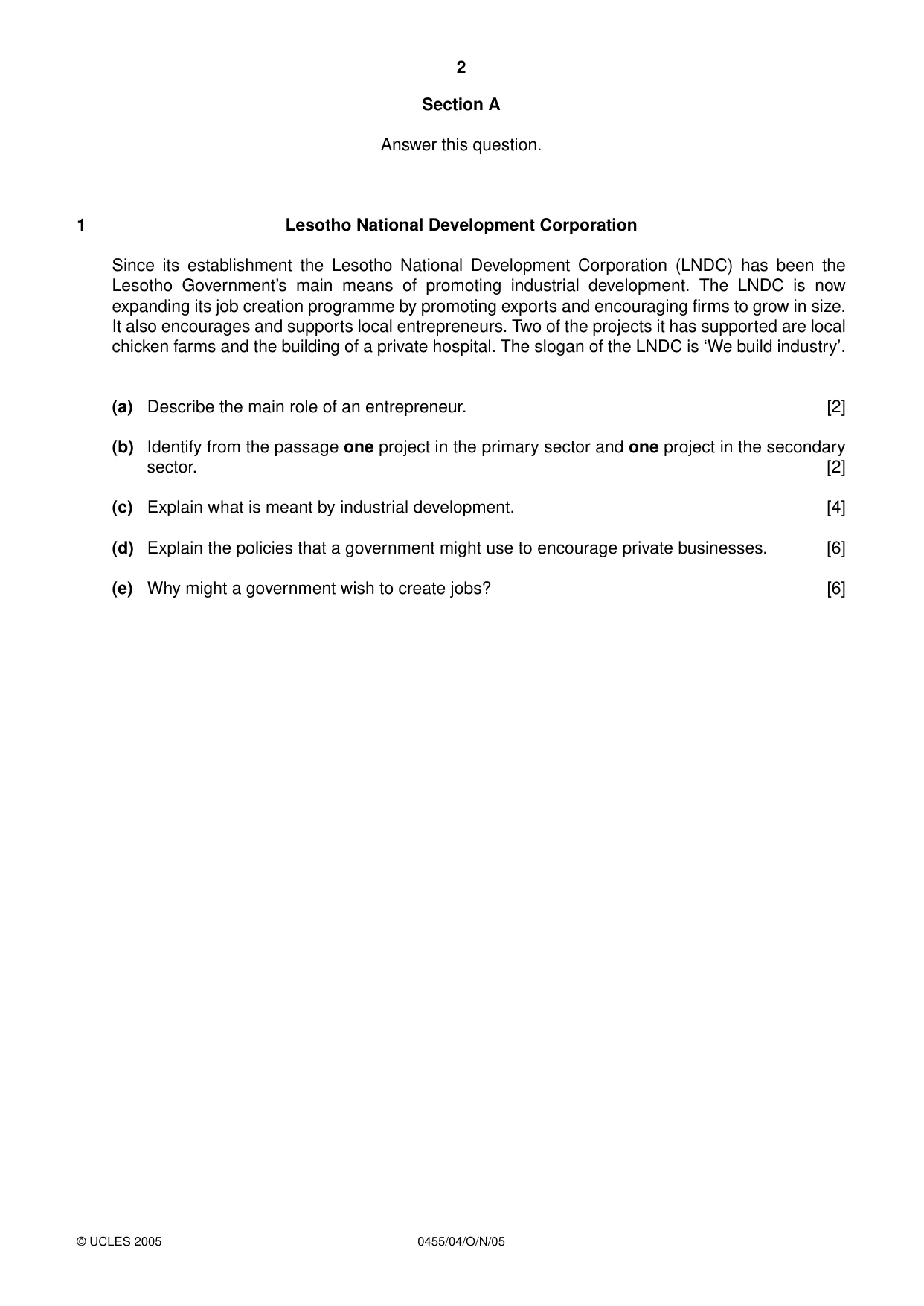
2 0455/04/O/N/05 Section A Answer this question. 1 Lesotho National Development Corporation Since its establishment the Lesotho National Development Corporation (LNDC) has been the Lesotho Government’s main means of promoting industrial development. The LNDC is now expanding its job creation programme by promoting exports and encouraging firms to grow in size. It also encourages and supports local entrepreneurs. Two of the projects it has supported are local chicken farms and the building of a private hospital. The slogan of the LNDC is ‘We build industry’. (a) Describe the main role of an entrepreneur. [2] (b) Identify from the passage one project in the primary sector and one project in the secondary sector. [2] (c) Explain what is meant by industrial development. [4] (d) Explain the policies that a government might use to encourage private businesses. [6] (e) Why might a government wish to create jobs? [6] © UCLES 2005
Question paper, page 3
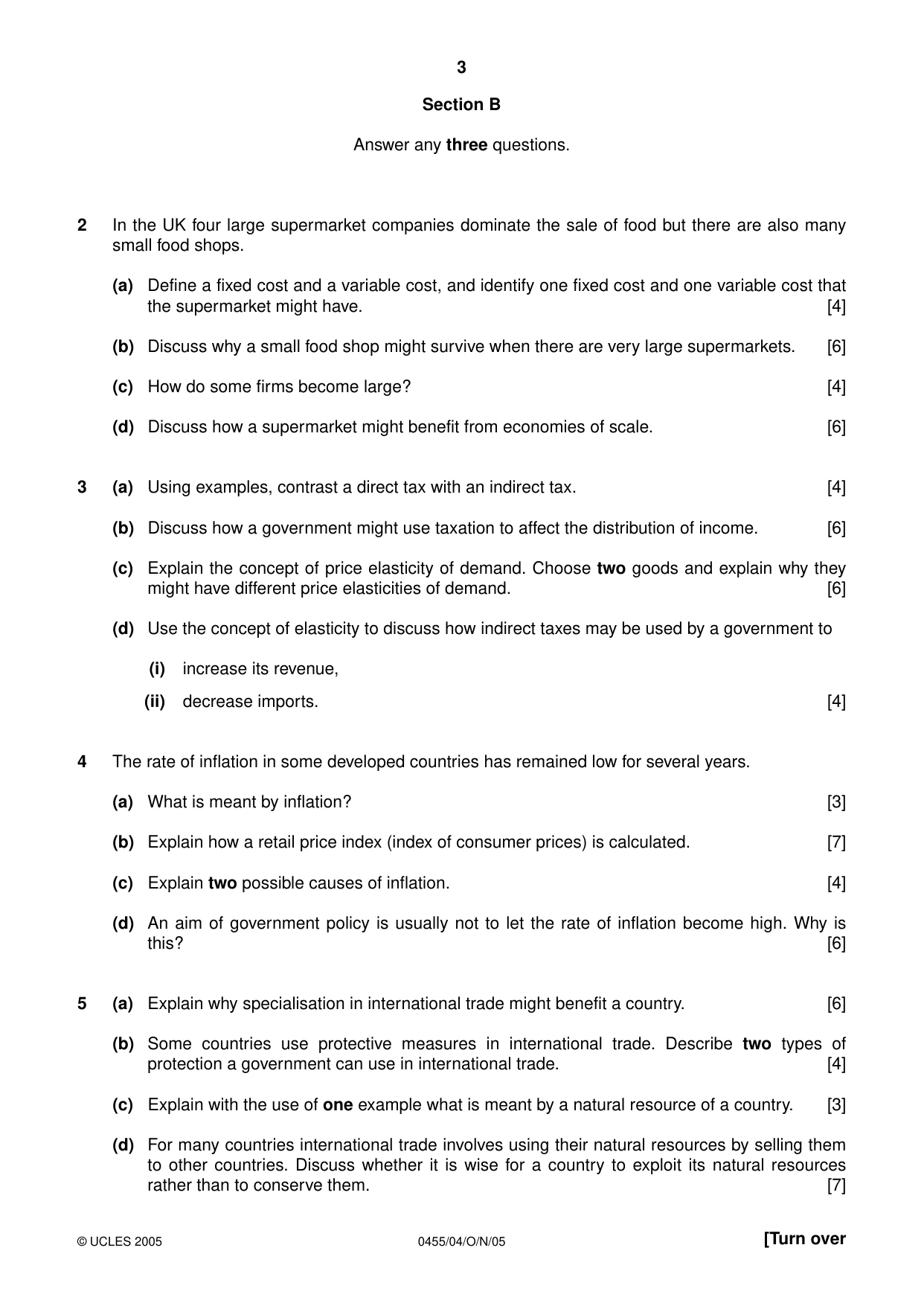
3 0455/04/O/N/05 [Turn over Section B Answer any three questions. 2 In the UK four large supermarket companies dominate the sale of food but there are also many small food shops. (a) Define a fixed cost and a variable cost, and identify one fixed cost and one variable cost that the supermarket might have. [4] (b) Discuss why a small food shop might survive when there are very large supermarkets. [6] (c) How do some firms become large? [4] (d) Discuss how a supermarket might benefit from economies of scale. [6] 3 (a) Using examples, contrast a direct tax with an indirect tax. [4] (b) Discuss how a government might use taxation to affect the distribution of income. [6] (c) Explain the concept of price elasticity of demand. Choose two goods and explain why they might have different price elasticities of demand. [6] (d) Use the concept of elasticity to discuss how indirect taxes may be used by a government to (i) increase its revenue, (ii) decrease imports. [4] 4 The rate of inflation in some developed countries has remained low for several years. (a) What is meant by inflation? [3] (b) Explain how a retail price index (index of consumer prices) is calculated. [7] (c) Explain two possible causes of inflation. [4] (d) An aim of government policy is usually not to let the rate of inflation become high. Why is this? [6] 5 (a) Explain why specialisation in international trade might benefit a country. [6] (b) Some countries use protective measures in international trade. Describe two types of protection a government can use in international trade. [4] (c) Explain with the use of one example what is meant by a natural resource of a country. [3] (d) For many countries international trade involves using their natural resources by selling them to other countries. Discuss whether it is wise for a country to exploit its natural resources rather than to conserve them. [7] © UCLES 2005
Question paper, page 4
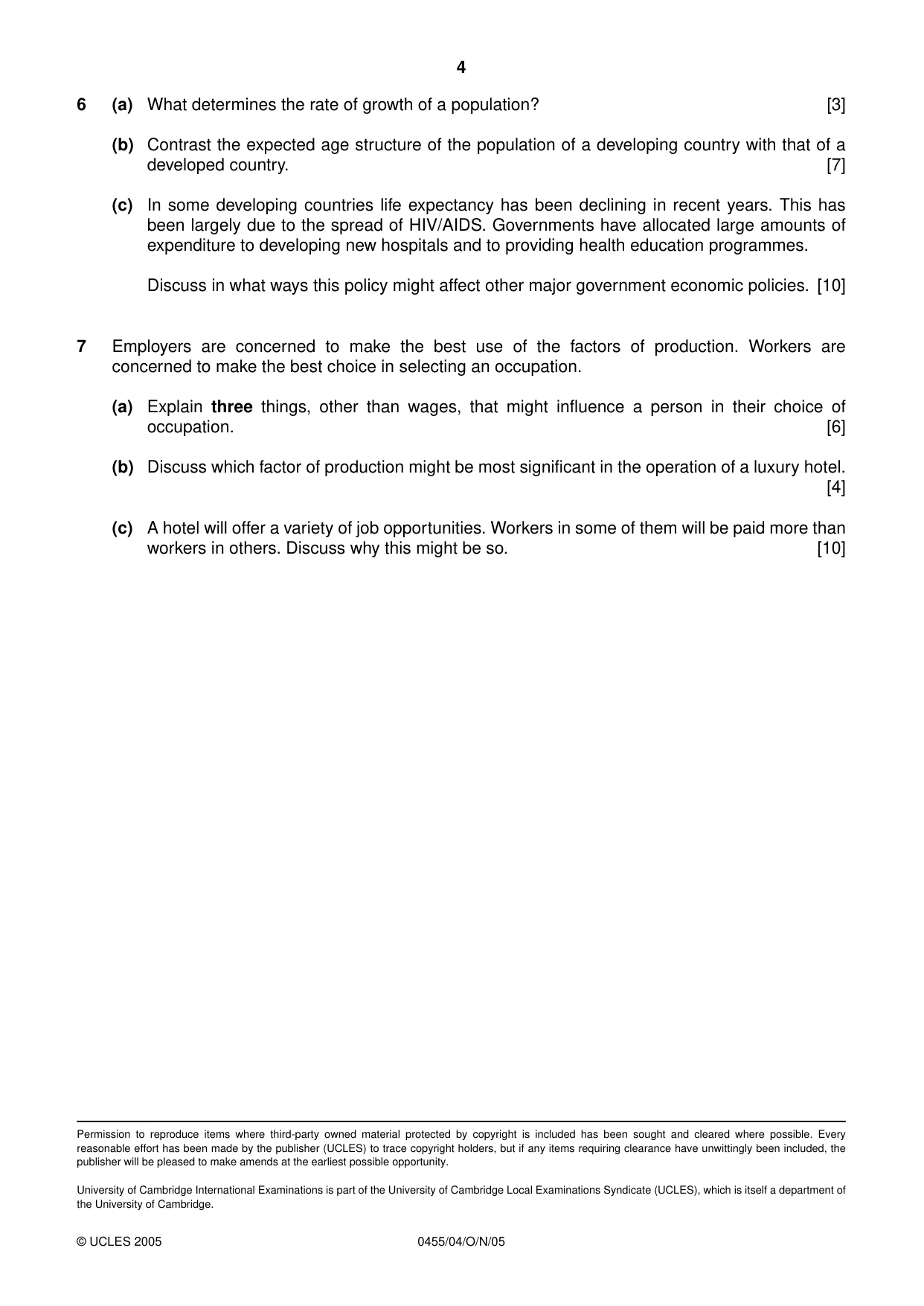
4 0455/04/O/N/05 6 (a) What determines the rate of growth of a population? [3] (b) Contrast the expected age structure of the population of a developing country with that of a developed country. [7] (c) In some developing countries life expectancy has been declining in recent years. This has been largely due to the spread of HIV/AIDS. Governments have allocated large amounts of expenditure to developing new hospitals and to providing health education programmes. Discuss in what ways this policy might affect other major government economic policies. [10] 7 Employers are concerned to make the best use of the factors of production. Workers are concerned to make the best choice in selecting an occupation. (a) Explain three things, other than wages, that might influence a person in their choice of occupation. [6] (b) Discuss which factor of production might be most significant in the operation of a luxury hotel. [4] (c) A hotel will offer a variety of job opportunities. Workers in some of them will be paid more than workers in others. Discuss why this might be so. [10] © UCLES 2005 Permission to reproduce items where third-party owned material protected by copyright is included has been sought and cleared where possible. Every reasonable effort has been made by the publisher (UCLES) to trace copyright holders, but if any items requiring clearance have unwittingly been included, the publisher will be pleased to make amends at the earliest possible opportunity. University of Cambridge International Examinations is part of the University of Cambridge Local Examinations Syndicate (UCLES), which is itself a department of the University of Cambridge.
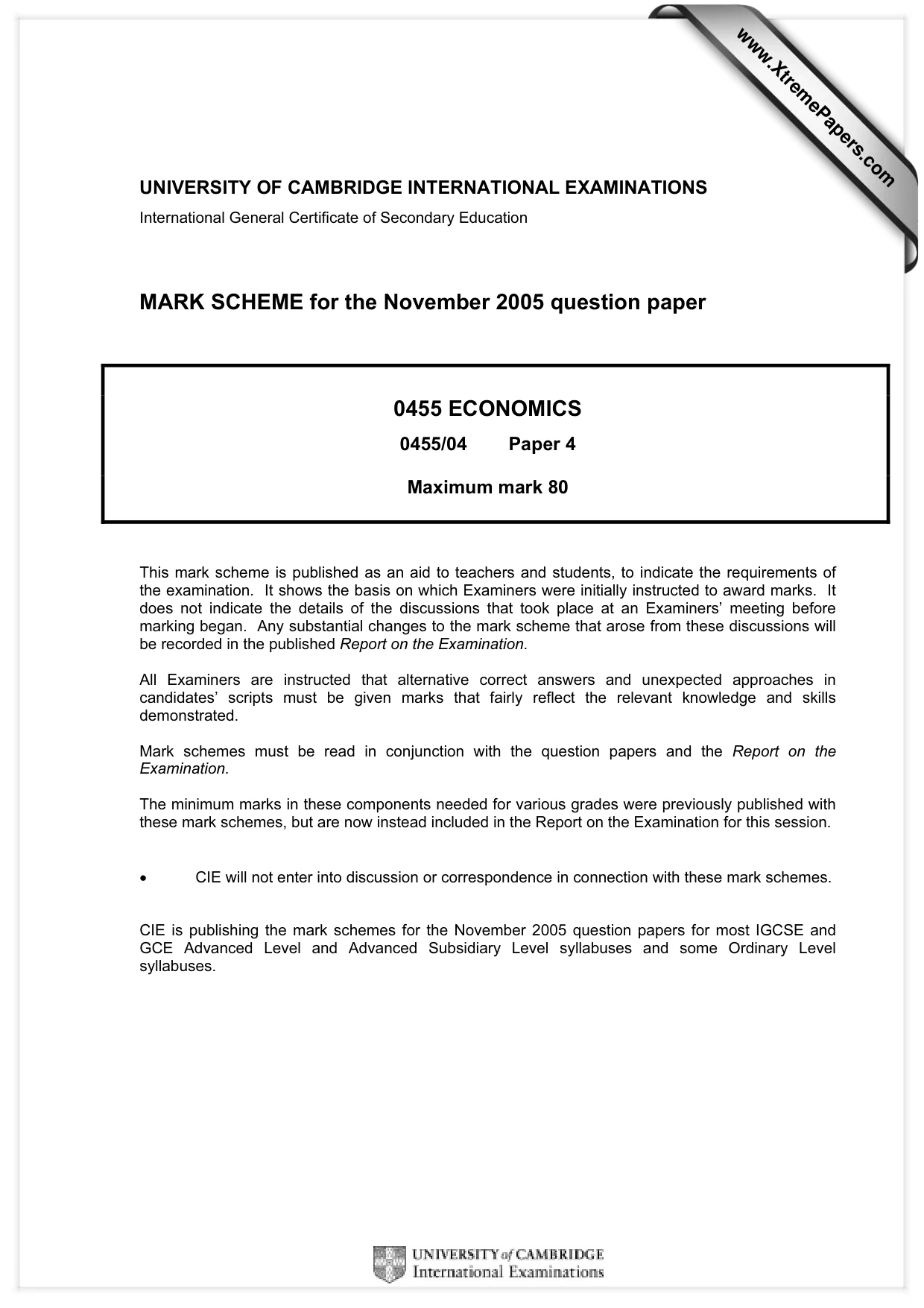
Mark scheme, page 1
UNIVERSITY OF CAMBRIDGE INTERNATIONAL EXAMINATIONS International General Certificate of Secondary Education MARK SCHEME for the November 2005 question paper 0455 ECONOMICS 0455/04 Paper 4 Maximum mark 80 This mark scheme is published as an aid to teachers and students, to indicate the requirements of the examination. It shows the basis on which Examiners were initially instructed to award marks. It does not indicate the details of the discussions that took place at an Examiners’ meeting before marking began. Any substantial changes to the mark scheme that arose from these discussions will be recorded in the published Report on the Examination. All Examiners are instructed that alternative correct answers and unexpected approaches in candidates’ scripts must be given marks that fairly reflect the relevant knowledge and skills demonstrated. Mark schemes must be read in conjunction with the question papers and the Report on the Examination. The minimum marks in these components needed for various grades were previously published with these mark schemes, but are now instead included in the Report on the Examination for this session. • CIE will not enter into discussion or correspondence in connection with these mark schemes. CIE is publishing the mark schemes for the November 2005 question papers for most IGCSE and GCE Advanced Level and Advanced Subsidiary Level syllabuses and some Ordinary Level syllabuses. www.XtremePapers.com
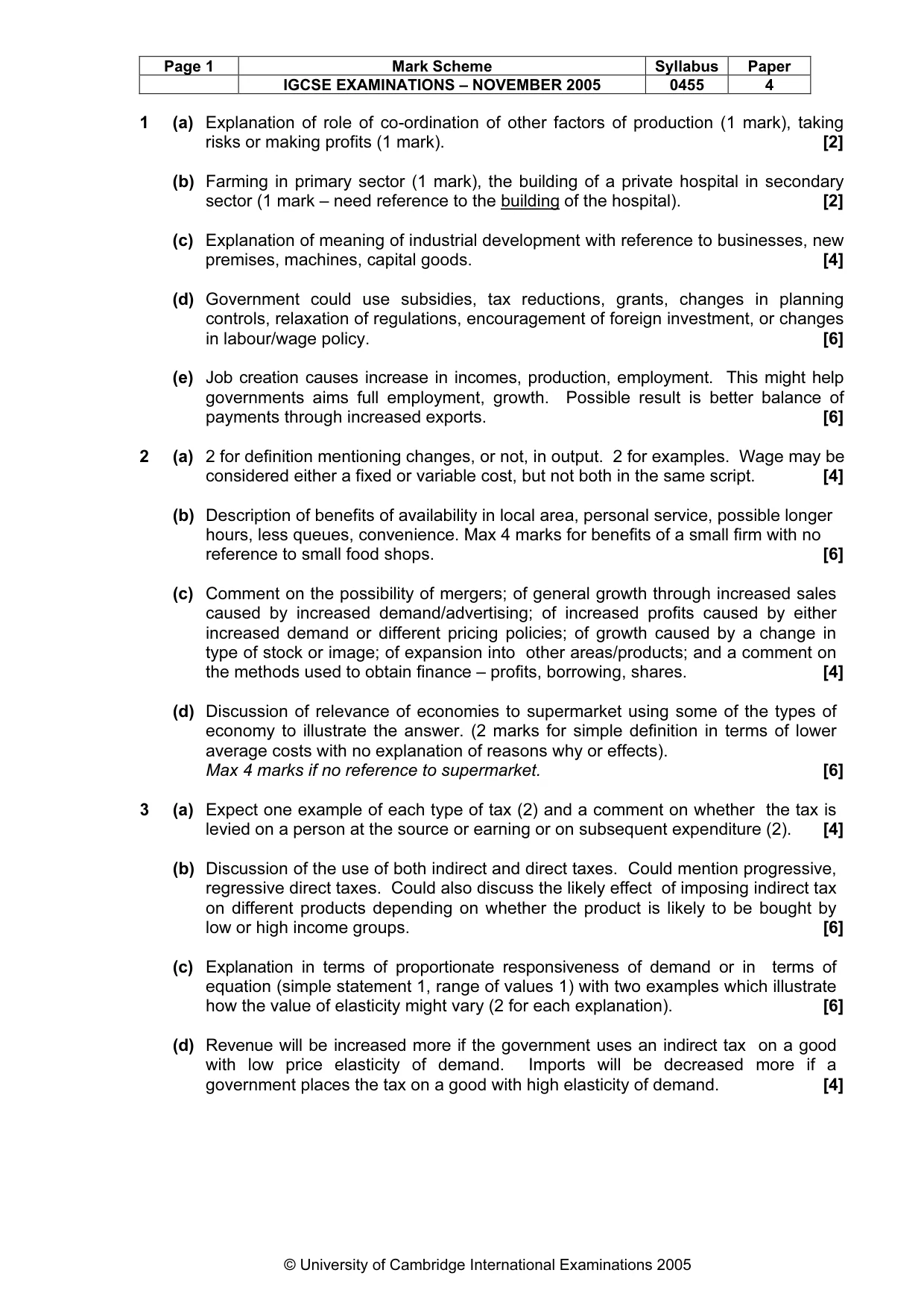
Mark scheme, page 2
Page 1 Mark Scheme Syllabus Paper IGCSE EXAMINATIONS – NOVEMBER 2005 0455 4 © University of Cambridge International Examinations 2005 1 (a) Explanation of role of co-ordination of other factors of production (1 mark), taking risks or making profits (1 mark). [2] (b) Farming in primary sector (1 mark), the building of a private hospital in secondary sector (1 mark – need reference to the building of the hospital). [2] (c) Explanation of meaning of industrial development with reference to businesses, new premises, machines, capital goods. [4] (d) Government could use subsidies, tax reductions, grants, changes in planning controls, relaxation of regulations, encouragement of foreign investment, or changes in labour/wage policy. [6] (e) Job creation causes increase in incomes, production, employment. This might help governments aims full employment, growth. Possible result is better balance of payments through increased exports. [6] 2 (a) 2 for definition mentioning changes, or not, in output. 2 for examples. Wage may be considered either a fixed or variable cost, but not both in the same script. [4] (b) Description of benefits of availability in local area, personal service, possible longer hours, less queues, convenience. Max 4 marks for benefits of a small firm with no reference to small food shops. [6] (c) Comment on the possibility of mergers; of general growth through increased sales caused by increased demand/advertising; of increased profits caused by either increased demand or different pricing policies; of growth caused by a change in type of stock or image; of expansion into other areas/products; and a comment on the methods used to obtain finance – profits, borrowing, shares. [4] (d) Discussion of relevance of economies to supermarket using some of the types of economy to illustrate the answer. (2 marks for simple definition in terms of lower average costs with no explanation of reasons why or effects). Max 4 marks if no reference to supermarket. [6] 3 (a) Expect one example of each type of tax (2) and a comment on whether the tax is levied on a person at the source or earning or on subsequent expenditure (2). [4] (b) Discussion of the use of both indirect and direct taxes. Could mention progressive, regressive direct taxes. Could also discuss the likely effect of imposing indirect tax on different products depending on whether the product is likely to be bought by low or high income groups. [6] (c) Explanation in terms of proportionate responsiveness of demand or in terms of equation (simple statement 1, range of values 1) with two examples which illustrate how the value of elasticity might vary (2 for each explanation). [6] (d) Revenue will be increased more if the government uses an indirect tax on a good with low price elasticity of demand. Imports will be decreased more if a government places the tax on a good with high elasticity of demand. [4]
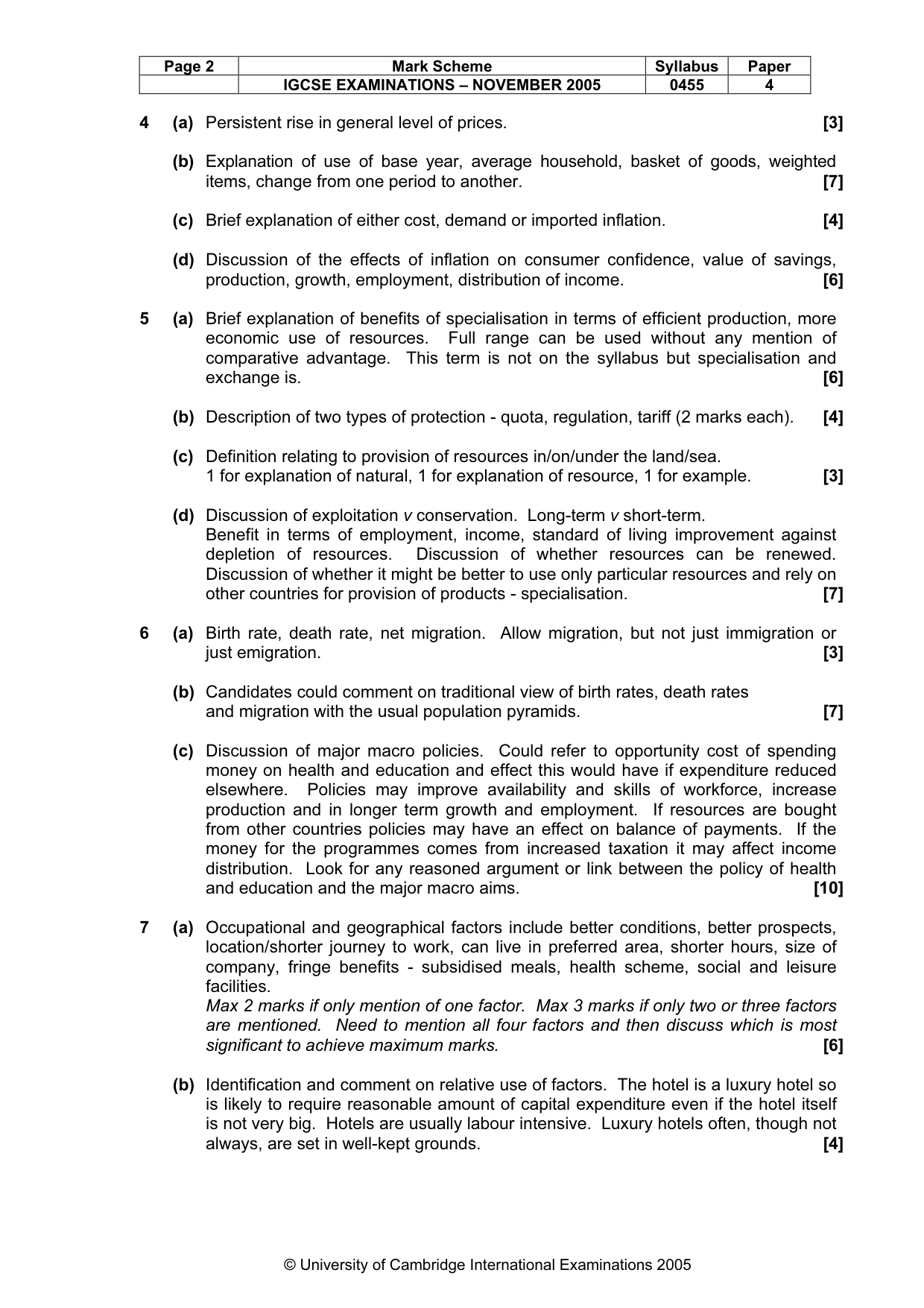
Mark scheme, page 3
Page 2 Mark Scheme Syllabus Paper IGCSE EXAMINATIONS – NOVEMBER 2005 0455 4 © University of Cambridge International Examinations 2005 4 (a) Persistent rise in general level of prices. [3] (b) Explanation of use of base year, average household, basket of goods, weighted items, change from one period to another. [7] (c) Brief explanation of either cost, demand or imported inflation. [4] (d) Discussion of the effects of inflation on consumer confidence, value of savings, production, growth, employment, distribution of income. [6] 5 (a) Brief explanation of benefits of specialisation in terms of efficient production, more economic use of resources. Full range can be used without any mention of comparative advantage. This term is not on the syllabus but specialisation and exchange is. [6] (b) Description of two types of protection - quota, regulation, tariff (2 marks each). [4] (c) Definition relating to provision of resources in/on/under the land/sea. 1 for explanation of natural, 1 for explanation of resource, 1 for example. [3] (d) Discussion of exploitation v conservation. Long-term v short-term. Benefit in terms of employment, income, standard of living improvement against depletion of resources. Discussion of whether resources can be renewed. Discussion of whether it might be better to use only particular resources and rely on other countries for provision of products - specialisation. [7] 6 (a) Birth rate, death rate, net migration. Allow migration, but not just immigration or just emigration. [3] (b) Candidates could comment on traditional view of birth rates, death rates and migration with the usual population pyramids. [7] (c) Discussion of major macro policies. Could refer to opportunity cost of spending money on health and education and effect this would have if expenditure reduced elsewhere. Policies may improve availability and skills of workforce, increase production and in longer term growth and employment. If resources are bought from other countries policies may have an effect on balance of payments. If the money for the programmes comes from increased taxation it may affect income distribution. Look for any reasoned argument or link between the policy of health and education and the major macro aims. [10] 7 (a) Occupational and geographical factors include better conditions, better prospects, location/shorter journey to work, can live in preferred area, shorter hours, size of company, fringe benefits - subsidised meals, health scheme, social and leisure facilities. Max 2 marks if only mention of one factor. Max 3 marks if only two or three factors are mentioned. Need to mention all four factors and then discuss which is most significant to achieve maximum marks. [6] (b) Identification and comment on relative use of factors. The hotel is a luxury hotel so is likely to require reasonable amount of capital expenditure even if the hotel itself is not very big. Hotels are usually labour intensive. Luxury hotels often, though not always, are set in well-kept grounds. [4]
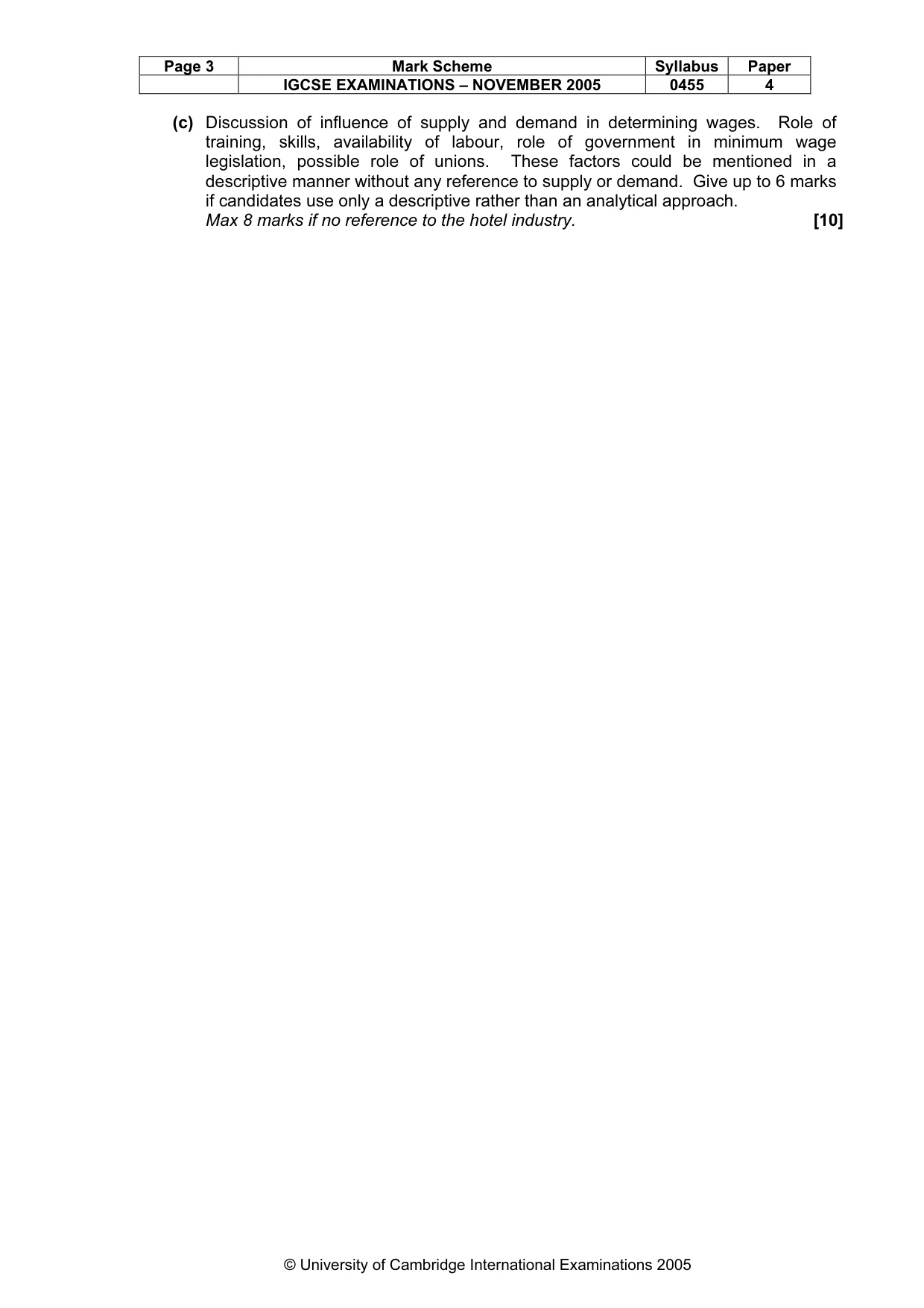
Mark scheme, page 4
Page 3 Mark Scheme Syllabus Paper IGCSE EXAMINATIONS – NOVEMBER 2005 0455 4 © University of Cambridge International Examinations 2005 (c) Discussion of influence of supply and demand in determining wages. Role of training, skills, availability of labour, role of government in minimum wage legislation, possible role of unions. These factors could be mentioned in a descriptive manner without any reference to supply or demand. Give up to 6 marks if candidates use only a descriptive rather than an analytical approach. Max 8 marks if no reference to the hotel industry. [10]