Cambridge IGCSE Economics 0455 — 2004 Oct/Nov Paper 4 · Variant 1
0455/41/O/N/04
The question paper and its mark scheme, free to read here and free to download. This is Cambridge’s own paper, exactly as it was sat.
Question paper4 pages
Mark scheme6 pages
Answers below. Sit the paper first if you are practising.
Paper as text
Question paper, page 1
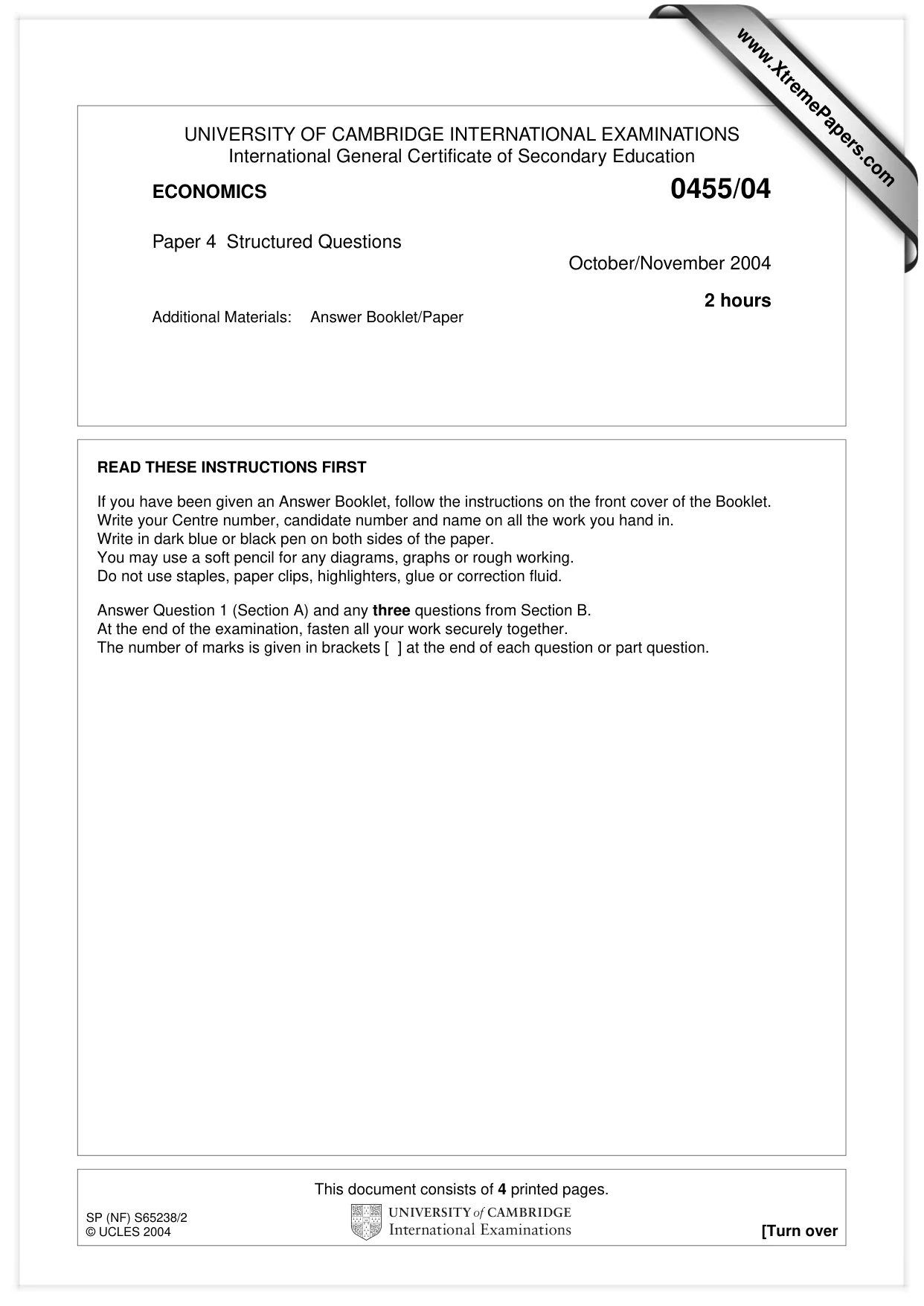
This document consists of 4 printed pages. SP (NF) S65238/2 © UCLES 2004 [Turn over UNIVERSITY OF CAMBRIDGE INTERNATIONAL EXAMINATIONS International General Certificate of Secondary Education ECONOMICS 0455/04 Paper 4 Structured Questions October/November 2004 2 hours Additional Materials: Answer Booklet/Paper READ THESE INSTRUCTIONS FIRST If you have been given an Answer Booklet, follow the instructions on the front cover of the Booklet. Write your Centre number, candidate number and name on all the work you hand in. Write in dark blue or black pen on both sides of the paper. You may use a soft pencil for any diagrams, graphs or rough working. Do not use staples, paper clips, highlighters, glue or correction fluid. Answer Question 1 (Section A) and any three questions from Section B. At the end of the examination, fasten all your work securely together. The number of marks is given in brackets [ ] at the end of each question or part question. www.XtremePapers.com
Question paper, page 2
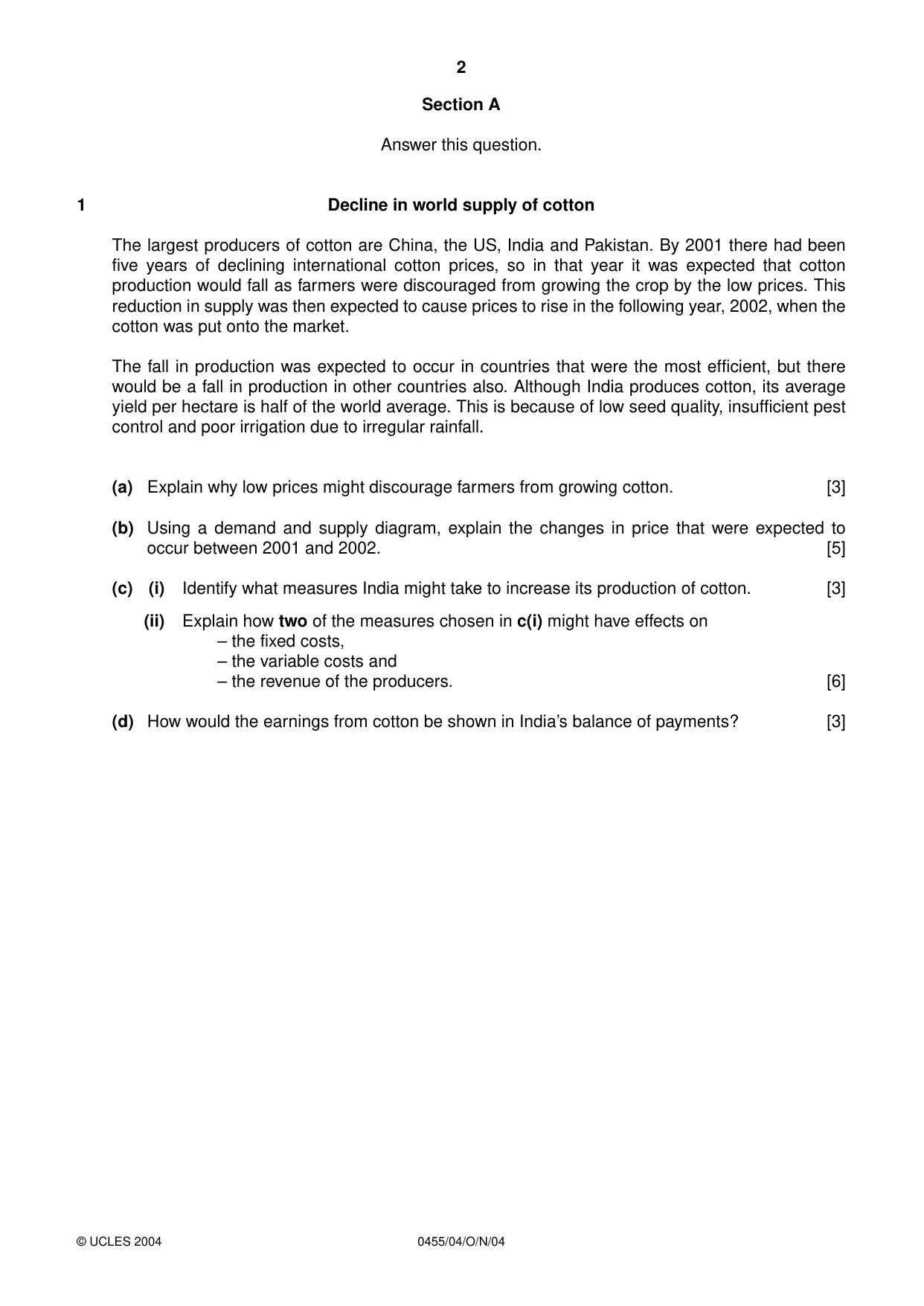
2 0455/04/O/N/04 Section A Answer this question. 1 Decline in world supply of cotton The largest producers of cotton are China, the US, India and Pakistan. By 2001 there had been five years of declining international cotton prices, so in that year it was expected that cotton production would fall as farmers were discouraged from growing the crop by the low prices. This reduction in supply was then expected to cause prices to rise in the following year, 2002, when the cotton was put onto the market. The fall in production was expected to occur in countries that were the most efficient, but there would be a fall in production in other countries also. Although India produces cotton, its average yield per hectare is half of the world average. This is because of low seed quality, insufficient pest control and poor irrigation due to irregular rainfall. (a) Explain why low prices might discourage farmers from growing cotton. [3] (b) Using a demand and supply diagram, explain the changes in price that were expected to occur between 2001 and 2002. [5] (c) (i) Identify what measures India might take to increase its production of cotton. [3] (ii) Explain how two of the measures chosen in c(i) might have effects on – the fixed costs, – the variable costs and – the revenue of the producers. [6] (d) How would the earnings from cotton be shown in India’s balance of payments? [3] © UCLES 2004
Question paper, page 3
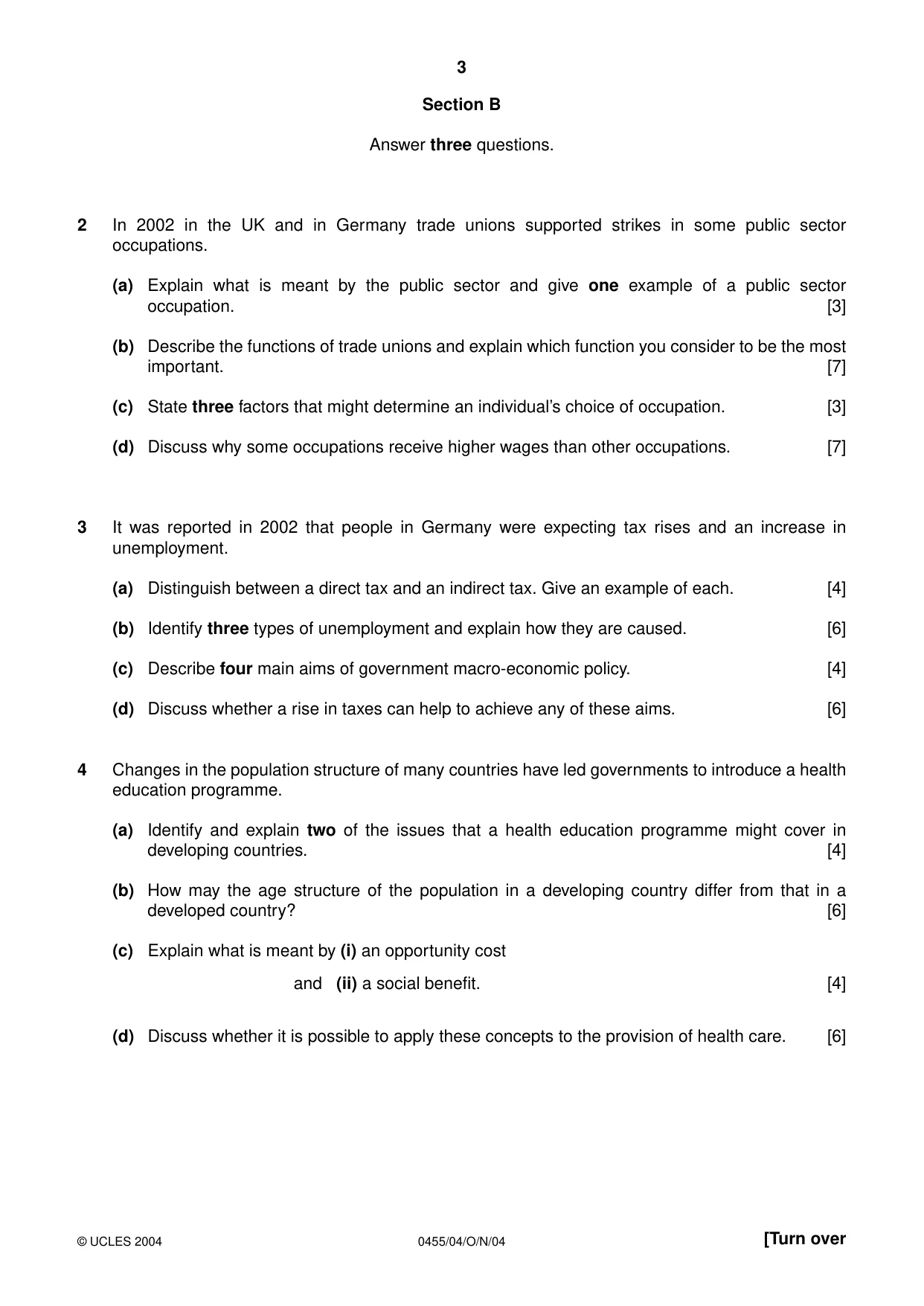
3 0455/04/O/N/04 [Turn over Section B Answer three questions. 2 In 2002 in the UK and in Germany trade unions supported strikes in some public sector occupations. (a) Explain what is meant by the public sector and give one example of a public sector occupation. [3] (b) Describe the functions of trade unions and explain which function you consider to be the most important. [7] (c) State three factors that might determine an individual’s choice of occupation. [3] (d) Discuss why some occupations receive higher wages than other occupations. [7] 3 It was reported in 2002 that people in Germany were expecting tax rises and an increase in unemployment. (a) Distinguish between a direct tax and an indirect tax. Give an example of each. [4] (b) Identify three types of unemployment and explain how they are caused. [6] (c) Describe four main aims of government macro-economic policy. [4] (d) Discuss whether a rise in taxes can help to achieve any of these aims. [6] 4 Changes in the population structure of many countries have led governments to introduce a health education programme. (a) Identify and explain two of the issues that a health education programme might cover in developing countries. [4] (b) How may the age structure of the population in a developing country differ from that in a developed country? [6] (c) Explain what is meant by (i) an opportunity cost and (ii) a social benefit. [4] (d) Discuss whether it is possible to apply these concepts to the provision of health care. [6] © UCLES 2004
Question paper, page 4
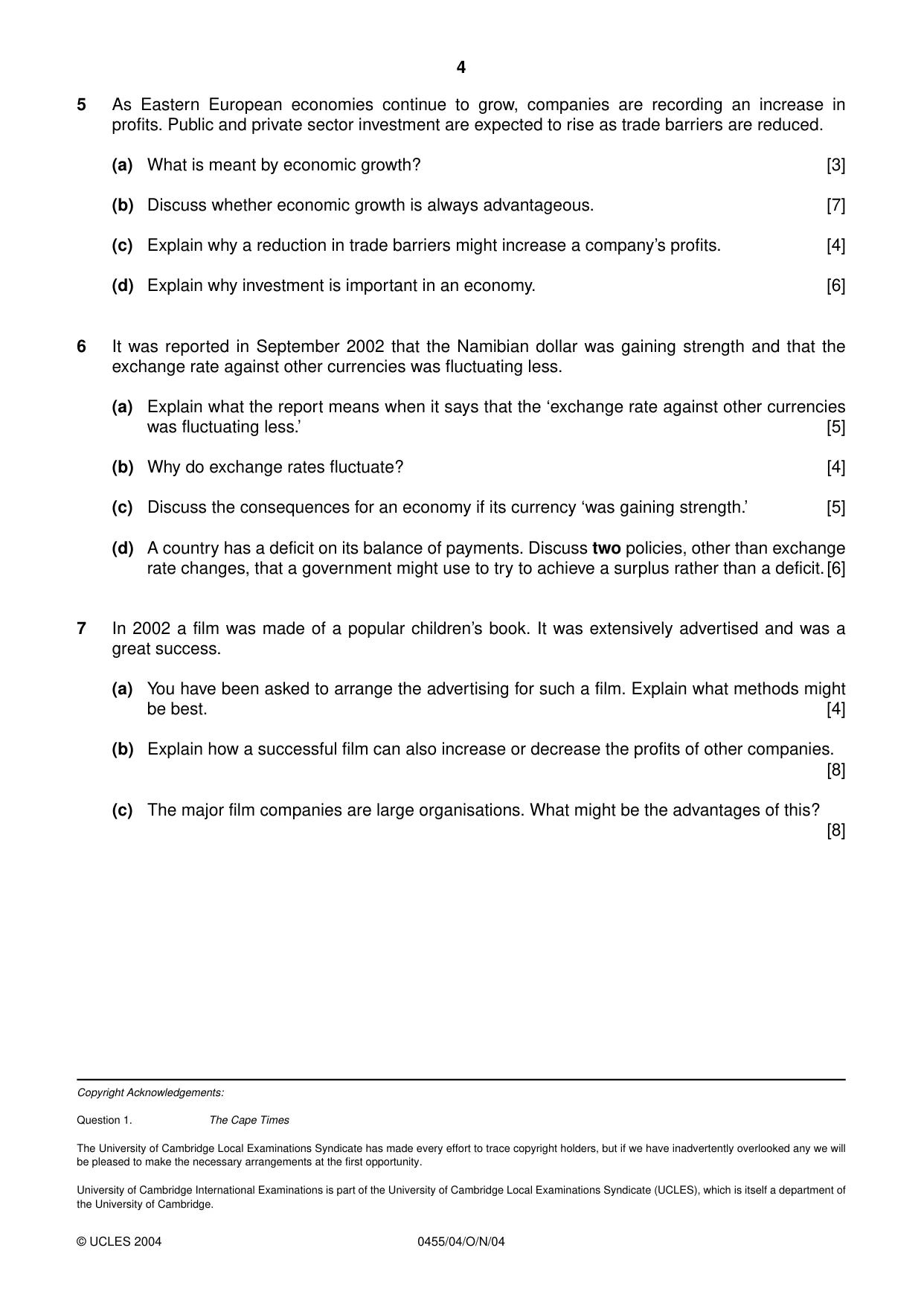
4 0455/04/O/N/04 5 As Eastern European economies continue to grow, companies are recording an increase in profits. Public and private sector investment are expected to rise as trade barriers are reduced. (a) What is meant by economic growth? [3] (b) Discuss whether economic growth is always advantageous. [7] (c) Explain why a reduction in trade barriers might increase a company’s profits. [4] (d) Explain why investment is important in an economy. [6] 6 It was reported in September 2002 that the Namibian dollar was gaining strength and that the exchange rate against other currencies was fluctuating less. (a) Explain what the report means when it says that the ‘exchange rate against other currencies was fluctuating less.’ [5] (b) Why do exchange rates fluctuate? [4] (c) Discuss the consequences for an economy if its currency ‘was gaining strength.’ [5] (d) A country has a deficit on its balance of payments. Discuss two policies, other than exchange rate changes, that a government might use to try to achieve a surplus rather than a deficit.[6] 7 In 2002 a film was made of a popular children’s book. It was extensively advertised and was a great success. (a) You have been asked to arrange the advertising for such a film. Explain what methods might be best. [4] (b) Explain how a successful film can also increase or decrease the profits of other companies. [8] (c) The major film companies are large organisations. What might be the advantages of this? [8] © UCLES 2004 Copyright Acknowledgements: Question 1. The Cape Times The University of Cambridge Local Examinations Syndicate has made every effort to trace copyright holders, but if we have inadvertently overlooked any we will be pleased to make the necessary arrangements at the first opportunity. University of Cambridge International Examinations is part of the University of Cambridge Local Examinations Syndicate (UCLES), which is itself a department of the University of Cambridge.
Mark scheme, page 1
UNIVERSITY OF CAMBRIDGE INTERNATIONAL EXAMINATIONS International General Certificate of Secondary Education MARK SCHEME for the November 2004 question papers 0455 ECONOMICS 0455/04 Paper 4 (Extended), maximum mark 80 This mark scheme is published as an aid to teachers and students, to indicate the requirements of the examination. It shows the basis on which Examiners were initially instructed to award marks. It does not indicate the details of the discussions that took place at an Examiners’ meeting before marking began. Any substantial changes to the mark scheme that arose from these discussions will be recorded in the published Report on the Examination. All Examiners are instructed that alternative correct answers and unexpected approaches in candidates’ scripts must be given marks that fairly reflect the relevant knowledge and skills demonstrated. Mark schemes must be read in conjunction with the question papers and the Report on the Examination. • CIE will not enter into discussion or correspondence in connection with these mark schemes. CIE is publishing the mark schemes for the November 2004 question papers for most IGCSE and GCE Advanced Level syllabuses. www.XtremePapers.com
Mark scheme, page 2
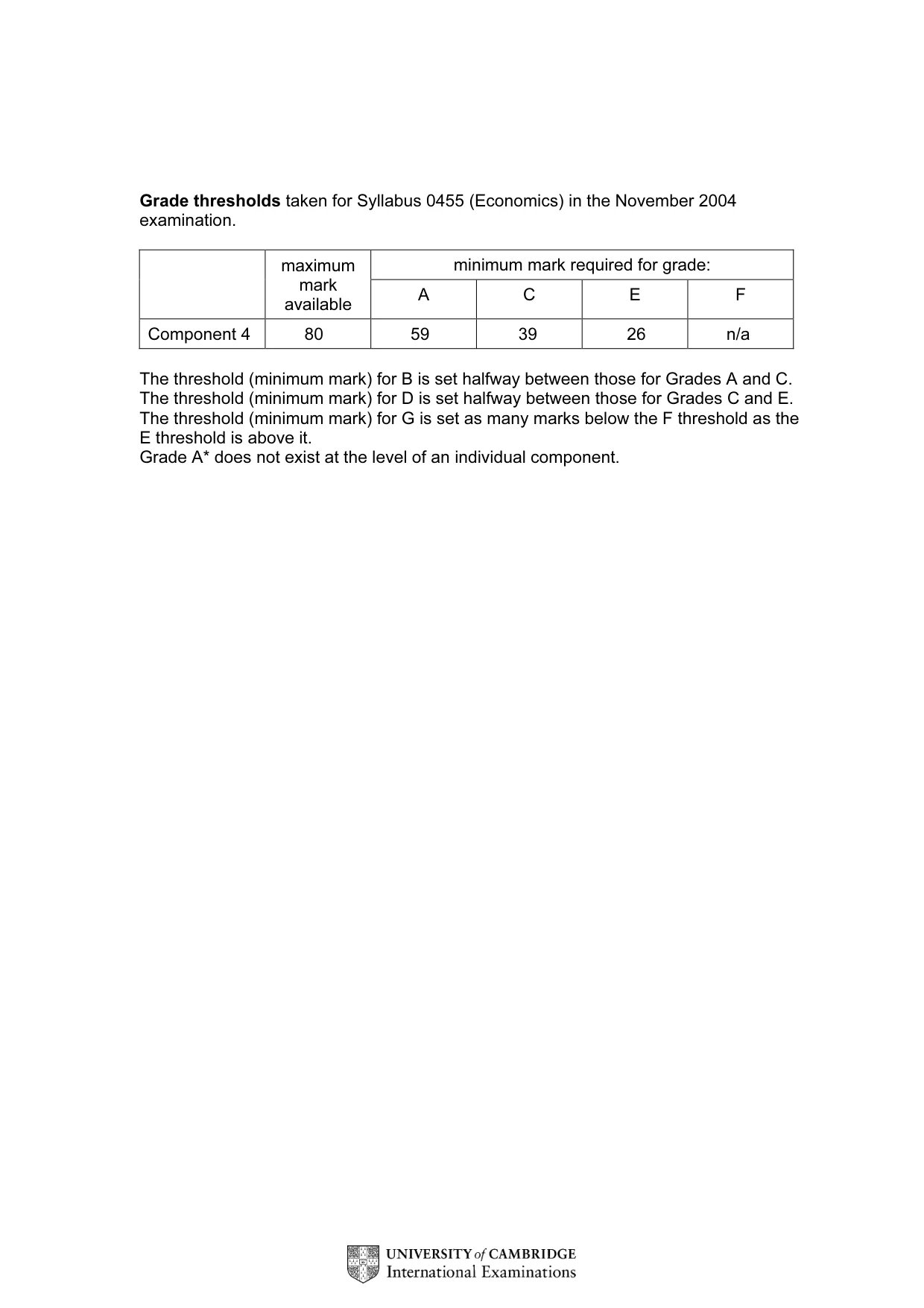
Grade thresholds taken for Syllabus 0455 (Economics) in the November 2004 examination. minimum mark required for grade: maximum mark available A C E F Component 4 80 59 39 26 n/a The threshold (minimum mark) for B is set halfway between those for Grades A and C. The threshold (minimum mark) for D is set halfway between those for Grades C and E. The threshold (minimum mark) for G is set as many marks below the F threshold as the E threshold is above it. Grade A* does not exist at the level of an individual component.
Mark scheme, page 3
November 2004 INTERNATIONAL GCSE MARK SCHEME MAXIMUM MARK: 80 SYLLABUS/COMPONENT: 0455/04 ECONOMICS (Extended)
Mark scheme, page 4
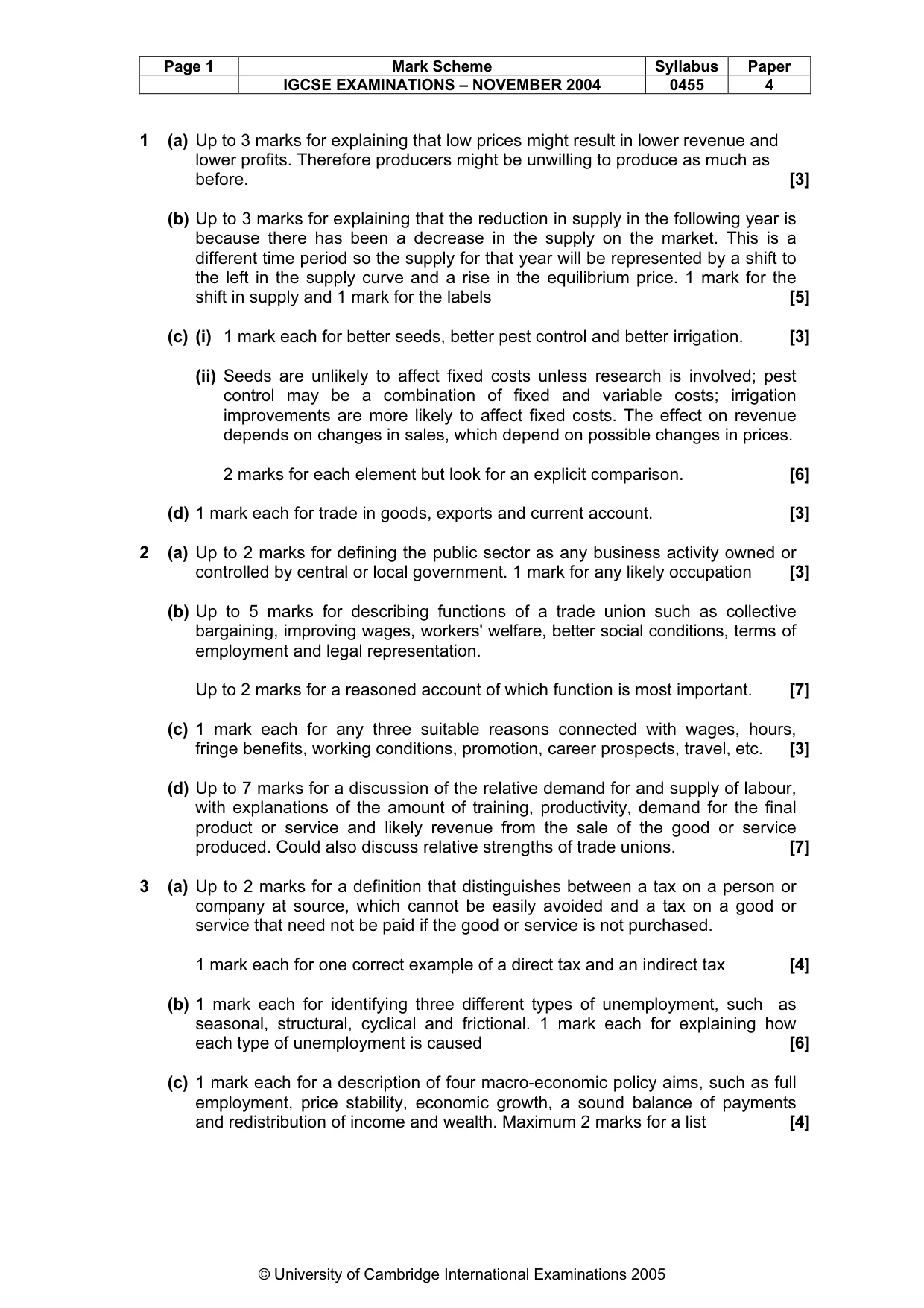
Page 1 Mark Scheme Syllabus Paper IGCSE EXAMINATIONS – NOVEMBER 2004 0455 4 © University of Cambridge International Examinations 2005 1 (a) Up to 3 marks for explaining that low prices might result in lower revenue and lower profits. Therefore producers might be unwilling to produce as much as before. [3] (b) Up to 3 marks for explaining that the reduction in supply in the following year is because there has been a decrease in the supply on the market. This is a different time period so the supply for that year will be represented by a shift to the left in the supply curve and a rise in the equilibrium price. 1 mark for the shift in supply and 1 mark for the labels [5] (c) (i) 1 mark each for better seeds, better pest control and better irrigation. [3] (ii) Seeds are unlikely to affect fixed costs unless research is involved; pest control may be a combination of fixed and variable costs; irrigation improvements are more likely to affect fixed costs. The effect on revenue depends on changes in sales, which depend on possible changes in prices. 2 marks for each element but look for an explicit comparison. [6] (d) 1 mark each for trade in goods, exports and current account. [3] 2 (a) Up to 2 marks for defining the public sector as any business activity owned or controlled by central or local government. 1 mark for any likely occupation [3] (b) Up to 5 marks for describing functions of a trade union such as collective bargaining, improving wages, workers' welfare, better social conditions, terms of employment and legal representation. Up to 2 marks for a reasoned account of which function is most important. [7] (c) 1 mark each for any three suitable reasons connected with wages, hours, fringe benefits, working conditions, promotion, career prospects, travel, etc. [3] (d) Up to 7 marks for a discussion of the relative demand for and supply of labour, with explanations of the amount of training, productivity, demand for the final product or service and likely revenue from the sale of the good or service produced. Could also discuss relative strengths of trade unions. [7] 3 (a) Up to 2 marks for a definition that distinguishes between a tax on a person or company at source, which cannot be easily avoided and a tax on a good or service that need not be paid if the good or service is not purchased. 1 mark each for one correct example of a direct tax and an indirect tax [4] (b) 1 mark each for identifying three different types of unemployment, such as seasonal, structural, cyclical and frictional. 1 mark each for explaining how each type of unemployment is caused [6] (c) 1 mark each for a description of four macro-economic policy aims, such as full employment, price stability, economic growth, a sound balance of payments and redistribution of income and wealth. Maximum 2 marks for a list [4]
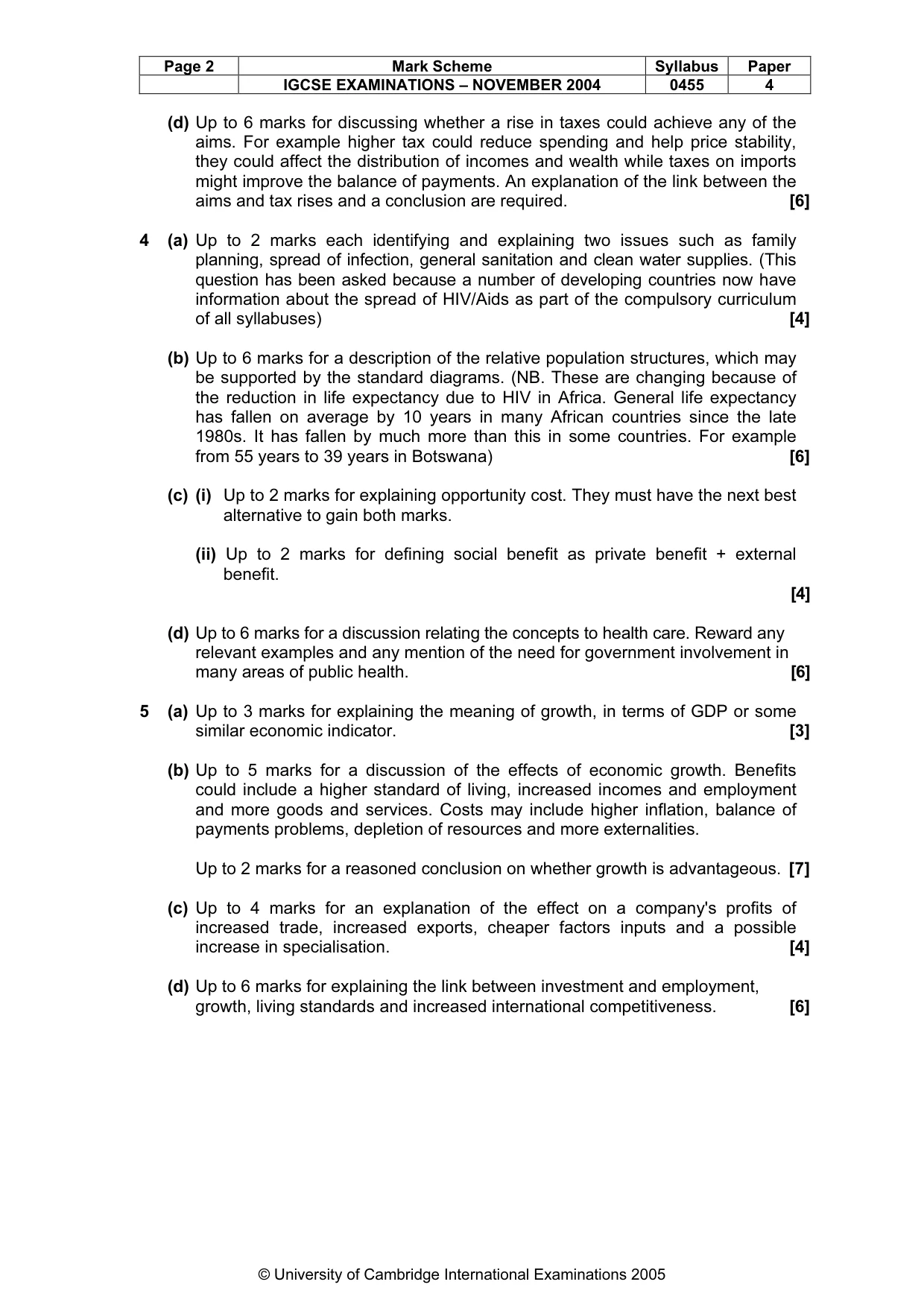
Mark scheme, page 5
Page 2 Mark Scheme Syllabus Paper IGCSE EXAMINATIONS – NOVEMBER 2004 0455 4 © University of Cambridge International Examinations 2005 (d) Up to 6 marks for discussing whether a rise in taxes could achieve any of the aims. For example higher tax could reduce spending and help price stability, they could affect the distribution of incomes and wealth while taxes on imports might improve the balance of payments. An explanation of the link between the aims and tax rises and a conclusion are required. [6] 4 (a) Up to 2 marks each identifying and explaining two issues such as family planning, spread of infection, general sanitation and clean water supplies. (This question has been asked because a number of developing countries now have information about the spread of HIV/Aids as part of the compulsory curriculum of all syllabuses) [4] (b) Up to 6 marks for a description of the relative population structures, which may be supported by the standard diagrams. (NB. These are changing because of the reduction in life expectancy due to HIV in Africa. General life expectancy has fallen on average by 10 years in many African countries since the late 1980s. It has fallen by much more than this in some countries. For example from 55 years to 39 years in Botswana) [6] (c) (i) Up to 2 marks for explaining opportunity cost. They must have the next best alternative to gain both marks. (ii) Up to 2 marks for defining social benefit as private benefit + external benefit. [4] (d) Up to 6 marks for a discussion relating the concepts to health care. Reward any relevant examples and any mention of the need for government involvement in many areas of public health. [6] 5 (a) Up to 3 marks for explaining the meaning of growth, in terms of GDP or some similar economic indicator. [3] (b) Up to 5 marks for a discussion of the effects of economic growth. Benefits could include a higher standard of living, increased incomes and employment and more goods and services. Costs may include higher inflation, balance of payments problems, depletion of resources and more externalities. Up to 2 marks for a reasoned conclusion on whether growth is advantageous. [7] (c) Up to 4 marks for an explanation of the effect on a company's profits of increased trade, increased exports, cheaper factors inputs and a possible increase in specialisation. [4] (d) Up to 6 marks for explaining the link between investment and employment, growth, living standards and increased international competitiveness. [6]
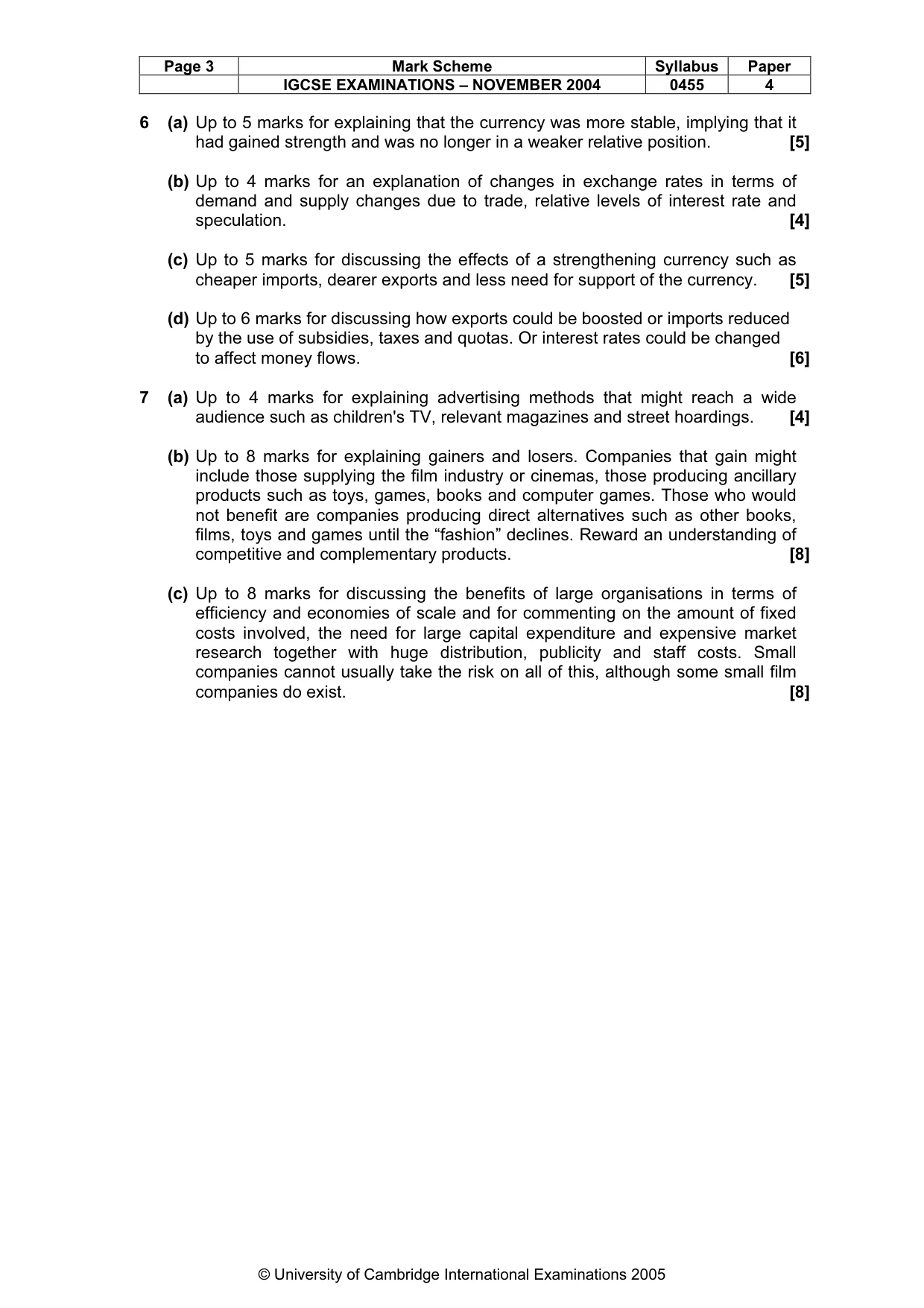
Mark scheme, page 6
Page 3 Mark Scheme Syllabus Paper IGCSE EXAMINATIONS – NOVEMBER 2004 0455 4 © University of Cambridge International Examinations 2005 6 (a) Up to 5 marks for explaining that the currency was more stable, implying that it had gained strength and was no longer in a weaker relative position. [5] (b) Up to 4 marks for an explanation of changes in exchange rates in terms of demand and supply changes due to trade, relative levels of interest rate and speculation. [4] (c) Up to 5 marks for discussing the effects of a strengthening currency such as cheaper imports, dearer exports and less need for support of the currency. [5] (d) Up to 6 marks for discussing how exports could be boosted or imports reduced by the use of subsidies, taxes and quotas. Or interest rates could be changed to affect money flows. [6] 7 (a) Up to 4 marks for explaining advertising methods that might reach a wide audience such as children's TV, relevant magazines and street hoardings. [4] (b) Up to 8 marks for explaining gainers and losers. Companies that gain might include those supplying the film industry or cinemas, those producing ancillary products such as toys, games, books and computer games. Those who would not benefit are companies producing direct alternatives such as other books, films, toys and games until the “fashion” declines. Reward an understanding of competitive and complementary products. [8] (c) Up to 8 marks for discussing the benefits of large organisations in terms of efficiency and economies of scale and for commenting on the amount of fixed costs involved, the need for large capital expenditure and expensive market research together with huge distribution, publicity and staff costs. Small companies cannot usually take the risk on all of this, although some small film companies do exist. [8]