Cambridge IGCSE Dutch - Foreign Language 0515 — 2017 May/June Paper 2 · Variant 1
0515/21/M/J/17 · 45 marks · ≈51 min
The question paper and its mark scheme, free to read here and free to download. This is Cambridge’s own paper, exactly as it was sat.
Question paper16 pages

Mark scheme11 pages
Answers below. Sit the paper first if you are practising.

Paper as text
Question paper, page 1
This document consists of 14 printed pages and 2 blank pages. DC (CW/SW) 134556/3 © UCLES 2017 [Turn over Cambridge International Examinations Cambridge International General Certificate of Secondary Education * 6 1 0 3 3 2 2 6 6 2 * DUTCH 0515/02 Paper 2 Reading May/June 2017 1 hour Candidates answer on the Question Paper. No Additional Materials are required. READ THESE INSTRUCTIONS FIRST Write your Centre number, candidate number and name in the spaces at the top of this page. Write in dark blue or black pen. Do not use staples, paper clips, glue or correction fluid. DO NOT WRITE IN ANY BARCODES. Answer all questions. The number of marks is given in brackets [ ] at the end of each question or part question.
Question paper, page 2
2 0515/02/M/J/17 © UCLES 2017 BLANK PAGE
Question paper, page 3
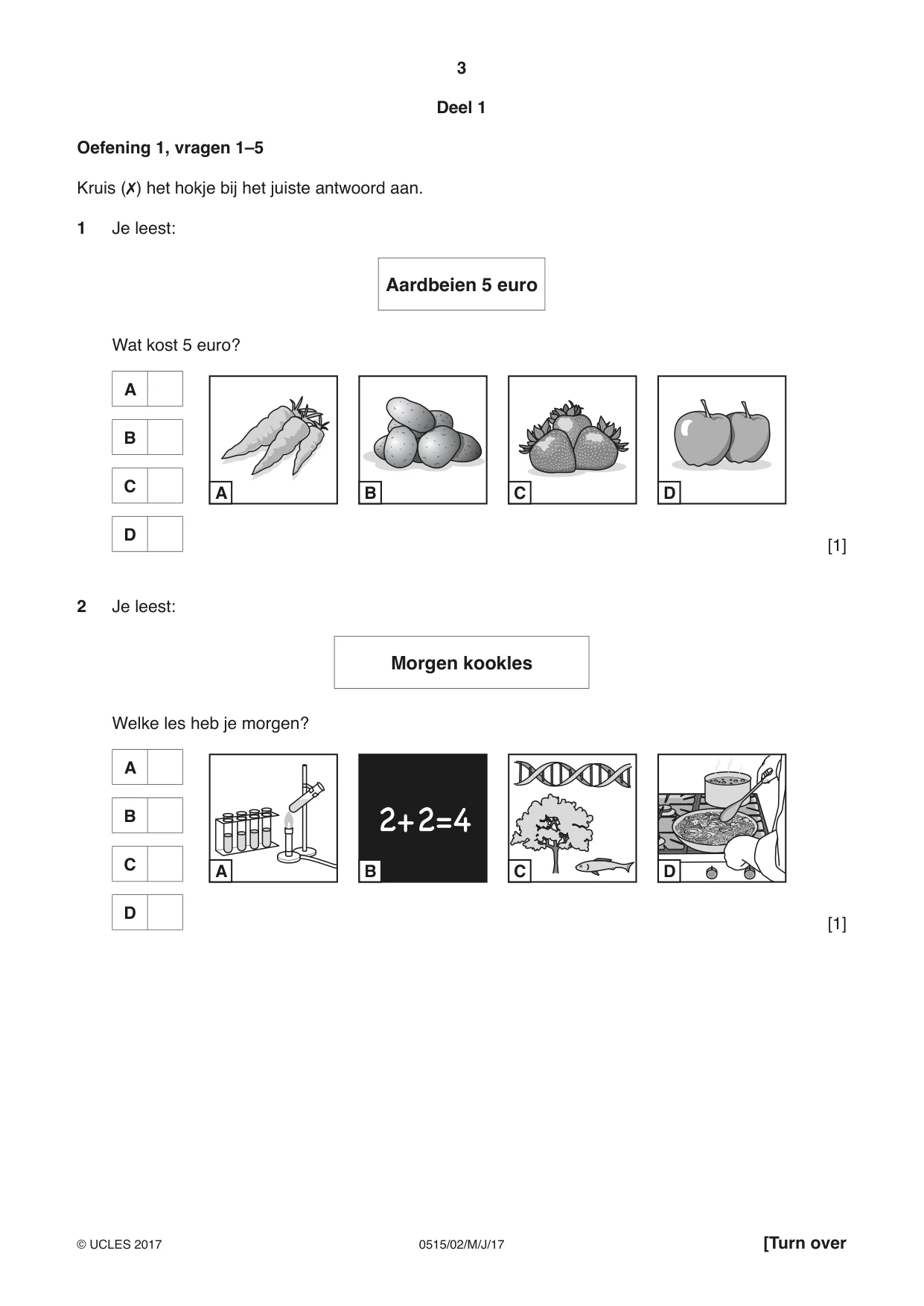
3 0515/02/M/J/17 © UCLES 2017 [Turn over Deel 1 Oefening 1, vragen 1–5 Kruis (✗) het hokje bij het juiste antwoord aan. 1 Je leest: Aardbeien 5 euro Wat kost 5 euro? A A B C D [1] B C D 2 Je leest: Morgen kookles Welke les heb je morgen? A A B C D [1] B C D
Question paper, page 4
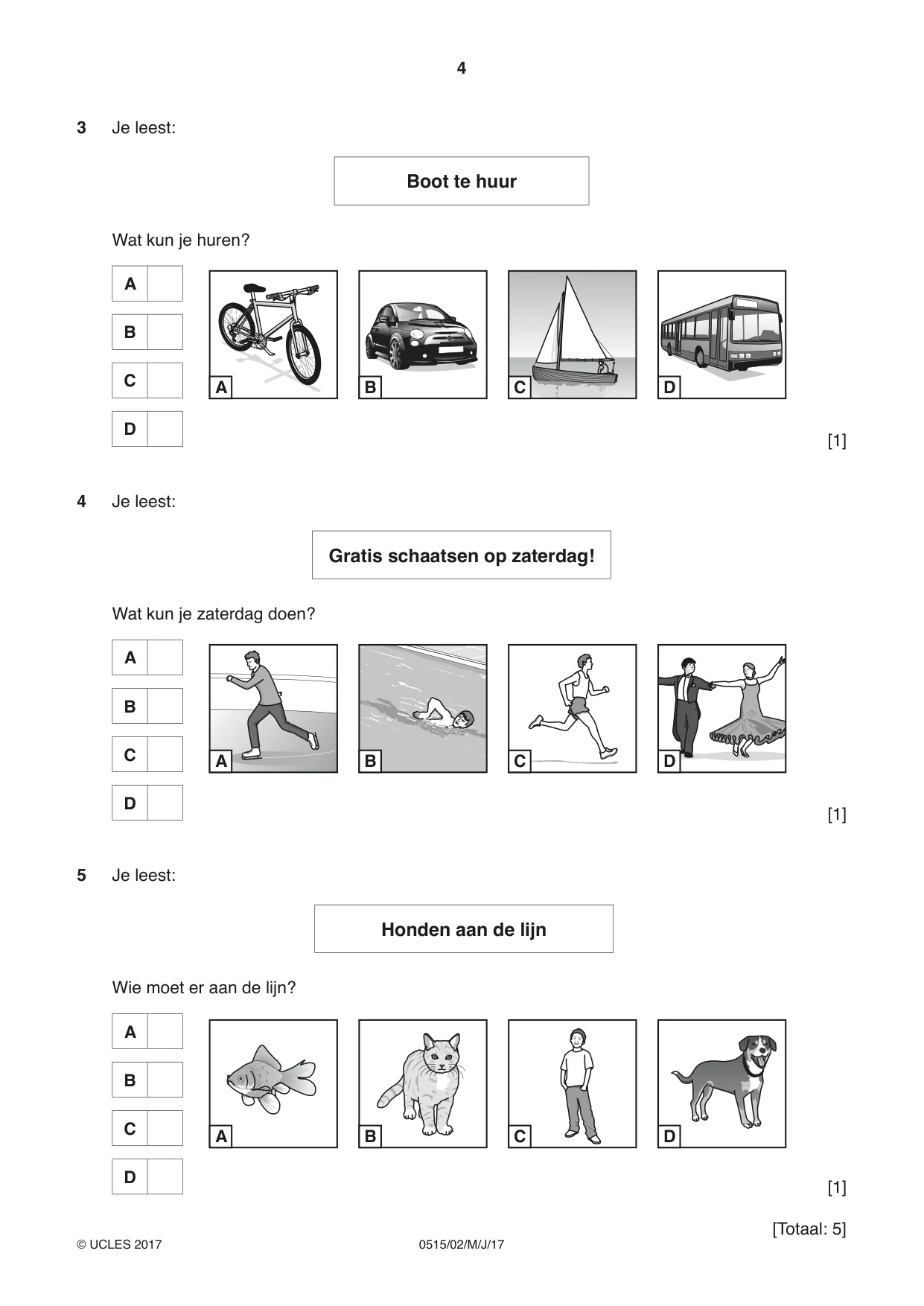
4 0515/02/M/J/17 © UCLES 2017 3 Je leest: Boot te huur Wat kun je huren? A A B C D [1] B C D 4 Je leest: Gratis schaatsen op zaterdag! Wat kun je zaterdag doen? A A B C D [1] B C D 5 Je leest: Honden aan de lijn Wie moet er aan de lijn? A A B C D [1] B C D [Totaal: 5]
Question paper, page 5
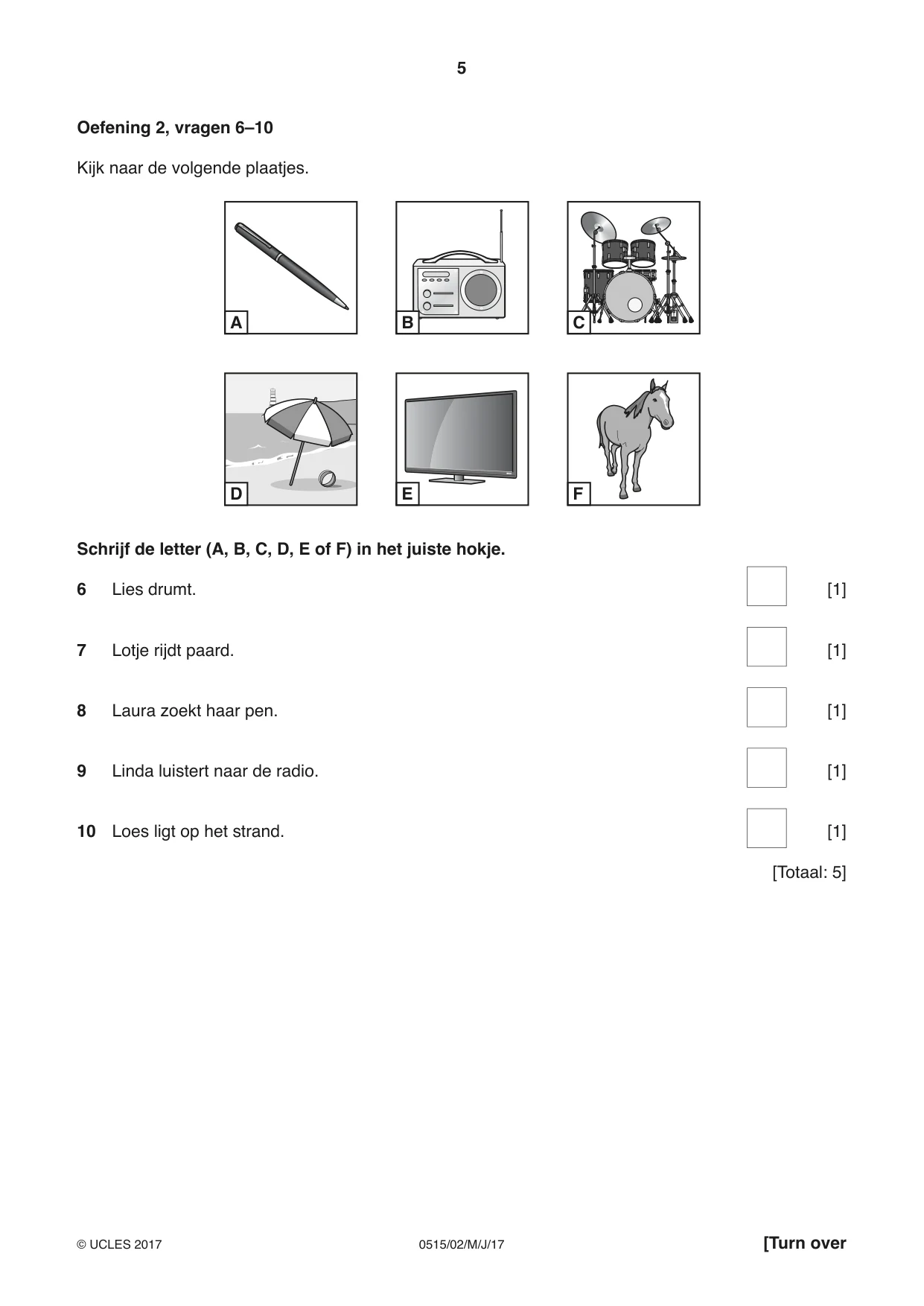
5 0515/02/M/J/17 © UCLES 2017 [Turn over Oefening 2, vragen 6–10 Kijk naar de volgende plaatjes. B C A E F D Schrijf de letter (A, B, C, D, E of F) in het juiste hokje. 6 Lies drumt. [1] 7 Lotje rijdt paard. [1] 8 Laura zoekt haar pen. [1] 9 Linda luistert naar de radio. [1] 10 Loes ligt op het strand. [1] [Totaal: 5]
Question paper, page 6
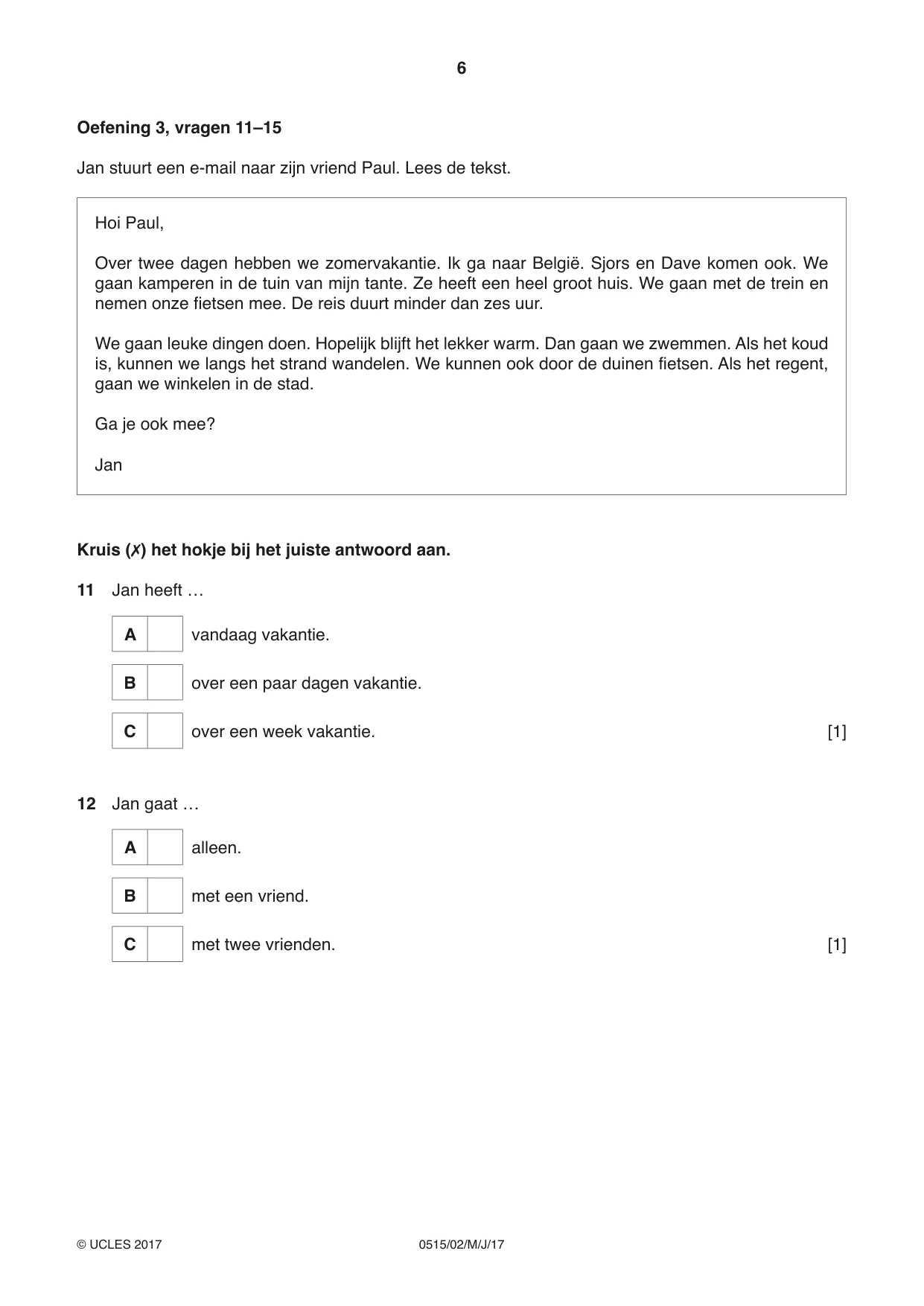
6 0515/02/M/J/17 © UCLES 2017 Oefening 3, vragen 11–15 Jan stuurt een e-mail naar zijn vriend Paul. Lees de tekst. Hoi Paul, Over twee dagen hebben we zomervakantie. Ik ga naar België. Sjors en Dave komen ook. We gaan kamperen in de tuin van mijn tante. Ze heeft een heel groot huis. We gaan met de trein en nemen onze fietsen mee. De reis duurt minder dan zes uur. We gaan leuke dingen doen. Hopelijk blijft het lekker warm. Dan gaan we zwemmen. Als het koud is, kunnen we langs het strand wandelen. We kunnen ook door de duinen fietsen. Als het regent, gaan we winkelen in de stad. Ga je ook mee? Jan Kruis (✗) het hokje bij het juiste antwoord aan. 11 Jan heeft … A vandaag vakantie. B over een paar dagen vakantie. C over een week vakantie. [1] 12 Jan gaat … A alleen. B met een vriend. C met twee vrienden. [1]
Question paper, page 7
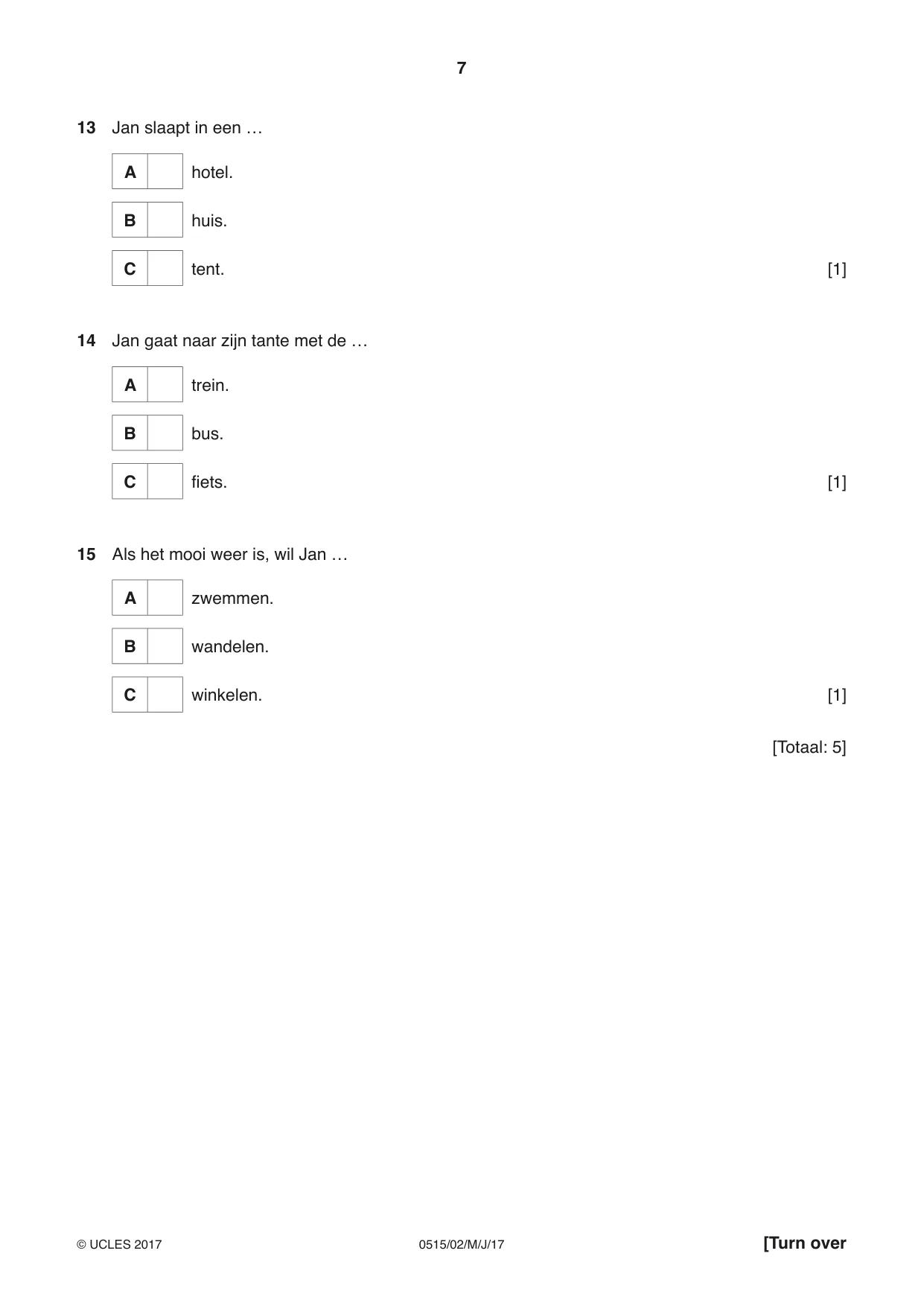
7 0515/02/M/J/17 © UCLES 2017 [Turn over 13 Jan slaapt in een … A hotel. B huis. C tent. [1] 14 Jan gaat naar zijn tante met de … A trein. B bus. C fiets. [1] 15 Als het mooi weer is, wil Jan … A zwemmen. B wandelen. C winkelen. [1] [Totaal: 5]
Question paper, page 8
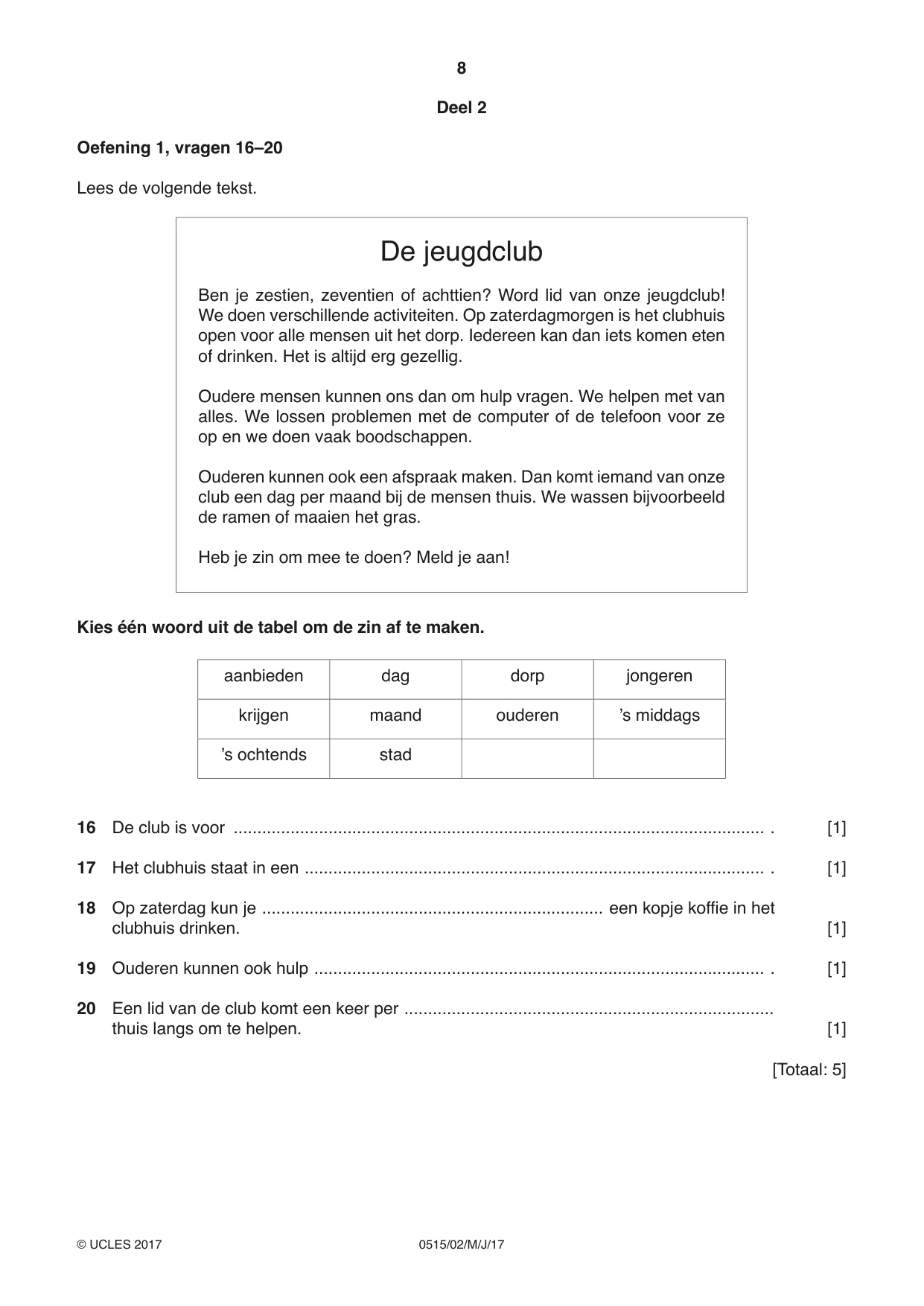
8 0515/02/M/J/17 © UCLES 2017 Deel 2 Oefening 1, vragen 16–20 Lees de volgende tekst. De jeugdclub Ben je zestien, zeventien of achttien? Word lid van onze jeugdclub! We doen verschillende activiteiten. Op zaterdagmorgen is het clubhuis open voor alle mensen uit het dorp. Iedereen kan dan iets komen eten of drinken. Het is altijd erg gezellig. Oudere mensen kunnen ons dan om hulp vragen. We helpen met van alles. We lossen problemen met de computer of de telefoon voor ze op en we doen vaak boodschappen. Ouderen kunnen ook een afspraak maken. Dan komt iemand van onze club een dag per maand bij de mensen thuis. We wassen bijvoorbeeld de ramen of maaien het gras. Heb je zin om mee te doen? Meld je aan! Kies één woord uit de tabel om de zin af te maken. aanbieden dag dorp jongeren krijgen maand ouderen ’s middags ’s ochtends stad 16 De club is voor … . [1] 17 Het clubhuis staat in een … . [1] 18 Op zaterdag kun je … een kopje koffie in het clubhuis drinken. [1] 19 Ouderen kunnen ook hulp … . [1] 20 Een lid van de club komt een keer per … thuis langs om te helpen. [1] [Totaal: 5]
Question paper, page 9
9 0515/02/M/J/17 © UCLES 2017 [Turn over OMSLAAN A.U.B. VOOR OEFENING 2.
Question paper, page 10
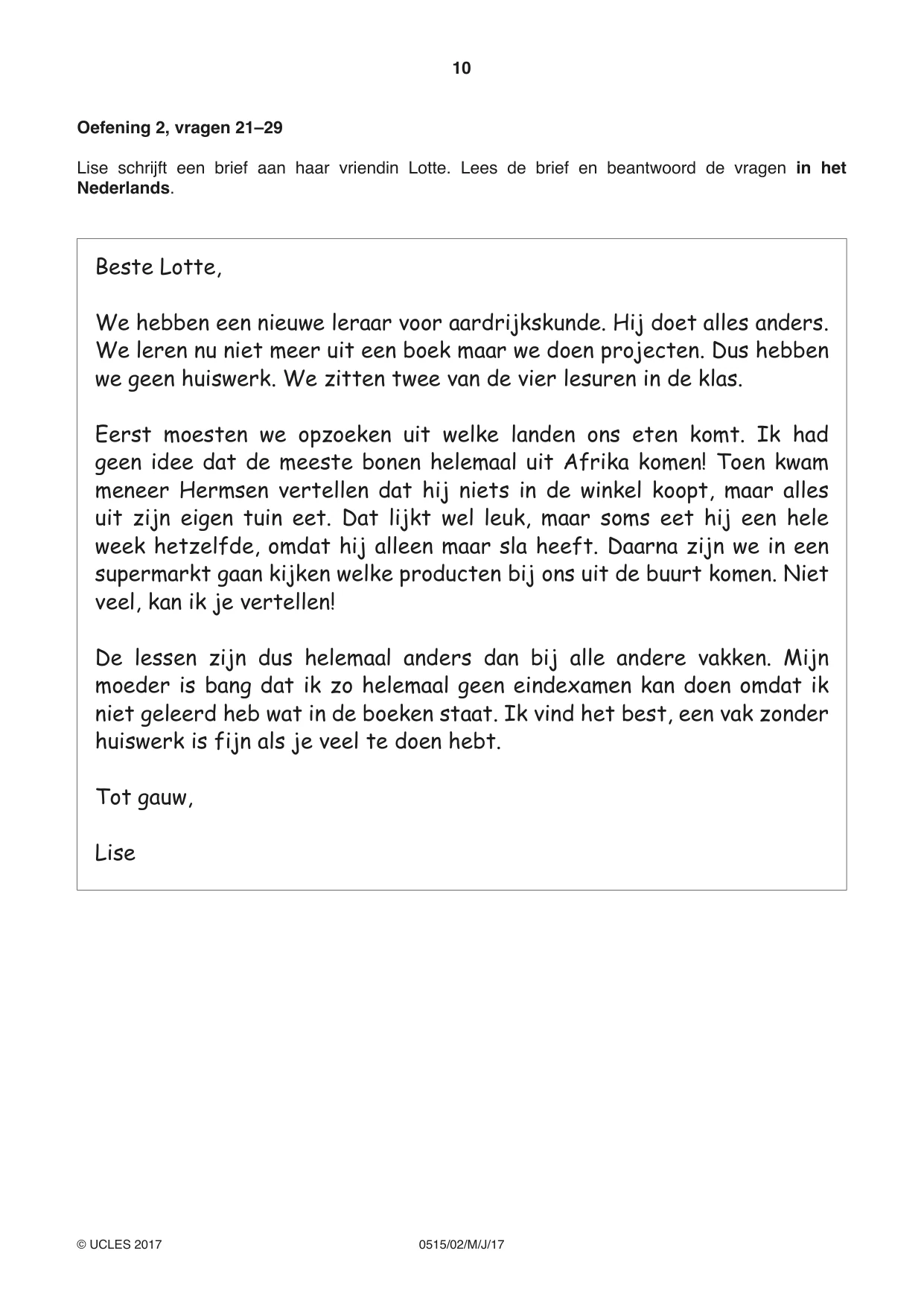
10 0515/02/M/J/17 © UCLES 2017 Oefening 2, vragen 21–29 Lise schrijft een brief aan haar vriendin Lotte. Lees de brief en beantwoord de vragen in het Nederlands. Beste Lotte, We hebben een nieuwe leraar voor aardrijkskunde. Hij doet alles anders. We leren nu niet meer uit een boek maar we doen projecten. Dus hebben we geen huiswerk. We zitten twee van de vier lesuren in de klas. Eerst moesten we opzoeken uit welke landen ons eten komt. Ik had geen idee dat de meeste bonen helemaal uit Afrika komen! Toen kwam meneer Hermsen vertellen dat hij niets in de winkel koopt, maar alles uit zijn eigen tuin eet. Dat lijkt wel leuk, maar soms eet hij een hele week hetzelfde, omdat hij alleen maar sla heeft. Daarna zijn we in een supermarkt gaan kijken welke producten bij ons uit de buurt komen. Niet veel, kan ik je vertellen! De lessen zijn dus helemaal anders dan bij alle andere vakken. Mijn moeder is bang dat ik zo helemaal geen eindexamen kan doen omdat ik niet geleerd heb wat in de boeken staat. Ik vind het best, een vak zonder huiswerk is fijn als je veel te doen hebt. Tot gauw, Lise
Question paper, page 11
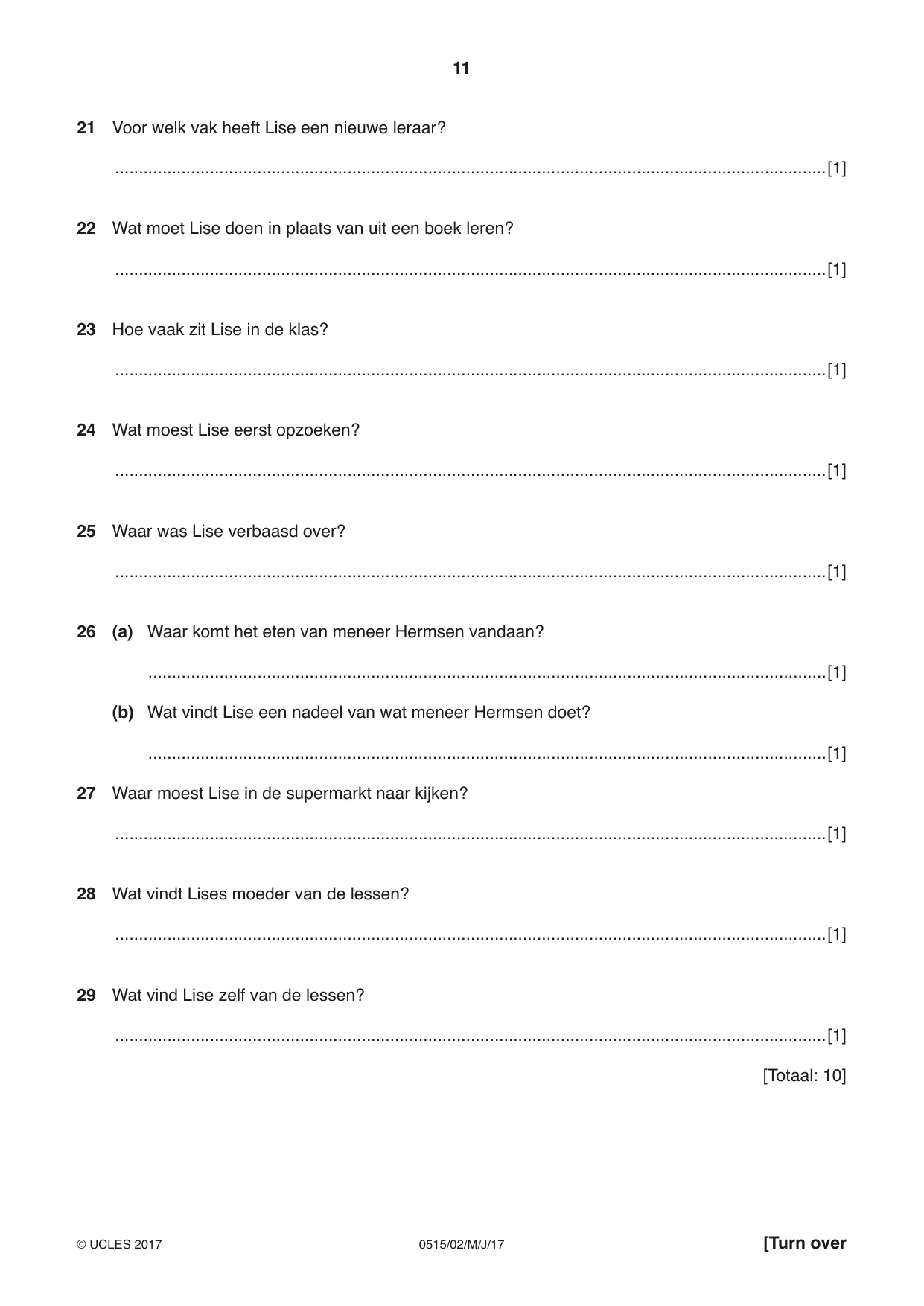
11 0515/02/M/J/17 © UCLES 2017 [Turn over 21 Voor welk vak heeft Lise een nieuwe leraar? …[1] 22 Wat moet Lise doen in plaats van uit een boek leren? …[1] 23 Hoe vaak zit Lise in de klas? …[1] 24 Wat moest Lise eerst opzoeken? …[1] 25 Waar was Lise verbaasd over? …[1] 26 (a) Waar komt het eten van meneer Hermsen vandaan? …[1] (b) Wat vindt Lise een nadeel van wat meneer Hermsen doet? …[1] 27 Waar moest Lise in de supermarkt naar kijken? …[1] 28 Wat vindt Lises moeder van de lessen? …[1] 29 Wat vind Lise zelf van de lessen? …[1] [Totaal: 10]
Question paper, page 12
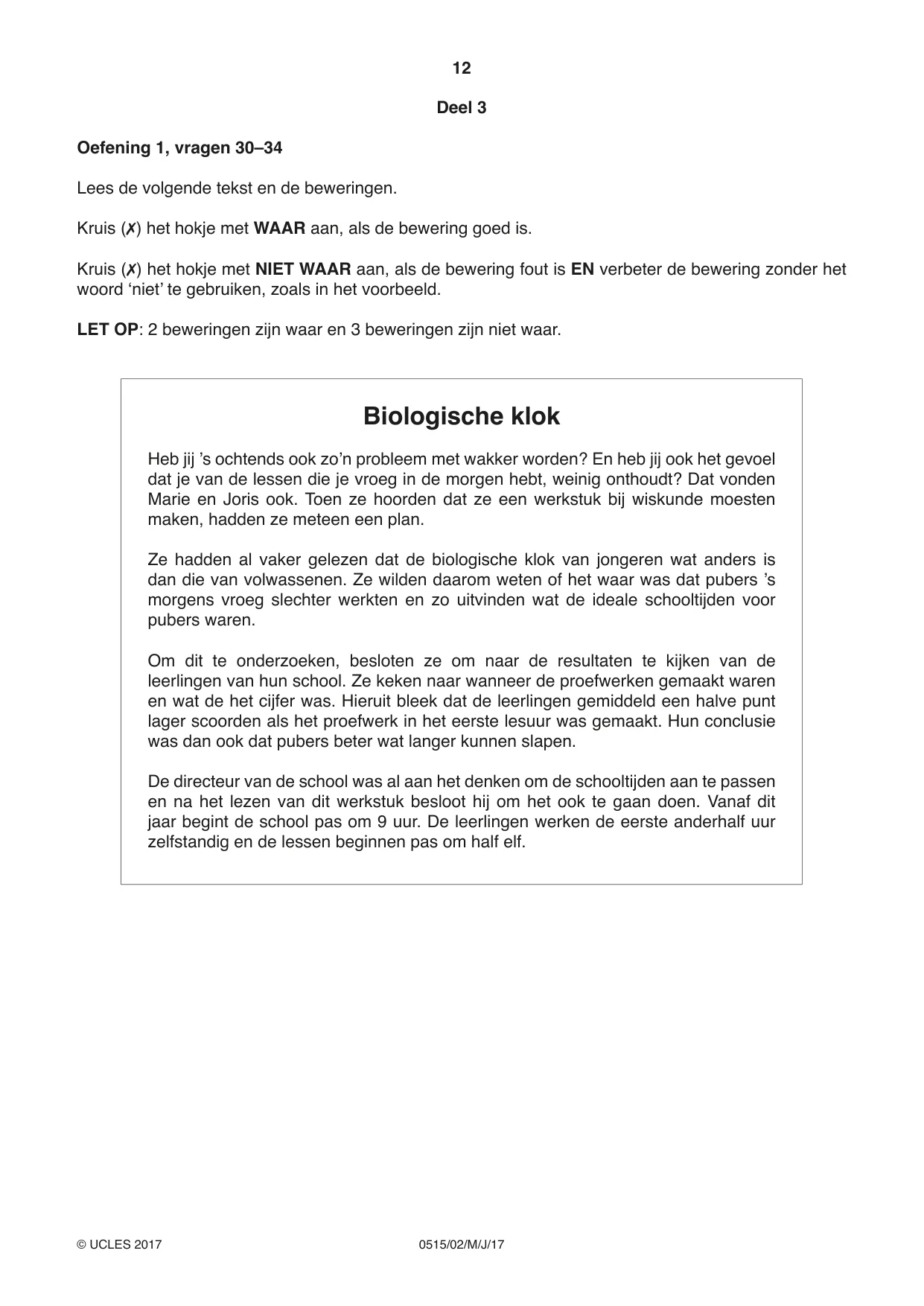
12 0515/02/M/J/17 © UCLES 2017 Deel 3 Oefening 1, vragen 30–34 Lees de volgende tekst en de beweringen. Kruis (✗) het hokje met WAAR aan, als de bewering goed is. Kruis (✗) het hokje met NIET WAAR aan, als de bewering fout is EN verbeter de bewering zonder het woord ‘niet’ te gebruiken, zoals in het voorbeeld. LET OP: 2 beweringen zijn waar en 3 beweringen zijn niet waar. Biologische klok Heb jij ’s ochtends ook zo’n probleem met wakker worden? En heb jij ook het gevoel dat je van de lessen die je vroeg in de morgen hebt, weinig onthoudt? Dat vonden Marie en Joris ook. Toen ze hoorden dat ze een werkstuk bij wiskunde moesten maken, hadden ze meteen een plan. Ze hadden al vaker gelezen dat de biologische klok van jongeren wat anders is dan die van volwassenen. Ze wilden daarom weten of het waar was dat pubers ’s morgens vroeg slechter werkten en zo uitvinden wat de ideale schooltijden voor pubers waren. Om dit te onderzoeken, besloten ze om naar de resultaten te kijken van de leerlingen van hun school. Ze keken naar wanneer de proefwerken gemaakt waren en wat de het cijfer was. Hieruit bleek dat de leerlingen gemiddeld een halve punt lager scoorden als het proefwerk in het eerste lesuur was gemaakt. Hun conclusie was dan ook dat pubers beter wat langer kunnen slapen. De directeur van de school was al aan het denken om de schooltijden aan te passen en na het lezen van dit werkstuk besloot hij om het ook te gaan doen. Vanaf dit jaar begint de school pas om 9 uur. De leerlingen werken de eerste anderhalf uur zelfstandig en de lessen beginnen pas om half elf.
Question paper, page 13
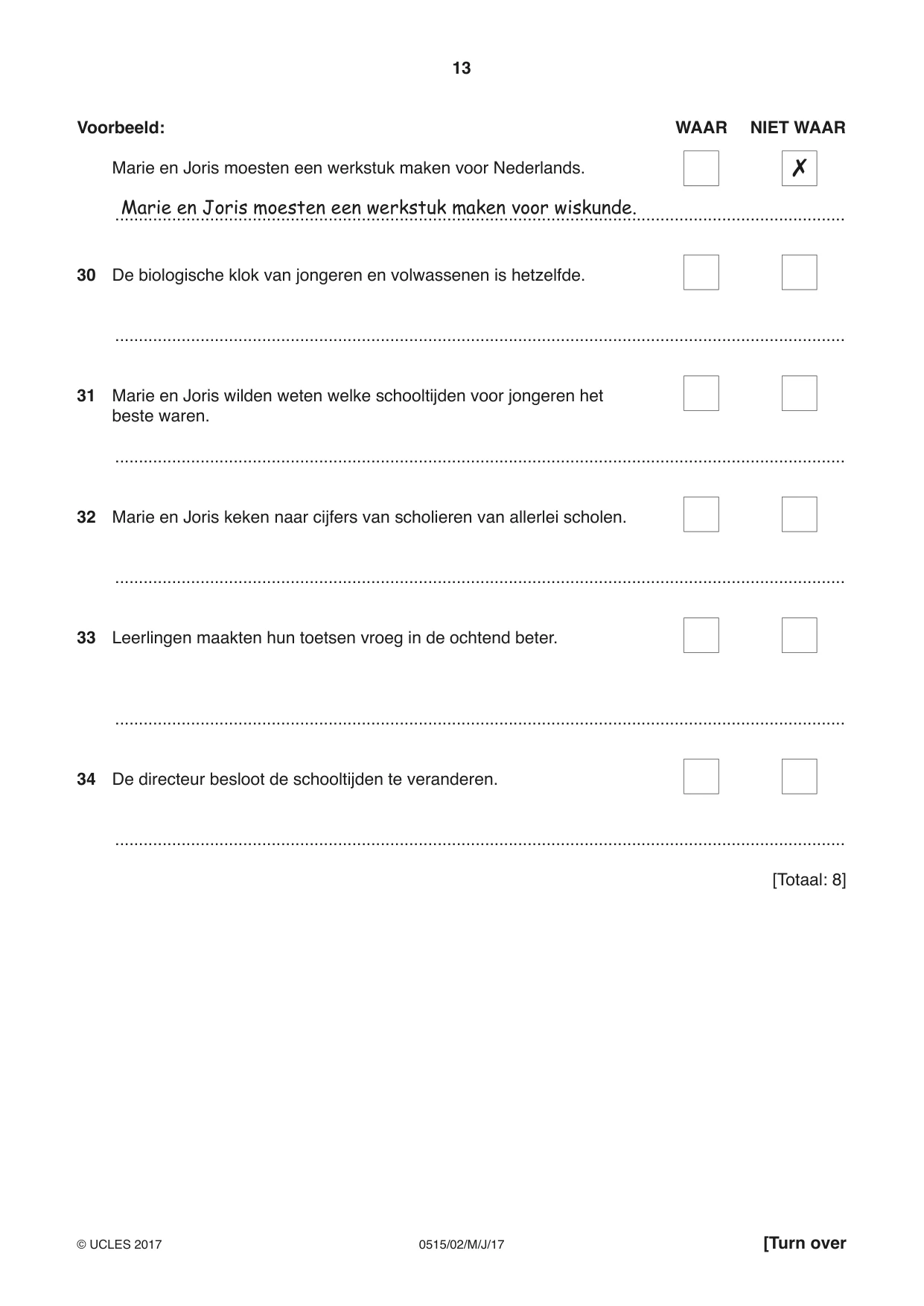
13 0515/02/M/J/17 © UCLES 2017 [Turn over Voorbeeld: WAAR NIET WAAR Marie en Joris moesten een werkstuk maken voor Nederlands. ✗ Marie en Joris moesten een werkstuk maken voor wiskunde. … 30 De biologische klok van jongeren en volwassenen is hetzelfde. … 31 Marie en Joris wilden weten welke schooltijden voor jongeren het beste waren. … 32 Marie en Joris keken naar cijfers van scholieren van allerlei scholen. … 33 Leerlingen maakten hun toetsen vroeg in de ochtend beter. … 34 De directeur besloot de schooltijden te veranderen. … [Totaal: 8]
Question paper, page 14
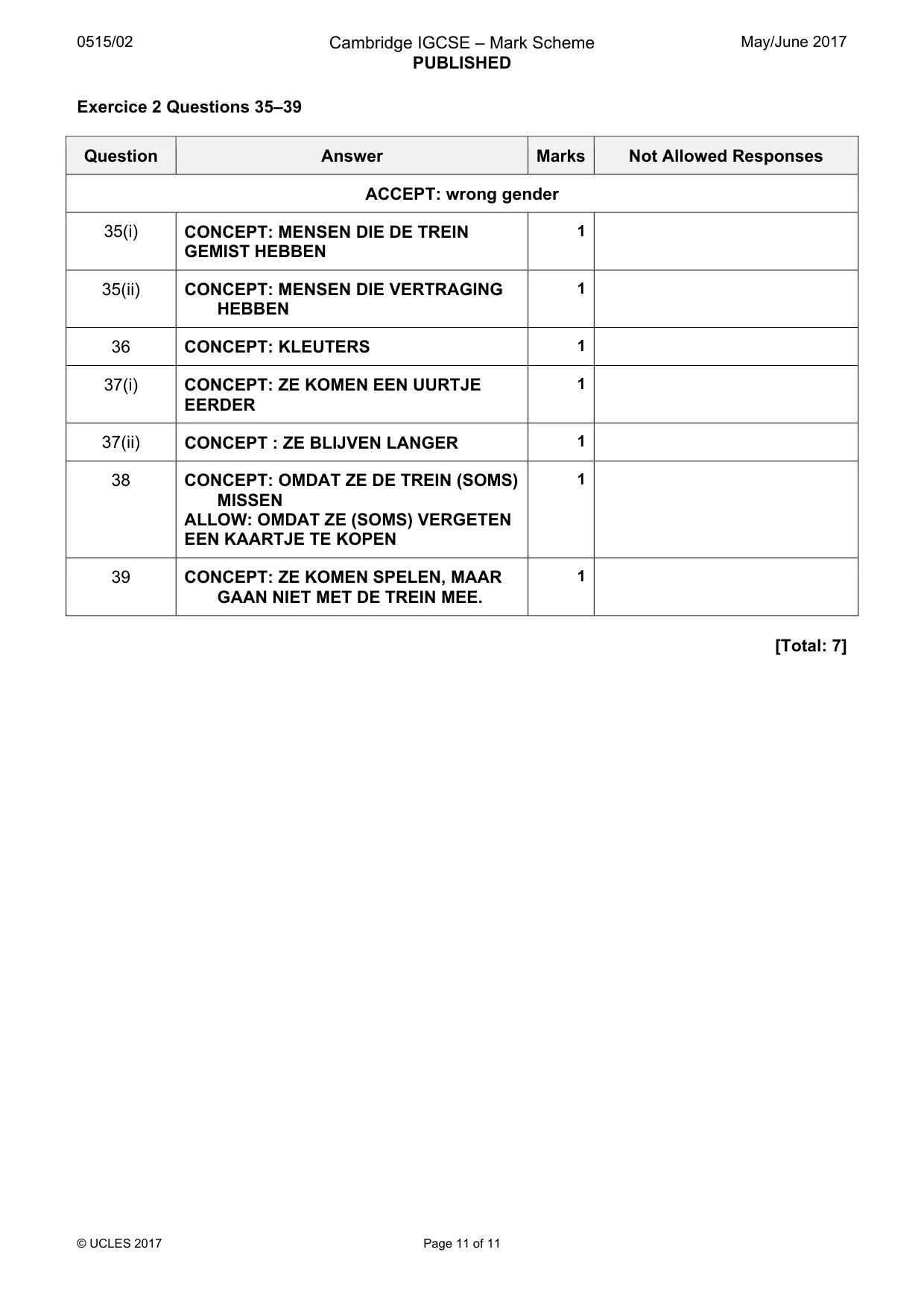
14 0515/02/M/J/17 © UCLES 2017 Oefening 2, vragen 35–39 Lees de volgende tekst en beantwoord de vragen in het Nederlands. Pianospelen Sinds een aantal jaren staat er een piano op het station in Amsterdam. En die wordt veel gebruikt. Als reizigers vertraging hebben of de trein hebben gemist, is het gezellig als ze piano kunnen spelen of naar muziek kunnen luisteren. Het lijkt net of je minder lang hoeft te wachten. Ook vanmiddag is de piano weer voortdurend bezet. Jong en oud spelen, de meesten hebben het vaker gedaan. Maar sommige ouders zetten ook hun kleuters achter de piano en laten ze lekker lawaai maken. Sommige pianisten houden hun rugzak op. Mensen die in rij voor een kaartje staan, wachten met hun rug naar de automaat en vergeten bijna een kaartje te kopen. Soms lopen luisteraars een rondje om het instrument, om te kijken of de pianist wel echt speelt. Veel mensen zien de piano tijdens het wachten en spelen een stukje. Maar voor een heel aantal mensen is het echt een deel van hun reis geworden. Zo komt Jan altijd expres ruim voordat zijn trein vertrekt op het station zodat hij nog een uurtje kan spelen en op de terugweg blijft hij nog een tijdje op het station. Hij heeft thuis niet zo’n mooie piano en hij geniet ervan om op de vleugel op het station te spelen. De studenten van de muziekschool hebben de piano ook gevonden. Zij gaan helemaal niet met de trein maar zij gebruiken de piano in de stationshal om te oefenen om voor een echt publiek te spelen. Dan is er ineens een echt concert. Mensen missen hun trein omdat ze de muziek zo mooi vinden. Er wordt niet alleen klassieke muziek gespeeld. Jan speelt waar de mensen om vragen. De kinderen vragen om kinderliedjes. Maar de volwassenen houden van jazz en populaire Nederlandse deuntjes, die speelt hij ook iedere keer als hij achter de piano zit.
Question paper, page 15
15 0515/02/M/J/17 © UCLES 2017 35 Voor wie is het fijn dat de piano er staat? Noem twee groepen. (i) …[1] (ii) …[1] 36 Wie maken er geen mooie muziek? …[1] 37 Hoe hebben sommige mensen hun reisplannen aan de piano aangepast? Noem twee manieren. (i) …[1] (ii) …[1] 38 Waarom is het niet voor alle mensen goed dat de piano er staat? Noem één nadeel. …[1] 39 Waarom zijn de mensen van de muziekschool geen echte reizigers? …[1] [Totaal: 7]
Question paper, page 16
16 0515/02/M/J/17 © UCLES 2017 Permission to reproduce items where third-party owned material protected by copyright is included has been sought and cleared where possible. Every reasonable effort has been made by the publisher (UCLES) to trace copyright holders, but if any items requiring clearance have unwittingly been included, the publisher will be pleased to make amends at the earliest possible opportunity. To avoid the issue of disclosure of answer-related information to candidates, all copyright acknowledgements are reproduced online in the Cambridge International Examinations Copyright Acknowledgements Booklet. This is produced for each series of examinations and is freely available to download at www.cie.org.uk after the live examination series. Cambridge International Examinations is part of the Cambridge Assessment Group. Cambridge Assessment is the brand name of University of Cambridge Local Examinations Syndicate (UCLES), which is itself a department of the University of Cambridge. BLANK PAGE
Mark scheme, page 1
® IGCSE is a registered trademark. This document consists of 11 printed pages. © UCLES 2017 [Turn over Cambridge International Examinations Cambridge International General Certificate of Secondary Education DUTCH 0515/02 Paper 2 Reading May/June 2017 MARK SCHEME Maximum Mark: 45 Published This mark scheme is published as an aid to teachers and candidates, to indicate the requirements of the examination. It shows the basis on which Examiners were instructed to award marks. It does not indicate the details of the discussions that took place at an Examiners’ meeting before marking began, which would have considered the acceptability of alternative answers. Mark schemes should be read in conjunction with the question paper and the Principal Examiner Report for Teachers. Cambridge will not enter into discussions about these mark schemes. Cambridge is publishing the mark schemes for the May/June 2017 series for most Cambridge IGCSE®, Cambridge International A and AS Level and Cambridge Pre-U components, and some Cambridge O Level components.
Mark scheme, page 2
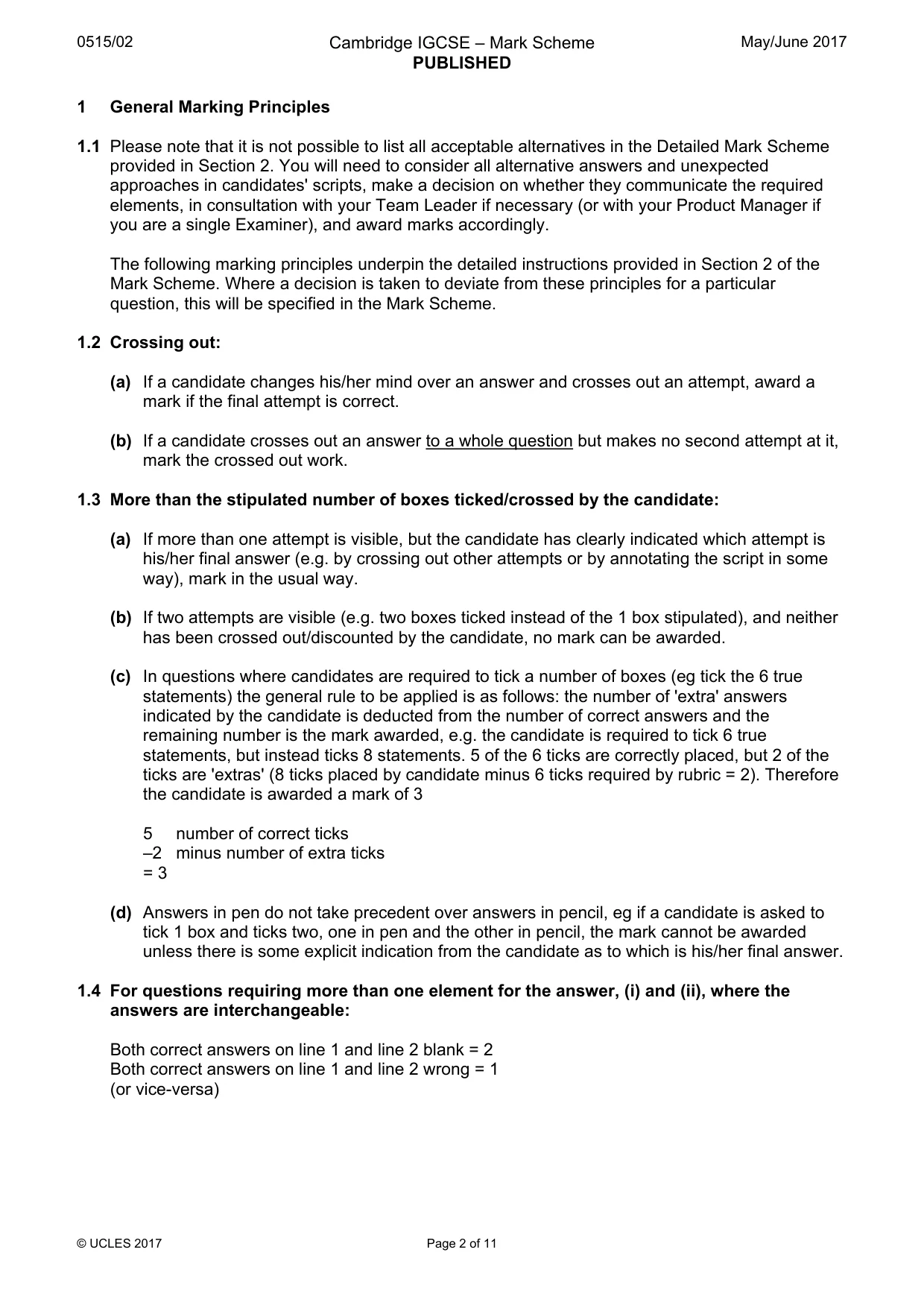
0515/02 Cambridge IGCSE – Mark Scheme PUBLISHED May/June 2017 © UCLES 2017 Page 2 of 11 1 General Marking Principles 1.1 Please note that it is not possible to list all acceptable alternatives in the Detailed Mark Scheme provided in Section 2. You will need to consider all alternative answers and unexpected approaches in candidates' scripts, make a decision on whether they communicate the required elements, in consultation with your Team Leader if necessary (or with your Product Manager if you are a single Examiner), and award marks accordingly. The following marking principles underpin the detailed instructions provided in Section 2 of the Mark Scheme. Where a decision is taken to deviate from these principles for a particular question, this will be specified in the Mark Scheme. 1.2 Crossing out: (a) If a candidate changes his/her mind over an answer and crosses out an attempt, award a mark if the final attempt is correct. (b) If a candidate crosses out an answer to a whole question but makes no second attempt at it, mark the crossed out work. 1.3 More than the stipulated number of boxes ticked/crossed by the candidate: (a) If more than one attempt is visible, but the candidate has clearly indicated which attempt is his/her final answer (e.g. by crossing out other attempts or by annotating the script in some way), mark in the usual way. (b) If two attempts are visible (e.g. two boxes ticked instead of the 1 box stipulated), and neither has been crossed out/discounted by the candidate, no mark can be awarded. (c) In questions where candidates are required to tick a number of boxes (eg tick the 6 true statements) the general rule to be applied is as follows: the number of 'extra' answers indicated by the candidate is deducted from the number of correct answers and the remaining number is the mark awarded, e.g. the candidate is required to tick 6 true statements, but instead ticks 8 statements. 5 of the 6 ticks are correctly placed, but 2 of the ticks are 'extras' (8 ticks placed by candidate minus 6 ticks required by rubric = 2). Therefore the candidate is awarded a mark of 3 5 number of correct ticks –2 minus number of extra ticks = 3 (d) Answers in pen do not take precedent over answers in pencil, eg if a candidate is asked to tick 1 box and ticks two, one in pen and the other in pencil, the mark cannot be awarded unless there is some explicit indication from the candidate as to which is his/her final answer. 1.4 For questions requiring more than one element for the answer, (i) and (ii), where the answers are interchangeable: Both correct answers on line 1 and line 2 blank = 2 Both correct answers on line 1 and line 2 wrong = 1 (or vice-versa)
Mark scheme, page 3
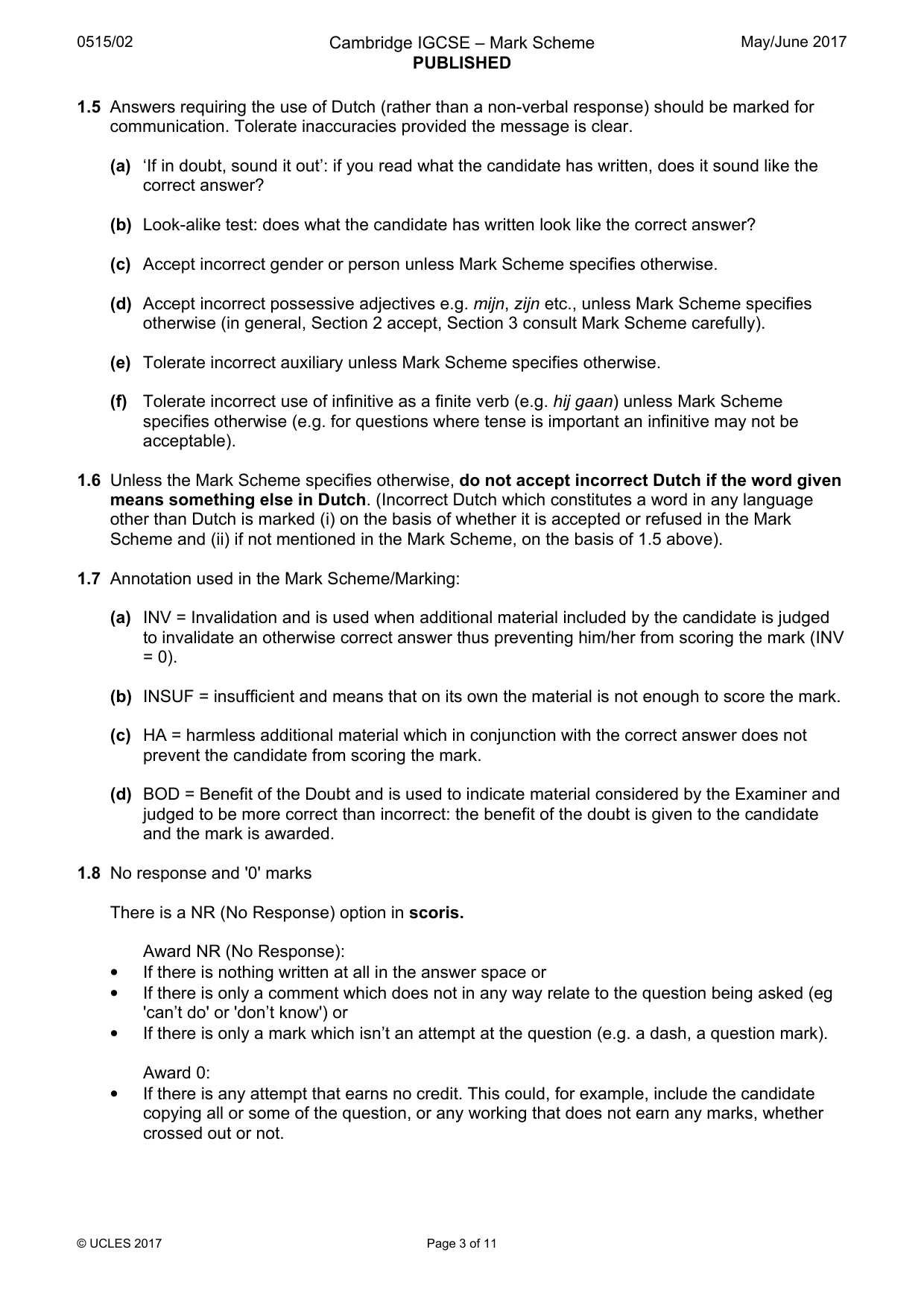
0515/02 Cambridge IGCSE – Mark Scheme PUBLISHED May/June 2017 © UCLES 2017 Page 3 of 11 1.5 Answers requiring the use of Dutch (rather than a non-verbal response) should be marked for communication. Tolerate inaccuracies provided the message is clear. (a) ‘If in doubt, sound it out’: if you read what the candidate has written, does it sound like the correct answer? (b) Look-alike test: does what the candidate has written look like the correct answer? (c) Accept incorrect gender or person unless Mark Scheme specifies otherwise. (d) Accept incorrect possessive adjectives e.g. mijn, zijn etc., unless Mark Scheme specifies otherwise (in general, Section 2 accept, Section 3 consult Mark Scheme carefully). (e) Tolerate incorrect auxiliary unless Mark Scheme specifies otherwise. (f) Tolerate incorrect use of infinitive as a finite verb (e.g. hij gaan) unless Mark Scheme specifies otherwise (e.g. for questions where tense is important an infinitive may not be acceptable). 1.6 Unless the Mark Scheme specifies otherwise, do not accept incorrect Dutch if the word given means something else in Dutch. (Incorrect Dutch which constitutes a word in any language other than Dutch is marked (i) on the basis of whether it is accepted or refused in the Mark Scheme and (ii) if not mentioned in the Mark Scheme, on the basis of 1.5 above). 1.7 Annotation used in the Mark Scheme/Marking: (a) INV = Invalidation and is used when additional material included by the candidate is judged to invalidate an otherwise correct answer thus preventing him/her from scoring the mark (INV = 0). (b) INSUF = insufficient and means that on its own the material is not enough to score the mark. (c) HA = harmless additional material which in conjunction with the correct answer does not prevent the candidate from scoring the mark. (d) BOD = Benefit of the Doubt and is used to indicate material considered by the Examiner and judged to be more correct than incorrect: the benefit of the doubt is given to the candidate and the mark is awarded. 1.8 No response and '0' marks There is a NR (No Response) option in scoris. Award NR (No Response): • If there is nothing written at all in the answer space or • If there is only a comment which does not in any way relate to the question being asked (eg 'can’t do' or 'don’t know') or • If there is only a mark which isn’t an attempt at the question (e.g. a dash, a question mark). Award 0: • If there is any attempt that earns no credit. This could, for example, include the candidate copying all or some of the question, or any working that does not earn any marks, whether crossed out or not.
Mark scheme, page 4
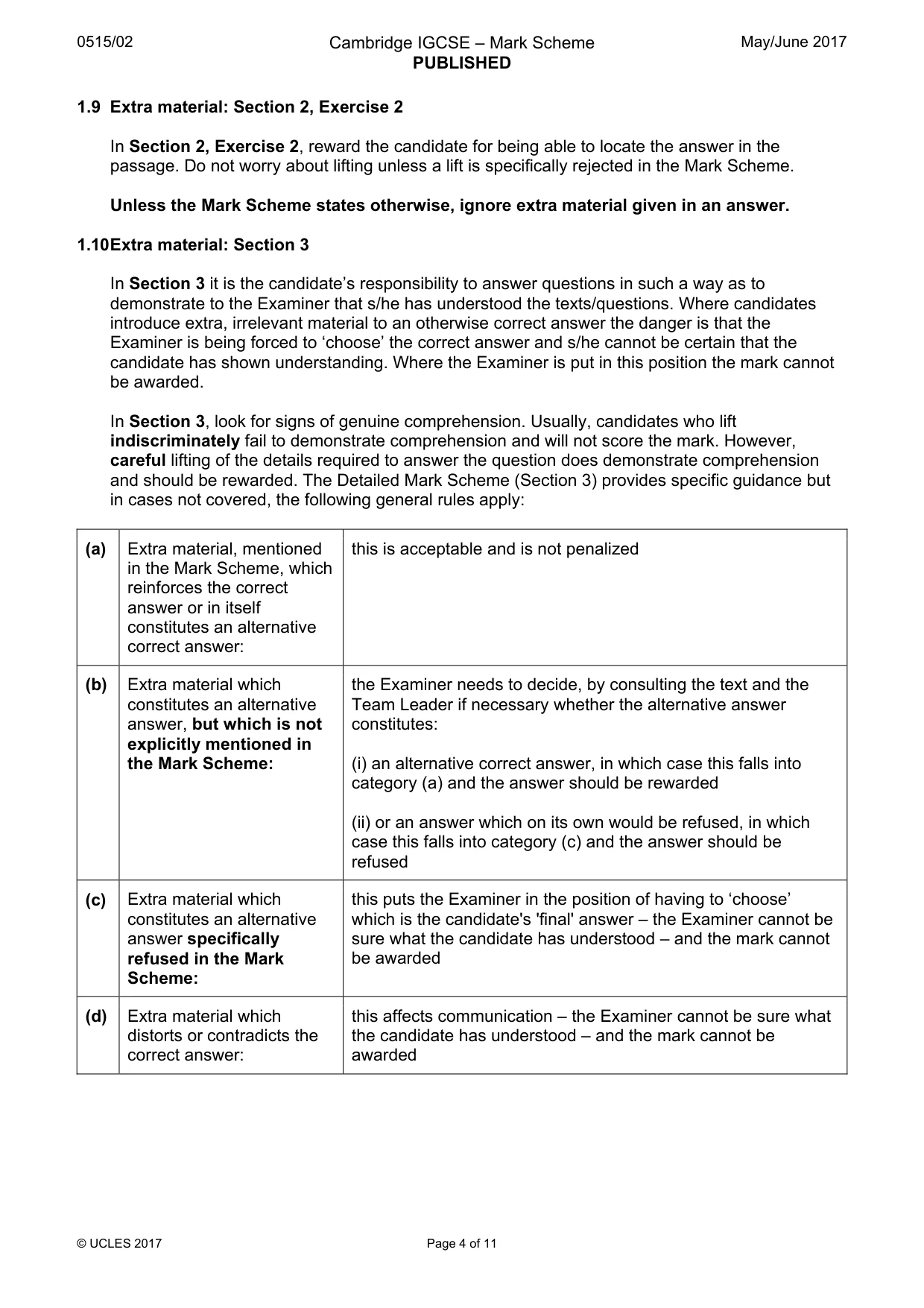
0515/02 Cambridge IGCSE – Mark Scheme PUBLISHED May/June 2017 © UCLES 2017 Page 4 of 11 1.9 Extra material: Section 2, Exercise 2 In Section 2, Exercise 2, reward the candidate for being able to locate the answer in the passage. Do not worry about lifting unless a lift is specifically rejected in the Mark Scheme. Unless the Mark Scheme states otherwise, ignore extra material given in an answer. 1.10 Extra material: Section 3 In Section 3 it is the candidate’s responsibility to answer questions in such a way as to demonstrate to the Examiner that s/he has understood the texts/questions. Where candidates introduce extra, irrelevant material to an otherwise correct answer the danger is that the Examiner is being forced to ‘choose’ the correct answer and s/he cannot be certain that the candidate has shown understanding. Where the Examiner is put in this position the mark cannot be awarded. In Section 3, look for signs of genuine comprehension. Usually, candidates who lift indiscriminately fail to demonstrate comprehension and will not score the mark. However, careful lifting of the details required to answer the question does demonstrate comprehension and should be rewarded. The Detailed Mark Scheme (Section 3) provides specific guidance but in cases not covered, the following general rules apply: (a) Extra material, mentioned in the Mark Scheme, which reinforces the correct answer or in itself constitutes an alternative correct answer: this is acceptable and is not penalized (b) Extra material which constitutes an alternative answer, but which is not explicitly mentioned in the Mark Scheme: the Examiner needs to decide, by consulting the text and the Team Leader if necessary whether the alternative answer constitutes: (i) an alternative correct answer, in which case this falls into category (a) and the answer should be rewarded (ii) or an answer which on its own would be refused, in which case this falls into category (c) and the answer should be refused (c) Extra material which constitutes an alternative answer specifically refused in the Mark Scheme: this puts the Examiner in the position of having to ‘choose’ which is the candidate's 'final' answer – the Examiner cannot be sure what the candidate has understood – and the mark cannot be awarded (d) Extra material which distorts or contradicts the correct answer: this affects communication – the Examiner cannot be sure what the candidate has understood – and the mark cannot be awarded
Mark scheme, page 5
0515/02 Cambridge IGCSE – Mark Scheme PUBLISHED May/June 2017 © UCLES 2017 Page 5 of 11 (e) Extra material introduced by the candidate and which does not feature in the text: this affects communication – the Examiner cannot be sure what the candidate has understood – and the mark cannot be awarded. It can sometimes be difficult to draw the line between what is a deduction made by an able candidate on the basis of what they have read and pure guesswork. Therefore where an answer of this sort occurs which is not covered in the Mark Scheme, Examiners should consult their Team Leader
Mark scheme, page 6
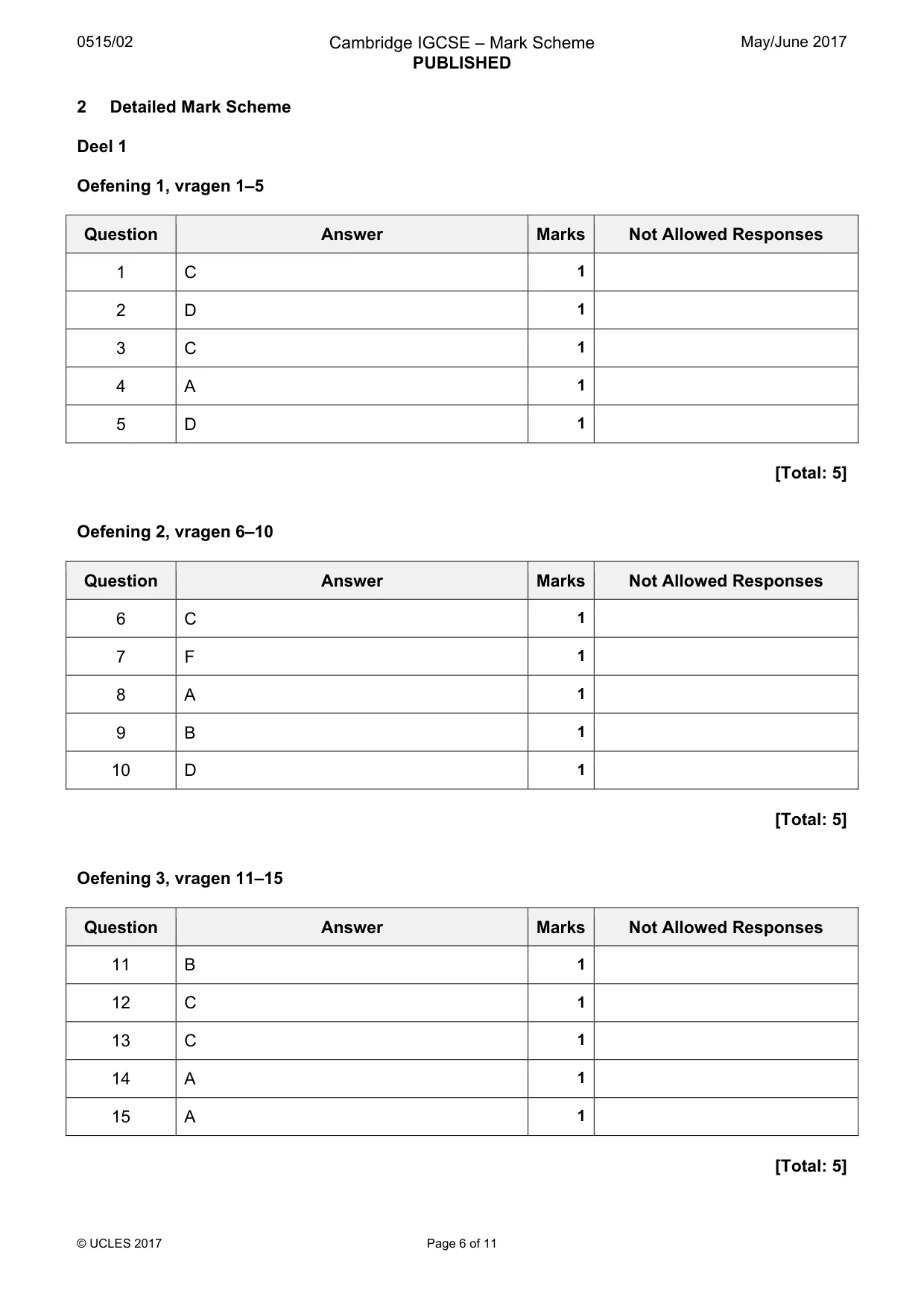
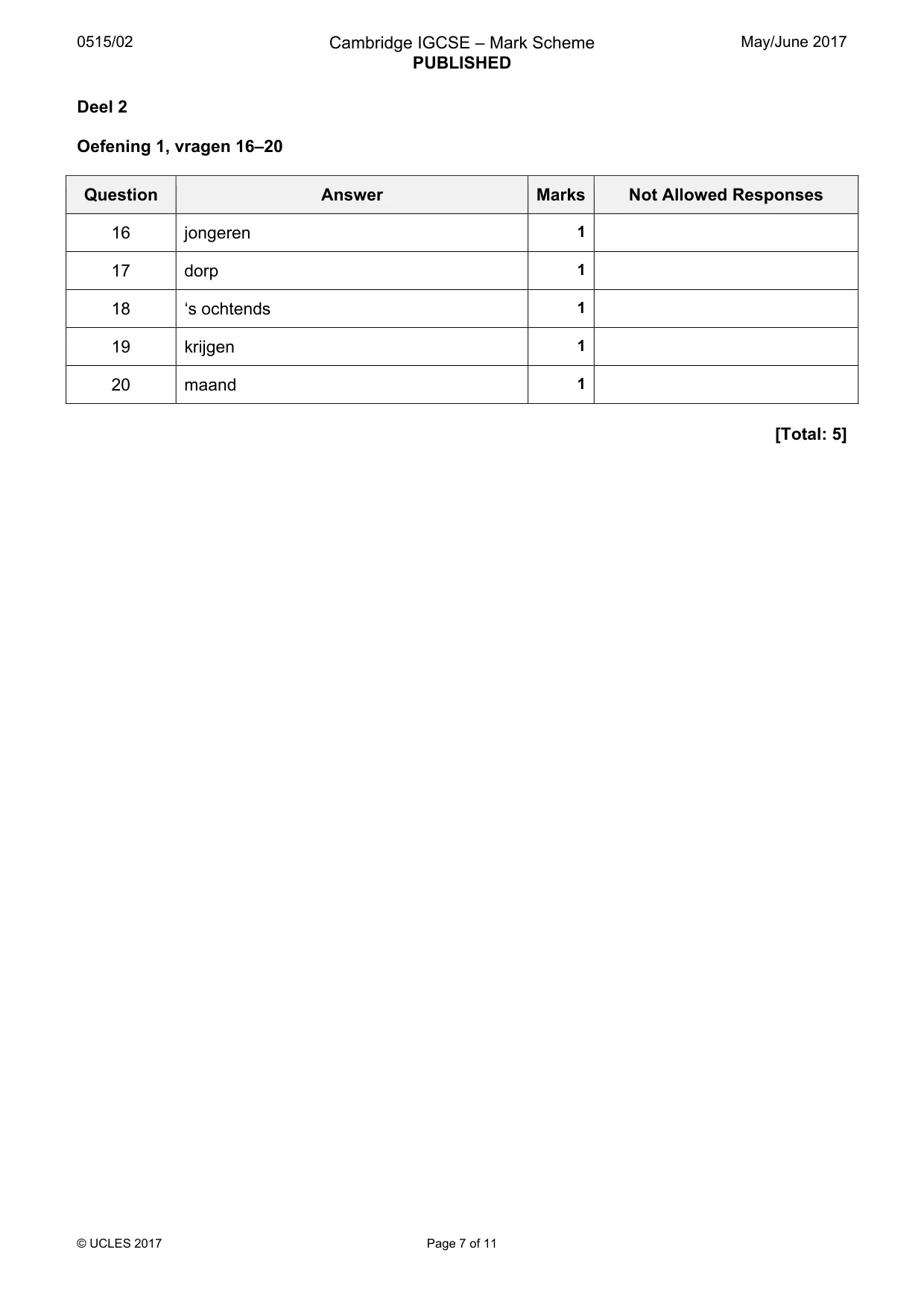
0515/02 Cambridge IGCSE – Mark Scheme PUBLISHED May/June 2017 © UCLES 2017 Page 6 of 11 2 Detailed Mark Scheme Deel 1 Oefening 1, vragen 1–5 Question Answer Marks Not Allowed Responses 1 C 1 2 D 1 3 C 1 4 A 1 5 D 1 [Total: 5] Oefening 2, vragen 6–10 Question Answer Marks Not Allowed Responses 6 C 1 7 F 1 8 A 1 9 B 1 10 D 1 [Total: 5] Oefening 3, vragen 11–15 Question Answer Marks Not Allowed Responses 11 B 1 12 C 1 13 C 1 14 A 1 15 A 1 [Total: 5]
Mark scheme, page 7
0515/02 Cambridge IGCSE – Mark Scheme PUBLISHED May/June 2017 © UCLES 2017 Page 7 of 11 Deel 2 Oefening 1, vragen 16–20 Question Answer Marks Not Allowed Responses 16 jongeren 1 17 dorp 1 18 ‘s ochtends 1 19 krijgen 1 20 maand 1 [Total: 5]
Mark scheme, page 8
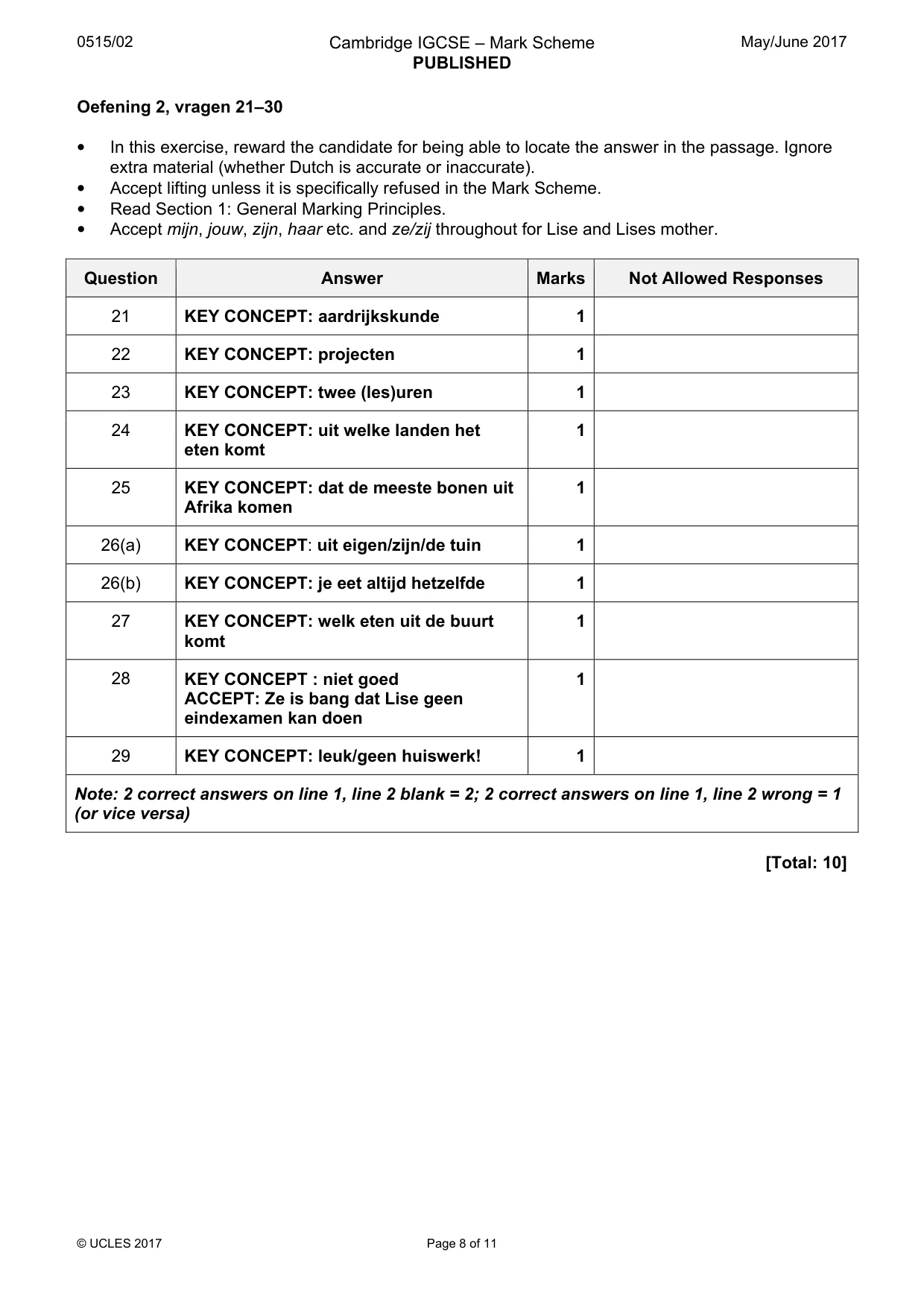
0515/02 Cambridge IGCSE – Mark Scheme PUBLISHED May/June 2017 © UCLES 2017 Page 8 of 11 Oefening 2, vragen 21–30 • In this exercise, reward the candidate for being able to locate the answer in the passage. Ignore extra material (whether Dutch is accurate or inaccurate). • Accept lifting unless it is specifically refused in the Mark Scheme. • Read Section 1: General Marking Principles. • Accept mijn, jouw, zijn, haar etc. and ze/zij throughout for Lise and Lises mother. Question Answer Marks Not Allowed Responses 21 KEY CONCEPT: aardrijkskunde 1 22 KEY CONCEPT: projecten 1 23 KEY CONCEPT: twee (les)uren 1 24 KEY CONCEPT: uit welke landen het eten komt 1 25 KEY CONCEPT: dat de meeste bonen uit Afrika komen 1 26(a) KEY CONCEPT: uit eigen/zijn/de tuin 1 26(b) KEY CONCEPT: je eet altijd hetzelfde 1 27 KEY CONCEPT: welk eten uit de buurt komt 1 28 KEY CONCEPT : niet goed ACCEPT: Ze is bang dat Lise geen eindexamen kan doen 1 29 KEY CONCEPT: leuk/geen huiswerk! 1 Note: 2 correct answers on line 1, line 2 blank = 2; 2 correct answers on line 1, line 2 wrong = 1 (or vice versa) [Total: 10]
Mark scheme, page 9
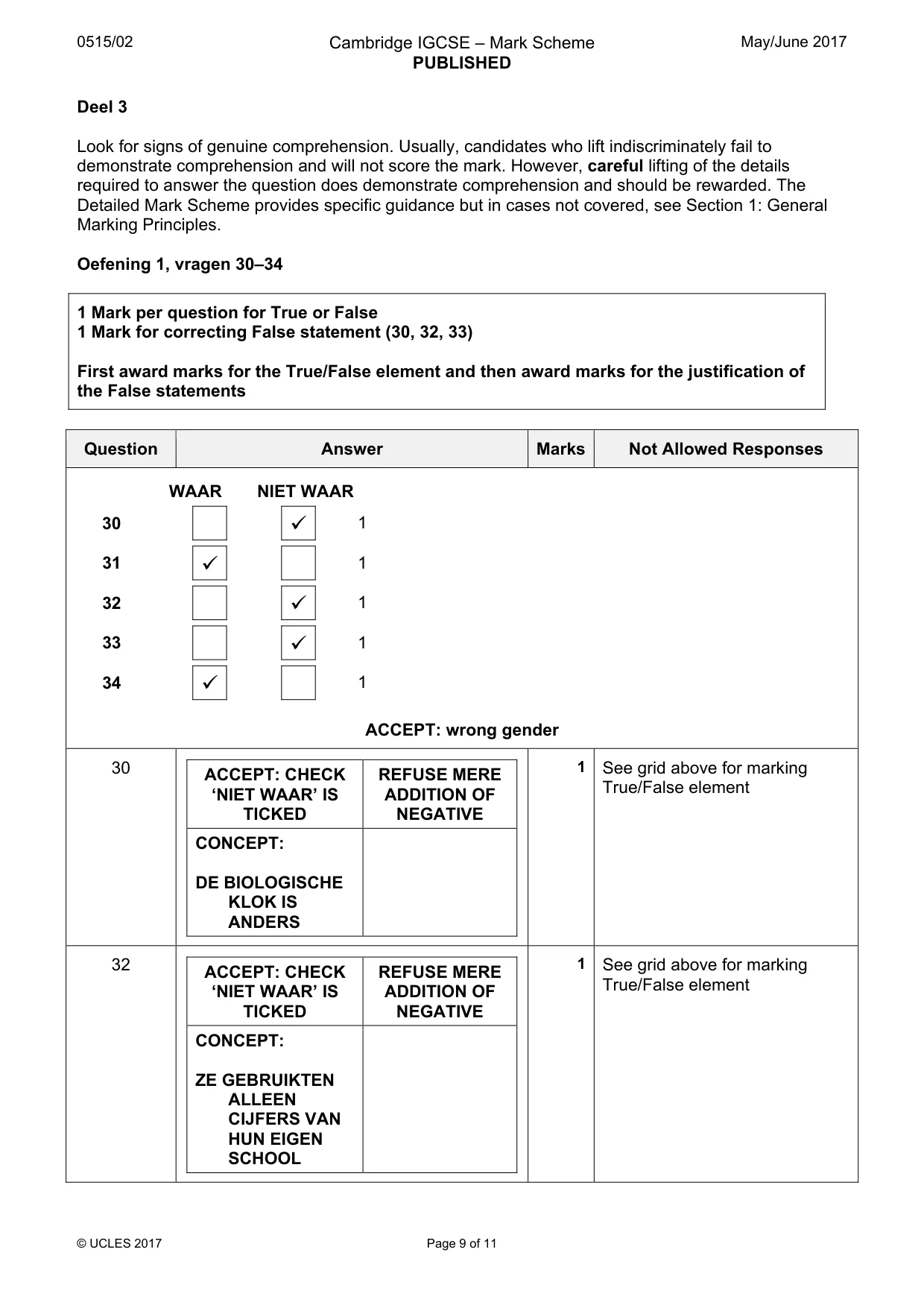
0515/02 Cambridge IGCSE – Mark Scheme PUBLISHED May/June 2017 © UCLES 2017 Page 9 of 11 Deel 3 Look for signs of genuine comprehension. Usually, candidates who lift indiscriminately fail to demonstrate comprehension and will not score the mark. However, careful lifting of the details required to answer the question does demonstrate comprehension and should be rewarded. The Detailed Mark Scheme provides specific guidance but in cases not covered, see Section 1: General Marking Principles. Oefening 1, vragen 30–34 1 Mark per question for True or False 1 Mark for correcting False statement (30, 32, 33) First award marks for the True/False element and then award marks for the justification of the False statements Question Answer Marks Not Allowed Responses WAAR NIET WAAR 30 9 1 31 9 1 32 9 1 33 9 1 34 9 1 ACCEPT: wrong gender 30 ACCEPT: CHECK ‘NIET WAAR’ IS TICKED REFUSE MERE ADDITION OF NEGATIVE CONCEPT: DE BIOLOGISCHE KLOK IS ANDERS 1 See grid above for marking True/False element 32 ACCEPT: CHECK ‘NIET WAAR’ IS TICKED REFUSE MERE ADDITION OF NEGATIVE CONCEPT: ZE GEBRUIKTEN ALLEEN CIJFERS VAN HUN EIGEN SCHOOL 1 See grid above for marking True/False element
Mark scheme, page 10
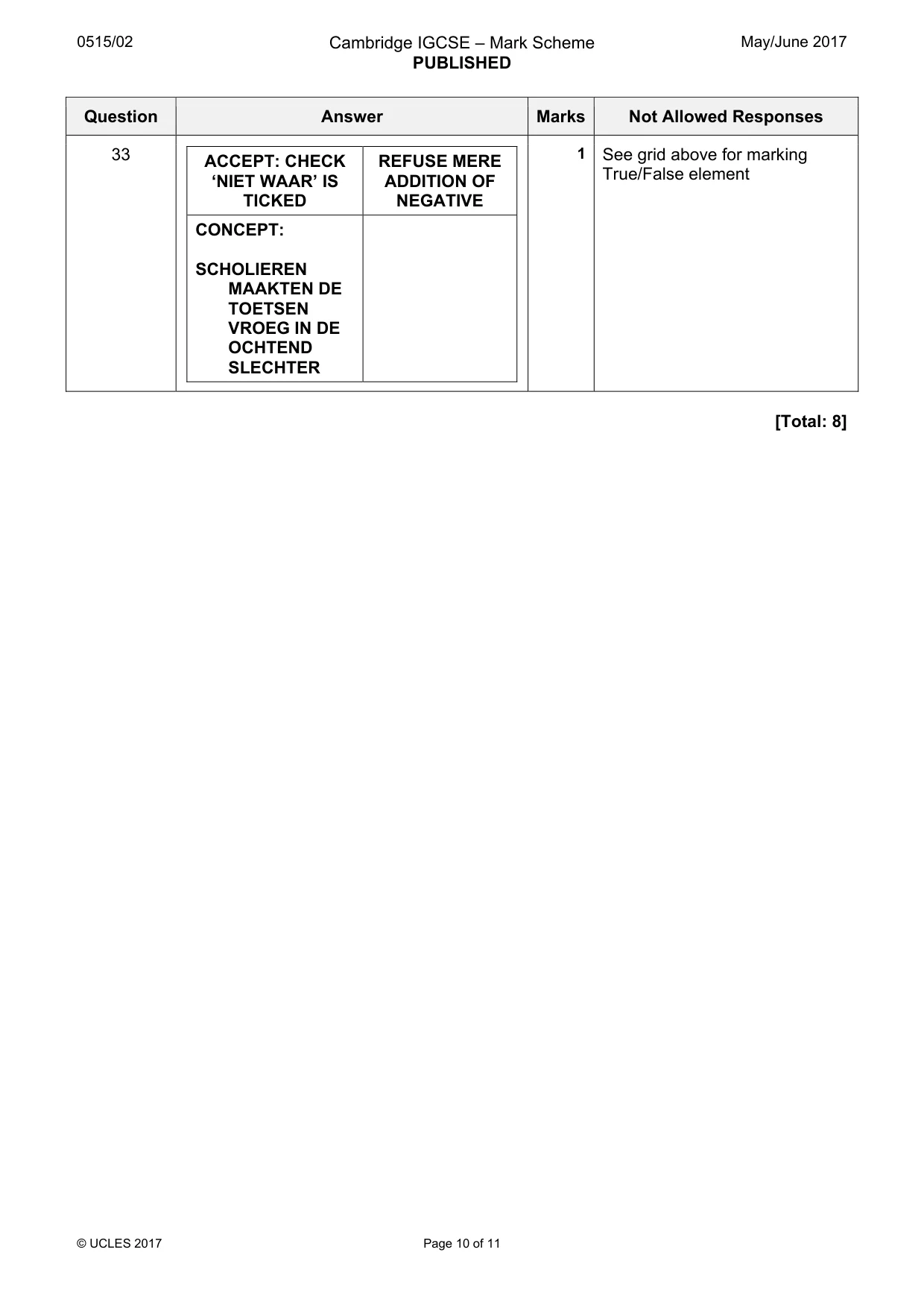
0515/02 Cambridge IGCSE – Mark Scheme PUBLISHED May/June 2017 © UCLES 2017 Page 10 of 11 Question Answer Marks Not Allowed Responses 33 ACCEPT: CHECK ‘NIET WAAR’ IS TICKED REFUSE MERE ADDITION OF NEGATIVE CONCEPT: SCHOLIEREN MAAKTEN DE TOETSEN VROEG IN DE OCHTEND SLECHTER 1 See grid above for marking True/False element [Total: 8]
Mark scheme, page 11
0515/02 Cambridge IGCSE – Mark Scheme PUBLISHED May/June 2017 © UCLES 2017 Page 11 of 11 Exercice 2 Questions 35–39 Question Answer Marks Not Allowed Responses ACCEPT: wrong gender 35(i) CONCEPT: MENSEN DIE DE TREIN GEMIST HEBBEN 1 35(ii) CONCEPT: MENSEN DIE VERTRAGING HEBBEN 1 36 CONCEPT: KLEUTERS 1 37(i) CONCEPT: ZE KOMEN EEN UURTJE EERDER 1 37(ii) CONCEPT : ZE BLIJVEN LANGER 1 38 CONCEPT: OMDAT ZE DE TREIN (SOMS) MISSEN ALLOW: OMDAT ZE (SOMS) VERGETEN EEN KAARTJE TE KOPEN 1 39 CONCEPT: ZE KOMEN SPELEN, MAAR GAAN NIET MET DE TREIN MEE. 1 [Total: 7]
What you needed in this session
Cambridge’s own grade thresholds for 2017 May/June, Paper 2 · Variant 1. A higher threshold means an easier paper — the bar moves with how the cohort did.