Cambridge IGCSE Design and Technology 0445 — 2021 Oct/Nov Paper 3 · Variant 3
0445/33/O/N/21 · 13 questions · 50 marks · ≈56 min
The question paper and its mark scheme, free to read here and free to download. This is Cambridge’s own paper, exactly as it was sat.
Question paper20 pages


Mark scheme9 pages
Answers below. Sit the paper first if you are practising.
Questions as text
Q1 · A method of joining two lengths of hardwood
1 Fig. 1.1 shows a method of joining two lengths of hardwood. An adhesive is used. slot Fig. 1.1 (a) State the method of joining shown in Fig. 1.1. ............................................................................................................................................. [1] (b) State an alternative method of joining the two lengths of hardwood. ............................................................................................................................................. [1]
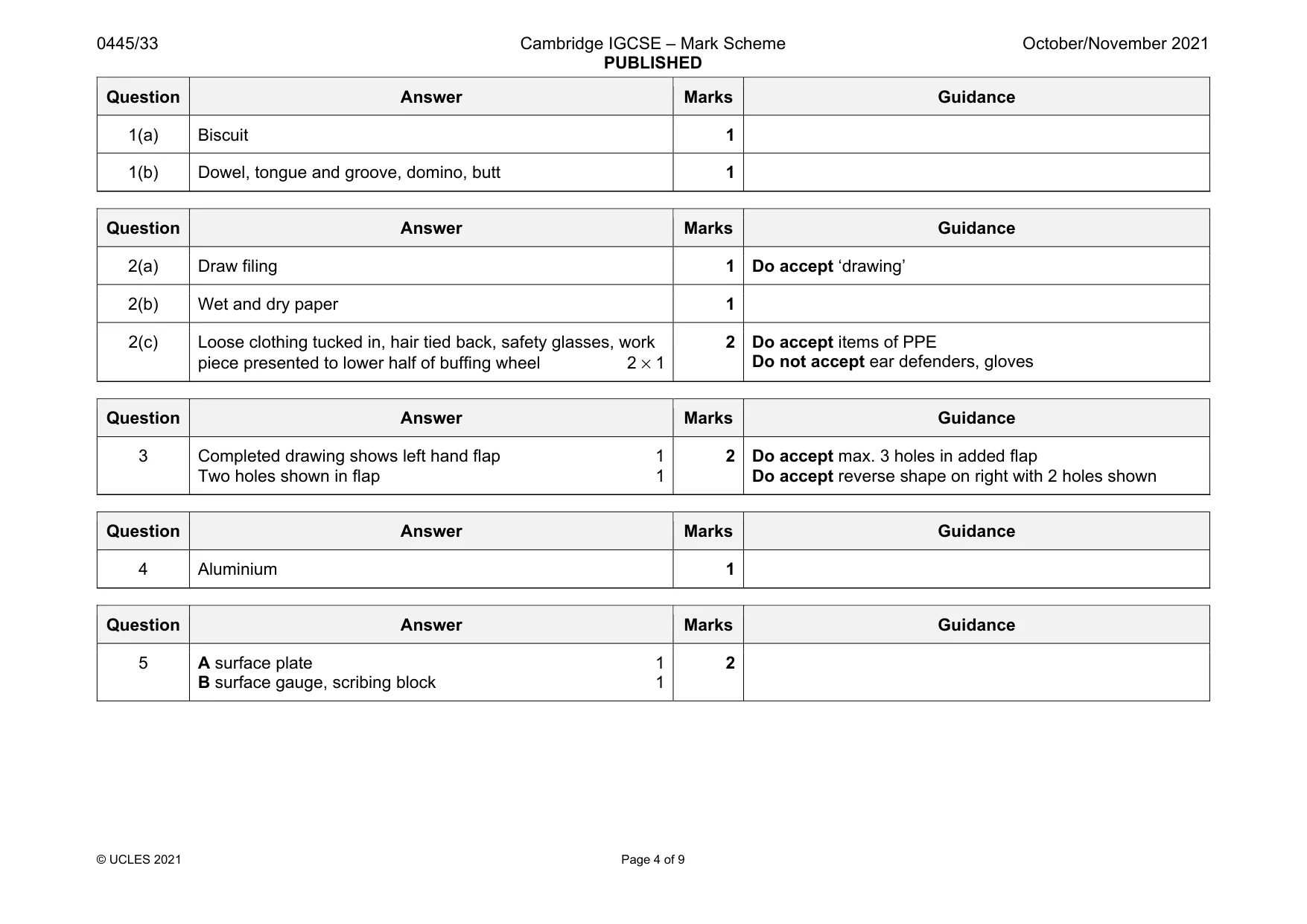
Mark scheme: 1(a) Biscuit 1 1(b) Dowel, tongue and groove, domino, butt 1
Q2 · There are three main stages to be carried out to produce a high quality finish to the…
2 There are three main stages to be carried out to produce a high quality finish to the edges of acrylic sheet. Fig. 2.1 shows the first stage. Fig. 2.1 (a) Name the method of filing shown in Fig. 2.1. ............................................................................................................................................. [1] (b) After filing the edges, silicon carbide paper will be used. Give the common name for silicon carbide paper. ............................................................................................................................................. [1] (c) The third stage is to polish the edges on a buffing wheel. Give two safety precautions that must be taken when using a buffing wheel. 1 ................................................................................................................................................ 2 ................................................................................................................................................ [2]
Mark scheme: 2(a) Draw filing 1 Do accept ‘drawing’ 2(b) Wet and dry paper 1 2(c) Loose clothing tucked in, hair tied back, safety glasses, work piece presented to lower half of buffing wheel 2 × 1 2 Do accept items of PPE Do not accept ear defenders, gloves
Q3 · An incomplete drawing of a flush hinge
3 Fig. 3.1 shows an incomplete drawing of a flush hinge. Fig. 3.1 Add to Fig. 3.1 to complete the drawing of the flush hinge. [2]
Mark scheme: 3 Completed drawing shows left hand flap 1 Two holes shown in flap 1 2 Do accept max. 3 holes in added flap Do accept reverse shape on right with 2 holes shown
Q4 · Circle from the list of materials below one material that can be anodised
4 Circle from the list of materials below one material that can be anodised. copper steel lead aluminium [1]
Mark scheme: 4 Aluminium 1
Q5 · Two items of equipment, A and B, used when marking out metal
5 Fig. 5.1 shows two items of equipment, A and B, used when marking out metal. B A Fig. 5.1 Name the items of equipment A and B in Fig. 5.1. A ....................................................................................................................................................... B ....................................................................................................................................................... [2]
Mark scheme: 5 A surface plate 1 B surface gauge, scribing block 1 2
Question 6
6 Fig. 6.1 shows a chair. The curved parts of the chair have been produced by steam bending. Fig. 6.1 Give two benefits of using steam bending to make the curved parts of the chair. 1 ....................................................................................................................................................... 2 ....................................................................................................................................................... [2]
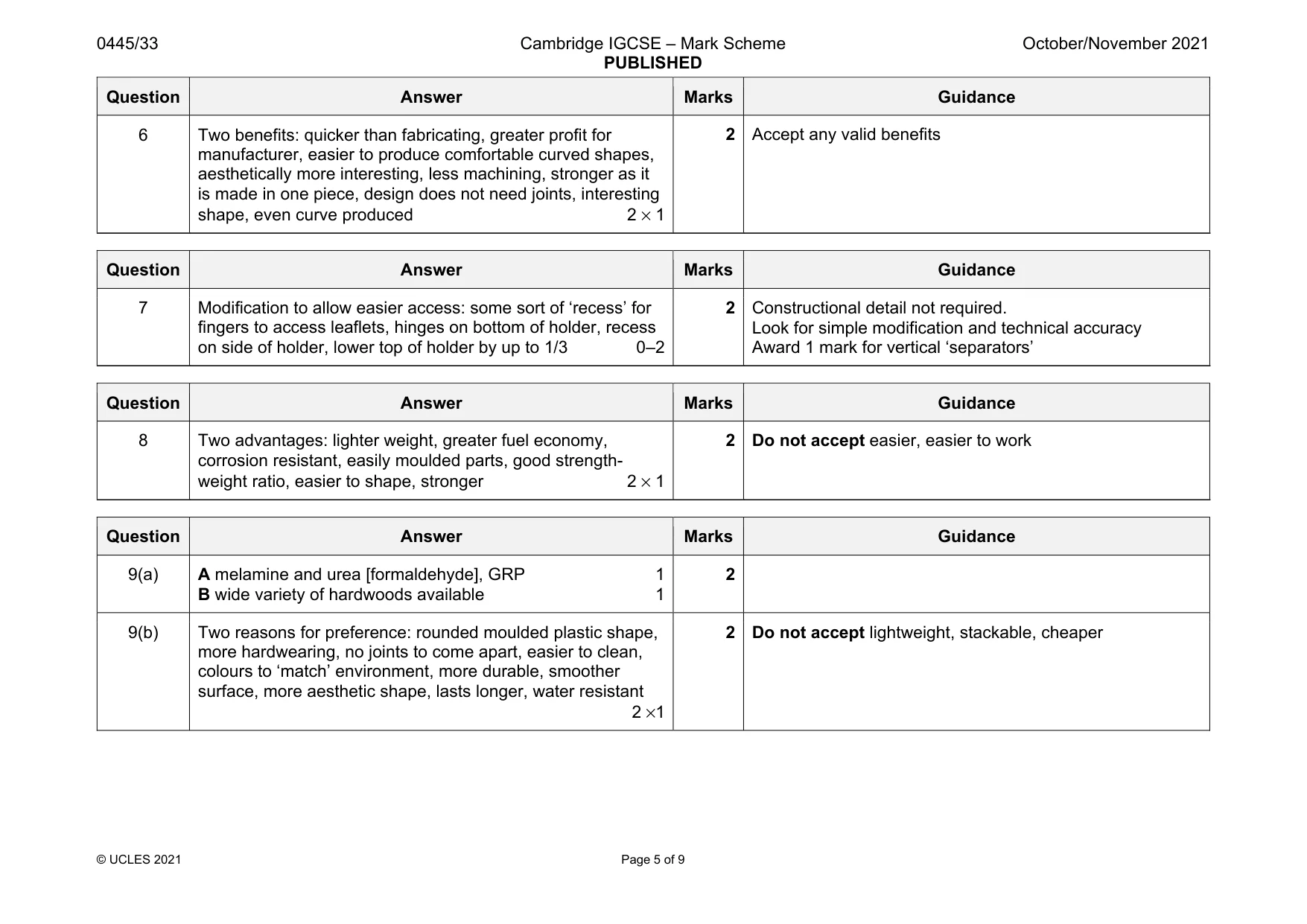
Mark scheme: 6 Two benefits: quicker than fabricating, greater profit for manufacturer, easier to produce comfortable curved shapes, aesthetically more interesting, less machining, stronger as it is made in one piece, design does not need joints, interesting shape, even curve produced 2 × 1
Q7 · A design for a wall-mounted leaflet holder
7 Fig. 7.1 shows a design for a wall-mounted leaflet holder. Fig. 7.1 Add sketches and notes to Fig. 7.1 to show a modification to the design that would make it easier to access the leaflets. [2]
Mark scheme: 7 Modification to allow easier access: some sort of ‘recess’ for fingers to access leaflets, hinges on bottom of holder, recess on side of holder, lower top of holder by up to 1/3 0–2 2 Constructional detail not required. Look for simple modification and technical accuracy Award 1 mark for vertical ‘separators’
Q8 · A car body shell made from carbon fibre reinforced plastic (CFRP)
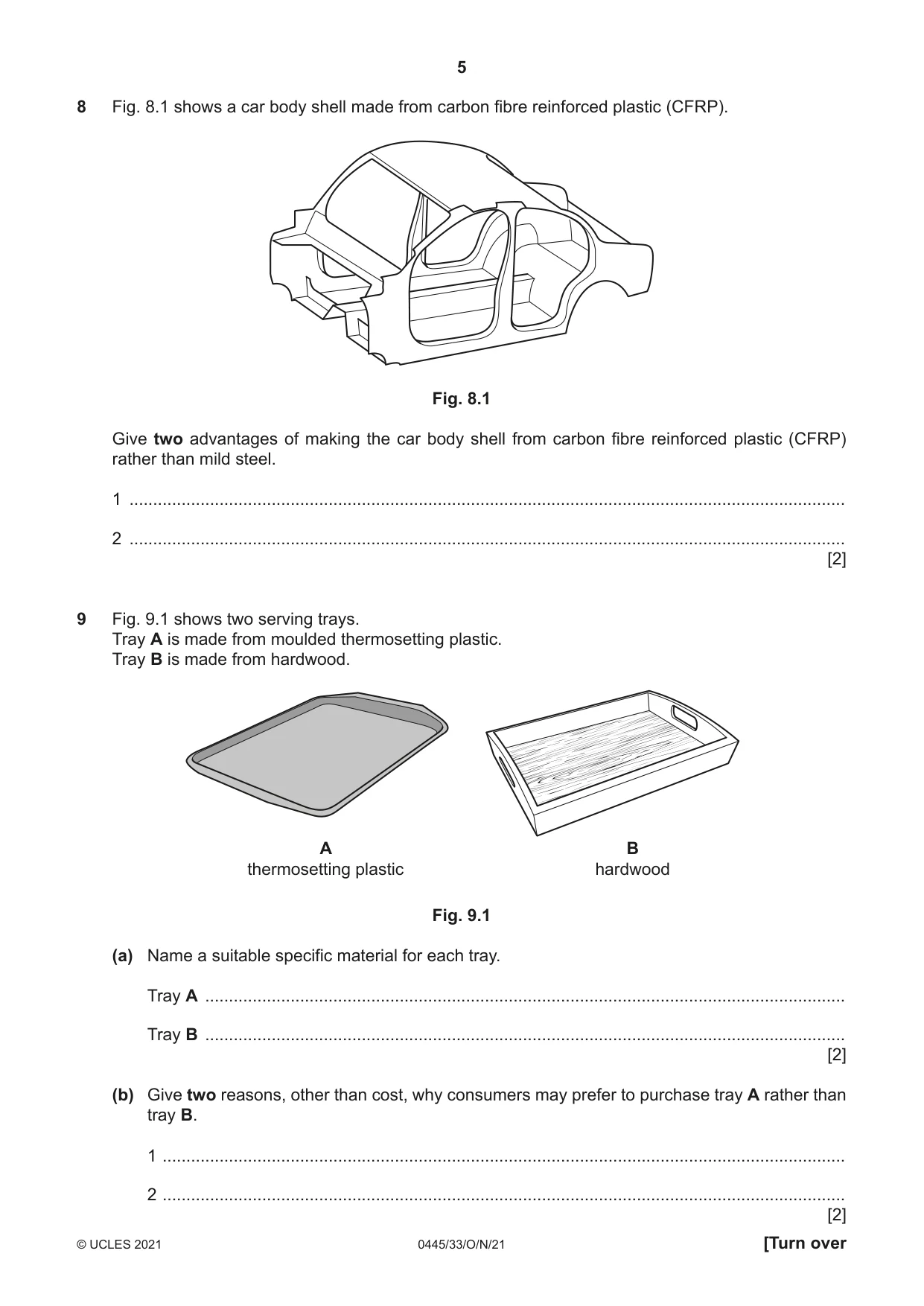
8 Fig. 8.1 shows a car body shell made from carbon fibre reinforced plastic (CFRP). Fig. 8.1 Give two advantages of making the car body shell from carbon fibre reinforced plastic (CFRP) rather than mild steel. 1 ....................................................................................................................................................... 2 ....................................................................................................................................................... [2]
Mark scheme: 8 Two advantages: lighter weight, greater fuel economy, corrosion resistant, easily moulded parts, good strength- weight ratio, easier to shape, stronger 2 × 1
Question 9
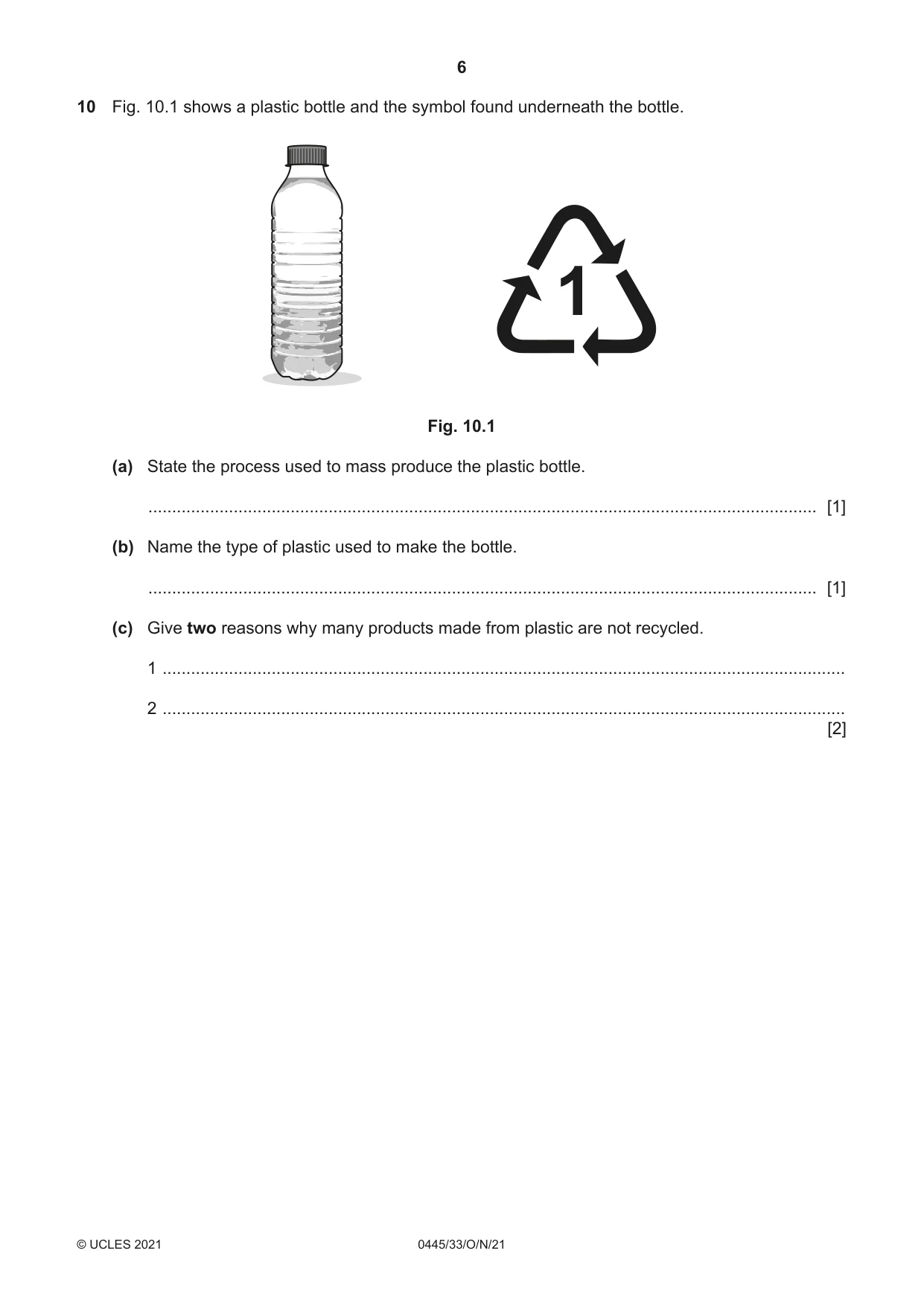
9 Fig. 9.1 shows two serving trays. Tray A is made from moulded thermosetting plastic. Tray B is made from hardwood. A B thermosetting plastic hardwood Fig. 9.1 (a) Name a suitable specific material for each tray. Tray A ....................................................................................................................................... Tray B ....................................................................................................................................... [2] (b) Give two reasons, other than cost, why consumers may prefer to purchase tray A rather than tray B. 1 ................................................................................................................................................ 2 ................................................................................................................................................ [2]
Mark scheme: 9(a) A melamine and urea [formaldehyde], GRP 1 B wide variety of hardwoods available 1 2 9(b) Two reasons for preference: rounded moulded plastic shape, more hardwearing, no joints to come apart, easier to clean, colours to ‘match’ environment, more durable, smoother surface, more aesthetic shape, lasts longer, water resistant 2 ×1 2 Do not accept lightweight, stackable, cheaper
Q10 · A plastic bottle and the symbol found underneath the bottle
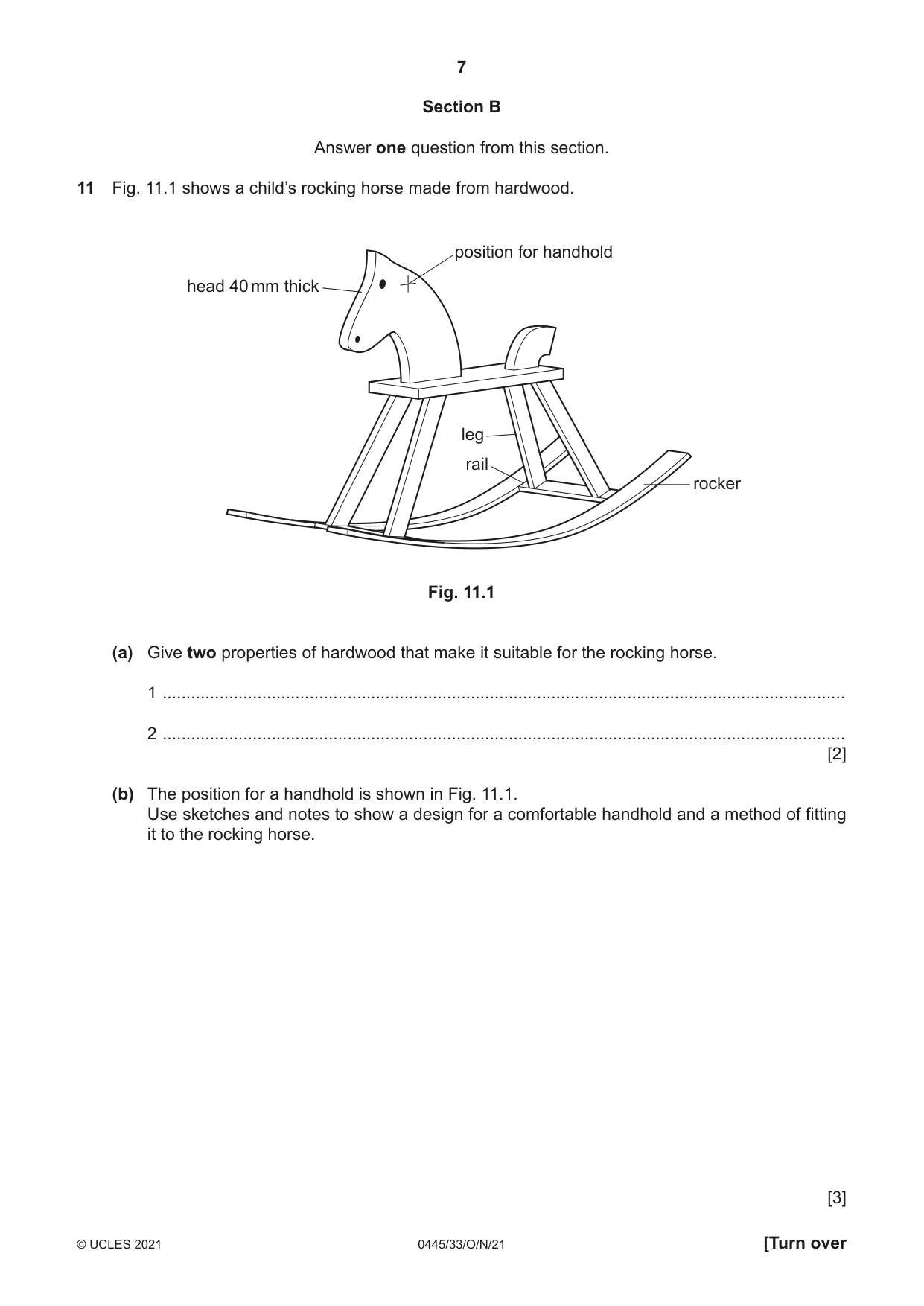
10 Fig. 10.1 shows a plastic bottle and the symbol found underneath the bottle. 1 Fig. 10.1 (a) State the process used to mass produce the plastic bottle. ............................................................................................................................................. [1] (b) Name the type of plastic used to make the bottle. ............................................................................................................................................. [1] (c) Give two reasons why many products made from plastic are not recycled. 1 ................................................................................................................................................ 2 ................................................................................................................................................ [2]
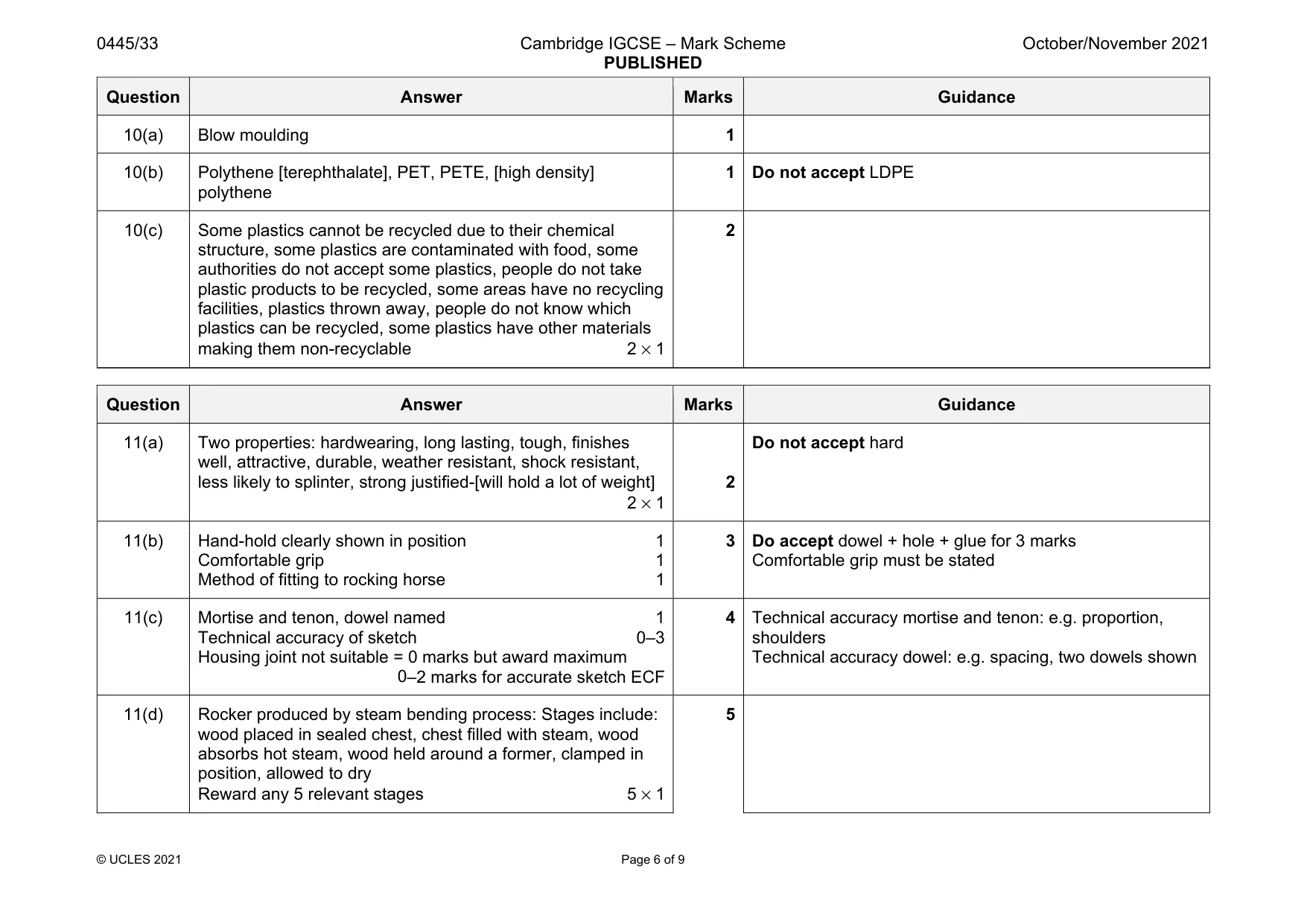
Mark scheme: 10(a) Blow moulding 1 10(b) Polythene [terephthalate], PET, PETE, [high density] polythene 1 Do not accept LDPE 10(c) Some plastics cannot be recycled due to their chemical structure, some plastics are contaminated with food, some authorities do not accept some plastics, people do not take plastic products to be recycled, some areas have no recycling facilities, plastics thrown away, people do not know which plastics can be recycled, some plastics have other materials making them non-recyclable 2 × 1 2
Q11 · A child’s rocking horse made from hardwood
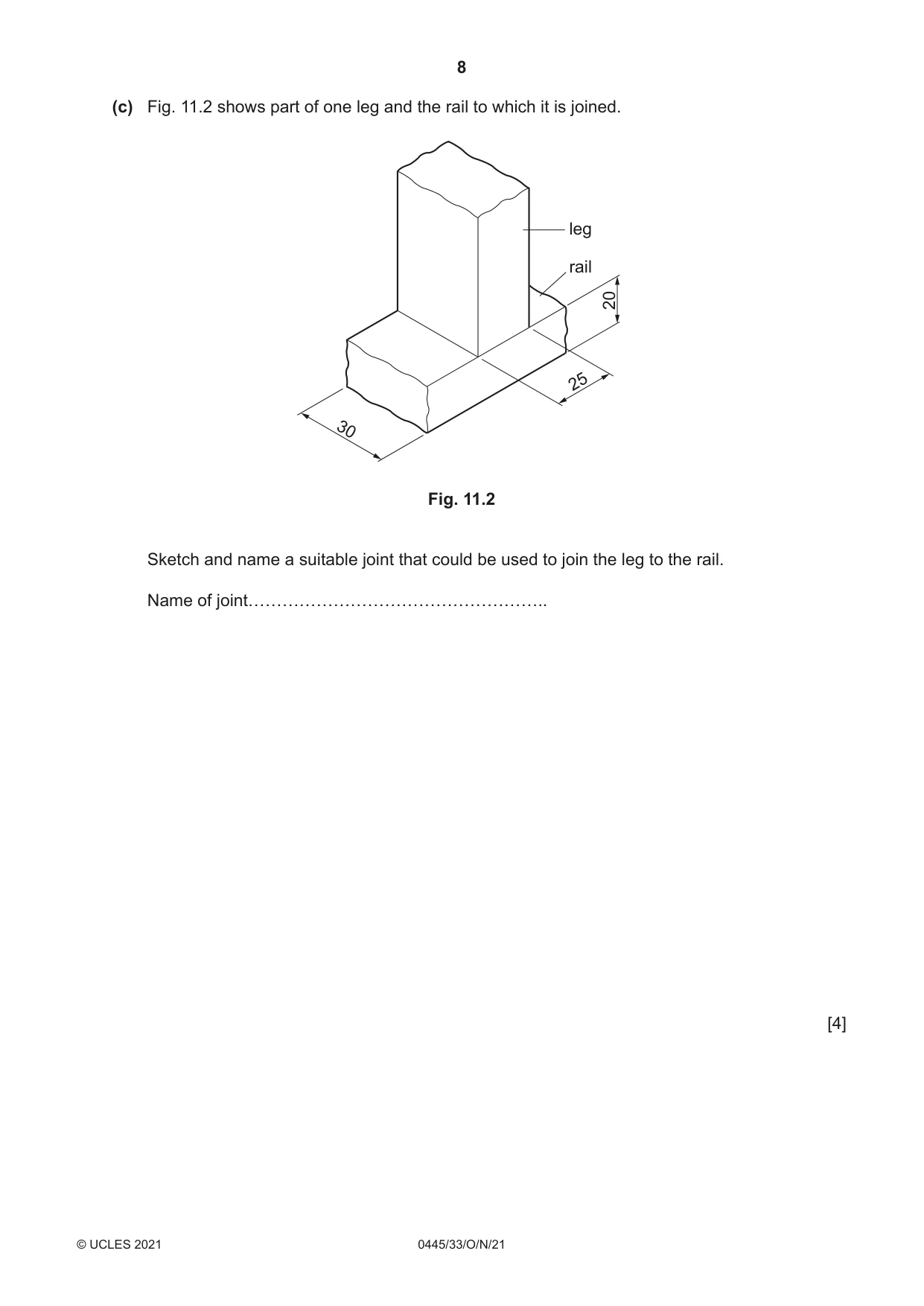
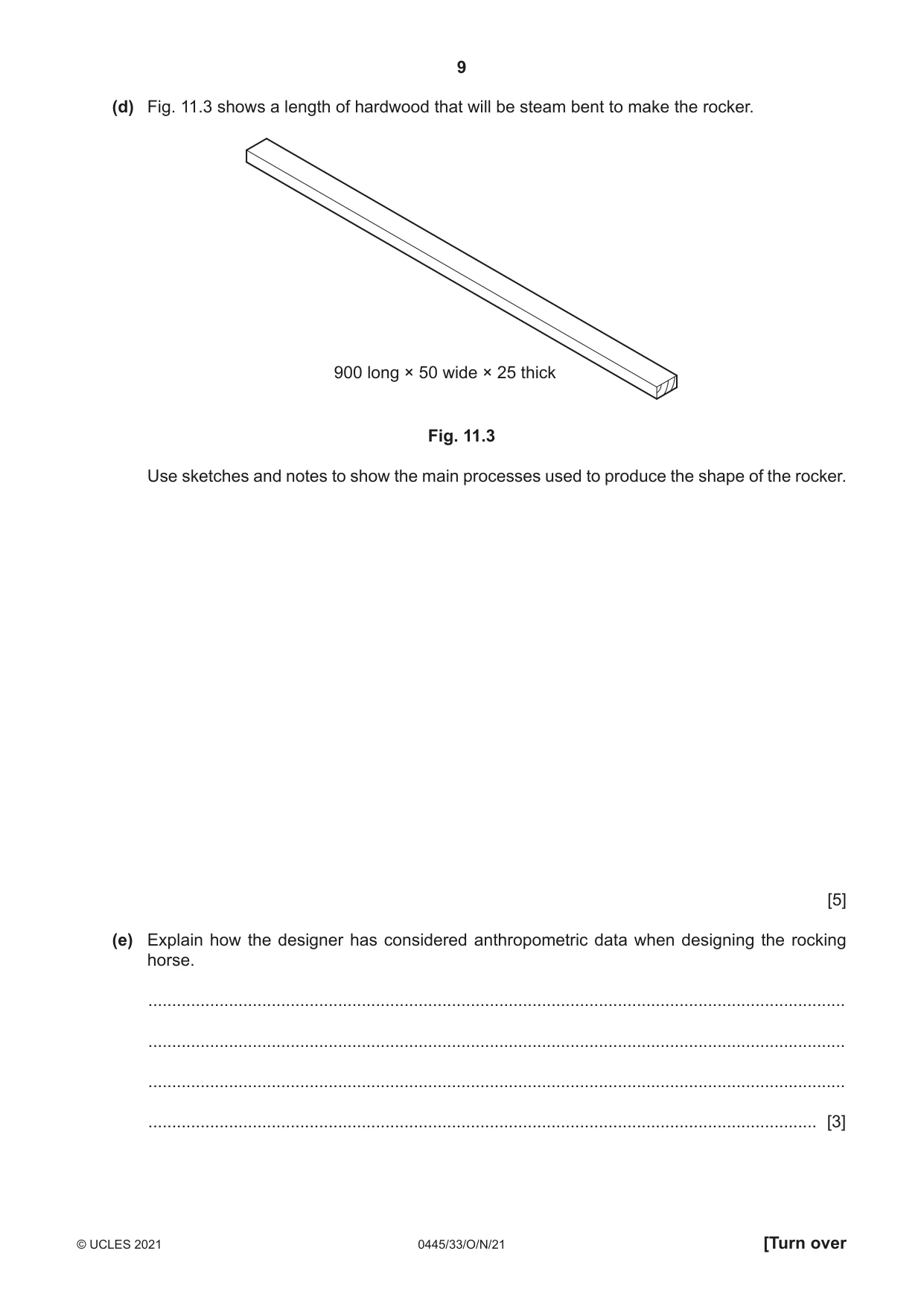
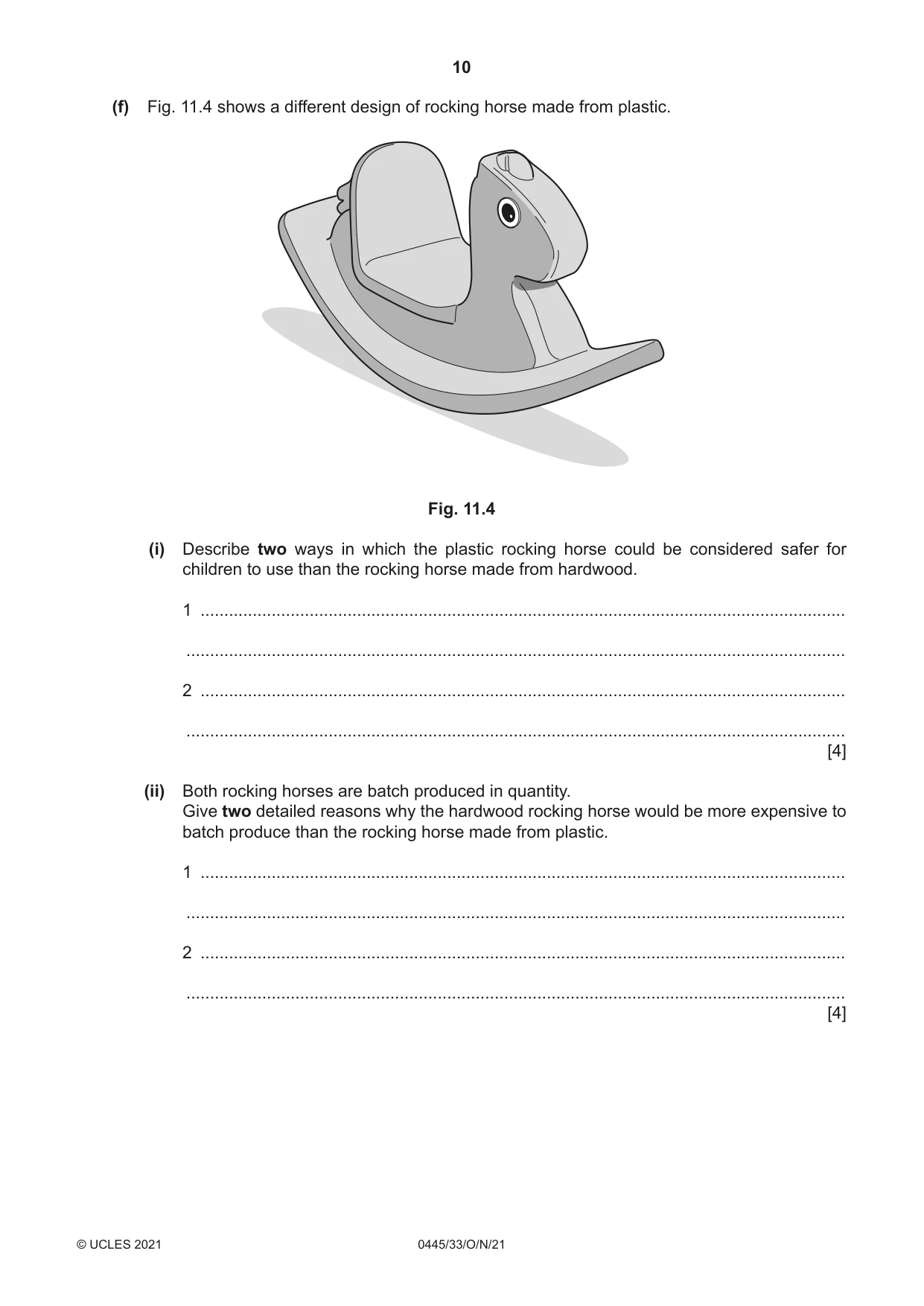
11 Fig. 11.1 shows a child’s rocking horse made from hardwood. position for handhold head 40 mm thick leg rail rocker Fig. 11.1 (a) Give two properties of hardwood that make it suitable for the rocking horse. 1 ................................................................................................................................................ 2 ................................................................................................................................................ [2] (b) The position for a handhold is shown in Fig. 11.1. Use sketches and notes to show a design for a comfortable handhold and a method of fitting it to the rocking horse. [3] (c) Fig. 11.2 shows part of one leg and the rail to which it is joined. leg rail 20 25 30 Fig. 11.2 Sketch and name a suitable joint that could be used to join the leg to the rail. Name of joint…………………………………………….. [4] (d) Fig. 11.3 shows a length of hardwood that will be steam bent to make the rocker. 900 long × 50 wide × 25 thick Fig. 11.3 Use sketches and notes to show the main processes used to produce the shape of the rocker. [5] (e) Explain how the designer has considered anthropometric data when designing the rocking horse. ................................................................................................................................................... ................................................................................................................................................... ................................................................................................................................................... ............................................................................................................................................. [3] (f) Fig. 11.4 shows a different design of rocking horse made from plastic. Fig. 11.4 (i) Describe two ways in which the plastic rocking horse could be considered safer for children to use than the rocking horse made from hardwood. 1 ........................................................................................................................................ ........................................................................................................................................... 2 ........................................................................................................................................ ........................................................................................................................................... [4] (ii) Both rocking horses are batch produced in quantity. Give two detailed reasons why the hardwood rocking horse would be more expensive to batch produce than the rocking horse made from plastic. 1 ........................................................................................................................................ ........................................................................................................................................... 2 ........................................................................................................................................ ........................................................................................................................................... [4]
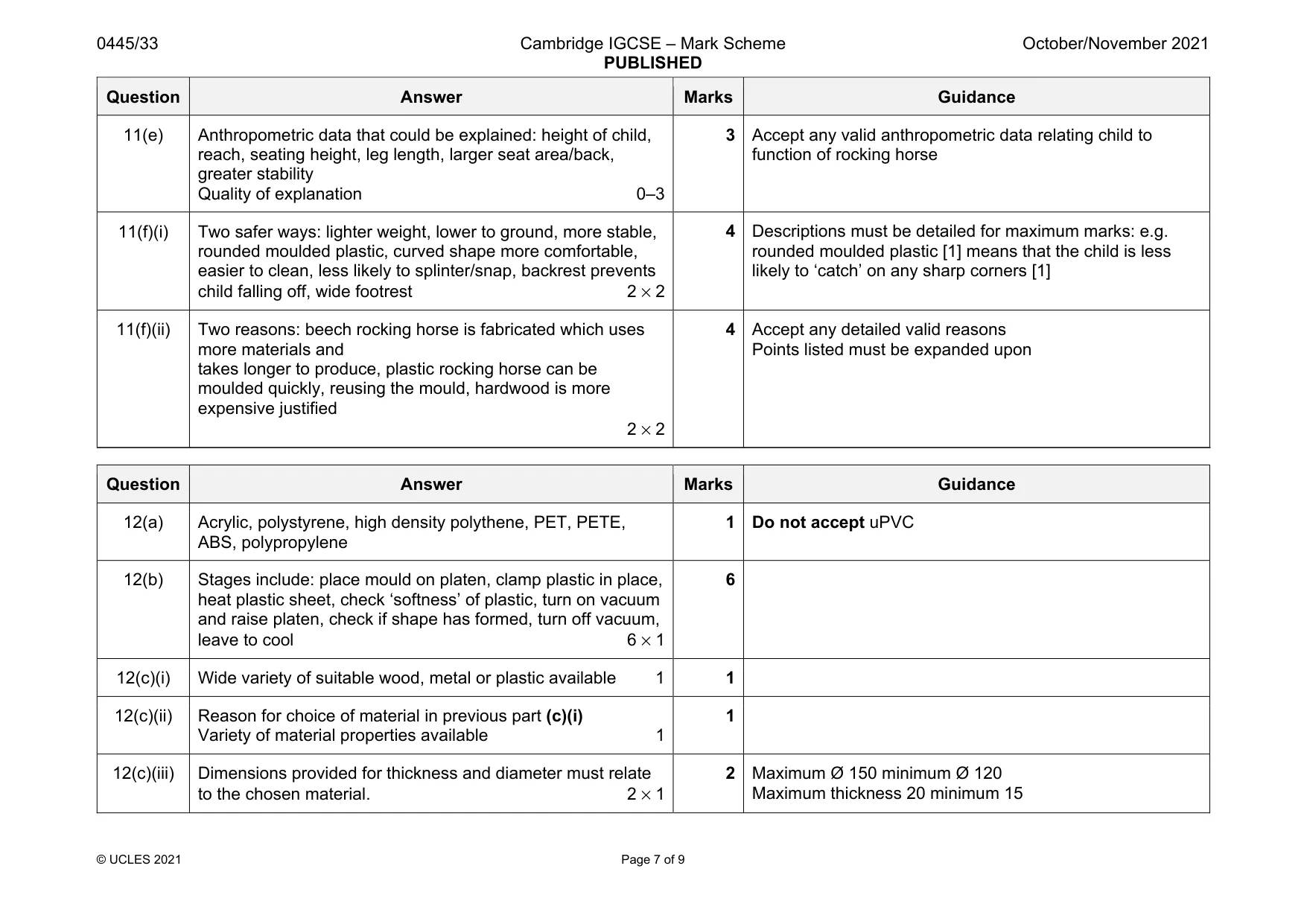
Mark scheme: 11(a) Two properties: hardwearing, long lasting, tough, finishes well, attractive, durable, weather resistant, shock resistant, less likely to splinter, strong justified-[will hold a lot of weight] 2 × 1 2 Do not accept hard 11(b) Hand-hold clearly shown in position 1 Comfortable grip 1 Method of fitting to rocking horse 1 3 Do accept dowel + hole + glue for 3 marks Comfortable grip must be stated 11(c) Mortise and tenon, dowel named 1 Technical accuracy of sketch 0–3 Housing joint not suitable = 0 marks but award maximum 0–2 marks for accurate sketch ECF 4 Technical accuracy mortise and tenon: e.g. proportion, shoulders Technical accuracy dowel: e.g. spacing, two dowels shown 11(d) Rocker produced by steam bending process: Stages include: wood placed in sealed chest, chest filled with steam, wood absorbs hot steam, wood held around a former, clamped in position, allowed to dry Reward any 5 relevant stages 5 × 1 5 Question Answer Marks Guidance 11(e) Anthropometric data that could be explained: height of child, reach, seating height, leg length, larger seat area/back, greater stability Quality of explanation 0–3 3 Accept any valid anthropometric data relating child to function of rocking horse 11(f)(i) Two safer ways: lighter weight, lower to ground, more stable, rounded moulded plastic, curved shape more comfortable, easier to clean, less likely to splinter/snap, backrest prevents child falling off, wide footrest 2 × 2 4 Descriptions must be detailed for maximum marks: e.g. rounded moulded plastic [1] means that the child is less likely to ‘catch’ on any sharp corners [1] 11(f)(ii) Two reasons: beech rocking horse is fabricated which uses more materials and takes longer to produce, plastic rocking horse can be moulded quickly, reusing the mould, hardwood is more expensive justified 2 × 2 4 Accept any detailed valid reasons Points listed must be expanded upon
Q12 · An incomplete design for a desk tidy
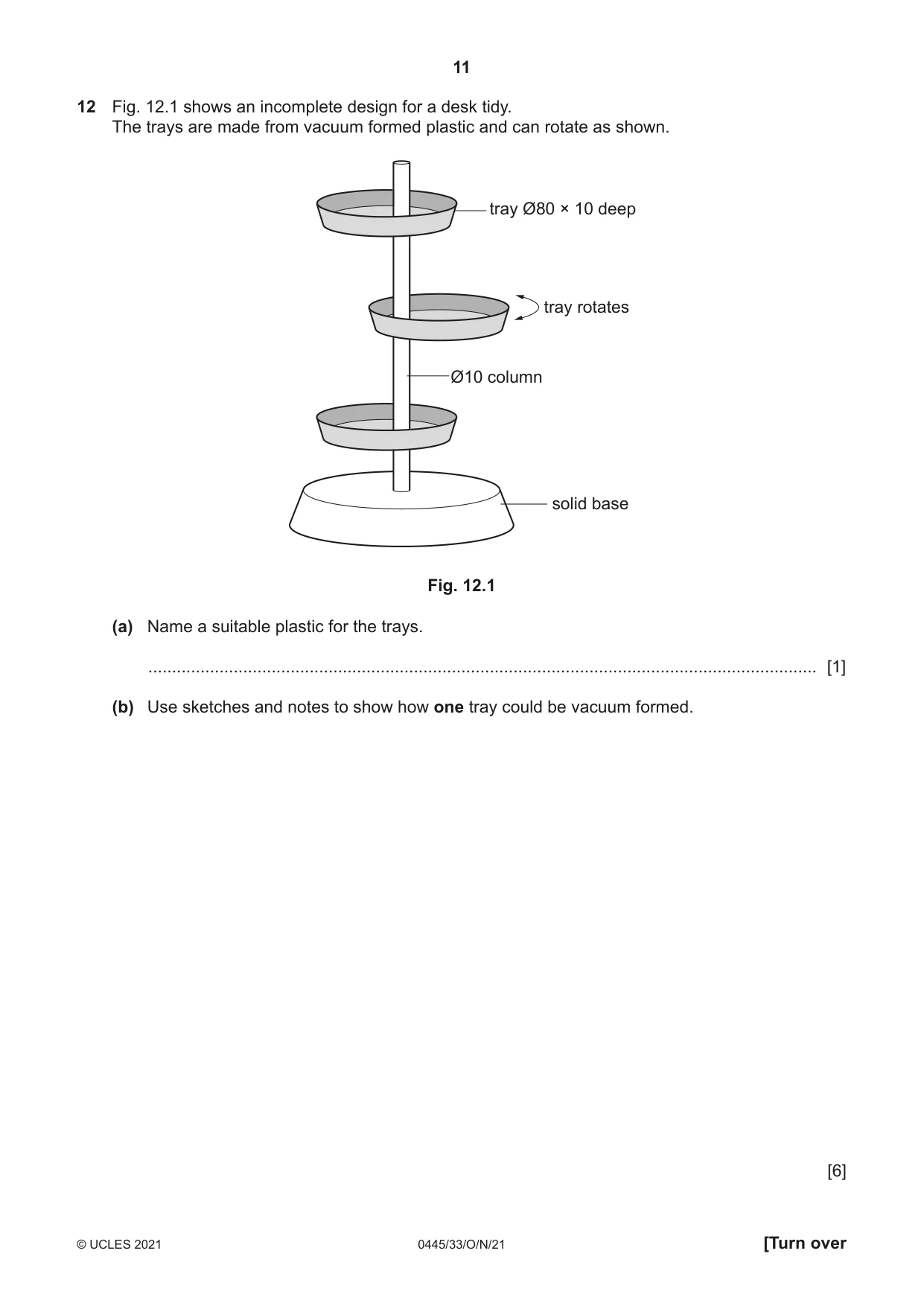
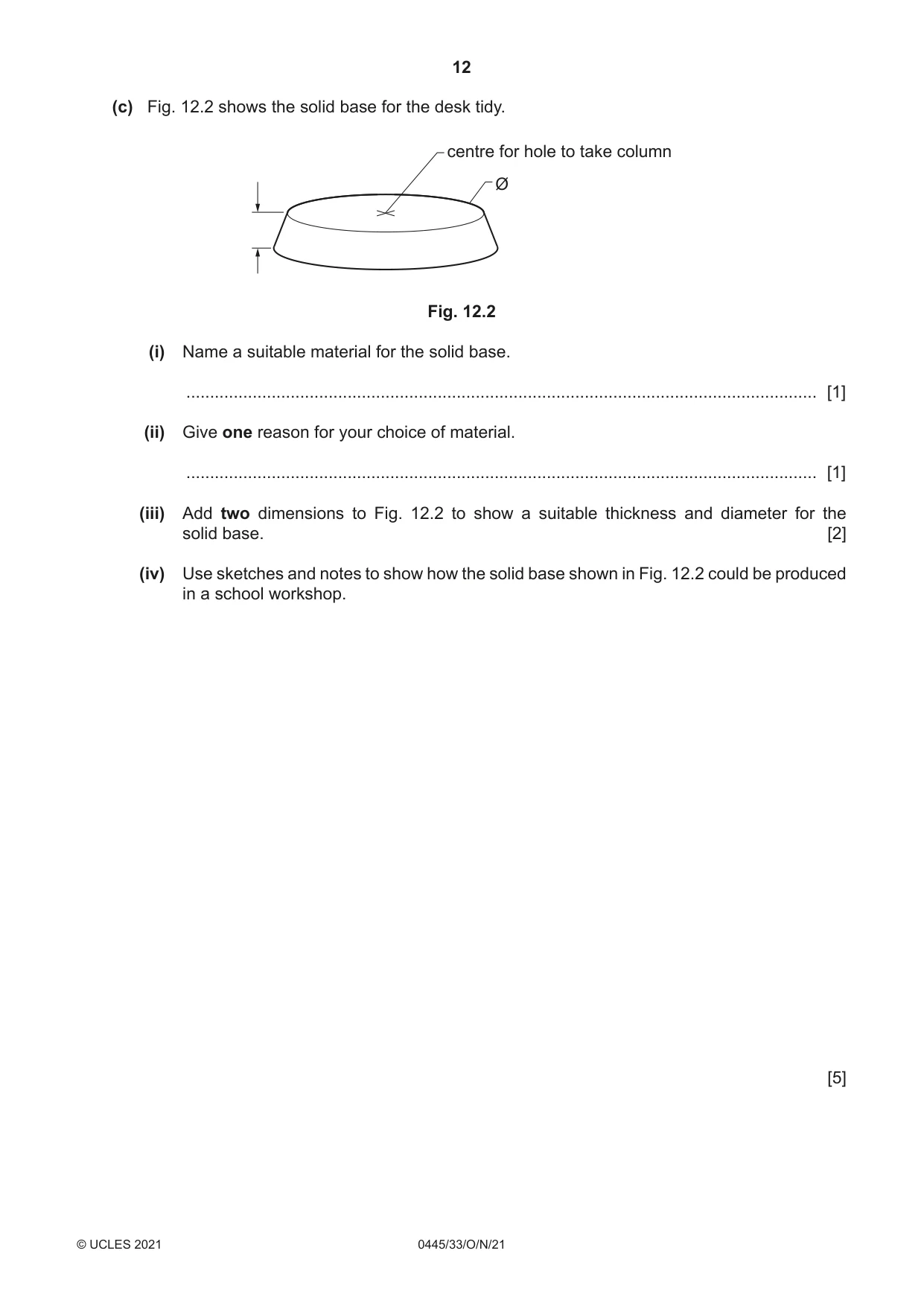
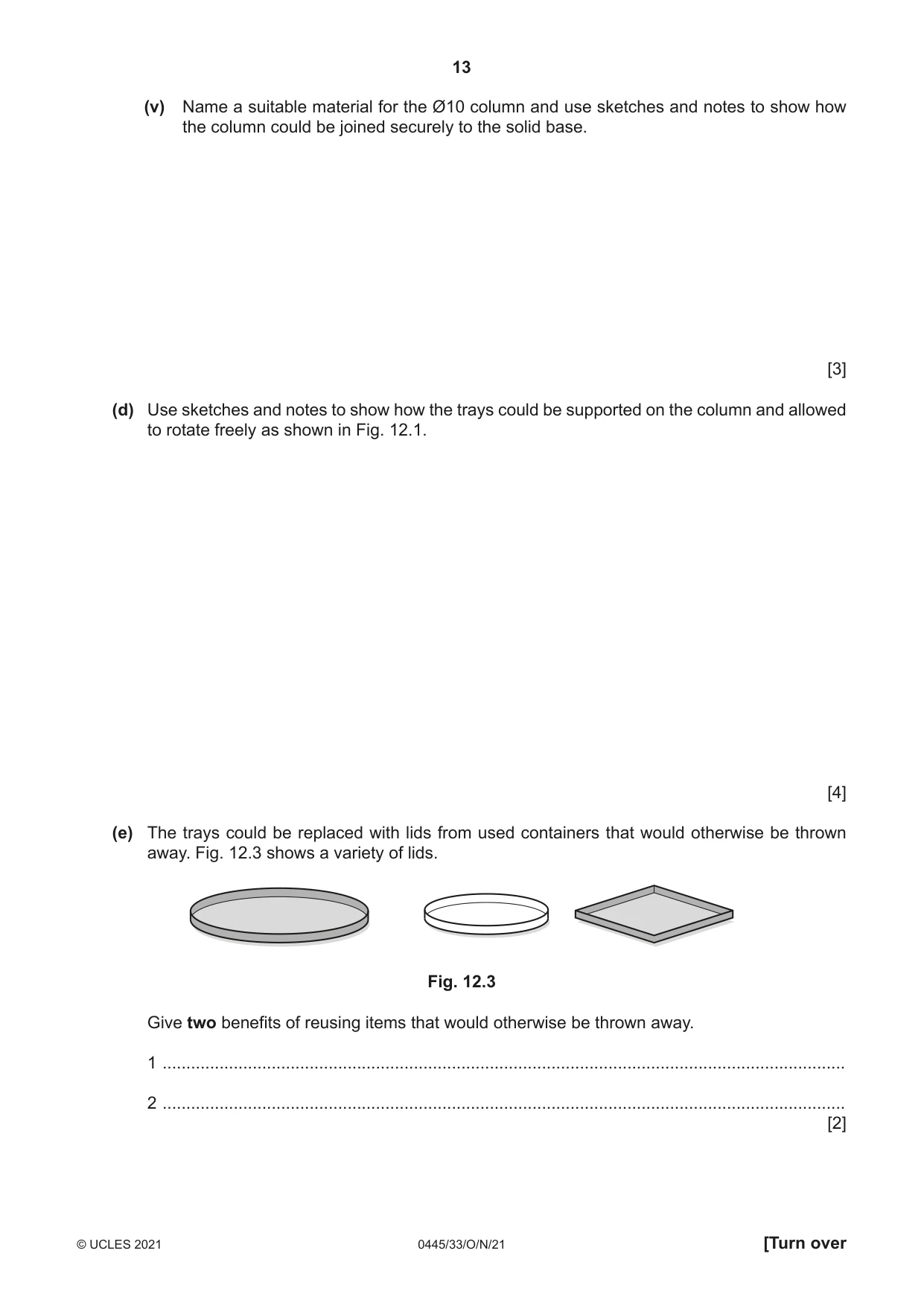
12 Fig. 12.1 shows an incomplete design for a desk tidy. The trays are made from vacuum formed plastic and can rotate as shown. tray Ø80 × 10 deep tray rotates Ø10 column solid base Fig. 12.1 (a) Name a suitable plastic for the trays. ............................................................................................................................................. [1] (b) Use sketches and notes to show how one tray could be vacuum formed. [6] (c) Fig. 12.2 shows the solid base for the desk tidy. centre for hole to take column Ø Fig. 12.2 (i) Name a suitable material for the solid base. ..................................................................................................................................... [1] (ii) Give one reason for your choice of material. ..................................................................................................................................... [1] (iii) Add two dimensions to Fig. 12.2 to show a suitable thickness and diameter for the solid base. [2] (iv) Use sketches and notes to show how the solid base shown in Fig. 12.2 could be produced in a school workshop. [5] (v) Name a suitable material for the Ø10 column and use sketches and notes to show how the column could be joined securely to the solid base. [3] (d) Use sketches and notes to show how the trays could be supported on the column and allowed to rotate freely as shown in Fig. 12.1. [4] (e) The trays could be replaced with lids from used containers that would otherwise be thrown away. Fig. 12.3 shows a variety of lids. Fig. 12.3 Give two benefits of reusing items that would otherwise be thrown away. 1 ................................................................................................................................................ 2 ................................................................................................................................................ [2]
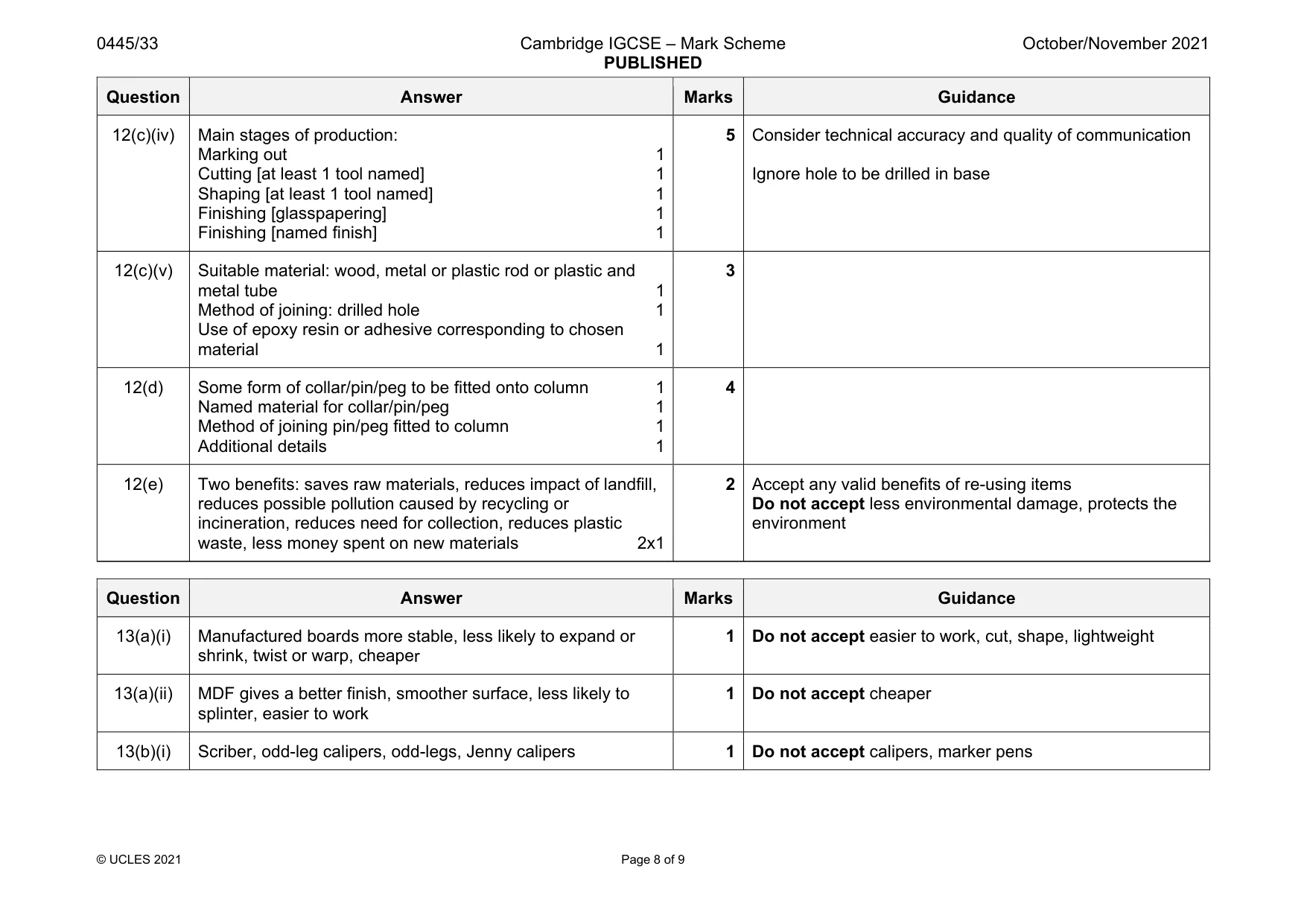
Mark scheme: 12(a) Acrylic, polystyrene, high density polythene, PET, PETE, ABS, polypropylene 1 Do not accept uPVC 12(b) Stages include: place mould on platen, clamp plastic in place, heat plastic sheet, check ‘softness’ of plastic, turn on vacuum and raise platen, check if shape has formed, turn off vacuum, leave to cool 6 × 1 6 12(c)(i) Wide variety of suitable wood, metal or plastic available 1 1 12(c)(ii) Reason for choice of material in previous part (c)(i) Variety of material properties available 1 1 12(c)(iii) Dimensions provided for thickness and diameter must relate to the chosen material. 2 × 1 2 Maximum Ø 150 minimum Ø 120 Maximum thickness 20 minimum 15 Question Answer Marks Guidance 12(c)(iv) Main stages of production: Marking out 1 Cutting [at least 1 tool named] 1 Shaping [at least 1 tool named] 1 Finishing [glasspapering] 1 Finishing [named finish] 1 5 Consider technical accuracy and quality of communication Ignore hole to be drilled in base 12(c)(v) Suitable material: wood, metal or plastic rod or plastic and metal tube 1 Method of joining: drilled hole 1 Use of epoxy resin or adhesive corresponding to chosen material 1 3 12(d) Some form of collar/pin/peg to be fitted onto column 1 Named material for collar/pin/peg 1 Method of joining pin/peg fitted to column 1 Additional details 1 4 12(e) Two benefits: saves raw materials, reduces impact of landfill, reduces possible pollution caused by recycling or incineration, reduces need for collection, reduces plastic waste, less money spent on new materials 2x1 2 Accept any valid benefits of re-using items Do not accept less environmental damage, protects the environment
Q13 · Details of a ‘floating’ shelf
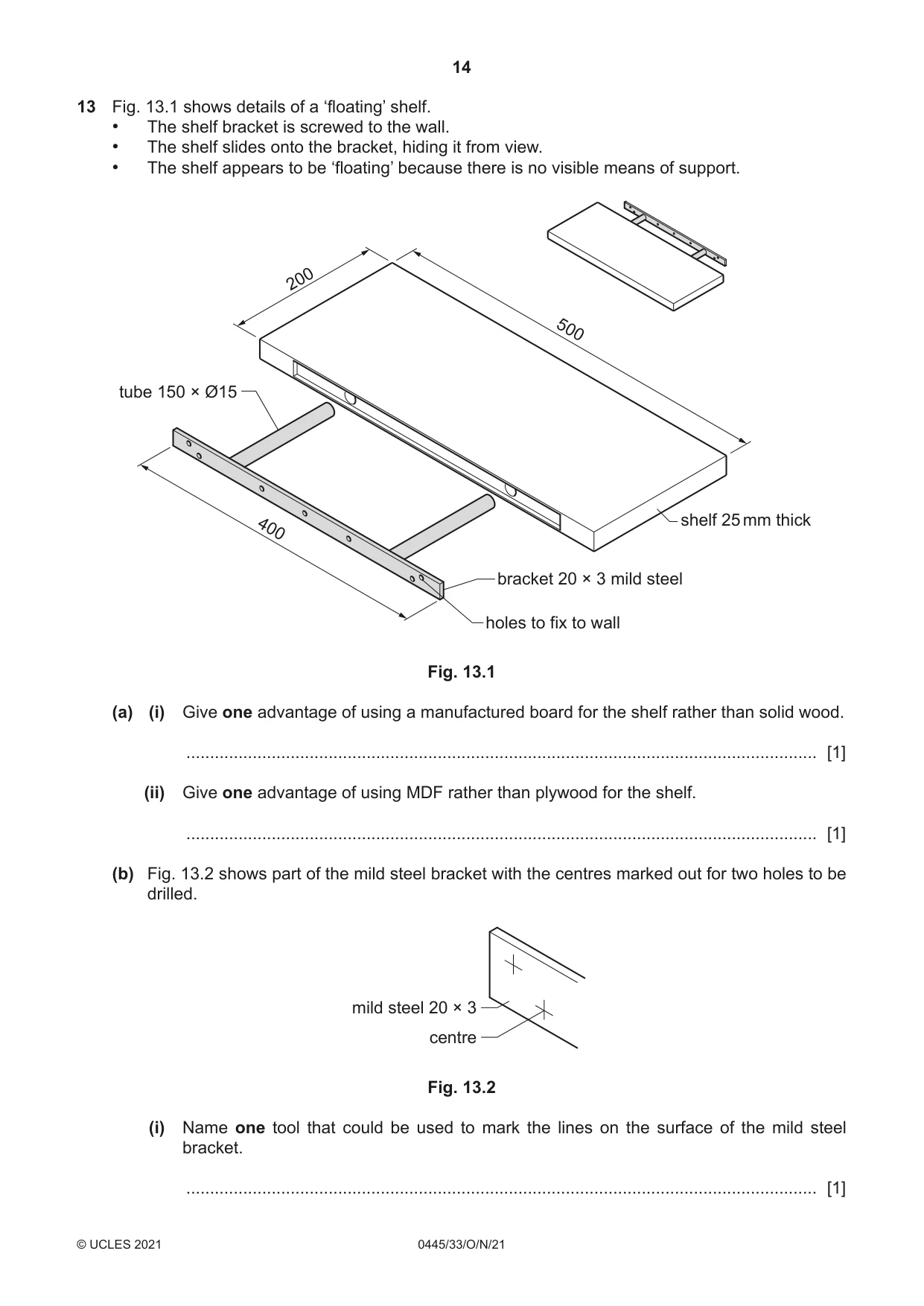
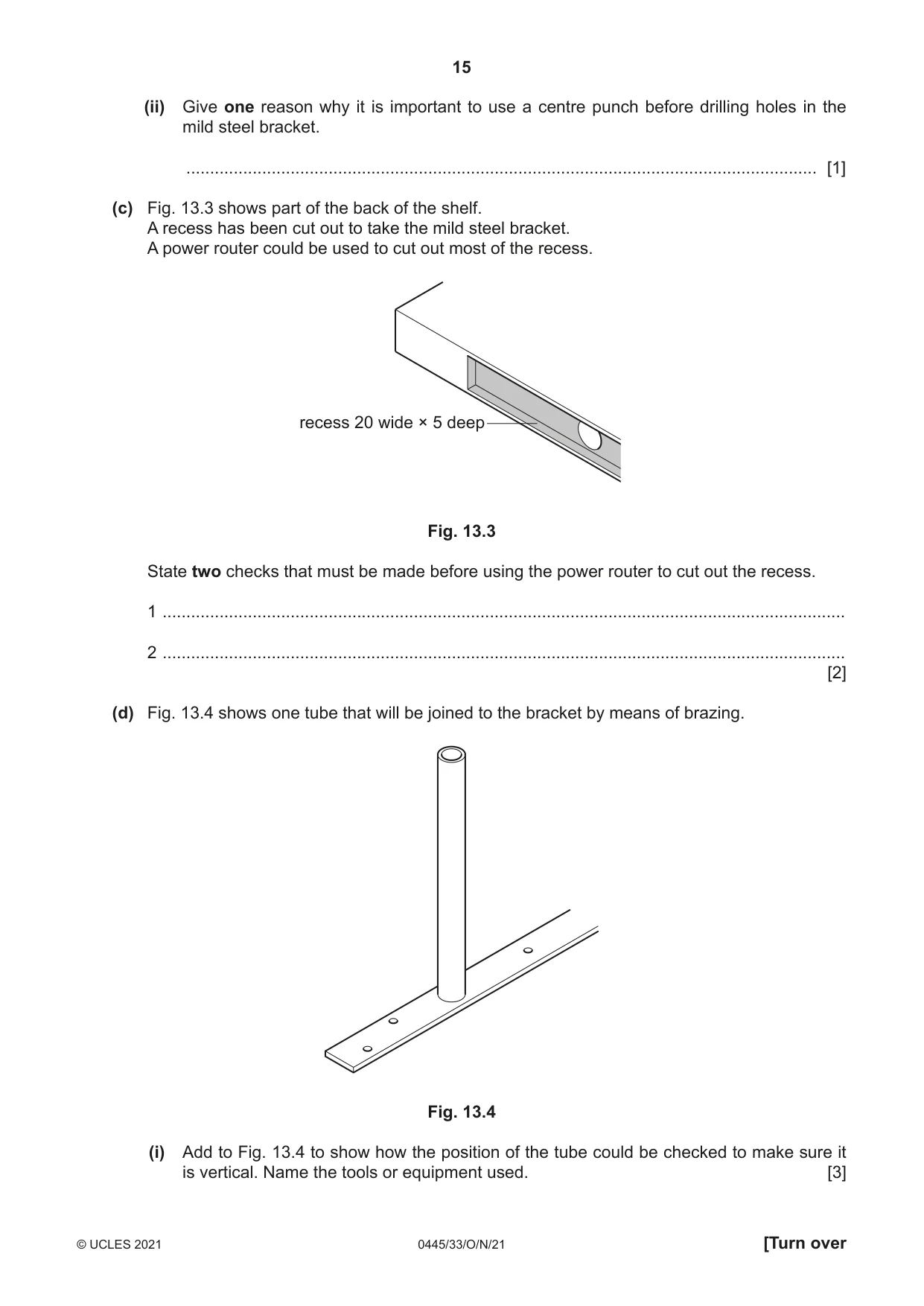
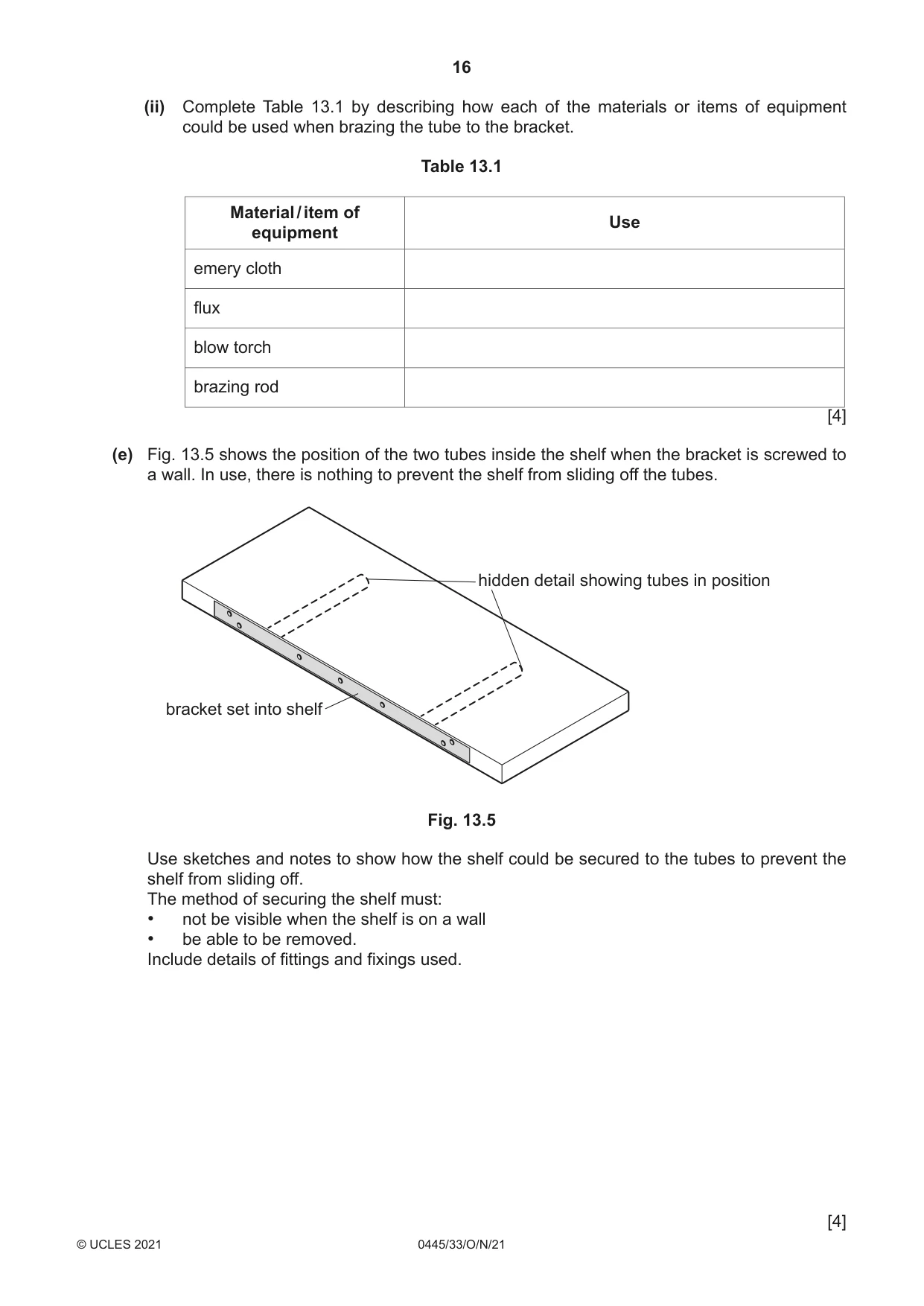
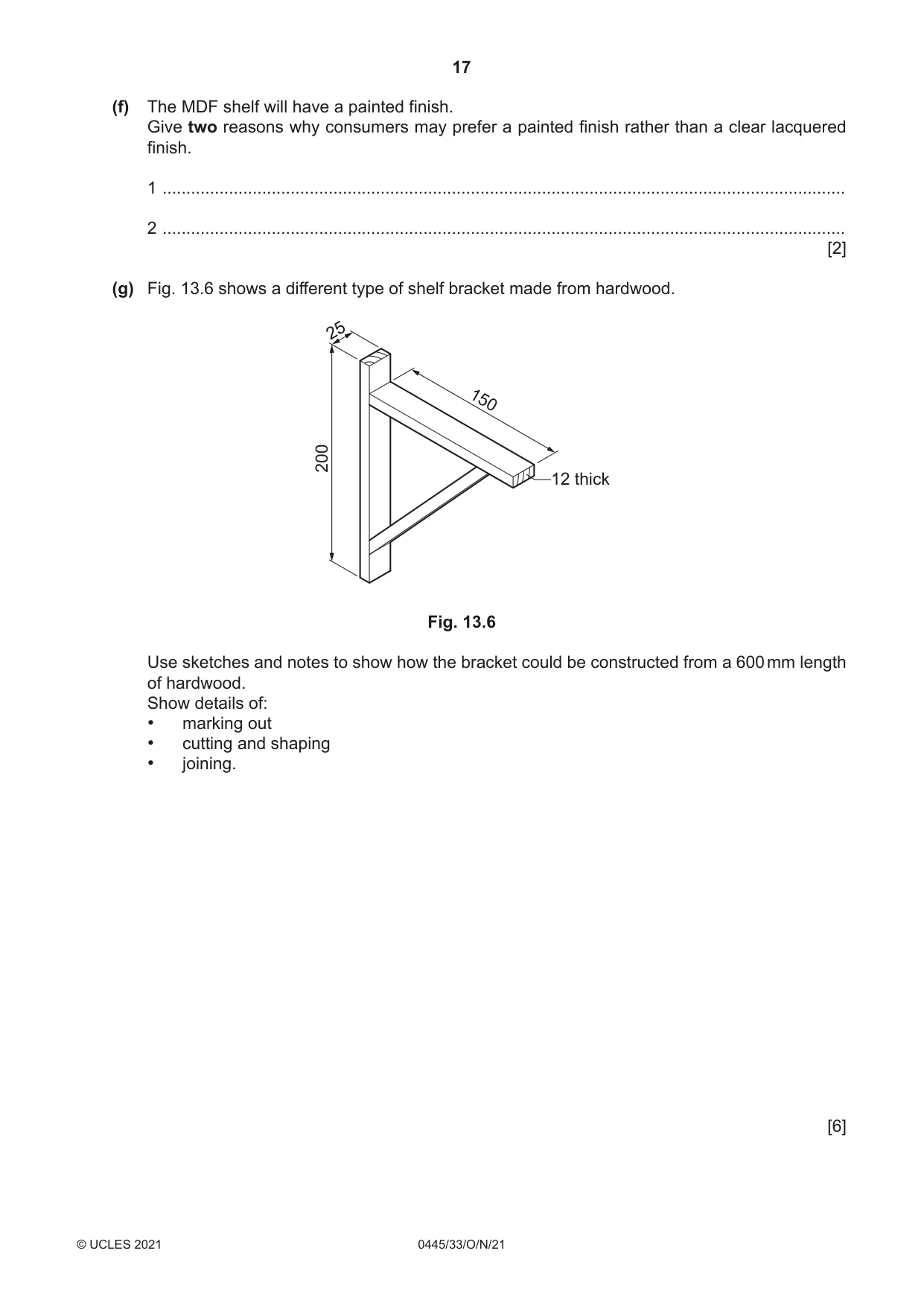
13 Fig. 13.1 shows details of a ‘floating’ shelf. • The shelf bracket is screwed to the wall. • The shelf slides onto the bracket, hiding it from view. • The shelf appears to be ‘floating’ because there is no visible means of support. 200 500 tube 150 × Ø15 400 shelf 25 mm thick bracket 20 × 3 mild steel holes to fix to wall Fig. 13.1 (a) (i) Give one advantage of using a manufactured board for the shelf rather than solid wood. ..................................................................................................................................... [1] (ii) Give one advantage of using MDF rather than plywood for the shelf. ..................................................................................................................................... [1] (b) Fig. 13.2 shows part of the mild steel bracket with the centres marked out for two holes to be drilled. mild steel 20 × 3 centre Fig. 13.2 (i) Name one tool that could be used to mark the lines on the surface of the mild steel bracket. ..................................................................................................................................... [1] (ii) Give one reason why it is important to use a centre punch before drilling holes in the mild steel bracket. ..................................................................................................................................... [1] (c) Fig. 13.3 shows part of the back of the shelf. A recess has been cut out to take the mild steel bracket. A power router could be used to cut out most of the recess. recess 20 wide × 5 deep Fig. 13.3 State two checks that must be made before using the power router to cut out the recess. 1 ................................................................................................................................................ 2 ................................................................................................................................................ [2] (d) Fig. 13.4 shows one tube that will be joined to the bracket by means of brazing. Fig. 13.4 (i) Add to Fig. 13.4 to show how the position of the tube could be checked to make sure it is vertical. Name the tools or equipment used. [3] (ii) Complete Table 13.1 by describing how each of the materials or items of equipment could be used when brazing the tube to the bracket. Table 13.1 Material / item of Use equipment emery cloth flux blow torch brazing rod [4] (e) Fig. 13.5 shows the position of the two tubes inside the shelf when the bracket is screwed to a wall. In use, there is nothing to prevent the shelf from sliding off the tubes. hidden detail showing tubes in position bracket set into shelf Fig. 13.5 Use sketches and notes to show how the shelf could be secured to the tubes to prevent the shelf from sliding off. The method of securing the shelf must: • not be visible when the shelf is on a wall • be able to be removed. Include details of fittings and fixings used.
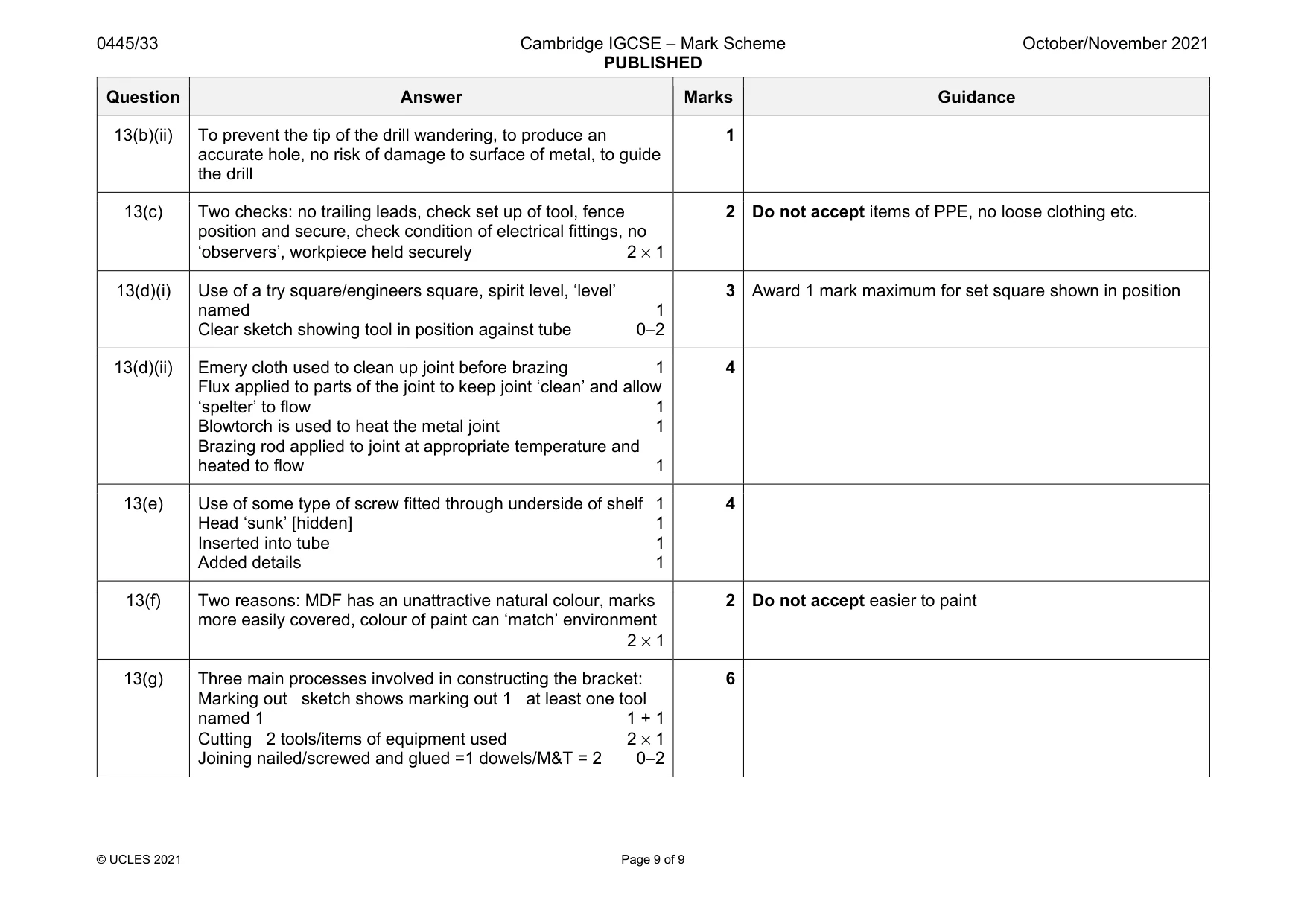
Mark scheme: 13(a)(i) Manufactured boards more stable, less likely to expand or shrink, twist or warp, cheaper 1 Do not accept easier to work, cut, shape, lightweight 13(a)(ii) MDF gives a better finish, smoother surface, less likely to splinter, easier to work 1 Do not accept cheaper 13(b)(i) Scriber, odd-leg calipers, odd-legs, Jenny calipers 1 Do not accept calipers, marker pens Question Answer Marks Guidance 13(b)(ii) To prevent the tip of the drill wandering, to produce an accurate hole, no risk of damage to surface of metal, to guide the drill 1 13(c) Two checks: no trailing leads, check set up of tool, fence position and secure, check condition of electrical fittings, no ‘observers’, workpiece held securely 2 × 1 2 Do not accept items of PPE, no loose clothing etc. 13(d)(i) Use of a try square/engineers square, spirit level, ‘level’ named 1 Clear sketch showing tool in position against tube 0–2 3 Award 1 mark maximum for set square shown in position 13(d)(ii) Emery cloth used to clean up joint before brazing 1 Flux applied to parts of the joint to keep joint ‘clean’ and allow ‘spelter’ to flow 1 Blowtorch is used to heat the metal joint 1 Brazing rod applied to joint at appropriate temperature and heated to flow 1 4 13(e) Use of some type of screw fitted through underside of shelf 1 Head ‘sunk’ [hidden] 1 Inserted into tube 1 Added details 1 4 13(f) Two reasons: MDF has an unattractive natural colour, marks more easily covered, colour of paint can ‘match’ environment 2 × 1 2 Do not accept easier to paint 13(g) Three main processes involved in constructing the bracket: Marking out sketch shows marking out 1 at least one tool named 1 1 + 1 Cutting 2 tools/items of equipment used 2 × 1 Joining nailed/screwed and glued =1 dowels/M&T = 2 0–2 6
What was in this paper
The subtopics covered by these 13 questions, and how many questions each got. Open one in a new tab to see every Cambridge question on it.
What you needed in this session
Cambridge’s own grade thresholds for 2021 Oct/Nov, Paper 3 · Variant 3. A higher threshold means an easier paper — the bar moves with how the cohort did.